×
Request Free Sample ×

Kindly complete the form below to receive a free sample of this Report

* Please use a valid business email

Leading companies partner with us for data-driven Insights

clients tt-cursor
Hero Background
English
Chinese
French
Japanese
Korean
German
Spanish

Digital Assistant Market Size

ID: MRFR/ICT/2935-CR
100 Pages
Ankit Gupta
February 2020

Digital Assistant Market Research Report Information Interface (Automatic Speech Recognition, Text-based, and Text-to-speech), Application (BFSI, Consumer Electronics, Automotive, Healthcare, Education, Retail, IT & Telecom, Travel & Hospitality, Others), and By Region (Asia-Pacific, North America, Europe, and Rest of the World) - Forecast till 2035

Share:
Download PDF ×

We do not share your information with anyone. However, we may send you emails based on your report interest from time to time. You may contact us at any time to opt-out.

Digital Assistant Market Infographic
Purchase Options

Digital Assistant Size

Digital Assistant Market Growth Projections and Opportunities

A large number of market factors add to the dynamic and quickly developing nature of the digital assistant market. A significant determinant in the extension of this industry is the heightening joining of regular language handling (NLP) and man-made consciousness (simulated intelligence) advancements. With the headway of computer-based intelligence calculations, advanced associates have become more astute and equipped for giving reactions to client requests; As a result, they are now a necessary part of smart homes, businesses, and many other industries.

Moreover, the multiplication of cell phones and other keen gadgets has altogether added to the development of the advanced digital assistant industry. The expansion of voice-actuated collaborators (Alexa, Google Partner, and Siri) has brought about an expanded requirement for gadgets that are viable with these mechanical progressions. As a result of this change in purchaser conduct, gadget makers have integrated computerized partners into a broad cluster of products, enveloping brilliant speakers, wearables, and machines.

An extra huge market factor that impacts the digital assistant market is the cutthroat scene. Noticeable innovation organizations, including Google, Apple, Amazon, and Microsoft, are engaged with a furious contention to improve and recognize their digital assistant items. Constant development has come about because of this opposition, as organizations endeavour to improve the accuracy, speed, and generally speaking execution of their computerized collaborators to get an upper hand.

The market is altogether affected by information protection and security concerns, which thus influence the development and execution of digital assistants. Clients' interests in regard to the security of their own information are developing pair with the treatment of delicate data by computer-based intelligence fueled frameworks. As a result, participants in the digital assistant market need to make investments in robust security measures and transparent data practices in order to build and maintain user confidence.

The market for digital assistants is likewise significantly affected by the developing commonness of remote work and virtual joint effort. The use of digital assistants was facilitated because of the Coronavirus pandemic, which in this way expanded the reliance on remote helpers for exercises including updates, data recovery, and booking. As the execution of remote work turns out to be more boundless in the global workforce, this example is supposed to persevere.

An extra huge market factor that influences the digital assistant’s industry is interoperability. Digital assistants that are able to seamlessly integrate with a variety of platforms and ecosystems are in high demand as a result of the increasing variety of devices owned by consumers. Associations that put a high worth on interoperability and give similarity across different gadgets are all the more really situated to meet the changed necessities of their customers.

Moreover, the multiplication of normal language understanding, and AI calculations fills in as an impulse for the development of the digital assistant industry. These innovative progressions work with the arrangement of reactions by advanced associates that are more custom-made and logically educated, subsequently enlarging the general client experience. With the movement of these calculations, it is likely that advanced partners will upgrade their ability to observe client inclinations and conform to explicit necessities.
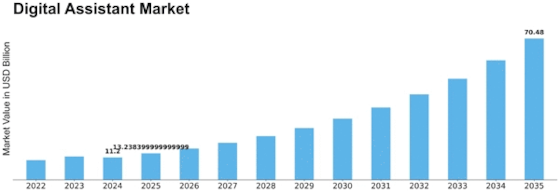
Digital Assistant Market Size Graph
Author
Ankit Gupta
Team Lead - Research

Ankit Gupta is a seasoned market intelligence and strategic research professional with over six plus years of experience in the ICT and Semiconductor industries. With academic roots in Telecom, Marketing, and Electronics, he blends technical insight with business strategy. Ankit has led 200+ projects, including work for Fortune 500 clients like Microsoft and Rio Tinto, covering market sizing, tech forecasting, and go-to-market strategies. Known for bridging engineering and enterprise decision-making, his insights support growth, innovation, and investment planning across diverse technology markets.

Leave a Comment

FAQs

What is the current valuation of the Digital Assistant Market as of 2024?

<p>The Digital Assistant Market was valued at 11.2 USD Billion in 2024.</p>

What is the projected market size for the Digital Assistant Market in 2035?

<p>The market is projected to reach 70.48 USD Billion by 2035.</p>

What is the expected CAGR for the Digital Assistant Market during the forecast period 2025 - 2035?

<p>The expected CAGR for the Digital Assistant Market during 2025 - 2035 is 18.2%.</p>

Which user-interface type segment had the highest valuation in 2024?

<p>The Text-Based user-interface type segment had the highest valuation at 4.48 USD Billion in 2024.</p>

How does the Automotive application segment perform in the Digital Assistant Market?

<p>The Automotive application segment was valued at 1.8 USD Billion in 2024 and is projected to grow significantly.</p>

Which key players dominate the Digital Assistant Market?

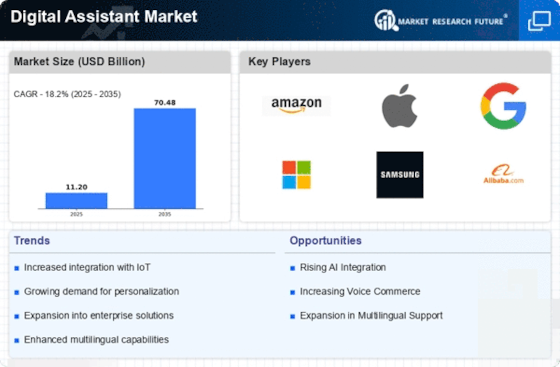
Key players in the market include Amazon, Apple, Google, Microsoft, Samsung, Alibaba, Baidu, IBM, and Nuance.

What was the valuation of the Healthcare application segment in 2024?

The Healthcare application segment was valued at 1.2 USD Billion in 2024.

What is the projected growth for the Consumer Electronics application segment by 2035?

The Consumer Electronics application segment is expected to grow from 2.0 USD Billion in 2024 to a much larger valuation by 2035.

How does the BFSI application segment compare to others in terms of valuation?

The BFSI application segment was valued at 1.5 USD Billion in 2024, indicating a competitive position within the market.

What are the implications of the projected growth for the Digital Assistant Market?

The projected growth suggests a robust expansion of the Digital Assistant Market, driven by advancements in technology and increasing adoption across various sectors.

Market Summary

As per Market Research Future analysis, the Digital Assistant Market Size was estimated at 11.2 USD Billion in 2024. The Digital Assistant industry is projected to grow from 13.24 USD Billion in 2025 to 70.48 USD Billion by 2035, exhibiting a compound annual growth rate (CAGR) of 18.2% during the forecast period 2025 - 2035

Key Market Trends & Highlights

The Digital Assistant Market is experiencing robust growth driven by technological advancements and evolving consumer preferences.

  • The market is witnessing increased personalization, enhancing user engagement and satisfaction. Integration with IoT devices is becoming prevalent, facilitating seamless interactions across platforms. A heightened focus on privacy and security is shaping the development of digital assistants, addressing consumer concerns. Rising demand for voice-activated technology and the expansion of the smart home ecosystem are key drivers propelling growth in North America and Asia-Pacific, particularly in the Automatic Speech Recognition and Healthcare segments.

Market Size & Forecast

2024 Market Size 11.2 (USD Billion)
2035 Market Size 70.48 (USD Billion)
CAGR (2025 - 2035) 18.2%
Largest Regional Market Share in 2024 North America

Major Players

Amazon (US), Apple (US), Google (US), <a href="https://blogs.windows.com/windowsexperience/2025/12/09/windows-pc-gaming-in-2025-handheld-innovation-arm-progress-and-directx-advances/">Microsoft</a> (US), Samsung (KR), Alibaba (CN), Baidu (CN), IBM (US), <a href="https://corporate.cyrilamarchandblogs.com/2025/07/the-consultation-paper-on-ai-regulation-a-case-for-nuance/">Nuance</a> (US)

Market Trends

The Digital Assistant Market is currently experiencing a transformative phase, characterized by rapid advancements in artificial intelligence and machine learning technologies. These innovations are enhancing the capabilities of digital assistants, allowing them to perform increasingly complex tasks and provide more personalized user experiences. As consumers become more accustomed to interacting with these technologies, the demand for sophisticated digital assistants is likely to grow. Companies are investing heavily in research and development to create solutions that not only meet but exceed user expectations, thereby fostering a competitive landscape. Moreover, the integration of digital assistants into various sectors, including healthcare, finance, and retail, appears to be expanding. This trend suggests that organizations recognize the potential of digital assistants to streamline operations and improve customer engagement. As businesses seek to leverage these tools for efficiency and enhanced service delivery, the Digital Assistant Market is poised for further growth. The ongoing evolution of user interfaces and natural language processing capabilities may also play a crucial role in shaping future developments within this sector.

Increased Personalization

Digital assistants are evolving to offer more tailored experiences, utilizing user data to provide customized responses and recommendations. This trend indicates a shift towards understanding individual preferences, which enhances user satisfaction.

Integration with IoT Devices

The convergence of digital assistants with Internet of Things (IoT) devices is becoming more prevalent. This integration allows users to control smart home devices seamlessly, suggesting a future where digital assistants serve as central hubs for managing connected environments.

Focus on Privacy and Security

As concerns regarding data privacy intensify, digital assistant developers are prioritizing security measures. This trend reflects a growing awareness of the need to protect user information, which may influence design and functionality in the Digital Assistant Market.

Digital Assistant Market Market Drivers

Expansion of Smart Home Ecosystem

The Digital Assistant Market is significantly influenced by the expansion of the smart home ecosystem. As more households adopt smart devices, the integration of digital assistants into these systems becomes increasingly prevalent. Data suggests that the number of smart home devices is expected to reach impressive milestones, creating a fertile ground for digital assistants to thrive. This integration allows users to control various aspects of their homes, from lighting to security, through voice commands. As a result, the Digital Assistant Market is likely to witness accelerated growth as consumers seek seamless connectivity and convenience in their daily lives.

Increased Focus on Customer Experience

In the Digital Assistant Market, there is a marked emphasis on enhancing customer experience. Companies are recognizing the importance of providing personalized and efficient interactions through digital assistants. Research indicates that businesses leveraging digital assistants can improve customer satisfaction rates significantly. By utilizing data analytics and machine learning, these assistants can offer tailored recommendations and support, thereby fostering customer loyalty. This focus on customer experience is driving organizations to invest in advanced digital assistant technologies, which in turn propels growth within the Digital Assistant Market.

Growing Importance of Multilingual Support

The Digital Assistant Market is increasingly recognizing the growing importance of multilingual support. As businesses expand their reach across diverse markets, the need for digital assistants that can communicate in multiple languages becomes paramount. Data suggests that a significant portion of consumers prefers using digital assistants in their native languages, which drives companies to invest in multilingual capabilities. This trend not only enhances user satisfaction but also broadens the potential customer base for digital assistant technologies. Consequently, the emphasis on multilingual support is likely to play a crucial role in shaping the future of the Digital Assistant Market.

Rising Demand for Voice-Activated Technology

The Digital Assistant Market experiences a notable surge in demand for voice-activated technology. As consumers increasingly prefer hands-free interactions, the adoption of voice-activated digital assistants is on the rise. According to recent data, the market for voice recognition technology is projected to reach substantial figures, indicating a growing acceptance among users. This trend is further fueled by advancements in natural language processing and machine learning, which enhance the accuracy and efficiency of voice commands. Consequently, businesses are investing in developing sophisticated voice-activated solutions to cater to this demand, thereby driving growth within the Digital Assistant Market.

Adoption of AI and Machine Learning Technologies

The Digital Assistant Market is witnessing a transformative shift due to the adoption of artificial intelligence and machine learning technologies. These advancements enable digital assistants to learn from user interactions, improving their functionality and responsiveness over time. Market data reveals that investments in AI technologies are expected to grow substantially, indicating a strong commitment from companies to enhance their digital assistant offerings. This integration of AI not only enhances the user experience but also allows for more complex tasks to be performed, thereby expanding the capabilities of digital assistants within the Digital Assistant Market.

Market Segment Insights

By User-Interface Type: Automatic Speech Recognition (Largest) vs. Text-to-Speech (Fastest-Growing)

In the Digital Assistant Market, the user-interface type segment is witnessing a diversified distribution of market share among its values. <a title="Automatic Speech Recognition (ASR)" href="https://www.marketresearchfuture.com/reports/automatic-speech-recognition-asr-software-market-27251" target="_blank" rel="noopener">Automatic Speech Recognition (ASR)</a> leads the segment with the largest share, owing to its widespread adoption in consumer devices and smart home technology. Text-Based interfaces have also carved out a substantial market presence, appealing mainly to users in professional settings who prefer traditional input methods. Meanwhile, Text-to-Speech technology is gaining traction as it enhances accessibility features across various applications, catering to a growing audience.

User-Interface Type: ASR (Dominant) vs. Text-to-Speech (Emerging)

Automatic Speech Recognition (ASR) stands as the dominant force within the User-Interface Type segment, particularly due to its integration into numerous devices, including smartphones and smart speakers. This technology allows for a seamless hands-free interaction, making it integral for various applications such as virtual assistants and voice-activated services. In contrast, Text-to-Speech (TTS) technology, although categorized as emerging, is rapidly gaining traction. Its ability to convert text into spoken words reflects a shift towards more inclusive user experiences, especially among users with disabilities or those seeking voice-guided assistance. This growth is fueled by advancements in natural language processing and machine learning, positioning TTS favorably within the digital assistant landscape.

By Application: BFSI (Largest) vs. Healthcare (Fastest-Growing)

The Digital Assistant Market is witnessing a significant share distribution across various application sectors. The BFSI sector holds the largest share, leveraging digital assistants for enhancing customer service, managing financial transactions, and offering personalized financial advice. Following closely, the healthcare sector has emerged as a significant player, utilizing digital assistants to streamline patient interactions and improve healthcare delivery. Other sectors, such as consumer electronics and automotive, are also witnessing notable contributions, albeit at a slower pace compared to BFSI and healthcare.

BFSI: Dominant vs. Healthcare: Emerging

The BFSI sector has been a dominant force in the Digital Assistant Market, primarily due to its focus on customer engagement and efficient service delivery. Financial institutions are increasingly adopting digital assistants to simplify processes, reduce operational costs, and enhance user experience. In contrast, the healthcare sector is rapidly emerging with innovative applications of digital assistants, focusing on personalized patient care and efficient resource management. With advancements in AI and natural language processing, healthcare digital assistants are becoming vital in offering timely information, appointment scheduling, and even diagnostic support, positioning themselves for significant growth in the coming years.

Get more detailed insights about Digital Assistant Market Research Report- Global Forecast 2035

Regional Insights

North America : Innovation and Market Leadership

North America remains the largest market for digital assistants, holding approximately 45% of the global share. The region's growth is driven by high consumer demand for smart home devices, advancements in AI technology, and supportive regulatory frameworks. The U.S. government has been proactive in promoting AI research and development, which further fuels market expansion. Leading the charge are the United States and Canada, with major players like Amazon, Apple, and Google headquartered in the U.S. The competitive landscape is characterized by rapid innovation and a focus on enhancing user experience. Companies are investing heavily in R&D to integrate digital assistants into various applications, from smart homes to enterprise solutions.

Europe : Regulatory Framework and Growth

Europe is witnessing significant growth in the digital assistant market, accounting for about 30% of the global share. The region's expansion is driven by increasing consumer adoption of smart devices and stringent data protection regulations, such as GDPR, which encourage companies to innovate responsibly. The European Commission is actively promoting AI technologies, which serves as a catalyst for market growth. Germany and the UK are the leading countries in this sector, with a strong presence of key players like Samsung and IBM. The competitive landscape is marked by collaborations between tech companies and local startups, fostering innovation. European firms are focusing on developing privacy-centric digital assistants to comply with regulations while enhancing user trust.

Asia-Pacific : Rapid Adoption and Innovation

Asia-Pacific is rapidly emerging as a powerhouse in the digital assistant market, holding approximately 20% of the global share. The region's growth is fueled by increasing smartphone penetration, a tech-savvy population, and rising disposable incomes. Countries like China and India are witnessing a surge in demand for AI-driven solutions, supported by government initiatives promoting digital transformation. China and Japan are at the forefront, with major players like Alibaba and Baidu leading the market. The competitive landscape is vibrant, with local startups innovating alongside established companies. The region is characterized by a focus on integrating digital assistants into various sectors, including e-commerce and customer service, enhancing overall user experience.

Middle East and Africa : Emerging Market with Potential

The Middle East and Africa are emerging markets for digital assistants, collectively holding about 5% of the global share. The growth is driven by increasing smartphone adoption and a young, tech-savvy population. Governments in the region are investing in digital infrastructure, which is expected to catalyze market expansion. Countries like South Africa and the UAE are leading the way in adopting AI technologies. The competitive landscape is still developing, with both local and international players vying for market share. Companies are focusing on creating solutions tailored to local languages and cultural nuances, which is crucial for user acceptance. The region presents significant growth opportunities as digital transformation initiatives gain momentum.

Key Players and Competitive Insights

The Digital Assistant Market is currently characterized by intense competition and rapid innovation, driven by advancements in artificial intelligence and machine learning technologies. Major players such as Amazon (US), Apple (US), and Google (US) are at the forefront, each adopting distinct strategies to enhance their market presence. Amazon (US) focuses on expanding its Alexa ecosystem through partnerships with various smart home device manufacturers, thereby solidifying its position in the home automation segment. Meanwhile, Apple (US) emphasizes privacy and user experience in its Siri platform, which appears to resonate well with consumers increasingly concerned about data security. Google (US), on the other hand, leverages its vast data resources to enhance the capabilities of Google Assistant, integrating it seamlessly across its suite of services, which likely strengthens user engagement and retention. The competitive structure of the Digital Assistant Market is moderately fragmented, with a mix of established giants and emerging players. Key tactics employed by these companies include localizing manufacturing to reduce costs and optimize supply chains, which is particularly relevant in the context of global economic fluctuations. The collective influence of these major players shapes market dynamics, as they continuously innovate and adapt to consumer preferences, thereby driving overall market growth. In August 2025, Amazon (US) announced a strategic partnership with a leading smart appliance manufacturer to integrate Alexa into their product line. This move is significant as it not only expands Alexa's reach but also enhances the functionality of smart appliances, potentially increasing consumer adoption rates. Such partnerships are indicative of Amazon's strategy to create a more interconnected smart home ecosystem, which could lead to increased customer loyalty and market share. In September 2025, Apple (US) unveiled a new feature for Siri that allows for more personalized interactions based on user behavior and preferences. This development is crucial as it aligns with the growing consumer demand for tailored experiences in digital assistants. By enhancing Siri's capabilities, Apple (US) aims to differentiate itself in a crowded market, potentially attracting users who prioritize personalization and privacy in their digital interactions. In October 2025, Google (US) launched an updated version of Google Assistant that incorporates advanced natural language processing capabilities. This update is particularly noteworthy as it enhances the assistant's ability to understand and respond to complex queries, thereby improving user satisfaction. Such technological advancements are likely to position Google (US) as a leader in the digital assistant space, as they continue to push the boundaries of what AI can achieve in everyday applications. As of October 2025, the Digital Assistant Market is witnessing trends that emphasize digitalization, sustainability, and AI integration. Strategic alliances among key players are increasingly shaping the competitive landscape, fostering innovation and collaboration. Looking ahead, it appears that competitive differentiation will evolve from traditional price-based strategies to a focus on innovation, technological advancements, and supply chain reliability. Companies that can effectively leverage these trends are likely to secure a competitive edge in this dynamic market.

Key Companies in the Digital Assistant Market include

Industry Developments

February 2023 Nebraska-based Today, Bluestem Health announced the debut of a Mediktor-powered AI-based virtual medical assistant. Both current and new patients can use this to effectively evaluate their symptoms online and be directed to the best degree of therapy.     

February 2023 Bixby has received fresh updates from Samsung Electronics Co., Ltd. that enhance its performance, capabilities, and user experience. The new enhancements significantly strengthen Bixby's language recognition capabilities, providing users more control over their smartphone experience.

Future Outlook

Digital Assistant Market Future Outlook

The Digital Assistant Market is projected to grow at an 18.2% CAGR from 2025 to 2035, driven by advancements in AI, increased consumer adoption, and integration across various platforms.

New opportunities lie in:

  • <p>Development of AI-driven personalized customer service solutions Expansion into healthcare with virtual health assistants Integration of digital assistants in smart home ecosystems</p>

By 2035, the Digital Assistant Market is expected to be a pivotal component of global technology infrastructure.

Market Segmentation

Digital Assistant Market Application Outlook

  • BFSI
  • Consumer Electronics
  • Automotive
  • Healthcare
  • Education
  • Retail
  • IT & Telecom
  • Travel & Hospitality
  • Others

Digital Assistant Market User-Interface Type Outlook

  • Automatic Speech Recognition
  • Text-Based
  • Text-to-Speech

Report Scope

MARKET SIZE 2024 11.2(USD Billion)
MARKET SIZE 2025 13.24(USD Billion)
MARKET SIZE 2035 70.48(USD Billion)
COMPOUND ANNUAL GROWTH RATE (CAGR) 18.2% (2025 - 2035)
REPORT COVERAGE Revenue Forecast, Competitive Landscape, Growth Factors, and Trends
BASE YEAR 2024
Market Forecast Period 2025 - 2035
Historical Data 2019 - 2024
Market Forecast Units USD Billion
Key Companies Profiled Amazon (US), Apple (US), Google (US), Microsoft (US), Samsung (KR), Alibaba (CN), Baidu (CN), IBM (US), Nuance (US)
Segments Covered Region
Key Market Opportunities Integration of artificial intelligence and machine learning enhances personalization in the Digital Assistant Market.
Key Market Dynamics Rising consumer demand for personalized experiences drives innovation and competition in the Digital Assistant Market.
Countries Covered North America, Europe, APAC, South America, MEA

FAQs

What is the current valuation of the Digital Assistant Market as of 2024?

<p>The Digital Assistant Market was valued at 11.2 USD Billion in 2024.</p>

What is the projected market size for the Digital Assistant Market in 2035?

<p>The market is projected to reach 70.48 USD Billion by 2035.</p>

What is the expected CAGR for the Digital Assistant Market during the forecast period 2025 - 2035?

<p>The expected CAGR for the Digital Assistant Market during 2025 - 2035 is 18.2%.</p>

Which user-interface type segment had the highest valuation in 2024?

<p>The Text-Based user-interface type segment had the highest valuation at 4.48 USD Billion in 2024.</p>

How does the Automotive application segment perform in the Digital Assistant Market?

<p>The Automotive application segment was valued at 1.8 USD Billion in 2024 and is projected to grow significantly.</p>

Which key players dominate the Digital Assistant Market?

Key players in the market include Amazon, Apple, Google, Microsoft, Samsung, Alibaba, Baidu, IBM, and Nuance.

What was the valuation of the Healthcare application segment in 2024?

The Healthcare application segment was valued at 1.2 USD Billion in 2024.

What is the projected growth for the Consumer Electronics application segment by 2035?

The Consumer Electronics application segment is expected to grow from 2.0 USD Billion in 2024 to a much larger valuation by 2035.

How does the BFSI application segment compare to others in terms of valuation?

The BFSI application segment was valued at 1.5 USD Billion in 2024, indicating a competitive position within the market.

What are the implications of the projected growth for the Digital Assistant Market?

The projected growth suggests a robust expansion of the Digital Assistant Market, driven by advancements in technology and increasing adoption across various sectors.

  1. SECTION I: EXECUTIVE SUMMARY AND KEY HIGHLIGHTS
    1. | 1.1 EXECUTIVE SUMMARY
    2. | | 1.1.1 Market Overview
    3. | | 1.1.2 Key Findings
    4. | | 1.1.3 Market Segmentation
    5. | | 1.1.4 Competitive Landscape
    6. | | 1.1.5 Challenges and Opportunities
    7. | | 1.1.6 Future Outlook
  2. SECTION II: SCOPING, METHODOLOGY AND MARKET STRUCTURE
    1. | 2.1 MARKET INTRODUCTION
    2. | | 2.1.1 Definition
    3. | | 2.1.2 Scope of the study
    4. | | | 2.1.2.1 Research Objective
    5. | | | 2.1.2.2 Assumption
    6. | | | 2.1.2.3 Limitations
    7. | 2.2 RESEARCH METHODOLOGY
    8. | | 2.2.1 Overview
    9. | | 2.2.2 Data Mining
    10. | | 2.2.3 Secondary Research
    11. | | 2.2.4 Primary Research
    12. | | | 2.2.4.1 Primary Interviews and Information Gathering Process
    13. | | | 2.2.4.2 Breakdown of Primary Respondents
    14. | | 2.2.5 Forecasting Model
    15. | | 2.2.6 Market Size Estimation
    16. | | | 2.2.6.1 Bottom-Up Approach
    17. | | | 2.2.6.2 Top-Down Approach
    18. | | 2.2.7 Data Triangulation
    19. | | 2.2.8 Validation
  3. SECTION III: QUALITATIVE ANALYSIS
    1. | 3.1 MARKET DYNAMICS
    2. | | 3.1.1 Overview
    3. | | 3.1.2 Drivers
    4. | | 3.1.3 Restraints
    5. | | 3.1.4 Opportunities
    6. | 3.2 MARKET FACTOR ANALYSIS
    7. | | 3.2.1 Value chain Analysis
    8. | | 3.2.2 Porter's Five Forces Analysis
    9. | | | 3.2.2.1 Bargaining Power of Suppliers
    10. | | | 3.2.2.2 Bargaining Power of Buyers
    11. | | | 3.2.2.3 Threat of New Entrants
    12. | | | 3.2.2.4 Threat of Substitutes
    13. | | | 3.2.2.5 Intensity of Rivalry
    14. | | 3.2.3 COVID-19 Impact Analysis
    15. | | | 3.2.3.1 Market Impact Analysis
    16. | | | 3.2.3.2 Regional Impact
    17. | | | 3.2.3.3 Opportunity and Threat Analysis
  4. SECTION IV: QUANTITATIVE ANALYSIS
    1. | 4.1 Information and Communications Technology, BY User-Interface Type (USD Billion)
    2. | | 4.1.1 Automatic Speech Recognition
    3. | | 4.1.2 Text-Based
    4. | | 4.1.3 Text-to-Speech
    5. | 4.2 Information and Communications Technology, BY Application (USD Billion)
    6. | | 4.2.1 BFSI
    7. | | 4.2.2 Consumer Electronics
    8. | | 4.2.3 Automotive
    9. | | 4.2.4 Healthcare
    10. | | 4.2.5 Education
    11. | | 4.2.6 Retail
    12. | | 4.2.7 IT & Telecom
    13. | | 4.2.8 Travel & Hospitality
    14. | | 4.2.9 Others
    15. | 4.3 Information and Communications Technology, BY Region (USD Billion)
    16. | | 4.3.1 North America
    17. | | | 4.3.1.1 US
    18. | | | 4.3.1.2 Canada
    19. | | 4.3.2 Europe
    20. | | | 4.3.2.1 Germany
    21. | | | 4.3.2.2 UK
    22. | | | 4.3.2.3 France
    23. | | | 4.3.2.4 Russia
    24. | | | 4.3.2.5 Italy
    25. | | | 4.3.2.6 Spain
    26. | | | 4.3.2.7 Rest of Europe
    27. | | 4.3.3 APAC
    28. | | | 4.3.3.1 China
    29. | | | 4.3.3.2 India
    30. | | | 4.3.3.3 Japan
    31. | | | 4.3.3.4 South Korea
    32. | | | 4.3.3.5 Malaysia
    33. | | | 4.3.3.6 Thailand
    34. | | | 4.3.3.7 Indonesia
    35. | | | 4.3.3.8 Rest of APAC
    36. | | 4.3.4 South America
    37. | | | 4.3.4.1 Brazil
    38. | | | 4.3.4.2 Mexico
    39. | | | 4.3.4.3 Argentina
    40. | | | 4.3.4.4 Rest of South America
    41. | | 4.3.5 MEA
    42. | | | 4.3.5.1 GCC Countries
    43. | | | 4.3.5.2 South Africa
    44. | | | 4.3.5.3 Rest of MEA
  5. SECTION V: COMPETITIVE ANALYSIS
    1. | 5.1 Competitive Landscape
    2. | | 5.1.1 Overview
    3. | | 5.1.2 Competitive Analysis
    4. | | 5.1.3 Market share Analysis
    5. | | 5.1.4 Major Growth Strategy in the Information and Communications Technology
    6. | | 5.1.5 Competitive Benchmarking
    7. | | 5.1.6 Leading Players in Terms of Number of Developments in the Information and Communications Technology
    8. | | 5.1.7 Key developments and growth strategies
    9. | | | 5.1.7.1 New Product Launch/Service Deployment
    10. | | | 5.1.7.2 Merger & Acquisitions
    11. | | | 5.1.7.3 Joint Ventures
    12. | | 5.1.8 Major Players Financial Matrix
    13. | | | 5.1.8.1 Sales and Operating Income
    14. | | | 5.1.8.2 Major Players R&D Expenditure. 2023
    15. | 5.2 Company Profiles
    16. | | 5.2.1 Amazon (US)
    17. | | | 5.2.1.1 Financial Overview
    18. | | | 5.2.1.2 Products Offered
    19. | | | 5.2.1.3 Key Developments
    20. | | | 5.2.1.4 SWOT Analysis
    21. | | | 5.2.1.5 Key Strategies
    22. | | 5.2.2 Apple (US)
    23. | | | 5.2.2.1 Financial Overview
    24. | | | 5.2.2.2 Products Offered
    25. | | | 5.2.2.3 Key Developments
    26. | | | 5.2.2.4 SWOT Analysis
    27. | | | 5.2.2.5 Key Strategies
    28. | | 5.2.3 Google (US)
    29. | | | 5.2.3.1 Financial Overview
    30. | | | 5.2.3.2 Products Offered
    31. | | | 5.2.3.3 Key Developments
    32. | | | 5.2.3.4 SWOT Analysis
    33. | | | 5.2.3.5 Key Strategies
    34. | | 5.2.4 Microsoft (US)
    35. | | | 5.2.4.1 Financial Overview
    36. | | | 5.2.4.2 Products Offered
    37. | | | 5.2.4.3 Key Developments
    38. | | | 5.2.4.4 SWOT Analysis
    39. | | | 5.2.4.5 Key Strategies
    40. | | 5.2.5 Samsung (KR)
    41. | | | 5.2.5.1 Financial Overview
    42. | | | 5.2.5.2 Products Offered
    43. | | | 5.2.5.3 Key Developments
    44. | | | 5.2.5.4 SWOT Analysis
    45. | | | 5.2.5.5 Key Strategies
    46. | | 5.2.6 Alibaba (CN)
    47. | | | 5.2.6.1 Financial Overview
    48. | | | 5.2.6.2 Products Offered
    49. | | | 5.2.6.3 Key Developments
    50. | | | 5.2.6.4 SWOT Analysis
    51. | | | 5.2.6.5 Key Strategies
    52. | | 5.2.7 Baidu (CN)
    53. | | | 5.2.7.1 Financial Overview
    54. | | | 5.2.7.2 Products Offered
    55. | | | 5.2.7.3 Key Developments
    56. | | | 5.2.7.4 SWOT Analysis
    57. | | | 5.2.7.5 Key Strategies
    58. | | 5.2.8 IBM (US)
    59. | | | 5.2.8.1 Financial Overview
    60. | | | 5.2.8.2 Products Offered
    61. | | | 5.2.8.3 Key Developments
    62. | | | 5.2.8.4 SWOT Analysis
    63. | | | 5.2.8.5 Key Strategies
    64. | | 5.2.9 Nuance (US)
    65. | | | 5.2.9.1 Financial Overview
    66. | | | 5.2.9.2 Products Offered
    67. | | | 5.2.9.3 Key Developments
    68. | | | 5.2.9.4 SWOT Analysis
    69. | | | 5.2.9.5 Key Strategies
    70. | 5.3 Appendix
    71. | | 5.3.1 References
    72. | | 5.3.2 Related Reports
  6. LIST OF FIGURES
    1. | 6.1 MARKET SYNOPSIS
    2. | 6.2 NORTH AMERICA MARKET ANALYSIS
    3. | 6.3 US MARKET ANALYSIS BY USER-INTERFACE TYPE
    4. | 6.4 US MARKET ANALYSIS BY APPLICATION
    5. | 6.5 CANADA MARKET ANALYSIS BY USER-INTERFACE TYPE
    6. | 6.6 CANADA MARKET ANALYSIS BY APPLICATION
    7. | 6.7 EUROPE MARKET ANALYSIS
    8. | 6.8 GERMANY MARKET ANALYSIS BY USER-INTERFACE TYPE
    9. | 6.9 GERMANY MARKET ANALYSIS BY APPLICATION
    10. | 6.10 UK MARKET ANALYSIS BY USER-INTERFACE TYPE
    11. | 6.11 UK MARKET ANALYSIS BY APPLICATION
    12. | 6.12 FRANCE MARKET ANALYSIS BY USER-INTERFACE TYPE
    13. | 6.13 FRANCE MARKET ANALYSIS BY APPLICATION
    14. | 6.14 RUSSIA MARKET ANALYSIS BY USER-INTERFACE TYPE
    15. | 6.15 RUSSIA MARKET ANALYSIS BY APPLICATION
    16. | 6.16 ITALY MARKET ANALYSIS BY USER-INTERFACE TYPE
    17. | 6.17 ITALY MARKET ANALYSIS BY APPLICATION
    18. | 6.18 SPAIN MARKET ANALYSIS BY USER-INTERFACE TYPE
    19. | 6.19 SPAIN MARKET ANALYSIS BY APPLICATION
    20. | 6.20 REST OF EUROPE MARKET ANALYSIS BY USER-INTERFACE TYPE
    21. | 6.21 REST OF EUROPE MARKET ANALYSIS BY APPLICATION
    22. | 6.22 APAC MARKET ANALYSIS
    23. | 6.23 CHINA MARKET ANALYSIS BY USER-INTERFACE TYPE
    24. | 6.24 CHINA MARKET ANALYSIS BY APPLICATION
    25. | 6.25 INDIA MARKET ANALYSIS BY USER-INTERFACE TYPE
    26. | 6.26 INDIA MARKET ANALYSIS BY APPLICATION
    27. | 6.27 JAPAN MARKET ANALYSIS BY USER-INTERFACE TYPE
    28. | 6.28 JAPAN MARKET ANALYSIS BY APPLICATION
    29. | 6.29 SOUTH KOREA MARKET ANALYSIS BY USER-INTERFACE TYPE
    30. | 6.30 SOUTH KOREA MARKET ANALYSIS BY APPLICATION
    31. | 6.31 MALAYSIA MARKET ANALYSIS BY USER-INTERFACE TYPE
    32. | 6.32 MALAYSIA MARKET ANALYSIS BY APPLICATION
    33. | 6.33 THAILAND MARKET ANALYSIS BY USER-INTERFACE TYPE
    34. | 6.34 THAILAND MARKET ANALYSIS BY APPLICATION
    35. | 6.35 INDONESIA MARKET ANALYSIS BY USER-INTERFACE TYPE
    36. | 6.36 INDONESIA MARKET ANALYSIS BY APPLICATION
    37. | 6.37 REST OF APAC MARKET ANALYSIS BY USER-INTERFACE TYPE
    38. | 6.38 REST OF APAC MARKET ANALYSIS BY APPLICATION
    39. | 6.39 SOUTH AMERICA MARKET ANALYSIS
    40. | 6.40 BRAZIL MARKET ANALYSIS BY USER-INTERFACE TYPE
    41. | 6.41 BRAZIL MARKET ANALYSIS BY APPLICATION
    42. | 6.42 MEXICO MARKET ANALYSIS BY USER-INTERFACE TYPE
    43. | 6.43 MEXICO MARKET ANALYSIS BY APPLICATION
    44. | 6.44 ARGENTINA MARKET ANALYSIS BY USER-INTERFACE TYPE
    45. | 6.45 ARGENTINA MARKET ANALYSIS BY APPLICATION
    46. | 6.46 REST OF SOUTH AMERICA MARKET ANALYSIS BY USER-INTERFACE TYPE
    47. | 6.47 REST OF SOUTH AMERICA MARKET ANALYSIS BY APPLICATION
    48. | 6.48 MEA MARKET ANALYSIS
    49. | 6.49 GCC COUNTRIES MARKET ANALYSIS BY USER-INTERFACE TYPE
    50. | 6.50 GCC COUNTRIES MARKET ANALYSIS BY APPLICATION
    51. | 6.51 SOUTH AFRICA MARKET ANALYSIS BY USER-INTERFACE TYPE
    52. | 6.52 SOUTH AFRICA MARKET ANALYSIS BY APPLICATION
    53. | 6.53 REST OF MEA MARKET ANALYSIS BY USER-INTERFACE TYPE
    54. | 6.54 REST OF MEA MARKET ANALYSIS BY APPLICATION
    55. | 6.55 KEY BUYING CRITERIA OF INFORMATION AND COMMUNICATIONS TECHNOLOGY
    56. | 6.56 RESEARCH PROCESS OF MRFR
    57. | 6.57 DRO ANALYSIS OF INFORMATION AND COMMUNICATIONS TECHNOLOGY
    58. | 6.58 DRIVERS IMPACT ANALYSIS: INFORMATION AND COMMUNICATIONS TECHNOLOGY
    59. | 6.59 RESTRAINTS IMPACT ANALYSIS: INFORMATION AND COMMUNICATIONS TECHNOLOGY
    60. | 6.60 SUPPLY / VALUE CHAIN: INFORMATION AND COMMUNICATIONS TECHNOLOGY
    61. | 6.61 INFORMATION AND COMMUNICATIONS TECHNOLOGY, BY USER-INTERFACE TYPE, 2024 (% SHARE)
    62. | 6.62 INFORMATION AND COMMUNICATIONS TECHNOLOGY, BY USER-INTERFACE TYPE, 2024 TO 2035 (USD Billion)
    63. | 6.63 INFORMATION AND COMMUNICATIONS TECHNOLOGY, BY APPLICATION, 2024 (% SHARE)
    64. | 6.64 INFORMATION AND COMMUNICATIONS TECHNOLOGY, BY APPLICATION, 2024 TO 2035 (USD Billion)
    65. | 6.65 BENCHMARKING OF MAJOR COMPETITORS
  7. LIST OF TABLES
    1. | 7.1 LIST OF ASSUMPTIONS
    2. | | 7.1.1
    3. | 7.2 North America MARKET SIZE ESTIMATES; FORECAST
    4. | | 7.2.1 BY USER-INTERFACE TYPE, 2025-2035 (USD Billion)
    5. | | 7.2.2 BY APPLICATION, 2025-2035 (USD Billion)
    6. | 7.3 US MARKET SIZE ESTIMATES; FORECAST
    7. | | 7.3.1 BY USER-INTERFACE TYPE, 2025-2035 (USD Billion)
    8. | | 7.3.2 BY APPLICATION, 2025-2035 (USD Billion)
    9. | 7.4 Canada MARKET SIZE ESTIMATES; FORECAST
    10. | | 7.4.1 BY USER-INTERFACE TYPE, 2025-2035 (USD Billion)
    11. | | 7.4.2 BY APPLICATION, 2025-2035 (USD Billion)
    12. | 7.5 Europe MARKET SIZE ESTIMATES; FORECAST
    13. | | 7.5.1 BY USER-INTERFACE TYPE, 2025-2035 (USD Billion)
    14. | | 7.5.2 BY APPLICATION, 2025-2035 (USD Billion)
    15. | 7.6 Germany MARKET SIZE ESTIMATES; FORECAST
    16. | | 7.6.1 BY USER-INTERFACE TYPE, 2025-2035 (USD Billion)
    17. | | 7.6.2 BY APPLICATION, 2025-2035 (USD Billion)
    18. | 7.7 UK MARKET SIZE ESTIMATES; FORECAST
    19. | | 7.7.1 BY USER-INTERFACE TYPE, 2025-2035 (USD Billion)
    20. | | 7.7.2 BY APPLICATION, 2025-2035 (USD Billion)
    21. | 7.8 France MARKET SIZE ESTIMATES; FORECAST
    22. | | 7.8.1 BY USER-INTERFACE TYPE, 2025-2035 (USD Billion)
    23. | | 7.8.2 BY APPLICATION, 2025-2035 (USD Billion)
    24. | 7.9 Russia MARKET SIZE ESTIMATES; FORECAST
    25. | | 7.9.1 BY USER-INTERFACE TYPE, 2025-2035 (USD Billion)
    26. | | 7.9.2 BY APPLICATION, 2025-2035 (USD Billion)
    27. | 7.10 Italy MARKET SIZE ESTIMATES; FORECAST
    28. | | 7.10.1 BY USER-INTERFACE TYPE, 2025-2035 (USD Billion)
    29. | | 7.10.2 BY APPLICATION, 2025-2035 (USD Billion)
    30. | 7.11 Spain MARKET SIZE ESTIMATES; FORECAST
    31. | | 7.11.1 BY USER-INTERFACE TYPE, 2025-2035 (USD Billion)
    32. | | 7.11.2 BY APPLICATION, 2025-2035 (USD Billion)
    33. | 7.12 Rest of Europe MARKET SIZE ESTIMATES; FORECAST
    34. | | 7.12.1 BY USER-INTERFACE TYPE, 2025-2035 (USD Billion)
    35. | | 7.12.2 BY APPLICATION, 2025-2035 (USD Billion)
    36. | 7.13 APAC MARKET SIZE ESTIMATES; FORECAST
    37. | | 7.13.1 BY USER-INTERFACE TYPE, 2025-2035 (USD Billion)
    38. | | 7.13.2 BY APPLICATION, 2025-2035 (USD Billion)
    39. | 7.14 China MARKET SIZE ESTIMATES; FORECAST
    40. | | 7.14.1 BY USER-INTERFACE TYPE, 2025-2035 (USD Billion)
    41. | | 7.14.2 BY APPLICATION, 2025-2035 (USD Billion)
    42. | 7.15 India MARKET SIZE ESTIMATES; FORECAST
    43. | | 7.15.1 BY USER-INTERFACE TYPE, 2025-2035 (USD Billion)
    44. | | 7.15.2 BY APPLICATION, 2025-2035 (USD Billion)
    45. | 7.16 Japan MARKET SIZE ESTIMATES; FORECAST
    46. | | 7.16.1 BY USER-INTERFACE TYPE, 2025-2035 (USD Billion)
    47. | | 7.16.2 BY APPLICATION, 2025-2035 (USD Billion)
    48. | 7.17 South Korea MARKET SIZE ESTIMATES; FORECAST
    49. | | 7.17.1 BY USER-INTERFACE TYPE, 2025-2035 (USD Billion)
    50. | | 7.17.2 BY APPLICATION, 2025-2035 (USD Billion)
    51. | 7.18 Malaysia MARKET SIZE ESTIMATES; FORECAST
    52. | | 7.18.1 BY USER-INTERFACE TYPE, 2025-2035 (USD Billion)
    53. | | 7.18.2 BY APPLICATION, 2025-2035 (USD Billion)
    54. | 7.19 Thailand MARKET SIZE ESTIMATES; FORECAST
    55. | | 7.19.1 BY USER-INTERFACE TYPE, 2025-2035 (USD Billion)
    56. | | 7.19.2 BY APPLICATION, 2025-2035 (USD Billion)
    57. | 7.20 Indonesia MARKET SIZE ESTIMATES; FORECAST
    58. | | 7.20.1 BY USER-INTERFACE TYPE, 2025-2035 (USD Billion)
    59. | | 7.20.2 BY APPLICATION, 2025-2035 (USD Billion)
    60. | 7.21 Rest of APAC MARKET SIZE ESTIMATES; FORECAST
    61. | | 7.21.1 BY USER-INTERFACE TYPE, 2025-2035 (USD Billion)
    62. | | 7.21.2 BY APPLICATION, 2025-2035 (USD Billion)
    63. | 7.22 South America MARKET SIZE ESTIMATES; FORECAST
    64. | | 7.22.1 BY USER-INTERFACE TYPE, 2025-2035 (USD Billion)
    65. | | 7.22.2 BY APPLICATION, 2025-2035 (USD Billion)
    66. | 7.23 Brazil MARKET SIZE ESTIMATES; FORECAST
    67. | | 7.23.1 BY USER-INTERFACE TYPE, 2025-2035 (USD Billion)
    68. | | 7.23.2 BY APPLICATION, 2025-2035 (USD Billion)
    69. | 7.24 Mexico MARKET SIZE ESTIMATES; FORECAST
    70. | | 7.24.1 BY USER-INTERFACE TYPE, 2025-2035 (USD Billion)
    71. | | 7.24.2 BY APPLICATION, 2025-2035 (USD Billion)
    72. | 7.25 Argentina MARKET SIZE ESTIMATES; FORECAST
    73. | | 7.25.1 BY USER-INTERFACE TYPE, 2025-2035 (USD Billion)
    74. | | 7.25.2 BY APPLICATION, 2025-2035 (USD Billion)
    75. | 7.26 Rest of South America MARKET SIZE ESTIMATES; FORECAST
    76. | | 7.26.1 BY USER-INTERFACE TYPE, 2025-2035 (USD Billion)
    77. | | 7.26.2 BY APPLICATION, 2025-2035 (USD Billion)
    78. | 7.27 MEA MARKET SIZE ESTIMATES; FORECAST
    79. | | 7.27.1 BY USER-INTERFACE TYPE, 2025-2035 (USD Billion)
    80. | | 7.27.2 BY APPLICATION, 2025-2035 (USD Billion)
    81. | 7.28 GCC Countries MARKET SIZE ESTIMATES; FORECAST
    82. | | 7.28.1 BY USER-INTERFACE TYPE, 2025-2035 (USD Billion)
    83. | | 7.28.2 BY APPLICATION, 2025-2035 (USD Billion)
    84. | 7.29 South Africa MARKET SIZE ESTIMATES; FORECAST
    85. | | 7.29.1 BY USER-INTERFACE TYPE, 2025-2035 (USD Billion)
    86. | | 7.29.2 BY APPLICATION, 2025-2035 (USD Billion)
    87. | 7.30 Rest of MEA MARKET SIZE ESTIMATES; FORECAST
    88. | | 7.30.1 BY USER-INTERFACE TYPE, 2025-2035 (USD Billion)
    89. | | 7.30.2 BY APPLICATION, 2025-2035 (USD Billion)
    90. | 7.31 PRODUCT LAUNCH/PRODUCT DEVELOPMENT/APPROVAL
    91. | | 7.31.1
    92. | 7.32 ACQUISITION/PARTNERSHIP
    93. | | 7.32.1

Information and Communications Technology Market Segmentation

Information and Communications Technology By User-Interface Type (USD Billion, 2025-2035)

  • Automatic Speech Recognition
  • Text-Based
  • Text-to-Speech

Information and Communications Technology By Application (USD Billion, 2025-2035)

  • BFSI
  • Consumer Electronics
  • Automotive
  • Healthcare
  • Education
  • Retail
  • IT & Telecom
  • Travel & Hospitality
  • Others
Infographic

Free Sample Request

Kindly complete the form below to receive a free sample of this Report

Get Free Sample

Customer Strories

Compare Licence

×
Features License Type
Single User Multiuser License Enterprise User
Price $4,950 $5,950 $7,250
Maximum User Access Limit 1 User Upto 10 Users Unrestricted Access Throughout the Organization
Free Customization
Direct Access to Analyst
Deliverable Format
Platform Access
Discount on Next Purchase 10% 15% 15%
Printable Versions