Request Free Sample ×

Kindly complete the form below to receive a free sample of this Report

* Please use a valid business email

Leading companies partner with us for data-driven Insights

clients tt-cursor
Hero Background
English
Chinese
French
Japanese
Korean
German
Spanish

Digestive Enzyme Supplements Market Share

ID: MRFR/FnB/6943-HCR
200 Pages
Snehal Singh
April 2026

Digestive Enzyme Supplements Market Size, Share, Industry Trend & Analysis Research Report By Type (Animal-Based Enzymes, Plant-Based Enzymes, Microbial Enzymes), By Form (Capsules, Tablets, Powder, Liquid), By Application (Digestive Health, Nutrient Absorption, Food Processing), By Distribution Channel (Online Retail, Pharmacies, Supermarkets, Health Stores), and By Regional (North America, Europe, South America, Asia Pacific, Middle East and Africa) - Forecast to 2035

Share:
Download PDF ×

We do not share your information with anyone. However, we may send you emails based on your report interest from time to time. You may contact us at any time to opt-out.

Digestive Enzyme Supplements Market Infographic
Purchase Options

Market Share

Digestive Enzyme Supplements Market Share Analysis

In the thriving Digestive enzyme supplements Market, organizations rent numerous strategies to place themselves competitively and cope with the developing client demand for digestive health answers. One key method is product diversification, in which businesses expand their range of digestive enzyme supplements to cater to exceptional wishes and preferences. This may also consist of formulations targeted at digestive issues, such as lactose intolerance or gluten sensitivity. By supplying a comprehensive portfolio, corporations function as comprehensive answer carriers, attractive to various customer bases searching for digestive aid. Targeted advertising marketing and education play a vital role in marketplace percentage strategies for digestive enzyme supplements. Given the nuanced nature of digestive fitness, companies frequently create centered campaigns to educate purchasers about the benefits of their products and how particular enzymes can deal with numerous digestive issues. Strategic alliances and collaborations with healthcare experts, nutritionists, or health professionals contribute considerably to marketplace percentage growth within the Digestive enzyme supplements Market. By aligning with authoritative figures within the fitness and health industry, corporations gain credibility and tap into hooked-up networks for product hints. Customization and innovation in product formulations are key drivers for market percentage positioning. Companies actively put money into research and improvement to introduce novel enzyme blends or transport structures that enhance the effectiveness of their digestive enzyme supplements. Innovations consisting of delayed-launch drugs or mixtures with probiotics exhibit a dedication to staying ahead of customer expectations and rising developments in digestive fitness. Pricing strategies play an essential role in the marketplace percentage positioning in the digestive enzyme supplements market. Companies might also adopt competitive pricing to attract a large client base, making digestive enzyme supplements reachable to a wider target market. Continuous research and development efforts to cope with emerging fitness trends and consumer choices are vital for long-term achievement in the Digestive enzyme supplements Market. Companies that stay abreast of medical improvements and adapt their formulations to satisfy evolving customer desires are highly located to seize and retain marketplace share. This adaptability ensures that digestive enzyme supplements remain relevant and powerful in a market wherein digestive fitness remains a priority for clients.


Author
Author Profile
Snehal Singh
Manager - Research

High acumen in analyzing complex macro & micro markets with more than 6 years of work experience in the field of market research. By implementing her analytical skills in forecasting and estimation into market research reports, she has expertise in Packaging, Construction, and Equipment domains. She handles a team size of 20-25 resources and ensures smooth running of the projects, associated marketing activities, and client servicing.

Leave a Comment

FAQs

What is the projected market valuation for the Digestive Enzyme Supplements Market in 2035?

<p>The projected market valuation for the Digestive Enzyme Supplements Market in 2035 is 7.196 USD Billion.</p>

What was the market valuation for Digestive Enzyme Supplements in 2024?

<p>The market valuation for Digestive Enzyme Supplements in 2024 was 4.64 USD Billion.</p>

What is the expected CAGR for the Digestive Enzyme Supplements Market from 2025 to 2035?

<p>The expected CAGR for the Digestive Enzyme Supplements Market during the forecast period 2025 - 2035 is 4.07%.</p>

Which segment of digestive enzyme supplements is projected to have the highest valuation by 2035?

<p>By 2035, the Plant-Based Enzymes segment is projected to reach a valuation of 2.8 USD Billion.</p>

What are the leading distribution channels for digestive enzyme supplements?

<p>The leading distribution channels include Online Retail, Pharmacies, Supermarkets, and Health Stores, with Health Stores projected to reach 2.0 USD Billion by 2035.</p>

Which form of digestive enzyme supplements is expected to grow the most by 2035?

<p>The Capsules form is expected to grow the most, with a projected valuation of 2.188 USD Billion by 2035.</p>

Who are the key players in the Digestive Enzyme Supplements Market?

<p>Key players in the market include Enzymedica, Garden of Life, NOW Foods, and Nature's Way, among others.</p>

What application segment is anticipated to see significant growth in the Digestive Enzyme Supplements Market?

<p>The Digestive Health application segment is anticipated to see significant growth, projected to reach 2.92 USD Billion by 2035.</p>

How did the valuation of Microbial Enzymes change from 2024 to 2035?

<p>The valuation of Microbial Enzymes increased from 1.34 USD Billion in 2024 to a projected 2.0 USD Billion in 2035.</p>

What is the expected market trend for Animal-Based Enzymes in the coming years?

<p>Animal-Based Enzymes are expected to grow, with a projected valuation of 2.4 USD Billion by 2035.</p>

Market Summary

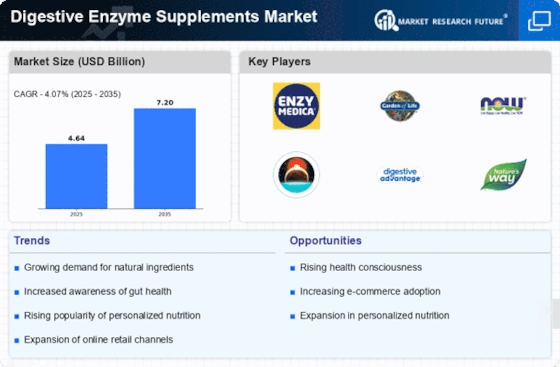
As per Market Research Future analysis, the Digestive Enzyme Supplements Market was estimated at 4.64 USD Billion in 2024. The digestive enzyme supplements industry is projected to grow from 4.829 USD Billion in 2025 to 7.196 USD Billion by 2035, exhibiting a compound annual growth rate (CAGR) of 4.07% during the forecast period 2025 - 2035

Key Market Trends & Highlights

The Digestive Enzyme Supplements Market is experiencing notable growth driven by consumer trends and demographic shifts.

  • Consumer awareness regarding digestive health is rising, leading to increased demand for enzyme supplements.
  • The market is witnessing a shift towards natural ingredients, particularly in the plant-based enzyme segment, which remains the largest.
  • E-commerce is expanding rapidly, facilitating access to a broader range of digestive enzyme products, especially in the Asia-Pacific region.
  • The increasing prevalence of digestive disorders and the aging population are key drivers propelling market growth.

Market Size & Forecast

2024 Market Size 4.64 (USD Billion)
2035 Market Size 7.196 (USD Billion)
CAGR (2025 - 2035) 4.07%
Largest Regional Market Share in 2024 North America

Major Players

Enzymedica (US), Garden of Life (US), NOW Foods (US), Source Naturals (US), Digestive Advantage (US), Nature's Way (US), Solgar (US), Life Extension (US), Kirkland Signature (US)

Market Trends

The Digestive Enzyme Supplements Market is currently experiencing a notable transformation, driven by increasing consumer awareness regarding digestive health and the role of enzymes in enhancing nutrient absorption. This market appears to be expanding as individuals seek natural solutions to alleviate digestive discomfort and improve overall well-being. The growing trend of preventive healthcare is likely influencing consumers to incorporate these supplements into their daily routines, as they aim to maintain optimal digestive function. Furthermore, the rise of e-commerce platforms is facilitating easier access to a variety of products, thereby broadening the consumer base and enhancing market growth. In addition, the Digestive Enzyme Supplements Market seems to be benefiting from a shift towards plant-based and organic products. As consumers become more health-conscious, there is a noticeable preference for supplements derived from natural sources. This inclination towards clean-label products suggests that manufacturers may need to adapt their offerings to meet evolving consumer demands. Overall, the market landscape appears dynamic, with various factors contributing to its ongoing development and potential future expansion.

Rising Consumer Awareness

There is an increasing recognition among consumers regarding the importance of digestive health. This trend suggests that individuals are more inclined to seek out supplements that can aid in digestion and overall wellness.

Shift Towards Natural Ingredients

A growing preference for plant-based and organic products is evident in the Digestive Enzyme Supplements Market. Consumers appear to favor supplements that are derived from natural sources, indicating a demand for clean-label options.

E-commerce Growth

The expansion of online shopping platforms is significantly impacting the market. This trend indicates that consumers are finding it easier to access a diverse range of digestive enzyme supplements, which may enhance market reach and accessibility.

Digestive Enzyme Supplements Market Market Drivers

Aging Population

The aging population is likely to be a key driver for the Digestive Enzyme Supplements Market. As individuals age, their digestive systems may become less efficient, leading to a higher incidence of digestive issues. Research indicates that older adults often experience decreased enzyme production, which can result in malabsorption and discomfort. This demographic shift suggests that there will be a growing need for digestive enzyme supplements among older consumers seeking to maintain their digestive health. The increasing number of elderly individuals globally could potentially expand the market, as they may actively seek out supplements to enhance their quality of life.

E-commerce Expansion

The expansion of e-commerce platforms is transforming the way consumers access digestive enzyme supplements, potentially driving market growth. Online shopping offers convenience and a wider selection of products, allowing consumers to easily compare options and read reviews. Data suggests that e-commerce sales in the dietary supplement sector are expected to grow significantly, with online channels accounting for a substantial portion of total sales. This shift towards digital purchasing may enhance the visibility of digestive enzyme supplements, making them more accessible to a diverse audience. As consumers increasingly turn to online platforms for their health needs, the Digestive Enzyme Supplements Market could benefit from this trend.

Rising Health Consciousness

There is a notable trend towards health consciousness among consumers, which appears to be influencing the Digestive Enzyme Supplements Market. Individuals are increasingly prioritizing their health and wellness, leading to a surge in demand for dietary supplements that promote digestive health. This trend is supported by data indicating that the dietary supplement market is projected to reach USD 230 billion by 2027, with digestive health products playing a significant role. As consumers become more informed about the benefits of digestive enzymes, the market for these supplements is likely to expand, reflecting a shift towards proactive health management.

Increasing Digestive Disorders

The prevalence of digestive disorders appears to be on the rise, which may drive demand for digestive enzyme supplements. Conditions such as irritable bowel syndrome, lactose intolerance, and celiac disease are becoming more recognized, leading consumers to seek solutions for their digestive health. According to recent data, approximately 60 to 70 million individuals are affected by digestive diseases, indicating a substantial market for digestive enzyme supplements. This growing awareness of digestive health issues suggests that the Digestive Enzyme Supplements Market could experience significant growth as consumers increasingly turn to these products for relief and support.

Innovative Product Development

The Digestive Enzyme Supplements Market is witnessing a wave of innovative product development, which may serve as a catalyst for growth. Manufacturers are increasingly focusing on creating specialized formulations that cater to specific dietary needs, such as vegan or gluten-free options. This innovation is likely to attract a broader consumer base, including those with dietary restrictions or preferences. Furthermore, advancements in technology and research are enabling the development of more effective enzyme blends, which could enhance product efficacy. As a result, the market may see an influx of new products that appeal to health-conscious consumers seeking tailored digestive solutions.

Market Segment Insights

By Type: Plant-Based Enzymes (Largest) vs. Animal-Based Enzymes (Fastest-Growing)

In the Digestive Enzyme Supplements Market, Plant-Based Enzymes currently hold the largest market share, primarily driven by growing consumer preference for natural and vegan products. This segment is appealing to health-conscious individuals who seek plant-derived solutions for digestive health. On the other hand, Animal-Based Enzymes, while a smaller segment, are witnessing rapid growth due to increased awareness of their potent digestive benefits and the demand for enzyme products sourced from animals that assist in protein digestion and nutrient absorption. Furthermore, Microbial Enzymes are gaining traction as well, driven by advancements in biotechnology and the rising popularity of probiotics. The increasing number of individuals seeking enzymes to enhance digestion, improve gut health, and support overall wellness contributes to the positive growth trends seen across all types. Innovations and expanded product offerings are fueling competition, making the market dynamic and responsive to consumer needs.

Plant-Based Enzymes (Dominant) vs. Microbial Enzymes (Emerging)

Plant-Based Enzymes dominate the Digestive Enzyme Supplements Market by appealing to health-conscious consumers who prefer vegan and natural supplements. These enzymes are derived from sources like papaya and pineapple, known for their effectiveness in aiding digestion. The consumer shift towards plant-based diets and holistic health practices significantly boosts the popularity of this segment. In contrast, Microbial Enzymes, while classified as emerging, are increasingly recognized for their unique benefits in digestive health. They are sourced from microorganisms and can enhance the bioavailability of nutrients, making them attractive in formulations targeting specific digestive issues. As dietary preferences evolve, both segments are poised for continued innovation and growth.

By Form: Capsules (Largest) vs. Powder (Fastest-Growing)

The Digestive Enzyme Supplements Market shows a healthy distribution among its forms, with capsules leading the pack as the largest segment. Capsules are favored for their ease of use and convenience, appealing to consumers who desire a straightforward supplementation method. Following capsules, powder forms have been gaining traction due to their flexibility in dosage and the ability to mix them with food or beverages, catering to health-conscious consumers who prefer customizable solutions. The growth trends in this segment indicate a shift towards more natural and versatile supplement options. The increasing awareness of digestive health and the benefits of digestive enzymes has driven the demand for diverse forms. As consumers lean towards powdered formats for their convenience and flexibility, companies are innovating in this space, pushing the development of flavored and functional powders, thereby enhancing their market appeal and potential growth further.

Capsules: Dominant vs. Powder: Emerging

Capsules remain the dominant form in the Digestive Enzyme Supplements Market due to their widespread acceptance and user-friendly nature. They appeal to individuals seeking quick and easy ingestion without the need for measurement. Capsules ensure accurate dosing and are often perceived as a more professional or clinical supplement option. Conversely, powders are emerging as a popular alternative, particularly among fitness enthusiasts and those looking for customizability in their supplement intake. The ability to adjust dosage easily and mix with various foods is driving consumer interest in powder forms. As a result, brands are increasingly focusing on innovative powder formulations, often incorporating additional nutritional benefits, to capture a larger share in this evolving market.

By Application: Digestive Health (Largest) vs. Nutrient Absorption (Fastest-Growing)

In the Digestive Enzyme Supplements Market, the segment of Digestive Health holds the largest market share due to increasing consumer awareness regarding gut health and the role of enzymes in facilitating digestion. This segment appeals to a broad consumer base, including those suffering from digestive disorders, leading to a higher demand for products tailored for digestive wellness. Conversely, Nutrient Absorption is emerging as the fastest-growing segment, driven by a rise in nutritional supplements as consumers seek to enhance their overall health and ensure they are gaining maximum nutritional benefit from their diets.

Digestive Health: Dominant vs. Nutrient Absorption: Emerging

The Digestive Health segment is characterized by its broad appeal and established market presence, focusing primarily on supplements that promote optimal digestion and relieve digestive issues. Products in this space are widely adopted by consumers looking for immediate relief from symptoms like bloating or indigestion. In contrast, Nutrient Absorption, although smaller, is rapidly gaining traction as an emerging segment. This growth is largely attributed to increasing awareness of bioavailability and how digestive enzymes can facilitate the absorption of essential vitamins and minerals, appealing particularly to health-conscious consumers and those with specific dietary needs.

By Distribution Channel: Online Retail (Largest) vs. Pharmacies (Fastest-Growing)

The distribution channels for digestive enzyme supplements show a diverse market landscape. Currently, online retail dominates the segment, accounting for a significant share as consumers increasingly prefer the convenience of shopping from home. Pharmacies represent another essential channel, steadily gaining traction among consumers who value quick access to health supplements. Supermarkets and health stores also play important roles, yet they lag behind the aforementioned channels in terms of market share.

Online Retail (Dominant) vs. Health Stores (Emerging)

Online retail has established itself as the dominant distribution channel in the digestive enzyme supplements market, driven by the growing trend of eCommerce and changing consumer behaviors towards online shopping. This channel offers customers the benefit of a wide selection, often at competitive prices, along with an easy shopping experience. In contrast, health stores serve as an emerging option, appealing to health-conscious consumers who prefer to shop for supplements in-person where they can receive expert advice. While these stores may not have the same reach as online platforms, they are gaining recognition for providing personalized service and high-quality products.

Get more detailed insights about Digestive Enzyme Supplements Market Research Report — Forecast till 2035

Regional Insights

Among the regions, North America was significant, valued at 1.5 USD Billion in 2024, and expected to grow to 2.4 USD Billion by 2035, marking it as a majority holding segment due to increasing health awareness and demand for dietary supplements.

Europe followed with a valuation of 1.2 USD Billion in 2024 and 1.9 USD Billion in 2035 as the market there is driven by aging populations and rising gastrointestinal health issues. The Asia Pacific region accounted for a valuation of 1.3 USD Billion in 2024 and is anticipated to reach 2.0 USD Billion in 2035, showcasing the importance of expanding middle-class income and health trends.

In South America, the market was valued at 0.5 USD Billion in 2024 and aims for 0.8 USD Billion in 2035, reflecting a growing interest in health supplements. Meanwhile, the Middle East and Africa represented a smaller segment, valued at 0.3 USD Billion in 2024 and projected to grow to 0.5 USD Billion by 2035, indicating potential for future expansion as health consciousness rises in these regions.

The variations in market dynamics across regions underscored critical opportunities and challenges within the Digestive Enzyme Supplements Market, with increasing demand creating pathways for substantial growth.

Key Players and Competitive Insights

The Digestive Enzyme Supplements Market is characterized by a dynamic landscape where various key players are vying for market share and consumer loyalty. The increased awareness regarding digestive health and the benefits of enzyme supplementation has driven this market to expand significantly.
This growth is influenced by factors such as the rising prevalence of digestive disorders, a growing trend toward preventive healthcare, and the increasing inclination of consumers towards natural and dietary supplements.
Companies are diversifying their product offerings and investing in research and development to introduce innovative formulations that cater to specific digestive issues. The competitive insights reveal that brands are strategically positioning themselves through unique value propositions, tailored marketing strategies, and customer engagement initiatives to establish a stronger market presence.
Seroyal has established itself as a noteworthy player in the Digestive Enzyme Supplements Market, leveraging its commitment to quality and efficacy. The company is known for its extensive range of dietary supplements designed to support digestive health, featuring a combination of various enzymes and nutrients.
Seroyal's strengths lie in its solid research foundation and dedication to natural ingredients, which resonate well with health-conscious consumers. The company's robust distribution network ensures its products reach a wide audience globally, enhancing its market presence.
Furthermore, Seroyal continuously invests in innovation and product development, demonstrating its agility in responding to the evolving consumer needs and preferences. By focusing on high-quality formulations backed by scientific research, Seroyal maintains a competitive edge in the digestive enzyme supplement sector.
Vital Nutrients is a significant contributor to the Digestive Enzyme Supplements Market, recognized for its premium quality formulations aimed at digestive support. The company offers a comprehensive range of digestive enzyme products that cater to various needs, such as lactose intolerance and general digestive health.
Vital Nutrients emphasizes the importance of transparency and efficacy, ensuring that its products are manufactured in compliance with rigorous quality standards. The company's strengths include its commitment to using pure ingredients and maintaining stringent testing protocols, which appeal to consumers seeking reliable supplements.
In recent years, Vital Nutrients has expanded its market presence through strategic partnerships and collaborations, further solidifying its position in the global market. The company actively pursues innovation in product development while remaining focused on enhancing customer satisfaction and addressing the specific digestive health needs of its clientele.

Key Companies in the Digestive Enzyme Supplements Market include

Industry Developments

Relesium, a patented all-natural supplement that combines chicken egg powder and bovine colostrum, was introduced by PanTheryx in March 2025 with the goal of reducing the gastrointestinal adverse effects of GLP-1 drugs, such as bloating, diarrhea, constipation, and acid reflux.

In July 2024, Enzyme Science unveiled GI+Biome, a multifunctional complex that supports intestinal microbiota balance by combining ButyraGen, Lipase Thera-blend, PepZinGi zinc-carnosine, and Livaux organic golden kiwi.PEPZYME PRO, a plant-based synbiotic enzyme solution that has been demonstrated to improve the bioavailability of BCAAs and postbiotics, was introduced by Specialty Enzymes & Probiotics in April 2023, specifically for vegan customers.

Additionally, in November 2024, Nestlé Health Science's Garden of Life brand launched enzyme blends that target gluten sensitivity and lactose intolerance, broadening the appeal of digestive support supplements to a wider audience.Leading supplement firms have concentrated on creating customized enzyme treatments to address each person's unique digestion needs, as well as multi-enzyme formulations that contain probiotics and prebiotics, since 2025.

Additionally, it has been noted that pharmaceutical and nutraceutical companies have made significant investments in biotech startups that focus on enzyme research. This has improved R&D capacity and encouraged strategic mergers and acquisitions to diversify product portfolios.

In line with consumer desires for clean-label, sustainable products, the market has shown a significant tendency toward plant-based enzyme formulations (such papain and bromelain) and direct-to-consumer e-commerce distribution over 2024–2025.

Future Outlook

Digestive Enzyme Supplements Market Future Outlook

The Digestive Enzyme Supplements Market is projected to grow at a 4.07% CAGR from 2025 to 2035, driven by increasing health awareness and demand for digestive health solutions.

New opportunities lie in:

  • Development of personalized enzyme formulations based on genetic testing.
  • Expansion into emerging markets with tailored marketing strategies.
  • Partnerships with healthcare providers for integrated wellness programs.

By 2035, the market is expected to solidify its position as a key player in health and wellness.

Market Segmentation

Digestive Enzyme Supplements Market Form Outlook

  • Capsules
  • Tablets
  • Powder
  • Liquid

Digestive Enzyme Supplements Market Type Outlook

  • Animal-Based Enzymes
  • Plant-Based Enzymes
  • Microbial Enzymes

Digestive Enzyme Supplements Market Application Outlook

  • Digestive Health
  • Nutrient Absorption
  • Food Processing

Digestive Enzyme Supplements Market Distribution Channel Outlook

  • Online Retail
  • Pharmacies
  • Supermarkets
  • Health Stores

Report Scope

MARKET SIZE 2024 4.64(USD Billion)
MARKET SIZE 2025 4.829(USD Billion)
MARKET SIZE 2035 7.196(USD Billion)
COMPOUND ANNUAL GROWTH RATE (CAGR) 4.07% (2025 - 2035)
REPORT COVERAGE Revenue Forecast, Competitive Landscape, Growth Factors, and Trends
BASE YEAR 2024
Market Forecast Period 2025 - 2035
Historical Data 2019 - 2024
Market Forecast Units USD Billion
Key Companies Profiled Enzymedica (US), Garden of Life (US), NOW Foods (US), Source Naturals (US), Digestive Advantage (US), Nature's Way (US), Solgar (US), Life Extension (US), Kirkland Signature (US)
Segments Covered Type, Form, Application, Distribution Channel, Regional
Key Market Opportunities Growing consumer awareness of gut health drives demand for innovative Digestive Enzyme Supplements Market solutions.
Key Market Dynamics Rising consumer awareness of digestive health drives demand for innovative digestive enzyme supplements and formulations.
Countries Covered North America, Europe, APAC, South America, MEA

FAQs

What is the projected market valuation for the Digestive Enzyme Supplements Market in 2035?

<p>The projected market valuation for the Digestive Enzyme Supplements Market in 2035 is 7.196 USD Billion.</p>

What was the market valuation for Digestive Enzyme Supplements in 2024?

<p>The market valuation for Digestive Enzyme Supplements in 2024 was 4.64 USD Billion.</p>

What is the expected CAGR for the Digestive Enzyme Supplements Market from 2025 to 2035?

<p>The expected CAGR for the Digestive Enzyme Supplements Market during the forecast period 2025 - 2035 is 4.07%.</p>

Which segment of digestive enzyme supplements is projected to have the highest valuation by 2035?

<p>By 2035, the Plant-Based Enzymes segment is projected to reach a valuation of 2.8 USD Billion.</p>

What are the leading distribution channels for digestive enzyme supplements?

<p>The leading distribution channels include Online Retail, Pharmacies, Supermarkets, and Health Stores, with Health Stores projected to reach 2.0 USD Billion by 2035.</p>

Which form of digestive enzyme supplements is expected to grow the most by 2035?

<p>The Capsules form is expected to grow the most, with a projected valuation of 2.188 USD Billion by 2035.</p>

Who are the key players in the Digestive Enzyme Supplements Market?

<p>Key players in the market include Enzymedica, Garden of Life, NOW Foods, and Nature's Way, among others.</p>

What application segment is anticipated to see significant growth in the Digestive Enzyme Supplements Market?

<p>The Digestive Health application segment is anticipated to see significant growth, projected to reach 2.92 USD Billion by 2035.</p>

How did the valuation of Microbial Enzymes change from 2024 to 2035?

<p>The valuation of Microbial Enzymes increased from 1.34 USD Billion in 2024 to a projected 2.0 USD Billion in 2035.</p>

What is the expected market trend for Animal-Based Enzymes in the coming years?

<p>Animal-Based Enzymes are expected to grow, with a projected valuation of 2.4 USD Billion by 2035.</p>

  1. SECTION I: EXECUTIVE SUMMARY AND KEY HIGHLIGHTS
    1. | 1.1 EXECUTIVE SUMMARY
    2. | | 1.1.1 Market Overview
    3. | | 1.1.2 Key Findings
    4. | | 1.1.3 Market Segmentation
    5. | | 1.1.4 Competitive Landscape
    6. | | 1.1.5 Challenges and Opportunities
    7. | | 1.1.6 Future Outlook
  2. SECTION II: SCOPING, METHODOLOGY AND MARKET STRUCTURE
    1. | 2.1 MARKET INTRODUCTION
    2. | | 2.1.1 Definition
    3. | | 2.1.2 Scope of the study
    4. | | | 2.1.2.1 Research Objective
    5. | | | 2.1.2.2 Assumption
    6. | | | 2.1.2.3 Limitations
    7. | 2.2 RESEARCH METHODOLOGY
    8. | | 2.2.1 Overview
    9. | | 2.2.2 Data Mining
    10. | | 2.2.3 Secondary Research
    11. | | 2.2.4 Primary Research
    12. | | | 2.2.4.1 Primary Interviews and Information Gathering Process
    13. | | | 2.2.4.2 Breakdown of Primary Respondents
    14. | | 2.2.5 Forecasting Model
    15. | | 2.2.6 Market Size Estimation
    16. | | | 2.2.6.1 Bottom-Up Approach
    17. | | | 2.2.6.2 Top-Down Approach
    18. | | 2.2.7 Data Triangulation
    19. | | 2.2.8 Validation
  3. SECTION III: QUALITATIVE ANALYSIS
    1. | 3.1 MARKET DYNAMICS
    2. | | 3.1.1 Overview
    3. | | 3.1.2 Drivers
    4. | | 3.1.3 Restraints
    5. | | 3.1.4 Opportunities
    6. | 3.2 MARKET FACTOR ANALYSIS
    7. | | 3.2.1 Value chain Analysis
    8. | | 3.2.2 Porter's Five Forces Analysis
    9. | | | 3.2.2.1 Bargaining Power of Suppliers
    10. | | | 3.2.2.2 Bargaining Power of Buyers
    11. | | | 3.2.2.3 Threat of New Entrants
    12. | | | 3.2.2.4 Threat of Substitutes
    13. | | | 3.2.2.5 Intensity of Rivalry
    14. | | 3.2.3 COVID-19 Impact Analysis
    15. | | | 3.2.3.1 Market Impact Analysis
    16. | | | 3.2.3.2 Regional Impact
    17. | | | 3.2.3.3 Opportunity and Threat Analysis
  4. SECTION IV: QUANTITATIVE ANALYSIS
    1. | 4.1 Food, Beverages & Nutrition, BY Type (USD Billion)
    2. | | 4.1.1 Animal-Based Enzymes
    3. | | 4.1.2 Plant-Based Enzymes
    4. | | 4.1.3 Microbial Enzymes
    5. | 4.2 Food, Beverages & Nutrition, BY Form (USD Billion)
    6. | | 4.2.1 Capsules
    7. | | 4.2.2 Tablets
    8. | | 4.2.3 Powder
    9. | | 4.2.4 Liquid
    10. | 4.3 Food, Beverages & Nutrition, BY Application (USD Billion)
    11. | | 4.3.1 Digestive Health
    12. | | 4.3.2 Nutrient Absorption
    13. | | 4.3.3 Food Processing
    14. | 4.4 Food, Beverages & Nutrition, BY Distribution Channel (USD Billion)
    15. | | 4.4.1 Online Retail
    16. | | 4.4.2 Pharmacies
    17. | | 4.4.3 Supermarkets
    18. | | 4.4.4 Health Stores
    19. | 4.5 Food, Beverages & Nutrition, BY Region (USD Billion)
    20. | | 4.5.1 North America
    21. | | | 4.5.1.1 US
    22. | | | 4.5.1.2 Canada
    23. | | 4.5.2 Europe
    24. | | | 4.5.2.1 Germany
    25. | | | 4.5.2.2 UK
    26. | | | 4.5.2.3 France
    27. | | | 4.5.2.4 Russia
    28. | | | 4.5.2.5 Italy
    29. | | | 4.5.2.6 Spain
    30. | | | 4.5.2.7 Rest of Europe
    31. | | 4.5.3 APAC
    32. | | | 4.5.3.1 China
    33. | | | 4.5.3.2 India
    34. | | | 4.5.3.3 Japan
    35. | | | 4.5.3.4 South Korea
    36. | | | 4.5.3.5 Malaysia
    37. | | | 4.5.3.6 Thailand
    38. | | | 4.5.3.7 Indonesia
    39. | | | 4.5.3.8 Rest of APAC
    40. | | 4.5.4 South America
    41. | | | 4.5.4.1 Brazil
    42. | | | 4.5.4.2 Mexico
    43. | | | 4.5.4.3 Argentina
    44. | | | 4.5.4.4 Rest of South America
    45. | | 4.5.5 MEA
    46. | | | 4.5.5.1 GCC Countries
    47. | | | 4.5.5.2 South Africa
    48. | | | 4.5.5.3 Rest of MEA
  5. SECTION V: COMPETITIVE ANALYSIS
    1. | 5.1 Competitive Landscape
    2. | | 5.1.1 Overview
    3. | | 5.1.2 Competitive Analysis
    4. | | 5.1.3 Market share Analysis
    5. | | 5.1.4 Major Growth Strategy in the Food, Beverages & Nutrition
    6. | | 5.1.5 Competitive Benchmarking
    7. | | 5.1.6 Leading Players in Terms of Number of Developments in the Food, Beverages & Nutrition
    8. | | 5.1.7 Key developments and growth strategies
    9. | | | 5.1.7.1 New Product Launch/Service Deployment
    10. | | | 5.1.7.2 Merger & Acquisitions
    11. | | | 5.1.7.3 Joint Ventures
    12. | | 5.1.8 Major Players Financial Matrix
    13. | | | 5.1.8.1 Sales and Operating Income
    14. | | | 5.1.8.2 Major Players R&D Expenditure. 2023
    15. | 5.2 Company Profiles
    16. | | 5.2.1 Enzymedica (US)
    17. | | | 5.2.1.1 Financial Overview
    18. | | | 5.2.1.2 Products Offered
    19. | | | 5.2.1.3 Key Developments
    20. | | | 5.2.1.4 SWOT Analysis
    21. | | | 5.2.1.5 Key Strategies
    22. | | 5.2.2 Garden of Life (US)
    23. | | | 5.2.2.1 Financial Overview
    24. | | | 5.2.2.2 Products Offered
    25. | | | 5.2.2.3 Key Developments
    26. | | | 5.2.2.4 SWOT Analysis
    27. | | | 5.2.2.5 Key Strategies
    28. | | 5.2.3 NOW Foods (US)
    29. | | | 5.2.3.1 Financial Overview
    30. | | | 5.2.3.2 Products Offered
    31. | | | 5.2.3.3 Key Developments
    32. | | | 5.2.3.4 SWOT Analysis
    33. | | | 5.2.3.5 Key Strategies
    34. | | 5.2.4 Source Naturals (US)
    35. | | | 5.2.4.1 Financial Overview
    36. | | | 5.2.4.2 Products Offered
    37. | | | 5.2.4.3 Key Developments
    38. | | | 5.2.4.4 SWOT Analysis
    39. | | | 5.2.4.5 Key Strategies
    40. | | 5.2.5 Digestive Advantage (US)
    41. | | | 5.2.5.1 Financial Overview
    42. | | | 5.2.5.2 Products Offered
    43. | | | 5.2.5.3 Key Developments
    44. | | | 5.2.5.4 SWOT Analysis
    45. | | | 5.2.5.5 Key Strategies
    46. | | 5.2.6 Nature's Way (US)
    47. | | | 5.2.6.1 Financial Overview
    48. | | | 5.2.6.2 Products Offered
    49. | | | 5.2.6.3 Key Developments
    50. | | | 5.2.6.4 SWOT Analysis
    51. | | | 5.2.6.5 Key Strategies
    52. | | 5.2.7 Solgar (US)
    53. | | | 5.2.7.1 Financial Overview
    54. | | | 5.2.7.2 Products Offered
    55. | | | 5.2.7.3 Key Developments
    56. | | | 5.2.7.4 SWOT Analysis
    57. | | | 5.2.7.5 Key Strategies
    58. | | 5.2.8 Life Extension (US)
    59. | | | 5.2.8.1 Financial Overview
    60. | | | 5.2.8.2 Products Offered
    61. | | | 5.2.8.3 Key Developments
    62. | | | 5.2.8.4 SWOT Analysis
    63. | | | 5.2.8.5 Key Strategies
    64. | | 5.2.9 Kirkland Signature (US)
    65. | | | 5.2.9.1 Financial Overview
    66. | | | 5.2.9.2 Products Offered
    67. | | | 5.2.9.3 Key Developments
    68. | | | 5.2.9.4 SWOT Analysis
    69. | | | 5.2.9.5 Key Strategies
    70. | 5.3 Appendix
    71. | | 5.3.1 References
    72. | | 5.3.2 Related Reports
  6. LIST OF FIGURES
    1. | 6.1 MARKET SYNOPSIS
    2. | 6.2 NORTH AMERICA MARKET ANALYSIS
    3. | 6.3 US MARKET ANALYSIS BY TYPE
    4. | 6.4 US MARKET ANALYSIS BY FORM
    5. | 6.5 US MARKET ANALYSIS BY APPLICATION
    6. | 6.6 US MARKET ANALYSIS BY DISTRIBUTION CHANNEL
    7. | 6.7 CANADA MARKET ANALYSIS BY TYPE
    8. | 6.8 CANADA MARKET ANALYSIS BY FORM
    9. | 6.9 CANADA MARKET ANALYSIS BY APPLICATION
    10. | 6.10 CANADA MARKET ANALYSIS BY DISTRIBUTION CHANNEL
    11. | 6.11 EUROPE MARKET ANALYSIS
    12. | 6.12 GERMANY MARKET ANALYSIS BY TYPE
    13. | 6.13 GERMANY MARKET ANALYSIS BY FORM
    14. | 6.14 GERMANY MARKET ANALYSIS BY APPLICATION
    15. | 6.15 GERMANY MARKET ANALYSIS BY DISTRIBUTION CHANNEL
    16. | 6.16 UK MARKET ANALYSIS BY TYPE
    17. | 6.17 UK MARKET ANALYSIS BY FORM
    18. | 6.18 UK MARKET ANALYSIS BY APPLICATION
    19. | 6.19 UK MARKET ANALYSIS BY DISTRIBUTION CHANNEL
    20. | 6.20 FRANCE MARKET ANALYSIS BY TYPE
    21. | 6.21 FRANCE MARKET ANALYSIS BY FORM
    22. | 6.22 FRANCE MARKET ANALYSIS BY APPLICATION
    23. | 6.23 FRANCE MARKET ANALYSIS BY DISTRIBUTION CHANNEL
    24. | 6.24 RUSSIA MARKET ANALYSIS BY TYPE
    25. | 6.25 RUSSIA MARKET ANALYSIS BY FORM
    26. | 6.26 RUSSIA MARKET ANALYSIS BY APPLICATION
    27. | 6.27 RUSSIA MARKET ANALYSIS BY DISTRIBUTION CHANNEL
    28. | 6.28 ITALY MARKET ANALYSIS BY TYPE
    29. | 6.29 ITALY MARKET ANALYSIS BY FORM
    30. | 6.30 ITALY MARKET ANALYSIS BY APPLICATION
    31. | 6.31 ITALY MARKET ANALYSIS BY DISTRIBUTION CHANNEL
    32. | 6.32 SPAIN MARKET ANALYSIS BY TYPE
    33. | 6.33 SPAIN MARKET ANALYSIS BY FORM
    34. | 6.34 SPAIN MARKET ANALYSIS BY APPLICATION
    35. | 6.35 SPAIN MARKET ANALYSIS BY DISTRIBUTION CHANNEL
    36. | 6.36 REST OF EUROPE MARKET ANALYSIS BY TYPE
    37. | 6.37 REST OF EUROPE MARKET ANALYSIS BY FORM
    38. | 6.38 REST OF EUROPE MARKET ANALYSIS BY APPLICATION
    39. | 6.39 REST OF EUROPE MARKET ANALYSIS BY DISTRIBUTION CHANNEL
    40. | 6.40 APAC MARKET ANALYSIS
    41. | 6.41 CHINA MARKET ANALYSIS BY TYPE
    42. | 6.42 CHINA MARKET ANALYSIS BY FORM
    43. | 6.43 CHINA MARKET ANALYSIS BY APPLICATION
    44. | 6.44 CHINA MARKET ANALYSIS BY DISTRIBUTION CHANNEL
    45. | 6.45 INDIA MARKET ANALYSIS BY TYPE
    46. | 6.46 INDIA MARKET ANALYSIS BY FORM
    47. | 6.47 INDIA MARKET ANALYSIS BY APPLICATION
    48. | 6.48 INDIA MARKET ANALYSIS BY DISTRIBUTION CHANNEL
    49. | 6.49 JAPAN MARKET ANALYSIS BY TYPE
    50. | 6.50 JAPAN MARKET ANALYSIS BY FORM
    51. | 6.51 JAPAN MARKET ANALYSIS BY APPLICATION
    52. | 6.52 JAPAN MARKET ANALYSIS BY DISTRIBUTION CHANNEL
    53. | 6.53 SOUTH KOREA MARKET ANALYSIS BY TYPE
    54. | 6.54 SOUTH KOREA MARKET ANALYSIS BY FORM
    55. | 6.55 SOUTH KOREA MARKET ANALYSIS BY APPLICATION
    56. | 6.56 SOUTH KOREA MARKET ANALYSIS BY DISTRIBUTION CHANNEL
    57. | 6.57 MALAYSIA MARKET ANALYSIS BY TYPE
    58. | 6.58 MALAYSIA MARKET ANALYSIS BY FORM
    59. | 6.59 MALAYSIA MARKET ANALYSIS BY APPLICATION
    60. | 6.60 MALAYSIA MARKET ANALYSIS BY DISTRIBUTION CHANNEL
    61. | 6.61 THAILAND MARKET ANALYSIS BY TYPE
    62. | 6.62 THAILAND MARKET ANALYSIS BY FORM
    63. | 6.63 THAILAND MARKET ANALYSIS BY APPLICATION
    64. | 6.64 THAILAND MARKET ANALYSIS BY DISTRIBUTION CHANNEL
    65. | 6.65 INDONESIA MARKET ANALYSIS BY TYPE
    66. | 6.66 INDONESIA MARKET ANALYSIS BY FORM
    67. | 6.67 INDONESIA MARKET ANALYSIS BY APPLICATION
    68. | 6.68 INDONESIA MARKET ANALYSIS BY DISTRIBUTION CHANNEL
    69. | 6.69 REST OF APAC MARKET ANALYSIS BY TYPE
    70. | 6.70 REST OF APAC MARKET ANALYSIS BY FORM
    71. | 6.71 REST OF APAC MARKET ANALYSIS BY APPLICATION
    72. | 6.72 REST OF APAC MARKET ANALYSIS BY DISTRIBUTION CHANNEL
    73. | 6.73 SOUTH AMERICA MARKET ANALYSIS
    74. | 6.74 BRAZIL MARKET ANALYSIS BY TYPE
    75. | 6.75 BRAZIL MARKET ANALYSIS BY FORM
    76. | 6.76 BRAZIL MARKET ANALYSIS BY APPLICATION
    77. | 6.77 BRAZIL MARKET ANALYSIS BY DISTRIBUTION CHANNEL
    78. | 6.78 MEXICO MARKET ANALYSIS BY TYPE
    79. | 6.79 MEXICO MARKET ANALYSIS BY FORM
    80. | 6.80 MEXICO MARKET ANALYSIS BY APPLICATION
    81. | 6.81 MEXICO MARKET ANALYSIS BY DISTRIBUTION CHANNEL
    82. | 6.82 ARGENTINA MARKET ANALYSIS BY TYPE
    83. | 6.83 ARGENTINA MARKET ANALYSIS BY FORM
    84. | 6.84 ARGENTINA MARKET ANALYSIS BY APPLICATION
    85. | 6.85 ARGENTINA MARKET ANALYSIS BY DISTRIBUTION CHANNEL
    86. | 6.86 REST OF SOUTH AMERICA MARKET ANALYSIS BY TYPE
    87. | 6.87 REST OF SOUTH AMERICA MARKET ANALYSIS BY FORM
    88. | 6.88 REST OF SOUTH AMERICA MARKET ANALYSIS BY APPLICATION
    89. | 6.89 REST OF SOUTH AMERICA MARKET ANALYSIS BY DISTRIBUTION CHANNEL
    90. | 6.90 MEA MARKET ANALYSIS
    91. | 6.91 GCC COUNTRIES MARKET ANALYSIS BY TYPE
    92. | 6.92 GCC COUNTRIES MARKET ANALYSIS BY FORM
    93. | 6.93 GCC COUNTRIES MARKET ANALYSIS BY APPLICATION
    94. | 6.94 GCC COUNTRIES MARKET ANALYSIS BY DISTRIBUTION CHANNEL
    95. | 6.95 SOUTH AFRICA MARKET ANALYSIS BY TYPE
    96. | 6.96 SOUTH AFRICA MARKET ANALYSIS BY FORM
    97. | 6.97 SOUTH AFRICA MARKET ANALYSIS BY APPLICATION
    98. | 6.98 SOUTH AFRICA MARKET ANALYSIS BY DISTRIBUTION CHANNEL
    99. | 6.99 REST OF MEA MARKET ANALYSIS BY TYPE
    100. | 6.100 REST OF MEA MARKET ANALYSIS BY FORM
    101. | 6.101 REST OF MEA MARKET ANALYSIS BY APPLICATION
    102. | 6.102 REST OF MEA MARKET ANALYSIS BY DISTRIBUTION CHANNEL
    103. | 6.103 KEY BUYING CRITERIA OF FOOD, BEVERAGES & NUTRITION
    104. | 6.104 RESEARCH PROCESS OF MRFR
    105. | 6.105 DRO ANALYSIS OF FOOD, BEVERAGES & NUTRITION
    106. | 6.106 DRIVERS IMPACT ANALYSIS: FOOD, BEVERAGES & NUTRITION
    107. | 6.107 RESTRAINTS IMPACT ANALYSIS: FOOD, BEVERAGES & NUTRITION
    108. | 6.108 SUPPLY / VALUE CHAIN: FOOD, BEVERAGES & NUTRITION
    109. | 6.109 FOOD, BEVERAGES & NUTRITION, BY TYPE, 2024 (% SHARE)
    110. | 6.110 FOOD, BEVERAGES & NUTRITION, BY TYPE, 2024 TO 2035 (USD Billion)
    111. | 6.111 FOOD, BEVERAGES & NUTRITION, BY FORM, 2024 (% SHARE)
    112. | 6.112 FOOD, BEVERAGES & NUTRITION, BY FORM, 2024 TO 2035 (USD Billion)
    113. | 6.113 FOOD, BEVERAGES & NUTRITION, BY APPLICATION, 2024 (% SHARE)
    114. | 6.114 FOOD, BEVERAGES & NUTRITION, BY APPLICATION, 2024 TO 2035 (USD Billion)
    115. | 6.115 FOOD, BEVERAGES & NUTRITION, BY DISTRIBUTION CHANNEL, 2024 (% SHARE)
    116. | 6.116 FOOD, BEVERAGES & NUTRITION, BY DISTRIBUTION CHANNEL, 2024 TO 2035 (USD Billion)
    117. | 6.117 BENCHMARKING OF MAJOR COMPETITORS
  7. LIST OF TABLES
    1. | 7.1 LIST OF ASSUMPTIONS
    2. | | 7.1.1
    3. | 7.2 North America MARKET SIZE ESTIMATES; FORECAST
    4. | | 7.2.1 BY TYPE, 2025-2035 (USD Billion)
    5. | | 7.2.2 BY FORM, 2025-2035 (USD Billion)
    6. | | 7.2.3 BY APPLICATION, 2025-2035 (USD Billion)
    7. | | 7.2.4 BY DISTRIBUTION CHANNEL, 2025-2035 (USD Billion)
    8. | 7.3 US MARKET SIZE ESTIMATES; FORECAST
    9. | | 7.3.1 BY TYPE, 2025-2035 (USD Billion)
    10. | | 7.3.2 BY FORM, 2025-2035 (USD Billion)
    11. | | 7.3.3 BY APPLICATION, 2025-2035 (USD Billion)
    12. | | 7.3.4 BY DISTRIBUTION CHANNEL, 2025-2035 (USD Billion)
    13. | 7.4 Canada MARKET SIZE ESTIMATES; FORECAST
    14. | | 7.4.1 BY TYPE, 2025-2035 (USD Billion)
    15. | | 7.4.2 BY FORM, 2025-2035 (USD Billion)
    16. | | 7.4.3 BY APPLICATION, 2025-2035 (USD Billion)
    17. | | 7.4.4 BY DISTRIBUTION CHANNEL, 2025-2035 (USD Billion)
    18. | 7.5 Europe MARKET SIZE ESTIMATES; FORECAST
    19. | | 7.5.1 BY TYPE, 2025-2035 (USD Billion)
    20. | | 7.5.2 BY FORM, 2025-2035 (USD Billion)
    21. | | 7.5.3 BY APPLICATION, 2025-2035 (USD Billion)
    22. | | 7.5.4 BY DISTRIBUTION CHANNEL, 2025-2035 (USD Billion)
    23. | 7.6 Germany MARKET SIZE ESTIMATES; FORECAST
    24. | | 7.6.1 BY TYPE, 2025-2035 (USD Billion)
    25. | | 7.6.2 BY FORM, 2025-2035 (USD Billion)
    26. | | 7.6.3 BY APPLICATION, 2025-2035 (USD Billion)
    27. | | 7.6.4 BY DISTRIBUTION CHANNEL, 2025-2035 (USD Billion)
    28. | 7.7 UK MARKET SIZE ESTIMATES; FORECAST
    29. | | 7.7.1 BY TYPE, 2025-2035 (USD Billion)
    30. | | 7.7.2 BY FORM, 2025-2035 (USD Billion)
    31. | | 7.7.3 BY APPLICATION, 2025-2035 (USD Billion)
    32. | | 7.7.4 BY DISTRIBUTION CHANNEL, 2025-2035 (USD Billion)
    33. | 7.8 France MARKET SIZE ESTIMATES; FORECAST
    34. | | 7.8.1 BY TYPE, 2025-2035 (USD Billion)
    35. | | 7.8.2 BY FORM, 2025-2035 (USD Billion)
    36. | | 7.8.3 BY APPLICATION, 2025-2035 (USD Billion)
    37. | | 7.8.4 BY DISTRIBUTION CHANNEL, 2025-2035 (USD Billion)
    38. | 7.9 Russia MARKET SIZE ESTIMATES; FORECAST
    39. | | 7.9.1 BY TYPE, 2025-2035 (USD Billion)
    40. | | 7.9.2 BY FORM, 2025-2035 (USD Billion)
    41. | | 7.9.3 BY APPLICATION, 2025-2035 (USD Billion)
    42. | | 7.9.4 BY DISTRIBUTION CHANNEL, 2025-2035 (USD Billion)
    43. | 7.10 Italy MARKET SIZE ESTIMATES; FORECAST
    44. | | 7.10.1 BY TYPE, 2025-2035 (USD Billion)
    45. | | 7.10.2 BY FORM, 2025-2035 (USD Billion)
    46. | | 7.10.3 BY APPLICATION, 2025-2035 (USD Billion)
    47. | | 7.10.4 BY DISTRIBUTION CHANNEL, 2025-2035 (USD Billion)
    48. | 7.11 Spain MARKET SIZE ESTIMATES; FORECAST
    49. | | 7.11.1 BY TYPE, 2025-2035 (USD Billion)
    50. | | 7.11.2 BY FORM, 2025-2035 (USD Billion)
    51. | | 7.11.3 BY APPLICATION, 2025-2035 (USD Billion)
    52. | | 7.11.4 BY DISTRIBUTION CHANNEL, 2025-2035 (USD Billion)
    53. | 7.12 Rest of Europe MARKET SIZE ESTIMATES; FORECAST
    54. | | 7.12.1 BY TYPE, 2025-2035 (USD Billion)
    55. | | 7.12.2 BY FORM, 2025-2035 (USD Billion)
    56. | | 7.12.3 BY APPLICATION, 2025-2035 (USD Billion)
    57. | | 7.12.4 BY DISTRIBUTION CHANNEL, 2025-2035 (USD Billion)
    58. | 7.13 APAC MARKET SIZE ESTIMATES; FORECAST
    59. | | 7.13.1 BY TYPE, 2025-2035 (USD Billion)
    60. | | 7.13.2 BY FORM, 2025-2035 (USD Billion)
    61. | | 7.13.3 BY APPLICATION, 2025-2035 (USD Billion)
    62. | | 7.13.4 BY DISTRIBUTION CHANNEL, 2025-2035 (USD Billion)
    63. | 7.14 China MARKET SIZE ESTIMATES; FORECAST
    64. | | 7.14.1 BY TYPE, 2025-2035 (USD Billion)
    65. | | 7.14.2 BY FORM, 2025-2035 (USD Billion)
    66. | | 7.14.3 BY APPLICATION, 2025-2035 (USD Billion)
    67. | | 7.14.4 BY DISTRIBUTION CHANNEL, 2025-2035 (USD Billion)
    68. | 7.15 India MARKET SIZE ESTIMATES; FORECAST
    69. | | 7.15.1 BY TYPE, 2025-2035 (USD Billion)
    70. | | 7.15.2 BY FORM, 2025-2035 (USD Billion)
    71. | | 7.15.3 BY APPLICATION, 2025-2035 (USD Billion)
    72. | | 7.15.4 BY DISTRIBUTION CHANNEL, 2025-2035 (USD Billion)
    73. | 7.16 Japan MARKET SIZE ESTIMATES; FORECAST
    74. | | 7.16.1 BY TYPE, 2025-2035 (USD Billion)
    75. | | 7.16.2 BY FORM, 2025-2035 (USD Billion)
    76. | | 7.16.3 BY APPLICATION, 2025-2035 (USD Billion)
    77. | | 7.16.4 BY DISTRIBUTION CHANNEL, 2025-2035 (USD Billion)
    78. | 7.17 South Korea MARKET SIZE ESTIMATES; FORECAST
    79. | | 7.17.1 BY TYPE, 2025-2035 (USD Billion)
    80. | | 7.17.2 BY FORM, 2025-2035 (USD Billion)
    81. | | 7.17.3 BY APPLICATION, 2025-2035 (USD Billion)
    82. | | 7.17.4 BY DISTRIBUTION CHANNEL, 2025-2035 (USD Billion)
    83. | 7.18 Malaysia MARKET SIZE ESTIMATES; FORECAST
    84. | | 7.18.1 BY TYPE, 2025-2035 (USD Billion)
    85. | | 7.18.2 BY FORM, 2025-2035 (USD Billion)
    86. | | 7.18.3 BY APPLICATION, 2025-2035 (USD Billion)
    87. | | 7.18.4 BY DISTRIBUTION CHANNEL, 2025-2035 (USD Billion)
    88. | 7.19 Thailand MARKET SIZE ESTIMATES; FORECAST
    89. | | 7.19.1 BY TYPE, 2025-2035 (USD Billion)
    90. | | 7.19.2 BY FORM, 2025-2035 (USD Billion)
    91. | | 7.19.3 BY APPLICATION, 2025-2035 (USD Billion)
    92. | | 7.19.4 BY DISTRIBUTION CHANNEL, 2025-2035 (USD Billion)
    93. | 7.20 Indonesia MARKET SIZE ESTIMATES; FORECAST
    94. | | 7.20.1 BY TYPE, 2025-2035 (USD Billion)
    95. | | 7.20.2 BY FORM, 2025-2035 (USD Billion)
    96. | | 7.20.3 BY APPLICATION, 2025-2035 (USD Billion)
    97. | | 7.20.4 BY DISTRIBUTION CHANNEL, 2025-2035 (USD Billion)
    98. | 7.21 Rest of APAC MARKET SIZE ESTIMATES; FORECAST
    99. | | 7.21.1 BY TYPE, 2025-2035 (USD Billion)
    100. | | 7.21.2 BY FORM, 2025-2035 (USD Billion)
    101. | | 7.21.3 BY APPLICATION, 2025-2035 (USD Billion)
    102. | | 7.21.4 BY DISTRIBUTION CHANNEL, 2025-2035 (USD Billion)
    103. | 7.22 South America MARKET SIZE ESTIMATES; FORECAST
    104. | | 7.22.1 BY TYPE, 2025-2035 (USD Billion)
    105. | | 7.22.2 BY FORM, 2025-2035 (USD Billion)
    106. | | 7.22.3 BY APPLICATION, 2025-2035 (USD Billion)
    107. | | 7.22.4 BY DISTRIBUTION CHANNEL, 2025-2035 (USD Billion)
    108. | 7.23 Brazil MARKET SIZE ESTIMATES; FORECAST
    109. | | 7.23.1 BY TYPE, 2025-2035 (USD Billion)
    110. | | 7.23.2 BY FORM, 2025-2035 (USD Billion)
    111. | | 7.23.3 BY APPLICATION, 2025-2035 (USD Billion)
    112. | | 7.23.4 BY DISTRIBUTION CHANNEL, 2025-2035 (USD Billion)
    113. | 7.24 Mexico MARKET SIZE ESTIMATES; FORECAST
    114. | | 7.24.1 BY TYPE, 2025-2035 (USD Billion)
    115. | | 7.24.2 BY FORM, 2025-2035 (USD Billion)
    116. | | 7.24.3 BY APPLICATION, 2025-2035 (USD Billion)
    117. | | 7.24.4 BY DISTRIBUTION CHANNEL, 2025-2035 (USD Billion)
    118. | 7.25 Argentina MARKET SIZE ESTIMATES; FORECAST
    119. | | 7.25.1 BY TYPE, 2025-2035 (USD Billion)
    120. | | 7.25.2 BY FORM, 2025-2035 (USD Billion)
    121. | | 7.25.3 BY APPLICATION, 2025-2035 (USD Billion)
    122. | | 7.25.4 BY DISTRIBUTION CHANNEL, 2025-2035 (USD Billion)
    123. | 7.26 Rest of South America MARKET SIZE ESTIMATES; FORECAST
    124. | | 7.26.1 BY TYPE, 2025-2035 (USD Billion)
    125. | | 7.26.2 BY FORM, 2025-2035 (USD Billion)
    126. | | 7.26.3 BY APPLICATION, 2025-2035 (USD Billion)
    127. | | 7.26.4 BY DISTRIBUTION CHANNEL, 2025-2035 (USD Billion)
    128. | 7.27 MEA MARKET SIZE ESTIMATES; FORECAST
    129. | | 7.27.1 BY TYPE, 2025-2035 (USD Billion)
    130. | | 7.27.2 BY FORM, 2025-2035 (USD Billion)
    131. | | 7.27.3 BY APPLICATION, 2025-2035 (USD Billion)
    132. | | 7.27.4 BY DISTRIBUTION CHANNEL, 2025-2035 (USD Billion)
    133. | 7.28 GCC Countries MARKET SIZE ESTIMATES; FORECAST
    134. | | 7.28.1 BY TYPE, 2025-2035 (USD Billion)
    135. | | 7.28.2 BY FORM, 2025-2035 (USD Billion)
    136. | | 7.28.3 BY APPLICATION, 2025-2035 (USD Billion)
    137. | | 7.28.4 BY DISTRIBUTION CHANNEL, 2025-2035 (USD Billion)
    138. | 7.29 South Africa MARKET SIZE ESTIMATES; FORECAST
    139. | | 7.29.1 BY TYPE, 2025-2035 (USD Billion)
    140. | | 7.29.2 BY FORM, 2025-2035 (USD Billion)
    141. | | 7.29.3 BY APPLICATION, 2025-2035 (USD Billion)
    142. | | 7.29.4 BY DISTRIBUTION CHANNEL, 2025-2035 (USD Billion)
    143. | 7.30 Rest of MEA MARKET SIZE ESTIMATES; FORECAST
    144. | | 7.30.1 BY TYPE, 2025-2035 (USD Billion)
    145. | | 7.30.2 BY FORM, 2025-2035 (USD Billion)
    146. | | 7.30.3 BY APPLICATION, 2025-2035 (USD Billion)
    147. | | 7.30.4 BY DISTRIBUTION CHANNEL, 2025-2035 (USD Billion)
    148. | 7.31 PRODUCT LAUNCH/PRODUCT DEVELOPMENT/APPROVAL
    149. | | 7.31.1
    150. | 7.32 ACQUISITION/PARTNERSHIP
    151. | | 7.32.1

Food, Beverages & Nutrition Market Segmentation

Food, Beverages & Nutrition By Type (USD Billion, 2025-2035)

  • Animal-Based Enzymes
  • Plant-Based Enzymes
  • Microbial Enzymes

Food, Beverages & Nutrition By Form (USD Billion, 2025-2035)

  • Capsules
  • Tablets
  • Powder
  • Liquid

Food, Beverages & Nutrition By Application (USD Billion, 2025-2035)

  • Digestive Health
  • Nutrient Absorption
  • Food Processing

Food, Beverages & Nutrition By Distribution Channel (USD Billion, 2025-2035)

  • Online Retail
  • Pharmacies
  • Supermarkets
  • Health Stores
Infographic

Free Sample Request

Kindly complete the form below to receive a free sample of this Report

Get Free Sample

Customer Strories

Compare Licence

×
Features License Type
Single User Multiuser License Enterprise User
Price $4,950 $5,950 $7,250
Maximum User Access Limit 1 User Upto 10 Users Unrestricted Access Throughout the Organization
Free Customization
Direct Access to Analyst
Deliverable Format
Platform Access
Discount on Next Purchase 10% 15% 15%
Printable Versions
%>