×
Request Free Sample ×

Kindly complete the form below to receive a free sample of this Report

* Please use a valid business email

Leading companies partner with us for data-driven Insights

clients tt-cursor
Hero Background
English
Chinese
French
Japanese
Korean
German
Spanish

Dietary Supplements Market Trends

ID: MRFR/FnB/0628-CR
128 Pages
Snehal Singh
July 2025

Dietary Supplements Size, Share, Industry Trend & Analysis Research Report By Form (Tablets, Capsules, Powders, Liquids, Soft gels), By Ingredients (Vitamins, Minerals, Herbs, Amino Acids, Enzymes), By Distribution Channel (Online, Supermarkets, Health Food Stores, Pharmacies, Direct Sales), By End-user (Adults, Children, Pregnant Women, Elderly), and By Regional (North America, Europe, South America, Asia Pacific, Middle East and Africa)

Share:
Download PDF ×

We do not share your information with anyone. However, we may send you emails based on your report interest from time to time. You may contact us at any time to opt-out.

Dietary Supplements Market Infographic
×
Dietary Supplements Market Infographic Full View
Purchase Options

Market Trends

Key Emerging Trends in the Dietary Supplements Market

The dietary supplements market has witnessed significant trends and transformations in recent years, reflecting the evolving preferences and health consciousness of consumers worldwide. One prominent trend shaping the market is the increasing focus on preventive healthcare and overall well-being. As individuals become more aware of the importance of a balanced diet and the role of supplements in filling nutritional gaps, the demand for dietary supplements has surged.

Another noteworthy trend is the growing preference for natural and organic ingredients in dietary supplements. Consumers are increasingly seeking products that align with their preferences for clean labels and minimal artificial additives. This shift towards natural ingredients is driven by a broader societal movement towards healthier lifestyles, with consumers showing a heightened awareness of the potential long-term impacts of their dietary choices.

In line with the broader health and wellness trend, personalized nutrition has emerged as a key driver in the dietary supplements market. Advances in technology and genetic testing have enabled companies to offer personalized supplement recommendations based on an individual's unique health profile. This customization appeals to consumers looking for targeted solutions to address specific health concerns or nutritional deficiencies, contributing to the overall growth of the market.

The e-commerce boom has also played a pivotal role in shaping market trends within the dietary supplements industry. Online platforms have become a preferred channel for consumers to explore, compare, and purchase a wide range of dietary supplements conveniently. This shift in consumer behavior has prompted companies to enhance their online presence, invest in e-commerce strategies, and establish direct-to-consumer channels to tap into the growing digital market.

Furthermore, sustainability has become a crucial factor influencing consumer choices in the dietary supplements sector. With a rising awareness of environmental issues, consumers are increasingly inclined towards products and brands that prioritize eco-friendly practices. Companies are responding by incorporating sustainable sourcing, packaging, and production methods, aligning their offerings with the values of environmentally conscious consumers.

The regulatory landscape is also contributing to the evolution of the dietary supplements market. Governments and health authorities around the world are implementing stricter regulations to ensure product safety, quality, and accurate labeling. This increased scrutiny is pushing industry players to invest in research and development, adhere to stringent quality standards, and enhance transparency in their operations to build trust among consumers.

In terms of product innovation, there is a notable trend towards novel delivery formats and formulations. From gummies and powders to liquid supplements, manufacturers are diversifying their product offerings to cater to different consumer preferences. This diversification not only attracts new customer segments but also provides existing consumers with a variety of options to meet their specific needs and preferences.


Author
Snehal Singh
Assistant Manager - Research

High acumen in analyzing complex macro & micro markets with more than 6 years of work experience in the field of market research. By implementing her analytical skills in forecasting and estimation into market research reports, she has expertise in Packaging, Construction, and Equipment domains. She handles a team size of 20-25 resources and ensures smooth running of the projects, associated marketing activities, and client servicing.

Leave a Comment

FAQs

What is the current valuation of the Dietary Supplements Market in 2024?

The Dietary Supplements Market was valued at 203.6 USD Billion in 2024.

What is the projected market valuation for the Dietary Supplements Market in 2035?

The Dietary Supplements Market is projected to reach 453.97 USD Billion by 2035.

What is the expected CAGR for the Dietary Supplements Market from 2025 to 2035?

The expected CAGR for the Dietary Supplements Market during the forecast period 2025 - 2035 is 7.56%.

Which distribution channel is anticipated to generate the highest revenue in the Dietary Supplements Market?

Supermarkets are expected to generate the highest revenue, with a projected valuation of 130.0 USD Billion by 2035.

What are the leading forms of dietary supplements in terms of market valuation?

Capsules and soft gels are leading forms, with projected valuations of 110.0 USD Billion and 128.97 USD Billion respectively by 2035.

Which demographic segment is projected to have the highest market share in the Dietary Supplements Market?

Adults are projected to hold the highest market share, with an expected valuation of 183.0 USD Billion by 2035.

Who are the key players in the Dietary Supplements Market?

Key players include Herbalife, Amway, GNC Holdings, and Nature's Bounty, among others.

What is the projected growth for the vitamins segment in the Dietary Supplements Market?

The vitamins segment is projected to grow to 90.0 USD Billion by 2035.

How does the market for herbal supplements compare to that of amino acids?

The herbal supplements market is projected to reach 60.0 USD Billion, significantly higher than the amino acids segment at 40.0 USD Billion by 2035.

What is the expected revenue from online sales in the Dietary Supplements Market by 2035?

Online sales are expected to generate a revenue of 100.0 USD Billion by 2035.

Market Summary

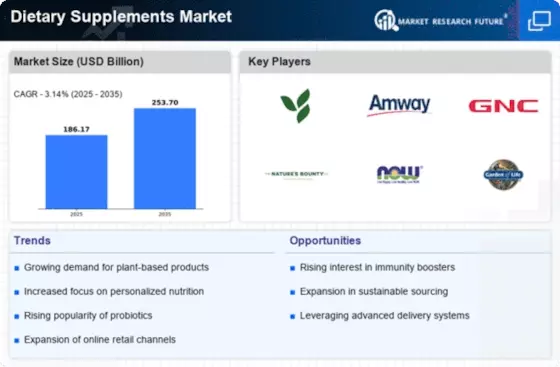
As per MRFR analysis, the Dietary Supplements Market was estimated at 180.5 USD Billion in 2024. The s dietary supplements industry is projected to grow from 186.17 USD Billion in 2025 to 253.7 USD Billion by 2035, exhibiting a compound annual growth rate (CAGR) of 3.14 during the forecast period 2025 - 2035.

Key Market Trends & Highlights

The dietary supplements market is experiencing a dynamic shift towards plant-based and mental health-focused products, driven by technological advancements and changing consumer preferences.

  • The rise of plant-based supplements is reshaping consumer choices, particularly in North America, where health consciousness is paramount.
  • Mental health-focused supplements are gaining traction, reflecting a broader societal shift towards holistic well-being in both North America and Asia-Pacific.
  • Technological advancements in supplement delivery methods are enhancing consumer convenience, particularly in the fast-growing sports nutrition segment.
  • Increasing health consciousness and the aging population are major drivers propelling growth in the nutritional support segment, especially in the context of e-commerce expansion.

Market Size & Forecast

2024 Market Size 180.5 (USD Billion)
2035 Market Size 253.7 (USD Billion)
CAGR (2025 - 2035) 3.14%
Largest Regional Market Share in 2024 North America

Major Players

Herbalife (US), Amway (US), GNC Holdings (US), Nature's Bounty (US), NOW Foods (US), Garden of Life (US), NutraBio Labs (US), Optimum Nutrition (US), USANA Health Sciences (US)

Market Trends

The Dietary Supplements Market is currently experiencing a dynamic evolution, driven by a confluence of consumer preferences and emerging health trends. As individuals increasingly prioritize wellness and preventive healthcare, the demand for dietary supplements has surged. This market encompasses a diverse array of products, including vitamins, minerals, herbal extracts, and protein powders, catering to various health needs and lifestyle choices. The growing awareness of the importance of nutrition in maintaining overall health appears to be a significant factor influencing purchasing decisions. Furthermore, the rise of e-commerce platforms has transformed how consumers access these products, making them more readily available than ever before. In addition to changing consumer behaviors, regulatory frameworks and scientific advancements are shaping the Dietary Supplements Market. Manufacturers are increasingly focusing on transparency and quality assurance, responding to consumer demands for safe and effective products. Innovations in formulation and delivery methods, such as gummies and powders, are also gaining traction, appealing to a broader audience. As the market continues to expand, it seems poised for further growth, with potential opportunities arising from the integration of technology and personalized nutrition solutions. Overall, the Dietary Supplements Market reflects a complex interplay of health consciousness, innovation, and consumer engagement, indicating a promising future for this sector.

Rise of Plant-Based Supplements

There is a noticeable shift towards plant-based dietary supplements, as consumers increasingly seek natural alternatives to synthetic products. This trend reflects a broader movement towards sustainability and health consciousness, with many individuals opting for supplements derived from botanical sources. Such products are perceived as safer and more aligned with holistic health practices.

Personalization in Supplementation

The concept of personalized nutrition is gaining traction within the Dietary Supplements Market. Consumers are increasingly interested in tailored supplements that address their specific health needs and preferences. This trend suggests a move towards individualized approaches, where products are designed based on genetic, lifestyle, and dietary factors.

Technological Integration in Product Development

Advancements in technology are playing a crucial role in the evolution of the Dietary Supplements Market. Innovations such as smart packaging and online health assessments are enhancing consumer engagement and product accessibility. This integration of technology not only improves the user experience but also facilitates better tracking of health outcomes.

Dietary Supplements Market Market Drivers

Aging Population

The demographic shift towards an aging population is likely to have a profound impact on the dietary supplements Market. As individuals age, their nutritional needs change, often leading to an increased reliance on dietary supplements to maintain health and vitality. Data suggests that the population aged 65 and older is expected to double by 2050, which could significantly boost the demand for supplements aimed at addressing age-related health concerns. This demographic trend compels manufacturers to innovate and develop products specifically tailored for older adults, thereby driving growth within the Dietary Supplements Market. The focus on maintaining quality of life among seniors is likely to further enhance the market's potential.

E-commerce Growth

The rapid expansion of e-commerce platforms is transforming the way consumers access dietary supplements, thereby acting as a catalyst for the Dietary Supplements Market. With the convenience of online shopping, consumers are increasingly purchasing supplements through digital channels. Recent statistics indicate that online sales of dietary supplements have surged, accounting for a substantial portion of total sales. This shift not only broadens the consumer base but also allows for greater product variety and accessibility. As e-commerce continues to evolve, it is expected to play a pivotal role in shaping consumer purchasing behavior, ultimately driving growth in the Dietary Supplements Market.

Focus on Preventive Healthcare

The growing emphasis on preventive healthcare is emerging as a significant driver for the Dietary Supplements Market. Consumers are becoming more proactive about their health, seeking ways to prevent illnesses rather than merely treating them. This shift in mindset is leading to increased consumption of dietary supplements that promote immune health, cardiovascular wellness, and overall vitality. Market data indicates that preventive health supplements are witnessing a notable rise in demand, reflecting a broader trend towards holistic health management. As healthcare systems increasingly advocate for preventive measures, the Dietary Supplements Market is likely to benefit from this paradigm shift.

Increasing Health Consciousness

The rising awareness regarding health and wellness among consumers appears to be a primary driver for the Dietary Supplements Market. Individuals are increasingly prioritizing their health, leading to a surge in demand for dietary supplements that support various health goals. According to recent data, the market is projected to grow at a compound annual growth rate of approximately 8.5% over the next few years. This trend indicates that consumers are actively seeking products that enhance their overall well-being, including vitamins, minerals, and herbal supplements. As a result, manufacturers are expanding their product lines to cater to this growing demand, thereby contributing to the overall expansion of the Dietary Supplements Market.

Innovation in Product Formulations

Innovation in product formulations is a key driver for the Dietary Supplements Market, as manufacturers strive to meet evolving consumer preferences. The introduction of new ingredients, delivery methods, and formulations is enhancing the appeal of dietary supplements. For instance, the incorporation of probiotics, adaptogens, and superfoods into supplements is gaining traction among health-conscious consumers. This trend is supported by Market Research Future indicating that innovative products are more likely to capture consumer interest and drive sales. As companies continue to invest in research and development, the Dietary Supplements Market is expected to witness sustained growth fueled by these advancements.

Market Segment Insights

By Application: Nutritional Support (Largest) vs. Sports Nutrition (Fastest-Growing)

In the dietary supplements market, the application segment is diversified, with Nutritional Support holding the largest share, followed by Weight Management, General Wellness, and Sports Nutrition. Nutritional Support benefits from increasing health consciousness among consumers, leading to higher demand for supplements bolstering everyday nutrition. Sports Nutrition, while currently smaller in market share, is gaining ground with the rise in fitness trends and athletic participation, showcasing a promising trajectory for growth. Growth trends in the application segment are primarily driven by shifting consumer preferences toward healthier lifestyles and enhanced performance. Nutritional Support is benefitting from an aging population seeking to maintain their health through supplementation, while Sports Nutrition is experiencing rapid growth owing to the increasing involvement in fitness and sports activities among millennials and Gen Z. This shift in demographic behaviors underpins the overall positive outlook across these applications in the dietary supplements market.

Nutritional Support: Dominant vs. Sports Nutrition: Emerging

Nutritional Support holds a dominant position in the dietary supplements market by addressing essential health concerns such as vitamin deficiencies and general well-being. Its comprehensive range of products appeals to a broad audience, including those looking for basic nutritional boosters and individuals with specific dietary needs. Conversely, Sports Nutrition is emerging rapidly due to the increasing health awareness and performance-focused lifestyle among consumers. This segment includes protein supplements, amino acids, and recovery aids that cater to athletes and fitness enthusiasts. The surge in gym memberships and fitness applications has further propelled this growth, marking Sports Nutrition as a key player for future expansion in the dietary supplements arena.

By Formulation Type: Capsules (Largest) vs. Powders (Fastest-Growing)

In the dietary supplements market, the formulation type segment is primarily divided into capsules, tablets, powders, and liquids, with capsules holding the largest market share. Capsules have gained immense popularity among consumers for their ease of use and the ability to mask unpleasant tastes, resulting in a significant preference over other forms. Tablets follow closely, but powders and liquids are increasingly becoming relevant, catering to specific consumer needs and preferences.

Capsules (Dominant) vs. Powders (Emerging)

Capsules dominate the formulation type segment in the dietary supplements market due to their convenience, accurate dosage, and potential for easy absorption. They are particularly favored by health-conscious individuals who prefer a quick and unobtrusive method of supplementation. On the other hand, powders have emerged as the fastest-growing formulation type, appealing to fitness enthusiasts and health-conscious consumers seeking customizable options. The flexibility of powders allows for easy mixing with beverages, enhancing consumer experience, thus driving significant growth in this category as people look for innovative and versatile dietary solutions.

By Target Demographic: Adults (Largest) vs. Seniors (Fastest-Growing)

In the dietary supplements market, adults represent the largest segment, commanding a significant share due to their diverse health and wellness needs. This demographic includes individuals seeking to maintain health, prevent illnesses, and enhance overall well-being. Meanwhile, the senior segment is rapidly growing, driven by an aging population increasingly focused on health maintenance and disease prevention. Their growing awareness of dietary supplements plays a crucial role in this trend. The growth trends in the dietary supplements market are primarily influenced by the rising prevalence of health consciousness among consumers. Factors such as greater access to information, recommendations from healthcare professionals, and innovations in supplement formulations are driving growth across demographics. Seniors are particularly influenced by research highlighting the benefits of supplements for age-related health concerns, contributing to their status as the fastest-growing segment in this market.

Adults: Health Maintenance (Dominant) vs. Seniors: Preventive Care (Emerging)

The adult segment of the dietary supplements market is characterized by its focus on health maintenance, as many adults are increasingly turning to supplements to support their lifestyle and wellness goals. This demographic typically seeks products that promote overall health, energy, and vitality. The explosion of product options tailored to adults, including vitamins, minerals, and herbal supplements, underscores their dominant position. Conversely, the senior segment is emerging as a key player, with a strong emphasis on preventive care. Seniors are actively seeking supplements that address specific age-related health issues, such as joint health, cognitive support, and immune function. This growing demand reflects a shift towards proactive health management in older adults, increasing their market significance.

By Distribution Channel: Online Retail (Largest) vs. Health Food Stores (Fastest-Growing)

The distribution channel for dietary supplements reveals a competitive landscape, with online retail holding the largest market share. This segment appeals to consumers seeking convenience and extensive product availability, driving significant sales. In contrast, health food stores are emerging as a prominent segment, catering to health-conscious consumers looking for specialized products. Pharmacies and supermarkets play supportive roles in the distribution framework, providing essential channels but currently holding smaller shares compared to online and health food channels.

Distribution Channels: Online Retail (Dominant) vs. Health Food Stores (Emerging)

Online retail stands as the dominant distribution channel in the dietary supplements market, offering consumers unparalleled convenience and a vast array of products at their fingertips. This segment thrives on advancements in technology and changing consumer behavior, with an increasing preference for e-commerce. In contrast, health food stores are an emerging segment characterized by their focus on organic and natural products, appealing to a niche but growing consumer base. These stores benefit from personalized service and expert staff, fostering a loyal customer relationship that drives organic growth. While both segments have distinct strengths, their roles within the market continue to evolve, reflecting broader trends in health and wellness consumption.

Get more detailed insights about Dietary Supplements Market Research Report - Forecast till 2035

Regional Insights

North America : Market Leader in Supplements

North America continues to lead the dietary supplements market, holding a significant share of 72.1% in 2024. The growth is driven by increasing health consciousness, a rise in preventive healthcare, and a growing aging population. Regulatory support from agencies like the FDA ensures product safety and efficacy, further boosting consumer confidence in dietary supplements. The trend towards natural and organic products is also gaining traction, enhancing market demand. The United States is the primary market within North America, hosting major players such as Herbalife, Amway, and GNC Holdings. The competitive landscape is characterized by innovation and a focus on quality, with companies investing heavily in research and development. The presence of established brands and a robust distribution network contribute to the region's dominance, making it a hub for dietary supplement innovation and sales.

Europe : Emerging Market with Regulations

Europe's dietary supplements market is valued at €50.0 billion, driven by increasing consumer awareness regarding health and wellness. The region is witnessing a shift towards preventive healthcare, with a growing demand for natural and organic supplements. Regulatory frameworks, such as the EU Food Supplements Directive, play a crucial role in ensuring product safety and quality, fostering consumer trust and market growth. Leading countries in this market include Germany, France, and the UK, where health trends are significantly influencing consumer choices. The competitive landscape features both local and international brands, with companies like Nature's Bounty and NOW Foods making substantial inroads. The presence of stringent regulations encourages innovation, as companies strive to meet consumer demands for transparency and quality in their products.

Asia-Pacific : Rapid Growth and Demand

The Asia-Pacific dietary supplements market, valued at $45.0 billion, is experiencing rapid growth, fueled by rising disposable incomes and increasing health awareness among consumers. The region is characterized by a growing trend towards preventive healthcare and wellness, with consumers increasingly seeking supplements to enhance their health and well-being. Regulatory bodies are also becoming more active in ensuring product safety, which is vital for market expansion. Countries like China, Japan, and Australia are leading the charge in this burgeoning market. The competitive landscape is diverse, with both local and international players vying for market share. Companies such as USANA Health Sciences and Optimum Nutrition are establishing a strong presence, focusing on innovative products that cater to the unique health needs of the region's population. The increasing penetration of e-commerce is also facilitating market growth, making supplements more accessible to consumers.

Middle East and Africa : Untapped Market Potential

The Middle East and Africa dietary supplements market, valued at $13.4 billion, is still in its nascent stages but shows significant growth potential. Factors such as increasing urbanization, rising health awareness, and a growing middle class are driving demand for dietary supplements. Regulatory frameworks are gradually evolving, which is essential for ensuring product safety and consumer trust in this emerging market. Countries like South Africa and the UAE are at the forefront of this market, with a growing number of local and international brands entering the space. The competitive landscape is becoming more dynamic, with companies focusing on product innovation and marketing strategies tailored to local preferences. As health trends continue to gain traction, the region presents lucrative opportunities for growth in the dietary supplements sector.

Key Players and Competitive Insights

The s dietary supplements market is characterized by a dynamic competitive landscape, driven by increasing consumer awareness regarding health and wellness. Key players are actively engaging in strategies that emphasize innovation, digital transformation, and sustainability. Companies such as Herbalife (US), Amway (US), and GNC Holdings (US) are at the forefront, each adopting distinct operational focuses that collectively shape the competitive environment. Herbalife (US) has been enhancing its product portfolio through research and development, while Amway (US) is leveraging its extensive distribution network to penetrate emerging markets. GNC Holdings (US), on the other hand, is focusing on digital sales channels to adapt to changing consumer preferences, indicating a shift towards e-commerce as a primary sales avenue.The market structure appears moderately fragmented, with numerous players vying for market share. Key business tactics such as localizing manufacturing and optimizing supply chains are becoming increasingly prevalent. This fragmentation allows for a diverse range of products, catering to various consumer needs, while the collective influence of major players helps to stabilize market dynamics. The competitive strategies employed by these companies not only enhance their individual market positions but also contribute to a more robust overall market structure.In November 2025, Herbalife (US) announced a strategic partnership with a leading technology firm to develop a personalized nutrition app. This initiative aims to leverage data analytics to provide tailored supplement recommendations to consumers, thereby enhancing customer engagement and loyalty. The significance of this move lies in its potential to position Herbalife (US) as a pioneer in the personalized nutrition space, aligning with current consumer trends towards customized health solutions.In October 2025, GNC Holdings (US) launched a new line of plant-based supplements, responding to the growing demand for vegan and vegetarian options. This product line not only diversifies GNC's offerings but also reflects a broader industry trend towards plant-based nutrition. The strategic importance of this launch is underscored by the increasing consumer preference for sustainable and ethically sourced products, which could enhance GNC's market appeal and competitiveness.In September 2025, Amway (US) expanded its operations in Asia by opening a new manufacturing facility in Vietnam. This move is indicative of Amway's commitment to localizing production and optimizing its supply chain. By establishing a presence in a rapidly growing market, Amway (US) is likely to enhance its operational efficiency and reduce costs, thereby strengthening its competitive position in the region.As of December 2025, current trends in the Dietary Supplements Market are heavily influenced by digitalization, sustainability, and the integration of artificial intelligence (AI) in product development and marketing strategies. Strategic alliances are increasingly shaping the competitive landscape, enabling companies to pool resources and expertise. Looking ahead, competitive differentiation is expected to evolve, with a notable shift from price-based competition towards innovation, technology, and supply chain reliability. This transition suggests that companies that prioritize these aspects will likely gain a competitive edge in the evolving market.

Key Companies in the Dietary Supplements Market include

Industry Developments

A Market Research Future from May 2025 noted that, because to China's high consumption and growing health consciousness in the Americas, Asia-Pacific accounted for 46.1% of the worldwide market for vitamins and dietary supplements.

With a focus on sustainability, ethical sourcing, and quality control, MRFR reported a boom in AI-driven customized nutrition, plant-based components, nano-encapsulation, microalgae-based supplements, and probiotic/omega-3 breakthroughs in March 2025.

Lion's-mane mushrooms for cognition, clear whey protein, NAD boosters for cellular aging, berberine for glucose control, tailored probiotics, and magnesium L-threonate for brain health were among the growing trends for 2025 that Health.com recognized in January 2025.

In order to address health hazards and regulatory inadequacies, the U.S. states of New Jersey and New York banned weight-loss and muscle-building supplements for minors in February 2025 and imposed civil fines.In June 2024, Evonik strengthened its sustainability approach by expanding its Healthberry line in the U.S. and introducing AvailOm (an omega-3 powder with Boswellia) and INVIVOBIOTICS synbiotics for gut health at Vitafoods Europe.

In addition to these, Market Reserach Future noted that consumer demand for supplements related to women's health, weight management, gut health, and immunity was increasing. In 2025, automation, artificial intelligence, smart packaging, and 3D-printed customized tablets were the top manufacturing innovations.

Future Outlook

Dietary Supplements Market Future Outlook

The s dietary supplements market is projected to grow at a 3.14% CAGR from 2024 to 2035, driven by increasing health awareness, aging populations, and rising disposable incomes.

New opportunities lie in:

  • Development of personalized supplement formulations based on genetic profiling.
  • Expansion into emerging markets with tailored marketing strategies.
  • Integration of e-commerce platforms for direct-to-consumer sales channels.

By 2035, the market is expected to be robust, reflecting evolving consumer preferences and innovative product offerings.

Market Segmentation

Dietary Supplements Market Application Outlook

  • Nutritional Support
  • Weight Management
  • Sports Nutrition
  • General Wellness

Dietary Supplements Market Formulation Type Outlook

  • Capsules
  • Tablets
  • Powders
  • Liquids

Dietary Supplements Market Target Demographic Outlook

  • Adults
  • Seniors
  • Athletes
  • Children

Dietary Supplements Market Distribution Channel Outlook

  • Online Retail
  • Health Food Stores
  • Pharmacies
  • Supermarkets

Report Scope

MARKET SIZE 2024180.5(USD Billion)
MARKET SIZE 2025186.17(USD Billion)
MARKET SIZE 2035253.7(USD Billion)
COMPOUND ANNUAL GROWTH RATE (CAGR)3.14% (2025 - 2035)
REPORT COVERAGERevenue Forecast, Competitive Landscape, Growth Factors, and Trends
BASE YEAR2024
Market Forecast Period2025 - 2035
Historical Data2019 - 2024
Market Forecast UnitsUSD Billion
Key Companies ProfiledHerbalife (US), Amway (US), GNC Holdings (US), Nature's Bounty (US), NOW Foods (US), Garden of Life (US), NutraBio Labs (US), Optimum Nutrition (US), USANA Health Sciences (US)
Segments CoveredApplication, Formulation Type, Target Demographic, Distribution Channel
Key Market OpportunitiesGrowing consumer demand for personalized nutrition in the Dietary Supplements Market presents significant opportunities.
Key Market DynamicsRising consumer demand for natural ingredients drives innovation and competition in the dietary supplements market.
Countries CoveredNorth America, Europe, APAC, South America, MEA

FAQs

What is the current valuation of the Dietary Supplements Market in 2024?

The Dietary Supplements Market was valued at 203.6 USD Billion in 2024.

What is the projected market valuation for the Dietary Supplements Market in 2035?

The Dietary Supplements Market is projected to reach 453.97 USD Billion by 2035.

What is the expected CAGR for the Dietary Supplements Market from 2025 to 2035?

The expected CAGR for the Dietary Supplements Market during the forecast period 2025 - 2035 is 7.56%.

Which distribution channel is anticipated to generate the highest revenue in the Dietary Supplements Market?

Supermarkets are expected to generate the highest revenue, with a projected valuation of 130.0 USD Billion by 2035.

What are the leading forms of dietary supplements in terms of market valuation?

Capsules and soft gels are leading forms, with projected valuations of 110.0 USD Billion and 128.97 USD Billion respectively by 2035.

Which demographic segment is projected to have the highest market share in the Dietary Supplements Market?

Adults are projected to hold the highest market share, with an expected valuation of 183.0 USD Billion by 2035.

Who are the key players in the Dietary Supplements Market?

Key players include Herbalife, Amway, GNC Holdings, and Nature's Bounty, among others.

What is the projected growth for the vitamins segment in the Dietary Supplements Market?

The vitamins segment is projected to grow to 90.0 USD Billion by 2035.

How does the market for herbal supplements compare to that of amino acids?

The herbal supplements market is projected to reach 60.0 USD Billion, significantly higher than the amino acids segment at 40.0 USD Billion by 2035.

What is the expected revenue from online sales in the Dietary Supplements Market by 2035?

Online sales are expected to generate a revenue of 100.0 USD Billion by 2035.

  1. SECTION I: EXECUTIVE SUMMARY AND KEY HIGHLIGHTS
    1. EXECUTIVE SUMMARY
      1. Market Overview
      2. Key Findings
      3. Market Segmentation
      4. Competitive Landscape
      5. Challenges and Opportunities
      6. Future Outlook 2
  2. SECTION II: SCOPING, METHODOLOGY AND MARKET STRUCTURE
    1. MARKET INTRODUCTION
      1. Definition
      2. Scope of the study
    2. RESEARCH METHODOLOGY
      1. Overview
      2. Data Mining
      3. Secondary Research
      4. Primary Research
      5. Forecasting Model
      6. Market Size Estimation
      7. Data Triangulation
      8. Validation 3
  3. SECTION III: QUALITATIVE ANALYSIS
    1. MARKET DYNAMICS
      1. Overview
      2. Drivers
      3. Restraints
      4. Opportunities
    2. MARKET FACTOR ANALYSIS
      1. Value chain Analysis
      2. Porter's Five Forces Analysis
      3. COVID-19 Impact Analysis
  4. SECTION IV: QUANTITATIVE ANALYSIS
    1. Food, Beverages & Nutrition, BY Form (USD Billion)
      1. Tablets
      2. Capsules
      3. Powders
      4. Liquids
      5. Soft gels
    2. Food, Beverages & Nutrition, BY Ingredients (USD Billion)
      1. Vitamins
      2. Minerals
      3. Herbs
      4. Amino Acids
      5. Enzymes
    3. Food, Beverages & Nutrition, BY Distribution Channel (USD Billion)
      1. Online
      2. Supermarkets
      3. Health Food Stores
      4. Pharmacies
      5. Direct Sales
    4. Food, Beverages & Nutrition, BY End-user (USD Billion)
      1. Adults
      2. Children
      3. Pregnant Women
      4. Elderly
    5. Food, Beverages & Nutrition, BY Region (USD Billion)
      1. North America
      2. Europe
      3. APAC
      4. South America
      5. MEA
  5. SECTION V: COMPETITIVE ANALYSIS
    1. Competitive Landscape
      1. Overview
      2. Competitive Analysis
      3. Market share Analysis
      4. Major Growth Strategy in the Food, Beverages & Nutrition
      5. Competitive Benchmarking
      6. Leading Players in Terms of Number of Developments in the Food, Beverages & Nutrition
      7. Key developments and growth strategies
      8. Major Players Financial Matrix
    2. Company Profiles
      1. Herbalife (US)
      2. Amway (US)
      3. GNC Holdings (US)
      4. Nature's Bounty (US)
      5. NOW Foods (US)
      6. Garden of Life (US)
      7. NutraBio Labs (US)
      8. Optimum Nutrition (US)
      9. USANA Health Sciences (US)
    3. Appendix
      1. References
      2. Related Reports 6 LIST OF FIGURES
    4. MARKET SYNOPSIS
    5. NORTH AMERICA MARKET ANALYSIS
    6. US MARKET ANALYSIS BY FORM
    7. US MARKET ANALYSIS BY INGREDIENTS
    8. US MARKET ANALYSIS BY DISTRIBUTION CHANNEL
    9. US MARKET ANALYSIS BY END-USER
    10. CANADA MARKET ANALYSIS BY FORM
    11. CANADA MARKET ANALYSIS BY INGREDIENTS
    12. CANADA MARKET ANALYSIS BY DISTRIBUTION CHANNEL
    13. CANADA MARKET ANALYSIS BY END-USER
    14. EUROPE MARKET ANALYSIS
    15. GERMANY MARKET ANALYSIS BY FORM
    16. GERMANY MARKET ANALYSIS BY INGREDIENTS
    17. GERMANY MARKET ANALYSIS BY DISTRIBUTION CHANNEL
    18. GERMANY MARKET ANALYSIS BY END-USER
    19. UK MARKET ANALYSIS BY FORM
    20. UK MARKET ANALYSIS BY INGREDIENTS
    21. UK MARKET ANALYSIS BY DISTRIBUTION CHANNEL
    22. UK MARKET ANALYSIS BY END-USER
    23. FRANCE MARKET ANALYSIS BY FORM
    24. FRANCE MARKET ANALYSIS BY INGREDIENTS
    25. FRANCE MARKET ANALYSIS BY DISTRIBUTION CHANNEL
    26. FRANCE MARKET ANALYSIS BY END-USER
    27. RUSSIA MARKET ANALYSIS BY FORM
    28. RUSSIA MARKET ANALYSIS BY INGREDIENTS
    29. RUSSIA MARKET ANALYSIS BY DISTRIBUTION CHANNEL
    30. RUSSIA MARKET ANALYSIS BY END-USER
    31. ITALY MARKET ANALYSIS BY FORM
    32. ITALY MARKET ANALYSIS BY INGREDIENTS
    33. ITALY MARKET ANALYSIS BY DISTRIBUTION CHANNEL
    34. ITALY MARKET ANALYSIS BY END-USER
    35. SPAIN MARKET ANALYSIS BY FORM
    36. SPAIN MARKET ANALYSIS BY INGREDIENTS
    37. SPAIN MARKET ANALYSIS BY DISTRIBUTION CHANNEL
    38. SPAIN MARKET ANALYSIS BY END-USER
    39. REST OF EUROPE MARKET ANALYSIS BY FORM
    40. REST OF EUROPE MARKET ANALYSIS BY INGREDIENTS
    41. REST OF EUROPE MARKET ANALYSIS BY DISTRIBUTION CHANNEL
    42. REST OF EUROPE MARKET ANALYSIS BY END-USER
    43. APAC MARKET ANALYSIS
    44. CHINA MARKET ANALYSIS BY FORM
    45. CHINA MARKET ANALYSIS BY INGREDIENTS
    46. CHINA MARKET ANALYSIS BY DISTRIBUTION CHANNEL
    47. CHINA MARKET ANALYSIS BY END-USER
    48. INDIA MARKET ANALYSIS BY FORM
    49. INDIA MARKET ANALYSIS BY INGREDIENTS
    50. INDIA MARKET ANALYSIS BY DISTRIBUTION CHANNEL
    51. INDIA MARKET ANALYSIS BY END-USER
    52. JAPAN MARKET ANALYSIS BY FORM
    53. JAPAN MARKET ANALYSIS BY INGREDIENTS
    54. JAPAN MARKET ANALYSIS BY DISTRIBUTION CHANNEL
    55. JAPAN MARKET ANALYSIS BY END-USER
    56. SOUTH KOREA MARKET ANALYSIS BY FORM
    57. SOUTH KOREA MARKET ANALYSIS BY INGREDIENTS
    58. SOUTH KOREA MARKET ANALYSIS BY DISTRIBUTION CHANNEL
    59. SOUTH KOREA MARKET ANALYSIS BY END-USER
    60. MALAYSIA MARKET ANALYSIS BY FORM
    61. MALAYSIA MARKET ANALYSIS BY INGREDIENTS
    62. MALAYSIA MARKET ANALYSIS BY DISTRIBUTION CHANNEL
    63. MALAYSIA MARKET ANALYSIS BY END-USER
    64. THAILAND MARKET ANALYSIS BY FORM
    65. THAILAND MARKET ANALYSIS BY INGREDIENTS
    66. THAILAND MARKET ANALYSIS BY DISTRIBUTION CHANNEL
    67. THAILAND MARKET ANALYSIS BY END-USER
    68. INDONESIA MARKET ANALYSIS BY FORM
    69. INDONESIA MARKET ANALYSIS BY INGREDIENTS
    70. INDONESIA MARKET ANALYSIS BY DISTRIBUTION CHANNEL
    71. INDONESIA MARKET ANALYSIS BY END-USER
    72. REST OF APAC MARKET ANALYSIS BY FORM
    73. REST OF APAC MARKET ANALYSIS BY INGREDIENTS
    74. REST OF APAC MARKET ANALYSIS BY DISTRIBUTION CHANNEL
    75. REST OF APAC MARKET ANALYSIS BY END-USER
    76. SOUTH AMERICA MARKET ANALYSIS
    77. BRAZIL MARKET ANALYSIS BY FORM
    78. BRAZIL MARKET ANALYSIS BY INGREDIENTS
    79. BRAZIL MARKET ANALYSIS BY DISTRIBUTION CHANNEL
    80. BRAZIL MARKET ANALYSIS BY END-USER
    81. MEXICO MARKET ANALYSIS BY FORM
    82. MEXICO MARKET ANALYSIS BY INGREDIENTS
    83. MEXICO MARKET ANALYSIS BY DISTRIBUTION CHANNEL
    84. MEXICO MARKET ANALYSIS BY END-USER
    85. ARGENTINA MARKET ANALYSIS BY FORM
    86. ARGENTINA MARKET ANALYSIS BY INGREDIENTS
    87. ARGENTINA MARKET ANALYSIS BY DISTRIBUTION CHANNEL
    88. ARGENTINA MARKET ANALYSIS BY END-USER
    89. REST OF SOUTH AMERICA MARKET ANALYSIS BY FORM
    90. REST OF SOUTH AMERICA MARKET ANALYSIS BY INGREDIENTS
    91. REST OF SOUTH AMERICA MARKET ANALYSIS BY DISTRIBUTION CHANNEL
    92. REST OF SOUTH AMERICA MARKET ANALYSIS BY END-USER
    93. MEA MARKET ANALYSIS
    94. GCC COUNTRIES MARKET ANALYSIS BY FORM
    95. GCC COUNTRIES MARKET ANALYSIS BY INGREDIENTS
    96. GCC COUNTRIES MARKET ANALYSIS BY DISTRIBUTION CHANNEL
    97. GCC COUNTRIES MARKET ANALYSIS BY END-USER
    98. SOUTH AFRICA MARKET ANALYSIS BY FORM
    99. SOUTH AFRICA MARKET ANALYSIS BY INGREDIENTS
    100. SOUTH AFRICA MARKET ANALYSIS BY DISTRIBUTION CHANNEL
    101. SOUTH AFRICA MARKET ANALYSIS BY END-USER
    102. REST OF MEA MARKET ANALYSIS BY FORM
    103. REST OF MEA MARKET ANALYSIS BY INGREDIENTS
    104. REST OF MEA MARKET ANALYSIS BY DISTRIBUTION CHANNEL
    105. REST OF MEA MARKET ANALYSIS BY END-USER
    106. KEY BUYING CRITERIA OF FOOD, BEVERAGES & NUTRITION
    107. RESEARCH PROCESS OF MRFR
    108. DRO ANALYSIS OF FOOD, BEVERAGES & NUTRITION
    109. DRIVERS IMPACT ANALYSIS: FOOD, BEVERAGES & NUTRITION
    110. RESTRAINTS IMPACT ANALYSIS: FOOD, BEVERAGES & NUTRITION
    111. SUPPLY / VALUE CHAIN: FOOD, BEVERAGES & NUTRITION
    112. FOOD, BEVERAGES & NUTRITION, BY FORM, 2024 (% SHARE)
    113. FOOD, BEVERAGES & NUTRITION, BY FORM, 2024 TO 2035 (USD Billion)
    114. FOOD, BEVERAGES & NUTRITION, BY INGREDIENTS, 2024 (% SHARE)
    115. FOOD, BEVERAGES & NUTRITION, BY INGREDIENTS, 2024 TO 2035 (USD Billion)
    116. FOOD, BEVERAGES & NUTRITION, BY DISTRIBUTION CHANNEL, 2024 (% SHARE)
    117. FOOD, BEVERAGES & NUTRITION, BY DISTRIBUTION CHANNEL, 2024 TO 2035 (USD Billion)
    118. FOOD, BEVERAGES & NUTRITION, BY END-USER, 2024 (% SHARE)
    119. FOOD, BEVERAGES & NUTRITION, BY END-USER, 2024 TO 2035 (USD Billion)
    120. BENCHMARKING OF MAJOR COMPETITORS 7 LIST OF TABLES
    121. LIST OF ASSUMPTIONS
    122. North America MARKET SIZE ESTIMATES; FORECAST
      1. BY FORM, 2025-2035 (USD Billion)
      2. BY INGREDIENTS, 2025-2035 (USD Billion)
      3. BY DISTRIBUTION CHANNEL, 2025-2035 (USD Billion)
      4. BY END-USER, 2025-2035 (USD Billion)
    123. US MARKET SIZE ESTIMATES; FORECAST
      1. BY FORM, 2025-2035 (USD Billion)
      2. BY INGREDIENTS, 2025-2035 (USD Billion)
      3. BY DISTRIBUTION CHANNEL, 2025-2035 (USD Billion)
      4. BY END-USER, 2025-2035 (USD Billion)
    124. Canada MARKET SIZE ESTIMATES; FORECAST
      1. BY FORM, 2025-2035 (USD Billion)
      2. BY INGREDIENTS, 2025-2035 (USD Billion)
      3. BY DISTRIBUTION CHANNEL, 2025-2035 (USD Billion)
      4. BY END-USER, 2025-2035 (USD Billion)
    125. Europe MARKET SIZE ESTIMATES; FORECAST
      1. BY FORM, 2025-2035 (USD Billion)
      2. BY INGREDIENTS, 2025-2035 (USD Billion)
      3. BY DISTRIBUTION CHANNEL, 2025-2035 (USD Billion)
      4. BY END-USER, 2025-2035 (USD Billion)
    126. Germany MARKET SIZE ESTIMATES; FORECAST
      1. BY FORM, 2025-2035 (USD Billion)
      2. BY INGREDIENTS, 2025-2035 (USD Billion)
      3. BY DISTRIBUTION CHANNEL, 2025-2035 (USD Billion)
      4. BY END-USER, 2025-2035 (USD Billion)
    127. UK MARKET SIZE ESTIMATES; FORECAST
      1. BY FORM, 2025-2035 (USD Billion)
      2. BY INGREDIENTS, 2025-2035 (USD Billion)
      3. BY DISTRIBUTION CHANNEL, 2025-2035 (USD Billion)
      4. BY END-USER, 2025-2035 (USD Billion)
    128. France MARKET SIZE ESTIMATES; FORECAST
      1. BY FORM, 2025-2035 (USD Billion)
      2. BY INGREDIENTS, 2025-2035 (USD Billion)
      3. BY DISTRIBUTION CHANNEL, 2025-2035 (USD Billion)
      4. BY END-USER, 2025-2035 (USD Billion)
    129. Russia MARKET SIZE ESTIMATES; FORECAST
      1. BY FORM, 2025-2035 (USD Billion)
      2. BY INGREDIENTS, 2025-2035 (USD Billion)
      3. BY DISTRIBUTION CHANNEL, 2025-2035 (USD Billion)
      4. BY END-USER, 2025-2035 (USD Billion)
    130. Italy MARKET SIZE ESTIMATES; FORECAST
      1. BY FORM, 2025-2035 (USD Billion)
      2. BY INGREDIENTS, 2025-2035 (USD Billion)
      3. BY DISTRIBUTION CHANNEL, 2025-2035 (USD Billion)
      4. BY END-USER, 2025-2035 (USD Billion)
    131. Spain MARKET SIZE ESTIMATES; FORECAST
      1. BY FORM, 2025-2035 (USD Billion)
      2. BY INGREDIENTS, 2025-2035 (USD Billion)
      3. BY DISTRIBUTION CHANNEL, 2025-2035 (USD Billion)
      4. BY END-USER, 2025-2035 (USD Billion)
    132. Rest of Europe MARKET SIZE ESTIMATES; FORECAST
      1. BY FORM, 2025-2035 (USD Billion)
      2. BY INGREDIENTS, 2025-2035 (USD Billion)
      3. BY DISTRIBUTION CHANNEL, 2025-2035 (USD Billion)
      4. BY END-USER, 2025-2035 (USD Billion)
    133. APAC MARKET SIZE ESTIMATES; FORECAST
      1. BY FORM, 2025-2035 (USD Billion)
      2. BY INGREDIENTS, 2025-2035 (USD Billion)
      3. BY DISTRIBUTION CHANNEL, 2025-2035 (USD Billion)
      4. BY END-USER, 2025-2035 (USD Billion)
    134. China MARKET SIZE ESTIMATES; FORECAST
      1. BY FORM, 2025-2035 (USD Billion)
      2. BY INGREDIENTS, 2025-2035 (USD Billion)
      3. BY DISTRIBUTION CHANNEL, 2025-2035 (USD Billion)
      4. BY END-USER, 2025-2035 (USD Billion)
    135. India MARKET SIZE ESTIMATES; FORECAST
      1. BY FORM, 2025-2035 (USD Billion)
      2. BY INGREDIENTS, 2025-2035 (USD Billion)
      3. BY DISTRIBUTION CHANNEL, 2025-2035 (USD Billion)
      4. BY END-USER, 2025-2035 (USD Billion)
    136. Japan MARKET SIZE ESTIMATES; FORECAST
      1. BY FORM, 2025-2035 (USD Billion)
      2. BY INGREDIENTS, 2025-2035 (USD Billion)
      3. BY DISTRIBUTION CHANNEL, 2025-2035 (USD Billion)
      4. BY END-USER, 2025-2035 (USD Billion)
    137. South Korea MARKET SIZE ESTIMATES; FORECAST
      1. BY FORM, 2025-2035 (USD Billion)
      2. BY INGREDIENTS, 2025-2035 (USD Billion)
      3. BY DISTRIBUTION CHANNEL, 2025-2035 (USD Billion)
      4. BY END-USER, 2025-2035 (USD Billion)
    138. Malaysia MARKET SIZE ESTIMATES; FORECAST
      1. BY FORM, 2025-2035 (USD Billion)
      2. BY INGREDIENTS, 2025-2035 (USD Billion)
      3. BY DISTRIBUTION CHANNEL, 2025-2035 (USD Billion)
      4. BY END-USER, 2025-2035 (USD Billion)
    139. Thailand MARKET SIZE ESTIMATES; FORECAST
      1. BY FORM, 2025-2035 (USD Billion)
      2. BY INGREDIENTS, 2025-2035 (USD Billion)
      3. BY DISTRIBUTION CHANNEL, 2025-2035 (USD Billion)
      4. BY END-USER, 2025-2035 (USD Billion)
    140. Indonesia MARKET SIZE ESTIMATES; FORECAST
      1. BY FORM, 2025-2035 (USD Billion)
      2. BY INGREDIENTS, 2025-2035 (USD Billion)
      3. BY DISTRIBUTION CHANNEL, 2025-2035 (USD Billion)
      4. BY END-USER, 2025-2035 (USD Billion)
    141. Rest of APAC MARKET SIZE ESTIMATES; FORECAST
      1. BY FORM, 2025-2035 (USD Billion)
      2. BY INGREDIENTS, 2025-2035 (USD Billion)
      3. BY DISTRIBUTION CHANNEL, 2025-2035 (USD Billion)
      4. BY END-USER, 2025-2035 (USD Billion)
    142. South America MARKET SIZE ESTIMATES; FORECAST
      1. BY FORM, 2025-2035 (USD Billion)
      2. BY INGREDIENTS, 2025-2035 (USD Billion)
      3. BY DISTRIBUTION CHANNEL, 2025-2035 (USD Billion)
      4. BY END-USER, 2025-2035 (USD Billion)
    143. Brazil MARKET SIZE ESTIMATES; FORECAST
      1. BY FORM, 2025-2035 (USD Billion)
      2. BY INGREDIENTS, 2025-2035 (USD Billion)
      3. BY DISTRIBUTION CHANNEL, 2025-2035 (USD Billion)
      4. BY END-USER, 2025-2035 (USD Billion)
    144. Mexico MARKET SIZE ESTIMATES; FORECAST
      1. BY FORM, 2025-2035 (USD Billion)
      2. BY INGREDIENTS, 2025-2035 (USD Billion)
      3. BY DISTRIBUTION CHANNEL, 2025-2035 (USD Billion)
      4. BY END-USER, 2025-2035 (USD Billion)
    145. Argentina MARKET SIZE ESTIMATES; FORECAST
      1. BY FORM, 2025-2035 (USD Billion)
      2. BY INGREDIENTS, 2025-2035 (USD Billion)
      3. BY DISTRIBUTION CHANNEL, 2025-2035 (USD Billion)
      4. BY END-USER, 2025-2035 (USD Billion)
    146. Rest of South America MARKET SIZE ESTIMATES; FORECAST
      1. BY FORM, 2025-2035 (USD Billion)
      2. BY INGREDIENTS, 2025-2035 (USD Billion)
      3. BY DISTRIBUTION CHANNEL, 2025-2035 (USD Billion)
      4. BY END-USER, 2025-2035 (USD Billion)
    147. MEA MARKET SIZE ESTIMATES; FORECAST
      1. BY FORM, 2025-2035 (USD Billion)
      2. BY INGREDIENTS, 2025-2035 (USD Billion)
      3. BY DISTRIBUTION CHANNEL, 2025-2035 (USD Billion)
      4. BY END-USER, 2025-2035 (USD Billion)
    148. GCC Countries MARKET SIZE ESTIMATES; FORECAST
      1. BY FORM, 2025-2035 (USD Billion)
      2. BY INGREDIENTS, 2025-2035 (USD Billion)
      3. BY DISTRIBUTION CHANNEL, 2025-2035 (USD Billion)
      4. BY END-USER, 2025-2035 (USD Billion)
    149. South Africa MARKET SIZE ESTIMATES; FORECAST
      1. BY FORM, 2025-2035 (USD Billion)
      2. BY INGREDIENTS, 2025-2035 (USD Billion)
      3. BY DISTRIBUTION CHANNEL, 2025-2035 (USD Billion)
      4. BY END-USER, 2025-2035 (USD Billion)
    150. Rest of MEA MARKET SIZE ESTIMATES; FORECAST
      1. BY FORM, 2025-2035 (USD Billion)
      2. BY INGREDIENTS, 2025-2035 (USD Billion)
      3. BY DISTRIBUTION CHANNEL, 2025-2035 (USD Billion)
      4. BY END-USER, 2025-2035 (USD Billion)
    151. PRODUCT LAUNCH/PRODUCT DEVELOPMENT/APPROVAL
    152. ACQUISITION/PARTNERSHIP

Dietary Supplements Market Segmentation

Dietary Supplements Market By Form (USD Billion, 2019-2035)

Tablets

Capsules

Powders

Liquids

Soft gels

Dietary Supplements Market By Ingredients (USD Billion, 2019-2035)

Vitamins

Minerals

Herbs

Amino Acids

Enzymes


Dietary Supplements Market By Distribution Channel (USD Billion, 2019-2035)

Online

Supermarkets

Health Food Stores

Pharmacies

Direct Sales


Dietary Supplements Market By End User (USD Billion, 2019-2035)

Adults

Children

Pregnant Women

Elderly


Dietary Supplements Market By Regional (USD Billion, 2019-2035)

North America

Europe

South America

Asia Pacific

Middle East and Africa


Dietary Supplements Market Regional Outlook (USD Billion, 2019-2035)

North America Outlook (USD Billion, 2019-2035)

North America Dietary Supplements Market by Form Type

Tablets

Capsules

Powders

Liquids

Soft gels

North America Dietary Supplements Market by Ingredients Type

Vitamins

Minerals

Herbs

Amino Acids

Enzymes

North America Dietary Supplements Market by Distribution Channel Type

Online

Supermarkets

Health Food Stores

Pharmacies

Direct Sales

North America Dietary Supplements Market by End User Type

Adults

Children

Pregnant Women

Elderly

North America Dietary Supplements Market by Regional Type

US

Canada

US Outlook (USD Billion, 2019-2035)

US Dietary Supplements Market by Form Type

Tablets

Capsules

Powders

Liquids

Soft gels

US Dietary Supplements Market by Ingredients Type

Vitamins

Minerals

Herbs

Amino Acids

Enzymes

US Dietary Supplements Market by Distribution Channel Type

Online

Supermarkets

Health Food Stores

Pharmacies

Direct Sales

US Dietary Supplements Market by End User Type

Adults

Children

Pregnant Women

Elderly

CANADA Outlook (USD Billion, 2019-2035)

CANADA Dietary Supplements Market by Form Type

Tablets

Capsules

Powders

Liquids

Soft gels

CANADA Dietary Supplements Market by Ingredients Type

Vitamins

Minerals

Herbs

Amino Acids

Enzymes

CANADA Dietary Supplements Market by Distribution Channel Type

Online

Supermarkets

Health Food Stores

Pharmacies

Direct Sales

CANADA Dietary Supplements Market by End User Type

Adults

Children

Pregnant Women

Elderly

Europe Outlook (USD Billion, 2019-2035)

Europe Dietary Supplements Market by Form Type

Tablets

Capsules

Powders

Liquids

Soft gels

Europe Dietary Supplements Market by Ingredients Type

Vitamins

Minerals

Herbs

Amino Acids

Enzymes

Europe Dietary Supplements Market by Distribution Channel Type

Online

Supermarkets

Health Food Stores

Pharmacies

Direct Sales

Europe Dietary Supplements Market by End User Type

Adults

Children

Pregnant Women

Elderly

Europe Dietary Supplements Market by Regional Type

Germany

UK

France

Russia

Italy

Spain

Rest of Europe

GERMANY Outlook (USD Billion, 2019-2035)

GERMANY Dietary Supplements Market by Form Type

Tablets

Capsules

Powders

Liquids

Soft gels

GERMANY Dietary Supplements Market by Ingredients Type

Vitamins

Minerals

Herbs

Amino Acids

Enzymes

GERMANY Dietary Supplements Market by Distribution Channel Type

Online

Supermarkets

Health Food Stores

Pharmacies

Direct Sales

GERMANY Dietary Supplements Market by End User Type

Adults

Children

Pregnant Women

Elderly

UK Outlook (USD Billion, 2019-2035)

UK Dietary Supplements Market by Form Type

Tablets

Capsules

Powders

Liquids

Soft gels

UK Dietary Supplements Market by Ingredients Type

Vitamins

Minerals

Herbs

Amino Acids

Enzymes

UK Dietary Supplements Market by Distribution Channel Type

Online

Supermarkets

Health Food Stores

Pharmacies

Direct Sales

UK Dietary Supplements Market by End User Type

Adults

Children

Pregnant Women

Elderly

FRANCE Outlook (USD Billion, 2019-2035)

FRANCE Dietary Supplements Market by Form Type

Tablets

Capsules

Powders

Liquids

Soft gels

FRANCE Dietary Supplements Market by Ingredients Type

Vitamins

Minerals

Herbs

Amino Acids

Enzymes

FRANCE Dietary Supplements Market by Distribution Channel Type

Online

Supermarkets

Health Food Stores

Pharmacies

Direct Sales

FRANCE Dietary Supplements Market by End User Type

Adults

Children

Pregnant Women

Elderly

RUSSIA Outlook (USD Billion, 2019-2035)

RUSSIA Dietary Supplements Market by Form Type

Tablets

Capsules

Powders

Liquids

Soft gels

RUSSIA Dietary Supplements Market by Ingredients Type

Vitamins

Minerals

Herbs

Amino Acids

Enzymes

RUSSIA Dietary Supplements Market by Distribution Channel Type

Online

Supermarkets

Health Food Stores

Pharmacies

Direct Sales

RUSSIA Dietary Supplements Market by End User Type

Adults

Children

Pregnant Women

Elderly

ITALY Outlook (USD Billion, 2019-2035)

ITALY Dietary Supplements Market by Form Type

Tablets

Capsules

Powders

Liquids

Soft gels

ITALY Dietary Supplements Market by Ingredients Type

Vitamins

Minerals

Herbs

Amino Acids

Enzymes

ITALY Dietary Supplements Market by Distribution Channel Type

Online

Supermarkets

Health Food Stores

Pharmacies

Direct Sales

ITALY Dietary Supplements Market by End User Type

Adults

Children

Pregnant Women

Elderly

SPAIN Outlook (USD Billion, 2019-2035)

SPAIN Dietary Supplements Market by Form Type

Tablets

Capsules

Powders

Liquids

Soft gels

SPAIN Dietary Supplements Market by Ingredients Type

Vitamins

Minerals

Herbs

Amino Acids

Enzymes

SPAIN Dietary Supplements Market by Distribution Channel Type

Online

Supermarkets

Health Food Stores

Pharmacies

Direct Sales

SPAIN Dietary Supplements Market by End User Type

Adults

Children

Pregnant Women

Elderly

REST OF EUROPE Outlook (USD Billion, 2019-2035)

REST OF EUROPE Dietary Supplements Market by Form Type

Tablets

Capsules

Powders

Liquids

Soft gels

REST OF EUROPE Dietary Supplements Market by Ingredients Type

Vitamins

Minerals

Herbs

Amino Acids

Enzymes

REST OF EUROPE Dietary Supplements Market by Distribution Channel Type

Online

Supermarkets

Health Food Stores

Pharmacies

Direct Sales

REST OF EUROPE Dietary Supplements Market by End User Type

Adults

Children

Pregnant Women

Elderly

APAC Outlook (USD Billion, 2019-2035)

APAC Dietary Supplements Market by Form Type

Tablets

Capsules

Powders

Liquids

Soft gels

APAC Dietary Supplements Market by Ingredients Type

Vitamins

Minerals

Herbs

Amino Acids

Enzymes

APAC Dietary Supplements Market by Distribution Channel Type

Online

Supermarkets

Health Food Stores

Pharmacies

Direct Sales

APAC Dietary Supplements Market by End User Type

Adults

Children

Pregnant Women

Elderly

APAC Dietary Supplements Market by Regional Type

China

India

Japan

South Korea

Malaysia

Thailand

Indonesia

Rest of APAC

CHINA Outlook (USD Billion, 2019-2035)

CHINA Dietary Supplements Market by Form Type

Tablets

Capsules

Powders

Liquids

Soft gels

CHINA Dietary Supplements Market by Ingredients Type

Vitamins

Minerals

Herbs

Amino Acids

Enzymes

CHINA Dietary Supplements Market by Distribution Channel Type

Online

Supermarkets

Health Food Stores

Pharmacies

Direct Sales

CHINA Dietary Supplements Market by End User Type

Adults

Children

Pregnant Women

Elderly

INDIA Outlook (USD Billion, 2019-2035)

INDIA Dietary Supplements Market by Form Type

Tablets

Capsules

Powders

Liquids

Soft gels

INDIA Dietary Supplements Market by Ingredients Type

Vitamins

Minerals

Herbs

Amino Acids

Enzymes

INDIA Dietary Supplements Market by Distribution Channel Type

Online

Supermarkets

Health Food Stores

Pharmacies

Direct Sales

INDIA Dietary Supplements Market by End User Type

Adults

Children

Pregnant Women

Elderly

JAPAN Outlook (USD Billion, 2019-2035)

JAPAN Dietary Supplements Market by Form Type

Tablets

Capsules

Powders

Liquids

Soft gels

JAPAN Dietary Supplements Market by Ingredients Type

Vitamins

Minerals

Herbs

Amino Acids

Enzymes

JAPAN Dietary Supplements Market by Distribution Channel Type

Online

Supermarkets

Health Food Stores

Pharmacies

Direct Sales

JAPAN Dietary Supplements Market by End User Type

Adults

Children

Pregnant Women

Elderly

SOUTH KOREA Outlook (USD Billion, 2019-2035)

SOUTH KOREA Dietary Supplements Market by Form Type

Tablets

Capsules

Powders

Liquids

Soft gels

SOUTH KOREA Dietary Supplements Market by Ingredients Type

Vitamins

Minerals

Herbs

Amino Acids

Enzymes

SOUTH KOREA Dietary Supplements Market by Distribution Channel Type

Online

Supermarkets

Health Food Stores

Pharmacies

Direct Sales

SOUTH KOREA Dietary Supplements Market by End User Type

Adults

Children

Pregnant Women

Elderly

MALAYSIA Outlook (USD Billion, 2019-2035)

MALAYSIA Dietary Supplements Market by Form Type

Tablets

Capsules

Powders

Liquids

Soft gels

MALAYSIA Dietary Supplements Market by Ingredients Type

Vitamins

Minerals

Herbs

Amino Acids

Enzymes

MALAYSIA Dietary Supplements Market by Distribution Channel Type

Online

Supermarkets

Health Food Stores

Pharmacies

Direct Sales

MALAYSIA Dietary Supplements Market by End User Type

Adults

Children

Pregnant Women

Elderly

THAILAND Outlook (USD Billion, 2019-2035)

THAILAND Dietary Supplements Market by Form Type

Tablets

Capsules

Powders

Liquids

Soft gels

THAILAND Dietary Supplements Market by Ingredients Type

Vitamins

Minerals

Herbs

Amino Acids

Enzymes

THAILAND Dietary Supplements Market by Distribution Channel Type

Online

Supermarkets

Health Food Stores

Pharmacies

Direct Sales

THAILAND Dietary Supplements Market by End User Type

Adults

Children

Pregnant Women

Elderly

INDONESIA Outlook (USD Billion, 2019-2035)

INDONESIA Dietary Supplements Market by Form Type

Tablets

Capsules

Powders

Liquids

Soft gels

INDONESIA Dietary Supplements Market by Ingredients Type

Vitamins

Minerals

Herbs

Amino Acids

Enzymes

INDONESIA Dietary Supplements Market by Distribution Channel Type

Online

Supermarkets

Health Food Stores

Pharmacies

Direct Sales

INDONESIA Dietary Supplements Market by End User Type

Adults

Children

Pregnant Women

Elderly

REST OF APAC Outlook (USD Billion, 2019-2035)

REST OF APAC Dietary Supplements Market by Form Type

Tablets

Capsules

Powders

Liquids

Soft gels

REST OF APAC Dietary Supplements Market by Ingredients Type

Vitamins

Minerals

Herbs

Amino Acids

Enzymes

REST OF APAC Dietary Supplements Market by Distribution Channel Type

Online

Supermarkets

Health Food Stores

Pharmacies

Direct Sales

REST OF APAC Dietary Supplements Market by End User Type

Adults

Children

Pregnant Women

Elderly

South America Outlook (USD Billion, 2019-2035)

South America Dietary Supplements Market by Form Type

Tablets

Capsules

Powders

Liquids

Soft gels

South America Dietary Supplements Market by Ingredients Type

Vitamins

Minerals

Herbs

Amino Acids

Enzymes

South America Dietary Supplements Market by Distribution Channel Type

Online

Supermarkets

Health Food Stores

Pharmacies

Direct Sales

South America Dietary Supplements Market by End User Type

Adults

Children

Pregnant Women

Elderly

South America Dietary Supplements Market by Regional Type

Brazil

Mexico

Argentina

Rest of South America

BRAZIL Outlook (USD Billion, 2019-2035)

BRAZIL Dietary Supplements Market by Form Type

Tablets

Capsules

Powders

Liquids

Soft gels

BRAZIL Dietary Supplements Market by Ingredients Type

Vitamins

Minerals

Herbs

Amino Acids

Enzymes

BRAZIL Dietary Supplements Market by Distribution Channel Type

Online

Supermarkets

Health Food Stores

Pharmacies

Direct Sales

BRAZIL Dietary Supplements Market by End User Type

Adults

Children

Pregnant Women

Elderly

MEXICO Outlook (USD Billion, 2019-2035)

MEXICO Dietary Supplements Market by Form Type

Tablets

Capsules

Powders

Liquids

Soft gels

MEXICO Dietary Supplements Market by Ingredients Type

Vitamins

Minerals

Herbs

Amino Acids

Enzymes

MEXICO Dietary Supplements Market by Distribution Channel Type

Online

Supermarkets

Health Food Stores

Pharmacies

Direct Sales

MEXICO Dietary Supplements Market by End User Type

Adults

Children

Pregnant Women

Elderly

ARGENTINA Outlook (USD Billion, 2019-2035)

ARGENTINA Dietary Supplements Market by Form Type

Tablets

Capsules

Powders

Liquids

Soft gels

ARGENTINA Dietary Supplements Market by Ingredients Type

Vitamins

Minerals

Herbs

Amino Acids

Enzymes

ARGENTINA Dietary Supplements Market by Distribution Channel Type

Online

Supermarkets

Health Food Stores

Pharmacies

Direct Sales

ARGENTINA Dietary Supplements Market by End User Type

Adults

Children

Pregnant Women

Elderly

REST OF SOUTH AMERICA Outlook (USD Billion, 2019-2035)

REST OF SOUTH AMERICA Dietary Supplements Market by Form Type

Tablets

Capsules

Powders

Liquids

Soft gels

REST OF SOUTH AMERICA Dietary Supplements Market by Ingredients Type

Vitamins

Minerals

Herbs

Amino Acids

Enzymes

REST OF SOUTH AMERICA Dietary Supplements Market by Distribution Channel Type

Online

Supermarkets

Health Food Stores

Pharmacies

Direct Sales

REST OF SOUTH AMERICA Dietary Supplements Market by End User Type

Adults

Children

Pregnant Women

Elderly

MEA Outlook (USD Billion, 2019-2035)

MEA Dietary Supplements Market by Form Type

Tablets

Capsules

Powders

Liquids

Soft gels

MEA Dietary Supplements Market by Ingredients Type

Vitamins

Minerals

Herbs

Amino Acids

Enzymes

MEA Dietary Supplements Market by Distribution Channel Type

Online

Supermarkets

Health Food Stores

Pharmacies

Direct Sales

MEA Dietary Supplements Market by End User Type

Adults

Children

Pregnant Women

Elderly

MEA Dietary Supplements Market by Regional Type

GCC Countries

South Africa

Rest of MEA

GCC COUNTRIES Outlook (USD Billion, 2019-2035)

GCC COUNTRIES Dietary Supplements Market by Form Type

Tablets

Capsules

Powders

Liquids

Soft gels

GCC COUNTRIES Dietary Supplements Market by Ingredients Type

Vitamins

Minerals

Herbs

Amino Acids

Enzymes

GCC COUNTRIES Dietary Supplements Market by Distribution Channel Type

Online

Supermarkets

Health Food Stores

Pharmacies

Direct Sales

GCC COUNTRIES Dietary Supplements Market by End User Type

Adults

Children

Pregnant Women

Elderly

SOUTH AFRICA Outlook (USD Billion, 2019-2035)

SOUTH AFRICA Dietary Supplements Market by Form Type

Tablets

Capsules

Powders

Liquids

Soft gels

SOUTH AFRICA Dietary Supplements Market by Ingredients Type

Vitamins

Minerals

Herbs

Amino Acids

Enzymes

SOUTH AFRICA Dietary Supplements Market by Distribution Channel Type

Online

Supermarkets

Health Food Stores

Pharmacies

Direct Sales

SOUTH AFRICA Dietary Supplements Market by End User Type

Adults

Children

Pregnant Women

Elderly

REST OF MEA Outlook (USD Billion, 2019-2035)

REST OF MEA Dietary Supplements Market by Form Type

Tablets

Capsules

Powders

Liquids

Soft gels

REST OF MEA Dietary Supplements Market by Ingredients Type

Vitamins

Minerals

Herbs

Amino Acids

Enzymes

REST OF MEA Dietary Supplements Market by Distribution Channel Type

Online

Supermarkets

Health Food Stores

Pharmacies

Direct Sales

REST OF MEA Dietary Supplements Market by End User Type

Adults

Children

Pregnant Women

Elderly


Infographic

Free Sample Request

Kindly complete the form below to receive a free sample of this Report

Get Free Sample

Customer Strories

Compare Licence

×
Features License Type
Single User Multiuser License Enterprise User
Price $4,950 $5,950 $7,250
Maximum User Access Limit 1 User Upto 10 Users Unrestricted Access Throughout the Organization
Free Customization
Direct Access to Analyst
Deliverable Format
Platform Access
Discount on Next Purchase 10% 15% 15%
Printable Versions