×
Hero Background
English
Chinese
French
Japanese
Korean
German
Spanish

Diaphragm Pumps Market Size

ID: MRFR/EnP/6142-HCR
100 Pages
Priya Nagrale
October 2025

Diaphragm Pumps Market Research Report Information By Operation (Single, and Double), By Mechanism (Air Operated, and Electrically Operated), By Pressure (Up to 80, 80-200, and > 200 bar), By End-Use (Oil & Gas, Food & Beverages, Water & Wastewater, and Chemicals) and By Region (North America, Europe, Asia-Pacific, and Rest of the World) – Global Industry Size, Share, Growth, Trends and Forecast To 2035

Share:
Download PDF ×

We do not share your information with anyone. However, we may send you emails based on your report interest from time to time. You may contact us at any time to opt-out.

Diaphragm Pumps Market Infographic
Purchase Options

Diaphragm Pumps Size

Diaphragm Pumps Market Growth Projections and Opportunities

The global market for air-operated double diaphragm pumps is experiencing a substantial surge in demand, primarily propelled by the rapid expansion of industries such as chemicals, oil & gas, water & wastewater, and pharmaceuticals. Projections indicate that the global air-operated double diaphragm pumps market is poised to witness a robust Compound Annual Growth Rate (CAGR) of 5.03% during the forecast period from 2020 to 2026. As of 2019, Asia-Pacific asserted its dominance in the air-operated double diaphragm pumps market, holding a commanding share of 4.034%. Following closely were North America and Europe, capturing shares of 21.84% and 19.78%, respectively.

The segmentation of the global air-operated double diaphragm pumps market takes into account various factors, including valve type, material composition, pressure capabilities, size dimensions, industry applications, and geographic regions. The valve type is subdivided into ball valve and flap valve categories, with the ball valve segment anticipated to exhibit faster growth throughout the forecast period. Notably, in 2019, the ball valve segment already commanded a substantial share, accounting for 57.13% of the overall air-operated double diaphragm pumps market.

As industries across the chemical, oil & gas, water & wastewater, and pharmaceutical sectors continue to expand, the demand for air-operated double diaphragm pumps is expected to witness sustained growth. This trend is underpinned by the versatility and efficiency of these pumps in handling diverse fluids and meeting the intricate requirements of various industrial processes.

The robust growth in the chemical industry, characterized by intricate processes and the need for reliable fluid handling systems, has been a key driver for air-operated double diaphragm pumps. These pumps, equipped with ball valve mechanisms, offer enhanced performance, making them particularly well-suited for the demands of the chemical sector.

Similarly, the oil & gas industry, with its complex fluid transfer and processing needs, has found air-operated double diaphragm pumps to be indispensable. The pumps' ability to handle viscous and abrasive fluids, coupled with their robust construction, positions them as vital components in the oil & gas sector's operations.

In the water & wastewater industry, where efficiency, reliability, and versatility are paramount, air-operated double diaphragm pumps have become integral. The ability of these pumps to handle a wide range of fluids, including those with solid particles, positions them as key players in water treatment and transfer applications.

Moreover, the pharmaceutical industry, with its stringent requirements for hygienic and precise fluid handling, has increasingly adopted air-operated double diaphragm pumps. These pumps, often featuring ball valve configurations, ensure the maintenance of sterile conditions and the precise delivery of pharmaceutical substances.

Looking ahead, the global air-operated double diaphragm pumps market is poised for sustained growth, driven by the ongoing expansion of key industries worldwide. The versatility, efficiency, and reliability of these pumps position them as indispensable components in various industrial processes, ensuring a steady trajectory for the market in the foreseeable future.
Diaphragm Pumps Market Size Graph
Author
Priya Nagrale
Senior Research Analyst

With an experience of over five years in market research industry (Chemicals & Materials domain), I gather and analyze market data from diverse sources to produce results, which are then presented back to a client. Also, provide recommendations based on the findings. As a Senior Research Analyst, I perform quality checks (QC) for market estimations, QC for reports, and handle queries and work extensively on client customizations. Also, handle the responsibilities of client proposals, report planning, report finalization, and execution

Leave a Comment

FAQs

What is the current valuation of the Diaphragm Pumps Market?

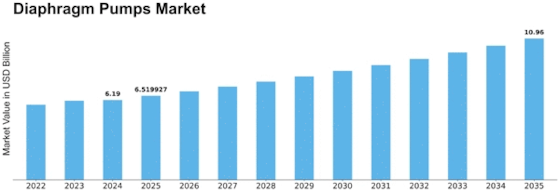
The Diaphragm Pumps Market was valued at 6.19 USD Billion in 2024.

What is the projected market size for the Diaphragm Pumps Market by 2035?

The market is projected to reach 10.96 USD Billion by 2035.

What is the expected CAGR for the Diaphragm Pumps Market during the forecast period?

The expected CAGR for the Diaphragm Pumps Market from 2025 to 2035 is 5.33%.

Which companies are considered key players in the Diaphragm Pumps Market?

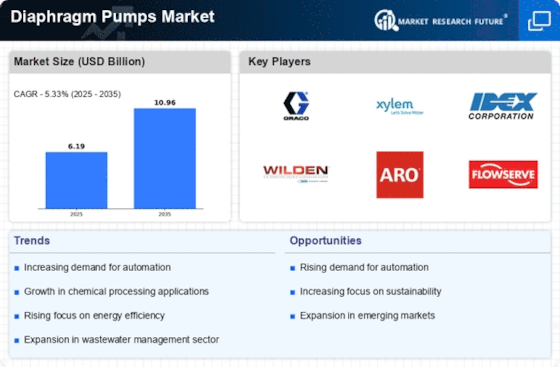
Key players include Graco Inc., Xylem Inc., IDEX Corporation, and Wilden Pump & Engineering LLC.

What are the main operational segments of the Diaphragm Pumps Market?

The main operational segments are Single and Double diaphragm pumps, with valuations of 2.48 and 3.71 USD Billion respectively in 2024.

How do the mechanism segments of diaphragm pumps compare in terms of valuation?

In 2024, Air Operated diaphragm pumps were valued at 3.1 USD Billion, while Electrically Operated pumps were valued at 3.09 USD Billion.

Market Summary

As per MRFR analysis, the Diaphragm Pumps Market Size was estimated at 6.19 USD Billion in 2024. The Diaphragm Pumps industry is projected to grow from 6.52 USD Billion in 2025 to 10.96 USD Billion by 2035, exhibiting a compound annual growth rate (CAGR) of 5.33 during the forecast period 2025 - 2035.

Key Market Trends & Highlights

The Diaphragm Pumps Market is experiencing robust growth driven by technological advancements and increasing regulatory influences.

  • North America remains the largest market for diaphragm pumps, driven by extensive applications in various industries. The Asia-Pacific region is emerging as the fastest-growing market, fueled by rapid industrialization and urbanization. Single diaphragm pumps dominate the market, while double diaphragm pumps are witnessing the fastest growth due to their versatility. Rising demand in chemical processing and an increased focus on environmental regulations are key drivers propelling market expansion.

Market Size & Forecast

2024 Market Size 6.19 (USD Billion)
2035 Market Size 10.96 (USD Billion)
CAGR (2025 - 2035) 5.33%
Largest Regional Market Share in 2024 Asia Pacific

Major Players

<p><a href="https://www.graco.com/us/en/in-plant-manufacturing/products/general-fluid-transfer/double-diaphragm-pumps.html">Graco Inc</a>. (US), Xylem Inc. (US), IDEX Corporation (US), Wilden Pump &amp; Engineering LLC (US), Aro Fluid Management (US), <a href="https://www.flowserve.com/ar/products/products-catalog/pumps/positive-displacement-pumps/diaphragm-pumps/">Flowserve Corporation</a> (US), Parker Hannifin Corporation (US), Verder Group (NL), Klaus Union GmbH &amp; Co. KG (DE)</p>

Market Trends

The Diaphragm Pumps Market is currently experiencing a notable evolution, driven by various factors that influence its growth trajectory. The increasing demand for efficient fluid transfer solutions across diverse industries, such as chemical processing, water treatment, and food and beverage, appears to be a primary catalyst. Furthermore, advancements in technology, particularly in materials and design, seem to enhance the performance and reliability of diaphragm pumps, making them more appealing to end-users. As industries seek to optimize operations and reduce downtime, the adoption of these pumps is likely to rise, reflecting a shift towards more sustainable and efficient practices. In addition to technological advancements, regulatory frameworks and environmental considerations are shaping the landscape of the Diaphragm Pumps Market. Stricter regulations regarding emissions and waste management compel industries to adopt cleaner technologies, which may favor the use of diaphragm pumps due to their ability to handle hazardous materials safely. Moreover, the growing emphasis on energy efficiency and reduced operational costs could further propel the market forward. Overall, the Diaphragm Pumps Market appears poised for growth, driven by innovation, regulatory pressures, and a shift towards sustainable practices.

Technological Advancements

Recent innovations in diaphragm pump technology are enhancing efficiency and reliability. New materials and designs are being developed to improve performance, which may lead to increased adoption across various sectors.

Regulatory Influences

The tightening of environmental regulations is prompting industries to seek cleaner and safer fluid handling solutions. This trend could drive the demand for diaphragm pumps, which are capable of managing hazardous substances effectively.

Sustainability Focus

There is a growing emphasis on sustainability within the Diaphragm Pumps Market. Companies are increasingly prioritizing energy-efficient solutions, which may lead to a rise in the use of diaphragm pumps that minimize energy consumption.

Diaphragm Pumps Market Market Drivers

Growth in Food and Beverage Sector

The diaphragm pumps market is benefiting from the growth in the food and beverage sector, where hygiene and precision are paramount. Diaphragm pumps are increasingly utilized for transferring various food products, including liquids and semi-solids, due to their ability to maintain product integrity and prevent contamination. The food and beverage industry is projected to expand significantly, driven by changing consumer preferences and the demand for processed foods. This growth is likely to enhance the diaphragm pumps market, as manufacturers seek reliable and efficient pumping solutions that comply with stringent food safety regulations. Consequently, the diaphragm pumps market is poised for substantial growth in this sector.

Rising Demand in Chemical Processing

The diaphragm pumps market is experiencing a notable increase in demand, particularly within the chemical processing sector. This growth is attributed to the pumps' ability to handle corrosive and viscous fluids, which are prevalent in chemical manufacturing. As industries seek to enhance operational efficiency, diaphragm pumps are favored for their reliability and low maintenance requirements. According to recent data, the chemical processing segment is projected to account for a substantial share of the diaphragm pumps market, driven by the need for safe and efficient fluid transfer. Furthermore, the increasing complexity of chemical formulations necessitates advanced pumping solutions, thereby propelling the diaphragm pumps market forward.

Technological Innovations in Pump Design

The diaphragm pumps market is witnessing a wave of technological innovations that enhance pump performance and efficiency. Advances in materials and design have led to the development of more durable and efficient diaphragm pumps, which are capable of operating under extreme conditions. These innovations not only improve the lifespan of the pumps but also reduce energy consumption, making them more cost-effective for end-users. As industries increasingly prioritize efficiency and sustainability, the demand for technologically advanced diaphragm pumps is expected to rise. This trend indicates a promising future for the diaphragm pumps market, as manufacturers continue to invest in research and development to meet evolving market needs.

Expansion in Water and Wastewater Management

The diaphragm pumps market is significantly influenced by the expansion of water and wastewater management initiatives. As urbanization accelerates, the demand for effective water treatment solutions rises, leading to increased adoption of diaphragm pumps. These pumps are particularly effective in handling sludges and other challenging materials found in wastewater. Recent statistics indicate that the water and wastewater management sector is expected to witness a robust growth rate, contributing to the overall expansion of the diaphragm pumps market. This trend is further supported by governmental investments in infrastructure, aimed at improving water quality and accessibility, which in turn bolsters the diaphragm pumps market.

Increased Focus on Environmental Regulations

The diaphragm pumps market is significantly impacted by the increasing focus on environmental regulations across various sectors. Stricter regulations regarding emissions and waste management are driving industries to adopt more efficient and environmentally friendly pumping solutions. Diaphragm pumps, known for their ability to minimize leaks and spills, are becoming a preferred choice for companies aiming to comply with these regulations. The market data suggests that as environmental standards become more stringent, the diaphragm pumps market is likely to experience growth, as businesses seek to enhance their sustainability practices. This shift not only benefits the environment but also positions diaphragm pumps as a critical component in achieving compliance.

Market Segment Insights

By Operation: Single (Largest) vs. Double (Fastest-Growing)

<p>In the Diaphragm Pumps Market, the Single diaphragm pumps currently hold the largest share among operational types, thanks to their simplicity and reliability in various applications. They are widely preferred in sectors like food and beverage, pharmaceuticals, and water treatment, leading to their significant presence in the market. Meanwhile, Double diaphragm pumps, though smaller in share relative to Single pumps, are rapidly capturing attention due to their versatility and efficiency in handling diverse media, thus facilitating their growth in niche segments.</p>

<p>Operation: Single (Dominant) vs. Double (Emerging)</p>

<p>Single diaphragm pumps are characterized by their straightforward design that enables ease of use and maintenance, making them dominant in stable flow applications where reliability is crucial. Their efficiency in pumping low to moderate viscosity fluids is particularly valuable in industries like food and beverage, pharmaceuticals, and chemical processing. In contrast, Double diaphragm pumps, with their dual chamber design, represent an emerging trend by allowing better flow control and handling of more viscous and abrasive materials. They offer improved operational flexibility and versatility, which is driving their adoption in sectors requiring complex pumping solutions. This adaptability positions them as a rapidly growing segment in the diaphragm pumps market.</p>

By Mechanism: Air Operated (Largest) vs. Electrically Operated (Fastest-Growing)

<p>In the Diaphragm Pumps Market, the Air Operated segment leads in market share, favored for its reliability and simplicity in operation, especially in industries like chemical processing, mining, and water treatment. Its ability to handle corrosive and viscous fluids without the risk of electric hazards propels its extensive adoption. Conversely, the Electrically Operated segment is rapidly gaining traction, appealing to sectors that prioritize energy efficiency and automation, aligning with increasing sustainability efforts across various industries.</p>

<p>Mechanism: Air Operated (Dominant) vs. Electrically Operated (Emerging)</p>

<p>Air Operated diaphragm pumps are recognized for their versatility and robust performance, making them the preferred choice in demanding environments where hydraulic fluid movement is crucial. This segment benefits from a straightforward design that provides cost-efficiency and ease of maintenance, positioning it as a dominant force in the market. On the other hand, Electrically Operated diaphragm pumps represent an emerging trend toward more advanced pumping solutions. These pumps offer targeted advantages such as improved precision, lower operational costs due to reduced energy consumption, and enhanced automation capabilities, making them increasingly desirable in applications where control and efficiency are paramount.</p>

By Pressure: Up to 80 bar (Largest) vs. 80-200 bar (Fastest-Growing)

<p>In the Diaphragm Pumps Market, the pressure segments exhibit a distinct distribution. The 'Up to 80 bar' segment holds the largest market share, attributed to its widespread application across various industries, including water treatment and chemical processing. This range caters to a broad spectrum of low-pressure needs, reinforcing its dominance. Meanwhile, the '80-200 bar' segment is emerging rapidly, driven by the increasing demand in applications requiring higher pressure outputs, particularly in sectors such as oil and gas, and specialty chemicals.</p>

<p>Pressure: Up to 80 bar (Dominant) vs. 80-200 bar (Emerging)</p>

<p>The 'Up to 80 bar' segment remains dominant in the Diaphragm Pumps Market, primarily due to its versatility and reliability in various applications. It serves a multitude of industries, ensuring efficient fluid transfer with minimal risk of contamination. This segment is particularly favored in wastewater treatment and agricultural applications. Conversely, the '80-200 bar' segment is considered emerging, as it meets the increasing industrial demand for higher pressures. Solutions within this range are particularly effective in sectors that require precise control and durability under increased operational demands, thus signaling its rapid growth trajectory.</p>

By End-User: Oil & Gas (Largest) vs. Water & Wastewater (Fastest-Growing)

<p>In the diaphragm pumps market, the end-user segmentation reveals a dynamic landscape with oil and gas leading the charge. This sector accounts for a substantial portion of the market share, benefiting from its extensive applications in extraction, transportation, and refining processes. Following closely is the water and wastewater segment, which is experiencing an impressive upswing as municipalities and industries seek efficient solutions to manage water resources and treatment processes. The food and beverages and chemicals sectors also contribute to the market, but their shares are relatively smaller compared to the dominating sectors.</p>

<p>Oil &amp; Gas (Dominant) vs. Water &amp; Wastewater (Emerging)</p>

<p>The oil and gas sector remains the dominant force in the diaphragm pumps market, largely due to its rigorous demand for reliable, efficient, and durable pumping solutions. These pumps are utilized in various processes including drilling, refining, and producing oil and gas. The need for performance in harsh environments ensures that oil and gas applications will continue to prioritize diaphragm pumps. On the other hand, the water and wastewater segment is marked as an emerging market driven by increasing regulatory pressures for clean water and sustainable practices. This segment seeks innovative pumping solutions that can handle varying fluid characteristics and support advanced treatment systems, marking a significant growth trajectory that complements the established oil and gas sector.</p>

Get more detailed insights about Diaphragm Pumps Market Research Report – Global Forecast till 2035

Regional Insights

North America : Market Leader in Innovation

North America is the largest market for diaphragm pumps, holding approximately 40% of the global market share. The region's growth is driven by increasing demand in the oil and gas, water treatment, and chemical industries. Regulatory support for environmental sustainability and efficiency standards further catalyzes market expansion. The U.S. is the primary contributor, followed by Canada, which is experiencing a surge in infrastructure projects and industrial applications. The competitive landscape in North America is robust, featuring key players such as Graco Inc., Xylem Inc., and IDEX Corporation. These companies are investing in innovative technologies and expanding their product lines to meet diverse customer needs. The presence of established manufacturers and a strong distribution network enhances market accessibility, ensuring that diaphragm pumps are readily available across various sectors. The focus on automation and smart technologies is also shaping the future of the market.

Europe : Emerging Regulatory Frameworks

Europe is witnessing significant growth in the diaphragm pumps market, accounting for approximately 30% of the global share. The region's expansion is fueled by stringent environmental regulations and a shift towards sustainable practices in industries such as pharmaceuticals, food and beverage, and wastewater management. Countries like Germany and the Netherlands are leading the charge, supported by government initiatives promoting energy efficiency and reduced emissions. Germany stands out as a key player in the European market, with companies like Klaus Union GmbH & Co. KG and Verder Group leading in innovation and technology. The competitive landscape is characterized by a mix of established firms and emerging startups, all vying for market share through advanced product offerings. The focus on R&D and collaboration with regulatory bodies ensures that the market remains aligned with evolving standards and consumer demands.

Asia-Pacific : Rapid Industrialization and Growth

Asia-Pacific is rapidly emerging as a significant player in the diaphragm pumps market, holding around 25% of the global market share. The region's growth is primarily driven by rapid industrialization, urbanization, and increasing investments in infrastructure projects. Countries like China and India are at the forefront, with government initiatives aimed at enhancing industrial output and improving water management systems, further boosting demand for diaphragm pumps. China is the largest market in the region, with a strong presence of local manufacturers and international players. The competitive landscape is evolving, with companies focusing on innovation and cost-effective solutions to cater to diverse applications. The presence of key players such as Flowserve Corporation and Parker Hannifin Corporation enhances market dynamics, as they leverage advanced technologies to meet the growing needs of various sectors, including agriculture and mining.

Middle East and Africa : Resource-Rich and Growing Demand

The Middle East and Africa region is gradually emerging in the diaphragm pumps market, holding about 5% of the global share. The growth is driven by increasing investments in oil and gas exploration, water treatment, and mining sectors. Countries like South Africa and the UAE are leading the market, supported by government initiatives aimed at improving infrastructure and resource management. The region's untapped potential presents significant opportunities for growth in the coming years. In the competitive landscape, local manufacturers are beginning to establish their presence, while international players are also expanding their operations. The market is characterized by a mix of established companies and new entrants, all striving to capture market share through innovative solutions. The focus on sustainability and efficient resource management is expected to shape the future of the diaphragm pumps market in this region.

Key Players and Competitive Insights

The Diaphragm Pumps Market is currently characterized by a dynamic competitive landscape, driven by increasing demand across various sectors such as water treatment, chemical processing, and food and beverage. Key players are actively engaging in strategies that emphasize innovation, regional expansion, and sustainability. For instance, Graco Inc. (US) has positioned itself as a leader in the market by focusing on technological advancements in pump efficiency and reliability. Similarly, Xylem Inc. (US) is leveraging its expertise in water technology to enhance its diaphragm pump offerings, thereby catering to the growing need for efficient water management solutions. These strategic focuses collectively contribute to a competitive environment that is increasingly oriented towards meeting specific industry needs and sustainability goals.

In terms of business tactics, companies are increasingly localizing manufacturing to reduce lead times and optimize supply chains. This approach appears to be particularly effective in a moderately fragmented market where several players vie for market share. The collective influence of key players, such as IDEX Corporation (US) and Wilden Pump & Engineering LLC (US), is shaping the market structure, as they adopt strategies that enhance operational efficiency and customer responsiveness.

In August 2025, IDEX Corporation (US) announced the acquisition of a regional diaphragm pump manufacturer, which is expected to bolster its market presence in Europe. This strategic move not only expands IDEX's product portfolio but also enhances its ability to serve local markets more effectively. The acquisition aligns with IDEX's broader strategy of strengthening its foothold in key regions, thereby positioning the company for sustained growth in the competitive landscape.

In September 2025, Wilden Pump & Engineering LLC (US) launched a new line of environmentally friendly diaphragm pumps designed to minimize energy consumption. This initiative reflects a growing trend towards sustainability within the industry, as companies seek to meet regulatory requirements and customer expectations for greener solutions. The introduction of these pumps is likely to enhance Wilden's competitive edge by appealing to environmentally conscious consumers and industries.

In October 2025, Flowserve Corporation (US) unveiled a digital platform aimed at optimizing pump performance through real-time monitoring and predictive maintenance. This technological advancement signifies a shift towards digitalization in the diaphragm pumps market, allowing Flowserve to offer enhanced value to its customers. By integrating AI and IoT technologies, Flowserve is not only improving operational efficiency but also setting a precedent for future innovations in the industry.

As of October 2025, the competitive trends in the diaphragm pumps market are increasingly defined by digitalization, sustainability, and technological integration. Strategic alliances among key players are fostering innovation and enhancing market responsiveness. The shift from price-based competition to a focus on technology, supply chain reliability, and sustainable practices is likely to shape the future of competitive differentiation in this sector. Companies that prioritize these elements may find themselves better positioned to navigate the evolving landscape.

Key Companies in the Diaphragm Pumps Market market include

Industry Developments

April 2020: The PSG and Dover Corporation subsidiary Quattroflow announced the launch of the new Quattroflow QF2500 Quaternary Diaphragm Pump as part of an expansion of its line of both multiple-use and single-use pumps. Since the new QF2500 pump has a maximum flow rate of 2,500 lph (660 gph), it is well suited to meet the requirements of challenging biopharma applications.

January 2022: The Kerala Water Authority had begun work on an Aluva water treatment facility with a 142 MLD treatment capacity. The factory is anticipated to cost INR 180 crore and be finished in 2024. Thus, throughout the projected period, such prospective water treatment projects are anticipated to raise demand for diaphragm pumps.

August 2021: Graco Inc. has unveiled a brand-new Husky 3300e electric double diaphragm pump. Plant managers can transfer enormous volumes of fluid (up to 220 gpm) while also drastically reducing power consumption with the Husky 3300e pump, which is used to move industrial fluids.

Future Outlook

Diaphragm Pumps Market Future Outlook

<p>The Diaphragm Pumps Market is projected to grow at a 5.33% CAGR from 2024 to 2035, driven by increasing demand in water treatment, chemical processing, and food &amp; beverage industries.</p>

New opportunities lie in:

  • <p>Expansion into renewable energy sector applications</p>
  • <p>Development of smart diaphragm pumps with IoT integration</p>
  • <p>Customized solutions for pharmaceutical manufacturing processes</p>

<p>By 2035, the diaphragm pumps market is expected to achieve robust growth, reflecting evolving industry needs.</p>

Market Segmentation

Diaphragm Pumps Market End-User Outlook

  • Oil & Gas
  • Food & Beverages
  • Water & Wastewater
  • Chemicals

Diaphragm Pumps Market Pressure Outlook

  • Up to 80
  • 80-200
  • > 200 bar

Diaphragm Pumps Market Mechanism Outlook

  • Air Operated
  • Electrically Operated

Diaphragm Pumps Market Operation Outlook

  • Single
  • Double

Report Scope

MARKET SIZE 2024 6.19(USD Billion)
MARKET SIZE 2025 6.52(USD Billion)
MARKET SIZE 2035 10.96(USD Billion)
COMPOUND ANNUAL GROWTH RATE (CAGR) 5.33% (2024 - 2035)
REPORT COVERAGE Revenue Forecast, Competitive Landscape, Growth Factors, and Trends
BASE YEAR 2024
Market Forecast Period 2025 - 2035
Historical Data 2019 - 2024
Market Forecast Units USD Billion
Key Companies Profiled Market analysis in progress
Segments Covered Market segmentation analysis in progress
Key Market Opportunities Integration of smart technologies enhances efficiency and monitoring in the Diaphragm Pumps Market.
Key Market Dynamics Rising demand for energy-efficient diaphragm pumps drives innovation and competition among manufacturers in various industries.
Countries Covered North America, Europe, APAC, South America, MEA

FAQs

What is the current valuation of the Diaphragm Pumps Market?

The Diaphragm Pumps Market was valued at 6.19 USD Billion in 2024.

What is the projected market size for the Diaphragm Pumps Market by 2035?

The market is projected to reach 10.96 USD Billion by 2035.

What is the expected CAGR for the Diaphragm Pumps Market during the forecast period?

The expected CAGR for the Diaphragm Pumps Market from 2025 to 2035 is 5.33%.

Which companies are considered key players in the Diaphragm Pumps Market?

Key players include Graco Inc., Xylem Inc., IDEX Corporation, and Wilden Pump &amp; Engineering LLC.

What are the main operational segments of the Diaphragm Pumps Market?

The main operational segments are Single and Double diaphragm pumps, with valuations of 2.48 and 3.71 USD Billion respectively in 2024.

How do the mechanism segments of diaphragm pumps compare in terms of valuation?

In 2024, Air Operated diaphragm pumps were valued at 3.1 USD Billion, while Electrically Operated pumps were valued at 3.09 USD Billion.

  1. SECTION I: EXECUTIVE SUMMARY AND KEY HIGHLIGHTS
    1. EXECUTIVE SUMMARY
      1. Market Overview
      2. Key Findings
      3. Market Segmentation
      4. Competitive Landscape
      5. Challenges and Opportunities
      6. Future Outlook 2
  2. SECTION II: SCOPING, METHODOLOGY AND MARKET STRUCTURE
    1. MARKET INTRODUCTION
      1. Definition
      2. Scope of the study
    2. RESEARCH METHODOLOGY
      1. Overview
      2. Data Mining
      3. Secondary Research
      4. Primary Research
      5. Forecasting Model
      6. Market Size Estimation
      7. Data Triangulation
      8. Validation 3
  3. SECTION III: QUALITATIVE ANALYSIS
    1. MARKET DYNAMICS
      1. Overview
      2. Drivers
      3. Restraints
      4. Opportunities
    2. MARKET FACTOR ANALYSIS
      1. Value chain Analysis
      2. Porter's Five Forces Analysis
      3. COVID-19 Impact Analysis
  4. SECTION IV: QUANTITATIVE ANALYSIS
    1. Energy & Power, BY Operation (USD Billion)
      1. Single
      2. Double
    2. Energy & Power, BY Mechanism (USD Billion)
      1. Air Operated
      2. Electrically Operated
    3. Energy & Power, BY Pressure (USD Billion)
      1. Up to 80
      2. 80-200
      3. > 200 bar
    4. Energy & Power, BY End-User (USD Billion)
      1. Oil & Gas
      2. Food & Beverages
      3. Water & Wastewater
      4. Chemicals
    5. Energy & Power, BY Region (USD Billion)
      1. North America
      2. Europe
      3. APAC
      4. South America
      5. MEA
  5. SECTION V: COMPETITIVE ANALYSIS
    1. Competitive Landscape
      1. Overview
      2. Competitive Analysis
      3. Market share Analysis
      4. Major Growth Strategy in the Energy & Power
      5. Competitive Benchmarking
      6. Leading Players in Terms of Number of Developments in the Energy & Power
      7. Key developments and growth strategies
      8. Major Players Financial Matrix
    2. Company Profiles
      1. Graco Inc. (US)
      2. Xylem Inc. (US)
      3. IDEX Corporation (US)
      4. Wilden Pump & Engineering LLC (US)
      5. Aro Fluid Management (US)
      6. Flowserve Corporation (US)
      7. Parker Hannifin Corporation (US)
      8. Verder Group (NL)
      9. Klaus Union GmbH & Co. KG (DE)
    3. Appendix
      1. References
      2. Related Reports 6 LIST OF FIGURES
    4. MARKET SYNOPSIS
    5. NORTH AMERICA MARKET ANALYSIS
    6. US MARKET ANALYSIS BY OPERATION
    7. US MARKET ANALYSIS BY MECHANISM
    8. US MARKET ANALYSIS BY PRESSURE
    9. US MARKET ANALYSIS BY END-USER
    10. CANADA MARKET ANALYSIS BY OPERATION
    11. CANADA MARKET ANALYSIS BY MECHANISM
    12. CANADA MARKET ANALYSIS BY PRESSURE
    13. CANADA MARKET ANALYSIS BY END-USER
    14. EUROPE MARKET ANALYSIS
    15. GERMANY MARKET ANALYSIS BY OPERATION
    16. GERMANY MARKET ANALYSIS BY MECHANISM
    17. GERMANY MARKET ANALYSIS BY PRESSURE
    18. GERMANY MARKET ANALYSIS BY END-USER
    19. UK MARKET ANALYSIS BY OPERATION
    20. UK MARKET ANALYSIS BY MECHANISM
    21. UK MARKET ANALYSIS BY PRESSURE
    22. UK MARKET ANALYSIS BY END-USER
    23. FRANCE MARKET ANALYSIS BY OPERATION
    24. FRANCE MARKET ANALYSIS BY MECHANISM
    25. FRANCE MARKET ANALYSIS BY PRESSURE
    26. FRANCE MARKET ANALYSIS BY END-USER
    27. RUSSIA MARKET ANALYSIS BY OPERATION
    28. RUSSIA MARKET ANALYSIS BY MECHANISM
    29. RUSSIA MARKET ANALYSIS BY PRESSURE
    30. RUSSIA MARKET ANALYSIS BY END-USER
    31. ITALY MARKET ANALYSIS BY OPERATION
    32. ITALY MARKET ANALYSIS BY MECHANISM
    33. ITALY MARKET ANALYSIS BY PRESSURE
    34. ITALY MARKET ANALYSIS BY END-USER
    35. SPAIN MARKET ANALYSIS BY OPERATION
    36. SPAIN MARKET ANALYSIS BY MECHANISM
    37. SPAIN MARKET ANALYSIS BY PRESSURE
    38. SPAIN MARKET ANALYSIS BY END-USER
    39. REST OF EUROPE MARKET ANALYSIS BY OPERATION
    40. REST OF EUROPE MARKET ANALYSIS BY MECHANISM
    41. REST OF EUROPE MARKET ANALYSIS BY PRESSURE
    42. REST OF EUROPE MARKET ANALYSIS BY END-USER
    43. APAC MARKET ANALYSIS
    44. CHINA MARKET ANALYSIS BY OPERATION
    45. CHINA MARKET ANALYSIS BY MECHANISM
    46. CHINA MARKET ANALYSIS BY PRESSURE
    47. CHINA MARKET ANALYSIS BY END-USER
    48. INDIA MARKET ANALYSIS BY OPERATION
    49. INDIA MARKET ANALYSIS BY MECHANISM
    50. INDIA MARKET ANALYSIS BY PRESSURE
    51. INDIA MARKET ANALYSIS BY END-USER
    52. JAPAN MARKET ANALYSIS BY OPERATION
    53. JAPAN MARKET ANALYSIS BY MECHANISM
    54. JAPAN MARKET ANALYSIS BY PRESSURE
    55. JAPAN MARKET ANALYSIS BY END-USER
    56. SOUTH KOREA MARKET ANALYSIS BY OPERATION
    57. SOUTH KOREA MARKET ANALYSIS BY MECHANISM
    58. SOUTH KOREA MARKET ANALYSIS BY PRESSURE
    59. SOUTH KOREA MARKET ANALYSIS BY END-USER
    60. MALAYSIA MARKET ANALYSIS BY OPERATION
    61. MALAYSIA MARKET ANALYSIS BY MECHANISM
    62. MALAYSIA MARKET ANALYSIS BY PRESSURE
    63. MALAYSIA MARKET ANALYSIS BY END-USER
    64. THAILAND MARKET ANALYSIS BY OPERATION
    65. THAILAND MARKET ANALYSIS BY MECHANISM
    66. THAILAND MARKET ANALYSIS BY PRESSURE
    67. THAILAND MARKET ANALYSIS BY END-USER
    68. INDONESIA MARKET ANALYSIS BY OPERATION
    69. INDONESIA MARKET ANALYSIS BY MECHANISM
    70. INDONESIA MARKET ANALYSIS BY PRESSURE
    71. INDONESIA MARKET ANALYSIS BY END-USER
    72. REST OF APAC MARKET ANALYSIS BY OPERATION
    73. REST OF APAC MARKET ANALYSIS BY MECHANISM
    74. REST OF APAC MARKET ANALYSIS BY PRESSURE
    75. REST OF APAC MARKET ANALYSIS BY END-USER
    76. SOUTH AMERICA MARKET ANALYSIS
    77. BRAZIL MARKET ANALYSIS BY OPERATION
    78. BRAZIL MARKET ANALYSIS BY MECHANISM
    79. BRAZIL MARKET ANALYSIS BY PRESSURE
    80. BRAZIL MARKET ANALYSIS BY END-USER
    81. MEXICO MARKET ANALYSIS BY OPERATION
    82. MEXICO MARKET ANALYSIS BY MECHANISM
    83. MEXICO MARKET ANALYSIS BY PRESSURE
    84. MEXICO MARKET ANALYSIS BY END-USER
    85. ARGENTINA MARKET ANALYSIS BY OPERATION
    86. ARGENTINA MARKET ANALYSIS BY MECHANISM
    87. ARGENTINA MARKET ANALYSIS BY PRESSURE
    88. ARGENTINA MARKET ANALYSIS BY END-USER
    89. REST OF SOUTH AMERICA MARKET ANALYSIS BY OPERATION
    90. REST OF SOUTH AMERICA MARKET ANALYSIS BY MECHANISM
    91. REST OF SOUTH AMERICA MARKET ANALYSIS BY PRESSURE
    92. REST OF SOUTH AMERICA MARKET ANALYSIS BY END-USER
    93. MEA MARKET ANALYSIS
    94. GCC COUNTRIES MARKET ANALYSIS BY OPERATION
    95. GCC COUNTRIES MARKET ANALYSIS BY MECHANISM
    96. GCC COUNTRIES MARKET ANALYSIS BY PRESSURE
    97. GCC COUNTRIES MARKET ANALYSIS BY END-USER
    98. SOUTH AFRICA MARKET ANALYSIS BY OPERATION
    99. SOUTH AFRICA MARKET ANALYSIS BY MECHANISM
    100. SOUTH AFRICA MARKET ANALYSIS BY PRESSURE
    101. SOUTH AFRICA MARKET ANALYSIS BY END-USER
    102. REST OF MEA MARKET ANALYSIS BY OPERATION
    103. REST OF MEA MARKET ANALYSIS BY MECHANISM
    104. REST OF MEA MARKET ANALYSIS BY PRESSURE
    105. REST OF MEA MARKET ANALYSIS BY END-USER
    106. KEY BUYING CRITERIA OF ENERGY & POWER
    107. RESEARCH PROCESS OF MRFR
    108. DRO ANALYSIS OF ENERGY & POWER
    109. DRIVERS IMPACT ANALYSIS: ENERGY & POWER
    110. RESTRAINTS IMPACT ANALYSIS: ENERGY & POWER
    111. SUPPLY / VALUE CHAIN: ENERGY & POWER
    112. ENERGY & POWER, BY OPERATION, 2024 (% SHARE)
    113. ENERGY & POWER, BY OPERATION, 2024 TO 2035 (USD Billion)
    114. ENERGY & POWER, BY MECHANISM, 2024 (% SHARE)
    115. ENERGY & POWER, BY MECHANISM, 2024 TO 2035 (USD Billion)
    116. ENERGY & POWER, BY PRESSURE, 2024 (% SHARE)
    117. ENERGY & POWER, BY PRESSURE, 2024 TO 2035 (USD Billion)
    118. ENERGY & POWER, BY END-USER, 2024 (% SHARE)
    119. ENERGY & POWER, BY END-USER, 2024 TO 2035 (USD Billion)
    120. BENCHMARKING OF MAJOR COMPETITORS 7 LIST OF TABLES
    121. LIST OF ASSUMPTIONS
    122. North America MARKET SIZE ESTIMATES; FORECAST
      1. BY OPERATION, 2025-2035 (USD Billion)
      2. BY MECHANISM, 2025-2035 (USD Billion)
      3. BY PRESSURE, 2025-2035 (USD Billion)
      4. BY END-USER, 2025-2035 (USD Billion)
    123. US MARKET SIZE ESTIMATES; FORECAST
      1. BY OPERATION, 2025-2035 (USD Billion)
      2. BY MECHANISM, 2025-2035 (USD Billion)
      3. BY PRESSURE, 2025-2035 (USD Billion)
      4. BY END-USER, 2025-2035 (USD Billion)
    124. Canada MARKET SIZE ESTIMATES; FORECAST
      1. BY OPERATION, 2025-2035 (USD Billion)
      2. BY MECHANISM, 2025-2035 (USD Billion)
      3. BY PRESSURE, 2025-2035 (USD Billion)
      4. BY END-USER, 2025-2035 (USD Billion)
    125. Europe MARKET SIZE ESTIMATES; FORECAST
      1. BY OPERATION, 2025-2035 (USD Billion)
      2. BY MECHANISM, 2025-2035 (USD Billion)
      3. BY PRESSURE, 2025-2035 (USD Billion)
      4. BY END-USER, 2025-2035 (USD Billion)
    126. Germany MARKET SIZE ESTIMATES; FORECAST
      1. BY OPERATION, 2025-2035 (USD Billion)
      2. BY MECHANISM, 2025-2035 (USD Billion)
      3. BY PRESSURE, 2025-2035 (USD Billion)
      4. BY END-USER, 2025-2035 (USD Billion)
    127. UK MARKET SIZE ESTIMATES; FORECAST
      1. BY OPERATION, 2025-2035 (USD Billion)
      2. BY MECHANISM, 2025-2035 (USD Billion)
      3. BY PRESSURE, 2025-2035 (USD Billion)
      4. BY END-USER, 2025-2035 (USD Billion)
    128. France MARKET SIZE ESTIMATES; FORECAST
      1. BY OPERATION, 2025-2035 (USD Billion)
      2. BY MECHANISM, 2025-2035 (USD Billion)
      3. BY PRESSURE, 2025-2035 (USD Billion)
      4. BY END-USER, 2025-2035 (USD Billion)
    129. Russia MARKET SIZE ESTIMATES; FORECAST
      1. BY OPERATION, 2025-2035 (USD Billion)
      2. BY MECHANISM, 2025-2035 (USD Billion)
      3. BY PRESSURE, 2025-2035 (USD Billion)
      4. BY END-USER, 2025-2035 (USD Billion)
    130. Italy MARKET SIZE ESTIMATES; FORECAST
      1. BY OPERATION, 2025-2035 (USD Billion)
      2. BY MECHANISM, 2025-2035 (USD Billion)
      3. BY PRESSURE, 2025-2035 (USD Billion)
      4. BY END-USER, 2025-2035 (USD Billion)
    131. Spain MARKET SIZE ESTIMATES; FORECAST
      1. BY OPERATION, 2025-2035 (USD Billion)
      2. BY MECHANISM, 2025-2035 (USD Billion)
      3. BY PRESSURE, 2025-2035 (USD Billion)
      4. BY END-USER, 2025-2035 (USD Billion)
    132. Rest of Europe MARKET SIZE ESTIMATES; FORECAST
      1. BY OPERATION, 2025-2035 (USD Billion)
      2. BY MECHANISM, 2025-2035 (USD Billion)
      3. BY PRESSURE, 2025-2035 (USD Billion)
      4. BY END-USER, 2025-2035 (USD Billion)
    133. APAC MARKET SIZE ESTIMATES; FORECAST
      1. BY OPERATION, 2025-2035 (USD Billion)
      2. BY MECHANISM, 2025-2035 (USD Billion)
      3. BY PRESSURE, 2025-2035 (USD Billion)
      4. BY END-USER, 2025-2035 (USD Billion)
    134. China MARKET SIZE ESTIMATES; FORECAST
      1. BY OPERATION, 2025-2035 (USD Billion)
      2. BY MECHANISM, 2025-2035 (USD Billion)
      3. BY PRESSURE, 2025-2035 (USD Billion)
      4. BY END-USER, 2025-2035 (USD Billion)
    135. India MARKET SIZE ESTIMATES; FORECAST
      1. BY OPERATION, 2025-2035 (USD Billion)
      2. BY MECHANISM, 2025-2035 (USD Billion)
      3. BY PRESSURE, 2025-2035 (USD Billion)
      4. BY END-USER, 2025-2035 (USD Billion)
    136. Japan MARKET SIZE ESTIMATES; FORECAST
      1. BY OPERATION, 2025-2035 (USD Billion)
      2. BY MECHANISM, 2025-2035 (USD Billion)
      3. BY PRESSURE, 2025-2035 (USD Billion)
      4. BY END-USER, 2025-2035 (USD Billion)
    137. South Korea MARKET SIZE ESTIMATES; FORECAST
      1. BY OPERATION, 2025-2035 (USD Billion)
      2. BY MECHANISM, 2025-2035 (USD Billion)
      3. BY PRESSURE, 2025-2035 (USD Billion)
      4. BY END-USER, 2025-2035 (USD Billion)
    138. Malaysia MARKET SIZE ESTIMATES; FORECAST
      1. BY OPERATION, 2025-2035 (USD Billion)
      2. BY MECHANISM, 2025-2035 (USD Billion)
      3. BY PRESSURE, 2025-2035 (USD Billion)
      4. BY END-USER, 2025-2035 (USD Billion)
    139. Thailand MARKET SIZE ESTIMATES; FORECAST
      1. BY OPERATION, 2025-2035 (USD Billion)
      2. BY MECHANISM, 2025-2035 (USD Billion)
      3. BY PRESSURE, 2025-2035 (USD Billion)
      4. BY END-USER, 2025-2035 (USD Billion)
    140. Indonesia MARKET SIZE ESTIMATES; FORECAST
      1. BY OPERATION, 2025-2035 (USD Billion)
      2. BY MECHANISM, 2025-2035 (USD Billion)
      3. BY PRESSURE, 2025-2035 (USD Billion)
      4. BY END-USER, 2025-2035 (USD Billion)
    141. Rest of APAC MARKET SIZE ESTIMATES; FORECAST
      1. BY OPERATION, 2025-2035 (USD Billion)
      2. BY MECHANISM, 2025-2035 (USD Billion)
      3. BY PRESSURE, 2025-2035 (USD Billion)
      4. BY END-USER, 2025-2035 (USD Billion)
    142. South America MARKET SIZE ESTIMATES; FORECAST
      1. BY OPERATION, 2025-2035 (USD Billion)
      2. BY MECHANISM, 2025-2035 (USD Billion)
      3. BY PRESSURE, 2025-2035 (USD Billion)
      4. BY END-USER, 2025-2035 (USD Billion)
    143. Brazil MARKET SIZE ESTIMATES; FORECAST
      1. BY OPERATION, 2025-2035 (USD Billion)
      2. BY MECHANISM, 2025-2035 (USD Billion)
      3. BY PRESSURE, 2025-2035 (USD Billion)
      4. BY END-USER, 2025-2035 (USD Billion)
    144. Mexico MARKET SIZE ESTIMATES; FORECAST
      1. BY OPERATION, 2025-2035 (USD Billion)
      2. BY MECHANISM, 2025-2035 (USD Billion)
      3. BY PRESSURE, 2025-2035 (USD Billion)
      4. BY END-USER, 2025-2035 (USD Billion)
    145. Argentina MARKET SIZE ESTIMATES; FORECAST
      1. BY OPERATION, 2025-2035 (USD Billion)
      2. BY MECHANISM, 2025-2035 (USD Billion)
      3. BY PRESSURE, 2025-2035 (USD Billion)
      4. BY END-USER, 2025-2035 (USD Billion)
    146. Rest of South America MARKET SIZE ESTIMATES; FORECAST
      1. BY OPERATION, 2025-2035 (USD Billion)
      2. BY MECHANISM, 2025-2035 (USD Billion)
      3. BY PRESSURE, 2025-2035 (USD Billion)
      4. BY END-USER, 2025-2035 (USD Billion)
    147. MEA MARKET SIZE ESTIMATES; FORECAST
      1. BY OPERATION, 2025-2035 (USD Billion)
      2. BY MECHANISM, 2025-2035 (USD Billion)
      3. BY PRESSURE, 2025-2035 (USD Billion)
      4. BY END-USER, 2025-2035 (USD Billion)
    148. GCC Countries MARKET SIZE ESTIMATES; FORECAST
      1. BY OPERATION, 2025-2035 (USD Billion)
      2. BY MECHANISM, 2025-2035 (USD Billion)
      3. BY PRESSURE, 2025-2035 (USD Billion)
      4. BY END-USER, 2025-2035 (USD Billion)
    149. South Africa MARKET SIZE ESTIMATES; FORECAST
      1. BY OPERATION, 2025-2035 (USD Billion)
      2. BY MECHANISM, 2025-2035 (USD Billion)
      3. BY PRESSURE, 2025-2035 (USD Billion)
      4. BY END-USER, 2025-2035 (USD Billion)
    150. Rest of MEA MARKET SIZE ESTIMATES; FORECAST
      1. BY OPERATION, 2025-2035 (USD Billion)
      2. BY MECHANISM, 2025-2035 (USD Billion)
      3. BY PRESSURE, 2025-2035 (USD Billion)
      4. BY END-USER, 2025-2035 (USD Billion)
    151. PRODUCT LAUNCH/PRODUCT DEVELOPMENT/APPROVAL
    152. ACQUISITION/PARTNERSHIP

Diaphragm Pumps Market Segmentation

Diaphragm Pumps Operation Outlook (USD Billion, 2018-2032)

  • Single
  • Double

Diaphragm Pumps Mechanism Outlook (USD Billion, 2018-2032)

  • Air Operated
  • Electrically Operated

Diaphragm Pumps Pressure Outlook (USD Billion, 2018-2032)

  • Up to 80
  • 80-200
  • > 200 bar

Diaphragm Pumps End-Use Outlook (USD Billion, 2018-2032)

  • Oil & Gas
  • Food & Beverages
  • Water & Wastewater
  • Chemicals

Diaphragm Pumps Regional Outlook (USD Billion, 2018-2032)

  • North America Outlook (USD Billion, 2018-2032)

    • North America Diaphragm Pumps by Operation
      • Single
      • Double
    • North America Diaphragm Pumps by Mechanism
      • Air Operated
      • Electrically Operated
    • North America Diaphragm Pumps by Pressure
      • Up to 80
      • 80-200
      • > 200 bar
    • North America Diaphragm Pumps by End-Use
      • Oil & Gas
      • Food & Beverages
      • Water & Wastewater
      • Chemicals
    • US Outlook (USD Billion, 2018-2032)

    • US Diaphragm Pumps by Operation
      • Single
      • Double
    • US Diaphragm Pumps by Mechanism
      • Air Operated
      • Electrically Operated
    • US Diaphragm Pumps by Pressure
      • Up to 80
      • 80-200
      • > 200 bar
    • US Diaphragm Pumps by End-Use
      • Oil & Gas
      • Food & Beverages
      • Water & Wastewater
      • Chemicals
    • CANADA Outlook (USD Billion, 2018-2032)

    • CANADA Diaphragm Pumps by Operation
      • Single
      • Double
    • CANADA Diaphragm Pumps by Mechanism
      • Air Operated
      • Electrically Operated
    • CANADA Diaphragm Pumps by Pressure
      • Up to 80
      • 80-200
      • > 200 bar
    • CANADA Diaphragm Pumps by End-Use
      • Oil & Gas
      • Food & Beverages
      • Water & Wastewater
      • Chemicals
  • Europe Outlook (USD Billion, 2018-2032)

    • Europe Diaphragm Pumps by Operation
      • Single
      • Double
    • Europe Diaphragm Pumps by Mechanism
      • Air Operated
      • Electrically Operated
    • Europe Diaphragm Pumps by Pressure
      • Up to 80
      • 80-200
      • > 200 bar
    • Europe Diaphragm Pumps by End-Use
      • Oil & Gas
      • Food & Beverages
      • Water & Wastewater
      • Chemicals
    • Germany Outlook (USD Billion, 2018-2032)

    • Germany Diaphragm Pumps by Operation
      • Single
      • Double
    • Germany Diaphragm Pumps by Mechanism
      • Air Operated
      • Electrically Operated
    • Germany Diaphragm Pumps by Pressure
      • Up to 80
      • 80-200
      • > 200 bar
    • Germany Diaphragm Pumps by End-Use
      • Oil & Gas
      • Food & Beverages
      • Water & Wastewater
      • Chemicals
    • France Outlook (USD Billion, 2018-2032)

    • France Diaphragm Pumps by Operation
      • Single
      • Double
    • France Diaphragm Pumps by Mechanism
      • Air Operated
      • Electrically Operated
    • France Diaphragm Pumps by Pressure
      • Up to 80
      • 80-200
      • > 200 bar
    • France Diaphragm Pumps by End-Use
      • Oil & Gas
      • Food & Beverages
      • Water & Wastewater
      • Chemicals
    • UK Outlook (USD Billion, 2018-2032)

    • UK Diaphragm Pumps by Operation
      • Single
      • Double
    • UK Diaphragm Pumps by Mechanism
      • Air Operated
      • Electrically Operated
    • UK Diaphragm Pumps by Pressure
      • Up to 80
      • 80-200
      • > 200 bar
    • UK Diaphragm Pumps by End-Use
      • Oil & Gas
      • Food & Beverages
      • Water & Wastewater
      • Chemicals
    • ITALY Outlook (USD Billion, 2018-2032)

    • ITALY Diaphragm Pumps by Operation
      • Single
      • Double
    • ITALY Diaphragm Pumps by Mechanism
      • Air Operated
      • Electrically Operated
    • ITALY Diaphragm Pumps by Pressure
      • Up to 80
      • 80-200
      • > 200 bar
    • ITALY Diaphragm Pumps by End-Use
      • Oil & Gas
      • Food & Beverages
      • Water & Wastewater
      • Chemicals
    • SPAIN Outlook (USD Billion, 2018-2032)

    • Spain Diaphragm Pumps by Operation
      • Single
      • Double
    • Spain Diaphragm Pumps by Mechanism
      • Air Operated
      • Electrically Operated
    • Spain Diaphragm Pumps by Pressure
      • Up to 80
      • 80-200
      • > 200 bar
    • Spain Diaphragm Pumps by End-Use
      • Oil & Gas
      • Food & Beverages
      • Water & Wastewater
      • Chemicals
    • Rest Of Europe Outlook (USD Billion, 2018-2032)

    • Rest Of Europe Diaphragm Pumps by Operation
      • Single
      • Double
    • REST OF EUROPE Diaphragm Pumps by Mechanism
      • Air Operated
      • Electrically Operated
    • REST OF EUROPE Diaphragm Pumps by Pressure
      • Up to 80
      • 80-200
      • > 200 bar
    • REST OF EUROPE Diaphragm Pumps by End-Use
      • Oil & Gas
      • Food & Beverages
      • Water & Wastewater
      • Chemicals
  • Asia-Pacific Outlook (USD Billion, 2018-2032)

    • Asia-Pacific Diaphragm Pumps by Operation
      • Single
      • Double
    • Asia-Pacific Diaphragm Pumps by Mechanism
      • Air Operated
      • Electrically Operated
    • Asia-Pacific Diaphragm Pumps by Pressure
      • Up to 80
      • 80-200
      • > 200 bar
    • Asia-Pacific Diaphragm Pumps by End-Use
      • Oil & Gas
      • Food & Beverages
      • Water & Wastewater
      • Chemicals
    • China Outlook (USD Billion, 2018-2032)

    • China Diaphragm Pumps by Operation
      • Single
      • Double
    • China Diaphragm Pumps by Mechanism
      • Air Operated
      • Electrically Operated
    • China Diaphragm Pumps by Pressure
      • Up to 80
      • 80-200
      • > 200 bar
    • China Diaphragm Pumps by End-Use
      • Oil & Gas
      • Food & Beverages
      • Water & Wastewater
      • Chemicals
    • Japan Outlook (USD Billion, 2018-2032)

    • Japan Diaphragm Pumps by Operation
      • Single
      • Double
    • Japan Diaphragm Pumps by Mechanism
      • Air Operated
      • Electrically Operated
    • Japan Diaphragm Pumps by Pressure
      • Up to 80
      • 80-200
      • > 200 bar
    • Japan Diaphragm Pumps by End-Use
      • Oil & Gas
      • Food & Beverages
      • Water & Wastewater
      • Chemicals
    • India Outlook (USD Billion, 2018-2032)

    • India Diaphragm Pumps by Operation
      • Single
      • Double
    • India Diaphragm Pumps by Mechanism
      • Air Operated
      • Electrically Operated
    • India Diaphragm Pumps by Pressure
      • Up to 80
      • 80-200
      • > 200 bar
    • India Diaphragm Pumps by End-Use
      • Oil & Gas
      • Food & Beverages
      • Water & Wastewater
      • Chemicals
    • Australia Outlook (USD Billion, 2018-2032)

    • Australia Diaphragm Pumps by Operation
      • Single
      • Double
    • Australia Diaphragm Pumps by Mechanism
      • Air Operated
      • Electrically Operated
    • Australia Diaphragm Pumps by Pressure
      • Up to 80
      • 80-200
      • > 200 bar
    • Australia Diaphragm Pumps by End-Use
      • Oil & Gas
      • Food & Beverages
      • Water & Wastewater
      • Chemicals
    • Rest of Asia-Pacific Outlook (USD Billion, 2018-2032)

    • Rest of Asia-Pacific Diaphragm Pumps by Operation
      • Single
      • Double
    • Rest of Asia-Pacific Diaphragm Pumps by Mechanism
      • Air Operated
      • Electrically Operated
    • Rest of Asia-Pacific Diaphragm Pumps by Pressure
      • Up to 80
      • 80-200
      • > 200 bar
    • Rest of Asia-Pacific Diaphragm Pumps by End-Use
      • Oil & Gas
      • Food & Beverages
      • Water & Wastewater
      • Chemicals
  • Rest of the World Outlook (USD Billion, 2018-2032)

    • Rest of the World Diaphragm Pumps by Operation
      • Single
      • Double
    • Rest of the World Diaphragm Pumps by Mechanism
      • Air Operated
      • Electrically Operated
    • Rest of the World Diaphragm Pumps by Pressure
      • Up to 80
      • 80-200
      • > 200 bar
    • Rest of the World Diaphragm Pumps by End-Use
      • Oil & Gas
      • Food & Beverages
      • Water & Wastewater
      • Chemicals
    • Middle East Outlook (USD Billion, 2018-2032)

    • Middle East Diaphragm Pumps by Operation
      • Single
      • Double
    • Middle East Diaphragm Pumps by Mechanism
      • Air Operated
      • Electrically Operated
    • Middle East Diaphragm Pumps by Pressure
      • Up to 80
      • 80-200
      • > 200 bar
    • Middle East Diaphragm Pumps by End-Use
      • Oil & Gas
      • Food & Beverages
      • Water & Wastewater
      • Chemicals
    • Africa Outlook (USD Billion, 2018-2032)

    • Africa Diaphragm Pumps by Operation
      • Single
      • Double
    • Africa Diaphragm Pumps by Mechanism
      • Air Operated
      • Electrically Operated
    • Africa Diaphragm Pumps by Pressure
      • Up to 80
      • 80-200
      • > 200 bar
    • Africa Diaphragm Pumps by End-Use
      • Oil & Gas
      • Food & Beverages
      • Water & Wastewater
      • Chemicals
    • Latin America Outlook (USD Billion, 2018-2032)

    • Latin America Diaphragm Pumps by Operation
      • Single
      • Double
    • Latin America Diaphragm Pumps by Mechanism
      • Air Operated
      • Electrically Operated
    • Latin America Diaphragm Pumps by Pressure
      • Up to 80
      • 80-200
      • > 200 bar
    • Latin America Diaphragm Pumps by End-Use
      • Oil & Gas
      • Food & Beverages
      • Water & Wastewater
      • Chemicals
Infographic

Free Sample Request

Kindly complete the form below to receive a free sample of this Report

Get Free Sample

Customer Strories

Compare Licence

×
Features License Type
Single User Multiuser License Enterprise User
Price $4,950 $5,950 $7,250
Maximum User Access Limit 1 User Upto 10 Users Unrestricted Access Throughout the Organization
Free Customization
Direct Access to Analyst
Deliverable Format
Platform Access
Discount on Next Purchase 10% 15% 15%
Printable Versions