Devsecops Market

ID: MRFR/ICT/38810-HCR
100 Pages
Aarti Dhapte
Last Updated: June 04, 2026
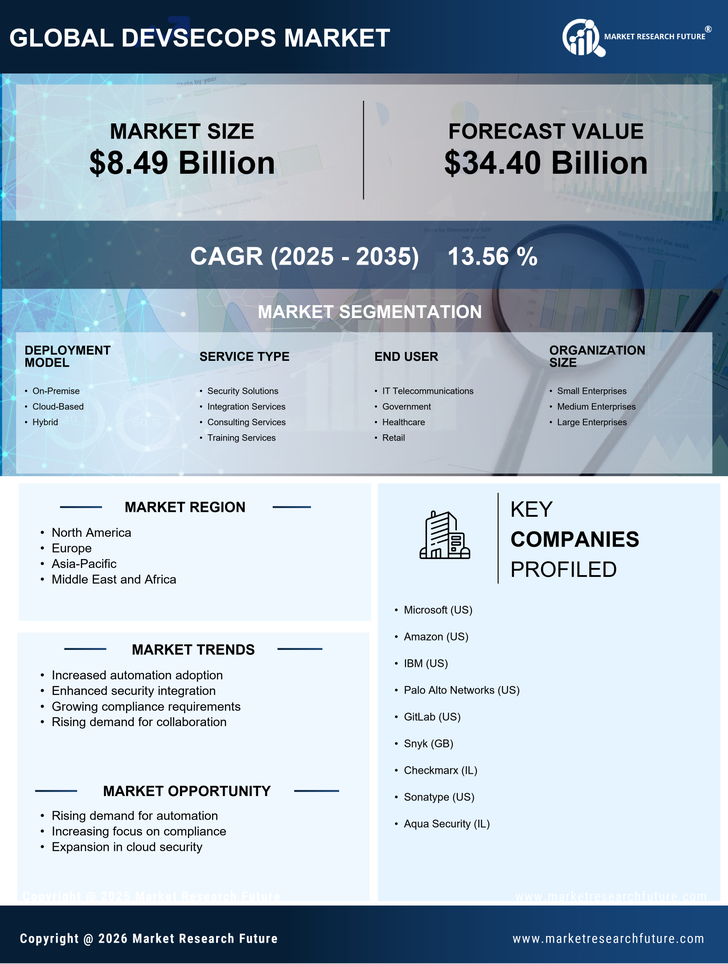
DevSecOps Market Size, Share and Research Report By Deployment Model (On-Premise, Cloud-Based, Hybrid), By Service Type (Security Solutions, Integration Services, Consulting Services, Training Services), By End User (IT Telecommunications, Government, Healthcare, Retail), By Organization Size (Small Enterprises, Medium Enterprises, Large Enterprises) and By Regional (North America, Europe, South America, Asia Pacific, Middle East and Africa) - Industry Forecast to 2035.
Download PDF ×

We do not share your information with anyone. However, we may send you emails based on your report interest from time to time. You may contact us at any time to opt-out.

  1. 1 Market Overview |
    1. 1.1 Study Assumptions & Market Definition |
    2. 1.2 Scope of the Study |
    3. 1.3 Research Methodology
  2. 2 Market Summary & Key Takeaways
  3. 3 Market Dynamics |
    1. 3.1 Market Drivers Analysis | |
      1. 3.1.1 Regulatory Mandates (EO 14028, NIS2, CRA) | |
      2. 3.1.2 Shift-Left Security Adoption in CI/CD Pipelines | |
      3. 3.1.3 Cloud-Native & Container Proliferation | |
      4. 3.1.4 AI/ML-Driven Vulnerability Remediation | |
      5. 3.1.5 SME Democratization via SaaS Tooling | |
      6. 3.1.6 Software Supply-Chain Security Scrutiny |
    2. 3.2 Market Restraints Analysis | |
      1. 3.2.1 Cybersecurity Talent Shortage | |
      2. 3.2.2 Tool Sprawl & Integration Complexity | |
      3. 3.2.3 Alert Fatigue & False-Positive Overload | |
      4. 3.2.4 Budget Constraints in SMEs | |
      5. 3.2.5 Data Residency & Sovereignty Friction |
    3. 3.3 Market Opportunity Analysis | |
      1. 3.3.1 AI-Powered Autonomous Security Pipelines | |
      2. 3.3.2 Compliance-as-Code for Regulated Industries | |
      3. 3.3.3 Emerging-Market SaaS Democratization | |
      4. 3.3.4 Software Supply-Chain Monetization | |
      5. 3.3.5 DevSecOps for OT/IoT Convergence |
    4. 3.4 Industry Value Chain Analysis |
    5. 3.5 Porter's Five Forces Analysis
  4. 4 Global DevSecOps Market Size & Forecast (2021–2035) |
    1. 4.1 Historical Market Size (2021–2025) |
    2. 4.2 Current & Forecast Market Size (2026–2035) |
    3. 4.3 Market Size by Revenue (USD Billion) |
    4. 4.4 Year-over-Year Growth Analysis
  5. 5 Segmentation Analysis |
    1. 5.1 By Offering | |
      1. 5.1.1 Solutions | |
      2. 5.1.2 Services — Professional Services | |
      3. 5.1.3 Services — Managed Services |
    2. 5.2 By Deployment Model | |
      1. 5.2.1 Cloud | |
      2. 5.2.2 On-Premise | |
      3. 5.2.3 Hybrid |
    3. 5.3 By End-User Enterprise Size | |
      1. 5.3.1 Large Enterprises | |
      2. 5.3.2 Small & Medium Enterprises (SMEs) |
    4. 5.4 By End-User Industry | |
      1. 5.4.1 IT & Telecom | |
      2. 5.4.2 BFSI | |
      3. 5.4.3 Manufacturing | |
      4. 5.4.4 Healthcare | |
      5. 5.4.5 Government & Defense | |
      6. 5.4.6 Others
  6. 6 Regional Analysis |
    1. 6.1 North America | |
      1. 6.1.1 United States | |
      2. 6.1.2 Canada | |
      3. 6.1.3 Mexico |
    2. 6.2 Europe | |
      1. 6.2.1 Germany | |
      2. 6.2.2 United Kingdom | |
      3. 6.2.3 France | |
      4. 6.2.4 Italy | |
      5. 6.2.5 Spain | |
      6. 6.2.6 Nordic Countries | |
      7. 6.2.7 Russia | |
      8. 6.2.8 Rest of Europe |
    3. 6.3 Asia-Pacific | |
      1. 6.3.1 China | |
      2. 6.3.2 India | |
      3. 6.3.3 Japan | |
      4. 6.3.4 South Korea | |
      5. 6.3.5 ASEAN | |
      6. 6.3.6 Rest of Asia-Pacific |
    4. 6.4 South America | |
      1. 6.4.1 Brazil | |
      2. 6.4.2 Argentina | |
      3. 6.4.3 Rest of South America |
    5. 6.5 Middle East & Africa | |
      1. 6.5.1 Saudi Arabia | |
      2. 6.5.2 UAE | |
      3. 6.5.3 South Africa | |
      4. 6.5.4 Egypt | |
      5. 6.5.5 Rest of Middle East & Africa
  7. 7 Competitive Landscape |
    1. 7.1 Market Share Analysis (2026) |
    2. 7.2 Competitive Benchmarking Matrix |
    3. 7.3 Company Profiles | |
      1. 7.3.1 Palo Alto Networks | |
      2. 7.3.2 Snyk | |
      3. 7.3.3 Synopsys | |
      4. 7.3.4 Checkmarx | |
      5. 7.3.5 Fortinet | |
      6. 7.3.6 GitLab | |
      7. 7.3.7 Microsoft | |
      8. 7.3.8 Veracode | |
      9. 7.3.9 Aqua Security | |
      10. 7.3.10 Sonatype
  8. 8 Future Outlook & Strategic Recommendations (2026–2035) |
    1. 8.1 Near-Term Outlook (2026–2028) |
    2. 8.2 Medium-Term Outlook (2029–2031) |
    3. 8.3 Long-Term Outlook (2032–2035)
  9. 9 Recent Developments & News
  10. 10 Frequently Asked Questions (FAQs)
  11. 11 Report Scope & Methodology |
    1. 11.1 Study Period & Base Year |
    2. 11.2 Data Sources & Citations |
    3. 11.3 Abbreviations

MARKET SEGMENTATION OVERVIEW

The global DevSecOps market is analyzed across four primary segmentation dimensions. Each dimension reflects distinct demand drivers, regulatory treatment, and end-user requirements, enabling granular revenue forecasting and strategic positioning for market participants.

By Offering

Sub-SegmentKey Trend
SolutionsUnified platforms combining SAST, DAST, SCA, and IaC scanning gaining share
Services — Professional ServicesImplementation consulting and pipeline integration advisory
Services — Managed ServicesOutsourced AppSec operations for talent-constrained mid-market firms


Solutions remain the largest sub-segment (~76% share in 2025) as enterprises consolidate point tools into integrated platforms. Managed Services (27.10% CAGR) is the fastest-growing sub-segment as organizations lacking in-house AppSec specialists outsource pipeline security operations to managed providers.

By Deployment Model

Sub-SegmentKey Trend
CloudKubernetes-native stacks driving SaaS-based DevSecOps adoption
On-PremiseDefense, intelligence, and banking mandating air-gapped environments
HybridGradual migration strategies bridging on-prem and cloud workloads


On-premise installations hold majority share (~53% in 2025) driven by data-sovereignty requirements in defense and financial verticals. Cloud deployments (28.50% CAGR) are the fastest-growing model as container security scanning becomes inseparable from cloud-native application stacks.

By End-User Enterprise Size

Sub-SegmentKey Trend
Large EnterprisesComplex multi-cloud environments and stringent compliance mandates
Small & Medium Enterprises (SMEs)SaaS-based affordable tooling with consumption-based pricing models


Large enterprises command ~62% share in 2025, driven by regulatory compliance obligations and scale. SMEs represent the faster-growing segment (25.80% CAGR) as vendors introduce consumption-based pricing that lowers the barrier to shift-left security adoption.

By End-User Industry

Sub-SegmentKey Trend
IT & TelecomMost mature CI/CD pipelines; highest code deployment frequency
BFSIDORA, PCI DSS 4.0 compliance driving fastest vertical growth
ManufacturingOT/IT convergence demanding pipeline-embedded firmware security
HealthcareHIPAA modernization and connected medical device security
Government & DefenseEO 14028, FedRAMP mandates requiring SBOM attestation
OthersEducation, retail, energy digital transformation initiatives


IT & Telecom leads with ~30% revenue share in 2025 due to mature CI/CD ecosystems. BFSI is the fastest-growing vertical (26.90% CAGR), propelled by Europe's DORA and global PCI DSS 4.0 mandates requiring continuous security testing across ICT service providers.

SEGMENTATION QUICK REFERENCE

DimensionSub-SegmentsDominant Segment (2025)Fastest Growing
OfferingSolutions · Professional Services · Managed ServicesSolutions (~76%)Managed Services (27.10%)
Deployment ModelCloud · On-Premise · HybridOn-Premise (~53%)Cloud (28.50%)
Enterprise SizeLarge Enterprises · SMEsLarge Enterprises (~62%)SMEs (25.80%)
End-User IndustryIT & Telecom · BFSI · Manufacturing · Healthcare · Gov & Defense · OthersIT & Telecom (~30%)BFSI (26.90%)


List of Tables