×
Hero Background
English
Chinese
French
Japanese
Korean
German
Spanish

Depression Screening Mental Health Market Analysis

ID: MRFR/Pharma/2518-CR
128 Pages
Kinjoll Dey
October 2023

Depression Screening Market Research Report Information by Indication (Major Depressive Disorder, Anxiety Distress, Bipolar Disorder, Psychotic Disorders, and Others), by Diagnosis (Psychological Tests, Blood Tests, Pharmacogenomic Testing, and Others), by End User (Hospitals and Clinics, Home-based, and Research and Academic Institutes), and by Region (North America, Europe, Asia-Pacific, and Rest of the World) - Forecast till 2035

Share:
Download PDF ×

We do not share your information with anyone. However, we may send you emails based on your report interest from time to time. You may contact us at any time to opt-out.

Depression Screening Mental Health Market Infographic
Purchase Options

Market Analysis

In-depth Analysis of Depression Screening Mental Health Market Industry Landscape

The increase in using new therapies and treatments is expected to make the depression screening market grow. More and more research and funding are going into creating new and improved ways to help people with mental health disorders. Pharmaceutical companies are doing a lot of research, and this has led to the approval of new medications by the FDA, which means better care for patients with depression.

Scientists are also trying out new and creative ideas, like combining different therapies with new or existing drugs. This has resulted in a lot of potential treatments for depression being tested. For example, in July 2022, Abbott, a company in the United States, got approval from the FDA to explore using a deep brain stimulation system to treat depression that doesn't respond to other treatments.

The government and international healthcare organizations are also giving a lot of support for research and development. This backing is creating many opportunities in the market for depression treatment. So, the increase in research and funding is driving the growth of the global depression screening market.

The growth of the depression screening market is connected to the efforts to find better ways to help people with mental health disorders. Pharmaceutical companies are playing a big role in this by doing more research. When the FDA approves a new medication, it means that the medication has met certain standards and is safe and effective for treating depression. This approval allows doctors to use these medications to provide better care for their patients.

Scientists are not just sticking to traditional methods; they are exploring new and innovative ideas. One exciting approach is combining different therapies with drugs, either new ones or ones that already exist. This creative thinking has led to a lot of potential treatments for depression. For example, Abbott, a company in the United States, is looking into using a deep brain stimulation system to treat a type of depression that doesn't get better with other treatments. This shows how researchers are exploring different avenues to find effective solutions.

The government and international healthcare organizations are also getting behind these efforts by providing support in the form of funding. This financial backing is crucial for carrying out research and developing new treatments. It's like giving researchers the resources they need to explore different possibilities. This support is creating many opportunities in the market for depression treatment. As more funding becomes available, more research can be done, and more innovative treatments can be developed.

In conclusion, the rise in adoption of new therapies and treatments for depression is driving the growth of the depression screening market. More research and funding are making it possible to develop better medications and explore creative approaches to treatment. The support from government and healthcare organizations is playing a vital role in creating opportunities for advancements in depression treatment. Overall, these efforts are contributing to improved care for individuals struggling with mental health disorders.


Author
Kinjoll Dey
Research Analyst Level I

He is an extremely curious individual currently working in Healthcare and Medical Devices Domain. Kinjoll is comfortably versed in data centric research backed by healthcare educational background. He leverages extensive data mining and analytics tools such as Primary and Secondary Research, Statistical Analysis, Machine Learning, Data Modelling. His key role also involves Technical Sales Support, Client Interaction and Project management within the Healthcare team. Lastly, he showcases extensive affinity towards learning new skills and remain fascinated in implementing them.

Leave a Comment

FAQs

What is the projected growth of the Depression Screening market?

The Depression Screening market is the expected increase in total market value of 1.37 USD billion over a defined forecast period 2025–2035. It is driven by factors such as demand trends, technological advances, regulatory changes, and geographic expansion.

What is the size of the Depression Screening market?

Depression Screening market size was valued at approximately 0.73 billion USD in 2024. This figure will reach 1.37 billion USD covering all regions (America, Europe, Asia, MEA and ROW), focusing its segments / services / distribution channels till 2035.

What is the CAGR of the Depression Screening market?

Depression Screening market is expected to grow at a CAGR of 5.87% between 2025 and 2035.

How much will the Depression Screening market be worth by 2035?

Depression Screening market is expected to be worth of 1.37 billion USD, reflecting growth driven by usage, technology and global demands by the end of 2035.

How will the Depression Screening market perform over the next 10 years?

Over the next 10 years the Depression Screening market is expected to shift from usd billion 0.73 to 1.37 billion USD, led by adoption of advanced tech, demographic trends, regulatory approvals, with potential headwinds from 2025 to 2035.

How much is the depression screening market?

The Depression Screening Market is anticipated to reach 1.24 billion during the forecast period of 2024-2035.

Market Summary

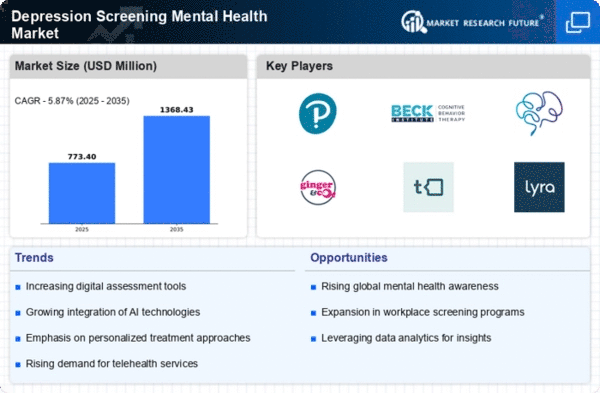
As per MRFR analysis, the Depression Screening Mental Health Market was estimated at 730.52 USD Million in 2024. The Depression Screening industry is projected to grow from 773.41 USD Million in 2025 to 1368.43 USD Million by 2035, exhibiting a compound annual growth rate (CAGR) of 5.87 during the forecast period 2025 - 2035.

Key Market Trends & Highlights

The Depression Screening Mental Health Market is experiencing a transformative shift towards integrated and preventive care solutions.

  • Technological integration is reshaping the landscape of depression screening, enhancing accuracy and accessibility.
  • North America remains the largest market, driven by increased awareness and robust healthcare infrastructure.
  • The treatment segment is witnessing rapid growth, particularly in telehealth services, which offer convenient access to mental health resources.
  • Rising prevalence of depression and advancements in screening technologies are key drivers propelling market expansion.

Market Size & Forecast

2024 Market Size 730.52 (USD Million)
2035 Market Size 1368.43 (USD Million)
CAGR (2025 - 2035) 5.87%
Largest Regional Market Share in 2024 North America

Major Players

<p>Pearson (GB), Beck Institute for Cognitive Behavior Therapy (US), Mind Diagnostics (US), Ginger (US), Talkspace (US), Lyra Health (US), Cerebral (US), BetterHelp (US), Headspace Health (US)</p>

Market Trends

The Depression Screening Mental Health Market is currently experiencing a notable evolution, driven by an increasing awareness of mental health issues and the importance of early detection. This market appears to be expanding as healthcare providers and organizations recognize the necessity of implementing effective screening tools. The integration of technology into mental health services, such as telehealth and mobile applications, seems to enhance accessibility and convenience for individuals seeking support. Furthermore, the growing emphasis on preventive care may lead to a more proactive approach in addressing depression, thereby fostering a culture of mental wellness. In addition, the ongoing collaboration between various stakeholders, including healthcare professionals, policymakers, and technology developers, indicates a collective effort to improve mental health outcomes. This collaboration may result in the development of innovative screening methods and resources tailored to diverse populations. As the Depression Screening Mental Health Market continues to evolve, it is likely that new strategies will emerge, focusing on personalized care and the integration of mental health services into primary healthcare settings. Overall, the market appears poised for growth, reflecting a broader societal shift towards prioritizing mental health and well-being.

Technological Integration

The incorporation of technology into the Depression Screening Mental Health Market is becoming increasingly prevalent. Digital tools, such as mobile applications and online platforms, facilitate easier access to screening resources. This trend suggests that individuals may benefit from more convenient and user-friendly options for assessing their mental health.

Focus on Preventive Care

There is a growing emphasis on preventive care within the Depression Screening Mental Health Market. This shift indicates a proactive approach to mental health, where early detection and intervention are prioritized. Such a focus may lead to improved outcomes and a reduction in the long-term impact of depression.

Collaborative Efforts

The Depression Screening Mental Health Market is witnessing enhanced collaboration among various stakeholders. Healthcare providers, policymakers, and technology developers are increasingly working together to create comprehensive screening solutions. This trend suggests a unified effort to address mental health challenges and improve access to necessary resources.

Depression Screening Mental Health Market Market Drivers

Market Growth Projections

The Global Depression Screening Market Industry is projected to experience substantial growth over the coming years. With a market value of 0.73 USD Billion in 2024, it is anticipated to reach 1.37 USD Billion by 2035, reflecting a compound annual growth rate (CAGR) of 5.86% from 2025 to 2035. This growth is driven by various factors, including the rising prevalence of depression, increased awareness of mental health, and advancements in screening technologies. As stakeholders in the healthcare sector recognize the importance of early detection and intervention, the market is likely to expand, presenting opportunities for innovation and investment.

Rising Prevalence of Depression

The increasing prevalence of depression globally serves as a primary driver for the Global Depression Screening Market Industry. Recent statistics indicate that approximately 264 million individuals are affected by depression worldwide, highlighting a pressing need for effective screening methods. As awareness of mental health issues grows, healthcare systems are prioritizing early detection and intervention strategies. This trend is likely to bolster the demand for screening tools and services, contributing to the market's projected growth from 0.73 USD Billion in 2024 to an estimated 1.37 USD Billion by 2035, reflecting a compound annual growth rate (CAGR) of 5.86% from 2025 to 2035.

Government Initiatives and Funding

Government initiatives aimed at improving mental health services significantly influence the Global Depression Screening Market Industry. Various countries are implementing policies that promote mental health awareness and allocate funding for screening programs. For instance, national health services are increasingly integrating depression screening into routine healthcare practices, thereby enhancing accessibility. Such initiatives not only encourage healthcare providers to adopt screening protocols but also facilitate the development of innovative screening tools. This supportive environment is expected to drive market growth, as evidenced by the projected increase in market value from 0.73 USD Billion in 2024 to 1.37 USD Billion by 2035.

Increased Awareness of Mental Health

The growing awareness of mental health issues among the global population significantly drives the Global Depression Screening Market Industry. Public campaigns and educational programs are fostering a better understanding of depression, its symptoms, and the importance of early detection. This heightened awareness encourages individuals to seek screening and treatment, thereby increasing the demand for screening services. As mental health becomes a priority in public health discussions, healthcare providers are more likely to implement screening protocols. The market is projected to grow from 0.73 USD Billion in 2024 to 1.37 USD Billion by 2035, reflecting the positive correlation between awareness and market expansion.

Integration of Screening in Primary Care

The integration of depression screening into primary care settings is a vital driver for the Global Depression Screening Market Industry. Healthcare providers are increasingly recognizing the importance of addressing mental health within general health services. This integration allows for early identification and management of depression, improving overall patient care. As primary care physicians adopt standardized screening tools, the demand for these tools is expected to rise. The market's growth trajectory, from 0.73 USD Billion in 2024 to 1.37 USD Billion by 2035, illustrates the potential impact of this integration on enhancing screening practices and expanding market opportunities.

Technological Advancements in Screening Tools

Technological advancements play a crucial role in shaping the Global Depression Screening Market Industry. The integration of artificial intelligence and machine learning into screening tools enhances their accuracy and efficiency, allowing for more effective identification of depression symptoms. Innovations such as mobile applications and telehealth platforms facilitate remote screening, making it easier for individuals to access mental health services. These advancements not only improve patient outcomes but also expand the market reach, as more healthcare providers adopt these technologies. The anticipated growth from 0.73 USD Billion in 2024 to 1.37 USD Billion by 2035 underscores the impact of technology on market dynamics.

Market Segment Insights

By Application: Screening (Largest) vs. Treatment (Fastest-Growing)

<p>In the Depression Screening Mental Health Market, the application segment is primarily divided into screening, diagnosis, monitoring, treatment, and research. Among these, screening emerges as the largest segment, driving significant revenue due to its essential role in early detection of depression. Conversely, the treatment segment is noted for its rapid growth, reflecting the increasing demand for effective methodologies addressing mental health issues.</p>

<p>Screening (Dominant) vs. Treatment (Emerging)</p>

<p>Screening, as the dominant segment in the market, encompasses various techniques and tools aimed at identifying individuals at risk of depression. This segment emphasizes early intervention to reduce the overall burden of mental health disorders. On the other hand, the treatment segment represents an emerging field reflecting advances in therapeutic practices, increasing acceptance of mental health treatments, and a growing focus on personalized care. The rapid growth in this segment can be attributed to the integration of innovative therapeutic approaches, including pharmacological and psychological interventions, responding to a rising awareness and need for effective mental health resources.</p>

By End Use: Hospitals (Largest) vs. Telehealth (Fastest-Growing)

<p>The Depression Screening Mental Health Market displays a diverse array of end-use segments, with hospitals commanding the largest market share. Typically, hospitals have robust resources and comprehensive facilities, enabling effective and timely depression screenings. Clinics follow closely, with a significant share as they provide specialized mental health services tailored to local populations. Home care, telehealth, and community health segments reflect emerging dynamics within the market, catering to a population increasingly seeking accessible mental health services.</p>

<p>Hospitals (Dominant) vs. Telehealth (Emerging)</p>

<p>Hospitals serve as the dominant players in the Depression Screening Mental Health Market, leveraging their extensive infrastructure and expertise to deliver high-quality mental health services. They are equipped with interdisciplinary teams that collaborate to address complex cases of depression. In contrast, the telehealth segment is gaining momentum, fueled by advancements in technology and a growing demand for remote healthcare solutions. Telehealth offers flexibility and accessibility, particularly advantageous for individuals in remote areas or those unable to attend traditional visits. As a result, while hospitals remain steadfast in their market position, telehealth is emerging as a vital alternative, bridging gaps in care and reaching underserved populations.</p>

By Age Group: Adults (Largest) vs. Children (Fastest-Growing)

<p>The Depression Screening Mental Health Market is significantly influenced by age demographics, with adults commanding the largest share. This adult segment encompasses individuals aged 18 to 64, who are increasingly seeking effective screening methods due to rising awareness of mental health issues. Conversely, the children segment is emerging as a focal point, driven by the growing recognition of mental health challenges in younger populations. As awareness continues to expand, these two segments present contrasting market positions in terms of share and growth. Growth trends indicate a promising trajectory for the child and adolescent segments as mental health awareness initiatives lead to increased screening adoption. Policy changes, school-based mental health programs, and parental advocacy are driving this growth. For adults, there is a steady demand for effective screening solutions, driven by a growing emphasis on mental well-being and early intervention strategies. These trends are likely to shape the market as it responds to the unique needs of each age group.</p>

<p>Adults (Dominant) vs. Children (Emerging)</p>

<p>In the Depression Screening Mental Health Market, adults serve as the dominant age group, primarily due to their higher incidence rates of depressive disorders and stronger engagement with mental health services. Adults typically have better access to the necessary resources and are more likely to seek professional help. Meanwhile, children represent an emerging segment that is rapidly gaining attention with increasing advocacy for mental health screening in schools. Recognized as a vulnerable population, children are now being targeted for early intervention initiatives. This focus on children enhances their market potential, as schools and healthcare providers emphasize the necessity for mental health screenings. Overall, both segments reflect crucial demographics in mental health care evolution.</p>

By Method of Screening: Clinical Assessment (Largest) vs. Digital Tools (Fastest-Growing)

<p>In the Depression Screening Mental Health Market, the screening methods showcase distinct distributions in market engagement. Clinical Assessment stands out as the largest segment, representing a substantial share of the market. This method is preferred in traditional healthcare settings, where professionals conduct thorough evaluations. Self-Assessment and Telephonic Screening follow, but Digital Tools are emerging as a notable competitor, appealing to a tech-savvy demographic seeking convenience and privacy in their mental health screenings.</p>

<p>Clinical Assessment (Dominant) vs. Digital Tools (Emerging)</p>

<p>Clinical Assessment remains the dominant method in the Depression Screening Mental Health Market, characterized by face-to-face interactions with healthcare professionals who administer standardized tests and evaluate patients comprehensively. This method ensures an accurate diagnosis and a tailored treatment plan. In contrast, Digital Tools are gaining traction rapidly, funded by advances in technology and a shift towards self-care. These tools are often interactive apps or online platforms that allow individuals to perform self-assessments at their convenience, appealing especially to younger, digital-native populations. This evolving dynamic reflects a broader trend towards integrating technology into mental health care, highlighting the increasing demand for accessible and user-friendly mental health solutions.</p>

By Severity of Depression: Mild (Largest) vs. Severe (Fastest-Growing)

<p>In the Depression Screening Mental Health Market, the distribution of severity levels reveals that 'Mild' depression constitutes a substantial share, establishing itself as the largest segment. This is attributed to the rising awareness and increasing screenings leading to early detection and management. 'Moderate' and 'Chronic' segments follow, but 'Severe' depression is gaining traction due to heightened emphasis on addressing this severe mental health condition. Overall, the market is evolving with a comprehensive range of screening tools targeting varying severity levels, which affects the treatment pathways chosen by healthcare providers. Growth trends indicate a significant shift towards recognizing 'Severe' depression as one of the fastest-growing segments. The escalating prevalence of depression, accelerated by social factors and economic stressors, has pushed the focus towards effective screening for severe cases. Healthcare professionals are increasingly integrating advanced technological tools that facilitate early detection, enabling timely interventions. Additionally, there's growing support for mental health initiatives, propelling awareness and improving access to screening, which significantly impacts the growth trajectory of 'Severe' depression screening initiatives.</p>

<p>Mild: Dominant vs. Severe: Emerging</p>

<p>The 'Mild' segment remains the dominant player in the Depression Screening Mental Health Market, characterized by its high prevalence and early identification practices. Individuals in this category often exhibit mild symptoms that can be effectively managed through various interventions, including counseling and lifestyle modifications. Awareness campaigns and community screenings have significantly boosted the recognition of this segment. Conversely, the 'Severe' segment is emerging rapidly as it encompasses individuals with pronounced symptoms requiring intensive intervention. This segment is marked by increased hospitalizations and treatment modalities tailored to severe cases. Factors driving growth in the 'Severe' illness segment include rising healthcare expenditures, advances in screening technologies, and a deepening understanding of mental health, reflecting a broader societal shift towards comprehensive mental health care.</p>

Get more detailed insights about Depression Screening Market Research Report - Forecast till 2035

Regional Insights

North America : Market Leader in Mental Health

North America is poised to maintain its leadership in the Depression Screening Mental Health Market, holding a significant market share of $365.26M in 2025. The region's growth is driven by increasing awareness of mental health issues, advancements in telehealth technologies, and supportive regulatory frameworks. The demand for effective screening tools is further fueled by rising incidences of depression and anxiety, prompting healthcare providers to adopt innovative solutions. The competitive landscape in North America is robust, featuring key players such as Talkspace, BetterHelp, and Ginger. These companies are leveraging technology to enhance accessibility and effectiveness in mental health care. The U.S. leads the market, supported by a strong healthcare infrastructure and a growing emphasis on mental health initiatives. The presence of established organizations fosters a dynamic environment for innovation and collaboration in mental health services.

Europe : Emerging Market for Mental Health

Europe is witnessing a significant transformation in the Depression Screening Mental Health Market, with a market size of €215.16M in 2025. The region's growth is propelled by increasing government initiatives aimed at mental health awareness and the integration of mental health services into primary care. Regulatory support, such as the European Mental Health Action Plan, is catalyzing the adoption of standardized screening tools across member states, enhancing accessibility and quality of care. Leading countries in Europe include Germany, France, and the UK, where mental health services are increasingly prioritized. The competitive landscape features key players like Mind Diagnostics and Headspace Health, who are innovating to meet the growing demand for effective screening solutions. The emphasis on digital health solutions is reshaping the market, making mental health care more accessible to diverse populations.

Asia-Pacific : Rapidly Growing Mental Health Sector

Asia-Pacific is emerging as a rapidly growing region in the Depression Screening Mental Health Market, with a market size of $130.0M in 2025. The growth is driven by increasing awareness of mental health issues, particularly in countries like Australia, Japan, and India. Government initiatives aimed at improving mental health services and reducing stigma are fostering a conducive environment for the adoption of screening tools. The rise of telehealth services is also contributing to market expansion, making mental health care more accessible. The competitive landscape in Asia-Pacific is evolving, with local and international players entering the market. Companies like Lyra Health and Cerebral are expanding their reach, offering innovative solutions tailored to regional needs. The focus on integrating mental health services into primary healthcare systems is expected to drive further growth, as countries prioritize mental well-being in their health agendas.

Middle East and Africa : Developing Mental Health Awareness

The Middle East and Africa region is gradually developing its focus on the Depression Screening Mental Health Market, with a market size of $20.1M in 2025. The growth is primarily driven by increasing awareness of mental health issues and the need for effective screening tools. Governments are beginning to recognize the importance of mental health, leading to initiatives aimed at improving access to mental health services. However, challenges such as stigma and limited resources still hinder progress in this area. Countries like South Africa and the UAE are taking steps to enhance mental health services, with a growing number of organizations focusing on mental health awareness. The competitive landscape is still nascent, but emerging players are beginning to offer innovative solutions. As the region continues to prioritize mental health, the demand for effective screening tools is expected to rise, paving the way for future growth.

Key Players and Competitive Insights

The Depression Screening Mental Health Market is currently characterized by a dynamic competitive landscape, driven by increasing awareness of mental health issues and the growing demand for accessible screening solutions. Key players such as Talkspace (US), BetterHelp (US), and Lyra Health (US) are strategically positioned to leverage digital platforms for delivering mental health services. These companies focus on innovation and technology integration, enhancing user experience through teletherapy and AI-driven assessments. Their collective strategies not only foster competition but also contribute to a more robust market environment, as they continuously adapt to the evolving needs of consumers seeking mental health support.

In terms of business tactics, companies are increasingly localizing their services to cater to diverse populations, optimizing their supply chains to ensure timely access to mental health resources. The market appears moderately fragmented, with a mix of established players and emerging startups. This structure allows for a variety of approaches to depression screening, as companies strive to differentiate themselves through unique service offerings and technological advancements.

In November 2025, Talkspace (US) announced a partnership with a leading health insurance provider to expand its coverage for mental health services. This strategic move is likely to enhance accessibility for users, potentially increasing their market share and reinforcing their position as a leader in the teletherapy space. By aligning with insurance providers, Talkspace may also streamline the reimbursement process, making it easier for clients to access necessary services.

In October 2025, BetterHelp (US) launched a new AI-driven tool designed to personalize therapy recommendations based on user input and behavioral data. This innovation could significantly improve user engagement and satisfaction, as it tailors the therapeutic experience to individual needs. The introduction of such technology not only positions BetterHelp as a forward-thinking player but also reflects a broader trend towards the integration of AI in mental health services, which may redefine user expectations.

In September 2025, Lyra Health (US) expanded its services into the European market, marking a significant step in its global growth strategy. This expansion is indicative of the increasing recognition of mental health as a critical component of overall health, and it suggests that Lyra is keen on tapping into new demographics. By entering Europe, Lyra Health may enhance its competitive edge, as it diversifies its service offerings and adapts to varying regional needs.

As of December 2025, the competitive trends in the Depression Screening Mental Health Market are heavily influenced by digitalization, AI integration, and a growing emphasis on sustainability. Strategic alliances among key players are shaping the landscape, fostering innovation and collaboration. The shift from price-based competition to a focus on technological advancements and reliable supply chains is evident, suggesting that future differentiation will hinge on the ability to innovate and provide high-quality, accessible mental health solutions.

Key Companies in the Depression Screening Mental Health Market market include

Industry Developments

  • In June 2022, Bruker (US) launched enhanced 3d holographic stimulation for optogenetics on its ultima 2pplus multiphoton microscope.
  • In November 2021, Siemens (Ireland) introduced Magnetom Free. It is a cost-effective whole-body MRI scanner designed to enable significantly better access to magnetic resonance imaging.
  • In November 2019, Siemens (Ireland) introduced a new Somatom X.cite CT scanner with a revolutionary user guidance system.

Depression Screening Segmentation

Depression Screening Indication Outlook

  • Major Depressive Disorder
  • Anxiety Distress
  • Bipolar Disorder
  • Psychotic Disorders
  • Others 

Depression Screening Diagnosis Outlook

  • Psychological Tests
  • Blood Tests
  • Pharmacogenomic Testing
  • Others

Depression Screening End User Outlook

  • Hospitals and Clinics
  • Home-based
  • Research and Academic Institutes

Depression Screening Regional Outlook

    • North America
      • US
      • Canada
    • Europe
      • Germany
      • France
      • UK
      • Italy
      • Spain
      • Rest of Europe
    • Asia-Pacific
      • China
      • Japan
      • India
      • South Korea
      • Australia
      • Rest of Asia-Pacific
    • Rest of the World
      • Middle East
      • Africa
      • Latin America

Future Outlook

Depression Screening Mental Health Market Future Outlook

<p>The Depression Screening Mental Health Market is projected to grow at a 5.87% CAGR from 2024 to 2035, driven by increasing awareness and technological advancements.</p>

New opportunities lie in:

  • <p>Integration of AI-driven screening tools in primary care settings.</p>
  • <p>Development of mobile applications for remote depression assessments.</p>
  • <p>Partnerships with employers for workplace mental health programs.</p>

<p>By 2035, the market is expected to be robust, reflecting enhanced screening capabilities and broader accessibility.</p>

Market Segmentation

Depression Screening Mental Health Market End Use Outlook

  • Hospitals
  • Clinics
  • Home Care
  • Telehealth
  • Community Health

Depression Screening Mental Health Market Age Group Outlook

  • Children
  • Adolescents
  • Adults
  • Elderly

Depression Screening Mental Health Market Application Outlook

  • Screening
  • Diagnosis
  • Monitoring
  • Treatment
  • Research

Depression Screening Mental Health Market Method of Screening Outlook

  • Self-Assessment
  • Clinical Assessment
  • Digital Tools
  • Telephonic Screening

Depression Screening Mental Health Market Severity of Depression Outlook

  • Mild
  • Moderate
  • Severe
  • Chronic

Report Scope

MARKET SIZE 2024730.52(USD Million)
MARKET SIZE 2025773.41(USD Million)
MARKET SIZE 20351368.43(USD Million)
COMPOUND ANNUAL GROWTH RATE (CAGR)5.87% (2024 - 2035)
REPORT COVERAGERevenue Forecast, Competitive Landscape, Growth Factors, and Trends
BASE YEAR2024
Market Forecast Period2025 - 2035
Historical Data2019 - 2024
Market Forecast UnitsUSD Million
Key Companies ProfiledPearson (GB), Beck Institute for Cognitive Behavior Therapy (US), Mind Diagnostics (US), Ginger (US), Talkspace (US), Lyra Health (US), Cerebral (US), BetterHelp (US), Headspace Health (US)
Segments CoveredApplication, End Use, Age Group, Method of Screening, Severity of Depression
Key Market OpportunitiesIntegration of digital tools enhances accessibility and efficiency in the Depression Screening Mental Health Market.
Key Market DynamicsRising demand for digital screening tools drives innovation and competition in the Depression Screening Mental Health Market.
Countries CoveredNorth America, Europe, APAC, South America, MEA

FAQs

What is the projected growth of the Depression Screening market?

The Depression Screening market is the expected increase in total market value of 1.37 USD billion over a defined forecast period 2025–2035. It is driven by factors such as demand trends, technological advances, regulatory changes, and geographic expansion.

What is the size of the Depression Screening market?

Depression Screening market size was valued at approximately 0.73 billion USD in 2024. This figure will reach 1.37 billion USD covering all regions (America, Europe, Asia, MEA and ROW), focusing its segments / services / distribution channels till 2035.

What is the CAGR of the Depression Screening market?

Depression Screening market is expected to grow at a CAGR of 5.87% between 2025 and 2035.

How much will the Depression Screening market be worth by 2035?

Depression Screening market is expected to be worth of 1.37 billion USD, reflecting growth driven by usage, technology and global demands by the end of 2035.

How will the Depression Screening market perform over the next 10 years?

Over the next 10 years the Depression Screening market is expected to shift from usd billion 0.73 to 1.37 billion USD, led by adoption of advanced tech, demographic trends, regulatory approvals, with potential headwinds from 2025 to 2035.

How much is the depression screening market?

The Depression Screening Market is anticipated to reach 1.24 billion during the forecast period of 2024-2035.

  1. EXECUTIVE SUMMARY
    1. OVERVIEW
      1. MARKET SYNOPSIS
  2. MARKET INTRODUCTION
    1. DEFINITION
    2. SCOPE OF THE STUDY
    3. RESEARCH OBJECTIVE
    4. MARKET STRUCTURE
    5. LIST OF ASSUMPTIONS
  3. RESEARCH METHODOLOGY
    1. OVERVIEW
    2. DATA MINING
    3. SECONDARY RESEARCH
    4. PRIMARY RESEARCH
      1. PRIMARY INTERVIEWS
      2. BREAKDOWN OF PRIMARY RESPONDENTS
    5. AND INFORMATION GATHERING PROCESS
    6. FORECASTING TECHNIQUES
    7. RESEARCH METHODOLOGY FOR MARKET SIZE ESTIMATION
      1. BOTTOM-UP APPROACH
      2. TOP-DOWN APPROACH
    8. DATA TRIANGULATION
    9. VALIDATION
  4. MARKET DYNAMICS
    1. OVERVIEW
    2. DRIVERS
      1. INCREASING PREVALENCE
      2. RISING NUMBER OF STRATEGIC INITIATIVES
    3. OF MENTAL DISORDERS
    4. RISE IN ADOPTION OF NEW THERAPIES AND TREATMENTS
    5. RESTRAINTS
      1. LACK OF AWARENESS
    6. AMONG PEOPLE
    7. DEARTH OF QUALIFIED MENTAL HEALTH PROFESSIONALS
    8. OPPORTUNITIES
      1. INCREASING TECHNOLOGICAL ADVANCEMENT IN REGARD
    9. TO MENTAL HEALTH
  5. MARKET FACTOR ANALYSIS
  6. VALUE CHAIN ANALYSIS
    1. PRODUCT DEVELOPMENT & BUSINESS ACQUISITION (PDBA)
    2. OF SUPPLIERS
    3. THREAT OF SUBSTITUTES
    4. BARGAINING POWER OF BUYERS
    5. MARKET
    6. IMPACT ON MARKET GROWTH
  7. SALES AND MARKETING
  8. CONTRACT MANAGEMENT
  9. CUSTOMER SERVICE & SUPPORT
    1. PORTER''S FIVE FORCES MODEL
      1. THREAT OF NEW ENTRANTS
      2. BARGAINING POWER
      3. INTENSITY OF RIVALRY
    2. IMPACT OF COVID-19 ON THE GLOBAL DEPRESSION SCREENING
      1. IMPACT ON VALUE CHAIN
      2. IMPACT ON END USERS
  10. GLOBAL DEPRESSION SCREENING MARKET, BY INDICATON
    1. OVERVIEW
    2. MAJOR DEPRESSIVE
    3. DISORDER
    4. ANXIETY DISTRESS
    5. BIPOLAR DISORDER
    6. PSYCHOTIC DISORDERS
    7. OTHERS
  11. GLOBAL
  12. DEPRESION SCREENING MARKET, BY DIAGNOSIS
    1. OVERVIEW
    2. PSYCHOLOGICAL TESTS
    3. BLOOD TESTS
    4. PHARMACOGENOMIC TESTING
    5. OTHERS
  13. GLOBAL DEPRESSION SCREENING MARKET, BY END USER
    1. OVERVIEW
    2. HOSPITALS AND CLINICS
    3. HOME-BASED
    4. RESEARCH AND ACADEMIC
    5. INSTITUTES
  14. GLOBAL DEPRESSION SCREENING MARKET, BY REGION
    1. OVERVIEW
    2. NORTH AMERICA
      1. US
      2. CANADA
    3. EUROPE
      1. GERMANY
      2. UK
      3. FRANCE
      4. ITALY
      5. SPAIN
      6. REST OF EUROPE
    4. ASIA-PACIFIC
      1. JAPAN
      2. CHINA
      3. INDIA
      4. SOUTH KOREA
      5. AUSTRALIA
      6. REST OF ASIA-PACIFIC
    5. REST OF THE WORLD
      1. MIDDLE EAST
      2. AFRICA
      3. LATIN AMERICA
  15. COMPETITIVE LANDSCAPE
    1. OVERVIEW
    2. COMPETITIVE BENCHMARKING
    3. MAJOR GROWTH STRATEGY IN THE GLOBAL DEPRESSION
  16. SCREENING MARKET
    1. THE LEADING PLAYER IN TERMS OF THE NUMBER OF DEVELOPMENTS IN THE GLOBAL DEPRESSION
  17. SCREENING MARKET
  18. KEY DEVELOPMENT ANALYSIS
    1. KEY DEVELOPMENTS & GROWTH STRATEGIES
      1. PRODUCT LAUNCH/ PRODUCT APPROVAL
      2. PARTNERSHIP/AGREEMENT
      3. MERGER /ACQUISTION
    2. FINANCIAL MATRIX
      1. SALES (USD BILLION),
    3. R&D EXPENDITURE (USD BILLION), 2022
  19. COMPANY PROFILES
    1. NATIONAL PSYCHOLOGICAL CORPORATION
      1. COMPANY OVERVIEW
      2. FINANCIAL OVERVIEW
      3. PRODUCTS OFFERED
      4. KEY DEVELOPMENTS
      5. KEY STRATEGIES
    2. BRUKER
      1. COMPANY OVERVIEW
      2. FINANCIAL OVERVIEW
      3. PRODUCTS OFFERED
      4. KEY DEVELOPMENTS
      5. SWOT ANALYSIS
      6. KEY STRATEGIES
    3. MEDTRONIC
      1. COMPANY OVERVIEWS
      2. FINANCIAL OVERVIEW
      3. PRODUCTS OFFERED
      4. KEY DEVELOPMENTS
      5. SWOT ANALYSIS
      6. KEY STRATEGIES
    4. MULTI-HEALTH SYSTEMS
    5. INC.
    6. COMPANY OVERVIEW
    7. FINANCIAL OVERVIEW
    8. PRODUCTS OFFERED
    9. KEY DEVELOPMENTS
    10. KEY STRATEGIES
    11. NEDLEY HEALTH
    12. COMPANY OVERVIEW
    13. FINANCIAL OVERVIEW
    14. PRODUCTS OFFERED
    15. KEY DEVELOPMENTS
    16. KEY STRATEGIES
    17. DANAHER CORPORATION
    18. COMPANY OVERVIEW
    19. FINANCIAL OVERVIEW
    20. PRODUCTS OFFERED
    21. KEY DEVELOPMENTS
  20. SWOT ANALYSIS
    1. KEY STRATEGIES
    2. PEARSON
    3. COMPANY OVERVIEW
    4. FINANCIAL OVERVIEW
    5. PRODUCTS/SERVICES OFFERED
    6. INC.
    7. COMPANY OVERVIEW
    8. FINANCIAL OVERVIEW
    9. PRODUCTS OFFERED
    10. KEY DEVELOPMENTS
    11. KEY STRATEGIES
    12. APPENDIX
    13. REFERENCES
    14. RELATED REPORTS
  21. KEY DEVELOPMENTS
  22. SWOT ANALYSIS
  23. KEY STRATEGIES
    1. SIGMA ASSESSMENT SYSTEMS INC.
      1. COMPANY OVERVIEW
      2. FINANCIAL OVERVIEW
      3. PRODUCTS OFFERED
      4. KEY DEVELOPMENTS
      5. KEY STRATEGIES
    2. SIEMENS
      1. COMPANY OVERVIEW
      2. FINANCIAL OVERVIEW
      3. PRODUCTS OFFERED
      4. KEY DEVELOPMENTS
      5. SWOT ANALYSIS
      6. KEY STRATEGIES
    3. PAR, INC.
      1. COMPANY OVERVIEW
      2. FINANCIAL OVERVIEW
      3. PRODUCTS OFFERED
      4. KEY DEVELOPMENTS
      5. KEY STRATEGIES
    4. MYRIAD GENETICS,
  24. LIST OF TABLES
  25. LIST OF ASSUMPTIONS
    1. & LIMITATIONS
    2. TABLE
  26. GLOBAL DEPRESSION SCREENING MARKET, BY INDICATION, 2019–2032 (USD BILLION)
  27. GLOBAL DEPRESSION
  28. SCREENING MARKET, FOR MAJOR DEPRESSIVE DISORDER, BY REGION, 2019–2032 (USD
    1. BILLION)
    2. TABLE
  29. GLOBAL DEPRESSION SCREENING MARKET, FOR ANXIETY DISTRESS, BY REGION, 2019–2032
    1. (USD BILLION)
    2. TABLE
  30. GLOBAL DEPRESSION SCREENING MARKET, FOR BIPOLAR DISORDER, BY REGION, 2019–2032
    1. (USD BILLION)
    2. TABLE
  31. GLOBAL DEPRESSION SCREENING MARKET, FOR PSYCHOTIC DISORDERS, BY REGION, 2019–2032
    1. (USD BILLION)
    2. TABLE
  32. GLOBAL DEPRESSION SCREENING MARKET, FOR OTHERS, BY REGION, 2019–2032 (USD
    1. BILLION)
    2. TABLE
  33. GLOBAL DEPRESSION SCREENING MARKET, BY DIAGNOSIS, 2019–2032 (USD BILLION)
  34. GLOBAL DEPRESSION
  35. SCREENING MARKET, FOR PSYCHOLOGICAL TESTS, BY REGION, 2019–2032 (USD BILLION)
  36. GLOBAL DEPRESSION
  37. SCREENING MARKET, FOR BLOOD TESTS, BY REGION, 2019–2032 (USD BILLION)
  38. GLOBAL DEPRESSION
  39. SCREENING MARKET, FOR PHARMACOGENOMIC TESTING, BY REGION, 2019–2032 (USD BILLION)
  40. GLOBAL DEPRESSION
  41. SCREENING MARKET, FOR OTHERS, BY ERGION, 2019–2032 (USD BILLION)
  42. GLOBAL DEPRESSION
  43. SCREENING MARKET, FOR END USER, BY REGION, 2019–2032 (USD BILLION)
  44. GLOBAL DEPRESSION
  45. SCREENING MARKET, FOR HOSPITALS AND CLINICS, BY REGION, 2019–2032 (USD BILLION)
  46. GLOBAL DEPRESSION
  47. SCREENING MARKET, FOR HOME-BASED, BY REGION, 2019–2032 (USD BILLION)
  48. GLOBAL DEPRESSION
  49. SCREENING MARKET, FOR RESEARCH AND ACADEMIC INSTITUTES, BY REGION, 2019–2032
    1. (USD BILLION)
    2. TABLE
  50. GLOBAL: DEPRESSION SCREENING MARKET, BY REGION, 2019–2032 (USD BILLION)
  51. NORTH AMERICA:
  52. DEPRESSION SCREENING MARKET, BY COUNTRY, 2019–2032 (USD BILLION)
  53. NORTH AMERICA:
  54. DEPRESSION SCREENING MARKET, BY INDICATION, 2019–2032 (USD BILLION)
  55. NORTH AMERICA:
  56. DEPRESSION SCREENING MARKET, BY DIAGNOSIS, 2019–2032 (USD BILLION)
  57. NORTH AMERICA:
  58. DEPRESSION SCREENING MARKET, BY END USER, 2019–2032 (USD BILLION)
  59. US: DEPRESSION
  60. SCREENING MARKET, BY INDICATION, 2019–2032 (USD BILLION)
  61. US: DEPRESSION SCREENING
  62. MARKET, BY DIAGNOSIS, 2019–2032 (USD BILLION)
  63. US: DEPRESSION SCREENING MARKET, BY END
    1. USER, 2019–2032 (USD BILLION)
  64. CANADA: DEPRESSION SCREENING MARKET, BY INDICATION,
  65. CANADA: DEPRESSION SCREENING MARKET, BY DIAGNOSIS, 2019–2032
    1. (USD BILLION)
    2. TABLE
  66. CANADA: DEPRESSION SCREENING MARKET, BY END USER, 2019–2032 (USD BILLION)
  67. EUROPE: DEPRESSION
  68. SCREENING MARKET, BY COUNTRY, 2019–2032 (USD BILLION)
  69. EUROPE: DEPRESSION SCREENING MARKET, BY
    1. INDICATION, 2019–2032 (USD BILLION)
  70. EUROPE: DEPRESSION SCREENING MARKET, BY
    1. DIAGNOSIS, 2019–2032 (USD BILLION)
  71. EUROPE: DEPRESSION SCREENING MARKET, BY END USER,
  72. GERMANY: DEPRESSION SCREENING MARKET, BY INDICATION, 2019–2032
    1. (USD BILLION)
    2. TABLE
  73. GERMANY: DEPRESSION SCREENING MARKET, BY DIAGNOSIS, 2019–2032 (USD BILLION)
  74. GERMANY: DEPRESSION
  75. SCREENING MARKET, BY END USER, 2019–2032 (USD BILLION)
  76. UK: DEPRESSION SCREENING MARKET, BY INDICATION,
  77. UK: DEPRESSION SCREENING MARKET, BY DIAGNOSIS, 2019–2032
    1. (USD BILLION)
    2. TABLE
  78. UK: DEPRESSION SCREENING MARKET, BY END USER, 2019–2032 (USD BILLION)
  79. FRANCE: DEPRESSION
  80. SCREENING MARKET, BY INDICATION, 2019–2032 (USD BILLION)
  81. FRANCE: DEPRESSION SCREENING
  82. MARKET, BY DIAGNOSIS, 2019–2032 (USD BILLION)
  83. FRANCE: DEPRESSION SCREENING MARKET, BY
    1. END USER, 2019–2032 (USD BILLION)
  84. ITALY: DEPRESSION SCREENING MARKET, BY INDICATION,
  85. ITALY: DEPRESSION SCREENING MARKET, BY DIAGNOSIS, 2019–2032
    1. (USD BILLION)
    2. TABLE
  86. ITALY: DEPRESSION SCREENING MARKET, BY END USER, 2019–2032 (USD BILLION)
  87. SPAIN: DEPRESSION
  88. SCREENING MARKET, BY INDICATION, 2019–2032 (USD BILLION)
  89. SPAIN: DEPRESSION SCREENING
  90. MARKET, BY DIAGNOSIS, 2019–2032 (USD BILLION)
  91. SPAIN: DEPRESSION SCREENING MARKET, BY END
    1. USER, 2019–2032 (USD BILLION)
  92. REST OF EUROPE: DEPRESSION SCREENING MARKET, BY
    1. INDICATION, 2019–2032 (USD BILLION)
  93. REST OF EUROPE: DEPRESSION SCREENING MARKET,
    1. BY DIAGNOSIS, 2019–2032 (USD BILLION)
  94. REST OF EUROPE: DEPRESSION SCREENING MARKET,
    1. BY END USER, 2019–2032 (USD BILLION)
  95. ASIA-PACIFIC: DEPRESSION SCREENING MARKET,
    1. BY COUNTRY, 2019–2032 (USD BILLION)
  96. ASIA-PACIFIC: DEPRESSION SCREENING MARKET,
    1. BY INDICATION, 2019–2032 (USD BILLION)
  97. ASIA-PACIFIC: DEPRESSION SCREENING MARKET,
    1. BY DIAGNOSIS, 2019–2032 (USD BILLION)
  98. ASIA-PACIFIC: DEPRESSION SCREENING MARKET,
    1. BY END USER, 2019–2032 (USD BILLION)
  99. JAPAN: DEPRESSION SCREENING MARKET, BY INDICATION,
  100. JAPAN: DEPRESSION SCREENING MARKET, BY DIAGNOSIS, 2019–2032
    1. (USD BILLION)
    2. TABLE
  101. JAPAN: DEPRESSION SCREENING MARKET, BY END USER, 2019–2032 (USD BILLION)
  102. CHINA: DEPRESSION
  103. SCREENING MARKET, BY INDICATION, 2019–2032 (USD BILLION)
  104. CHINA: DEPRESSION SCREENING
  105. MARKET, BY DIAGNOSIS, 2019–2032 (USD BILLION)
  106. CHINA: DEPRESSION SCREENING MARKET, BY END
    1. USER, 2019–2032 (USD BILLION)
  107. INDIA: DEPRESSION SCREENING MARKET, BY INDICATION,
  108. INDIA: DEPRESSION SCREENING MARKET, BY DIAGNOSIS, 2019–2032
    1. (USD BILLION)
    2. TABLE
  109. INDIA: DEPRESSION SCREENING MARKET, BY END USER, 2019–2032 (USD BILLION)
  110. SOUTH KOREA:
  111. DEPRESSION SCREENING MARKET, BY INDICATION, 2019–2032 (USD BILLION)
  112. SOUTH KOREA:
  113. DEPRESSION SCREENING MARKET, BY DIAGNOSIS, 2019–2032 (USD BILLION)
  114. SOUTH KOREA:
  115. DEPRESSION SCREENING MARKET, BY END USER, 2019–2032 (USD BILLION)
  116. AUSTRALIA: DEPRESSION
  117. SCREENING MARKET, BY INDICATION, 2019–2032 (USD BILLION)
  118. AUSTRALIA: DEPRESSION
  119. SCREENING MARKET, BY DIAGNOSIS, 2019–2032 (USD BILLION)
  120. AUSTRALIA: DEPRESSION
  121. SCREENING MARKET, BY END USER, 2019–2032 (USD BILLION)
  122. REST OF ASIA-PACIFIC: DEPRESSION SCREENING
  123. MARKET, BY INDICATION, 2019–2032 (USD BILLION)
  124. REST OF ASIA-PACIFIC: DEPRESSION SCREENING
  125. MARKET, BY DIAGNOSIS, 2019–2032 (USD BILLION)
  126. REST OF ASIA-PACIFIC: DEPRESSION SCREENING
  127. MARKET, BY END USER, 2019–2032 (USD BILLION)
  128. REST OF THE WORLD: DEPRESSION SCREENING
  129. MARKET, BY COUNTRY, 2019–2032 (USD BILLION)
  130. REST OF THE WORLD: DEPRESSION SCREENING
  131. MARKET, BY INDICATION, 2019–2032 (USD BILLION)
  132. REST OF THE WORLD: DEPRESSION SCREENING
  133. MARKET, BY DIAGNOSIS, 2019–2032 (USD BILLION)
  134. REST OF THE WORLD: DEPRESSION SCREENING
  135. MARKET, BY END USER, 2019–2032 (USD BILLION)
  136. MIDDLE EAST: DEPRESSION SCREENING MARKET,
    1. BY INDICATION, 2019–2032 (USD BILLION)
  137. MIDDLE EAST: DEPRESSION SCREENING MARKET,
    1. BY DIAGNOSIS, 2019–2032 (USD BILLION)
  138. MIDDLE EAST: DEPRESSION SCREENING MARKET,
    1. BY END USER, 2019–2032 (USD BILLION)
  139. AFRICA: DEPRESSION SCREENING MARKET, BY
    1. INDICATION, 2019–2032 (USD BILLION)
  140. AFRICA: DEPRESSION SCREENING MARKET, BY
    1. DIAGNOSIS, 2019–2032 (USD BILLION)
  141. AFRICA: DEPRESSION SCREENING MARKET, BY END USER,
  142. LATIN AMERICA: DEPRESSION SCREENING MARKET, BY INDICATION,
  143. LATIN AMERICA: DEPRESSION SCREENING MARKET, BY DIAGNOSIS,
  144. LATIN AMERICA: DEPRESSION SCREENING MARKET, BY END USER, 2019–2032
    1. (USD BILLION)
    2. TABLE
  145. MAJOR PLAYERS IN THE GLOBAL DEPRESSION SCREENING MARKET
  146. MOST ACTIVE PLAYER IN THE GLOBAL DEPRESSION
  147. SCREENING MARKET
    1. TABLE
  148. PRODUCT LAUNCH/ PRODUCT APPROVAL
  149. PARTNERSHIP/AGREEMENT
  150. MERGER/ACQUISTION
  151. NATIONAL PSYCHOLOGICAL CORPORATION.: PRODUCTS
    1. OFFERED
    2. TABLE
  152. BRUKER: PRODUCTS OFFERED
  153. BRUKER: KEY DEVELOPMENTS
  154. MEDTRONIC: PRODUCTS OFFERED
  155. MEDTRONIC: KEY DEVELOPMENTS
  156. MULTI-HEALTH
    1. SYSTEMS INC.: PRODUCTS OFFERED
  157. NEDLEY HEALTH: PRODUCTS OFFERED
  158. DANAHER CORPORATION: PRODUCTS/SERVICES OFFERED
  159. DANAHER CORPORATION:
    1. KEY DEVELOPMENTS
    2. TABLE
  160. PEARSON: PRODUCTS/SERVICES OFFERED
  161. SIGMA ASSESSMENT SYSTEMS INC.: PRODUCTS/SERVICES
    1. OFFERED
    2. TABLE
  162. SIEMENS: PRODUCTS OFFERED

Depression Screening Market Segmentation

Depression Screening Indication Outlook (USD Billion, 2019-2032)

  • Major Depressive Disorder
  • Anxiety Distress
  • Bipolar Disorder
  • Psychotic Disorders
  • Others

Depression Screening Diagnosis Outlook (USD Billion, 2019-2032)

  • Psychological Tests
  • Blood Tests
  • Pharmacogenomic Testing
  • Others

Depression Screening End User Outlook (USD Billion, 2019-2032)

  • Hospitals and Clinics
  • Home-based
  • Research and Academic Institutes

Depression Screening Regional Outlook (USD Billion, 2019-2032)

  • North America Outlook (USD Billion, 2019-2032)
    • North America Depression Screening by Indication
      • Major Depressive Disorder
      • Anxiety Distress
      • Bipolar Disorder
      • Psychotic Disorders
      • Others
    • North America Depression Screening by Diagnosis
      • Psychological Tests
      • Blood Tests
      • Pharmacogenomic Testing
      • Others
    • North America Depression Screening by End User
      • Hospitals and Clinics
      • Home-based
      • Research and Academic Institutes
    • US Outlook (USD Billion, 2019-2032)
    • US Depression Screening by Indication
      • Major Depressive Disorder
      • Anxiety Distress
      • Bipolar Disorder
      • Psychotic Disorders
      • Others
    • US Depression Screening by Diagnosis
      • Psychological Tests
      • Blood Tests
      • Pharmacogenomic Testing
      • Others
    • US Depression Screening by End User
      • Hospitals and Clinics
      • Home-based
      • Research and Academic Institutes
    • Canada Outlook (USD Billion, 2019-2032)
    • Canada Depression Screening by Indication
      • Major Depressive Disorder
      • Anxiety Distress
      • Bipolar Disorder
      • Psychotic Disorders
      • Others
    • Canada Depression Screening by Diagnosis
      • Psychological Tests
      • Blood Tests
      • Pharmacogenomic Testing
      • Others
    • Canada Depression Screening by End User
      • Hospitals and Clinics
      • Home-based
      • Research and Academic Institutes
    • Europe Outlook (USD Billion, 2019-2032)
      • Europe Depression Screening by Indication
        • Major Depressive Disorder
        • Anxiety Distress
        • Bipolar Disorder
        • Psychotic Disorders
        • Others
      • Europe Depression Screening by Diagnosis
        • Psychological Tests
        • Blood Tests
        • Pharmacogenomic Testing
        • Others
      • Europe Depression Screening by End User
        • Hospitals and Clinics
        • Home-based
        • Research and Academic Institutes
      • Germany Outlook (USD Billion, 2019-2032)
      • Germany Depression Screening by Indication
        • Major Depressive Disorder
        • Anxiety Distress
        • Bipolar Disorder
        • Psychotic Disorders
        • Others
      • Germany Depression Screening by Diagnosis
        • Psychological Tests
        • Blood Tests
        • Pharmacogenomic Testing
        • Others
      • Germany Depression Screening by End User
        • Hospitals and Clinics
        • Home-based
        • Research and Academic Institutes
      • France Outlook (USD Billion, 2019-2032)
      • France Depression Screening by Indication
        • Major Depressive Disorder
        • Anxiety Distress
        • Bipolar Disorder
        • Psychotic Disorders
        • Others
      • France Depression Screening by Diagnosis
        • Psychological Tests
        • Blood Tests
        • Pharmacogenomic Testing
        • Others
      • France Depression Screening by End User
        • Hospitals and Clinics
        • Home-based
        • Research and Academic Institutes
      • UK Outlook (USD Billion, 2019-2032)
      • UK Depression Screening by Indication
        • Major Depressive Disorder
        • Anxiety Distress
        • Bipolar Disorder
        • Psychotic Disorders
        • Others
      • UK Depression Screening by Diagnosis
        • Psychological Tests
        • Blood Tests
        • Pharmacogenomic Testing
        • Others
      • UK Depression Screening by End User
        • Hospitals and Clinics
        • Home-based
        • Research and Academic Institutes
      • Italy Outlook (USD Billion, 2019-2032)
      • Italy Depression Screening by Indication
        • Major Depressive Disorder
        • Anxiety Distress
        • Bipolar Disorder
        • Psychotic Disorders
        • Others
      • Italy Depression Screening by Diagnosis
        • Psychological Tests
        • Blood Tests
        • Pharmacogenomic Testing
        • Others
      • Italy Depression Screening by End User
        • Hospitals and Clinics
        • Home-based
        • Research and Academic Institutes
      • Spain Outlook (USD Billion, 2019-2032)
      • Spain Depression Screening by Indication
        • Major Depressive Disorder
        • Anxiety Distress
        • Bipolar Disorder
        • Psychotic Disorders
        • Others
      • Spain Depression Screening by Diagnosis
        • Psychological Tests
        • Blood Tests
        • Pharmacogenomic Testing
        • Others
      • Spain Depression Screening by End User
        • Hospitals and Clinics
        • Home-based
        • Research and Academic Institutes
      • Rest of Europe Outlook (USD Billion, 2019-2032)
      • Rest of Europe Depression Screening by Indication
        • Major Depressive Disorder
        • Anxiety Distress
        • Bipolar Disorder
        • Psychotic Disorders
        • Others
      • Rest of Europe Depression Screening by Diagnosis
        • Psychological Tests
        • Blood Tests
        • Pharmacogenomic Testing
        • Others
      • Rest of Europe Depression Screening by End User
        • Hospitals and Clinics
        • Home-based
        • Research and Academic Institutes
      • Asia-Pacific Outlook (USD Billion, 2019-2032)
        • Asia-Pacific Depression Screening by Indication
          • Major Depressive Disorder
          • Anxiety Distress
          • Bipolar Disorder
          • Psychotic Disorders
          • Others
        • Asia-Pacific Depression Screening by Diagnosis
          • Psychological Tests
          • Blood Tests
          • Pharmacogenomic Testing
          • Others
        • Asia-Pacific Depression Screening by End User
          • Hospitals and Clinics
          • Home-based
          • Research and Academic Institutes
        • China Outlook (USD Billion, 2019-2032)
        • China Depression Screening by Indication
          • Major Depressive Disorder
          • Anxiety Distress
          • Bipolar Disorder
          • Psychotic Disorders
          • Others
        • China Depression Screening by Diagnosis
          • Psychological Tests
          • Blood Tests
          • Pharmacogenomic Testing
          • Others
        • China Depression Screening by End User
          • Hospitals and Clinics
          • Home-based
          • Research and Academic Institutes
        • Japan Outlook (USD Billion, 2019-2032)
        • Japan Depression Screening by Indication
          • Major Depressive Disorder
          • Anxiety Distress
          • Bipolar Disorder
          • Psychotic Disorders
          • Others
        • Japan Depression Screening by Diagnosis
          • Psychological Tests
          • Blood Tests
          • Pharmacogenomic Testing
          • Others
        • Japan Depression Screening by End User
          • Hospitals and Clinics
          • Home-based
          • Research and Academic Institutes
        • India Outlook (USD Billion, 2019-2032)
        • India Depression Screening by Indication
          • Major Depressive Disorder
          • Anxiety Distress
          • Bipolar Disorder
          • Psychotic Disorders
          • Others
        • India Depression Screening by Diagnosis
          • Psychological Tests
          • Blood Tests
          • Pharmacogenomic Testing
          • Others
        • India Depression Screening by End User
          • Hospitals and Clinics
          • Home-based
          • Research and Academic Institutes
        • South Korea Outlook (USD Billion, 2019-2032)
        • South Korea Depression Screening by Indication
          • Major Depressive Disorder
          • Anxiety Distress
          • Bipolar Disorder
          • Psychotic Disorders
          • Others
        • South Korea Depression Screening by Diagnosis
          • Psychological Tests
          • Blood Tests
          • Pharmacogenomic Testing
          • Others
        • South Korea Depression Screening by End User
          • Hospitals and Clinics
          • Home-based
          • Research and Academic Institutes
        • Australia Outlook (USD Billion, 2019-2032)
        • Australia Depression Screening by Indication
          • Major Depressive Disorder
          • Anxiety Distress
          • Bipolar Disorder
          • Psychotic Disorders
          • Others
        • Australia Depression Screening by Diagnosis
          • Psychological Tests
          • Blood Tests
          • Pharmacogenomic Testing
          • Others
        • Australia Depression Screening by End User
          • Hospitals and Clinics
          • Home-based
          • Research and Academic Institutes
        • Rest of Asia-Pacific Outlook (USD Billion, 2019-2032)
        • Rest of Asia-Pacific Depression Screening by Indication
          • Major Depressive Disorder
          • Anxiety Distress
          • Bipolar Disorder
          • Psychotic Disorders
          • Others
        • Rest of Asia-Pacific Depression Screening by Diagnosis
          • Psychological Tests
          • Blood Tests
          • Pharmacogenomic Testing
          • Others
        • Rest of Asia-Pacific Depression Screening by End User
          • Hospitals and Clinics
          • Home-based
          • Research and Academic Institutes
        • Rest of the World Outlook (USD Billion, 2019-2032)
          • Rest of the World Depression Screening by Indication
            • Major Depressive Disorder
            • Anxiety Distress
            • Bipolar Disorder
            • Psychotic Disorders
            • Others
          • Rest of the World Depression Screening by Diagnosis
            • Psychological Tests
            • Blood Tests
            • Pharmacogenomic Testing
            • Others
          • Rest of the World Depression Screening by End User
            • Hospitals and Clinics
            • Home-based
            • Research and Academic Institutes
          • Middle East Outlook (USD Billion, 2019-2032)
          • Middle East Depression Screening by Indication
            • Major Depressive Disorder
            • Anxiety Distress
            • Bipolar Disorder
            • Psychotic Disorders
            • Others
          • Middle East Depression Screening by Diagnosis
            • Psychological Tests
            • Blood Tests
            • Pharmacogenomic Testing
            • Others
          • Middle East Depression Screening by End User
            • Hospitals and Clinics
            • Home-based
            • Research and Academic Institutes
          • Africa Outlook (USD Billion, 2019-2032)
          • Africa Depression Screening by Indication
            • Major Depressive Disorder
            • Anxiety Distress
            • Bipolar Disorder
            • Psychotic Disorders
            • Others
          • Africa Depression Screening by Diagnosis
            • Psychological Tests
            • Blood Tests
            • Pharmacogenomic Testing
            • Others
          • Africa Depression Screening by End User
            • Hospitals and Clinics
            • Home-based
            • Research and Academic Institutes
          • Latin America Outlook (USD Billion, 2019-2032)
          • Latin America Depression Screening by Indication
            • Major Depressive Disorder
            • Anxiety Distress
            • Bipolar Disorder
            • Psychotic Disorders
            • Others
          • Latin America Depression Screening by Diagnosis
            • Psychological Tests
            • Blood Tests
            • Pharmacogenomic Testing
            • Others
          • Latin America Depression Screening by End User
            • Hospitals and Clinics
            • Home-based
            • Research and Academic Institutes
Infographic

Free Sample Request

Kindly complete the form below to receive a free sample of this Report

Get Free Sample

Customer Strories

Compare Licence

×
Features License Type
Single User Multiuser License Enterprise User
Price $4,950 $5,950 $7,250
Maximum User Access Limit 1 User Upto 10 Users Unrestricted Access Throughout the Organization
Free Customization
Direct Access to Analyst
Deliverable Format
Platform Access
Discount on Next Purchase 10% 15% 15%
Printable Versions