Request Free Sample ×

Kindly complete the form below to receive a free sample of this Report

* Please use a valid business email

Leading companies partner with us for data-driven Insights

clients tt-cursor
Hero Background
English
Chinese
French
Japanese
Korean
German
Spanish

Dental Sterilization Market Share

ID: MRFR/MED/5196-HCR
200 Pages
Rahul Gotadki
Last Updated: April 06, 2026

Dental Sterilization Market Research Report By Product Type (Autoclaves, Chemical Sterilizers, Heat Sterilizers, Radiation Sterilizers), By End User (Dental Clinics, Dental Laboratories, Hospitals), By Sterilization Method (Steam Sterilization, Dry Heat Sterilization, Chemical Sterilization), By Application (Instruments Sterilization, Surface Disinfection, Waste Sterilization) and By Regional (North America, Europe, South America, Asia Pacific, Middle East and Africa) - Growth & Industry Forecast 2025 To 2035

Share:
Download PDF ×

We do not share your information with anyone. However, we may send you emails based on your report interest from time to time. You may contact us at any time to opt-out.

Dental Sterilization Market Infographic
Purchase Options

Market Share

Dental Sterilization Market Share Analysis

One frequently used marketing approach is to differentiate oneself by technological advancement. These companies could have an edge over others if they invest in up-to-date sterilization technologies like complex autoclaves or chemical sterilants with shorter processing times only. By doing so these companies become market leaders in providing efficient solutions that are updated thus attracting clinicians who need recent developments for patient safety purposes.

Besides cost leadership is another important market share positioning strategy within the dental sterilization industry. Producing lower priced, yet high quality decontamination products can expand their reach to a greater number of dentists. Attracting smaller clinics or those that are operating on tight budgets could see this strategy increase the organization’s market share. Moreover, through optimizing processes and benefiting from economies of scale, businesses can continuously offer competitive pricing while maintaining low production costs without compromise on quality.

Making strong ties with dental professionals and key opinion leaders in the industry is a strategic move for dental sterilization market. Often businesses engage in partnerships with dental associations, participate in industry events and run educational campaigns to gain reputation for reliability. When brands place themselves as sources of reliable information and assistance, they can increase their share in the market.” In this way, dentists who value the reliability and assistance provided by sterilization products develop more loyalty towards such companies.

Market share positioning may be influenced by geographical positioning strategies. Organizations implement strategies tailored around regional or national legislations, customer preferences and healthcare infrastructures. Through manufacturing products that meet regional specifications while effectively responding to distinct challenges that are likely to emerge from various markets, a company can enhance its competitive position. This helps organizations have a more solid presence within specific regions hence leading to an increase of their overall market share.

Also, effective marketing and branding agenda plays a significant role in influencing market share positioning in dental sterilization sector. Dental customers are lured into purchasing from firms that invest into convincing communication that highlights unique features and benefits of new items. Market visibility and/or share can be bolstered if robust brand identity is established together with being present at relevant publications or online platforms.

Author
Author Profile
Rahul Gotadki
Research Manager

He holds an experience of about 9+ years in Market Research and Business Consulting, working under the spectrum of Life Sciences and Healthcare domains. Rahul conceptualizes and implements a scalable business strategy and provides strategic leadership to the clients. His expertise lies in market estimation, competitive intelligence, pipeline analysis, customer assessment, etc.

Leave a Comment

FAQs

What is the current valuation of the Dental Sterilization Market as of 2024?

<p>The Dental Sterilization Market was valued at 2.2 USD Billion in 2024.</p>

What is the projected market size for the Dental Sterilization Market in 2035?

<p>The market is projected to reach 7.081 USD Billion by 2035.</p>

What is the expected CAGR for the Dental Sterilization Market during the forecast period 2025 - 2035?

<p>The expected CAGR for the Dental Sterilization Market during 2025 - 2035 is 11.21%.</p>

Which product type segment is anticipated to have the highest valuation by 2035?

<p>The Autoclaves segment is expected to reach 2.75 USD Billion by 2035.</p>

How do dental clinics contribute to the Dental Sterilization Market?

<p>Dental clinics are projected to account for 2.8 USD Billion by 2035.</p>

What is the expected valuation for chemical sterilizers by 2035?

<p>Chemical Sterilizers are anticipated to reach a valuation of 2.05 USD Billion by 2035.</p>

Which sterilization method is likely to dominate the market by 2035?

<p>Steam Sterilization is expected to dominate with a valuation of 2.75 USD Billion by 2035.</p>

What role do key players like Steris and Getinge play in the market?

<p>Key players such as Steris and Getinge are instrumental in driving innovation and market growth.</p>

What is the projected valuation for waste sterilization by 2035?

<p>Waste Sterilization is projected to reach 2.35 USD Billion by 2035.</p>

How does the market for dental laboratories compare to that of hospitals by 2035?

<p>By 2035, dental laboratories are expected to reach 2.1 USD Billion, while hospitals are projected at 2.18 USD Billion.</p>

Market Summary

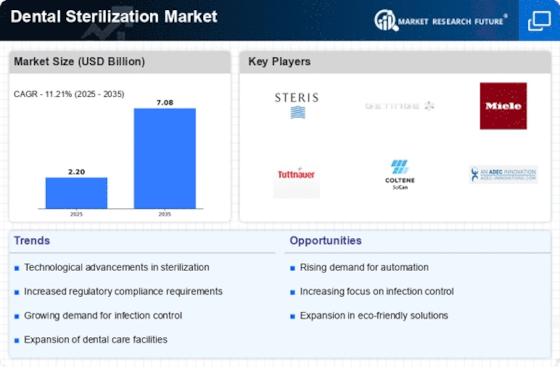
As per Market Research Future analysis, the Dental Sterilization Market was estimated at 2.2 USD Billion in 2024. The Dental Sterilization industry is projected to grow from 2.447 USD Billion in 2025 to 7.081 USD Billion by 2035, exhibiting a compound annual growth rate (CAGR) of 11.21% during the forecast period 2025 - 2035

Key Market Trends & Highlights

The Dental Sterilization Market is poised for growth driven by technological advancements and increasing regulatory compliance.

  • Technological advancements in sterilization equipment are reshaping the Dental Sterilization Market, particularly in North America. The demand for minimally invasive procedures is propelling growth in the Asia-Pacific region, indicating a shift in dental practices. Autoclaves remain the largest segment, while chemical sterilizers are emerging as the fastest-growing category in the market. Increasing awareness of infection control and regulatory compliance requirements are key drivers fueling market expansion.

Market Size & Forecast

2024 Market Size 2.2 (USD Billion)
2035 Market Size 7.081 (USD Billion)
CAGR (2025 - 2035) 11.21%
Largest Regional Market Share in 2024 North America

Major Players

Steris (US), Getinge (SE), Miele (DE), <a href="https://tuttnauer.com/dental-autoclaves">Tuttnauer </a>(IL), SciCan (CA), A-dec (US), Cattani (IT), BPR Medical (GB), Dentsply Sirona (US)

Market Trends

The Dental Sterilization Market is currently experiencing a notable evolution, driven by increasing awareness regarding infection control and patient safety. As dental practices prioritize hygiene, the demand for advanced sterilization equipment and techniques appears to be on the rise. Innovations in sterilization technologies, such as the integration of automated systems and enhanced monitoring capabilities, suggest a shift towards more efficient and reliable processes. Furthermore, regulatory bodies are emphasizing stringent sterilization protocols, which may further propel market growth as dental professionals seek compliance with these standards. In addition, the growing trend of minimally invasive procedures in dentistry could influence the Dental Sterilization Market. As these procedures often require specialized instruments, the need for effective sterilization methods becomes paramount. The market seems poised for expansion, with manufacturers focusing on developing user-friendly and effective sterilization solutions. Overall, the Dental Sterilization Market reflects a dynamic landscape, characterized by technological advancements and a heightened focus on safety and compliance.

Technological Advancements

The Dental Sterilization Market is witnessing a surge in technological innovations, particularly in sterilization equipment. Automated systems and advanced monitoring technologies are becoming increasingly prevalent, enhancing the efficiency and reliability of sterilization processes. These advancements not only streamline operations but also ensure compliance with stringent safety standards.

Regulatory Compliance

Regulatory bodies are intensifying their focus on infection control protocols within dental practices. This heightened scrutiny is driving demand for sterilization solutions that meet or exceed established guidelines. As dental professionals strive to adhere to these regulations, the market for compliant sterilization products is likely to expand.

Minimally Invasive Procedures

The rise of minimally invasive dental procedures is influencing the Dental Sterilization Market. These techniques often necessitate specialized instruments that require effective sterilization. Consequently, the demand for tailored sterilization solutions is expected to grow, as practitioners seek to maintain high standards of hygiene and patient safety.

Dental Sterilization Market Market Drivers

Rising Demand for Preventive Dental Care

The increasing emphasis on preventive dental care is influencing the Dental Sterilization Market. As patients become more proactive about their oral health, dental professionals are adopting preventive measures that necessitate stringent sterilization protocols. This shift towards preventive care is reflected in the growing popularity of routine check-ups and cleanings, which require effective sterilization of instruments and equipment. Data indicates that preventive dental visits have surged by 20% over the past few years, prompting dental practices to enhance their sterilization processes. As a result, the demand for reliable sterilization solutions is expected to rise, driving growth within the Dental Sterilization Market. This trend highlights the importance of maintaining high standards of hygiene in the pursuit of preventive dental care.

Growth of Dental Practices and Procedures

The expansion of dental practices and the increasing number of dental procedures are driving the Dental Sterilization Market. As more individuals seek dental care, the volume of procedures performed is on the rise, necessitating effective sterilization methods to ensure patient safety. Market analysis suggests that the number of dental visits has increased by approximately 15% in recent years, leading to a corresponding demand for sterilization solutions. This growth is particularly evident in emerging markets, where access to dental care is improving. Consequently, dental practices are investing in advanced sterilization technologies to accommodate the growing patient base and maintain high standards of hygiene. This trend is likely to bolster the Dental Sterilization Market in the coming years.

Increasing Awareness of Infection Control

The rising awareness regarding infection control in dental practices is a pivotal driver for the Dental Sterilization Market. Dental professionals and patients alike are becoming increasingly cognizant of the risks associated with inadequate sterilization. This heightened awareness is leading to a greater demand for effective sterilization solutions. According to recent data, approximately 70% of dental practitioners report that they have upgraded their sterilization protocols in response to patient concerns. This trend is likely to continue, as educational initiatives and public health campaigns emphasize the importance of infection prevention. Consequently, the Dental Sterilization Market is experiencing a surge in demand for advanced sterilization equipment and products, which are essential for maintaining high standards of hygiene and safety in dental settings.

Regulatory Standards and Compliance Requirements

The stringent regulatory standards governing dental practices are a crucial driver for the Dental Sterilization Market. Regulatory bodies are continuously updating guidelines to ensure the safety and efficacy of sterilization processes. Compliance with these regulations is not optional; it is essential for dental practices to maintain their licenses and avoid penalties. Recent reports indicate that over 60% of dental practices have invested in new sterilization technologies to meet these evolving standards. This trend underscores the necessity for reliable sterilization solutions that adhere to regulatory requirements. As dental professionals strive to comply with these regulations, the demand for high-quality sterilization products and services within the Dental Sterilization Market is expected to rise.

Technological Innovations in Sterilization Equipment

Technological advancements are significantly shaping the Dental Sterilization Market. Innovations such as automated sterilizers, advanced chemical sterilants, and monitoring systems are enhancing the efficiency and effectiveness of sterilization processes. For instance, the introduction of steam sterilizers with improved cycle times and energy efficiency is gaining traction among dental practices. Market data indicates that the segment for automated sterilization equipment is projected to grow at a compound annual growth rate of 8% over the next five years. These innovations not only streamline operations but also ensure compliance with stringent sterilization standards, thereby fostering trust among patients. As dental practices increasingly adopt these technologies, the Dental Sterilization Market is poised for substantial growth.

Market Segment Insights

By Product Type: Autoclaves (Largest) vs. Chemical Sterilizers (Fastest-Growing)

The dental sterilization market is diverse, with autoclaves leading the segment due to their reliable and effective sterilization capabilities. Autoclaves are widely recognized for their high-temperature steam sterilization, making them essential in dental practices. Following autoclaves, chemical sterilizers are gaining share with increasing adoption, particularly where heat-sensitive instruments are used. In contrast, heat sterilizers and radiation sterilizers occupy smaller segments but serve critical niches in specific dental applications. The growth trends for these segments are driven by elevated awareness regarding infection control and sterilization standards in the <a href="https://www.marketresearchfuture.com/reports/dental-industry-market-7637">dental healthcare sector</a>. The rising number of dental procedures coupled with advancements in sterilization technology are propelling the demand for chemical sterilizers, marking them as the fastest-growing segment. As dental practices evolve, the emphasis on efficiency and safety will continue to influence market dynamics in favor of innovative sterilization methods.

Autoclaves (Dominant) vs. Chemical Sterilizers (Emerging)

Autoclaves remain the dominant product type in the dental sterilization market due to their efficacy and proven safety record. These devices utilize steam under pressure to eliminate bacteria, viruses, and spores, ensuring thorough sterilization of dental instruments. Their ability to handle a wide range of materials makes them versatile for dental practices. On the other hand, chemical sterilizers are emerging as an important alternative, particularly for sensitive instruments that cannot withstand high temperatures. Chemical sterilizers use liquid or gas-phase disinfectants, offering flexibility in sterilization processes. As dental practices prioritize speed and effectiveness, the emerging trends indicate a growing reliance on chemical sterilizers alongside traditional autoclaves.

By End User: Dental Clinics (Largest) vs. Dental Laboratories (Fastest-Growing)

In the Dental Sterilization Market, the distribution of end users shows that dental clinics hold the largest share due to their widespread establishment and routine sterilization practices. These clinics prioritize infection control and patient safety, necessitating a consistent demand for advanced sterilization equipment. On the other hand, dental laboratories are rapidly gaining traction, driven by increasing service demands and advancements in dental technology, which require diligent sterilization processes to maintain quality and safety standards.

Dental Clinics: Dominant vs. Dental Laboratories: Emerging

Dental clinics represent the dominant end user segment in the Dental Sterilization Market, given their critical role in ensuring patient safety through thorough sterilization practices. They often invest in advanced sterilization technologies to comply with stringent safety regulations and provide high-quality care. In contrast, dental laboratories are an emerging segment, increasingly recognized for their role in the preparation of dental products. The rise in custom and complex prosthetics necessitates reliable sterilization solutions, positioning these laboratories as a critical component of the dental ecosystem, with growth driven by technological advancements and heightened awareness of infection control protocols.

By Sterilization Method: Steam Sterilization (Largest) vs. Chemical Sterilization (Fastest-Growing)

In the Dental Sterilization Market, the distribution among sterilization methods showcases a clear dominance of Steam Sterilization, accounting for the largest share due to its widespread application and effectiveness in eliminating pathogens. Following this, Dry Heat Sterilization and Chemical Sterilization also play significant roles, but their market shares are comparatively smaller. Chemical Sterilization, however, is capturing increasing attention for specific applications where moisture sensitivity is a concern, highlighting the segmentation in operating preferences within dental practices. As the market evolves, growth trends indicate that Chemical Sterilization is emerging as the fastest-growing segment, driven by the rising demand for high-level disinfection methods in facilities integrating modern technological advancements. Factors such as increased awareness around infection control, regulatory standards, and the need for efficient sterilization processes are propelling both ongoing investments in traditional methods like Steam Sterilization and innovations in Chemical Sterilization to meet the diverse needs of dental practices efficiently.

Steam Sterilization (Dominant) vs. Chemical Sterilization (Emerging)

Steam Sterilization remains the dominant method in the Dental Sterilization Market due to its proven effectiveness, speed, and safety profile. It utilizes pressurized steam to achieve sterilization, ensuring reliable eradication of all microbial life, which aligns well with stringent hygiene standards in dental settings. In contrast, Chemical Sterilization is emerging as a viable alternative, offering a solution for heat-sensitive instruments or materials, which cannot withstand high temperatures. It utilizes various chemical agents, making it versatile for specific sterilization scenarios, hence attracting attention from practitioners seeking to expand their sterilization capabilities. This growth in Chemical Sterilization is also influenced by technological enhancements that improve efficiency while addressing infection control challenges.

By Application: Instruments Sterilization (Largest) vs. Surface Disinfection (Fastest-Growing)

In the Dental Sterilization Market, Instruments Sterilization holds the largest market share, showcasing its critical importance in maintaining hygiene and safety in dental practices. This segment includes various processes and products dedicated to sterilizing dental tools, which are essential for preventing infections and ensuring patient safety. Surface Disinfection follows with a rapidly growing share as dental practices increasingly recognize the significance of disinfecting surfaces to minimize cross-contamination risks. This highlights a shifting focus towards comprehensive infection control measures in dental settings.

Instruments Sterilization (Dominant) vs. Waste Sterilization (Emerging)

Instruments Sterilization remains the dominant segment in the Dental Sterilization Market, primarily due to the stringent regulations and high standards of hygiene required in dental practices. This segment encompasses various sterilization methods such as autoclaving and chemical sterilization, tailored to ensure the efficacy of instruments used. On the other hand, Waste Sterilization is an emerging segment that is gaining traction, driven by increased awareness of proper waste management in dentistry. Although it currently has a smaller market share compared to Instruments Sterilization, the rise in disposable dental products and the need for safe disposal of biohazardous waste are propelling its growth, signaling a positive trend for future investments in this area.

Get more detailed insights about Dental Sterilization Market Research Report-Global Forecast till 2035

Regional Insights

North America : Market Leader in Sterilization

North America is the largest market for dental sterilization, accounting for approximately 40% of the global share. The growth is driven by stringent regulations regarding infection control, increasing dental procedures, and advancements in sterilization technologies. The U.S. leads this market, followed by Canada, which holds around 10% of the market share. Regulatory bodies like the FDA enforce strict guidelines that propel demand for effective sterilization solutions. The competitive landscape is characterized by key players such as Steris, Dentsply Sirona, and A-dec, which dominate the market with innovative products. The presence of advanced healthcare infrastructure and a high prevalence of dental diseases further fuel the demand for sterilization equipment. As dental practices increasingly adopt automated solutions, the market is expected to witness significant growth in the coming years.

Europe : Regulatory-Driven Market Growth

Europe is a significant player in the dental sterilization market, holding approximately 30% of the global share. The growth is primarily driven by stringent regulations from the European Union regarding health and safety standards in dental practices. Countries like Germany and the UK are the largest markets, contributing around 12% and 8% respectively. The increasing awareness of infection control and the adoption of advanced sterilization technologies are key demand drivers. Leading countries in Europe are Germany, the UK, and France, with a competitive landscape featuring companies like Getinge and Miele. The market is characterized by a focus on innovation, with manufacturers investing in research and development to meet regulatory requirements. The presence of established healthcare systems and a growing number of dental clinics further enhance market opportunities.

Asia-Pacific : Emerging Market Potential

Asia-Pacific is an emerging powerhouse in the dental sterilization market, accounting for approximately 20% of the global share. The region is witnessing rapid growth due to increasing dental health awareness, rising disposable incomes, and expanding healthcare infrastructure. Countries like China and India are the largest markets, with China holding about 10% of the market share. The regulatory environment is evolving, with governments implementing stricter health regulations to improve sterilization practices. The competitive landscape is becoming increasingly dynamic, with local and international players vying for market share. Key players such as SciCan and Tuttnauer are expanding their presence in the region. The growing number of dental clinics and the rising prevalence of dental diseases are driving demand for advanced sterilization solutions. As the market matures, innovation and compliance with health regulations will be crucial for success.

Middle East and Africa : Untapped Market Opportunities

The Middle East and Africa (MEA) region represents a growing segment of the dental sterilization market, holding approximately 10% of the global share. The growth is driven by increasing healthcare investments, rising awareness of dental hygiene, and the need for effective sterilization solutions in dental practices. Countries like South Africa and the UAE are leading the market, with South Africa accounting for about 5% of the share. Regulatory bodies are beginning to enforce stricter health standards, which is expected to boost market growth. The competitive landscape is characterized by a mix of local and international players, including Cattani and BPR Medical. The region's healthcare sector is evolving, with more dental clinics opening and investing in advanced sterilization technologies. As the demand for quality dental care increases, the market for dental sterilization solutions is poised for significant growth in the coming years.

Key Players and Competitive Insights

The Dental Sterilization Market is currently characterized by a dynamic competitive landscape, driven by increasing regulatory requirements and a heightened focus on patient safety. Key players such as Steris (US), Getinge (SE), and Dentsply Sirona (US) are strategically positioned to leverage innovation and technological advancements. Steris (US) emphasizes a robust portfolio of sterilization solutions, while Getinge (SE) focuses on enhancing operational efficiencies through digital transformation. Dentsply Sirona (US) is actively pursuing partnerships to expand its market reach, indicating a collective strategy among these companies to enhance their competitive edge through innovation and collaboration.
In terms of business tactics, companies are increasingly localizing manufacturing to reduce lead times and optimize supply chains. The market appears moderately fragmented, with several players vying for market share. However, the influence of major companies like Steris (US) and Getinge (SE) is substantial, as they set industry standards and drive technological advancements that smaller players often follow.
In August 2025, Steris (US) announced the launch of a new line of eco-friendly sterilization products aimed at reducing environmental impact. This strategic move not only aligns with global sustainability trends but also positions Steris (US) as a leader in environmentally conscious practices within the dental sterilization sector. The introduction of these products is likely to attract environmentally aware dental practices, enhancing customer loyalty and market share.
In September 2025, Getinge (SE) unveiled a state-of-the-art sterilization monitoring system that integrates AI technology to optimize sterilization processes. This innovation is significant as it enhances operational efficiency and ensures compliance with stringent regulatory standards. By adopting AI, Getinge (SE) is not only improving its product offerings but also setting a benchmark for technological integration in the industry, which could influence competitors to follow suit.
In July 2025, Dentsply Sirona (US) entered a strategic partnership with a leading software company to develop a comprehensive digital platform for dental practices. This collaboration aims to streamline sterilization processes and improve overall practice management. The strategic importance of this partnership lies in its potential to enhance customer experience and operational efficiency, thereby solidifying Dentsply Sirona's position in the market.
As of October 2025, the competitive trends in the Dental Sterilization Market are increasingly defined by digitalization, sustainability, and the integration of advanced technologies such as AI. Strategic alliances are becoming more prevalent, shaping the landscape as companies seek to enhance their capabilities and market presence. Looking ahead, competitive differentiation is likely to evolve from traditional price-based competition to a focus on innovation, technological advancements, and supply chain reliability, reflecting the industry's shift towards more sustainable and efficient practices.

Key Companies in the Dental Sterilization Market include

Industry Developments

  • Q1 2024: In February 2024, Kerr Dental introduced SimpliCut, a line of pre-sterilized, single-patient-use diamond burs that reduce the need for post-use cleaning, enhancing convenience and efficiency in dental practices. Kerr Dental launched SimpliCut, a new product line of pre-sterilized, single-patient-use diamond burs designed to streamline dental workflows by eliminating the need for post-use cleaning and sterilization, thereby improving efficiency in dental practices.

Future Outlook

Dental Sterilization Market Future Outlook

The Dental Sterilization Market is projected to grow at 11.21% CAGR from 2025 to 2035, driven by technological advancements, increasing dental procedures, and stringent sterilization regulations.

New opportunities lie in:

  • Development of advanced sterilization equipment with IoT integration.
  • Expansion of sterilization service contracts for dental practices.
  • Introduction of eco-friendly sterilization solutions to meet regulatory demands.

By 2035, the Dental Sterilization Market is expected to achieve substantial growth and innovation.

Market Segmentation

Dental Sterilization Market End User Outlook

  • Dental Clinics
  • Dental Laboratories
  • Hospitals

Dental Sterilization Market Application Outlook

  • Instruments Sterilization
  • Surface Disinfection
  • Waste Sterilization

Dental Sterilization Market Product Type Outlook

  • Autoclaves
  • Chemical Sterilizers
  • Heat Sterilizers
  • Radiation Sterilizers

Dental Sterilization Market Sterilization Method Outlook

  • Steam Sterilization
  • Dry Heat Sterilization
  • Chemical Sterilization

Report Scope

MARKET SIZE 2024 2.2(USD Billion)
MARKET SIZE 2025 2.447(USD Billion)
MARKET SIZE 2035 7.081(USD Billion)
COMPOUND ANNUAL GROWTH RATE (CAGR) 11.21% (2025 - 2035)
REPORT COVERAGE Revenue Forecast, Competitive Landscape, Growth Factors, and Trends
BASE YEAR 2024
Market Forecast Period 2025 - 2035
Historical Data 2019 - 2024
Market Forecast Units USD Billion
Key Companies Profiled Steris (US), Getinge (SE), Miele (DE), Tuttnauer (IL), SciCan (CA), A-dec (US), Cattani (IT), BPR Medical (GB), Dentsply Sirona (US)
Segments Covered Product Type, End User, Sterilization Method, Application, Regional
Key Market Opportunities Integration of advanced sterilization technologies enhances safety and efficiency in the Dental Sterilization Market.
Key Market Dynamics Rising regulatory standards and technological advancements drive innovation in the dental sterilization market.
Countries Covered North America, Europe, APAC, South America, MEA

FAQs

What is the current valuation of the Dental Sterilization Market as of 2024?

<p>The Dental Sterilization Market was valued at 2.2 USD Billion in 2024.</p>

What is the projected market size for the Dental Sterilization Market in 2035?

<p>The market is projected to reach 7.081 USD Billion by 2035.</p>

What is the expected CAGR for the Dental Sterilization Market during the forecast period 2025 - 2035?

<p>The expected CAGR for the Dental Sterilization Market during 2025 - 2035 is 11.21%.</p>

Which product type segment is anticipated to have the highest valuation by 2035?

<p>The Autoclaves segment is expected to reach 2.75 USD Billion by 2035.</p>

How do dental clinics contribute to the Dental Sterilization Market?

<p>Dental clinics are projected to account for 2.8 USD Billion by 2035.</p>

What is the expected valuation for chemical sterilizers by 2035?

<p>Chemical Sterilizers are anticipated to reach a valuation of 2.05 USD Billion by 2035.</p>

Which sterilization method is likely to dominate the market by 2035?

<p>Steam Sterilization is expected to dominate with a valuation of 2.75 USD Billion by 2035.</p>

What role do key players like Steris and Getinge play in the market?

<p>Key players such as Steris and Getinge are instrumental in driving innovation and market growth.</p>

What is the projected valuation for waste sterilization by 2035?

<p>Waste Sterilization is projected to reach 2.35 USD Billion by 2035.</p>

How does the market for dental laboratories compare to that of hospitals by 2035?

<p>By 2035, dental laboratories are expected to reach 2.1 USD Billion, while hospitals are projected at 2.18 USD Billion.</p>

  1. SECTION I: EXECUTIVE SUMMARY AND KEY HIGHLIGHTS
    1. | 1.1 EXECUTIVE SUMMARY
    2. | | 1.1.1 Market Overview
    3. | | 1.1.2 Key Findings
    4. | | 1.1.3 Market Segmentation
    5. | | 1.1.4 Competitive Landscape
    6. | | 1.1.5 Challenges and Opportunities
    7. | | 1.1.6 Future Outlook
  2. SECTION II: SCOPING, METHODOLOGY AND MARKET STRUCTURE
    1. | 2.1 MARKET INTRODUCTION
    2. | | 2.1.1 Definition
    3. | | 2.1.2 Scope of the study
    4. | | | 2.1.2.1 Research Objective
    5. | | | 2.1.2.2 Assumption
    6. | | | 2.1.2.3 Limitations
    7. | 2.2 RESEARCH METHODOLOGY
    8. | | 2.2.1 Overview
    9. | | 2.2.2 Data Mining
    10. | | 2.2.3 Secondary Research
    11. | | 2.2.4 Primary Research
    12. | | | 2.2.4.1 Primary Interviews and Information Gathering Process
    13. | | | 2.2.4.2 Breakdown of Primary Respondents
    14. | | 2.2.5 Forecasting Model
    15. | | 2.2.6 Market Size Estimation
    16. | | | 2.2.6.1 Bottom-Up Approach
    17. | | | 2.2.6.2 Top-Down Approach
    18. | | 2.2.7 Data Triangulation
    19. | | 2.2.8 Validation
  3. SECTION III: QUALITATIVE ANALYSIS
    1. | 3.1 MARKET DYNAMICS
    2. | | 3.1.1 Overview
    3. | | 3.1.2 Drivers
    4. | | 3.1.3 Restraints
    5. | | 3.1.4 Opportunities
    6. | 3.2 MARKET FACTOR ANALYSIS
    7. | | 3.2.1 Value chain Analysis
    8. | | 3.2.2 Porter's Five Forces Analysis
    9. | | | 3.2.2.1 Bargaining Power of Suppliers
    10. | | | 3.2.2.2 Bargaining Power of Buyers
    11. | | | 3.2.2.3 Threat of New Entrants
    12. | | | 3.2.2.4 Threat of Substitutes
    13. | | | 3.2.2.5 Intensity of Rivalry
    14. | | 3.2.3 COVID-19 Impact Analysis
    15. | | | 3.2.3.1 Market Impact Analysis
    16. | | | 3.2.3.2 Regional Impact
    17. | | | 3.2.3.3 Opportunity and Threat Analysis
  4. SECTION IV: QUANTITATIVE ANALYSIS
    1. | 4.1 Healthcare, BY Product Type (USD Billion)
    2. | | 4.1.1 Autoclaves
    3. | | 4.1.2 Chemical Sterilizers
    4. | | 4.1.3 Heat Sterilizers
    5. | | 4.1.4 Radiation Sterilizers
    6. | 4.2 Healthcare, BY End User (USD Billion)
    7. | | 4.2.1 Dental Clinics
    8. | | 4.2.2 Dental Laboratories
    9. | | 4.2.3 Hospitals
    10. | 4.3 Healthcare, BY Sterilization Method (USD Billion)
    11. | | 4.3.1 Steam Sterilization
    12. | | 4.3.2 Dry Heat Sterilization
    13. | | 4.3.3 Chemical Sterilization
    14. | 4.4 Healthcare, BY Application (USD Billion)
    15. | | 4.4.1 Instruments Sterilization
    16. | | 4.4.2 Surface Disinfection
    17. | | 4.4.3 Waste Sterilization
    18. | 4.5 Healthcare, BY Region (USD Billion)
    19. | | 4.5.1 North America
    20. | | | 4.5.1.1 US
    21. | | | 4.5.1.2 Canada
    22. | | 4.5.2 Europe
    23. | | | 4.5.2.1 Germany
    24. | | | 4.5.2.2 UK
    25. | | | 4.5.2.3 France
    26. | | | 4.5.2.4 Russia
    27. | | | 4.5.2.5 Italy
    28. | | | 4.5.2.6 Spain
    29. | | | 4.5.2.7 Rest of Europe
    30. | | 4.5.3 APAC
    31. | | | 4.5.3.1 China
    32. | | | 4.5.3.2 India
    33. | | | 4.5.3.3 Japan
    34. | | | 4.5.3.4 South Korea
    35. | | | 4.5.3.5 Malaysia
    36. | | | 4.5.3.6 Thailand
    37. | | | 4.5.3.7 Indonesia
    38. | | | 4.5.3.8 Rest of APAC
    39. | | 4.5.4 South America
    40. | | | 4.5.4.1 Brazil
    41. | | | 4.5.4.2 Mexico
    42. | | | 4.5.4.3 Argentina
    43. | | | 4.5.4.4 Rest of South America
    44. | | 4.5.5 MEA
    45. | | | 4.5.5.1 GCC Countries
    46. | | | 4.5.5.2 South Africa
    47. | | | 4.5.5.3 Rest of MEA
  5. SECTION V: COMPETITIVE ANALYSIS
    1. | 5.1 Competitive Landscape
    2. | | 5.1.1 Overview
    3. | | 5.1.2 Competitive Analysis
    4. | | 5.1.3 Market share Analysis
    5. | | 5.1.4 Major Growth Strategy in the Healthcare
    6. | | 5.1.5 Competitive Benchmarking
    7. | | 5.1.6 Leading Players in Terms of Number of Developments in the Healthcare
    8. | | 5.1.7 Key developments and growth strategies
    9. | | | 5.1.7.1 New Product Launch/Service Deployment
    10. | | | 5.1.7.2 Merger & Acquisitions
    11. | | | 5.1.7.3 Joint Ventures
    12. | | 5.1.8 Major Players Financial Matrix
    13. | | | 5.1.8.1 Sales and Operating Income
    14. | | | 5.1.8.2 Major Players R&D Expenditure. 2023
    15. | 5.2 Company Profiles
    16. | | 5.2.1 Steris (US)
    17. | | | 5.2.1.1 Financial Overview
    18. | | | 5.2.1.2 Products Offered
    19. | | | 5.2.1.3 Key Developments
    20. | | | 5.2.1.4 SWOT Analysis
    21. | | | 5.2.1.5 Key Strategies
    22. | | 5.2.2 Getinge (SE)
    23. | | | 5.2.2.1 Financial Overview
    24. | | | 5.2.2.2 Products Offered
    25. | | | 5.2.2.3 Key Developments
    26. | | | 5.2.2.4 SWOT Analysis
    27. | | | 5.2.2.5 Key Strategies
    28. | | 5.2.3 Miele (DE)
    29. | | | 5.2.3.1 Financial Overview
    30. | | | 5.2.3.2 Products Offered
    31. | | | 5.2.3.3 Key Developments
    32. | | | 5.2.3.4 SWOT Analysis
    33. | | | 5.2.3.5 Key Strategies
    34. | | 5.2.4 Tuttnauer (IL)
    35. | | | 5.2.4.1 Financial Overview
    36. | | | 5.2.4.2 Products Offered
    37. | | | 5.2.4.3 Key Developments
    38. | | | 5.2.4.4 SWOT Analysis
    39. | | | 5.2.4.5 Key Strategies
    40. | | 5.2.5 SciCan (CA)
    41. | | | 5.2.5.1 Financial Overview
    42. | | | 5.2.5.2 Products Offered
    43. | | | 5.2.5.3 Key Developments
    44. | | | 5.2.5.4 SWOT Analysis
    45. | | | 5.2.5.5 Key Strategies
    46. | | 5.2.6 A-dec (US)
    47. | | | 5.2.6.1 Financial Overview
    48. | | | 5.2.6.2 Products Offered
    49. | | | 5.2.6.3 Key Developments
    50. | | | 5.2.6.4 SWOT Analysis
    51. | | | 5.2.6.5 Key Strategies
    52. | | 5.2.7 Cattani (IT)
    53. | | | 5.2.7.1 Financial Overview
    54. | | | 5.2.7.2 Products Offered
    55. | | | 5.2.7.3 Key Developments
    56. | | | 5.2.7.4 SWOT Analysis
    57. | | | 5.2.7.5 Key Strategies
    58. | | 5.2.8 BPR Medical (GB)
    59. | | | 5.2.8.1 Financial Overview
    60. | | | 5.2.8.2 Products Offered
    61. | | | 5.2.8.3 Key Developments
    62. | | | 5.2.8.4 SWOT Analysis
    63. | | | 5.2.8.5 Key Strategies
    64. | | 5.2.9 Dentsply Sirona (US)
    65. | | | 5.2.9.1 Financial Overview
    66. | | | 5.2.9.2 Products Offered
    67. | | | 5.2.9.3 Key Developments
    68. | | | 5.2.9.4 SWOT Analysis
    69. | | | 5.2.9.5 Key Strategies
    70. | 5.3 Appendix
    71. | | 5.3.1 References
    72. | | 5.3.2 Related Reports
  6. LIST OF FIGURES
    1. | 6.1 MARKET SYNOPSIS
    2. | 6.2 NORTH AMERICA MARKET ANALYSIS
    3. | 6.3 US MARKET ANALYSIS BY PRODUCT TYPE
    4. | 6.4 US MARKET ANALYSIS BY END USER
    5. | 6.5 US MARKET ANALYSIS BY STERILIZATION METHOD
    6. | 6.6 US MARKET ANALYSIS BY APPLICATION
    7. | 6.7 CANADA MARKET ANALYSIS BY PRODUCT TYPE
    8. | 6.8 CANADA MARKET ANALYSIS BY END USER
    9. | 6.9 CANADA MARKET ANALYSIS BY STERILIZATION METHOD
    10. | 6.10 CANADA MARKET ANALYSIS BY APPLICATION
    11. | 6.11 EUROPE MARKET ANALYSIS
    12. | 6.12 GERMANY MARKET ANALYSIS BY PRODUCT TYPE
    13. | 6.13 GERMANY MARKET ANALYSIS BY END USER
    14. | 6.14 GERMANY MARKET ANALYSIS BY STERILIZATION METHOD
    15. | 6.15 GERMANY MARKET ANALYSIS BY APPLICATION
    16. | 6.16 UK MARKET ANALYSIS BY PRODUCT TYPE
    17. | 6.17 UK MARKET ANALYSIS BY END USER
    18. | 6.18 UK MARKET ANALYSIS BY STERILIZATION METHOD
    19. | 6.19 UK MARKET ANALYSIS BY APPLICATION
    20. | 6.20 FRANCE MARKET ANALYSIS BY PRODUCT TYPE
    21. | 6.21 FRANCE MARKET ANALYSIS BY END USER
    22. | 6.22 FRANCE MARKET ANALYSIS BY STERILIZATION METHOD
    23. | 6.23 FRANCE MARKET ANALYSIS BY APPLICATION
    24. | 6.24 RUSSIA MARKET ANALYSIS BY PRODUCT TYPE
    25. | 6.25 RUSSIA MARKET ANALYSIS BY END USER
    26. | 6.26 RUSSIA MARKET ANALYSIS BY STERILIZATION METHOD
    27. | 6.27 RUSSIA MARKET ANALYSIS BY APPLICATION
    28. | 6.28 ITALY MARKET ANALYSIS BY PRODUCT TYPE
    29. | 6.29 ITALY MARKET ANALYSIS BY END USER
    30. | 6.30 ITALY MARKET ANALYSIS BY STERILIZATION METHOD
    31. | 6.31 ITALY MARKET ANALYSIS BY APPLICATION
    32. | 6.32 SPAIN MARKET ANALYSIS BY PRODUCT TYPE
    33. | 6.33 SPAIN MARKET ANALYSIS BY END USER
    34. | 6.34 SPAIN MARKET ANALYSIS BY STERILIZATION METHOD
    35. | 6.35 SPAIN MARKET ANALYSIS BY APPLICATION
    36. | 6.36 REST OF EUROPE MARKET ANALYSIS BY PRODUCT TYPE
    37. | 6.37 REST OF EUROPE MARKET ANALYSIS BY END USER
    38. | 6.38 REST OF EUROPE MARKET ANALYSIS BY STERILIZATION METHOD
    39. | 6.39 REST OF EUROPE MARKET ANALYSIS BY APPLICATION
    40. | 6.40 APAC MARKET ANALYSIS
    41. | 6.41 CHINA MARKET ANALYSIS BY PRODUCT TYPE
    42. | 6.42 CHINA MARKET ANALYSIS BY END USER
    43. | 6.43 CHINA MARKET ANALYSIS BY STERILIZATION METHOD
    44. | 6.44 CHINA MARKET ANALYSIS BY APPLICATION
    45. | 6.45 INDIA MARKET ANALYSIS BY PRODUCT TYPE
    46. | 6.46 INDIA MARKET ANALYSIS BY END USER
    47. | 6.47 INDIA MARKET ANALYSIS BY STERILIZATION METHOD
    48. | 6.48 INDIA MARKET ANALYSIS BY APPLICATION
    49. | 6.49 JAPAN MARKET ANALYSIS BY PRODUCT TYPE
    50. | 6.50 JAPAN MARKET ANALYSIS BY END USER
    51. | 6.51 JAPAN MARKET ANALYSIS BY STERILIZATION METHOD
    52. | 6.52 JAPAN MARKET ANALYSIS BY APPLICATION
    53. | 6.53 SOUTH KOREA MARKET ANALYSIS BY PRODUCT TYPE
    54. | 6.54 SOUTH KOREA MARKET ANALYSIS BY END USER
    55. | 6.55 SOUTH KOREA MARKET ANALYSIS BY STERILIZATION METHOD
    56. | 6.56 SOUTH KOREA MARKET ANALYSIS BY APPLICATION
    57. | 6.57 MALAYSIA MARKET ANALYSIS BY PRODUCT TYPE
    58. | 6.58 MALAYSIA MARKET ANALYSIS BY END USER
    59. | 6.59 MALAYSIA MARKET ANALYSIS BY STERILIZATION METHOD
    60. | 6.60 MALAYSIA MARKET ANALYSIS BY APPLICATION
    61. | 6.61 THAILAND MARKET ANALYSIS BY PRODUCT TYPE
    62. | 6.62 THAILAND MARKET ANALYSIS BY END USER
    63. | 6.63 THAILAND MARKET ANALYSIS BY STERILIZATION METHOD
    64. | 6.64 THAILAND MARKET ANALYSIS BY APPLICATION
    65. | 6.65 INDONESIA MARKET ANALYSIS BY PRODUCT TYPE
    66. | 6.66 INDONESIA MARKET ANALYSIS BY END USER
    67. | 6.67 INDONESIA MARKET ANALYSIS BY STERILIZATION METHOD
    68. | 6.68 INDONESIA MARKET ANALYSIS BY APPLICATION
    69. | 6.69 REST OF APAC MARKET ANALYSIS BY PRODUCT TYPE
    70. | 6.70 REST OF APAC MARKET ANALYSIS BY END USER
    71. | 6.71 REST OF APAC MARKET ANALYSIS BY STERILIZATION METHOD
    72. | 6.72 REST OF APAC MARKET ANALYSIS BY APPLICATION
    73. | 6.73 SOUTH AMERICA MARKET ANALYSIS
    74. | 6.74 BRAZIL MARKET ANALYSIS BY PRODUCT TYPE
    75. | 6.75 BRAZIL MARKET ANALYSIS BY END USER
    76. | 6.76 BRAZIL MARKET ANALYSIS BY STERILIZATION METHOD
    77. | 6.77 BRAZIL MARKET ANALYSIS BY APPLICATION
    78. | 6.78 MEXICO MARKET ANALYSIS BY PRODUCT TYPE
    79. | 6.79 MEXICO MARKET ANALYSIS BY END USER
    80. | 6.80 MEXICO MARKET ANALYSIS BY STERILIZATION METHOD
    81. | 6.81 MEXICO MARKET ANALYSIS BY APPLICATION
    82. | 6.82 ARGENTINA MARKET ANALYSIS BY PRODUCT TYPE
    83. | 6.83 ARGENTINA MARKET ANALYSIS BY END USER
    84. | 6.84 ARGENTINA MARKET ANALYSIS BY STERILIZATION METHOD
    85. | 6.85 ARGENTINA MARKET ANALYSIS BY APPLICATION
    86. | 6.86 REST OF SOUTH AMERICA MARKET ANALYSIS BY PRODUCT TYPE
    87. | 6.87 REST OF SOUTH AMERICA MARKET ANALYSIS BY END USER
    88. | 6.88 REST OF SOUTH AMERICA MARKET ANALYSIS BY STERILIZATION METHOD
    89. | 6.89 REST OF SOUTH AMERICA MARKET ANALYSIS BY APPLICATION
    90. | 6.90 MEA MARKET ANALYSIS
    91. | 6.91 GCC COUNTRIES MARKET ANALYSIS BY PRODUCT TYPE
    92. | 6.92 GCC COUNTRIES MARKET ANALYSIS BY END USER
    93. | 6.93 GCC COUNTRIES MARKET ANALYSIS BY STERILIZATION METHOD
    94. | 6.94 GCC COUNTRIES MARKET ANALYSIS BY APPLICATION
    95. | 6.95 SOUTH AFRICA MARKET ANALYSIS BY PRODUCT TYPE
    96. | 6.96 SOUTH AFRICA MARKET ANALYSIS BY END USER
    97. | 6.97 SOUTH AFRICA MARKET ANALYSIS BY STERILIZATION METHOD
    98. | 6.98 SOUTH AFRICA MARKET ANALYSIS BY APPLICATION
    99. | 6.99 REST OF MEA MARKET ANALYSIS BY PRODUCT TYPE
    100. | 6.100 REST OF MEA MARKET ANALYSIS BY END USER
    101. | 6.101 REST OF MEA MARKET ANALYSIS BY STERILIZATION METHOD
    102. | 6.102 REST OF MEA MARKET ANALYSIS BY APPLICATION
    103. | 6.103 KEY BUYING CRITERIA OF HEALTHCARE
    104. | 6.104 RESEARCH PROCESS OF MRFR
    105. | 6.105 DRO ANALYSIS OF HEALTHCARE
    106. | 6.106 DRIVERS IMPACT ANALYSIS: HEALTHCARE
    107. | 6.107 RESTRAINTS IMPACT ANALYSIS: HEALTHCARE
    108. | 6.108 SUPPLY / VALUE CHAIN: HEALTHCARE
    109. | 6.109 HEALTHCARE, BY PRODUCT TYPE, 2024 (% SHARE)
    110. | 6.110 HEALTHCARE, BY PRODUCT TYPE, 2024 TO 2035 (USD Billion)
    111. | 6.111 HEALTHCARE, BY END USER, 2024 (% SHARE)
    112. | 6.112 HEALTHCARE, BY END USER, 2024 TO 2035 (USD Billion)
    113. | 6.113 HEALTHCARE, BY STERILIZATION METHOD, 2024 (% SHARE)
    114. | 6.114 HEALTHCARE, BY STERILIZATION METHOD, 2024 TO 2035 (USD Billion)
    115. | 6.115 HEALTHCARE, BY APPLICATION, 2024 (% SHARE)
    116. | 6.116 HEALTHCARE, BY APPLICATION, 2024 TO 2035 (USD Billion)
    117. | 6.117 BENCHMARKING OF MAJOR COMPETITORS
  7. LIST OF TABLES
    1. | 7.1 LIST OF ASSUMPTIONS
    2. | | 7.1.1
    3. | 7.2 North America MARKET SIZE ESTIMATES; FORECAST
    4. | | 7.2.1 BY PRODUCT TYPE, 2025-2035 (USD Billion)
    5. | | 7.2.2 BY END USER, 2025-2035 (USD Billion)
    6. | | 7.2.3 BY STERILIZATION METHOD, 2025-2035 (USD Billion)
    7. | | 7.2.4 BY APPLICATION, 2025-2035 (USD Billion)
    8. | 7.3 US MARKET SIZE ESTIMATES; FORECAST
    9. | | 7.3.1 BY PRODUCT TYPE, 2025-2035 (USD Billion)
    10. | | 7.3.2 BY END USER, 2025-2035 (USD Billion)
    11. | | 7.3.3 BY STERILIZATION METHOD, 2025-2035 (USD Billion)
    12. | | 7.3.4 BY APPLICATION, 2025-2035 (USD Billion)
    13. | 7.4 Canada MARKET SIZE ESTIMATES; FORECAST
    14. | | 7.4.1 BY PRODUCT TYPE, 2025-2035 (USD Billion)
    15. | | 7.4.2 BY END USER, 2025-2035 (USD Billion)
    16. | | 7.4.3 BY STERILIZATION METHOD, 2025-2035 (USD Billion)
    17. | | 7.4.4 BY APPLICATION, 2025-2035 (USD Billion)
    18. | 7.5 Europe MARKET SIZE ESTIMATES; FORECAST
    19. | | 7.5.1 BY PRODUCT TYPE, 2025-2035 (USD Billion)
    20. | | 7.5.2 BY END USER, 2025-2035 (USD Billion)
    21. | | 7.5.3 BY STERILIZATION METHOD, 2025-2035 (USD Billion)
    22. | | 7.5.4 BY APPLICATION, 2025-2035 (USD Billion)
    23. | 7.6 Germany MARKET SIZE ESTIMATES; FORECAST
    24. | | 7.6.1 BY PRODUCT TYPE, 2025-2035 (USD Billion)
    25. | | 7.6.2 BY END USER, 2025-2035 (USD Billion)
    26. | | 7.6.3 BY STERILIZATION METHOD, 2025-2035 (USD Billion)
    27. | | 7.6.4 BY APPLICATION, 2025-2035 (USD Billion)
    28. | 7.7 UK MARKET SIZE ESTIMATES; FORECAST
    29. | | 7.7.1 BY PRODUCT TYPE, 2025-2035 (USD Billion)
    30. | | 7.7.2 BY END USER, 2025-2035 (USD Billion)
    31. | | 7.7.3 BY STERILIZATION METHOD, 2025-2035 (USD Billion)
    32. | | 7.7.4 BY APPLICATION, 2025-2035 (USD Billion)
    33. | 7.8 France MARKET SIZE ESTIMATES; FORECAST
    34. | | 7.8.1 BY PRODUCT TYPE, 2025-2035 (USD Billion)
    35. | | 7.8.2 BY END USER, 2025-2035 (USD Billion)
    36. | | 7.8.3 BY STERILIZATION METHOD, 2025-2035 (USD Billion)
    37. | | 7.8.4 BY APPLICATION, 2025-2035 (USD Billion)
    38. | 7.9 Russia MARKET SIZE ESTIMATES; FORECAST
    39. | | 7.9.1 BY PRODUCT TYPE, 2025-2035 (USD Billion)
    40. | | 7.9.2 BY END USER, 2025-2035 (USD Billion)
    41. | | 7.9.3 BY STERILIZATION METHOD, 2025-2035 (USD Billion)
    42. | | 7.9.4 BY APPLICATION, 2025-2035 (USD Billion)
    43. | 7.10 Italy MARKET SIZE ESTIMATES; FORECAST
    44. | | 7.10.1 BY PRODUCT TYPE, 2025-2035 (USD Billion)
    45. | | 7.10.2 BY END USER, 2025-2035 (USD Billion)
    46. | | 7.10.3 BY STERILIZATION METHOD, 2025-2035 (USD Billion)
    47. | | 7.10.4 BY APPLICATION, 2025-2035 (USD Billion)
    48. | 7.11 Spain MARKET SIZE ESTIMATES; FORECAST
    49. | | 7.11.1 BY PRODUCT TYPE, 2025-2035 (USD Billion)
    50. | | 7.11.2 BY END USER, 2025-2035 (USD Billion)
    51. | | 7.11.3 BY STERILIZATION METHOD, 2025-2035 (USD Billion)
    52. | | 7.11.4 BY APPLICATION, 2025-2035 (USD Billion)
    53. | 7.12 Rest of Europe MARKET SIZE ESTIMATES; FORECAST
    54. | | 7.12.1 BY PRODUCT TYPE, 2025-2035 (USD Billion)
    55. | | 7.12.2 BY END USER, 2025-2035 (USD Billion)
    56. | | 7.12.3 BY STERILIZATION METHOD, 2025-2035 (USD Billion)
    57. | | 7.12.4 BY APPLICATION, 2025-2035 (USD Billion)
    58. | 7.13 APAC MARKET SIZE ESTIMATES; FORECAST
    59. | | 7.13.1 BY PRODUCT TYPE, 2025-2035 (USD Billion)
    60. | | 7.13.2 BY END USER, 2025-2035 (USD Billion)
    61. | | 7.13.3 BY STERILIZATION METHOD, 2025-2035 (USD Billion)
    62. | | 7.13.4 BY APPLICATION, 2025-2035 (USD Billion)
    63. | 7.14 China MARKET SIZE ESTIMATES; FORECAST
    64. | | 7.14.1 BY PRODUCT TYPE, 2025-2035 (USD Billion)
    65. | | 7.14.2 BY END USER, 2025-2035 (USD Billion)
    66. | | 7.14.3 BY STERILIZATION METHOD, 2025-2035 (USD Billion)
    67. | | 7.14.4 BY APPLICATION, 2025-2035 (USD Billion)
    68. | 7.15 India MARKET SIZE ESTIMATES; FORECAST
    69. | | 7.15.1 BY PRODUCT TYPE, 2025-2035 (USD Billion)
    70. | | 7.15.2 BY END USER, 2025-2035 (USD Billion)
    71. | | 7.15.3 BY STERILIZATION METHOD, 2025-2035 (USD Billion)
    72. | | 7.15.4 BY APPLICATION, 2025-2035 (USD Billion)
    73. | 7.16 Japan MARKET SIZE ESTIMATES; FORECAST
    74. | | 7.16.1 BY PRODUCT TYPE, 2025-2035 (USD Billion)
    75. | | 7.16.2 BY END USER, 2025-2035 (USD Billion)
    76. | | 7.16.3 BY STERILIZATION METHOD, 2025-2035 (USD Billion)
    77. | | 7.16.4 BY APPLICATION, 2025-2035 (USD Billion)
    78. | 7.17 South Korea MARKET SIZE ESTIMATES; FORECAST
    79. | | 7.17.1 BY PRODUCT TYPE, 2025-2035 (USD Billion)
    80. | | 7.17.2 BY END USER, 2025-2035 (USD Billion)
    81. | | 7.17.3 BY STERILIZATION METHOD, 2025-2035 (USD Billion)
    82. | | 7.17.4 BY APPLICATION, 2025-2035 (USD Billion)
    83. | 7.18 Malaysia MARKET SIZE ESTIMATES; FORECAST
    84. | | 7.18.1 BY PRODUCT TYPE, 2025-2035 (USD Billion)
    85. | | 7.18.2 BY END USER, 2025-2035 (USD Billion)
    86. | | 7.18.3 BY STERILIZATION METHOD, 2025-2035 (USD Billion)
    87. | | 7.18.4 BY APPLICATION, 2025-2035 (USD Billion)
    88. | 7.19 Thailand MARKET SIZE ESTIMATES; FORECAST
    89. | | 7.19.1 BY PRODUCT TYPE, 2025-2035 (USD Billion)
    90. | | 7.19.2 BY END USER, 2025-2035 (USD Billion)
    91. | | 7.19.3 BY STERILIZATION METHOD, 2025-2035 (USD Billion)
    92. | | 7.19.4 BY APPLICATION, 2025-2035 (USD Billion)
    93. | 7.20 Indonesia MARKET SIZE ESTIMATES; FORECAST
    94. | | 7.20.1 BY PRODUCT TYPE, 2025-2035 (USD Billion)
    95. | | 7.20.2 BY END USER, 2025-2035 (USD Billion)
    96. | | 7.20.3 BY STERILIZATION METHOD, 2025-2035 (USD Billion)
    97. | | 7.20.4 BY APPLICATION, 2025-2035 (USD Billion)
    98. | 7.21 Rest of APAC MARKET SIZE ESTIMATES; FORECAST
    99. | | 7.21.1 BY PRODUCT TYPE, 2025-2035 (USD Billion)
    100. | | 7.21.2 BY END USER, 2025-2035 (USD Billion)
    101. | | 7.21.3 BY STERILIZATION METHOD, 2025-2035 (USD Billion)
    102. | | 7.21.4 BY APPLICATION, 2025-2035 (USD Billion)
    103. | 7.22 South America MARKET SIZE ESTIMATES; FORECAST
    104. | | 7.22.1 BY PRODUCT TYPE, 2025-2035 (USD Billion)
    105. | | 7.22.2 BY END USER, 2025-2035 (USD Billion)
    106. | | 7.22.3 BY STERILIZATION METHOD, 2025-2035 (USD Billion)
    107. | | 7.22.4 BY APPLICATION, 2025-2035 (USD Billion)
    108. | 7.23 Brazil MARKET SIZE ESTIMATES; FORECAST
    109. | | 7.23.1 BY PRODUCT TYPE, 2025-2035 (USD Billion)
    110. | | 7.23.2 BY END USER, 2025-2035 (USD Billion)
    111. | | 7.23.3 BY STERILIZATION METHOD, 2025-2035 (USD Billion)
    112. | | 7.23.4 BY APPLICATION, 2025-2035 (USD Billion)
    113. | 7.24 Mexico MARKET SIZE ESTIMATES; FORECAST
    114. | | 7.24.1 BY PRODUCT TYPE, 2025-2035 (USD Billion)
    115. | | 7.24.2 BY END USER, 2025-2035 (USD Billion)
    116. | | 7.24.3 BY STERILIZATION METHOD, 2025-2035 (USD Billion)
    117. | | 7.24.4 BY APPLICATION, 2025-2035 (USD Billion)
    118. | 7.25 Argentina MARKET SIZE ESTIMATES; FORECAST
    119. | | 7.25.1 BY PRODUCT TYPE, 2025-2035 (USD Billion)
    120. | | 7.25.2 BY END USER, 2025-2035 (USD Billion)
    121. | | 7.25.3 BY STERILIZATION METHOD, 2025-2035 (USD Billion)
    122. | | 7.25.4 BY APPLICATION, 2025-2035 (USD Billion)
    123. | 7.26 Rest of South America MARKET SIZE ESTIMATES; FORECAST
    124. | | 7.26.1 BY PRODUCT TYPE, 2025-2035 (USD Billion)
    125. | | 7.26.2 BY END USER, 2025-2035 (USD Billion)
    126. | | 7.26.3 BY STERILIZATION METHOD, 2025-2035 (USD Billion)
    127. | | 7.26.4 BY APPLICATION, 2025-2035 (USD Billion)
    128. | 7.27 MEA MARKET SIZE ESTIMATES; FORECAST
    129. | | 7.27.1 BY PRODUCT TYPE, 2025-2035 (USD Billion)
    130. | | 7.27.2 BY END USER, 2025-2035 (USD Billion)
    131. | | 7.27.3 BY STERILIZATION METHOD, 2025-2035 (USD Billion)
    132. | | 7.27.4 BY APPLICATION, 2025-2035 (USD Billion)
    133. | 7.28 GCC Countries MARKET SIZE ESTIMATES; FORECAST
    134. | | 7.28.1 BY PRODUCT TYPE, 2025-2035 (USD Billion)
    135. | | 7.28.2 BY END USER, 2025-2035 (USD Billion)
    136. | | 7.28.3 BY STERILIZATION METHOD, 2025-2035 (USD Billion)
    137. | | 7.28.4 BY APPLICATION, 2025-2035 (USD Billion)
    138. | 7.29 South Africa MARKET SIZE ESTIMATES; FORECAST
    139. | | 7.29.1 BY PRODUCT TYPE, 2025-2035 (USD Billion)
    140. | | 7.29.2 BY END USER, 2025-2035 (USD Billion)
    141. | | 7.29.3 BY STERILIZATION METHOD, 2025-2035 (USD Billion)
    142. | | 7.29.4 BY APPLICATION, 2025-2035 (USD Billion)
    143. | 7.30 Rest of MEA MARKET SIZE ESTIMATES; FORECAST
    144. | | 7.30.1 BY PRODUCT TYPE, 2025-2035 (USD Billion)
    145. | | 7.30.2 BY END USER, 2025-2035 (USD Billion)
    146. | | 7.30.3 BY STERILIZATION METHOD, 2025-2035 (USD Billion)
    147. | | 7.30.4 BY APPLICATION, 2025-2035 (USD Billion)
    148. | 7.31 PRODUCT LAUNCH/PRODUCT DEVELOPMENT/APPROVAL
    149. | | 7.31.1
    150. | 7.32 ACQUISITION/PARTNERSHIP
    151. | | 7.32.1

Healthcare Market Segmentation

Healthcare By Product Type (USD Billion, 2025-2035)

  • Autoclaves
  • Chemical Sterilizers
  • Heat Sterilizers
  • Radiation Sterilizers

Healthcare By End User (USD Billion, 2025-2035)

  • Dental Clinics
  • Dental Laboratories
  • Hospitals

Healthcare By Sterilization Method (USD Billion, 2025-2035)

  • Steam Sterilization
  • Dry Heat Sterilization
  • Chemical Sterilization

Healthcare By Application (USD Billion, 2025-2035)

  • Instruments Sterilization
  • Surface Disinfection
  • Waste Sterilization
Infographic

Free Sample Request

Kindly complete the form below to receive a free sample of this Report

Get Free Sample

Customer Strories

Compare Licence

×
Features License Type
Single User Multiuser License Enterprise User
Price $4,950 $5,950 $7,250
Maximum User Access Limit 1 User Upto 10 Users Unrestricted Access Throughout the Organization
Free Customization
Direct Access to Analyst
Deliverable Format
Platform Access
Discount on Next Purchase 10% 15% 15%
Printable Versions