Request Free Sample ×

Kindly complete the form below to receive a free sample of this Report

* Please use a valid business email

Leading companies partner with us for data-driven Insights

clients tt-cursor
Hero Background
English
Chinese
French
Japanese
Korean
German
Spanish

Dental CAM Milling Machines Market Analysis

ID: MRFR/MED/1404-CR
123 Pages
Satyendra Maurya
April 2024

Dental CAD CAM Milling Machines Market Research Report Information by Product Type (Desktop Milling Machines, Benchtop Milling Machines, and Stand Alone Milling Machines), By Axis Tyoe (4 Axis, and 5 Axis), By Application (Crowns and Bridges, Dentures, Implant Abutments, Inlays and Onlays, and Others), By End User (Dental Hospitals, Dental Laboratories, Academic Research Institutes) and by Region (North America, Europe, Asia-Pacific, and Rest of the World) - Forecast till 2035

Share:
Download PDF ×

We do not share your information with anyone. However, we may send you emails based on your report interest from time to time. You may contact us at any time to opt-out.

Dental CAM Milling Machines Market Infographic
Purchase Options

Market Analysis

In-depth Analysis of Dental CAM Milling Machines Market Industry Landscape

The dental CAM milling machine market elements rotate around the groundbreaking effect of advanced dentistry on the customary dental prosthetics manufacturing process. As innovation keeps on reclassifying dental consideration, the market for Computer-Aided Manufacturing (CAM) milling machines assumes an essential part in reshaping how dental recoveries are delivered. The market is driven by the more extensive shift towards advanced dentistry. Dental CAM milling machines address a vital part of this development, empowering the progress from customary, work concentrated strategies to computerized correctness in the manufacture of dental prosthetics, including crowns, scaffolds, and dental implants. The market elements are vigorously affected by continuous developments in dental materials viable with CAM milling machines. Progresses in pottery, zirconia, and hybrid materials add to additional strong and stylishly satisfying dental rebuilding efforts. The similarity of these materials with milling machines improves the adaptability and appeal of the innovation. The market is molded by the more extensive reception of Computer-Aided Design and Computer-Aided Manufacturing (CAD/CAM) innovation in dentistry. Dental experts progressively depend on computerized outputs and CAD programming to plan reclamations, which are then converted into exact milling directions for CAM machines. This consistent coordination smoothes out the work process in dental labs. CAM milling machine market elements are impacted by the interest for conservative and easy to understand plans. Dental practices and research centers look for machines that fit into restricted spaces while offering natural points of interaction. The accessibility and usability of these machines add to their boundless reception across various sizes of dental offices. CAM milling machines add to the market by empowering more noteworthy customization in dental prosthetics. The capacity to fit reclamations to individual patient necessities, both practically and tastefully, improves patient fulfillment. This patient-centric methodology lines up with the more extensive pattern in healthcare towards customized medicines.

Author
Author Profile
Satyendra Maurya
Research Analyst

An accomplished research analyst with high proficiency in market forecasting, data visualization, competitive benchmarking, and others. He holds a pronounced track record in research and consulting projects for sectors such as life sciences, medical devices, and healthcare IT. His capabilities in qualitative and quantitative analysis have resulted in positive client outcomes. Working on niche market trends, opportunities, sales, and forecasted value is part of his skill set.

Leave a Comment

FAQs

What is the projected market valuation for the Dental CAM Milling Machines Market by 2035?

<p>The projected market valuation for the Dental CAM Milling Machines Market by 2035 is approximately 3008.73 USD Million.</p>

What was the market valuation of the Dental CAM Milling Machines Market in 2024?

<p>The market valuation of the Dental CAM Milling Machines Market in 2024 was 1310.0 USD Million.</p>

What is the expected CAGR for the Dental CAM Milling Machines Market during the forecast period 2025 - 2035?

<p>The expected CAGR for the Dental CAM Milling Machines Market during the forecast period 2025 - 2035 is 7.85%.</p>

Which companies are considered key players in the Dental CAM Milling Machines Market?

<p>Key players in the Dental CAM Milling Machines Market include Sirona Dental Systems, 3M, Dentsply Sirona, Roland DG, and Mitsubishi Materials.</p>

What are the main applications of Dental CAM Milling Machines?

<p>The main applications of Dental CAM Milling Machines include Dental Restorations, Orthodontics, Implantology, and Prosthodontics.</p>

How do the market segments for Dental CAM Milling Machines break down by end use?

<p>The market segments for Dental CAM Milling Machines by end use include Dental Clinics, Dental Laboratories, and Research Institutions.</p>

What are the different technologies used in Dental CAM Milling Machines?

<p>The different technologies used in Dental CAM Milling Machines are Dry Milling, Wet Milling, and Hybrid Milling.</p>

What materials are commonly processed by Dental CAM Milling Machines?

<p>Common materials processed by Dental CAM Milling Machines include Ceramics, Metals, Composites, and Polymers.</p>

What types of products are available in the Dental CAM Milling Machines Market?

<p>The types of products available in the Dental CAM Milling Machines Market include Chairside Milling Machines, Laboratory Milling Machines, and Compact Milling Machines.</p>

What was the valuation range for Dental Restorations in the Dental CAM Milling Machines Market?

<p>The valuation range for Dental Restorations in the Dental CAM Milling Machines Market was between 500.0 and 1200.0 USD Million.</p>

Market Summary

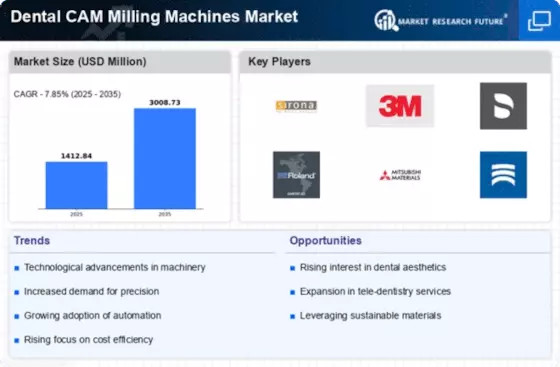
As per MRFR analysis, the Dental CAM Milling Machines Market was estimated at 1310.0 USD Million in 2024. The Dental CAM Milling Machines industry is projected to grow from 1412.86 USD Million in 2025 to 3008.73 USD Million by 2035, exhibiting a compound annual growth rate (CAGR) of 7.85% during the forecast period 2025 - 2035.

Key Market Trends & Highlights

The Dental CAM Milling Machines Market is poised for growth driven by technological advancements and increasing customization demands.

  • Technological advancements are enhancing the precision and efficiency of dental CAM milling machines, particularly in North America.
  • The Asia-Pacific region is experiencing rapid growth in the dental CAM milling machines market, fueled by rising disposable incomes and increased dental care awareness.
  • Customization and personalization in dental solutions are becoming increasingly important, catering to the unique needs of patients and dental professionals alike.
  • The market is driven by the increasing demand for aesthetic dentistry and the growth of dental laboratories, which are pivotal in shaping future trends.

Market Size & Forecast

2024 Market Size 1310.0 (USD Million)
2035 Market Size 3008.73 (USD Million)
CAGR (2025 - 2035) 7.85%
Largest Regional Market Share in 2024 North America

Major Players

<p>Sirona Dental Systems (US), 3M (US), Dentsply Sirona (US), Roland DG (JP), Mitsubishi Materials (JP), Amann Girrbach (AT), Zirkonzahn (IT), Bego (DE), VHF (DE), Planmeca (FI)</p>

Market Trends

The Dental CAM Milling Machines Market is currently experiencing a notable transformation, driven by advancements in technology and increasing demand for precision in dental restorations. The integration of computer-aided design and manufacturing processes has revolutionized the way dental professionals approach the creation of prosthetics and restorations. As a result, the market is witnessing a shift towards more efficient and accurate milling machines that enhance productivity and reduce turnaround times. Furthermore, the growing emphasis on patient-centric care is prompting dental practices to adopt innovative solutions that improve treatment outcomes and patient satisfaction. In addition to technological advancements, the Dental CAM Milling Machines Market is influenced by changing consumer preferences and the rising awareness of oral health. Dental practitioners are increasingly seeking equipment that not only meets their operational needs but also aligns with sustainability goals. This trend indicates a potential shift towards eco-friendly materials and energy-efficient machines. As the market evolves, it appears that collaboration between manufacturers and dental professionals will be crucial in developing solutions that address the dynamic needs of the industry, ultimately shaping the future landscape of dental milling technology.

Technological Advancements

The ongoing evolution of technology in the Dental CAM Milling Machines Market is leading to the development of more sophisticated and efficient milling systems. Innovations such as enhanced software capabilities and improved hardware components are enabling dental professionals to achieve higher precision and faster production times.

Sustainability Focus

There is a growing trend towards sustainability within the Dental CAM Milling Machines Market, as practitioners and manufacturers alike are increasingly prioritizing eco-friendly practices. This includes the use of sustainable materials and energy-efficient machines, reflecting a broader commitment to environmental responsibility.

Customization and Personalization

The demand for customized dental solutions is rising, prompting manufacturers to develop milling machines that can accommodate a wider range of materials and designs. This trend highlights the importance of personalization in dental care, allowing practitioners to better meet the unique needs of their patients.

Dental CAM Milling Machines Market Market Drivers

Rising Geriatric Population

The increasing geriatric population is a significant driver for the Dental CAM Milling Machines Market. As individuals age, they often require more dental care, including restorative procedures such as crowns, bridges, and dentures. This demographic shift is expected to lead to a higher demand for dental services, consequently increasing the need for efficient milling machines capable of producing high-quality restorations. Reports indicate that the population aged 65 and older is projected to double by 2050, which will likely result in a substantial rise in dental procedures. Consequently, dental practices will need to invest in advanced milling technologies to cater to this growing patient base, thereby fueling the Dental CAM Milling Machines Market.

Growth of Dental Laboratories

The expansion of dental laboratories is another key driver in the Dental CAM Milling Machines Market. As the number of dental laboratories increases, so does the demand for efficient and precise milling machines. These laboratories require advanced equipment to produce a wide range of dental restorations quickly and accurately. The market for dental laboratories is projected to grow significantly, driven by the increasing number of dental procedures and the demand for high-quality restorations. This growth necessitates the adoption of advanced CAM milling technologies, which can enhance productivity and meet the evolving needs of dental professionals. Thus, the growth of dental laboratories is likely to propel the Dental CAM Milling Machines Market.

Increasing Demand for Aesthetic Dentistry

The rising consumer preference for aesthetic dentistry is a notable driver in the Dental CAM Milling Machines Market. Patients increasingly seek cosmetic dental procedures, which necessitate high-quality restorations. This trend has led to a surge in demand for dental milling machines that can produce precise and aesthetically pleasing dental restorations. According to industry reports, the aesthetic dentistry segment is projected to grow at a compound annual growth rate of over 10% in the coming years. As dental practices adapt to meet these demands, the need for advanced milling machines becomes paramount, thereby propelling the growth of the Dental CAM Milling Machines Market.

Regulatory Support for Dental Innovations

Regulatory support for dental innovations is an emerging driver in the Dental CAM Milling Machines Market. Governments and regulatory bodies are increasingly recognizing the importance of advanced dental technologies in improving patient outcomes. This support often translates into favorable policies and funding for research and development in dental equipment. As regulations evolve to encourage innovation, dental practices are more likely to invest in cutting-edge milling machines that comply with new standards. This trend not only enhances the quality of dental care but also stimulates growth in the Dental CAM Milling Machines Market, as manufacturers respond to the demand for compliant and innovative solutions.

Technological Innovations in Dental Equipment

Technological advancements play a crucial role in shaping the Dental CAM Milling Machines Market. Innovations such as computer-aided design (CAD) and computer-aided manufacturing (CAM) have revolutionized the way dental restorations are created. These technologies enhance precision, reduce production time, and improve the overall quality of dental products. The integration of artificial intelligence and machine learning into milling machines is also on the rise, allowing for more efficient workflows and better outcomes. As dental practices increasingly adopt these technologies, the demand for sophisticated milling machines is expected to rise, further driving the growth of the Dental CAM Milling Machines Market.

Market Segment Insights

By Application: Dental Restorations (Largest) vs. Orthodontics (Fastest-Growing)

<p>In the Dental CAM Milling Machines Market, the application segment is primarily dominated by dental restorations, which capture the largest share due to the increasing demand for dental procedures and aesthetic enhancements. Meanwhile, orthodontics is emerging as a vital segment, growing rapidly as more patients seek corrective treatments with braces and aligners, leading to an expansion in the workflows associated with CAD/CAM technology. As dental practices continue to evolve with digital solutions, the application of milling machines in restorations and orthodontics remains crucial for efficient outcomes.</p>

<p>Orthodontics (Dominant) vs. Implantology (Emerging)</p>

<p>The orthodontics segment has increasingly established itself as a dominant force in the Dental CAM Milling Machines Market, driven by the rising awareness of dental aesthetics and preventive care. Innovations in orthodontic technology, such as clear aligners and personalized treatment plans, compel dental labs to adopt sophisticated milling machines capable of creating precise dental solutions. Conversely, implantology is an emerging segment, leveraging advancements in materials and techniques to improve implant longevity and success rates. This growth is fueled by an expanding elderly population requiring dental implants and a trend towards oral rehabilitation, creating market resilience and opportunities for specialized milling technologies.</p>

By End Use: Dental Clinics (Largest) vs. Dental Laboratories (Fastest-Growing)

<p>In the Dental CAM Milling Machines Market, the distribution of market share among the end user segments shows that dental clinics hold the largest share. Their prominence is attributed to the increasing need for efficient and precise dental restorations, which clinics can provide using advanced milling technology. In contrast, dental laboratories are witnessing robust growth, driven by rising demand for custom dental solutions and improvements in dental workflow efficiency. Research institutions, while significant, occupy a smaller niche within this market, primarily focusing on technological advancements and product innovations. The growth trends within the Dental CAM Milling Machines Market are largely fueled by the increasing adoption of digital dentistry. As the industry moves towards more integrated systems, dental laboratories are rapidly expanding their capabilities, which positions them as the fastest-growing segment. Furthermore, rising consumer expectations for faster turnaround times and the personalization of dental products are propelling both clinics and laboratories to adopt CAM technology at an accelerated pace.</p>

<p>Dental Clinics (Dominant) vs. Dental Laboratories (Emerging)</p>

<p>Dental clinics serve as the dominant end-user segment in the Dental CAM Milling Machines Market. They leverage these advanced milling machines to enhance their service offerings, streamlining dental restorations, and improving patient outcomes. Their established presence in the market allows them to adopt new technologies quickly, thereby enhancing their operational efficiency. On the other hand, dental laboratories are emerging as a key player, rapidly adopting CAM systems due to their ability to reduce production time and deliver high-quality dental products. The laboratories are increasingly integrating digital processes, making them more adaptive and responsive to market demands. This evolution positions them as an essential component of the dental supply chain, fostering collaboration with both clinics and dental practitioners to meet growing customer needs.</p>

By Technology: Dry Milling (Largest) vs. Wet Milling (Fastest-Growing)

<p>In the Dental CAM Milling Machines Market, the technology segment consists of three primary methods: dry milling, wet milling, and hybrid milling. Currently, dry milling holds the largest market share, owing to its efficiency and reliability in producing a variety of dental restorations. Wet milling, however, is rapidly gaining traction and has emerged as the fastest-growing segment due to its ability to handle complex materials and deliver superior accuracy in restorations.</p>

<p>Technology: Dry Milling (Dominant) vs. Wet Milling (Emerging)</p>

<p>Dry milling is recognized for its established efficiency in the production of dental prosthetics, making it the dominant technology in the market. It operates without the need for cooling liquids, which simplifies the milling process and reduces maintenance costs. Conversely, wet milling is emerging as a formidable contender by providing enhanced precision and versatility with materials such as zirconia and composite resins. This segment appeals to dental practitioners seeking advanced capabilities and improved patient outcomes, positioning wet milling as a technology on the rise.</p>

By Material Type: Ceramics (Largest) vs. Metals (Fastest-Growing)

<p>In the Dental CAM Milling Machines Market, ceramics represent the largest segment due to their optimal aesthetic qualities and biocompatibility, widely preferred for both crowns and bridges. Metals follow closely, with notable shares owing to their strength and durability in dental applications. Composites and polymers, while smaller in share, are vital for specific applications such as temporary restorations and orthodontics. The balanced distribution showcases the diverse material preferences in dental practices.</p>

<p>Ceramics (Dominant) vs. Metals (Emerging)</p>

<p>Ceramics hold a dominant position in the Dental CAM Milling Machines Market due to their superior aesthetic appeal, translucency, and ability to closely mimic natural tooth structure. They are extensively used in creating high-quality dental restorations, making them a go-to choice for cosmetic applications. On the other hand, metals, characterized by their robustness and longevity, are emerging as a significant segment driven by increasing applications in implantology and more complex dental structures. This shift towards metals is fueled by advancements in milling technologies that allow for intricate designs while maintaining material integrity, catering to evolving dental demands.</p>

By Product Type: Laboratory Milling Machines (Largest) vs. Chairside Milling Machines (Fastest-Growing)

<p>The Dental CAM Milling Machines Market exhibits a diversified distribution among its key product types, with Laboratory Milling Machines leading the share. This segment benefits from strong adoption in dental laboratories due to its enhanced capacity for mass production and precision. Chairside Milling Machines, while smaller in market share, are rapidly gaining traction as they offer convenience and efficiency for dental practices, allowing for immediate treatment solutions and chairside restorations.</p>

<p>Laboratory Milling Machines (Dominant) vs. Chairside Milling Machines (Emerging)</p>

<p>Laboratory Milling Machines stand out as a dominant segment owing to their established presence and reliance on precision in intricate dental formulations. These machines cater to professional labs, significantly enhancing productivity while ensuring high-quality outputs. On the other hand, Chairside Milling Machines represent an emerging trend, appealing to dental practices seeking to provide immediate solutions for patients. This segment's growth is driven by the demand for on-the-spot restorations and simplified workflows, transforming patient experiences and treatment timelines in contemporary dental settings.</p>

Get more detailed insights about Dental CAD CAM Milling Machines Market Research Report - Forecast till 2035

Regional Insights

North America : Market Leader in Innovation

North America leads the Dental CAM Milling Machines market with a share of $700.0M in 2024, driven by advanced technology adoption and a growing demand for efficient dental solutions. Regulatory support and increased investment in dental healthcare are key growth catalysts. The region's focus on innovation and quality assurance further enhances market dynamics, making it a hub for dental technology advancements. The United States is the primary market player, hosting major companies like Sirona Dental Systems and Dentsply Sirona. The competitive landscape is characterized by continuous product innovation and strategic partnerships among key players. The presence of established firms ensures a robust supply chain and a wide range of offerings, catering to diverse customer needs. This competitive edge solidifies North America's position as a leader in the dental milling sector.

Europe : Emerging Market with Growth Potential

Europe's Dental CAM Milling Machines market is valued at $400.0M, reflecting a growing demand for high-quality dental solutions. The region benefits from stringent regulatory frameworks that ensure product safety and efficacy, driving innovation. Increased awareness of dental health and technological advancements are key factors propelling market growth, alongside a rising number of dental clinics adopting CAM technologies. Germany, Italy, and the UK are leading countries in this market, with a strong presence of manufacturers like Amann Girrbach and Bego. The competitive landscape is marked by collaborations and mergers among key players to enhance product offerings. The European market is characterized by a focus on sustainability and eco-friendly practices, aligning with regulatory standards that promote responsible manufacturing. "The European dental market is expected to grow significantly, driven by technological advancements and increasing patient demand for quality care."

Asia-Pacific : Rapidly Growing Market Segment

The Asia-Pacific region is witnessing a burgeoning Dental CAM Milling Machines market, valued at $150.0M. Factors such as increasing disposable incomes, a growing aging population, and rising awareness of dental health are driving demand. Regulatory bodies are also promoting advanced dental technologies, which is expected to further boost market growth. The region's focus on improving healthcare infrastructure is a significant catalyst for this sector. Countries like Japan and Australia are at the forefront, with key players such as Roland DG and Mitsubishi Materials leading the market. The competitive landscape is evolving, with local manufacturers emerging to meet the growing demand. Strategic partnerships and technological collaborations are common, enhancing the region's capabilities in dental milling solutions. The Asia-Pacific market is poised for substantial growth as it adapts to changing consumer needs and technological advancements.

Middle East and Africa : Emerging Market with Untapped Potential

The Middle East and Africa region's Dental CAM Milling Machines market is valued at $60.0M, reflecting a nascent but promising sector. The growth is driven by increasing investments in healthcare infrastructure and rising awareness of dental health among the population. Regulatory initiatives aimed at improving healthcare standards are also contributing to market expansion, fostering a conducive environment for dental technology adoption. Countries like South Africa and the UAE are leading the way in this market, with a growing number of dental clinics adopting advanced milling technologies. The competitive landscape is characterized by a mix of local and international players, creating opportunities for innovation and collaboration. As the region continues to develop its healthcare capabilities, the demand for dental CAM milling solutions is expected to rise significantly, paving the way for future growth.

Key Players and Competitive Insights

The Dental CAM Milling Machines Market is characterized by a dynamic competitive landscape, driven by technological advancements and increasing demand for precision in dental restorations. Key players such as Sirona Dental Systems (US), 3M (US), and Dentsply Sirona (US) are at the forefront, each adopting distinct strategies to enhance their market positioning. Sirona Dental Systems (US) focuses on innovation through the development of advanced milling technologies, while 3M (US) emphasizes partnerships with dental practices to integrate their solutions seamlessly into existing workflows. Dentsply Sirona (US) appears to be leveraging its extensive product portfolio to cater to diverse customer needs, thereby shaping a competitive environment that prioritizes quality and efficiency.

In terms of business tactics, companies are increasingly localizing manufacturing to reduce lead times and optimize supply chains. The market structure is moderately fragmented, with several players vying for market share, yet the collective influence of major companies is significant. This fragmentation allows for niche players to emerge, fostering innovation and competition. The strategic focus on supply chain optimization and localized production is likely to enhance responsiveness to market demands, further intensifying competition.

In January 2026, Dentsply Sirona (US) announced a strategic partnership with a leading dental software provider to enhance its digital workflow solutions. This collaboration is expected to streamline the integration of CAM milling machines with digital imaging technologies, thereby improving operational efficiency for dental practices. The strategic importance of this partnership lies in its potential to create a more cohesive ecosystem for dental professionals, ultimately driving adoption of Dentsply Sirona's products.

In December 2025, 3M (US) launched a new line of CAM milling machines designed specifically for high-precision dental restorations. This product introduction is significant as it reflects 3M's commitment to innovation and its ability to respond to the evolving needs of dental professionals. By focusing on high-precision solutions, 3M aims to differentiate itself in a competitive market, potentially capturing a larger share of the high-end segment.

In November 2025, Sirona Dental Systems (US) expanded its global footprint by entering into a joint venture with a prominent dental distributor in Asia. This strategic move is likely to enhance Sirona's market presence in a rapidly growing region, allowing for better access to emerging markets. The joint venture underscores the importance of strategic alliances in navigating the complexities of The Dental CAM Milling Machines demands.

As of February 2026, current trends in the Dental CAM Milling Machines Market include a strong emphasis on digitalization, sustainability, and the integration of artificial intelligence (AI) into manufacturing processes. Strategic alliances are increasingly shaping the competitive landscape, enabling companies to pool resources and expertise. Looking ahead, competitive differentiation is expected to evolve from traditional price-based competition to a focus on innovation, technological advancements, and supply chain reliability. This shift suggests that companies that prioritize these aspects will likely gain a competitive edge in the market.

Key Companies in the Dental CAM Milling Machines Market include

Industry Developments

  • Q2 2024: Dentsply Sirona launches new PrimeMill 2.0 dental milling machine Dentsply Sirona announced the launch of its PrimeMill 2.0, an upgraded dental CAM milling machine designed to improve speed and precision for dental laboratories and clinics. The new model features enhanced automation and expanded material compatibility.
  • Q1 2024: Ivoclar introduces PrograMill DRY, a new dry milling solution for dental labs Ivoclar unveiled the PrograMill DRY, a dry milling machine aimed at increasing efficiency and material versatility for dental laboratories. The product launch expands Ivoclar’s digital dentistry portfolio.
  • Q2 2024: Straumann Group acquires 60% stake in Medit, expanding digital dentistry portfolio Straumann Group announced the acquisition of a majority stake in Medit, a company specializing in digital dental solutions, to strengthen its position in the dental CAD/CAM and milling machine market.
  • Q3 2024: Roland DG launches DWX-53DCi, a next-generation dental milling machine Roland DG introduced the DWX-53DCi, a new dental CAM milling machine featuring automated disc changer technology and improved workflow integration for dental labs.
  • Q2 2024: Planmeca announces new PlanMill 60 S for high-speed dental prosthetics milling Planmeca launched the PlanMill 60 S, a high-speed dental milling machine designed for rapid production of crowns, bridges, and other restorations, targeting dental clinics and laboratories.
  • Q1 2025: VHF Camfacture AG opens new manufacturing facility in Germany to meet rising demand VHF Camfacture AG inaugurated a new manufacturing plant in Germany to expand production capacity for its dental CAM milling machines, responding to increased global demand.
  • Q2 2024: Amann Girrbach partners with 3Shape to integrate CAD/CAM workflows Amann Girrbach announced a strategic partnership with 3Shape to integrate their dental CAM milling machines with 3Shape’s CAD software, aiming to streamline digital workflows for dental professionals.
  • Q3 2024: DGSHAPE by Roland and exocad announce collaboration for seamless digital dentistry DGSHAPE by Roland and exocad revealed a new collaboration to ensure compatibility between DGSHAPE’s dental milling machines and exocad’s CAD software, enhancing digital workflow solutions.
  • Q2 2025: Dentsply Sirona appoints new Head of Digital Solutions to drive innovation in CAM milling Dentsply Sirona named a new executive to lead its Digital Solutions division, with a focus on advancing the company’s dental CAM milling machine technologies and digital dentistry initiatives.
  • Q1 2024: Ivoclar secures CE mark for PrograMill PM7, expanding European market access Ivoclar announced that its PrograMill PM7 dental milling machine received CE mark approval, allowing for expanded sales and distribution across the European Union.
  • Q4 2024: Straumann Group opens new digital dentistry innovation center in Switzerland Straumann Group inaugurated a new innovation center focused on digital dentistry and CAM milling machine development, aiming to accelerate product innovation and training.
  • Q2 2024: Roland DG announces partnership with Dental Wings for integrated CAD/CAM solutions Roland DG and Dental Wings entered a partnership to integrate Roland’s dental milling machines with Dental Wings’ CAD software, offering a comprehensive digital solution for dental labs.

Future Outlook

Dental CAM Milling Machines Market Future Outlook

The Dental CAM Milling Machines Market is projected to grow at a 7.85% CAGR from 2024 to 2035, driven by technological advancements, increasing dental procedures, and rising demand for customized dental solutions.

New opportunities lie in:

  • Expansion into emerging markets with tailored financing options
  • Development of integrated software solutions for enhanced workflow
  • Partnerships with dental schools for training and product testing

By 2035, the market is expected to be robust, driven by innovation and strategic partnerships.

Market Segmentation

Dental CAM Milling Machines Market End Use Outlook

  • Dental Clinics
  • Dental Laboratories
  • Research Institutions

Dental CAM Milling Machines Market Technology Outlook

  • Dry Milling
  • Wet Milling
  • Hybrid Milling

Dental CAM Milling Machines Market Application Outlook

  • Dental Restorations
  • Orthodontics
  • Implantology
  • Prosthodontics

Dental CAM Milling Machines Market Product Type Outlook

  • Chairside Milling Machines
  • Laboratory Milling Machines
  • Compact Milling Machines

Dental CAM Milling Machines Market Material Type Outlook

  • Ceramics
  • Metals
  • Composites
  • Polymers

Report Scope

MARKET SIZE 2024 1310.0(USD Million)
MARKET SIZE 2025 1412.86(USD Million)
MARKET SIZE 2035 3008.73(USD Million)
COMPOUND ANNUAL GROWTH RATE (CAGR) 7.85% (2024 - 2035)
REPORT COVERAGE Revenue Forecast, Competitive Landscape, Growth Factors, and Trends
BASE YEAR 2024
Market Forecast Period 2025 - 2035
Historical Data 2019 - 2024
Market Forecast Units USD Million
Key Companies Profiled Sirona Dental Systems (US), 3M (US), Dentsply Sirona (US), Roland DG (JP), Mitsubishi Materials (JP), Amann Girrbach (AT), Zirkonzahn (IT), Bego (DE), VHF (DE), Planmeca (FI)
Segments Covered Application, End Use, Technology, Material Type, Product Type
Key Market Opportunities Integration of artificial intelligence in Dental CAM Milling Machines enhances precision and efficiency in dental restorations.
Key Market Dynamics Technological advancements and increasing demand for precision drive growth in the Dental CAM Milling Machines market.
Countries Covered North America, Europe, APAC, South America, MEA

FAQs

What is the projected market valuation for the Dental CAM Milling Machines Market by 2035?

<p>The projected market valuation for the Dental CAM Milling Machines Market by 2035 is approximately 3008.73 USD Million.</p>

What was the market valuation of the Dental CAM Milling Machines Market in 2024?

<p>The market valuation of the Dental CAM Milling Machines Market in 2024 was 1310.0 USD Million.</p>

What is the expected CAGR for the Dental CAM Milling Machines Market during the forecast period 2025 - 2035?

<p>The expected CAGR for the Dental CAM Milling Machines Market during the forecast period 2025 - 2035 is 7.85%.</p>

Which companies are considered key players in the Dental CAM Milling Machines Market?

<p>Key players in the Dental CAM Milling Machines Market include Sirona Dental Systems, 3M, Dentsply Sirona, Roland DG, and Mitsubishi Materials.</p>

What are the main applications of Dental CAM Milling Machines?

<p>The main applications of Dental CAM Milling Machines include Dental Restorations, Orthodontics, Implantology, and Prosthodontics.</p>

How do the market segments for Dental CAM Milling Machines break down by end use?

<p>The market segments for Dental CAM Milling Machines by end use include Dental Clinics, Dental Laboratories, and Research Institutions.</p>

What are the different technologies used in Dental CAM Milling Machines?

<p>The different technologies used in Dental CAM Milling Machines are Dry Milling, Wet Milling, and Hybrid Milling.</p>

What materials are commonly processed by Dental CAM Milling Machines?

<p>Common materials processed by Dental CAM Milling Machines include Ceramics, Metals, Composites, and Polymers.</p>

What types of products are available in the Dental CAM Milling Machines Market?

<p>The types of products available in the Dental CAM Milling Machines Market include Chairside Milling Machines, Laboratory Milling Machines, and Compact Milling Machines.</p>

What was the valuation range for Dental Restorations in the Dental CAM Milling Machines Market?

<p>The valuation range for Dental Restorations in the Dental CAM Milling Machines Market was between 500.0 and 1200.0 USD Million.</p>

  1. SECTION I: EXECUTIVE SUMMARY AND KEY HIGHLIGHTS
    1. | 1.1 EXECUTIVE SUMMARY
    2. | | 1.1.1 Market Overview
    3. | | 1.1.2 Key Findings
    4. | | 1.1.3 Market Segmentation
    5. | | 1.1.4 Competitive Landscape
    6. | | 1.1.5 Challenges and Opportunities
    7. | | 1.1.6 Future Outlook
  2. SECTION II: SCOPING, METHODOLOGY AND MARKET STRUCTURE
    1. | 2.1 MARKET INTRODUCTION
    2. | | 2.1.1 Definition
    3. | | 2.1.2 Scope of the study
    4. | | | 2.1.2.1 Research Objective
    5. | | | 2.1.2.2 Assumption
    6. | | | 2.1.2.3 Limitations
    7. | 2.2 RESEARCH METHODOLOGY
    8. | | 2.2.1 Overview
    9. | | 2.2.2 Data Mining
    10. | | 2.2.3 Secondary Research
    11. | | 2.2.4 Primary Research
    12. | | | 2.2.4.1 Primary Interviews and Information Gathering Process
    13. | | | 2.2.4.2 Breakdown of Primary Respondents
    14. | | 2.2.5 Forecasting Model
    15. | | 2.2.6 Market Size Estimation
    16. | | | 2.2.6.1 Bottom-Up Approach
    17. | | | 2.2.6.2 Top-Down Approach
    18. | | 2.2.7 Data Triangulation
    19. | | 2.2.8 Validation
  3. SECTION III: QUALITATIVE ANALYSIS
    1. | 3.1 MARKET DYNAMICS
    2. | | 3.1.1 Overview
    3. | | 3.1.2 Drivers
    4. | | 3.1.3 Restraints
    5. | | 3.1.4 Opportunities
    6. | 3.2 MARKET FACTOR ANALYSIS
    7. | | 3.2.1 Value chain Analysis
    8. | | 3.2.2 Porter's Five Forces Analysis
    9. | | | 3.2.2.1 Bargaining Power of Suppliers
    10. | | | 3.2.2.2 Bargaining Power of Buyers
    11. | | | 3.2.2.3 Threat of New Entrants
    12. | | | 3.2.2.4 Threat of Substitutes
    13. | | | 3.2.2.5 Intensity of Rivalry
    14. | | 3.2.3 COVID-19 Impact Analysis
    15. | | | 3.2.3.1 Market Impact Analysis
    16. | | | 3.2.3.2 Regional Impact
    17. | | | 3.2.3.3 Opportunity and Threat Analysis
  4. SECTION IV: QUANTITATIVE ANALYSIS
    1. | 4.1 Healthcare, BY Application (USD Million)
    2. | | 4.1.1 Dental Restorations
    3. | | 4.1.2 Orthodontics
    4. | | 4.1.3 Implantology
    5. | | 4.1.4 Prosthodontics
    6. | 4.2 Healthcare, BY End Use (USD Million)
    7. | | 4.2.1 Dental Clinics
    8. | | 4.2.2 Dental Laboratories
    9. | | 4.2.3 Research Institutions
    10. | 4.3 Healthcare, BY Technology (USD Million)
    11. | | 4.3.1 Dry Milling
    12. | | 4.3.2 Wet Milling
    13. | | 4.3.3 Hybrid Milling
    14. | 4.4 Healthcare, BY Material Type (USD Million)
    15. | | 4.4.1 Ceramics
    16. | | 4.4.2 Metals
    17. | | 4.4.3 Composites
    18. | | 4.4.4 Polymers
    19. | 4.5 Healthcare, BY Product Type (USD Million)
    20. | | 4.5.1 Chairside Milling Machines
    21. | | 4.5.2 Laboratory Milling Machines
    22. | | 4.5.3 Compact Milling Machines
    23. | 4.6 Healthcare, BY Region (USD Million)
    24. | | 4.6.1 North America
    25. | | | 4.6.1.1 US
    26. | | | 4.6.1.2 Canada
    27. | | 4.6.2 Europe
    28. | | | 4.6.2.1 Germany
    29. | | | 4.6.2.2 UK
    30. | | | 4.6.2.3 France
    31. | | | 4.6.2.4 Russia
    32. | | | 4.6.2.5 Italy
    33. | | | 4.6.2.6 Spain
    34. | | | 4.6.2.7 Rest of Europe
    35. | | 4.6.3 APAC
    36. | | | 4.6.3.1 China
    37. | | | 4.6.3.2 India
    38. | | | 4.6.3.3 Japan
    39. | | | 4.6.3.4 South Korea
    40. | | | 4.6.3.5 Malaysia
    41. | | | 4.6.3.6 Thailand
    42. | | | 4.6.3.7 Indonesia
    43. | | | 4.6.3.8 Rest of APAC
    44. | | 4.6.4 South America
    45. | | | 4.6.4.1 Brazil
    46. | | | 4.6.4.2 Mexico
    47. | | | 4.6.4.3 Argentina
    48. | | | 4.6.4.4 Rest of South America
    49. | | 4.6.5 MEA
    50. | | | 4.6.5.1 GCC Countries
    51. | | | 4.6.5.2 South Africa
    52. | | | 4.6.5.3 Rest of MEA
  5. SECTION V: COMPETITIVE ANALYSIS
    1. | 5.1 Competitive Landscape
    2. | | 5.1.1 Overview
    3. | | 5.1.2 Competitive Analysis
    4. | | 5.1.3 Market share Analysis
    5. | | 5.1.4 Major Growth Strategy in the Healthcare
    6. | | 5.1.5 Competitive Benchmarking
    7. | | 5.1.6 Leading Players in Terms of Number of Developments in the Healthcare
    8. | | 5.1.7 Key developments and growth strategies
    9. | | | 5.1.7.1 New Product Launch/Service Deployment
    10. | | | 5.1.7.2 Merger & Acquisitions
    11. | | | 5.1.7.3 Joint Ventures
    12. | | 5.1.8 Major Players Financial Matrix
    13. | | | 5.1.8.1 Sales and Operating Income
    14. | | | 5.1.8.2 Major Players R&D Expenditure. 2023
    15. | 5.2 Company Profiles
    16. | | 5.2.1 Sirona Dental Systems (US)
    17. | | | 5.2.1.1 Financial Overview
    18. | | | 5.2.1.2 Products Offered
    19. | | | 5.2.1.3 Key Developments
    20. | | | 5.2.1.4 SWOT Analysis
    21. | | | 5.2.1.5 Key Strategies
    22. | | 5.2.2 3M (US)
    23. | | | 5.2.2.1 Financial Overview
    24. | | | 5.2.2.2 Products Offered
    25. | | | 5.2.2.3 Key Developments
    26. | | | 5.2.2.4 SWOT Analysis
    27. | | | 5.2.2.5 Key Strategies
    28. | | 5.2.3 Dentsply Sirona (US)
    29. | | | 5.2.3.1 Financial Overview
    30. | | | 5.2.3.2 Products Offered
    31. | | | 5.2.3.3 Key Developments
    32. | | | 5.2.3.4 SWOT Analysis
    33. | | | 5.2.3.5 Key Strategies
    34. | | 5.2.4 Roland DG (JP)
    35. | | | 5.2.4.1 Financial Overview
    36. | | | 5.2.4.2 Products Offered
    37. | | | 5.2.4.3 Key Developments
    38. | | | 5.2.4.4 SWOT Analysis
    39. | | | 5.2.4.5 Key Strategies
    40. | | 5.2.5 Mitsubishi Materials (JP)
    41. | | | 5.2.5.1 Financial Overview
    42. | | | 5.2.5.2 Products Offered
    43. | | | 5.2.5.3 Key Developments
    44. | | | 5.2.5.4 SWOT Analysis
    45. | | | 5.2.5.5 Key Strategies
    46. | | 5.2.6 Amann Girrbach (AT)
    47. | | | 5.2.6.1 Financial Overview
    48. | | | 5.2.6.2 Products Offered
    49. | | | 5.2.6.3 Key Developments
    50. | | | 5.2.6.4 SWOT Analysis
    51. | | | 5.2.6.5 Key Strategies
    52. | | 5.2.7 Zirkonzahn (IT)
    53. | | | 5.2.7.1 Financial Overview
    54. | | | 5.2.7.2 Products Offered
    55. | | | 5.2.7.3 Key Developments
    56. | | | 5.2.7.4 SWOT Analysis
    57. | | | 5.2.7.5 Key Strategies
    58. | | 5.2.8 Bego (DE)
    59. | | | 5.2.8.1 Financial Overview
    60. | | | 5.2.8.2 Products Offered
    61. | | | 5.2.8.3 Key Developments
    62. | | | 5.2.8.4 SWOT Analysis
    63. | | | 5.2.8.5 Key Strategies
    64. | | 5.2.9 VHF (DE)
    65. | | | 5.2.9.1 Financial Overview
    66. | | | 5.2.9.2 Products Offered
    67. | | | 5.2.9.3 Key Developments
    68. | | | 5.2.9.4 SWOT Analysis
    69. | | | 5.2.9.5 Key Strategies
    70. | | 5.2.10 Planmeca (FI)
    71. | | | 5.2.10.1 Financial Overview
    72. | | | 5.2.10.2 Products Offered
    73. | | | 5.2.10.3 Key Developments
    74. | | | 5.2.10.4 SWOT Analysis
    75. | | | 5.2.10.5 Key Strategies
    76. | 5.3 Appendix
    77. | | 5.3.1 References
    78. | | 5.3.2 Related Reports
  6. LIST OF FIGURES
    1. | 6.1 MARKET SYNOPSIS
    2. | 6.2 NORTH AMERICA MARKET ANALYSIS
    3. | 6.3 US MARKET ANALYSIS BY APPLICATION
    4. | 6.4 US MARKET ANALYSIS BY END USE
    5. | 6.5 US MARKET ANALYSIS BY TECHNOLOGY
    6. | 6.6 US MARKET ANALYSIS BY MATERIAL TYPE
    7. | 6.7 US MARKET ANALYSIS BY PRODUCT TYPE
    8. | 6.8 CANADA MARKET ANALYSIS BY APPLICATION
    9. | 6.9 CANADA MARKET ANALYSIS BY END USE
    10. | 6.10 CANADA MARKET ANALYSIS BY TECHNOLOGY
    11. | 6.11 CANADA MARKET ANALYSIS BY MATERIAL TYPE
    12. | 6.12 CANADA MARKET ANALYSIS BY PRODUCT TYPE
    13. | 6.13 EUROPE MARKET ANALYSIS
    14. | 6.14 GERMANY MARKET ANALYSIS BY APPLICATION
    15. | 6.15 GERMANY MARKET ANALYSIS BY END USE
    16. | 6.16 GERMANY MARKET ANALYSIS BY TECHNOLOGY
    17. | 6.17 GERMANY MARKET ANALYSIS BY MATERIAL TYPE
    18. | 6.18 GERMANY MARKET ANALYSIS BY PRODUCT TYPE
    19. | 6.19 UK MARKET ANALYSIS BY APPLICATION
    20. | 6.20 UK MARKET ANALYSIS BY END USE
    21. | 6.21 UK MARKET ANALYSIS BY TECHNOLOGY
    22. | 6.22 UK MARKET ANALYSIS BY MATERIAL TYPE
    23. | 6.23 UK MARKET ANALYSIS BY PRODUCT TYPE
    24. | 6.24 FRANCE MARKET ANALYSIS BY APPLICATION
    25. | 6.25 FRANCE MARKET ANALYSIS BY END USE
    26. | 6.26 FRANCE MARKET ANALYSIS BY TECHNOLOGY
    27. | 6.27 FRANCE MARKET ANALYSIS BY MATERIAL TYPE
    28. | 6.28 FRANCE MARKET ANALYSIS BY PRODUCT TYPE
    29. | 6.29 RUSSIA MARKET ANALYSIS BY APPLICATION
    30. | 6.30 RUSSIA MARKET ANALYSIS BY END USE
    31. | 6.31 RUSSIA MARKET ANALYSIS BY TECHNOLOGY
    32. | 6.32 RUSSIA MARKET ANALYSIS BY MATERIAL TYPE
    33. | 6.33 RUSSIA MARKET ANALYSIS BY PRODUCT TYPE
    34. | 6.34 ITALY MARKET ANALYSIS BY APPLICATION
    35. | 6.35 ITALY MARKET ANALYSIS BY END USE
    36. | 6.36 ITALY MARKET ANALYSIS BY TECHNOLOGY
    37. | 6.37 ITALY MARKET ANALYSIS BY MATERIAL TYPE
    38. | 6.38 ITALY MARKET ANALYSIS BY PRODUCT TYPE
    39. | 6.39 SPAIN MARKET ANALYSIS BY APPLICATION
    40. | 6.40 SPAIN MARKET ANALYSIS BY END USE
    41. | 6.41 SPAIN MARKET ANALYSIS BY TECHNOLOGY
    42. | 6.42 SPAIN MARKET ANALYSIS BY MATERIAL TYPE
    43. | 6.43 SPAIN MARKET ANALYSIS BY PRODUCT TYPE
    44. | 6.44 REST OF EUROPE MARKET ANALYSIS BY APPLICATION
    45. | 6.45 REST OF EUROPE MARKET ANALYSIS BY END USE
    46. | 6.46 REST OF EUROPE MARKET ANALYSIS BY TECHNOLOGY
    47. | 6.47 REST OF EUROPE MARKET ANALYSIS BY MATERIAL TYPE
    48. | 6.48 REST OF EUROPE MARKET ANALYSIS BY PRODUCT TYPE
    49. | 6.49 APAC MARKET ANALYSIS
    50. | 6.50 CHINA MARKET ANALYSIS BY APPLICATION
    51. | 6.51 CHINA MARKET ANALYSIS BY END USE
    52. | 6.52 CHINA MARKET ANALYSIS BY TECHNOLOGY
    53. | 6.53 CHINA MARKET ANALYSIS BY MATERIAL TYPE
    54. | 6.54 CHINA MARKET ANALYSIS BY PRODUCT TYPE
    55. | 6.55 INDIA MARKET ANALYSIS BY APPLICATION
    56. | 6.56 INDIA MARKET ANALYSIS BY END USE
    57. | 6.57 INDIA MARKET ANALYSIS BY TECHNOLOGY
    58. | 6.58 INDIA MARKET ANALYSIS BY MATERIAL TYPE
    59. | 6.59 INDIA MARKET ANALYSIS BY PRODUCT TYPE
    60. | 6.60 JAPAN MARKET ANALYSIS BY APPLICATION
    61. | 6.61 JAPAN MARKET ANALYSIS BY END USE
    62. | 6.62 JAPAN MARKET ANALYSIS BY TECHNOLOGY
    63. | 6.63 JAPAN MARKET ANALYSIS BY MATERIAL TYPE
    64. | 6.64 JAPAN MARKET ANALYSIS BY PRODUCT TYPE
    65. | 6.65 SOUTH KOREA MARKET ANALYSIS BY APPLICATION
    66. | 6.66 SOUTH KOREA MARKET ANALYSIS BY END USE
    67. | 6.67 SOUTH KOREA MARKET ANALYSIS BY TECHNOLOGY
    68. | 6.68 SOUTH KOREA MARKET ANALYSIS BY MATERIAL TYPE
    69. | 6.69 SOUTH KOREA MARKET ANALYSIS BY PRODUCT TYPE
    70. | 6.70 MALAYSIA MARKET ANALYSIS BY APPLICATION
    71. | 6.71 MALAYSIA MARKET ANALYSIS BY END USE
    72. | 6.72 MALAYSIA MARKET ANALYSIS BY TECHNOLOGY
    73. | 6.73 MALAYSIA MARKET ANALYSIS BY MATERIAL TYPE
    74. | 6.74 MALAYSIA MARKET ANALYSIS BY PRODUCT TYPE
    75. | 6.75 THAILAND MARKET ANALYSIS BY APPLICATION
    76. | 6.76 THAILAND MARKET ANALYSIS BY END USE
    77. | 6.77 THAILAND MARKET ANALYSIS BY TECHNOLOGY
    78. | 6.78 THAILAND MARKET ANALYSIS BY MATERIAL TYPE
    79. | 6.79 THAILAND MARKET ANALYSIS BY PRODUCT TYPE
    80. | 6.80 INDONESIA MARKET ANALYSIS BY APPLICATION
    81. | 6.81 INDONESIA MARKET ANALYSIS BY END USE
    82. | 6.82 INDONESIA MARKET ANALYSIS BY TECHNOLOGY
    83. | 6.83 INDONESIA MARKET ANALYSIS BY MATERIAL TYPE
    84. | 6.84 INDONESIA MARKET ANALYSIS BY PRODUCT TYPE
    85. | 6.85 REST OF APAC MARKET ANALYSIS BY APPLICATION
    86. | 6.86 REST OF APAC MARKET ANALYSIS BY END USE
    87. | 6.87 REST OF APAC MARKET ANALYSIS BY TECHNOLOGY
    88. | 6.88 REST OF APAC MARKET ANALYSIS BY MATERIAL TYPE
    89. | 6.89 REST OF APAC MARKET ANALYSIS BY PRODUCT TYPE
    90. | 6.90 SOUTH AMERICA MARKET ANALYSIS
    91. | 6.91 BRAZIL MARKET ANALYSIS BY APPLICATION
    92. | 6.92 BRAZIL MARKET ANALYSIS BY END USE
    93. | 6.93 BRAZIL MARKET ANALYSIS BY TECHNOLOGY
    94. | 6.94 BRAZIL MARKET ANALYSIS BY MATERIAL TYPE
    95. | 6.95 BRAZIL MARKET ANALYSIS BY PRODUCT TYPE
    96. | 6.96 MEXICO MARKET ANALYSIS BY APPLICATION
    97. | 6.97 MEXICO MARKET ANALYSIS BY END USE
    98. | 6.98 MEXICO MARKET ANALYSIS BY TECHNOLOGY
    99. | 6.99 MEXICO MARKET ANALYSIS BY MATERIAL TYPE
    100. | 6.100 MEXICO MARKET ANALYSIS BY PRODUCT TYPE
    101. | 6.101 ARGENTINA MARKET ANALYSIS BY APPLICATION
    102. | 6.102 ARGENTINA MARKET ANALYSIS BY END USE
    103. | 6.103 ARGENTINA MARKET ANALYSIS BY TECHNOLOGY
    104. | 6.104 ARGENTINA MARKET ANALYSIS BY MATERIAL TYPE
    105. | 6.105 ARGENTINA MARKET ANALYSIS BY PRODUCT TYPE
    106. | 6.106 REST OF SOUTH AMERICA MARKET ANALYSIS BY APPLICATION
    107. | 6.107 REST OF SOUTH AMERICA MARKET ANALYSIS BY END USE
    108. | 6.108 REST OF SOUTH AMERICA MARKET ANALYSIS BY TECHNOLOGY
    109. | 6.109 REST OF SOUTH AMERICA MARKET ANALYSIS BY MATERIAL TYPE
    110. | 6.110 REST OF SOUTH AMERICA MARKET ANALYSIS BY PRODUCT TYPE
    111. | 6.111 MEA MARKET ANALYSIS
    112. | 6.112 GCC COUNTRIES MARKET ANALYSIS BY APPLICATION
    113. | 6.113 GCC COUNTRIES MARKET ANALYSIS BY END USE
    114. | 6.114 GCC COUNTRIES MARKET ANALYSIS BY TECHNOLOGY
    115. | 6.115 GCC COUNTRIES MARKET ANALYSIS BY MATERIAL TYPE
    116. | 6.116 GCC COUNTRIES MARKET ANALYSIS BY PRODUCT TYPE
    117. | 6.117 SOUTH AFRICA MARKET ANALYSIS BY APPLICATION
    118. | 6.118 SOUTH AFRICA MARKET ANALYSIS BY END USE
    119. | 6.119 SOUTH AFRICA MARKET ANALYSIS BY TECHNOLOGY
    120. | 6.120 SOUTH AFRICA MARKET ANALYSIS BY MATERIAL TYPE
    121. | 6.121 SOUTH AFRICA MARKET ANALYSIS BY PRODUCT TYPE
    122. | 6.122 REST OF MEA MARKET ANALYSIS BY APPLICATION
    123. | 6.123 REST OF MEA MARKET ANALYSIS BY END USE
    124. | 6.124 REST OF MEA MARKET ANALYSIS BY TECHNOLOGY
    125. | 6.125 REST OF MEA MARKET ANALYSIS BY MATERIAL TYPE
    126. | 6.126 REST OF MEA MARKET ANALYSIS BY PRODUCT TYPE
    127. | 6.127 KEY BUYING CRITERIA OF HEALTHCARE
    128. | 6.128 RESEARCH PROCESS OF MRFR
    129. | 6.129 DRO ANALYSIS OF HEALTHCARE
    130. | 6.130 DRIVERS IMPACT ANALYSIS: HEALTHCARE
    131. | 6.131 RESTRAINTS IMPACT ANALYSIS: HEALTHCARE
    132. | 6.132 SUPPLY / VALUE CHAIN: HEALTHCARE
    133. | 6.133 HEALTHCARE, BY APPLICATION, 2024 (% SHARE)
    134. | 6.134 HEALTHCARE, BY APPLICATION, 2024 TO 2035 (USD Million)
    135. | 6.135 HEALTHCARE, BY END USE, 2024 (% SHARE)
    136. | 6.136 HEALTHCARE, BY END USE, 2024 TO 2035 (USD Million)
    137. | 6.137 HEALTHCARE, BY TECHNOLOGY, 2024 (% SHARE)
    138. | 6.138 HEALTHCARE, BY TECHNOLOGY, 2024 TO 2035 (USD Million)
    139. | 6.139 HEALTHCARE, BY MATERIAL TYPE, 2024 (% SHARE)
    140. | 6.140 HEALTHCARE, BY MATERIAL TYPE, 2024 TO 2035 (USD Million)
    141. | 6.141 HEALTHCARE, BY PRODUCT TYPE, 2024 (% SHARE)
    142. | 6.142 HEALTHCARE, BY PRODUCT TYPE, 2024 TO 2035 (USD Million)
    143. | 6.143 BENCHMARKING OF MAJOR COMPETITORS
  7. LIST OF TABLES
    1. | 7.1 LIST OF ASSUMPTIONS
    2. | | 7.1.1
    3. | 7.2 North America MARKET SIZE ESTIMATES; FORECAST
    4. | | 7.2.1 BY APPLICATION, 2026-2035 (USD Million)
    5. | | 7.2.2 BY END USE, 2026-2035 (USD Million)
    6. | | 7.2.3 BY TECHNOLOGY, 2026-2035 (USD Million)
    7. | | 7.2.4 BY MATERIAL TYPE, 2026-2035 (USD Million)
    8. | | 7.2.5 BY PRODUCT TYPE, 2026-2035 (USD Million)
    9. | 7.3 US MARKET SIZE ESTIMATES; FORECAST
    10. | | 7.3.1 BY APPLICATION, 2026-2035 (USD Million)
    11. | | 7.3.2 BY END USE, 2026-2035 (USD Million)
    12. | | 7.3.3 BY TECHNOLOGY, 2026-2035 (USD Million)
    13. | | 7.3.4 BY MATERIAL TYPE, 2026-2035 (USD Million)
    14. | | 7.3.5 BY PRODUCT TYPE, 2026-2035 (USD Million)
    15. | 7.4 Canada MARKET SIZE ESTIMATES; FORECAST
    16. | | 7.4.1 BY APPLICATION, 2026-2035 (USD Million)
    17. | | 7.4.2 BY END USE, 2026-2035 (USD Million)
    18. | | 7.4.3 BY TECHNOLOGY, 2026-2035 (USD Million)
    19. | | 7.4.4 BY MATERIAL TYPE, 2026-2035 (USD Million)
    20. | | 7.4.5 BY PRODUCT TYPE, 2026-2035 (USD Million)
    21. | 7.5 Europe MARKET SIZE ESTIMATES; FORECAST
    22. | | 7.5.1 BY APPLICATION, 2026-2035 (USD Million)
    23. | | 7.5.2 BY END USE, 2026-2035 (USD Million)
    24. | | 7.5.3 BY TECHNOLOGY, 2026-2035 (USD Million)
    25. | | 7.5.4 BY MATERIAL TYPE, 2026-2035 (USD Million)
    26. | | 7.5.5 BY PRODUCT TYPE, 2026-2035 (USD Million)
    27. | 7.6 Germany MARKET SIZE ESTIMATES; FORECAST
    28. | | 7.6.1 BY APPLICATION, 2026-2035 (USD Million)
    29. | | 7.6.2 BY END USE, 2026-2035 (USD Million)
    30. | | 7.6.3 BY TECHNOLOGY, 2026-2035 (USD Million)
    31. | | 7.6.4 BY MATERIAL TYPE, 2026-2035 (USD Million)
    32. | | 7.6.5 BY PRODUCT TYPE, 2026-2035 (USD Million)
    33. | 7.7 UK MARKET SIZE ESTIMATES; FORECAST
    34. | | 7.7.1 BY APPLICATION, 2026-2035 (USD Million)
    35. | | 7.7.2 BY END USE, 2026-2035 (USD Million)
    36. | | 7.7.3 BY TECHNOLOGY, 2026-2035 (USD Million)
    37. | | 7.7.4 BY MATERIAL TYPE, 2026-2035 (USD Million)
    38. | | 7.7.5 BY PRODUCT TYPE, 2026-2035 (USD Million)
    39. | 7.8 France MARKET SIZE ESTIMATES; FORECAST
    40. | | 7.8.1 BY APPLICATION, 2026-2035 (USD Million)
    41. | | 7.8.2 BY END USE, 2026-2035 (USD Million)
    42. | | 7.8.3 BY TECHNOLOGY, 2026-2035 (USD Million)
    43. | | 7.8.4 BY MATERIAL TYPE, 2026-2035 (USD Million)
    44. | | 7.8.5 BY PRODUCT TYPE, 2026-2035 (USD Million)
    45. | 7.9 Russia MARKET SIZE ESTIMATES; FORECAST
    46. | | 7.9.1 BY APPLICATION, 2026-2035 (USD Million)
    47. | | 7.9.2 BY END USE, 2026-2035 (USD Million)
    48. | | 7.9.3 BY TECHNOLOGY, 2026-2035 (USD Million)
    49. | | 7.9.4 BY MATERIAL TYPE, 2026-2035 (USD Million)
    50. | | 7.9.5 BY PRODUCT TYPE, 2026-2035 (USD Million)
    51. | 7.10 Italy MARKET SIZE ESTIMATES; FORECAST
    52. | | 7.10.1 BY APPLICATION, 2026-2035 (USD Million)
    53. | | 7.10.2 BY END USE, 2026-2035 (USD Million)
    54. | | 7.10.3 BY TECHNOLOGY, 2026-2035 (USD Million)
    55. | | 7.10.4 BY MATERIAL TYPE, 2026-2035 (USD Million)
    56. | | 7.10.5 BY PRODUCT TYPE, 2026-2035 (USD Million)
    57. | 7.11 Spain MARKET SIZE ESTIMATES; FORECAST
    58. | | 7.11.1 BY APPLICATION, 2026-2035 (USD Million)
    59. | | 7.11.2 BY END USE, 2026-2035 (USD Million)
    60. | | 7.11.3 BY TECHNOLOGY, 2026-2035 (USD Million)
    61. | | 7.11.4 BY MATERIAL TYPE, 2026-2035 (USD Million)
    62. | | 7.11.5 BY PRODUCT TYPE, 2026-2035 (USD Million)
    63. | 7.12 Rest of Europe MARKET SIZE ESTIMATES; FORECAST
    64. | | 7.12.1 BY APPLICATION, 2026-2035 (USD Million)
    65. | | 7.12.2 BY END USE, 2026-2035 (USD Million)
    66. | | 7.12.3 BY TECHNOLOGY, 2026-2035 (USD Million)
    67. | | 7.12.4 BY MATERIAL TYPE, 2026-2035 (USD Million)
    68. | | 7.12.5 BY PRODUCT TYPE, 2026-2035 (USD Million)
    69. | 7.13 APAC MARKET SIZE ESTIMATES; FORECAST
    70. | | 7.13.1 BY APPLICATION, 2026-2035 (USD Million)
    71. | | 7.13.2 BY END USE, 2026-2035 (USD Million)
    72. | | 7.13.3 BY TECHNOLOGY, 2026-2035 (USD Million)
    73. | | 7.13.4 BY MATERIAL TYPE, 2026-2035 (USD Million)
    74. | | 7.13.5 BY PRODUCT TYPE, 2026-2035 (USD Million)
    75. | 7.14 China MARKET SIZE ESTIMATES; FORECAST
    76. | | 7.14.1 BY APPLICATION, 2026-2035 (USD Million)
    77. | | 7.14.2 BY END USE, 2026-2035 (USD Million)
    78. | | 7.14.3 BY TECHNOLOGY, 2026-2035 (USD Million)
    79. | | 7.14.4 BY MATERIAL TYPE, 2026-2035 (USD Million)
    80. | | 7.14.5 BY PRODUCT TYPE, 2026-2035 (USD Million)
    81. | 7.15 India MARKET SIZE ESTIMATES; FORECAST
    82. | | 7.15.1 BY APPLICATION, 2026-2035 (USD Million)
    83. | | 7.15.2 BY END USE, 2026-2035 (USD Million)
    84. | | 7.15.3 BY TECHNOLOGY, 2026-2035 (USD Million)
    85. | | 7.15.4 BY MATERIAL TYPE, 2026-2035 (USD Million)
    86. | | 7.15.5 BY PRODUCT TYPE, 2026-2035 (USD Million)
    87. | 7.16 Japan MARKET SIZE ESTIMATES; FORECAST
    88. | | 7.16.1 BY APPLICATION, 2026-2035 (USD Million)
    89. | | 7.16.2 BY END USE, 2026-2035 (USD Million)
    90. | | 7.16.3 BY TECHNOLOGY, 2026-2035 (USD Million)
    91. | | 7.16.4 BY MATERIAL TYPE, 2026-2035 (USD Million)
    92. | | 7.16.5 BY PRODUCT TYPE, 2026-2035 (USD Million)
    93. | 7.17 South Korea MARKET SIZE ESTIMATES; FORECAST
    94. | | 7.17.1 BY APPLICATION, 2026-2035 (USD Million)
    95. | | 7.17.2 BY END USE, 2026-2035 (USD Million)
    96. | | 7.17.3 BY TECHNOLOGY, 2026-2035 (USD Million)
    97. | | 7.17.4 BY MATERIAL TYPE, 2026-2035 (USD Million)
    98. | | 7.17.5 BY PRODUCT TYPE, 2026-2035 (USD Million)
    99. | 7.18 Malaysia MARKET SIZE ESTIMATES; FORECAST
    100. | | 7.18.1 BY APPLICATION, 2026-2035 (USD Million)
    101. | | 7.18.2 BY END USE, 2026-2035 (USD Million)
    102. | | 7.18.3 BY TECHNOLOGY, 2026-2035 (USD Million)
    103. | | 7.18.4 BY MATERIAL TYPE, 2026-2035 (USD Million)
    104. | | 7.18.5 BY PRODUCT TYPE, 2026-2035 (USD Million)
    105. | 7.19 Thailand MARKET SIZE ESTIMATES; FORECAST
    106. | | 7.19.1 BY APPLICATION, 2026-2035 (USD Million)
    107. | | 7.19.2 BY END USE, 2026-2035 (USD Million)
    108. | | 7.19.3 BY TECHNOLOGY, 2026-2035 (USD Million)
    109. | | 7.19.4 BY MATERIAL TYPE, 2026-2035 (USD Million)
    110. | | 7.19.5 BY PRODUCT TYPE, 2026-2035 (USD Million)
    111. | 7.20 Indonesia MARKET SIZE ESTIMATES; FORECAST
    112. | | 7.20.1 BY APPLICATION, 2026-2035 (USD Million)
    113. | | 7.20.2 BY END USE, 2026-2035 (USD Million)
    114. | | 7.20.3 BY TECHNOLOGY, 2026-2035 (USD Million)
    115. | | 7.20.4 BY MATERIAL TYPE, 2026-2035 (USD Million)
    116. | | 7.20.5 BY PRODUCT TYPE, 2026-2035 (USD Million)
    117. | 7.21 Rest of APAC MARKET SIZE ESTIMATES; FORECAST
    118. | | 7.21.1 BY APPLICATION, 2026-2035 (USD Million)
    119. | | 7.21.2 BY END USE, 2026-2035 (USD Million)
    120. | | 7.21.3 BY TECHNOLOGY, 2026-2035 (USD Million)
    121. | | 7.21.4 BY MATERIAL TYPE, 2026-2035 (USD Million)
    122. | | 7.21.5 BY PRODUCT TYPE, 2026-2035 (USD Million)
    123. | 7.22 South America MARKET SIZE ESTIMATES; FORECAST
    124. | | 7.22.1 BY APPLICATION, 2026-2035 (USD Million)
    125. | | 7.22.2 BY END USE, 2026-2035 (USD Million)
    126. | | 7.22.3 BY TECHNOLOGY, 2026-2035 (USD Million)
    127. | | 7.22.4 BY MATERIAL TYPE, 2026-2035 (USD Million)
    128. | | 7.22.5 BY PRODUCT TYPE, 2026-2035 (USD Million)
    129. | 7.23 Brazil MARKET SIZE ESTIMATES; FORECAST
    130. | | 7.23.1 BY APPLICATION, 2026-2035 (USD Million)
    131. | | 7.23.2 BY END USE, 2026-2035 (USD Million)
    132. | | 7.23.3 BY TECHNOLOGY, 2026-2035 (USD Million)
    133. | | 7.23.4 BY MATERIAL TYPE, 2026-2035 (USD Million)
    134. | | 7.23.5 BY PRODUCT TYPE, 2026-2035 (USD Million)
    135. | 7.24 Mexico MARKET SIZE ESTIMATES; FORECAST
    136. | | 7.24.1 BY APPLICATION, 2026-2035 (USD Million)
    137. | | 7.24.2 BY END USE, 2026-2035 (USD Million)
    138. | | 7.24.3 BY TECHNOLOGY, 2026-2035 (USD Million)
    139. | | 7.24.4 BY MATERIAL TYPE, 2026-2035 (USD Million)
    140. | | 7.24.5 BY PRODUCT TYPE, 2026-2035 (USD Million)
    141. | 7.25 Argentina MARKET SIZE ESTIMATES; FORECAST
    142. | | 7.25.1 BY APPLICATION, 2026-2035 (USD Million)
    143. | | 7.25.2 BY END USE, 2026-2035 (USD Million)
    144. | | 7.25.3 BY TECHNOLOGY, 2026-2035 (USD Million)
    145. | | 7.25.4 BY MATERIAL TYPE, 2026-2035 (USD Million)
    146. | | 7.25.5 BY PRODUCT TYPE, 2026-2035 (USD Million)
    147. | 7.26 Rest of South America MARKET SIZE ESTIMATES; FORECAST
    148. | | 7.26.1 BY APPLICATION, 2026-2035 (USD Million)
    149. | | 7.26.2 BY END USE, 2026-2035 (USD Million)
    150. | | 7.26.3 BY TECHNOLOGY, 2026-2035 (USD Million)
    151. | | 7.26.4 BY MATERIAL TYPE, 2026-2035 (USD Million)
    152. | | 7.26.5 BY PRODUCT TYPE, 2026-2035 (USD Million)
    153. | 7.27 MEA MARKET SIZE ESTIMATES; FORECAST
    154. | | 7.27.1 BY APPLICATION, 2026-2035 (USD Million)
    155. | | 7.27.2 BY END USE, 2026-2035 (USD Million)
    156. | | 7.27.3 BY TECHNOLOGY, 2026-2035 (USD Million)
    157. | | 7.27.4 BY MATERIAL TYPE, 2026-2035 (USD Million)
    158. | | 7.27.5 BY PRODUCT TYPE, 2026-2035 (USD Million)
    159. | 7.28 GCC Countries MARKET SIZE ESTIMATES; FORECAST
    160. | | 7.28.1 BY APPLICATION, 2026-2035 (USD Million)
    161. | | 7.28.2 BY END USE, 2026-2035 (USD Million)
    162. | | 7.28.3 BY TECHNOLOGY, 2026-2035 (USD Million)
    163. | | 7.28.4 BY MATERIAL TYPE, 2026-2035 (USD Million)
    164. | | 7.28.5 BY PRODUCT TYPE, 2026-2035 (USD Million)
    165. | 7.29 South Africa MARKET SIZE ESTIMATES; FORECAST
    166. | | 7.29.1 BY APPLICATION, 2026-2035 (USD Million)
    167. | | 7.29.2 BY END USE, 2026-2035 (USD Million)
    168. | | 7.29.3 BY TECHNOLOGY, 2026-2035 (USD Million)
    169. | | 7.29.4 BY MATERIAL TYPE, 2026-2035 (USD Million)
    170. | | 7.29.5 BY PRODUCT TYPE, 2026-2035 (USD Million)
    171. | 7.30 Rest of MEA MARKET SIZE ESTIMATES; FORECAST
    172. | | 7.30.1 BY APPLICATION, 2026-2035 (USD Million)
    173. | | 7.30.2 BY END USE, 2026-2035 (USD Million)
    174. | | 7.30.3 BY TECHNOLOGY, 2026-2035 (USD Million)
    175. | | 7.30.4 BY MATERIAL TYPE, 2026-2035 (USD Million)
    176. | | 7.30.5 BY PRODUCT TYPE, 2026-2035 (USD Million)
    177. | 7.31 PRODUCT LAUNCH/PRODUCT DEVELOPMENT/APPROVAL
    178. | | 7.31.1
    179. | 7.32 ACQUISITION/PARTNERSHIP
    180. | | 7.32.1

Healthcare Market Segmentation

Healthcare By Application (USD Million, 2022-2035)

  • Dental Restorations
  • Orthodontics
  • Implantology
  • Prosthodontics

Healthcare By End Use (USD Million, 2022-2035)

  • Dental Clinics
  • Dental Laboratories
  • Research Institutions

Healthcare By Technology (USD Million, 2022-2035)

  • Dry Milling
  • Wet Milling
  • Hybrid Milling

Healthcare By Material Type (USD Million, 2022-2035)

  • Ceramics
  • Metals
  • Composites
  • Polymers

Healthcare By Product Type (USD Million, 2022-2035)

  • Chairside Milling Machines
  • Laboratory Milling Machines
  • Compact Milling Machines
Infographic

Free Sample Request

Kindly complete the form below to receive a free sample of this Report

Get Free Sample

Customer Strories

Compare Licence

×
Features License Type
Single User Multiuser License Enterprise User
Price $4,950 $5,950 $7,250
Maximum User Access Limit 1 User Upto 10 Users Unrestricted Access Throughout the Organization
Free Customization
Direct Access to Analyst
Deliverable Format
Platform Access
Discount on Next Purchase 10% 15% 15%
Printable Versions
%>