×
Hero Background
English
Chinese
French
Japanese
Korean
German
Spanish

Delirium Market Size

ID: MRFR/Pharma/4394-CR
128 Pages
Rahul Gotadki
January 2024

Delirium Market Research Report Information by Type (Hyperactive, Hypoactive, Mixed), By Diagnosis and treatment (Diagnosis, Treatment) By End-User (Hospitals, Specialty Care, Research Centers), and Region (North America, Europe, Asia-Pacific, and Rest of the World)—Forecast till 2035

Share:
Download PDF ×

We do not share your information with anyone. However, we may send you emails based on your report interest from time to time. You may contact us at any time to opt-out.

Delirium Market Infographic
Purchase Options

Delirium Size

Delirium Market Growth Projections and Opportunities

The pervasiveness and incidence of delirium shift internationally, impacted by elements like age, fundamental ailments, utilization of medications, and hospitalization, driving business sector interest for symptomatic devices and treatment choices taking special care of impacted people. The maturing population, especially in established nations, adds to the rising predominance of delirium, as more established people are more defenseless to delirium because age related mental degradation and higher pervasiveness of comorbidities, driving business sector growth through more appeal for geriatric care administrations. Fundamental ailments like dementia, contamination, electrolyte imbalance nature, and neurological problems increment the gamble of delirium, impacting market interest for interventions focusing on the hidden causes and comorbidities related with delirium. The utilization of specific medications, like tranquilizers, anticholinergics, and narcotics, builds the risk of delirium, driving business sector interest for elective medications with a lower chance of delirium enlistment and pharmacological interventions focusing on delirium side effects. Hospitalization, especially in intensive care units (ICUs) and postoperative settings, builds the risk of delirium because of variables like lack of sleep, immovable condition, tangible hardship, and prescription organization, driving business sector growth through more appeal for delirium counteraction and the executives procedures in healthcare settings. Varieties in healthcare foundation across districts influence admittance to specific geriatric care administrations, mental offices, and intensive care units fit for overseeing delirium, affecting business sector interest for therapy choices and healthcare administrations. Varieties in health care coverage inclusion for delirium treatment influence market openness and reasonableness for patients, impacting treatment choices and healthcare supplier proposals in regards to delirium the board. Advancing administrative systems for drugs, clinical gadgets, and mental care influence market passage methodologies for organizations creating items and administrations connected with delirium treatment, affecting item accessibility, estimating, and contest elements. Financial factors, for example, healthcare use, Gross domestic product per capita, and healthcare foundation improvement impact market elements by deciding the moderateness and directness of treatment choices for patients with delirium in various areas.
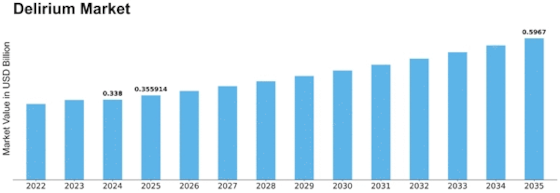
Delirium Market Size Graph
Author
Rahul Gotadki
Assistant Manager

He holds an experience of about 7+ years in Market Research and Business Consulting, working under the spectrum of Life Sciences and Healthcare domains. Rahul conceptualizes and implements a scalable business strategy and provides strategic leadership to the clients. His expertise lies in market estimation, competitive intelligence, pipeline analysis, customer assessment, etc. In addition to the above, his other responsibility includes strategic tracking of high growth markets & advising clients on the potential areas of focus they could direct their business initiatives

Leave a Comment

FAQs

What is the projected market valuation of the Delirium Market by 2035?

The Delirium Market is projected to reach a valuation of 0.5967 USD Billion by 2035.

What was the market valuation of the Delirium Market in 2024?

In 2024, the Delirium Market had a valuation of 0.338 USD Billion.

What is the expected CAGR for the Delirium Market during the forecast period 2025 - 2035?

The expected CAGR for the Delirium Market during the forecast period 2025 - 2035 is 5.3%.

Which companies are considered key players in the Delirium Market?

Key players in the Delirium Market include Johnson & Johnson, Pfizer Inc., and Bristol-Myers Squibb, among others.

What are the main segments of the Delirium Market?

The main segments of the Delirium Market include Type, Diagnosis and Treatment, and End User.

How did the Hyperactive segment perform in 2024?

In 2024, the Hyperactive segment was valued at 0.1014 USD Billion.

What is the projected value of the Treatment segment by 2035?

The Treatment segment is projected to reach a value of 0.358 USD Billion by 2035.

Market Summary

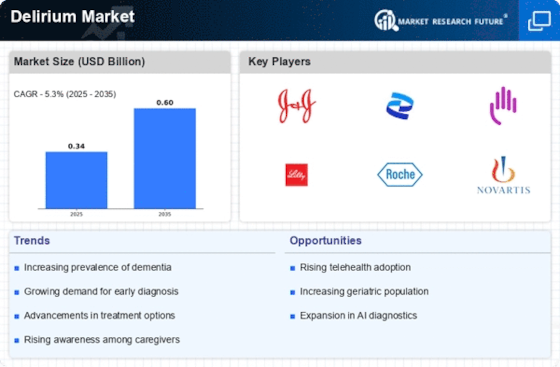
As per MRFR analysis, the Delirium Market Size was estimated at 0.338 USD Billion in 2024. The Delirium industry is projected to grow from 0.3559 in 2025 to 0.5967 by 2035, exhibiting a compound annual growth rate (CAGR) of 5.3 during the forecast period 2025 - 2035.

Key Market Trends & Highlights

The Delirium Market is experiencing a dynamic shift driven by increased awareness and technological advancements.

  • North America remains the largest market for delirium management, reflecting a robust healthcare infrastructure.
  • The Asia-Pacific region is emerging as the fastest-growing market, fueled by rising healthcare investments and awareness.
  • The hyperactive segment continues to dominate the market, while the hypoactive segment is witnessing rapid growth due to evolving diagnostic criteria.
  • Key market drivers include the rising incidence of delirium and advancements in diagnostic technologies, which are shaping care delivery.

Market Size & Forecast

2024 Market Size 0.338 (USD Billion)
2035 Market Size 0.5967 (USD Billion)
CAGR (2025 - 2035) 5.3%
Largest Regional Market Share in 2024 North America

Major Players

<p>Johnson & Johnson (US), Pfizer Inc. (US), Bristol-Myers Squibb (US), Eli Lilly and Company (US), Roche Holding AG (CH), Novartis AG (CH), AstraZeneca PLC (GB), Merck & Co., Inc. (US), Sanofi S.A. (FR)</p>

Market Trends

The Delirium Market is currently experiencing a notable evolution, driven by a growing awareness of the condition and its implications for patient care. Healthcare professionals are increasingly recognizing the importance of early diagnosis and intervention, which appears to enhance patient outcomes. This shift in focus is likely influenced by a broader understanding of the cognitive impairments associated with delirium, prompting the development of targeted treatment protocols. Furthermore, advancements in technology and research methodologies are facilitating a more nuanced understanding of the underlying mechanisms of delirium, potentially leading to innovative therapeutic options. In addition, the Delirium Market is witnessing a rise in collaborative efforts among healthcare providers, researchers, and pharmaceutical companies. These partnerships seem to foster a more integrated approach to managing delirium, emphasizing the need for comprehensive care strategies. As the healthcare landscape continues to evolve, the emphasis on patient-centered care is likely to shape the future of the Delirium Market, encouraging the adoption of holistic treatment approaches that address both the psychological and physiological aspects of the condition.

Increased Awareness and Education

There is a growing emphasis on educating healthcare professionals about delirium, which may lead to improved recognition and management of the condition. This trend suggests that enhanced training programs could significantly impact patient outcomes.

Technological Advancements in Diagnosis

Innovations in diagnostic tools and technologies are emerging, potentially allowing for quicker and more accurate identification of delirium. This trend indicates a shift towards more efficient healthcare practices, which may improve treatment timelines.

Collaborative Care Models

The Delirium Market is seeing a rise in collaborative care models that involve multidisciplinary teams. This approach appears to enhance the quality of care provided to patients, as it integrates various expertise to address the complexities of delirium.

Delirium Market Market Drivers

Rising Incidence of Delirium

The increasing incidence of delirium, particularly among the elderly population, is a notable driver in the Delirium Market. Studies indicate that approximately 15 to 30% of hospitalized older adults experience delirium, which can lead to longer hospital stays and increased healthcare costs. This rising prevalence necessitates enhanced diagnostic and therapeutic options, thereby propelling market growth. Furthermore, the aging population is projected to reach 1.5 billion by 2050, suggesting a sustained demand for delirium management solutions. As healthcare systems adapt to this demographic shift, the Delirium Market is likely to expand, with a focus on innovative treatment modalities and preventive strategies.

Increased Focus on Mental Health

The growing emphasis on mental health awareness is influencing the Delirium Market. As healthcare providers recognize the psychological aspects of delirium, there is a shift towards integrated care models that address both physical and mental health needs. This holistic approach is likely to enhance treatment efficacy and patient satisfaction. Moreover, mental health initiatives are gaining traction, with funding for research and treatment programs on the rise. This trend is expected to foster the development of new therapeutic options specifically targeting delirium, thereby expanding the Delirium Market. The intersection of mental health and delirium management is becoming increasingly relevant in contemporary healthcare.

Advancements in Diagnostic Technologies

Technological advancements in diagnostic tools are transforming the Delirium Market. Enhanced imaging techniques and biomarkers are facilitating earlier and more accurate detection of delirium. For instance, the integration of artificial intelligence in diagnostic processes is showing promise in identifying at-risk patients. The market for diagnostic devices is expected to grow significantly, with estimates suggesting a compound annual growth rate of over 10% in the coming years. This growth is driven by the need for timely interventions, which can mitigate the adverse effects of delirium. Consequently, the Delirium Market is witnessing an influx of innovative diagnostic solutions that improve patient outcomes.

Regulatory Support for Innovative Therapies

Regulatory bodies are increasingly supporting the development of innovative therapies for delirium, which is a crucial driver in the Delirium Market. Initiatives aimed at expediting the approval process for new drugs and treatment protocols are emerging, reflecting a commitment to addressing this complex condition. For instance, the introduction of fast-track designations for promising therapies can significantly shorten the time to market. This regulatory environment encourages pharmaceutical companies to invest in research and development, potentially leading to breakthroughs in delirium treatment. As a result, the Delirium Market is poised for growth, with a variety of new therapeutic options likely to enter the market in the near future.

Growing Demand for Comprehensive Care Solutions

The demand for comprehensive care solutions in the Delirium Market is on the rise, driven by the need for integrated treatment approaches. Healthcare providers are increasingly recognizing that delirium management requires a multifaceted strategy, encompassing medical, psychological, and social support. This shift is prompting the development of collaborative care models that involve multidisciplinary teams. The market for such comprehensive solutions is expected to expand, as they are associated with improved patient outcomes and reduced healthcare costs. Furthermore, the emphasis on value-based care is likely to propel investments in comprehensive delirium management programs, thereby enhancing the Delirium Market.

Market Segment Insights

Delirium Market Type Insights

The Delirium Market segmentation, based on type, includes Hyperactive, Hypoactive, Mixed. The Hypoactive segment is to hold the majority share in 2022 in the Delirium Market revenue. Due to hypoactive characterized by subdued motor activity, poses a unique challenge, necessitating specialized interventions. Pharmaceutical advancements and targeted therapeutic approaches are driving innovation in this market, providing novel treatment options. Healthcare providers are increasingly recognizing the importance of early detection and tailored interventions for hypoactive delirium, contributing to market expansion.

January 7, 2019: Dr. Lata McGinn, Cognitive Behavioural Consultants and Professor at Yeshiva University, announced the launch of the New International Cognitive Behaviour Therapy Organization. The organization is dedicated to the promotion of health and well-being through the scientific development and implementation of evidence-based cognitive behavioural strategies designed to evaluate, prevent, and treat mental conditions and illnesses.

Delirium Market Indication Insights

The Delirium Market segmentation is based on a Diagnosis and treatment, that includes Diagnosis, and Treatment. The diagnosis segment has dominated the market in 2022 and is projected to be the fastest-growing segment during the forecast period, 2024-2032. This is due to integration of artificial intelligence and machine learning algorithms revolutionizing diagnostic approaches, offering more efficient and objective assessments. The growing emphasis on early detection and intervention is driving investments in research and development, fostering a dynamic landscape for diagnostic innovations in the Delirium Market, ultimately improving patient care and outcomes.

Figure 2: DELIRIUM MARKET, BY INDICATION, 2022 & 2032 (USD Billion)

Source: Secondary Research, Primary Research, Market Research Future Database, and Analyst Review

Delirium Market End User Insights

The Delirium Market segmentation is based on end-user that includes Hospitals, Speciality Care, and Research Centers. The hospitals segment has dominated the market in 2022 and homecare is projected to be the fastest-growing segment during the forecast period, 2024-2032. This is due to hospitals increasingly recognizing the significance of delirium in patient care, there is a growing demand for effective solutions and interventions. Delirium Market management has become a focal point in hospitals, driven by factors such as an aging population and the recognition of delirium's impact on healthcare outcomes.

Hospitals are investing in staff training, awareness programs, and specialized resources to address delirium promptly. The integration of comprehensive delirium protocols within hospital workflows is contributing to improved patient care, creating a positive trajectory for the growth of delirium-related services and products in the global healthcare landscape.

Get more detailed insights about Delirium Market Research Report — Global Forecast till 2035

Regional Insights

North America : Leading Market for Delirium Market

North America is the largest market for delirium treatments, accounting for approximately 45% of the global market share. The region's growth is driven by an aging population, increasing awareness of delirium, and advancements in treatment options. Regulatory support from agencies like the FDA has also catalyzed market expansion, facilitating quicker approvals for innovative therapies. The demand for effective management of delirium in hospitals and long-term care facilities is on the rise, further propelling market growth. The United States is the primary contributor to this market, with significant investments from key players such as Johnson & Johnson, Pfizer, and Merck. Canada follows as the second-largest market, holding around 10% of the share. The competitive landscape is characterized by a mix of established pharmaceutical companies and emerging biotech firms, all striving to develop effective solutions for delirium management. The presence of robust healthcare infrastructure enhances the market's potential.

Europe : Emerging Market with Potential

Europe is witnessing significant growth in the delirium market, holding approximately 30% of the global share. The region's expansion is fueled by increasing incidences of delirium, particularly among the elderly, and a growing focus on mental health awareness. Regulatory frameworks, such as the European Medicines Agency's guidelines, are encouraging the development of new therapies, thus enhancing market dynamics. Countries like Germany and the UK are leading this growth, driven by their advanced healthcare systems and research initiatives. Germany stands out as the largest market in Europe, followed closely by the UK and France. The competitive landscape is marked by the presence of major players like Roche and Novartis, who are actively involved in research and development. The collaboration between pharmaceutical companies and healthcare providers is fostering innovation in treatment options, making Europe a promising region for future investments in the delirium market. The emphasis on patient-centered care is also shaping market strategies.

Asia-Pacific : Rapidly Growing Market

The Asia-Pacific region is emerging as a rapidly growing market for delirium treatments, currently holding about 15% of the global market share. The growth is driven by increasing healthcare expenditure, rising awareness of mental health issues, and a growing elderly population. Countries like Japan and China are at the forefront, with government initiatives aimed at improving healthcare services and mental health support. Regulatory bodies are also becoming more proactive in approving new treatments, which is expected to further boost market growth. Japan is the largest market in the region, followed by China and Australia. The competitive landscape is evolving, with both local and international players vying for market share. Key companies such as Eli Lilly and AstraZeneca are investing in research and development to introduce innovative solutions for delirium management. The increasing collaboration between healthcare providers and pharmaceutical companies is expected to enhance treatment accessibility and effectiveness in the region.

Middle East and Africa : Untapped Market Potential

The Middle East and Africa region represents an untapped market for delirium treatments, currently holding about 10% of the global market share. The growth is primarily driven by increasing healthcare investments and a rising awareness of mental health issues. Countries like South Africa and the UAE are leading the way, with government initiatives aimed at improving healthcare infrastructure and mental health services. Regulatory bodies are beginning to recognize the importance of mental health, which is expected to catalyze market growth in the coming years. South Africa is the largest market in this region, followed by the UAE. The competitive landscape is characterized by a mix of local and international players, with companies like Sanofi and Merck making significant inroads. The focus on improving healthcare access and quality is shaping market strategies, and the increasing collaboration between stakeholders is expected to drive innovation in delirium management solutions.

Key Players and Competitive Insights

The Delirium Market is characterized by the presence of many global, regional, players. The market comprises tier-1, tier-2, and local players. The tier-1 and tier-2 players have reached across the globe with diverse Type portfolios. Companies such as Otsuka Pharmaceutical Co., Ltd (Japan), Mylan N.V (US), Teva Pharmaceutical Industries Ltd (Israel), Zydus Group (India), Glenmark Pharmaceuticals Ltd (India), Pfizer (India), Mylan N.V (US), Teva Pharmaceutical Industries Ltd (Israel), Glenmark Pharmaceuticals Ltd (India), Novartis AG (Switzerland) dominate the Delirium Market due to Type differentiation, financial stability, strategic services, and diversified regional presence.

The players are focused on investing in extensive research and development as well. Furthermore, they adopt strategic growth initiatives, such as expansion, joint ventures, and partnerships, to strengthen their market position and capture a large customer base.

One of the primary business strategies adopted by manufacturers in the global Delirium industry to benefit clients and expand the market sector is to manufacture locally to reduce operating costs.

Key Companies in the Delirium Market market include

Industry Developments

April 2023, Otsuka Pharmaceutical Co., Ltd (Japan) got approval from US Food and Drug Administration for drug ABILIFY ASIMTUFII (aripiprazole) approval for the treatment of schizophrenia or delirium as well as maintenance monotherapy in people with bipolar I disorder. Moreover, this drug effectively treats delirium.

In April 2023, The US Food and Drug Administration approved Teva Pharmaceutical Industries’ UZEDY (risperidone) an injectable suspension, a long-acting subcutaneous atypical antipsychotic injection, for the treatment of schizophrenia and delirium in adults. Additionally, those who are physically ill could use this medication to decrease the behavioral and cognitive symptoms of delirium.

In September 2022, Ceribell, Inc (US) received US FDA breakthrough device designation from its device Ceribell system for the treatment of delirium indication. This device operates machine learning to examine electroencephalography (EEG) signals to detect delirium.

Future Outlook

Delirium Market Future Outlook

<p>The Delirium Market is projected to grow at a 5.3% CAGR from 2024 to 2035, driven by increasing awareness, advancements in treatment options, and an aging population.</p>

New opportunities lie in:

  • <p>Development of telehealth platforms for remote patient monitoring</p>
  • <p>Investment in AI-driven diagnostic tools for early detection</p>
  • <p>Expansion of specialized training programs for healthcare professionals</p>

<p>By 2035, the Delirium Market is expected to achieve substantial growth, reflecting evolving healthcare needs.</p>

Market Segmentation

Delirium Market Type Outlook

  • Hyperactive
  • Hypoactive
  • Mixed

Delirium Market End User Outlook

  • Hospitals
  • Speciality Care
  • Research Centers

Delirium Market Diagnosis and Treatment Outlook

  • Diagnosis
  • Treatment

Report Scope

MARKET SIZE 20240.338(USD Billion)
MARKET SIZE 20250.3559(USD Billion)
MARKET SIZE 20350.5967(USD Billion)
COMPOUND ANNUAL GROWTH RATE (CAGR)5.3% (2024 - 2035)
REPORT COVERAGERevenue Forecast, Competitive Landscape, Growth Factors, and Trends
BASE YEAR2024
Market Forecast Period2025 - 2035
Historical Data2019 - 2024
Market Forecast UnitsUSD Billion
Key Companies ProfiledMarket analysis in progress
Segments CoveredMarket segmentation analysis in progress
Key Market OpportunitiesAdvancements in digital health technologies enhance early detection and management in the Delirium Market.
Key Market DynamicsRising awareness of delirium management drives innovation in treatment options and enhances patient care strategies.
Countries CoveredNorth America, Europe, APAC, South America, MEA

FAQs

What is the projected market valuation of the Delirium Market by 2035?

The Delirium Market is projected to reach a valuation of 0.5967 USD Billion by 2035.

What was the market valuation of the Delirium Market in 2024?

In 2024, the Delirium Market had a valuation of 0.338 USD Billion.

What is the expected CAGR for the Delirium Market during the forecast period 2025 - 2035?

The expected CAGR for the Delirium Market during the forecast period 2025 - 2035 is 5.3%.

Which companies are considered key players in the Delirium Market?

Key players in the Delirium Market include Johnson & Johnson, Pfizer Inc., and Bristol-Myers Squibb, among others.

What are the main segments of the Delirium Market?

The main segments of the Delirium Market include Type, Diagnosis and Treatment, and End User.

How did the Hyperactive segment perform in 2024?

In 2024, the Hyperactive segment was valued at 0.1014 USD Billion.

What is the projected value of the Treatment segment by 2035?

The Treatment segment is projected to reach a value of 0.358 USD Billion by 2035.

  1. SECTION I: EXECUTIVE SUMMARY AND KEY HIGHLIGHTS
    1. EXECUTIVE SUMMARY
      1. Market Overview
      2. Key Findings
      3. Market Segmentation
      4. Competitive Landscape
      5. Challenges and Opportunities
      6. Future Outlook
  2. SECTION II: SCOPING, METHODOLOGY AND MARKET STRUCTURE
    1. MARKET INTRODUCTION
      1. Definition
      2. Scope of the study
    2. RESEARCH METHODOLOGY
      1. Overview
      2. Data Mining
      3. Secondary Research
      4. Primary Research
      5. Forecasting Model
      6. Market Size Estimation
      7. Data Triangulation
      8. Validation
  3. SECTION III: QUALITATIVE ANALYSIS
    1. MARKET DYNAMICS
      1. Overview
      2. Drivers
      3. Restraints
      4. Opportunities
    2. MARKET FACTOR ANALYSIS
      1. Value chain Analysis
      2. Porter's Five Forces Analysis
      3. COVID-19 Impact Analysis
  4. SECTION IV: QUANTITATIVE ANALYSIS
    1. Healthcare, BY Type (USD Billion)
      1. Hyperactive
      2. Hypoactive
      3. Mixed
    2. Healthcare, BY Diagnosis and Treatment (USD Billion)
      1. Diagnosis
      2. Treatment
    3. Healthcare, BY End User (USD Billion)
      1. Hospitals
      2. Speciality Care
      3. Research Centers
    4. Healthcare, BY Region (USD Billion)
      1. North America
      2. Europe
      3. APAC
      4. South America
      5. MEA
  5. SECTION V: COMPETITIVE ANALYSIS
    1. Competitive Landscape
      1. Overview
      2. Competitive Analysis
      3. Market share Analysis
      4. Major Growth Strategy in the Healthcare
      5. Competitive Benchmarking
      6. Leading Players in Terms of Number of Developments in the Healthcare
      7. Key developments and growth strategies
      8. Major Players Financial Matrix
    2. Company Profiles
      1. Johnson & Johnson (US)
      2. Pfizer Inc. (US)
      3. Bristol-Myers Squibb (US)
      4. Eli Lilly and Company (US)
      5. Roche Holding AG (CH)
      6. Novartis AG (CH)
      7. AstraZeneca PLC (GB)
      8. Merck & Co., Inc. (US)
      9. Sanofi S.A. (FR)
    3. Appendix
      1. References
      2. Related Reports
  6. LIST OF FIGURES
    1. MARKET SYNOPSIS
    2. NORTH AMERICA MARKET ANALYSIS
    3. US MARKET ANALYSIS BY TYPE
    4. US MARKET ANALYSIS BY DIAGNOSIS AND TREATMENT
    5. US MARKET ANALYSIS BY END USER
    6. CANADA MARKET ANALYSIS BY TYPE
    7. CANADA MARKET ANALYSIS BY DIAGNOSIS AND TREATMENT
    8. CANADA MARKET ANALYSIS BY END USER
    9. EUROPE MARKET ANALYSIS
    10. GERMANY MARKET ANALYSIS BY TYPE
    11. GERMANY MARKET ANALYSIS BY DIAGNOSIS AND TREATMENT
    12. GERMANY MARKET ANALYSIS BY END USER
    13. UK MARKET ANALYSIS BY TYPE
    14. UK MARKET ANALYSIS BY DIAGNOSIS AND TREATMENT
    15. UK MARKET ANALYSIS BY END USER
    16. FRANCE MARKET ANALYSIS BY TYPE
    17. FRANCE MARKET ANALYSIS BY DIAGNOSIS AND TREATMENT
    18. FRANCE MARKET ANALYSIS BY END USER
    19. RUSSIA MARKET ANALYSIS BY TYPE
    20. RUSSIA MARKET ANALYSIS BY DIAGNOSIS AND TREATMENT
    21. RUSSIA MARKET ANALYSIS BY END USER
    22. ITALY MARKET ANALYSIS BY TYPE
    23. ITALY MARKET ANALYSIS BY DIAGNOSIS AND TREATMENT
    24. ITALY MARKET ANALYSIS BY END USER
    25. SPAIN MARKET ANALYSIS BY TYPE
    26. SPAIN MARKET ANALYSIS BY DIAGNOSIS AND TREATMENT
    27. SPAIN MARKET ANALYSIS BY END USER
    28. REST OF EUROPE MARKET ANALYSIS BY TYPE
    29. REST OF EUROPE MARKET ANALYSIS BY DIAGNOSIS AND TREATMENT
    30. REST OF EUROPE MARKET ANALYSIS BY END USER
    31. APAC MARKET ANALYSIS
    32. CHINA MARKET ANALYSIS BY TYPE
    33. CHINA MARKET ANALYSIS BY DIAGNOSIS AND TREATMENT
    34. CHINA MARKET ANALYSIS BY END USER
    35. INDIA MARKET ANALYSIS BY TYPE
    36. INDIA MARKET ANALYSIS BY DIAGNOSIS AND TREATMENT
    37. INDIA MARKET ANALYSIS BY END USER
    38. JAPAN MARKET ANALYSIS BY TYPE
    39. JAPAN MARKET ANALYSIS BY DIAGNOSIS AND TREATMENT
    40. JAPAN MARKET ANALYSIS BY END USER
    41. SOUTH KOREA MARKET ANALYSIS BY TYPE
    42. SOUTH KOREA MARKET ANALYSIS BY DIAGNOSIS AND TREATMENT
    43. SOUTH KOREA MARKET ANALYSIS BY END USER
    44. MALAYSIA MARKET ANALYSIS BY TYPE
    45. MALAYSIA MARKET ANALYSIS BY DIAGNOSIS AND TREATMENT
    46. MALAYSIA MARKET ANALYSIS BY END USER
    47. THAILAND MARKET ANALYSIS BY TYPE
    48. THAILAND MARKET ANALYSIS BY DIAGNOSIS AND TREATMENT
    49. THAILAND MARKET ANALYSIS BY END USER
    50. INDONESIA MARKET ANALYSIS BY TYPE
    51. INDONESIA MARKET ANALYSIS BY DIAGNOSIS AND TREATMENT
    52. INDONESIA MARKET ANALYSIS BY END USER
    53. REST OF APAC MARKET ANALYSIS BY TYPE
    54. REST OF APAC MARKET ANALYSIS BY DIAGNOSIS AND TREATMENT
    55. REST OF APAC MARKET ANALYSIS BY END USER
    56. SOUTH AMERICA MARKET ANALYSIS
    57. BRAZIL MARKET ANALYSIS BY TYPE
    58. BRAZIL MARKET ANALYSIS BY DIAGNOSIS AND TREATMENT
    59. BRAZIL MARKET ANALYSIS BY END USER
    60. MEXICO MARKET ANALYSIS BY TYPE
    61. MEXICO MARKET ANALYSIS BY DIAGNOSIS AND TREATMENT
    62. MEXICO MARKET ANALYSIS BY END USER
    63. ARGENTINA MARKET ANALYSIS BY TYPE
    64. ARGENTINA MARKET ANALYSIS BY DIAGNOSIS AND TREATMENT
    65. ARGENTINA MARKET ANALYSIS BY END USER
    66. REST OF SOUTH AMERICA MARKET ANALYSIS BY TYPE
    67. REST OF SOUTH AMERICA MARKET ANALYSIS BY DIAGNOSIS AND TREATMENT
    68. REST OF SOUTH AMERICA MARKET ANALYSIS BY END USER
    69. MEA MARKET ANALYSIS
    70. GCC COUNTRIES MARKET ANALYSIS BY TYPE
    71. GCC COUNTRIES MARKET ANALYSIS BY DIAGNOSIS AND TREATMENT
    72. GCC COUNTRIES MARKET ANALYSIS BY END USER
    73. SOUTH AFRICA MARKET ANALYSIS BY TYPE
    74. SOUTH AFRICA MARKET ANALYSIS BY DIAGNOSIS AND TREATMENT
    75. SOUTH AFRICA MARKET ANALYSIS BY END USER
    76. REST OF MEA MARKET ANALYSIS BY TYPE
    77. REST OF MEA MARKET ANALYSIS BY DIAGNOSIS AND TREATMENT
    78. REST OF MEA MARKET ANALYSIS BY END USER
    79. KEY BUYING CRITERIA OF HEALTHCARE
    80. RESEARCH PROCESS OF MRFR
    81. DRO ANALYSIS OF HEALTHCARE
    82. DRIVERS IMPACT ANALYSIS: HEALTHCARE
    83. RESTRAINTS IMPACT ANALYSIS: HEALTHCARE
    84. SUPPLY / VALUE CHAIN: HEALTHCARE
    85. HEALTHCARE, BY TYPE, 2024 (% SHARE)
    86. HEALTHCARE, BY TYPE, 2024 TO 2035 (USD Billion)
    87. HEALTHCARE, BY DIAGNOSIS AND TREATMENT, 2024 (% SHARE)
    88. HEALTHCARE, BY DIAGNOSIS AND TREATMENT, 2024 TO 2035 (USD Billion)
    89. HEALTHCARE, BY END USER, 2024 (% SHARE)
    90. HEALTHCARE, BY END USER, 2024 TO 2035 (USD Billion)
    91. BENCHMARKING OF MAJOR COMPETITORS
  7. LIST OF TABLES
    1. LIST OF ASSUMPTIONS
    2. North America MARKET SIZE ESTIMATES; FORECAST
      1. BY TYPE, 2025-2035 (USD Billion)
      2. BY DIAGNOSIS AND TREATMENT, 2025-2035 (USD Billion)
      3. BY END USER, 2025-2035 (USD Billion)
    3. US MARKET SIZE ESTIMATES; FORECAST
      1. BY TYPE, 2025-2035 (USD Billion)
      2. BY DIAGNOSIS AND TREATMENT, 2025-2035 (USD Billion)
      3. BY END USER, 2025-2035 (USD Billion)
    4. Canada MARKET SIZE ESTIMATES; FORECAST
      1. BY TYPE, 2025-2035 (USD Billion)
      2. BY DIAGNOSIS AND TREATMENT, 2025-2035 (USD Billion)
      3. BY END USER, 2025-2035 (USD Billion)
    5. Europe MARKET SIZE ESTIMATES; FORECAST
      1. BY TYPE, 2025-2035 (USD Billion)
      2. BY DIAGNOSIS AND TREATMENT, 2025-2035 (USD Billion)
      3. BY END USER, 2025-2035 (USD Billion)
    6. Germany MARKET SIZE ESTIMATES; FORECAST
      1. BY TYPE, 2025-2035 (USD Billion)
      2. BY DIAGNOSIS AND TREATMENT, 2025-2035 (USD Billion)
      3. BY END USER, 2025-2035 (USD Billion)
    7. UK MARKET SIZE ESTIMATES; FORECAST
      1. BY TYPE, 2025-2035 (USD Billion)
      2. BY DIAGNOSIS AND TREATMENT, 2025-2035 (USD Billion)
      3. BY END USER, 2025-2035 (USD Billion)
    8. France MARKET SIZE ESTIMATES; FORECAST
      1. BY TYPE, 2025-2035 (USD Billion)
      2. BY DIAGNOSIS AND TREATMENT, 2025-2035 (USD Billion)
      3. BY END USER, 2025-2035 (USD Billion)
    9. Russia MARKET SIZE ESTIMATES; FORECAST
      1. BY TYPE, 2025-2035 (USD Billion)
      2. BY DIAGNOSIS AND TREATMENT, 2025-2035 (USD Billion)
      3. BY END USER, 2025-2035 (USD Billion)
    10. Italy MARKET SIZE ESTIMATES; FORECAST
      1. BY TYPE, 2025-2035 (USD Billion)
      2. BY DIAGNOSIS AND TREATMENT, 2025-2035 (USD Billion)
      3. BY END USER, 2025-2035 (USD Billion)
    11. Spain MARKET SIZE ESTIMATES; FORECAST
      1. BY TYPE, 2025-2035 (USD Billion)
      2. BY DIAGNOSIS AND TREATMENT, 2025-2035 (USD Billion)
      3. BY END USER, 2025-2035 (USD Billion)
    12. Rest of Europe MARKET SIZE ESTIMATES; FORECAST
      1. BY TYPE, 2025-2035 (USD Billion)
      2. BY DIAGNOSIS AND TREATMENT, 2025-2035 (USD Billion)
      3. BY END USER, 2025-2035 (USD Billion)
    13. APAC MARKET SIZE ESTIMATES; FORECAST
      1. BY TYPE, 2025-2035 (USD Billion)
      2. BY DIAGNOSIS AND TREATMENT, 2025-2035 (USD Billion)
      3. BY END USER, 2025-2035 (USD Billion)
    14. China MARKET SIZE ESTIMATES; FORECAST
      1. BY TYPE, 2025-2035 (USD Billion)
      2. BY DIAGNOSIS AND TREATMENT, 2025-2035 (USD Billion)
      3. BY END USER, 2025-2035 (USD Billion)
    15. India MARKET SIZE ESTIMATES; FORECAST
      1. BY TYPE, 2025-2035 (USD Billion)
      2. BY DIAGNOSIS AND TREATMENT, 2025-2035 (USD Billion)
      3. BY END USER, 2025-2035 (USD Billion)
    16. Japan MARKET SIZE ESTIMATES; FORECAST
      1. BY TYPE, 2025-2035 (USD Billion)
      2. BY DIAGNOSIS AND TREATMENT, 2025-2035 (USD Billion)
      3. BY END USER, 2025-2035 (USD Billion)
    17. South Korea MARKET SIZE ESTIMATES; FORECAST
      1. BY TYPE, 2025-2035 (USD Billion)
      2. BY DIAGNOSIS AND TREATMENT, 2025-2035 (USD Billion)
      3. BY END USER, 2025-2035 (USD Billion)
    18. Malaysia MARKET SIZE ESTIMATES; FORECAST
      1. BY TYPE, 2025-2035 (USD Billion)
      2. BY DIAGNOSIS AND TREATMENT, 2025-2035 (USD Billion)
      3. BY END USER, 2025-2035 (USD Billion)
    19. Thailand MARKET SIZE ESTIMATES; FORECAST
      1. BY TYPE, 2025-2035 (USD Billion)
      2. BY DIAGNOSIS AND TREATMENT, 2025-2035 (USD Billion)
      3. BY END USER, 2025-2035 (USD Billion)
    20. Indonesia MARKET SIZE ESTIMATES; FORECAST
      1. BY TYPE, 2025-2035 (USD Billion)
      2. BY DIAGNOSIS AND TREATMENT, 2025-2035 (USD Billion)
      3. BY END USER, 2025-2035 (USD Billion)
    21. Rest of APAC MARKET SIZE ESTIMATES; FORECAST
      1. BY TYPE, 2025-2035 (USD Billion)
      2. BY DIAGNOSIS AND TREATMENT, 2025-2035 (USD Billion)
      3. BY END USER, 2025-2035 (USD Billion)
    22. South America MARKET SIZE ESTIMATES; FORECAST
      1. BY TYPE, 2025-2035 (USD Billion)
      2. BY DIAGNOSIS AND TREATMENT, 2025-2035 (USD Billion)
      3. BY END USER, 2025-2035 (USD Billion)
    23. Brazil MARKET SIZE ESTIMATES; FORECAST
      1. BY TYPE, 2025-2035 (USD Billion)
      2. BY DIAGNOSIS AND TREATMENT, 2025-2035 (USD Billion)
      3. BY END USER, 2025-2035 (USD Billion)
    24. Mexico MARKET SIZE ESTIMATES; FORECAST
      1. BY TYPE, 2025-2035 (USD Billion)
      2. BY DIAGNOSIS AND TREATMENT, 2025-2035 (USD Billion)
      3. BY END USER, 2025-2035 (USD Billion)
    25. Argentina MARKET SIZE ESTIMATES; FORECAST
      1. BY TYPE, 2025-2035 (USD Billion)
      2. BY DIAGNOSIS AND TREATMENT, 2025-2035 (USD Billion)
      3. BY END USER, 2025-2035 (USD Billion)
    26. Rest of South America MARKET SIZE ESTIMATES; FORECAST
      1. BY TYPE, 2025-2035 (USD Billion)
      2. BY DIAGNOSIS AND TREATMENT, 2025-2035 (USD Billion)
      3. BY END USER, 2025-2035 (USD Billion)
    27. MEA MARKET SIZE ESTIMATES; FORECAST
      1. BY TYPE, 2025-2035 (USD Billion)
      2. BY DIAGNOSIS AND TREATMENT, 2025-2035 (USD Billion)
      3. BY END USER, 2025-2035 (USD Billion)
    28. GCC Countries MARKET SIZE ESTIMATES; FORECAST
      1. BY TYPE, 2025-2035 (USD Billion)
      2. BY DIAGNOSIS AND TREATMENT, 2025-2035 (USD Billion)
      3. BY END USER, 2025-2035 (USD Billion)
    29. South Africa MARKET SIZE ESTIMATES; FORECAST
      1. BY TYPE, 2025-2035 (USD Billion)
      2. BY DIAGNOSIS AND TREATMENT, 2025-2035 (USD Billion)
      3. BY END USER, 2025-2035 (USD Billion)
    30. Rest of MEA MARKET SIZE ESTIMATES; FORECAST
      1. BY TYPE, 2025-2035 (USD Billion)
      2. BY DIAGNOSIS AND TREATMENT, 2025-2035 (USD Billion)
      3. BY END USER, 2025-2035 (USD Billion)
    31. PRODUCT LAUNCH/PRODUCT DEVELOPMENT/APPROVAL
    32. ACQUISITION/PARTNERSHIP

Delirium Market Segmentation

Delirium Drug Outlook (USD Billion, 2018-2032)

  • First-generation Antipsychotics
  • Second-generation Antipsychotics
  • Benzodiazepines

Delirium Distribution Channel Outlook (USD Billion, 2018-2032)

  • Retail Pharmacies
  • Hospital Pharmacies
  • Online Pharmacies

Delirium Type Outlook (USD Billion, 2018-2032)

  • Hyperactive
  • Hypoactive
  • Mixed

Delirium Diagnosis Outlook (USD Billion, 2018-2032)

  • Laboratory Tests
  • Physical Examination
  • Imaging test
  • Blood test
  • Urine test

Delirium End-User Outlook (USD Billion, 2018-2032)

  • Hospitals
  • Research Centers
  • Specialty Centers

Delirium Regional Outlook (USD Billion, 2018-2032)

  • North America Outlook (USD Billion, 2018-2032)

    • North America Delirium by Drug

      • First-generation Antipsychotics
      • Second-generation Antipsychotics
      • Benzodiazepines
    • North America Delirium by Distribution Channel

      • Retail Pharmacies
      • Hospital Pharmacies
      • Online Pharmacies
    • North America Delirium by Type

      • Hyperactive
      • Hypoactive
      • Mixed
    • North America Delirium by Diagnosis

      • Laboratory Tests
      • Physical Examination
      • Imaging test
      • Blood test
      • Urine test
    • North America Delirium by End-User

      • Hospitals
      • Research Centers
      • Specialty Centers
    • US Outlook (USD Billion, 2018-2032)

    • US Delirium by Drug

      • First-generation Antipsychotics
      • Second-generation Antipsychotics
      • Benzodiazepines
    • US Delirium by Distribution Channel

      • Retail Pharmacies
      • Hospital Pharmacies
      • Online Pharmacies
    • US Delirium by Type

      • Hyperactive
      • Hypoactive
      • Mixed
    • US Delirium by Diagnosis

      • Laboratory Tests
      • Physical Examination
      • Imaging test
      • Blood test
      • Urine test
    • US Delirium by End-User

      • Hospitals
      • Research Centers
      • Specialty Centers
    • CANADA Outlook (USD Billion, 2018-2032)

    • CANADA Delirium by Drug

      • First-generation Antipsychotics
      • Second-generation Antipsychotics
      • Benzodiazepines
    • CANADA Delirium by Distribution Channel

      • Retail Pharmacies
      • Hospital Pharmacies
      • Online Pharmacies
    • CANADA Delirium by Type

      • HYPERACTIVE
      • Hypoactive
      • Mixed
    • CANADA Delirium by Diagnosis

      • Laboratory Tests
      • Physical Examination
      • Imaging test
      • Blood test
      • Urine test
    • CANADA Delirium by End-User

      • Hospitals
      • Research Centers
      • Specialty Centers
  • Europe Outlook (USD Billion, 2018-2032)

    • Europe Delirium by Drug

      • First-generation Antipsychotics
      • Second-generation Antipsychotics
      • Benzodiazepines
    • Europe Delirium by Distribution Channel

      • Retail Pharmacies
      • Hospital Pharmacies
      • Online Pharmacies
    • Europe Delirium by Type

      • Hyperactive
      • Hypoactive
      • Mixed
    • Europe Delirium by Diagnosis

      • Laboratory Tests
      • Physical Examination
      • Imaging test
      • Blood test
      • Urine test
    • Europe Delirium by End-User

      • Hospitals
      • Research Centers
      • Specialty Centers
    • Germany Outlook (USD Billion, 2018-2032)

    • Germany Delirium by Drug

      • First-generation Antipsychotics
      • Second-generation Antipsychotics
      • Benzodiazepines
    • Germany Delirium by Distribution Channel

      • Retail Pharmacies
      • Hospital Pharmacies
      • Online Pharmacies
    • Germany Delirium by Type

      • Hyperactive
      • Hypoactive
      • Mixed
    • Germany Delirium by Diagnosis

      • Laboratory Tests
      • Physical Examination
      • Imaging test
      • Blood test
      • Urine test
    • Germany Delirium by End-User

      • Hospitals
      • Research Centers
      • Specialty Centers
    • France Outlook (USD Billion, 2018-2032)

    • France Delirium by Drug

      • First-generation Antipsychotics
      • Second-generation Antipsychotics
      • Benzodiazepines
    • France Delirium by Distribution Channel

      • Retail Pharmacies
      • Hospital Pharmacies
      • Online Pharmacies
    • France Delirium by Type

      • Hyperactive
      • Hypoactive
      • Mixed
    • France Delirium by Diagnosis

      • Laboratory Tests
      • Physical Examination
      • Imaging test
      • Blood test
      • Urine test
    • France Delirium by End-User

      • Hospitals
      • Research Centers
      • Specialty Centers
    • UK Outlook (USD Billion, 2018-2032)

    • UK Delirium by Drug

      • First-generation Antipsychotics
      • Second-generation Antipsychotics
      • Benzodiazepines
    • UK Delirium by Distribution Channel

      • Retail Pharmacies
      • Hospital Pharmacies
      • Online Pharmacies
    • UK Delirium by Type

      • Hyperactive
      • Hypoactive
      • Mixed
    • UK Delirium by Diagnosis

      • Laboratory Tests
      • Physical Examination
      • Imaging test
      • Blood test
      • Urine test
    • UK Delirium by End-User

      • Hospitals
      • Research Centers
      • Specialty Centers
    • ITALY Outlook (USD Billion, 2018-2032)

    • ITALY Delirium by Drug

      • First-generation Antipsychotics
      • Second-generation Antipsychotics
      • Benzodiazepines
    • ITALY Delirium by Distribution Channel

      • Retail Pharmacies
      • Hospital Pharmacies
      • Online Pharmacies
    • ITALY Delirium by Type

      • Hyperactive
      • Hypoactive
      • Mixed
    • ITALY Delirium by Diagnosis

      • Laboratory Tests
      • Physical Examination
      • Imaging test
      • Blood test
      • Urine test
    • ITALY Delirium by End-User

      • Hospitals
      • Research Centers
      • Specialty Centers
    • SPAIN Outlook (USD Billion, 2018-2032)

    • Spain Delirium by Drug

      • First-generation Antipsychotics
      • Second-generation Antipsychotics
      • Benzodiazepines
    • Spain Delirium by Distribution Channel

      • Retail Pharmacies
      • Hospital Pharmacies
      • Online Pharmacies
    • Spain Delirium by Type

      • Hyperactive
      • Hypoactive
      • Mixed
    • Spain Delirium by Diagnosis

      • Laboratory Tests
      • Physical Examination
      • Imaging test
      • Blood test
      • Urine test
    • Spain Delirium by End-User

      • Hospitals
      • Research Centers
      • Specialty Centers
    • Rest Of Europe Outlook (USD Billion, 2018-2032)

    • Rest Of Europe Delirium by Drug

      • First-generation Antipsychotics
      • Second-generation Antipsychotics
      • Benzodiazepines
    • REST OF EUROPE Delirium by Distribution Channel

      • Retail Pharmacies
      • Hospital Pharmacies
      • Online Pharmacies
    • REST OF EUROPE Delirium by Type

      • HYPERACTIVE
      • Hypoactive
      • Mixed
    • REST OF EUROPE Delirium by Diagnosis

      • Laboratory Tests
      • Physical Examination
      • Imaging test
      • Blood test
      • Urine test
    • REST OF EUROPE Delirium by End-User

      • Hospitals
      • Research Centers
      • Specialty Centers
  • Asia-Pacific Outlook (USD Billion, 2018-2032)

    • Asia-Pacific Delirium by Drug

      • First-generation Antipsychotics
      • Second-generation Antipsychotics
      • Benzodiazepines
    • Asia-Pacific Delirium by Distribution Channel

      • Retail Pharmacies
      • Hospital Pharmacies
      • Online Pharmacies
    • Asia-Pacific Delirium by Type

      • Hyperactive
      • Hypoactive
      • Mixed
    • Asia-Pacific Delirium by Diagnosis

      • Laboratory Tests
      • Physical Examination
      • Imaging test
      • Blood test
      • Urine test
    • Asia-Pacific Delirium by End-User

      • Hospitals
      • Research Centers
      • Specialty Centers
    • China Outlook (USD Billion, 2018-2032)

    • China Delirium by Drug

      • First-generation Antipsychotics
      • Second-generation Antipsychotics
      • Benzodiazepines
    • China Delirium by Distribution Channel

      • Retail Pharmacies
      • Hospital Pharmacies
      • Online Pharmacies
    • China Delirium by Type

      • Hyperactive
      • Hypoactive
      • Mixed
    • China Delirium by Diagnosis

      • Laboratory Tests
      • Physical Examination
      • Imaging test
      • Blood test
      • Urine test
    • China Delirium by End-User

      • Hospitals
      • Research Centers
      • Specialty Centers
    • Japan Outlook (USD Billion, 2018-2032)

    • Japan Delirium by Drug

      • First-generation Antipsychotics
      • Second-generation Antipsychotics
      • Benzodiazepines
    • Japan Delirium by Distribution Channel

      • Retail Pharmacies
      • Hospital Pharmacies
      • Online Pharmacies
    • Japan Delirium by Type

      • Hyperactive
      • Hypoactive
      • Mixed
    • Japan Delirium by Diagnosis

      • Laboratory Tests
      • Physical Examination
      • Imaging test
      • Blood test
      • Urine test
    • Japan Delirium by End-User

      • Hospitals
      • Research Centers
      • Specialty Centers
    • India Outlook (USD Billion, 2018-2032)

    • India Delirium by Drug

      • First-generation Antipsychotics
      • Second-generation Antipsychotics
      • Benzodiazepines
    • India Delirium by Distribution Channel

      • Retail Pharmacies
      • Hospital Pharmacies
      • Online Pharmacies
    • India Delirium by Type

      • Hyperactive
      • Hypoactive
      • Mixed
    • India Delirium by Diagnosis

      • Laboratory Tests
      • Physical Examination
      • Imaging test
      • Blood test
      • Urine test
    • India Delirium by End-User

      • Hospitals
      • Research Centers
      • Specialty Centers
    • Australia Outlook (USD Billion, 2018-2032)

    • Australia Delirium by Drug

      • First-generation Antipsychotics
      • Second-generation Antipsychotics
      • Benzodiazepines
    • Australia Delirium by Distribution Channel

      • Retail Pharmacies
      • Hospital Pharmacies
      • Online Pharmacies
    • Australia Delirium by Type

      • Hyperactive
      • Hypoactive
      • Mixed
    • Australia Delirium by Diagnosis

      • Laboratory Tests
      • Physical Examination
      • Imaging test
      • Blood test
      • Urine test
    • Australia Delirium by End-User

      • Hospitals
      • Research Centers
      • Specialty Centers
    • Rest of Asia-Pacific Outlook (USD Billion, 2018-2032)

    • Rest of Asia-Pacific Delirium by Drug

      • First-generation Antipsychotics
      • Second-generation Antipsychotics
      • Benzodiazepines
    • Rest of Asia-Pacific Delirium by Distribution Channel

      • Retail Pharmacies
      • Hospital Pharmacies
      • Online Pharmacies
    • Rest of Asia-Pacific Delirium by Type

      • Hyperactive
      • Hypoactive
      • Mixed
    • Rest of Asia-Pacific Delirium by Diagnosis

      • Laboratory Tests
      • Physical Examination
      • Imaging test
      • Blood test
      • Urine test
    • Rest of Asia-Pacific Delirium by End-User

      • Hospitals
      • Research Centers
      • Specialty Centers
  • Rest of the World Outlook (USD Billion, 2018-2032)

    • Rest of the World Delirium by Drug

      • First-generation Antipsychotics
      • Second-generation Antipsychotics
      • Benzodiazepines
    • Rest of the World Delirium by Distribution Channel

      • Retail Pharmacies
      • Hospital Pharmacies
      • Online Pharmacies
    • Rest of the World Delirium by Type

      • Hyperactive
      • Hypoactive
      • Mixed
    • Rest of the World Delirium by Diagnosis

      • Laboratory Tests
      • Physical Examination
      • Imaging test
      • Blood test
      • Urine test
    • Rest of the World Delirium by End-User

      • Hospitals
      • Research Centers
      • Specialty Centers
  • Middle East Outlook (USD Billion, 2018-2032)

    • Middle East Delirium by Drug

      • First-generation Antipsychotics
      • Second-generation Antipsychotics
      • Benzodiazepines
    • Middle East Delirium by Distribution Channel

      • Retail Pharmacies
      • Hospital Pharmacies
      • Online Pharmacies
    • Middle East Delirium by Type

      • Hyperactive
      • Hypoactive
      • Mixed
    • Middle East Delirium by Diagnosis

      • Laboratory Tests
      • Physical Examination
      • Imaging test
      • Blood test
      • Urine test
    • Middle East Delirium by End-User

      • Hospitals
      • Research Centers
      • Specialty Centers
    • Africa Outlook (USD Billion, 2018-2032)

    • Africa Delirium by Drug

      • First-generation Antipsychotics
      • Second-generation Antipsychotics
      • Benzodiazepines
    • Africa Delirium by Distribution Channel

      • Retail Pharmacies
      • Hospital Pharmacies
      • Online Pharmacies
    • Africa Delirium by Type

      • Hyperactive
      • Hypoactive
      • Mixed
    • Africa Delirium by Diagnosis

      • Laboratory Tests
      • Physical Examination
      • Imaging test
      • Blood test
      • Urine test
    • Africa Delirium by End-User

      • Hospitals
      • Research Centers
      • Specialty Centers
    • Latin America Outlook (USD Billion, 2018-2032)

    • Latin America Delirium by Drug

      • First-generation Antipsychotics
      • Second-generation Antipsychotics
      • Benzodiazepines
    • Latin America Delirium by Distribution Channel

      • Retail Pharmacies
      • Hospital Pharmacies
      • Online Pharmacies
    • Latin America Delirium by Type

      • HYPERACTIVE
      • Hypoactive
      • Mixed
    • Latin America Delirium by Diagnosis

      • Laboratory Tests
      • Physical Examination
      • Imaging test
      • Blood test
      • Urine test
    • Latin America Delirium by End-User

      • Hospitals
      • Research Centers
      • Specialty Centers


Infographic

Free Sample Request

Kindly complete the form below to receive a free sample of this Report

Get Free Sample

Customer Strories

Compare Licence

×
Features License Type
Single User Multiuser License Enterprise User
Price $4,950 $5,950 $7,250
Maximum User Access Limit 1 User Upto 10 Users Unrestricted Access Throughout the Organization
Free Customization
Direct Access to Analyst
Deliverable Format
Platform Access
Discount on Next Purchase 10% 15% 15%
Printable Versions