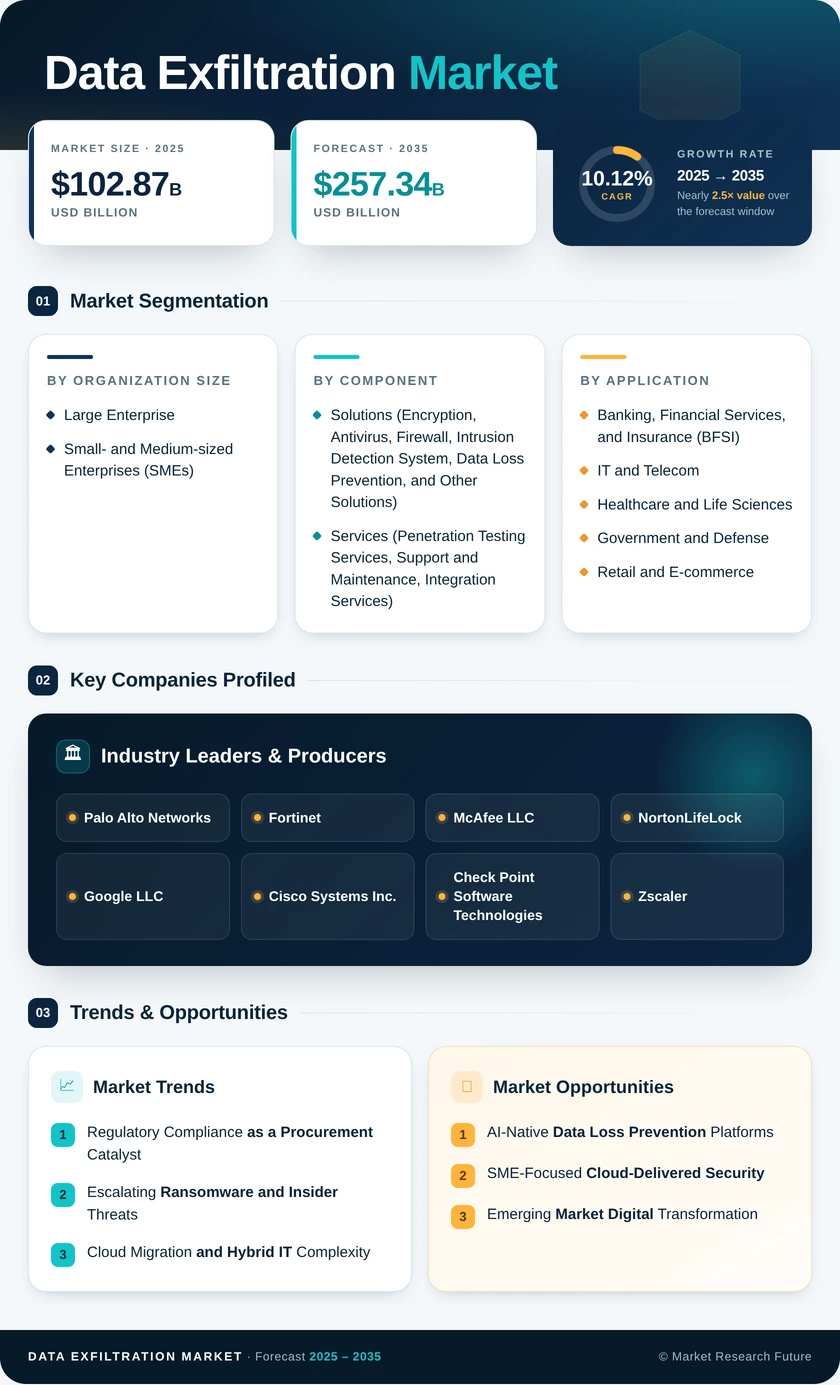
MARKET SEGMENTATION OVERVIEW
The global data exfiltration market is analyzed across three primary segmentation dimensions. Each dimension reflects distinct demand drivers, regulatory treatment, and end-user requirements, enabling granular revenue forecasting and strategic positioning for market participants.
By Organization Size
| Sub-Segment | Key Trend |
| Large Enterprise | Dominant share driven by expansive multi-cloud environments, dedicated SOC teams, and stringent regulatory mandates requiring advanced DLP solutions and insider threat monitoring |
| Small- and Medium-sized Enterprises (SMEs) | Fastest-growing segment as cloud-delivered security bundles lower cost barriers and subscription-based pricing models accelerate adoption of endpoint-level data exfiltration prevention |
- Large enterprises command ~66% of the data exfiltration market in 2026, reflecting their complex IT environments and multi-billion-dollar cybersecurity budgets. Small- and Medium-sized Enterprises (SMEs) represent the fastest-growing sub-segment at 12.5% CAGR, driven by affordable cloud-delivered DLP solutions to prevent data exfiltration and managed security service adoption that eliminates the need for in-house specialist teams.
By Component
| Sub-Segment | Key Trend |
| Solutions (Encryption, Antivirus, Firewall, Intrusion Detection System, Data Loss Prevention, and Other Solutions) | Dominant revenue contributor; enterprises prioritize integrated platforms combining encryption, network traffic analysis for data theft detection, and CASB for cloud data exfiltration control |
| Services (Penetration Testing Services, Support and Maintenance, Integration Services) | Fastest-growing component as cybersecurity talent shortages push organizations toward managed detection, consulting, and penetration testing outsourcing |
- Solutions account for USD 63.78 billion in 2025, with data loss prevention and encryption forming the largest revenue sub-components within this segment. Enterprises increasingly demand unified platforms that combine endpoint-level data exfiltration prevention with network-layer detection and cloud access security brokering. Services are expanding at an 11.8% CAGR as organizations outsource penetration testing, integration, and consulting engagements to address the global shortfall of 3.4 million cybersecurity professionals.
By End-User Vertical
| Sub-Segment | Key Trend |
| Banking, Financial Services, and Insurance (BFSI) | Largest vertical share; driven by regulatory compliance (OCC, PRA, PCI-DSS), high per-record breach costs, and privileged access risk requiring insider threat monitoring for data leakage |
| IT and Telecom | Rapid growth fueled by cloud infrastructure protection needs, massive customer data volumes, and network traffic analysis for data theft detection across service provider environments |
| Healthcare and Life Sciences | High sensitivity of patient health information (PHI) and electronic health records (EHRs); HIPAA compliance and rising ransomware targeting accelerate deployment of CASB for cloud data exfiltration control |
| Government and Defense | National security mandates, classified data protection requirements, and zero-trust architecture adoption drive sustained procurement of DLP solutions to prevent data exfiltration |
| Retail and E-commerce | PCI-DSS compliance obligations, customer PII protection needs, and growing e-commerce transaction volumes expand demand for endpoint-level data exfiltration prevention |
| Manufacturing | Intellectual property theft prevention and OT/IT convergence security; monitoring industrial protocols for unauthorized data transfers is an emerging priority |
| Other End-User Verticals | Education, energy, transportation, and media sectors with growing but nascent cybersecurity postures, driving incremental market expansion |
- BFSI commands ~28% of the data exfiltration market in 2026, reflecting the sector's exposure to financial fraud, regulatory scrutiny, and the highest per-record breach costs averaging USD 5.9 million across financial institutions. IT and Telecom follows as the second-largest vertical with an 11.4% CAGR, driven by the sector's role as both a primary target and a critical infrastructure provider requiring robust network traffic analysis for data theft detection. Healthcare and Life Sciences represent USD 13.37 billion in 2025 revenue, with HIPAA breach notification rules and escalating ransomware attacks driving rapid deployment of insider threat monitoring for data leakage and encrypted data transfer controls. Retail and e-commerce are the fastest-growing verticals at 12.1% CAGR, propelled by PCI-DSS compliance and surging online transaction volumes that expand the attack surface for customer data exfiltration.
SEGMENTATION QUICK REFERENCE
| Dimension | Sub-Segments | Dominant Segment (2026) | Fastest Growing |
| Organization Size | Large Enterprise · SMEs | Large Enterprise (~66%) | SMEs (12.5% CAGR) |
| Component | Solutions (Encryption, Antivirus, Firewall, IDS, DLP, Other) · Services (Penetration Testing, Support; Maintenance, Integration, Consulting) | Solutions (USD 63.78B in 2025) | Services (11.8% CAGR) |
| End-User Vertical | BFSI · IT and Telecom · Healthcare and Life Sciences · Government and Defense · Retail and E-commerce · Manufacturing · Other End-User Verticals | BFSI (~28%) | Retail and E-commerce (12.1% CAGR) |