
×
Hero Background
English
Chinese
French
Japanese
Korean
German
Spanish

Data Center Virtualization Market Analysis

ID: MRFR/ICT/2316-HCR
100 Pages
Aarti Dhapte
October 2025

Data Center Virtualization Market Research Report: Information By Type (Server, Storage, Network, and Desktop), By organization Size (Small and Medium-Sized Enterprises (SMEs) and Large Enterprises), By Vertical (BFSI, IT & Telecommunication, Manufacturing & Automotive, Government, Healthcare, and Others), And By Region (North America, Europe, Asia-Pacific, And Rest Of The World) –Market Forecast Till 2035.

Share:
Download PDF ×

We do not share your information with anyone. However, we may send you emails based on your report interest from time to time. You may contact us at any time to opt-out.

Data Center Virtualization Market Infographic
Purchase Options

Market Analysis

In-depth Analysis of Data Center Virtualization Market Industry Landscape

The Data Center Virtualization market has undergone significant growth and dynamic changes, fueled by the increasing demand for efficient and scalable IT infrastructure solutions. Data center virtualization involves the abstraction of computing resources, enabling multiple virtual instances to run on a single physical server. The market dynamics are shaped by factors such as the pursuit of cost savings, the need for resource optimization, and the constant evolution of technology in the realm of IT infrastructure.

One of the primary drivers influencing the market dynamics of data center virtualization is the pursuit of cost efficiency and resource optimization. Organizations seek ways to maximize the utilization of their IT resources while minimizing hardware and operational costs. Data center virtualization allows for the consolidation of servers, storage, and networking equipment, enabling businesses to achieve higher efficiency, reduce physical space requirements, and decrease overall energy consumption. This cost-effectiveness is a compelling factor driving the widespread adoption of virtualization technologies.

The competitive landscape of the data center virtualization market is marked by the presence of major IT infrastructure vendors and specialized virtualization solution providers. Established players often offer comprehensive suites of virtualization products, while newer entrants may focus on niche areas or provide innovative features. This competition stimulates innovation and drives the development of data center virtualization solutions that cater to the evolving needs of businesses, from small enterprises to large-scale data centers.

Technological advancements in virtualization technologies, as well as complementary areas such as software-defined networking (SDN) and hyper-converged infrastructure (HCI), significantly influence the market dynamics of data center virtualization. The continuous improvement in virtualization software, hypervisors, and management tools contributes to the scalability, flexibility, and overall performance of virtualized environments. As businesses strive to modernize their IT infrastructure, the capabilities of data center virtualization solutions continue to expand, offering enhanced features and addressing emerging challenges.

Interoperability and integration capabilities play a critical role in the market dynamics of data center virtualization. Businesses operate diverse IT environments, often employing a mix of virtualized and non-virtualized systems. Data center virtualization solutions that offer seamless integration with existing infrastructure, support for various hypervisors, and interoperability with cloud platforms gain a competitive advantage. Interoperability ensures that businesses can adopt virtualization technologies without disrupting their existing operations.

Strategic partnerships and collaborations between data center virtualization providers and other technology firms contribute to the evolving dynamics of the market. These partnerships aim to create integrated solutions that address specific business needs, such as combining virtualization with cloud services, containerization, or edge computing. Strategic collaborations enhance the overall value proposition of data center virtualization and provide businesses with a more comprehensive and interoperable IT infrastructure.

Government regulations and compliance considerations also influence the market dynamics of data center virtualization. As businesses increasingly rely on virtualized environments to process and store sensitive data, compliance with data protection regulations and industry standards becomes a crucial consideration. Data center virtualization solutions that prioritize security measures and compliance with relevant regulations gain the trust of organizations across various sectors.


Author
Aarti Dhapte
Team Lead - Research

She holds an experience of about 6+ years in Market Research and Business Consulting, working under the spectrum of Information Communication Technology, Telecommunications and Semiconductor domains. Aarti conceptualizes and implements a scalable business strategy and provides strategic leadership to the clients. Her expertise lies in market estimation, competitive intelligence, pipeline analysis, customer assessment, etc.

Leave a Comment

FAQs

What is the projected market valuation of the Data Center Virtualization Market by 2035?

The projected market valuation for the Data Center Virtualization Market by 2035 is 31.25 USD Billion.

What was the market valuation of the Data Center Virtualization Market in 2024?

The overall market valuation of the Data Center Virtualization Market in 2024 was 6.62 USD Billion.

What is the expected CAGR for the Data Center Virtualization Market during the forecast period 2025 - 2035?

The expected CAGR for the Data Center Virtualization Market during the forecast period 2025 - 2035 is 15.15%.

Which organization size segments are included in the Data Center Virtualization Market?

The Data Center Virtualization Market includes segments for Small and Medium-Sized Enterprises (SMEs) and Large Enterprises.

What are the projected valuations for Small and Medium-Sized Enterprises (SMEs) in the Data Center Virtualization Market?

The projected valuation for Small and Medium-Sized Enterprises (SMEs) in the Data Center Virtualization Market is expected to reach 12.5 USD Billion.

What is the anticipated market size for the Desktop segment in the Data Center Virtualization Market?

The anticipated market size for the Desktop segment in the Data Center Virtualization Market is projected to be 10.75 USD Billion.

Market Summary

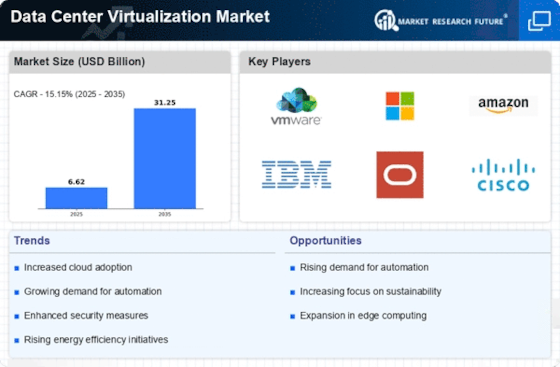
As per MRFR analysis, the Data Center Virtualization Market Size was estimated at 6.62 USD Billion in 2024. The Data Center Virtualization industry is projected to grow from 7.623 USD Billion in 2025 to 31.25 USD Billion by 2035, exhibiting a compound annual growth rate (CAGR) of 15.15 during the forecast period 2025 - 2035.

Key Market Trends & Highlights

The Data Center Virtualization Market is experiencing robust growth driven by technological advancements and evolving business needs.

  • The market witnesses increased adoption of hybrid cloud solutions, particularly in North America, which remains the largest market.
  • Enhanced security measures are becoming a focal point for organizations, especially among small and medium-sized enterprises.
  • Energy efficiency and sustainability initiatives are gaining traction, particularly in the rapidly growing Asia-Pacific region.
  • Rising demand for scalability and cost reduction initiatives are key drivers propelling the market forward.

Market Size & Forecast

2024 Market Size 6.62 (USD Billion)
2035 Market Size 31.25 (USD Billion)
CAGR (2025 - 2035) 15.15%
Largest Regional Market Share in 2024 North America

Major Players

<p>VMware (US), Microsoft (US), Amazon (US), IBM (US), Oracle (US), Cisco (US), Nutanix (US), Red Hat (US), Citrix (US), Hewlett Packard Enterprise (US)</p>

Market Trends

The Data Center Virtualization Market is currently experiencing a transformative phase, driven by the increasing demand for efficient resource management and cost reduction. Organizations are increasingly adopting virtualization technologies to optimize their IT infrastructure, enabling them to enhance operational efficiency and scalability. This shift is largely influenced by the growing need for cloud computing solutions, which necessitate robust virtualization strategies to support dynamic workloads and ensure seamless service delivery. Furthermore, the rise of remote work and digital transformation initiatives has accelerated the adoption of virtualization, as businesses seek to maintain agility and responsiveness in a rapidly evolving landscape. In addition, the Data Center Virtualization Market is witnessing advancements in technologies such as artificial intelligence and machine learning, which are being integrated into virtualization solutions. These innovations appear to enhance automation, improve resource allocation, and facilitate predictive analytics, thereby enabling organizations to make informed decisions regarding their IT environments. As the market continues to evolve, it seems likely that the focus will shift towards hybrid and multi-cloud strategies, allowing businesses to leverage the benefits of various cloud environments while maintaining control over their data and applications. Overall, the Data Center Virtualization Market is poised for substantial growth, driven by technological advancements and changing business needs.

Increased Adoption of Hybrid Cloud Solutions

Organizations are increasingly gravitating towards hybrid cloud models, which combine on-premises infrastructure with public cloud services. This trend allows businesses to maintain control over sensitive data while leveraging the scalability and flexibility of cloud resources. As a result, the Data Center Virtualization Market is likely to see a surge in demand for solutions that facilitate seamless integration between different environments.

Focus on Enhanced Security Measures

With the rise of cyber threats, there is a growing emphasis on security within the Data Center Virtualization Market. Companies are prioritizing solutions that offer robust security features, such as encryption and access controls, to protect their virtualized environments. This trend indicates a shift towards more secure virtualization practices, ensuring that organizations can safeguard their data and applications.

Emphasis on Energy Efficiency and Sustainability

As environmental concerns gain prominence, organizations are increasingly seeking energy-efficient virtualization solutions. The Data Center Virtualization Market is responding to this demand by developing technologies that reduce energy consumption and carbon footprints. This trend suggests a broader commitment to sustainability, as businesses aim to align their IT strategies with environmental goals.

Data Center Virtualization Market Market Drivers

Cost Reduction Initiatives

Cost efficiency remains a pivotal driver in the Data Center Virtualization Market. Organizations are increasingly adopting virtualization technologies to reduce operational expenses associated with hardware and maintenance. By consolidating servers and optimizing resource allocation, companies can significantly lower their capital expenditures. Recent statistics indicate that businesses can save up to 30% on IT costs through effective virtualization strategies. This financial incentive is compelling, particularly for small to medium-sized enterprises that may have limited budgets. As the pressure to maintain profitability intensifies, the focus on cost reduction through virtualization is likely to continue shaping the landscape of the Data Center Virtualization Market.

Rising Demand for Scalability

The Data Center Virtualization Market is experiencing a notable surge in demand for scalability solutions. Organizations are increasingly seeking to expand their IT infrastructure without incurring substantial costs. Virtualization allows for the dynamic allocation of resources, enabling businesses to scale their operations efficiently. According to recent data, the virtualization market is projected to grow at a compound annual growth rate of approximately 15% over the next five years. This growth is driven by the need for businesses to adapt to fluctuating workloads and the desire to optimize resource utilization. As companies continue to embrace digital transformation, the ability to scale operations seamlessly becomes a critical factor in their success, thereby propelling the Data Center Virtualization Market forward.

Growing Need for Remote Work Solutions

The Data Center Virtualization Market is significantly influenced by the growing need for remote work solutions. As organizations adapt to flexible work arrangements, the demand for virtualized environments that support remote access has surged. Virtualization enables employees to access critical applications and data from any location, fostering productivity and collaboration. Recent data suggests that the remote work trend is likely to persist, with over 50% of companies planning to maintain flexible work policies. This shift necessitates robust virtualization solutions that can accommodate remote access securely and efficiently. Consequently, the Data Center Virtualization Market is poised for growth as businesses invest in technologies that support a distributed workforce.

Advancements in Virtualization Technologies

Technological advancements play a crucial role in shaping the Data Center Virtualization Market. Innovations in virtualization technologies, such as containerization and hyper-converged infrastructure, are enhancing the capabilities of data centers. These advancements allow for improved resource management, increased performance, and greater flexibility in deploying applications. Recent reports indicate that the adoption of hyper-converged infrastructure is expected to grow by over 25% in the coming years, reflecting the industry's shift towards more integrated solutions. As organizations seek to leverage cutting-edge technologies to optimize their operations, the Data Center Virtualization Market is likely to benefit from these ongoing advancements, driving further investment and development.

Increased Focus on Disaster Recovery Solutions

The Data Center Virtualization Market is witnessing a heightened emphasis on disaster recovery solutions. Organizations are recognizing the importance of ensuring business continuity in the face of unforeseen disruptions. Virtualization technologies facilitate robust disaster recovery strategies by enabling quick data backup and recovery processes. Recent surveys indicate that nearly 70% of businesses consider disaster recovery a top priority, further driving the demand for virtualization solutions. As companies seek to mitigate risks associated with data loss and downtime, the integration of virtualization into their disaster recovery plans becomes increasingly vital. This trend is expected to bolster the Data Center Virtualization Market as organizations invest in resilient infrastructure.

Market Segment Insights

By Type: Server (Largest) vs. Network (Fastest-Growing)

<p>In the Data Center Virtualization Market, the segment distribution reveals that Server virtualization holds the largest market share, driven by its essential role in enhancing data center efficiency. Storage and Network segments follow, exhibiting varying degrees of influence based on organizational needs. Desktop virtualization, while significant, remains behind in overall market share, as enterprises increasingly favor solutions that deliver robust scalability and resource management. This trend underscores a clear preference for server-based solutions as fundamental to modern virtualization strategies.</p>

<p>Technology: Server (Dominant) vs. Network (Emerging)</p>

<p>The Server segment continues to dominate the Data Center Virtualization Market, owing to its pivotal role in centralizing processing power and resource management. Organizations increasingly rely on server virtualization to streamline their operations and improve workload efficiency. In contrast, the Network segment is emerging rapidly, fueled by advancements in software-defined networking (SDN) and the rising demand for enhanced connectivity and network automation. This growth reflects organizations' need to support dynamic workloads and improve operational flexibility, making network virtualization an increasingly vital facet of data center strategies.</p>

By Organization Size: Small and Medium-Sized Enterprises (Largest) vs. Large Enterprises (Fastest-Growing)

<p>In the Data Center Virtualization Market, Small and Medium-Sized Enterprises (SMEs) currently hold the largest share due to their increasing need for cost-efficient solutions and the agility offered by virtualization technologies. SMEs are leveraging these solutions to optimize their operations and improve scalability. Meanwhile, Large Enterprises are rapidly catching up as they invest in more extensive infrastructure and advanced virtualization tools to support their extensive operations in a competitive market, driving significant changes in market dynamics.</p>

<p>SMEs (Dominant) vs. Large Enterprises (Emerging)</p>

<p>Small and Medium-Sized Enterprises (SMEs) represent the dominant segment in the Data Center Virtualization Market, often characterized by their requirement for flexible and scalable IT solutions that provide a competitive edge. They typically adopt virtualization technologies to reduce costs and enhance operational efficiency as they scale. On the other hand, Large Enterprises are an emerging force. They are increasingly adopting advanced virtualization strategies to streamline their vast IT infrastructures, with a focus on innovation and cloud integration. This segment is marked by significant investments aimed at enhancing performance and increasing the ROI on IT expenditures.</p>

By Vertical: IT & Telecommunication (Largest) vs. BFSI (Fastest-Growing)

<p>In the Data Center Virtualization Market, the IT & Telecommunication sector holds the largest market share, underscoring its critical role in managing vast data requirements and providing seamless connectivity. This segment significantly influences market dynamics due to its extensive adoption of virtualization technologies, which optimize resource management and improve operational efficiency. Meanwhile, the BFSI sector is emerging as the fastest-growing portion of the market, catalyzed by increasing demands for agile and secure IT solutions to handle sensitive financial data and enhance customer service.</p>

<p>IT & Telecommunication: Dominant vs. BFSI: Emerging</p>

<p>The IT & Telecommunication sector stands as the dominant force within the Data Center Virtualization Market, driven by the necessity for ongoing innovation and infrastructure efficiency. This segment benefits from rapid technological adoption and the need for scalable solutions to cope with the growing demand for data services. Conversely, the BFSI segment is an emerging player, characterized by its focus on robust security measures and compliance with regulatory standards. The acceleration towards digital banking and financial technologies positions BFSI favorably, as institutions seek to leverage virtualization to enhance service delivery and data management capabilities.</p>

Get more detailed insights about Data Center Virtualization Market Research Report- Global Forecast 2035

Regional Insights

By region, the study provides market insights into North America, Europe, Asia-Pacific and the Rest of the World. The North American, Data Center Virtualization Market will dominate this market; The region has been at the forefront of adopting new technology, contributing significantly to the region's progress.

Further, the major countries studied in the market report are The US, Canada, the UK, Italy, Spain, China, Japan, India, German, France, Australia, South Korea, and Brazil.

Figure 2: DATA CENTER VIRTUALIZATION MARKET SHARE BY REGION 2022 (USD Billion)

DATA CENTER VIRTUALIZATION MARKET SHARE BY REGION

Source: Secondary Research, Primary Research, Market Research Future Database and Analyst Review

Europe has the second-largest market share for Data Centre Virtualization. Cloud adoption is also significant in this region, with cloud service providers improving and growing their infrastructure by integrating virtualization applications and services. Furthermore, the German Data Centre Virtualization market dominated, while the UK Data Centre Virtualization market grew fastest in Europe.

From 2023 to 2032, the Asia-Pacific Data Centre Virtualization Market is predicted to develop at the quickest CAGR. The region's expansion may be ascribed to causes such as increased data centers, improved digital infrastructure, corporate digitalization, increased acceptance of cloud services, and the cost-effective elements of data center virtualization. Furthermore, China's Data Centre Virtualization market had the highest market share, while India's Data Centre Virtualization market was the fastest expanding in the Asia-Pacific region.

Key Players and Competitive Insights

The Data Center Virtualization Market is currently characterized by a dynamic competitive landscape, driven by rapid technological advancements and increasing demand for efficient data management solutions. Major players such as VMware (US), Microsoft (US), and Amazon (US) are at the forefront, each adopting distinct strategies to enhance their market positioning. VMware (US) continues to focus on innovation, particularly in hybrid cloud solutions, while Microsoft (US) emphasizes its Azure platform's integration capabilities. Amazon (US), leveraging its extensive cloud infrastructure, aims to provide scalable virtualization solutions that cater to diverse business needs. Collectively, these strategies not only enhance their competitive edge but also contribute to a more integrated and efficient market environment.

In terms of business tactics, companies are increasingly localizing their operations to better serve regional markets, optimizing supply chains to enhance efficiency and reduce costs. The competitive structure of the Data Center Virtualization Market appears moderately fragmented, with several key players exerting substantial influence. This fragmentation allows for a variety of solutions and innovations, fostering a competitive atmosphere that encourages continuous improvement and adaptation among market participants.

In August 2025, VMware (US) announced a strategic partnership with a leading telecommunications provider to enhance its edge computing capabilities. This collaboration is poised to expand VMware's reach into new markets, enabling it to offer more robust solutions that cater to the growing demand for edge computing in data center virtualization. The partnership signifies VMware's commitment to staying ahead in a rapidly evolving technological landscape.

In September 2025, Microsoft (US) unveiled a new suite of AI-driven tools integrated into its Azure platform, aimed at optimizing data center operations. This move not only reinforces Microsoft's position as a leader in cloud services but also highlights the increasing importance of artificial intelligence in data center management. By leveraging AI, Microsoft seeks to enhance operational efficiency and provide clients with predictive analytics capabilities, thereby solidifying its competitive advantage.

In October 2025, Amazon (US) launched an innovative virtualization service that utilizes machine learning algorithms to optimize resource allocation in real-time. This service is expected to significantly reduce operational costs for businesses while improving performance metrics. Amazon's focus on integrating advanced technologies into its offerings reflects a broader trend within the industry, where companies are increasingly prioritizing technological innovation to differentiate themselves in a crowded market.

As of October 2025, the Data Center Virtualization Market is witnessing a shift towards digitalization, sustainability, and AI integration. Strategic alliances among key players are becoming increasingly prevalent, fostering collaboration that enhances technological capabilities and market reach. Looking ahead, competitive differentiation is likely to evolve, with a pronounced shift from price-based competition to a focus on innovation, technology, and supply chain reliability. This transition underscores the necessity for companies to adapt and innovate continuously to maintain their competitive edge in an ever-changing market.

Key Companies in the Data Center Virtualization Market market include

Industry Developments

  • Q1 2025: What's next for data centers in 2025 - WWT In early 2025, companies are actively prioritizing their virtualization strategies, with many revisiting their on-premises virtualization solutions due to market shifts, new pricing strategies, and the introduction of new products and players. This trend is prompting organizations to re-evaluate their current hypervisor vendors and consider migrations or optimizations for their data center virtualization needs.

Future Outlook

Data Center Virtualization Market Future Outlook

<p>The Data Center Virtualization Market is projected to grow at a 15.15% CAGR from 2024 to 2035, driven by increasing cloud adoption, operational efficiency, and demand for scalable solutions.</p>

New opportunities lie in:

  • <p>Development of AI-driven resource allocation tools</p>
  • <p>Expansion of hybrid cloud integration services</p>
  • <p>Creation of advanced security frameworks for virtual environments</p>

<p>By 2035, the market is expected to be robust, reflecting substantial growth and innovation.</p>

Market Segmentation

Data Center Virtualization Market Type Outlook

  • Server
  • Storage
  • Network
  • Desktop

Data Center Virtualization Market Vertical Outlook

  • BFSI
  • IT & Telecommunication
  • Manufacturing & Automotive
  • Government
  • Healthcare
  • Others

Data Center Virtualization Market Organization Size Outlook

  • Small and Medium-Sized Enterprises (SMEs)
  • Large Enterprises

Report Scope

MARKET SIZE 20246.62(USD Billion)
MARKET SIZE 20257.623(USD Billion)
MARKET SIZE 203531.25(USD Billion)
COMPOUND ANNUAL GROWTH RATE (CAGR)15.15% (2024 - 2035)
REPORT COVERAGERevenue Forecast, Competitive Landscape, Growth Factors, and Trends
BASE YEAR2024
Market Forecast Period2025 - 2035
Historical Data2019 - 2024
Market Forecast UnitsUSD Billion
Key Companies ProfiledMarket analysis in progress
Segments CoveredMarket segmentation analysis in progress
Key Market OpportunitiesIntegration of artificial intelligence enhances efficiency and scalability in the Data Center Virtualization Market.
Key Market DynamicsRising demand for efficient resource management drives innovation and competition in the Data Center Virtualization Market.
Countries CoveredNorth America, Europe, APAC, South America, MEA

FAQs

What is the projected market valuation of the Data Center Virtualization Market by 2035?

The projected market valuation for the Data Center Virtualization Market by 2035 is 31.25 USD Billion.

What was the market valuation of the Data Center Virtualization Market in 2024?

The overall market valuation of the Data Center Virtualization Market in 2024 was 6.62 USD Billion.

What is the expected CAGR for the Data Center Virtualization Market during the forecast period 2025 - 2035?

The expected CAGR for the Data Center Virtualization Market during the forecast period 2025 - 2035 is 15.15%.

Which organization size segments are included in the Data Center Virtualization Market?

The Data Center Virtualization Market includes segments for Small and Medium-Sized Enterprises (SMEs) and Large Enterprises.

What are the projected valuations for Small and Medium-Sized Enterprises (SMEs) in the Data Center Virtualization Market?

The projected valuation for Small and Medium-Sized Enterprises (SMEs) in the Data Center Virtualization Market is expected to reach 12.5 USD Billion.

What is the anticipated market size for the Desktop segment in the Data Center Virtualization Market?

The anticipated market size for the Desktop segment in the Data Center Virtualization Market is projected to be 10.75 USD Billion.

  1. SECTION I: EXECUTIVE SUMMARY AND KEY HIGHLIGHTS
    1. EXECUTIVE SUMMARY
      1. Market Overview
      2. Key Findings
      3. Market Segmentation
      4. Competitive Landscape
      5. Challenges and Opportunities
      6. Future Outlook
  2. SECTION II: SCOPING, METHODOLOGY AND MARKET STRUCTURE
    1. MARKET INTRODUCTION
      1. Definition
      2. Scope of the study
    2. RESEARCH METHODOLOGY
      1. Overview
      2. Data Mining
      3. Secondary Research
      4. Primary Research
      5. Forecasting Model
      6. Market Size Estimation
      7. Data Triangulation
      8. Validation
  3. SECTION III: QUALITATIVE ANALYSIS
    1. MARKET DYNAMICS
      1. Overview
      2. Drivers
      3. Restraints
      4. Opportunities
    2. MARKET FACTOR ANALYSIS
      1. Value chain Analysis
      2. Porter's Five Forces Analysis
      3. COVID-19 Impact Analysis
  4. SECTION IV: QUANTITATIVE ANALYSIS
    1. Information and Communications Technology, BY Type (USD Billion)
      1. Server
      2. Storage
      3. Network
      4. Desktop
    2. Information and Communications Technology, BY Organization Size (USD Billion)
      1. Small and Medium-Sized Enterprises (SMEs)
      2. Large Enterprises
    3. Information and Communications Technology, BY Vertical (USD Billion)
      1. BFSI
      2. IT & Telecommunication
      3. Manufacturing & Automotive
      4. Government
      5. Healthcare
      6. Others
    4. Information and Communications Technology, BY Region (USD Billion)
      1. North America
      2. Europe
      3. APAC
      4. South America
      5. MEA
  5. SECTION V: COMPETITIVE ANALYSIS
    1. Competitive Landscape
      1. Overview
      2. Competitive Analysis
      3. Market share Analysis
      4. Major Growth Strategy in the Information and Communications Technology
      5. Competitive Benchmarking
      6. Leading Players in Terms of Number of Developments in the Information and Communications Technology
      7. Key developments and growth strategies
      8. Major Players Financial Matrix
    2. Company Profiles
      1. VMware (US)
      2. Microsoft (US)
      3. Amazon (US)
      4. IBM (US)
      5. Oracle (US)
      6. Cisco (US)
      7. Nutanix (US)
      8. Red Hat (US)
      9. Citrix (US)
      10. Hewlett Packard Enterprise (US)
    3. Appendix
      1. References
      2. Related Reports
  6. LIST OF FIGURES
    1. MARKET SYNOPSIS
    2. NORTH AMERICA MARKET ANALYSIS
    3. US MARKET ANALYSIS BY TYPE
    4. US MARKET ANALYSIS BY ORGANIZATION SIZE
    5. US MARKET ANALYSIS BY VERTICAL
    6. CANADA MARKET ANALYSIS BY TYPE
    7. CANADA MARKET ANALYSIS BY ORGANIZATION SIZE
    8. CANADA MARKET ANALYSIS BY VERTICAL
    9. EUROPE MARKET ANALYSIS
    10. GERMANY MARKET ANALYSIS BY TYPE
    11. GERMANY MARKET ANALYSIS BY ORGANIZATION SIZE
    12. GERMANY MARKET ANALYSIS BY VERTICAL
    13. UK MARKET ANALYSIS BY TYPE
    14. UK MARKET ANALYSIS BY ORGANIZATION SIZE
    15. UK MARKET ANALYSIS BY VERTICAL
    16. FRANCE MARKET ANALYSIS BY TYPE
    17. FRANCE MARKET ANALYSIS BY ORGANIZATION SIZE
    18. FRANCE MARKET ANALYSIS BY VERTICAL
    19. RUSSIA MARKET ANALYSIS BY TYPE
    20. RUSSIA MARKET ANALYSIS BY ORGANIZATION SIZE
    21. RUSSIA MARKET ANALYSIS BY VERTICAL
    22. ITALY MARKET ANALYSIS BY TYPE
    23. ITALY MARKET ANALYSIS BY ORGANIZATION SIZE
    24. ITALY MARKET ANALYSIS BY VERTICAL
    25. SPAIN MARKET ANALYSIS BY TYPE
    26. SPAIN MARKET ANALYSIS BY ORGANIZATION SIZE
    27. SPAIN MARKET ANALYSIS BY VERTICAL
    28. REST OF EUROPE MARKET ANALYSIS BY TYPE
    29. REST OF EUROPE MARKET ANALYSIS BY ORGANIZATION SIZE
    30. REST OF EUROPE MARKET ANALYSIS BY VERTICAL
    31. APAC MARKET ANALYSIS
    32. CHINA MARKET ANALYSIS BY TYPE
    33. CHINA MARKET ANALYSIS BY ORGANIZATION SIZE
    34. CHINA MARKET ANALYSIS BY VERTICAL
    35. INDIA MARKET ANALYSIS BY TYPE
    36. INDIA MARKET ANALYSIS BY ORGANIZATION SIZE
    37. INDIA MARKET ANALYSIS BY VERTICAL
    38. JAPAN MARKET ANALYSIS BY TYPE
    39. JAPAN MARKET ANALYSIS BY ORGANIZATION SIZE
    40. JAPAN MARKET ANALYSIS BY VERTICAL
    41. SOUTH KOREA MARKET ANALYSIS BY TYPE
    42. SOUTH KOREA MARKET ANALYSIS BY ORGANIZATION SIZE
    43. SOUTH KOREA MARKET ANALYSIS BY VERTICAL
    44. MALAYSIA MARKET ANALYSIS BY TYPE
    45. MALAYSIA MARKET ANALYSIS BY ORGANIZATION SIZE
    46. MALAYSIA MARKET ANALYSIS BY VERTICAL
    47. THAILAND MARKET ANALYSIS BY TYPE
    48. THAILAND MARKET ANALYSIS BY ORGANIZATION SIZE
    49. THAILAND MARKET ANALYSIS BY VERTICAL
    50. INDONESIA MARKET ANALYSIS BY TYPE
    51. INDONESIA MARKET ANALYSIS BY ORGANIZATION SIZE
    52. INDONESIA MARKET ANALYSIS BY VERTICAL
    53. REST OF APAC MARKET ANALYSIS BY TYPE
    54. REST OF APAC MARKET ANALYSIS BY ORGANIZATION SIZE
    55. REST OF APAC MARKET ANALYSIS BY VERTICAL
    56. SOUTH AMERICA MARKET ANALYSIS
    57. BRAZIL MARKET ANALYSIS BY TYPE
    58. BRAZIL MARKET ANALYSIS BY ORGANIZATION SIZE
    59. BRAZIL MARKET ANALYSIS BY VERTICAL
    60. MEXICO MARKET ANALYSIS BY TYPE
    61. MEXICO MARKET ANALYSIS BY ORGANIZATION SIZE
    62. MEXICO MARKET ANALYSIS BY VERTICAL
    63. ARGENTINA MARKET ANALYSIS BY TYPE
    64. ARGENTINA MARKET ANALYSIS BY ORGANIZATION SIZE
    65. ARGENTINA MARKET ANALYSIS BY VERTICAL
    66. REST OF SOUTH AMERICA MARKET ANALYSIS BY TYPE
    67. REST OF SOUTH AMERICA MARKET ANALYSIS BY ORGANIZATION SIZE
    68. REST OF SOUTH AMERICA MARKET ANALYSIS BY VERTICAL
    69. MEA MARKET ANALYSIS
    70. GCC COUNTRIES MARKET ANALYSIS BY TYPE
    71. GCC COUNTRIES MARKET ANALYSIS BY ORGANIZATION SIZE
    72. GCC COUNTRIES MARKET ANALYSIS BY VERTICAL
    73. SOUTH AFRICA MARKET ANALYSIS BY TYPE
    74. SOUTH AFRICA MARKET ANALYSIS BY ORGANIZATION SIZE
    75. SOUTH AFRICA MARKET ANALYSIS BY VERTICAL
    76. REST OF MEA MARKET ANALYSIS BY TYPE
    77. REST OF MEA MARKET ANALYSIS BY ORGANIZATION SIZE
    78. REST OF MEA MARKET ANALYSIS BY VERTICAL
    79. KEY BUYING CRITERIA OF INFORMATION AND COMMUNICATIONS TECHNOLOGY
    80. RESEARCH PROCESS OF MRFR
    81. DRO ANALYSIS OF INFORMATION AND COMMUNICATIONS TECHNOLOGY
    82. DRIVERS IMPACT ANALYSIS: INFORMATION AND COMMUNICATIONS TECHNOLOGY
    83. RESTRAINTS IMPACT ANALYSIS: INFORMATION AND COMMUNICATIONS TECHNOLOGY
    84. SUPPLY / VALUE CHAIN: INFORMATION AND COMMUNICATIONS TECHNOLOGY
    85. INFORMATION AND COMMUNICATIONS TECHNOLOGY, BY TYPE, 2024 (% SHARE)
    86. INFORMATION AND COMMUNICATIONS TECHNOLOGY, BY TYPE, 2024 TO 2035 (USD Billion)
    87. INFORMATION AND COMMUNICATIONS TECHNOLOGY, BY ORGANIZATION SIZE, 2024 (% SHARE)
    88. INFORMATION AND COMMUNICATIONS TECHNOLOGY, BY ORGANIZATION SIZE, 2024 TO 2035 (USD Billion)
    89. INFORMATION AND COMMUNICATIONS TECHNOLOGY, BY VERTICAL, 2024 (% SHARE)
    90. INFORMATION AND COMMUNICATIONS TECHNOLOGY, BY VERTICAL, 2024 TO 2035 (USD Billion)
    91. BENCHMARKING OF MAJOR COMPETITORS
  7. LIST OF TABLES
    1. LIST OF ASSUMPTIONS
    2. North America MARKET SIZE ESTIMATES; FORECAST
      1. BY TYPE, 2025-2035 (USD Billion)
      2. BY ORGANIZATION SIZE, 2025-2035 (USD Billion)
      3. BY VERTICAL, 2025-2035 (USD Billion)
    3. US MARKET SIZE ESTIMATES; FORECAST
      1. BY TYPE, 2025-2035 (USD Billion)
      2. BY ORGANIZATION SIZE, 2025-2035 (USD Billion)
      3. BY VERTICAL, 2025-2035 (USD Billion)
    4. Canada MARKET SIZE ESTIMATES; FORECAST
      1. BY TYPE, 2025-2035 (USD Billion)
      2. BY ORGANIZATION SIZE, 2025-2035 (USD Billion)
      3. BY VERTICAL, 2025-2035 (USD Billion)
    5. Europe MARKET SIZE ESTIMATES; FORECAST
      1. BY TYPE, 2025-2035 (USD Billion)
      2. BY ORGANIZATION SIZE, 2025-2035 (USD Billion)
      3. BY VERTICAL, 2025-2035 (USD Billion)
    6. Germany MARKET SIZE ESTIMATES; FORECAST
      1. BY TYPE, 2025-2035 (USD Billion)
      2. BY ORGANIZATION SIZE, 2025-2035 (USD Billion)
      3. BY VERTICAL, 2025-2035 (USD Billion)
    7. UK MARKET SIZE ESTIMATES; FORECAST
      1. BY TYPE, 2025-2035 (USD Billion)
      2. BY ORGANIZATION SIZE, 2025-2035 (USD Billion)
      3. BY VERTICAL, 2025-2035 (USD Billion)
    8. France MARKET SIZE ESTIMATES; FORECAST
      1. BY TYPE, 2025-2035 (USD Billion)
      2. BY ORGANIZATION SIZE, 2025-2035 (USD Billion)
      3. BY VERTICAL, 2025-2035 (USD Billion)
    9. Russia MARKET SIZE ESTIMATES; FORECAST
      1. BY TYPE, 2025-2035 (USD Billion)
      2. BY ORGANIZATION SIZE, 2025-2035 (USD Billion)
      3. BY VERTICAL, 2025-2035 (USD Billion)
    10. Italy MARKET SIZE ESTIMATES; FORECAST
      1. BY TYPE, 2025-2035 (USD Billion)
      2. BY ORGANIZATION SIZE, 2025-2035 (USD Billion)
      3. BY VERTICAL, 2025-2035 (USD Billion)
    11. Spain MARKET SIZE ESTIMATES; FORECAST
      1. BY TYPE, 2025-2035 (USD Billion)
      2. BY ORGANIZATION SIZE, 2025-2035 (USD Billion)
      3. BY VERTICAL, 2025-2035 (USD Billion)
    12. Rest of Europe MARKET SIZE ESTIMATES; FORECAST
      1. BY TYPE, 2025-2035 (USD Billion)
      2. BY ORGANIZATION SIZE, 2025-2035 (USD Billion)
      3. BY VERTICAL, 2025-2035 (USD Billion)
    13. APAC MARKET SIZE ESTIMATES; FORECAST
      1. BY TYPE, 2025-2035 (USD Billion)
      2. BY ORGANIZATION SIZE, 2025-2035 (USD Billion)
      3. BY VERTICAL, 2025-2035 (USD Billion)
    14. China MARKET SIZE ESTIMATES; FORECAST
      1. BY TYPE, 2025-2035 (USD Billion)
      2. BY ORGANIZATION SIZE, 2025-2035 (USD Billion)
      3. BY VERTICAL, 2025-2035 (USD Billion)
    15. India MARKET SIZE ESTIMATES; FORECAST
      1. BY TYPE, 2025-2035 (USD Billion)
      2. BY ORGANIZATION SIZE, 2025-2035 (USD Billion)
      3. BY VERTICAL, 2025-2035 (USD Billion)
    16. Japan MARKET SIZE ESTIMATES; FORECAST
      1. BY TYPE, 2025-2035 (USD Billion)
      2. BY ORGANIZATION SIZE, 2025-2035 (USD Billion)
      3. BY VERTICAL, 2025-2035 (USD Billion)
    17. South Korea MARKET SIZE ESTIMATES; FORECAST
      1. BY TYPE, 2025-2035 (USD Billion)
      2. BY ORGANIZATION SIZE, 2025-2035 (USD Billion)
      3. BY VERTICAL, 2025-2035 (USD Billion)
    18. Malaysia MARKET SIZE ESTIMATES; FORECAST
      1. BY TYPE, 2025-2035 (USD Billion)
      2. BY ORGANIZATION SIZE, 2025-2035 (USD Billion)
      3. BY VERTICAL, 2025-2035 (USD Billion)
    19. Thailand MARKET SIZE ESTIMATES; FORECAST
      1. BY TYPE, 2025-2035 (USD Billion)
      2. BY ORGANIZATION SIZE, 2025-2035 (USD Billion)
      3. BY VERTICAL, 2025-2035 (USD Billion)
    20. Indonesia MARKET SIZE ESTIMATES; FORECAST
      1. BY TYPE, 2025-2035 (USD Billion)
      2. BY ORGANIZATION SIZE, 2025-2035 (USD Billion)
      3. BY VERTICAL, 2025-2035 (USD Billion)
    21. Rest of APAC MARKET SIZE ESTIMATES; FORECAST
      1. BY TYPE, 2025-2035 (USD Billion)
      2. BY ORGANIZATION SIZE, 2025-2035 (USD Billion)
      3. BY VERTICAL, 2025-2035 (USD Billion)
    22. South America MARKET SIZE ESTIMATES; FORECAST
      1. BY TYPE, 2025-2035 (USD Billion)
      2. BY ORGANIZATION SIZE, 2025-2035 (USD Billion)
      3. BY VERTICAL, 2025-2035 (USD Billion)
    23. Brazil MARKET SIZE ESTIMATES; FORECAST
      1. BY TYPE, 2025-2035 (USD Billion)
      2. BY ORGANIZATION SIZE, 2025-2035 (USD Billion)
      3. BY VERTICAL, 2025-2035 (USD Billion)
    24. Mexico MARKET SIZE ESTIMATES; FORECAST
      1. BY TYPE, 2025-2035 (USD Billion)
      2. BY ORGANIZATION SIZE, 2025-2035 (USD Billion)
      3. BY VERTICAL, 2025-2035 (USD Billion)
    25. Argentina MARKET SIZE ESTIMATES; FORECAST
      1. BY TYPE, 2025-2035 (USD Billion)
      2. BY ORGANIZATION SIZE, 2025-2035 (USD Billion)
      3. BY VERTICAL, 2025-2035 (USD Billion)
    26. Rest of South America MARKET SIZE ESTIMATES; FORECAST
      1. BY TYPE, 2025-2035 (USD Billion)
      2. BY ORGANIZATION SIZE, 2025-2035 (USD Billion)
      3. BY VERTICAL, 2025-2035 (USD Billion)
    27. MEA MARKET SIZE ESTIMATES; FORECAST
      1. BY TYPE, 2025-2035 (USD Billion)
      2. BY ORGANIZATION SIZE, 2025-2035 (USD Billion)
      3. BY VERTICAL, 2025-2035 (USD Billion)
    28. GCC Countries MARKET SIZE ESTIMATES; FORECAST
      1. BY TYPE, 2025-2035 (USD Billion)
      2. BY ORGANIZATION SIZE, 2025-2035 (USD Billion)
      3. BY VERTICAL, 2025-2035 (USD Billion)
    29. South Africa MARKET SIZE ESTIMATES; FORECAST
      1. BY TYPE, 2025-2035 (USD Billion)
      2. BY ORGANIZATION SIZE, 2025-2035 (USD Billion)
      3. BY VERTICAL, 2025-2035 (USD Billion)
    30. Rest of MEA MARKET SIZE ESTIMATES; FORECAST
      1. BY TYPE, 2025-2035 (USD Billion)
      2. BY ORGANIZATION SIZE, 2025-2035 (USD Billion)
      3. BY VERTICAL, 2025-2035 (USD Billion)
    31. PRODUCT LAUNCH/PRODUCT DEVELOPMENT/APPROVAL
    32. ACQUISITION/PARTNERSHIP

Data Center Virtualization Market Segmentation

Data Center Virtualization Type Outlook (USD Billion, 2018-2032)

  • Server
  • Storage
  • Network
  • Desktop

Data Center Virtualization Organization Size Outlook (USD Billion, 2018-2032)

  • Small and Medium-Sized Enterprises (SMEs)
  • Large Enterprises

Data Center Virtualization Vertical Outlook (USD Billion, 2018-2032)

  • BFSI
  • IT & Telecommunication
  • Manufacturing & Automotive
  • Government
  • Healthcare
  • Others

Data Center Virtualization Regional Outlook (USD Billion, 2018-2032)

  • North America Outlook (USD Billion, 2018-2032)

    • North America Data Center Virtualization by Type
      • Server
      • Storage
      • Network
      • Desktop
    • North America Data Center Virtualization by Organization Size
      • Small and Medium-Sized Enterprises (SMEs)
      • Large Enterprises
    • North America Data Center Virtualization by Vertical
      • BFSI
      • IT & Telecommunication
      • Manufacturing & Automotive
      • Government
      • Healthcare
      • Others
    • US Outlook (USD Billion, 2018-2032)

    • US Data Center Virtualization by Type
      • Server
      • Storage
      • Network
      • Desktop
    • US Data Center Virtualization by Organization Size
      • Small and Medium-Sized Enterprises (SMEs)
      • Large Enterprises
    • US Data Center Virtualization by Vertical
      • BFSI
      • IT & Telecommunication
      • Manufacturing & Automotive
      • Government
      • Healthcare
      • Others
    • CANADA Outlook (USD Billion, 2018-2032)

    • CANADA Data Center Virtualization by Type
      • Server
      • Storage
      • Network
      • Desktop
    • CANADA Data Center Virtualization by Organization Size
      • Small and Medium-Sized Enterprises (SMEs)
      • Large Enterprises
    • CANADA Data Center Virtualization by Vertical
      • BFSI
      • IT & Telecommunication
      • Manufacturing & Automotive
      • Government
      • Healthcare
      • Others
  • Europe Outlook (USD Billion, 2018-2032)

    • Europe Data Center Virtualization by Type
      • Server
      • Storage
      • Network
      • Desktop
    • Europe Data Center Virtualization by Organization Size
      • Small and Medium-Sized Enterprises (SMEs)
      • Large Enterprises
    • Europe Data Center Virtualization by Vertical
      • BFSI
      • IT & Telecommunication
      • Manufacturing & Automotive
      • Government
      • Healthcare
      • Others
    • Germany Outlook (USD Billion, 2018-2032)

    • Germany Data Center Virtualization by Type
      • Server
      • Storage
      • Network
      • Desktop
    • Germany Data Center Virtualization by Organization Size
      • Small and Medium-Sized Enterprises (SMEs)
      • Large Enterprises
    • Germany Data Center Virtualization by Vertical
      • BFSI
      • IT & Telecommunication
      • Manufacturing & Automotive
      • Government
      • Healthcare
      • Others
    • France Outlook (USD Billion, 2018-2032)

    • France Data Center Virtualization by Type
      • Server
      • Storage
      • Network
      • Desktop
    • France Data Center Virtualization by Organization Size
      • Small and Medium-Sized Enterprises (SMEs)
      • Large Enterprises
    • France Data Center Virtualization by Vertical
      • BFSI
      • IT & Telecommunication
      • Manufacturing & Automotive
      • Government
      • Healthcare
      • Others
    • UK Outlook (USD Billion, 2018-2032)

    • UK Data Center Virtualization by Type
      • Server
      • Storage
      • Network
      • Desktop
    • UK Data Center Virtualization by Organization Size
      • Small and Medium-Sized Enterprises (SMEs)
      • Large Enterprises
    • UK Data Center Virtualization by Vertical
      • BFSI
      • IT & Telecommunication
      • Manufacturing & Automotive
      • Government
      • Healthcare
      • Others
    • ITALY Outlook (USD Billion, 2018-2032)

    • ITALY Data Center Virtualization by Type
      • Server
      • Storage
      • Network
      • Desktop
    • ITALY Data Center Virtualization by Organization Size
      • Small and Medium-Sized Enterprises (SMEs)
      • Large Enterprises
    • ITALY Data Center Virtualization by Vertical
      • BFSI
      • IT & Telecommunication
      • Manufacturing & Automotive
      • Government
      • Healthcare
      • Others
    • SPAIN Outlook (USD Billion, 2018-2032)

    • Spain Data Center Virtualization by Type
      • Server
      • Storage
      • Network
      • Desktop
    • Spain Data Center Virtualization by Organization Size
      • Small and Medium-Sized Enterprises (SMEs)
      • Large Enterprises
    • Spain Data Center Virtualization by Vertical
      • BFSI
      • IT & Telecommunication
      • Manufacturing & Automotive
      • Government
      • Healthcare
      • Others
    • Rest Of Europe Outlook (USD Billion, 2018-2032)

    • Rest Of Europe Data Center Virtualization by Type
      • Server
      • Storage
      • Network
      • Desktop
    • Rest Of Europe Data Center Virtualization by Organization Size
      • Small and Medium-Sized Enterprises (SMEs)
      • Large Enterprises
    • Rest Of Europe Data Center Virtualization by Vertical
      • BFSI
      • IT & Telecommunication
      • Manufacturing & Automotive
      • Government
      • Healthcare
      • Others
  • Asia-Pacific Outlook (USD Billion, 2018-2032)

    • Asia-Pacific Data Center Virtualization by Type
      • Server
      • Storage
      • Network
      • Desktop
    • Asia-Pacific Data Center Virtualization by Organization Size
      • Small and Medium-Sized Enterprises (SMEs)
      • Large Enterprises
    • Asia-Pacific Data Center Virtualization by Vertical
      • BFSI
      • IT & Telecommunication
      • Manufacturing & Automotive
      • Government
      • Healthcare
      • Others
    • China Outlook (USD Billion, 2018-2032)

    • China Data Center Virtualization by Type
      • Server
      • Storage
      • Network
      • Desktop
    • China Data Center Virtualization by Organization Size
      • Small and Medium-Sized Enterprises (SMEs)
      • Large Enterprises
    • China Data Center Virtualization by Vertical
      • BFSI
      • IT & Telecommunication
      • Manufacturing & Automotive
      • Government
      • Healthcare
      • Others
    • Japan Outlook (USD Billion, 2018-2032)

    • Japan Data Center Virtualization by Type
      • Server
      • Storage
      • Network
      • Desktop
    • Japan Data Center Virtualization by Organization Size
      • Small and Medium-Sized Enterprises (SMEs)
      • Large Enterprises
    • Japan Data Center Virtualization by Vertical
      • BFSI
      • IT & Telecommunication
      • Manufacturing & Automotive
      • Government
      • Healthcare
      • Others
    • India Outlook (USD Billion, 2018-2032)

    • India Data Center Virtualization by Type
      • Server
      • Storage
      • Network
      • Desktop
    • India Data Center Virtualization by Organization Size
      • Small and Medium-Sized Enterprises (SMEs)
      • Large Enterprises
    • India Data Center Virtualization by Vertical
      • BFSI
      • IT & Telecommunication
      • Manufacturing & Automotive
      • Government
      • Healthcare
      • Others
    • Australia Outlook (USD Billion, 2018-2032)

    • Australia Data Center Virtualization by Type
      • Server
      • Storage
      • Network
      • Desktop
    • Australia Data Center Virtualization by Organization Size
      • Small and Medium-Sized Enterprises (SMEs)
      • Large Enterprises
    • Australia Data Center Virtualization by Vertical
      • BFSI
      • IT & Telecommunication
      • Manufacturing & Automotive
      • Government
      • Healthcare
      • Others
    • Rest of Asia-Pacific Outlook (USD Billion, 2018-2032)

    • Rest of Asia-Pacific Data Center Virtualization by Type
      • Server
      • Storage
      • Network
      • Desktop
    • Rest of Asia-Pacific Data Center Virtualization by Organization Size
      • Small and Medium-Sized Enterprises (SMEs)
      • Large Enterprises
    • Rest of Asia-Pacific Data Center Virtualization by Vertical
      • BFSI
      • IT & Telecommunication
      • Manufacturing & Automotive
      • Government
      • Healthcare
      • Others
  • Rest of the World Outlook (USD Billion, 2018-2032)

    • Rest of the World Data Center Virtualization by Type
      • Server
      • Storage
      • Network
      • Desktop
    • Rest of the World Data Center Virtualization by Organization Size
      • Small and Medium-Sized Enterprises (SMEs)
      • Large Enterprises
    • Rest of the World Data Center Virtualization by Vertical
      • BFSI
      • IT & Telecommunication
      • Manufacturing & Automotive
      • Government
      • Healthcare
      • Others
    • Middle East Outlook (USD Billion, 2018-2032)

    • Middle East Data Center Virtualization by Type
      • Server
      • Storage
      • Network
      • Desktop
    • Middle East Data Center Virtualization by Organization Size
      • Small and Medium-Sized Enterprises (SMEs)
      • Large Enterprises
    • Middle East Data Center Virtualization by Vertical
      • BFSI
      • IT & Telecommunication
      • Manufacturing & Automotive
      • Government
      • Healthcare
      • Others
    • Africa Outlook (USD Billion, 2018-2032)

    • Africa Data Center Virtualization by Type
      • Server
      • Storage
      • Network
      • Desktop
    • Africa Data Center Virtualization by Organization Size
      • Small and Medium-Sized Enterprises (SMEs)
      • Large Enterprises
    • Africa Data Center Virtualization by Vertical
      • BFSI
      • IT & Telecommunication
      • Manufacturing & Automotive
      • Government
      • Healthcare
      • Others
    • Latin America Outlook (USD Billion, 2018-2032)

    • Latin America Data Center Virtualization by Type
      • Server
      • Storage
      • Network
      • Desktop
    • Latin America Data Center Virtualization by Organization Size
      • Small and Medium-Sized Enterprises (SMEs)
      • Large Enterprises
    • Latin America Data Center Virtualization by Vertical
      • BFSI
      • IT & Telecommunication
      • Manufacturing & Automotive
      • Government
      • Healthcare
      • Others
Infographic

Free Sample Request

Kindly complete the form below to receive a free sample of this Report

Get Free Sample

Customer Strories

Compare Licence

×
Features License Type
Single User Multiuser License Enterprise User
Price $4,950 $5,950 $7,250
Maximum User Access Limit 1 User Upto 10 Users Unrestricted Access Throughout the Organization
Free Customization
Direct Access to Analyst
Deliverable Format
Platform Access
Discount on Next Purchase 10% 15% 15%
Printable Versions