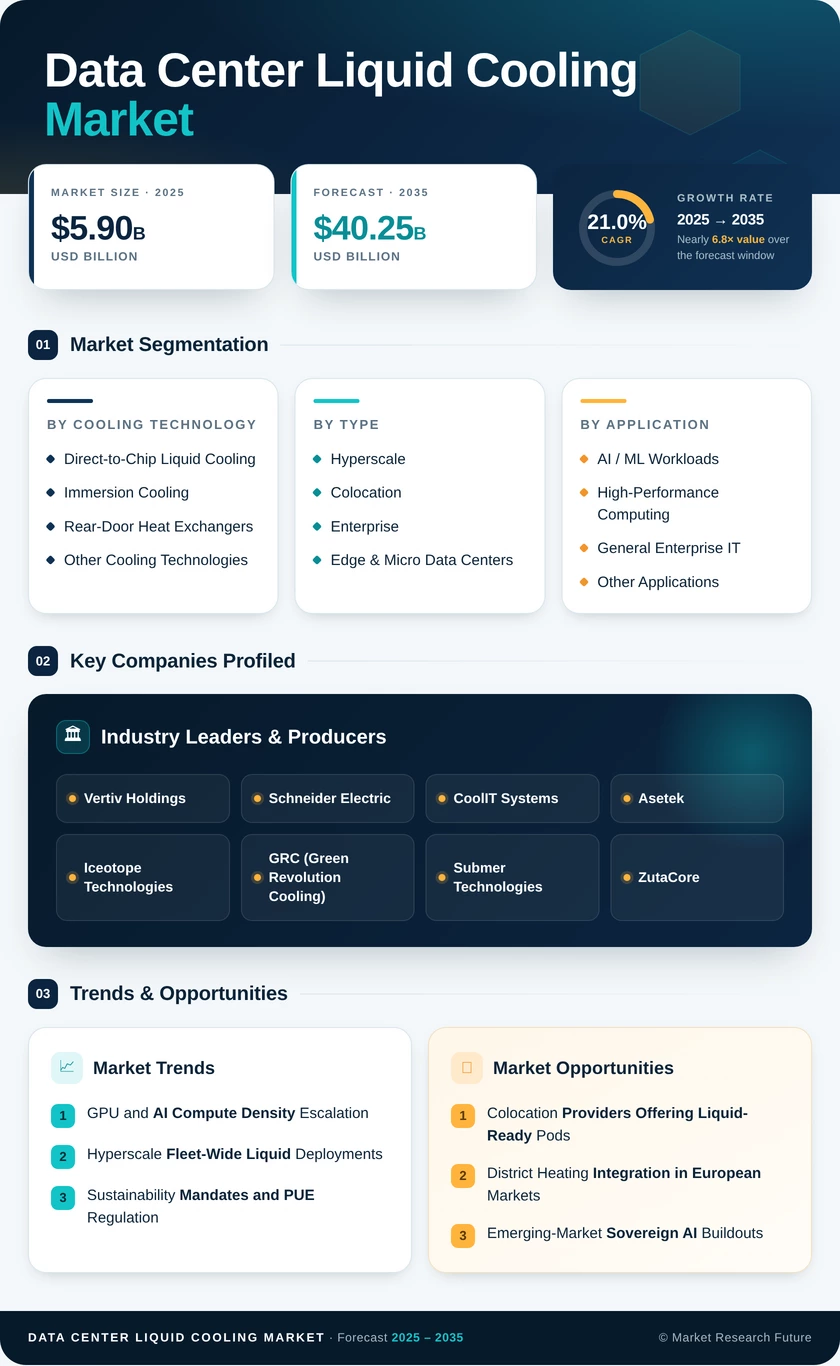
Segmentation Quick Reference
| Dimension | Sub-Segments | Dominant Segment | Fastest Growing Segment |
| Cooling Technology | Direct-to-Chip Liquid Cooling, Immersion Cooling, Rear-Door Heat Exchangers, Other | Direct-to-Chip Liquid Cooling | Immersion Cooling |
| Coolant Type | Single-Phase Hydrocarbon Fluids, Two-Phase Fluorocarbon Fluids, Water / Glycol Blends, Other | Single-Phase Hydrocarbon Fluids | Two-Phase Fluorocarbon Fluids |
| Data Center Type | Hyperscale, Colocation, Enterprise, Edge & Micro Data Centers | Hyperscale | Edge & Micro Data Centers |
| Application | AI / ML Workloads, High-Performance Computing, General Enterprise IT, Other | AI / ML Workloads | AI / ML Workloads |
| Geography | North America, Europe, Asia-Pacific, South America, Middle East & Africa | North America | Asia-Pacific |
Market Segmentation Overview
By Cooling Technology
| Sub-Segment | Key Trend |
| Direct-to-Chip Liquid Cooling | Standard specification for new hyperscale campuses; OEM cold plate integration growing |
| Immersion Cooling | Two-phase systems gaining traction for 80+ kW rack densities in AI training |
| Rear-Door Heat Exchangers | Entry-level retrofit solution for enterprise facilities upgrading to 15–30 kW racks |
| Other Cooling Technologies | Spray cooling and microfluidic approaches in early-stage R&D and pilot programs |
Direct-to-chip remains the workhorse of the industry due to its compatibility with standard rack formats, while immersion cooling is advancing rapidly as AI cluster densities push beyond the thermal envelope of chip-level cold plates.
By Coolant Type
| Sub-Segment | Key Trend |
| Single-Phase Hydrocarbon Fluids | Cost-effective, non-toxic medium for single-phase immersion and rack-level cooling |
| Two-Phase Fluorocarbon Fluids | Highest thermal performance via phase-change heat transfer; PFAS regulatory exposure |
| Water / Glycol Blends | Dominant in direct-to-chip closed loops; well-understood chemistry and low cost |
| Other Coolants | Next-generation low-GWP synthetic fluids entering commercial trials |
Coolant selection is increasingly influenced by regulatory developments, particularly the European PFAS restriction proposal, which is redirecting R&D investment toward hydrocarbon and synthetic alternatives.
By Data Center Type
| Sub-Segment | Key Trend |
| Hyperscale | Fleet-wide liquid mandates from cloud operators; largest absolute spend |
| Colocation | Liquid-ready pods as competitive differentiator for high-density tenants |
| Enterprise | On-premises AI inference driving first-time liquid cooling adoption. |
| Edge & Micro Data Centers | Compact liquid systems enabling high-density compute at the network edge. |
Hyperscale procurement shapes pricing and supply chains, while edge deployments represent the highest-growth opportunity as inference workloads distribute beyond centralized campuses.
By Application
| Sub-Segment | Key Trend |
| AI / ML Workloads | Primary demand driver; GPU cluster densities make liquid cooling a prerequisite |
| High-Performance Computing | Scientific and defense simulation clusters adopting liquid as standard. |
| General Enterprise IT | Mixed workload densification gradually pulling mid-market operators toward liquid. |
| Other Applications | Blockchain, media rendering, and financial high-frequency trading niche deployments |
AI and ML workloads dominate spending growth, but the broadening of liquid cooling into general enterprise IT signals that the technology is transitioning from specialty to mainstream infrastructure.


 Noah Malgeri
Co-Founder

 Peter Groot koerkamp
Account and Business Manager

 Younghwan Choi
Senior Retail Manager

 Mark Irwin
Management Consultant

 Akif Moroglu
Strategy & Business Development Director

 Guilherme Gomes Martins
Product Management Director

 Joseph Aguayo
Sales Operations & Pricing Manager

 La Terria Dodd
Program Support Specialist

 Rob Kooiker
Group Product Manager HVAC & Fire Protection GMA