Request Free Sample ×

Kindly complete the form below to receive a free sample of this Report

* Please use a valid business email

Leading companies partner with us for data-driven Insights

clients tt-cursor
Hero Background
English
Chinese
French
Japanese
Korean
German
Spanish

Dairy Alternatives Market Share

ID: MRFR/FnB/1096-HCR
200 Pages
Snehal Singh
April 2026

Dairy Alternative Products Market Size, Share, Industry Trend & Analysis Research Report By Product Type (Almond Milk, Soy Milk, Oat Milk, Coconut Milk, Rice Milk), By Source (Nuts, Legumes, Grains, Seeds, Vegetables), By Packaging Type (Cartons, Bottles, Pouches, Cans), By Distribution Channel (Supermarkets, Online Stores, Health Food Stores, Convenience Stores), and By Regional (North America, Europe, South America, Asia Pacific, Middle East and Africa) - Forecast to 2035

Share:
Download PDF ×

We do not share your information with anyone. However, we may send you emails based on your report interest from time to time. You may contact us at any time to opt-out.

Dairy Alternatives Market Infographic
Purchase Options

Market Share

dairy alternative products market Share

In order to gain the upper hand over their rivals and also get larger market shares, companies operating within the highly competitive dairy alternative products industry use several strategies depending on their circumstances. One such factor is product diversification, where they place various flavors or even come up with unique ingredients for their products that make them stand out from others within the same category. In addition to this, there are other essential aspects, such as branding and marketing. They communicate their brand values through advertisements, social media, and all other forms of communication, thus advertising it through television adverts and online commercials, among many other methods. Branding plays a very important role in consumer behavior regarding shopping patterns, as buyers associate themselves with brands whose goals and objectives are similar to theirs. This helps customers differentiate one company's goods or services from those offered by competitors. Other than this, price positioning is also an important factor in market share strategies in the dairy alternative products (DAP) market. Firms, such as premium pricing for high-quality or luxury items and competitive pricing for budget-conscious consumers, can use different pricing strategies. Furthermore, distribution channels are also instrumental in the market share positioning strategies. This means that companies ensure that their products are available to customers widely and through several distribution channels such as grocery stores, supermarkets, specialty health food stores, online retailers, and food service outlets. Besides these matters, there is one more important point, i.e., innovations and product development are the key elements of market share positioning strategies in the DA market. Research and Development (R&D) initiatives aim to enable corporations to come up with new innovative products that cater to consumers' dynamic preferences and dietary trends. Collaboration and partnerships are increasingly becoming a key strategy for companies looking to increase their market share in DAPs'. Companies collaborate with other companies, food manufacturers, or retailers to leverage synergies, access new distribution channels, or enter into new consumer demographics. There are two other factors driving market share positioning strategies: sustainability and ethical considerations in relation to DA products. Companies that wish to distinguish themselves from competitors using various sustainability practices prefer environmentally friendly sourcing techniques together with ethically sound production approaches as well as transparent supply chains so that they can attract eco-aware customers who prefer acquiring such types of commodities because this type of customer base is rapidly growing today. In addition, by prioritizing sustainability and ethical values, companies may gain a competitive edge over rivals because they will have built confidence among their clients, hence increasing their shares.

Author
Author Profile
Snehal Singh
Manager - Research

High acumen in analyzing complex macro & micro markets with more than 6 years of work experience in the field of market research. By implementing her analytical skills in forecasting and estimation into market research reports, she has expertise in Packaging, Construction, and Equipment domains. She handles a team size of 20-25 resources and ensures smooth running of the projects, associated marketing activities, and client servicing.

Leave a Comment

FAQs

What is the current valuation of the Dairy Alternative Products Market?

<p>The Dairy Alternative Products Market was valued at 24.9 USD Billion in 2024.</p>

What is the projected market size for Dairy Alternative Products by 2035?

The market is projected to reach 77.57 USD Billion by 2035.

What is the expected CAGR for the Dairy Alternative Products Market from 2025 to 2035?

The expected CAGR during the forecast period 2025 - 2035 is 10.88%.

Which types of dairy alternatives are leading in market valuation?

Soy Milk and Almond Milk are leading, with valuations of 15.5 USD Billion and 12.05 USD Billion respectively in 2035.

What are the primary sources of dairy alternative products?

Grains and Nuts are significant sources, projected to reach 18.0 USD Billion and 15.0 USD Billion by 2035.

How does packaging type influence the Dairy Alternative Products Market?

Bottles and Pouches are expected to dominate, with projected valuations of 22.0 USD Billion and 20.0 USD Billion by 2035.

What distribution channels are most effective for dairy alternative products?

Supermarkets and Online Stores are leading channels, projected to reach 31.12 USD Billion and 19.36 USD Billion by 2035.

Who are the key players in the Dairy Alternative Products Market?

Key players include Alpro, Silk, Oatly, and Ripple Foods, among others.

What trends are influencing the growth of the Dairy Alternative Products Market?

Consumer preferences for plant-based diets and health consciousness appear to drive market growth.

How does the Dairy Alternative Products Market compare to traditional dairy products?

The Dairy Alternative Products Market is expanding rapidly, indicating a shift in consumer preferences away from traditional dairy.

Market Summary

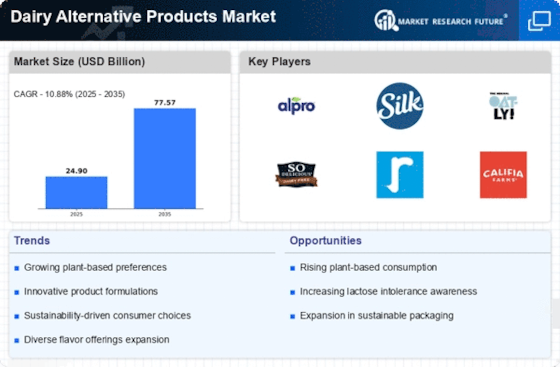
As per Market Research Future analysis, the Dairy Alternative Products Market was estimated at 24.9 USD Billion in 2024. The Dairy Alternative Products industry is projected to grow from 27.61 USD Billion in 2025 to 77.57 USD Billion by 2035, exhibiting a compound annual growth rate (CAGR) of 10.88% during the forecast period 2025 - 2035

Key Market Trends & Highlights

The Dairy Alternative Products Market is experiencing robust growth driven by health consciousness and sustainability.

  • Health consciousness continues to drive demand for dairy alternatives, particularly in North America, the largest market.
  • Oat milk emerges as the fastest-growing segment, reflecting changing consumer preferences towards plant-based options.
  • Almond milk remains the largest segment, showcasing its established popularity among health-conscious consumers.
  • Key market drivers include the health benefits of dairy alternatives and the increasing focus on environmental sustainability.

Market Size & Forecast

2024 Market Size 24.9 (USD Billion)
2035 Market Size 77.57 (USD Billion)
CAGR (2025 - 2035) 10.88%
Largest Regional Market Share in 2024 North America

Major Players

Alpro (BE), Silk (US), Oatly (SE), So Delicious (US), Ripple Foods (US), Califia Farms (US), Nutpods (US), Mooala (US), Minor Figures (GB)

Market Trends

The Dairy Alternative Products Market is currently experiencing a notable transformation, driven by evolving consumer preferences and heightened awareness regarding health and sustainability. As individuals increasingly seek plant-based options, the demand for alternatives to traditional dairy products has surged. This shift appears to be influenced by a combination of factors, including dietary restrictions, ethical considerations, and a growing inclination towards environmentally friendly choices. Consequently, manufacturers are innovating to meet these changing needs, introducing a diverse array of products that cater to various tastes and dietary requirements. In addition to health and sustainability, the Dairy Alternative Products Market is also witnessing a rise in the popularity of fortified and functional products. Consumers are not only looking for alternatives but are also interested in added nutritional benefits. This trend suggests that brands may need to focus on enhancing the nutritional profiles of their offerings to remain competitive. Furthermore, the expansion of distribution channels, including online platforms, is likely to facilitate greater accessibility for consumers, thereby broadening the market's reach. Overall, the Dairy Alternative Products Market is poised for continued growth as it adapts to the dynamic landscape of consumer demands and preferences.

Health Consciousness

The Dairy Alternative Products Market is increasingly shaped by a growing awareness of health and wellness among consumers. Individuals are actively seeking options that align with their dietary goals, leading to a rise in demand for plant-based alternatives that are perceived as healthier than traditional dairy.

Sustainability Focus

Sustainability has emerged as a pivotal factor influencing the Dairy Alternative Products Market. Consumers are becoming more environmentally conscious, prompting a shift towards products that are produced with minimal ecological impact. This trend encourages brands to adopt sustainable practices in sourcing and manufacturing.

Innovation in Product Offerings

Innovation plays a crucial role in the Dairy Alternative Products Market, as companies strive to differentiate themselves through unique product offerings. The introduction of diverse flavors, textures, and fortified options reflects a response to consumer desires for variety and enhanced nutritional value.

Dairy Alternatives Market Market Drivers

Diverse Product Innovations

Innovation plays a crucial role in the Dairy Alternative Products Market, as manufacturers continuously develop new and diverse offerings to cater to evolving consumer preferences. The introduction of fortified products, such as plant-based yogurts enriched with vitamins and minerals, has broadened the appeal of dairy alternatives. Market data suggests that the segment for flavored and functional dairy alternatives is expanding rapidly, with a growth rate of around 15% projected over the next few years. This trend indicates that consumers are not only seeking healthier options but also variety and convenience in their diets. As brands invest in research and development, the market is likely to witness an influx of innovative products that meet these demands.

Changing Dietary Preferences

The Dairy Alternative Products Market is also shaped by shifting dietary preferences, particularly among younger generations who are more inclined to adopt vegan or flexitarian diets. This demographic is increasingly rejecting traditional dairy in favor of plant-based options, driven by ethical considerations and a desire for healthier lifestyles. Data indicates that nearly 30% of millennials actively seek dairy alternatives, a trend that is expected to continue as awareness of animal welfare issues grows. This shift in consumer behavior presents a substantial opportunity for brands to capture market share by aligning their products with the values of this influential group. As dietary preferences evolve, the market is poised for sustained growth.

Environmental Sustainability

The Dairy Alternative Products Market is significantly influenced by the growing emphasis on environmental sustainability. As consumers become increasingly aware of the ecological impact of dairy farming, they are turning to plant-based alternatives that require fewer resources and produce lower greenhouse gas emissions. For example, producing almond milk uses substantially less water compared to traditional dairy. This shift is reflected in market data, which indicates that sales of dairy alternatives have risen by over 20% in recent years, driven by eco-conscious consumers. The potential for further growth remains high as brands innovate to enhance sustainability in their production processes, appealing to a demographic that values environmental responsibility.

Health Benefits of Dairy Alternatives

The Dairy Alternative Products Market is experiencing a surge in demand due to the increasing awareness of health benefits associated with plant-based alternatives. Consumers are gravitating towards products that are lower in saturated fats and cholesterol, which are often found in traditional dairy. For instance, almond and oat milk are perceived as healthier options, contributing to a projected growth rate of approximately 10% annually in this sector. This shift is not merely a trend but reflects a broader lifestyle change where individuals prioritize nutrition and wellness. As more research highlights the advantages of dairy alternatives, the market is likely to expand further, attracting health-conscious consumers who seek to improve their dietary habits.

Increased Accessibility and Availability

The Dairy Alternative Products Market is benefiting from increased accessibility and availability of dairy alternatives in retail and online platforms. As consumer demand rises, retailers are expanding their product ranges to include a variety of plant-based options, making it easier for consumers to find and purchase these products. Market data shows that sales of dairy alternatives have surged, with a notable increase in shelf space dedicated to these items in supermarkets. This trend is likely to continue, as more consumers seek convenient and accessible options that fit their lifestyles. The expansion of distribution channels, including e-commerce, further enhances the market's growth potential, allowing brands to reach a broader audience and cater to diverse consumer needs.

Market Segment Insights

By Type: Almond Milk (Largest) vs. Oat Milk (Fastest-Growing)

In the Dairy Alternative Products Market, the distribution of market share among various types has shown a significant variance, with <a href="https://www.marketresearchfuture.com/reports/almond-milk-market-2872" target="_blank">almond milk</a> leading as the largest segment. The popularity of almond milk is attributed to its taste, versatility, and wide availability in various flavors and formulations. Soy milk closely follows, known for its high protein content, while oat milk is rapidly gaining traction among health-conscious consumers, positioning itself as a key contender in the market.

Almond Milk (Dominant) vs. Oat Milk (Emerging)

Almond milk remains the dominant player in the Dairy Alternative Products Market, appreciated for its creamy texture and low calorie count, appealing to those seeking healthier alternatives to dairy. It is a well-established product with extensive distribution and brand recognition. In contrast, oat milk is emerging as a strong competitor, particularly among consumers who prioritize sustainability and taste. It boasts a creamy richness that rivals almond milk, and its eco-friendly perception makes it increasingly popular among environmentally conscious buyers. Both segments serve different consumer needs, making them pivotal in shaping future market dynamics.

By Source: Nuts (Largest) vs. Legumes (Fastest-Growing)

The Dairy Alternative Products Market is witnessing a significant shift in consumer preferences, with nuts leading as the predominant source of dairy alternatives. This segment has established itself as a favorite due to its rich flavor profile and nutritional benefits. In contrast, legumes are emerging as a fast-growing segment, gaining traction among health-conscious consumers looking for protein-rich substitutes. The market share distribution shows that while nuts hold the largest share, legumes are rapidly catching up, reflecting changing dietary trends. Growth trends within the source segment are primarily driven by a rising demand for plant-based diets and sustainable food options. Consumers are increasingly seeking dairy alternatives that are not only nutritious but also environmentally friendly. This shift is complemented by innovative product offerings that enhance the appeal of legumes, and their incorporation into everyday diets is expected to accelerate. Overall, the Dairy Alternative Products Market is evolving, with both nuts and legumes playing pivotal roles in its expansion.

Nuts (Dominant) vs. Legumes (Emerging)

In the Dairy Alternative Products Market, nuts are recognized as the dominant source, favored for their versatility and rich flavor. Almonds, cashews, and hazelnuts are particularly popular, contributing to a diverse range of milk, yogurt, and <a href="https://www.marketresearchfuture.com/reports/cheese-market-2213" target="_blank">cheese</a> alternatives. These products not only provide a creamy texture but also boast healthy fats and proteins, appealing to consumers seeking nutritious options. On the other hand, legumes represent an emerging source within the market, increasingly utilized for their high protein content and fiber. Products derived from soy, peas, and lentils are gaining popularity, especially among those seeking plant-based protein sources. The combination of innovative product development and growing consumer awareness about the benefits of legumes is poised to enhance their market presence in the coming years.

By Packaging Type: Cartons (Largest) vs. Bottles (Fastest-Growing)

The Dairy Alternative Products Market exhibits a diverse packaging type distribution, with cartons dominating the segment owing to their cost-effectiveness, sustainability, and ease of transport. Cartons are typically preferred for their barrier properties that help preserve the freshness of perishable products, making them the leading choice among consumers and retailers alike. In contrast, bottles are rapidly gaining popularity, particularly in the premium segment, due to their convenience and aesthetic appeal. This shift indicates a changing consumer preference towards more sophisticated and premium packaging solutions. Growth trends in the Dairy Alternative Products Market are significantly influenced by the rising demand for plant-based beverages, which is driving innovation in packaging. Bottles are becoming the fastest-growing option as consumers increasingly seek convenience, portability, and product visibility. Moreover, environmentally conscious consumers are also influencing packaging choices, prompting manufacturers to explore sustainable materials for both cartons and bottles. As the market matures, brands are focusing not only on functionality but also on providing an appealing user experience through their packaging designs.

Cartons (Dominant) vs. Pouches (Emerging)

Cartons remain the dominant packaging type in the Dairy Alternative Products Market, favored for their lightweight, recyclable properties, and efficiency in preserving product freshness. They cater to various dairy alternative beverages, including almond milk, soy milk, and oat-based drinks. Pouches, on the other hand, are emerging as a noteworthy alternative due to their lightweight nature and flexibility, appealing to on-the-go consumers. The shift towards pouches is attributed to their resealable features and minimal environmental footprint. As consumer preferences evolve, pioneering brands are beginning to explore pouches not just as practical packaging but as a sustainable option that aligns with the growing demand for eco-friendly products.

By Distribution Channel: Supermarkets (Largest) vs. Online Stores (Fastest-Growing)

In the Dairy Alternative Products Market, Supermarkets dominate the distribution channel landscape, capturing a significant share due to their extensive reach and consumer trust. They provide a wide variety of dairy alternatives, making them the go-to choice for many consumers. Online Stores, however, are rapidly gaining ground, thanks to the convenience they offer and the growing trend of eCommerce, particularly among younger consumers and health-conscious buyers.

Supermarkets (Dominant) vs. Online Stores (Emerging)

Supermarkets serve as the dominant distribution channel for Dairy Alternative Products, supported by their established infrastructure and ability to stock a diverse range of products. They cater to a wide demographic, allowing consumers to explore different brands and options in one location. On the other hand, Online Stores have emerged as a key player in this market, driven by the rise in digital shopping behavior and the demand for specialty products. This channel allows for personalized shopping experiences and access to niche brands, thus catering to specific consumer needs. As more consumers turn to online shopping, the prominence of online stores in the Dairy Alternative Products Market is expected to increase.

Get more detailed insights about Dairy Alternatives Products Market Research Report - Forecast till 2035

Regional Insights

The Dairy Alternative Products Market experienced significant growth across various regions. North America held a majority share, with a valuation of 6.5 USD Billion in the same year, expected to increase to 12.5 USD Billion by 2035, driven by rising demand for plant-based diets and lactose-free options.

In Europe, the market was valued at 5.2 USD Billion in 2024 and is anticipated to expand to 10.5 USD Billion by 2035, reflecting consumers' increasing awareness about health and sustainability.

The South American market, valued at 2.2 USD Billion in 2024, is also poised for growth, supported by a rising inclination towards alternative proteins, while Asia Pacific, with a valuation of 3.5 USD Billion in 2024, showed potential for significant expansion, driven by population growth and changing dietary preferences.

The Middle East and Africa, although the smallest segment with a value of 0.6 USD Billion in 2024, represented an emerging market with untapped potential for dairy alternatives. Overall, the regional dynamics in the Dairy Alternative Products Market were characterized by varied growth patterns influenced by cultural and economic factors, making each region vital for market expansion.

Key Players and Competitive Insights

The Dairy Alternative Products Market has become increasingly competitive, driven by rising consumer preference for plant-based options, concerns regarding lactose intolerance, and a growing awareness of health benefits associated with non-dairy alternatives.This market includes a variety of products such as almond milk, soy milk, oat milk, rice milk, and other innovative formulations that cater to diverse dietary needs and lifestyles. The competitive landscape is characterized by a blend of established companies and emerging startups, all vying for market share.Key strategies employed by industry players include product innovation, aggressive marketing campaigns, diversification of product portfolios, and forging strategic partnerships to enhance distribution networks. As consumer trends continue to shift toward sustainable and health-oriented choices, companies must adapt swiftly to maintain relevance in this dynamic market.WhiteWave has established a formidable presence in the Dairy Alternative Products Market, primarily known for its strong commitment to sustainability and high-quality ingredients. The company focuses on organic and natural products that resonate well with health-conscious consumers.Its robust product line includes almond milks, soy milks, and other plant-based beverages, showcasing a dedication to variety and quality, which are significant strengths in gaining consumer trust and loyalty. WhiteWave has also developed a reputation for innovation, often leading the market with new product launches that meet evolving dietary preferences.Its strategic marketing emphasizes not just the functional benefits of dairy alternatives but also aligns with lifestyle choices promoting environmental stewardship, making it a formidable player in the global landscape.Blue Diamond Growers has carved out a significant niche within the Dairy Alternative Products Market, primarily recognized for its high-quality almond-based products such as almond milk and almond flour. The company benefits from its cooperative structure, which allows it to leverage the collective resources of almond growers to maintain competitive pricing and product availability on a global scale.Blue Diamond Growers emphasizes its quality assurance processes and sustainability initiatives, enhancing its brand reputation and trust among consumers. Moreover, with successful mergers and acquisitions in the recent past, the company has expanded its product portfolio significantly, allowing it to cater to a diverse consumer base.Its strategic focus on almond-based innovations and expanding distribution channels has solidified Blue Diamond Growers as a crucial player in the marketplace, addressing the rising demand for dairy alternatives.

Key Companies in the Dairy Alternatives Market include

Industry Developments

In order to improve cow digestion using Ajinomoto's AjiPro® L enzyme additive and reduce greenhouse gas emissions in dairy and dairy alternative production, Danone and Ajinomoto announced a partnership in April 2025. The goal is to improve farm-level margins and reduce nitrous oxide emissions by up to 25%.

The industry is getting closer to commercially viable cultured dairy substitutes after Israeli precision fermentation firm Imagindairy was granted regulatory approval in Israel in April 2025 for its animal-free dairy proteins that resemble conventional milk caseins.In order to increase sustainability and customer choice, Oatly and Nestlé intensified their efforts in post-toddler plant-based nutrition in June 2024 by expanding Oatly's "NOT M'LK" oat drink, which is made entirely from locally produced German oats.

A breakthrough in precision-fermentation-derived casein for stretchable plant-based cheese was made in October 2024 by the Israeli biotech company DairyX. This cheese is anticipated to be on the market by 2027 and will save CO₂ emissions by 90% when compared to traditional dairy.

While Q1 sales statistics showed that Danone's Activia kefir and Fage Total yogurt witnessed 4 and 16 percent year-over-year growth, respectively, dairy researchers at SIAL Paris unveiled developments in high-protein lactose-free yogurts targeted at GLP-1 users in June 2024.Traditional dairy brands made a comeback in November 2024, as plant-based milk sales fell 8.4% while dairy milk sales in the US increased 3.5%, indicating a revived customer desire.

Future Outlook

Dairy Alternatives Market Future Outlook

The Dairy Alternative Products Market is projected to grow at a 10.88% CAGR from 2025 to 2035, driven by rising health consciousness, environmental concerns, and innovation in product offerings.

New opportunities lie in:

  • Expansion of plant-based <a href="https://www.marketresearchfuture.com/reports/cheese-market-2213" target="_blank">cheese</a> alternatives in food service sectors.
  • Development of fortified dairy alternatives targeting specific dietary needs.
  • Investment in sustainable packaging solutions for dairy alternative products.

By 2035, the market is expected to solidify its position as a leading segment in the global food industry.

Market Segmentation

Dairy Alternatives Market Type Outlook

  • Almond Milk
  • Soy Milk
  • Oat Milk
  • Coconut Milk
  • Rice Milk

Dairy Alternatives Market Source Outlook

  • Nuts
  • Legumes
  • Grains
  • Seeds
  • Vegetables

Dairy Alternatives Market Packaging Type Outlook

  • Cartons
  • Bottles
  • Pouches
  • Cans

Dairy Alternatives Market Distribution Channel Outlook

  • Supermarkets
  • Online Stores
  • Health Food Stores
  • Convenience Stores

Report Scope

MARKET SIZE 2024 24.9(USD Billion)
MARKET SIZE 2025 27.61(USD Billion)
MARKET SIZE 2035 77.57(USD Billion)
COMPOUND ANNUAL GROWTH RATE (CAGR) 10.88% (2025 - 2035)
REPORT COVERAGE Revenue Forecast, Competitive Landscape, Growth Factors, and Trends
BASE YEAR 2024
Market Forecast Period 2025 - 2035
Historical Data 2019 - 2024
Market Forecast Units USD Billion
Key Companies Profiled Alpro (BE), Silk (US), Oatly (SE), So Delicious (US), Ripple Foods (US), Califia Farms (US), Nutpods (US), Mooala (US), Minor Figures (GB)
Segments Covered Product Type, Source, Packaging Type, Distribution Channel, Regional
Key Market Opportunities Growing consumer preference for plant-based diets drives innovation in the Dairy Alternative Products Market.
Key Market Dynamics Rising consumer preference for plant-based diets drives innovation and competition in the Dairy Alternative Products Market.
Countries Covered North America, Europe, APAC, South America, MEA

FAQs

What is the current valuation of the Dairy Alternative Products Market?

<p>The Dairy Alternative Products Market was valued at 24.9 USD Billion in 2024.</p>

What is the projected market size for Dairy Alternative Products by 2035?

The market is projected to reach 77.57 USD Billion by 2035.

What is the expected CAGR for the Dairy Alternative Products Market from 2025 to 2035?

The expected CAGR during the forecast period 2025 - 2035 is 10.88%.

Which types of dairy alternatives are leading in market valuation?

Soy Milk and Almond Milk are leading, with valuations of 15.5 USD Billion and 12.05 USD Billion respectively in 2035.

What are the primary sources of dairy alternative products?

Grains and Nuts are significant sources, projected to reach 18.0 USD Billion and 15.0 USD Billion by 2035.

How does packaging type influence the Dairy Alternative Products Market?

Bottles and Pouches are expected to dominate, with projected valuations of 22.0 USD Billion and 20.0 USD Billion by 2035.

What distribution channels are most effective for dairy alternative products?

Supermarkets and Online Stores are leading channels, projected to reach 31.12 USD Billion and 19.36 USD Billion by 2035.

Who are the key players in the Dairy Alternative Products Market?

Key players include Alpro, Silk, Oatly, and Ripple Foods, among others.

What trends are influencing the growth of the Dairy Alternative Products Market?

Consumer preferences for plant-based diets and health consciousness appear to drive market growth.

How does the Dairy Alternative Products Market compare to traditional dairy products?

The Dairy Alternative Products Market is expanding rapidly, indicating a shift in consumer preferences away from traditional dairy.

  1. SECTION I: EXECUTIVE SUMMARY AND KEY HIGHLIGHTS
    1. | 1.1 EXECUTIVE SUMMARY
    2. | | 1.1.1 Market Overview
    3. | | 1.1.2 Key Findings
    4. | | 1.1.3 Market Segmentation
    5. | | 1.1.4 Competitive Landscape
    6. | | 1.1.5 Challenges and Opportunities
    7. | | 1.1.6 Future Outlook
  2. SECTION II: SCOPING, METHODOLOGY AND MARKET STRUCTURE
    1. | 2.1 MARKET INTRODUCTION
    2. | | 2.1.1 Definition
    3. | | 2.1.2 Scope of the study
    4. | | | 2.1.2.1 Research Objective
    5. | | | 2.1.2.2 Assumption
    6. | | | 2.1.2.3 Limitations
    7. | 2.2 RESEARCH METHODOLOGY
    8. | | 2.2.1 Overview
    9. | | 2.2.2 Data Mining
    10. | | 2.2.3 Secondary Research
    11. | | 2.2.4 Primary Research
    12. | | | 2.2.4.1 Primary Interviews and Information Gathering Process
    13. | | | 2.2.4.2 Breakdown of Primary Respondents
    14. | | 2.2.5 Forecasting Model
    15. | | 2.2.6 Market Size Estimation
    16. | | | 2.2.6.1 Bottom-Up Approach
    17. | | | 2.2.6.2 Top-Down Approach
    18. | | 2.2.7 Data Triangulation
    19. | | 2.2.8 Validation
  3. SECTION III: QUALITATIVE ANALYSIS
    1. | 3.1 MARKET DYNAMICS
    2. | | 3.1.1 Overview
    3. | | 3.1.2 Drivers
    4. | | 3.1.3 Restraints
    5. | | 3.1.4 Opportunities
    6. | 3.2 MARKET FACTOR ANALYSIS
    7. | | 3.2.1 Value chain Analysis
    8. | | 3.2.2 Porter's Five Forces Analysis
    9. | | | 3.2.2.1 Bargaining Power of Suppliers
    10. | | | 3.2.2.2 Bargaining Power of Buyers
    11. | | | 3.2.2.3 Threat of New Entrants
    12. | | | 3.2.2.4 Threat of Substitutes
    13. | | | 3.2.2.5 Intensity of Rivalry
    14. | | 3.2.3 COVID-19 Impact Analysis
    15. | | | 3.2.3.1 Market Impact Analysis
    16. | | | 3.2.3.2 Regional Impact
    17. | | | 3.2.3.3 Opportunity and Threat Analysis
  4. SECTION IV: QUANTITATIVE ANALYSIS
    1. | 4.1 Food, Beverages & Nutrition, BY Type (USD Billion)
    2. | | 4.1.1 Almond Milk
    3. | | 4.1.2 Soy Milk
    4. | | 4.1.3 Oat Milk
    5. | | 4.1.4 Coconut Milk
    6. | | 4.1.5 Rice Milk
    7. | 4.2 Food, Beverages & Nutrition, BY Source (USD Billion)
    8. | | 4.2.1 Nuts
    9. | | 4.2.2 Legumes
    10. | | 4.2.3 Grains
    11. | | 4.2.4 Seeds
    12. | | 4.2.5 Vegetables
    13. | 4.3 Food, Beverages & Nutrition, BY Packaging Type (USD Billion)
    14. | | 4.3.1 Cartons
    15. | | 4.3.2 Bottles
    16. | | 4.3.3 Pouches
    17. | | 4.3.4 Cans
    18. | 4.4 Food, Beverages & Nutrition, BY Distribution Channel (USD Billion)
    19. | | 4.4.1 Supermarkets
    20. | | 4.4.2 Online Stores
    21. | | 4.4.3 Health Food Stores
    22. | | 4.4.4 Convenience Stores
    23. | 4.5 Food, Beverages & Nutrition, BY Region (USD Billion)
    24. | | 4.5.1 North America
    25. | | | 4.5.1.1 US
    26. | | | 4.5.1.2 Canada
    27. | | 4.5.2 Europe
    28. | | | 4.5.2.1 Germany
    29. | | | 4.5.2.2 UK
    30. | | | 4.5.2.3 France
    31. | | | 4.5.2.4 Russia
    32. | | | 4.5.2.5 Italy
    33. | | | 4.5.2.6 Spain
    34. | | | 4.5.2.7 Rest of Europe
    35. | | 4.5.3 APAC
    36. | | | 4.5.3.1 China
    37. | | | 4.5.3.2 India
    38. | | | 4.5.3.3 Japan
    39. | | | 4.5.3.4 South Korea
    40. | | | 4.5.3.5 Malaysia
    41. | | | 4.5.3.6 Thailand
    42. | | | 4.5.3.7 Indonesia
    43. | | | 4.5.3.8 Rest of APAC
    44. | | 4.5.4 South America
    45. | | | 4.5.4.1 Brazil
    46. | | | 4.5.4.2 Mexico
    47. | | | 4.5.4.3 Argentina
    48. | | | 4.5.4.4 Rest of South America
    49. | | 4.5.5 MEA
    50. | | | 4.5.5.1 GCC Countries
    51. | | | 4.5.5.2 South Africa
    52. | | | 4.5.5.3 Rest of MEA
  5. SECTION V: COMPETITIVE ANALYSIS
    1. | 5.1 Competitive Landscape
    2. | | 5.1.1 Overview
    3. | | 5.1.2 Competitive Analysis
    4. | | 5.1.3 Market share Analysis
    5. | | 5.1.4 Major Growth Strategy in the Food, Beverages & Nutrition
    6. | | 5.1.5 Competitive Benchmarking
    7. | | 5.1.6 Leading Players in Terms of Number of Developments in the Food, Beverages & Nutrition
    8. | | 5.1.7 Key developments and growth strategies
    9. | | | 5.1.7.1 New Product Launch/Service Deployment
    10. | | | 5.1.7.2 Merger & Acquisitions
    11. | | | 5.1.7.3 Joint Ventures
    12. | | 5.1.8 Major Players Financial Matrix
    13. | | | 5.1.8.1 Sales and Operating Income
    14. | | | 5.1.8.2 Major Players R&D Expenditure. 2023
    15. | 5.2 Company Profiles
    16. | | 5.2.1 Alpro (BE)
    17. | | | 5.2.1.1 Financial Overview
    18. | | | 5.2.1.2 Products Offered
    19. | | | 5.2.1.3 Key Developments
    20. | | | 5.2.1.4 SWOT Analysis
    21. | | | 5.2.1.5 Key Strategies
    22. | | 5.2.2 Silk (US)
    23. | | | 5.2.2.1 Financial Overview
    24. | | | 5.2.2.2 Products Offered
    25. | | | 5.2.2.3 Key Developments
    26. | | | 5.2.2.4 SWOT Analysis
    27. | | | 5.2.2.5 Key Strategies
    28. | | 5.2.3 Oatly (SE)
    29. | | | 5.2.3.1 Financial Overview
    30. | | | 5.2.3.2 Products Offered
    31. | | | 5.2.3.3 Key Developments
    32. | | | 5.2.3.4 SWOT Analysis
    33. | | | 5.2.3.5 Key Strategies
    34. | | 5.2.4 So Delicious (US)
    35. | | | 5.2.4.1 Financial Overview
    36. | | | 5.2.4.2 Products Offered
    37. | | | 5.2.4.3 Key Developments
    38. | | | 5.2.4.4 SWOT Analysis
    39. | | | 5.2.4.5 Key Strategies
    40. | | 5.2.5 Ripple Foods (US)
    41. | | | 5.2.5.1 Financial Overview
    42. | | | 5.2.5.2 Products Offered
    43. | | | 5.2.5.3 Key Developments
    44. | | | 5.2.5.4 SWOT Analysis
    45. | | | 5.2.5.5 Key Strategies
    46. | | 5.2.6 Califia Farms (US)
    47. | | | 5.2.6.1 Financial Overview
    48. | | | 5.2.6.2 Products Offered
    49. | | | 5.2.6.3 Key Developments
    50. | | | 5.2.6.4 SWOT Analysis
    51. | | | 5.2.6.5 Key Strategies
    52. | | 5.2.7 Nutpods (US)
    53. | | | 5.2.7.1 Financial Overview
    54. | | | 5.2.7.2 Products Offered
    55. | | | 5.2.7.3 Key Developments
    56. | | | 5.2.7.4 SWOT Analysis
    57. | | | 5.2.7.5 Key Strategies
    58. | | 5.2.8 Mooala (US)
    59. | | | 5.2.8.1 Financial Overview
    60. | | | 5.2.8.2 Products Offered
    61. | | | 5.2.8.3 Key Developments
    62. | | | 5.2.8.4 SWOT Analysis
    63. | | | 5.2.8.5 Key Strategies
    64. | | 5.2.9 Minor Figures (GB)
    65. | | | 5.2.9.1 Financial Overview
    66. | | | 5.2.9.2 Products Offered
    67. | | | 5.2.9.3 Key Developments
    68. | | | 5.2.9.4 SWOT Analysis
    69. | | | 5.2.9.5 Key Strategies
    70. | 5.3 Appendix
    71. | | 5.3.1 References
    72. | | 5.3.2 Related Reports
  6. LIST OF FIGURES
    1. | 6.1 MARKET SYNOPSIS
    2. | 6.2 NORTH AMERICA MARKET ANALYSIS
    3. | 6.3 US MARKET ANALYSIS BY TYPE
    4. | 6.4 US MARKET ANALYSIS BY SOURCE
    5. | 6.5 US MARKET ANALYSIS BY PACKAGING TYPE
    6. | 6.6 US MARKET ANALYSIS BY DISTRIBUTION CHANNEL
    7. | 6.7 CANADA MARKET ANALYSIS BY TYPE
    8. | 6.8 CANADA MARKET ANALYSIS BY SOURCE
    9. | 6.9 CANADA MARKET ANALYSIS BY PACKAGING TYPE
    10. | 6.10 CANADA MARKET ANALYSIS BY DISTRIBUTION CHANNEL
    11. | 6.11 EUROPE MARKET ANALYSIS
    12. | 6.12 GERMANY MARKET ANALYSIS BY TYPE
    13. | 6.13 GERMANY MARKET ANALYSIS BY SOURCE
    14. | 6.14 GERMANY MARKET ANALYSIS BY PACKAGING TYPE
    15. | 6.15 GERMANY MARKET ANALYSIS BY DISTRIBUTION CHANNEL
    16. | 6.16 UK MARKET ANALYSIS BY TYPE
    17. | 6.17 UK MARKET ANALYSIS BY SOURCE
    18. | 6.18 UK MARKET ANALYSIS BY PACKAGING TYPE
    19. | 6.19 UK MARKET ANALYSIS BY DISTRIBUTION CHANNEL
    20. | 6.20 FRANCE MARKET ANALYSIS BY TYPE
    21. | 6.21 FRANCE MARKET ANALYSIS BY SOURCE
    22. | 6.22 FRANCE MARKET ANALYSIS BY PACKAGING TYPE
    23. | 6.23 FRANCE MARKET ANALYSIS BY DISTRIBUTION CHANNEL
    24. | 6.24 RUSSIA MARKET ANALYSIS BY TYPE
    25. | 6.25 RUSSIA MARKET ANALYSIS BY SOURCE
    26. | 6.26 RUSSIA MARKET ANALYSIS BY PACKAGING TYPE
    27. | 6.27 RUSSIA MARKET ANALYSIS BY DISTRIBUTION CHANNEL
    28. | 6.28 ITALY MARKET ANALYSIS BY TYPE
    29. | 6.29 ITALY MARKET ANALYSIS BY SOURCE
    30. | 6.30 ITALY MARKET ANALYSIS BY PACKAGING TYPE
    31. | 6.31 ITALY MARKET ANALYSIS BY DISTRIBUTION CHANNEL
    32. | 6.32 SPAIN MARKET ANALYSIS BY TYPE
    33. | 6.33 SPAIN MARKET ANALYSIS BY SOURCE
    34. | 6.34 SPAIN MARKET ANALYSIS BY PACKAGING TYPE
    35. | 6.35 SPAIN MARKET ANALYSIS BY DISTRIBUTION CHANNEL
    36. | 6.36 REST OF EUROPE MARKET ANALYSIS BY TYPE
    37. | 6.37 REST OF EUROPE MARKET ANALYSIS BY SOURCE
    38. | 6.38 REST OF EUROPE MARKET ANALYSIS BY PACKAGING TYPE
    39. | 6.39 REST OF EUROPE MARKET ANALYSIS BY DISTRIBUTION CHANNEL
    40. | 6.40 APAC MARKET ANALYSIS
    41. | 6.41 CHINA MARKET ANALYSIS BY TYPE
    42. | 6.42 CHINA MARKET ANALYSIS BY SOURCE
    43. | 6.43 CHINA MARKET ANALYSIS BY PACKAGING TYPE
    44. | 6.44 CHINA MARKET ANALYSIS BY DISTRIBUTION CHANNEL
    45. | 6.45 INDIA MARKET ANALYSIS BY TYPE
    46. | 6.46 INDIA MARKET ANALYSIS BY SOURCE
    47. | 6.47 INDIA MARKET ANALYSIS BY PACKAGING TYPE
    48. | 6.48 INDIA MARKET ANALYSIS BY DISTRIBUTION CHANNEL
    49. | 6.49 JAPAN MARKET ANALYSIS BY TYPE
    50. | 6.50 JAPAN MARKET ANALYSIS BY SOURCE
    51. | 6.51 JAPAN MARKET ANALYSIS BY PACKAGING TYPE
    52. | 6.52 JAPAN MARKET ANALYSIS BY DISTRIBUTION CHANNEL
    53. | 6.53 SOUTH KOREA MARKET ANALYSIS BY TYPE
    54. | 6.54 SOUTH KOREA MARKET ANALYSIS BY SOURCE
    55. | 6.55 SOUTH KOREA MARKET ANALYSIS BY PACKAGING TYPE
    56. | 6.56 SOUTH KOREA MARKET ANALYSIS BY DISTRIBUTION CHANNEL
    57. | 6.57 MALAYSIA MARKET ANALYSIS BY TYPE
    58. | 6.58 MALAYSIA MARKET ANALYSIS BY SOURCE
    59. | 6.59 MALAYSIA MARKET ANALYSIS BY PACKAGING TYPE
    60. | 6.60 MALAYSIA MARKET ANALYSIS BY DISTRIBUTION CHANNEL
    61. | 6.61 THAILAND MARKET ANALYSIS BY TYPE
    62. | 6.62 THAILAND MARKET ANALYSIS BY SOURCE
    63. | 6.63 THAILAND MARKET ANALYSIS BY PACKAGING TYPE
    64. | 6.64 THAILAND MARKET ANALYSIS BY DISTRIBUTION CHANNEL
    65. | 6.65 INDONESIA MARKET ANALYSIS BY TYPE
    66. | 6.66 INDONESIA MARKET ANALYSIS BY SOURCE
    67. | 6.67 INDONESIA MARKET ANALYSIS BY PACKAGING TYPE
    68. | 6.68 INDONESIA MARKET ANALYSIS BY DISTRIBUTION CHANNEL
    69. | 6.69 REST OF APAC MARKET ANALYSIS BY TYPE
    70. | 6.70 REST OF APAC MARKET ANALYSIS BY SOURCE
    71. | 6.71 REST OF APAC MARKET ANALYSIS BY PACKAGING TYPE
    72. | 6.72 REST OF APAC MARKET ANALYSIS BY DISTRIBUTION CHANNEL
    73. | 6.73 SOUTH AMERICA MARKET ANALYSIS
    74. | 6.74 BRAZIL MARKET ANALYSIS BY TYPE
    75. | 6.75 BRAZIL MARKET ANALYSIS BY SOURCE
    76. | 6.76 BRAZIL MARKET ANALYSIS BY PACKAGING TYPE
    77. | 6.77 BRAZIL MARKET ANALYSIS BY DISTRIBUTION CHANNEL
    78. | 6.78 MEXICO MARKET ANALYSIS BY TYPE
    79. | 6.79 MEXICO MARKET ANALYSIS BY SOURCE
    80. | 6.80 MEXICO MARKET ANALYSIS BY PACKAGING TYPE
    81. | 6.81 MEXICO MARKET ANALYSIS BY DISTRIBUTION CHANNEL
    82. | 6.82 ARGENTINA MARKET ANALYSIS BY TYPE
    83. | 6.83 ARGENTINA MARKET ANALYSIS BY SOURCE
    84. | 6.84 ARGENTINA MARKET ANALYSIS BY PACKAGING TYPE
    85. | 6.85 ARGENTINA MARKET ANALYSIS BY DISTRIBUTION CHANNEL
    86. | 6.86 REST OF SOUTH AMERICA MARKET ANALYSIS BY TYPE
    87. | 6.87 REST OF SOUTH AMERICA MARKET ANALYSIS BY SOURCE
    88. | 6.88 REST OF SOUTH AMERICA MARKET ANALYSIS BY PACKAGING TYPE
    89. | 6.89 REST OF SOUTH AMERICA MARKET ANALYSIS BY DISTRIBUTION CHANNEL
    90. | 6.90 MEA MARKET ANALYSIS
    91. | 6.91 GCC COUNTRIES MARKET ANALYSIS BY TYPE
    92. | 6.92 GCC COUNTRIES MARKET ANALYSIS BY SOURCE
    93. | 6.93 GCC COUNTRIES MARKET ANALYSIS BY PACKAGING TYPE
    94. | 6.94 GCC COUNTRIES MARKET ANALYSIS BY DISTRIBUTION CHANNEL
    95. | 6.95 SOUTH AFRICA MARKET ANALYSIS BY TYPE
    96. | 6.96 SOUTH AFRICA MARKET ANALYSIS BY SOURCE
    97. | 6.97 SOUTH AFRICA MARKET ANALYSIS BY PACKAGING TYPE
    98. | 6.98 SOUTH AFRICA MARKET ANALYSIS BY DISTRIBUTION CHANNEL
    99. | 6.99 REST OF MEA MARKET ANALYSIS BY TYPE
    100. | 6.100 REST OF MEA MARKET ANALYSIS BY SOURCE
    101. | 6.101 REST OF MEA MARKET ANALYSIS BY PACKAGING TYPE
    102. | 6.102 REST OF MEA MARKET ANALYSIS BY DISTRIBUTION CHANNEL
    103. | 6.103 KEY BUYING CRITERIA OF FOOD, BEVERAGES & NUTRITION
    104. | 6.104 RESEARCH PROCESS OF MRFR
    105. | 6.105 DRO ANALYSIS OF FOOD, BEVERAGES & NUTRITION
    106. | 6.106 DRIVERS IMPACT ANALYSIS: FOOD, BEVERAGES & NUTRITION
    107. | 6.107 RESTRAINTS IMPACT ANALYSIS: FOOD, BEVERAGES & NUTRITION
    108. | 6.108 SUPPLY / VALUE CHAIN: FOOD, BEVERAGES & NUTRITION
    109. | 6.109 FOOD, BEVERAGES & NUTRITION, BY TYPE, 2024 (% SHARE)
    110. | 6.110 FOOD, BEVERAGES & NUTRITION, BY TYPE, 2024 TO 2035 (USD Billion)
    111. | 6.111 FOOD, BEVERAGES & NUTRITION, BY SOURCE, 2024 (% SHARE)
    112. | 6.112 FOOD, BEVERAGES & NUTRITION, BY SOURCE, 2024 TO 2035 (USD Billion)
    113. | 6.113 FOOD, BEVERAGES & NUTRITION, BY PACKAGING TYPE, 2024 (% SHARE)
    114. | 6.114 FOOD, BEVERAGES & NUTRITION, BY PACKAGING TYPE, 2024 TO 2035 (USD Billion)
    115. | 6.115 FOOD, BEVERAGES & NUTRITION, BY DISTRIBUTION CHANNEL, 2024 (% SHARE)
    116. | 6.116 FOOD, BEVERAGES & NUTRITION, BY DISTRIBUTION CHANNEL, 2024 TO 2035 (USD Billion)
    117. | 6.117 BENCHMARKING OF MAJOR COMPETITORS
  7. LIST OF TABLES
    1. | 7.1 LIST OF ASSUMPTIONS
    2. | | 7.1.1
    3. | 7.2 North America MARKET SIZE ESTIMATES; FORECAST
    4. | | 7.2.1 BY TYPE, 2025-2035 (USD Billion)
    5. | | 7.2.2 BY SOURCE, 2025-2035 (USD Billion)
    6. | | 7.2.3 BY PACKAGING TYPE, 2025-2035 (USD Billion)
    7. | | 7.2.4 BY DISTRIBUTION CHANNEL, 2025-2035 (USD Billion)
    8. | 7.3 US MARKET SIZE ESTIMATES; FORECAST
    9. | | 7.3.1 BY TYPE, 2025-2035 (USD Billion)
    10. | | 7.3.2 BY SOURCE, 2025-2035 (USD Billion)
    11. | | 7.3.3 BY PACKAGING TYPE, 2025-2035 (USD Billion)
    12. | | 7.3.4 BY DISTRIBUTION CHANNEL, 2025-2035 (USD Billion)
    13. | 7.4 Canada MARKET SIZE ESTIMATES; FORECAST
    14. | | 7.4.1 BY TYPE, 2025-2035 (USD Billion)
    15. | | 7.4.2 BY SOURCE, 2025-2035 (USD Billion)
    16. | | 7.4.3 BY PACKAGING TYPE, 2025-2035 (USD Billion)
    17. | | 7.4.4 BY DISTRIBUTION CHANNEL, 2025-2035 (USD Billion)
    18. | 7.5 Europe MARKET SIZE ESTIMATES; FORECAST
    19. | | 7.5.1 BY TYPE, 2025-2035 (USD Billion)
    20. | | 7.5.2 BY SOURCE, 2025-2035 (USD Billion)
    21. | | 7.5.3 BY PACKAGING TYPE, 2025-2035 (USD Billion)
    22. | | 7.5.4 BY DISTRIBUTION CHANNEL, 2025-2035 (USD Billion)
    23. | 7.6 Germany MARKET SIZE ESTIMATES; FORECAST
    24. | | 7.6.1 BY TYPE, 2025-2035 (USD Billion)
    25. | | 7.6.2 BY SOURCE, 2025-2035 (USD Billion)
    26. | | 7.6.3 BY PACKAGING TYPE, 2025-2035 (USD Billion)
    27. | | 7.6.4 BY DISTRIBUTION CHANNEL, 2025-2035 (USD Billion)
    28. | 7.7 UK MARKET SIZE ESTIMATES; FORECAST
    29. | | 7.7.1 BY TYPE, 2025-2035 (USD Billion)
    30. | | 7.7.2 BY SOURCE, 2025-2035 (USD Billion)
    31. | | 7.7.3 BY PACKAGING TYPE, 2025-2035 (USD Billion)
    32. | | 7.7.4 BY DISTRIBUTION CHANNEL, 2025-2035 (USD Billion)
    33. | 7.8 France MARKET SIZE ESTIMATES; FORECAST
    34. | | 7.8.1 BY TYPE, 2025-2035 (USD Billion)
    35. | | 7.8.2 BY SOURCE, 2025-2035 (USD Billion)
    36. | | 7.8.3 BY PACKAGING TYPE, 2025-2035 (USD Billion)
    37. | | 7.8.4 BY DISTRIBUTION CHANNEL, 2025-2035 (USD Billion)
    38. | 7.9 Russia MARKET SIZE ESTIMATES; FORECAST
    39. | | 7.9.1 BY TYPE, 2025-2035 (USD Billion)
    40. | | 7.9.2 BY SOURCE, 2025-2035 (USD Billion)
    41. | | 7.9.3 BY PACKAGING TYPE, 2025-2035 (USD Billion)
    42. | | 7.9.4 BY DISTRIBUTION CHANNEL, 2025-2035 (USD Billion)
    43. | 7.10 Italy MARKET SIZE ESTIMATES; FORECAST
    44. | | 7.10.1 BY TYPE, 2025-2035 (USD Billion)
    45. | | 7.10.2 BY SOURCE, 2025-2035 (USD Billion)
    46. | | 7.10.3 BY PACKAGING TYPE, 2025-2035 (USD Billion)
    47. | | 7.10.4 BY DISTRIBUTION CHANNEL, 2025-2035 (USD Billion)
    48. | 7.11 Spain MARKET SIZE ESTIMATES; FORECAST
    49. | | 7.11.1 BY TYPE, 2025-2035 (USD Billion)
    50. | | 7.11.2 BY SOURCE, 2025-2035 (USD Billion)
    51. | | 7.11.3 BY PACKAGING TYPE, 2025-2035 (USD Billion)
    52. | | 7.11.4 BY DISTRIBUTION CHANNEL, 2025-2035 (USD Billion)
    53. | 7.12 Rest of Europe MARKET SIZE ESTIMATES; FORECAST
    54. | | 7.12.1 BY TYPE, 2025-2035 (USD Billion)
    55. | | 7.12.2 BY SOURCE, 2025-2035 (USD Billion)
    56. | | 7.12.3 BY PACKAGING TYPE, 2025-2035 (USD Billion)
    57. | | 7.12.4 BY DISTRIBUTION CHANNEL, 2025-2035 (USD Billion)
    58. | 7.13 APAC MARKET SIZE ESTIMATES; FORECAST
    59. | | 7.13.1 BY TYPE, 2025-2035 (USD Billion)
    60. | | 7.13.2 BY SOURCE, 2025-2035 (USD Billion)
    61. | | 7.13.3 BY PACKAGING TYPE, 2025-2035 (USD Billion)
    62. | | 7.13.4 BY DISTRIBUTION CHANNEL, 2025-2035 (USD Billion)
    63. | 7.14 China MARKET SIZE ESTIMATES; FORECAST
    64. | | 7.14.1 BY TYPE, 2025-2035 (USD Billion)
    65. | | 7.14.2 BY SOURCE, 2025-2035 (USD Billion)
    66. | | 7.14.3 BY PACKAGING TYPE, 2025-2035 (USD Billion)
    67. | | 7.14.4 BY DISTRIBUTION CHANNEL, 2025-2035 (USD Billion)
    68. | 7.15 India MARKET SIZE ESTIMATES; FORECAST
    69. | | 7.15.1 BY TYPE, 2025-2035 (USD Billion)
    70. | | 7.15.2 BY SOURCE, 2025-2035 (USD Billion)
    71. | | 7.15.3 BY PACKAGING TYPE, 2025-2035 (USD Billion)
    72. | | 7.15.4 BY DISTRIBUTION CHANNEL, 2025-2035 (USD Billion)
    73. | 7.16 Japan MARKET SIZE ESTIMATES; FORECAST
    74. | | 7.16.1 BY TYPE, 2025-2035 (USD Billion)
    75. | | 7.16.2 BY SOURCE, 2025-2035 (USD Billion)
    76. | | 7.16.3 BY PACKAGING TYPE, 2025-2035 (USD Billion)
    77. | | 7.16.4 BY DISTRIBUTION CHANNEL, 2025-2035 (USD Billion)
    78. | 7.17 South Korea MARKET SIZE ESTIMATES; FORECAST
    79. | | 7.17.1 BY TYPE, 2025-2035 (USD Billion)
    80. | | 7.17.2 BY SOURCE, 2025-2035 (USD Billion)
    81. | | 7.17.3 BY PACKAGING TYPE, 2025-2035 (USD Billion)
    82. | | 7.17.4 BY DISTRIBUTION CHANNEL, 2025-2035 (USD Billion)
    83. | 7.18 Malaysia MARKET SIZE ESTIMATES; FORECAST
    84. | | 7.18.1 BY TYPE, 2025-2035 (USD Billion)
    85. | | 7.18.2 BY SOURCE, 2025-2035 (USD Billion)
    86. | | 7.18.3 BY PACKAGING TYPE, 2025-2035 (USD Billion)
    87. | | 7.18.4 BY DISTRIBUTION CHANNEL, 2025-2035 (USD Billion)
    88. | 7.19 Thailand MARKET SIZE ESTIMATES; FORECAST
    89. | | 7.19.1 BY TYPE, 2025-2035 (USD Billion)
    90. | | 7.19.2 BY SOURCE, 2025-2035 (USD Billion)
    91. | | 7.19.3 BY PACKAGING TYPE, 2025-2035 (USD Billion)
    92. | | 7.19.4 BY DISTRIBUTION CHANNEL, 2025-2035 (USD Billion)
    93. | 7.20 Indonesia MARKET SIZE ESTIMATES; FORECAST
    94. | | 7.20.1 BY TYPE, 2025-2035 (USD Billion)
    95. | | 7.20.2 BY SOURCE, 2025-2035 (USD Billion)
    96. | | 7.20.3 BY PACKAGING TYPE, 2025-2035 (USD Billion)
    97. | | 7.20.4 BY DISTRIBUTION CHANNEL, 2025-2035 (USD Billion)
    98. | 7.21 Rest of APAC MARKET SIZE ESTIMATES; FORECAST
    99. | | 7.21.1 BY TYPE, 2025-2035 (USD Billion)
    100. | | 7.21.2 BY SOURCE, 2025-2035 (USD Billion)
    101. | | 7.21.3 BY PACKAGING TYPE, 2025-2035 (USD Billion)
    102. | | 7.21.4 BY DISTRIBUTION CHANNEL, 2025-2035 (USD Billion)
    103. | 7.22 South America MARKET SIZE ESTIMATES; FORECAST
    104. | | 7.22.1 BY TYPE, 2025-2035 (USD Billion)
    105. | | 7.22.2 BY SOURCE, 2025-2035 (USD Billion)
    106. | | 7.22.3 BY PACKAGING TYPE, 2025-2035 (USD Billion)
    107. | | 7.22.4 BY DISTRIBUTION CHANNEL, 2025-2035 (USD Billion)
    108. | 7.23 Brazil MARKET SIZE ESTIMATES; FORECAST
    109. | | 7.23.1 BY TYPE, 2025-2035 (USD Billion)
    110. | | 7.23.2 BY SOURCE, 2025-2035 (USD Billion)
    111. | | 7.23.3 BY PACKAGING TYPE, 2025-2035 (USD Billion)
    112. | | 7.23.4 BY DISTRIBUTION CHANNEL, 2025-2035 (USD Billion)
    113. | 7.24 Mexico MARKET SIZE ESTIMATES; FORECAST
    114. | | 7.24.1 BY TYPE, 2025-2035 (USD Billion)
    115. | | 7.24.2 BY SOURCE, 2025-2035 (USD Billion)
    116. | | 7.24.3 BY PACKAGING TYPE, 2025-2035 (USD Billion)
    117. | | 7.24.4 BY DISTRIBUTION CHANNEL, 2025-2035 (USD Billion)
    118. | 7.25 Argentina MARKET SIZE ESTIMATES; FORECAST
    119. | | 7.25.1 BY TYPE, 2025-2035 (USD Billion)
    120. | | 7.25.2 BY SOURCE, 2025-2035 (USD Billion)
    121. | | 7.25.3 BY PACKAGING TYPE, 2025-2035 (USD Billion)
    122. | | 7.25.4 BY DISTRIBUTION CHANNEL, 2025-2035 (USD Billion)
    123. | 7.26 Rest of South America MARKET SIZE ESTIMATES; FORECAST
    124. | | 7.26.1 BY TYPE, 2025-2035 (USD Billion)
    125. | | 7.26.2 BY SOURCE, 2025-2035 (USD Billion)
    126. | | 7.26.3 BY PACKAGING TYPE, 2025-2035 (USD Billion)
    127. | | 7.26.4 BY DISTRIBUTION CHANNEL, 2025-2035 (USD Billion)
    128. | 7.27 MEA MARKET SIZE ESTIMATES; FORECAST
    129. | | 7.27.1 BY TYPE, 2025-2035 (USD Billion)
    130. | | 7.27.2 BY SOURCE, 2025-2035 (USD Billion)
    131. | | 7.27.3 BY PACKAGING TYPE, 2025-2035 (USD Billion)
    132. | | 7.27.4 BY DISTRIBUTION CHANNEL, 2025-2035 (USD Billion)
    133. | 7.28 GCC Countries MARKET SIZE ESTIMATES; FORECAST
    134. | | 7.28.1 BY TYPE, 2025-2035 (USD Billion)
    135. | | 7.28.2 BY SOURCE, 2025-2035 (USD Billion)
    136. | | 7.28.3 BY PACKAGING TYPE, 2025-2035 (USD Billion)
    137. | | 7.28.4 BY DISTRIBUTION CHANNEL, 2025-2035 (USD Billion)
    138. | 7.29 South Africa MARKET SIZE ESTIMATES; FORECAST
    139. | | 7.29.1 BY TYPE, 2025-2035 (USD Billion)
    140. | | 7.29.2 BY SOURCE, 2025-2035 (USD Billion)
    141. | | 7.29.3 BY PACKAGING TYPE, 2025-2035 (USD Billion)
    142. | | 7.29.4 BY DISTRIBUTION CHANNEL, 2025-2035 (USD Billion)
    143. | 7.30 Rest of MEA MARKET SIZE ESTIMATES; FORECAST
    144. | | 7.30.1 BY TYPE, 2025-2035 (USD Billion)
    145. | | 7.30.2 BY SOURCE, 2025-2035 (USD Billion)
    146. | | 7.30.3 BY PACKAGING TYPE, 2025-2035 (USD Billion)
    147. | | 7.30.4 BY DISTRIBUTION CHANNEL, 2025-2035 (USD Billion)
    148. | 7.31 PRODUCT LAUNCH/PRODUCT DEVELOPMENT/APPROVAL
    149. | | 7.31.1
    150. | 7.32 ACQUISITION/PARTNERSHIP
    151. | | 7.32.1

Food, Beverages & Nutrition Market Segmentation

Food, Beverages & Nutrition By Type (USD Billion, 2025-2035)

  • Almond Milk
  • Soy Milk
  • Oat Milk
  • Coconut Milk
  • Rice Milk

Food, Beverages & Nutrition By Source (USD Billion, 2025-2035)

  • Nuts
  • Legumes
  • Grains
  • Seeds
  • Vegetables

Food, Beverages & Nutrition By Packaging Type (USD Billion, 2025-2035)

  • Cartons
  • Bottles
  • Pouches
  • Cans

Food, Beverages & Nutrition By Distribution Channel (USD Billion, 2025-2035)

  • Supermarkets
  • Online Stores
  • Health Food Stores
  • Convenience Stores
Infographic

Free Sample Request

Kindly complete the form below to receive a free sample of this Report

Get Free Sample

Customer Strories

Compare Licence

×
Features License Type
Single User Multiuser License Enterprise User
Price $4,950 $5,950 $7,250
Maximum User Access Limit 1 User Upto 10 Users Unrestricted Access Throughout the Organization
Free Customization
Direct Access to Analyst
Deliverable Format
Platform Access
Discount on Next Purchase 10% 15% 15%
Printable Versions
%>