×
Request Free Sample ×

Kindly complete the form below to receive a free sample of this Report

* Please use a valid business email

Leading companies partner with us for data-driven Insights

clients tt-cursor
Hero Background
English
Chinese
French
Japanese
Korean
German
Spanish

Curing Adhesives Market Analysis

ID: MRFR/CnM/8360-CR
111 Pages
Chitranshi Jaiswal
September 2021

Curing Adhesives Market Research Report Information by Resin (Acrylate, Epoxy, Polyurethane, Silicone, and Others), Product Type (Moisture Cure, UV Cure, and Heat/Thermal Cure), Application (Electronics & Electrical and Others), and Region (Asia-Pacific, Europe, North America, Latin America, and the Middle East & Africa)—Forecast till 2035

Share:
Download PDF ×

We do not share your information with anyone. However, we may send you emails based on your report interest from time to time. You may contact us at any time to opt-out.

Curing Adhesives Market Infographic
×
Curing Adhesives Market Infographic Full View
Purchase Options

Market Analysis

In-depth Analysis of Curing Adhesives Market Industry Landscape

The curing adhesives market is growing due to its widespread use in car, gadget, development, and medical industries. Curing adhesives, sometimes called primary adhesives, are designed to provide strength and honesty after curing or hardening. Rising interest in the auto industry, where curing adhesives are frequently used to hold and gather parts, shapes the market. As the auto industry seeks lightweight materials and efficient assembly procedures, curing adhesives help improve vehicle performance, solidity, and weight.

The hardware industry, which uses curing adhesives in electronic parts and devices, affects the market. Curing adhesives secure delicate electronic parts, scaling down and strengthening electronics. As consumer and mechanical devices improve, need for high-performance curing adhesives grows, driving market growth.

In addition, the development industry shapes the curing adhesives market. Development applications use curing adhesives to hold glass veneers, metal boards, and composite materials. Curing adhesives are preferred in modern development practices because they circulate pressure, increase load distribution, and improve structural respectability. As engineers and developers focus on creative and manageable development arrangements, strong and flexible curing adhesives are in demand.

Curing adhesives are used in medical devices, twisted care products, and dental applications, which affects the market. Curing adhesives help assemble clinical devices with biocompatible and sterile bonding, meeting strict medical services industry standards. Curing adhesives are essential medical service materials because they can be used in wearable devices and delicate instruments.

However, the curing adhesives market has problems such bespoke planning, substrate compatibility, and environmental concerns. Entrepreneurs need curing adhesives with specific features including quick curing, flexibility, and high-temperature resistance. Market participants must develop new details to fulfill varied needs and ensure substrate compatibility. The company also struggles to adopt eco-friendly practices, prompting new research into low-VOC (volatile organic chemical) curing cement methods.

Innovative work practices help the curing adhesives market grow. Advanced curing glue innovations, faster fix times, and more uses are being developed. Advances in hybrid definitions, like light-treatable and double fix adhesives, enable producers fast and flexible holding options. Bio-based and controllable natural curing adhesives may solve environmental concerns and follow the trend toward eco-friendly cement systems.

Author
Chitranshi Jaiswal
Research Analyst Level I

In her 3 years of experience in the market research field, she has handled critical cross-domain projects. She has an in-depth knowledge of market estimation & analysis, problem-solving, primary as well as secondary research, and team management.She holds an engineering degree and is an MBA professional from a well-known university, capable of evaluating the market and competitive conditions. An exceptional strategist with excellent communication skills and a passion for delivering cutting-edge & practical insights for the market. Proficient in multi-tasking, and can successfully deal with competing demands, while maintaining complete confidentiality. Generated business through active client and project development, networking, and high-quality responses. Her knowledge and skills have helped in making solid business decisions, securing funding from investors, and avoiding business failures.

Leave a Comment

FAQs

At what CAGR is the Curing Adhesives Market predicted to grow during the forecast period?

Curing Adhesives Market is predicted to grow at 7.76% through forecast period of 2025-2035.

What is the forecast period of Curing Adhesives Market research report?

The forecast period for Curing Adhesives Market research report is 2025-2035.

Who are the key players in the Curing Adhesives Market?

Key players operating in the global curing adhesives market include Henkel AG & Co. KGaA (Germany), Bostik (France), Sika AG (Switzerland), Dow (US), 3M (US), Wacker Chemie AG (Germany), H.B. Fuller (US), Dymax (US), Tosoh Corporation (Japan), DELO (Germany), Permabond LLC (UK), and Shin-Etsu Chemical Co., Ltd (Japan) among others.

What are the common resins used in the Curing adhesive industry?

• Epoxy • Polyurethane • Acrylate • Others

What are the major end-user industries of the curing adhesives industry?

• Automotive • Construction • Electronics & Electrical • Medical • Woodworking • Others

What are the major types of curing adhesives?

• UV curing adhesives • Moisture curing adhesives • Thermal curing adhesives

Who are the major market players in the Curing adhesives industry?

• Bostik SA • H.B. Fuller • Dow Corning • 3M Company • Jowat SE • Dymax Corporation • Tosoh

Market Summary

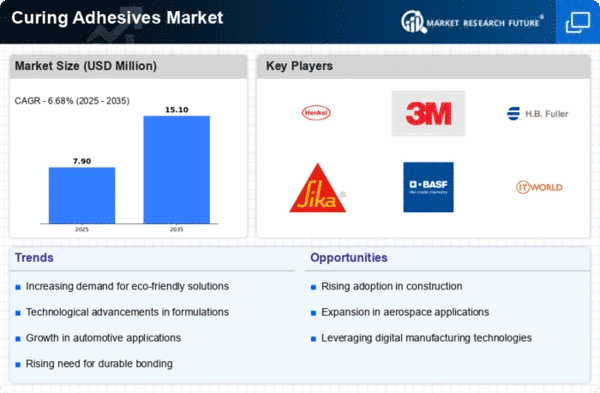
As per MRFR analysis, the Curing Adhesives Market Size was estimated at 7.41 USD Million in 2024. The Curing Adhesives industry is projected to grow from 7.91 in 2025 to 15.1 by 2035, exhibiting a compound annual growth rate (CAGR) of 6.68 during the forecast period 2025 - 2035.

Key Market Trends & Highlights

The Curing Adhesives Market is poised for robust growth driven by sustainability and technological advancements.

  • North America remains the largest market for curing adhesives, driven by extensive construction activities. Asia-Pacific is the fastest-growing region, reflecting a surge in automotive applications and manufacturing automation. The construction segment dominates the market, while the automotive segment is experiencing rapid growth due to innovative adhesive solutions. Key market drivers include rising demand in the construction sector and an increasing focus on sustainable practices.

Market Size & Forecast

2024 Market Size 7.41 (USD Million)
2035 Market Size 15.1 (USD Million)
CAGR (2025 - 2035) 6.68%
Largest Regional Market Share in 2024 North America

Major Players

Henkel (DE), 3M (US), H.B. Fuller (US), Sika AG (CH), BASF (DE), ITW (US), Lord Corporation (US), Momentive (US), Dow (US)

Market Trends

The Curing Adhesives Market is currently experiencing a dynamic evolution, driven by advancements in technology and increasing demand across various industries. The versatility of curing adhesives, which can bond a wide range of materials, positions them as essential components in sectors such as automotive, construction, and electronics. As manufacturers seek to enhance product performance and durability, the adoption of innovative adhesive formulations is on the rise. This trend is further supported by the growing emphasis on sustainability, prompting companies to explore eco-friendly alternatives that do not compromise on quality. In addition, the Curing Adhesives Market is witnessing a shift towards automation and smart manufacturing processes. This transition is likely to streamline production, reduce waste, and improve efficiency. As industries continue to embrace digital transformation, the integration of curing adhesives into automated systems appears to be a strategic move. Furthermore, the increasing focus on research and development is expected to yield new adhesive technologies that cater to specific application needs, thereby expanding the market's potential. Overall, the Curing Adhesives Market is poised for growth, driven by innovation, sustainability, and technological advancements.

Sustainability Initiatives

The Curing Adhesives Market is increasingly influenced by sustainability initiatives. Manufacturers are exploring bio-based and low-VOC formulations to meet environmental regulations and consumer preferences. This shift not only addresses ecological concerns but also enhances brand reputation, as companies strive to align with global sustainability goals.

Technological Advancements

Technological advancements are reshaping the Curing Adhesives Market. Innovations in adhesive formulations and application techniques are enhancing performance characteristics, such as bond strength and curing speed. These developments enable industries to adopt more efficient processes, ultimately leading to improved product quality and reduced production costs.

Automation in Manufacturing

The trend towards automation in manufacturing is significantly impacting the Curing Adhesives Market. As industries implement automated systems, the demand for adhesives that can perform reliably in high-speed applications is increasing. This shift not only boosts productivity but also necessitates the development of adhesives that can withstand the rigors of automated processes.

Curing Adhesives Market Market Drivers

Market Growth Projections

The Global Curing Adhesives Market Industry is poised for substantial growth, with projections indicating a market value of 7.88 USD Billion in 2024 and an anticipated increase to 15.7 USD Billion by 2035. This growth corresponds to a compound annual growth rate (CAGR) of 6.46% from 2025 to 2035. Such figures reflect the increasing adoption of curing adhesives across various sectors, driven by technological advancements and rising demand for high-performance bonding solutions. The market's expansion is likely to be influenced by factors such as regulatory changes, environmental considerations, and evolving consumer preferences, suggesting a dynamic landscape for stakeholders.

Growth in Construction Activities

The Global Curing Adhesives Market Industry benefits from the ongoing expansion in the construction sector, where these adhesives are increasingly employed for bonding materials such as wood, metal, and glass. As urbanization accelerates globally, the demand for residential and commercial buildings rises, leading to increased adhesive consumption. The construction industry is anticipated to contribute significantly to the market's growth, with a projected value of 15.7 USD Billion by 2035. Curing adhesives provide essential properties such as moisture resistance and structural integrity, making them ideal for various applications in construction. This trend suggests a sustained demand for curing adhesives in the coming years.

Rising Demand in Automotive Sector

The automotive industry is a primary driver for the Global Curing Adhesives Market Industry, as manufacturers increasingly utilize these adhesives for bonding components and enhancing vehicle performance. With the global automotive market projected to reach 7.88 USD Billion in 2024, the demand for curing adhesives is expected to grow significantly. These adhesives offer superior bonding strength and durability, which are essential for modern vehicles. As electric and hybrid vehicles gain traction, the need for lightweight materials and efficient assembly processes further propels the adoption of curing adhesives. This trend indicates a robust growth trajectory for the market, aligning with the overall expansion of the automotive sector.

Diverse Applications Across Industries

The versatility of curing adhesives across various industries is a key driver for the Global Curing Adhesives Market Industry. These adhesives find applications in sectors such as electronics, aerospace, and packaging, where their unique properties are leveraged for specific needs. For example, in the electronics industry, curing adhesives are used for potting and encapsulation, providing protection against moisture and mechanical stress. The diverse applications indicate a broad market potential, as industries continue to explore innovative uses for curing adhesives. This adaptability suggests that the market will experience sustained growth as new applications emerge and existing ones expand.

Technological Advancements in Adhesive Formulations

Innovations in adhesive formulations are transforming the Global Curing Adhesives Market Industry, as manufacturers develop new products that offer enhanced performance characteristics. Advances in chemistry and material science have led to the creation of adhesives that cure faster, bond more effectively, and withstand extreme conditions. For instance, the introduction of UV-curable adhesives has revolutionized applications in electronics and medical devices. These advancements not only improve product performance but also reduce production times and costs. As industries seek to optimize their processes, the demand for technologically advanced curing adhesives is likely to increase, indicating a dynamic shift in market trends.

Environmental Regulations and Sustainability Initiatives

Increasing environmental regulations and a growing emphasis on sustainability are influencing the Global Curing Adhesives Market Industry. Manufacturers are under pressure to develop eco-friendly adhesives that comply with stringent regulations regarding volatile organic compounds (VOCs) and other harmful substances. This shift towards sustainability is prompting companies to invest in research and development of bio-based and low-emission adhesives. As consumers become more environmentally conscious, the demand for sustainable products is expected to rise, potentially driving market growth. The trend towards greener alternatives suggests that the curing adhesives market will evolve to meet these new standards, aligning with global sustainability goals.

Market Segment Insights

By Application: Construction (Largest) vs. Automotive (Fastest-Growing)

In the Curing Adhesives Market, the application segment is predominantly led by Construction, which holds the largest share thanks to the extensive use of these adhesives in building materials and structural bonding. Following closely, Automotive applications are gaining momentum as manufacturers increasingly rely on advanced adhesives for vehicle assembly and part joining, enhancing durability and performance.

Construction: Dominant vs. Automotive: Emerging

The Construction sector remains the dominant force within the curing adhesives market, characterized by a high volume of demand driven by ongoing infrastructure projects and renovations. This segment capitalizes on high-strength adhesives that ensure lasting bonds for a variety of materials, including metals and plastics. Conversely, the Automotive sector is emerging rapidly, influenced by innovations in lightweight materials and electric vehicles that require adaptable bonding solutions for optimal performance. As manufacturers seek more efficient and sustainable options, automotive curing adhesives are poised for significant growth, focusing on eco-friendly formulations and enhanced adhesion properties.

By Technology: UV Curing (Largest) vs. Thermal Curing (Fastest-Growing)

In the Curing Adhesives Market, the technology segment is dominated by UV Curing, which holds the largest market share due to its efficiency and effectiveness in various applications, including automotive and electronics. Thermal Curing and Moisture Curing follow closely, each contributing significantly to the overall market yet lacking the prevalence of UV. Chemical Curing, while essential, remains a niche segment with more specialized applications.

Technology: UV Curing (Dominant) vs. Thermal Curing (Emerging)

UV Curing is recognized as the dominant force within the Curing Adhesives Market, largely because of its rapid curing process and versatility across different substrates. This technology is favored in industries requiring quick turnaround times, such as electronics and automotive manufacturing. On the other hand, Thermal Curing is emerging due to advancements in thermal set adhesives that offer higher performance in demanding applications. As manufacturers seek adhesives that can withstand extreme conditions, Thermal Curing’s market position is gaining traction, supported by ongoing innovations in material science.

By End Use: Manufacturing (Largest) vs. Assembly (Fastest-Growing)

In the Curing Adhesives Market, the 'End Use' segment is significantly influenced by the manufacturing sector, which holds a commanding position due to its extensive applications, especially in automotive, electronics, and building materials. This dominance allows manufacturing to capture a substantial share of the market, leveraging high-volume production processes that require durable adhesion solutions. On the other hand, assembly applications are rapidly gaining traction, as industries shift towards automated processes that require efficient and reliable bonding materials. This evolution is being driven by the continuous innovation in manufacturing techniques and the need for lightweight materials.

Manufacturing: Dominant vs. Assembly: Emerging

Manufacturing is currently the dominant segment in the Curing Adhesives Market, primarily due to the longstanding need for robust adhesives in the production of various goods including automobiles, machinery, and consumer electronics. Its significance is amplified by the increasing complexity of manufacturing processes that demand high-performance adhesive solutions. In contrast, assembly is emerging as a vital segment, reflecting a trend towards automated assembly lines where rapid and reliable adhesive applications are essential. The growth in this segment is propelled by advancements in technology that enable faster production times and improved product integrity, making assembly adhesives pivotal for companies seeking competitive advantages in a fast-evolving marketplace.

By Formulation Type: Epoxy (Largest) vs. Polyurethane (Fastest-Growing)

In the Curing Adhesives Market, the segmentation by formulation type reveals that epoxy resins dominate the market due to their excellent bonding properties and versatility across industries such as automotive, aerospace, and construction. <a href="https://www.marketresearchfuture.com/reports/polyurethane-market-2444">Polyurethane</a> adhesives, while currently a smaller share, are experiencing rapid growth owing to their flexibility and adhesion to various substrates. Silicone and acrylic formulations also contribute to the market, but their shares are notably less significant compared to epoxy and polyurethane. The growth of the formulation types can be attributed to advancements in technology and increasing demand for high-performance adhesives in various applications. Epoxy is favored for its strength and durability, making it ideal for heavy-duty uses, while polyurethane is gaining traction in sectors that require flexible yet robust adhesives. As industries evolve, the need for sustainable and efficient adhesive solutions is steering growth towards emerging formulations like polyurethane that are adaptable to diverse operational requirements.

Epoxy (Dominant) vs. Polyurethane (Emerging)

Epoxy adhesives stand out as the dominant formulation in the curing adhesives market, celebrated for their remarkable strength, chemical resistance, and durability. These properties make them particularly appealing to industries such as construction and automotive, where safety and longevity are paramount. Meanwhile, polyurethane adhesives are emerging as strong contenders, recognized for their versatility and elasticity. These adhesives can cure at room temperature and can bond with numerous surfaces, appealing to manufacturers looking for flexibility in their applications. As innovations continue, the combination of epoxy's robust characteristics with polyurethane's adaptability is fostering a competitive landscape where both can thrive, catering to evolving market demands. Overall, the synergy between these two formulations is pivotal in addressing the diverse requirements of various sectors.

By Curing Mechanism: Heat Curing (Largest) vs. Radiation Curing (Fastest-Growing)

The Curing Adhesives Market reveals a distinct distribution among its primary segments: Radiation Curing, Heat Curing, and Chemical Curing. Heat Curing dominates the market due to its extensive application across various industries, particularly in automotive and construction. Conversely, Radiation Curing is gaining traction, particularly in sectors that favor fast production cycles and precision, bolstered by advancements in technology that enhance its efficiency and versatility.

Heat Curing: Dominant vs. Radiation Curing: Emerging

Heat Curing remains the dominant segment within the curing mechanisms, leveraging its established applications in high-performance bonding scenarios where strong adhesion is paramount. This method caters primarily to industries requiring curing at elevated temperatures, offering rapid curing times and optimal adhesive properties. On the other hand, Radiation Curing is emerging as a key player, driven by innovations in UV and electron beam technologies. This approach is lauded for its speed and minimal environmental impact, positioning it as a crucial alternative in sectors committed to sustainability and efficiency.

Get more detailed insights about Curing Adhesives Market Research Report—Global Forecast till 2035

Regional Insights

North America : Market Leader in Curing Adhesives

North America is poised to maintain its leadership in the curing adhesives market, holding a significant share of 3.0 in 2025. The region's growth is driven by robust demand from automotive, construction, and electronics sectors, alongside stringent regulations promoting the use of eco-friendly adhesives. The increasing trend towards lightweight materials and sustainable practices further fuels market expansion. The United States stands as the largest market, supported by key players like 3M, H.B. Fuller, and Dow. These companies are investing in R&D to innovate and enhance product offerings. The competitive landscape is characterized by strategic partnerships and acquisitions, ensuring a steady supply of advanced curing adhesives to meet diverse industrial needs.

Europe : Innovation and Sustainability Focus

Europe's curing adhesives market is projected to reach a size of 2.5 by 2025, driven by increasing demand for sustainable and high-performance adhesives across various industries. Regulatory frameworks, such as REACH, are pushing manufacturers to develop eco-friendly products, which is a significant catalyst for market growth. The region's focus on innovation and sustainability is reshaping the competitive landscape. Germany and France are leading markets, with major players like Henkel and BASF spearheading advancements in adhesive technologies. The presence of stringent regulations encourages companies to invest in R&D, fostering a competitive environment. This focus on sustainability and innovation positions Europe as a key player in The Curing Adhesives.

Asia-Pacific : Emerging Market with High Potential

Asia-Pacific is emerging as a significant player in the curing adhesives market, with a projected size of 1.5 by 2025. The region's growth is fueled by rapid industrialization, urbanization, and increasing demand from sectors like automotive and construction. Additionally, government initiatives promoting infrastructure development are acting as catalysts for market expansion, creating a favorable environment for adhesive manufacturers. China and India are the leading countries in this region, with a growing presence of key players such as Sika AG and Momentive. The competitive landscape is evolving, with local manufacturers gaining traction alongside established global companies. This dynamic environment is expected to drive innovation and enhance product offerings in the curing adhesives market.

Middle East and Africa : Untapped Market Opportunities

The Middle East and Africa region is gradually emerging in the curing adhesives market, with a size of 0.41 projected for 2025. The growth is primarily driven by increasing construction activities and a rising demand for advanced adhesive solutions in various industries. Government investments in infrastructure and housing projects are expected to further stimulate market growth, creating opportunities for adhesive manufacturers. Countries like the UAE and South Africa are leading the market, with a growing interest from international players. The competitive landscape is characterized by a mix of local and global companies, which are focusing on expanding their product portfolios to cater to the diverse needs of the region. This evolving market presents significant opportunities for growth in the curing adhesives sector.

Key Players and Competitive Insights

The Curing Adhesives Market is currently characterized by a dynamic competitive landscape, driven by innovation, sustainability, and strategic partnerships. Key players such as Henkel (DE), 3M (US), and H.B. Fuller (US) are actively shaping the market through their distinct operational focuses. Henkel (DE) emphasizes innovation in product development, particularly in eco-friendly formulations, while 3M (US) leverages its extensive R&D capabilities to enhance adhesive performance across various applications. H.B. Fuller (US) is strategically expanding its global footprint, particularly in emerging markets, to capitalize on the growing demand for high-performance adhesives. Collectively, these strategies contribute to a moderately fragmented market structure, where competition is increasingly defined by technological advancements and sustainability initiatives.
In terms of business tactics, companies are localizing manufacturing to reduce lead times and optimize supply chains. This approach not only enhances operational efficiency but also allows for better responsiveness to regional market demands. The competitive structure remains moderately fragmented, with several players vying for market share. However, the influence of major companies is significant, as they set benchmarks for quality and innovation that smaller firms strive to meet.
In November 2025, Henkel (DE) announced the launch of a new line of bio-based curing adhesives aimed at reducing environmental impact. This strategic move aligns with the growing consumer demand for sustainable products and positions Henkel as a leader in eco-friendly adhesive solutions. The introduction of these products is likely to enhance Henkel's market share and strengthen its brand reputation in sustainability.
In October 2025, 3M (US) unveiled a new digital platform designed to streamline the adhesive selection process for customers. This platform utilizes AI to recommend optimal adhesive solutions based on specific application needs. By integrating technology into its customer service approach, 3M not only improves user experience but also reinforces its commitment to innovation, potentially increasing customer loyalty and market penetration.
In September 2025, H.B. Fuller (US) completed the acquisition of a regional adhesive manufacturer in Asia, significantly expanding its production capabilities in the region. This acquisition is strategically important as it allows H.B. Fuller to better serve the growing demand in Asia, particularly in the automotive and construction sectors. The move is expected to enhance operational efficiencies and provide a competitive edge in a rapidly evolving market.
As of December 2025, current competitive trends in the Curing Adhesives Market are heavily influenced by digitalization, sustainability, and the integration of AI technologies. Strategic alliances are increasingly shaping the landscape, enabling companies to pool resources and expertise to drive innovation. Looking ahead, competitive differentiation is likely to evolve from traditional price-based competition to a focus on technological advancements, product innovation, and supply chain reliability. This shift underscores the importance of adaptability and forward-thinking strategies in maintaining a competitive edge.

Key Companies in the Curing Adhesives Market include

Industry Developments

February 2022 - Westlake Chemical Corporation has carried out the acquisition of the global epoxy business owned by Hexion Inc. for around USD 1.2 billion in cash.Westlake Epoxy is a renowned developer of curing agents, modifiers and epoxy resins for high-performance and quality coatings, composites, and materials. The extensive worldwide business covers upstream base epoxy resins as well as intermediates available as solid and liquid epoxy resins, coupled with downstream specialty epoxy resins utilized in composites and coatings.

Westlake Epoxy caters to numerous sectors, such as adhesives; automotive; aerospace; construction and civil engineering; electronics; composite and wind energy; marine, protective coatings, and electrical laminates.October 2021 - Evonik introduces its latest TEGO RC 1442 silicone release coating, which is based on its present RC 1400 series technology, delivering high performance advantages customers expect from the company.This coating has been created for fast curing pressure sensitive adhesive applications, and offers impressive anchorage to the substrates while delivering stable release values in time, regardless of the humid storage conditions.

In the year 2021, one of the leading market players, Wacker, has expanded their brand in European countries. In the same year, another prominent market player, H.B Fuller has brought in two compostable adhesives for the packaging industries. Such advancements and expansions have significantly affected the overall growth of the Curing Adhesives industry.

Future Outlook

Curing Adhesives Market Future Outlook

The Curing Adhesives Market is projected to grow at a 6.68% CAGR from 2024 to 2035, driven by advancements in technology, increasing demand in automotive applications, and sustainable product innovations.

New opportunities lie in:

  • Development of bio-based curing adhesives for eco-conscious consumers.
  • Expansion into emerging markets with tailored adhesive solutions.
  • Integration of smart technology in adhesive application processes.

By 2035, the Curing Adhesives Market is expected to achieve robust growth, reflecting evolving industry demands.

Market Segmentation

Curing Adhesives Market End Use Outlook

  • Manufacturing
  • Repair
  • Assembly
  • Packaging

Curing Adhesives Market Technology Outlook

  • UV Curing
  • Thermal Curing
  • Moisture Curing
  • Chemical Curing

Curing Adhesives Market Application Outlook

  • Automotive
  • Construction
  • Electronics
  • Aerospace
  • Medical

Curing Adhesives Market Curing Mechanism Outlook

  • Radiation Curing
  • Heat Curing
  • Chemical Curing

Curing Adhesives Market Formulation Type Outlook

  • Epoxy
  • Polyurethane
  • Silicone
  • Acrylic

Report Scope

MARKET SIZE 2024 7.41(USD Million)
MARKET SIZE 2025 7.91(USD Million)
MARKET SIZE 2035 15.1(USD Million)
COMPOUND ANNUAL GROWTH RATE (CAGR) 6.68% (2025 - 2035)
REPORT COVERAGE Revenue Forecast, Competitive Landscape, Growth Factors, and Trends
BASE YEAR 2024
Market Forecast Period 2025 - 2035
Historical Data 2019 - 2024
Market Forecast Units USD Million
Key Companies Profiled Henkel (DE), 3M (US), H.B. Fuller (US), Sika AG (CH), BASF (DE), ITW (US), Lord Corporation (US), Momentive (US), Dow (US)
Segments Covered Application, Technology, End Use, Formulation Type, Curing Mechanism
Key Market Opportunities Growing demand for eco-friendly formulations in the Curing Adhesives Market presents significant opportunities.
Key Market Dynamics Rising demand for eco-friendly formulations drives innovation and competition in the curing adhesives market.
Countries Covered North America, Europe, APAC, South America, MEA

FAQs

At what CAGR is the Curing Adhesives Market predicted to grow during the forecast period?

Curing Adhesives Market is predicted to grow at 7.76% through forecast period of 2025-2035.

What is the forecast period of Curing Adhesives Market research report?

The forecast period for Curing Adhesives Market research report is 2025-2035.

Who are the key players in the Curing Adhesives Market?

Key players operating in the global curing adhesives market include Henkel AG &amp; Co. KGaA (Germany), Bostik (France), Sika AG (Switzerland), Dow (US), 3M (US), Wacker Chemie AG (Germany), H.B. Fuller (US), Dymax (US), Tosoh Corporation (Japan), DELO (Germany), Permabond LLC (UK), and Shin-Etsu Chemical Co., Ltd (Japan) among others.

What are the common resins used in the Curing adhesive industry?

• Epoxy • Polyurethane • Acrylate • Others

What are the major end-user industries of the curing adhesives industry?

• Automotive • Construction • Electronics &amp; Electrical • Medical • Woodworking • Others

What are the major types of curing adhesives?

• UV curing adhesives • Moisture curing adhesives • Thermal curing adhesives

Who are the major market players in the Curing adhesives industry?

• Bostik SA • H.B. Fuller • Dow Corning • 3M Company • Jowat SE • Dymax Corporation • Tosoh

  1. SECTION I: EXECUTIVE SUMMARY AND KEY HIGHLIGHTS
    1. | 1.1 EXECUTIVE SUMMARY
  2. SECTION II: SCOPING, METHODOLOGY AND MARKET STRUCTURE
    1. | 2.1 MARKET INTRODUCTION
    2. | 2.2 RESEARCH METHODOLOGY
  3. SECTION III: QUALITATIVE ANALYSIS
    1. | 3.1 MARKET DYNAMICS
    2. | 3.2 MARKET FACTOR ANALYSIS
  4. SECTION IV: QUANTITATIVE ANALYSIS
    1. | 4.1 Chemicals and Materials, BY Application (USD Million)
    2. | 4.2 Chemicals and Materials, BY Technology (USD Million)
    3. | 4.3 Chemicals and Materials, BY End Use (USD Million)
    4. | 4.4 Chemicals and Materials, BY Formulation Type (USD Million)
    5. | 4.5 Chemicals and Materials, BY Curing Mechanism (USD Million)
    6. | 4.6 Chemicals and Materials, BY Region (USD Million)
  5. SECTION V: COMPETITIVE ANALYSIS
    1. | 5.1 Competitive Landscape
    2. | 5.2 Company Profiles
    3. | 5.3 Appendix

Curing Adhesives Market Segmentation

Market Segmentation Overview

  • Detailed segmentation data will be available in the full report
  • Comprehensive analysis by multiple parameters
  • Regional and country-level breakdowns
  • Market size forecasts by segment
Infographic

Free Sample Request

Kindly complete the form below to receive a free sample of this Report

Get Free Sample

Customer Strories

Compare Licence

×
Features License Type
Single User Multiuser License Enterprise User
Price $4,950 $5,950 $7,250
Maximum User Access Limit 1 User Upto 10 Users Unrestricted Access Throughout the Organization
Free Customization
Direct Access to Analyst
Deliverable Format
Platform Access
Discount on Next Purchase 10% 15% 15%
Printable Versions