Request Free Sample ×

Kindly complete the form below to receive a free sample of this Report

* Please use a valid business email

Leading companies partner with us for data-driven Insights

clients tt-cursor
Hero Background
English
Chinese
French
Japanese
Korean
German
Spanish

Cruiser Bike Market Analysis

ID: MRFR/AT/10160-HCR
128 Pages
Shubham Munde
March 2026

Cruiser Bike Market Research Report Information By Engine Capacity (Less Than 500cc, 501cc to 1000 cc, and More Than 1000cc), By Price (Low, Mid, and High), By Application (Daily Commute and Touring), And By Region (North America, Europe, Asia-Pacific, And Rest Of The World) – Market Forecast Till 2035

Share:
Download PDF ×

We do not share your information with anyone. However, we may send you emails based on your report interest from time to time. You may contact us at any time to opt-out.

Cruzer Bike Market Infographic
Purchase Options

Market Analysis

In-depth Analysis of Cruzer Bike Market Industry Landscape

The global cruiser bike market is set to reach US$ 105.36 BN by 2032, at a 5.90% CAGR between years 2023-2032. This state of market dynamics in the cruzer bike segment highlights a very complex interplay between numerous factors that affect consumer interest, industry trends and competitive arena. Underlying the cruzer bike market is a shifting consumer palate and lifestyle. Retro nostalgia and a longing for an easier form of riding have spurred the demand for cruzer bikes. These are the bikes that have an easygoing design, with a seating position to deliver both style and comfort for pleasure trips. Market dynamics is also driven by the concern towards sustainability and eco-friendliness. Increasing environmental concerns, the consumers are turning towards electric cruzer bikes that in their turn lead to a shift towards greener means of transportation. The penetration of electric propulsion technology not only broadens the market reach but also creates many new opportunities for innovation and differentiation among the manufacturers. Further, the cruzer bike market is influenced by many economic factors. The economic instability affects the consumer’s buying behavior due to its influence on the purchasing power of a consumer. In times of economic prosperity, consumers might devote their additional savings to consume leisure and recreational items such as a cruzer bike. On the other hand, in times of recession there may be a move towards more cost effectiveness options forcing the manufacturers to have their marketing and product strategies shift accordingly. The competitive landscape is another changing environment of the cruzer bike market. A lot of manufacturers from big brands to the niche players compete in this market share by launching various models that target different consumer groups. Innovation in the design, technology and features is an very important part of acquiring a competitive advantage. In addition, strategic partnerships, marketing campaigns and distribution channels are other factors that affect the market mechanism as firms attempt to properly promote their products in order to attract more customers. The cruzer bike market is very affected by the government regulations and also policies pertaining to transportation and emissions. However, with the governments across the globe implementing more rigorous emission standards and prioritizing green transportation alternatives, producers have to adapt their output in order to comply. The above mutual relationship between the regulatory bodies and the industry determines patterns of development in CRUZER market, leading to inducement towards cleaner alternatives more friendly in terms of the environmental parameters. Consumer characteristics form part of the many factors that determine market dynamics as different age groups and also cultural backgrounds might have a unique tastes for cruzer bikes.


Author
Author Profile
Shubham Munde
Team Lead - Research

Shubham brings over 7 years of expertise in Market Intelligence and Strategic Consulting, with a strong focus on the Automotive, Aerospace, and Defense sectors. Backed by a solid foundation in semiconductors, electronics, and software, he has successfully delivered high-impact syndicated and custom research on a global scale. His core strengths include market sizing, forecasting, competitive intelligence, consumer insights, and supply chain mapping. Widely recognized for developing scalable growth strategies, Shubham empowers clients to navigate complex markets and achieve a lasting competitive edge. Trusted by start-ups and Fortune 500 companies alike, he consistently converts challenges into strategic opportunities that drive sustainable growth.

Leave a Comment

FAQs

What is the current valuation of the Cruiser Bike Market?

<p>The Cruiser Bike Market was valued at 70.54 USD Billion in 2024.</p>

What is the projected market size for the Cruiser Bike Market by 2035?

<p>The market is projected to reach 132.55 USD Billion by 2035.</p>

What is the expected CAGR for the Cruiser Bike Market during the forecast period?

<p>The expected CAGR for the Cruiser Bike Market from 2025 to 2035 is 5.9%.</p>

Which companies are the key players in the Cruiser Bike Market?

<p>Key players include Harley-Davidson, Honda, Yamaha, Kawasaki, Suzuki, Indian Motorcycle, Bajaj Auto, Royal Enfield, and Ducati.</p>

How is the Cruiser Bike Market segmented by engine capacity?

<p>The market segments by engine capacity include Less Than 500cc, 501cc to 1000cc, and More Than 1000cc, with valuations of 15.0, 30.0, and 25.54 USD Billion respectively.</p>

What are the price segments in the Cruiser Bike Market?

<p>Price segments in the market are categorized as Low, Mid, and High, with valuations of 10.0, 25.0, and 35.54 USD Billion respectively.</p>

What applications are driving the Cruiser Bike Market?

The primary applications driving the market are Daily Commute and Touring, valued at 28.0 and 42.54 USD Billion respectively.

How does the performance of the Cruiser Bike Market compare across different engine capacities?

The performance across engine capacities indicates that the 501cc to 1000cc segment is likely to dominate with a valuation of 55.0 USD Billion.

What trends are influencing the growth of the Cruiser Bike Market?

Trends such as increasing demand for touring bikes and rising disposable incomes appear to influence the market's growth.

What is the potential for new entrants in the Cruiser Bike Market?

The potential for new entrants may be substantial, given the projected growth and evolving consumer preferences in the Cruiser Bike Market.

Market Summary

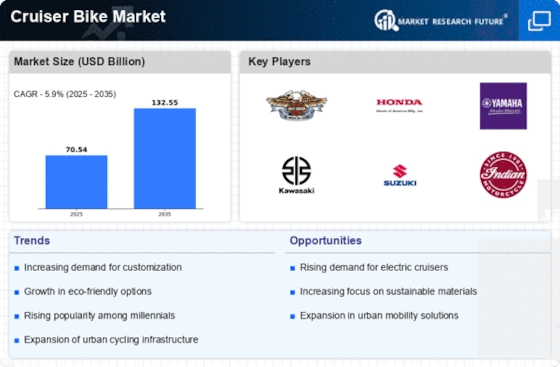
As per Market Research Future analysis, the Cruiser Bike Market Size was estimated at 70.54 USD Billion in 2024. The Cruiser Bike industry is projected to grow from 74.7 USD Billion in 2025 to 132.55 USD Billion by 2035, exhibiting a compound annual growth rate (CAGR) of 5.9% during the forecast period 2025 - 2035

Key Market Trends & Highlights

The Cruiser Bike Market is experiencing a dynamic shift towards eco-friendly and technologically advanced options.

  • The demand for eco-friendly transportation is driving innovation in the cruiser bike market. Technological advancements in design are enhancing safety features and rider experience. North America remains the largest market, while Asia-Pacific is emerging as the fastest-growing region. The increasing popularity of leisure riding and customization are key drivers of market growth.

Market Size & Forecast

2024 Market Size 70.54 (USD Billion)
2035 Market Size 132.55 (USD Billion)
CAGR (2025 - 2035) 5.9%
Largest Regional Market Share in 2024 North America

Major Players

<a href="https://www.harley-davidson.com/in/en/motorcycles/cruiser.html">Harley-Davidson</a> (US), Honda (JP), Yamaha (JP), Kawasaki (JP), Suzuki (JP), Indian Motorcycle (US), Bajaj Auto (IN), <a href="https://www.royalenfield.com/in/en/motorcycles/">Royal Enfield</a> (IN), Ducati (IT)

Market Trends

The Cruiser Bike Market is currently experiencing a dynamic evolution, characterized by a growing interest in leisure cycling and lifestyle-oriented transportation. This market segment appears to be gaining traction among diverse demographics, particularly among younger consumers who seek both style and functionality in their riding experience. The increasing emphasis on sustainable transportation options may also contribute to the rising popularity of cruiser bikes, as they offer an eco-friendly alternative to traditional motor vehicles. Furthermore, advancements in design and technology are likely enhancing the appeal of these bikes, making them more accessible and attractive to a broader audience. In addition, the Cruiser Bike Market seems to be influenced by a shift towards urban mobility solutions. As cities become more congested, individuals are exploring alternative means of transportation that are not only efficient but also enjoyable. This trend indicates a potential for growth in the market, as more people recognize the benefits of cycling for both personal health and environmental sustainability. The combination of aesthetic appeal, practicality, and a growing awareness of ecological issues suggests that the Cruiser Bike Market is poised for continued expansion in the coming years.

Rising Demand for Eco-Friendly Transportation

The Cruiser Bike Market is witnessing an increasing preference for environmentally sustainable modes of transport. Consumers are becoming more conscious of their carbon footprint, leading to a surge in interest for bicycles as a viable alternative to motor vehicles.

Technological Innovations in Design

Recent advancements in materials and design are enhancing the functionality and aesthetic appeal of cruiser bikes. Manufacturers are integrating modern technology, which may improve performance and comfort, thereby attracting a wider range of consumers.

Urban Mobility Trends

As urban areas become more congested, there is a noticeable shift towards cycling as a practical solution for commuting. The Cruiser Bike Market is likely benefiting from this trend, as more individuals seek efficient and enjoyable ways to navigate city environments.

Cruzer Bike Market Market Drivers

Rising Interest in Customization

Customization has emerged as a pivotal driver in the Cruiser Bike Market Industry, as consumers increasingly seek personalized experiences. The desire for unique and tailored bikes has led to a rise in aftermarket modifications and custom builds. Market data suggests that nearly 30% of cruiser bike owners engage in some form of customization, whether through aesthetic changes or performance enhancements. This trend is particularly appealing to enthusiasts who view their bikes as an extension of their identity. Manufacturers are responding by offering a wider range of accessories and customization options, thereby enhancing consumer engagement. The Cruiser Bike Market Industry is likely to see sustained growth as more riders invest in personalized features, which not only enhance the riding experience but also foster a sense of community among enthusiasts.

Expansion of E-commerce Platforms

The Cruiser Bike Market Industry is witnessing a transformative shift with the expansion of e-commerce platforms. As consumers increasingly turn to online shopping for convenience, the availability of cruiser bikes through digital channels has grown significantly. Market data indicates that online sales of cruiser bikes have increased by over 20% in the past year, reflecting changing consumer preferences. This trend allows manufacturers and retailers to reach a broader audience, including those in remote areas where physical dealerships may be limited. Additionally, e-commerce platforms often provide detailed product information and customer reviews, enhancing the purchasing experience. The Cruiser Bike Market Industry is likely to benefit from this trend, as it facilitates easier access to a diverse range of models and brands, ultimately driving sales and market penetration.

Growing Focus on Health and Wellness

The Cruiser Bike Market Industry is positively influenced by the growing focus on health and wellness among consumers. As individuals become more health-conscious, cycling is increasingly recognized as a beneficial activity for physical fitness and mental well-being. This trend is particularly relevant in urban areas, where cruiser bikes offer a practical solution for commuting while promoting an active lifestyle. Market data suggests that the demand for cruiser bikes has risen in tandem with the health and wellness movement, with a notable increase in sales among fitness-oriented consumers. Manufacturers are capitalizing on this trend by promoting the health benefits of cycling, thereby appealing to a broader audience. The Cruiser Bike Market Industry is likely to continue thriving as more individuals incorporate cycling into their daily routines, further solidifying its position in the transportation and leisure sectors.

Increasing Popularity of Leisure Riding

The Cruiser Bike Market Industry experiences a notable surge in demand due to the increasing popularity of leisure riding. As more individuals seek recreational activities, cruiser bikes offer an appealing option for leisurely rides. This trend is particularly pronounced among millennials and younger generations, who are drawn to the lifestyle associated with cruising. The market data indicates that leisure riding contributes significantly to the overall sales of cruiser bikes, with a projected growth rate of approximately 5% annually. This growth is likely fueled by the desire for outdoor experiences and the social aspects of riding in groups. Consequently, manufacturers are focusing on producing models that cater to this demographic, enhancing comfort and style. The Cruiser Bike Market Industry thus stands to benefit from this trend, as it aligns with broader lifestyle changes favoring outdoor and recreational activities.

Technological Advancements in Safety Features

Technological advancements in safety features are becoming a crucial driver in the Cruiser Bike Market Industry. As safety concerns among riders grow, manufacturers are increasingly integrating innovative technologies into their designs. Features such as anti-lock braking systems, advanced lighting, and improved visibility are gaining traction. Market data indicates that bikes equipped with enhanced safety features are experiencing higher sales, as consumers prioritize safety alongside style and performance. This trend is particularly relevant for new riders who may be more apprehensive about road safety. The Cruiser Bike Market Industry is likely to see continued investment in research and development aimed at improving safety standards, which could lead to a more secure riding experience. As safety becomes a focal point, manufacturers that prioritize these advancements may gain a competitive edge in the market.

Market Segment Insights

By Engine Capacity: Less Than 500cc (Largest) vs. More Than 1000cc (Fastest-Growing)

In the Cruiser Bike Market, the segment values for <a href="https://www.marketresearchfuture.com/reports/engine-market-24300">engine</a> capacity are distinctly varied, reflecting notable preferences among consumers. The 'Less Than 500cc' category holds a significant market share, appealing to new riders and those seeking more manageable power. Meanwhile, '501cc to 1000cc' serves as a versatile middle ground, attracting riders looking for a balance between performance and comfort, while 'More Than 1000cc', representing emerging capacity trends, shows rapid growth due to the rising demand for powerful cruising experiences among seasoned enthusiasts.

Less Than 500cc (Dominant) vs. More Than 1000cc (Emerging)

The 'Less Than 500cc' segment is a dominant force within the Cruiser Bike Market, catering primarily to novice riders and those prioritizing fuel efficiency and ease of handling. This segment's motorcycles are typically lighter and more affordable, making them accessible to a broader audience. In contrast, the 'More Than 1000cc' segment is emerging rapidly, driven by a surge in interest for high-performance models that offer advanced technology and superior power. Riders in this category are often experienced enthusiasts who appreciate the blend of luxury and performance, indicating a trend toward more powerful bikes that provide thrilling experiences on the open road.

By Price: Mid (Largest) vs. Low (Fastest-Growing)

In the Cruiser Bike Market, the price segment is distinctly categorized into low, mid, and high-priced bikes. The mid-priced segment commands the largest share, appealing to a broad demographic of consumers who seek an ideal balance of quality and affordability. The low-priced segment, while traditionally viewed as entry-level, has shown remarkable growth, attracting novice riders and budget-conscious buyers, making it a significant player in the current market landscape.

Low (Dominant) vs. Mid (Emerging)

The low-priced cruiser bikes cater to a large segment of consumers, often featuring basic designs and essential features. Their affordability makes them particularly attractive to younger riders or those new to the biking lifestyle. Conversely, mid-priced cruiser bikes present a balance of features and quality, appealing to more experienced riders looking for enhanced comfort, aesthetics, and performance without venturing into premium pricing. While the low-priced bikes are becoming increasingly popular, especially among budget-constrained consumers, mid-priced bikes are emerging as a preferred choice for those willing to invest slightly more for better quality and durability.

By Application: Daily Commute (Largest) vs. Touring (Fastest-Growing)

In the Cruiser Bike Market, the application segment is primarily dominated by daily commuting. This segment accounts for the majority of the market share, driven by urbanization and the increasing shift towards environmentally friendly transportation options. On the other hand, the touring segment is gaining traction as more cyclists look for recreational and long-distance travel experiences, positioning itself as the fastest-growing segment. The appeal of leisure cycling and the rise in travel for enjoyment have facilitated this growth.

Daily Commute: (Dominant) vs. Touring (Emerging)

The Daily Commute segment is characterized by its practical designs tailored for urban riders, focusing on comfort, ease of use, and storage capabilities. These bikes are often equipped with features that enhance everyday usability, such as upright seating positions and integrated lights. In contrast, the Touring segment targets adventure seekers who prioritize features such as durability, long-range capability, and storage for longer journeys. Touring bikes typically boast robust frames and specialized gear, appealing to those seeking both leisure and exploration through cycling. As consumers increasingly value versatility and unique riding experiences, both segments continue to establish their significance in the Cruiser Bike Market.

Get more detailed insights about Cruiser Bike Market Research Report—Global Forecast till 2035

Regional Insights

By Region, the study provides market insights into North America, Europe, Asia-Pacific, and Rest of the World. The North American Cruiser Bike market area will dominate this market in 2022. Customers increased comfort and rising per capita income are anticipated to fuel market expansion.

Further, the major countries studied in the market report are The U.S., Canada, German, France, the UK, Italy, Spain, China, Japan, India, Australia, South Korea, and Brazil.

Figure 2: Cruzer Bike Market Share By Region 2023 (%)

Europe’s Cruiser Bike market accounts for the second-largest market share. Over the forecast period, Europe is anticipated to hold a sizable market share and expand quickly due to factors like the cruiser bikes' scope for customization, improved designs, and the adoption of cutting-edge technologies. Further, the German Cruiser Bike market held the largest market share, and the UK Cruiser Bike market was the fastest-growing market in the European region

The Asia-Pacific Cruiser Bike Market is expected to grow at the fastest CAGR from 2023 to 2032. The market is anticipated to grow for some key reasons, including the local auto industry's expansion and the demand for high-end motorcycles. China is thought to be the region's top revenue-producing nation as a result of the presence of significant market players. Moreover, China’s Cruiser Bike market held the largest market share, and the Indian Cruzer Bike Market was the fastest-growing market in the Asia-Pacific region.

Key Players and Competitive Insights

Leading market players invest heavily in R&D activities to expand their products, which will assist the Cruiser Bike market. Companies are also undertaking strategic activities to develop their global market share, with important market developments such as new product launches, agreements, higher investments, mergers & acquisitions, and collaboration with other companies. One of the key business strategies manufacturers use in the global Cruzer Bike industry is manufacturing locally to minimize manufacturing costs. Major players in the Cruiser Bike market include BMW AG, Harley Davidson, Hero Motocorp, Honda Motor Company, Piaggio, Suzuki Motor Company, Triumph Motorcycle, TVS, Yamaha, and Zero Motorcycle. Automotive firm Bayerische Motoren Werke AG is involved. It creates, produces, and markets bikes, cars, replacement parts, other vehicles, and engines. Additionally, the business provides services for insurance, fleet management, retail customer and dealer financing, deposit business, and automobile leasing. It sells goods under the labels Motorrad, BMW, MINI, Rolls-Royce, Alphabet, John Cooper Works, and YOUR NOW. The business caters to customers from Europe, the Americas, Asia, and other continents. It has factories for production and assembly and a global sales network. The headquarters of BMW is located in Munich, Bavaria. The luxury motorbike maker Harley-Davidson Inc. The business creates, assembles, and sells bikes, motorcycle components, and accessories. On a wholesale basis, it also provides general products relating to motorcycles. Harley-Davidson offers its dealers and customers options for wholesale and retail finance and insurance in the US and Canada. It has an online store where it sells motorbike accessories, parts, and other related goods and services. The business also offers electric bikes for sale. The company sells and markets motorcycles through a network of independent dealers in the US, Europe, the Middle East, Africa, Japan, Canada, Australia, New Zealand, and other countries. Milwaukee, Wisconsin, in the US, serves as Harley-Davidson's corporate headquarters.

Key Companies in the Cruzer Bike Market include

Industry Developments

July 2021 Kawasaki introduced the W175 in India. It includes disc brakes and a 175cc engine, giving a strong performance.

April 2021 The Royal Enfield Meteor 350 was introduced in North America, and the motorcycles are anticipated to be available at dealers in both the US and Canada. The RE Meteor 350 starts at $4,400 in the US.

September 2020 The R18, BMW Motorrad's first flagship cruiser motorcycle, was introduced in India. The 1965 R5 served as a stylistic inspiration for the R18. However, BMW made sure to keep the classic and retro design cues. With a long wheelbase and a low stance, it adheres to the classic cruiser design language.

Future Outlook

Cruzer Bike Market Future Outlook

The Cruiser Bike Market is projected to grow at a 5.9% CAGR from 2025 to 2035, driven by increasing consumer interest in leisure cycling and eco-friendly transportation.

New opportunities lie in:

  • <p>Expansion of electric cruiser bike models to capture eco-conscious consumers. Development of subscription-based ownership models for urban riders. Partnerships with tourism companies for guided cruiser bike tours.</p>

By 2035, the Cruiser Bike Market is expected to achieve robust growth, reflecting evolving consumer preferences.

Market Segmentation

Cruzer Bike Market Price Outlook

  • Low
  • Mid
  • High

Cruzer Bike Market Application Outlook

  • Daily Commute
  • Touring

Cruzer Bike Market Engine Capacity Outlook

  • Less Than 500cc
  • 501cc to 1000 cc
  • More Than 1000cc

Report Scope

MARKET SIZE 2024 70.54(USD Billion)
MARKET SIZE 2025 74.7(USD Billion)
MARKET SIZE 2035 132.55(USD Billion)
COMPOUND ANNUAL GROWTH RATE (CAGR) 5.9% (2025 - 2035)
REPORT COVERAGE Revenue Forecast, Competitive Landscape, Growth Factors, and Trends
BASE YEAR 2024
Market Forecast Period 2025 - 2035
Historical Data 2019 - 2024
Market Forecast Units USD Billion
Key Companies Profiled Harley-Davidson (US), Honda (JP), Yamaha (JP), Kawasaki (JP), Suzuki (JP), Indian Motorcycle (US), Bajaj Auto (IN), Royal Enfield (IN), Ducati (IT)
Segments Covered Engine Capacity, Price, Application, Region
Key Market Opportunities Growing demand for electric Cruiser Bikes driven by sustainability trends and urban commuting preferences.
Key Market Dynamics Rising consumer preference for electric cruiser bikes drives innovation and competition among manufacturers in the market.
Countries Covered North America, Europe, APAC, South America, MEA

FAQs

What is the current valuation of the Cruiser Bike Market?

<p>The Cruiser Bike Market was valued at 70.54 USD Billion in 2024.</p>

What is the projected market size for the Cruiser Bike Market by 2035?

<p>The market is projected to reach 132.55 USD Billion by 2035.</p>

What is the expected CAGR for the Cruiser Bike Market during the forecast period?

<p>The expected CAGR for the Cruiser Bike Market from 2025 to 2035 is 5.9%.</p>

Which companies are the key players in the Cruiser Bike Market?

<p>Key players include Harley-Davidson, Honda, Yamaha, Kawasaki, Suzuki, Indian Motorcycle, Bajaj Auto, Royal Enfield, and Ducati.</p>

How is the Cruiser Bike Market segmented by engine capacity?

<p>The market segments by engine capacity include Less Than 500cc, 501cc to 1000cc, and More Than 1000cc, with valuations of 15.0, 30.0, and 25.54 USD Billion respectively.</p>

What are the price segments in the Cruiser Bike Market?

<p>Price segments in the market are categorized as Low, Mid, and High, with valuations of 10.0, 25.0, and 35.54 USD Billion respectively.</p>

What applications are driving the Cruiser Bike Market?

The primary applications driving the market are Daily Commute and Touring, valued at 28.0 and 42.54 USD Billion respectively.

How does the performance of the Cruiser Bike Market compare across different engine capacities?

The performance across engine capacities indicates that the 501cc to 1000cc segment is likely to dominate with a valuation of 55.0 USD Billion.

What trends are influencing the growth of the Cruiser Bike Market?

Trends such as increasing demand for touring bikes and rising disposable incomes appear to influence the market's growth.

What is the potential for new entrants in the Cruiser Bike Market?

The potential for new entrants may be substantial, given the projected growth and evolving consumer preferences in the Cruiser Bike Market.

  1. SECTION I: EXECUTIVE SUMMARY AND KEY HIGHLIGHTS
    1. | 1.1 EXECUTIVE SUMMARY
    2. | | 1.1.1 Market Overview
    3. | | 1.1.2 Key Findings
    4. | | 1.1.3 Market Segmentation
    5. | | 1.1.4 Competitive Landscape
    6. | | 1.1.5 Challenges and Opportunities
    7. | | 1.1.6 Future Outlook
  2. SECTION II: SCOPING, METHODOLOGY AND MARKET STRUCTURE
    1. | 2.1 MARKET INTRODUCTION
    2. | | 2.1.1 Definition
    3. | | 2.1.2 Scope of the study
    4. | | | 2.1.2.1 Research Objective
    5. | | | 2.1.2.2 Assumption
    6. | | | 2.1.2.3 Limitations
    7. | 2.2 RESEARCH METHODOLOGY
    8. | | 2.2.1 Overview
    9. | | 2.2.2 Data Mining
    10. | | 2.2.3 Secondary Research
    11. | | 2.2.4 Primary Research
    12. | | | 2.2.4.1 Primary Interviews and Information Gathering Process
    13. | | | 2.2.4.2 Breakdown of Primary Respondents
    14. | | 2.2.5 Forecasting Model
    15. | | 2.2.6 Market Size Estimation
    16. | | | 2.2.6.1 Bottom-Up Approach
    17. | | | 2.2.6.2 Top-Down Approach
    18. | | 2.2.7 Data Triangulation
    19. | | 2.2.8 Validation
  3. SECTION III: QUALITATIVE ANALYSIS
    1. | 3.1 MARKET DYNAMICS
    2. | | 3.1.1 Overview
    3. | | 3.1.2 Drivers
    4. | | 3.1.3 Restraints
    5. | | 3.1.4 Opportunities
    6. | 3.2 MARKET FACTOR ANALYSIS
    7. | | 3.2.1 Value chain Analysis
    8. | | 3.2.2 Porter's Five Forces Analysis
    9. | | | 3.2.2.1 Bargaining Power of Suppliers
    10. | | | 3.2.2.2 Bargaining Power of Buyers
    11. | | | 3.2.2.3 Threat of New Entrants
    12. | | | 3.2.2.4 Threat of Substitutes
    13. | | | 3.2.2.5 Intensity of Rivalry
    14. | | 3.2.3 COVID-19 Impact Analysis
    15. | | | 3.2.3.1 Market Impact Analysis
    16. | | | 3.2.3.2 Regional Impact
    17. | | | 3.2.3.3 Opportunity and Threat Analysis
  4. SECTION IV: QUANTITATIVE ANALYSIS
    1. | 4.1 Automobile, BY Engine Capacity (USD Billion)
    2. | | 4.1.1 Less Than 500cc
    3. | | 4.1.2 501cc to 1000 cc
    4. | | 4.1.3 More Than 1000cc
    5. | 4.2 Automobile, BY Price (USD Billion)
    6. | | 4.2.1 Low
    7. | | 4.2.2 Mid
    8. | | 4.2.3 High
    9. | 4.3 Automobile, BY Application (USD Billion)
    10. | | 4.3.1 Daily Commute
    11. | | 4.3.2 Touring
    12. | 4.4 Automobile, BY Region (USD Billion)
    13. | | 4.4.1 North America
    14. | | | 4.4.1.1 US
    15. | | | 4.4.1.2 Canada
    16. | | 4.4.2 Europe
    17. | | | 4.4.2.1 Germany
    18. | | | 4.4.2.2 UK
    19. | | | 4.4.2.3 France
    20. | | | 4.4.2.4 Russia
    21. | | | 4.4.2.5 Italy
    22. | | | 4.4.2.6 Spain
    23. | | | 4.4.2.7 Rest of Europe
    24. | | 4.4.3 APAC
    25. | | | 4.4.3.1 China
    26. | | | 4.4.3.2 India
    27. | | | 4.4.3.3 Japan
    28. | | | 4.4.3.4 South Korea
    29. | | | 4.4.3.5 Malaysia
    30. | | | 4.4.3.6 Thailand
    31. | | | 4.4.3.7 Indonesia
    32. | | | 4.4.3.8 Rest of APAC
    33. | | 4.4.4 South America
    34. | | | 4.4.4.1 Brazil
    35. | | | 4.4.4.2 Mexico
    36. | | | 4.4.4.3 Argentina
    37. | | | 4.4.4.4 Rest of South America
    38. | | 4.4.5 MEA
    39. | | | 4.4.5.1 GCC Countries
    40. | | | 4.4.5.2 South Africa
    41. | | | 4.4.5.3 Rest of MEA
  5. SECTION V: COMPETITIVE ANALYSIS
    1. | 5.1 Competitive Landscape
    2. | | 5.1.1 Overview
    3. | | 5.1.2 Competitive Analysis
    4. | | 5.1.3 Market share Analysis
    5. | | 5.1.4 Major Growth Strategy in the Automobile
    6. | | 5.1.5 Competitive Benchmarking
    7. | | 5.1.6 Leading Players in Terms of Number of Developments in the Automobile
    8. | | 5.1.7 Key developments and growth strategies
    9. | | | 5.1.7.1 New Product Launch/Service Deployment
    10. | | | 5.1.7.2 Merger & Acquisitions
    11. | | | 5.1.7.3 Joint Ventures
    12. | | 5.1.8 Major Players Financial Matrix
    13. | | | 5.1.8.1 Sales and Operating Income
    14. | | | 5.1.8.2 Major Players R&D Expenditure. 2023
    15. | 5.2 Company Profiles
    16. | | 5.2.1 Harley-Davidson (US)
    17. | | | 5.2.1.1 Financial Overview
    18. | | | 5.2.1.2 Products Offered
    19. | | | 5.2.1.3 Key Developments
    20. | | | 5.2.1.4 SWOT Analysis
    21. | | | 5.2.1.5 Key Strategies
    22. | | 5.2.2 Honda (JP)
    23. | | | 5.2.2.1 Financial Overview
    24. | | | 5.2.2.2 Products Offered
    25. | | | 5.2.2.3 Key Developments
    26. | | | 5.2.2.4 SWOT Analysis
    27. | | | 5.2.2.5 Key Strategies
    28. | | 5.2.3 Yamaha (JP)
    29. | | | 5.2.3.1 Financial Overview
    30. | | | 5.2.3.2 Products Offered
    31. | | | 5.2.3.3 Key Developments
    32. | | | 5.2.3.4 SWOT Analysis
    33. | | | 5.2.3.5 Key Strategies
    34. | | 5.2.4 Kawasaki (JP)
    35. | | | 5.2.4.1 Financial Overview
    36. | | | 5.2.4.2 Products Offered
    37. | | | 5.2.4.3 Key Developments
    38. | | | 5.2.4.4 SWOT Analysis
    39. | | | 5.2.4.5 Key Strategies
    40. | | 5.2.5 Suzuki (JP)
    41. | | | 5.2.5.1 Financial Overview
    42. | | | 5.2.5.2 Products Offered
    43. | | | 5.2.5.3 Key Developments
    44. | | | 5.2.5.4 SWOT Analysis
    45. | | | 5.2.5.5 Key Strategies
    46. | | 5.2.6 Indian Motorcycle (US)
    47. | | | 5.2.6.1 Financial Overview
    48. | | | 5.2.6.2 Products Offered
    49. | | | 5.2.6.3 Key Developments
    50. | | | 5.2.6.4 SWOT Analysis
    51. | | | 5.2.6.5 Key Strategies
    52. | | 5.2.7 Bajaj Auto (IN)
    53. | | | 5.2.7.1 Financial Overview
    54. | | | 5.2.7.2 Products Offered
    55. | | | 5.2.7.3 Key Developments
    56. | | | 5.2.7.4 SWOT Analysis
    57. | | | 5.2.7.5 Key Strategies
    58. | | 5.2.8 Royal Enfield (IN)
    59. | | | 5.2.8.1 Financial Overview
    60. | | | 5.2.8.2 Products Offered
    61. | | | 5.2.8.3 Key Developments
    62. | | | 5.2.8.4 SWOT Analysis
    63. | | | 5.2.8.5 Key Strategies
    64. | | 5.2.9 Ducati (IT)
    65. | | | 5.2.9.1 Financial Overview
    66. | | | 5.2.9.2 Products Offered
    67. | | | 5.2.9.3 Key Developments
    68. | | | 5.2.9.4 SWOT Analysis
    69. | | | 5.2.9.5 Key Strategies
    70. | 5.3 Appendix
    71. | | 5.3.1 References
    72. | | 5.3.2 Related Reports
  6. LIST OF FIGURES
    1. | 6.1 MARKET SYNOPSIS
    2. | 6.2 NORTH AMERICA MARKET ANALYSIS
    3. | 6.3 US MARKET ANALYSIS BY ENGINE CAPACITY
    4. | 6.4 US MARKET ANALYSIS BY PRICE
    5. | 6.5 US MARKET ANALYSIS BY APPLICATION
    6. | 6.6 CANADA MARKET ANALYSIS BY ENGINE CAPACITY
    7. | 6.7 CANADA MARKET ANALYSIS BY PRICE
    8. | 6.8 CANADA MARKET ANALYSIS BY APPLICATION
    9. | 6.9 EUROPE MARKET ANALYSIS
    10. | 6.10 GERMANY MARKET ANALYSIS BY ENGINE CAPACITY
    11. | 6.11 GERMANY MARKET ANALYSIS BY PRICE
    12. | 6.12 GERMANY MARKET ANALYSIS BY APPLICATION
    13. | 6.13 UK MARKET ANALYSIS BY ENGINE CAPACITY
    14. | 6.14 UK MARKET ANALYSIS BY PRICE
    15. | 6.15 UK MARKET ANALYSIS BY APPLICATION
    16. | 6.16 FRANCE MARKET ANALYSIS BY ENGINE CAPACITY
    17. | 6.17 FRANCE MARKET ANALYSIS BY PRICE
    18. | 6.18 FRANCE MARKET ANALYSIS BY APPLICATION
    19. | 6.19 RUSSIA MARKET ANALYSIS BY ENGINE CAPACITY
    20. | 6.20 RUSSIA MARKET ANALYSIS BY PRICE
    21. | 6.21 RUSSIA MARKET ANALYSIS BY APPLICATION
    22. | 6.22 ITALY MARKET ANALYSIS BY ENGINE CAPACITY
    23. | 6.23 ITALY MARKET ANALYSIS BY PRICE
    24. | 6.24 ITALY MARKET ANALYSIS BY APPLICATION
    25. | 6.25 SPAIN MARKET ANALYSIS BY ENGINE CAPACITY
    26. | 6.26 SPAIN MARKET ANALYSIS BY PRICE
    27. | 6.27 SPAIN MARKET ANALYSIS BY APPLICATION
    28. | 6.28 REST OF EUROPE MARKET ANALYSIS BY ENGINE CAPACITY
    29. | 6.29 REST OF EUROPE MARKET ANALYSIS BY PRICE
    30. | 6.30 REST OF EUROPE MARKET ANALYSIS BY APPLICATION
    31. | 6.31 APAC MARKET ANALYSIS
    32. | 6.32 CHINA MARKET ANALYSIS BY ENGINE CAPACITY
    33. | 6.33 CHINA MARKET ANALYSIS BY PRICE
    34. | 6.34 CHINA MARKET ANALYSIS BY APPLICATION
    35. | 6.35 INDIA MARKET ANALYSIS BY ENGINE CAPACITY
    36. | 6.36 INDIA MARKET ANALYSIS BY PRICE
    37. | 6.37 INDIA MARKET ANALYSIS BY APPLICATION
    38. | 6.38 JAPAN MARKET ANALYSIS BY ENGINE CAPACITY
    39. | 6.39 JAPAN MARKET ANALYSIS BY PRICE
    40. | 6.40 JAPAN MARKET ANALYSIS BY APPLICATION
    41. | 6.41 SOUTH KOREA MARKET ANALYSIS BY ENGINE CAPACITY
    42. | 6.42 SOUTH KOREA MARKET ANALYSIS BY PRICE
    43. | 6.43 SOUTH KOREA MARKET ANALYSIS BY APPLICATION
    44. | 6.44 MALAYSIA MARKET ANALYSIS BY ENGINE CAPACITY
    45. | 6.45 MALAYSIA MARKET ANALYSIS BY PRICE
    46. | 6.46 MALAYSIA MARKET ANALYSIS BY APPLICATION
    47. | 6.47 THAILAND MARKET ANALYSIS BY ENGINE CAPACITY
    48. | 6.48 THAILAND MARKET ANALYSIS BY PRICE
    49. | 6.49 THAILAND MARKET ANALYSIS BY APPLICATION
    50. | 6.50 INDONESIA MARKET ANALYSIS BY ENGINE CAPACITY
    51. | 6.51 INDONESIA MARKET ANALYSIS BY PRICE
    52. | 6.52 INDONESIA MARKET ANALYSIS BY APPLICATION
    53. | 6.53 REST OF APAC MARKET ANALYSIS BY ENGINE CAPACITY
    54. | 6.54 REST OF APAC MARKET ANALYSIS BY PRICE
    55. | 6.55 REST OF APAC MARKET ANALYSIS BY APPLICATION
    56. | 6.56 SOUTH AMERICA MARKET ANALYSIS
    57. | 6.57 BRAZIL MARKET ANALYSIS BY ENGINE CAPACITY
    58. | 6.58 BRAZIL MARKET ANALYSIS BY PRICE
    59. | 6.59 BRAZIL MARKET ANALYSIS BY APPLICATION
    60. | 6.60 MEXICO MARKET ANALYSIS BY ENGINE CAPACITY
    61. | 6.61 MEXICO MARKET ANALYSIS BY PRICE
    62. | 6.62 MEXICO MARKET ANALYSIS BY APPLICATION
    63. | 6.63 ARGENTINA MARKET ANALYSIS BY ENGINE CAPACITY
    64. | 6.64 ARGENTINA MARKET ANALYSIS BY PRICE
    65. | 6.65 ARGENTINA MARKET ANALYSIS BY APPLICATION
    66. | 6.66 REST OF SOUTH AMERICA MARKET ANALYSIS BY ENGINE CAPACITY
    67. | 6.67 REST OF SOUTH AMERICA MARKET ANALYSIS BY PRICE
    68. | 6.68 REST OF SOUTH AMERICA MARKET ANALYSIS BY APPLICATION
    69. | 6.69 MEA MARKET ANALYSIS
    70. | 6.70 GCC COUNTRIES MARKET ANALYSIS BY ENGINE CAPACITY
    71. | 6.71 GCC COUNTRIES MARKET ANALYSIS BY PRICE
    72. | 6.72 GCC COUNTRIES MARKET ANALYSIS BY APPLICATION
    73. | 6.73 SOUTH AFRICA MARKET ANALYSIS BY ENGINE CAPACITY
    74. | 6.74 SOUTH AFRICA MARKET ANALYSIS BY PRICE
    75. | 6.75 SOUTH AFRICA MARKET ANALYSIS BY APPLICATION
    76. | 6.76 REST OF MEA MARKET ANALYSIS BY ENGINE CAPACITY
    77. | 6.77 REST OF MEA MARKET ANALYSIS BY PRICE
    78. | 6.78 REST OF MEA MARKET ANALYSIS BY APPLICATION
    79. | 6.79 KEY BUYING CRITERIA OF AUTOMOBILE
    80. | 6.80 RESEARCH PROCESS OF MRFR
    81. | 6.81 DRO ANALYSIS OF AUTOMOBILE
    82. | 6.82 DRIVERS IMPACT ANALYSIS: AUTOMOBILE
    83. | 6.83 RESTRAINTS IMPACT ANALYSIS: AUTOMOBILE
    84. | 6.84 SUPPLY / VALUE CHAIN: AUTOMOBILE
    85. | 6.85 AUTOMOBILE, BY ENGINE CAPACITY, 2024 (% SHARE)
    86. | 6.86 AUTOMOBILE, BY ENGINE CAPACITY, 2024 TO 2035 (USD Billion)
    87. | 6.87 AUTOMOBILE, BY PRICE, 2024 (% SHARE)
    88. | 6.88 AUTOMOBILE, BY PRICE, 2024 TO 2035 (USD Billion)
    89. | 6.89 AUTOMOBILE, BY APPLICATION, 2024 (% SHARE)
    90. | 6.90 AUTOMOBILE, BY APPLICATION, 2024 TO 2035 (USD Billion)
    91. | 6.91 BENCHMARKING OF MAJOR COMPETITORS
  7. LIST OF TABLES
    1. | 7.1 LIST OF ASSUMPTIONS
    2. | | 7.1.1
    3. | 7.2 North America MARKET SIZE ESTIMATES; FORECAST
    4. | | 7.2.1 BY ENGINE CAPACITY, 2025-2035 (USD Billion)
    5. | | 7.2.2 BY PRICE, 2025-2035 (USD Billion)
    6. | | 7.2.3 BY APPLICATION, 2025-2035 (USD Billion)
    7. | 7.3 US MARKET SIZE ESTIMATES; FORECAST
    8. | | 7.3.1 BY ENGINE CAPACITY, 2025-2035 (USD Billion)
    9. | | 7.3.2 BY PRICE, 2025-2035 (USD Billion)
    10. | | 7.3.3 BY APPLICATION, 2025-2035 (USD Billion)
    11. | 7.4 Canada MARKET SIZE ESTIMATES; FORECAST
    12. | | 7.4.1 BY ENGINE CAPACITY, 2025-2035 (USD Billion)
    13. | | 7.4.2 BY PRICE, 2025-2035 (USD Billion)
    14. | | 7.4.3 BY APPLICATION, 2025-2035 (USD Billion)
    15. | 7.5 Europe MARKET SIZE ESTIMATES; FORECAST
    16. | | 7.5.1 BY ENGINE CAPACITY, 2025-2035 (USD Billion)
    17. | | 7.5.2 BY PRICE, 2025-2035 (USD Billion)
    18. | | 7.5.3 BY APPLICATION, 2025-2035 (USD Billion)
    19. | 7.6 Germany MARKET SIZE ESTIMATES; FORECAST
    20. | | 7.6.1 BY ENGINE CAPACITY, 2025-2035 (USD Billion)
    21. | | 7.6.2 BY PRICE, 2025-2035 (USD Billion)
    22. | | 7.6.3 BY APPLICATION, 2025-2035 (USD Billion)
    23. | 7.7 UK MARKET SIZE ESTIMATES; FORECAST
    24. | | 7.7.1 BY ENGINE CAPACITY, 2025-2035 (USD Billion)
    25. | | 7.7.2 BY PRICE, 2025-2035 (USD Billion)
    26. | | 7.7.3 BY APPLICATION, 2025-2035 (USD Billion)
    27. | 7.8 France MARKET SIZE ESTIMATES; FORECAST
    28. | | 7.8.1 BY ENGINE CAPACITY, 2025-2035 (USD Billion)
    29. | | 7.8.2 BY PRICE, 2025-2035 (USD Billion)
    30. | | 7.8.3 BY APPLICATION, 2025-2035 (USD Billion)
    31. | 7.9 Russia MARKET SIZE ESTIMATES; FORECAST
    32. | | 7.9.1 BY ENGINE CAPACITY, 2025-2035 (USD Billion)
    33. | | 7.9.2 BY PRICE, 2025-2035 (USD Billion)
    34. | | 7.9.3 BY APPLICATION, 2025-2035 (USD Billion)
    35. | 7.10 Italy MARKET SIZE ESTIMATES; FORECAST
    36. | | 7.10.1 BY ENGINE CAPACITY, 2025-2035 (USD Billion)
    37. | | 7.10.2 BY PRICE, 2025-2035 (USD Billion)
    38. | | 7.10.3 BY APPLICATION, 2025-2035 (USD Billion)
    39. | 7.11 Spain MARKET SIZE ESTIMATES; FORECAST
    40. | | 7.11.1 BY ENGINE CAPACITY, 2025-2035 (USD Billion)
    41. | | 7.11.2 BY PRICE, 2025-2035 (USD Billion)
    42. | | 7.11.3 BY APPLICATION, 2025-2035 (USD Billion)
    43. | 7.12 Rest of Europe MARKET SIZE ESTIMATES; FORECAST
    44. | | 7.12.1 BY ENGINE CAPACITY, 2025-2035 (USD Billion)
    45. | | 7.12.2 BY PRICE, 2025-2035 (USD Billion)
    46. | | 7.12.3 BY APPLICATION, 2025-2035 (USD Billion)
    47. | 7.13 APAC MARKET SIZE ESTIMATES; FORECAST
    48. | | 7.13.1 BY ENGINE CAPACITY, 2025-2035 (USD Billion)
    49. | | 7.13.2 BY PRICE, 2025-2035 (USD Billion)
    50. | | 7.13.3 BY APPLICATION, 2025-2035 (USD Billion)
    51. | 7.14 China MARKET SIZE ESTIMATES; FORECAST
    52. | | 7.14.1 BY ENGINE CAPACITY, 2025-2035 (USD Billion)
    53. | | 7.14.2 BY PRICE, 2025-2035 (USD Billion)
    54. | | 7.14.3 BY APPLICATION, 2025-2035 (USD Billion)
    55. | 7.15 India MARKET SIZE ESTIMATES; FORECAST
    56. | | 7.15.1 BY ENGINE CAPACITY, 2025-2035 (USD Billion)
    57. | | 7.15.2 BY PRICE, 2025-2035 (USD Billion)
    58. | | 7.15.3 BY APPLICATION, 2025-2035 (USD Billion)
    59. | 7.16 Japan MARKET SIZE ESTIMATES; FORECAST
    60. | | 7.16.1 BY ENGINE CAPACITY, 2025-2035 (USD Billion)
    61. | | 7.16.2 BY PRICE, 2025-2035 (USD Billion)
    62. | | 7.16.3 BY APPLICATION, 2025-2035 (USD Billion)
    63. | 7.17 South Korea MARKET SIZE ESTIMATES; FORECAST
    64. | | 7.17.1 BY ENGINE CAPACITY, 2025-2035 (USD Billion)
    65. | | 7.17.2 BY PRICE, 2025-2035 (USD Billion)
    66. | | 7.17.3 BY APPLICATION, 2025-2035 (USD Billion)
    67. | 7.18 Malaysia MARKET SIZE ESTIMATES; FORECAST
    68. | | 7.18.1 BY ENGINE CAPACITY, 2025-2035 (USD Billion)
    69. | | 7.18.2 BY PRICE, 2025-2035 (USD Billion)
    70. | | 7.18.3 BY APPLICATION, 2025-2035 (USD Billion)
    71. | 7.19 Thailand MARKET SIZE ESTIMATES; FORECAST
    72. | | 7.19.1 BY ENGINE CAPACITY, 2025-2035 (USD Billion)
    73. | | 7.19.2 BY PRICE, 2025-2035 (USD Billion)
    74. | | 7.19.3 BY APPLICATION, 2025-2035 (USD Billion)
    75. | 7.20 Indonesia MARKET SIZE ESTIMATES; FORECAST
    76. | | 7.20.1 BY ENGINE CAPACITY, 2025-2035 (USD Billion)
    77. | | 7.20.2 BY PRICE, 2025-2035 (USD Billion)
    78. | | 7.20.3 BY APPLICATION, 2025-2035 (USD Billion)
    79. | 7.21 Rest of APAC MARKET SIZE ESTIMATES; FORECAST
    80. | | 7.21.1 BY ENGINE CAPACITY, 2025-2035 (USD Billion)
    81. | | 7.21.2 BY PRICE, 2025-2035 (USD Billion)
    82. | | 7.21.3 BY APPLICATION, 2025-2035 (USD Billion)
    83. | 7.22 South America MARKET SIZE ESTIMATES; FORECAST
    84. | | 7.22.1 BY ENGINE CAPACITY, 2025-2035 (USD Billion)
    85. | | 7.22.2 BY PRICE, 2025-2035 (USD Billion)
    86. | | 7.22.3 BY APPLICATION, 2025-2035 (USD Billion)
    87. | 7.23 Brazil MARKET SIZE ESTIMATES; FORECAST
    88. | | 7.23.1 BY ENGINE CAPACITY, 2025-2035 (USD Billion)
    89. | | 7.23.2 BY PRICE, 2025-2035 (USD Billion)
    90. | | 7.23.3 BY APPLICATION, 2025-2035 (USD Billion)
    91. | 7.24 Mexico MARKET SIZE ESTIMATES; FORECAST
    92. | | 7.24.1 BY ENGINE CAPACITY, 2025-2035 (USD Billion)
    93. | | 7.24.2 BY PRICE, 2025-2035 (USD Billion)
    94. | | 7.24.3 BY APPLICATION, 2025-2035 (USD Billion)
    95. | 7.25 Argentina MARKET SIZE ESTIMATES; FORECAST
    96. | | 7.25.1 BY ENGINE CAPACITY, 2025-2035 (USD Billion)
    97. | | 7.25.2 BY PRICE, 2025-2035 (USD Billion)
    98. | | 7.25.3 BY APPLICATION, 2025-2035 (USD Billion)
    99. | 7.26 Rest of South America MARKET SIZE ESTIMATES; FORECAST
    100. | | 7.26.1 BY ENGINE CAPACITY, 2025-2035 (USD Billion)
    101. | | 7.26.2 BY PRICE, 2025-2035 (USD Billion)
    102. | | 7.26.3 BY APPLICATION, 2025-2035 (USD Billion)
    103. | 7.27 MEA MARKET SIZE ESTIMATES; FORECAST
    104. | | 7.27.1 BY ENGINE CAPACITY, 2025-2035 (USD Billion)
    105. | | 7.27.2 BY PRICE, 2025-2035 (USD Billion)
    106. | | 7.27.3 BY APPLICATION, 2025-2035 (USD Billion)
    107. | 7.28 GCC Countries MARKET SIZE ESTIMATES; FORECAST
    108. | | 7.28.1 BY ENGINE CAPACITY, 2025-2035 (USD Billion)
    109. | | 7.28.2 BY PRICE, 2025-2035 (USD Billion)
    110. | | 7.28.3 BY APPLICATION, 2025-2035 (USD Billion)
    111. | 7.29 South Africa MARKET SIZE ESTIMATES; FORECAST
    112. | | 7.29.1 BY ENGINE CAPACITY, 2025-2035 (USD Billion)
    113. | | 7.29.2 BY PRICE, 2025-2035 (USD Billion)
    114. | | 7.29.3 BY APPLICATION, 2025-2035 (USD Billion)
    115. | 7.30 Rest of MEA MARKET SIZE ESTIMATES; FORECAST
    116. | | 7.30.1 BY ENGINE CAPACITY, 2025-2035 (USD Billion)
    117. | | 7.30.2 BY PRICE, 2025-2035 (USD Billion)
    118. | | 7.30.3 BY APPLICATION, 2025-2035 (USD Billion)
    119. | 7.31 PRODUCT LAUNCH/PRODUCT DEVELOPMENT/APPROVAL
    120. | | 7.31.1
    121. | 7.32 ACQUISITION/PARTNERSHIP
    122. | | 7.32.1

Automobile Market Segmentation

Automobile By Engine Capacity (USD Billion, 2025-2035)

  • Less Than 500cc
  • 501cc to 1000 cc
  • More Than 1000cc

Automobile By Price (USD Billion, 2025-2035)

  • Low
  • Mid
  • High

Automobile By Application (USD Billion, 2025-2035)

  • Daily Commute
  • Touring
Infographic

Free Sample Request

Kindly complete the form below to receive a free sample of this Report

Get Free Sample

Customer Strories

Compare Licence

×
Features License Type
Single User Multiuser License Enterprise User
Price $4,950 $5,950 $7,250
Maximum User Access Limit 1 User Upto 10 Users Unrestricted Access Throughout the Organization
Free Customization
Direct Access to Analyst
Deliverable Format
Platform Access
Discount on Next Purchase 10% 15% 15%
Printable Versions