
Request Free Sample ×

Kindly complete the form below to receive a free sample of this Report

* Please use a valid business email

Leading companies partner with us for data-driven Insights

clients tt-cursor
Hero Background
English
Chinese
French
Japanese
Korean
German
Spanish

Crowdsourced Testing Market Analysis

ID: MRFR/ICT/6818-HCR
141 Pages
Apoorva Priyadarshi
March 2026

Crowdsourced Testing Market Size, Share and Research Report: By Type (Functional Testing, Security Testing, Usability Testing, Localization Testing And Others), By Platform (Mobile Based, Web-Based And Others), Organization Size (Large Enterprises, Small & Medium Enterprises), Vertical (BFSI, IT & Telecommunication, Retail and Consumer Goods, Healthcare & Life Sciences, Media & Entertainment And Others) And By Region (North America, Europe, Asia-Pacific, And Rest Of The World) –Market Forecast Till 2035.

Share:
Download PDF ×

We do not share your information with anyone. However, we may send you emails based on your report interest from time to time. You may contact us at any time to opt-out.

Crowdsourced Testing Market Infographic
Purchase Options

Market Analysis

Crowdsourced Testing Market (Global, 2023)

Introduction

The Crowd-Testing market has emerged as a major component in the software development life cycle, a result of the growing need for high-quality applications and the need for quick deployment in a highly competitive environment. As companies seek to enhance the user experience and ensure the robust performance of their applications across multiple platforms, Crowd-Testing offers a unique solution by allowing them to tap into a global pool of testers who can provide them with real-world feedback and insights. This new approach not only accelerates the testing process, but also enhances the diversity of devices, operating systems, and users, resulting in a more diverse testing environment. The growing reliance on digital solutions in various industries has also driven the adoption of Crowd-Testing, as companies seek to reduce the risk of application failure and enhance the quality of their products. This report aims to provide a thorough understanding of the market, including the key trends, challenges, and opportunities that will shape the future of Crowd-Testing, and offer valuable insights for stakeholders navigating this dynamic landscape.

PESTLE Analysis

Political
In 2023 the crowd-testing market is influenced by various government regulations to increase cyber-security. The European Union’s General Data Protection Regulation (GDPR), for example, places strict rules on the handling of personal data. This affects how crowd-testing companies manage their users’ personal data. The GDPR imposes fines of up to 20 million euros or 4 per cent of turnover, whichever is the higher. As a result, companies have to invest heavily in compliance measures.
Economic
The market environment for crowd-testing is shaped by the growing demand for cost-effective testing solutions. During the forecast period, companies will allocate about $ 1.5 billion to crowd-testing, which is a growing trend towards outsource testing to reduce costs. The average salary of a software test engineer in the United States is about $ 90,000, which also demonstrates the financial benefits of crowd-testing to access the global talent pool at a potentially lower cost.
Social
The social factors of the crowd-testing phenomenon play a decisive role in the acceptance and spread of the phenomenon. It is estimated that more than seventy percent of the development teams will have adopted agile methods, which focus on rapid testing and feedback. This change in working culture creates a demand for crowd-testing, which offers faster feedback and a wider audience. In addition, the worldwide community of testers will exceed one million people, enabling companies to access a vast pool of resources for diverse feedback on their products.
Technological
The development of technology is profoundly influencing the crowdtesting market. Artificial intelligence and machine learning will be used to increase the efficiency and accuracy of testing. Companies are investing about $500 million in intelligent tools that can automate some repetitive tasks and detect bugs with a detection rate of up to 30%. The technological evolution makes crowdtesting more attractive to organizations that want to take advantage of the latest solutions.
Legal
The crowd-testing market is governed by legal considerations, particularly those relating to intellectual property rights and data protection. About 60% of companies will face litigation over intellectual property rights by 2023, underscoring the importance of drafting clear agreements with the test subjects. In addition, the implementation of the California Consumer Privacy Act (CCPA), which requires businesses to provide notice of data collection practices and could impose fines of up to $7,500 per violation, will force companies to adopt more stringent legal frameworks.
Environmental
In crowdtesting, the importance of the environment is growing. This is especially true for companies that are looking for a sustainable development. By 2023, it is estimated that 40 % of technology companies will have introduced green policies, such as remote testing, to reduce the carbon footprint of travel. Also, the average consumption of energy in data centers will reach 200 terawatt hours worldwide. This will force crowdtesting companies to follow the trend towards energy-saving practices in order to comply with standards and customer expectations.

Porter's Five Forces

Threat of New Entrants
Crowdtesting has medium barriers to entry. This includes the need for technical knowledge and an established network of beta-testers. But even though new entrants can use existing platforms to reach out to beta-testers, they will have to compete with the established players who have built up a reputation over time. In a balanced market like this, new entrants can enter but are challenged to gain market share.
Bargaining Power of Suppliers
Suppliers in the Crowd-Sourced Testing market are primarily testing platforms and service companies. Suppliers are in a weak negotiating position, due to the large number of platforms available and the low switching costs for the companies that are looking for testing services. As a result, companies can easily find other suppliers, which creates a highly competitive price situation.
Bargaining Power of Buyers
The buyer’s power in the crowd-testing market is high, as they have many choices available. With many companies offering crowd-testing services, the buyer can negotiate the best possible terms and prices. As the demand for quality assurance in software development is growing, the buyer has an opportunity to find the best quality assurance service for their needs.
Threat of Substitutes
The threat of substitutes in the crowdtesting market is moderate, since both the traditional methods of testing and in-house testing teams can serve as alternatives to crowdtesting. The unique advantages of crowdtesting, such as the access to a diverse pool of test persons and the possibility of testing more quickly, however, reduce this threat. However, companies may still use substitutes, but the advantages of crowdtesting often outweigh the advantages of the traditional methods.
Competitive Rivalry
Competition in the Crowdtesting market is intense, and many companies compete for the same piece of the pie. Both the big and the small, the established and the newcomers, are constantly trying to improve their offerings and thus attract new customers. Competition is high and the price level is low, which makes the market highly dynamic.

SWOT Analysis

Strengths

  • Access to a diverse pool of testers from various demographics and geographies.
  • Cost-effective testing solutions compared to traditional methods.
  • Faster feedback and bug identification due to a larger testing workforce.
  • Flexibility in scaling testing efforts based on project needs.

Weaknesses

  • Quality control challenges due to varying skill levels of testers.
  • Potential security risks associated with sharing sensitive data with external testers.
  • Dependence on the availability and reliability of the crowd.
  • Difficulty in managing and coordinating large groups of testers.

Opportunities

  • Growing demand for software quality assurance in an increasingly digital world.
  • Expansion into emerging markets with rising software development needs.
  • Integration of AI and machine learning to enhance testing processes.
  • Partnerships with software development companies to provide tailored testing solutions.

Threats

  • Intense competition from established testing firms and new entrants.
  • Rapid technological changes that may outpace current testing methodologies.
  • Economic downturns affecting budgets for software testing.
  • Regulatory changes impacting data privacy and security in crowdsourced environments.

Summary

The Crowd-Testing Market in 2023 is a unique combination of opportunities and threats. It is expected to grow at a high rate in the face of a variety of challenges. The ability to benefit from the diversity of the test audience and cost-effective solutions places the market in a favorable position. But the market must also face challenges in terms of quality assurance and security. The increasing need for quality assurance and the prospects for technological progress open up growth opportunities. Competition and regulatory changes are a threat.


Author
Author Profile
Apoorva Priyadarshi
Research Analyst

With 4+ years of experience in Market Intelligence and Strategic Research, Apoorv specializes in ICT, Semiconductor, and BFSI markets. Combining strong analytical capabilities with a deep understanding of technology-driven industries, he focuses on delivering data-driven insights that support strategic decision-making. With a background in technology and business research, Apoorv has contributed to numerous global market studies, competitive landscape analyses, and opportunity assessments across sectors such as semiconductors, digital banking, cybersecurity, and telecommunications.

Leave a Comment

FAQs

What is the projected market valuation of the Crowdsourced Testing Market by 2035?

<p>The Crowdsourced Testing Market is projected to reach a valuation of 6.485 USD Billion by 2035.</p>

What was the market valuation of the Crowdsourced Testing Market in 2024?

<p>In 2024, the Crowdsourced Testing Market had a valuation of 2.206 USD Billion.</p>

What is the expected CAGR for the Crowdsourced Testing Market during the forecast period 2025 - 2035?

<p>The expected CAGR for the Crowdsourced Testing Market during the forecast period 2025 - 2035 is 10.3%.</p>

Which companies are considered key players in the Crowdsourced Testing Market?

<p>Key players in the Crowdsourced Testing Market include Applause, Testbirds, Rainforest QA, uTest, Crowdtest, Global App Testing, Bugcrowd, and UserTesting.</p>

What are the main segments of the Crowdsourced Testing Market?

<p>The main segments of the Crowdsourced Testing Market include Functional Testing, Security Testing, Usability Testing, Localization Testing, and others.</p>

How does the Crowdsourced Testing Market perform in terms of organization size?

<p>The market shows a valuation of 1.323 USD Billion for large enterprises and 0.883 USD Billion for small and medium enterprises.</p>

What is the valuation of the Crowdsourced Testing Market for mobile-based platforms?

<p>The valuation for mobile-based platforms in the Crowdsourced Testing Market is 2.546 USD Billion.</p>

Which verticals are driving growth in the Crowdsourced Testing Market?

<p>Key verticals driving growth include BFSI, IT & Telecommunication, Retail and Consumer Goods, and Healthcare & Life Sciences.</p>

What was the valuation for usability testing in the Crowdsourced Testing Market in 2024?

<p>In 2024, the valuation for usability testing in the Crowdsourced Testing Market was 0.441 USD Billion.</p>

What is the projected growth for web-based platforms in the Crowdsourced Testing Market by 2035?

<p>The projected valuation for web-based platforms in the Crowdsourced Testing Market is expected to reach 2.546 USD Billion by 2035.</p>

Market Summary

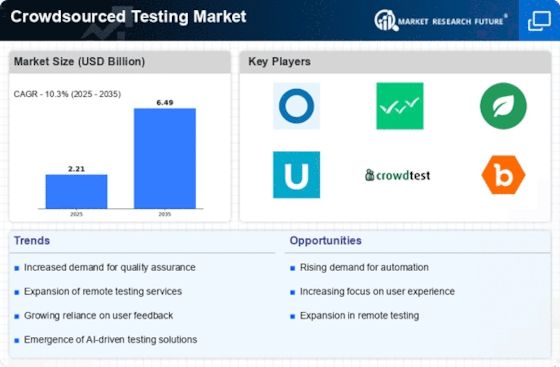
As per Market Research Future analysis, the Crowdsourced Testing Market Size was estimated at 2.206 USD Billion in 2024. The Crowdsourced Testing industry is projected to grow from 2.433 USD Billion in 2025 to 6.485 USD Billion by 2035, exhibiting a compound annual growth rate (CAGR) of 10.3% during the forecast period 2025 - 2035

Key Market Trends & Highlights

The Crowdsourced Testing Market is experiencing robust growth driven by technological advancements and evolving user expectations.

  • The market is witnessing increased adoption of agile methodologies, enhancing the efficiency of testing processes. Diverse tester demographics are contributing to a broader range of insights and perspectives in testing outcomes. AI-driven testing solutions are emerging, indicating a shift towards more automated and intelligent testing frameworks. The growing demand for quality assurance and the cost-effectiveness of crowdsourced testing are major drivers, particularly in North America and the Asia-Pacific region, with functional testing being the largest segment and security testing the fastest-growing.

Market Size & Forecast

2024 Market Size 2.206 (USD Billion)
2035 Market Size 6.485 (USD Billion)
CAGR (2025 - 2035) 10.3%
Largest Regional Market Share in 2024 North America

Major Players

Applause (US), Testbirds (DE), Rainforest QA (US), uTest (US), Crowdtest (IT), Global App Testing (GB), Bugcrowd (US), UserTesting (US)

Market Trends

The Crowdsourced Testing Market is currently experiencing a notable evolution, driven by the increasing demand for high-quality software and applications. Organizations are recognizing the value of leveraging diverse user perspectives to enhance product quality and user experience. This approach not only accelerates the testing process but also allows for the identification of issues that may not be apparent through traditional testing methods. As technology continues to advance, the integration of crowdsourced testing into development cycles appears to be becoming a standard practice, reflecting a shift towards more agile methodologies. Crowdsourced software testing, also referred to as crowdsourcing software testing, is a quality assurance approach that leverages a distributed network of real users and professional testers to evaluate applications across diverse devices, geographies, and environments. This crowdsourced testing model enables organizations to accelerate release cycles while improving product reliability and user experience. The global crowdsourced testing market is experiencing notable evolution, driven by rising demand for crowdsourced QA and scalable crowdsourced software testing solutions across industries. Organizations are increasingly adopting crowdsourced QA testing to identify real-world usability issues, compatibility errors, and performance bottlenecks before product deployment. These crowdsourced testing companies are continuously investing in AI-driven automation, global tester communities, and advanced crowd testing platforms to strengthen service offerings.

The surge in crowdsourcing mobile testing reflects the growing need to validate applications across multiple operating systems, device types, and network conditions. Small and medium enterprises are increasingly leveraging crowd testing services to reduce internal infrastructure costs while gaining access to global tester communities. Many crowdsourced testing sites are expanding geographically to provide localized and real-time feedback for global enterprises. The evolution of the crowdsourced testing pay structure, including performance-based compensation models, is expected to further attract skilled testers worldwide.

Moreover, the rise of remote work and The Crowdsourced Testing Market. Companies are now able to tap into a vast pool of testers from various geographical locations, which enriches the testing process with varied insights and experiences. This trend suggests that organizations are increasingly prioritizing flexibility and adaptability in their testing strategies. As the market evolves, it is likely that new tools and platforms will emerge, enhancing the efficiency and effectiveness of crowdsourced testing initiatives, thereby solidifying its role in the software development lifecycle.

Increased Adoption of Agile Methodologies

The Crowdsourced Testing Market is witnessing a growing trend towards the adoption of agile methodologies. Organizations are increasingly integrating crowdsourced testing into their agile frameworks, allowing for continuous feedback and rapid iterations. This shift enables teams to respond swiftly to user needs and market changes, enhancing overall product quality.

Diverse Tester Demographics

A notable trend within the Crowdsourced Testing Market is the emphasis on diverse tester demographics. Companies are recognizing the importance of including testers from various backgrounds, cultures, and experiences. This diversity not only enriches the testing process but also ensures that products are more inclusive and accessible to a broader audience.

Emergence of AI-Driven Testing Solutions

The Crowdsourced Testing Market is also seeing the emergence of AI-driven testing solutions. These technologies are being utilized to streamline the testing process, automate repetitive tasks, and analyze large volumes of data. The integration of artificial intelligence is likely to enhance the efficiency and accuracy of crowdsourced testing efforts.

Crowdsourced Testing Market Market Drivers

Increased Focus on User Experience

The Crowdsourced Testing Market is significantly influenced by the heightened focus on user experience. In an era where customer satisfaction is paramount, organizations are keen to ensure that their software products meet user expectations. Crowdsourced testing allows for real-world feedback from actual users, providing invaluable insights into usability and functionality. This user-centric approach is becoming increasingly vital as companies strive to differentiate themselves in competitive markets. The emphasis on user experience is expected to drive the demand for crowdsourced testing services, as businesses recognize the importance of delivering high-quality, user-friendly applications.

Growing Demand for Quality Assurance

The Crowdsourced Testing Market is experiencing a notable surge in demand for quality assurance services. As businesses increasingly rely on software applications, the need for rigorous testing has become paramount. Companies are recognizing that traditional testing methods may not suffice in identifying all potential issues. This has led to a shift towards crowdsourced testing, where diverse groups of testers can provide varied insights. According to recent estimates, the market for quality assurance services is projected to reach substantial figures, indicating a robust growth trajectory. This trend suggests that organizations are willing to invest in comprehensive testing solutions to enhance user experience and satisfaction.

Expansion of Mobile and Web Applications

The rapid expansion of mobile and web applications is a significant driver of the Crowdsourced Testing Market. With the increasing reliance on digital platforms for various services, the demand for thorough testing of these applications has surged. Crowdsourced testing offers a practical solution, enabling companies to tap into a diverse pool of testers who can evaluate applications across different devices and environments. This is particularly important as users expect seamless performance regardless of the platform. The growth in mobile and web applications is anticipated to continue, thereby fueling the need for effective testing solutions that crowdsourced testing can provide.

Cost-Effectiveness of Crowdsourced Testing

One of the compelling drivers of the Crowdsourced Testing Market is the cost-effectiveness associated with this approach. Organizations are increasingly seeking ways to optimize their testing budgets while maintaining high standards of quality. Crowdsourced testing offers a flexible and scalable solution, allowing companies to access a wide pool of testers without the overhead costs of maintaining an in-house team. This model not only reduces expenses but also accelerates the testing process, enabling faster time-to-market for software products. As businesses continue to prioritize cost efficiency, the adoption of crowdsourced testing is likely to rise, further propelling market growth.

Technological Advancements in Testing Tools

Technological advancements are playing a crucial role in shaping the Crowdsourced Testing Market. The emergence of sophisticated testing tools and platforms has made it easier for organizations to implement crowdsourced testing strategies. These tools facilitate seamless collaboration between testers and developers, enhancing the overall efficiency of the testing process. Furthermore, innovations such as automated testing and AI-driven analytics are being integrated into crowdsourced testing frameworks, providing deeper insights and faster results. As technology continues to evolve, it is likely that the crowdsourced testing landscape will become more dynamic, attracting more businesses to adopt this approach.

Market Segment Insights

By Type: Functional Testing (Largest) vs. Security Testing (Fastest-Growing)

The Crowdsourced Testing Market is characterized by various segments, with Functional Testing taking the lead due to its widespread use across many industries. Functional Testing accounts for a significant portion of the market as it ensures that products meet the required specifications and performance criteria. In contrast, <a href="security%20testing%20-%20https://www.marketresearchfuture.com/reports/security-testing-market-6705">Security Testing </a>is gaining ground rapidly as organizations increasingly focus on protecting their applications and systems from vulnerabilities, reflecting a shift towards prioritizing security in the development lifecycle. The growth trends within these segments indicate a rising demand for comprehensive testing solutions. The emphasis on maintaining and improving user experience is driving more businesses to adopt Functional Testing. Meanwhile, rising cyber threats and regulatory requirements are propelling <a href="security%20testing%20-%20https://www.marketresearchfuture.com/reports/security-testing-market-6705">Security Testing </a>to the forefront, establishing it as the fastest-growing segment in the market. These trends illustrate the dynamic nature of crowdsourced testing, where adaptability to market needs is crucial for success.

Functional Testing (Dominant) vs. Localization Testing (Emerging)

Functional Testing remains the dominant force in the Crowdsourced Testing Market as it meticulously checks for the accuracy and reliability of software applications against functional requirements. Its established presence is underscored by widespread adoption across diverse sectors including e-commerce, healthcare, and finance, where meeting specifications is non-negotiable. Conversely, Localization Testing emerges as a critical segment, focusing on adapting applications for specific regional markets. With globalization increasingly penetrating the technology sphere, companies are realizing the importance of ensuring that their products resonate with local languages and cultures. This adaptation not only enhances user satisfaction but also expands market reach, positioning Localization Testing as a valuable asset for brands looking to succeed in international environments.

By Platform: Mobile Based (Largest) vs. Web-Based (Fastest-Growing)

The Crowdsourced Testing Market exhibits a diverse platform distribution, prominently featuring Mobile Based services, which command the majority share. This segment has captivated a broad user base, largely due to the proliferation of <a href="mobile%20application%20-%20https://www.marketresearchfuture.com/reports/mobile-application-market-4497">mobile applications </a>and the growing reliance on mobile platforms for daily operations. Web-Based platforms, while currently smaller in market share, are experiencing rapid adoption, thus contributing to a dynamic competitive landscape within the market.

Mobile Based (Dominant) vs. Web-Based (Emerging)

Mobile Based platforms stand as the dominant segment within the Crowdsourced Testing Market, bolstered by the immense growth in <a href="mobile%20app%20development%20-%20https://www.marketresearchfuture.com/reports/mobile-app-development-market-1752">mobile app development </a>and usage. This segment leverages the ubiquity of smartphones and ensures extensive testing capabilities across various devices. It supports an extensive range of applications, from gaming to enterprise tools, focusing on real-time feedback and effective bug tracking. Conversely, Web-Based platforms are rapidly emerging, driven by the increasing necessity for comprehensive online solutions. This segment benefits from adaptive testing environments that cater to diverse user needs, enhancing website and application <a href="performance%20analytics%20-%20https://www.marketresearchfuture.com/reports/performance-analytics-market-2761">performance analytics</a>. Both platforms play a crucial role, ensuring product reliability and superior user experiences in a competitive online marketplace.

By Organization Size: Large Enterprises (Largest) vs. Small & Medium Enterprises (Fastest-Growing)

In the Crowdsourced Testing Market, the distribution of market share is significantly skewed in favor of large enterprises, which dominate the landscape due to their abundant resources and extensive testing requirements. These organizations utilize crowdsourced testing to streamline their processes, reduce time to market, and enhance product quality, which further solidifies their position within the market. Conversely, small and medium enterprises (SMEs) are witnessing a rapid increase in their market share as they adopt agile methodologies and digital solutions. Their unique ability to quickly adapt to changing customer needs is enabling them to leverage crowdsourced testing effectively, thus catering to their diverse product offerings.

Large Enterprises (Dominant) vs. Small &amp; Medium Enterprises (Emerging)

Large enterprises are characterized by their established brands, substantial budgets, and complex product portfolios, which necessitate comprehensive testing solutions. They typically prioritize thoroughness over speed, utilizing crowdsourced testing to mitigate risks associated with product launches. In contrast, small and medium enterprises are emerging players in the market, driven by their agility and innovative approaches. They are increasingly turning to crowdsourced testing to achieve cost-effective solutions and faster feedback cycles, enabling them to compete with larger players. This adaptability, combined with the rising demand for specialized testing services, positions SMEs as a dynamic force within the Crowdsourced Testing Market, poised for growth.

By Vertical: BFSI (Largest) vs. IT & Telecommunication (Fastest-Growing)

In the Crowdsourced Testing Market, the BFSI sector holds the largest share, as financial institutions increasingly rely on testing solutions to ensure security and compliance. Meanwhile, the IT &amp; Telecommunication sector is witnessing rapid growth, driven by the rise of agile methodologies and the need for continuous software integration and delivery. Other segments, such as Retail and Consumer Goods, Healthcare &amp; Life Sciences, and Media &amp; Entertainment, also contribute to the market but to a lesser extent, focusing on enhancing user experience and ensuring high-quality digital applications. The growth trends within these verticals highlight a shift towards more digital and connected solutions in BFSI and IT &amp; Telecommunication. Factors driving this change include the increasing complexity of software applications and the demand for rapid deployments in a competitive landscape. As the Crowdsourced Testing Market matures, organizations are prioritizing quality assurance and end-user satisfaction, particularly in the fastest-growing segments, which are becoming critical for business success.

BFSI: Dominant vs. IT &amp; Telecommunication: Emerging

The BFSI segment stands out as the dominant force in the Crowdsourced Testing Market, attributed to its rigorous regulatory frameworks and the inherent need for reliable software solutions to maintain consumer trust. Institutions in this sector leverage crowdsourced testing to enhance security measures and create seamless banking experiences. On the other hand, IT &amp; Telecommunication emerges as a rapidly growing segment, propelled by innovations in technology and the necessity for rapid testing cycles to keep up with market demands. Companies in this arena are increasingly adopting crowdsourced testing to harness vast pools of testers, enabling them to deliver robust applications swiftly while maintaining high quality. This dual dynamic underscores the evolving landscape of the Crowdsourced Testing Market, where both established and emerging parameters are crucial.

Get more detailed insights about Crowdsourced Testing Market Research Report - Global Forecast till 2035

Regional Insights

By Region, the study provides the market insights into North America, Europe, Asia-Pacific and Rest of the World. North America is predicted to hold a substantial share over the forecast period, owing to the fast use of sophisticated technologies such as cloud computing. The North American government is aiding crowdsourced testing service providers in implementing successful crowdsourced testing solutions. North America is a technological hub. As a result, the government has established tight criteria for security crowdsourcing testing services.

Further, the major countries studied in the market report are The U.S., Canada, German, France, the UK, Italy, Spain, China, Japan, India, Australia, South Korea, and Brazil.

Figure 3: CROWDSOURCED TESTING MARKET SHARE BY REGION 2022 (%)

Europe crowdsourced testing market accounts for the second-largest market share due to the region's early embrace of new technology and the availability of crowdsourced testing service providers. Further, the German crowdsourced testing market held the largest market share, and the UK crowdsourced testing market was the fastest growing market in the European region

The Asia-Pacific Crowdsourced Testing Market is expected to grow at the fastest CAGR from 2023 to 2030. This is due of the expanding IT sector in countries such as China, Japan, and India. Moreover, China’s crowdsourced testing market held the largest market share, and the Indian crowdsourced testing market was the fastest growing market in the Asia-Pacific region.

For instance, Americans are actively pursuing a physically active lifestyle and are becoming more health concerned. The expansion and growth of the industry have been aided by an increase in the number of health clubs and fitness facilities across the nation.

Key Players and Competitive Insights

Leading market players are extensively spending in R&D to develop their product offerings, which will assist the crowdsourced testing market grow even more. Market participants are also engaging in a number of strategic initiatives to grow their worldwide presence, with significant market developments including new product launches, contractual agreements, mergers and acquisitions, increased investments, and collaboration with other organizations. To grow and survive in a more competitive and increasing market climate, the crowdsourced testing industry must provide cost-effective products. Leading crowd testing companies are focusing on optimizing crowd source testing costs by offering flexible engagement models and pay-per-bug pricing structures.
Producing locally to reduce operational costs is one of the most important business strategies employed by manufacturers in the worldwide crowdsourced testing industry to serve clients and expand the market sector. During recent years, the crowdsourced testing industry has provided some of the most significant benefits to medicine. Test birds are a major player in the crowdsourced testing industry. The applause test IO Synack by Cobalt Labs Crowdsourced Testing Market Quality Flatworld Solutions Rainforest App Testing QA Infotech Infosys and others are committed to reduce their production costs. On the other side, they endeavor to give customers with better-equipped merchandise.
They also want to broaden the applications of crowdsourced testing.
Nomura Research Institute, Ltd. (NRI) is a component of the Nomura Group and Japan's largest economic research and consultancy organization. The company was founded in 1965 and presently employs over 13,000 employees. It has 10 Japanese subsidiaries and many international companies in India, New York City, Dallas, London, Seoul, Shanghai, Beijing, Hong Kong, Moscow, Taipei, the Philippines, Singapore, Bangkok, and Jakarta.
In May Nomura Research Institute, Ltd. has announced the acquisition of SQA Holdco Pty Ltd, the parent company of Planit Test Management Solutions Pty Ltd. Planit was a market leader in crowdsourced testing.
Infosys Ltd is a Indian information technology corporation that specializes in business consulting, information technology, and outsourcing. The company was established in Pune and has its headquarters in Bangalore. According to the Forbes 2000 list, Infosys is the second-biggest Indian IT business, after Tata Consultancy Services, in terms of revenue in 2020, and the 602nd largest public company in the world.
In February Infosys partnered with Applause App Quality, a crowdsourced testing service provider. The collaboration would assist Infosys in developing end-to-end testing services for its clients.
The collaboration would strengthen Applause's ability to provide clients with high-quality digital testing services. Furthermore, the firms will ensure that Infosys clients' digital experiences are re-validated by actual customers and highly verified testers before new features are released to the market, hence increasing their clients' customer satisfaction ratings.

Key Companies in the Crowdsourced Testing Market include

Industry Developments

  • Q2 2024: Testlio raises $12M Series B to expand its crowdsourced software testing platform Testlio, a leading crowdsourced testing company, announced a $12 million Series B funding round to accelerate product development and expand its global tester network.
  • Q1 2024: Applause Announces Partnership with Microsoft to Enhance App Quality Through Crowdsourced Testing Market Applause, a major crowdsourced testing provider, entered a strategic partnership with Microsoft to integrate its testing services into Microsoft’s developer ecosystem.
  • Q2 2024: Global App Testing Appoints New CEO to Drive Next Phase of Growth Global App Testing, a crowdsourced QA platform, announced the appointment of a new CEO to lead the company’s expansion and innovation strategy.
  • Q3 2024: Testbirds Launches AI-Powered Test Case Generation for Crowdsourced Testing Market Testbirds, a European crowdsourced testing firm, launched a new AI-powered feature that automates test case generation, aiming to improve testing efficiency for clients.
  • Q2 2024: uTest expands operations with new testing center in India uTest, a prominent crowdsourced testing platform, opened a new facility in Bangalore, India, to support its growing client base and enhance service delivery in the APAC region.
  • Q1 2025: Crowd4Test Secures Major Contract with European Fintech Firm Crowd4Test, a crowdsourced software testing provider, announced it has won a multi-year contract to provide QA services for a leading European fintech company.
  • Q2 2025: Testlio Acquires QAonDemand to Broaden Crowdsourced Testing Market Capabilities Testlio acquired QAonDemand, a move aimed at expanding its service offerings and increasing its global tester community.
  • Q1 2024: Applause Launches Accessibility Testing Suite for Digital Products Applause introduced a new accessibility testing suite, leveraging its global crowd to help companies meet digital accessibility standards.
  • Q3 2024: Testbirds Partners with SAP to Deliver Enhanced Crowdsourced Testing Market for Enterprise Clients Testbirds announced a partnership with SAP to provide integrated crowdsourced testing solutions for SAP’s enterprise software customers.
  • Q2 2024: Global App Testing Raises $10M Series A to Accelerate International Expansion Global App Testing secured $10 million in Series A funding to support its international growth and further develop its crowdsourced testing platform.

Future Outlook

Crowdsourced Testing Market Future Outlook

The Crowdsourced Testing Market is projected to grow at a 10.3% CAGR from 2025 to 2035, driven by increasing demand for quality assurance and rapid software development cycles.

New opportunities lie in:

  • <p>Expansion into emerging markets with localized testing services. Development of AI-driven testing tools to enhance efficiency. Partnerships with educational institutions for talent sourcing and training.</p>

By 2035, the market is expected to solidify its position as a critical component of software development.

Market Segmentation

Crowdsourced Testing Market Type Outlook

  • Functional Testing
  • Security Testing
  • Usability Testing
  • Localization Testing
  • Others

Crowdsourced Testing Market Platform Outlook

  • Mobile Based
  • Web-Based
  • Others

Crowdsourced Testing Market Vertical Outlook

  • BFSI
  • IT & Telecommunication
  • Retail and Consumer Goods
  • Healthcare & Life Sciences
  • Media & Entertainment
  • Others

Crowdsourced Testing Market Organization Size Outlook

  • Large Enterprises
  • Small & Medium Enterprises

Report Scope

MARKET SIZE 2024 2.206(USD Billion)
MARKET SIZE 2025 2.433(USD Billion)
MARKET SIZE 2035 6.485(USD Billion)
COMPOUND ANNUAL GROWTH RATE (CAGR) 10.3% (2025 - 2035)
REPORT COVERAGE Revenue Forecast, Competitive Landscape, Growth Factors, and Trends
BASE YEAR 2024
Market Forecast Period 2025 - 2035
Historical Data 2019 - 2024
Market Forecast Units USD Billion
Key Companies Profiled Applause (US), Testbirds (DE), Rainforest QA (US), uTest (US), Crowdtest (IT), Global App Testing (GB), Bugcrowd (US), UserTesting (US)
Segments Covered Type, Platform, Region
Key Market Opportunities Integration of artificial intelligence enhances efficiency and accuracy in the Crowdsourced Testing Market.
Key Market Dynamics Rising demand for agile software development drives growth in crowdsourced testing, enhancing quality assurance and user experience.
Countries Covered North America, Europe, APAC, South America, MEA

FAQs

What is the projected market valuation of the Crowdsourced Testing Market by 2035?

<p>The Crowdsourced Testing Market is projected to reach a valuation of 6.485 USD Billion by 2035.</p>

What was the market valuation of the Crowdsourced Testing Market in 2024?

<p>In 2024, the Crowdsourced Testing Market had a valuation of 2.206 USD Billion.</p>

What is the expected CAGR for the Crowdsourced Testing Market during the forecast period 2025 - 2035?

<p>The expected CAGR for the Crowdsourced Testing Market during the forecast period 2025 - 2035 is 10.3%.</p>

Which companies are considered key players in the Crowdsourced Testing Market?

<p>Key players in the Crowdsourced Testing Market include Applause, Testbirds, Rainforest QA, uTest, Crowdtest, Global App Testing, Bugcrowd, and UserTesting.</p>

What are the main segments of the Crowdsourced Testing Market?

<p>The main segments of the Crowdsourced Testing Market include Functional Testing, Security Testing, Usability Testing, Localization Testing, and others.</p>

How does the Crowdsourced Testing Market perform in terms of organization size?

<p>The market shows a valuation of 1.323 USD Billion for large enterprises and 0.883 USD Billion for small and medium enterprises.</p>

What is the valuation of the Crowdsourced Testing Market for mobile-based platforms?

<p>The valuation for mobile-based platforms in the Crowdsourced Testing Market is 2.546 USD Billion.</p>

Which verticals are driving growth in the Crowdsourced Testing Market?

<p>Key verticals driving growth include BFSI, IT & Telecommunication, Retail and Consumer Goods, and Healthcare & Life Sciences.</p>

What was the valuation for usability testing in the Crowdsourced Testing Market in 2024?

<p>In 2024, the valuation for usability testing in the Crowdsourced Testing Market was 0.441 USD Billion.</p>

What is the projected growth for web-based platforms in the Crowdsourced Testing Market by 2035?

<p>The projected valuation for web-based platforms in the Crowdsourced Testing Market is expected to reach 2.546 USD Billion by 2035.</p>

  1. SECTION I: EXECUTIVE SUMMARY AND KEY HIGHLIGHTS
    1. | 1.1 EXECUTIVE SUMMARY
    2. | | 1.1.1 Market Overview
    3. | | 1.1.2 Key Findings
    4. | | 1.1.3 Market Segmentation
    5. | | 1.1.4 Competitive Landscape
    6. | | 1.1.5 Challenges and Opportunities
    7. | | 1.1.6 Future Outlook
  2. SECTION II: SCOPING, METHODOLOGY AND MARKET STRUCTURE
    1. | 2.1 MARKET INTRODUCTION
    2. | | 2.1.1 Definition
    3. | | 2.1.2 Scope of the study
    4. | | | 2.1.2.1 Research Objective
    5. | | | 2.1.2.2 Assumption
    6. | | | 2.1.2.3 Limitations
    7. | 2.2 RESEARCH METHODOLOGY
    8. | | 2.2.1 Overview
    9. | | 2.2.2 Data Mining
    10. | | 2.2.3 Secondary Research
    11. | | 2.2.4 Primary Research
    12. | | | 2.2.4.1 Primary Interviews and Information Gathering Process
    13. | | | 2.2.4.2 Breakdown of Primary Respondents
    14. | | 2.2.5 Forecasting Model
    15. | | 2.2.6 Market Size Estimation
    16. | | | 2.2.6.1 Bottom-Up Approach
    17. | | | 2.2.6.2 Top-Down Approach
    18. | | 2.2.7 Data Triangulation
    19. | | 2.2.8 Validation
  3. SECTION III: QUALITATIVE ANALYSIS
    1. | 3.1 MARKET DYNAMICS
    2. | | 3.1.1 Overview
    3. | | 3.1.2 Drivers
    4. | | 3.1.3 Restraints
    5. | | 3.1.4 Opportunities
    6. | 3.2 MARKET FACTOR ANALYSIS
    7. | | 3.2.1 Value chain Analysis
    8. | | 3.2.2 Porter's Five Forces Analysis
    9. | | | 3.2.2.1 Bargaining Power of Suppliers
    10. | | | 3.2.2.2 Bargaining Power of Buyers
    11. | | | 3.2.2.3 Threat of New Entrants
    12. | | | 3.2.2.4 Threat of Substitutes
    13. | | | 3.2.2.5 Intensity of Rivalry
    14. | | 3.2.3 COVID-19 Impact Analysis
    15. | | | 3.2.3.1 Market Impact Analysis
    16. | | | 3.2.3.2 Regional Impact
    17. | | | 3.2.3.3 Opportunity and Threat Analysis
  4. SECTION IV: QUANTITATIVE ANALYSIS
    1. | 4.1 Information and Communications Technology, BY Type (USD Billion)
    2. | | 4.1.1 Functional Testing
    3. | | 4.1.2 Security Testing
    4. | | 4.1.3 Usability Testing
    5. | | 4.1.4 Localization Testing
    6. | | 4.1.5 Others
    7. | 4.2 Information and Communications Technology, BY Platform (USD Billion)
    8. | | 4.2.1 Mobile Based
    9. | | 4.2.2 Web-Based
    10. | | 4.2.3 Others
    11. | 4.3 Information and Communications Technology, BY Organization Size (USD Billion)
    12. | | 4.3.1 Large Enterprises
    13. | | 4.3.2 Small & Medium Enterprises
    14. | 4.4 Information and Communications Technology, BY Vertical (USD Billion)
    15. | | 4.4.1 BFSI
    16. | | 4.4.2 IT & Telecommunication
    17. | | 4.4.3 Retail and Consumer Goods
    18. | | 4.4.4 Healthcare & Life Sciences
    19. | | 4.4.5 Media & Entertainment
    20. | | 4.4.6 Others
    21. | 4.5 Information and Communications Technology, BY Region (USD Billion)
    22. | | 4.5.1 North America
    23. | | | 4.5.1.1 US
    24. | | | 4.5.1.2 Canada
    25. | | 4.5.2 Europe
    26. | | | 4.5.2.1 Germany
    27. | | | 4.5.2.2 UK
    28. | | | 4.5.2.3 France
    29. | | | 4.5.2.4 Russia
    30. | | | 4.5.2.5 Italy
    31. | | | 4.5.2.6 Spain
    32. | | | 4.5.2.7 Rest of Europe
    33. | | 4.5.3 APAC
    34. | | | 4.5.3.1 China
    35. | | | 4.5.3.2 India
    36. | | | 4.5.3.3 Japan
    37. | | | 4.5.3.4 South Korea
    38. | | | 4.5.3.5 Malaysia
    39. | | | 4.5.3.6 Thailand
    40. | | | 4.5.3.7 Indonesia
    41. | | | 4.5.3.8 Rest of APAC
    42. | | 4.5.4 South America
    43. | | | 4.5.4.1 Brazil
    44. | | | 4.5.4.2 Mexico
    45. | | | 4.5.4.3 Argentina
    46. | | | 4.5.4.4 Rest of South America
    47. | | 4.5.5 MEA
    48. | | | 4.5.5.1 GCC Countries
    49. | | | 4.5.5.2 South Africa
    50. | | | 4.5.5.3 Rest of MEA
  5. SECTION V: COMPETITIVE ANALYSIS
    1. | 5.1 Competitive Landscape
    2. | | 5.1.1 Overview
    3. | | 5.1.2 Competitive Analysis
    4. | | 5.1.3 Market share Analysis
    5. | | 5.1.4 Major Growth Strategy in the Information and Communications Technology
    6. | | 5.1.5 Competitive Benchmarking
    7. | | 5.1.6 Leading Players in Terms of Number of Developments in the Information and Communications Technology
    8. | | 5.1.7 Key developments and growth strategies
    9. | | | 5.1.7.1 New Product Launch/Service Deployment
    10. | | | 5.1.7.2 Merger & Acquisitions
    11. | | | 5.1.7.3 Joint Ventures
    12. | | 5.1.8 Major Players Financial Matrix
    13. | | | 5.1.8.1 Sales and Operating Income
    14. | | | 5.1.8.2 Major Players R&D Expenditure. 2023
    15. | 5.2 Company Profiles
    16. | | 5.2.1 Applause (US)
    17. | | | 5.2.1.1 Financial Overview
    18. | | | 5.2.1.2 Products Offered
    19. | | | 5.2.1.3 Key Developments
    20. | | | 5.2.1.4 SWOT Analysis
    21. | | | 5.2.1.5 Key Strategies
    22. | | 5.2.2 Testbirds (DE)
    23. | | | 5.2.2.1 Financial Overview
    24. | | | 5.2.2.2 Products Offered
    25. | | | 5.2.2.3 Key Developments
    26. | | | 5.2.2.4 SWOT Analysis
    27. | | | 5.2.2.5 Key Strategies
    28. | | 5.2.3 Rainforest QA (US)
    29. | | | 5.2.3.1 Financial Overview
    30. | | | 5.2.3.2 Products Offered
    31. | | | 5.2.3.3 Key Developments
    32. | | | 5.2.3.4 SWOT Analysis
    33. | | | 5.2.3.5 Key Strategies
    34. | | 5.2.4 uTest (US)
    35. | | | 5.2.4.1 Financial Overview
    36. | | | 5.2.4.2 Products Offered
    37. | | | 5.2.4.3 Key Developments
    38. | | | 5.2.4.4 SWOT Analysis
    39. | | | 5.2.4.5 Key Strategies
    40. | | 5.2.5 Crowdtest (IT)
    41. | | | 5.2.5.1 Financial Overview
    42. | | | 5.2.5.2 Products Offered
    43. | | | 5.2.5.3 Key Developments
    44. | | | 5.2.5.4 SWOT Analysis
    45. | | | 5.2.5.5 Key Strategies
    46. | | 5.2.6 Global App Testing (GB)
    47. | | | 5.2.6.1 Financial Overview
    48. | | | 5.2.6.2 Products Offered
    49. | | | 5.2.6.3 Key Developments
    50. | | | 5.2.6.4 SWOT Analysis
    51. | | | 5.2.6.5 Key Strategies
    52. | | 5.2.7 Bugcrowd (US)
    53. | | | 5.2.7.1 Financial Overview
    54. | | | 5.2.7.2 Products Offered
    55. | | | 5.2.7.3 Key Developments
    56. | | | 5.2.7.4 SWOT Analysis
    57. | | | 5.2.7.5 Key Strategies
    58. | | 5.2.8 UserTesting (US)
    59. | | | 5.2.8.1 Financial Overview
    60. | | | 5.2.8.2 Products Offered
    61. | | | 5.2.8.3 Key Developments
    62. | | | 5.2.8.4 SWOT Analysis
    63. | | | 5.2.8.5 Key Strategies
    64. | 5.3 Appendix
    65. | | 5.3.1 References
    66. | | 5.3.2 Related Reports
  6. LIST OF FIGURES
    1. | 6.1 MARKET SYNOPSIS
    2. | 6.2 NORTH AMERICA MARKET ANALYSIS
    3. | 6.3 US MARKET ANALYSIS BY TYPE
    4. | 6.4 US MARKET ANALYSIS BY PLATFORM
    5. | 6.5 US MARKET ANALYSIS BY ORGANIZATION SIZE
    6. | 6.6 US MARKET ANALYSIS BY VERTICAL
    7. | 6.7 CANADA MARKET ANALYSIS BY TYPE
    8. | 6.8 CANADA MARKET ANALYSIS BY PLATFORM
    9. | 6.9 CANADA MARKET ANALYSIS BY ORGANIZATION SIZE
    10. | 6.10 CANADA MARKET ANALYSIS BY VERTICAL
    11. | 6.11 EUROPE MARKET ANALYSIS
    12. | 6.12 GERMANY MARKET ANALYSIS BY TYPE
    13. | 6.13 GERMANY MARKET ANALYSIS BY PLATFORM
    14. | 6.14 GERMANY MARKET ANALYSIS BY ORGANIZATION SIZE
    15. | 6.15 GERMANY MARKET ANALYSIS BY VERTICAL
    16. | 6.16 UK MARKET ANALYSIS BY TYPE
    17. | 6.17 UK MARKET ANALYSIS BY PLATFORM
    18. | 6.18 UK MARKET ANALYSIS BY ORGANIZATION SIZE
    19. | 6.19 UK MARKET ANALYSIS BY VERTICAL
    20. | 6.20 FRANCE MARKET ANALYSIS BY TYPE
    21. | 6.21 FRANCE MARKET ANALYSIS BY PLATFORM
    22. | 6.22 FRANCE MARKET ANALYSIS BY ORGANIZATION SIZE
    23. | 6.23 FRANCE MARKET ANALYSIS BY VERTICAL
    24. | 6.24 RUSSIA MARKET ANALYSIS BY TYPE
    25. | 6.25 RUSSIA MARKET ANALYSIS BY PLATFORM
    26. | 6.26 RUSSIA MARKET ANALYSIS BY ORGANIZATION SIZE
    27. | 6.27 RUSSIA MARKET ANALYSIS BY VERTICAL
    28. | 6.28 ITALY MARKET ANALYSIS BY TYPE
    29. | 6.29 ITALY MARKET ANALYSIS BY PLATFORM
    30. | 6.30 ITALY MARKET ANALYSIS BY ORGANIZATION SIZE
    31. | 6.31 ITALY MARKET ANALYSIS BY VERTICAL
    32. | 6.32 SPAIN MARKET ANALYSIS BY TYPE
    33. | 6.33 SPAIN MARKET ANALYSIS BY PLATFORM
    34. | 6.34 SPAIN MARKET ANALYSIS BY ORGANIZATION SIZE
    35. | 6.35 SPAIN MARKET ANALYSIS BY VERTICAL
    36. | 6.36 REST OF EUROPE MARKET ANALYSIS BY TYPE
    37. | 6.37 REST OF EUROPE MARKET ANALYSIS BY PLATFORM
    38. | 6.38 REST OF EUROPE MARKET ANALYSIS BY ORGANIZATION SIZE
    39. | 6.39 REST OF EUROPE MARKET ANALYSIS BY VERTICAL
    40. | 6.40 APAC MARKET ANALYSIS
    41. | 6.41 CHINA MARKET ANALYSIS BY TYPE
    42. | 6.42 CHINA MARKET ANALYSIS BY PLATFORM
    43. | 6.43 CHINA MARKET ANALYSIS BY ORGANIZATION SIZE
    44. | 6.44 CHINA MARKET ANALYSIS BY VERTICAL
    45. | 6.45 INDIA MARKET ANALYSIS BY TYPE
    46. | 6.46 INDIA MARKET ANALYSIS BY PLATFORM
    47. | 6.47 INDIA MARKET ANALYSIS BY ORGANIZATION SIZE
    48. | 6.48 INDIA MARKET ANALYSIS BY VERTICAL
    49. | 6.49 JAPAN MARKET ANALYSIS BY TYPE
    50. | 6.50 JAPAN MARKET ANALYSIS BY PLATFORM
    51. | 6.51 JAPAN MARKET ANALYSIS BY ORGANIZATION SIZE
    52. | 6.52 JAPAN MARKET ANALYSIS BY VERTICAL
    53. | 6.53 SOUTH KOREA MARKET ANALYSIS BY TYPE
    54. | 6.54 SOUTH KOREA MARKET ANALYSIS BY PLATFORM
    55. | 6.55 SOUTH KOREA MARKET ANALYSIS BY ORGANIZATION SIZE
    56. | 6.56 SOUTH KOREA MARKET ANALYSIS BY VERTICAL
    57. | 6.57 MALAYSIA MARKET ANALYSIS BY TYPE
    58. | 6.58 MALAYSIA MARKET ANALYSIS BY PLATFORM
    59. | 6.59 MALAYSIA MARKET ANALYSIS BY ORGANIZATION SIZE
    60. | 6.60 MALAYSIA MARKET ANALYSIS BY VERTICAL
    61. | 6.61 THAILAND MARKET ANALYSIS BY TYPE
    62. | 6.62 THAILAND MARKET ANALYSIS BY PLATFORM
    63. | 6.63 THAILAND MARKET ANALYSIS BY ORGANIZATION SIZE
    64. | 6.64 THAILAND MARKET ANALYSIS BY VERTICAL
    65. | 6.65 INDONESIA MARKET ANALYSIS BY TYPE
    66. | 6.66 INDONESIA MARKET ANALYSIS BY PLATFORM
    67. | 6.67 INDONESIA MARKET ANALYSIS BY ORGANIZATION SIZE
    68. | 6.68 INDONESIA MARKET ANALYSIS BY VERTICAL
    69. | 6.69 REST OF APAC MARKET ANALYSIS BY TYPE
    70. | 6.70 REST OF APAC MARKET ANALYSIS BY PLATFORM
    71. | 6.71 REST OF APAC MARKET ANALYSIS BY ORGANIZATION SIZE
    72. | 6.72 REST OF APAC MARKET ANALYSIS BY VERTICAL
    73. | 6.73 SOUTH AMERICA MARKET ANALYSIS
    74. | 6.74 BRAZIL MARKET ANALYSIS BY TYPE
    75. | 6.75 BRAZIL MARKET ANALYSIS BY PLATFORM
    76. | 6.76 BRAZIL MARKET ANALYSIS BY ORGANIZATION SIZE
    77. | 6.77 BRAZIL MARKET ANALYSIS BY VERTICAL
    78. | 6.78 MEXICO MARKET ANALYSIS BY TYPE
    79. | 6.79 MEXICO MARKET ANALYSIS BY PLATFORM
    80. | 6.80 MEXICO MARKET ANALYSIS BY ORGANIZATION SIZE
    81. | 6.81 MEXICO MARKET ANALYSIS BY VERTICAL
    82. | 6.82 ARGENTINA MARKET ANALYSIS BY TYPE
    83. | 6.83 ARGENTINA MARKET ANALYSIS BY PLATFORM
    84. | 6.84 ARGENTINA MARKET ANALYSIS BY ORGANIZATION SIZE
    85. | 6.85 ARGENTINA MARKET ANALYSIS BY VERTICAL
    86. | 6.86 REST OF SOUTH AMERICA MARKET ANALYSIS BY TYPE
    87. | 6.87 REST OF SOUTH AMERICA MARKET ANALYSIS BY PLATFORM
    88. | 6.88 REST OF SOUTH AMERICA MARKET ANALYSIS BY ORGANIZATION SIZE
    89. | 6.89 REST OF SOUTH AMERICA MARKET ANALYSIS BY VERTICAL
    90. | 6.90 MEA MARKET ANALYSIS
    91. | 6.91 GCC COUNTRIES MARKET ANALYSIS BY TYPE
    92. | 6.92 GCC COUNTRIES MARKET ANALYSIS BY PLATFORM
    93. | 6.93 GCC COUNTRIES MARKET ANALYSIS BY ORGANIZATION SIZE
    94. | 6.94 GCC COUNTRIES MARKET ANALYSIS BY VERTICAL
    95. | 6.95 SOUTH AFRICA MARKET ANALYSIS BY TYPE
    96. | 6.96 SOUTH AFRICA MARKET ANALYSIS BY PLATFORM
    97. | 6.97 SOUTH AFRICA MARKET ANALYSIS BY ORGANIZATION SIZE
    98. | 6.98 SOUTH AFRICA MARKET ANALYSIS BY VERTICAL
    99. | 6.99 REST OF MEA MARKET ANALYSIS BY TYPE
    100. | 6.100 REST OF MEA MARKET ANALYSIS BY PLATFORM
    101. | 6.101 REST OF MEA MARKET ANALYSIS BY ORGANIZATION SIZE
    102. | 6.102 REST OF MEA MARKET ANALYSIS BY VERTICAL
    103. | 6.103 KEY BUYING CRITERIA OF INFORMATION AND COMMUNICATIONS TECHNOLOGY
    104. | 6.104 RESEARCH PROCESS OF MRFR
    105. | 6.105 DRO ANALYSIS OF INFORMATION AND COMMUNICATIONS TECHNOLOGY
    106. | 6.106 DRIVERS IMPACT ANALYSIS: INFORMATION AND COMMUNICATIONS TECHNOLOGY
    107. | 6.107 RESTRAINTS IMPACT ANALYSIS: INFORMATION AND COMMUNICATIONS TECHNOLOGY
    108. | 6.108 SUPPLY / VALUE CHAIN: INFORMATION AND COMMUNICATIONS TECHNOLOGY
    109. | 6.109 INFORMATION AND COMMUNICATIONS TECHNOLOGY, BY TYPE, 2024 (% SHARE)
    110. | 6.110 INFORMATION AND COMMUNICATIONS TECHNOLOGY, BY TYPE, 2024 TO 2035 (USD Billion)
    111. | 6.111 INFORMATION AND COMMUNICATIONS TECHNOLOGY, BY PLATFORM, 2024 (% SHARE)
    112. | 6.112 INFORMATION AND COMMUNICATIONS TECHNOLOGY, BY PLATFORM, 2024 TO 2035 (USD Billion)
    113. | 6.113 INFORMATION AND COMMUNICATIONS TECHNOLOGY, BY ORGANIZATION SIZE, 2024 (% SHARE)
    114. | 6.114 INFORMATION AND COMMUNICATIONS TECHNOLOGY, BY ORGANIZATION SIZE, 2024 TO 2035 (USD Billion)
    115. | 6.115 INFORMATION AND COMMUNICATIONS TECHNOLOGY, BY VERTICAL, 2024 (% SHARE)
    116. | 6.116 INFORMATION AND COMMUNICATIONS TECHNOLOGY, BY VERTICAL, 2024 TO 2035 (USD Billion)
    117. | 6.117 BENCHMARKING OF MAJOR COMPETITORS
  7. LIST OF TABLES
    1. | 7.1 LIST OF ASSUMPTIONS
    2. | | 7.1.1
    3. | 7.2 North America MARKET SIZE ESTIMATES; FORECAST
    4. | | 7.2.1 BY TYPE, 2025-2035 (USD Billion)
    5. | | 7.2.2 BY PLATFORM, 2025-2035 (USD Billion)
    6. | | 7.2.3 BY ORGANIZATION SIZE, 2025-2035 (USD Billion)
    7. | | 7.2.4 BY VERTICAL, 2025-2035 (USD Billion)
    8. | 7.3 US MARKET SIZE ESTIMATES; FORECAST
    9. | | 7.3.1 BY TYPE, 2025-2035 (USD Billion)
    10. | | 7.3.2 BY PLATFORM, 2025-2035 (USD Billion)
    11. | | 7.3.3 BY ORGANIZATION SIZE, 2025-2035 (USD Billion)
    12. | | 7.3.4 BY VERTICAL, 2025-2035 (USD Billion)
    13. | 7.4 Canada MARKET SIZE ESTIMATES; FORECAST
    14. | | 7.4.1 BY TYPE, 2025-2035 (USD Billion)
    15. | | 7.4.2 BY PLATFORM, 2025-2035 (USD Billion)
    16. | | 7.4.3 BY ORGANIZATION SIZE, 2025-2035 (USD Billion)
    17. | | 7.4.4 BY VERTICAL, 2025-2035 (USD Billion)
    18. | 7.5 Europe MARKET SIZE ESTIMATES; FORECAST
    19. | | 7.5.1 BY TYPE, 2025-2035 (USD Billion)
    20. | | 7.5.2 BY PLATFORM, 2025-2035 (USD Billion)
    21. | | 7.5.3 BY ORGANIZATION SIZE, 2025-2035 (USD Billion)
    22. | | 7.5.4 BY VERTICAL, 2025-2035 (USD Billion)
    23. | 7.6 Germany MARKET SIZE ESTIMATES; FORECAST
    24. | | 7.6.1 BY TYPE, 2025-2035 (USD Billion)
    25. | | 7.6.2 BY PLATFORM, 2025-2035 (USD Billion)
    26. | | 7.6.3 BY ORGANIZATION SIZE, 2025-2035 (USD Billion)
    27. | | 7.6.4 BY VERTICAL, 2025-2035 (USD Billion)
    28. | 7.7 UK MARKET SIZE ESTIMATES; FORECAST
    29. | | 7.7.1 BY TYPE, 2025-2035 (USD Billion)
    30. | | 7.7.2 BY PLATFORM, 2025-2035 (USD Billion)
    31. | | 7.7.3 BY ORGANIZATION SIZE, 2025-2035 (USD Billion)
    32. | | 7.7.4 BY VERTICAL, 2025-2035 (USD Billion)
    33. | 7.8 France MARKET SIZE ESTIMATES; FORECAST
    34. | | 7.8.1 BY TYPE, 2025-2035 (USD Billion)
    35. | | 7.8.2 BY PLATFORM, 2025-2035 (USD Billion)
    36. | | 7.8.3 BY ORGANIZATION SIZE, 2025-2035 (USD Billion)
    37. | | 7.8.4 BY VERTICAL, 2025-2035 (USD Billion)
    38. | 7.9 Russia MARKET SIZE ESTIMATES; FORECAST
    39. | | 7.9.1 BY TYPE, 2025-2035 (USD Billion)
    40. | | 7.9.2 BY PLATFORM, 2025-2035 (USD Billion)
    41. | | 7.9.3 BY ORGANIZATION SIZE, 2025-2035 (USD Billion)
    42. | | 7.9.4 BY VERTICAL, 2025-2035 (USD Billion)
    43. | 7.10 Italy MARKET SIZE ESTIMATES; FORECAST
    44. | | 7.10.1 BY TYPE, 2025-2035 (USD Billion)
    45. | | 7.10.2 BY PLATFORM, 2025-2035 (USD Billion)
    46. | | 7.10.3 BY ORGANIZATION SIZE, 2025-2035 (USD Billion)
    47. | | 7.10.4 BY VERTICAL, 2025-2035 (USD Billion)
    48. | 7.11 Spain MARKET SIZE ESTIMATES; FORECAST
    49. | | 7.11.1 BY TYPE, 2025-2035 (USD Billion)
    50. | | 7.11.2 BY PLATFORM, 2025-2035 (USD Billion)
    51. | | 7.11.3 BY ORGANIZATION SIZE, 2025-2035 (USD Billion)
    52. | | 7.11.4 BY VERTICAL, 2025-2035 (USD Billion)
    53. | 7.12 Rest of Europe MARKET SIZE ESTIMATES; FORECAST
    54. | | 7.12.1 BY TYPE, 2025-2035 (USD Billion)
    55. | | 7.12.2 BY PLATFORM, 2025-2035 (USD Billion)
    56. | | 7.12.3 BY ORGANIZATION SIZE, 2025-2035 (USD Billion)
    57. | | 7.12.4 BY VERTICAL, 2025-2035 (USD Billion)
    58. | 7.13 APAC MARKET SIZE ESTIMATES; FORECAST
    59. | | 7.13.1 BY TYPE, 2025-2035 (USD Billion)
    60. | | 7.13.2 BY PLATFORM, 2025-2035 (USD Billion)
    61. | | 7.13.3 BY ORGANIZATION SIZE, 2025-2035 (USD Billion)
    62. | | 7.13.4 BY VERTICAL, 2025-2035 (USD Billion)
    63. | 7.14 China MARKET SIZE ESTIMATES; FORECAST
    64. | | 7.14.1 BY TYPE, 2025-2035 (USD Billion)
    65. | | 7.14.2 BY PLATFORM, 2025-2035 (USD Billion)
    66. | | 7.14.3 BY ORGANIZATION SIZE, 2025-2035 (USD Billion)
    67. | | 7.14.4 BY VERTICAL, 2025-2035 (USD Billion)
    68. | 7.15 India MARKET SIZE ESTIMATES; FORECAST
    69. | | 7.15.1 BY TYPE, 2025-2035 (USD Billion)
    70. | | 7.15.2 BY PLATFORM, 2025-2035 (USD Billion)
    71. | | 7.15.3 BY ORGANIZATION SIZE, 2025-2035 (USD Billion)
    72. | | 7.15.4 BY VERTICAL, 2025-2035 (USD Billion)
    73. | 7.16 Japan MARKET SIZE ESTIMATES; FORECAST
    74. | | 7.16.1 BY TYPE, 2025-2035 (USD Billion)
    75. | | 7.16.2 BY PLATFORM, 2025-2035 (USD Billion)
    76. | | 7.16.3 BY ORGANIZATION SIZE, 2025-2035 (USD Billion)
    77. | | 7.16.4 BY VERTICAL, 2025-2035 (USD Billion)
    78. | 7.17 South Korea MARKET SIZE ESTIMATES; FORECAST
    79. | | 7.17.1 BY TYPE, 2025-2035 (USD Billion)
    80. | | 7.17.2 BY PLATFORM, 2025-2035 (USD Billion)
    81. | | 7.17.3 BY ORGANIZATION SIZE, 2025-2035 (USD Billion)
    82. | | 7.17.4 BY VERTICAL, 2025-2035 (USD Billion)
    83. | 7.18 Malaysia MARKET SIZE ESTIMATES; FORECAST
    84. | | 7.18.1 BY TYPE, 2025-2035 (USD Billion)
    85. | | 7.18.2 BY PLATFORM, 2025-2035 (USD Billion)
    86. | | 7.18.3 BY ORGANIZATION SIZE, 2025-2035 (USD Billion)
    87. | | 7.18.4 BY VERTICAL, 2025-2035 (USD Billion)
    88. | 7.19 Thailand MARKET SIZE ESTIMATES; FORECAST
    89. | | 7.19.1 BY TYPE, 2025-2035 (USD Billion)
    90. | | 7.19.2 BY PLATFORM, 2025-2035 (USD Billion)
    91. | | 7.19.3 BY ORGANIZATION SIZE, 2025-2035 (USD Billion)
    92. | | 7.19.4 BY VERTICAL, 2025-2035 (USD Billion)
    93. | 7.20 Indonesia MARKET SIZE ESTIMATES; FORECAST
    94. | | 7.20.1 BY TYPE, 2025-2035 (USD Billion)
    95. | | 7.20.2 BY PLATFORM, 2025-2035 (USD Billion)
    96. | | 7.20.3 BY ORGANIZATION SIZE, 2025-2035 (USD Billion)
    97. | | 7.20.4 BY VERTICAL, 2025-2035 (USD Billion)
    98. | 7.21 Rest of APAC MARKET SIZE ESTIMATES; FORECAST
    99. | | 7.21.1 BY TYPE, 2025-2035 (USD Billion)
    100. | | 7.21.2 BY PLATFORM, 2025-2035 (USD Billion)
    101. | | 7.21.3 BY ORGANIZATION SIZE, 2025-2035 (USD Billion)
    102. | | 7.21.4 BY VERTICAL, 2025-2035 (USD Billion)
    103. | 7.22 South America MARKET SIZE ESTIMATES; FORECAST
    104. | | 7.22.1 BY TYPE, 2025-2035 (USD Billion)
    105. | | 7.22.2 BY PLATFORM, 2025-2035 (USD Billion)
    106. | | 7.22.3 BY ORGANIZATION SIZE, 2025-2035 (USD Billion)
    107. | | 7.22.4 BY VERTICAL, 2025-2035 (USD Billion)
    108. | 7.23 Brazil MARKET SIZE ESTIMATES; FORECAST
    109. | | 7.23.1 BY TYPE, 2025-2035 (USD Billion)
    110. | | 7.23.2 BY PLATFORM, 2025-2035 (USD Billion)
    111. | | 7.23.3 BY ORGANIZATION SIZE, 2025-2035 (USD Billion)
    112. | | 7.23.4 BY VERTICAL, 2025-2035 (USD Billion)
    113. | 7.24 Mexico MARKET SIZE ESTIMATES; FORECAST
    114. | | 7.24.1 BY TYPE, 2025-2035 (USD Billion)
    115. | | 7.24.2 BY PLATFORM, 2025-2035 (USD Billion)
    116. | | 7.24.3 BY ORGANIZATION SIZE, 2025-2035 (USD Billion)
    117. | | 7.24.4 BY VERTICAL, 2025-2035 (USD Billion)
    118. | 7.25 Argentina MARKET SIZE ESTIMATES; FORECAST
    119. | | 7.25.1 BY TYPE, 2025-2035 (USD Billion)
    120. | | 7.25.2 BY PLATFORM, 2025-2035 (USD Billion)
    121. | | 7.25.3 BY ORGANIZATION SIZE, 2025-2035 (USD Billion)
    122. | | 7.25.4 BY VERTICAL, 2025-2035 (USD Billion)
    123. | 7.26 Rest of South America MARKET SIZE ESTIMATES; FORECAST
    124. | | 7.26.1 BY TYPE, 2025-2035 (USD Billion)
    125. | | 7.26.2 BY PLATFORM, 2025-2035 (USD Billion)
    126. | | 7.26.3 BY ORGANIZATION SIZE, 2025-2035 (USD Billion)
    127. | | 7.26.4 BY VERTICAL, 2025-2035 (USD Billion)
    128. | 7.27 MEA MARKET SIZE ESTIMATES; FORECAST
    129. | | 7.27.1 BY TYPE, 2025-2035 (USD Billion)
    130. | | 7.27.2 BY PLATFORM, 2025-2035 (USD Billion)
    131. | | 7.27.3 BY ORGANIZATION SIZE, 2025-2035 (USD Billion)
    132. | | 7.27.4 BY VERTICAL, 2025-2035 (USD Billion)
    133. | 7.28 GCC Countries MARKET SIZE ESTIMATES; FORECAST
    134. | | 7.28.1 BY TYPE, 2025-2035 (USD Billion)
    135. | | 7.28.2 BY PLATFORM, 2025-2035 (USD Billion)
    136. | | 7.28.3 BY ORGANIZATION SIZE, 2025-2035 (USD Billion)
    137. | | 7.28.4 BY VERTICAL, 2025-2035 (USD Billion)
    138. | 7.29 South Africa MARKET SIZE ESTIMATES; FORECAST
    139. | | 7.29.1 BY TYPE, 2025-2035 (USD Billion)
    140. | | 7.29.2 BY PLATFORM, 2025-2035 (USD Billion)
    141. | | 7.29.3 BY ORGANIZATION SIZE, 2025-2035 (USD Billion)
    142. | | 7.29.4 BY VERTICAL, 2025-2035 (USD Billion)
    143. | 7.30 Rest of MEA MARKET SIZE ESTIMATES; FORECAST
    144. | | 7.30.1 BY TYPE, 2025-2035 (USD Billion)
    145. | | 7.30.2 BY PLATFORM, 2025-2035 (USD Billion)
    146. | | 7.30.3 BY ORGANIZATION SIZE, 2025-2035 (USD Billion)
    147. | | 7.30.4 BY VERTICAL, 2025-2035 (USD Billion)
    148. | 7.31 PRODUCT LAUNCH/PRODUCT DEVELOPMENT/APPROVAL
    149. | | 7.31.1
    150. | 7.32 ACQUISITION/PARTNERSHIP
    151. | | 7.32.1

Information and Communications Technology Market Segmentation

Information and Communications Technology By Type (USD Billion, 2025-2035)

  • Functional Testing
  • Security Testing
  • Usability Testing
  • Localization Testing
  • Others

Information and Communications Technology By Platform (USD Billion, 2025-2035)

  • Mobile Based
  • Web-Based
  • Others

Information and Communications Technology By Organization Size (USD Billion, 2025-2035)

  • Large Enterprises
  • Small & Medium Enterprises

Information and Communications Technology By Vertical (USD Billion, 2025-2035)

  • BFSI
  • IT & Telecommunication
  • Retail and Consumer Goods
  • Healthcare & Life Sciences
  • Media & Entertainment
  • Others
Infographic

Free Sample Request

Kindly complete the form below to receive a free sample of this Report

Get Free Sample

Customer Strories

Compare Licence

×
Features License Type
Single User Multiuser License Enterprise User
Price $4,950 $5,950 $7,250
Maximum User Access Limit 1 User Upto 10 Users Unrestricted Access Throughout the Organization
Free Customization
Direct Access to Analyst
Deliverable Format
Platform Access
Discount on Next Purchase 10% 15% 15%
Printable Versions