×
Hero Background
English
Chinese
French
Japanese
Korean
German
Spanish

Crack tooth syndrome Market Trends

ID: MRFR/MED/4686-HCR
100 Pages
Rahul Gotadki
October 2025

Crack tooth syndrome Market Size, Growth and Share Analysis by Diagnosis (Clinical Examination, Dye Test, X-ray, Transillumination, Radiograph, Others), Types (Completely Fractured Teeth (obliquely directed and vertically directed), Incompletely Fractured (oblique and vertical)), Drug Class (Pain Killers, Anti-biotic, Others), by Treatment (Stabilization, Crown Restoration, Root Canal Therapy, Extraction, Others), by Devices (Implants, Adhesives, Expendables, Others) - Forecast to 2035

Share:
Download PDF ×

We do not share your information with anyone. However, we may send you emails based on your report interest from time to time. You may contact us at any time to opt-out.

Crack tooth syndrome Market Infographic
Purchase Options

Market Trends

Key Emerging Trends in the Crack tooth syndrome Market

One of the unmistakable market patterns is the deluge in detailed instances of CTS. This can be credited to elevated awareness among the two patients and dental experts in regards to the condition. Established analytic strategies and expanded routine dental check-ups have worked with early recognition, adding to the increasing occurrence rates. Considering the developing commonness of CTS, there is a perceptible shift towards patient-centric treatment approaches. Dental experts are progressively tailoring their intercessions to meet individual patient necessities, considering factors like pain resistance, inclinations, and overall oral health objectives. The market is seeing a move towards minimally invasive mediations for CTS. This pattern lines up with the more extensive healthcare worldview, emphasizing methods that decrease patient distress and recuperation time. Minimally invasive strategies for treating CTS incorporate holding, sealants, and moderate rebuilding techniques. As awareness develops, there is an uplifted prominence on preventive dentistry to address CTS. Dental experts are putting expanded significance on patient instruction, empowering propensities that can relieve the risk of creating tooth cracks. This remembers direction for legitimate oral cleanliness, dietary decisions, and lifestyle factors that impact dental health. There is a striking pattern towards extended protection inclusion for CTS-related treatments. As the comprehension of CTS develops, protection suppliers are perceiving the meaning of covering intercessions that address the condition. This development in inclusion is adding to further developed availability to quality dental consideration for people impacted by CTS.

Author
Rahul Gotadki
Assistant Manager

He holds an experience of about 7+ years in Market Research and Business Consulting, working under the spectrum of Life Sciences and Healthcare domains. Rahul conceptualizes and implements a scalable business strategy and provides strategic leadership to the clients. His expertise lies in market estimation, competitive intelligence, pipeline analysis, customer assessment, etc. In addition to the above, his other responsibility includes strategic tracking of high growth markets & advising clients on the potential areas of focus they could direct their business initiatives

Leave a Comment

FAQs

What is the projected market valuation for the Crack Tooth Syndrome Market in 2035?

The projected market valuation for the Crack Tooth Syndrome Market in 2035 is 2.753 USD Billion.

What was the overall market valuation for the Crack Tooth Syndrome Market in 2024?

The overall market valuation for the Crack Tooth Syndrome Market in 2024 was 1.4 USD Billion.

What is the expected CAGR for the Crack Tooth Syndrome Market from 2025 to 2035?

The expected CAGR for the Crack Tooth Syndrome Market during the forecast period 2025 - 2035 is 6.34%.

Which companies are considered key players in the Crack Tooth Syndrome Market?

Key players in the Crack Tooth Syndrome Market include Dentsply Sirona, Henry Schein, 3M, and Danaher Corporation.

What are the primary segments of the Crack Tooth Syndrome Market?

The primary segments of the Crack Tooth Syndrome Market include Diagnosis, Types, Drug Class, Treatment, and Devices.

Market Summary

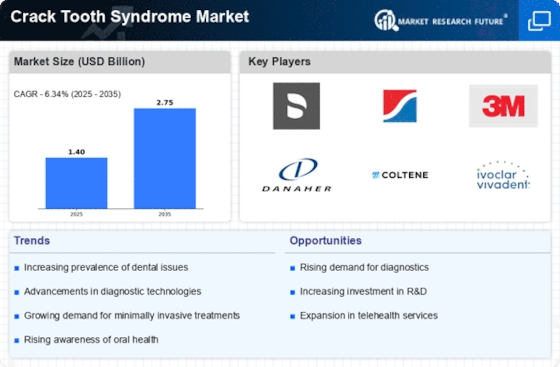
As per MRFR analysis, the Crack Tooth Syndrome Market Size was estimated at 1.4 USD Billion in 2024. The Crack Tooth Syndrome industry is projected to grow from 1.489 USD Billion in 2025 to 2.753 USD Billion by 2035, exhibiting a compound annual growth rate (CAGR) of 6.34 during the forecast period 2025 - 2035.

Key Market Trends & Highlights

The Crack Tooth Syndrome Market is poised for growth driven by technological advancements and increasing patient awareness.

  • North America remains the largest market for Crack Tooth Syndrome, driven by advanced healthcare infrastructure.
  • Asia-Pacific is emerging as the fastest-growing region, reflecting a rising demand for dental care services.
  • The X-ray segment holds the largest market share, while the Dye Test segment is experiencing rapid growth due to innovative diagnostic techniques.
  • Key market drivers include technological advancements in treatment and the rising incidence of dental disorders, particularly among the aging population.

Market Size & Forecast

2024 Market Size 1.4 (USD Billion)
2035 Market Size 2.753 (USD Billion)
CAGR (2025 - 2035) 6.34%
Largest Regional Market Share in 2024 North America

Major Players

<p>Dentsply Sirona (US), Henry Schein (US), 3M (US), Danaher Corporation (US), Coltene Holding AG (CH), Ivoclar Vivadent AG (LI), Kavo Kerr (DE), GC Corporation (JP), Shofu Inc. (JP)</p>

Market Trends

The Crack Tooth Syndrome Market is currently experiencing notable shifts driven by advancements in dental technology and an increasing awareness of oral health. As dental professionals become more adept at diagnosing and treating this condition, the demand for innovative treatment options appears to be on the rise. Patients are increasingly seeking solutions that not only alleviate pain but also restore functionality and aesthetics. This growing focus on comprehensive care is likely to influence the types of products and services offered within the market, as practitioners aim to meet evolving patient expectations. Moreover, the Crack Tooth Syndrome Market seems to be benefiting from a broader trend towards preventive dentistry. As individuals become more proactive about their dental health, there is a potential increase in early diagnosis and intervention. This shift may lead to a greater emphasis on education and awareness campaigns, which could further drive market growth. Additionally, the integration of digital tools in dental practices may enhance patient engagement and streamline treatment processes, thereby contributing to the overall expansion of the market.

Technological Advancements in Diagnosis

Recent innovations in diagnostic tools are enhancing the ability of dental professionals to identify Crack Tooth Syndrome more accurately. These advancements may lead to earlier detection and more effective treatment options, ultimately improving patient outcomes.

Increased Patient Awareness

There appears to be a growing awareness among patients regarding oral health issues, including Crack Tooth Syndrome. This heightened consciousness may drive demand for dental consultations and treatments, as individuals seek to address their concerns proactively.

Shift Towards Preventive Care

The market is likely witnessing a shift towards preventive care strategies, with an emphasis on education and early intervention. This trend may encourage dental practices to adopt more comprehensive approaches to patient care, focusing on prevention rather than solely treatment.

Crack tooth syndrome Market Market Drivers

Growing Geriatric Population

The Crack Tooth Syndrome Market is significantly impacted by the growing geriatric population, which is more susceptible to dental issues, including crack tooth syndrome. As individuals age, the risk of dental problems increases due to factors such as wear and tear, decreased saliva production, and underlying health conditions. Current demographic trends indicate that the population aged 65 and older is expected to double by 2050, leading to a higher demand for dental care services. This demographic shift is likely to drive the Crack Tooth Syndrome Market, as dental professionals adapt their services to meet the needs of an aging population.

Rising Incidence of Dental Disorders

The Crack Tooth Syndrome Market is influenced by the rising incidence of dental disorders, which has been steadily increasing over the years. Factors such as dietary changes, increased consumption of sugary foods, and a lack of proper oral hygiene contribute to this trend. Recent statistics indicate that approximately 30% of adults experience some form of dental issue, with crack tooth syndrome being a prevalent concern. This growing prevalence necessitates enhanced dental care services and products, thereby propelling the Crack Tooth Syndrome Market forward. As awareness of dental health continues to rise, the demand for specialized treatments is expected to grow.

Expansion of Dental Insurance Coverage

The Crack Tooth Syndrome Market is benefiting from the expansion of dental insurance coverage, which is making dental care more accessible to a broader population. As insurance providers increasingly recognize the importance of preventive and restorative dental care, more individuals are seeking treatment for conditions like crack tooth syndrome. Recent reports indicate that dental insurance enrollment has increased by 20% over the past five years, facilitating access to necessary treatments. This trend is expected to continue, potentially leading to a surge in demand for services within the Crack Tooth Syndrome Market, as more patients are able to afford comprehensive dental care.

Increased Focus on Aesthetic Dentistry

The Crack Tooth Syndrome Market is also being driven by an increased focus on aesthetic dentistry. Patients are becoming more conscious of their dental appearance, leading to a higher demand for cosmetic procedures that address issues like cracked teeth. The integration of aesthetic considerations into dental treatments has prompted practitioners to seek advanced solutions that not only restore function but also enhance visual appeal. Market data suggests that the aesthetic dentistry segment is projected to grow by 15% annually, reflecting the rising consumer preference for treatments that combine functionality with aesthetics. This trend is likely to further stimulate the Crack Tooth Syndrome Market.

Technological Advancements in Treatment

The Crack Tooth Syndrome Market is experiencing a notable transformation due to advancements in dental technology. Innovations such as 3D imaging and digital scanning have enhanced diagnostic accuracy, allowing for earlier detection of crack tooth syndrome. Furthermore, the development of minimally invasive treatment options, including adhesive dentistry and advanced restorative materials, has improved patient outcomes. According to recent data, the adoption of these technologies has led to a 25% increase in successful treatment rates. As dental professionals increasingly embrace these innovations, the Crack Tooth Syndrome Market is likely to expand, driven by the demand for effective and efficient treatment solutions.


Market Segment Insights

By Diagnosis: X-ray (Largest) vs. Dye Test (Fastest-Growing)

<p>In the Crack Tooth Syndrome Market, the diagnosis segment is dominated by X-ray methods, reflecting their widespread acceptance and effectiveness in identifying underlying issues. Clinical examination remains a valuable practice but has a smaller market share compared to advanced imaging techniques. Other methods such as radiographs, transillumination, and dye tests also play significant roles, with dye tests emerging rapidly as practitioners seek more efficient diagnostic options. Growth within this segment is driven by advancements in technology and increased awareness of Crack Tooth Syndrome among dental professionals. The opportunities for consistent diagnoses are expanding as new techniques and tools are introduced. Diagnostics such as the dye test are gaining momentum for their effectiveness and simplicity, making them attractive options, particularly in emerging markets where rapid improvements in dental care are sought after.</p>

<p>Clinical Examination (Dominant) vs. Transillumination (Emerging)</p>

<p>Clinical examination is regarded as the dominant diagnostic method in the Crack Tooth Syndrome Market due to its ease of use and direct patient interaction. Dentists often rely on thorough assessments of symptoms and visual inspections in initial consultations. Meanwhile, transillumination is recognized as an emerging diagnostic tool that enhances visibility during examinations by using light to detect cracks that may not be visible through traditional means. This technique is gaining traction, particularly among newer dental practitioners who prioritize innovative methods. The integration of both techniques offers a comprehensive diagnostic approach, allowing for accurate detection and timely intervention for patients suffering from Crack Tooth Syndrome.</p>

By Types: Completely Fractured Teeth (Largest) vs. Incompletely Fractured Teeth (Fastest-Growing)

<p>In the Crack Tooth Syndrome Market, the segment of completely fractured teeth holds the largest market share, demonstrating a significant presence in dental practices. This segment has been a focal point for treatment options due to its severe nature, prompting dentists to adopt advanced techniques for diagnosis and management. Conversely, the inconspicuous yet rapidly growing segment of incompletely fractured teeth is gaining attention as awareness around its implications increases. This category represents cases that were previously underdiagnosed but are now being recognized for their long-term impact on dental health.</p>

<p>Completely Fractured Teeth (Dominant) vs. Incompletely Fractured Teeth (Emerging)</p>

<p>The dominant segment of completely fractured teeth involves cases where the structural integrity of the tooth is severely compromised, leading to acute pain and necessitating immediate dental intervention. This category sees significant treatment utilization owing to the urgency and complexity of these cases, with a high propensity for referral to specialists. On the other hand, the emerging segment of incompletely fractured teeth, while less critical initially, is becoming increasingly significant as ongoing research highlights the chronic issues associated with these fractures. As dentists become more skilled in identifying and managing these cases, the demand for treatment in this segment is set to rise, driven by the growing emphasis on preserving natural teeth and improving patient outcomes.</p>

By Drug Class: Pain Killers (Largest) vs. Antibiotics (Fastest-Growing)

<p>In the Crack Tooth Syndrome Market, the 'Drug Class' segment reveals a diverse range of options. Pain Killers dominate this space, holding the majority market share due to their essential role in managing the acute pain associated with this condition. Meanwhile, Antibiotics are emerging as the fastest-growing segment, fueled by increasing awareness of the importance of preventing infections in cracked tooth scenarios, thus enhancing overall treatment efficacy. Growth trends in the Drug Class segment are significantly influenced by evolving patient needs and advancements in pharmaceutical formulations. As dental professionals emphasize comprehensive treatment approaches, the demand for Pain Killers remains strong, while the rapid uptake of Antibiotics highlights a shift towards more preventative care strategies in dentistry. This dual approach underscores a dynamic market that caters to both immediate and long-term patient care needs.</p>

<p>Pain Killers (Dominant) vs. Antibiotics (Emerging)</p>

<p>Pain Killers serve as the dominant class in managing Crack Tooth Syndrome, appreciated for their rapid pain relief and immediate effectiveness in acute situations. Their established presence in dental practices ensures consistent demand, with advancements in formulation enhancing patient compliance. Conversely, Antibiotics are emerging as a critical player in this market, pushed by a growing recognition of the need to address potential infections associated with tooth cracks. Their role is increasingly vital, particularly in patients with compromised immune systems or those undergoing invasive dental procedures, thus positioning them as a key focus for future developments in dental pharmacotherapy.</p>

By Treatment: Root Canal Therapy (Largest) vs. Crown Restoration (Fastest-Growing)

<p>In the Crack Tooth Syndrome Market, the treatment segment is characterized by distinct values, with root canal therapy holding the largest market share due to its effectiveness in preserving natural teeth and popularity among dentists. Stabilization techniques and crown restoration are also significant, with stabilization accounting for a notable portion of the market, while extraction remains the least utilized option, chosen only in severe cases. Other treatments include various innovative approaches that contribute to the overall treatment landscape.</p>

<p>Root Canal Therapy (Dominant) vs. Crown Restoration (Emerging)</p>

<p>Root canal therapy is the dominant treatment option within the Crack Tooth Syndrome market, recognized for its ability to treat infected or damaged tooth pulp, preventing further complications and allowing for the retention of natural teeth. This option is favored due to its proven efficacy and the advancements in dental technology that have improved patient comfort during the procedure. Conversely, crown restoration is emerging as a rapidly growing segment, propelled by an increasing demand for aesthetic dental solutions and advancements in materials that enhance durability and appearance. Dentists are increasingly opting for crowns post-root canal treatment to ensure long-term functionality and aesthetic appeal, thus indicating a significant shift towards more restorative techniques in managing Crack Tooth Syndrome.</p>

By Devices: Implants (Largest) vs. Adhesives (Fastest-Growing)

<p>The Crack Tooth Syndrome Market is characterized by a diverse range of devices including implants, adhesives, expendables, and others. Among these, implants hold the largest market share due to their long-lasting solutions and effectiveness in restoring tooth function. On the other hand, adhesives are rapidly gaining traction as a preferred choice for many dental professionals, reflecting an increasing inclination towards minimally invasive procedures. Expendables and others remain vital but play supporting roles in the overall distribution of market share.</p>

<p>Implants: Dominant vs. Adhesives: Emerging</p>

<p>Implants are established as the dominant choice in the Crack Tooth Syndrome Market because they provide longevity and structural support for patients suffering from extensive tooth damage. Their ability to integrate with jawbone tissue offers a solution that restores aesthetics and function effectively. In contrast, adhesives are emerging as a fast-growing segment, favored for their easy application and versatility in various dental repairs. This emerging category highlights the trend of immediate treatment solutions, aligning with patient desires for less invasive options. Together, these segments indicate a shift in market dynamics, reflecting advancements in dental technology and evolving practitioner preferences.</p>

Get more detailed insights about Crack Tooth Syndrome Market Research Report – Forecast to 2035

Regional Insights

North America : Leading Market for Dental Solutions

North America is the largest market for Crack Tooth Syndrome solutions, accounting for approximately 45% of the global market share. The region's growth is driven by increasing dental health awareness, advanced healthcare infrastructure, and a high prevalence of dental disorders. Regulatory support from organizations like the FDA further catalyzes market expansion, ensuring the availability of innovative dental products and treatments. The United States leads the North American market, supported by key players such as Dentsply Sirona and Henry Schein. The competitive landscape is characterized by continuous innovation and strategic partnerships among major companies. Canada also contributes significantly, focusing on enhancing dental care services and product availability, thereby fostering a robust market environment.

Europe : Emerging Market with Strong Growth

Europe is witnessing significant growth in the Crack Tooth Syndrome market, holding approximately 30% of the global share. The region benefits from a well-established healthcare system, increasing investments in dental research, and a growing elderly population that demands advanced dental care. Regulatory frameworks, such as the EU Medical Device Regulation, ensure high standards for dental products, promoting market growth and consumer trust. Germany and the UK are the leading countries in this market, with a strong presence of key players like Kavo Kerr and Coltene Holding AG. The competitive landscape is marked by innovation and collaboration among companies to develop effective solutions for dental issues. Additionally, the rising trend of preventive dental care is driving demand for products addressing Crack Tooth Syndrome, further enhancing market dynamics.

Asia-Pacific : Rapidly Growing Dental Market

The Asia-Pacific region is emerging as a significant player in the Crack Tooth Syndrome market, accounting for about 20% of the global share. Factors such as rising disposable incomes, increasing dental health awareness, and a growing population are driving demand for dental solutions. Additionally, government initiatives aimed at improving healthcare access and quality are further propelling market growth in this region. Countries like Japan and China are at the forefront of this market, with key players such as GC Corporation and Shofu Inc. leading the charge. The competitive landscape is characterized by a mix of local and international companies striving to innovate and meet the growing demand for effective dental treatments. The region's focus on enhancing dental care infrastructure is expected to sustain this growth trajectory in the coming years.

Middle East and Africa : Emerging Market with Untapped Potential

The Middle East and Africa region is gradually emerging in the Crack Tooth Syndrome market, holding approximately 5% of the global share. The growth is driven by increasing urbanization, rising healthcare expenditure, and a growing awareness of dental health. Regulatory bodies are beginning to implement standards that promote the use of advanced dental technologies, which is expected to enhance market growth in the coming years. Countries like South Africa and the UAE are leading the market, with a growing number of dental clinics and healthcare facilities. The competitive landscape is evolving, with both local and international players entering the market to capitalize on the increasing demand for dental solutions. The region's potential for growth is significant, as investments in healthcare infrastructure continue to rise, paving the way for innovative dental products and services.

Key Companies in the Crack tooth syndrome Market market include

Industry Developments

Future Outlook

Crack tooth syndrome Market Future Outlook

<p>The Crack Tooth Syndrome Market is projected to grow at a 6.34% CAGR from 2024 to 2035, driven by increasing awareness and advancements in dental technology.</p>

New opportunities lie in:

  • <p>Development of AI-driven diagnostic tools for early detection.</p>
  • <p>Expansion of tele-dentistry services for remote consultations.</p>
  • <p>Investment in regenerative dental materials for enhanced treatment options.</p>

<p>By 2035, the market is expected to be robust, reflecting significant advancements and increased demand.</p>

Market Segmentation

Crack tooth syndrome Market Types Outlook

  • completely fractured teeth
  • incompletely fractured teeth

Crack tooth syndrome Market Devices Outlook

  • implants
  • adhesives
  • expendables
  • others

Crack tooth syndrome Market Diagnosis Outlook

  • clinical examination
  • dye test
  • X-ray
  • transillumination
  • radiograph
  • others

Crack tooth syndrome Market Treatment Outlook

  • stabilization
  • crown restoration
  • root canal therapy
  • extraction
  • others

Crack tooth syndrome Market Drug Class Outlook

  • pain killers
  • anti-biotic
  • others

Report Scope

MARKET SIZE 20241.4(USD Billion)
MARKET SIZE 20251.489(USD Billion)
MARKET SIZE 20352.753(USD Billion)
COMPOUND ANNUAL GROWTH RATE (CAGR)6.34% (2024 - 2035)
REPORT COVERAGERevenue Forecast, Competitive Landscape, Growth Factors, and Trends
BASE YEAR2024
Market Forecast Period2025 - 2035
Historical Data2019 - 2024
Market Forecast UnitsUSD Billion
Key Companies ProfiledMarket analysis in progress
Segments CoveredMarket segmentation analysis in progress
Key Market OpportunitiesAdvancements in diagnostic technologies enhance early detection in the Crack Tooth Syndrome Market.
Key Market DynamicsRising awareness of Crack Tooth Syndrome drives demand for advanced diagnostic tools and treatment options in dentistry.
Countries CoveredNorth America, Europe, APAC, South America, MEA

FAQs

What is the projected market valuation for the Crack Tooth Syndrome Market in 2035?

The projected market valuation for the Crack Tooth Syndrome Market in 2035 is 2.753 USD Billion.

What was the overall market valuation for the Crack Tooth Syndrome Market in 2024?

The overall market valuation for the Crack Tooth Syndrome Market in 2024 was 1.4 USD Billion.

What is the expected CAGR for the Crack Tooth Syndrome Market from 2025 to 2035?

The expected CAGR for the Crack Tooth Syndrome Market during the forecast period 2025 - 2035 is 6.34%.

Which companies are considered key players in the Crack Tooth Syndrome Market?

Key players in the Crack Tooth Syndrome Market include Dentsply Sirona, Henry Schein, 3M, and Danaher Corporation.

What are the primary segments of the Crack Tooth Syndrome Market?

The primary segments of the Crack Tooth Syndrome Market include Diagnosis, Types, Drug Class, Treatment, and Devices.

  1. SECTION I: EXECUTIVE SUMMARY AND KEY HIGHLIGHTS
    1. EXECUTIVE SUMMARY
      1. Market Overview
      2. Key Findings
      3. Market Segmentation
      4. Competitive Landscape
      5. Challenges and Opportunities
      6. Future Outlook
  2. SECTION II: SCOPING, METHODOLOGY AND MARKET STRUCTURE
    1. MARKET INTRODUCTION
      1. Definition
      2. Scope of the study
    2. RESEARCH METHODOLOGY
      1. Overview
      2. Data Mining
      3. Secondary Research
      4. Primary Research
      5. Forecasting Model
      6. Market Size Estimation
      7. Data Triangulation
      8. Validation
  3. SECTION III: QUALITATIVE ANALYSIS
    1. MARKET DYNAMICS
      1. Overview
      2. Drivers
      3. Restraints
      4. Opportunities
    2. MARKET FACTOR ANALYSIS
      1. Value chain Analysis
      2. Porter's Five Forces Analysis
      3. COVID-19 Impact Analysis
  4. SECTION IV: QUANTITATIVE ANALYSIS
    1. Healthcare, BY Diagnosis (USD Billion)
      1. clinical examination
      2. dye test
      3. X-ray
      4. transillumination
      5. radiograph
      6. others
    2. Healthcare, BY Types (USD Billion)
      1. completely fractured teeth
      2. incompletely fractured teeth
    3. Healthcare, BY Drug Class (USD Billion)
      1. pain killers
      2. anti-biotic
      3. others
    4. Healthcare, BY Treatment (USD Billion)
      1. stabilization
      2. crown restoration
      3. root canal therapy
      4. extraction
      5. others
    5. Healthcare, BY Devices (USD Billion)
      1. implants
      2. adhesives
      3. expendables
      4. others
    6. Healthcare, BY Region (USD Billion)
      1. North America
      2. Europe
      3. APAC
      4. South America
      5. MEA
  5. SECTION V: COMPETITIVE ANALYSIS
    1. Competitive Landscape
      1. Overview
      2. Competitive Analysis
      3. Market share Analysis
      4. Major Growth Strategy in the Healthcare
      5. Competitive Benchmarking
      6. Leading Players in Terms of Number of Developments in the Healthcare
      7. Key developments and growth strategies
      8. Major Players Financial Matrix
    2. Company Profiles
      1. Dentsply Sirona (US)
      2. Henry Schein (US)
      3. 3M (US)
      4. Danaher Corporation (US)
      5. Coltene Holding AG (CH)
      6. Ivoclar Vivadent AG (LI)
      7. Kavo Kerr (DE)
      8. GC Corporation (JP)
      9. Shofu Inc. (JP)
    3. Appendix
      1. References
      2. Related Reports
  6. LIST OF FIGURES
    1. MARKET SYNOPSIS
    2. NORTH AMERICA MARKET ANALYSIS
    3. US MARKET ANALYSIS BY DIAGNOSIS
    4. US MARKET ANALYSIS BY TYPES
    5. US MARKET ANALYSIS BY DRUG CLASS
    6. US MARKET ANALYSIS BY TREATMENT
    7. US MARKET ANALYSIS BY DEVICES
    8. CANADA MARKET ANALYSIS BY DIAGNOSIS
    9. CANADA MARKET ANALYSIS BY TYPES
    10. CANADA MARKET ANALYSIS BY DRUG CLASS
    11. CANADA MARKET ANALYSIS BY TREATMENT
    12. CANADA MARKET ANALYSIS BY DEVICES
    13. EUROPE MARKET ANALYSIS
    14. GERMANY MARKET ANALYSIS BY DIAGNOSIS
    15. GERMANY MARKET ANALYSIS BY TYPES
    16. GERMANY MARKET ANALYSIS BY DRUG CLASS
    17. GERMANY MARKET ANALYSIS BY TREATMENT
    18. GERMANY MARKET ANALYSIS BY DEVICES
    19. UK MARKET ANALYSIS BY DIAGNOSIS
    20. UK MARKET ANALYSIS BY TYPES
    21. UK MARKET ANALYSIS BY DRUG CLASS
    22. UK MARKET ANALYSIS BY TREATMENT
    23. UK MARKET ANALYSIS BY DEVICES
    24. FRANCE MARKET ANALYSIS BY DIAGNOSIS
    25. FRANCE MARKET ANALYSIS BY TYPES
    26. FRANCE MARKET ANALYSIS BY DRUG CLASS
    27. FRANCE MARKET ANALYSIS BY TREATMENT
    28. FRANCE MARKET ANALYSIS BY DEVICES
    29. RUSSIA MARKET ANALYSIS BY DIAGNOSIS
    30. RUSSIA MARKET ANALYSIS BY TYPES
    31. RUSSIA MARKET ANALYSIS BY DRUG CLASS
    32. RUSSIA MARKET ANALYSIS BY TREATMENT
    33. RUSSIA MARKET ANALYSIS BY DEVICES
    34. ITALY MARKET ANALYSIS BY DIAGNOSIS
    35. ITALY MARKET ANALYSIS BY TYPES
    36. ITALY MARKET ANALYSIS BY DRUG CLASS
    37. ITALY MARKET ANALYSIS BY TREATMENT
    38. ITALY MARKET ANALYSIS BY DEVICES
    39. SPAIN MARKET ANALYSIS BY DIAGNOSIS
    40. SPAIN MARKET ANALYSIS BY TYPES
    41. SPAIN MARKET ANALYSIS BY DRUG CLASS
    42. SPAIN MARKET ANALYSIS BY TREATMENT
    43. SPAIN MARKET ANALYSIS BY DEVICES
    44. REST OF EUROPE MARKET ANALYSIS BY DIAGNOSIS
    45. REST OF EUROPE MARKET ANALYSIS BY TYPES
    46. REST OF EUROPE MARKET ANALYSIS BY DRUG CLASS
    47. REST OF EUROPE MARKET ANALYSIS BY TREATMENT
    48. REST OF EUROPE MARKET ANALYSIS BY DEVICES
    49. APAC MARKET ANALYSIS
    50. CHINA MARKET ANALYSIS BY DIAGNOSIS
    51. CHINA MARKET ANALYSIS BY TYPES
    52. CHINA MARKET ANALYSIS BY DRUG CLASS
    53. CHINA MARKET ANALYSIS BY TREATMENT
    54. CHINA MARKET ANALYSIS BY DEVICES
    55. INDIA MARKET ANALYSIS BY DIAGNOSIS
    56. INDIA MARKET ANALYSIS BY TYPES
    57. INDIA MARKET ANALYSIS BY DRUG CLASS
    58. INDIA MARKET ANALYSIS BY TREATMENT
    59. INDIA MARKET ANALYSIS BY DEVICES
    60. JAPAN MARKET ANALYSIS BY DIAGNOSIS
    61. JAPAN MARKET ANALYSIS BY TYPES
    62. JAPAN MARKET ANALYSIS BY DRUG CLASS
    63. JAPAN MARKET ANALYSIS BY TREATMENT
    64. JAPAN MARKET ANALYSIS BY DEVICES
    65. SOUTH KOREA MARKET ANALYSIS BY DIAGNOSIS
    66. SOUTH KOREA MARKET ANALYSIS BY TYPES
    67. SOUTH KOREA MARKET ANALYSIS BY DRUG CLASS
    68. SOUTH KOREA MARKET ANALYSIS BY TREATMENT
    69. SOUTH KOREA MARKET ANALYSIS BY DEVICES
    70. MALAYSIA MARKET ANALYSIS BY DIAGNOSIS
    71. MALAYSIA MARKET ANALYSIS BY TYPES
    72. MALAYSIA MARKET ANALYSIS BY DRUG CLASS
    73. MALAYSIA MARKET ANALYSIS BY TREATMENT
    74. MALAYSIA MARKET ANALYSIS BY DEVICES
    75. THAILAND MARKET ANALYSIS BY DIAGNOSIS
    76. THAILAND MARKET ANALYSIS BY TYPES
    77. THAILAND MARKET ANALYSIS BY DRUG CLASS
    78. THAILAND MARKET ANALYSIS BY TREATMENT
    79. THAILAND MARKET ANALYSIS BY DEVICES
    80. INDONESIA MARKET ANALYSIS BY DIAGNOSIS
    81. INDONESIA MARKET ANALYSIS BY TYPES
    82. INDONESIA MARKET ANALYSIS BY DRUG CLASS
    83. INDONESIA MARKET ANALYSIS BY TREATMENT
    84. INDONESIA MARKET ANALYSIS BY DEVICES
    85. REST OF APAC MARKET ANALYSIS BY DIAGNOSIS
    86. REST OF APAC MARKET ANALYSIS BY TYPES
    87. REST OF APAC MARKET ANALYSIS BY DRUG CLASS
    88. REST OF APAC MARKET ANALYSIS BY TREATMENT
    89. REST OF APAC MARKET ANALYSIS BY DEVICES
    90. SOUTH AMERICA MARKET ANALYSIS
    91. BRAZIL MARKET ANALYSIS BY DIAGNOSIS
    92. BRAZIL MARKET ANALYSIS BY TYPES
    93. BRAZIL MARKET ANALYSIS BY DRUG CLASS
    94. BRAZIL MARKET ANALYSIS BY TREATMENT
    95. BRAZIL MARKET ANALYSIS BY DEVICES
    96. MEXICO MARKET ANALYSIS BY DIAGNOSIS
    97. MEXICO MARKET ANALYSIS BY TYPES
    98. MEXICO MARKET ANALYSIS BY DRUG CLASS
    99. MEXICO MARKET ANALYSIS BY TREATMENT
    100. MEXICO MARKET ANALYSIS BY DEVICES
    101. ARGENTINA MARKET ANALYSIS BY DIAGNOSIS
    102. ARGENTINA MARKET ANALYSIS BY TYPES
    103. ARGENTINA MARKET ANALYSIS BY DRUG CLASS
    104. ARGENTINA MARKET ANALYSIS BY TREATMENT
    105. ARGENTINA MARKET ANALYSIS BY DEVICES
    106. REST OF SOUTH AMERICA MARKET ANALYSIS BY DIAGNOSIS
    107. REST OF SOUTH AMERICA MARKET ANALYSIS BY TYPES
    108. REST OF SOUTH AMERICA MARKET ANALYSIS BY DRUG CLASS
    109. REST OF SOUTH AMERICA MARKET ANALYSIS BY TREATMENT
    110. REST OF SOUTH AMERICA MARKET ANALYSIS BY DEVICES
    111. MEA MARKET ANALYSIS
    112. GCC COUNTRIES MARKET ANALYSIS BY DIAGNOSIS
    113. GCC COUNTRIES MARKET ANALYSIS BY TYPES
    114. GCC COUNTRIES MARKET ANALYSIS BY DRUG CLASS
    115. GCC COUNTRIES MARKET ANALYSIS BY TREATMENT
    116. GCC COUNTRIES MARKET ANALYSIS BY DEVICES
    117. SOUTH AFRICA MARKET ANALYSIS BY DIAGNOSIS
    118. SOUTH AFRICA MARKET ANALYSIS BY TYPES
    119. SOUTH AFRICA MARKET ANALYSIS BY DRUG CLASS
    120. SOUTH AFRICA MARKET ANALYSIS BY TREATMENT
    121. SOUTH AFRICA MARKET ANALYSIS BY DEVICES
    122. REST OF MEA MARKET ANALYSIS BY DIAGNOSIS
    123. REST OF MEA MARKET ANALYSIS BY TYPES
    124. REST OF MEA MARKET ANALYSIS BY DRUG CLASS
    125. REST OF MEA MARKET ANALYSIS BY TREATMENT
    126. REST OF MEA MARKET ANALYSIS BY DEVICES
    127. KEY BUYING CRITERIA OF HEALTHCARE
    128. RESEARCH PROCESS OF MRFR
    129. DRO ANALYSIS OF HEALTHCARE
    130. DRIVERS IMPACT ANALYSIS: HEALTHCARE
    131. RESTRAINTS IMPACT ANALYSIS: HEALTHCARE
    132. SUPPLY / VALUE CHAIN: HEALTHCARE
    133. HEALTHCARE, BY DIAGNOSIS, 2024 (% SHARE)
    134. HEALTHCARE, BY DIAGNOSIS, 2024 TO 2035 (USD Billion)
    135. HEALTHCARE, BY TYPES, 2024 (% SHARE)
    136. HEALTHCARE, BY TYPES, 2024 TO 2035 (USD Billion)
    137. HEALTHCARE, BY DRUG CLASS, 2024 (% SHARE)
    138. HEALTHCARE, BY DRUG CLASS, 2024 TO 2035 (USD Billion)
    139. HEALTHCARE, BY TREATMENT, 2024 (% SHARE)
    140. HEALTHCARE, BY TREATMENT, 2024 TO 2035 (USD Billion)
    141. HEALTHCARE, BY DEVICES, 2024 (% SHARE)
    142. HEALTHCARE, BY DEVICES, 2024 TO 2035 (USD Billion)
    143. BENCHMARKING OF MAJOR COMPETITORS
  7. LIST OF TABLES
    1. LIST OF ASSUMPTIONS
    2. North America MARKET SIZE ESTIMATES; FORECAST
      1. BY DIAGNOSIS, 2025-2035 (USD Billion)
      2. BY TYPES, 2025-2035 (USD Billion)
      3. BY DRUG CLASS, 2025-2035 (USD Billion)
      4. BY TREATMENT, 2025-2035 (USD Billion)
      5. BY DEVICES, 2025-2035 (USD Billion)
    3. US MARKET SIZE ESTIMATES; FORECAST
      1. BY DIAGNOSIS, 2025-2035 (USD Billion)
      2. BY TYPES, 2025-2035 (USD Billion)
      3. BY DRUG CLASS, 2025-2035 (USD Billion)
      4. BY TREATMENT, 2025-2035 (USD Billion)
      5. BY DEVICES, 2025-2035 (USD Billion)
    4. Canada MARKET SIZE ESTIMATES; FORECAST
      1. BY DIAGNOSIS, 2025-2035 (USD Billion)
      2. BY TYPES, 2025-2035 (USD Billion)
      3. BY DRUG CLASS, 2025-2035 (USD Billion)
      4. BY TREATMENT, 2025-2035 (USD Billion)
      5. BY DEVICES, 2025-2035 (USD Billion)
    5. Europe MARKET SIZE ESTIMATES; FORECAST
      1. BY DIAGNOSIS, 2025-2035 (USD Billion)
      2. BY TYPES, 2025-2035 (USD Billion)
      3. BY DRUG CLASS, 2025-2035 (USD Billion)
      4. BY TREATMENT, 2025-2035 (USD Billion)
      5. BY DEVICES, 2025-2035 (USD Billion)
    6. Germany MARKET SIZE ESTIMATES; FORECAST
      1. BY DIAGNOSIS, 2025-2035 (USD Billion)
      2. BY TYPES, 2025-2035 (USD Billion)
      3. BY DRUG CLASS, 2025-2035 (USD Billion)
      4. BY TREATMENT, 2025-2035 (USD Billion)
      5. BY DEVICES, 2025-2035 (USD Billion)
    7. UK MARKET SIZE ESTIMATES; FORECAST
      1. BY DIAGNOSIS, 2025-2035 (USD Billion)
      2. BY TYPES, 2025-2035 (USD Billion)
      3. BY DRUG CLASS, 2025-2035 (USD Billion)
      4. BY TREATMENT, 2025-2035 (USD Billion)
      5. BY DEVICES, 2025-2035 (USD Billion)
    8. France MARKET SIZE ESTIMATES; FORECAST
      1. BY DIAGNOSIS, 2025-2035 (USD Billion)
      2. BY TYPES, 2025-2035 (USD Billion)
      3. BY DRUG CLASS, 2025-2035 (USD Billion)
      4. BY TREATMENT, 2025-2035 (USD Billion)
      5. BY DEVICES, 2025-2035 (USD Billion)
    9. Russia MARKET SIZE ESTIMATES; FORECAST
      1. BY DIAGNOSIS, 2025-2035 (USD Billion)
      2. BY TYPES, 2025-2035 (USD Billion)
      3. BY DRUG CLASS, 2025-2035 (USD Billion)
      4. BY TREATMENT, 2025-2035 (USD Billion)
      5. BY DEVICES, 2025-2035 (USD Billion)
    10. Italy MARKET SIZE ESTIMATES; FORECAST
      1. BY DIAGNOSIS, 2025-2035 (USD Billion)
      2. BY TYPES, 2025-2035 (USD Billion)
      3. BY DRUG CLASS, 2025-2035 (USD Billion)
      4. BY TREATMENT, 2025-2035 (USD Billion)
      5. BY DEVICES, 2025-2035 (USD Billion)
    11. Spain MARKET SIZE ESTIMATES; FORECAST
      1. BY DIAGNOSIS, 2025-2035 (USD Billion)
      2. BY TYPES, 2025-2035 (USD Billion)
      3. BY DRUG CLASS, 2025-2035 (USD Billion)
      4. BY TREATMENT, 2025-2035 (USD Billion)
      5. BY DEVICES, 2025-2035 (USD Billion)
    12. Rest of Europe MARKET SIZE ESTIMATES; FORECAST
      1. BY DIAGNOSIS, 2025-2035 (USD Billion)
      2. BY TYPES, 2025-2035 (USD Billion)
      3. BY DRUG CLASS, 2025-2035 (USD Billion)
      4. BY TREATMENT, 2025-2035 (USD Billion)
      5. BY DEVICES, 2025-2035 (USD Billion)
    13. APAC MARKET SIZE ESTIMATES; FORECAST
      1. BY DIAGNOSIS, 2025-2035 (USD Billion)
      2. BY TYPES, 2025-2035 (USD Billion)
      3. BY DRUG CLASS, 2025-2035 (USD Billion)
      4. BY TREATMENT, 2025-2035 (USD Billion)
      5. BY DEVICES, 2025-2035 (USD Billion)
    14. China MARKET SIZE ESTIMATES; FORECAST
      1. BY DIAGNOSIS, 2025-2035 (USD Billion)
      2. BY TYPES, 2025-2035 (USD Billion)
      3. BY DRUG CLASS, 2025-2035 (USD Billion)
      4. BY TREATMENT, 2025-2035 (USD Billion)
      5. BY DEVICES, 2025-2035 (USD Billion)
    15. India MARKET SIZE ESTIMATES; FORECAST
      1. BY DIAGNOSIS, 2025-2035 (USD Billion)
      2. BY TYPES, 2025-2035 (USD Billion)
      3. BY DRUG CLASS, 2025-2035 (USD Billion)
      4. BY TREATMENT, 2025-2035 (USD Billion)
      5. BY DEVICES, 2025-2035 (USD Billion)
    16. Japan MARKET SIZE ESTIMATES; FORECAST
      1. BY DIAGNOSIS, 2025-2035 (USD Billion)
      2. BY TYPES, 2025-2035 (USD Billion)
      3. BY DRUG CLASS, 2025-2035 (USD Billion)
      4. BY TREATMENT, 2025-2035 (USD Billion)
      5. BY DEVICES, 2025-2035 (USD Billion)
    17. South Korea MARKET SIZE ESTIMATES; FORECAST
      1. BY DIAGNOSIS, 2025-2035 (USD Billion)
      2. BY TYPES, 2025-2035 (USD Billion)
      3. BY DRUG CLASS, 2025-2035 (USD Billion)
      4. BY TREATMENT, 2025-2035 (USD Billion)
      5. BY DEVICES, 2025-2035 (USD Billion)
    18. Malaysia MARKET SIZE ESTIMATES; FORECAST
      1. BY DIAGNOSIS, 2025-2035 (USD Billion)
      2. BY TYPES, 2025-2035 (USD Billion)
      3. BY DRUG CLASS, 2025-2035 (USD Billion)
      4. BY TREATMENT, 2025-2035 (USD Billion)
      5. BY DEVICES, 2025-2035 (USD Billion)
    19. Thailand MARKET SIZE ESTIMATES; FORECAST
      1. BY DIAGNOSIS, 2025-2035 (USD Billion)
      2. BY TYPES, 2025-2035 (USD Billion)
      3. BY DRUG CLASS, 2025-2035 (USD Billion)
      4. BY TREATMENT, 2025-2035 (USD Billion)
      5. BY DEVICES, 2025-2035 (USD Billion)
    20. Indonesia MARKET SIZE ESTIMATES; FORECAST
      1. BY DIAGNOSIS, 2025-2035 (USD Billion)
      2. BY TYPES, 2025-2035 (USD Billion)
      3. BY DRUG CLASS, 2025-2035 (USD Billion)
      4. BY TREATMENT, 2025-2035 (USD Billion)
      5. BY DEVICES, 2025-2035 (USD Billion)
    21. Rest of APAC MARKET SIZE ESTIMATES; FORECAST
      1. BY DIAGNOSIS, 2025-2035 (USD Billion)
      2. BY TYPES, 2025-2035 (USD Billion)
      3. BY DRUG CLASS, 2025-2035 (USD Billion)
      4. BY TREATMENT, 2025-2035 (USD Billion)
      5. BY DEVICES, 2025-2035 (USD Billion)
    22. South America MARKET SIZE ESTIMATES; FORECAST
      1. BY DIAGNOSIS, 2025-2035 (USD Billion)
      2. BY TYPES, 2025-2035 (USD Billion)
      3. BY DRUG CLASS, 2025-2035 (USD Billion)
      4. BY TREATMENT, 2025-2035 (USD Billion)
      5. BY DEVICES, 2025-2035 (USD Billion)
    23. Brazil MARKET SIZE ESTIMATES; FORECAST
      1. BY DIAGNOSIS, 2025-2035 (USD Billion)
      2. BY TYPES, 2025-2035 (USD Billion)
      3. BY DRUG CLASS, 2025-2035 (USD Billion)
      4. BY TREATMENT, 2025-2035 (USD Billion)
      5. BY DEVICES, 2025-2035 (USD Billion)
    24. Mexico MARKET SIZE ESTIMATES; FORECAST
      1. BY DIAGNOSIS, 2025-2035 (USD Billion)
      2. BY TYPES, 2025-2035 (USD Billion)
      3. BY DRUG CLASS, 2025-2035 (USD Billion)
      4. BY TREATMENT, 2025-2035 (USD Billion)
      5. BY DEVICES, 2025-2035 (USD Billion)
    25. Argentina MARKET SIZE ESTIMATES; FORECAST
      1. BY DIAGNOSIS, 2025-2035 (USD Billion)
      2. BY TYPES, 2025-2035 (USD Billion)
      3. BY DRUG CLASS, 2025-2035 (USD Billion)
      4. BY TREATMENT, 2025-2035 (USD Billion)
      5. BY DEVICES, 2025-2035 (USD Billion)
    26. Rest of South America MARKET SIZE ESTIMATES; FORECAST
      1. BY DIAGNOSIS, 2025-2035 (USD Billion)
      2. BY TYPES, 2025-2035 (USD Billion)
      3. BY DRUG CLASS, 2025-2035 (USD Billion)
      4. BY TREATMENT, 2025-2035 (USD Billion)
      5. BY DEVICES, 2025-2035 (USD Billion)
    27. MEA MARKET SIZE ESTIMATES; FORECAST
      1. BY DIAGNOSIS, 2025-2035 (USD Billion)
      2. BY TYPES, 2025-2035 (USD Billion)
      3. BY DRUG CLASS, 2025-2035 (USD Billion)
      4. BY TREATMENT, 2025-2035 (USD Billion)
      5. BY DEVICES, 2025-2035 (USD Billion)
    28. GCC Countries MARKET SIZE ESTIMATES; FORECAST
      1. BY DIAGNOSIS, 2025-2035 (USD Billion)
      2. BY TYPES, 2025-2035 (USD Billion)
      3. BY DRUG CLASS, 2025-2035 (USD Billion)
      4. BY TREATMENT, 2025-2035 (USD Billion)
      5. BY DEVICES, 2025-2035 (USD Billion)
    29. South Africa MARKET SIZE ESTIMATES; FORECAST
      1. BY DIAGNOSIS, 2025-2035 (USD Billion)
      2. BY TYPES, 2025-2035 (USD Billion)
      3. BY DRUG CLASS, 2025-2035 (USD Billion)
      4. BY TREATMENT, 2025-2035 (USD Billion)
      5. BY DEVICES, 2025-2035 (USD Billion)
    30. Rest of MEA MARKET SIZE ESTIMATES; FORECAST
      1. BY DIAGNOSIS, 2025-2035 (USD Billion)
      2. BY TYPES, 2025-2035 (USD Billion)
      3. BY DRUG CLASS, 2025-2035 (USD Billion)
      4. BY TREATMENT, 2025-2035 (USD Billion)
      5. BY DEVICES, 2025-2035 (USD Billion)
    31. PRODUCT LAUNCH/PRODUCT DEVELOPMENT/APPROVAL
    32. ACQUISITION/PARTNERSHIP

Crack Tooth Syndrome Market Segmentation

Market Segmentation Overview

  • Detailed segmentation data will be available in the full report
  • Comprehensive analysis by multiple parameters
  • Regional and country-level breakdowns
  • Market size forecasts by segment
Infographic

Free Sample Request

Kindly complete the form below to receive a free sample of this Report

Get Free Sample

Customer Strories

Compare Licence

×
Features License Type
Single User Multiuser License Enterprise User
Price $4,950 $5,950 $7,250
Maximum User Access Limit 1 User Upto 10 Users Unrestricted Access Throughout the Organization
Free Customization
Direct Access to Analyst
Deliverable Format
Platform Access
Discount on Next Purchase 10% 15% 15%
Printable Versions