Request Free Sample ×

Kindly complete the form below to receive a free sample of this Report

* Please use a valid business email

Leading companies partner with us for data-driven Insights

clients tt-cursor
Hero Background
English
Chinese
French
Japanese
Korean
German
Spanish

COVID 19 Sample Collection Kits Market Analysis

ID: MRFR/HC/8291-HCR
120 Pages
Vikita Thakur
Last Updated: April 15, 2026

COVID-19 Sample Collection Kits Market Research Report By Product Type (Swabs, Viral Transport Media, Blood Collection Kits, Others), Application (Diagnostics, Research), End-User (Hospitals & Clinics, Diagnostic Centers, Others) and Region (Americas, Europe, Asia-Pacific, Middle East & Africa) - Growth & Industry Forecast 2025 To 2035

Share:
Download PDF ×

We do not share your information with anyone. However, we may send you emails based on your report interest from time to time. You may contact us at any time to opt-out.

COVID 19 Sample Collection Kits Market Infographic
Purchase Options

Market Analysis

In-depth Analysis of COVID 19 Sample Collection Kits Market Industry Landscape

The COVID-19 sample collection kits market has seen dynamic development since the beginning of the pandemic, driven by the worldwide interest for capable and open answers for diagnosing the virus. These kits assume a pivotal part in the collection, conservation, and transportation of natural specimens, working with exact testing for the presence of the SARS-CoV-2 virus. Market elements are firmly affected by the surge in popularity for COVID-19 testing. State run administrations, healthcare associations, and confidential substances overall have motivated testing endeavors to recognize and segregate cases speedily, driving the requirement for dependable sample collection kits. The market incorporates an assortment of sample collection techniques, including nasopharyngeal swabs, oropharyngeal swabs, saliva collection kits, and that is just the beginning. This variety takes special care of various testing inclinations, patient comfort, and healthcare settings, adding to the flexibility and openness of COVID-19 testing. The market is seeing development in self-testing advancements, including at-home collection kits that coordinate with cell phone applications for result announcing. These progresses aim to upgrade client experience, increase availability, and support inevitable testing interest. Market elements are affected by cost contemplations and moderateness. Adjusting the expense viability of sample collection kits with the requirement for far reaching testing is essential for market players to guarantee availability and address monetary difficulties related with the pandemic. The COVID-19 sample collection kits market is ready for proceeded with advancement as the condition and testing needs develop. Continuous progresses in innovation, administrative variations, and key reactions to arising variations of the virus add to the flexibility of sample collection arrangements. The COVID-19 sample collection kits market is supposed to remain dynamic, reflecting continuous endeavors to upgrade testing efficiency, openness, and unwavering quality. Future patterns might remember further headways for self-testing advances, consistent upgrades in component strategy, and the foundation of strong worldwide organizations to guarantee the powerful reaction to general health crises.


Author
Author Profile
Vikita Thakur
Senior Research Analyst

She holds an experience of about 5+ years in market research and business consulting projects for sectors such as life sciences, medical devices, and healthcare IT. She possesses a robust background in data analysis, market estimation, competitive intelligence, pipeline analysis market trend identification, and consumer behavior insights. Her expertise lies in technical Sales support, client interaction and project management, designing and implementing market research studies, conducting competitive analysis, and synthesizing complex data into actionable recommendations that drive business growth.

Leave a Comment

FAQs

What is the projected market valuation for the COVID-19 Sample Collection Kits Market in 2035?

<p>The projected market valuation for the COVID-19 Sample Collection Kits Market in 2035 is 2.72 USD Billion.</p>

What was the overall market valuation for the COVID-19 Sample Collection Kits Market in 2024?

<p>The overall market valuation for the COVID-19 Sample Collection Kits Market in 2024 was 2.267 USD Billion.</p>

What is the expected CAGR for the COVID-19 Sample Collection Kits Market during the forecast period 2025 - 2035?

<p>The expected CAGR for the COVID-19 Sample Collection Kits Market during the forecast period 2025 - 2035 is 1.67%.</p>

Which product type segment had the highest valuation in 2024?

<p>In 2024, the Nasopharyngeal (NP) Swabs segment had the highest valuation at 0.8 USD Billion.</p>

What are the projected values for the Diagnostic application segment by 2035?

<p>The projected value for the Diagnostic application segment is expected to reach 1.8 USD Billion by 2035.</p>

Which end-user segment is anticipated to show the most growth from 2024 to 2035?

The Hospitals &amp; Clinics end-user segment is anticipated to grow from 0.91 USD Billion in 2024 to 1.1 USD Billion by 2035.

Who are the key players in the COVID-19 Sample Collection Kits Market?

<p>Key players in the market include Thermo Fisher Scientific, Roche Diagnostics, Abbott Laboratories, and BD, among others.</p>

What is the projected value for the Viral Transport Media segment by 2035?

<p>The projected value for the Viral Transport Media segment is expected to reach 0.4 USD Billion by 2035.</p>

How does the Research application segment compare to the Diagnostic segment in terms of valuation?

The Research application segment is projected to reach 0.92 USD Billion by 2035, which is lower than the Diagnostic segment's 1.8 USD Billion.

What was the valuation for Blood Collection Kits in 2024?

The valuation for Blood Collection Kits in 2024 was 0.2 USD Billion.

Market Summary

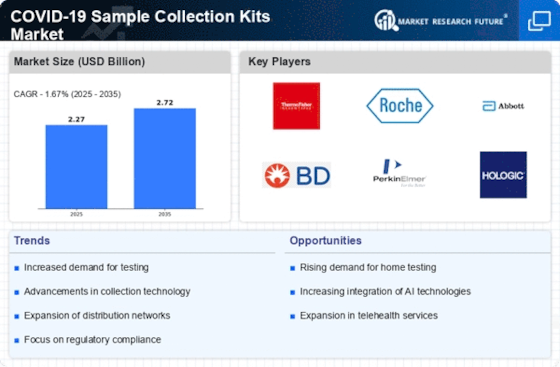
As per Market Research Future analysis, the COVID-19 Sample Collection Kits Market Size was estimated at 2.267 USD Billion in 2024. The COVID-19 Sample Collection Kits industry is projected to grow from 2.305 USD Billion in 2025 to 2.72 USD Billion by 2035, exhibiting a compound annual growth rate (CAGR) of 1.6% during the forecast period 2025 - 2035

Key Market Trends & Highlights

The COVID-19 Sample Collection Kits Market is experiencing robust growth driven by technological advancements and increased public awareness.

  • North America remains the largest market for COVID-19 sample collection kits, reflecting a strong demand for reliable testing solutions. The Asia-Pacific region is emerging as the fastest-growing market, propelled by rising healthcare investments and expanding access to testing. Swabs continue to dominate the market as the largest segment, while viral transport media is witnessing rapid growth due to its critical role in sample preservation. Key market drivers include the rising demand for home testing solutions and government initiatives aimed at enhancing preventive healthcare measures.

Market Size & Forecast

2024 Market Size 2.267 (USD Billion)
2035 Market Size 2.72 (USD Billion)
CAGR (2025 - 2035) 1.67%
Largest Regional Market Share in 2024 Americas

Major Players

<a href="https://www.thermofisher.com/search/browse/category/us/en/90231006">Thermo Fisher Scientific</a> (US), Roche Diagnostics (CH), Abbott Laboratories (US), BD (US), PerkinElmer (US), Hologic (US), Qiagen (DE), GenMark Diagnostics (US), Mylab Discovery Solutions (IN)

Market Trends

The COVID-19 Sample Collection Kits Market is currently experiencing a notable evolution, driven by the ongoing need for efficient and reliable testing solutions. As the global health landscape continues to adapt, the demand for these kits remains robust, reflecting a heightened awareness of public health protocols. Various stakeholders, including healthcare providers and governmental organizations, are increasingly prioritizing the availability of high-quality sample collection kits to facilitate timely diagnosis and monitoring of viral infections. This trend suggests a sustained commitment to enhancing healthcare infrastructure and ensuring that testing capabilities are readily accessible to populations worldwide. Moreover, the market appears to be influenced by advancements in technology and innovation, which are likely to enhance the efficiency and accuracy of sample collection processes. Manufacturers are exploring new materials and designs that could improve user experience and safety. Additionally, the integration of digital solutions, such as mobile applications for tracking and reporting results, may further streamline operations within the COVID-19 Sample Collection Kits Market. As the landscape evolves, it is essential for stakeholders to remain vigilant and responsive to emerging trends and consumer needs, ensuring that the market continues to thrive in a dynamic environment.

Technological Advancements

The COVID-19 Sample Collection Kits Market is witnessing a surge in technological innovations aimed at improving the efficiency and accuracy of sample collection. Manufacturers are increasingly investing in research and development to create kits that utilize advanced materials and designs, which may enhance user experience and safety during the collection process.

Regulatory Support

Regulatory bodies are playing a crucial role in shaping the COVID-19 Sample Collection Kits Market by establishing guidelines and standards that ensure the quality and reliability of testing solutions. This support appears to foster confidence among consumers and healthcare providers, potentially leading to increased adoption of these kits.

Increased Public Awareness

There is a growing public awareness regarding the importance of testing in managing viral outbreaks, which is likely to drive demand for COVID-19 Sample Collection Kits. Educational campaigns and health initiatives may contribute to a more informed population, emphasizing the need for accessible and reliable testing solutions.

COVID 19 Sample Collection Kits Market Market Drivers

Emergence of New Variants

The COVID-19 Sample Collection Kits Market is facing ongoing challenges due to the emergence of new variants of the virus. As variants continue to evolve, the need for effective testing solutions remains critical. This situation has led to an increased demand for sample collection kits that can accurately detect various strains of the virus. Market analysis suggests that the presence of new variants may drive innovation in the development of more sophisticated testing kits, which could enhance the overall efficacy of COVID-19 testing. Consequently, manufacturers are likely to focus on creating versatile sample collection kits that can adapt to the changing landscape of the virus.

Expansion of Telehealth Services

The COVID-19 Sample Collection Kits Market is being positively influenced by the expansion of telehealth services. As healthcare providers increasingly adopt telemedicine, the need for efficient sample collection methods has become paramount. Telehealth consultations often require patients to provide samples for diagnostic testing, thereby driving the demand for COVID-19 sample collection kits. Data suggests that telehealth usage has surged, with a significant percentage of patients opting for virtual consultations. This trend indicates a growing reliance on remote healthcare solutions, which in turn necessitates the availability of effective sample collection kits that can be easily integrated into telehealth platforms.

Government Initiatives and Funding

The COVID-19 Sample Collection Kits Market is benefiting from various government initiatives and funding aimed at enhancing public health infrastructure. Governments worldwide are investing in the procurement and distribution of COVID-19 testing kits to ensure widespread access to testing. This financial support is crucial for manufacturers, as it enables them to scale production and improve the quality of their sample collection kits. Recent data indicates that government funding for testing initiatives has increased, with several countries allocating substantial budgets to combat the pandemic. Such initiatives not only bolster the market but also reinforce the importance of accessible testing solutions in managing public health crises.

Increased Focus on Preventive Healthcare

The COVID-19 Sample Collection Kits Market is witnessing a shift towards preventive healthcare measures. As individuals become more health-conscious, there is a growing emphasis on early detection and prevention of diseases, including COVID-19. This trend is reflected in the rising sales of sample collection kits, as consumers seek proactive solutions to monitor their health. Market data indicates that the preventive healthcare sector is expanding, with a significant increase in the adoption of at-home testing kits. This focus on prevention not only enhances public health outcomes but also drives the demand for innovative and reliable COVID-19 sample collection kits that cater to the needs of health-conscious consumers.

Rising Demand for Home Testing Solutions

The COVID-19 Sample Collection Kits Market is experiencing a notable surge in demand for home testing solutions. This trend is largely driven by the convenience and accessibility that home testing offers to consumers. As individuals seek to minimize exposure to healthcare facilities, the preference for at-home sample collection kits has increased. Reports indicate that the market for home testing kits is projected to grow significantly, with estimates suggesting a compound annual growth rate of over 20% in the coming years. This shift towards home testing not only reflects changing consumer behavior but also highlights the need for reliable and user-friendly sample collection kits that can be utilized without professional supervision.

Market Segment Insights

By Product Type: Swabs (Largest) vs. Viral Transport Media (Fastest-Growing)

In the COVID-19 Sample Collection Kits Market, the product type segmentation reveals a significant dominance of swabs, particularly nasopharyngeal swabs, which account for the largest share due to their effectiveness in collecting samples. Oropharyngeal swabs and viral <a href="https://www.marketresearchfuture.com/reports/transport-media-market-42628">transport media</a> also contribute notably, but their market share is comparatively smaller. Blood collection kits and other ancillary products serve vital purposes but represent a lesser proportion of the market, suggesting the primary reliance on swabs for effective COVID-19 testing.

Swabs (Dominant) vs. Viral Transport Media (Emerging)

Swabs, specifically nasopharyngeal and oropharyngeal swabs, play a dominant role in the COVID-19 Sample Collection Kits Market due to their high reliability in obtaining specimens for testing. They are designed for ease of use and compatibility with various testing methodologies, ensuring a broad adoption in clinical settings. In contrast, viral transport media is emerging as a critical component, facilitating the safe transport of samples and preserving viability during transit. The growing emphasis on efficient testing processes and logistical improvements in handling samples positions viral transport media for rapid growth, reflecting evolving strategies in pandemic response and healthcare delivery.

By Application: Diagnostic (Largest) vs. Research (Fastest-Growing)

In the COVID-19 Sample Collection Kits Market, the 'Diagnostic' application holds the largest share due to its critical role in identifying and confirming COVID-19 cases. Diagnostic kits are in high demand as healthcare providers prioritize rapid and accurate testing to manage the pandemic's spread. On the other hand, the 'Research' application is gaining traction as research institutions seek to deepen their understanding of COVID-19 and its variants. As of recent trends, diagnostic kits dominate the market, reflecting public health priorities and urgent testing needs.

Application: Diagnostic (Dominant) vs. Research (Emerging)

The 'Diagnostic' application of COVID-19 Sample Collection Kits is characterized by its essential role in facilitating timely and accurate testing for the virus within clinical settings. This segment benefits from established workflows in hospitals and laboratories, ensuring high reliability and expedited testing processes. Conversely, the 'Research' application represents an emerging segment fueled by a growing number of studies aimed at vaccine development and understanding long-term effects of COVID-19. This area sees increased investment from research organizations and governmental bodies, promoting innovation and providing resources for extensive studies on viral behavior and immunity responses.

By End-User: Hospitals & Clinics (Largest) vs. Diagnostics Centers (Fastest-Growing)

In the COVID-19 Sample Collection Kits Market, the distribution of market share reflects the pivotal role of various end-users. Hospitals and clinics constitute the largest share, leveraging their infrastructure and resources to conduct widespread testing and collection. This segment benefits from integrated healthcare solutions and a direct line to patients, solidifying its dominant position. In contrast, diagnostics centers are quickly gaining traction, reflecting a substantial increase in demand driven by the need for rapid and accurate diagnostics, especially in specialized settings. The growth trends within the end-user segment showcase a nuanced landscape. Hospitals and clinics continue to expand their capabilities and services, responding to patient demands and public health initiatives. Meanwhile, diagnostics centers are emerging as key players, fueled by technological advancements and increased awareness of the need for efficient sample processing. This dynamic interplay between the largest and fastest-growing segments indicates a robust overall market growth, influenced by ongoing public health challenges and innovations in testing methodologies.

Hospitals &amp; Clinics (Dominant) vs. Diagnostics Centers (Emerging)

The segment of hospitals and clinics remains dominant in the COVID-19 Sample Collection Kits Market, primarily due to their established roles in patient care and acute healthcare delivery. With significant infrastructure and healthcare professionals on hand, they are well-equipped to manage large volumes of COVID-19 samples efficiently. This segment benefits from the integration of testing protocols and hospital management systems that streamline operations. On the other hand, diagnostics centers are emerging as vital contributors, characterized by their specialized focus on diagnostic services. Offering rapid testing solutions and advanced technology for sample analysis, these centers appeal to a growing consumer base seeking swift and accurate results. Their flexibility and dedication to specialized diagnostics position them favorably as the market evolves.

Get more detailed insights about COVID-19 Sample Collection Kits Market Research Report - Forecast till 2035

Regional Insights

North America : Leading Market for Innovation

North America is the largest market for COVID-19 sample collection kits, holding approximately 45% of the global market share. The region's growth is driven by high demand for testing, government funding, and rapid technological advancements. Regulatory support from agencies like the FDA has accelerated the approval of new testing kits, enhancing market dynamics. The U.S. is the primary contributor, followed by Canada, which is also witnessing significant growth in testing capabilities. The competitive landscape in North America is robust, featuring key players such as Thermo Fisher Scientific, Abbott Laboratories, and BD. These companies are at the forefront of innovation, offering a range of sample collection solutions. The presence of advanced healthcare infrastructure and a strong emphasis on research and development further bolster the market. As testing continues to evolve, these companies are likely to maintain their leadership positions in the market.

Europe : Regulatory Support and Growth

Europe is witnessing significant growth in the COVID-19 sample collection kits market, holding around 30% of the global share. The region's growth is fueled by stringent regulatory frameworks and increased public health initiatives aimed at controlling the pandemic. Countries like Germany and France are leading the market, supported by government investments in healthcare infrastructure and testing capabilities. The European Medicines Agency (EMA) has played a crucial role in expediting the approval process for new testing kits, enhancing market accessibility. Germany stands out as the largest market in Europe, followed by France and the UK. The competitive landscape includes major players like Roche Diagnostics and Qiagen, which are innovating to meet the rising demand for efficient testing solutions. The presence of advanced laboratories and a focus on research and development further strengthen the market. As the pandemic evolves, the demand for reliable sample collection kits is expected to remain high, driving growth in the region.

Asia-Pacific : Rapidly Growing Market Potential

Asia-Pacific is emerging as a significant player in the COVID-19 sample collection kits market, accounting for approximately 20% of the global market share. The region's growth is driven by increasing infection rates, government initiatives to enhance testing, and a growing awareness of public health. Countries like India and China are at the forefront, with substantial investments in healthcare infrastructure and testing capabilities. Regulatory bodies are also streamlining approval processes to facilitate quicker access to testing solutions. India is the largest market in the region, followed by China and Japan. The competitive landscape features key players such as Mylab Discovery Solutions and PerkinElmer, which are actively developing innovative testing kits. The presence of a large population and rising healthcare expenditures further contribute to the market's growth. As the region continues to combat COVID-19, the demand for effective sample collection kits is expected to rise significantly, driving further investments in this sector.

Middle East and Africa : Emerging Market with Challenges

The Middle East and Africa region is gradually developing its COVID-19 sample collection kits market, holding about 5% of the global share. The growth is primarily driven by increasing testing needs and government efforts to combat the pandemic. Countries like South Africa and the UAE are leading the market, supported by international aid and investments in healthcare infrastructure. However, regulatory challenges and varying healthcare standards across countries pose hurdles to market expansion. South Africa is the largest market in the region, followed by the UAE. The competitive landscape includes local and international players, with companies like Hologic and BD making significant inroads. The region's diverse healthcare needs and the push for improved testing capabilities are likely to drive growth. As governments continue to prioritize public health, the demand for reliable sample collection kits is expected to increase, fostering a more robust market environment.

Key Players and Competitive Insights

The COVID-19 Sample Collection Kits Market is currently characterized by a dynamic competitive landscape, driven by the ongoing demand for efficient and reliable testing solutions. Key players such as Thermo Fisher Scientific (US), Roche Diagnostics (CH), and Abbott Laboratories (US) are at the forefront, each adopting distinct strategies to enhance their market positioning. Thermo Fisher Scientific (US) emphasizes innovation through the development of advanced sample collection technologies, while Roche Diagnostics (CH) focuses on strategic partnerships to expand its distribution networks. Abbott Laboratories (US) appears to be leveraging its extensive experience in diagnostics to enhance product offerings, thereby shaping a competitive environment that is increasingly reliant on technological advancements and collaborative efforts.
In terms of business tactics, companies are increasingly localizing manufacturing to mitigate supply chain disruptions and optimize logistics. The market structure is moderately fragmented, with several players vying for market share, yet the collective influence of major companies is significant. This competitive structure allows for a diverse range of products and services, catering to various regional needs and preferences, which in turn fosters innovation and responsiveness to market demands.
In August 2025, Roche Diagnostics (CH) announced a strategic partnership with a leading telehealth provider to integrate remote sample collection capabilities into its testing services. This move is likely to enhance patient access to testing, thereby expanding Roche's market reach and reinforcing its commitment to innovative healthcare solutions. The integration of telehealth with traditional diagnostics could potentially streamline the testing process, making it more efficient and user-friendly.
In September 2025, Abbott Laboratories (US) launched a new line of COVID-19 sample collection kits designed for at-home use, which reflects a growing trend towards decentralized testing solutions. This strategic initiative not only caters to consumer preferences for convenience but also positions Abbott as a leader in the evolving landscape of home diagnostics. The ability to provide reliable testing options directly to consumers may significantly enhance Abbott's competitive edge in the market.
In October 2025, Thermo Fisher Scientific (US) unveiled a new digital platform aimed at optimizing the management of sample collection and testing workflows. This platform is expected to leverage artificial intelligence to improve efficiency and accuracy in sample processing. By investing in digital transformation, Thermo Fisher is likely to enhance its operational capabilities, thereby solidifying its position as a key player in the market.
As of October 2025, current competitive trends indicate a pronounced shift towards digitalization, sustainability, and the integration of artificial intelligence within the COVID-19 Sample Collection Kits Market. Strategic alliances are increasingly shaping the landscape, enabling companies to pool resources and expertise to drive innovation. Looking ahead, competitive differentiation is expected to evolve, with a greater emphasis on technological advancements and supply chain reliability, rather than solely on price. This shift suggests that companies that prioritize innovation and adaptability will likely emerge as leaders in this rapidly changing market.

Key Companies in the COVID 19 Sample Collection Kits Market include

Industry Developments

Future Outlook

COVID 19 Sample Collection Kits Market Future Outlook

The COVID-19 Sample Collection Kits Market is projected to grow at a 1.67% CAGR from 2025 to 2035, driven by technological advancements and increasing demand for rapid testing solutions.

New opportunities lie in:

  • <p>Expansion into <a href="https://www.marketresearchfuture.com/reports/telehealth-market-900">telehealth</a> partnerships for remote sample collection services. Development of eco-friendly, biodegradable sample collection kits. Integration of AI-driven analytics for enhanced sample processing efficiency.</p>

By 2035, the market is expected to stabilize, reflecting steady growth and innovation.

Market Segmentation

COVID 19 Sample Collection Kits Market End-User Outlook

  • Hospitals & Clinics
  • Diagnostics Centers
  • Others

COVID 19 Sample Collection Kits Market Application Outlook

  • Diagnostic
  • Research

COVID 19 Sample Collection Kits Market Product Type Outlook

  • Swabs
  • Nasopharyngeal (NP) Swabs
  • Oropharyngeal (OP) Swabs
  • Viral Transport Media
  • Blood Collection Kits
  • Others

Report Scope

MARKET SIZE 2024 2.267(USD Billion)
MARKET SIZE 2025 2.305(USD Billion)
MARKET SIZE 2035 2.72(USD Billion)
COMPOUND ANNUAL GROWTH RATE (CAGR) 1.67% (2025 - 2035)
REPORT COVERAGE Revenue Forecast, Competitive Landscape, Growth Factors, and Trends
BASE YEAR 2024
Market Forecast Period 2025 - 2035
Historical Data 2019 - 2024
Market Forecast Units USD Billion
Key Companies Profiled Thermo Fisher Scientific (US), Roche Diagnostics (CH), Abbott Laboratories (US), BD (US), PerkinElmer (US), Hologic (US), Qiagen (DE), GenMark Diagnostics (US), Mylab Discovery Solutions (IN)
Segments Covered Product Type
Key Market Opportunities Integration of advanced digital health technologies enhances efficiency in the COVID-19 Sample Collection Kits Market.
Key Market Dynamics Rising demand for COVID-19 sample collection kits drives innovation and regulatory adaptations in healthcare supply chains.
Countries Covered North America, Europe, APAC, South America, MEA

FAQs

What is the projected market valuation for the COVID-19 Sample Collection Kits Market in 2035?

<p>The projected market valuation for the COVID-19 Sample Collection Kits Market in 2035 is 2.72 USD Billion.</p>

What was the overall market valuation for the COVID-19 Sample Collection Kits Market in 2024?

<p>The overall market valuation for the COVID-19 Sample Collection Kits Market in 2024 was 2.267 USD Billion.</p>

What is the expected CAGR for the COVID-19 Sample Collection Kits Market during the forecast period 2025 - 2035?

<p>The expected CAGR for the COVID-19 Sample Collection Kits Market during the forecast period 2025 - 2035 is 1.67%.</p>

Which product type segment had the highest valuation in 2024?

<p>In 2024, the Nasopharyngeal (NP) Swabs segment had the highest valuation at 0.8 USD Billion.</p>

What are the projected values for the Diagnostic application segment by 2035?

<p>The projected value for the Diagnostic application segment is expected to reach 1.8 USD Billion by 2035.</p>

Which end-user segment is anticipated to show the most growth from 2024 to 2035?

The Hospitals &amp; Clinics end-user segment is anticipated to grow from 0.91 USD Billion in 2024 to 1.1 USD Billion by 2035.

Who are the key players in the COVID-19 Sample Collection Kits Market?

<p>Key players in the market include Thermo Fisher Scientific, Roche Diagnostics, Abbott Laboratories, and BD, among others.</p>

What is the projected value for the Viral Transport Media segment by 2035?

<p>The projected value for the Viral Transport Media segment is expected to reach 0.4 USD Billion by 2035.</p>

How does the Research application segment compare to the Diagnostic segment in terms of valuation?

The Research application segment is projected to reach 0.92 USD Billion by 2035, which is lower than the Diagnostic segment's 1.8 USD Billion.

What was the valuation for Blood Collection Kits in 2024?

The valuation for Blood Collection Kits in 2024 was 0.2 USD Billion.

  1. SECTION I: EXECUTIVE SUMMARY AND KEY HIGHLIGHTS |
    1. EXECUTIVE SUMMARY | |
      1. Market Overview | |
      2. Key Findings | |
      3. Market Segmentation | |
      4. Competitive Landscape | |
      5. Challenges and Opportunities | |
      6. Future Outlook 2
  2. SECTION II: SCOPING, METHODOLOGY AND MARKET STRUCTURE |
    1. MARKET INTRODUCTION | |
      1. Definition | |
      2. Scope of the study | | |
    2. RESEARCH METHODOLOGY | |
      1. Overview | |
      2. Data Mining | |
      3. Secondary Research | |
      4. Primary Research | | |
      5. Forecasting Model | |
      6. Market Size Estimation | | |
      7. Data Triangulation | |
      8. Validation 3
  3. SECTION III: QUALITATIVE ANALYSIS |
    1. MARKET DYNAMICS | |
      1. Overview | |
      2. Drivers | |
      3. Restraints | |
      4. Opportunities |
    2. MARKET FACTOR ANALYSIS | |
      1. Value chain Analysis | |
      2. Porter's Five Forces Analysis | | |
      3. COVID-19 Impact Analysis | | |
  4. SECTION IV: QUANTITATIVE ANALYSIS |
    1. Healthcare, BY Product Type (USD Billion) | |
      1. Swabs | |
      2. Nasopharyngeal (NP) Swabs | |
      3. Oropharyngeal (OP) Swabs | |
      4. Viral Transport Media | |
      5. Blood Collection Kits | |
      6. Others |
    2. Healthcare, BY Application (USD Billion) | |
      1. Diagnostic | |
      2. Research |
    3. Healthcare, BY End-User (USD Billion) | |
      1. Hospitals & Clinics | |
      2. Diagnostics Centers | |
      3. Others |
    4. Healthcare, BY Region (USD Billion) | |
      1. North America | | |
      2. Europe | | |
      3. APAC | | |
      4. South America | | |
      5. MEA | | |
  5. SECTION V: COMPETITIVE ANALYSIS |
    1. Competitive Landscape | |
      1. Overview | |
      2. Competitive Analysis | |
      3. Market share Analysis | |
      4. Major Growth Strategy in the Healthcare | |
      5. Competitive Benchmarking | |
      6. Leading Players in Terms of Number of Developments in the Healthcare | |
      7. Key developments and growth strategies | | |
      8. Major Players Financial Matrix | | |
    2. Company Profiles | |
      1. Thermo Fisher Scientific (US) | | |
      2. Roche Diagnostics (CH) | | |
      3. Abbott Laboratories (US) | | |
      4. BD (US) | | |
      5. PerkinElmer (US) | | |
      6. Hologic (US) | | |
      7. Qiagen (DE) | | |
      8. GenMark Diagnostics (US) | | |
      9. Mylab Discovery Solutions (IN) | | |
    3. Appendix | |
      1. References | |
      2. Related Reports 6 LIST OF FIGURES |
    4. MARKET SYNOPSIS |
    5. NORTH AMERICA MARKET ANALYSIS |
    6. US MARKET ANALYSIS BY PRODUCT TYPE |
    7. US MARKET ANALYSIS BY APPLICATION |
    8. US MARKET ANALYSIS BY END-USER |
    9. CANADA MARKET ANALYSIS BY PRODUCT TYPE |
    10. CANADA MARKET ANALYSIS BY APPLICATION |
    11. CANADA MARKET ANALYSIS BY END-USER |
    12. EUROPE MARKET ANALYSIS |
    13. GERMANY MARKET ANALYSIS BY PRODUCT TYPE |
    14. GERMANY MARKET ANALYSIS BY APPLICATION |
    15. GERMANY MARKET ANALYSIS BY END-USER |
    16. UK MARKET ANALYSIS BY PRODUCT TYPE |
    17. UK MARKET ANALYSIS BY APPLICATION |
    18. UK MARKET ANALYSIS BY END-USER |
    19. FRANCE MARKET ANALYSIS BY PRODUCT TYPE |
    20. FRANCE MARKET ANALYSIS BY APPLICATION |
    21. FRANCE MARKET ANALYSIS BY END-USER |
    22. RUSSIA MARKET ANALYSIS BY PRODUCT TYPE |
    23. RUSSIA MARKET ANALYSIS BY APPLICATION |
    24. RUSSIA MARKET ANALYSIS BY END-USER |
    25. ITALY MARKET ANALYSIS BY PRODUCT TYPE |
    26. ITALY MARKET ANALYSIS BY APPLICATION |
    27. ITALY MARKET ANALYSIS BY END-USER |
    28. SPAIN MARKET ANALYSIS BY PRODUCT TYPE |
    29. SPAIN MARKET ANALYSIS BY APPLICATION |
    30. SPAIN MARKET ANALYSIS BY END-USER |
    31. REST OF EUROPE MARKET ANALYSIS BY PRODUCT TYPE |
    32. REST OF EUROPE MARKET ANALYSIS BY APPLICATION |
    33. REST OF EUROPE MARKET ANALYSIS BY END-USER |
    34. APAC MARKET ANALYSIS |
    35. CHINA MARKET ANALYSIS BY PRODUCT TYPE |
    36. CHINA MARKET ANALYSIS BY APPLICATION |
    37. CHINA MARKET ANALYSIS BY END-USER |
    38. INDIA MARKET ANALYSIS BY PRODUCT TYPE |
    39. INDIA MARKET ANALYSIS BY APPLICATION |
    40. INDIA MARKET ANALYSIS BY END-USER |
    41. JAPAN MARKET ANALYSIS BY PRODUCT TYPE |
    42. JAPAN MARKET ANALYSIS BY APPLICATION |
    43. JAPAN MARKET ANALYSIS BY END-USER |
    44. SOUTH KOREA MARKET ANALYSIS BY PRODUCT TYPE |
    45. SOUTH KOREA MARKET ANALYSIS BY APPLICATION |
    46. SOUTH KOREA MARKET ANALYSIS BY END-USER |
    47. MALAYSIA MARKET ANALYSIS BY PRODUCT TYPE |
    48. MALAYSIA MARKET ANALYSIS BY APPLICATION |
    49. MALAYSIA MARKET ANALYSIS BY END-USER |
    50. THAILAND MARKET ANALYSIS BY PRODUCT TYPE |
    51. THAILAND MARKET ANALYSIS BY APPLICATION |
    52. THAILAND MARKET ANALYSIS BY END-USER |
    53. INDONESIA MARKET ANALYSIS BY PRODUCT TYPE |
    54. INDONESIA MARKET ANALYSIS BY APPLICATION |
    55. INDONESIA MARKET ANALYSIS BY END-USER |
    56. REST OF APAC MARKET ANALYSIS BY PRODUCT TYPE |
    57. REST OF APAC MARKET ANALYSIS BY APPLICATION |
    58. REST OF APAC MARKET ANALYSIS BY END-USER |
    59. SOUTH AMERICA MARKET ANALYSIS |
    60. BRAZIL MARKET ANALYSIS BY PRODUCT TYPE |
    61. BRAZIL MARKET ANALYSIS BY APPLICATION |
    62. BRAZIL MARKET ANALYSIS BY END-USER |
    63. MEXICO MARKET ANALYSIS BY PRODUCT TYPE |
    64. MEXICO MARKET ANALYSIS BY APPLICATION |
    65. MEXICO MARKET ANALYSIS BY END-USER |
    66. ARGENTINA MARKET ANALYSIS BY PRODUCT TYPE |
    67. ARGENTINA MARKET ANALYSIS BY APPLICATION |
    68. ARGENTINA MARKET ANALYSIS BY END-USER |
    69. REST OF SOUTH AMERICA MARKET ANALYSIS BY PRODUCT TYPE |
    70. REST OF SOUTH AMERICA MARKET ANALYSIS BY APPLICATION |
    71. REST OF SOUTH AMERICA MARKET ANALYSIS BY END-USER |
    72. MEA MARKET ANALYSIS |
    73. GCC COUNTRIES MARKET ANALYSIS BY PRODUCT TYPE |
    74. GCC COUNTRIES MARKET ANALYSIS BY APPLICATION |
    75. GCC COUNTRIES MARKET ANALYSIS BY END-USER |
    76. SOUTH AFRICA MARKET ANALYSIS BY PRODUCT TYPE |
    77. SOUTH AFRICA MARKET ANALYSIS BY APPLICATION |
    78. SOUTH AFRICA MARKET ANALYSIS BY END-USER |
    79. REST OF MEA MARKET ANALYSIS BY PRODUCT TYPE |
    80. REST OF MEA MARKET ANALYSIS BY APPLICATION |
    81. REST OF MEA MARKET ANALYSIS BY END-USER |
    82. KEY BUYING CRITERIA OF HEALTHCARE |
    83. RESEARCH PROCESS OF MRFR |
    84. DRO ANALYSIS OF HEALTHCARE |
    85. DRIVERS IMPACT ANALYSIS: HEALTHCARE |
    86. RESTRAINTS IMPACT ANALYSIS: HEALTHCARE |
    87. SUPPLY / VALUE CHAIN: HEALTHCARE |
    88. HEALTHCARE, BY PRODUCT TYPE, 2024 (% SHARE) |
    89. HEALTHCARE, BY PRODUCT TYPE, 2024 TO 2035 (USD Billion) |
    90. HEALTHCARE, BY APPLICATION, 2024 (% SHARE) |
    91. HEALTHCARE, BY APPLICATION, 2024 TO 2035 (USD Billion) |
    92. HEALTHCARE, BY END-USER, 2024 (% SHARE) |
    93. HEALTHCARE, BY END-USER, 2024 TO 2035 (USD Billion) |
    94. BENCHMARKING OF MAJOR COMPETITORS 7 LIST OF TABLES |
    95. LIST OF ASSUMPTIONS | |
      1. |
    96. North America MARKET SIZE ESTIMATES; FORECAST | |
      1. BY PRODUCT TYPE, 2025-2035 (USD Billion) | |
      2. BY APPLICATION, 2025-2035 (USD Billion) | |
      3. BY END-USER, 2025-2035 (USD Billion) |
    97. US MARKET SIZE ESTIMATES; FORECAST | |
      1. BY PRODUCT TYPE, 2025-2035 (USD Billion) | |
      2. BY APPLICATION, 2025-2035 (USD Billion) | |
      3. BY END-USER, 2025-2035 (USD Billion) |
    98. Canada MARKET SIZE ESTIMATES; FORECAST | |
      1. BY PRODUCT TYPE, 2025-2035 (USD Billion) | |
      2. BY APPLICATION, 2025-2035 (USD Billion) | |
      3. BY END-USER, 2025-2035 (USD Billion) |
    99. Europe MARKET SIZE ESTIMATES; FORECAST | |
      1. BY PRODUCT TYPE, 2025-2035 (USD Billion) | |
      2. BY APPLICATION, 2025-2035 (USD Billion) | |
      3. BY END-USER, 2025-2035 (USD Billion) |
    100. Germany MARKET SIZE ESTIMATES; FORECAST | |
      1. BY PRODUCT TYPE, 2025-2035 (USD Billion) | |
      2. BY APPLICATION, 2025-2035 (USD Billion) | |
      3. BY END-USER, 2025-2035 (USD Billion) |
    101. UK MARKET SIZE ESTIMATES; FORECAST | |
      1. BY PRODUCT TYPE, 2025-2035 (USD Billion) | |
      2. BY APPLICATION, 2025-2035 (USD Billion) | |
      3. BY END-USER, 2025-2035 (USD Billion) |
    102. France MARKET SIZE ESTIMATES; FORECAST | |
      1. BY PRODUCT TYPE, 2025-2035 (USD Billion) | |
      2. BY APPLICATION, 2025-2035 (USD Billion) | |
      3. BY END-USER, 2025-2035 (USD Billion) |
    103. Russia MARKET SIZE ESTIMATES; FORECAST | |
      1. BY PRODUCT TYPE, 2025-2035 (USD Billion) | |
      2. BY APPLICATION, 2025-2035 (USD Billion) | |
      3. BY END-USER, 2025-2035 (USD Billion) |
    104. Italy MARKET SIZE ESTIMATES; FORECAST | |
      1. BY PRODUCT TYPE, 2025-2035 (USD Billion) | |
      2. BY APPLICATION, 2025-2035 (USD Billion) | |
      3. BY END-USER, 2025-2035 (USD Billion) |
    105. Spain MARKET SIZE ESTIMATES; FORECAST | |
      1. BY PRODUCT TYPE, 2025-2035 (USD Billion) | |
      2. BY APPLICATION, 2025-2035 (USD Billion) | |
      3. BY END-USER, 2025-2035 (USD Billion) |
    106. Rest of Europe MARKET SIZE ESTIMATES; FORECAST | |
      1. BY PRODUCT TYPE, 2025-2035 (USD Billion) | |
      2. BY APPLICATION, 2025-2035 (USD Billion) | |
      3. BY END-USER, 2025-2035 (USD Billion) |
    107. APAC MARKET SIZE ESTIMATES; FORECAST | |
      1. BY PRODUCT TYPE, 2025-2035 (USD Billion) | |
      2. BY APPLICATION, 2025-2035 (USD Billion) | |
      3. BY END-USER, 2025-2035 (USD Billion) |
    108. China MARKET SIZE ESTIMATES; FORECAST | |
      1. BY PRODUCT TYPE, 2025-2035 (USD Billion) | |
      2. BY APPLICATION, 2025-2035 (USD Billion) | |
      3. BY END-USER, 2025-2035 (USD Billion) |
    109. India MARKET SIZE ESTIMATES; FORECAST | |
      1. BY PRODUCT TYPE, 2025-2035 (USD Billion) | |
      2. BY APPLICATION, 2025-2035 (USD Billion) | |
      3. BY END-USER, 2025-2035 (USD Billion) |
    110. Japan MARKET SIZE ESTIMATES; FORECAST | |
      1. BY PRODUCT TYPE, 2025-2035 (USD Billion) | |
      2. BY APPLICATION, 2025-2035 (USD Billion) | |
      3. BY END-USER, 2025-2035 (USD Billion) |
    111. South Korea MARKET SIZE ESTIMATES; FORECAST | |
      1. BY PRODUCT TYPE, 2025-2035 (USD Billion) | |
      2. BY APPLICATION, 2025-2035 (USD Billion) | |
      3. BY END-USER, 2025-2035 (USD Billion) |
    112. Malaysia MARKET SIZE ESTIMATES; FORECAST | |
      1. BY PRODUCT TYPE, 2025-2035 (USD Billion) | |
      2. BY APPLICATION, 2025-2035 (USD Billion) | |
      3. BY END-USER, 2025-2035 (USD Billion) |
    113. Thailand MARKET SIZE ESTIMATES; FORECAST | |
      1. BY PRODUCT TYPE, 2025-2035 (USD Billion) | |
      2. BY APPLICATION, 2025-2035 (USD Billion) | |
      3. BY END-USER, 2025-2035 (USD Billion) |
    114. Indonesia MARKET SIZE ESTIMATES; FORECAST | |
      1. BY PRODUCT TYPE, 2025-2035 (USD Billion) | |
      2. BY APPLICATION, 2025-2035 (USD Billion) | |
      3. BY END-USER, 2025-2035 (USD Billion) |
    115. Rest of APAC MARKET SIZE ESTIMATES; FORECAST | |
      1. BY PRODUCT TYPE, 2025-2035 (USD Billion) | |
      2. BY APPLICATION, 2025-2035 (USD Billion) | |
      3. BY END-USER, 2025-2035 (USD Billion) |
    116. South America MARKET SIZE ESTIMATES; FORECAST | |
      1. BY PRODUCT TYPE, 2025-2035 (USD Billion) | |
      2. BY APPLICATION, 2025-2035 (USD Billion) | |
      3. BY END-USER, 2025-2035 (USD Billion) |
    117. Brazil MARKET SIZE ESTIMATES; FORECAST | |
      1. BY PRODUCT TYPE, 2025-2035 (USD Billion) | |
      2. BY APPLICATION, 2025-2035 (USD Billion) | |
      3. BY END-USER, 2025-2035 (USD Billion) |
    118. Mexico MARKET SIZE ESTIMATES; FORECAST | |
      1. BY PRODUCT TYPE, 2025-2035 (USD Billion) | |
      2. BY APPLICATION, 2025-2035 (USD Billion) | |
      3. BY END-USER, 2025-2035 (USD Billion) |
    119. Argentina MARKET SIZE ESTIMATES; FORECAST | |
      1. BY PRODUCT TYPE, 2025-2035 (USD Billion) | |
      2. BY APPLICATION, 2025-2035 (USD Billion) | |
      3. BY END-USER, 2025-2035 (USD Billion) |
    120. Rest of South America MARKET SIZE ESTIMATES; FORECAST | |
      1. BY PRODUCT TYPE, 2025-2035 (USD Billion) | |
      2. BY APPLICATION, 2025-2035 (USD Billion) | |
      3. BY END-USER, 2025-2035 (USD Billion) |
    121. MEA MARKET SIZE ESTIMATES; FORECAST | |
      1. BY PRODUCT TYPE, 2025-2035 (USD Billion) | |
      2. BY APPLICATION, 2025-2035 (USD Billion) | |
      3. BY END-USER, 2025-2035 (USD Billion) |
    122. GCC Countries MARKET SIZE ESTIMATES; FORECAST | |
      1. BY PRODUCT TYPE, 2025-2035 (USD Billion) | |
      2. BY APPLICATION, 2025-2035 (USD Billion) | |
      3. BY END-USER, 2025-2035 (USD Billion) |
    123. South Africa MARKET SIZE ESTIMATES; FORECAST | |
      1. BY PRODUCT TYPE, 2025-2035 (USD Billion) | |
      2. BY APPLICATION, 2025-2035 (USD Billion) | |
      3. BY END-USER, 2025-2035 (USD Billion) |
    124. Rest of MEA MARKET SIZE ESTIMATES; FORECAST | |
      1. BY PRODUCT TYPE, 2025-2035 (USD Billion) | |
      2. BY APPLICATION, 2025-2035 (USD Billion) | |
      3. BY END-USER, 2025-2035 (USD Billion) |
    125. PRODUCT LAUNCH/PRODUCT DEVELOPMENT/APPROVAL | |
      1. |
    126. ACQUISITION/PARTNERSHIP | |

Healthcare Market Segmentation

Healthcare By Product Type (USD Billion, 2025-2035)

  • Swabs
  • Nasopharyngeal (NP) Swabs
  • Oropharyngeal (OP) Swabs
  • Viral Transport Media
  • Blood Collection Kits
  • Others

Healthcare By Application (USD Billion, 2025-2035)

  • Diagnostic
  • Research

Healthcare By End-User (USD Billion, 2025-2035)

  • Hospitals & Clinics
  • Diagnostics Centers
  • Others
Infographic

Free Sample Request

Kindly complete the form below to receive a free sample of this Report

Get Free Sample

Customer Strories

Compare Licence

×
Features License Type
Single User Multiuser License Enterprise User
Price $4,950 $5,950 $7,250
Maximum User Access Limit 1 User Upto 10 Users Unrestricted Access Throughout the Organization
Free Customization
Direct Access to Analyst
Deliverable Format
Platform Access
Discount on Next Purchase 10% 15% 15%
Printable Versions