Request Free Sample ×

Kindly complete the form below to receive a free sample of this Report

* Please use a valid business email

Leading companies partner with us for data-driven Insights

clients tt-cursor
Hero Background
English
Chinese
French
Japanese
Korean
German
Spanish

Cosmetic Surgery Market Size

ID: MRFR/MED/2279-HCR
80 Pages
Vikita Thakur
March 2026

Cosmetic Surgery Market Research Report Information by Procedure Type {Invasive (Breast Augmentation, Liposuction, Nose Reshaping, Eyelid Surgery, Tummy Tuck, and Others) Non-invasive (Botox Injections, Soft Tissue Fillers, Chemical Peel, Laser Hair Removal, Microdermabrasion, Dermabrasion, and Others)}, by End User (Hospitals and Dermatology Clinics, Ambulatory Surgical Centers, and Others), and Region (North America, Europe, Asia-Pacific, and Rest of the World - Forecast till 2035

Share:
Download PDF ×

We do not share your information with anyone. However, we may send you emails based on your report interest from time to time. You may contact us at any time to opt-out.

Cosmetic Surgery Market Infographic
Purchase Options

Cosmetic Surgery Size

Cosmetic Surgery Market Growth Projections and Opportunities

The cosmetic surgery Market is essentially affected by the unique changes in excellence norms. Cultural guidelines of magnificence are liable to change, and with an end goal to adjust to present day beliefs, people much of the time seek after surface level methods. The interest for specific corrective systems, for example, rhinoplasty or bosom expansion, encounters comparing variances in light of movements in excellence principles. Mechanical Progressions: The cosmetic surgery market is significantly influenced by technological advancements. The advances in laser technologies, 3-dimensional imaging, & minimally invasive surgical procedures all contribute to reduced delays, safer procedures, and progressed outcomes in surgical planning. Surgeons who accept these technologies may be able to appeal a wider range of clients who are looking for efficient, cutting-edge solutions. Virtual entertainment and VIP culture apply a critical and expansive effect on the cosmetic surgery industry, persuading various turns of events. Advice and powerhouses' actual appearances habitually influence people, in this way encouraging a preference for specific restorative upgrades. Restorative specialists may likewise use online entertainment stages as a promoting instrument to display their skill and tempt forthcoming clients. A segment change toward a maturing populace considerably affects the market for cosmetic surgery. The regular maturing process causes changes in facial elements and skin versatility as people progress in age. The attractiveness of cosmetic surgery, including facelifts and Botox infusions, develops among the people who want to save a young appearance. Upgraded Destigmatization and Acknowledgment: The cultural discernment and disgrace encompassing corrective medical procedure are dynamically lessening. As cultural mentalities change, more people will uncover their longing for corrective improvements as a way to defeat frailties or upgrade their confidence. This social change upgrades the reach and variety of clients that cosmetic surgery specialists draw in. The increased accessibility and affordability of cosmetic surgery procedures facilitate the market's expansion. Improvements in clinical the travel industry focuses and the accessibility of supporting choices add to the expanded openness of cosmetic surgery procedure to a more extensive range of people. The market's scope is expanded, and a diverse clientele is attracted by the democratization of cosmetic procedures. There is a developing pattern among buyers to favour modified and customized cosmetic surgery arrangements. Specialists who furnish modified methodology as per explicit stylish targets and individual inclinations are bound to engage an insightful customer base. The tendency towards customization rises above facial methodology and incorporates extra surface level mediations, for example, body molding. Injectables and laser medicines are instances of non-careful restorative systems that are encountering a flood in fame. These negligibly intrusive choices appeal to people who are fearful about ordinary surgeries because of their quick results and brief recuperation periods. The market elements show a change towards a more noteworthy tendency towards mediations that require less disturbance. The adherence to thorough security guidelines and administrative systems is critical on the lookout. Stakeholders in the healthcare business gain assurance and confidence when regulatory obligations are obeyed. Patients who are cautious and well-informed are more likely to pick surgeons and clinics that obey stringent safety protocols. The market elements are being impacted by the developing attention to the mental and close to home prosperity suggestions related with cosmetic surgery procedure. Various people see corrective methods as a method for working on their psychological and profound wellbeing notwithstanding their actual appearance. The administrations of specialists who take care of these all-encompassing worries could encounter a flood popular.
Cosmetic Surgery Market Size Graph
Author
Author Profile
Vikita Thakur
Senior Research Analyst

She holds an experience of about 5+ years in market research and business consulting projects for sectors such as life sciences, medical devices, and healthcare IT. She possesses a robust background in data analysis, market estimation, competitive intelligence, pipeline analysis market trend identification, and consumer behavior insights. Her expertise lies in technical Sales support, client interaction and project management, designing and implementing market research studies, conducting competitive analysis, and synthesizing complex data into actionable recommendations that drive business growth.

Leave a Comment

FAQs

What is the current valuation of the Cosmetic Surgery Market in 2025?

<p>The Cosmetic Surgery Market is valued at approximately 60.22 USD Billion in 2024.</p>

What is the projected market size for the Cosmetic Surgery Market by 2035?

<p>The market is expected to reach a valuation of 135.51 USD Billion by 2035.</p>

What is the expected CAGR for the Cosmetic Surgery Market during the forecast period 2025 - 2035?

<p>The expected CAGR for the Cosmetic Surgery Market during the forecast period 2025 - 2035 is 7.65%.</p>

Which companies are considered key players in the Cosmetic Surgery Market?

<p>Key players in the market include Allergan, Galderma, Revance Therapeutics, Medytox, Ipsen, Hugel, Sientra, and Croma-Pharma.</p>

What are the main segments of the Cosmetic Surgery Market?

<p>The main segments of the market include Invasive Procedures, Non-Invasive Procedures, and End Users.</p>

What was the market size for Invasive Procedures in 2024?

<p>In 2024, the market size for Invasive Procedures was approximately 30.11 USD Billion.</p>

What is the projected market size for Non-Invasive Procedures by 2035?

The projected market size for Non-Invasive Procedures is expected to reach 67.76 USD Billion by 2035.

Which invasive procedure had the highest market size in 2024?

Breast Augmentation had the highest market size among invasive procedures, valued at 12.06 USD Billion in 2024.

What is the expected market size for Botox Injections by 2035?

The market size for Botox Injections is projected to reach 25.0 USD Billion by 2035.

What are the primary end users in the Cosmetic Surgery Market?

Primary end users include Hospitals and Dermatology Clinics, Ambulatory Surgical Centers, and others.

Market Summary

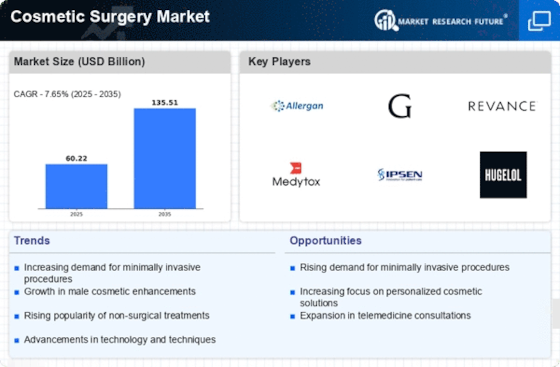
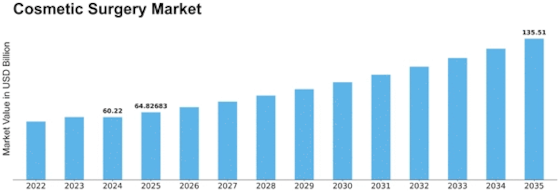
As per Market Research Future analysis, the Cosmetic Surgery Market was estimated at 60.22 USD Billion in 2024. The Cosmetic Surgery industry is projected to grow from 64.83 USD Billion in 2025 to 135.51 USD Billion by 2035, exhibiting a compound annual growth rate (CAGR) of 7.65% during the forecast period 2025 - 2035

Key Market Trends & Highlights

The Cosmetic Surgery Market is experiencing a dynamic shift towards non-invasive procedures and personalized treatments.

  • The rise of non-invasive procedures is reshaping consumer preferences, particularly in North America. There is an increased focus on personalization, with patients seeking tailored solutions that cater to individual needs. Integration of technology in procedures is enhancing safety and efficacy, driving growth in the Asia-Pacific region. Growing acceptance of cosmetic surgery and advancements in surgical techniques are key drivers propelling the market forward.

Market Size & Forecast

2024 Market Size 60.22 (USD Billion)
2035 Market Size 135.51 (USD Billion)
CAGR (2025 - 2035) 7.65%
Largest Regional Market Share in 2024 North America

Major Players

Allergan (US), Galderma (CH), Revance Therapeutics (US), Medytox (KR), Ipsen (FR), Hugel (KR), Medytox (KR), <a href="https://sientra.com/">Sientra</a> (US), Croma-Pharma (AT)

Market Trends

The Cosmetic Surgery Market is currently experiencing a dynamic evolution, driven by a confluence of factors that shape consumer preferences and technological advancements. Increasing societal acceptance of aesthetic procedures appears to be a pivotal element, as individuals increasingly seek enhancements that align with personal ideals of beauty. This shift in perception is complemented by the proliferation of social media platforms, which serve as both a source of inspiration and a means of showcasing results. As a result, the market is witnessing a surge in demand for various procedures, ranging from minimally invasive techniques to more complex surgical interventions. Moreover, advancements in technology are likely to play a crucial role in the future trajectory of the Cosmetic Surgery Market. Innovations in surgical techniques and equipment may enhance safety and efficacy, thereby attracting a broader demographic. Additionally, the rise of telemedicine could facilitate consultations and follow-ups, making cosmetic procedures more accessible to a wider audience. As the market continues to evolve, it seems poised for sustained growth, driven by changing attitudes towards beauty and the continuous development of new technologies that enhance patient experiences and outcomes.

Rise of Non-Invasive Procedures

There is a noticeable trend towards non-invasive cosmetic procedures, which are perceived as safer and requiring less recovery time. Treatments such as injectables and laser therapies are gaining popularity, appealing to individuals who desire aesthetic improvements without the commitment of surgery.

Increased Focus on Personalization

The Cosmetic Surgery Market is witnessing a shift towards personalized treatment plans tailored to individual needs and preferences. This trend suggests that practitioners are increasingly considering the unique characteristics of each patient, leading to more satisfactory outcomes.

Integration of Technology in Procedures

The incorporation of advanced technology in cosmetic procedures is becoming more prevalent. Techniques such as 3D imaging and robotic-assisted surgeries may enhance precision and reduce complications, indicating a potential transformation in how procedures are performed.

Cosmetic Surgery Market Market Drivers

Influence of Social Media

The impact of social media on the Cosmetic Surgery Market cannot be overstated. Platforms such as Instagram and TikTok have become powerful tools for promoting cosmetic procedures, with influencers and celebrities showcasing their transformations. This visibility has led to increased awareness and interest in cosmetic surgery among younger demographics. Data indicates that a significant portion of individuals considering cosmetic procedures cite social media as a primary source of inspiration. The ability to share before-and-after photos and personal experiences has created a community that normalizes cosmetic enhancements. As social media continues to shape perceptions of beauty, the Cosmetic Surgery Market is likely to benefit from heightened demand driven by these platforms.

Rising Disposable Incomes

The Cosmetic Surgery Market is significantly influenced by rising disposable incomes across various demographics. As individuals experience increased financial freedom, they are more inclined to invest in personal aesthetics. This trend is particularly evident in emerging markets, where economic growth has led to a surge in the number of individuals seeking cosmetic enhancements. Market data suggests that higher income levels correlate with a greater willingness to spend on cosmetic procedures, thereby driving industry growth. This financial empowerment allows consumers to prioritize their appearance, further propelling the demand for cosmetic surgery. Consequently, the Cosmetic Surgery Market is poised for continued expansion as economic conditions improve and more individuals seek to enhance their physical appearance.

Advancements in Surgical Techniques

Innovations in surgical techniques are playing a crucial role in the growth of the Cosmetic Surgery Market. Minimally invasive procedures, such as endoscopic surgery and laser treatments, have gained popularity due to their reduced recovery times and lower risk of complications. Data indicates that the demand for such procedures has surged, with a significant percentage of patients opting for less invasive options. These advancements not only enhance patient safety but also improve aesthetic outcomes, making cosmetic surgery more appealing. As technology continues to evolve, the Cosmetic Surgery Market is likely to witness further developments that could redefine traditional surgical practices, attracting a wider audience and increasing overall market size.

Growing Acceptance of Cosmetic Surgery

The Cosmetic Surgery Market is experiencing a notable shift in societal attitudes towards cosmetic procedures. Increasingly, individuals view cosmetic surgery as a viable option for enhancing their appearance, leading to a rise in demand. According to recent data, the number of cosmetic procedures performed has increased significantly, with millions of procedures conducted annually. This growing acceptance is driven by factors such as celebrity endorsements and social media influence, which normalize cosmetic enhancements. As more people share their experiences online, the stigma surrounding cosmetic surgery diminishes, encouraging others to consider these options. This trend suggests that the Cosmetic Surgery Market will continue to expand as societal norms evolve, potentially leading to a broader demographic seeking these services.

Increased Focus on Mental Health and Well-being

The Cosmetic Surgery Market is increasingly intersecting with the growing emphasis on mental health and well-being. Many individuals seek cosmetic procedures not only for aesthetic reasons but also to boost self-esteem and confidence. Research indicates that individuals who undergo cosmetic surgery often report improved psychological well-being post-procedure. This trend highlights a shift in the perception of cosmetic surgery as a means of enhancing overall quality of life. As mental health awareness continues to rise, more individuals may consider cosmetic enhancements as a valid approach to achieving personal satisfaction. This evolving mindset suggests that the Cosmetic Surgery Market will continue to thrive as it aligns with broader societal trends focused on mental health and self-improvement.

Market Segment Insights

By Procedure Type: Invasive (Largest) vs. Non-Invasive (Fastest-Growing)

The Cosmetic Surgery Market is distinctly divided between invasive and non-invasive procedures. Currently, invasive procedures hold a significant share of the market, with cosmetic surgeries such as liposuction, breast augmentation, and facelifts leading in popularity. This segment represents a substantial portion of overall cosmetic procedures, demonstrating consistent demand from consumers seeking significant physical enhancements. On the other hand, non-invasive procedures are experiencing a surge in popularity, positioning themselves as the fastest-growing category in the market. Treatments such as Botox and fillers, which offer minimal downtime and lower costs, are becoming increasingly preferred among younger demographics. The rising trend of self-improvement and beauty consciousness contributes to the rapid growth of non-invasive procedures, appealing to a broader audience.

Invasive (Dominant) vs. Non-Invasive (Emerging)

Invasive procedures are recognized as the dominant force in the Cosmetic Surgery Market, characterized by their complex nature and the commitment required from patients in terms of recovery and adjustments. Treatments such as full surgical enhancements provide significant and lasting results, justifying their continued popularity despite the associated risks. Conversely, non-invasive procedures are emerging as a formidable segment, thanks to technological advances that enhance safety and effectiveness. These include minimally invasive treatments that require little to no recovery time, attracting a diverse clientele seeking quick, effective beauty solutions without extensive commitment. This dynamic creates a competitive landscape where both segments vie for consumer attention in the evolving beauty culture.

By Invasive Procedures: Breast Augmentation (Largest) vs. Liposuction (Fastest-Growing)

In the Cosmetic Surgery Market, Breast Augmentation leads as the largest segment. This procedure caters to a wide demographic, driven by desires for aesthetics, body confidence, and personal empowerment. Liposuction, while not the largest, is rapidly gaining popularity due to its effectiveness in body contouring and the increasing awareness of minimally invasive techniques. Market trends indicate a growing acceptance of invasive procedures, influenced by social media, celebrity endorsements, and advancements in surgical technology. Patients are seeking tailored solutions, which include aesthetic enhancements and fat reduction techniques. As healthcare professionals continue to enhance their skills, both segments are likely to see a surge in demand, particularly among younger demographics keen on achieving idealised body images.

Breast Augmentation: Dominant vs. Eyelid Surgery: Emerging

Breast Augmentation stands as the dominant leader in the invasive procedures segment, appealing to a diverse audience seeking enhancements in breast volume and shape. This procedure is often perceived as synonymous with beauty and femininity, fostering its continued popularity. In contrast, Eyelid Surgery, although an emerging trend, is carving its niche primarily among older patients seeking rejuvenation. This procedure addresses concerns about aging, offering significant improvements in appearance and self-confidence. The rising interest in Eyelid Surgery is bolstered by its minimally invasive nature and quicker recovery times, appealing to those hesitant about extensive surgeries, thus driving its growth within the cosmetic surgery landscape.

By Non-Invasive Procedures: Botox Injections (Largest) vs. Soft Tissue Fillers (Fastest-Growing)

In the Cosmetic Surgery Market, the Non-Invasive Procedures segment showcases a diverse range of options catering to various cosmetic needs. Leading this segment, Botox Injections hold the largest market share, primarily due to their established reputation and widespread acceptance among consumers. Following closely, Soft Tissue Fillers continue to gain traction, appealing to a younger demographic focused on volume enhancement. Other notable procedures include Laser Hair Removal and Microdermabrasion, which contribute significantly to the overall dynamics of the market.

Botox Injections (Dominant) vs. Soft Tissue Fillers (Emerging)

Botox Injections serve as the dominant player in the Non-Invasive Procedures segment, renowned for their effectiveness in reducing wrinkles and fine lines. This procedure's stability in consumer preference stems from its quick application and minimal downtime, making it a staple in cosmetic enhancement. In contrast, Soft Tissue Fillers represent an emerging trend, particularly appealing to those seeking a youthful appearance without invasive surgery. Their versatility in facial contouring and restoration of volume has attracted a growing audience, positioning them as a strong contender in the evolving landscape of cosmetic procedures.

By End User: Hospitals and Dermatology Clinics (Largest) vs. Ambulatory Surgical Centers (Fastest-Growing)

In the Cosmetic Surgery Market, the segment distribution reveals a dominance of Hospitals and Dermatology Clinics, accounting for the largest share. Their extensive infrastructure, specialized staff, and comprehensive services cater effectively to a wide range of cosmetic procedures, appealing to a broad demographic. Ambulatory Surgical Centers, although currently smaller, are gaining traction and are predicted to capture significant market share in the near future.

Hospitals and Dermatology Clinics (Dominant) vs. Ambulatory Surgical Centers (Emerging)

Hospitals and Dermatology Clinics represent the dominant force in the Cosmetic Surgery Market, offering a comprehensive array of surgical and non-surgical procedures. These establishments benefit from advanced technology, skilled medical professionals, and established patient trust. In contrast, Ambulatory Surgical Centers are characterized by their efficiency and convenience, often providing cost-effective solutions with shorter recovery times. This segment is emerging rapidly as patients increasingly seek outpatient options. Both segments play crucial roles, but the growing demand for minimally invasive procedures and patient preferences towards convenience are propelling Ambulatory Surgical Centers to become significant competitors in the market.

Get more detailed insights about Cosmetic Surgery Market Research Report- Global Forecast To 2035

Regional Insights

North America : Cosmetic Surgery Market Leader

North America remains the largest market for cosmetic surgery, accounting for approximately 40% of the global market share. The region's growth is driven by increasing consumer awareness, technological advancements, and a rising number of minimally invasive procedures. Regulatory support from agencies like the FDA further catalyzes market expansion, ensuring safety and efficacy in cosmetic products and procedures. The United States is the leading country in this sector, with a significant presence of key players such as Allergan and Revance Therapeutics. Canada also contributes to the market, focusing on innovative solutions and patient-centric services. The competitive landscape is characterized by a mix of established companies and emerging players, all striving to meet the growing demand for cosmetic enhancements.

Europe : Emerging Cosmetic Surgery Market Hub

Europe is witnessing a robust growth trajectory in the cosmetic surgery market, holding approximately 30% of the global share. Factors such as an aging population, increased disposable income, and a cultural shift towards aesthetic enhancement are driving demand. Regulatory frameworks across countries like Germany and France are evolving to support innovative procedures while ensuring patient safety, thus fostering market growth. Leading countries in this region include Germany, France, and the UK, where a high concentration of cosmetic clinics and skilled practitioners exists. The competitive landscape features major players like Galderma and Ipsen, alongside numerous local clinics. The market is characterized by a blend of traditional surgical procedures and advanced non-invasive techniques, catering to diverse consumer preferences.

Asia-Pacific : Rapidly Growing Market

Asia-Pacific is emerging as a significant player in the cosmetic surgery market, accounting for around 25% of the global share. The region's growth is fueled by rising disposable incomes, increasing awareness of aesthetic procedures, and a cultural acceptance of cosmetic enhancements. Countries like South Korea and Japan are at the forefront, with supportive regulations that encourage innovation and safety in cosmetic practices. South Korea is particularly notable for its advanced cosmetic surgery techniques and a high volume of procedures performed annually. The competitive landscape includes key players like Medytox and Hugel, which are expanding their offerings to meet the growing demand. The region is also witnessing an influx of international brands, enhancing the overall market dynamics and consumer choices.

Middle East and Africa : Emerging Market Potential

The Middle East and Africa region is gradually establishing itself in the cosmetic surgery market, holding about 5% of the global share. Factors such as increasing urbanization, rising disposable incomes, and a growing interest in aesthetic procedures are driving market growth. Countries like the UAE and South Africa are leading the way, with regulatory bodies working to ensure safety and quality in cosmetic practices. The UAE, particularly Dubai, is becoming a hub for cosmetic surgery, attracting both local and international patients. The competitive landscape features a mix of local clinics and international chains, providing a wide range of services. Key players are focusing on innovative techniques and personalized care to cater to the diverse needs of consumers in this region.

Key Players and Competitive Insights

The Cosmetic Surgery Market is currently characterized by a dynamic competitive landscape, driven by factors such as increasing consumer demand for aesthetic procedures, advancements in technology, and a growing emphasis on minimally invasive techniques. Key players like Allergan (US), Galderma (CH), and Revance Therapeutics (US) are strategically positioned to leverage these trends. Allergan (US), known for its flagship product Botox, continues to innovate with new formulations and applications, while Galderma (CH) focuses on expanding its portfolio of dermal fillers and skin care products. Revance Therapeutics (US) is making strides with its DaxibotulinumtoxinA injection, which promises longer-lasting results, thereby enhancing its competitive edge. Collectively, these strategies not only bolster individual company performance but also intensify competition within the market, as firms vie for consumer attention and market share.In terms of business tactics, companies are increasingly localizing manufacturing to reduce costs and improve supply chain efficiency. This approach is particularly evident in the operations of Medytox (KR) and Ipsen (FR), which have optimized their production processes to cater to regional markets more effectively. The Cosmetic Surgery Market appears moderately fragmented, with a mix of established players and emerging companies. The collective influence of these key players shapes market dynamics, as they engage in strategic partnerships and collaborations to enhance their product offerings and market reach.

In August Allergan (US) announced the launch of a new line of advanced dermal fillers designed to cater to the evolving preferences of consumers seeking natural-looking results. This strategic move is significant as it aligns with the growing trend towards less invasive procedures, positioning Allergan to capture a larger share of the market. The introduction of these fillers not only reinforces Allergan's commitment to innovation but also responds to consumer demands for products that enhance rather than alter appearance.

In September Galderma (CH) expanded its global footprint by entering into a strategic partnership with a leading aesthetic clinic chain in Asia. This collaboration aims to enhance the distribution of Galderma's products in the region, tapping into the burgeoning demand for cosmetic procedures. Such partnerships are crucial as they enable Galderma to leverage local expertise and consumer insights, thereby strengthening its market position and driving growth in a competitive landscape.

In October Revance Therapeutics (US) revealed plans to invest in AI-driven technologies to enhance patient experience and streamline operations. This initiative is indicative of a broader trend within the industry, where companies are increasingly integrating technology to improve service delivery and operational efficiency. By adopting AI solutions, Revance aims to differentiate itself in a crowded market, potentially setting new standards for patient engagement and satisfaction.

As of October the Cosmetic Surgery Market is witnessing a shift towards digitalization, sustainability, and the integration of advanced technologies such as AI. Strategic alliances are becoming increasingly pivotal, as companies recognize the value of collaboration in navigating the complexities of the market. Looking ahead, competitive differentiation is likely to evolve, with a pronounced emphasis on innovation and technology rather than solely on price. This transition suggests that companies that prioritize research and development, alongside reliable supply chains, will be better positioned to thrive in an increasingly competitive environment.

Key Companies in the Cosmetic Surgery Market include

Industry Developments

In February 2023, Candela Corporation introduced the new FDA-cleared Profound Matrix System. This multi-application solution, designed to repair, preserve, and restore skin at various stages of ageing, includes Sublime, Sublative RF, and all-new Matrix Pro applicators.

In June 2022, Cynosure introduced the PicoSure Pro device, the newest improvement to the PicoSure platform.

In March 2022, Health Canada has given its approval for Sientra breast implants. Through its local partner Kai Aesthetic, the company will offer breast implants in Canada. Sientra will uphold the highest quality, safety, and service standards for patients and plastic surgeons within the terms of the distribution agreement.

In September 2021, Galderma's Restylane portfolio grew and expanded. Restylane Eyesight was introduced as a focused treatment for under-eye shadows. The FDA authorized Restylane Defyne in February 2021 for the augmentation and treatment of mild to moderate chin retrusion in people over the age of 21.

The World Health Organization, also known as the WHO, is urged by US and Mexican authorities to declare an international health emergency due to a fungal epidemic linked to cosmetic procedures in Mexico. According to the Centers for Disease Control and Prevention, or CDC, meningitis claimed the lives of two patients who underwent surgeries under epidural anesthesia. Nearly 400 people are being watched in the United States and Mexico. In the Mexican town of Matamoros, two cosmetic surgery clinics have closed.

Authorities in the US and Mexico have advised people to get evaluated, even if they are asymptomatic, if they had procedures involving anesthesia with epidural performed at the River Side Surgical Center or Clinica K-3 since January.

A law that aims to control influencers' commercial activities and safeguard consumers from fraud and scams is being finalized in France. The National Assembly and the Senate have already approved the rule forbidding promoting cosmetic surgery and paying for sports betting subscriptions. Influencers must also disclose how much they have been compensated for advocating a product, whether photos have been edited, and whether artificial intelligence was used to create a person's face or body.

If someone violates the rules, they could spend a maximum of two years in jail, pay a fine of €300,000 ($320,000), and lose their right to use social media for business purposes. 

The legislators use examples like advertising alleged "drugs" for cancer or hair-loss-inducing cosmetics. The proposed law expands on existing French law, which strictly controls the promotion of goods like alcohol and tobacco. While the new bill might call for influencers to incorporate a display indicating which post is being sponsored, the existing law already requires advertising to be transparent.

Future Outlook

Cosmetic Surgery Market Future Outlook

The Cosmetic Surgery Market is projected to grow at a 7.65% CAGR from 2025 to 2035, driven by technological advancements, increasing consumer awareness, and rising disposable incomes.

New opportunities lie in:

  • Expansion of telemedicine consultations for cosmetic procedures.</p><p>Development of personalized cosmetic surgery packages targeting millennials.</p><p>Investment in AI-driven surgical planning tools to enhance precision.

By 2035, the market is expected to solidify its position as a leader in aesthetic enhancements.

Market Segmentation

Cosmetic Surgery Market End User Outlook

  • Hospitals and Dermatology Clinics
  • Ambulatory Surgical Centers
  • Others

Cosmetic Surgery Market Procedure Type Outlook

  • Invasive
  • Non-Invasive

Cosmetic Surgery Market Invasive Procedures Outlook

  • Breast Augmentation
  • Liposuction
  • Nose Reshaping
  • Eyelid Surgery
  • Tummy Tuck
  • Others

Cosmetic Surgery Market Non-Invasive Procedures Outlook

  • Botox Injections
  • Soft Tissue Fillers
  • Chemical Peel
  • Laser Hair Removal
  • Microdermabrasion
  • Dermabrasion
  • Others

Report Scope

MARKET SIZE 2024 60.22(USD Billion)
MARKET SIZE 2025 64.83(USD Billion)
MARKET SIZE 2035 135.51(USD Billion)
COMPOUND ANNUAL GROWTH RATE (CAGR) 7.65% (2025 - 2035)
REPORT COVERAGE Revenue Forecast, Competitive Landscape, Growth Factors, and Trends
BASE YEAR 2024
Market Forecast Period 2025 - 2035
Historical Data 2019 - 2024
Market Forecast Units USD Billion
Key Companies Profiled Allergan (US), Galderma (CH), Revance Therapeutics (US), Medytox (KR), Ipsen (FR), Hugel (KR), Medytox (KR), Sientra (US), Croma-Pharma (AT)
Segments Covered Procedure Type {Invasive, End User
Key Market Opportunities Integration of advanced technologies enhances patient experience and expands service offerings in the Cosmetic Surgery Market.
Key Market Dynamics Rising consumer demand for minimally invasive procedures drives innovation and competition in the cosmetic surgery market.
Countries Covered North America, Europe, APAC, South America, MEA

FAQs

What is the current valuation of the Cosmetic Surgery Market in 2025?

<p>The Cosmetic Surgery Market is valued at approximately 60.22 USD Billion in 2024.</p>

What is the projected market size for the Cosmetic Surgery Market by 2035?

<p>The market is expected to reach a valuation of 135.51 USD Billion by 2035.</p>

What is the expected CAGR for the Cosmetic Surgery Market during the forecast period 2025 - 2035?

<p>The expected CAGR for the Cosmetic Surgery Market during the forecast period 2025 - 2035 is 7.65%.</p>

Which companies are considered key players in the Cosmetic Surgery Market?

<p>Key players in the market include Allergan, Galderma, Revance Therapeutics, Medytox, Ipsen, Hugel, Sientra, and Croma-Pharma.</p>

What are the main segments of the Cosmetic Surgery Market?

<p>The main segments of the market include Invasive Procedures, Non-Invasive Procedures, and End Users.</p>

What was the market size for Invasive Procedures in 2024?

<p>In 2024, the market size for Invasive Procedures was approximately 30.11 USD Billion.</p>

What is the projected market size for Non-Invasive Procedures by 2035?

The projected market size for Non-Invasive Procedures is expected to reach 67.76 USD Billion by 2035.

Which invasive procedure had the highest market size in 2024?

Breast Augmentation had the highest market size among invasive procedures, valued at 12.06 USD Billion in 2024.

What is the expected market size for Botox Injections by 2035?

The market size for Botox Injections is projected to reach 25.0 USD Billion by 2035.

What are the primary end users in the Cosmetic Surgery Market?

Primary end users include Hospitals and Dermatology Clinics, Ambulatory Surgical Centers, and others.

  1. SECTION I: EXECUTIVE SUMMARY AND KEY HIGHLIGHTS
    1. | 1.1 EXECUTIVE SUMMARY
    2. | | 1.1.1 Market Overview
    3. | | 1.1.2 Key Findings
    4. | | 1.1.3 Market Segmentation
    5. | | 1.1.4 Competitive Landscape
    6. | | 1.1.5 Challenges and Opportunities
    7. | | 1.1.6 Future Outlook
  2. SECTION II: SCOPING, METHODOLOGY AND MARKET STRUCTURE
    1. | 2.1 MARKET INTRODUCTION
    2. | | 2.1.1 Definition
    3. | | 2.1.2 Scope of the study
    4. | | | 2.1.2.1 Research Objective
    5. | | | 2.1.2.2 Assumption
    6. | | | 2.1.2.3 Limitations
    7. | 2.2 RESEARCH METHODOLOGY
    8. | | 2.2.1 Overview
    9. | | 2.2.2 Data Mining
    10. | | 2.2.3 Secondary Research
    11. | | 2.2.4 Primary Research
    12. | | | 2.2.4.1 Primary Interviews and Information Gathering Process
    13. | | | 2.2.4.2 Breakdown of Primary Respondents
    14. | | 2.2.5 Forecasting Model
    15. | | 2.2.6 Market Size Estimation
    16. | | | 2.2.6.1 Bottom-Up Approach
    17. | | | 2.2.6.2 Top-Down Approach
    18. | | 2.2.7 Data Triangulation
    19. | | 2.2.8 Validation
  3. SECTION III: QUALITATIVE ANALYSIS
    1. | 3.1 MARKET DYNAMICS
    2. | | 3.1.1 Overview
    3. | | 3.1.2 Drivers
    4. | | 3.1.3 Restraints
    5. | | 3.1.4 Opportunities
    6. | 3.2 MARKET FACTOR ANALYSIS
    7. | | 3.2.1 Value chain Analysis
    8. | | 3.2.2 Porter's Five Forces Analysis
    9. | | | 3.2.2.1 Bargaining Power of Suppliers
    10. | | | 3.2.2.2 Bargaining Power of Buyers
    11. | | | 3.2.2.3 Threat of New Entrants
    12. | | | 3.2.2.4 Threat of Substitutes
    13. | | | 3.2.2.5 Intensity of Rivalry
    14. | | 3.2.3 COVID-19 Impact Analysis
    15. | | | 3.2.3.1 Market Impact Analysis
    16. | | | 3.2.3.2 Regional Impact
    17. | | | 3.2.3.3 Opportunity and Threat Analysis
  4. SECTION IV: QUANTITATIVE ANALYSIS
    1. | 4.1 Healthcare, BY Procedure Type (USD Billion)
    2. | | 4.1.1 Invasive
    3. | | 4.1.2 Non-Invasive
    4. | 4.2 Healthcare, BY Invasive Procedures (USD Billion)
    5. | | 4.2.1 Breast Augmentation
    6. | | 4.2.2 Liposuction
    7. | | 4.2.3 Nose Reshaping
    8. | | 4.2.4 Eyelid Surgery
    9. | | 4.2.5 Tummy Tuck
    10. | | 4.2.6 Others
    11. | 4.3 Healthcare, BY Non-Invasive Procedures (USD Billion)
    12. | | 4.3.1 Botox Injections
    13. | | 4.3.2 Soft Tissue Fillers
    14. | | 4.3.3 Chemical Peel
    15. | | 4.3.4 Laser Hair Removal
    16. | | 4.3.5 Microdermabrasion
    17. | | 4.3.6 Dermabrasion
    18. | | 4.3.7 Others
    19. | 4.4 Healthcare, BY End User (USD Billion)
    20. | | 4.4.1 Hospitals and Dermatology Clinics
    21. | | 4.4.2 Ambulatory Surgical Centers
    22. | | 4.4.3 Others
    23. | 4.5 Healthcare, BY Region (USD Billion)
    24. | | 4.5.1 North America
    25. | | | 4.5.1.1 US
    26. | | | 4.5.1.2 Canada
    27. | | 4.5.2 Europe
    28. | | | 4.5.2.1 Germany
    29. | | | 4.5.2.2 UK
    30. | | | 4.5.2.3 France
    31. | | | 4.5.2.4 Russia
    32. | | | 4.5.2.5 Italy
    33. | | | 4.5.2.6 Spain
    34. | | | 4.5.2.7 Rest of Europe
    35. | | 4.5.3 APAC
    36. | | | 4.5.3.1 China
    37. | | | 4.5.3.2 India
    38. | | | 4.5.3.3 Japan
    39. | | | 4.5.3.4 South Korea
    40. | | | 4.5.3.5 Malaysia
    41. | | | 4.5.3.6 Thailand
    42. | | | 4.5.3.7 Indonesia
    43. | | | 4.5.3.8 Rest of APAC
    44. | | 4.5.4 South America
    45. | | | 4.5.4.1 Brazil
    46. | | | 4.5.4.2 Mexico
    47. | | | 4.5.4.3 Argentina
    48. | | | 4.5.4.4 Rest of South America
    49. | | 4.5.5 MEA
    50. | | | 4.5.5.1 GCC Countries
    51. | | | 4.5.5.2 South Africa
    52. | | | 4.5.5.3 Rest of MEA
  5. SECTION V: COMPETITIVE ANALYSIS
    1. | 5.1 Competitive Landscape
    2. | | 5.1.1 Overview
    3. | | 5.1.2 Competitive Analysis
    4. | | 5.1.3 Market share Analysis
    5. | | 5.1.4 Major Growth Strategy in the Healthcare
    6. | | 5.1.5 Competitive Benchmarking
    7. | | 5.1.6 Leading Players in Terms of Number of Developments in the Healthcare
    8. | | 5.1.7 Key developments and growth strategies
    9. | | | 5.1.7.1 New Product Launch/Service Deployment
    10. | | | 5.1.7.2 Merger & Acquisitions
    11. | | | 5.1.7.3 Joint Ventures
    12. | | 5.1.8 Major Players Financial Matrix
    13. | | | 5.1.8.1 Sales and Operating Income
    14. | | | 5.1.8.2 Major Players R&D Expenditure. 2023
    15. | 5.2 Company Profiles
    16. | | 5.2.1 Allergan (US)
    17. | | | 5.2.1.1 Financial Overview
    18. | | | 5.2.1.2 Products Offered
    19. | | | 5.2.1.3 Key Developments
    20. | | | 5.2.1.4 SWOT Analysis
    21. | | | 5.2.1.5 Key Strategies
    22. | | 5.2.2 Galderma (CH)
    23. | | | 5.2.2.1 Financial Overview
    24. | | | 5.2.2.2 Products Offered
    25. | | | 5.2.2.3 Key Developments
    26. | | | 5.2.2.4 SWOT Analysis
    27. | | | 5.2.2.5 Key Strategies
    28. | | 5.2.3 Revance Therapeutics (US)
    29. | | | 5.2.3.1 Financial Overview
    30. | | | 5.2.3.2 Products Offered
    31. | | | 5.2.3.3 Key Developments
    32. | | | 5.2.3.4 SWOT Analysis
    33. | | | 5.2.3.5 Key Strategies
    34. | | 5.2.4 Medytox (KR)
    35. | | | 5.2.4.1 Financial Overview
    36. | | | 5.2.4.2 Products Offered
    37. | | | 5.2.4.3 Key Developments
    38. | | | 5.2.4.4 SWOT Analysis
    39. | | | 5.2.4.5 Key Strategies
    40. | | 5.2.5 Ipsen (FR)
    41. | | | 5.2.5.1 Financial Overview
    42. | | | 5.2.5.2 Products Offered
    43. | | | 5.2.5.3 Key Developments
    44. | | | 5.2.5.4 SWOT Analysis
    45. | | | 5.2.5.5 Key Strategies
    46. | | 5.2.6 Hugel (KR)
    47. | | | 5.2.6.1 Financial Overview
    48. | | | 5.2.6.2 Products Offered
    49. | | | 5.2.6.3 Key Developments
    50. | | | 5.2.6.4 SWOT Analysis
    51. | | | 5.2.6.5 Key Strategies
    52. | | 5.2.7 Medytox (KR)
    53. | | | 5.2.7.1 Financial Overview
    54. | | | 5.2.7.2 Products Offered
    55. | | | 5.2.7.3 Key Developments
    56. | | | 5.2.7.4 SWOT Analysis
    57. | | | 5.2.7.5 Key Strategies
    58. | | 5.2.8 Sientra (US)
    59. | | | 5.2.8.1 Financial Overview
    60. | | | 5.2.8.2 Products Offered
    61. | | | 5.2.8.3 Key Developments
    62. | | | 5.2.8.4 SWOT Analysis
    63. | | | 5.2.8.5 Key Strategies
    64. | | 5.2.9 Croma-Pharma (AT)
    65. | | | 5.2.9.1 Financial Overview
    66. | | | 5.2.9.2 Products Offered
    67. | | | 5.2.9.3 Key Developments
    68. | | | 5.2.9.4 SWOT Analysis
    69. | | | 5.2.9.5 Key Strategies
    70. | 5.3 Appendix
    71. | | 5.3.1 References
    72. | | 5.3.2 Related Reports
  6. LIST OF FIGURES
    1. | 6.1 MARKET SYNOPSIS
    2. | 6.2 NORTH AMERICA MARKET ANALYSIS
    3. | 6.3 US MARKET ANALYSIS BY PROCEDURE TYPE
    4. | 6.4 US MARKET ANALYSIS BY INVASIVE PROCEDURES
    5. | 6.5 US MARKET ANALYSIS BY NON-INVASIVE PROCEDURES
    6. | 6.6 US MARKET ANALYSIS BY END USER
    7. | 6.7 CANADA MARKET ANALYSIS BY PROCEDURE TYPE
    8. | 6.8 CANADA MARKET ANALYSIS BY INVASIVE PROCEDURES
    9. | 6.9 CANADA MARKET ANALYSIS BY NON-INVASIVE PROCEDURES
    10. | 6.10 CANADA MARKET ANALYSIS BY END USER
    11. | 6.11 EUROPE MARKET ANALYSIS
    12. | 6.12 GERMANY MARKET ANALYSIS BY PROCEDURE TYPE
    13. | 6.13 GERMANY MARKET ANALYSIS BY INVASIVE PROCEDURES
    14. | 6.14 GERMANY MARKET ANALYSIS BY NON-INVASIVE PROCEDURES
    15. | 6.15 GERMANY MARKET ANALYSIS BY END USER
    16. | 6.16 UK MARKET ANALYSIS BY PROCEDURE TYPE
    17. | 6.17 UK MARKET ANALYSIS BY INVASIVE PROCEDURES
    18. | 6.18 UK MARKET ANALYSIS BY NON-INVASIVE PROCEDURES
    19. | 6.19 UK MARKET ANALYSIS BY END USER
    20. | 6.20 FRANCE MARKET ANALYSIS BY PROCEDURE TYPE
    21. | 6.21 FRANCE MARKET ANALYSIS BY INVASIVE PROCEDURES
    22. | 6.22 FRANCE MARKET ANALYSIS BY NON-INVASIVE PROCEDURES
    23. | 6.23 FRANCE MARKET ANALYSIS BY END USER
    24. | 6.24 RUSSIA MARKET ANALYSIS BY PROCEDURE TYPE
    25. | 6.25 RUSSIA MARKET ANALYSIS BY INVASIVE PROCEDURES
    26. | 6.26 RUSSIA MARKET ANALYSIS BY NON-INVASIVE PROCEDURES
    27. | 6.27 RUSSIA MARKET ANALYSIS BY END USER
    28. | 6.28 ITALY MARKET ANALYSIS BY PROCEDURE TYPE
    29. | 6.29 ITALY MARKET ANALYSIS BY INVASIVE PROCEDURES
    30. | 6.30 ITALY MARKET ANALYSIS BY NON-INVASIVE PROCEDURES
    31. | 6.31 ITALY MARKET ANALYSIS BY END USER
    32. | 6.32 SPAIN MARKET ANALYSIS BY PROCEDURE TYPE
    33. | 6.33 SPAIN MARKET ANALYSIS BY INVASIVE PROCEDURES
    34. | 6.34 SPAIN MARKET ANALYSIS BY NON-INVASIVE PROCEDURES
    35. | 6.35 SPAIN MARKET ANALYSIS BY END USER
    36. | 6.36 REST OF EUROPE MARKET ANALYSIS BY PROCEDURE TYPE
    37. | 6.37 REST OF EUROPE MARKET ANALYSIS BY INVASIVE PROCEDURES
    38. | 6.38 REST OF EUROPE MARKET ANALYSIS BY NON-INVASIVE PROCEDURES
    39. | 6.39 REST OF EUROPE MARKET ANALYSIS BY END USER
    40. | 6.40 APAC MARKET ANALYSIS
    41. | 6.41 CHINA MARKET ANALYSIS BY PROCEDURE TYPE
    42. | 6.42 CHINA MARKET ANALYSIS BY INVASIVE PROCEDURES
    43. | 6.43 CHINA MARKET ANALYSIS BY NON-INVASIVE PROCEDURES
    44. | 6.44 CHINA MARKET ANALYSIS BY END USER
    45. | 6.45 INDIA MARKET ANALYSIS BY PROCEDURE TYPE
    46. | 6.46 INDIA MARKET ANALYSIS BY INVASIVE PROCEDURES
    47. | 6.47 INDIA MARKET ANALYSIS BY NON-INVASIVE PROCEDURES
    48. | 6.48 INDIA MARKET ANALYSIS BY END USER
    49. | 6.49 JAPAN MARKET ANALYSIS BY PROCEDURE TYPE
    50. | 6.50 JAPAN MARKET ANALYSIS BY INVASIVE PROCEDURES
    51. | 6.51 JAPAN MARKET ANALYSIS BY NON-INVASIVE PROCEDURES
    52. | 6.52 JAPAN MARKET ANALYSIS BY END USER
    53. | 6.53 SOUTH KOREA MARKET ANALYSIS BY PROCEDURE TYPE
    54. | 6.54 SOUTH KOREA MARKET ANALYSIS BY INVASIVE PROCEDURES
    55. | 6.55 SOUTH KOREA MARKET ANALYSIS BY NON-INVASIVE PROCEDURES
    56. | 6.56 SOUTH KOREA MARKET ANALYSIS BY END USER
    57. | 6.57 MALAYSIA MARKET ANALYSIS BY PROCEDURE TYPE
    58. | 6.58 MALAYSIA MARKET ANALYSIS BY INVASIVE PROCEDURES
    59. | 6.59 MALAYSIA MARKET ANALYSIS BY NON-INVASIVE PROCEDURES
    60. | 6.60 MALAYSIA MARKET ANALYSIS BY END USER
    61. | 6.61 THAILAND MARKET ANALYSIS BY PROCEDURE TYPE
    62. | 6.62 THAILAND MARKET ANALYSIS BY INVASIVE PROCEDURES
    63. | 6.63 THAILAND MARKET ANALYSIS BY NON-INVASIVE PROCEDURES
    64. | 6.64 THAILAND MARKET ANALYSIS BY END USER
    65. | 6.65 INDONESIA MARKET ANALYSIS BY PROCEDURE TYPE
    66. | 6.66 INDONESIA MARKET ANALYSIS BY INVASIVE PROCEDURES
    67. | 6.67 INDONESIA MARKET ANALYSIS BY NON-INVASIVE PROCEDURES
    68. | 6.68 INDONESIA MARKET ANALYSIS BY END USER
    69. | 6.69 REST OF APAC MARKET ANALYSIS BY PROCEDURE TYPE
    70. | 6.70 REST OF APAC MARKET ANALYSIS BY INVASIVE PROCEDURES
    71. | 6.71 REST OF APAC MARKET ANALYSIS BY NON-INVASIVE PROCEDURES
    72. | 6.72 REST OF APAC MARKET ANALYSIS BY END USER
    73. | 6.73 SOUTH AMERICA MARKET ANALYSIS
    74. | 6.74 BRAZIL MARKET ANALYSIS BY PROCEDURE TYPE
    75. | 6.75 BRAZIL MARKET ANALYSIS BY INVASIVE PROCEDURES
    76. | 6.76 BRAZIL MARKET ANALYSIS BY NON-INVASIVE PROCEDURES
    77. | 6.77 BRAZIL MARKET ANALYSIS BY END USER
    78. | 6.78 MEXICO MARKET ANALYSIS BY PROCEDURE TYPE
    79. | 6.79 MEXICO MARKET ANALYSIS BY INVASIVE PROCEDURES
    80. | 6.80 MEXICO MARKET ANALYSIS BY NON-INVASIVE PROCEDURES
    81. | 6.81 MEXICO MARKET ANALYSIS BY END USER
    82. | 6.82 ARGENTINA MARKET ANALYSIS BY PROCEDURE TYPE
    83. | 6.83 ARGENTINA MARKET ANALYSIS BY INVASIVE PROCEDURES
    84. | 6.84 ARGENTINA MARKET ANALYSIS BY NON-INVASIVE PROCEDURES
    85. | 6.85 ARGENTINA MARKET ANALYSIS BY END USER
    86. | 6.86 REST OF SOUTH AMERICA MARKET ANALYSIS BY PROCEDURE TYPE
    87. | 6.87 REST OF SOUTH AMERICA MARKET ANALYSIS BY INVASIVE PROCEDURES
    88. | 6.88 REST OF SOUTH AMERICA MARKET ANALYSIS BY NON-INVASIVE PROCEDURES
    89. | 6.89 REST OF SOUTH AMERICA MARKET ANALYSIS BY END USER
    90. | 6.90 MEA MARKET ANALYSIS
    91. | 6.91 GCC COUNTRIES MARKET ANALYSIS BY PROCEDURE TYPE
    92. | 6.92 GCC COUNTRIES MARKET ANALYSIS BY INVASIVE PROCEDURES
    93. | 6.93 GCC COUNTRIES MARKET ANALYSIS BY NON-INVASIVE PROCEDURES
    94. | 6.94 GCC COUNTRIES MARKET ANALYSIS BY END USER
    95. | 6.95 SOUTH AFRICA MARKET ANALYSIS BY PROCEDURE TYPE
    96. | 6.96 SOUTH AFRICA MARKET ANALYSIS BY INVASIVE PROCEDURES
    97. | 6.97 SOUTH AFRICA MARKET ANALYSIS BY NON-INVASIVE PROCEDURES
    98. | 6.98 SOUTH AFRICA MARKET ANALYSIS BY END USER
    99. | 6.99 REST OF MEA MARKET ANALYSIS BY PROCEDURE TYPE
    100. | 6.100 REST OF MEA MARKET ANALYSIS BY INVASIVE PROCEDURES
    101. | 6.101 REST OF MEA MARKET ANALYSIS BY NON-INVASIVE PROCEDURES
    102. | 6.102 REST OF MEA MARKET ANALYSIS BY END USER
    103. | 6.103 KEY BUYING CRITERIA OF HEALTHCARE
    104. | 6.104 RESEARCH PROCESS OF MRFR
    105. | 6.105 DRO ANALYSIS OF HEALTHCARE
    106. | 6.106 DRIVERS IMPACT ANALYSIS: HEALTHCARE
    107. | 6.107 RESTRAINTS IMPACT ANALYSIS: HEALTHCARE
    108. | 6.108 SUPPLY / VALUE CHAIN: HEALTHCARE
    109. | 6.109 HEALTHCARE, BY PROCEDURE TYPE, 2024 (% SHARE)
    110. | 6.110 HEALTHCARE, BY PROCEDURE TYPE, 2024 TO 2035 (USD Billion)
    111. | 6.111 HEALTHCARE, BY INVASIVE PROCEDURES, 2024 (% SHARE)
    112. | 6.112 HEALTHCARE, BY INVASIVE PROCEDURES, 2024 TO 2035 (USD Billion)
    113. | 6.113 HEALTHCARE, BY NON-INVASIVE PROCEDURES, 2024 (% SHARE)
    114. | 6.114 HEALTHCARE, BY NON-INVASIVE PROCEDURES, 2024 TO 2035 (USD Billion)
    115. | 6.115 HEALTHCARE, BY END USER, 2024 (% SHARE)
    116. | 6.116 HEALTHCARE, BY END USER, 2024 TO 2035 (USD Billion)
    117. | 6.117 BENCHMARKING OF MAJOR COMPETITORS
  7. LIST OF TABLES
    1. | 7.1 LIST OF ASSUMPTIONS
    2. | | 7.1.1
    3. | 7.2 North America MARKET SIZE ESTIMATES; FORECAST
    4. | | 7.2.1 BY PROCEDURE TYPE, 2025-2035 (USD Billion)
    5. | | 7.2.2 BY INVASIVE PROCEDURES, 2025-2035 (USD Billion)
    6. | | 7.2.3 BY NON-INVASIVE PROCEDURES, 2025-2035 (USD Billion)
    7. | | 7.2.4 BY END USER, 2025-2035 (USD Billion)
    8. | 7.3 US MARKET SIZE ESTIMATES; FORECAST
    9. | | 7.3.1 BY PROCEDURE TYPE, 2025-2035 (USD Billion)
    10. | | 7.3.2 BY INVASIVE PROCEDURES, 2025-2035 (USD Billion)
    11. | | 7.3.3 BY NON-INVASIVE PROCEDURES, 2025-2035 (USD Billion)
    12. | | 7.3.4 BY END USER, 2025-2035 (USD Billion)
    13. | 7.4 Canada MARKET SIZE ESTIMATES; FORECAST
    14. | | 7.4.1 BY PROCEDURE TYPE, 2025-2035 (USD Billion)
    15. | | 7.4.2 BY INVASIVE PROCEDURES, 2025-2035 (USD Billion)
    16. | | 7.4.3 BY NON-INVASIVE PROCEDURES, 2025-2035 (USD Billion)
    17. | | 7.4.4 BY END USER, 2025-2035 (USD Billion)
    18. | 7.5 Europe MARKET SIZE ESTIMATES; FORECAST
    19. | | 7.5.1 BY PROCEDURE TYPE, 2025-2035 (USD Billion)
    20. | | 7.5.2 BY INVASIVE PROCEDURES, 2025-2035 (USD Billion)
    21. | | 7.5.3 BY NON-INVASIVE PROCEDURES, 2025-2035 (USD Billion)
    22. | | 7.5.4 BY END USER, 2025-2035 (USD Billion)
    23. | 7.6 Germany MARKET SIZE ESTIMATES; FORECAST
    24. | | 7.6.1 BY PROCEDURE TYPE, 2025-2035 (USD Billion)
    25. | | 7.6.2 BY INVASIVE PROCEDURES, 2025-2035 (USD Billion)
    26. | | 7.6.3 BY NON-INVASIVE PROCEDURES, 2025-2035 (USD Billion)
    27. | | 7.6.4 BY END USER, 2025-2035 (USD Billion)
    28. | 7.7 UK MARKET SIZE ESTIMATES; FORECAST
    29. | | 7.7.1 BY PROCEDURE TYPE, 2025-2035 (USD Billion)
    30. | | 7.7.2 BY INVASIVE PROCEDURES, 2025-2035 (USD Billion)
    31. | | 7.7.3 BY NON-INVASIVE PROCEDURES, 2025-2035 (USD Billion)
    32. | | 7.7.4 BY END USER, 2025-2035 (USD Billion)
    33. | 7.8 France MARKET SIZE ESTIMATES; FORECAST
    34. | | 7.8.1 BY PROCEDURE TYPE, 2025-2035 (USD Billion)
    35. | | 7.8.2 BY INVASIVE PROCEDURES, 2025-2035 (USD Billion)
    36. | | 7.8.3 BY NON-INVASIVE PROCEDURES, 2025-2035 (USD Billion)
    37. | | 7.8.4 BY END USER, 2025-2035 (USD Billion)
    38. | 7.9 Russia MARKET SIZE ESTIMATES; FORECAST
    39. | | 7.9.1 BY PROCEDURE TYPE, 2025-2035 (USD Billion)
    40. | | 7.9.2 BY INVASIVE PROCEDURES, 2025-2035 (USD Billion)
    41. | | 7.9.3 BY NON-INVASIVE PROCEDURES, 2025-2035 (USD Billion)
    42. | | 7.9.4 BY END USER, 2025-2035 (USD Billion)
    43. | 7.10 Italy MARKET SIZE ESTIMATES; FORECAST
    44. | | 7.10.1 BY PROCEDURE TYPE, 2025-2035 (USD Billion)
    45. | | 7.10.2 BY INVASIVE PROCEDURES, 2025-2035 (USD Billion)
    46. | | 7.10.3 BY NON-INVASIVE PROCEDURES, 2025-2035 (USD Billion)
    47. | | 7.10.4 BY END USER, 2025-2035 (USD Billion)
    48. | 7.11 Spain MARKET SIZE ESTIMATES; FORECAST
    49. | | 7.11.1 BY PROCEDURE TYPE, 2025-2035 (USD Billion)
    50. | | 7.11.2 BY INVASIVE PROCEDURES, 2025-2035 (USD Billion)
    51. | | 7.11.3 BY NON-INVASIVE PROCEDURES, 2025-2035 (USD Billion)
    52. | | 7.11.4 BY END USER, 2025-2035 (USD Billion)
    53. | 7.12 Rest of Europe MARKET SIZE ESTIMATES; FORECAST
    54. | | 7.12.1 BY PROCEDURE TYPE, 2025-2035 (USD Billion)
    55. | | 7.12.2 BY INVASIVE PROCEDURES, 2025-2035 (USD Billion)
    56. | | 7.12.3 BY NON-INVASIVE PROCEDURES, 2025-2035 (USD Billion)
    57. | | 7.12.4 BY END USER, 2025-2035 (USD Billion)
    58. | 7.13 APAC MARKET SIZE ESTIMATES; FORECAST
    59. | | 7.13.1 BY PROCEDURE TYPE, 2025-2035 (USD Billion)
    60. | | 7.13.2 BY INVASIVE PROCEDURES, 2025-2035 (USD Billion)
    61. | | 7.13.3 BY NON-INVASIVE PROCEDURES, 2025-2035 (USD Billion)
    62. | | 7.13.4 BY END USER, 2025-2035 (USD Billion)
    63. | 7.14 China MARKET SIZE ESTIMATES; FORECAST
    64. | | 7.14.1 BY PROCEDURE TYPE, 2025-2035 (USD Billion)
    65. | | 7.14.2 BY INVASIVE PROCEDURES, 2025-2035 (USD Billion)
    66. | | 7.14.3 BY NON-INVASIVE PROCEDURES, 2025-2035 (USD Billion)
    67. | | 7.14.4 BY END USER, 2025-2035 (USD Billion)
    68. | 7.15 India MARKET SIZE ESTIMATES; FORECAST
    69. | | 7.15.1 BY PROCEDURE TYPE, 2025-2035 (USD Billion)
    70. | | 7.15.2 BY INVASIVE PROCEDURES, 2025-2035 (USD Billion)
    71. | | 7.15.3 BY NON-INVASIVE PROCEDURES, 2025-2035 (USD Billion)
    72. | | 7.15.4 BY END USER, 2025-2035 (USD Billion)
    73. | 7.16 Japan MARKET SIZE ESTIMATES; FORECAST
    74. | | 7.16.1 BY PROCEDURE TYPE, 2025-2035 (USD Billion)
    75. | | 7.16.2 BY INVASIVE PROCEDURES, 2025-2035 (USD Billion)
    76. | | 7.16.3 BY NON-INVASIVE PROCEDURES, 2025-2035 (USD Billion)
    77. | | 7.16.4 BY END USER, 2025-2035 (USD Billion)
    78. | 7.17 South Korea MARKET SIZE ESTIMATES; FORECAST
    79. | | 7.17.1 BY PROCEDURE TYPE, 2025-2035 (USD Billion)
    80. | | 7.17.2 BY INVASIVE PROCEDURES, 2025-2035 (USD Billion)
    81. | | 7.17.3 BY NON-INVASIVE PROCEDURES, 2025-2035 (USD Billion)
    82. | | 7.17.4 BY END USER, 2025-2035 (USD Billion)
    83. | 7.18 Malaysia MARKET SIZE ESTIMATES; FORECAST
    84. | | 7.18.1 BY PROCEDURE TYPE, 2025-2035 (USD Billion)
    85. | | 7.18.2 BY INVASIVE PROCEDURES, 2025-2035 (USD Billion)
    86. | | 7.18.3 BY NON-INVASIVE PROCEDURES, 2025-2035 (USD Billion)
    87. | | 7.18.4 BY END USER, 2025-2035 (USD Billion)
    88. | 7.19 Thailand MARKET SIZE ESTIMATES; FORECAST
    89. | | 7.19.1 BY PROCEDURE TYPE, 2025-2035 (USD Billion)
    90. | | 7.19.2 BY INVASIVE PROCEDURES, 2025-2035 (USD Billion)
    91. | | 7.19.3 BY NON-INVASIVE PROCEDURES, 2025-2035 (USD Billion)
    92. | | 7.19.4 BY END USER, 2025-2035 (USD Billion)
    93. | 7.20 Indonesia MARKET SIZE ESTIMATES; FORECAST
    94. | | 7.20.1 BY PROCEDURE TYPE, 2025-2035 (USD Billion)
    95. | | 7.20.2 BY INVASIVE PROCEDURES, 2025-2035 (USD Billion)
    96. | | 7.20.3 BY NON-INVASIVE PROCEDURES, 2025-2035 (USD Billion)
    97. | | 7.20.4 BY END USER, 2025-2035 (USD Billion)
    98. | 7.21 Rest of APAC MARKET SIZE ESTIMATES; FORECAST
    99. | | 7.21.1 BY PROCEDURE TYPE, 2025-2035 (USD Billion)
    100. | | 7.21.2 BY INVASIVE PROCEDURES, 2025-2035 (USD Billion)
    101. | | 7.21.3 BY NON-INVASIVE PROCEDURES, 2025-2035 (USD Billion)
    102. | | 7.21.4 BY END USER, 2025-2035 (USD Billion)
    103. | 7.22 South America MARKET SIZE ESTIMATES; FORECAST
    104. | | 7.22.1 BY PROCEDURE TYPE, 2025-2035 (USD Billion)
    105. | | 7.22.2 BY INVASIVE PROCEDURES, 2025-2035 (USD Billion)
    106. | | 7.22.3 BY NON-INVASIVE PROCEDURES, 2025-2035 (USD Billion)
    107. | | 7.22.4 BY END USER, 2025-2035 (USD Billion)
    108. | 7.23 Brazil MARKET SIZE ESTIMATES; FORECAST
    109. | | 7.23.1 BY PROCEDURE TYPE, 2025-2035 (USD Billion)
    110. | | 7.23.2 BY INVASIVE PROCEDURES, 2025-2035 (USD Billion)
    111. | | 7.23.3 BY NON-INVASIVE PROCEDURES, 2025-2035 (USD Billion)
    112. | | 7.23.4 BY END USER, 2025-2035 (USD Billion)
    113. | 7.24 Mexico MARKET SIZE ESTIMATES; FORECAST
    114. | | 7.24.1 BY PROCEDURE TYPE, 2025-2035 (USD Billion)
    115. | | 7.24.2 BY INVASIVE PROCEDURES, 2025-2035 (USD Billion)
    116. | | 7.24.3 BY NON-INVASIVE PROCEDURES, 2025-2035 (USD Billion)
    117. | | 7.24.4 BY END USER, 2025-2035 (USD Billion)
    118. | 7.25 Argentina MARKET SIZE ESTIMATES; FORECAST
    119. | | 7.25.1 BY PROCEDURE TYPE, 2025-2035 (USD Billion)
    120. | | 7.25.2 BY INVASIVE PROCEDURES, 2025-2035 (USD Billion)
    121. | | 7.25.3 BY NON-INVASIVE PROCEDURES, 2025-2035 (USD Billion)
    122. | | 7.25.4 BY END USER, 2025-2035 (USD Billion)
    123. | 7.26 Rest of South America MARKET SIZE ESTIMATES; FORECAST
    124. | | 7.26.1 BY PROCEDURE TYPE, 2025-2035 (USD Billion)
    125. | | 7.26.2 BY INVASIVE PROCEDURES, 2025-2035 (USD Billion)
    126. | | 7.26.3 BY NON-INVASIVE PROCEDURES, 2025-2035 (USD Billion)
    127. | | 7.26.4 BY END USER, 2025-2035 (USD Billion)
    128. | 7.27 MEA MARKET SIZE ESTIMATES; FORECAST
    129. | | 7.27.1 BY PROCEDURE TYPE, 2025-2035 (USD Billion)
    130. | | 7.27.2 BY INVASIVE PROCEDURES, 2025-2035 (USD Billion)
    131. | | 7.27.3 BY NON-INVASIVE PROCEDURES, 2025-2035 (USD Billion)
    132. | | 7.27.4 BY END USER, 2025-2035 (USD Billion)
    133. | 7.28 GCC Countries MARKET SIZE ESTIMATES; FORECAST
    134. | | 7.28.1 BY PROCEDURE TYPE, 2025-2035 (USD Billion)
    135. | | 7.28.2 BY INVASIVE PROCEDURES, 2025-2035 (USD Billion)
    136. | | 7.28.3 BY NON-INVASIVE PROCEDURES, 2025-2035 (USD Billion)
    137. | | 7.28.4 BY END USER, 2025-2035 (USD Billion)
    138. | 7.29 South Africa MARKET SIZE ESTIMATES; FORECAST
    139. | | 7.29.1 BY PROCEDURE TYPE, 2025-2035 (USD Billion)
    140. | | 7.29.2 BY INVASIVE PROCEDURES, 2025-2035 (USD Billion)
    141. | | 7.29.3 BY NON-INVASIVE PROCEDURES, 2025-2035 (USD Billion)
    142. | | 7.29.4 BY END USER, 2025-2035 (USD Billion)
    143. | 7.30 Rest of MEA MARKET SIZE ESTIMATES; FORECAST
    144. | | 7.30.1 BY PROCEDURE TYPE, 2025-2035 (USD Billion)
    145. | | 7.30.2 BY INVASIVE PROCEDURES, 2025-2035 (USD Billion)
    146. | | 7.30.3 BY NON-INVASIVE PROCEDURES, 2025-2035 (USD Billion)
    147. | | 7.30.4 BY END USER, 2025-2035 (USD Billion)
    148. | 7.31 PRODUCT LAUNCH/PRODUCT DEVELOPMENT/APPROVAL
    149. | | 7.31.1
    150. | 7.32 ACQUISITION/PARTNERSHIP
    151. | | 7.32.1

Healthcare Market Segmentation

Healthcare By Procedure Type (USD Billion, 2025-2035)

  • Invasive
  • Non-Invasive

Healthcare By Invasive Procedures (USD Billion, 2025-2035)

  • Breast Augmentation
  • Liposuction
  • Nose Reshaping
  • Eyelid Surgery
  • Tummy Tuck
  • Others

Healthcare By Non-Invasive Procedures (USD Billion, 2025-2035)

  • Botox Injections
  • Soft Tissue Fillers
  • Chemical Peel
  • Laser Hair Removal
  • Microdermabrasion
  • Dermabrasion
  • Others

Healthcare By End User (USD Billion, 2025-2035)

  • Hospitals and Dermatology Clinics
  • Ambulatory Surgical Centers
  • Others
Infographic

Free Sample Request

Kindly complete the form below to receive a free sample of this Report

Get Free Sample

Customer Strories

Compare Licence

×
Features License Type
Single User Multiuser License Enterprise User
Price $4,950 $5,950 $7,250
Maximum User Access Limit 1 User Upto 10 Users Unrestricted Access Throughout the Organization
Free Customization
Direct Access to Analyst
Deliverable Format
Platform Access
Discount on Next Purchase 10% 15% 15%
Printable Versions