×
Request Free Sample ×

Kindly complete the form below to receive a free sample of this Report

* Please use a valid business email

Leading companies partner with us for data-driven Insights

clients tt-cursor
Hero Background
English
Chinese
French
Japanese
Korean
German
Spanish

Cosmetic Pigments Market Trends

ID: MRFR/CnM/3613-HCR
138 Pages
Priya Nagrale
October 2025

Cosmetic Pigments Market Research Report by Composition (Organic, Inorganic), Type (Special Effect, Surface Treated, Nano), Application (Facial Makeup, Eye Makeup, Lip Products, Nail Products, Hair Color Products) – Forecast till 2035

Share:
Download PDF ×

We do not share your information with anyone. However, we may send you emails based on your report interest from time to time. You may contact us at any time to opt-out.

Cosmetic Pigments Market Infographic
Purchase Options

Market Trends

Key Emerging Trends in the Cosmetic Pigments Market

The cosmetic pigments market is experiencing significant trends that are shaping the industry and driving its growth. One prominent trend is the increasing demand for cosmetic pigments due to the rising popularity of beauty and personal care products worldwide. With changing consumer preferences and evolving beauty trends, there is a growing demand for innovative and high-quality cosmetic formulations that offer vibrant colors, long-lasting effects, and diverse finishes. Cosmetic pigments play a crucial role in enhancing the visual appeal and performance of cosmetics such as lipsticks, eyeshadows, blushes, and nail polishes, driving their usage across various segments of the beauty industry.

Moreover, there is a growing emphasis on natural and sustainable cosmetic pigments derived from mineral sources, plant extracts, and other natural ingredients. With increasing awareness of environmental sustainability and health-consciousness among consumers, there is a rising demand for cosmetics formulated with natural and eco-friendly ingredients. Natural cosmetic pigments offer advantages such as biodegradability, non-toxicity, and reduced environmental impact compared to synthetic pigments, making them an attractive option for beauty brands seeking to align with consumer preferences and sustainability goals.

Furthermore, the market is witnessing increasing demand for specialty cosmetic pigments with unique properties such as color-shifting, pearlescent, and iridescent effects. Specialty pigments enable cosmetic manufacturers to create distinctive and trend-setting formulations that stand out in the competitive beauty market. These pigments are used to create eye-catching makeup looks, innovative nail art designs, and captivating skincare products that appeal to consumers' desire for self-expression and individuality. As beauty trends continue to evolve, the demand for specialty cosmetic pigments is expected to grow, driving market expansion and fostering innovation in cosmetic formulations.

Additionally, the cosmetic pigments market is experiencing a shift towards digitalization and customization, driven by technological advancements and changing consumer behaviors. With the rise of social media and digital platforms, consumers are increasingly seeking personalized beauty experiences and products that cater to their unique preferences and skin tones. Cosmetic companies are leveraging digital tools such as augmented reality (AR), artificial intelligence (AI), and color-matching algorithms to develop customized makeup solutions and offer personalized recommendations to consumers. This trend towards customization and digitalization is driving investment in research and development, product innovation, and customer engagement strategies in the cosmetic pigments market.

Author
Priya Nagrale
Senior Research Analyst

With an experience of over five years in market research industry (Chemicals & Materials domain), I gather and analyze market data from diverse sources to produce results, which are then presented back to a client. Also, provide recommendations based on the findings. As a Senior Research Analyst, I perform quality checks (QC) for market estimations, QC for reports, and handle queries and work extensively on client customizations. Also, handle the responsibilities of client proposals, report planning, report finalization, and execution

Leave a Comment

FAQs

What is the major trend in the cosmetic pigments market?

The increasing demand for organic pigments is likely to be a major trend in the global cosmetic pigments market.

What is the leading application of cosmetic pigments?

Facial makeup products take up a commanding share in the global cosmetic pigments market, at 30%.

Which is the major regional market for cosmetic pigments?

Europe is the leading regional market for cosmetic pigments, followed by North America and Asia Pacific.

What is the major driver for the cosmetic pigments market?

The increasing awareness about appearance among men and women is likely to be the major driver for the cosmetic pigments market over the forecast period.

What are the major players in the cosmetic pigments market?

Leading players in the cosmetic pigments market include Lanxess, Sun Chemical Corporation, Sensient, Sudarshan Chemical Industries Limited, Kobo Products Inc., and BASF.

Market Summary

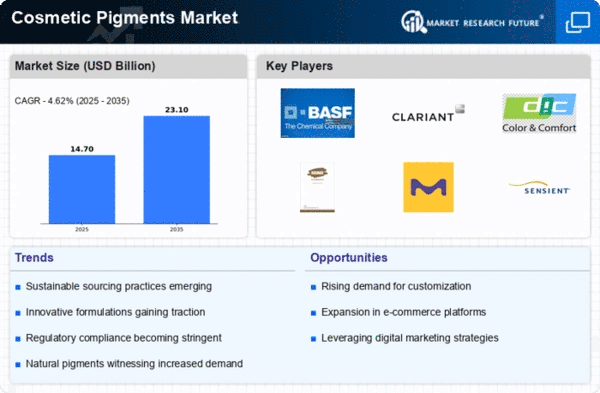
As per MRFR analysis, the Cosmetic Pigments Market Size was estimated at 14.05 USD Billion in 2024. The Cosmetic Pigments industry is projected to grow from 14.7 in 2025 to 23.1 by 2035, exhibiting a compound annual growth rate (CAGR) of 4.62 during the forecast period 2025 - 2035.

Key Market Trends & Highlights

The Cosmetic Pigments Market is experiencing a dynamic shift towards sustainability and innovation.

  • The market is witnessing a notable shift towards natural pigments, driven by consumer preferences for eco-friendly products.
  • E-commerce expansion is significantly influencing purchasing behaviors, particularly in North America, the largest market for cosmetic pigments.
  • Makeup remains the largest segment, while skincare is emerging as the fastest-growing segment in the cosmetic pigments market.
  • The increasing demand for sustainable products and the influence of social media are major drivers propelling market growth.

Market Size & Forecast

2024 Market Size 14.05 (USD Billion)
2035 Market Size 23.1 (USD Billion)
CAGR (2025 - 2035) 4.62%
Largest Regional Market Share in 2024 North America

Major Players

BASF SE (DE), Clariant AG (CH), DIC Corporation (JP), Kremer Pigments GmbH & Co. KG (DE), Merck KGaA (DE), Sensient Technologies Corporation (US), Toyo Ink SC Holdings Co., Ltd. (JP), Ferro Corporation (US), Huntsman Corporation (US), Chromaflo Technologies Corp. (US)

Market Trends

The Cosmetic Pigments Market is currently experiencing a dynamic evolution, driven by a confluence of consumer preferences and regulatory developments. As individuals increasingly seek products that align with their values, there is a noticeable shift towards natural and organic pigments. This trend appears to be fueled by a growing awareness of the potential health impacts associated with synthetic alternatives. Furthermore, the demand for vibrant and long-lasting colors in cosmetics continues to rise, prompting manufacturers to innovate and diversify their offerings. The market landscape is characterized by a blend of traditional and modern approaches, as companies strive to meet the diverse needs of consumers while adhering to stringent safety standards. In addition, the Cosmetic Pigments Market is witnessing a surge in the popularity of multifunctional products. These items not only provide color but also offer additional benefits such as sun protection or skin nourishment. This trend suggests a shift towards convenience and efficiency in beauty routines, as consumers increasingly favor products that serve multiple purposes. Moreover, the rise of e-commerce platforms has transformed the way consumers access cosmetic pigments, enabling a broader reach and facilitating informed purchasing decisions. Overall, the market appears poised for continued growth, driven by innovation and evolving consumer expectations.

Shift Towards Natural Pigments

There is a growing inclination among consumers towards natural and organic pigments, reflecting a broader trend of health consciousness. This shift suggests that brands may need to adapt their formulations to meet the rising demand for safer, eco-friendly alternatives.

Rise of Multifunctional Products

The emergence of multifunctional cosmetic products indicates a preference for items that combine color with additional benefits. This trend highlights the desire for efficiency in beauty routines, as consumers seek products that simplify their daily regimen.

E-commerce Expansion

The increasing prevalence of e-commerce platforms is reshaping the Cosmetic Pigments Market. This trend allows consumers to access a wider array of products and facilitates informed choices, potentially influencing purchasing behaviors and brand loyalty.

Cosmetic Pigments Market Market Drivers

Market Growth Projections

The Global Cosmetic Pigment Market Industry is on a growth trajectory, with projections indicating a compound annual growth rate of 6.35% from 2025 to 2035. This growth is fueled by various factors, including increasing consumer demand for innovative cosmetic products and the expansion of the e-commerce sector. The market is expected to reach 12.1 USD Billion in 2024, with a further increase to 23.8 USD Billion by 2035. These figures suggest a robust market environment, driven by evolving consumer preferences and advancements in pigment technology.

Growth of the E-commerce Sector

The rise of e-commerce is significantly influencing the Global Cosmetic Pigment Market Industry. Online retail platforms provide consumers with easy access to a wide range of cosmetic products, including those featuring innovative pigments. The convenience of online shopping, coupled with targeted marketing strategies, has led to increased sales of cosmetic products. In 2024, the market is projected to reach 12.1 USD Billion, with e-commerce contributing a substantial share. This trend is expected to continue, as more consumers prefer the convenience of purchasing cosmetics online, thereby driving market growth.

Rising Demand for Natural Pigments

The Global Cosmetic Pigment Market Industry is witnessing a notable shift towards natural pigments, driven by consumer preferences for organic and eco-friendly products. As awareness of synthetic chemicals' potential harm increases, brands are reformulating their products to include plant-based pigments. This trend is reflected in the growing market share of natural pigments, which is projected to reach a significant portion of the overall market by 2035. The increasing demand for sustainable beauty products is expected to contribute to the market's growth, with natural pigments becoming a key component in cosmetic formulations.

Increasing Awareness of Skin Health

There is a growing awareness of skin health among consumers, which is impacting the Global Cosmetic Pigment Market Industry. As individuals become more informed about the effects of various ingredients on skin health, they are seeking products that not only enhance appearance but also provide skin benefits. This trend is leading to the formulation of cosmetics that incorporate pigments with added skincare properties. Brands are responding by developing products that cater to this demand, thereby expanding their market presence. The focus on skin health is likely to drive innovation and growth in the cosmetic pigment sector.

Regulatory Support for Cosmetic Safety

Regulatory frameworks supporting cosmetic safety are shaping the Global Cosmetic Pigment Market Industry. Governments worldwide are implementing stricter regulations to ensure the safety and efficacy of cosmetic products, including pigments. This regulatory environment encourages manufacturers to invest in safer, high-quality pigments, fostering consumer trust. As a result, the market is expected to grow, with projections indicating a rise to 23.8 USD Billion by 2035. Compliance with these regulations not only enhances product safety but also drives innovation in pigment development, ultimately benefiting the industry.

Technological Advancements in Pigment Production

Innovations in pigment production technology are playing a crucial role in the Global Cosmetic Pigment Market Industry. Advanced manufacturing processes, such as nanotechnology and microencapsulation, enhance the stability and performance of pigments in cosmetic applications. These technologies allow for the creation of more vibrant colors and improved product longevity. As a result, manufacturers are increasingly adopting these innovations to meet consumer expectations for high-quality cosmetics. The integration of technology not only boosts product appeal but also aligns with the industry's shift towards more sustainable practices, potentially impacting market dynamics positively.

Market Segment Insights

By Application: Makeup (Largest) vs. Skincare (Fastest-Growing)

In the Cosmetic Pigments Market, the application segment showcases a diverse landscape, with Makeup holding the largest share. This segment is well-established, driven by a constant demand for innovative and vibrant colorants that enhance beauty products. Skincare, on the other hand, is rapidly gaining traction, fueled by the rising consumer preference for products that combine aesthetic appeal with skincare benefits. This increasing trend is changing the dynamics of market share distribution across the application segment.

Makeup: (Dominant) vs. Skincare (Emerging)

Makeup has established itself as the dominant application in the Cosmetic Pigments Market, characterized by a wide array of products, including foundations, lipsticks, and eyeshadows that rely heavily on vibrant pigments. The demand for bold and varied color options continues to propel this segment. Conversely, Skincare is emerging as a significant player, capitalizing on trends that favor multi-functional products, such as tinted moisturizers and BB creams. This shift signifies consumers' growing emphasis on holistic beauty solutions, making Skincare a crucial area for innovation within the market.

By Type: Organic Pigments (Largest) vs. Synthetic Pigments (Fastest-Growing)

In the Cosmetic Pigments Market, Organic Pigments hold the largest market share, driven by increasing consumer preference for clean label products. Their natural appeal and vibrant colors have made them the pigment of choice in various cosmetic applications, surpassing their synthetic counterparts. Meanwhile, Synthetic Pigments are gaining remarkable traction, attributed to their cost-effectiveness and long-lasting properties. As cosmetic formulations evolve, these pigments have proven to be versatile options for manufacturers aiming for innovation and sustainability in their offerings. The growth trends within the segment are largely influenced by consumer demand for high-performance and eco-friendly products. The rising trend of organic and natural beauty products favors the use of Organic Pigments, while the expanding personal care industry propels Synthetic Pigments into the spotlight. Additionally, regulatory changes concerning the safety and efficacy of cosmetic ingredients are prompting brands to diversify their offerings, further driving the growth within both categories of pigments.

Organic Pigments (Dominant) vs. Synthetic Pigments (Emerging)

Organic Pigments are characterized by their carbon-based structures, offering vibrant colors and excellent stability, making them a dominant force in the Cosmetic Pigments Market. Their ability to provide natural aesthetics aligns perfectly with the growing trend of green beauty, facilitating their widespread adoption in formulations seeking to highlight clean ingredients. In contrast, Synthetic Pigments are seeing rapid emergence due to advancements in commercial manufacturing processes, improving their affordability and performance. These pigments can mimic the visual appeal of organic options while enhancing product longevity, appealing to both manufacturers and consumers. As the market evolves, the dichotomy between these two types illustrates a dynamic landscape, with Organic Pigments asserting dominance and Synthetic Pigments emerging as the preferred choice for innovative solutions.

By Formulation: Powder (Largest) vs. Liquid (Fastest-Growing)

The formulation segment of the cosmetic pigments market is primarily dominated by powder pigments, which hold the largest market share. Their solid form and versatility make them a preferred choice across various cosmetic products, including foundations, eyeshadows, and blushes. Liquid formulations follow closely behind, appealing to manufacturers due to their ease of use and ability to create vibrant color mixtures, often used in lip products and liquid foundations.

Powder (Dominant) vs. Liquid (Emerging)

Powder pigments represent the dominant segment in the formulation landscape of the cosmetic pigments market. Their fine texture provides excellent coverage and ease of application, making them essential in various cosmetic offerings. The rising demand for mineral-based and natural cosmetic products further bolsters the popularity of powder formulations, allowing for a broad spectrum of applications. In contrast, liquid pigments are recognized as an emerging alternative, driven by trends towards fluid formulations that deliver intensity and precision. Innovations in technology have enriched the quality of liquid pigments, enabling manufacturers to explore new color combinations and finishes, thus meeting the evolving consumer preferences in the beauty industry.

By End Use: Personal Care (Largest) vs. Professional Use (Fastest-Growing)

The Cosmetic Pigments Market exhibits a diverse end-use segmentation with Personal Care leading significantly in market share. This segment includes products such as skincare, makeup, and hair care, which utilize a wide range of pigments to enhance aesthetics and product performance. Professional Use is also a vital participant in the market, particularly in salons and professional cosmetic applications, although it comprises a smaller portion compared to Personal Care. In recent years, growth trends have been increasingly favorable for the Professional Use segment, attributed to rising demand for professional beauty services. Factors driving this growth include the expansion of salons, the introduction of new formulations, and an increasing focus on high-quality, durable products, which are prompting professional end-users to seek more specialized pigments that enhance color impact and longevity.

Personal Care (Dominant) vs. Professional Use (Emerging)

Personal Care remains the dominant segment in the Cosmetic Pigments Market, characterized by its widespread use in everyday consumer products. This segment thrives on the growing consumer preference for cosmetics that offer vibrant colors and long-lasting effects. Brands are heavily investing in innovative formulations to enhance the visual appeal while ensuring safety and compliance with regulations. On the other hand, Professional Use is emerging rapidly as a significant segment driven by the beauty industry's shift towards customized services and high-end products. Professionals are increasingly opting for premium-quality pigments that provide superior performance and application versatility, indicating a shift in consumer behavior towards more specialized and innovative cosmetic solutions. This emerging segment is becoming increasingly influential as trends in professional beauty evolve.

By Distribution Channel: Online Retail (Largest) vs. Offline Retail (Fastest-Growing)

The Cosmetic Pigments Market exhibits a diverse distribution channel landscape, with Online Retail holding a significant share. This channel's accessibility and convenience cater to a growing customer base that prefers shopping from the comfort of their homes. On the other hand, Offline Retail remains a crucial element, providing customers with tangible experiences and immediate product availability. While both segments play vital roles, the scale of Online Retail sets it apart as the largest segment within the market.

Online Retail (Dominant) vs. Offline Retail (Emerging)

Online Retail remains the dominant distribution channel in the Cosmetic Pigments Market, enjoying a considerable share due to its convenience and wide reach. Consumers appreciate the ability to browse and purchase products at their leisure, leading to increased demand for online platforms. Conversely, Offline Retail is emerging rapidly as brands seek to enhance in-store experiences. Despite challenges posed by the online environment, offline channels are innovating through interactive displays and personalized services that attract customers. As trends shift towards omnichannel retailing, both segments are adapting to meet consumer preferences, emphasizing the dual importance of accessibility and experiential shopping.

Get more detailed insights about Cosmetic Pigments Market Research Report- Forecast to 2035

Regional Insights

North America : Market Leader in Innovation

North America is poised to maintain its leadership in the cosmetic pigments market, holding a significant share of 5.5 in 2024. The region's growth is driven by increasing consumer demand for high-quality cosmetic products, coupled with stringent regulations that promote safety and sustainability. The rise of e-commerce and digital marketing strategies further fuels market expansion, as brands seek to reach a broader audience with innovative offerings. The competitive landscape in North America is robust, featuring key players such as BASF SE, Clariant AG, and Sensient Technologies Corporation. The U.S. stands out as the largest market, supported by a strong manufacturing base and advanced R&D capabilities. Companies are increasingly focusing on eco-friendly pigments to align with consumer preferences for sustainable products, ensuring a dynamic market environment.

Europe : Sustainable Growth and Innovation

Europe's cosmetic pigments market is projected to grow, with a market size of 4.0 in 2025. The region is characterized by a strong emphasis on sustainability and regulatory compliance, which drives innovation in product formulations. The European Union's stringent regulations on cosmetic ingredients encourage manufacturers to invest in safer, eco-friendly alternatives, thus enhancing market growth. The demand for organic and natural pigments is also on the rise, reflecting changing consumer preferences. Leading countries such as Germany, France, and the UK are at the forefront of this market, hosting major players like Merck KGaA and Kremer Pigments GmbH & Co. KG. The competitive landscape is marked by collaborations and partnerships aimed at developing innovative products that meet regulatory standards. As the market evolves, companies are increasingly focusing on research and development to create pigments that are both effective and environmentally friendly.

Asia-Pacific : Rapid Growth and Demand

The Asia-Pacific region is witnessing rapid growth in the cosmetic pigments market, with a market size of 3.5 in 2025. This growth is fueled by rising disposable incomes, urbanization, and a growing middle class that is increasingly investing in beauty and personal care products. Additionally, the region's diverse consumer preferences drive demand for a wide range of cosmetic pigments, from traditional to innovative formulations. Regulatory support for the cosmetics industry further enhances market potential. Countries like Japan, China, and India are leading the charge, with significant contributions from local and international players such as DIC Corporation and Toyo Ink SC Holdings Co., Ltd. The competitive landscape is dynamic, with companies focusing on product differentiation and sustainability to capture market share. As the region continues to evolve, the emphasis on quality and safety will shape the future of the cosmetic pigments market.

Middle East and Africa : Emerging Market Potential

The Middle East and Africa (MEA) region is emerging as a potential market for cosmetic pigments, with a market size of 1.05 in 2025. The growth is driven by increasing urbanization, a young population, and rising beauty consciousness among consumers. Additionally, the region's diverse cultural influences create a demand for a variety of cosmetic products, which in turn boosts the need for innovative pigments. Regulatory frameworks are gradually evolving to support the cosmetics industry, enhancing market prospects. Countries like South Africa and the UAE are leading the market, with local and international players establishing a presence. The competitive landscape is characterized by a mix of established companies and new entrants, all vying for market share. As the region develops, the focus on quality and compliance with international standards will be crucial for success in the cosmetic pigments market.

Key Players and Competitive Insights

The Cosmetic Pigments Market is characterized by a dynamic competitive landscape, driven by innovation, sustainability, and the increasing demand for high-quality cosmetic products. Key players such as BASF SE (DE), Clariant AG (CH), and Merck KGaA (DE) are strategically positioned to leverage their extensive research and development capabilities. These companies focus on enhancing product performance and expanding their portfolios to include eco-friendly pigments, which aligns with the growing consumer preference for sustainable beauty products. Their collective strategies not only foster competition but also push the market towards higher standards of quality and environmental responsibility.In terms of business tactics, companies are increasingly localizing manufacturing to reduce lead times and optimize supply chains. The market structure appears moderately fragmented, with several players vying for market share. However, the influence of major companies like DIC Corporation (JP) and Sensient Technologies Corporation (US) is notable, as they implement strategies that enhance their competitive edge and market presence.

In November Clariant AG (CH) announced a partnership with a leading beauty brand to develop a new line of sustainable cosmetic pigments. This collaboration is significant as it underscores Clariant's commitment to sustainability and innovation, potentially setting a new benchmark in the industry for eco-friendly products. Such partnerships may enhance brand loyalty and attract environmentally conscious consumers.

In October BASF SE (DE) launched a new range of bio-based pigments aimed at reducing the environmental impact of cosmetic formulations. This strategic move not only aligns with The Cosmetic Pigments. The introduction of these products could significantly influence consumer preferences and drive sales growth.

In September Merck KGaA (DE) expanded its production capabilities in Asia to meet the rising demand for cosmetic pigments in the region. This expansion is crucial as it allows Merck to enhance its supply chain efficiency and respond more effectively to local market needs. Such operational enhancements are likely to strengthen Merck's competitive position in the rapidly growing Asian market.

As of December the Cosmetic Pigments Market is witnessing trends such as digitalization, sustainability, and the integration of AI technologies. These trends are reshaping the competitive landscape, with strategic alliances becoming increasingly important for innovation and market penetration. The shift from price-based competition to a focus on technological advancement and supply chain reliability is evident. Companies that prioritize these aspects are likely to differentiate themselves and thrive in an evolving market.

Key Companies in the Cosmetic Pigments Market include

Industry Developments

  • July 2021 : Sun Chemical has introduced two color travel effect pigments, Reflecks MD Midnight Sapphire and Reflecks MD Midnight Cherry, additions to its Reflecks MultiDimensions range. These blackened metallic-like effect cosmetic pigments are based on calcium sodium borosilicate, make use of the advanced multilayer technology that offers intense color travel, sparkle, and chroma. In addition to the latest patent-pending technique, the pigments’ coating is embedded with the absorption colorant, which facilitates faster and easier formulation coupled with the provision of minimally stained skin. With the use of effect pigments that are based on calcium sodium borosilicate helps eliminate the requirement for extra absorption colorants, with respect to the cosmetic formula. This cutting-edge technology further facilitates reduction in skin staining, especially in comparison to the blended absorption pigments.
  • Merck recently expanded its cosmetics pigments plant in Germany
  • Sun Chemical recently introduced a new pigment that has more reflective qualities.


Future Outlook

Cosmetic Pigments Market Future Outlook

The Cosmetic Pigments Market is projected to grow at a 4.62% CAGR from 2025 to 2035, driven by increasing demand for natural ingredients and innovative formulations.

New opportunities lie in:

  • Expansion into sustainable pigment sourcing initiatives
  • Development of customizable pigment solutions for niche markets
  • Investment in advanced digital marketing strategies targeting younger consumers

By 2035, the market is expected to achieve robust growth, reflecting evolving consumer preferences and technological advancements.

Market Segmentation

Cosmetic Pigments Market Type Outlook

  • Organic Pigments
  • Inorganic Pigments
  • Natural Pigments
  • Synthetic Pigments

Cosmetic Pigments Market End Use Outlook

  • Personal Care
  • Professional Use
  • Cosmetic Manufacturing

Cosmetic Pigments Market Application Outlook

  • Makeup
  • Skincare
  • Hair Care
  • Nail Care
  • Fragrance

Cosmetic Pigments Market Formulation Outlook

  • Powder
  • Liquid
  • Cream
  • Gel

Cosmetic Pigments Market Distribution Channel Outlook

  • Online Retail
  • Offline Retail
  • Direct Sales

Report Scope

MARKET SIZE 202414.05(USD Billion)
MARKET SIZE 202514.7(USD Billion)
MARKET SIZE 203523.1(USD Billion)
COMPOUND ANNUAL GROWTH RATE (CAGR)4.62% (2025 - 2035)
REPORT COVERAGERevenue Forecast, Competitive Landscape, Growth Factors, and Trends
BASE YEAR2024
Market Forecast Period2025 - 2035
Historical Data2019 - 2024
Market Forecast UnitsUSD Billion
Key Companies ProfiledBASF SE (DE), Clariant AG (CH), DIC Corporation (JP), Kremer Pigments GmbH & Co. KG (DE), Merck KGaA (DE), Sensient Technologies Corporation (US), Toyo Ink SC Holdings Co., Ltd. (JP), Ferro Corporation (US), Huntsman Corporation (US), Chromaflo Technologies Corp. (US)
Segments CoveredApplication, Type, Formulation, End Use, Distribution Channel
Key Market OpportunitiesGrowing demand for natural and sustainable pigments in the Cosmetic Pigments Market presents significant opportunities.
Key Market DynamicsRising consumer demand for natural and sustainable cosmetic pigments drives innovation and regulatory scrutiny in the market.
Countries CoveredNorth America, Europe, APAC, South America, MEA

FAQs

What is the major trend in the cosmetic pigments market?

The increasing demand for organic pigments is likely to be a major trend in the global cosmetic pigments market.

What is the leading application of cosmetic pigments?

Facial makeup products take up a commanding share in the global cosmetic pigments market, at 30%.

Which is the major regional market for cosmetic pigments?

Europe is the leading regional market for cosmetic pigments, followed by North America and Asia Pacific.

What is the major driver for the cosmetic pigments market?

The increasing awareness about appearance among men and women is likely to be the major driver for the cosmetic pigments market over the forecast period.

What are the major players in the cosmetic pigments market?

Leading players in the cosmetic pigments market include Lanxess, Sun Chemical Corporation, Sensient, Sudarshan Chemical Industries Limited, Kobo Products Inc., and BASF.

  1. SECTION I: EXECUTIVE SUMMARY AND KEY HIGHLIGHTS
    1. | 1.1 EXECUTIVE SUMMARY
    2. | 1.1.1 Market Overview
    3. | 1.1.2 Key Findings
    4. | 1.1.3 Market Segmentation
    5. | 1.1.4 Competitive Landscape
    6. | 1.1.5 Challenges and Opportunities
    7. | 1.1.6 Future Outlook
  2. SECTION II: SCOPING, METHODOLOGY AND MARKET STRUCTURE
    1. | 2.1 MARKET INTRODUCTION
    2. | 2.1.1 Definition
    3. | 2.1.2 Scope of the study
    4. |-- 2.1.2.1 Research Objective
    5. |-- 2.1.2.2 Assumption
    6. |-- 2.1.2.3 Limitations
    7. | 2.2 RESEARCH METHODOLOGY
    8. | 2.2.1 Overview
    9. | 2.2.2 Data Mining
    10. | 2.2.3 Secondary Research
    11. | 2.2.4 Primary Research
    12. |-- 2.2.4.1 Primary Interviews and Information Gathering Process
    13. |-- 2.2.4.2 Breakdown of Primary Respondents
    14. | 2.2.5 Forecasting Model
    15. | 2.2.6 Market Size Estimation
    16. |-- 2.2.6.1 Bottom-Up Approach
    17. |-- 2.2.6.2 Top-Down Approach
    18. | 2.2.7 Data Triangulation
    19. | 2.2.8 Validation
  3. SECTION III: QUALITATIVE ANALYSIS
    1. | 3.1 MARKET DYNAMICS
    2. | 3.1.1 Overview
    3. | 3.1.2 Drivers
    4. | 3.1.3 Restraints
    5. | 3.1.4 Opportunities
    6. | 3.2 MARKET FACTOR ANALYSIS
    7. | 3.2.1 Value chain Analysis
    8. | 3.2.2 Porter's Five Forces Analysis
    9. |-- 3.2.2.1 Bargaining Power of Suppliers
    10. |-- 3.2.2.2 Bargaining Power of Buyers
    11. |-- 3.2.2.3 Threat of New Entrants
    12. |-- 3.2.2.4 Threat of Substitutes
    13. |-- 3.2.2.5 Intensity of Rivalry
    14. | 3.2.3 COVID-19 Impact Analysis
    15. |-- 3.2.3.1 Market Impact Analysis
    16. |-- 3.2.3.2 Regional Impact
    17. |-- 3.2.3.3 Opportunity and Threat Analysis
  4. SECTION IV: QUANTITATIVE ANALYSIS
    1. | 4.1 Chemicals and Materials, BY Application (USD Billion)
    2. | 4.1.1 Makeup
    3. | 4.1.2 Skincare
    4. | 4.1.3 Hair Care
    5. | 4.1.4 Nail Care
    6. | 4.1.5 Fragrance
    7. | 4.2 Chemicals and Materials, BY Type (USD Billion)
    8. | 4.2.1 Organic Pigments
    9. | 4.2.2 Inorganic Pigments
    10. | 4.2.3 Natural Pigments
    11. | 4.2.4 Synthetic Pigments
    12. | 4.3 Chemicals and Materials, BY Formulation (USD Billion)
    13. | 4.3.1 Powder
    14. | 4.3.2 Liquid
    15. | 4.3.3 Cream
    16. | 4.3.4 Gel
    17. | 4.4 Chemicals and Materials, BY End Use (USD Billion)
    18. | 4.4.1 Personal Care
    19. | 4.4.2 Professional Use
    20. | 4.4.3 Cosmetic Manufacturing
    21. | 4.5 Chemicals and Materials, BY Distribution Channel (USD Billion)
    22. | 4.5.1 Online Retail
    23. | 4.5.2 Offline Retail
    24. | 4.5.3 Direct Sales
    25. | 4.6 Chemicals and Materials, BY Region (USD Billion)
    26. | 4.6.1 North America
    27. |-- 4.6.1.1 US
    28. |-- 4.6.1.2 Canada
    29. | 4.6.2 Europe
    30. |-- 4.6.2.1 Germany
    31. |-- 4.6.2.2 UK
    32. |-- 4.6.2.3 France
    33. |-- 4.6.2.4 Russia
    34. |-- 4.6.2.5 Italy
    35. |-- 4.6.2.6 Spain
    36. |-- 4.6.2.7 Rest of Europe
    37. | 4.6.3 APAC
    38. |-- 4.6.3.1 China
    39. |-- 4.6.3.2 India
    40. |-- 4.6.3.3 Japan
    41. |-- 4.6.3.4 South Korea
    42. |-- 4.6.3.5 Malaysia
    43. |-- 4.6.3.6 Thailand
    44. |-- 4.6.3.7 Indonesia
    45. |-- 4.6.3.8 Rest of APAC
    46. | 4.6.4 South America
    47. |-- 4.6.4.1 Brazil
    48. |-- 4.6.4.2 Mexico
    49. |-- 4.6.4.3 Argentina
    50. |-- 4.6.4.4 Rest of South America
    51. | 4.6.5 MEA
    52. |-- 4.6.5.1 GCC Countries
    53. |-- 4.6.5.2 South Africa
    54. |-- 4.6.5.3 Rest of MEA
  5. SECTION V: COMPETITIVE ANALYSIS
    1. | 5.1 Competitive Landscape
    2. | 5.1.1 Overview
    3. | 5.1.2 Competitive Analysis
    4. | 5.1.3 Market share Analysis
    5. | 5.1.4 Major Growth Strategy in the Chemicals and Materials
    6. | 5.1.5 Competitive Benchmarking
    7. | 5.1.6 Leading Players in Terms of Number of Developments in the Chemicals and Materials
    8. | 5.1.7 Key developments and growth strategies
    9. |-- 5.1.7.1 New Product Launch/Service Deployment
    10. |-- 5.1.7.2 Merger & Acquisitions
    11. |-- 5.1.7.3 Joint Ventures
    12. | 5.1.8 Major Players Financial Matrix
    13. |-- 5.1.8.1 Sales and Operating Income
    14. |-- 5.1.8.2 Major Players R&D Expenditure. 2023
    15. | 5.2 Company Profiles
    16. | 5.2.1 BASF SE (DE)
    17. |-- 5.2.1.1 Financial Overview
    18. |-- 5.2.1.2 Products Offered
    19. |-- 5.2.1.3 Key Developments
    20. |-- 5.2.1.4 SWOT Analysis
    21. |-- 5.2.1.5 Key Strategies
    22. | 5.2.2 Clariant AG (CH)
    23. |-- 5.2.2.1 Financial Overview
    24. |-- 5.2.2.2 Products Offered
    25. |-- 5.2.2.3 Key Developments
    26. |-- 5.2.2.4 SWOT Analysis
    27. |-- 5.2.2.5 Key Strategies
    28. | 5.2.3 DIC Corporation (JP)
    29. |-- 5.2.3.1 Financial Overview
    30. |-- 5.2.3.2 Products Offered
    31. |-- 5.2.3.3 Key Developments
    32. |-- 5.2.3.4 SWOT Analysis
    33. |-- 5.2.3.5 Key Strategies
    34. | 5.2.4 Kremer Pigments GmbH & Co. KG (DE)
    35. |-- 5.2.4.1 Financial Overview
    36. |-- 5.2.4.2 Products Offered
    37. |-- 5.2.4.3 Key Developments
    38. |-- 5.2.4.4 SWOT Analysis
    39. |-- 5.2.4.5 Key Strategies
    40. | 5.2.5 Merck KGaA (DE)
    41. |-- 5.2.5.1 Financial Overview
    42. |-- 5.2.5.2 Products Offered
    43. |-- 5.2.5.3 Key Developments
    44. |-- 5.2.5.4 SWOT Analysis
    45. |-- 5.2.5.5 Key Strategies
    46. | 5.2.6 Sensient Technologies Corporation (US)
    47. |-- 5.2.6.1 Financial Overview
    48. |-- 5.2.6.2 Products Offered
    49. |-- 5.2.6.3 Key Developments
    50. |-- 5.2.6.4 SWOT Analysis
    51. |-- 5.2.6.5 Key Strategies
    52. | 5.2.7 Toyo Ink SC Holdings Co., Ltd. (JP)
    53. |-- 5.2.7.1 Financial Overview
    54. |-- 5.2.7.2 Products Offered
    55. |-- 5.2.7.3 Key Developments
    56. |-- 5.2.7.4 SWOT Analysis
    57. |-- 5.2.7.5 Key Strategies
    58. | 5.2.8 Ferro Corporation (US)
    59. |-- 5.2.8.1 Financial Overview
    60. |-- 5.2.8.2 Products Offered
    61. |-- 5.2.8.3 Key Developments
    62. |-- 5.2.8.4 SWOT Analysis
    63. |-- 5.2.8.5 Key Strategies
    64. | 5.2.9 Huntsman Corporation (US)
    65. |-- 5.2.9.1 Financial Overview
    66. |-- 5.2.9.2 Products Offered
    67. |-- 5.2.9.3 Key Developments
    68. |-- 5.2.9.4 SWOT Analysis
    69. |-- 5.2.9.5 Key Strategies
    70. | 5.2.10 Chromaflo Technologies Corp. (US)
    71. |-- 5.2.10.1 Financial Overview
    72. |-- 5.2.10.2 Products Offered
    73. |-- 5.2.10.3 Key Developments
    74. |-- 5.2.10.4 SWOT Analysis
    75. |-- 5.2.10.5 Key Strategies
    76. | 5.3 Appendix
    77. | 5.3.1 References
    78. | 5.3.2 Related Reports

Chemicals and Materials Market Segmentation

Chemicals and Materials By Application (USD Billion, 2025-2035)

  • Makeup
  • Skincare
  • Hair Care
  • Nail Care
  • Fragrance

Chemicals and Materials By Type (USD Billion, 2025-2035)

  • Organic Pigments
  • Inorganic Pigments
  • Natural Pigments
  • Synthetic Pigments

Chemicals and Materials By Formulation (USD Billion, 2025-2035)

  • Powder
  • Liquid
  • Cream
  • Gel

Chemicals and Materials By End Use (USD Billion, 2025-2035)

  • Personal Care
  • Professional Use
  • Cosmetic Manufacturing

Chemicals and Materials By Distribution Channel (USD Billion, 2025-2035)

  • Online Retail
  • Offline Retail
  • Direct Sales
Infographic

Free Sample Request

Kindly complete the form below to receive a free sample of this Report

Get Free Sample

Customer Strories

Compare Licence

×
Features License Type
Single User Multiuser License Enterprise User
Price $4,950 $5,950 $7,250
Maximum User Access Limit 1 User Upto 10 Users Unrestricted Access Throughout the Organization
Free Customization
Direct Access to Analyst
Deliverable Format
Platform Access
Discount on Next Purchase 10% 15% 15%
Printable Versions