×
Request Free Sample ×

Kindly complete the form below to receive a free sample of this Report

* Please use a valid business email

Leading companies partner with us for data-driven Insights

clients tt-cursor
Hero Background
English
Chinese
French
Japanese
Korean
German
Spanish

Cosmetic Packaging Market Trends

ID: MRFR/PCM/1246-CR
111 Pages
Snehal Singh
April 2024

Cosmetic Packaging Market Research Report Information by Material (plastic, metal, paper & paperboard, glass and others), by Product (tube, bottle, palette, sticks, jars & tubs, blisters & spirit packs, folding carton, aerosol cans, and others), by Application (skincare, fragrance, color cosmetics and others), – Market Forecast Till 2035

Share:
Download PDF ×

We do not share your information with anyone. However, we may send you emails based on your report interest from time to time. You may contact us at any time to opt-out.

Cosmetic Packaging Market Infographic
×
Cosmetic Packaging Market Infographic Full View
Purchase Options

Market Trends

Key Emerging Trends in the Cosmetic Packaging Market

The global packaging market, particularly in the personal care sector encompassing skincare, haircare, and cosmetics, is experiencing substantial growth due to the escalating demand for premium range products worldwide. Consumers are increasingly drawn to high-end products for both home care and personal grooming, propelling the expansion of the packaging industry. A notable contributor to this surge is the heightened interest among consumers in purchasing top-tier cosmetics, leading to increased sales in the Middle East & Africa region. This, in turn, is fostering growth in the cosmetic packaging market in these areas. The phenomenon is particularly pronounced in developing countries, where the rising per capita income and the growing availability of premium product offerings are driving the demand for personal care items. Consequently, there is a parallel surge in the need for advanced cosmetic packaging technology to cater to these evolving consumer preferences. The forecast for the global cosmetic packaging market anticipates a significant boost, primarily attributed to the increasing demand for premium cosmetics products. The trend is underlined by insights from the L’Oréal annual report, indicating substantial growth in the cosmetics market on a global scale. The preference for premium cosmetic products is identified as a key driver fueling this growth.

Moreover, the market is poised to benefit from factors such as the imperative need for enhanced packaging technology and the ongoing innovation and upgrading of plastic packaging methods specifically tailored for cosmetic products. The plastic packaging technology in the cosmetic sector is experiencing continuous advancements to meet the evolving demands of consumers. As a result, the impact of the rising demand for premium products is expected to transition from a moderate to a high influence over the forecast period. In conclusion, the global cosmetic packaging market is on an upward trajectory, buoyed by the surging demand for premium cosmetics products. This trend is not only evident in developed regions but is also making significant inroads in emerging markets, driven by factors such as increased consumer spending capacity and a growing array of premium product options. The packaging industry, especially in the realm of cosmetic products, is gearing up to meet the evolving demands, presenting a promising landscape for future growth.

Author
Snehal Singh
Assistant Manager - Research

High acumen in analyzing complex macro & micro markets with more than 6 years of work experience in the field of market research. By implementing her analytical skills in forecasting and estimation into market research reports, she has expertise in Packaging, Construction, and Equipment domains. She handles a team size of 20-25 resources and ensures smooth running of the projects, associated marketing activities, and client servicing.

Leave a Comment

FAQs

How much is the Cosmetic Packaging Market?

The Cosmetic Packaging Market size is expected to be valued at USD 88645.76 million in 2035.

What is the growth rate of the Cosmetic Packaging Market?

Cosmetic Packaging Market is projected to register a CAGR of 3.92% from 2025-2035

Which region held the largest market share in the Cosmetic Packaging Market?

Asia- Pacific had the largest share of the global market.

Who are the key players in the Cosmetic Packaging Market?

The key players in the market include Pinard, HCT, Cosmospacks, Berry Global, and Cosmogen.

Which material dominates the Cosmetic Packaging Market?

The plastic material category dominated the market in 2024.

Which Application type had the largest market share in the Cosmetic Packaging Market?

The skincare application had the largest revenue share of the global market.

Market Summary

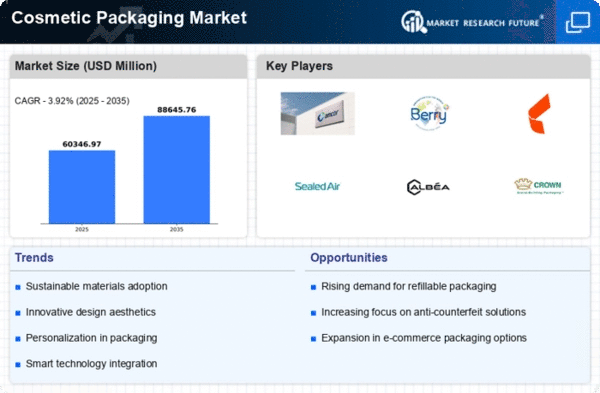
As per MRFR analysis, the Cosmetic Packaging Market was estimated at 58070.6 USD Million in 2024. The Cosmetic Packaging industry is projected to grow from 60347.11 USD Million in 2025 to 88645.76 USD Million by 2035, exhibiting a compound annual growth rate (CAGR) of 3.92% during the forecast period 2025 - 2035.

Key Market Trends & Highlights

The Cosmetic Packaging Market is experiencing a transformative shift towards sustainability and innovation.

  • Sustainable packaging solutions are becoming increasingly prevalent, particularly in North America, which remains the largest market. Personalization and customization trends are gaining traction, especially within the skin care segment, which holds the largest market share. Smart packaging innovations are emerging as a key focus, particularly in the rapidly growing hair care segment in Asia-Pacific. Market drivers such as regulatory compliance and the rise of e-commerce are significantly influencing packaging adaptations across various segments.

Market Size & Forecast

2024 Market Size 58070.6 (USD Million)
2035 Market Size 88645.76 (USD Million)
CAGR (2025 - 2035) 3.92%
Largest Regional Market Share in 2024 North America

Major Players

<p>Amcor (AU), Berry Global (US), Mondi Group (GB), Sealed Air (US), Albea (FR), Crown Holdings (US), Silgan Holdings (US), Quadpack (ES), HCP Packaging (CN)</p>

Market Trends

The Cosmetic Packaging Market is currently experiencing a dynamic evolution, driven by various factors that reflect changing consumer preferences and environmental considerations. As sustainability becomes a focal point for many industries, the demand for eco-friendly packaging solutions is on the rise. Brands are increasingly seeking materials that minimize environmental impact while maintaining aesthetic appeal and functionality. This shift not only aligns with consumer values but also enhances brand loyalty, as customers gravitate towards companies that demonstrate a commitment to sustainability. Furthermore, the integration of innovative designs and smart packaging technologies is reshaping the landscape, offering enhanced user experiences and convenience. In addition to sustainability, the Cosmetic Packaging Market is witnessing a surge in personalization trends. Consumers are increasingly drawn to products that reflect their individuality, prompting brands to explore customizable packaging options. This trend not only fosters a deeper connection between the consumer and the product but also encourages brand differentiation in a crowded marketplace. As the market continues to evolve, it appears that adaptability and responsiveness to consumer demands will be crucial for brands aiming to thrive in this competitive environment. The future of the Cosmetic Packaging Market seems poised for further transformation, with ongoing advancements in materials and design likely to play a pivotal role in shaping its trajectory.

Sustainable Packaging Solutions

The Cosmetic Packaging Market is increasingly leaning towards sustainable packaging options. Brands are exploring biodegradable materials and recyclable designs to meet consumer demand for environmentally friendly products. This trend reflects a broader societal shift towards sustainability, as consumers become more conscious of their purchasing choices.

Personalization and Customization

There is a growing trend towards personalization in the Cosmetic Packaging Market. Consumers are seeking products that resonate with their individual identities, prompting brands to offer customizable packaging solutions. This approach not only enhances consumer engagement but also helps brands stand out in a competitive landscape.

Smart Packaging Innovations

The integration of smart technologies into cosmetic packaging is gaining traction. Features such as QR codes and augmented reality are being utilized to enhance user experience and provide additional product information. This trend indicates a shift towards more interactive and informative packaging solutions.

Cosmetic Packaging Market Market Drivers

E-commerce Growth

The rapid growth of e-commerce is significantly impacting the Global Cosmetic Packaging Market Industry. As online shopping becomes more prevalent, brands are adapting their packaging to ensure safe and appealing delivery. This includes the use of protective packaging materials and designs that enhance the unboxing experience. Furthermore, e-commerce platforms often prioritize visually appealing packaging that can attract consumers' attention in a crowded digital marketplace. This shift is likely to drive market growth, as the industry adapts to the evolving retail landscape, contributing to the anticipated market value of 58.1 USD Billion in 2024.

Regulatory Compliance

Regulatory compliance is a critical driver in the Global Cosmetic Packaging Market Industry. Governments worldwide are implementing stringent regulations regarding packaging materials, labeling, and safety standards. Companies must navigate these regulations to ensure their products meet legal requirements, which can influence packaging design and materials used. For instance, regulations may mandate the use of specific recyclable materials or require clear labeling of ingredients. Compliance not only ensures market access but also builds consumer trust. As the industry adapts to these regulatory changes, it is likely to see a steady growth trajectory, contributing to the overall market expansion.

Sustainability Trends

The Global Cosmetic Packaging Market Industry is increasingly influenced by sustainability trends, as consumers demand eco-friendly packaging solutions. This shift is evident in the rising use of biodegradable materials and recyclable packaging. Companies are adopting sustainable practices to reduce their carbon footprint, which aligns with the global push for environmental responsibility. For instance, brands are exploring plant-based plastics and minimalistic designs that reduce material usage. This trend is expected to drive the market's growth, contributing to an estimated value of 58.1 USD Billion in 2024, as companies prioritize sustainability to meet consumer expectations.

Market Growth Projections

The Global Cosmetic Packaging Market Industry is projected to experience substantial growth, with estimates indicating a market value of 58.1 USD Billion in 2024 and a potential increase to 88.2 USD Billion by 2035. This growth trajectory suggests a compound annual growth rate (CAGR) of 3.87% from 2025 to 2035. Such projections highlight the increasing consumer demand for innovative and sustainable packaging solutions, as well as the industry's ability to adapt to changing market dynamics. The anticipated growth reflects broader trends in consumer preferences and technological advancements, positioning the industry for continued success.

Technological Advancements

Technological advancements play a pivotal role in shaping the Global Cosmetic Packaging Market Industry. Innovations such as smart packaging, which incorporates QR codes and NFC technology, enhance consumer engagement and provide information about product usage. Additionally, advancements in printing technology allow for high-quality graphics and customization options, appealing to a broader audience. These technologies not only improve the aesthetic appeal of packaging but also enhance functionality, such as tamper-proof seals and air-tight closures. As these innovations proliferate, they are likely to contribute to the market's projected growth, reaching 88.2 USD Billion by 2035.

Rising Demand for Premium Products

The Global Cosmetic Packaging Market Industry is witnessing a surge in demand for premium and luxury cosmetic products. Consumers are increasingly willing to invest in high-quality items that offer unique packaging experiences. This trend is particularly pronounced in the skincare and fragrance segments, where packaging serves as a key differentiator. Brands are responding by utilizing high-end materials and intricate designs that convey a sense of luxury. This shift towards premiumization is expected to bolster the market, as it aligns with the projected CAGR of 3.87% from 2025 to 2035, reflecting a growing consumer preference for premium offerings.

Market Segment Insights

By Application: Skin Care (Largest) vs. Hair Care (Fastest-Growing)

<p>In the Cosmetic Packaging Market, the application segment is divided into five critical areas: Skin Care, Hair Care, Makeup, Fragrance, and Personal Care. Among these, Skin Care holds the largest market share, driven by the increasing consumer focus on skincare routines and anti-aging products. Hair Care, while substantial in its market presence, is recognized as the fastest-growing category as consumers increasingly seek innovative and sustainable packaging solutions that align with their eco-conscious values.</p>

<p>Skin Care (Dominant) vs. Hair Care (Emerging)</p>

<p>Skin Care has established itself as the dominant segment in the Cosmetic Packaging Market, characterized by a wide range of products, from moisturizers to serums, each requiring unique packaging solutions to maintain product efficacy. This dominance is fueled by consumers' growing awareness of skincare health and the rising demand for luxurious packaging designs. Conversely, Hair Care represents an emerging segment that is rapidly gaining traction, primarily due to the rise of clean beauty trends and a shift towards sustainable choices. Packaging innovations, such as refillable and recyclable options, are key drivers in this segment, appealing to a younger demographic that prioritizes eco-friendly practices.</p>

By Material Type: Plastic (Largest) vs. Glass (Fastest-Growing)

<p>The cosmetic packaging market is witnessing a significant distribution across various material types. Among these, plastic remains the largest segment, favored for its lightweight, versatile, and cost-effective properties, making it a popular choice among cosmetic manufacturers. <a href="https://www.marketresearchfuture.com/reports/glass-packaging-market-1258">Glass packaging</a>, while traditionally valued for its premium aesthetic appeal and recyclable nature, has recently gained traction, becoming the fastest-growing segment as consumers are increasingly leaning towards sustainable and eco-friendly products. In contrast to plastic's dominance, the growth of glass must be attributed to changing consumer preferences favoring sustainability and premium branding. Additionally, biodegradable packaging is emerging as a niche segment driven by environmental concerns, further shifting the dynamics of the cosmetic packaging market towards greener alternatives. The increasing emphasis on sustainability is reshaping the landscape, encouraging brands to innovate in packaging materials.</p>

<p>Plastic (Dominant) vs. Biodegradable (Emerging)</p>

<p>Plastic packaging holds a dominant position in the cosmetic packaging market due to its robust functionality and low production costs. It offers a variety of designs, making it appealing for diverse product lines. On the other hand, biodegradable packaging is an emerging segment that is gaining attention for its environmentally friendly characteristics. As awareness about plastic waste grows, more brands are exploring biodegradable options to cater to eco-conscious consumers. This segment, while still smaller, is expected to see rapid development as innovations in biodegradable materials continue. As the market shifts towards sustainability, the competition between dominant plastics and emerging biodegradable solutions will shape the future of cosmetic packaging.</p>

By Closure Type: Screw Cap (Largest) vs. Pump Dispenser (Fastest-Growing)

<p>In the Cosmetic Packaging Market, closure types play a significant role in product usability and consumer preferences. Screw caps hold the largest market share among the closure types, owing to their reliability and versatility across various cosmetic applications. Pump dispensers are rapidly gaining traction, particularly in skincare and liquid cosmetic products, as they offer convenience and precise dosage, appealing to both brands and consumers. Growth trends indicate a shift towards more innovative closure designs, with pump dispensers seeing the fastest growth due to increasing demand for user-friendly packaging. Factors driving this change include the rising popularity of clean and minimalistic product designs, which favor functional packaging solutions. Consumers are also becoming more conscious about product safety and hygiene, further boosting demand for pump dispensers and other modern closure types that promote these qualities.</p>

<p>Screw Cap: Dominant vs. Pump Dispenser: Emerging</p>

<p>Screw caps are the dominant closure type in the Cosmetic Packaging Market, favored for their robust sealing capabilities and compatibility with a wide range of product formulations. They offer ease of use, ensuring that products remain secure during transport and usage. On the other hand, pump dispensers are emerging as a popular choice, especially among premium cosmetic brands that emphasize ease of application and dose control. Their design allows for reduced waste and increased user satisfaction, making them particularly appealing for liquid formulations like serums and lotions. The market position of these closures reflects broader trends in consumer preferences, with a marked shift towards more functional and aesthetically pleasing packaging options.</p>

By Design Type: Standard (Largest) vs. Eco-Friendly (Fastest-Growing)

<p>In the Cosmetic Packaging Market, the design type segment reveals a varied distribution of market share among different categories. Standard design types dominate the market, appealing to a broad audience due to their established presence and consumer familiarity. Custom designs also hold significant market shares, attracting brands looking to differentiate themselves and cater to specific consumer preferences. Other segments, such as Eco-Friendly, Luxury, and Travel Size, contribute to the diversity but with distinct characteristics and consumer bases, emphasizing sustainability and convenience, respectively.</p>

<p>Standard (Dominant) vs. Eco-Friendly (Emerging)</p>

<p>The Standard design type continues to be the dominant force in the Cosmetic Packaging Market, appealing to the mass market by balancing functionality and affordability. Its widespread acceptance is primarily due to its versatility and ease of production. In contrast, the Eco-Friendly design type is emerging rapidly, driven by increasing consumer demand for sustainable practices and environmentally conscious products. Brands are innovating in this space by utilizing biodegradable materials and sustainable production methods, thus attracting eco-conscious consumers. While Standard design may remain the dominant choice, Eco-Friendly options are quickly gaining traction and reshaping market dynamics as sustainability becomes a critical factor in packaging decisions.</p>

By End User: Retail (Largest) vs. E-commerce (Fastest-Growing)

<p>The cosmetic packaging market is heavily influenced by the end user segments, with retail taking the lead as the largest contributor. This segment encompasses brick-and-mortar stores where brands engage directly with consumers, making it a critical area for growth. Retail's extensive reach ensures a steady demand for cosmetic packaging, driven by the desire for visually appealing products that attract customers in stores.</p>

<p>Retail (Dominant) vs. E-commerce (Emerging)</p>

<p>Retail remains the dominant force in the cosmetic packaging market, characterized by established brands leveraging captivating packaging designs to enhance shelf appeal. This segment caters to a diverse audience, from luxury to mass-market products, contributing to its resilience and adaptability. On the other hand, E-commerce is an emerging force, fueled by changing consumer habits and the convenience of online shopping. Brands are increasingly investing in packaging solutions designed for shipping and unboxing experiences, emphasizing sustainability and functionality to attract the growing customer base that prefers shopping online.</p>

Get more detailed insights about Cosmetic Packaging Market Research Report – Forecast to 2035

Regional Insights

North America : Market Leader in Innovation

North America continues to lead the cosmetic packaging market, holding a significant share of 29000.0. The region's growth is driven by increasing consumer demand for sustainable and innovative packaging solutions. Regulatory support for eco-friendly materials and stringent quality standards further catalyze market expansion. The rise of e-commerce and personalized beauty products also contribute to the growing demand for diverse packaging options. The competitive landscape in North America is robust, featuring key players such as Amcor, Berry Global, and Sealed Air. These companies are at the forefront of innovation, focusing on sustainable practices and advanced technologies. The U.S. remains the largest market, with Canada and Mexico also showing promising growth. The presence of major cosmetic brands fuels the demand for high-quality packaging, ensuring a dynamic market environment.

Europe : Sustainable Packaging Initiatives

Europe's cosmetic packaging market is valued at 15000.0, reflecting a strong commitment to sustainability and innovation. The region is witnessing a shift towards biodegradable and recyclable materials, driven by consumer preferences and regulatory frameworks aimed at reducing plastic waste. The European Union's directives on packaging waste management are pivotal in shaping market dynamics, encouraging brands to adopt greener practices. Leading countries such as Germany, France, and the UK are at the forefront of this transformation, with companies like Mondi Group and Albea leading the charge in sustainable packaging solutions. The competitive landscape is characterized by a mix of established players and innovative startups, all striving to meet the growing demand for eco-conscious products. This focus on sustainability is expected to drive further growth in the coming years.

Asia-Pacific : Emerging Market Potential

The Asia-Pacific cosmetic packaging market, valued at 12000.0, is experiencing rapid growth, fueled by rising disposable incomes and changing consumer lifestyles. The demand for premium and innovative packaging solutions is on the rise, driven by the booming beauty and personal care sector. Regulatory initiatives promoting safety and quality standards are also enhancing market dynamics, ensuring consumer trust in products. China and India are the leading countries in this region, with significant contributions from local and international brands. Key players like HCP Packaging and Quadpack are expanding their presence, focusing on innovative designs and sustainable materials. The competitive landscape is vibrant, with a mix of global giants and local manufacturers, all vying for market share in this burgeoning sector.

Middle East and Africa : Untapped Market Opportunities

The Middle East and Africa cosmetic packaging market, valued at 4070.6, presents untapped opportunities driven by increasing urbanization and a growing middle class. The demand for cosmetic products is rising, leading to a corresponding need for innovative packaging solutions. Regulatory frameworks are gradually evolving to support industry growth, focusing on safety and quality standards that align with global practices. Countries like South Africa and the UAE are leading the market, with a growing presence of both local and international brands. The competitive landscape is characterized by a mix of established players and new entrants, all aiming to capture the growing consumer base. Companies are increasingly focusing on unique packaging designs and sustainable materials to differentiate themselves in this emerging market.

Key Players and Competitive Insights

The Cosmetic Packaging Market is currently characterized by a dynamic competitive landscape, driven by innovation, sustainability, and consumer demand for personalized products. Key players such as Amcor (AU), Berry Global (US), and Albea (FR) are strategically positioning themselves to leverage these trends. Amcor (AU) focuses on sustainable packaging solutions, aiming to reduce environmental impact while enhancing product appeal. Berry Global (US) emphasizes innovation in materials and design, catering to the growing demand for eco-friendly and functional packaging. Albea (FR) is enhancing its operational focus on customization and digital transformation, which appears to resonate well with contemporary consumer preferences. Collectively, these strategies contribute to a competitive environment that is increasingly centered around sustainability and innovation. In terms of business tactics, companies are localizing manufacturing and optimizing supply chains to enhance efficiency and responsiveness to market demands. The market structure is moderately fragmented, with several key players exerting influence over various segments. This fragmentation allows for niche players to thrive, while larger companies leverage their scale to drive innovation and sustainability initiatives. The collective influence of these key players shapes the market dynamics, fostering a competitive atmosphere that encourages continuous improvement and adaptation.

In November Amcor (AU) announced a partnership with a leading beauty brand to develop a new line of biodegradable packaging. This strategic move underscores Amcor's commitment to sustainability and positions the company as a frontrunner in eco-friendly packaging solutions. The collaboration is expected to enhance brand loyalty among environmentally conscious consumers, thereby strengthening Amcor's market position.

In October Berry Global (US) launched a new range of recyclable cosmetic containers designed to meet the increasing regulatory demands for sustainability. This initiative not only aligns with global trends towards circular economy practices but also demonstrates Berry's proactive approach to compliance and innovation. The introduction of these containers is likely to attract brands seeking to enhance their sustainability credentials, thereby expanding Berry's market share.

In September Albea (FR) unveiled a digital platform aimed at streamlining the customization process for cosmetic packaging. This platform allows brands to design and order packaging solutions more efficiently, reflecting Albea's focus on digital transformation. By enhancing customer experience and operational efficiency, this initiative positions Albea favorably in a competitive landscape that increasingly values speed and personalization.

As of December current trends in the Cosmetic Packaging Market are heavily influenced by digitalization, sustainability, and the integration of AI technologies. Strategic alliances are becoming more prevalent, as companies recognize the need to collaborate to enhance innovation and meet consumer expectations. The competitive differentiation is likely to evolve from traditional price-based competition to a focus on technological advancements, sustainable practices, and reliable supply chains. This shift indicates a future where companies that prioritize innovation and sustainability will likely lead the market.

Key Companies in the Cosmetic Packaging Market include

Industry Developments

In February 2024, Aptar Group Inc. released its Future Disc Top, a completely recyclable closure that can withstand tough e-commerce trips and give brands and consumers peace of mind. Superior to the beauty and personal care classes, Future Disc Top distinguishes itself in numerous aspects and is formed entirely from polyethylene (PE), a widely recycled packaging material.

In January 2024, Quadpack worked with Collister to develop the new LIFT HD+ Smoothing Lifting Concealer, which is a cosmetic product that eliminates signs of weariness and restores luminosity. Packaged in a mono-material solution by Quadpack, improving user experience, the product has 95% natural substances. Essential applicator combined with Gala dip-in pack's visually striking thick-walled bottle for an exceptionally smooth and effortless application. The pack complies with the brand's desire to use solely recyclable materials as it is made up wholly of polyethylene terephthalate (PET).

In March 2024, GEKA, Medmix's beauty label, revolutionizes sustainable cosmetics through revolutionary material innovation in the cosmetics packaging sector. This novel plastics-based material was developed together with WIS-Kunststoffe, their long-time partner at GEKA which contains more than 95% reused pp-plastic without any smell at all. It has been tested according to numerous strict international standards imposed on industries producing cosmetics or food products.

In June 2021, Berry Global made a strategic partnership with RAW Elements U.S.A., a flexible packaging specialist for surf, sunscreen, moisturizer and hand sanitizers who pioneered the manufacture of tubes from sugarcane.

Future Outlook

Cosmetic Packaging Market Future Outlook

<p>The Cosmetic Packaging Market is projected to grow at a 3.92% CAGR from 2024 to 2035, driven by sustainability trends, technological advancements, and consumer demand for innovative designs.</p>

New opportunities lie in:

  • <p>Development of biodegradable packaging solutions to meet eco-conscious consumer preferences. Integration of smart packaging technologies for enhanced user engagement and product tracking. Expansion into emerging markets with tailored packaging solutions for local preferences.</p>

<p>By 2035, the market is expected to be robust, driven by innovation and sustainability.</p>

Market Segmentation

Cosmetic Packaging Market End User Outlook

  • Retail
  • E-commerce
  • Professional
  • Wholesale
  • Direct Sales

Cosmetic Packaging Market Application Outlook

  • Skin Care
  • Hair Care
  • Makeup
  • Fragrance
  • Personal Care

Cosmetic Packaging Market Design Type Outlook

  • Standard
  • Custom
  • Eco-Friendly
  • Luxury
  • Travel Size

Cosmetic Packaging Market Closure Type Outlook

  • Screw Cap
  • Pump Dispenser
  • Spray Cap
  • Dropper
  • Flip Top

Cosmetic Packaging Market Material Type Outlook

  • Plastic
  • Glass
  • Metal
  • Paper
  • Biodegradable

Report Scope

MARKET SIZE 2024 58070.6(USD Million)
MARKET SIZE 2025 60347.11(USD Million)
MARKET SIZE 2035 88645.76(USD Million)
COMPOUND ANNUAL GROWTH RATE (CAGR) 3.92% (2025 - 2035)
REPORT COVERAGE Revenue Forecast, Competitive Landscape, Growth Factors, and Trends
BASE YEAR 2024
Market Forecast Period 2025 - 2035
Historical Data 2019 - 2024
Market Forecast Units USD Million
Key Companies Profiled Amcor (AU), Berry Global (US), Mondi Group (GB), Sealed Air (US), Albea (FR), Crown Holdings (US), Silgan Holdings (US), Quadpack (ES), HCP Packaging (CN)
Segments Covered Application, Material Type, Closure Type, Design Type, End User
Key Market Opportunities Adoption of sustainable materials in the Cosmetic Packaging Market enhances brand loyalty and meets consumer demand.
Key Market Dynamics Rising consumer demand for sustainable packaging drives innovation and competition in the cosmetic packaging sector.
Countries Covered North America, Europe, APAC, South America, MEA

FAQs

How much is the Cosmetic Packaging Market?

The Cosmetic Packaging Market size is expected to be valued at USD 88645.76 million in 2035.

What is the growth rate of the Cosmetic Packaging Market?

Cosmetic Packaging Market is projected to register a CAGR of 3.92% from 2025-2035

Which region held the largest market share in the Cosmetic Packaging Market?

Asia- Pacific had the largest share of the global market.

Who are the key players in the Cosmetic Packaging Market?

The key players in the market include Pinard, HCT, Cosmospacks, Berry Global, and Cosmogen.

Which material dominates the Cosmetic Packaging Market?

The plastic material category dominated the market in 2024.

Which Application type had the largest market share in the Cosmetic Packaging Market?

The skincare application had the largest revenue share of the global market.

  1. SECTION I: EXECUTIVE SUMMARY AND KEY HIGHLIGHTS
    1. | 1.1 EXECUTIVE SUMMARY
  2. SECTION II: SCOPING, METHODOLOGY AND MARKET STRUCTURE
    1. | 2.1 MARKET INTRODUCTION
    2. | 2.2 RESEARCH METHODOLOGY
  3. SECTION III: QUALITATIVE ANALYSIS
    1. | 3.1 MARKET DYNAMICS
    2. | 3.2 MARKET FACTOR ANALYSIS
  4. SECTION IV: QUANTITATIVE ANALYSIS
    1. | 4.1 Packaging & Transport, BY Application (USD Million)
    2. | 4.2 Packaging & Transport, BY Material Type (USD Million)
    3. | 4.3 Packaging & Transport, BY Closure Type (USD Million)
    4. | 4.4 Packaging & Transport, BY Design Type (USD Million)
    5. | 4.5 Packaging & Transport, BY End User (USD Million)
    6. | 4.6 Packaging & Transport, BY Region (USD Million)
  5. SECTION V: COMPETITIVE ANALYSIS
    1. | 5.1 Competitive Landscape
    2. | 5.2 Company Profiles
    3. | 5.3 Appendix

Cosmetic Packaging Market Segmentation

Market Segmentation Overview

  • Detailed segmentation data will be available in the full report
  • Comprehensive analysis by multiple parameters
  • Regional and country-level breakdowns
  • Market size forecasts by segment
Infographic

Free Sample Request

Kindly complete the form below to receive a free sample of this Report

Get Free Sample

Customer Strories

Compare Licence

×
Features License Type
Single User Multiuser License Enterprise User
Price $4,950 $5,950 $7,250
Maximum User Access Limit 1 User Upto 10 Users Unrestricted Access Throughout the Organization
Free Customization
Direct Access to Analyst
Deliverable Format
Platform Access
Discount on Next Purchase 10% 15% 15%
Printable Versions