Request Free Sample ×

Kindly complete the form below to receive a free sample of this Report

* Please use a valid business email

Leading companies partner with us for data-driven Insights

clients tt-cursor
Hero Background
English
Chinese
French
Japanese
Korean
German
Spanish

Contrast Media Market Analysis

ID: MRFR/LS/0776-HCR
90 Pages
Nidhi Mandole
April 2026

Contrast Media Market Research Report Information By Type (Iodinated Contrast Media, Gadolinium-Based Contrast Media), By Form (Tablet, Powder, Liquid, Paste), By Procedures (X-ray/Computed Tomography, Magnetic Resonance Imaging), By Application (Cardiovascular Disease, Oncology, Gastrointestinal Disorders), And By Region (North America, Europe, Asia-Pacific, And Rest Of The World) - Growth & Industry Forecast 2025 To 2035

Share:
Download PDF ×

We do not share your information with anyone. However, we may send you emails based on your report interest from time to time. You may contact us at any time to opt-out.

Contrast Media Market Infographic
Purchase Options

Market Analysis

In-depth Analysis of Contrast Media Market Industry Landscape

The increased requirement for medical imaging modalities drives the Contrast Media Market. Diagnostic imaging methods including angiography, CT scans, and MRI are driving contrast media demand. This drives market expansion. As imaging technology advances, contrast mediums change. The contrast agent industry is growing due to new formulations and delivery strategies that improve diagnostic capabilities. Diagnostic imaging is needed more due to the rise in chronic illnesses including cancer and cardiovascular disease. The market is driven by contrast media's growing importance in disorder detection and monitoring. This is because healthcare systems value early and precise diagnosis. Ageing populations affect sector dynamics. The contrast media market is affected by older people's requirement for diagnostic imaging for age-related health issues. The strict regulatory standards for contrast media approval affect market dynamics. Product development and market entrance plans must address regulatory clearance and safety standards to ensure contrast agents are safe and effective. Medical imaging is growing in emerging countries as more individuals get interested in it. Due to healthcare infrastructure expansion and improved knowledge of diagnostic imaging advantages, these geographic locations enhance contrast media demand worldwide. Due to the popularity of less intrusive diagnostic imaging methods, contrast media selection changes. Innovations in imaging technologies and processes, which need contrast agents, drive market diversity. Research and development for patient safety drives contrast media sales. It is developing safer, more stable contrast agents with fewer side effects to improve patient outcomes and customer preferences. The modification is intended to enhance patient outcomes. The contrast media field is highly competitive, driving product development and corporate consolidation. Mergers and acquisitions help large companies gain a competitive advantage and expand their product lines. Economic factors and cost-effectiveness are crucial to market dynamics. The availability of affordable contrast media is crucial, particularly in low-income areas. Market players strive to provide high-quality, affordable solutions to adapt to various economic situations.


Author
Author Profile
Nidhi Mandole
Senior Research Analyst

She is an extremely curious individual currently working in Healthcare and Medical Devices Domain. Nidhi is comfortably versed in data centric research backed by healthcare educational background. She leverages extensive data mining and analytics tools such as Primary and Secondary Research, Statistical Analysis, Machine Learning, Data Modelling. Her key role also involves Technical Sales Support, Client Interaction and Project management within the Healthcare team. Lastly, she showcases extensive affinity towards learning new skills and remain fascinated in implementing them.

Leave a Comment

FAQs

What is the current valuation of the Contrast Media Market as of 2024?

<p>The Contrast Media Market was valued at 6.74 USD Billion in 2024.</p>

What is the projected market valuation for the Contrast Media Market in 2035?

<p>The market is projected to reach 11.24 USD Billion by 2035.</p>

What is the expected CAGR for the market during the forecast period 2025 - 2035?

The expected CAGR for the market during 2025 - 2035 is 4.76%.

Which segment of the Contrast Media Market is expected to grow the most by 2035?

<p>Iodinated Contrast Media is anticipated to grow from 4.04 USD Billion in 2024 to 6.7 USD Billion by 2035.</p>

How do Gadolinium-Based Contrast Media valuations compare between 2024 and 2035?

<p>Gadolinium-Based Contrast Media is expected to increase from 2.7 USD Billion in 2024 to 4.54 USD Billion by 2035.</p>

What forms of contrast media are projected to see significant growth by 2035?

Liquid forms are expected to grow from 2.68 USD Billion in 2024 to 4.45 USD Billion by 2035.

Which medical procedures are driving the demand for contrast media?

X-ray/Computed Tomography (CT) and Magnetic Resonance Imaging (MRI) are key procedures, with CT expected to grow from 3.5 USD Billion in 2024 to 5.8 USD Billion by 2035.

What applications are contributing to the growth of the Contrast Media Market?

Oncology is projected to grow from 2.68 USD Billion in 2024 to 4.4 USD Billion by 2035, indicating a strong demand in this area.

Who are the key players in the Contrast Media Market?

Key players include Bayer AG, GE Healthcare, and Bracco Imaging S.p.A., among others.

What is the expected growth trend for the market in the coming years?

The market is likely to experience steady growth, driven by advancements in imaging technologies and increasing applications in various medical fields.

Market Summary

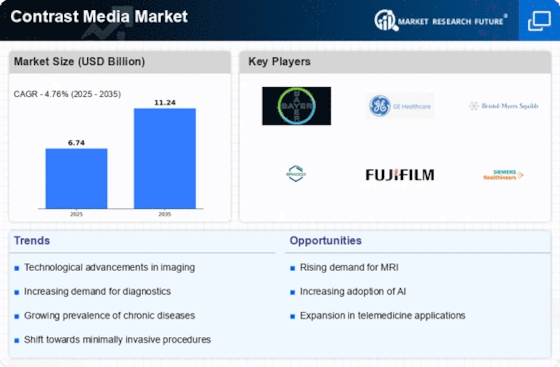
April 01, 2026- According to Market Research Future analysis, the Contrast Media Market Size was valued at USD 6.74 Billion in 2024 & the market is projected to grow from USD 7.061 Billion in 2025 to USD 11.24 Billion by 2035, registering a CAGR of 4.76% during the forecast period 2025–2035. North America led the market with over 45% share, generating around USD 3.03 billion in revenue. Rising prevalence of chronic diseases and increasing demand for advanced diagnostic imaging procedures are key growth drivers for the contrast media market. Expanding healthcare infrastructure and technological advancements in imaging modalities further accelerate adoption of contrast agents globally.

  • According to WHO, cardiovascular diseases cause 17.9 million deaths annually, while cancer accounts for nearly 10 million deaths globally, significantly increasing diagnostic imaging demand. Additionally, OECD reports imaging procedures like CT scans have grown by over 20% in the past decade, supporting contrast media utilization growth.

Key Market Trends & Highlights

The Contrast Media Market is poised for substantial growth driven by technological advancements and increasing healthcare demands.

  • North America dominates with over 45% revenue share in 2024, driven by advanced imaging infrastructure and high procedure volumes. Europe holds 30% share, valued at USD 2.02 billion in 2024, supported by aging population and regulatory-driven adoption. CT scan procedures increased by over 20% globally, significantly boosting demand for iodinated and gadolinium-based contrast agents. Aging population exceeding 25% in Europe and increasing imaging rates support strong regional market expansion.

Market Size & Forecast

2024 Market Size 6.74 (USD Billion)
2035 Market Size 11.24 (USD Billion)
CAGR (2025 - 2035) 4.76%
Largest Regional Market Share in 2024 North America

Major Players

Companies such as <a href="https://www.bayer.com/en/products/products-from-A-to-Z">Bayer</a> AG (DE), <a href="https://www.gehealthcare.com/products/pharmaceutical-diagnostics" target="_blank" rel="noopener">GE Healthcare</a> (US), Bristol-Myers Squibb Company (US), Bracco Imaging S.p.A. (IT), Fujifilm Holdings Corporation (JP), Siemens Healthineers (DE), Canon Medical Systems Corporation (JP), Hoffmann-La Roche Ltd (CH) are some of the major participants in the global market.

Market Trends

The Contrast Media Market is currently experiencing a dynamic evolution, driven by advancements in imaging technologies and an increasing demand for diagnostic procedures. The integration of artificial intelligence and machine learning into imaging modalities appears to enhance the accuracy and efficiency of contrast media applications.

Furthermore, the growing prevalence of chronic diseases necessitates improved diagnostic capabilities, thereby propelling the market forward. As healthcare systems worldwide strive for better patient outcomes, the role of contrast agents in medical imaging becomes increasingly pivotal. In addition, the rising awareness regarding early disease detection and the importance of timely diagnosis seems to be influencing the demand for contrast media.

Regulatory bodies are also playing a crucial role in ensuring the safety and efficacy of these agents, which may further bolster market growth. The ongoing research and development efforts aimed at creating innovative contrast agents that minimize adverse effects could potentially reshape the landscape of the market in the coming years.

Technological Advancements in Imaging

The Contrast Media Market is witnessing a surge in technological innovations, particularly in imaging modalities such as MRI and CT scans. These advancements are likely to enhance the precision of diagnostic imaging, thereby increasing the reliance on contrast agents. Within this context, the diagnostic agents definition encompasses a diverse range of substances—including iodinated, gadolinium-based, and barium compounds—that temporarily alter how internal structures interact with imaging energy.

  • WHO estimates that over 3.6 billion diagnostic imaging procedures are performed annually worldwide, with CT scan utilization increasing by more than 30% in developed regions. This growth highlights strong demand for advanced imaging technologies, directly boosting the adoption of iodinated and gadolinium-based contrast agents.

Growing Demand for Minimally Invasive Procedures

There appears to be a notable shift towards minimally invasive diagnostic and therapeutic procedures within the healthcare sector. This trend is likely to drive the demand for contrast media, as these agents are essential for visualizing internal structures during such procedures. The preference for less invasive options may lead to an increase in the utilization of contrast agents.

  • According to CDC data, minimally invasive procedures have increased by nearly 25% in the last decade in the U.S. alone, reducing hospital stays by up to 50%. This surge supports increased reliance on imaging-guided diagnostics, significantly driving demand for contrast media in clinical settings.

Focus on Patient Safety and Efficacy

Consolidation within the contrast agents’ market has led to more streamlined distribution networks, yet it also places a premium on manufacturers who can demonstrate superior safety profiles for patients with renal sensitivities. The portfolio of Bracco contrast media is recognized for its specialized offerings in ultrasound and MRI, positioning the company as a critical partner for hospitals shifting toward radiation-free diagnostic modalities.

  • ECDC reports indicate that adverse drug reaction monitoring systems across Europe have improved patient safety outcomes by over 35% in recent years. Additionally, adoption of safer contrast agents has increased by 28%, reinforcing market growth through innovation in low-toxicity and renal-safe imaging solutions.

Contrast Media Market Market Drivers

Rising Incidence of Chronic Diseases

The increasing prevalence of chronic diseases such as cancer, cardiovascular disorders, and neurological conditions is a primary driver of the Contrast Media Market. As these diseases require advanced imaging techniques for diagnosis and monitoring, the demand for contrast media is expected to rise.
 
According to recent statistics, the incidence of cancer is projected to increase, leading to a higher need for imaging modalities like MRI and CT scans, which utilize contrast agents. This trend indicates a growing market for contrast media, as healthcare providers seek effective solutions for accurate diagnosis and treatment planning. Furthermore, the aging population is likely to exacerbate this trend, as older individuals are more susceptible to chronic conditions, thereby further propelling the demand for contrast media in medical imaging.

Increase in Diagnostic Imaging Procedures

The rising number of diagnostic imaging procedures is a crucial driver of the Contrast Media Market. As healthcare systems increasingly rely on imaging for accurate diagnosis, the demand for contrast media is likely to grow. Reports indicate that the number of CT and MRI scans performed annually has surged, reflecting a shift towards more comprehensive diagnostic approaches.
 
This increase is attributed to the growing awareness of the importance of early disease detection and the advancements in imaging technology that facilitate these procedures. Consequently, the market is poised for growth, as healthcare providers seek to enhance the effectiveness of imaging studies through the use of high-quality contrast agents. This trend underscores the essential role of contrast media in modern diagnostic practices.

Growing Awareness of Preventive Healthcare

The increasing emphasis on preventive healthcare is driving the demand for diagnostic imaging, thereby influencing the Contrast Media Market. As patients and healthcare providers recognize the importance of early detection and intervention, the utilization of imaging techniques that require contrast media is likely to rise.
 
Educational campaigns and public health initiatives are fostering a culture of preventive care, leading to more individuals seeking regular health screenings that incorporate advanced imaging. This trend is expected to boost the demand for contrast agents, as they play a critical role in enhancing the quality of imaging studies. Consequently, the market is positioned for growth, as it aligns with the broader shift towards preventive healthcare practices that prioritize early diagnosis and treatment.

Technological Innovations in Imaging Techniques

Technological advancements in imaging modalities are significantly influencing the Contrast Media Market. Innovations such as 3D imaging, hybrid imaging systems, and enhanced MRI techniques are driving the adoption of advanced contrast agents. These technologies improve diagnostic accuracy and patient outcomes, leading to an increased utilization of contrast media.
 
For instance, the development of gadolinium-based contrast agents has revolutionized MRI imaging, providing clearer images and better diagnostic capabilities. The market for contrast media is expected to expand as healthcare facilities invest in state-of-the-art imaging technologies, which require sophisticated contrast agents to enhance image quality. This trend suggests a robust growth trajectory for the contrast media sector, as it adapts to the evolving landscape of medical imaging.

Regulatory Support for Advanced Imaging Solutions

Regulatory bodies are increasingly supporting the development and approval of advanced imaging solutions, which is positively impacting the Contrast Media Market. Initiatives aimed at expediting the approval process for new contrast agents and imaging technologies are likely to foster innovation and enhance market growth. For example, regulatory agencies have introduced frameworks that facilitate faster access to novel contrast media, ensuring that healthcare providers can utilize the latest advancements in imaging.
 
This regulatory support not only encourages research and development but also enhances patient access to cutting-edge diagnostic tools. As a result, the market is expected to benefit from a more favorable regulatory environment, promoting the introduction of innovative products that meet the evolving needs of healthcare professionals.

Market Segment Insights

By Type: Iodinated Contrast Media (Largest) vs. Gadolinium-Based Contrast Media (Fastest-Growing)

The market is predominantly supported by iodinated contrast media, which consistently hold the largest share in the Contrast Media Market at 62% within the segment. This type accounts for a significant portion of the diagnostic imaging procedures, preferred for its effectiveness in enhancing the contrast of imaging results. In contrast, Gadolinium-Based Contrast Media, while smaller in share compared to Iodinated types, is witnessing a rapid increase in acceptance due to its favorable safety profile, particularly among patients with renal issues.

Contrast Media: Iodinated Contrast Media (Dominant) vs. Gadolinium-Based Contrast Media (Emerging)

Iodinated Contrast Media is widely regarded as the dominant type due to its extensive application in various imaging modalities, including X-rays and CT scans. Its high osmolarity offers enhanced visualization, which makes it a staple choice in clinical settings. On the other hand, Gadolinium-Based Contrast Media is emerging rapidly as a preferred alternative, especially in MRI procedures. It is known for its reduced risk of adverse reactions, making it highly appealing, particularly in patients with renal impairment. The increasing awareness and adoption of gadolinium media are driven by ongoing research showcasing its efficacy and safety, thereby augmenting its market growth.

By Form: Liquid (Largest) vs. Tablet (Fastest-Growing)

In the Contrast Media Market, liquid forms dominate the market, holding a 78% share due to their widespread applicability and effectiveness in imaging procedures. These products continue to be the preferred choice for many medical professionals because of their ease of administration and rapid action within the body. Tablets, while currently a smaller segment, are rapidly gaining traction as they offer convenience and improved patient compliance, positioning themselves as a viable alternative to traditional liquid forms.

Liquid (Dominant) vs. Tablet (Emerging)

Liquid contrast media is recognized for its superior efficacy in enhancing imaging results, with a broad range of applications in various diagnostic imaging modalities such as X-rays and CT scans. Its extensive utilization in hospitals fortifies its position as the dominant form in the market. On the other hand, tablet contrast media is emerging as a convenient option, particularly for patients who prefer an oral intake method. Its growth is propelled by advancements in formulation technology that enhance absorption and bioavailability, making it an appealing choice for both patients and healthcare providers.

By Procedure: X-ray/CT (Largest) vs. MRI (Fastest-Growing)

X-ray/Computed Tomography (CT) holds the largest share in the Contrast Media Market at 64%, representing a significant portion of overall usage. This dominance is attributed to the widespread application of X-ray and CT imaging in various diagnostic procedures, making it a preferred choice among healthcare professionals. Meanwhile, Magnetic Resonance Imaging (MRI) is rapidly gaining traction, driven by its non-invasive nature and superior soft tissue contrast, appealing to an increasing number of clinicians and patients alike.

Imaging Technologies: X-ray/CT (Dominant) vs. MRI (Emerging)

X-ray/CT technology is well-established in the medical imaging field, known for its quick diagnostic capabilities and ongoing integration with digital technologies, which enhance image quality and patient safety. On the other hand, MRI is viewed as an emerging player in the market, particularly favored for its ability to provide detailed images of soft tissues without radiation. The increasing prevalence of chronic diseases necessitating precise imaging and the advancement of MRI technology are key drivers propelling its growth. As practitioners seek out improved diagnostic methods, MRI is poised to capture greater market share in the upcoming years, complementing the already dominant X-ray/CT segment.

By Application: Cardiovascular Disease (Largest) vs. Oncology (Fastest-Growing)

In the Contrast Media Market, the application segment is prominently led by cardiovascular disease applications, which represent the largest share at 36%. This segment benefits from the increasing prevalence of heart-related ailments, driving demand for effective diagnostic solutions. Additionally, oncology applications are witnessing accelerated growth, spurred by rising cancer incidences and innovative advancements in imaging techniques to enhance tumor detection and monitoring. As a result, the applications of contrast media in these areas capture significant market attention.

Cardiovascular Disease (Dominant) vs. Oncology (Emerging)

The cardiovascular disease segment remains dominant within the contrast media applications, aided by its extensive use in diagnostic imaging modalities that significantly improve patient outcomes. Cardiovascular procedures that utilize contrast media enhance visualization of the heart and blood vessels, which are crucial for accurate diagnosis and treatment planning. Conversely, the oncology segment is emerging rapidly, fueled by innovations in imaging technologies and targeted therapeutics. The increasing focus on early detection of cancers through advanced imaging methods highlights the growing adoption of contrast media, positioning it as a pivotal application in comprehensive cancer care.

Get more detailed insights about Contrast Media Market Research Report - Global Forecast till 2035

Regional Insights

North America : Leading Innovation and Demand

North America leads in the Contrast Media Market size, accounting for over 45% of the global revenue in 2024. The region's growth is driven by advanced healthcare infrastructure, increasing prevalence of chronic diseases, and rising demand for diagnostic imaging. Regulatory support from agencies like the FDA further catalyzes market expansion, ensuring safety and efficacy in contrast media products.

  • CDC reports that over 129 million Americans suffer from at least one chronic disease, while imaging procedures exceed 80 million CT scans annually in the U.S. This high diagnostic volume significantly drives contrast media demand across hospitals and diagnostic centers.

The United States is the primary contributor, with significant investments in healthcare technology and research. Key players such as GE Healthcare and Bristol-Myers Squibb are prominent in this market, focusing on innovative solutions and partnerships. The competitive landscape is characterized by continuous advancements in imaging technologies, enhancing patient outcomes and driving market growth.

Europe : Regulatory Framework and Growth

Europe Contrast Media Market size was valued at USD 2.02 billion in 2024, making it the second-largest regional market with a 30% share. The region benefits from stringent regulatory frameworks that ensure high-quality standards in medical products. Increasing investments in healthcare infrastructure and a growing aging population are key drivers of demand.

  • According to WHO Europe, nearly 25% of the population is aged 60 and above, with chronic diseases responsible for over 86% of deaths. Additionally, imaging utilization has grown by approximately 18% across EU countries, supporting increased demand for contrast agents.

Countries like Germany and France are leading the market, supported by favorable reimbursement policies and technological advancements. Germany stands out as a major player, with significant contributions from companies like Bayer AG and Siemens Healthineers. The competitive landscape is robust, with a focus on innovation and collaboration among key players. The European market is also witnessing a rise in the adoption of advanced imaging techniques, further propelling growth in the contrast media sector.

Asia-Pacific : Emerging Market Potential

Asia-Pacific is an emerging powerhouse in the contrast media market, holding approximately 20% of the global share. The region's growth is fueled by increasing healthcare expenditure, rising awareness of diagnostic imaging, and a growing patient population. Countries like China and India are at the forefront, with significant investments in healthcare infrastructure and technology.

Regulatory bodies are also enhancing their frameworks to support market growth. China is the largest market in the region, driven by a surge in demand for advanced imaging techniques. Key players such as Fujifilm Holdings and Canon Medical Systems are expanding their presence, focusing on innovative products tailored to local needs. The competitive landscape is evolving, with a mix of The market share in this rapidly growing sector.

Middle East and Africa : Untapped Market Opportunities

The Middle East and Africa region represents a growing market for contrast media, accounting for about 5% of the global share. The growth is driven by increasing healthcare investments, rising awareness of diagnostic imaging, and a growing population. Countries like South Africa and the UAE are leading the market, supported by government initiatives to improve healthcare access and quality.

South Africa is a key player, with a focus on enhancing healthcare infrastructure and technology. The competitive landscape includes both local and international companies, with a growing emphasis on partnerships and collaborations. As the region continues to develop, the demand for advanced imaging solutions is expected to rise, presenting significant opportunities for market players.

Key Players and Competitive Insights

The Contrast Media Market is currently characterized by a dynamic competitive landscape, driven by technological advancements and increasing demand for diagnostic imaging. Key players such as Bayer AG (Germany), GE Healthcare (US), and Bracco Imaging S.p.A. (Italy) are at the forefront, each adopting distinct strategies to enhance their market presence.
 
Bayer AG (Germany) focuses on innovation in contrast agents, particularly in the development of safer and more effective products, while GE Healthcare (US) emphasizes digital transformation and integration of AI in imaging technologies. Bracco Imaging S.p.A. (Italy) is actively pursuing regional expansion, particularly in emerging markets, to capitalize on the growing healthcare infrastructure. Collectively, these strategies not only enhance their competitive positioning but also contribute to a more robust market environment. 
 
In terms of business tactics, companies are increasingly localizing manufacturing to reduce costs and improve supply chain efficiency. The market structure appears moderately fragmented, with several players vying for market share. However, the influence of major companies is significant, as they set industry standards and drive innovation. This competitive structure fosters an environment where smaller firms can thrive by focusing on niche markets or specialized products, thereby enhancing overall market dynamism. 
 
In August 2025, Bayer AG (Germany) announced a strategic partnership with a leading AI technology firm to develop advanced imaging solutions that enhance diagnostic accuracy. This collaboration is poised to leverage AI capabilities to improve the efficacy of contrast media, potentially revolutionizing patient outcomes in diagnostic imaging. The strategic importance of this partnership lies in its potential to position Bayer as a leader in the integration of AI within the contrast media sector, aligning with broader industry trends towards digitalization. 
 
In September 2025, GE Healthcare (US) launched a new line of contrast agents designed specifically for pediatric patients, addressing a critical gap in the market. This initiative not only demonstrates GE's commitment to patient safety but also reflects a growing trend towards personalized medicine. By focusing on the unique needs of pediatric patients, GE Healthcare is likely to enhance its market share and strengthen its brand loyalty among healthcare providers. 
 
In July 2025, Bracco Imaging S.p.A. (Italy) expanded its operations in Asia by establishing a new manufacturing facility in India. This move is strategically significant as it allows Bracco to tap into the rapidly growing healthcare market in the region, while also optimizing its supply chain. The establishment of local manufacturing capabilities is expected to reduce lead times and costs, thereby enhancing Bracco's competitive edge in the Asian market. 
 
As of October 2025, the Contrast Media Market is witnessing trends such as increased digitalization, sustainability initiatives, and the integration of AI technologies. Strategic alliances among key players are shaping the competitive landscape, fostering innovation and collaboration. Looking ahead, it appears that competitive differentiation will increasingly hinge on technological advancements and supply chain reliability, rather than solely on price. Companies that prioritize innovation and adapt to evolving market demands are likely to emerge as leaders in this rapidly changing environment.

Key Companies in the Contrast Media Market include

Industry Developments

October 2022: G.E. Healthcare's pharmaceutical diagnostics company announced a long-term agreement with the Chilean mining company Sociedad Quimica y Minera (SQM) de Chile S.A. to guarantee its supply of iodine, which is used in X-ray contrast media products. Vital components and computed tomography procedures around the world. As part of G.E. Healthcare's larger commitment and investment plan, this will help SQM expand its supply of iodine raw material year-on-year, producing an additional 30 Billion doses of iodine contrast media per year by 2025.

December 2021: The previously announced G.E. Healthcare acquisition of B.K. Medical was finalized. With this acquisition, G.E. Healthcare has enhanced its pre- and post-operative ultrasound capabilities to cover real-time surgical observation, a fast-growing and relatively new discipline.

Future Outlook

Contrast Media Market Future Outlook

The Contrast Media Market size is projected to reach USD 11.24 Billion by 2035, growing at a CAGR of 4.76%, driven by technological advancements, increasing diagnostic imaging demand, and rising healthcare expenditures.

New opportunities lie in:

  • <p>Development of AI-driven imaging solutions for enhanced diagnostic accuracy. Expansion into emerging markets with tailored contrast media products. Partnerships with healthcare providers for integrated imaging services.</p>

By 2035, the Contrast Media Market is expected to achieve robust growth, reflecting evolving healthcare needs.

Market Segmentation

Contrast Media Market Form Outlook

  • Liquid
  • Tablet
  • Powder
  • Paste

Contrast Media Market Type Outlook

  • Iodinated Contrast Media
  • Gadolinium-Based Contrast Media

Contrast Media Market Procedure Outlook

  • X-ray/Computed Tomography (CT)
  • Magnetic Resonance Imaging (MRI)

Contrast Media Market Application Outlook

  • Cardiovascular Disease
  • Oncology
  • Gastrointestinal Disorders

Report Scope

MARKET SIZE 2024 6.74(USD Billion)
MARKET SIZE 2025 7.061(USD Billion)
MARKET SIZE 2035 11.24(USD Billion)
COMPOUND ANNUAL GROWTH RATE (CAGR) 4.76% (2025 - 2035)
REPORT COVERAGE Revenue Forecast, Competitive Landscape, Growth Factors, and Trends
BASE YEAR 2024
Market Forecast Period 2025 - 2035
Historical Data 2019 - 2024
Market Forecast Units USD Billion
Key Companies Profiled Bayer AG (DE), GE Healthcare (US), Bristol-Myers Squibb Company (US), Bracco Imaging S.p.A. (IT), Fujifilm Holdings Corporation (JP), Siemens Healthineers (DE), Canon Medical Systems Corporation (JP), Hoffmann-La Roche Ltd (CH)
Segments Covered Type, Form, Procedures, Application, Region
Key Market Opportunities Advancements in artificial intelligence enhance diagnostic accuracy in the market.
Key Market Dynamics Technological advancements and regulatory changes drive innovation and competition in the market.
Countries Covered North America, Europe, APAC, South America, MEA

FAQs

What is the current valuation of the Contrast Media Market as of 2024?

<p>The Contrast Media Market was valued at 6.74 USD Billion in 2024.</p>

What is the projected market valuation for the Contrast Media Market in 2035?

<p>The market is projected to reach 11.24 USD Billion by 2035.</p>

What is the expected CAGR for the market during the forecast period 2025 - 2035?

The expected CAGR for the market during 2025 - 2035 is 4.76%.

Which segment of the Contrast Media Market is expected to grow the most by 2035?

<p>Iodinated Contrast Media is anticipated to grow from 4.04 USD Billion in 2024 to 6.7 USD Billion by 2035.</p>

How do Gadolinium-Based Contrast Media valuations compare between 2024 and 2035?

<p>Gadolinium-Based Contrast Media is expected to increase from 2.7 USD Billion in 2024 to 4.54 USD Billion by 2035.</p>

What forms of contrast media are projected to see significant growth by 2035?

Liquid forms are expected to grow from 2.68 USD Billion in 2024 to 4.45 USD Billion by 2035.

Which medical procedures are driving the demand for contrast media?

X-ray/Computed Tomography (CT) and Magnetic Resonance Imaging (MRI) are key procedures, with CT expected to grow from 3.5 USD Billion in 2024 to 5.8 USD Billion by 2035.

What applications are contributing to the growth of the Contrast Media Market?

Oncology is projected to grow from 2.68 USD Billion in 2024 to 4.4 USD Billion by 2035, indicating a strong demand in this area.

Who are the key players in the Contrast Media Market?

Key players include Bayer AG, GE Healthcare, and Bracco Imaging S.p.A., among others.

What is the expected growth trend for the market in the coming years?

The market is likely to experience steady growth, driven by advancements in imaging technologies and increasing applications in various medical fields.

  1. SECTION I: EXECUTIVE SUMMARY AND KEY HIGHLIGHTS |
    1. EXECUTIVE SUMMARY | |
      1. Market Overview | |
      2. Key Findings | |
      3. Market Segmentation | |
      4. Competitive Landscape | |
      5. Challenges and Opportunities | |
      6. Future Outlook 2
  2. SECTION II: SCOPING, METHODOLOGY AND MARKET STRUCTURE |
    1. MARKET INTRODUCTION | |
      1. Definition | |
      2. Scope of the study | | |
    2. RESEARCH METHODOLOGY | |
      1. Overview | |
      2. Data Mining | |
      3. Secondary Research | |
      4. Primary Research | | |
      5. Forecasting Model | |
      6. Market Size Estimation | | |
      7. Data Triangulation | |
      8. Validation 3
  3. SECTION III: QUALITATIVE ANALYSIS |
    1. MARKET DYNAMICS | |
      1. Overview | |
      2. Drivers | |
      3. Restraints | |
      4. Opportunities |
    2. MARKET FACTOR ANALYSIS | |
      1. Value chain Analysis | |
      2. Porter's Five Forces Analysis | | |
      3. COVID-19 Impact Analysis | | |
  4. SECTION IV: QUANTITATIVE ANALYSIS |
    1. Healthcare, BY Type (USD Billion) | |
      1. Iodinated Contrast Media | |
      2. Gadolinium-Based Contrast Media |
    2. Healthcare, BY Form (USD Billion) | |
      1. Liquid | |
      2. Tablet | |
      3. Powder | |
      4. Paste |
    3. Healthcare, BY Procedure (USD Billion) | |
      1. X-ray/Computed Tomography (CT) | |
      2. Magnetic Resonance Imaging (MRI) |
    4. Healthcare, BY Application (USD Billion) | |
      1. Cardiovascular Disease | |
      2. Oncology | |
      3. Gastrointestinal Disorders |
    5. Healthcare, BY Region (USD Billion) | |
      1. North America | | |
      2. Europe | | |
      3. APAC | | |
      4. South America | | |
      5. MEA | | |
  5. SECTION V: COMPETITIVE ANALYSIS |
    1. Competitive Landscape | |
      1. Overview | |
      2. Competitive Analysis | |
      3. Market share Analysis | |
      4. Major Growth Strategy in the Healthcare | |
      5. Competitive Benchmarking | |
      6. Leading Players in Terms of Number of Developments in the Healthcare | |
      7. Key developments and growth strategies | | |
      8. Major Players Financial Matrix | | |
    2. Company Profiles | |
      1. Bayer AG (DE) | | |
      2. GE Healthcare (US) | | |
      3. Bristol-Myers Squibb Company (US) | | |
      4. Bracco Imaging S.p.A. (IT) | | |
      5. Fujifilm Holdings Corporation (JP) | | |
      6. Siemens Healthineers (DE) | | |
      7. Canon Medical Systems Corporation (JP) | | |
      8. Hoffmann-La Roche Ltd (CH) | | |
    3. Appendix | |
      1. References | |
      2. Related Reports 6 LIST OF FIGURES |
    4. MARKET SYNOPSIS |
    5. NORTH AMERICA MARKET ANALYSIS |
    6. US MARKET ANALYSIS BY TYPE |
    7. US MARKET ANALYSIS BY FORM |
    8. US MARKET ANALYSIS BY PROCEDURE |
    9. US MARKET ANALYSIS BY APPLICATION |
    10. CANADA MARKET ANALYSIS BY TYPE |
    11. CANADA MARKET ANALYSIS BY FORM |
    12. CANADA MARKET ANALYSIS BY PROCEDURE |
    13. CANADA MARKET ANALYSIS BY APPLICATION |
    14. EUROPE MARKET ANALYSIS |
    15. GERMANY MARKET ANALYSIS BY TYPE |
    16. GERMANY MARKET ANALYSIS BY FORM |
    17. GERMANY MARKET ANALYSIS BY PROCEDURE |
    18. GERMANY MARKET ANALYSIS BY APPLICATION |
    19. UK MARKET ANALYSIS BY TYPE |
    20. UK MARKET ANALYSIS BY FORM |
    21. UK MARKET ANALYSIS BY PROCEDURE |
    22. UK MARKET ANALYSIS BY APPLICATION |
    23. FRANCE MARKET ANALYSIS BY TYPE |
    24. FRANCE MARKET ANALYSIS BY FORM |
    25. FRANCE MARKET ANALYSIS BY PROCEDURE |
    26. FRANCE MARKET ANALYSIS BY APPLICATION |
    27. RUSSIA MARKET ANALYSIS BY TYPE |
    28. RUSSIA MARKET ANALYSIS BY FORM |
    29. RUSSIA MARKET ANALYSIS BY PROCEDURE |
    30. RUSSIA MARKET ANALYSIS BY APPLICATION |
    31. ITALY MARKET ANALYSIS BY TYPE |
    32. ITALY MARKET ANALYSIS BY FORM |
    33. ITALY MARKET ANALYSIS BY PROCEDURE |
    34. ITALY MARKET ANALYSIS BY APPLICATION |
    35. SPAIN MARKET ANALYSIS BY TYPE |
    36. SPAIN MARKET ANALYSIS BY FORM |
    37. SPAIN MARKET ANALYSIS BY PROCEDURE |
    38. SPAIN MARKET ANALYSIS BY APPLICATION |
    39. REST OF EUROPE MARKET ANALYSIS BY TYPE |
    40. REST OF EUROPE MARKET ANALYSIS BY FORM |
    41. REST OF EUROPE MARKET ANALYSIS BY PROCEDURE |
    42. REST OF EUROPE MARKET ANALYSIS BY APPLICATION |
    43. APAC MARKET ANALYSIS |
    44. CHINA MARKET ANALYSIS BY TYPE |
    45. CHINA MARKET ANALYSIS BY FORM |
    46. CHINA MARKET ANALYSIS BY PROCEDURE |
    47. CHINA MARKET ANALYSIS BY APPLICATION |
    48. INDIA MARKET ANALYSIS BY TYPE |
    49. INDIA MARKET ANALYSIS BY FORM |
    50. INDIA MARKET ANALYSIS BY PROCEDURE |
    51. INDIA MARKET ANALYSIS BY APPLICATION |
    52. JAPAN MARKET ANALYSIS BY TYPE |
    53. JAPAN MARKET ANALYSIS BY FORM |
    54. JAPAN MARKET ANALYSIS BY PROCEDURE |
    55. JAPAN MARKET ANALYSIS BY APPLICATION |
    56. SOUTH KOREA MARKET ANALYSIS BY TYPE |
    57. SOUTH KOREA MARKET ANALYSIS BY FORM |
    58. SOUTH KOREA MARKET ANALYSIS BY PROCEDURE |
    59. SOUTH KOREA MARKET ANALYSIS BY APPLICATION |
    60. MALAYSIA MARKET ANALYSIS BY TYPE |
    61. MALAYSIA MARKET ANALYSIS BY FORM |
    62. MALAYSIA MARKET ANALYSIS BY PROCEDURE |
    63. MALAYSIA MARKET ANALYSIS BY APPLICATION |
    64. THAILAND MARKET ANALYSIS BY TYPE |
    65. THAILAND MARKET ANALYSIS BY FORM |
    66. THAILAND MARKET ANALYSIS BY PROCEDURE |
    67. THAILAND MARKET ANALYSIS BY APPLICATION |
    68. INDONESIA MARKET ANALYSIS BY TYPE |
    69. INDONESIA MARKET ANALYSIS BY FORM |
    70. INDONESIA MARKET ANALYSIS BY PROCEDURE |
    71. INDONESIA MARKET ANALYSIS BY APPLICATION |
    72. REST OF APAC MARKET ANALYSIS BY TYPE |
    73. REST OF APAC MARKET ANALYSIS BY FORM |
    74. REST OF APAC MARKET ANALYSIS BY PROCEDURE |
    75. REST OF APAC MARKET ANALYSIS BY APPLICATION |
    76. SOUTH AMERICA MARKET ANALYSIS |
    77. BRAZIL MARKET ANALYSIS BY TYPE |
    78. BRAZIL MARKET ANALYSIS BY FORM |
    79. BRAZIL MARKET ANALYSIS BY PROCEDURE |
    80. BRAZIL MARKET ANALYSIS BY APPLICATION |
    81. MEXICO MARKET ANALYSIS BY TYPE |
    82. MEXICO MARKET ANALYSIS BY FORM |
    83. MEXICO MARKET ANALYSIS BY PROCEDURE |
    84. MEXICO MARKET ANALYSIS BY APPLICATION |
    85. ARGENTINA MARKET ANALYSIS BY TYPE |
    86. ARGENTINA MARKET ANALYSIS BY FORM |
    87. ARGENTINA MARKET ANALYSIS BY PROCEDURE |
    88. ARGENTINA MARKET ANALYSIS BY APPLICATION |
    89. REST OF SOUTH AMERICA MARKET ANALYSIS BY TYPE |
    90. REST OF SOUTH AMERICA MARKET ANALYSIS BY FORM |
    91. REST OF SOUTH AMERICA MARKET ANALYSIS BY PROCEDURE |
    92. REST OF SOUTH AMERICA MARKET ANALYSIS BY APPLICATION |
    93. MEA MARKET ANALYSIS |
    94. GCC COUNTRIES MARKET ANALYSIS BY TYPE |
    95. GCC COUNTRIES MARKET ANALYSIS BY FORM |
    96. GCC COUNTRIES MARKET ANALYSIS BY PROCEDURE |
    97. GCC COUNTRIES MARKET ANALYSIS BY APPLICATION |
    98. SOUTH AFRICA MARKET ANALYSIS BY TYPE |
    99. SOUTH AFRICA MARKET ANALYSIS BY FORM |
    100. SOUTH AFRICA MARKET ANALYSIS BY PROCEDURE |
    101. SOUTH AFRICA MARKET ANALYSIS BY APPLICATION |
    102. REST OF MEA MARKET ANALYSIS BY TYPE |
    103. REST OF MEA MARKET ANALYSIS BY FORM |
    104. REST OF MEA MARKET ANALYSIS BY PROCEDURE |
    105. REST OF MEA MARKET ANALYSIS BY APPLICATION |
    106. KEY BUYING CRITERIA OF HEALTHCARE |
    107. RESEARCH PROCESS OF MRFR |
    108. DRO ANALYSIS OF HEALTHCARE |
    109. DRIVERS IMPACT ANALYSIS: HEALTHCARE |
    110. RESTRAINTS IMPACT ANALYSIS: HEALTHCARE |
    111. SUPPLY / VALUE CHAIN: HEALTHCARE |
    112. HEALTHCARE, BY TYPE, 2024 (% SHARE) |
    113. HEALTHCARE, BY TYPE, 2024 TO 2035 (USD Billion) |
    114. HEALTHCARE, BY FORM, 2024 (% SHARE) |
    115. HEALTHCARE, BY FORM, 2024 TO 2035 (USD Billion) |
    116. HEALTHCARE, BY PROCEDURE, 2024 (% SHARE) |
    117. HEALTHCARE, BY PROCEDURE, 2024 TO 2035 (USD Billion) |
    118. HEALTHCARE, BY APPLICATION, 2024 (% SHARE) |
    119. HEALTHCARE, BY APPLICATION, 2024 TO 2035 (USD Billion) |
    120. BENCHMARKING OF MAJOR COMPETITORS 7 LIST OF TABLES |
    121. LIST OF ASSUMPTIONS | |
      1. |
    122. North America MARKET SIZE ESTIMATES; FORECAST | |
      1. BY TYPE, 2025-2035 (USD Billion) | |
      2. BY FORM, 2025-2035 (USD Billion) | |
      3. BY PROCEDURE, 2025-2035 (USD Billion) | |
      4. BY APPLICATION, 2025-2035 (USD Billion) |
    123. US MARKET SIZE ESTIMATES; FORECAST | |
      1. BY TYPE, 2025-2035 (USD Billion) | |
      2. BY FORM, 2025-2035 (USD Billion) | |
      3. BY PROCEDURE, 2025-2035 (USD Billion) | |
      4. BY APPLICATION, 2025-2035 (USD Billion) |
    124. Canada MARKET SIZE ESTIMATES; FORECAST | |
      1. BY TYPE, 2025-2035 (USD Billion) | |
      2. BY FORM, 2025-2035 (USD Billion) | |
      3. BY PROCEDURE, 2025-2035 (USD Billion) | |
      4. BY APPLICATION, 2025-2035 (USD Billion) |
    125. Europe MARKET SIZE ESTIMATES; FORECAST | |
      1. BY TYPE, 2025-2035 (USD Billion) | |
      2. BY FORM, 2025-2035 (USD Billion) | |
      3. BY PROCEDURE, 2025-2035 (USD Billion) | |
      4. BY APPLICATION, 2025-2035 (USD Billion) |
    126. Germany MARKET SIZE ESTIMATES; FORECAST | |
      1. BY TYPE, 2025-2035 (USD Billion) | |
      2. BY FORM, 2025-2035 (USD Billion) | |
      3. BY PROCEDURE, 2025-2035 (USD Billion) | |
      4. BY APPLICATION, 2025-2035 (USD Billion) |
    127. UK MARKET SIZE ESTIMATES; FORECAST | |
      1. BY TYPE, 2025-2035 (USD Billion) | |
      2. BY FORM, 2025-2035 (USD Billion) | |
      3. BY PROCEDURE, 2025-2035 (USD Billion) | |
      4. BY APPLICATION, 2025-2035 (USD Billion) |
    128. France MARKET SIZE ESTIMATES; FORECAST | |
      1. BY TYPE, 2025-2035 (USD Billion) | |
      2. BY FORM, 2025-2035 (USD Billion) | |
      3. BY PROCEDURE, 2025-2035 (USD Billion) | |
      4. BY APPLICATION, 2025-2035 (USD Billion) |
    129. Russia MARKET SIZE ESTIMATES; FORECAST | |
      1. BY TYPE, 2025-2035 (USD Billion) | |
      2. BY FORM, 2025-2035 (USD Billion) | |
      3. BY PROCEDURE, 2025-2035 (USD Billion) | |
      4. BY APPLICATION, 2025-2035 (USD Billion) |
    130. Italy MARKET SIZE ESTIMATES; FORECAST | |
      1. BY TYPE, 2025-2035 (USD Billion) | |
      2. BY FORM, 2025-2035 (USD Billion) | |
      3. BY PROCEDURE, 2025-2035 (USD Billion) | |
      4. BY APPLICATION, 2025-2035 (USD Billion) |
    131. Spain MARKET SIZE ESTIMATES; FORECAST | |
      1. BY TYPE, 2025-2035 (USD Billion) | |
      2. BY FORM, 2025-2035 (USD Billion) | |
      3. BY PROCEDURE, 2025-2035 (USD Billion) | |
      4. BY APPLICATION, 2025-2035 (USD Billion) |
    132. Rest of Europe MARKET SIZE ESTIMATES; FORECAST | |
      1. BY TYPE, 2025-2035 (USD Billion) | |
      2. BY FORM, 2025-2035 (USD Billion) | |
      3. BY PROCEDURE, 2025-2035 (USD Billion) | |
      4. BY APPLICATION, 2025-2035 (USD Billion) |
    133. APAC MARKET SIZE ESTIMATES; FORECAST | |
      1. BY TYPE, 2025-2035 (USD Billion) | |
      2. BY FORM, 2025-2035 (USD Billion) | |
      3. BY PROCEDURE, 2025-2035 (USD Billion) | |
      4. BY APPLICATION, 2025-2035 (USD Billion) |
    134. China MARKET SIZE ESTIMATES; FORECAST | |
      1. BY TYPE, 2025-2035 (USD Billion) | |
      2. BY FORM, 2025-2035 (USD Billion) | |
      3. BY PROCEDURE, 2025-2035 (USD Billion) | |
      4. BY APPLICATION, 2025-2035 (USD Billion) |
    135. India MARKET SIZE ESTIMATES; FORECAST | |
      1. BY TYPE, 2025-2035 (USD Billion) | |
      2. BY FORM, 2025-2035 (USD Billion) | |
      3. BY PROCEDURE, 2025-2035 (USD Billion) | |
      4. BY APPLICATION, 2025-2035 (USD Billion) |
    136. Japan MARKET SIZE ESTIMATES; FORECAST | |
      1. BY TYPE, 2025-2035 (USD Billion) | |
      2. BY FORM, 2025-2035 (USD Billion) | |
      3. BY PROCEDURE, 2025-2035 (USD Billion) | |
      4. BY APPLICATION, 2025-2035 (USD Billion) |
    137. South Korea MARKET SIZE ESTIMATES; FORECAST | |
      1. BY TYPE, 2025-2035 (USD Billion) | |
      2. BY FORM, 2025-2035 (USD Billion) | |
      3. BY PROCEDURE, 2025-2035 (USD Billion) | |
      4. BY APPLICATION, 2025-2035 (USD Billion) |
    138. Malaysia MARKET SIZE ESTIMATES; FORECAST | |
      1. BY TYPE, 2025-2035 (USD Billion) | |
      2. BY FORM, 2025-2035 (USD Billion) | |
      3. BY PROCEDURE, 2025-2035 (USD Billion) | |
      4. BY APPLICATION, 2025-2035 (USD Billion) |
    139. Thailand MARKET SIZE ESTIMATES; FORECAST | |
      1. BY TYPE, 2025-2035 (USD Billion) | |
      2. BY FORM, 2025-2035 (USD Billion) | |
      3. BY PROCEDURE, 2025-2035 (USD Billion) | |
      4. BY APPLICATION, 2025-2035 (USD Billion) |
    140. Indonesia MARKET SIZE ESTIMATES; FORECAST | |
      1. BY TYPE, 2025-2035 (USD Billion) | |
      2. BY FORM, 2025-2035 (USD Billion) | |
      3. BY PROCEDURE, 2025-2035 (USD Billion) | |
      4. BY APPLICATION, 2025-2035 (USD Billion) |
    141. Rest of APAC MARKET SIZE ESTIMATES; FORECAST | |
      1. BY TYPE, 2025-2035 (USD Billion) | |
      2. BY FORM, 2025-2035 (USD Billion) | |
      3. BY PROCEDURE, 2025-2035 (USD Billion) | |
      4. BY APPLICATION, 2025-2035 (USD Billion) |
    142. South America MARKET SIZE ESTIMATES; FORECAST | |
      1. BY TYPE, 2025-2035 (USD Billion) | |
      2. BY FORM, 2025-2035 (USD Billion) | |
      3. BY PROCEDURE, 2025-2035 (USD Billion) | |
      4. BY APPLICATION, 2025-2035 (USD Billion) |
    143. Brazil MARKET SIZE ESTIMATES; FORECAST | |
      1. BY TYPE, 2025-2035 (USD Billion) | |
      2. BY FORM, 2025-2035 (USD Billion) | |
      3. BY PROCEDURE, 2025-2035 (USD Billion) | |
      4. BY APPLICATION, 2025-2035 (USD Billion) |
    144. Mexico MARKET SIZE ESTIMATES; FORECAST | |
      1. BY TYPE, 2025-2035 (USD Billion) | |
      2. BY FORM, 2025-2035 (USD Billion) | |
      3. BY PROCEDURE, 2025-2035 (USD Billion) | |
      4. BY APPLICATION, 2025-2035 (USD Billion) |
    145. Argentina MARKET SIZE ESTIMATES; FORECAST | |
      1. BY TYPE, 2025-2035 (USD Billion) | |
      2. BY FORM, 2025-2035 (USD Billion) | |
      3. BY PROCEDURE, 2025-2035 (USD Billion) | |
      4. BY APPLICATION, 2025-2035 (USD Billion) |
    146. Rest of South America MARKET SIZE ESTIMATES; FORECAST | |
      1. BY TYPE, 2025-2035 (USD Billion) | |
      2. BY FORM, 2025-2035 (USD Billion) | |
      3. BY PROCEDURE, 2025-2035 (USD Billion) | |
      4. BY APPLICATION, 2025-2035 (USD Billion) |
    147. MEA MARKET SIZE ESTIMATES; FORECAST | |
      1. BY TYPE, 2025-2035 (USD Billion) | |
      2. BY FORM, 2025-2035 (USD Billion) | |
      3. BY PROCEDURE, 2025-2035 (USD Billion) | |
      4. BY APPLICATION, 2025-2035 (USD Billion) |
    148. GCC Countries MARKET SIZE ESTIMATES; FORECAST | |
      1. BY TYPE, 2025-2035 (USD Billion) | |
      2. BY FORM, 2025-2035 (USD Billion) | |
      3. BY PROCEDURE, 2025-2035 (USD Billion) | |
      4. BY APPLICATION, 2025-2035 (USD Billion) |
    149. South Africa MARKET SIZE ESTIMATES; FORECAST | |
      1. BY TYPE, 2025-2035 (USD Billion) | |
      2. BY FORM, 2025-2035 (USD Billion) | |
      3. BY PROCEDURE, 2025-2035 (USD Billion) | |
      4. BY APPLICATION, 2025-2035 (USD Billion) |
    150. Rest of MEA MARKET SIZE ESTIMATES; FORECAST | |
      1. BY TYPE, 2025-2035 (USD Billion) | |
      2. BY FORM, 2025-2035 (USD Billion) | |
      3. BY PROCEDURE, 2025-2035 (USD Billion) | |
      4. BY APPLICATION, 2025-2035 (USD Billion) |
    151. PRODUCT LAUNCH/PRODUCT DEVELOPMENT/APPROVAL | |
      1. |
    152. ACQUISITION/PARTNERSHIP | |

Healthcare Market Segmentation

Healthcare By Type (USD Billion, 2025-2035)

  • Iodinated Contrast Media
  • Gadolinium-Based Contrast Media

Healthcare By Form (USD Billion, 2025-2035)

  • Liquid
  • Tablet
  • Powder
  • Paste

Healthcare By Procedure (USD Billion, 2025-2035)

  • X-ray/Computed Tomography (CT)
  • Magnetic Resonance Imaging (MRI)

Healthcare By Application (USD Billion, 2025-2035)

  • Cardiovascular Disease
  • Oncology
  • Gastrointestinal Disorders
Infographic

Free Sample Request

Kindly complete the form below to receive a free sample of this Report

Get Free Sample

Customer Strories

Compare Licence

×
Features License Type
Single User Multiuser License Enterprise User
Price $4,950 $5,950 $7,250
Maximum User Access Limit 1 User Upto 10 Users Unrestricted Access Throughout the Organization
Free Customization
Direct Access to Analyst
Deliverable Format
Platform Access
Discount on Next Purchase 10% 15% 15%
Printable Versions