Request Free Sample ×

Kindly complete the form below to receive a free sample of this Report

* Please use a valid business email

Leading companies partner with us for data-driven Insights

clients tt-cursor
Hero Background
English
Chinese
French
Japanese
Korean
German
Spanish

Contract Research Organization Market Share

ID: MRFR/HS/2389-CR
90 Pages
Satyendra Maurya
July 2025

Contract Research Organization (CRO) Market Research Report: Size, Share, Trend Analysis By Service Type (Clinical Research Services, Preclinical Services, Laboratory Services, Consulting Services), By Therapeutic Area (Oncology, Cardiology, Neurology, Infectious Diseases, Endocrinology), By End Users (Pharmaceutical Companies, Biotechnology Companies, Medical Device Companies, Academic Institutions), By Phase of Development (Preclinical, Phase I, Phase II, Phase III, Phase IV) and By Regional (North America, Europe, South America, Asia Pacific, Middle East and Africa) - Growth Outlook & Industry Forecast 2025 To 2035

Share:
Download PDF ×

We do not share your information with anyone. However, we may send you emails based on your report interest from time to time. You may contact us at any time to opt-out.

Contract Research Organization Market Infographic
Purchase Options

Market Share

Contract Research Organization Market Share Analysis

Market share positioning strategies play a pivotal role in the competitive landscape of the Contract Research Organization (CRO) market. These strategies encompass various approaches that companies adopt to establish and enhance their presence within the industry. One of the primary strategies employed by CROs involves differentiation. Companies strive to differentiate themselves by offering unique services, specialized expertise, or innovative technologies that set them apart from competitors. By carving out a distinct niche, CROs can attract specific clientele and command a higher market share within that segment.

Furthermore, pricing strategies play a crucial role in market share positioning within the CRO industry. Some companies opt for a cost leadership approach, aiming to offer services at lower prices compared to competitors. This strategy can help CROs capture price-sensitive segments of the market and gain a competitive edge. On the other hand, some firms focus on premium pricing, positioning themselves as providers of high-quality services with added value. While this approach may limit market penetration, it allows companies to target clients who prioritize quality and are willing to pay a premium for superior services.

In addition to differentiation and pricing, strategic partnerships and collaborations are integral to market share positioning in the CRO market. Forming alliances with pharmaceutical companies, biotech firms, and academic institutions enables CROs to access new markets, expand their service offerings, and leverage complementary expertise. Through strategic partnerships, CROs can enhance their visibility and credibility within the industry, ultimately driving market share growth.

Moreover, geographic expansion is a key component of market share positioning strategies for CROs. As the demand for clinical research services continues to grow globally, companies are increasingly focusing on expanding their presence in emerging markets. By establishing operations in regions with high demand for clinical trials, such as Asia-Pacific and Latin America, CROs can tap into new revenue streams and gain a competitive advantage over rivals with limited geographic reach.

Furthermore, technological innovation plays a pivotal role in market share positioning within the CRO industry. Companies that invest in cutting-edge technologies, such as artificial intelligence, machine learning, and data analytics, can streamline processes, enhance efficiency, and deliver more precise and reliable results to clients. By staying at the forefront of technological advancements, CROs can differentiate themselves from competitors and attract clients seeking innovative solutions for their research needs.

Additionally, customer-centricity is paramount in market share positioning strategies for CROs. Understanding the unique needs and preferences of clients and delivering tailored solutions can help companies build long-term relationships and foster loyalty among customers. By providing exceptional customer service, maintaining open communication channels, and continually soliciting feedback, CROs can strengthen their position in the market and differentiate themselves from competitors.


Author
Author Profile
Satyendra Maurya
Research Analyst

An accomplished research analyst with high proficiency in market forecasting, data visualization, competitive benchmarking, and others. He holds a pronounced track record in research and consulting projects for sectors such as life sciences, medical devices, and healthcare IT. His capabilities in qualitative and quantitative analysis have resulted in positive client outcomes. Working on niche market trends, opportunities, sales, and forecasted value is part of his skill set.

Leave a Comment

FAQs

What is the current valuation of the Market?

As of 2024, the market valuation was 84.3 USD Billion.

What is the projected market size for the Market by 2035?

The market is projected to reach 170.63 USD Billion by 2035.

What is the expected CAGR for the Market during the forecast period?

The expected CAGR for the market from 2025 to 2035 is 6.62%.

Which companies are considered key players in the Market?

Key players include IQVIA, Labcorp Drug Development, PPD, Syneos Health, and Charles River Laboratories.

What are the primary applications of Contract Research Organizations?

<p>The primary applications include Clinical Trials, Preclinical Research, and Laboratory Services, with Clinical Trials valued between 30.0 and 60.0 USD Billion.</p>

How do the end-use segments of the market break down?

<p>End-use segments include Pharmaceutical Companies, Biotechnology Firms, and Medical Device Manufacturers, with Pharmaceutical Companies valued between 30.0 and 65.0 USD Billion.</p>

What service types are offered by Contract Research Organizations?

<p>Service types include Full-Service, Functional Service Provider, and Project Management, with Full-Service valued between 30.0 and 60.0 USD Billion.</p>

Which therapeutic areas are most prominent in the Contract Research Organization Market?

<p>Prominent therapeutic areas include Oncology, Cardiology, and Neurology, with Oncology valued between 30.0 and 60.0 USD Billion.</p>

What phases of studies are included in the Contract Research Organization services?

<p>The study phases include Phase I, Phase II, and Phase III, with Phase III valued between 30.0 and 60.0 USD Billion.</p>

How does the market's growth potential appear in the context of future trends?

<p>The market's growth potential appears robust, with a projected increase in valuation and a steady CAGR of 6.62% from 2025 to 2035.</p>

Market Summary

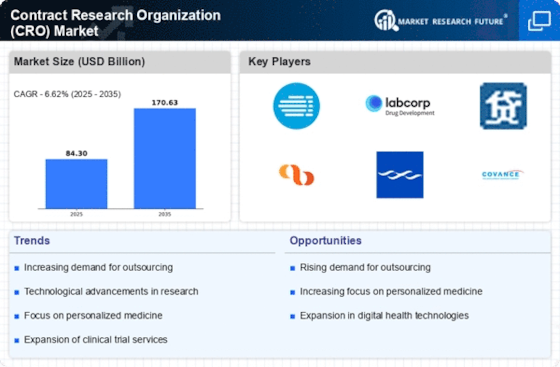
As per Market Research Future Reports analysis, the Contract Research Organization Market size was valued at USD 84.3 Billion in 2024. The market is projected to grow from USD 89.88 Billion in 2025 to USD 170.63 Billion by 2035, exhibiting a CAGR of 6.62% during the forecast period 2025–2035. North America led the market with over 44.96% share, generating around USD 37.9 billion in revenue.
 
The Contract Research Organization (CRO) market is primarily driven by the rising global burden of chronic diseases and increasing demand for efficient drug development, encouraging pharmaceutical companies to outsource clinical research to specialized organizations for faster, cost-effective, and compliant trial execution.
 
According to the World Health Organization (WHO), noncommunicable diseases account for 74% of global deaths annually (41 million people), significantly increasing demand for clinical trials and accelerating reliance on CROs to manage expanding research pipelines efficiently.

Key Market Trends & Highlights

The Contract Research Organization Market is experiencing robust growth driven by technological advancements and increased outsourcing.

  • North America leads with 44.96% share in 2024, driven by strong clinical research infrastructure. Europe accounts for 25% share, valued at USD 21.075 billion in 2024. Clinical trials dominate with 69% share, driven by increasing global R&D investments and complex drug development pipelines. Pharmaceutical companies hold 65% share, supported by large-scale outsourcing strategies and rising therapeutic innovation globally.

Market Size & Forecast

2024 Market Size 84.3 (USD Billion)
2035 Market Size 170.63 (USD Billion)
CAGR (2025 - 2035) 6.62%
Largest Regional Market Share in 2024 North America

Major Players

Companies such as IQVIA (US), <a href="https://www.labcorp.com/biopharma" target="_blank" rel="noopener">Labcorp Drug Development</a> (US), PPD (US), Syneos Health (US), Charles River Laboratories (US), <a href="https://www.medpace.com/" target="_blank" rel="noopener">Medpace</a> (US), PRA Health Sciences (US), Wuxi AppTec (CN), Celerion (US) are some of the major participants in the global market.

Market Trends

The Contract Research Organization Market is currently experiencing a dynamic evolution, driven by various factors that shape its landscape. The increasing complexity of clinical trials, coupled with the growing demand for outsourcing services, appears to be propelling the market forward. Organizations are increasingly seeking specialized expertise to navigate regulatory requirements and enhance operational efficiency. This trend suggests a shift towards more strategic partnerships between pharmaceutical companies and contract research organizations, as they aim to streamline processes and reduce time to market for new therapies.

Moreover, advancements in technology, particularly in data analytics and artificial intelligence, seem to be transforming the way research is conducted. These innovations may facilitate more efficient patient recruitment, improve trial design, and enhance data management. As a result, the Contract Research Organization Market is likely to witness a surge in demand for tech-enabled services, which could redefine traditional operational models. Overall, the market appears poised for growth, with organizations adapting to meet the evolving needs of the healthcare sector and leveraging technology to drive efficiencies.

Increased Outsourcing of Clinical Trials

Pharmaceutical companies are increasingly outsourcing clinical trials to contract research organizations. This trend indicates a strategic shift towards leveraging external expertise to manage complex trial processes, thereby enhancing efficiency and reducing operational burdens.

According to the Centers for Disease Control and Prevention (CDC), over 6 in 10 adults in the U.S. suffer from at least one chronic disease, increasing clinical trial demand significantly. This growing disease burden encourages pharmaceutical companies to outsource trials to CROs, improving efficiency, scalability, and reducing operational costs in drug development.

Technological Integration in Research Processes

The integration of advanced technologies, such as artificial intelligence and data analytics, is transforming the Contract Research Organization Market. These innovations may streamline trial management, improve patient recruitment, and enhance data analysis, leading to more effective research outcomes.

Data from the Institute for Health Metrics and Evaluation (IHME) highlights that global healthcare data volume is expanding rapidly due to rising disease monitoring needs, supporting AI-driven research. Advanced analytics adoption improves patient recruitment accuracy and trial success rates, making technology-enabled CRO services increasingly essential in modern clinical research ecosystems.

Focus on Regulatory Compliance and Quality Assurance

As regulatory environments become more stringent, contract research organizations are placing greater emphasis on compliance and quality assurance. This focus suggests a commitment to maintaining high standards in research practices, which is essential for gaining trust and ensuring successful trial outcomes.

The European Centre for Disease Prevention and Control (ECDC) emphasizes stringent clinical and safety monitoring frameworks across Europe, with increasing regulatory oversight in trials. This has driven CROs to enhance compliance systems and quality assurance processes, ensuring adherence to international standards while improving credibility and trial approval success rates.

Contract Research Organization Market Market Drivers

Rising Demand for Drug Development

The Contract Research Organization Market experiences a notable increase in demand for drug development services. This trend is driven by the growing need for innovative therapies and the rising prevalence of chronic diseases. According to recent data, the pharmaceutical sector is projected to invest over 200 billion dollars in research and development by 2026.
 
Consequently, Contract Research Organizations are positioned to play a pivotal role in facilitating clinical trials and ensuring timely drug approvals. The increasing complexity of clinical trials necessitates specialized expertise, which further propels the demand for these organizations. As pharmaceutical companies seek to streamline their operations and reduce costs, the reliance on Contract Research Organizations for drug development is likely to intensify, thereby shaping the future landscape of the industry.

Expansion of Biopharmaceutical Sector

The biopharmaceutical sector's expansion significantly influences the Contract Research Organization Market. With advancements in biotechnology and personalized medicine, there is a surge in the development of biologics and biosimilars. This sector is expected to grow at a compound annual growth rate of approximately 8% through 2026.
 
As biopharmaceutical companies increasingly outsource their research activities to Contract Research Organizations, the latter are becoming essential partners in navigating the complexities of biologic drug development. The need for specialized knowledge in areas such as cell and gene therapy further underscores the importance of these organizations. This trend not only enhances the efficiency of drug development processes but also fosters innovation within the biopharmaceutical landscape.

Increased Focus on Patient-Centric Trials

The Contract Research Organization Market is witnessing a shift towards patient-centric clinical trials. This approach emphasizes the importance of patient engagement and experience in the research process. As regulatory bodies advocate for more inclusive trial designs, Contract Research Organizations are adapting their methodologies to incorporate patient feedback and preferences.
 
This trend is likely to enhance recruitment and retention rates, ultimately leading to more successful trial outcomes. Furthermore, the integration of digital health technologies facilitates real-time data collection and patient monitoring, which aligns with the patient-centric model. As the industry evolves, the ability of Contract Research Organizations to implement these strategies will be crucial in meeting the demands of both sponsors and regulatory authorities.

Technological Advancements in Data Management

Technological advancements are reshaping the Contract Research Organization Market, particularly in data management and analytics. The adoption of artificial intelligence and machine learning is streamlining data collection, analysis, and reporting processes. These technologies enable Contract Research Organizations to handle large volumes of data efficiently, thereby improving the accuracy and speed of clinical trial results.
 
As the industry moves towards more data-driven decision-making, organizations that leverage these technologies are likely to gain a competitive edge. Moreover, the integration of cloud-based solutions enhances collaboration among stakeholders, facilitating real-time access to critical information. This technological evolution not only optimizes operational efficiency but also enhances the overall quality of research outcomes.

Regulatory Changes and Compliance Requirements

The Contract Research Organization Market is significantly impacted by evolving regulatory changes and compliance requirements. As governments and regulatory bodies implement stricter guidelines for clinical trials, the demand for expertise in regulatory affairs is increasing. Contract Research Organizations are tasked with ensuring that their clients adhere to these regulations, which can vary across regions.
 
This complexity necessitates a robust understanding of local and international compliance standards. Organizations that can navigate these regulatory landscapes effectively are likely to thrive in the competitive market. Additionally, the emphasis on quality assurance and risk management further underscores the importance of compliance in clinical research. As the industry adapts to these changes, the role of Contract Research Organizations in facilitating compliance will become increasingly vital.

Market Segment Insights

By Application: Clinical Trials (Largest) vs. Laboratory Services (Fastest-Growing)

The application segment of the Contract Research Organization Market is characterized by significant diversity, with Clinical Trials holding the largest market share at 68%. This sector benefits from its essential role in drug development and regulatory approval, appealing to a broad range of pharmaceutical and biotech companies. Conversely, Laboratory Services has emerged as a rapidly growing component, reflecting a trend where organizations prefer to outsource specialized tasks to enhance efficiency and reduce costs. The competition among Contract Research Organizations focuses on the ability to provide comprehensive services across these applications, leading to a more fragmented market landscape. In terms of growth trends, Clinical Trials continue to thrive amid increasing R&amp;D spending and a robust pipeline of new drugs, driven by technological advancements in clinical research methodologies. Meanwhile, Laboratory Services showcase remarkable growth due to the increasing demand for niche services, including genomic testing and biomarker analysis. The digital transformation within laboratory environments further boosts the appeal, enhancing operational precision and enabling firms to meet the evolving needs of clients more effectively. Diverse market drivers indicate a progressive shift towards integrated service offerings, which are becoming essential for operational success in this competitive landscape. <br> 

Clinical Trials (Dominant) vs. Laboratory Services (Emerging)

Clinical Trials lead the application segment as the dominant force within the market, underscoring their crucial role in testing and validating new pharmaceuticals. This segment thrives on extensive partnerships with pharmaceutical companies, often requiring sophisticated management of large patient populations and regulatory compliance. In contrast, Laboratory Services, now regarded as an emerging segment, is rapidly expanding due to the growing need for specialized scientific testing and analysis. The trend towards precision medicine has amplified the demand for advanced laboratory capabilities, enabling organizations to provide more targeted and efficient services. With a robust focus on innovation and automation, Laboratory Services are set to capture a larger market influence, positioning themselves as integral players in the evolving landscape of drug development.

By End Use: Pharmaceutical Companies (Largest) vs. Biotechnology Firms (Fastest-Growing)

<section class="text-token-text-primary w-full focus:outline-none [--shadow-height:45px] has-data-writing-block:pointer-events-none has-data-writing-block:-mt-(--shadow-height) has-data-writing-block:pt-(--shadow-height) [&amp;:has([data-writing-block])&gt;*]:pointer-events-auto scroll-mt-[calc(var(--header-height)+min(200px,max(70px,20svh)))]" dir="auto" data-turn-id="request-WEB:3ffb5159-7dbf-46a8-a062-3073117ada8e-3" data-testid="conversation-turn-6" data-scroll-anchor="true" data-turn="assistant">In the Contract Research Organization (CRO) market, pharmaceutical companies account for the largest end-use share at 64%, leveraging extensive research budgets and a high demand for clinical trials. Following closely, biotechnology firms are emerging as a significant segment, benefitting from rapid innovation and increasing investment in biologics. The adoption of outsourced services is a common practice among both sectors, driven by the need to accelerate drug development and spend resources efficiently. The growth of the CRO market is primarily propelled by the expansion of pharmaceutical companies looking to streamline their processes and reduce costs through outsourcing. Additionally, biotechnology firms are witnessing the fastest growth, powered by advancements in technology and an increasing pipeline of biopharmaceutical products. The interplay between these two sectors is set to dominate the market landscape, with aims to enhance efficiency and meeting strict regulatory requirements. <br> </section>

Pharmaceutical Companies (Dominant) vs. Biotechnology Firms (Emerging)

Pharmaceutical companies represent the dominant force in the market share, as they possess significant resources and established networks for conducting extensive clinical trials. They prioritize comprehensive research and development to bring medications to market, often engaging CROs to improve efficiency and compliance with regulatory standards. In contrast, biotechnology firms have emerged rapidly, characterized by innovation and agility. This segment benefits from backing by venture capital and government grants, fostering an environment conducive to breakthrough discoveries. Their focus on unique therapeutics, such as gene and cell therapies, positions biotech firms as an essential part of the growing landscape, complementing the more traditional pharmaceutical companies.

By Service Type: Full-Service (Largest) vs. Functional Service Provider (Fastest-Growing)

The Contract Research Organization (CRO) market presents a diverse landscape where Full-Service CROs currently dominate the service type segment, capturing a significant share of 61% due to their comprehensive range of services. Functional Service Providers, on the other hand, are emerging rapidly, catering to specific client needs and preferences, thereby increasing their market presence as they offer specialized solutions in various areas such as data management, biostatistics, and regulatory compliance. As companies seek efficiency and specialization, the attractiveness of these service types is reshaping the market dynamics.

Full-Service (Dominant) vs. Consulting Services (Emerging)

Full-Service CROs have cemented their position as dominant players in the industry by offering a complete suite of services from drug discovery to post-marketing studies, allowing clients to streamline their research processes. They are often chosen by larger pharmaceutical companies for their ability to manage complex clinical trials efficiently. In contrast, Consulting Services are emerging as a critical component of the market, providing strategic guidance and expertise that help companies navigate regulatory challenges and market access hurdles. This segment is gaining traction especially among small to mid-sized biotech firms that require expert insight without committing to full-scale outsourcing.

By Therapeutic Area: Oncology (Largest) vs. Cardiology (Fastest-Growing)

In the Contract Research Organization (CRO) market, Oncology emerges as the largest therapeutic area holding the share of 42%, significantly impacting overall market dynamics. Major pharmaceutical companies and biotechs prioritize oncology trials, leading to a substantial share in resources and investments allocated towards cancer therapeutics, including innovative treatments and clinical trials. Meanwhile, cardiology is rapidly gaining attention, showcasing a robust growth trajectory as cardiovascular diseases become increasingly prevalent and necessitate extensive research and development activities.

Oncology (Dominant) vs. Neurology (Emerging)

Oncology stands out as the dominant force within the CRO market, capitalizing on continuous advancements in treatment methodologies and an increasing incidence of cancer. The demand for complex clinical trials in oncology pushes CROs to develop specialized expertise and innovative solutions. In contrast, neurology is an emerging area witnessing increased interest due to rising neurological disorders such as Alzheimer's and multiple sclerosis. While still a smaller segment, neurology's growth is driven by a heightened need for research aimed at understanding complex brain mechanisms and developing novel therapies, positioning it as a key focus for future CRO endeavors.

By Study Phase: Phase III (Largest) vs. Phase I (Fastest-Growing)

In the Contract Research Organization market, the study phase segment exhibits a varied distribution of market share, with Phase III holding the largest portion of 53% due to its critical role in late-stage clinical trials. This phase significantly impacts the drug approval process, leading to substantial investments from pharmaceutical companies. Other phases, such as Phase I and Phase II, also hold considerable shares, however, they are not as dominant. Phase I, particularly, is experiencing an increased interest as drug developers seek quicker pathways to market.

Phase III (Dominant) vs. Phase I (Emerging)

Phase III trials represent the most significant segment within the study phase of the  market, characterized by comprehensive testing on large patient groups to assess efficacy and safety prior to regulatory submission. Their dominant role stems from the necessity of validating a drug's therapeutic effects, allowing for substantial investment in resources and time. Conversely, Phase I trials are emerging as a critical segment, gaining traction due to the increasing complexity of drug development and the need for faster entry into the clinical market. This phase focuses on assessing safety and dosage in small groups, making it essential for early development strategies and attracting new players eager to innovate.

Get more detailed insights about Contract Research Organization Market Research Report – Forecast till 2035

Regional Insights

North America : Leading Market Innovators

North America leads in the Contract Research Organization Market (CRO) Market Size, accounting for over 44.96% of the global revenue in 2024. The region's growth is driven by a robust pharmaceutical industry, increasing R&D investments, and a favorable regulatory environment. The demand for clinical trials and outsourcing services is on the rise, fueled by advancements in technology and a focus on personalized medicine. Regulatory catalysts, such as streamlined approval processes, further enhance market dynamics.

The competitive landscape in North America is characterized by the presence of major players like IQVIA, Labcorp Drug Development, and PPD. These companies leverage their extensive networks and expertise to offer comprehensive services across various therapeutic areas. The U.S. remains the leading country, with a strong focus on innovation and a well-established infrastructure for clinical research. This competitive edge positions North America as a key player in The Contract Research Organization.

Europe : Emerging Regulatory Frameworks

Europe Contract Research Organization Market (CRO) Market size was valued at USD 21.075 billion in 2024, making it the second-largest regional market with a 25% share. The region benefits from a diverse pharmaceutical landscape and increasing collaboration between academia and industry. Regulatory changes aimed at expediting drug approvals and enhancing patient safety are driving demand for CRO services. The emphasis on clinical trial transparency and data integrity is also shaping the market, encouraging investment in innovative research methodologies.

Leading countries in Europe include Germany, France, and the UK, which are home to several prominent CROs. The competitive landscape features key players such as Syneos Health and Charles River Laboratories, who are adapting to the evolving regulatory environment. The presence of a skilled workforce and advanced research facilities further strengthens Europe's position in The Contract Research Organization. As regulations evolve, companies are increasingly focusing on compliance and quality assurance to maintain their competitive edge.

Asia-Pacific : Rapid Growth Potential

The Asia-Pacific region is witnessing rapid growth in the CRO market, currently accounting for 10.0% of the global share. This growth is driven by increasing investments in healthcare infrastructure, a rising number of clinical trials, and a growing demand for cost-effective research solutions. Countries like China and India are emerging as key players, supported by favorable government policies and a large patient population, which enhance the region's attractiveness for clinical research.

The competitive landscape in Asia-Pacific is evolving, with both local and international CROs expanding their presence. Companies such as Wuxi AppTec are capitalizing on the region's growth potential by offering a wide range of services tailored to meet local needs. The increasing focus on biopharmaceuticals and personalized medicine is further driving demand for CRO services, positioning Asia-Pacific as a significant player in the global market.

Middle East and Africa : Untapped Market Opportunities

The Middle East and Africa (MEA) region represents an untapped market in the CRO sector, currently holding a 4.3% share. The growth in this region is fueled by increasing healthcare investments, a rising prevalence of chronic diseases, and a growing interest in clinical research. Governments are actively promoting initiatives to enhance healthcare infrastructure, which is expected to drive demand for CRO services in the coming years. Countries like South Africa and the UAE are leading the way in establishing a robust clinical research environment.

The competitive landscape is gradually evolving, with both local and international CROs recognizing the potential of the MEA market. As the region continues to develop, the presence of key players and investment in research capabilities will be crucial for capturing market opportunities and driving growth.

Key Players and Competitive Insights

The Contract Research Organization Market is characterized by a dynamic competitive landscape, driven by increasing demand for clinical trials and the need for efficient drug development processes. Key players such as IQVIA (US), Labcorp Drug Development (US), and Charles River Laboratories (US) are strategically positioned to leverage their extensive expertise and technological capabilities. These companies focus on innovation and digital transformation, which are critical in enhancing operational efficiencies and improving client outcomes. Their collective strategies not only shape the competitive environment but also indicate a trend towards more integrated service offerings that encompass a wide range of clinical development solutions.
 

In terms of business tactics, companies are increasingly localizing their operations to better serve regional markets and optimize supply chains. The market appears moderately fragmented, with a mix of large multinational corporations and smaller specialized firms. This structure allows for a diverse range of services and competitive pricing, although the influence of major players remains substantial, often setting industry standards and best practices.
In January 2026, IQVIA (US) announced a strategic partnership with a leading biotechnology firm to enhance its capabilities in real-world evidence generation.
 
This collaboration is expected to bolster IQVIA's position in the market by providing clients with more comprehensive data analytics and insights, thereby facilitating faster decision-making in drug development. The strategic importance of this partnership lies in its potential to integrate advanced analytics with clinical trial data, which could significantly improve the efficiency of the drug development process.
 

In December 2025, Labcorp Drug Development (US) expanded its global footprint by acquiring a European-based CRO specializing in oncology trials. This acquisition is likely to enhance Labcorp's service offerings in a high-demand therapeutic area, positioning the company to capture a larger share of the oncology market. The strategic move underscores Labcorp's commitment to expanding its capabilities and geographic reach, which is essential in a competitive landscape where specialized expertise is increasingly valued.
 

In November 2025, Charles River Laboratories (US) launched a new suite of digital tools aimed at streamlining the clinical trial process. This initiative reflects a broader trend towards digitalization within the industry, as companies seek to leverage technology to improve operational efficiencies and enhance patient engagement. The introduction of these tools is expected to provide Charles River with a competitive edge, as clients increasingly prioritize technology-driven solutions in their selection of CRO partners.
 

As of February 2026, current competitive trends in the Contract Research Organization Market include a strong emphasis on digitalization, sustainability, and the integration of artificial intelligence (AI) into clinical processes. Strategic alliances are becoming more prevalent, as companies recognize the value of collaboration in enhancing service offerings and expanding market reach. Looking ahead, competitive differentiation is likely to evolve from traditional price-based competition to a focus on innovation, technological advancements, and the reliability of supply chains. This shift may redefine how companies position themselves in the market, emphasizing the importance of delivering value through cutting-edge solutions.

Key Companies in the Contract Research Organization Market include

Industry Developments

In recent months, the Contract Research Organization Market (CRO) Market has seen significant developments, particularly with major companies expanding their capabilities and market presence. In October 2023, Charles River Laboratories announced the expansion of its preclinical and clinical services to meet increasing demand from biopharmaceutical companies. Meanwhile, in September 2023, PPD was acquired by Thermo Fisher Scientific, a move that strengthens its position in the biopharmaceutical services sector. 

Additionally, Advanced Clinical has been making strides in enhancing its operational efficiencies through innovative technologies, which reflects the ongoing trend towards digital transformation within the industry. Market valuations for companies like IQVIA and Syneos Health have surged due to their extensive service offerings and strategic partnerships. 

Over the past few years, between 2021 and 2023, the CRO market has experienced robust growth, fueled by increasing R&D expenditures and rising demand for clinical trial services globally, especially in regions such as North America and Europe. This growth is also accompanied by regulatory changes that aim to streamline the clinical trial processes, further propelling the market forward as evidenced by ongoing collaborations and investments in technology by various CROs.

Future Outlook

Contract Research Organization Market Future Outlook

The Contract Research Organization Market size is projected to grow at a 6.62% CAGR from 2024 to 2035, driven by increasing R&amp;D investments and technological advancements.

New opportunities lie in:

  • <p>Expansion of decentralized clinical trial services Integration of artificial intelligence in data analysis Development of specialized therapeutic areas for niche markets</p>

By 2035, the market is expected to achieve robust growth, solidifying its critical role in the pharmaceutical landscape.

Market Segmentation

Contract Research Organization Market End Use Outlook

  • Pharmaceutical Companies
  • Biotechnology Firms
  • Medical Device Manufacturers
  • Academic Institutions
  • Government Agencies

Contract Research Organization Market Application Outlook

  • Clinical Trials
  • Preclinical Research
  • Laboratory Services
  • Data Management
  • Regulatory Affairs

Contract Research Organization Market Study Phase Outlook

  • Phase I
  • Phase II
  • Phase III
  • Phase IV
  • Post-Marketing Surveillance

Contract Research Organization Market Service Type Outlook

  • Full-Service
  • Functional Service Provider
  • Project Management
  • Consulting Services
  • Laboratory Services

Contract Research Organization Market Therapeutic Area Outlook

  • Oncology
  • Cardiology
  • Neurology
  • Infectious Diseases
  • Metabolic Disorders

Report Scope

MARKET SIZE 2024 84.3(USD Billion)
MARKET SIZE 2025 89.88(USD Billion)
MARKET SIZE 2035 170.63(USD Billion)
COMPOUND ANNUAL GROWTH RATE (CAGR) 6.62% (2024 - 2035)
REPORT COVERAGE Revenue Forecast, Competitive Landscape, Growth Factors, and Trends
BASE YEAR 2024
Market Forecast Period 2025 - 2035
Historical Data 2019 - 2024
Market Forecast Units USD Billion
Key Companies Profiled IQVIA (US), Labcorp Drug Development (US), PPD (US), Syneos Health (US), Charles River Laboratories (US), Medpace (US), PRA Health Sciences (US), Wuxi AppTec (CN), Celerion (US)
Segments Covered Application, End Use, Service Type, Therapeutic Area, Study Phase
Key Market Opportunities Integration of artificial intelligence in clinical trial management enhances efficiency in the Market.
Key Market Dynamics Rising demand for outsourcing Research and Development drives competitive dynamics in the market.
Countries Covered North America, Europe, APAC, South America, MEA

FAQs

What is the current valuation of the Market?

As of 2024, the market valuation was 84.3 USD Billion.

What is the projected market size for the Market by 2035?

The market is projected to reach 170.63 USD Billion by 2035.

What is the expected CAGR for the Market during the forecast period?

The expected CAGR for the market from 2025 to 2035 is 6.62%.

Which companies are considered key players in the Market?

Key players include IQVIA, Labcorp Drug Development, PPD, Syneos Health, and Charles River Laboratories.

What are the primary applications of Contract Research Organizations?

<p>The primary applications include Clinical Trials, Preclinical Research, and Laboratory Services, with Clinical Trials valued between 30.0 and 60.0 USD Billion.</p>

How do the end-use segments of the market break down?

<p>End-use segments include Pharmaceutical Companies, Biotechnology Firms, and Medical Device Manufacturers, with Pharmaceutical Companies valued between 30.0 and 65.0 USD Billion.</p>

What service types are offered by Contract Research Organizations?

<p>Service types include Full-Service, Functional Service Provider, and Project Management, with Full-Service valued between 30.0 and 60.0 USD Billion.</p>

Which therapeutic areas are most prominent in the Contract Research Organization Market?

<p>Prominent therapeutic areas include Oncology, Cardiology, and Neurology, with Oncology valued between 30.0 and 60.0 USD Billion.</p>

What phases of studies are included in the Contract Research Organization services?

<p>The study phases include Phase I, Phase II, and Phase III, with Phase III valued between 30.0 and 60.0 USD Billion.</p>

How does the market's growth potential appear in the context of future trends?

<p>The market's growth potential appears robust, with a projected increase in valuation and a steady CAGR of 6.62% from 2025 to 2035.</p>

  1. SECTION I: EXECUTIVE SUMMARY AND KEY HIGHLIGHTS |
    1. EXECUTIVE SUMMARY | |
      1. Market Overview | |
      2. Key Findings | |
      3. Market Segmentation | |
      4. Competitive Landscape | |
      5. Challenges and Opportunities | |
      6. Future Outlook 2
  2. SECTION II: SCOPING, METHODOLOGY AND MARKET STRUCTURE |
    1. MARKET INTRODUCTION | |
      1. Definition | |
      2. Scope of the study | | |
    2. RESEARCH METHODOLOGY | |
      1. Overview | |
      2. Data Mining | |
      3. Secondary Research | |
      4. Primary Research | | |
      5. Forecasting Model | |
      6. Market Size Estimation | | |
      7. Data Triangulation | |
      8. Validation 3
  3. SECTION III: QUALITATIVE ANALYSIS |
    1. MARKET DYNAMICS | |
      1. Overview | |
      2. Drivers | |
      3. Restraints | |
      4. Opportunities |
    2. MARKET FACTOR ANALYSIS | |
      1. Value chain Analysis | |
      2. Porter's Five Forces Analysis | | |
      3. COVID-19 Impact Analysis | | |
  4. SECTION IV: QUANTITATIVE ANALYSIS |
    1. Healthcare, BY Application (USD Billion) | |
      1. Clinical Trials | |
      2. Preclinical Research | |
      3. Laboratory Services | |
      4. Data Management | |
      5. Regulatory Affairs |
    2. Healthcare, BY End Use (USD Billion) | |
      1. Pharmaceutical Companies | |
      2. Biotechnology Firms | |
      3. Medical Device Manufacturers | |
      4. Academic Institutions | |
      5. Government Agencies |
    3. Healthcare, BY Service Type (USD Billion) | |
      1. Full-Service | |
      2. Functional Service Provider | |
      3. Project Management | |
      4. Consulting Services | |
      5. Laboratory Services |
    4. Healthcare, BY Therapeutic Area (USD Billion) | |
      1. Oncology | |
      2. Cardiology | |
      3. Neurology | |
      4. Infectious Diseases | |
      5. Metabolic Disorders |
    5. Healthcare, BY Study Phase (USD Billion) | |
      1. Phase I | |
      2. Phase II | |
      3. Phase III | |
      4. Phase IV | |
      5. Post-Marketing Surveillance |
    6. Healthcare, BY Region (USD Billion) | |
      1. North America | | |
      2. Europe | | |
      3. APAC | | |
      4. South America | | |
      5. MEA | | |
  5. SECTION V: COMPETITIVE ANALYSIS |
    1. Competitive Landscape | |
      1. Overview | |
      2. Competitive Analysis | |
      3. Market share Analysis | |
      4. Major Growth Strategy in the Healthcare | |
      5. Competitive Benchmarking | |
      6. Leading Players in Terms of Number of Developments in the Healthcare | |
      7. Key developments and growth strategies | | |
      8. Major Players Financial Matrix | | |
    2. Company Profiles | |
      1. IQVIA (US) | | |
      2. Labcorp Drug Development (US) | | |
      3. PPD (US) | | |
      4. Syneos Health (US) | | |
      5. Charles River Laboratories (US) | | |
      6. Medpace (US) | | |
      7. PRA Health Sciences (US) | | |
      8. Wuxi AppTec (CN) | | |
      9. Celerion (US) | | |
    3. Appendix | |
      1. References | |
      2. Related Reports 6 LIST OF FIGURES |
    4. MARKET SYNOPSIS |
    5. NORTH AMERICA MARKET ANALYSIS |
    6. US MARKET ANALYSIS BY APPLICATION |
    7. US MARKET ANALYSIS BY END USE |
    8. US MARKET ANALYSIS BY SERVICE TYPE |
    9. US MARKET ANALYSIS BY THERAPEUTIC AREA |
    10. US MARKET ANALYSIS BY STUDY PHASE |
    11. CANADA MARKET ANALYSIS BY APPLICATION |
    12. CANADA MARKET ANALYSIS BY END USE |
    13. CANADA MARKET ANALYSIS BY SERVICE TYPE |
    14. CANADA MARKET ANALYSIS BY THERAPEUTIC AREA |
    15. CANADA MARKET ANALYSIS BY STUDY PHASE |
    16. EUROPE MARKET ANALYSIS |
    17. GERMANY MARKET ANALYSIS BY APPLICATION |
    18. GERMANY MARKET ANALYSIS BY END USE |
    19. GERMANY MARKET ANALYSIS BY SERVICE TYPE |
    20. GERMANY MARKET ANALYSIS BY THERAPEUTIC AREA |
    21. GERMANY MARKET ANALYSIS BY STUDY PHASE |
    22. UK MARKET ANALYSIS BY APPLICATION |
    23. UK MARKET ANALYSIS BY END USE |
    24. UK MARKET ANALYSIS BY SERVICE TYPE |
    25. UK MARKET ANALYSIS BY THERAPEUTIC AREA |
    26. UK MARKET ANALYSIS BY STUDY PHASE |
    27. FRANCE MARKET ANALYSIS BY APPLICATION |
    28. FRANCE MARKET ANALYSIS BY END USE |
    29. FRANCE MARKET ANALYSIS BY SERVICE TYPE |
    30. FRANCE MARKET ANALYSIS BY THERAPEUTIC AREA |
    31. FRANCE MARKET ANALYSIS BY STUDY PHASE |
    32. RUSSIA MARKET ANALYSIS BY APPLICATION |
    33. RUSSIA MARKET ANALYSIS BY END USE |
    34. RUSSIA MARKET ANALYSIS BY SERVICE TYPE |
    35. RUSSIA MARKET ANALYSIS BY THERAPEUTIC AREA |
    36. RUSSIA MARKET ANALYSIS BY STUDY PHASE |
    37. ITALY MARKET ANALYSIS BY APPLICATION |
    38. ITALY MARKET ANALYSIS BY END USE |
    39. ITALY MARKET ANALYSIS BY SERVICE TYPE |
    40. ITALY MARKET ANALYSIS BY THERAPEUTIC AREA |
    41. ITALY MARKET ANALYSIS BY STUDY PHASE |
    42. SPAIN MARKET ANALYSIS BY APPLICATION |
    43. SPAIN MARKET ANALYSIS BY END USE |
    44. SPAIN MARKET ANALYSIS BY SERVICE TYPE |
    45. SPAIN MARKET ANALYSIS BY THERAPEUTIC AREA |
    46. SPAIN MARKET ANALYSIS BY STUDY PHASE |
    47. REST OF EUROPE MARKET ANALYSIS BY APPLICATION |
    48. REST OF EUROPE MARKET ANALYSIS BY END USE |
    49. REST OF EUROPE MARKET ANALYSIS BY SERVICE TYPE |
    50. REST OF EUROPE MARKET ANALYSIS BY THERAPEUTIC AREA |
    51. REST OF EUROPE MARKET ANALYSIS BY STUDY PHASE |
    52. APAC MARKET ANALYSIS |
    53. CHINA MARKET ANALYSIS BY APPLICATION |
    54. CHINA MARKET ANALYSIS BY END USE |
    55. CHINA MARKET ANALYSIS BY SERVICE TYPE |
    56. CHINA MARKET ANALYSIS BY THERAPEUTIC AREA |
    57. CHINA MARKET ANALYSIS BY STUDY PHASE |
    58. INDIA MARKET ANALYSIS BY APPLICATION |
    59. INDIA MARKET ANALYSIS BY END USE |
    60. INDIA MARKET ANALYSIS BY SERVICE TYPE |
    61. INDIA MARKET ANALYSIS BY THERAPEUTIC AREA |
    62. INDIA MARKET ANALYSIS BY STUDY PHASE |
    63. JAPAN MARKET ANALYSIS BY APPLICATION |
    64. JAPAN MARKET ANALYSIS BY END USE |
    65. JAPAN MARKET ANALYSIS BY SERVICE TYPE |
    66. JAPAN MARKET ANALYSIS BY THERAPEUTIC AREA |
    67. JAPAN MARKET ANALYSIS BY STUDY PHASE |
    68. SOUTH KOREA MARKET ANALYSIS BY APPLICATION |
    69. SOUTH KOREA MARKET ANALYSIS BY END USE |
    70. SOUTH KOREA MARKET ANALYSIS BY SERVICE TYPE |
    71. SOUTH KOREA MARKET ANALYSIS BY THERAPEUTIC AREA |
    72. SOUTH KOREA MARKET ANALYSIS BY STUDY PHASE |
    73. MALAYSIA MARKET ANALYSIS BY APPLICATION |
    74. MALAYSIA MARKET ANALYSIS BY END USE |
    75. MALAYSIA MARKET ANALYSIS BY SERVICE TYPE |
    76. MALAYSIA MARKET ANALYSIS BY THERAPEUTIC AREA |
    77. MALAYSIA MARKET ANALYSIS BY STUDY PHASE |
    78. THAILAND MARKET ANALYSIS BY APPLICATION |
    79. THAILAND MARKET ANALYSIS BY END USE |
    80. THAILAND MARKET ANALYSIS BY SERVICE TYPE |
    81. THAILAND MARKET ANALYSIS BY THERAPEUTIC AREA |
    82. THAILAND MARKET ANALYSIS BY STUDY PHASE |
    83. INDONESIA MARKET ANALYSIS BY APPLICATION |
    84. INDONESIA MARKET ANALYSIS BY END USE |
    85. INDONESIA MARKET ANALYSIS BY SERVICE TYPE |
    86. INDONESIA MARKET ANALYSIS BY THERAPEUTIC AREA |
    87. INDONESIA MARKET ANALYSIS BY STUDY PHASE |
    88. REST OF APAC MARKET ANALYSIS BY APPLICATION |
    89. REST OF APAC MARKET ANALYSIS BY END USE |
    90. REST OF APAC MARKET ANALYSIS BY SERVICE TYPE |
    91. REST OF APAC MARKET ANALYSIS BY THERAPEUTIC AREA |
    92. REST OF APAC MARKET ANALYSIS BY STUDY PHASE |
    93. SOUTH AMERICA MARKET ANALYSIS |
    94. BRAZIL MARKET ANALYSIS BY APPLICATION |
    95. BRAZIL MARKET ANALYSIS BY END USE |
    96. BRAZIL MARKET ANALYSIS BY SERVICE TYPE |
    97. BRAZIL MARKET ANALYSIS BY THERAPEUTIC AREA |
    98. BRAZIL MARKET ANALYSIS BY STUDY PHASE |
    99. MEXICO MARKET ANALYSIS BY APPLICATION |
    100. MEXICO MARKET ANALYSIS BY END USE |
    101. MEXICO MARKET ANALYSIS BY SERVICE TYPE |
    102. MEXICO MARKET ANALYSIS BY THERAPEUTIC AREA |
    103. MEXICO MARKET ANALYSIS BY STUDY PHASE |
    104. ARGENTINA MARKET ANALYSIS BY APPLICATION |
    105. ARGENTINA MARKET ANALYSIS BY END USE |
    106. ARGENTINA MARKET ANALYSIS BY SERVICE TYPE |
    107. ARGENTINA MARKET ANALYSIS BY THERAPEUTIC AREA |
    108. ARGENTINA MARKET ANALYSIS BY STUDY PHASE |
    109. REST OF SOUTH AMERICA MARKET ANALYSIS BY APPLICATION |
    110. REST OF SOUTH AMERICA MARKET ANALYSIS BY END USE |
    111. REST OF SOUTH AMERICA MARKET ANALYSIS BY SERVICE TYPE |
    112. REST OF SOUTH AMERICA MARKET ANALYSIS BY THERAPEUTIC AREA |
    113. REST OF SOUTH AMERICA MARKET ANALYSIS BY STUDY PHASE |
    114. MEA MARKET ANALYSIS |
    115. GCC COUNTRIES MARKET ANALYSIS BY APPLICATION |
    116. GCC COUNTRIES MARKET ANALYSIS BY END USE |
    117. GCC COUNTRIES MARKET ANALYSIS BY SERVICE TYPE |
    118. GCC COUNTRIES MARKET ANALYSIS BY THERAPEUTIC AREA |
    119. GCC COUNTRIES MARKET ANALYSIS BY STUDY PHASE |
    120. SOUTH AFRICA MARKET ANALYSIS BY APPLICATION |
    121. SOUTH AFRICA MARKET ANALYSIS BY END USE |
    122. SOUTH AFRICA MARKET ANALYSIS BY SERVICE TYPE |
    123. SOUTH AFRICA MARKET ANALYSIS BY THERAPEUTIC AREA |
    124. SOUTH AFRICA MARKET ANALYSIS BY STUDY PHASE |
    125. REST OF MEA MARKET ANALYSIS BY APPLICATION |
    126. REST OF MEA MARKET ANALYSIS BY END USE |
    127. REST OF MEA MARKET ANALYSIS BY SERVICE TYPE |
    128. REST OF MEA MARKET ANALYSIS BY THERAPEUTIC AREA |
    129. REST OF MEA MARKET ANALYSIS BY STUDY PHASE |
    130. KEY BUYING CRITERIA OF HEALTHCARE |
    131. RESEARCH PROCESS OF MRFR |
    132. DRO ANALYSIS OF HEALTHCARE |
    133. DRIVERS IMPACT ANALYSIS: HEALTHCARE |
    134. RESTRAINTS IMPACT ANALYSIS: HEALTHCARE |
    135. SUPPLY / VALUE CHAIN: HEALTHCARE |
    136. HEALTHCARE, BY APPLICATION, 2024 (% SHARE) |
    137. HEALTHCARE, BY APPLICATION, 2024 TO 2035 (USD Billion) |
    138. HEALTHCARE, BY END USE, 2024 (% SHARE) |
    139. HEALTHCARE, BY END USE, 2024 TO 2035 (USD Billion) |
    140. HEALTHCARE, BY SERVICE TYPE, 2024 (% SHARE) |
    141. HEALTHCARE, BY SERVICE TYPE, 2024 TO 2035 (USD Billion) |
    142. HEALTHCARE, BY THERAPEUTIC AREA, 2024 (% SHARE) |
    143. HEALTHCARE, BY THERAPEUTIC AREA, 2024 TO 2035 (USD Billion) |
    144. HEALTHCARE, BY STUDY PHASE, 2024 (% SHARE) |
    145. HEALTHCARE, BY STUDY PHASE, 2024 TO 2035 (USD Billion) |
    146. BENCHMARKING OF MAJOR COMPETITORS 7 LIST OF TABLES |
    147. LIST OF ASSUMPTIONS | |
      1. |
    148. North America MARKET SIZE ESTIMATES; FORECAST | |
      1. BY APPLICATION, 2026-2035 (USD Billion) | |
      2. BY END USE, 2026-2035 (USD Billion) | |
      3. BY SERVICE TYPE, 2026-2035 (USD Billion) | |
      4. BY THERAPEUTIC AREA, 2026-2035 (USD Billion) | |
      5. BY STUDY PHASE, 2026-2035 (USD Billion) |
    149. US MARKET SIZE ESTIMATES; FORECAST | |
      1. BY APPLICATION, 2026-2035 (USD Billion) | |
      2. BY END USE, 2026-2035 (USD Billion) | |
      3. BY SERVICE TYPE, 2026-2035 (USD Billion) | |
      4. BY THERAPEUTIC AREA, 2026-2035 (USD Billion) | |
      5. BY STUDY PHASE, 2026-2035 (USD Billion) |
    150. Canada MARKET SIZE ESTIMATES; FORECAST | |
      1. BY APPLICATION, 2026-2035 (USD Billion) | |
      2. BY END USE, 2026-2035 (USD Billion) | |
      3. BY SERVICE TYPE, 2026-2035 (USD Billion) | |
      4. BY THERAPEUTIC AREA, 2026-2035 (USD Billion) | |
      5. BY STUDY PHASE, 2026-2035 (USD Billion) |
    151. Europe MARKET SIZE ESTIMATES; FORECAST | |
      1. BY APPLICATION, 2026-2035 (USD Billion) | |
      2. BY END USE, 2026-2035 (USD Billion) | |
      3. BY SERVICE TYPE, 2026-2035 (USD Billion) | |
      4. BY THERAPEUTIC AREA, 2026-2035 (USD Billion) | |
      5. BY STUDY PHASE, 2026-2035 (USD Billion) |
    152. Germany MARKET SIZE ESTIMATES; FORECAST | |
      1. BY APPLICATION, 2026-2035 (USD Billion) | |
      2. BY END USE, 2026-2035 (USD Billion) | |
      3. BY SERVICE TYPE, 2026-2035 (USD Billion) | |
      4. BY THERAPEUTIC AREA, 2026-2035 (USD Billion) | |
      5. BY STUDY PHASE, 2026-2035 (USD Billion) |
    153. UK MARKET SIZE ESTIMATES; FORECAST | |
      1. BY APPLICATION, 2026-2035 (USD Billion) | |
      2. BY END USE, 2026-2035 (USD Billion) | |
      3. BY SERVICE TYPE, 2026-2035 (USD Billion) | |
      4. BY THERAPEUTIC AREA, 2026-2035 (USD Billion) | |
      5. BY STUDY PHASE, 2026-2035 (USD Billion) |
    154. France MARKET SIZE ESTIMATES; FORECAST | |
      1. BY APPLICATION, 2026-2035 (USD Billion) | |
      2. BY END USE, 2026-2035 (USD Billion) | |
      3. BY SERVICE TYPE, 2026-2035 (USD Billion) | |
      4. BY THERAPEUTIC AREA, 2026-2035 (USD Billion) | |
      5. BY STUDY PHASE, 2026-2035 (USD Billion) |
    155. Russia MARKET SIZE ESTIMATES; FORECAST | |
      1. BY APPLICATION, 2026-2035 (USD Billion) | |
      2. BY END USE, 2026-2035 (USD Billion) | |
      3. BY SERVICE TYPE, 2026-2035 (USD Billion) | |
      4. BY THERAPEUTIC AREA, 2026-2035 (USD Billion) | |
      5. BY STUDY PHASE, 2026-2035 (USD Billion) |
    156. Italy MARKET SIZE ESTIMATES; FORECAST | |
      1. BY APPLICATION, 2026-2035 (USD Billion) | |
      2. BY END USE, 2026-2035 (USD Billion) | |
      3. BY SERVICE TYPE, 2026-2035 (USD Billion) | |
      4. BY THERAPEUTIC AREA, 2026-2035 (USD Billion) | |
      5. BY STUDY PHASE, 2026-2035 (USD Billion) |
    157. Spain MARKET SIZE ESTIMATES; FORECAST | |
      1. BY APPLICATION, 2026-2035 (USD Billion) | |
      2. BY END USE, 2026-2035 (USD Billion) | |
      3. BY SERVICE TYPE, 2026-2035 (USD Billion) | |
      4. BY THERAPEUTIC AREA, 2026-2035 (USD Billion) | |
      5. BY STUDY PHASE, 2026-2035 (USD Billion) |
    158. Rest of Europe MARKET SIZE ESTIMATES; FORECAST | |
      1. BY APPLICATION, 2026-2035 (USD Billion) | |
      2. BY END USE, 2026-2035 (USD Billion) | |
      3. BY SERVICE TYPE, 2026-2035 (USD Billion) | |
      4. BY THERAPEUTIC AREA, 2026-2035 (USD Billion) | |
      5. BY STUDY PHASE, 2026-2035 (USD Billion) |
    159. APAC MARKET SIZE ESTIMATES; FORECAST | |
      1. BY APPLICATION, 2026-2035 (USD Billion) | |
      2. BY END USE, 2026-2035 (USD Billion) | |
      3. BY SERVICE TYPE, 2026-2035 (USD Billion) | |
      4. BY THERAPEUTIC AREA, 2026-2035 (USD Billion) | |
      5. BY STUDY PHASE, 2026-2035 (USD Billion) |
    160. China MARKET SIZE ESTIMATES; FORECAST | |
      1. BY APPLICATION, 2026-2035 (USD Billion) | |
      2. BY END USE, 2026-2035 (USD Billion) | |
      3. BY SERVICE TYPE, 2026-2035 (USD Billion) | |
      4. BY THERAPEUTIC AREA, 2026-2035 (USD Billion) | |
      5. BY STUDY PHASE, 2026-2035 (USD Billion) |
    161. India MARKET SIZE ESTIMATES; FORECAST | |
      1. BY APPLICATION, 2026-2035 (USD Billion) | |
      2. BY END USE, 2026-2035 (USD Billion) | |
      3. BY SERVICE TYPE, 2026-2035 (USD Billion) | |
      4. BY THERAPEUTIC AREA, 2026-2035 (USD Billion) | |
      5. BY STUDY PHASE, 2026-2035 (USD Billion) |
    162. Japan MARKET SIZE ESTIMATES; FORECAST | |
      1. BY APPLICATION, 2026-2035 (USD Billion) | |
      2. BY END USE, 2026-2035 (USD Billion) | |
      3. BY SERVICE TYPE, 2026-2035 (USD Billion) | |
      4. BY THERAPEUTIC AREA, 2026-2035 (USD Billion) | |
      5. BY STUDY PHASE, 2026-2035 (USD Billion) |
    163. South Korea MARKET SIZE ESTIMATES; FORECAST | |
      1. BY APPLICATION, 2026-2035 (USD Billion) | |
      2. BY END USE, 2026-2035 (USD Billion) | |
      3. BY SERVICE TYPE, 2026-2035 (USD Billion) | |
      4. BY THERAPEUTIC AREA, 2026-2035 (USD Billion) | |
      5. BY STUDY PHASE, 2026-2035 (USD Billion) |
    164. Malaysia MARKET SIZE ESTIMATES; FORECAST | |
      1. BY APPLICATION, 2026-2035 (USD Billion) | |
      2. BY END USE, 2026-2035 (USD Billion) | |
      3. BY SERVICE TYPE, 2026-2035 (USD Billion) | |
      4. BY THERAPEUTIC AREA, 2026-2035 (USD Billion) | |
      5. BY STUDY PHASE, 2026-2035 (USD Billion) |
    165. Thailand MARKET SIZE ESTIMATES; FORECAST | |
      1. BY APPLICATION, 2026-2035 (USD Billion) | |
      2. BY END USE, 2026-2035 (USD Billion) | |
      3. BY SERVICE TYPE, 2026-2035 (USD Billion) | |
      4. BY THERAPEUTIC AREA, 2026-2035 (USD Billion) | |
      5. BY STUDY PHASE, 2026-2035 (USD Billion) |
    166. Indonesia MARKET SIZE ESTIMATES; FORECAST | |
      1. BY APPLICATION, 2026-2035 (USD Billion) | |
      2. BY END USE, 2026-2035 (USD Billion) | |
      3. BY SERVICE TYPE, 2026-2035 (USD Billion) | |
      4. BY THERAPEUTIC AREA, 2026-2035 (USD Billion) | |
      5. BY STUDY PHASE, 2026-2035 (USD Billion) |
    167. Rest of APAC MARKET SIZE ESTIMATES; FORECAST | |
      1. BY APPLICATION, 2026-2035 (USD Billion) | |
      2. BY END USE, 2026-2035 (USD Billion) | |
      3. BY SERVICE TYPE, 2026-2035 (USD Billion) | |
      4. BY THERAPEUTIC AREA, 2026-2035 (USD Billion) | |
      5. BY STUDY PHASE, 2026-2035 (USD Billion) |
    168. South America MARKET SIZE ESTIMATES; FORECAST | |
      1. BY APPLICATION, 2026-2035 (USD Billion) | |
      2. BY END USE, 2026-2035 (USD Billion) | |
      3. BY SERVICE TYPE, 2026-2035 (USD Billion) | |
      4. BY THERAPEUTIC AREA, 2026-2035 (USD Billion) | |
      5. BY STUDY PHASE, 2026-2035 (USD Billion) |
    169. Brazil MARKET SIZE ESTIMATES; FORECAST | |
      1. BY APPLICATION, 2026-2035 (USD Billion) | |
      2. BY END USE, 2026-2035 (USD Billion) | |
      3. BY SERVICE TYPE, 2026-2035 (USD Billion) | |
      4. BY THERAPEUTIC AREA, 2026-2035 (USD Billion) | |
      5. BY STUDY PHASE, 2026-2035 (USD Billion) |
    170. Mexico MARKET SIZE ESTIMATES; FORECAST | |
      1. BY APPLICATION, 2026-2035 (USD Billion) | |
      2. BY END USE, 2026-2035 (USD Billion) | |
      3. BY SERVICE TYPE, 2026-2035 (USD Billion) | |
      4. BY THERAPEUTIC AREA, 2026-2035 (USD Billion) | |
      5. BY STUDY PHASE, 2026-2035 (USD Billion) |
    171. Argentina MARKET SIZE ESTIMATES; FORECAST | |
      1. BY APPLICATION, 2026-2035 (USD Billion) | |
      2. BY END USE, 2026-2035 (USD Billion) | |
      3. BY SERVICE TYPE, 2026-2035 (USD Billion) | |
      4. BY THERAPEUTIC AREA, 2026-2035 (USD Billion) | |
      5. BY STUDY PHASE, 2026-2035 (USD Billion) |
    172. Rest of South America MARKET SIZE ESTIMATES; FORECAST | |
      1. BY APPLICATION, 2026-2035 (USD Billion) | |
      2. BY END USE, 2026-2035 (USD Billion) | |
      3. BY SERVICE TYPE, 2026-2035 (USD Billion) | |
      4. BY THERAPEUTIC AREA, 2026-2035 (USD Billion) | |
      5. BY STUDY PHASE, 2026-2035 (USD Billion) |
    173. MEA MARKET SIZE ESTIMATES; FORECAST | |
      1. BY APPLICATION, 2026-2035 (USD Billion) | |
      2. BY END USE, 2026-2035 (USD Billion) | |
      3. BY SERVICE TYPE, 2026-2035 (USD Billion) | |
      4. BY THERAPEUTIC AREA, 2026-2035 (USD Billion) | |
      5. BY STUDY PHASE, 2026-2035 (USD Billion) |
    174. GCC Countries MARKET SIZE ESTIMATES; FORECAST | |
      1. BY APPLICATION, 2026-2035 (USD Billion) | |
      2. BY END USE, 2026-2035 (USD Billion) | |
      3. BY SERVICE TYPE, 2026-2035 (USD Billion) | |
      4. BY THERAPEUTIC AREA, 2026-2035 (USD Billion) | |
      5. BY STUDY PHASE, 2026-2035 (USD Billion) |
    175. South Africa MARKET SIZE ESTIMATES; FORECAST | |
      1. BY APPLICATION, 2026-2035 (USD Billion) | |
      2. BY END USE, 2026-2035 (USD Billion) | |
      3. BY SERVICE TYPE, 2026-2035 (USD Billion) | |
      4. BY THERAPEUTIC AREA, 2026-2035 (USD Billion) | |
      5. BY STUDY PHASE, 2026-2035 (USD Billion) |
    176. Rest of MEA MARKET SIZE ESTIMATES; FORECAST | |
      1. BY APPLICATION, 2026-2035 (USD Billion) | |
      2. BY END USE, 2026-2035 (USD Billion) | |
      3. BY SERVICE TYPE, 2026-2035 (USD Billion) | |
      4. BY THERAPEUTIC AREA, 2026-2035 (USD Billion) | |
      5. BY STUDY PHASE, 2026-2035 (USD Billion) |
    177. PRODUCT LAUNCH/PRODUCT DEVELOPMENT/APPROVAL | |
      1. |
    178. ACQUISITION/PARTNERSHIP | |

Healthcare Market Segmentation

Healthcare By Application (USD Billion, 2022-2035)

  • Clinical Trials
  • Preclinical Research
  • Laboratory Services
  • Data Management
  • Regulatory Affairs

Healthcare By End Use (USD Billion, 2022-2035)

  • Pharmaceutical Companies
  • Biotechnology Firms
  • Medical Device Manufacturers
  • Academic Institutions
  • Government Agencies

Healthcare By Service Type (USD Billion, 2022-2035)

  • Full-Service
  • Functional Service Provider
  • Project Management
  • Consulting Services
  • Laboratory Services

Healthcare By Therapeutic Area (USD Billion, 2022-2035)

  • Oncology
  • Cardiology
  • Neurology
  • Infectious Diseases
  • Metabolic Disorders

Healthcare By Study Phase (USD Billion, 2022-2035)

  • Phase I
  • Phase II
  • Phase III
  • Phase IV
  • Post-Marketing Surveillance
Infographic

Free Sample Request

Kindly complete the form below to receive a free sample of this Report

Get Free Sample

Customer Strories

Compare Licence

×
Features License Type
Single User Multiuser License Enterprise User
Price $4,950 $5,950 $7,250
Maximum User Access Limit 1 User Upto 10 Users Unrestricted Access Throughout the Organization
Free Customization
Direct Access to Analyst
Deliverable Format
Platform Access
Discount on Next Purchase 10% 15% 15%
Printable Versions
%>