×
Request Free Sample ×

Kindly complete the form below to receive a free sample of this Report

* Please use a valid business email

Leading companies partner with us for data-driven Insights

clients tt-cursor
Hero Background
English
Chinese
French
Japanese
Korean
German
Spanish

Construction Tape Market Share

ID: MRFR/PCM/10755-HCR
111 Pages
Snehal Singh
February 2026

Construction Tape Market Research Report Information By Product (Double-Sided Tapes, Masking Tapes, Duct Tapes, and Other Tapes), By Backing Material (Polyvinyl Chloride, Polyethylene Terephthalate, Polypropylene, Polyethylene, and Others), By Application (Flooring, Walls & Ceiling, Windows, Doors, and Others), By Function (Bonding, Protection, Insulation, Glazing, Sound Proofing, and Cable Management), And By Region (North America, Europe, Asia-Pacific, And Rest Of The World) –Market Forecast Till 2035.

Share:
Download PDF ×

We do not share your information with anyone. However, we may send you emails based on your report interest from time to time. You may contact us at any time to opt-out.

Construction Tape Market Infographic
Purchase Options

Market Share

Construction Tape Market Share Analysis

The Construction Tape Market is witnessing strategic shifts as companies strive to establish a robust presence in the construction and building materials sector. To gain a competitive edge, businesses are implementing various market positioning strategies that encompass product innovation, diversification, and sustainability. Here are key strategies employed in the market share positioning of Construction Tapes: Innovative Tape Technologies: Leading companies in the Construction Tape Market prioritize innovation in tape technologies. This involves the development of advanced construction tapes with enhanced adhesion, durability, and weather resistance. Continuous research and development efforts contribute to the introduction of tapes that offer superior performance and versatility, positioning manufacturers as leaders in the field. Diversification of Tape Types and Applications: To broaden market reach, companies focus on diversifying the types and applications of construction tapes. This includes tapes for sealing, bonding, insulating, and marking in various construction and building scenarios. Diversification allows companies to cater to the evolving needs of construction professionals, positioning construction tapes as essential tools for different applications. Customization for Specific Construction Requirements: Customization is a key strategy in the market, with companies tailoring construction tapes for specific construction materials, surfaces, and environments. This involves offering a range of tapes with varying adhesion levels, widths, and formulations suitable for diverse construction projects. Providing customized solutions enhances the versatility of construction tapes and allows manufacturers to address a wide range of customer needs. Sustainability and Eco-Friendly Materials: With an increasing focus on sustainability, companies in the Construction Tape Market are adopting eco-friendly practices. This includes the development of tapes with reduced environmental impact, use of recycled materials, and adherence to green building standards. Positioning construction tapes as sustainable aligns with global environmental goals and attracts environmentally conscious construction professionals. Strategic Alliances with Construction Material Suppliers: Collaborative efforts with construction material suppliers form a strategic approach. Partnerships enable companies to work closely with industry stakeholders, providing tailored tape solutions, and ensuring compatibility with specific construction materials. Joint ventures and collaborations enhance the overall value proposition, making a company more attractive to construction professionals seeking reliable and innovative construction tape solutions. Global Market Expansion: Companies aiming for increased market share strategically expand their global presence. This involves entering new markets, establishing partnerships with distributors, and adapting construction tapes to meet diverse international standards. A global footprint not only widens the customer base but also positions a company as a reliable supplier capable of meeting the diverse needs of an international clientele. Investment in Research and Development: A commitment to research and development is crucial for staying competitive in the Construction Tape Market. Companies invest in R&D to explore new tape formulations, improve adhesive technologies, and stay ahead of industry trends. Innovations stemming from R&D efforts contribute to positioning manufacturers as leaders in the development of cutting-edge construction tape solutions. Training and Education Programs: Providing education and training programs to construction professionals is a strategic approach. This includes training on the proper use, application techniques, and best practices for construction tapes. Educated professionals are more likely to choose and effectively use construction tapes, contributing to customer satisfaction and loyalty.

Author
Snehal Singh
Assistant Manager - Research

High acumen in analyzing complex macro & micro markets with more than 6 years of work experience in the field of market research. By implementing her analytical skills in forecasting and estimation into market research reports, she has expertise in Packaging, Construction, and Equipment domains. She handles a team size of 20-25 resources and ensures smooth running of the projects, associated marketing activities, and client servicing.

Leave a Comment

FAQs

What is the current valuation of the Construction Tape Market?

<p>The Construction Tape Market was valued at 3.065 USD Billion in 2024.</p>

What is the projected market size for the Construction Tape Market by 2035?

<p>The market is projected to reach 5.026 USD Billion by 2035.</p>

What is the expected CAGR for the Construction Tape Market during the forecast period?

<p>The expected CAGR for the Construction Tape Market from 2025 to 2035 is 4.6%.</p>

Which product segments are leading in the Construction Tape Market?

<p>The leading product segments include Double-Sided Tapes and Duct Tapes, each projected to grow from 0.915 to 1.485 USD Billion.</p>

What are the primary backing materials used in construction tapes?

<p>The primary backing materials include Polyvinyl Chloride, which is expected to grow from 0.915 to 1.485 USD Billion.</p>

How do application areas impact the Construction Tape Market?

<p>Application areas such as Walls & Ceiling and Flooring are projected to grow significantly, with valuations reaching 1.5 USD Billion and 1.3 USD Billion, respectively.</p>

What functions do construction tapes serve in the market?

Functions such as Bonding and Protection are crucial, with expected valuations of 1.485 USD Billion and 1.185 USD Billion.

Who are the key players in the Construction Tape Market?

Key players include 3M, Tesa SE, Avery Dennison Corporation, and Henkel AG &amp; Co. KGaA.

What trends are influencing the growth of the Construction Tape Market?

Trends such as increased demand for insulation and soundproofing solutions are likely to drive market growth.

How does the market performance of construction tapes compare across different segments?

Market performance varies, with Double-Sided Tapes and Masking Tapes showing strong growth potential, indicating diverse applications.

Market Summary

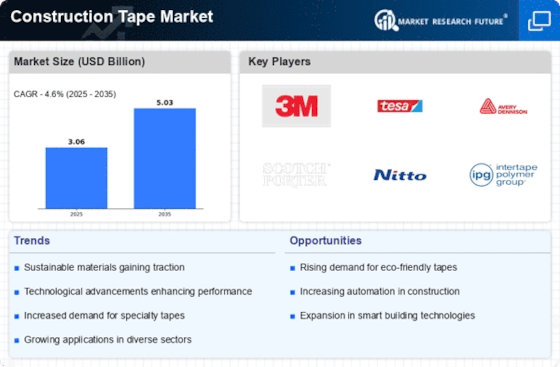
As per Market Research Future analysis, the Construction Tape Market Size was estimated at 3.065 USD Billion in 2024. The Construction Tape industry is projected to grow from 3.206 USD Billion in 2025 to 5.026 USD Billion by 2035, exhibiting a compound annual growth rate (CAGR) of 4.6% during the forecast period 2025 - 2035

Key Market Trends & Highlights

The Construction Tape Market is experiencing a dynamic shift towards sustainability and technological innovation.

  • North America remains the largest market for construction tape, driven by robust construction activities and infrastructure development. Asia-Pacific is identified as the fastest-growing region, reflecting increasing urbanization and construction demand. Duct tapes dominate the market as the largest segment, while double-sided tapes are emerging as the fastest-growing segment. Key market drivers include rising construction activities and a growing demand for eco-friendly products, which are shaping industry trends.

Market Size & Forecast

2024 Market Size 3.065 (USD Billion)
2035 Market Size 5.026 (USD Billion)
CAGR (2025 - 2035) 4.6%
Largest Regional Market Share in 2024 North America

Major Players

3M (US), Tesa SE (DE), Avery Dennison Corporation (US), Scotch (US), Nitto Denko Corporation (JP), Intertape Polymer Group (CA), Shurtape Technologies, LLC (US), Henkel AG &amp; Co. KGaA (DE), Sika AG (CH)

Market Trends

The Construction Tape Market is currently experiencing a dynamic evolution, driven by various factors that influence its growth trajectory. The increasing demand for efficient and reliable adhesive solutions in construction projects appears to be a primary catalyst. As construction activities expand globally, the need for high-performance tapes that can withstand diverse environmental conditions is becoming more pronounced. Furthermore, innovations in tape technology, such as the development of eco-friendly materials and enhanced adhesive properties, seem to be reshaping consumer preferences. This shift towards sustainability and performance is likely to attract a broader customer base, including both professionals and DIY enthusiasts. In addition, the Construction Tape Market is witnessing a notable trend towards customization and specialization. Manufacturers are increasingly focusing on producing tapes tailored to specific applications, such as electrical, plumbing, or general construction. This trend indicates a growing recognition of the unique requirements of different sectors within the construction industry. Moreover, the rise of e-commerce platforms is facilitating easier access to a wider range of products, allowing consumers to find specialized tapes that meet their specific needs. Overall, the Construction Tape Market appears poised for continued growth, driven by innovation, customization, and a heightened focus on sustainability.

Sustainability Initiatives

The Construction Tape Market is increasingly influenced by sustainability initiatives. Manufacturers are exploring eco-friendly materials and production processes to meet the rising demand for environmentally responsible products. This trend reflects a broader commitment to reducing the ecological footprint of construction activities.

Technological Advancements

Technological advancements are reshaping the Construction Tape Market. Innovations in adhesive formulations and tape durability are enhancing performance characteristics. These improvements are likely to cater to the evolving needs of construction professionals, ensuring that tapes can withstand various environmental challenges.

Customization and Specialization

Customization and specialization are becoming prominent trends within the Construction Tape Market. Companies are focusing on developing tapes designed for specific applications, such as electrical or plumbing tasks. This trend indicates a shift towards meeting the unique demands of diverse construction sectors.

Construction Tape Market Market Drivers

Rising Construction Activities

The Construction Tape Market is experiencing a surge in demand due to increasing construction activities across various sectors. Urbanization and infrastructure development projects are driving this growth, as more residential, commercial, and industrial buildings are being erected. According to recent data, the construction sector is projected to grow at a compound annual growth rate of approximately 5% over the next few years. This expansion necessitates the use of construction tape for various applications, including sealing, insulation, and surface protection. As construction projects become more complex, the need for reliable and efficient materials, such as construction tape, becomes paramount. Consequently, this trend is likely to bolster the market, as construction companies seek high-quality tape solutions to meet their operational needs.

Expansion of E-Commerce Platforms

The Construction Tape Market is experiencing a transformation due to the expansion of e-commerce platforms that facilitate the distribution of construction materials. Online retailing provides construction companies and contractors with convenient access to a wide range of construction tapes, often at competitive prices. This shift towards digital purchasing is particularly appealing to smaller businesses that may lack the resources for traditional procurement methods. As e-commerce continues to grow, it is expected that the construction tape market will see an increase in sales volume, potentially rising by 5% over the next few years. The ease of online ordering and the ability to compare products are likely to enhance customer satisfaction and drive market growth.

Increased Focus on Safety Standards

The Construction Tape Market is significantly influenced by the heightened emphasis on safety standards within the construction sector. Regulatory bodies are increasingly mandating the use of safety measures to protect workers and ensure compliance with industry regulations. Construction tape plays a crucial role in this context, as it is often utilized for marking hazardous areas, securing materials, and providing visual warnings. The demand for safety-compliant products is expected to rise, with the construction tape market projected to witness a growth rate of around 4% annually. This focus on safety not only enhances worker protection but also promotes the adoption of innovative tape solutions that meet stringent safety requirements, thereby driving the market forward.

Growing Demand for Eco-Friendly Products

The Construction Tape Market is witnessing a shift towards eco-friendly products, driven by increasing environmental awareness among consumers and businesses. As sustainability becomes a key consideration in construction practices, the demand for construction tapes made from recyclable and biodegradable materials is on the rise. This trend is supported by various initiatives aimed at reducing the carbon footprint of construction activities. Market data suggests that the eco-friendly segment of the construction tape market could grow by 7% annually, as more companies seek to align their operations with sustainable practices. This growing preference for environmentally responsible products is likely to reshape the competitive landscape of the market, encouraging manufacturers to innovate and offer greener alternatives.

Technological Innovations in Tape Manufacturing

The Construction Tape Market is benefiting from technological innovations that enhance the performance and functionality of construction tapes. Advances in adhesive technologies, materials science, and manufacturing processes are leading to the development of tapes that offer superior adhesion, durability, and weather resistance. For instance, the introduction of eco-friendly adhesives and advanced backing materials is gaining traction among manufacturers. This trend is likely to attract a broader customer base, as construction companies increasingly prioritize quality and sustainability. The market is expected to grow by approximately 6% in the coming years, driven by these technological advancements that cater to the evolving needs of the construction industry.

Market Segment Insights

By Product: Duct Tapes (Largest) vs. Double-Sided Tapes (Fastest-Growing)

In the Construction Tape Market, the product segment showcases a competitive landscape with Duct Tapes leading in market share, accounting for a significant portion of overall sales. Masking Tapes follow closely, offering a versatile solution for various applications in construction and DIY projects. Double-Sided Tapes and Other Tapes also contribute to the market, although to a lesser extent, reflecting specialized use cases and consumer preferences across the industry. This distribution highlights the importance of product functionality and performance in driving market success. The growth trends within the product segments indicate a robust evolution of tape technologies, along with increasing demand from construction contractors and DIY enthusiasts. Duct Tapes continue to thrive due to their strong adhesive properties and durability, making them a go-to choice for heavy-duty applications. Meanwhile, Double-Sided Tapes are on an upward trajectory, fueled by rising interest in aesthetic applications in home renovation and design projects, leading to innovative product developments that further enhance their market position.

Duct Tapes (Dominant) vs. Double-Sided Tapes (Emerging)

Duct Tapes are recognized as the dominant force in the Construction Tape Market due to their unparalleled strength and versatility. They are widely used in <a href="https://www.marketresearchfuture.com/reports/construction-market-16065">construction</a>, repair, and maintenance tasks, making them essential for contractors and craftsmen alike. Their robust adhesive backing allows for effective bonding on rough and uneven surfaces, offering reliability in demanding environments. On the other hand, Double-Sided Tapes represent an emerging segment, gaining traction among consumers looking for innovative solutions in mounting, joining, and creating seamless finishes. With advancements in adhesive technology, these tapes have improved their performance in terms of adhesion and durability, making them increasingly popular for interior design, craft projects, and packaging. Both segments reflect the diverse applications and evolving needs within the construction sector.

By Backing Material: Polyvinyl Chloride (Largest) vs. Polyethylene (Fastest-Growing)

In the Construction Tape Market, the backing material segment is primarily divided into five key materials: Polyvinyl Chloride (PVC), <a href="https://www.marketresearchfuture.com/reports/polyethylene-terephthalate-market-5521">Polyethylene Terephthalate</a> (PET), Polypropylene (PP), Polyethylene (PE), and Others. Among these, <a href="https://www.marketresearchfuture.com/reports/polyvinyl-chloride-market-1043">Polyvinyl Chloride</a> holds a significant market share due to its excellent durability and versatile applications in various construction projects. Polyethylene comes in as a robust competitor, experiencing an increase in market share due to its lightweight characteristics and cost-effectiveness, making it a popular choice among contractors.

Polyvinyl Chloride (Dominant) vs. Polyethylene (Emerging)

Polyvinyl Chloride (PVC) is recognized as the dominant backing material in the Construction Tape Market, favored for its resistance to moisture, UV rays, and various environmental factors, allowing for a wide range of applications from heavy-duty tasks to lighter projects. In contrast, Polyethylene (PE) is an emerging material, increasingly chosen for its strong adhesion and flexibility. PE’s expanding adoption in the market is attributed to its economical price point and low weight, catering to sectors that require high-volume use without compromising on performance. This dynamic between PVC as a well-established choice and PE’s rapid growth illustrates varying preferences influenced by project requirements and cost considerations.

By Application: Flooring (Largest) vs. Walls & Ceiling (Fastest-Growing)

In the Construction Tape Market, the application segment reveals a diverse landscape characterized by varied end-uses. Flooring stands out as the largest segment, dominating market share due to its essential role in supporting various flooring materials while ensuring durability and adhesion. In contrast, the Walls &amp; Ceiling segment is emerging as the fastest-growing area, driven by increased construction activities and a surge in renovation projects that require high-performance tape solutions for effective insulation and moisture barriers.

Flooring: Dominant vs. Walls &amp; Ceiling: Emerging

Flooring applications for construction tape are crucial as they provide the necessary adhesion for materials like vinyl, laminate, and hardwood. This segment's dominance stems from its extensive usage in both new constructions and renovations, where maintaining quality and safety standards is paramount. On the other hand, the Walls &amp; Ceiling segment is rapidly gaining traction, motivated by trends towards sustainability and energy efficiency in building designs. As walls and ceilings are integral to constructing energy-efficient structures, high-performance tapes that ensure air and moisture barriers are vital, making this segment an exciting area of growth and innovation.

By Function: Bonding (Largest) vs. Protection (Fastest-Growing)

In the Construction Tape Market, the segment of Bonding holds the largest market share, primarily due to its widespread applications in various construction projects. It is favored for its durability and adhesive strength, making it an essential choice for bonding materials together securely. Following closely is Protection, which is rapidly growing in demand as more contractors recognize the importance of safeguarding surfaces during construction. Its role in preventing damage and maintaining the quality of materials has made it an essential product in construction tasks.

Bonding (Dominant) vs. Protection (Emerging)

Bonding tape stands as a dominant segment in the Construction Tape Market, known for its exceptional adhesion and reliability in creating strong joints between various construction materials. This category caters to a diverse range of applications, contributing to its market prevalence. On the other hand, Protection tape is emerging prominently as it offers solutions for shielding surfaces from scratches, dust, and other potential damage during the construction phase. The increased emphasis on finishing quality and surface preservation has accelerated the growth of this segment, establishing it as a key player in the market.

Get more detailed insights about Construction Tape Market Research Report - Global Forecast 2035

Regional Insights

By region, the study provides the market insights into North America, Europe, Asia-Pacific and Rest of the World. Due to an increase in national government programs to provide housing options for the growing population, the North American Construction Tape Market sector will lead this industry. The existence of independent organizations like INFONAVIT, PEMEX, and CONAVI is expected to promote the expansion of the local residential construction industry.

Further, the major countries studied in the market report are The US, France, Canada, German, the UK, Italy, Spain, China, India, Australia, South Korea, Japan, and Brazil.

Figure 2: CONSTRUCTION TAPE MARKET SHARE BY REGION 2022 (USD Billion)

Europe Construction Tape Market attributable to the growth of the commercial building sector, holds the second-largest market share. Further, the German Construction Tape Market held the largest market share, and the UK Construction Tape Market was the European region's fastest-growing market.

The Asia-Pacific Construction Tape Market is anticipated to develop at the fastest CAGR between 2023 and 2032. This is due to utilization of double-sided products has expanded, and they are widely employed in a variety of building applications. Moreover, China’s Construction Tape Market held the largest market share, and the Indian Construction Tape Market was the Asia-Pacific region's fastest-growing market.

Key Players and Competitive Insights

Leading market players are making significant R&D investments to expand their product lines, which will help the construction tape market expand even further. Additionally, market participants are engaging in a range of strategic initiatives to increase their worldwide reach, with important market developments such as the introduction of new products, contracts, mergers and acquisitions, increased investments, and cooperation with other organizations. To grow and endure in an increasingly competitive and challenging market environment, Construction Tape industry must provide reasonably priced goods.One of the main business strategies employed by manufacturers is to produce locally to reduce operational expenses in the Construction Tape industry to benefit clients and increase the market sector. In recent years, the Construction Tape industry has offered some of the most significant advantages to construction sector. Major players in the Construction Tape Market, including 3M, Tesa SE, Avery Dennison Corporation, Saint-Gobain, Henkel AG & Co. KGaA, and others, are engaging in research and development activities in an effort to improve market demand.3M Company works in the areas of business, consumer goods, healthcare, and worker safety. The business manufactures more than 60,000 items under numerous names, such as laminates, adhesives, abrasives, passive fire prevention, personal safety gear, etc. Its headquarters are in Maplewood, a Minnesota suburb of Saint Paul. A handful of the company's subsidiaries are abroad, including 3M Canada, 3M Japan, and 3M India. The Minnesota Mining and Production Company were established by five businessmen in Two Harbours, Minnesota, as a mining operation.In 2022, the Corporation declared that it would separate its healthcare assets into a brand-new, independent company, with the sale probably closing in 2023. Tesa SE is a German company that creates adhesive products. When it was first established in 2001, the business was a part of Beiersdorf, and it continues to be one of its subsidiaries today. The brand name is recognized as a synonym for adhesive tape in Germany and is included in the Duden lexicon as such. The business not only sells adhesive tapes to consumers, but it also provides adhesives to other sectors.Customers include Apple and Samsung, who use Tesa's adhesives to construct smart phones and tablet computers, as well as the auto sector, which uses the company's adhesives for a variety of purposes including windows, sensors, and displays. In 2022, the foundation of Tesa SE's new facility, which is situated in the Vietnamese port of Haiphong, cost about USD 61.5 million. Because Asia is one of the fastest-growing markets, the company intends to increase its manufacturing capacity for the region. This new facility will produce 40 million square meters of sticky tape annually.

Key Companies in the Construction Tape Market include

Industry Developments

May 2024   

3M has come out with a green offering construction tape. The main focus of the product line was to meet the growing demand for green building practices and strengthen the company's position in the adhesive segment. The green tape is in line with the global trend on environmental compliance and has greater demand in North America and Europe.

March 2024  

Henkel AG & Co. KGaA has now produced this commercial construction fire-resistant tape. The tape also complies with the demand for higher safety features due to elevated wires and pipes and the need to increase the number of high-rise buildings and industrial projects in the Asia-Pacific.

December 2023  

Tesa SE has established a new Vietnamese factory after an injection of $61.5 million to cater to increased growth in the Asia-Pacific. Therefore, The company has complemented its decision with the vast construction opportunities available in the region cut out by growing urbanization and industrialization.

June 2023   

According to Berry Globals' announcement, the burden of labor shortages in residential constructions has been lowered due to a recent introduction of lightweight polyethylene-based tapes to improve installation efficiency. The product has presented limitless installation possibilities spearheaded by construction tapes.

March 2022  

Bostik moved forward in the construction industry by adding a new set of construction tapes to their product line, officially termed the Supergrip series. It is reported that these products are meant to cater to carpentry and general construction works to foster improved sustainability in building materials.

October 2023

Tesa SE has recently opened a new production facility in Haiphong, Vietnam, to boost its global presence. This facility can meet the increasing market demand for construction tapes in Asia-Pacific as it is expected to manufacture up to 40 million square meters of tapes every year.

May 2023

Nitto Denko Corporation has rolled out bio-adhesive tape branded PlanetFlags composed of recycled products, thus underlining the company's environmental concern. This has changed the direction of the market toward the use of green construction materials.

Future Outlook

Construction Tape Market Future Outlook

The Construction Tape Market is projected to grow at a 4.6% CAGR from 2025 to 2035, driven by increasing construction activities, technological advancements, and rising demand for durable materials.

New opportunities lie in:

  • Development of eco-friendly adhesive technologies</p><p>Expansion into emerging markets with tailored products</p><p>Integration of smart technology in tape applications

By 2035, the market is expected to achieve robust growth, reflecting evolving industry needs and innovations.

Market Segmentation

Construction Tape Market Product Outlook

  • Double-Sided Tapes
  • Masking Tapes
  • Duct Tapes
  • Other Tapes

Construction Tape Market Function Outlook

  • Bonding
  • Protection
  • Insulation
  • Glazing
  • Sound Proofing
  • Cable Management

Construction Tape Market Application Outlook

  • Flooring
  • Walls & Ceiling
  • Windows
  • Doors
  • Others

Construction Tape Market Backing Material Outlook

  • Polyvinyl Chloride
  • Polyethylene Terephthalate
  • Polypropylene
  • Polyethylene
  • Others

Report Scope

MARKET SIZE 2024 3.065(USD Billion)
MARKET SIZE 2025 3.206(USD Billion)
MARKET SIZE 2035 5.026(USD Billion)
COMPOUND ANNUAL GROWTH RATE (CAGR) 4.6% (2025 - 2035)
REPORT COVERAGE Revenue Forecast, Competitive Landscape, Growth Factors, and Trends
BASE YEAR 2024
Market Forecast Period 2025 - 2035
Historical Data 2019 - 2024
Market Forecast Units USD Billion
Key Companies Profiled 3M (US), Tesa SE (DE), Avery Dennison Corporation (US), Scotch (US), Nitto Denko Corporation (JP), Intertape Polymer Group (CA), Shurtape Technologies, LLC (US), Henkel AG & Co. KGaA (DE), Sika AG (CH)
Segments Covered Product, Backing Material, Application, Function, Region
Key Market Opportunities Integration of advanced adhesive technologies enhances performance in the Construction Tape Market.
Key Market Dynamics Rising demand for eco-friendly materials drives innovation and competition in the construction tape market.
Countries Covered North America, Europe, APAC, South America, MEA

FAQs

What is the current valuation of the Construction Tape Market?

<p>The Construction Tape Market was valued at 3.065 USD Billion in 2024.</p>

What is the projected market size for the Construction Tape Market by 2035?

<p>The market is projected to reach 5.026 USD Billion by 2035.</p>

What is the expected CAGR for the Construction Tape Market during the forecast period?

<p>The expected CAGR for the Construction Tape Market from 2025 to 2035 is 4.6%.</p>

Which product segments are leading in the Construction Tape Market?

<p>The leading product segments include Double-Sided Tapes and Duct Tapes, each projected to grow from 0.915 to 1.485 USD Billion.</p>

What are the primary backing materials used in construction tapes?

<p>The primary backing materials include Polyvinyl Chloride, which is expected to grow from 0.915 to 1.485 USD Billion.</p>

How do application areas impact the Construction Tape Market?

<p>Application areas such as Walls & Ceiling and Flooring are projected to grow significantly, with valuations reaching 1.5 USD Billion and 1.3 USD Billion, respectively.</p>

What functions do construction tapes serve in the market?

Functions such as Bonding and Protection are crucial, with expected valuations of 1.485 USD Billion and 1.185 USD Billion.

Who are the key players in the Construction Tape Market?

Key players include 3M, Tesa SE, Avery Dennison Corporation, and Henkel AG &amp; Co. KGaA.

What trends are influencing the growth of the Construction Tape Market?

Trends such as increased demand for insulation and soundproofing solutions are likely to drive market growth.

How does the market performance of construction tapes compare across different segments?

Market performance varies, with Double-Sided Tapes and Masking Tapes showing strong growth potential, indicating diverse applications.

  1. SECTION I: EXECUTIVE SUMMARY AND KEY HIGHLIGHTS
    1. | 1.1 EXECUTIVE SUMMARY
    2. | | 1.1.1 Market Overview
    3. | | 1.1.2 Key Findings
    4. | | 1.1.3 Market Segmentation
    5. | | 1.1.4 Competitive Landscape
    6. | | 1.1.5 Challenges and Opportunities
    7. | | 1.1.6 Future Outlook
  2. SECTION II: SCOPING, METHODOLOGY AND MARKET STRUCTURE
    1. | 2.1 MARKET INTRODUCTION
    2. | | 2.1.1 Definition
    3. | | 2.1.2 Scope of the study
    4. | | | 2.1.2.1 Research Objective
    5. | | | 2.1.2.2 Assumption
    6. | | | 2.1.2.3 Limitations
    7. | 2.2 RESEARCH METHODOLOGY
    8. | | 2.2.1 Overview
    9. | | 2.2.2 Data Mining
    10. | | 2.2.3 Secondary Research
    11. | | 2.2.4 Primary Research
    12. | | | 2.2.4.1 Primary Interviews and Information Gathering Process
    13. | | | 2.2.4.2 Breakdown of Primary Respondents
    14. | | 2.2.5 Forecasting Model
    15. | | 2.2.6 Market Size Estimation
    16. | | | 2.2.6.1 Bottom-Up Approach
    17. | | | 2.2.6.2 Top-Down Approach
    18. | | 2.2.7 Data Triangulation
    19. | | 2.2.8 Validation
  3. SECTION III: QUALITATIVE ANALYSIS
    1. | 3.1 MARKET DYNAMICS
    2. | | 3.1.1 Overview
    3. | | 3.1.2 Drivers
    4. | | 3.1.3 Restraints
    5. | | 3.1.4 Opportunities
    6. | 3.2 MARKET FACTOR ANALYSIS
    7. | | 3.2.1 Value chain Analysis
    8. | | 3.2.2 Porter's Five Forces Analysis
    9. | | | 3.2.2.1 Bargaining Power of Suppliers
    10. | | | 3.2.2.2 Bargaining Power of Buyers
    11. | | | 3.2.2.3 Threat of New Entrants
    12. | | | 3.2.2.4 Threat of Substitutes
    13. | | | 3.2.2.5 Intensity of Rivalry
    14. | | 3.2.3 COVID-19 Impact Analysis
    15. | | | 3.2.3.1 Market Impact Analysis
    16. | | | 3.2.3.2 Regional Impact
    17. | | | 3.2.3.3 Opportunity and Threat Analysis
  4. SECTION IV: QUANTITATIVE ANALYSIS
    1. | 4.1 Packaging & Transport, BY Product (USD Billion)
    2. | | 4.1.1 Double-Sided Tapes
    3. | | 4.1.2 Masking Tapes
    4. | | 4.1.3 Duct Tapes
    5. | | 4.1.4 Other Tapes
    6. | 4.2 Packaging & Transport, BY Backing Material (USD Billion)
    7. | | 4.2.1 Polyvinyl Chloride
    8. | | 4.2.2 Polyethylene Terephthalate
    9. | | 4.2.3 Polypropylene
    10. | | 4.2.4 Polyethylene
    11. | | 4.2.5 Others
    12. | 4.3 Packaging & Transport, BY Application (USD Billion)
    13. | | 4.3.1 Flooring
    14. | | 4.3.2 Walls & Ceiling
    15. | | 4.3.3 Windows
    16. | | 4.3.4 Doors
    17. | | 4.3.5 Others
    18. | 4.4 Packaging & Transport, BY Function (USD Billion)
    19. | | 4.4.1 Bonding
    20. | | 4.4.2 Protection
    21. | | 4.4.3 Insulation
    22. | | 4.4.4 Glazing
    23. | | 4.4.5 Sound Proofing
    24. | | 4.4.6 Cable Management
    25. | 4.5 Packaging & Transport, BY Region (USD Billion)
    26. | | 4.5.1 North America
    27. | | | 4.5.1.1 US
    28. | | | 4.5.1.2 Canada
    29. | | 4.5.2 Europe
    30. | | | 4.5.2.1 Germany
    31. | | | 4.5.2.2 UK
    32. | | | 4.5.2.3 France
    33. | | | 4.5.2.4 Russia
    34. | | | 4.5.2.5 Italy
    35. | | | 4.5.2.6 Spain
    36. | | | 4.5.2.7 Rest of Europe
    37. | | 4.5.3 APAC
    38. | | | 4.5.3.1 China
    39. | | | 4.5.3.2 India
    40. | | | 4.5.3.3 Japan
    41. | | | 4.5.3.4 South Korea
    42. | | | 4.5.3.5 Malaysia
    43. | | | 4.5.3.6 Thailand
    44. | | | 4.5.3.7 Indonesia
    45. | | | 4.5.3.8 Rest of APAC
    46. | | 4.5.4 South America
    47. | | | 4.5.4.1 Brazil
    48. | | | 4.5.4.2 Mexico
    49. | | | 4.5.4.3 Argentina
    50. | | | 4.5.4.4 Rest of South America
    51. | | 4.5.5 MEA
    52. | | | 4.5.5.1 GCC Countries
    53. | | | 4.5.5.2 South Africa
    54. | | | 4.5.5.3 Rest of MEA
  5. SECTION V: COMPETITIVE ANALYSIS
    1. | 5.1 Competitive Landscape
    2. | | 5.1.1 Overview
    3. | | 5.1.2 Competitive Analysis
    4. | | 5.1.3 Market share Analysis
    5. | | 5.1.4 Major Growth Strategy in the Packaging & Transport
    6. | | 5.1.5 Competitive Benchmarking
    7. | | 5.1.6 Leading Players in Terms of Number of Developments in the Packaging & Transport
    8. | | 5.1.7 Key developments and growth strategies
    9. | | | 5.1.7.1 New Product Launch/Service Deployment
    10. | | | 5.1.7.2 Merger & Acquisitions
    11. | | | 5.1.7.3 Joint Ventures
    12. | | 5.1.8 Major Players Financial Matrix
    13. | | | 5.1.8.1 Sales and Operating Income
    14. | | | 5.1.8.2 Major Players R&D Expenditure. 2023
    15. | 5.2 Company Profiles
    16. | | 5.2.1 3M (US)
    17. | | | 5.2.1.1 Financial Overview
    18. | | | 5.2.1.2 Products Offered
    19. | | | 5.2.1.3 Key Developments
    20. | | | 5.2.1.4 SWOT Analysis
    21. | | | 5.2.1.5 Key Strategies
    22. | | 5.2.2 Tesa SE (DE)
    23. | | | 5.2.2.1 Financial Overview
    24. | | | 5.2.2.2 Products Offered
    25. | | | 5.2.2.3 Key Developments
    26. | | | 5.2.2.4 SWOT Analysis
    27. | | | 5.2.2.5 Key Strategies
    28. | | 5.2.3 Avery Dennison Corporation (US)
    29. | | | 5.2.3.1 Financial Overview
    30. | | | 5.2.3.2 Products Offered
    31. | | | 5.2.3.3 Key Developments
    32. | | | 5.2.3.4 SWOT Analysis
    33. | | | 5.2.3.5 Key Strategies
    34. | | 5.2.4 Scotch (US)
    35. | | | 5.2.4.1 Financial Overview
    36. | | | 5.2.4.2 Products Offered
    37. | | | 5.2.4.3 Key Developments
    38. | | | 5.2.4.4 SWOT Analysis
    39. | | | 5.2.4.5 Key Strategies
    40. | | 5.2.5 Nitto Denko Corporation (JP)
    41. | | | 5.2.5.1 Financial Overview
    42. | | | 5.2.5.2 Products Offered
    43. | | | 5.2.5.3 Key Developments
    44. | | | 5.2.5.4 SWOT Analysis
    45. | | | 5.2.5.5 Key Strategies
    46. | | 5.2.6 Intertape Polymer Group (CA)
    47. | | | 5.2.6.1 Financial Overview
    48. | | | 5.2.6.2 Products Offered
    49. | | | 5.2.6.3 Key Developments
    50. | | | 5.2.6.4 SWOT Analysis
    51. | | | 5.2.6.5 Key Strategies
    52. | | 5.2.7 Shurtape Technologies, LLC (US)
    53. | | | 5.2.7.1 Financial Overview
    54. | | | 5.2.7.2 Products Offered
    55. | | | 5.2.7.3 Key Developments
    56. | | | 5.2.7.4 SWOT Analysis
    57. | | | 5.2.7.5 Key Strategies
    58. | | 5.2.8 Henkel AG & Co. KGaA (DE)
    59. | | | 5.2.8.1 Financial Overview
    60. | | | 5.2.8.2 Products Offered
    61. | | | 5.2.8.3 Key Developments
    62. | | | 5.2.8.4 SWOT Analysis
    63. | | | 5.2.8.5 Key Strategies
    64. | | 5.2.9 Sika AG (CH)
    65. | | | 5.2.9.1 Financial Overview
    66. | | | 5.2.9.2 Products Offered
    67. | | | 5.2.9.3 Key Developments
    68. | | | 5.2.9.4 SWOT Analysis
    69. | | | 5.2.9.5 Key Strategies
    70. | 5.3 Appendix
    71. | | 5.3.1 References
    72. | | 5.3.2 Related Reports
  6. LIST OF FIGURES
    1. | 6.1 MARKET SYNOPSIS
    2. | 6.2 NORTH AMERICA MARKET ANALYSIS
    3. | 6.3 US MARKET ANALYSIS BY PRODUCT
    4. | 6.4 US MARKET ANALYSIS BY BACKING MATERIAL
    5. | 6.5 US MARKET ANALYSIS BY APPLICATION
    6. | 6.6 US MARKET ANALYSIS BY FUNCTION
    7. | 6.7 CANADA MARKET ANALYSIS BY PRODUCT
    8. | 6.8 CANADA MARKET ANALYSIS BY BACKING MATERIAL
    9. | 6.9 CANADA MARKET ANALYSIS BY APPLICATION
    10. | 6.10 CANADA MARKET ANALYSIS BY FUNCTION
    11. | 6.11 EUROPE MARKET ANALYSIS
    12. | 6.12 GERMANY MARKET ANALYSIS BY PRODUCT
    13. | 6.13 GERMANY MARKET ANALYSIS BY BACKING MATERIAL
    14. | 6.14 GERMANY MARKET ANALYSIS BY APPLICATION
    15. | 6.15 GERMANY MARKET ANALYSIS BY FUNCTION
    16. | 6.16 UK MARKET ANALYSIS BY PRODUCT
    17. | 6.17 UK MARKET ANALYSIS BY BACKING MATERIAL
    18. | 6.18 UK MARKET ANALYSIS BY APPLICATION
    19. | 6.19 UK MARKET ANALYSIS BY FUNCTION
    20. | 6.20 FRANCE MARKET ANALYSIS BY PRODUCT
    21. | 6.21 FRANCE MARKET ANALYSIS BY BACKING MATERIAL
    22. | 6.22 FRANCE MARKET ANALYSIS BY APPLICATION
    23. | 6.23 FRANCE MARKET ANALYSIS BY FUNCTION
    24. | 6.24 RUSSIA MARKET ANALYSIS BY PRODUCT
    25. | 6.25 RUSSIA MARKET ANALYSIS BY BACKING MATERIAL
    26. | 6.26 RUSSIA MARKET ANALYSIS BY APPLICATION
    27. | 6.27 RUSSIA MARKET ANALYSIS BY FUNCTION
    28. | 6.28 ITALY MARKET ANALYSIS BY PRODUCT
    29. | 6.29 ITALY MARKET ANALYSIS BY BACKING MATERIAL
    30. | 6.30 ITALY MARKET ANALYSIS BY APPLICATION
    31. | 6.31 ITALY MARKET ANALYSIS BY FUNCTION
    32. | 6.32 SPAIN MARKET ANALYSIS BY PRODUCT
    33. | 6.33 SPAIN MARKET ANALYSIS BY BACKING MATERIAL
    34. | 6.34 SPAIN MARKET ANALYSIS BY APPLICATION
    35. | 6.35 SPAIN MARKET ANALYSIS BY FUNCTION
    36. | 6.36 REST OF EUROPE MARKET ANALYSIS BY PRODUCT
    37. | 6.37 REST OF EUROPE MARKET ANALYSIS BY BACKING MATERIAL
    38. | 6.38 REST OF EUROPE MARKET ANALYSIS BY APPLICATION
    39. | 6.39 REST OF EUROPE MARKET ANALYSIS BY FUNCTION
    40. | 6.40 APAC MARKET ANALYSIS
    41. | 6.41 CHINA MARKET ANALYSIS BY PRODUCT
    42. | 6.42 CHINA MARKET ANALYSIS BY BACKING MATERIAL
    43. | 6.43 CHINA MARKET ANALYSIS BY APPLICATION
    44. | 6.44 CHINA MARKET ANALYSIS BY FUNCTION
    45. | 6.45 INDIA MARKET ANALYSIS BY PRODUCT
    46. | 6.46 INDIA MARKET ANALYSIS BY BACKING MATERIAL
    47. | 6.47 INDIA MARKET ANALYSIS BY APPLICATION
    48. | 6.48 INDIA MARKET ANALYSIS BY FUNCTION
    49. | 6.49 JAPAN MARKET ANALYSIS BY PRODUCT
    50. | 6.50 JAPAN MARKET ANALYSIS BY BACKING MATERIAL
    51. | 6.51 JAPAN MARKET ANALYSIS BY APPLICATION
    52. | 6.52 JAPAN MARKET ANALYSIS BY FUNCTION
    53. | 6.53 SOUTH KOREA MARKET ANALYSIS BY PRODUCT
    54. | 6.54 SOUTH KOREA MARKET ANALYSIS BY BACKING MATERIAL
    55. | 6.55 SOUTH KOREA MARKET ANALYSIS BY APPLICATION
    56. | 6.56 SOUTH KOREA MARKET ANALYSIS BY FUNCTION
    57. | 6.57 MALAYSIA MARKET ANALYSIS BY PRODUCT
    58. | 6.58 MALAYSIA MARKET ANALYSIS BY BACKING MATERIAL
    59. | 6.59 MALAYSIA MARKET ANALYSIS BY APPLICATION
    60. | 6.60 MALAYSIA MARKET ANALYSIS BY FUNCTION
    61. | 6.61 THAILAND MARKET ANALYSIS BY PRODUCT
    62. | 6.62 THAILAND MARKET ANALYSIS BY BACKING MATERIAL
    63. | 6.63 THAILAND MARKET ANALYSIS BY APPLICATION
    64. | 6.64 THAILAND MARKET ANALYSIS BY FUNCTION
    65. | 6.65 INDONESIA MARKET ANALYSIS BY PRODUCT
    66. | 6.66 INDONESIA MARKET ANALYSIS BY BACKING MATERIAL
    67. | 6.67 INDONESIA MARKET ANALYSIS BY APPLICATION
    68. | 6.68 INDONESIA MARKET ANALYSIS BY FUNCTION
    69. | 6.69 REST OF APAC MARKET ANALYSIS BY PRODUCT
    70. | 6.70 REST OF APAC MARKET ANALYSIS BY BACKING MATERIAL
    71. | 6.71 REST OF APAC MARKET ANALYSIS BY APPLICATION
    72. | 6.72 REST OF APAC MARKET ANALYSIS BY FUNCTION
    73. | 6.73 SOUTH AMERICA MARKET ANALYSIS
    74. | 6.74 BRAZIL MARKET ANALYSIS BY PRODUCT
    75. | 6.75 BRAZIL MARKET ANALYSIS BY BACKING MATERIAL
    76. | 6.76 BRAZIL MARKET ANALYSIS BY APPLICATION
    77. | 6.77 BRAZIL MARKET ANALYSIS BY FUNCTION
    78. | 6.78 MEXICO MARKET ANALYSIS BY PRODUCT
    79. | 6.79 MEXICO MARKET ANALYSIS BY BACKING MATERIAL
    80. | 6.80 MEXICO MARKET ANALYSIS BY APPLICATION
    81. | 6.81 MEXICO MARKET ANALYSIS BY FUNCTION
    82. | 6.82 ARGENTINA MARKET ANALYSIS BY PRODUCT
    83. | 6.83 ARGENTINA MARKET ANALYSIS BY BACKING MATERIAL
    84. | 6.84 ARGENTINA MARKET ANALYSIS BY APPLICATION
    85. | 6.85 ARGENTINA MARKET ANALYSIS BY FUNCTION
    86. | 6.86 REST OF SOUTH AMERICA MARKET ANALYSIS BY PRODUCT
    87. | 6.87 REST OF SOUTH AMERICA MARKET ANALYSIS BY BACKING MATERIAL
    88. | 6.88 REST OF SOUTH AMERICA MARKET ANALYSIS BY APPLICATION
    89. | 6.89 REST OF SOUTH AMERICA MARKET ANALYSIS BY FUNCTION
    90. | 6.90 MEA MARKET ANALYSIS
    91. | 6.91 GCC COUNTRIES MARKET ANALYSIS BY PRODUCT
    92. | 6.92 GCC COUNTRIES MARKET ANALYSIS BY BACKING MATERIAL
    93. | 6.93 GCC COUNTRIES MARKET ANALYSIS BY APPLICATION
    94. | 6.94 GCC COUNTRIES MARKET ANALYSIS BY FUNCTION
    95. | 6.95 SOUTH AFRICA MARKET ANALYSIS BY PRODUCT
    96. | 6.96 SOUTH AFRICA MARKET ANALYSIS BY BACKING MATERIAL
    97. | 6.97 SOUTH AFRICA MARKET ANALYSIS BY APPLICATION
    98. | 6.98 SOUTH AFRICA MARKET ANALYSIS BY FUNCTION
    99. | 6.99 REST OF MEA MARKET ANALYSIS BY PRODUCT
    100. | 6.100 REST OF MEA MARKET ANALYSIS BY BACKING MATERIAL
    101. | 6.101 REST OF MEA MARKET ANALYSIS BY APPLICATION
    102. | 6.102 REST OF MEA MARKET ANALYSIS BY FUNCTION
    103. | 6.103 KEY BUYING CRITERIA OF PACKAGING & TRANSPORT
    104. | 6.104 RESEARCH PROCESS OF MRFR
    105. | 6.105 DRO ANALYSIS OF PACKAGING & TRANSPORT
    106. | 6.106 DRIVERS IMPACT ANALYSIS: PACKAGING & TRANSPORT
    107. | 6.107 RESTRAINTS IMPACT ANALYSIS: PACKAGING & TRANSPORT
    108. | 6.108 SUPPLY / VALUE CHAIN: PACKAGING & TRANSPORT
    109. | 6.109 PACKAGING & TRANSPORT, BY PRODUCT, 2024 (% SHARE)
    110. | 6.110 PACKAGING & TRANSPORT, BY PRODUCT, 2024 TO 2035 (USD Billion)
    111. | 6.111 PACKAGING & TRANSPORT, BY BACKING MATERIAL, 2024 (% SHARE)
    112. | 6.112 PACKAGING & TRANSPORT, BY BACKING MATERIAL, 2024 TO 2035 (USD Billion)
    113. | 6.113 PACKAGING & TRANSPORT, BY APPLICATION, 2024 (% SHARE)
    114. | 6.114 PACKAGING & TRANSPORT, BY APPLICATION, 2024 TO 2035 (USD Billion)
    115. | 6.115 PACKAGING & TRANSPORT, BY FUNCTION, 2024 (% SHARE)
    116. | 6.116 PACKAGING & TRANSPORT, BY FUNCTION, 2024 TO 2035 (USD Billion)
    117. | 6.117 BENCHMARKING OF MAJOR COMPETITORS
  7. LIST OF TABLES
    1. | 7.1 LIST OF ASSUMPTIONS
    2. | | 7.1.1
    3. | 7.2 North America MARKET SIZE ESTIMATES; FORECAST
    4. | | 7.2.1 BY PRODUCT, 2025-2035 (USD Billion)
    5. | | 7.2.2 BY BACKING MATERIAL, 2025-2035 (USD Billion)
    6. | | 7.2.3 BY APPLICATION, 2025-2035 (USD Billion)
    7. | | 7.2.4 BY FUNCTION, 2025-2035 (USD Billion)
    8. | 7.3 US MARKET SIZE ESTIMATES; FORECAST
    9. | | 7.3.1 BY PRODUCT, 2025-2035 (USD Billion)
    10. | | 7.3.2 BY BACKING MATERIAL, 2025-2035 (USD Billion)
    11. | | 7.3.3 BY APPLICATION, 2025-2035 (USD Billion)
    12. | | 7.3.4 BY FUNCTION, 2025-2035 (USD Billion)
    13. | 7.4 Canada MARKET SIZE ESTIMATES; FORECAST
    14. | | 7.4.1 BY PRODUCT, 2025-2035 (USD Billion)
    15. | | 7.4.2 BY BACKING MATERIAL, 2025-2035 (USD Billion)
    16. | | 7.4.3 BY APPLICATION, 2025-2035 (USD Billion)
    17. | | 7.4.4 BY FUNCTION, 2025-2035 (USD Billion)
    18. | 7.5 Europe MARKET SIZE ESTIMATES; FORECAST
    19. | | 7.5.1 BY PRODUCT, 2025-2035 (USD Billion)
    20. | | 7.5.2 BY BACKING MATERIAL, 2025-2035 (USD Billion)
    21. | | 7.5.3 BY APPLICATION, 2025-2035 (USD Billion)
    22. | | 7.5.4 BY FUNCTION, 2025-2035 (USD Billion)
    23. | 7.6 Germany MARKET SIZE ESTIMATES; FORECAST
    24. | | 7.6.1 BY PRODUCT, 2025-2035 (USD Billion)
    25. | | 7.6.2 BY BACKING MATERIAL, 2025-2035 (USD Billion)
    26. | | 7.6.3 BY APPLICATION, 2025-2035 (USD Billion)
    27. | | 7.6.4 BY FUNCTION, 2025-2035 (USD Billion)
    28. | 7.7 UK MARKET SIZE ESTIMATES; FORECAST
    29. | | 7.7.1 BY PRODUCT, 2025-2035 (USD Billion)
    30. | | 7.7.2 BY BACKING MATERIAL, 2025-2035 (USD Billion)
    31. | | 7.7.3 BY APPLICATION, 2025-2035 (USD Billion)
    32. | | 7.7.4 BY FUNCTION, 2025-2035 (USD Billion)
    33. | 7.8 France MARKET SIZE ESTIMATES; FORECAST
    34. | | 7.8.1 BY PRODUCT, 2025-2035 (USD Billion)
    35. | | 7.8.2 BY BACKING MATERIAL, 2025-2035 (USD Billion)
    36. | | 7.8.3 BY APPLICATION, 2025-2035 (USD Billion)
    37. | | 7.8.4 BY FUNCTION, 2025-2035 (USD Billion)
    38. | 7.9 Russia MARKET SIZE ESTIMATES; FORECAST
    39. | | 7.9.1 BY PRODUCT, 2025-2035 (USD Billion)
    40. | | 7.9.2 BY BACKING MATERIAL, 2025-2035 (USD Billion)
    41. | | 7.9.3 BY APPLICATION, 2025-2035 (USD Billion)
    42. | | 7.9.4 BY FUNCTION, 2025-2035 (USD Billion)
    43. | 7.10 Italy MARKET SIZE ESTIMATES; FORECAST
    44. | | 7.10.1 BY PRODUCT, 2025-2035 (USD Billion)
    45. | | 7.10.2 BY BACKING MATERIAL, 2025-2035 (USD Billion)
    46. | | 7.10.3 BY APPLICATION, 2025-2035 (USD Billion)
    47. | | 7.10.4 BY FUNCTION, 2025-2035 (USD Billion)
    48. | 7.11 Spain MARKET SIZE ESTIMATES; FORECAST
    49. | | 7.11.1 BY PRODUCT, 2025-2035 (USD Billion)
    50. | | 7.11.2 BY BACKING MATERIAL, 2025-2035 (USD Billion)
    51. | | 7.11.3 BY APPLICATION, 2025-2035 (USD Billion)
    52. | | 7.11.4 BY FUNCTION, 2025-2035 (USD Billion)
    53. | 7.12 Rest of Europe MARKET SIZE ESTIMATES; FORECAST
    54. | | 7.12.1 BY PRODUCT, 2025-2035 (USD Billion)
    55. | | 7.12.2 BY BACKING MATERIAL, 2025-2035 (USD Billion)
    56. | | 7.12.3 BY APPLICATION, 2025-2035 (USD Billion)
    57. | | 7.12.4 BY FUNCTION, 2025-2035 (USD Billion)
    58. | 7.13 APAC MARKET SIZE ESTIMATES; FORECAST
    59. | | 7.13.1 BY PRODUCT, 2025-2035 (USD Billion)
    60. | | 7.13.2 BY BACKING MATERIAL, 2025-2035 (USD Billion)
    61. | | 7.13.3 BY APPLICATION, 2025-2035 (USD Billion)
    62. | | 7.13.4 BY FUNCTION, 2025-2035 (USD Billion)
    63. | 7.14 China MARKET SIZE ESTIMATES; FORECAST
    64. | | 7.14.1 BY PRODUCT, 2025-2035 (USD Billion)
    65. | | 7.14.2 BY BACKING MATERIAL, 2025-2035 (USD Billion)
    66. | | 7.14.3 BY APPLICATION, 2025-2035 (USD Billion)
    67. | | 7.14.4 BY FUNCTION, 2025-2035 (USD Billion)
    68. | 7.15 India MARKET SIZE ESTIMATES; FORECAST
    69. | | 7.15.1 BY PRODUCT, 2025-2035 (USD Billion)
    70. | | 7.15.2 BY BACKING MATERIAL, 2025-2035 (USD Billion)
    71. | | 7.15.3 BY APPLICATION, 2025-2035 (USD Billion)
    72. | | 7.15.4 BY FUNCTION, 2025-2035 (USD Billion)
    73. | 7.16 Japan MARKET SIZE ESTIMATES; FORECAST
    74. | | 7.16.1 BY PRODUCT, 2025-2035 (USD Billion)
    75. | | 7.16.2 BY BACKING MATERIAL, 2025-2035 (USD Billion)
    76. | | 7.16.3 BY APPLICATION, 2025-2035 (USD Billion)
    77. | | 7.16.4 BY FUNCTION, 2025-2035 (USD Billion)
    78. | 7.17 South Korea MARKET SIZE ESTIMATES; FORECAST
    79. | | 7.17.1 BY PRODUCT, 2025-2035 (USD Billion)
    80. | | 7.17.2 BY BACKING MATERIAL, 2025-2035 (USD Billion)
    81. | | 7.17.3 BY APPLICATION, 2025-2035 (USD Billion)
    82. | | 7.17.4 BY FUNCTION, 2025-2035 (USD Billion)
    83. | 7.18 Malaysia MARKET SIZE ESTIMATES; FORECAST
    84. | | 7.18.1 BY PRODUCT, 2025-2035 (USD Billion)
    85. | | 7.18.2 BY BACKING MATERIAL, 2025-2035 (USD Billion)
    86. | | 7.18.3 BY APPLICATION, 2025-2035 (USD Billion)
    87. | | 7.18.4 BY FUNCTION, 2025-2035 (USD Billion)
    88. | 7.19 Thailand MARKET SIZE ESTIMATES; FORECAST
    89. | | 7.19.1 BY PRODUCT, 2025-2035 (USD Billion)
    90. | | 7.19.2 BY BACKING MATERIAL, 2025-2035 (USD Billion)
    91. | | 7.19.3 BY APPLICATION, 2025-2035 (USD Billion)
    92. | | 7.19.4 BY FUNCTION, 2025-2035 (USD Billion)
    93. | 7.20 Indonesia MARKET SIZE ESTIMATES; FORECAST
    94. | | 7.20.1 BY PRODUCT, 2025-2035 (USD Billion)
    95. | | 7.20.2 BY BACKING MATERIAL, 2025-2035 (USD Billion)
    96. | | 7.20.3 BY APPLICATION, 2025-2035 (USD Billion)
    97. | | 7.20.4 BY FUNCTION, 2025-2035 (USD Billion)
    98. | 7.21 Rest of APAC MARKET SIZE ESTIMATES; FORECAST
    99. | | 7.21.1 BY PRODUCT, 2025-2035 (USD Billion)
    100. | | 7.21.2 BY BACKING MATERIAL, 2025-2035 (USD Billion)
    101. | | 7.21.3 BY APPLICATION, 2025-2035 (USD Billion)
    102. | | 7.21.4 BY FUNCTION, 2025-2035 (USD Billion)
    103. | 7.22 South America MARKET SIZE ESTIMATES; FORECAST
    104. | | 7.22.1 BY PRODUCT, 2025-2035 (USD Billion)
    105. | | 7.22.2 BY BACKING MATERIAL, 2025-2035 (USD Billion)
    106. | | 7.22.3 BY APPLICATION, 2025-2035 (USD Billion)
    107. | | 7.22.4 BY FUNCTION, 2025-2035 (USD Billion)
    108. | 7.23 Brazil MARKET SIZE ESTIMATES; FORECAST
    109. | | 7.23.1 BY PRODUCT, 2025-2035 (USD Billion)
    110. | | 7.23.2 BY BACKING MATERIAL, 2025-2035 (USD Billion)
    111. | | 7.23.3 BY APPLICATION, 2025-2035 (USD Billion)
    112. | | 7.23.4 BY FUNCTION, 2025-2035 (USD Billion)
    113. | 7.24 Mexico MARKET SIZE ESTIMATES; FORECAST
    114. | | 7.24.1 BY PRODUCT, 2025-2035 (USD Billion)
    115. | | 7.24.2 BY BACKING MATERIAL, 2025-2035 (USD Billion)
    116. | | 7.24.3 BY APPLICATION, 2025-2035 (USD Billion)
    117. | | 7.24.4 BY FUNCTION, 2025-2035 (USD Billion)
    118. | 7.25 Argentina MARKET SIZE ESTIMATES; FORECAST
    119. | | 7.25.1 BY PRODUCT, 2025-2035 (USD Billion)
    120. | | 7.25.2 BY BACKING MATERIAL, 2025-2035 (USD Billion)
    121. | | 7.25.3 BY APPLICATION, 2025-2035 (USD Billion)
    122. | | 7.25.4 BY FUNCTION, 2025-2035 (USD Billion)
    123. | 7.26 Rest of South America MARKET SIZE ESTIMATES; FORECAST
    124. | | 7.26.1 BY PRODUCT, 2025-2035 (USD Billion)
    125. | | 7.26.2 BY BACKING MATERIAL, 2025-2035 (USD Billion)
    126. | | 7.26.3 BY APPLICATION, 2025-2035 (USD Billion)
    127. | | 7.26.4 BY FUNCTION, 2025-2035 (USD Billion)
    128. | 7.27 MEA MARKET SIZE ESTIMATES; FORECAST
    129. | | 7.27.1 BY PRODUCT, 2025-2035 (USD Billion)
    130. | | 7.27.2 BY BACKING MATERIAL, 2025-2035 (USD Billion)
    131. | | 7.27.3 BY APPLICATION, 2025-2035 (USD Billion)
    132. | | 7.27.4 BY FUNCTION, 2025-2035 (USD Billion)
    133. | 7.28 GCC Countries MARKET SIZE ESTIMATES; FORECAST
    134. | | 7.28.1 BY PRODUCT, 2025-2035 (USD Billion)
    135. | | 7.28.2 BY BACKING MATERIAL, 2025-2035 (USD Billion)
    136. | | 7.28.3 BY APPLICATION, 2025-2035 (USD Billion)
    137. | | 7.28.4 BY FUNCTION, 2025-2035 (USD Billion)
    138. | 7.29 South Africa MARKET SIZE ESTIMATES; FORECAST
    139. | | 7.29.1 BY PRODUCT, 2025-2035 (USD Billion)
    140. | | 7.29.2 BY BACKING MATERIAL, 2025-2035 (USD Billion)
    141. | | 7.29.3 BY APPLICATION, 2025-2035 (USD Billion)
    142. | | 7.29.4 BY FUNCTION, 2025-2035 (USD Billion)
    143. | 7.30 Rest of MEA MARKET SIZE ESTIMATES; FORECAST
    144. | | 7.30.1 BY PRODUCT, 2025-2035 (USD Billion)
    145. | | 7.30.2 BY BACKING MATERIAL, 2025-2035 (USD Billion)
    146. | | 7.30.3 BY APPLICATION, 2025-2035 (USD Billion)
    147. | | 7.30.4 BY FUNCTION, 2025-2035 (USD Billion)
    148. | 7.31 PRODUCT LAUNCH/PRODUCT DEVELOPMENT/APPROVAL
    149. | | 7.31.1
    150. | 7.32 ACQUISITION/PARTNERSHIP
    151. | | 7.32.1

Packaging & Transport Market Segmentation

Packaging & Transport By Product (USD Billion, 2025-2035)

  • Double-Sided Tapes
  • Masking Tapes
  • Duct Tapes
  • Other Tapes

Packaging & Transport By Backing Material (USD Billion, 2025-2035)

  • Polyvinyl Chloride
  • Polyethylene Terephthalate
  • Polypropylene
  • Polyethylene
  • Others

Packaging & Transport By Application (USD Billion, 2025-2035)

  • Flooring
  • Walls & Ceiling
  • Windows
  • Doors
  • Others

Packaging & Transport By Function (USD Billion, 2025-2035)

  • Bonding
  • Protection
  • Insulation
  • Glazing
  • Sound Proofing
  • Cable Management
Infographic

Free Sample Request

Kindly complete the form below to receive a free sample of this Report

Get Free Sample

Customer Strories

Compare Licence

×
Features License Type
Single User Multiuser License Enterprise User
Price $4,950 $5,950 $7,250
Maximum User Access Limit 1 User Upto 10 Users Unrestricted Access Throughout the Organization
Free Customization
Direct Access to Analyst
Deliverable Format
Platform Access
Discount on Next Purchase 10% 15% 15%
Printable Versions