
Request Free Sample ×

Kindly complete the form below to receive a free sample of this Report

* Please use a valid business email

Leading companies partner with us for data-driven Insights

clients tt-cursor
Hero Background
English
Chinese
French
Japanese
Korean
German
Spanish

Construction Robot Market Size

ID: MRFR/ICT/4844-HCR
200 Pages
Nirmit Biswas
April 2026

Construction Robot Market Size, Share and Research Report: By Application (Bricklaying, Demolition, Painting, Groundworks), By Type (Autonomous Mobile Robots, Exoskeletons, Drones, Robotic Arms), By End Use (Residential Construction, Commercial Construction, Industrial Construction) and By Regional (North America, Europe, South America, Asia Pacific, Middle East and Africa)- Industry Forecast to 2035

Share:
Download PDF ×

We do not share your information with anyone. However, we may send you emails based on your report interest from time to time. You may contact us at any time to opt-out.

Construction Robot Market Infographic
Purchase Options

Construction Robot Size

Construction Robot Market Growth Projections and Opportunities

The Construction Robot Market is affected by different market factors that shape its elements and development direction. One critical variable is the rising interest for robotization and effectiveness in the construction business. With the construction projects growing increasingly complex and deadlines becoming tighter, there is a rising need for innovative solutions which can simplify processes and enhance productivity. There is a promising pledge of construction robots that mechanize tasks such as bricklaying, concrete pouring and welding, reducing physical labor hours hence expediting project schedules.

The growing focus on safety and risk mitigation in the construction sector is another essential market influencer. Work sites are naturally hazardous environments, and the use of robots can help to reduce risks arising from physical work. As such, robots can be sent for jobs in places or situations that are dangerous and thus curtail the likelihood of accidents stemming from injuries. The emphasis on wellness, in turn, protects the labor force and coincides with regulatory guidelines and increases construction firm reputation.

The increasing demand for sustainable and environmentally friendly practices worldwide is also influencing the Construction Robot Market. Legislation and organizations generally tend to consider sustainable construction strategies as a vital component of limiting the environmental impact caused by building projects. Construction robots help in reducing wastage and streamlining the use of resources. This correlates with the broader trend of engaging responsible practices towards nature in construction, making construction robots an attractive option for those that are environmentally conscious.

In addition, innovations play a crucial role in shaping the Construction Robot Market. The cooperation of artificial intelligence, man-made consciousness and sensor technologies increases the abilities that construction robots possess. These improvements enable robots to adapt dynamic settings, resolve decisions continuously and enhance overall performance. With technological development, construction bots are believed to become more sophisticated; adaptable and cost-efficient thereby strengthening their adoption in the building sector.

Financial aspects also play a significant role in the drivers of Construction Robot Market. The demand for construction services is influenced by the monetary development, high levels of urbanization and infrastructural investments made by state governments. Since construction action intensifies, the need for adept and intelligent solutions becomes a necessity which allows adoption of robots in designing. Alternately, monetary slumps may briefly dial back interests in construction projects, affecting the market for construction robots.

Construction Robot Market Size Graph
Author
Author Profile
Nirmit Biswas
Senior Research Analyst

With 5+ years of expertise in Market Intelligence and Strategic Research, Nirmit Biswas specializes in ICT, Semiconductors, and BFSI. Backed by an MBA in Financial Services and a Computer Science foundation, Nirmit blends technical depth with business acumen. He has successfully led 100+ projects for global enterprises and startups, including Amazon, Cisco, L&T and Huawei, delivering market estimations, competitive benchmarking, and GTM strategies. His focus lies in transforming complex data into clear, actionable insights that drive growth, innovation, and investment decisions. Recognized for bridging engineering innovation with executive strategy, Nirmit helps businesses navigate dynamic markets with confidence.

Leave a Comment

FAQs

What is the projected market valuation of the Construction Robot Market by 2035?

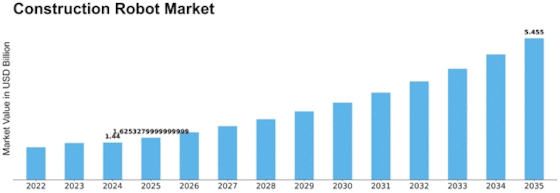
<p>The Construction Robot Market is projected to reach a valuation of 5.455 USD Billion by 2035.</p>

What was the market valuation of the Construction Robot Market in 2024?

<p>In 2024, the Construction Robot Market had a valuation of 1.44 USD Billion.</p>

What is the expected CAGR for the Construction Robot Market during the forecast period 2025 - 2035?

<p>The expected CAGR for the Construction Robot Market during the forecast period 2025 - 2035 is 12.87%.</p>

Which application segments are expected to drive growth in the Construction Robot Market?

<p>Key application segments include Bricklaying, Demolition, Painting, and Groundworks, with Bricklaying projected to grow from 0.576 to 1.5 USD Billion.</p>

What types of construction robots are anticipated to gain traction in the market?

<p>The market is likely to see growth in Autonomous Mobile Robots, Exoskeletons, Drones, and Robotic Arms, with Autonomous Mobile Robots expected to increase from 0.5 to 1.8 USD Billion.</p>

Which end-use sectors are contributing to the growth of the Construction Robot Market?

<p>The Residential, Commercial, and Industrial Construction sectors are contributing, with Residential Construction projected to grow from 0.576 to 1.8 USD Billion.</p>

Who are the key players in the Construction Robot Market?

<p>Key players include Boston Dynamics, Built Robotics, Cyberdyne, Doxel, Fastbrick Robotics, KUKA, Komatsu, RoboBuilder, Scantech, and Tadano.</p>

What is the projected growth for the Demolition segment in the Construction Robot Market?

<p>The Demolition segment is projected to grow from 0.432 to 1.1 USD Billion by 2035.</p>

How does the market for Drones compare to other types of construction robots?

<p>The market for Drones is expected to grow from 0.4 to 1.5 USD Billion, indicating strong potential compared to other types.</p>

What trends are influencing the Construction Robot Market in 2025?

<p>Trends include advancements in automation technology and increasing demand for efficiency in construction processes.</p>

Market Summary

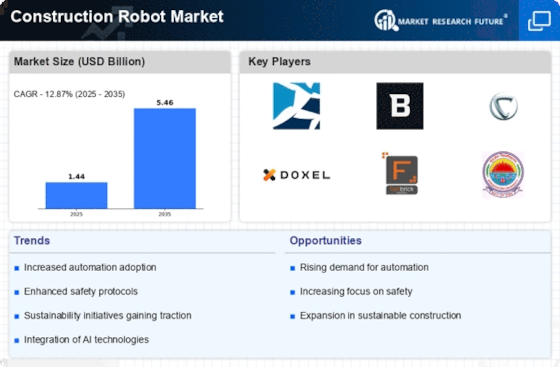
As per Market Research Future analysis, the Construction Robot Market Size was estimated at 1.44 USD Billion in 2024. The Construction Robot industry is projected to grow from 1.625 USD Billion in 2025 to 5.455 USD Billion by 2035, exhibiting a compound annual growth rate (CAGR) of 12.87% during the forecast period 2025 - 2035

Key Market Trends & Highlights

The Construction Robot Market is experiencing robust growth driven by automation and technological advancements.

  • North America remains the largest market for construction robots, reflecting a strong demand for automation in the construction sector. The Asia-Pacific region is emerging as the fastest-growing market, fueled by rapid urbanization and infrastructure development. Bricklaying robots dominate the market, while demolition robots are gaining traction as the fastest-growing segment. Rising labor costs and labor shortages are significant drivers propelling the adoption of construction robots across various segments.

Market Size & Forecast

2024 Market Size 1.44 (USD Billion)
2035 Market Size 5.455 (USD Billion)
CAGR (2025 - 2035) 12.87%
Largest Regional Market Share in 2024 Asia Pacific

Major Players

Boston Dynamics (US), <a href="https://www.builtrobotics.com/">Built Robotics</a> (US), Cyberdyne (JP), Doxel (US), Fastbrick Robotics (AU), <a href="https://www.kuka.com/">KUKA </a>(DE), Komatsu (JP), RoboBuilder (US), Scantech (US), Tadano (JP)

Market Trends

The Construction Robot Market is currently experiencing a transformative phase, driven by advancements in technology and a growing emphasis on efficiency and safety within the construction sector. As the industry grapples with labor shortages and rising project complexities, the integration of robotic solutions appears to offer a viable pathway to enhance productivity. These machines are designed to perform a variety of tasks, ranging from bricklaying to demolition, thereby reducing the physical strain on human workers and minimizing the risk of accidents on job sites.

Furthermore, the increasing adoption of automation technologies suggests a shift towards more innovative construction practices, which could redefine traditional methodologies. In addition to improving operational efficiency, the Construction Robot Market is likely to benefit from heightened investments in research and development. Companies are exploring new applications for robotics, which may lead to the emergence of specialized machines tailored for specific tasks. This trend indicates a potential for customization and adaptability, allowing construction firms to select robotic solutions that best meet their unique project requirements. As the market evolves, collaboration between technology providers and construction firms may foster a more integrated approach, ultimately enhancing the overall effectiveness of construction processes. The construction robots market is gaining strong momentum as automation, labor shortages, and safety concerns drive the adoption of advanced robotic solutions across global construction projects. The construction robotics market is undergoing a transformative phase, supported by advancements in autonomous systems, AI-driven navigation, and improved human-robot collaboration. The construction and demolition robots market is expanding rapidly as urban redevelopment and safety regulations increase demand for automated demolition solutions in confined and high-risk environments.

Increased Automation Adoption

The Construction Robot Market is witnessing a notable shift towards automation, as firms seek to streamline operations and reduce reliance on manual labor. This trend is characterized by the introduction of advanced robotic systems that can perform repetitive tasks with precision, thereby enhancing overall productivity.

Focus on Safety and Risk Mitigation

Safety remains a paramount concern in construction, and the integration of robots is seen as a means to mitigate risks associated with hazardous tasks. By deploying robots for dangerous activities, companies aim to protect their workforce while maintaining project timelines.

Customization and Specialized Solutions

As the Construction Robot Market matures, there is a growing emphasis on developing customized robotic solutions tailored to specific construction needs. This trend reflects a broader understanding that one-size-fits-all approaches may not be effective, prompting innovation in specialized machinery.

Construction Robot Market Market Drivers

Labor Shortages

Labor shortages are a pressing issue within the construction sector, significantly impacting the Construction Robot Market. As the workforce ages and fewer young individuals enter the trades, companies face challenges in finding skilled labor. This shortage drives construction firms to explore automation as a viable solution. Robots can fill gaps in labor availability, performing repetitive and labor-intensive tasks with precision and efficiency. The market is responding to this challenge, with projections indicating a substantial increase in the adoption of construction robots over the next few years. By leveraging robotic technologies, companies can maintain productivity levels and meet project deadlines despite the ongoing labor shortages.

Rising Labor Costs

The Construction Robot Market is experiencing a notable shift due to the rising labor costs across various regions. As construction projects become increasingly complex, the demand for skilled labor has surged, leading to higher wages. This trend compels construction companies to seek automation solutions to mitigate labor expenses. The integration of robots in construction processes not only reduces reliance on human labor but also enhances efficiency and productivity. According to recent data, labor costs in the construction sector have increased by approximately 20% over the past five years, prompting firms to invest in robotic technologies. Consequently, the Construction Robot Market is likely to expand as companies prioritize cost-effective solutions that maintain project timelines and quality.

Sustainability Initiatives

Sustainability initiatives are increasingly influencing the Construction Robot Market as stakeholders prioritize environmentally friendly practices. The construction sector is under pressure to reduce its carbon footprint and enhance resource efficiency. Robots can contribute to these goals by optimizing material usage, minimizing waste, and improving energy efficiency during construction processes. For example, robotic systems can precisely measure and cut materials, reducing excess waste. Furthermore, the integration of renewable energy sources in robotic operations aligns with sustainability objectives. As regulations and consumer preferences shift towards greener solutions, the Construction Robot Market is likely to see a surge in demand for robots that support sustainable construction practices.

Technological Advancements

Technological advancements play a pivotal role in shaping the Construction Robot Market. Innovations in robotics, artificial intelligence, and machine learning are driving the development of sophisticated construction robots capable of performing complex tasks. These advancements enable robots to operate autonomously, adapt to various environments, and collaborate with human workers. For instance, the introduction of drones for site surveying and robotic arms for precise assembly has revolutionized construction practices. The market is projected to grow significantly, with estimates suggesting a compound annual growth rate of over 25% in the next five years. As technology continues to evolve, the Construction Robot Market is poised for substantial growth, attracting investments and fostering new applications.

Increased Infrastructure Development

The Construction Robot Market is benefiting from increased infrastructure development initiatives worldwide. Governments and private entities are investing heavily in infrastructure projects, including roads, bridges, and buildings, to support economic growth and urbanization. This surge in construction activity creates a favorable environment for the adoption of robotic technologies. Robots can enhance the speed and quality of construction, addressing the growing demand for infrastructure. Recent reports indicate that infrastructure spending is expected to reach trillions of dollars over the next decade, further propelling the Construction Robot Market. As projects become more ambitious, the reliance on advanced robotic solutions is likely to intensify.

Market Segment Insights

By Application: Bricklaying (Largest) vs. Demolition (Fastest-Growing)

In the Construction Robot Market, Bricklaying emerges as the largest segment, capturing a significant portion of the overall demand due to its essential role in construction processes. Bricklaying robots are widely adopted for their efficiency, precision, and ability to streamline workflow in masonry tasks. Following closely, the Demolition segment has shown remarkable growth, driven by increasing urbanization and the need for safe demolition solutions in congested areas. The demand for automation in construction is also fostering growth in the Painting and Groundworks segments. While Painting is gaining traction due to advancements in robotics technology ensuring better quality and efficiency, the Groundworks segment is becoming increasingly important, driven by the focus on foundational integrity and efficiency in excavation tasks. Together, these segments illustrate the evolving dynamics within the Construction Robot Market, reflecting shifting consumer preferences and technological innovations.

Bricklaying (Dominant) vs. Groundworks (Emerging)

In the Construction Robot Market, Bricklaying has established itself as the dominant force due to its widespread application and substantial productivity benefits it offers to construction teams. These robots enhance the speed and accuracy of brick placement, reduce labor costs, and minimize material waste, making them invaluable in modern construction projects. Conversely, Groundworks, while considered an emerging segment, is gaining attention as the industry's focus on automation continues to increase. Groundwork robots are designed to perform critical tasks such as excavation, grading, and site preparation, which are essential to the overall construction process. Their adaptability to various terrains and integration with advanced technologies are key characteristics driving their market penetration. As the demand for more efficient construction methods grows, Groundworks is poised to become a significant player in this market.

By Type: Autonomous Mobile Robots (Largest) vs. Exoskeletons (Fastest-Growing)

The Construction Robot Market demonstrates a diverse distribution of market share across various types, with Autonomous Mobile Robots leading the charge. This category has garnered the largest share, attributed to its versatile application in transporting materials and facilitating on-site logistics. Following closely are Exoskeletons, which, while smaller in share, are rapidly gaining traction due to their innovative design aimed at enhancing human capabilities, thereby reducing the physical strain on workers in construction environments. Growth trends within this market segment are significantly influenced by the increasing adoption of automation and robotics in building projects. <a href="https://www.marketresearchfuture.com/reports/drones-market-1124">Drones</a> are also witnessing heightened interest as they provide aerial surveillance and mapping, while Robotic Arms are enhancing precision in tasks such as welding and assembly. Furthermore, advancements in technology, coupled with a push for safer work environments, are driving investments and interest in robotic solutions.

Autonomous Mobile Robots (Dominant) vs. Drones (Emerging)

Autonomous Mobile Robots (AMRs) are the dominant force in the construction robot landscape, known for their efficiency and ability to operate autonomously in complex environments. These robots excel in transporting materials and performing duties such as site monitoring. With their growing implementation, they are helping to streamline operations, reduce downtime, and optimize resource allocation. On the other hand, Drones are emerging as vital tools within the construction sector, providing innovative solutions for surveying, mapping, and inspecting hard-to-reach areas. Equipped with advanced imaging technologies and sensors, Drones enhance project accuracy and data collection, positioning them as indispensable in modern construction workflows. The synergy between AMRs and Drones indicates a trend toward a more integrated and automated construction site.

By End-Use: Residential Construction (Largest) vs. Industrial Construction (Fastest-Growing)

In the Construction Robot Market, the distribution of market share among the end-use segments reveals that Residential Construction holds the largest share, driven by increasing demand for automated solutions in homebuilding. This segment benefits from a growing trend towards smart home technologies and sustainable practices, appealing to homeowners and builders alike. Conversely, Industrial Construction is witnessing rapid growth, fueled by the rising need for efficiency and safety in larger-scale projects. Companies are increasingly adopting <a href="https://www.marketresearchfuture.com/reports/robotics-market-4732">robotics</a> to streamline operations and enhance safety standards in hazardous environments.

Residential Construction (Dominant) vs. Industrial Construction (Emerging)

Residential Construction represents a dominant segment in the market, characterized by its reliance on advanced robotics for tasks such as bricklaying, painting, and additional functions that enhance overall productivity. The segment is marked by the widespread adoption of technologies that cater to the demand for smart homes, showcasing innovations that align with energy efficiency and automated construction practices. On the other hand, Industrial Construction is emerging rapidly, leveraging robotics to address complex industrial projects. The segment is defined by its focus on efficiency and precision, utilizing robotics in heavy lifting, assembly, and logistics to meet the rigorous demands of industrial applications, thus positioning itself as a pivotal player in the evolving construction landscape.

Get more detailed insights about Construction Robot Market Research Report – Forecast to 2035

Regional Insights

North America : Innovation and Investment Hub

North America is the largest market for construction robots, holding approximately 45% of the global share. The region's growth is driven by significant investments in automation and robotics, alongside a strong demand for efficiency in construction processes. Regulatory support for innovation and safety standards further catalyzes market expansion, with the U.S. leading in technological advancements and adoption rates. The competitive landscape is dominated by key players such as Boston Dynamics, Built Robotics, and Doxel, which are pioneering advancements in robotic technologies. The U.S. is the primary market, followed by Canada, which is also witnessing a surge in construction automation. The presence of established firms and startups alike fosters a vibrant ecosystem for innovation in construction robotics. In addition, the Mexico construction robots market is gradually emerging, driven by infrastructure development, industrial expansion, and increasing adoption of automation in large-scale construction projects.

Europe : Regulatory Support and Growth

Europe is witnessing rapid growth in the construction robot market, accounting for about 30% of the global share. The region benefits from stringent regulations promoting safety and efficiency in construction, which drives the adoption of robotic solutions. Countries like Germany and the UK are at the forefront, with government initiatives supporting technological advancements and sustainability in construction practices. Germany leads the market, followed closely by the UK and France, with a strong presence of companies like KUKA and other local innovators. The competitive landscape is characterized by collaborations between technology firms and construction companies, enhancing the development and deployment of construction robots. This synergy is crucial for meeting the increasing demand for automation in the construction sector.

Asia-Pacific : Rapid Adoption and Growth

Asia-Pacific is rapidly emerging as a significant player in the construction robot market, holding around 20% of the global share. The region's growth is fueled by urbanization, increasing labor costs, and a strong push towards automation in construction. Countries like Japan and Australia are leading the charge, supported by favorable government policies and investments in technology to enhance construction efficiency. Japan is a key market, with companies like Cyberdyne and Komatsu driving innovation in robotics. Australia is also seeing increased adoption of construction robots, particularly in large-scale projects. The competitive landscape is marked by a mix of established firms and startups, fostering a dynamic environment for technological advancements in construction automation.

Middle East and Africa : Resource-Rich and Emerging Market

The Middle East and Africa region is gradually emerging in the construction robot market, currently holding about 5% of the global share. The growth is primarily driven by rapid urbanization and infrastructure development projects, particularly in countries like the UAE and South Africa. Government initiatives aimed at diversifying economies and enhancing construction efficiency are key catalysts for market growth. The UAE is leading the market, with significant investments in smart city projects and construction automation. South Africa is also witnessing a growing interest in robotics within the construction sector. The competitive landscape is characterized by a mix of local and international players, creating opportunities for innovation and collaboration in construction robotics.

Key Players and Competitive Insights

The Construction Robot Market is currently characterized by a dynamic competitive landscape, driven by technological advancements and increasing demand for automation in construction processes. Key players such as Boston Dynamics (US), Built Robotics (US), and Komatsu (JP) are at the forefront, each adopting distinct strategies to enhance their market positioning. Boston Dynamics (US) focuses on innovation, particularly in robotics mobility and manipulation, while Built Robotics (US) emphasizes the integration of AI and machine learning into their autonomous construction equipment. Komatsu (JP), on the other hand, is leveraging its extensive experience in heavy machinery to develop smart construction solutions, indicating a trend towards digital transformation across the sector. Collectively, these strategies contribute to a competitive environment that is increasingly reliant on technological prowess and operational efficiency. In terms of business tactics, companies are localizing manufacturing and optimizing supply chains to enhance responsiveness to market demands. The Construction Robot Market appears moderately fragmented, with a mix of established players and emerging startups. This structure allows for a diverse range of innovations and solutions, although the influence of key players like KUKA (DE) and Cyberdyne (JP) remains substantial, as they continue to set benchmarks in robotics technology and automation. In August 2025, Boston Dynamics (US) announced a partnership with a leading construction firm to deploy its Spot robot for site inspections and data collection. This strategic move not only enhances the operational capabilities of construction sites but also positions Boston Dynamics as a leader in integrating robotics into everyday construction tasks. The partnership underscores the growing recognition of robotics as a vital component in improving efficiency and safety in construction. Similarly, in September 2025, Built Robotics (US) unveiled its latest autonomous excavator, which incorporates advanced AI algorithms for real-time decision-making. This development is significant as it reflects the company's commitment to pushing the boundaries of automation in construction, potentially reducing labor costs and increasing productivity on job sites. The introduction of such technology may also influence competitors to accelerate their own innovation cycles. In July 2025, Komatsu (JP) launched a new suite of smart construction solutions that utilize IoT technology to enhance equipment monitoring and maintenance. This initiative is crucial as it aligns with the industry's shift towards data-driven decision-making, allowing for predictive maintenance and improved operational efficiency. Komatsu's focus on smart technology not only strengthens its market position but also sets a precedent for other players in the industry to follow. As of October 2025, the Construction Robot Market is witnessing trends such as digitalization, sustainability, and AI integration, which are reshaping competitive dynamics. Strategic alliances are becoming increasingly important, as companies recognize the value of collaboration in driving innovation. Looking ahead, competitive differentiation is likely to evolve from traditional price-based competition to a focus on technological innovation, reliability in supply chains, and the ability to deliver sustainable solutions. This shift indicates a maturation of the market, where the emphasis will be on creating value through advanced technologies and strategic partnerships.

Key Companies in the Construction Robot Market include

Industry Developments

Recent developments in the Global Construction Robot Market indicate a growing trend toward automation within the sector, with several key companies actively enhancing their technological capabilities. Notably, Terex has expanded its portfolio by incorporating advanced robotics solutions, targeting increased efficiency in construction processes. KUKA and Boston Dynamics are collaborating to integrate robotics into construction workflows, aiming to streamline operations and reduce labor costs. In September 2023, Built Robotics announced a partnership with Caterpillar to develop autonomous heavy machinery, reinforcing the push towards automated solutions in heavy construction.

Additionally, in August 2023, Skanska acquired Construction Robotics, intending to enhance its competitive edge with improved robotics technologies. The market shows robust growth, with a valuation that has increased significantly over the past two years, driven by technological advancements and the demand for safety and efficiency. Companies like Komatsu and FANUC are focusing heavily on Research and Development to innovate and expand their market share. 

The integration of robotics solutions is also influencing project timelines and costs, ultimately redefining traditional construction methodologies on a global scale. With the increasing emphasis on sustainability and efficiency, the adoption of construction robots is poised to contribute significantly to industry transformations.

Future Outlook

Construction Robot Market Future Outlook

The Construction Robot Market is projected to grow at a 12.87% CAGR from 2025 to 2035, driven by technological advancements, labor shortages, and increased demand for efficiency.

New opportunities lie in:

  • <p>Integration of AI-driven project management tools Development of autonomous material handling robots Expansion of robotic solutions for sustainable construction practices</p>

By 2035, the market is expected to be robust, characterized by innovation and increased adoption of robotic technologies.

Market Segmentation

Construction Robot Market Type Outlook

  • Autonomous Mobile Robots
  • Exoskeletons
  • Drones
  • Robotic Arms

Construction Robot Market End-Use Outlook

  • Residential Construction
  • Commercial Construction
  • Industrial Construction

Construction Robot Market Application Outlook

  • Bricklaying
  • Demolition
  • Painting
  • Groundworks

Report Scope

MARKET SIZE 2024 1.44(USD Billion)
MARKET SIZE 2025 1.625(USD Billion)
MARKET SIZE 2035 5.455(USD Billion)
COMPOUND ANNUAL GROWTH RATE (CAGR) 12.87% (2025 - 2035)
REPORT COVERAGE Revenue Forecast, Competitive Landscape, Growth Factors, and Trends
BASE YEAR 2024
Market Forecast Period 2025 - 2035
Historical Data 2019 - 2024
Market Forecast Units USD Billion
Key Companies Profiled Boston Dynamics (US), Built Robotics (US), Cyberdyne (JP), Doxel (US), Fastbrick Robotics (AU), KUKA (DE), Komatsu (JP), RoboBuilder (US), Scantech (US), Tadano (JP)
Segments Covered Application, Type, End Use, Regional
Key Market Opportunities Integration of artificial intelligence and automation enhances efficiency in the Construction Robot Market.
Key Market Dynamics Rising demand for automation in construction drives innovation and competition among construction robot manufacturers.
Countries Covered North America, Europe, APAC, South America, MEA

FAQs

What is the projected market valuation of the Construction Robot Market by 2035?

<p>The Construction Robot Market is projected to reach a valuation of 5.455 USD Billion by 2035.</p>

What was the market valuation of the Construction Robot Market in 2024?

<p>In 2024, the Construction Robot Market had a valuation of 1.44 USD Billion.</p>

What is the expected CAGR for the Construction Robot Market during the forecast period 2025 - 2035?

<p>The expected CAGR for the Construction Robot Market during the forecast period 2025 - 2035 is 12.87%.</p>

Which application segments are expected to drive growth in the Construction Robot Market?

<p>Key application segments include Bricklaying, Demolition, Painting, and Groundworks, with Bricklaying projected to grow from 0.576 to 1.5 USD Billion.</p>

What types of construction robots are anticipated to gain traction in the market?

<p>The market is likely to see growth in Autonomous Mobile Robots, Exoskeletons, Drones, and Robotic Arms, with Autonomous Mobile Robots expected to increase from 0.5 to 1.8 USD Billion.</p>

Which end-use sectors are contributing to the growth of the Construction Robot Market?

<p>The Residential, Commercial, and Industrial Construction sectors are contributing, with Residential Construction projected to grow from 0.576 to 1.8 USD Billion.</p>

Who are the key players in the Construction Robot Market?

<p>Key players include Boston Dynamics, Built Robotics, Cyberdyne, Doxel, Fastbrick Robotics, KUKA, Komatsu, RoboBuilder, Scantech, and Tadano.</p>

What is the projected growth for the Demolition segment in the Construction Robot Market?

<p>The Demolition segment is projected to grow from 0.432 to 1.1 USD Billion by 2035.</p>

How does the market for Drones compare to other types of construction robots?

<p>The market for Drones is expected to grow from 0.4 to 1.5 USD Billion, indicating strong potential compared to other types.</p>

What trends are influencing the Construction Robot Market in 2025?

<p>Trends include advancements in automation technology and increasing demand for efficiency in construction processes.</p>

  1. SECTION I: EXECUTIVE SUMMARY AND KEY HIGHLIGHTS
    1. | 1.1 EXECUTIVE SUMMARY
    2. | | 1.1.1 Market Overview
    3. | | 1.1.2 Key Findings
    4. | | 1.1.3 Market Segmentation
    5. | | 1.1.4 Competitive Landscape
    6. | | 1.1.5 Challenges and Opportunities
    7. | | 1.1.6 Future Outlook
  2. SECTION II: SCOPING, METHODOLOGY AND MARKET STRUCTURE
    1. | 2.1 MARKET INTRODUCTION
    2. | | 2.1.1 Definition
    3. | | 2.1.2 Scope of the study
    4. | | | 2.1.2.1 Research Objective
    5. | | | 2.1.2.2 Assumption
    6. | | | 2.1.2.3 Limitations
    7. | 2.2 RESEARCH METHODOLOGY
    8. | | 2.2.1 Overview
    9. | | 2.2.2 Data Mining
    10. | | 2.2.3 Secondary Research
    11. | | 2.2.4 Primary Research
    12. | | | 2.2.4.1 Primary Interviews and Information Gathering Process
    13. | | | 2.2.4.2 Breakdown of Primary Respondents
    14. | | 2.2.5 Forecasting Model
    15. | | 2.2.6 Market Size Estimation
    16. | | | 2.2.6.1 Bottom-Up Approach
    17. | | | 2.2.6.2 Top-Down Approach
    18. | | 2.2.7 Data Triangulation
    19. | | 2.2.8 Validation
  3. SECTION III: QUALITATIVE ANALYSIS
    1. | 3.1 MARKET DYNAMICS
    2. | | 3.1.1 Overview
    3. | | 3.1.2 Drivers
    4. | | 3.1.3 Restraints
    5. | | 3.1.4 Opportunities
    6. | 3.2 MARKET FACTOR ANALYSIS
    7. | | 3.2.1 Value chain Analysis
    8. | | 3.2.2 Porter's Five Forces Analysis
    9. | | | 3.2.2.1 Bargaining Power of Suppliers
    10. | | | 3.2.2.2 Bargaining Power of Buyers
    11. | | | 3.2.2.3 Threat of New Entrants
    12. | | | 3.2.2.4 Threat of Substitutes
    13. | | | 3.2.2.5 Intensity of Rivalry
    14. | | 3.2.3 COVID-19 Impact Analysis
    15. | | | 3.2.3.1 Market Impact Analysis
    16. | | | 3.2.3.2 Regional Impact
    17. | | | 3.2.3.3 Opportunity and Threat Analysis
  4. SECTION IV: QUANTITATIVE ANALYSIS
    1. | 4.1 Information and Communications Technology, BY Application (USD Billion)
    2. | | 4.1.1 Bricklaying
    3. | | 4.1.2 Demolition
    4. | | 4.1.3 Painting
    5. | | 4.1.4 Groundworks
    6. | 4.2 Information and Communications Technology, BY Type (USD Billion)
    7. | | 4.2.1 Autonomous Mobile Robots
    8. | | 4.2.2 Exoskeletons
    9. | | 4.2.3 Drones
    10. | | 4.2.4 Robotic Arms
    11. | 4.3 Information and Communications Technology, BY End-Use (USD Billion)
    12. | | 4.3.1 Residential Construction
    13. | | 4.3.2 Commercial Construction
    14. | | 4.3.3 Industrial Construction
    15. | 4.4 Information and Communications Technology, BY Region (USD Billion)
    16. | | 4.4.1 North America
    17. | | | 4.4.1.1 US
    18. | | | 4.4.1.2 Canada
    19. | | 4.4.2 Europe
    20. | | | 4.4.2.1 Germany
    21. | | | 4.4.2.2 UK
    22. | | | 4.4.2.3 France
    23. | | | 4.4.2.4 Russia
    24. | | | 4.4.2.5 Italy
    25. | | | 4.4.2.6 Spain
    26. | | | 4.4.2.7 Rest of Europe
    27. | | 4.4.3 APAC
    28. | | | 4.4.3.1 China
    29. | | | 4.4.3.2 India
    30. | | | 4.4.3.3 Japan
    31. | | | 4.4.3.4 South Korea
    32. | | | 4.4.3.5 Malaysia
    33. | | | 4.4.3.6 Thailand
    34. | | | 4.4.3.7 Indonesia
    35. | | | 4.4.3.8 Rest of APAC
    36. | | 4.4.4 South America
    37. | | | 4.4.4.1 Brazil
    38. | | | 4.4.4.2 Mexico
    39. | | | 4.4.4.3 Argentina
    40. | | | 4.4.4.4 Rest of South America
    41. | | 4.4.5 MEA
    42. | | | 4.4.5.1 GCC Countries
    43. | | | 4.4.5.2 South Africa
    44. | | | 4.4.5.3 Rest of MEA
  5. SECTION V: COMPETITIVE ANALYSIS
    1. | 5.1 Competitive Landscape
    2. | | 5.1.1 Overview
    3. | | 5.1.2 Competitive Analysis
    4. | | 5.1.3 Market share Analysis
    5. | | 5.1.4 Major Growth Strategy in the Information and Communications Technology
    6. | | 5.1.5 Competitive Benchmarking
    7. | | 5.1.6 Leading Players in Terms of Number of Developments in the Information and Communications Technology
    8. | | 5.1.7 Key developments and growth strategies
    9. | | | 5.1.7.1 New Product Launch/Service Deployment
    10. | | | 5.1.7.2 Merger & Acquisitions
    11. | | | 5.1.7.3 Joint Ventures
    12. | | 5.1.8 Major Players Financial Matrix
    13. | | | 5.1.8.1 Sales and Operating Income
    14. | | | 5.1.8.2 Major Players R&D Expenditure. 2023
    15. | 5.2 Company Profiles
    16. | | 5.2.1 Boston Dynamics (US)
    17. | | | 5.2.1.1 Financial Overview
    18. | | | 5.2.1.2 Products Offered
    19. | | | 5.2.1.3 Key Developments
    20. | | | 5.2.1.4 SWOT Analysis
    21. | | | 5.2.1.5 Key Strategies
    22. | | 5.2.2 Built Robotics (US)
    23. | | | 5.2.2.1 Financial Overview
    24. | | | 5.2.2.2 Products Offered
    25. | | | 5.2.2.3 Key Developments
    26. | | | 5.2.2.4 SWOT Analysis
    27. | | | 5.2.2.5 Key Strategies
    28. | | 5.2.3 Cyberdyne (JP)
    29. | | | 5.2.3.1 Financial Overview
    30. | | | 5.2.3.2 Products Offered
    31. | | | 5.2.3.3 Key Developments
    32. | | | 5.2.3.4 SWOT Analysis
    33. | | | 5.2.3.5 Key Strategies
    34. | | 5.2.4 Doxel (US)
    35. | | | 5.2.4.1 Financial Overview
    36. | | | 5.2.4.2 Products Offered
    37. | | | 5.2.4.3 Key Developments
    38. | | | 5.2.4.4 SWOT Analysis
    39. | | | 5.2.4.5 Key Strategies
    40. | | 5.2.5 Fastbrick Robotics (AU)
    41. | | | 5.2.5.1 Financial Overview
    42. | | | 5.2.5.2 Products Offered
    43. | | | 5.2.5.3 Key Developments
    44. | | | 5.2.5.4 SWOT Analysis
    45. | | | 5.2.5.5 Key Strategies
    46. | | 5.2.6 KUKA (DE)
    47. | | | 5.2.6.1 Financial Overview
    48. | | | 5.2.6.2 Products Offered
    49. | | | 5.2.6.3 Key Developments
    50. | | | 5.2.6.4 SWOT Analysis
    51. | | | 5.2.6.5 Key Strategies
    52. | | 5.2.7 Komatsu (JP)
    53. | | | 5.2.7.1 Financial Overview
    54. | | | 5.2.7.2 Products Offered
    55. | | | 5.2.7.3 Key Developments
    56. | | | 5.2.7.4 SWOT Analysis
    57. | | | 5.2.7.5 Key Strategies
    58. | | 5.2.8 RoboBuilder (US)
    59. | | | 5.2.8.1 Financial Overview
    60. | | | 5.2.8.2 Products Offered
    61. | | | 5.2.8.3 Key Developments
    62. | | | 5.2.8.4 SWOT Analysis
    63. | | | 5.2.8.5 Key Strategies
    64. | | 5.2.9 Scantech (US)
    65. | | | 5.2.9.1 Financial Overview
    66. | | | 5.2.9.2 Products Offered
    67. | | | 5.2.9.3 Key Developments
    68. | | | 5.2.9.4 SWOT Analysis
    69. | | | 5.2.9.5 Key Strategies
    70. | | 5.2.10 Tadano (JP)
    71. | | | 5.2.10.1 Financial Overview
    72. | | | 5.2.10.2 Products Offered
    73. | | | 5.2.10.3 Key Developments
    74. | | | 5.2.10.4 SWOT Analysis
    75. | | | 5.2.10.5 Key Strategies
    76. | 5.3 Appendix
    77. | | 5.3.1 References
    78. | | 5.3.2 Related Reports
  6. LIST OF FIGURES
    1. | 6.1 MARKET SYNOPSIS
    2. | 6.2 NORTH AMERICA MARKET ANALYSIS
    3. | 6.3 US MARKET ANALYSIS BY APPLICATION
    4. | 6.4 US MARKET ANALYSIS BY TYPE
    5. | 6.5 US MARKET ANALYSIS BY END-USE
    6. | 6.6 CANADA MARKET ANALYSIS BY APPLICATION
    7. | 6.7 CANADA MARKET ANALYSIS BY TYPE
    8. | 6.8 CANADA MARKET ANALYSIS BY END-USE
    9. | 6.9 EUROPE MARKET ANALYSIS
    10. | 6.10 GERMANY MARKET ANALYSIS BY APPLICATION
    11. | 6.11 GERMANY MARKET ANALYSIS BY TYPE
    12. | 6.12 GERMANY MARKET ANALYSIS BY END-USE
    13. | 6.13 UK MARKET ANALYSIS BY APPLICATION
    14. | 6.14 UK MARKET ANALYSIS BY TYPE
    15. | 6.15 UK MARKET ANALYSIS BY END-USE
    16. | 6.16 FRANCE MARKET ANALYSIS BY APPLICATION
    17. | 6.17 FRANCE MARKET ANALYSIS BY TYPE
    18. | 6.18 FRANCE MARKET ANALYSIS BY END-USE
    19. | 6.19 RUSSIA MARKET ANALYSIS BY APPLICATION
    20. | 6.20 RUSSIA MARKET ANALYSIS BY TYPE
    21. | 6.21 RUSSIA MARKET ANALYSIS BY END-USE
    22. | 6.22 ITALY MARKET ANALYSIS BY APPLICATION
    23. | 6.23 ITALY MARKET ANALYSIS BY TYPE
    24. | 6.24 ITALY MARKET ANALYSIS BY END-USE
    25. | 6.25 SPAIN MARKET ANALYSIS BY APPLICATION
    26. | 6.26 SPAIN MARKET ANALYSIS BY TYPE
    27. | 6.27 SPAIN MARKET ANALYSIS BY END-USE
    28. | 6.28 REST OF EUROPE MARKET ANALYSIS BY APPLICATION
    29. | 6.29 REST OF EUROPE MARKET ANALYSIS BY TYPE
    30. | 6.30 REST OF EUROPE MARKET ANALYSIS BY END-USE
    31. | 6.31 APAC MARKET ANALYSIS
    32. | 6.32 CHINA MARKET ANALYSIS BY APPLICATION
    33. | 6.33 CHINA MARKET ANALYSIS BY TYPE
    34. | 6.34 CHINA MARKET ANALYSIS BY END-USE
    35. | 6.35 INDIA MARKET ANALYSIS BY APPLICATION
    36. | 6.36 INDIA MARKET ANALYSIS BY TYPE
    37. | 6.37 INDIA MARKET ANALYSIS BY END-USE
    38. | 6.38 JAPAN MARKET ANALYSIS BY APPLICATION
    39. | 6.39 JAPAN MARKET ANALYSIS BY TYPE
    40. | 6.40 JAPAN MARKET ANALYSIS BY END-USE
    41. | 6.41 SOUTH KOREA MARKET ANALYSIS BY APPLICATION
    42. | 6.42 SOUTH KOREA MARKET ANALYSIS BY TYPE
    43. | 6.43 SOUTH KOREA MARKET ANALYSIS BY END-USE
    44. | 6.44 MALAYSIA MARKET ANALYSIS BY APPLICATION
    45. | 6.45 MALAYSIA MARKET ANALYSIS BY TYPE
    46. | 6.46 MALAYSIA MARKET ANALYSIS BY END-USE
    47. | 6.47 THAILAND MARKET ANALYSIS BY APPLICATION
    48. | 6.48 THAILAND MARKET ANALYSIS BY TYPE
    49. | 6.49 THAILAND MARKET ANALYSIS BY END-USE
    50. | 6.50 INDONESIA MARKET ANALYSIS BY APPLICATION
    51. | 6.51 INDONESIA MARKET ANALYSIS BY TYPE
    52. | 6.52 INDONESIA MARKET ANALYSIS BY END-USE
    53. | 6.53 REST OF APAC MARKET ANALYSIS BY APPLICATION
    54. | 6.54 REST OF APAC MARKET ANALYSIS BY TYPE
    55. | 6.55 REST OF APAC MARKET ANALYSIS BY END-USE
    56. | 6.56 SOUTH AMERICA MARKET ANALYSIS
    57. | 6.57 BRAZIL MARKET ANALYSIS BY APPLICATION
    58. | 6.58 BRAZIL MARKET ANALYSIS BY TYPE
    59. | 6.59 BRAZIL MARKET ANALYSIS BY END-USE
    60. | 6.60 MEXICO MARKET ANALYSIS BY APPLICATION
    61. | 6.61 MEXICO MARKET ANALYSIS BY TYPE
    62. | 6.62 MEXICO MARKET ANALYSIS BY END-USE
    63. | 6.63 ARGENTINA MARKET ANALYSIS BY APPLICATION
    64. | 6.64 ARGENTINA MARKET ANALYSIS BY TYPE
    65. | 6.65 ARGENTINA MARKET ANALYSIS BY END-USE
    66. | 6.66 REST OF SOUTH AMERICA MARKET ANALYSIS BY APPLICATION
    67. | 6.67 REST OF SOUTH AMERICA MARKET ANALYSIS BY TYPE
    68. | 6.68 REST OF SOUTH AMERICA MARKET ANALYSIS BY END-USE
    69. | 6.69 MEA MARKET ANALYSIS
    70. | 6.70 GCC COUNTRIES MARKET ANALYSIS BY APPLICATION
    71. | 6.71 GCC COUNTRIES MARKET ANALYSIS BY TYPE
    72. | 6.72 GCC COUNTRIES MARKET ANALYSIS BY END-USE
    73. | 6.73 SOUTH AFRICA MARKET ANALYSIS BY APPLICATION
    74. | 6.74 SOUTH AFRICA MARKET ANALYSIS BY TYPE
    75. | 6.75 SOUTH AFRICA MARKET ANALYSIS BY END-USE
    76. | 6.76 REST OF MEA MARKET ANALYSIS BY APPLICATION
    77. | 6.77 REST OF MEA MARKET ANALYSIS BY TYPE
    78. | 6.78 REST OF MEA MARKET ANALYSIS BY END-USE
    79. | 6.79 KEY BUYING CRITERIA OF INFORMATION AND COMMUNICATIONS TECHNOLOGY
    80. | 6.80 RESEARCH PROCESS OF MRFR
    81. | 6.81 DRO ANALYSIS OF INFORMATION AND COMMUNICATIONS TECHNOLOGY
    82. | 6.82 DRIVERS IMPACT ANALYSIS: INFORMATION AND COMMUNICATIONS TECHNOLOGY
    83. | 6.83 RESTRAINTS IMPACT ANALYSIS: INFORMATION AND COMMUNICATIONS TECHNOLOGY
    84. | 6.84 SUPPLY / VALUE CHAIN: INFORMATION AND COMMUNICATIONS TECHNOLOGY
    85. | 6.85 INFORMATION AND COMMUNICATIONS TECHNOLOGY, BY APPLICATION, 2024 (% SHARE)
    86. | 6.86 INFORMATION AND COMMUNICATIONS TECHNOLOGY, BY APPLICATION, 2024 TO 2035 (USD Billion)
    87. | 6.87 INFORMATION AND COMMUNICATIONS TECHNOLOGY, BY TYPE, 2024 (% SHARE)
    88. | 6.88 INFORMATION AND COMMUNICATIONS TECHNOLOGY, BY TYPE, 2024 TO 2035 (USD Billion)
    89. | 6.89 INFORMATION AND COMMUNICATIONS TECHNOLOGY, BY END-USE, 2024 (% SHARE)
    90. | 6.90 INFORMATION AND COMMUNICATIONS TECHNOLOGY, BY END-USE, 2024 TO 2035 (USD Billion)
    91. | 6.91 BENCHMARKING OF MAJOR COMPETITORS
  7. LIST OF TABLES
    1. | 7.1 LIST OF ASSUMPTIONS
    2. | | 7.1.1
    3. | 7.2 North America MARKET SIZE ESTIMATES; FORECAST
    4. | | 7.2.1 BY APPLICATION, 2025-2035 (USD Billion)
    5. | | 7.2.2 BY TYPE, 2025-2035 (USD Billion)
    6. | | 7.2.3 BY END-USE, 2025-2035 (USD Billion)
    7. | 7.3 US MARKET SIZE ESTIMATES; FORECAST
    8. | | 7.3.1 BY APPLICATION, 2025-2035 (USD Billion)
    9. | | 7.3.2 BY TYPE, 2025-2035 (USD Billion)
    10. | | 7.3.3 BY END-USE, 2025-2035 (USD Billion)
    11. | 7.4 Canada MARKET SIZE ESTIMATES; FORECAST
    12. | | 7.4.1 BY APPLICATION, 2025-2035 (USD Billion)
    13. | | 7.4.2 BY TYPE, 2025-2035 (USD Billion)
    14. | | 7.4.3 BY END-USE, 2025-2035 (USD Billion)
    15. | 7.5 Europe MARKET SIZE ESTIMATES; FORECAST
    16. | | 7.5.1 BY APPLICATION, 2025-2035 (USD Billion)
    17. | | 7.5.2 BY TYPE, 2025-2035 (USD Billion)
    18. | | 7.5.3 BY END-USE, 2025-2035 (USD Billion)
    19. | 7.6 Germany MARKET SIZE ESTIMATES; FORECAST
    20. | | 7.6.1 BY APPLICATION, 2025-2035 (USD Billion)
    21. | | 7.6.2 BY TYPE, 2025-2035 (USD Billion)
    22. | | 7.6.3 BY END-USE, 2025-2035 (USD Billion)
    23. | 7.7 UK MARKET SIZE ESTIMATES; FORECAST
    24. | | 7.7.1 BY APPLICATION, 2025-2035 (USD Billion)
    25. | | 7.7.2 BY TYPE, 2025-2035 (USD Billion)
    26. | | 7.7.3 BY END-USE, 2025-2035 (USD Billion)
    27. | 7.8 France MARKET SIZE ESTIMATES; FORECAST
    28. | | 7.8.1 BY APPLICATION, 2025-2035 (USD Billion)
    29. | | 7.8.2 BY TYPE, 2025-2035 (USD Billion)
    30. | | 7.8.3 BY END-USE, 2025-2035 (USD Billion)
    31. | 7.9 Russia MARKET SIZE ESTIMATES; FORECAST
    32. | | 7.9.1 BY APPLICATION, 2025-2035 (USD Billion)
    33. | | 7.9.2 BY TYPE, 2025-2035 (USD Billion)
    34. | | 7.9.3 BY END-USE, 2025-2035 (USD Billion)
    35. | 7.10 Italy MARKET SIZE ESTIMATES; FORECAST
    36. | | 7.10.1 BY APPLICATION, 2025-2035 (USD Billion)
    37. | | 7.10.2 BY TYPE, 2025-2035 (USD Billion)
    38. | | 7.10.3 BY END-USE, 2025-2035 (USD Billion)
    39. | 7.11 Spain MARKET SIZE ESTIMATES; FORECAST
    40. | | 7.11.1 BY APPLICATION, 2025-2035 (USD Billion)
    41. | | 7.11.2 BY TYPE, 2025-2035 (USD Billion)
    42. | | 7.11.3 BY END-USE, 2025-2035 (USD Billion)
    43. | 7.12 Rest of Europe MARKET SIZE ESTIMATES; FORECAST
    44. | | 7.12.1 BY APPLICATION, 2025-2035 (USD Billion)
    45. | | 7.12.2 BY TYPE, 2025-2035 (USD Billion)
    46. | | 7.12.3 BY END-USE, 2025-2035 (USD Billion)
    47. | 7.13 APAC MARKET SIZE ESTIMATES; FORECAST
    48. | | 7.13.1 BY APPLICATION, 2025-2035 (USD Billion)
    49. | | 7.13.2 BY TYPE, 2025-2035 (USD Billion)
    50. | | 7.13.3 BY END-USE, 2025-2035 (USD Billion)
    51. | 7.14 China MARKET SIZE ESTIMATES; FORECAST
    52. | | 7.14.1 BY APPLICATION, 2025-2035 (USD Billion)
    53. | | 7.14.2 BY TYPE, 2025-2035 (USD Billion)
    54. | | 7.14.3 BY END-USE, 2025-2035 (USD Billion)
    55. | 7.15 India MARKET SIZE ESTIMATES; FORECAST
    56. | | 7.15.1 BY APPLICATION, 2025-2035 (USD Billion)
    57. | | 7.15.2 BY TYPE, 2025-2035 (USD Billion)
    58. | | 7.15.3 BY END-USE, 2025-2035 (USD Billion)
    59. | 7.16 Japan MARKET SIZE ESTIMATES; FORECAST
    60. | | 7.16.1 BY APPLICATION, 2025-2035 (USD Billion)
    61. | | 7.16.2 BY TYPE, 2025-2035 (USD Billion)
    62. | | 7.16.3 BY END-USE, 2025-2035 (USD Billion)
    63. | 7.17 South Korea MARKET SIZE ESTIMATES; FORECAST
    64. | | 7.17.1 BY APPLICATION, 2025-2035 (USD Billion)
    65. | | 7.17.2 BY TYPE, 2025-2035 (USD Billion)
    66. | | 7.17.3 BY END-USE, 2025-2035 (USD Billion)
    67. | 7.18 Malaysia MARKET SIZE ESTIMATES; FORECAST
    68. | | 7.18.1 BY APPLICATION, 2025-2035 (USD Billion)
    69. | | 7.18.2 BY TYPE, 2025-2035 (USD Billion)
    70. | | 7.18.3 BY END-USE, 2025-2035 (USD Billion)
    71. | 7.19 Thailand MARKET SIZE ESTIMATES; FORECAST
    72. | | 7.19.1 BY APPLICATION, 2025-2035 (USD Billion)
    73. | | 7.19.2 BY TYPE, 2025-2035 (USD Billion)
    74. | | 7.19.3 BY END-USE, 2025-2035 (USD Billion)
    75. | 7.20 Indonesia MARKET SIZE ESTIMATES; FORECAST
    76. | | 7.20.1 BY APPLICATION, 2025-2035 (USD Billion)
    77. | | 7.20.2 BY TYPE, 2025-2035 (USD Billion)
    78. | | 7.20.3 BY END-USE, 2025-2035 (USD Billion)
    79. | 7.21 Rest of APAC MARKET SIZE ESTIMATES; FORECAST
    80. | | 7.21.1 BY APPLICATION, 2025-2035 (USD Billion)
    81. | | 7.21.2 BY TYPE, 2025-2035 (USD Billion)
    82. | | 7.21.3 BY END-USE, 2025-2035 (USD Billion)
    83. | 7.22 South America MARKET SIZE ESTIMATES; FORECAST
    84. | | 7.22.1 BY APPLICATION, 2025-2035 (USD Billion)
    85. | | 7.22.2 BY TYPE, 2025-2035 (USD Billion)
    86. | | 7.22.3 BY END-USE, 2025-2035 (USD Billion)
    87. | 7.23 Brazil MARKET SIZE ESTIMATES; FORECAST
    88. | | 7.23.1 BY APPLICATION, 2025-2035 (USD Billion)
    89. | | 7.23.2 BY TYPE, 2025-2035 (USD Billion)
    90. | | 7.23.3 BY END-USE, 2025-2035 (USD Billion)
    91. | 7.24 Mexico MARKET SIZE ESTIMATES; FORECAST
    92. | | 7.24.1 BY APPLICATION, 2025-2035 (USD Billion)
    93. | | 7.24.2 BY TYPE, 2025-2035 (USD Billion)
    94. | | 7.24.3 BY END-USE, 2025-2035 (USD Billion)
    95. | 7.25 Argentina MARKET SIZE ESTIMATES; FORECAST
    96. | | 7.25.1 BY APPLICATION, 2025-2035 (USD Billion)
    97. | | 7.25.2 BY TYPE, 2025-2035 (USD Billion)
    98. | | 7.25.3 BY END-USE, 2025-2035 (USD Billion)
    99. | 7.26 Rest of South America MARKET SIZE ESTIMATES; FORECAST
    100. | | 7.26.1 BY APPLICATION, 2025-2035 (USD Billion)
    101. | | 7.26.2 BY TYPE, 2025-2035 (USD Billion)
    102. | | 7.26.3 BY END-USE, 2025-2035 (USD Billion)
    103. | 7.27 MEA MARKET SIZE ESTIMATES; FORECAST
    104. | | 7.27.1 BY APPLICATION, 2025-2035 (USD Billion)
    105. | | 7.27.2 BY TYPE, 2025-2035 (USD Billion)
    106. | | 7.27.3 BY END-USE, 2025-2035 (USD Billion)
    107. | 7.28 GCC Countries MARKET SIZE ESTIMATES; FORECAST
    108. | | 7.28.1 BY APPLICATION, 2025-2035 (USD Billion)
    109. | | 7.28.2 BY TYPE, 2025-2035 (USD Billion)
    110. | | 7.28.3 BY END-USE, 2025-2035 (USD Billion)
    111. | 7.29 South Africa MARKET SIZE ESTIMATES; FORECAST
    112. | | 7.29.1 BY APPLICATION, 2025-2035 (USD Billion)
    113. | | 7.29.2 BY TYPE, 2025-2035 (USD Billion)
    114. | | 7.29.3 BY END-USE, 2025-2035 (USD Billion)
    115. | 7.30 Rest of MEA MARKET SIZE ESTIMATES; FORECAST
    116. | | 7.30.1 BY APPLICATION, 2025-2035 (USD Billion)
    117. | | 7.30.2 BY TYPE, 2025-2035 (USD Billion)
    118. | | 7.30.3 BY END-USE, 2025-2035 (USD Billion)
    119. | 7.31 PRODUCT LAUNCH/PRODUCT DEVELOPMENT/APPROVAL
    120. | | 7.31.1
    121. | 7.32 ACQUISITION/PARTNERSHIP
    122. | | 7.32.1

Information and Communications Technology Market Segmentation

Information and Communications Technology By Application (USD Billion, 2025-2035)

  • Bricklaying
  • Demolition
  • Painting
  • Groundworks

Information and Communications Technology By Type (USD Billion, 2025-2035)

  • Autonomous Mobile Robots
  • Exoskeletons
  • Drones
  • Robotic Arms

Information and Communications Technology By End-Use (USD Billion, 2025-2035)

  • Residential Construction
  • Commercial Construction
  • Industrial Construction
Infographic

Free Sample Request

Kindly complete the form below to receive a free sample of this Report

Get Free Sample

Customer Strories

Compare Licence

×
Features License Type
Single User Multiuser License Enterprise User
Price $4,950 $5,950 $7,250
Maximum User Access Limit 1 User Upto 10 Users Unrestricted Access Throughout the Organization
Free Customization
Direct Access to Analyst
Deliverable Format
Platform Access
Discount on Next Purchase 10% 15% 15%
Printable Versions