
×
Hero Background
English
Chinese
French
Japanese
Korean
German
Spanish

Construction Repair Composites Market Size

ID: MRFR/PCM/10754-HCR
111 Pages
Snehal Singh
October 2025

Construction Repair Composites Market Research Report Information By Fiber Type (Glass Fiber, Carbon Fiber, and Others), By Resin Type (Vinyl Easter, Epoxy, and Others), By Product Type (Textile / Fabric, Plate, Rebar, Mesh, and Adhesive), By Application (Residential, Commercial, Bridge, Silo Flue Pipe, Oil & Natural Gas Pipe line, Water Structure, Industrial Structure, and Others), and By Region (North America, Europe, Asia-Pacific, And Rest of the World) –Market Forecast Till 2035.

Share:
Download PDF ×

We do not share your information with anyone. However, we may send you emails based on your report interest from time to time. You may contact us at any time to opt-out.

Construction Repair Composites Market Infographic
Purchase Options

Construction Repair Composites Size

Construction Repair Composites Market Growth Projections and Opportunities

The Construction Repair Composites market is influenced by various factors that play a crucial role in its growth and development. To gain insights into the dynamics of this industry, it's essential to explore the critical market factors shaping the Construction Repair Composites market. Here are key factors presented in a clear and concise pointer format: Infrastructure Aging and Rehabilitation: The demand for construction repair composites is driven by the aging infrastructure in many regions. As buildings, bridges, and other structures deteriorate over time, repair composites offer a cost-effective and durable solution for extending the lifespan and structural integrity of these assets. Increasing Focus on Sustainable Solutions: Construction repair composites are often preferred for their sustainability benefits. With a growing emphasis on environmentally friendly construction practices, repair composites that reduce the need for demolitions, minimize waste, and provide long-lasting repairs are gaining traction in the market. High Strength and Durability Requirements: The construction industry demands materials that can withstand high stress, weathering, and other environmental factors. Construction repair composites, known for their high strength and durability, are favored for applications where traditional materials may fall short in meeting stringent performance requirements. Corrosion Protection in Infrastructure: Corrosion is a significant concern for infrastructure exposed to harsh environmental conditions. Construction repair composites provide an effective solution for corrosion protection, extending the life of structures and reducing the frequency of maintenance and repairs. Technological Advancements in Composite Materials: Ongoing advancements in composite materials technology contribute to the growth of the construction repair composites market. Innovations in resin formulations, fiber reinforcements, and manufacturing processes enhance the performance and versatility of these materials, expanding their applications. Government Investments in Infrastructure: Government initiatives and investments in infrastructure development projects influence the demand for construction repair composites. Rehabilitation and repair activities funded by government bodies contribute to the market's expansion, particularly in regions with aging infrastructure. Rising Urbanization and Population Growth: The global trend of urbanization and population growth increases the strain on existing infrastructure. Construction repair composites play a crucial role in maintaining and upgrading urban structures, addressing the challenges posed by increased usage and environmental factors. Adoption in Seismic Retrofitting: Construction repair composites find applications in seismic retrofitting projects. In earthquake-prone regions, these composites are used to strengthen and reinforce structures, improving their resilience to seismic events and ensuring the safety of occupants. Cost-Efficiency Compared to Traditional Methods: Construction repair composites offer cost-efficient solutions compared to traditional repair methods. The reduced labor, downtime, and material waste associated with composite repairs contribute to their cost-effectiveness, making them an attractive option for budget-conscious construction projects. Contractor and Engineer Awareness and Training: The awareness and training of contractors and engineers play a crucial role in the adoption of construction repair composites. Education and training programs that highlight the benefits, applications, and proper installation techniques contribute to the successful integration of these composites in construction projects.

Construction Repair Composites Market Size Graph
Author
Snehal Singh
Assistant Manager - Research

High acumen in analyzing complex macro & micro markets with more than 6 years of work experience in the field of market research. By implementing her analytical skills in forecasting and estimation into market research reports, she has expertise in Packaging, Construction, and Equipment domains. She handles a team size of 20-25 resources and ensures smooth running of the projects, associated marketing activities, and client servicing.

Leave a Comment

FAQs

What is the current valuation of the Construction Repair Composites Market?

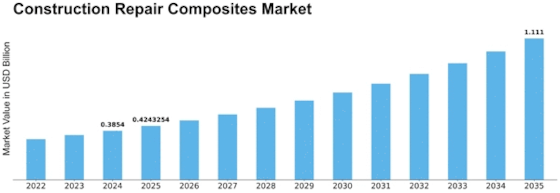
As of 2024, the market valuation stood at 0.3854 USD Billion.

What is the projected market size for the Construction Repair Composites Market by 2035?

The market is expected to reach a valuation of 1.111 USD Billion by 2035.

What is the expected CAGR for the Construction Repair Composites Market during the forecast period?

The market is projected to grow at a CAGR of 10.1% from 2025 to 2035.

Which companies are considered key players in the Construction Repair Composites Market?

Key players include Sika AG, BASF SE, 3M Company, Henkel AG & Co. KGaA, and others.

What are the primary fiber types used in the Construction Repair Composites Market?

The primary fiber types include Glass Fiber, Carbon Fiber, and others, with Glass Fiber valued at 0.5545 USD Billion in 2025.

How does the market perform in terms of resin types?

In 2025, Epoxy resin is projected to reach 0.611 USD Billion, indicating its dominance in the market.

Market Summary

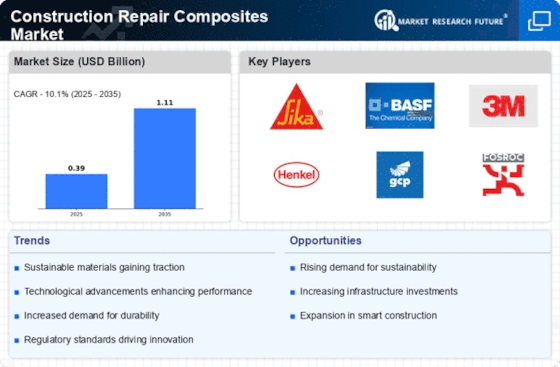
As per MRFR analysis, the Construction Repair Composites Market was estimated at 0.3854 USD Billion in 2024. The Construction Repair Composites industry is projected to grow from 0.4243 in 2025 to 1.111 by 2035, exhibiting a compound annual growth rate (CAGR) of 10.1 during the forecast period 2025 - 2035.

Key Market Trends & Highlights

The Construction Repair Composites Market is poised for growth driven by sustainability and technological advancements.

  • North America remains the largest market for construction repair composites, reflecting robust infrastructure needs.
  • Asia-Pacific is emerging as the fastest-growing region, fueled by rapid urbanization and infrastructure development.
  • Glass fiber composites dominate the market, while carbon fiber composites are witnessing the highest growth rates.
  • Sustainability in material selection and technological innovations are key drivers propelling market expansion.

Market Size & Forecast

2024 Market Size 0.3854 (USD Billion)
2035 Market Size 1.111 (USD Billion)
CAGR (2025 - 2035) 10.1%
Largest Regional Market Share in 2024 North America

Major Players

<p>Sika AG (CH), BASF SE (DE), 3M Company (US), Henkel AG & Co. KGaA (DE), GCP Applied Technologies Inc. (US), Fosroc International Ltd. (GB), Mapei S.p.A. (IT), Saint-Gobain S.A. (FR), Dow Inc. (US)</p>

Market Trends

The Construction Repair Composites Market is currently experiencing a notable evolution, driven by advancements in material science and increasing demand for durable, efficient repair solutions. This market encompasses a variety of composite materials designed to restore and enhance the structural integrity of buildings, bridges, and other infrastructures. As urbanization accelerates and aging infrastructure becomes a pressing concern, the need for innovative repair solutions appears to be growing. Furthermore, sustainability considerations are influencing material choices, with a shift towards eco-friendly composites that minimize environmental impact while maintaining performance standards. In addition, the Construction Repair Composites Market is likely to benefit from technological advancements that enhance the properties of repair materials. Innovations in resin formulations and fiber reinforcements may lead to composites that offer superior strength, flexibility, and resistance to environmental factors. This trend suggests a potential for increased adoption across various sectors, including residential, commercial, and industrial applications. As stakeholders seek to optimize repair processes and extend the lifespan of structures, the market is poised for continued growth, reflecting a broader commitment to infrastructure resilience and sustainability.

Sustainability in Material Selection

There is a growing emphasis on eco-friendly materials within the Construction Repair Composites Market. Stakeholders are increasingly prioritizing sustainable options that reduce environmental impact while ensuring durability and performance. This trend reflects a broader commitment to responsible construction practices.

Technological Advancements in Composites

Innovations in composite materials are transforming the Construction Repair Composites Market. Enhanced resin formulations and advanced fiber reinforcements are likely to improve the strength and flexibility of repair solutions, making them more effective for various applications.

Urbanization and Infrastructure Demand

The ongoing trend of urbanization is driving the need for effective repair solutions in the Construction Repair Composites Market. As cities expand and existing infrastructure ages, the demand for reliable repair composites is expected to increase, highlighting the importance of maintaining structural integrity.

Construction Repair Composites Market Market Drivers

Regulatory Standards and Compliance

Regulatory standards and compliance requirements are shaping the Construction Repair Composites Market. Governments and regulatory bodies are implementing stringent guidelines to ensure safety and sustainability in construction practices. These regulations often mandate the use of specific materials and techniques for repairs, thereby influencing market dynamics. Companies that adapt to these regulations by incorporating compliant composites are likely to gain a competitive edge. Recent data indicates that compliance-driven demand for construction repair composites is expected to rise, with a projected increase of 8% in market size as firms prioritize adherence to safety and environmental standards.

Rising Demand for Aesthetic Solutions

The rising demand for aesthetic solutions in construction is emerging as a notable driver for the Construction Repair Composites Market. As property owners and developers seek to enhance the visual appeal of structures, the need for repair composites that offer both functionality and aesthetic value is increasing. This trend is particularly relevant in residential and commercial sectors, where the appearance of materials can significantly impact property value. Industry expert's suggest that the segment focusing on aesthetic repair composites may experience a growth rate of approximately 10% in the next few years, reflecting a shift towards integrating design considerations in repair solutions.

Urbanization and Infrastructure Development

The rapid pace of urbanization and infrastructure development is a key driver for the Construction Repair Composites Market. As cities expand and aging infrastructure requires urgent repairs, the demand for effective repair solutions is surging. This trend is particularly evident in emerging economies, where urban populations are growing at unprecedented rates. The need for durable and efficient repair materials is critical to maintaining infrastructure integrity. Market analysis suggests that the construction repair composites segment could witness a growth rate of around 12% annually, driven by the increasing investments in infrastructure projects and the necessity for timely repairs.

Sustainability in Construction Repair Composites

The increasing emphasis on sustainability within the construction sector appears to drive the Construction Repair Composites Market. As environmental concerns gain prominence, construction companies are increasingly opting for eco-friendly materials that minimize environmental impact. This shift is reflected in the growing demand for composites that utilize recycled materials and have lower carbon footprints. According to recent data, the market for sustainable construction materials is projected to grow at a compound annual growth rate of over 10% in the coming years. This trend not only aligns with regulatory requirements but also appeals to environmentally conscious consumers, thereby enhancing the market potential for sustainable construction repair composites.

Technological Innovations in Composite Materials

Technological advancements in composite materials are significantly influencing the Construction Repair Composites Market. Innovations such as the development of high-performance resins and advanced fiber reinforcements are enhancing the durability and effectiveness of repair composites. These advancements enable construction professionals to address complex repair challenges more efficiently. For instance, the introduction of smart composites that can self-heal or respond to environmental changes is gaining traction. Market data indicates that the adoption of such innovative materials is expected to increase by approximately 15% over the next five years, reflecting a strong inclination towards integrating technology in construction repair solutions.

Market Segment Insights

By Fiber Type: Glass Fiber (Largest) vs. Carbon Fiber (Fastest-Growing)

<p>In the Construction Repair Composites Market, the Fiber Type segment is composed of various materials, with Glass Fiber commanding the largest share. This dominance can be attributed to its exceptional strength-to-weight ratio, durability, and cost-effectiveness, making it the preferred choice across a wide range of applications. Meanwhile, Carbon Fiber is emerging rapidly, capturing attention for its lightweight properties and high-performance capabilities, indicating a shift in preferences among manufacturers and consumers alike.</p>

<p>Glass Fiber (Dominant) vs. Carbon Fiber (Emerging)</p>

<p>Glass Fiber remains the dominant player in the Construction Repair Composites Market due to its widespread application in repair and reinforcement projects, thanks to its excellent mechanical properties and affordability. It is particularly favored in environments where corrosion resistance and weight savings are imperative. On the other hand, Carbon Fiber is recognized as an emerging alternative, known for its superior tensile strength and minimal weight, making it ideal for advanced structural applications. As industries seek more innovative materials to enhance performance and sustainability, Carbon Fiber is gaining traction despite its higher cost, positioning it as a strong competitor in the market.</p>

By Resin Type: Vinyl Ester (Largest) vs. Epoxy (Fastest-Growing)

<p>In the Construction Repair Composites Market, the ‘Resin Type’ segment exhibits a notable distribution among three key values: Vinyl Ester, Epoxy, and Others. Vinyl Ester currently dominates the market, thanks to its favorable properties and wide acceptance in various applications. On the other hand, Epoxy is quickly developing a significant presence, driven by increasing demand for high-performance composites in construction repair applications. The 'Others' segment trails with niche applications and varied resins.</p>

<p>Vinyl Ester (Dominant) vs. Epoxy (Emerging)</p>

<p>Vinyl Ester resin has established itself as the dominant resin type in the Construction Repair Composites Market owing to its superior corrosion resistance, durability, and versatility. It is preferred in applications that require significant chemical resistance and robustness, making it suitable for harsh environments. Conversely, Epoxy resin is emerging as a fast-growing segment due to its excellent adhesion, mechanical strength, and favorable curing properties, which have seen increased adoption in specialized repair projects. As the industry evolves, these two resin types will continue to shape the market, catering to diverse needs in construction repair.</p>

By Product Type: Textile / Fabric (Largest) vs. Mesh (Fastest-Growing)

<p>The Construction Repair Composites Market is witnessing diverse dynamics among its product types. Textile / Fabric composites hold the largest market share due to their widespread application in various repair and reinforcement tasks. This segment's versatility and ability to provide flexible solutions contribute to its prominence. In contrast, Mesh composites are emerging rapidly, capturing attention for their unique properties and ease of use, showcasing significant potential for growth in upcoming years.</p>

<p>Textile / Fabric (Dominant) vs. Mesh (Emerging)</p>

<p>Within the Construction Repair Composites Market, Textile / Fabric composites serve as the dominant segment due to their extensive application and adaptability in various construction scenarios. They are recognized for their strength, lightweight characteristics, and resistance to extreme conditions, making them a preferred choice for contractors. Conversely, the Mesh segment is emerging as a vital player, offering innovative solutions in structural reinforcement. Mesh composites are valued for their ease of installation and ability to enhance bonding in repairs, making them increasingly popular among construction professionals looking for efficient and reliable outcomes.</p>

By Application: Residential (Largest) vs. Commercial (Fastest-Growing)

<p>The construction repair composites market has a diverse application landscape with the residential segment holding the largest market share. This sector typically demands high-performance materials for repairs, driven by increasing construction activities and home renovation projects. In contrast, the commercial segment is rapidly gaining momentum due to an upsurge in infrastructure development and the need for durable and cost-effective repair solutions in commercial buildings, offices, and retail spaces.</p>

<p>Residential (Dominant) vs. Commercial (Emerging)</p>

<p>The residential segment is characterized by a strong preference for versatile and reliable repair composites that cater to a variety of needs, including home renovations and maintenance. Products in this category often emphasize aesthetics alongside structural integrity. Meanwhile, the commercial segment is emerging as a key player, driven by urbanization and increased spending on infrastructure. Commercial repair composites must meet stringent performance standards and durability requirements, making them more specialized than their residential counterparts, thus presenting opportunities for innovation and targeted product development.</p>

Get more detailed insights about Construction Repair Composites Market Research Report - Global Forecast 2035

Regional Insights

North America : Construction Innovation Leader

North America is the largest market for construction repair composites, holding approximately 40% of the global market share. The region's growth is driven by increasing infrastructure investments, stringent building codes, and a rising focus on sustainable construction practices. Regulatory catalysts, such as the Infrastructure Investment and Jobs Act, are further propelling demand for advanced repair solutions. The United States and Canada are the leading countries in this market, with major players like Sika AG, BASF SE, and 3M Company establishing a strong presence. The competitive landscape is characterized by innovation and strategic partnerships, as companies aim to enhance product offerings and meet the growing demand for durable and efficient repair composites. The focus on eco-friendly materials is also shaping market dynamics.

Europe : Regulatory-Driven Market Growth

Europe is the second-largest market for construction repair composites, accounting for approximately 30% of the global share. The region's growth is fueled by stringent environmental regulations and a strong emphasis on sustainability in construction. Initiatives like the European Green Deal are encouraging the adoption of innovative repair solutions that minimize environmental impact and enhance building longevity. Leading countries in this market include Germany, France, and the United Kingdom, where companies like BASF SE and Henkel AG & Co. KGaA are prominent. The competitive landscape is marked by a focus on research and development, with firms investing in advanced materials and technologies to meet regulatory standards and consumer preferences for sustainable products. This trend is expected to drive further growth in the coming years.

Asia-Pacific : Emerging Market Potential

Asia-Pacific is witnessing rapid growth in the construction repair composites market, holding approximately 25% of the global share. The region's expansion is driven by urbanization, increasing infrastructure projects, and a growing focus on building safety and durability. Government initiatives aimed at enhancing infrastructure are acting as significant demand catalysts, particularly in countries like China and India. China and India are the leading countries in this market, with a competitive landscape featuring key players such as Mapei S.p.A. and Fosroc International Ltd. The presence of these companies is bolstered by local partnerships and collaborations, enabling them to cater to the unique demands of the region. As the construction sector continues to grow, the demand for advanced repair composites is expected to rise significantly, driven by both residential and commercial projects.

Middle East and Africa : Resource-Rich Market Dynamics

The Middle East and Africa region is emerging as a significant market for construction repair composites, accounting for approximately 5% of the global share. The growth is primarily driven by increasing investments in infrastructure development and a rising focus on maintenance and repair of existing structures. Regulatory frameworks are evolving to support sustainable construction practices, further enhancing market potential. Leading countries in this region include the United Arab Emirates and South Africa, where companies like GCP Applied Technologies Inc. and Saint-Gobain S.A. are making strides. The competitive landscape is characterized by a mix of local and international players, with a focus on innovative solutions tailored to the region's unique environmental conditions. As construction activities ramp up, the demand for effective repair composites is expected to grow.

Key Players and Competitive Insights

Leading market players are putting a lot of money into R&D to expand their product line, which will help the Construction Repair Composites Market, grow even more. Additionally, market participants are engaging in a range of strategic initiatives to increase their worldwide reach, with important market developments such as the introduction of new products, contracts, mergers and acquisitions, increased investments, and cooperation with other organizations. To grow and endure in an increasingly competitive and challenging market environment, Construction Repair Composites industry must provide reasonably priced goods.

One of the main business strategies employed by manufacturers is to produce locally to reduce operational expenses in the Construction Repair Composites industry to develop market sector and provide benefits to customers. In recent years, the Construction Repair Composites industry has provided some of the most important benefits to the infrastructure sector. Major players in the Construction Repair Composites Market, including Sika AG, BASF SE, Arkema SA, Owens Corning, Saint-Gobain S.A., S&P Inc., DuPont de Nemours, Inc., Ashland Holdings Inc., Henkel AG & Co. KGaA, W.R.

Grace & Co., PPG Industries, Inc., Mapei S.p.A., and others, are attempting to increase market demand by investing in research and development operations.

Swiss multinational Sika AG, with its headquarters in Baar, provides speciality chemicals to the building and automotive industries. The business creates systems and goods for bonding, sealing, dampening, strengthening, and protecting. It currently has more than 33,000 workers, subsidiaries in more than 100 countries, and a CHF 10.5 billion annual sales turnover. Kaspar Winkler lay the company's foundational stone in 1910, establishing Sika as a result. After rising out of poverty to become a prosperous businessman, Winkler began establishing subsidiaries abroad during the 1920s.

In 2023, Sika purchased MBCC, a company with operations in 60 countries, 95 production facilities, 6,200 workers, and a 2022 revenue forecast of 2,100 million CHF.

Along with its six integrated manufacturing sites, BASF has 390 more production facilities across Europe, Asia, Australia, the Americas, and Africa. It also maintains joint ventures and subsidiaries in more than 80 countries. Over 190 nations are BASF's customers, and the business provides its products to numerous industries. The corporation, despite its size and reach, combined with a number of other German chemical firms to become the chemicals conglomerate IG Farben. The economic development of Nazi Germany was significantly influenced by IG Farben.

In 2019, the sale of BASF's ultra filtration membrane company, Inge GmbH, was negotiated with DuPont Safety & Construction, a DuPont Co. subsidiary business unit. Executives from BASF claim that Inge GmbH and its goods work better with DuPont and their corporate strategy.

Key Companies in the Construction Repair Composites Market market include

Industry Developments

October 2024

The construction repair composites market has experienced a lot of action thanks to manufacturers for performance improvement of the composites for tough applications such as bridges, silos and pipelines. Organizations are concentrating on the advancement of fiber reinforced polymers which is mostly in glass and carbon fibers which are the market leaders because of their high tensile strength and light weight.

September 2024

Owens Corning expanded its dominance in composites by introducing advanced repair solutions that integrate cutting-edge glass reinforcement technology. This strategic focus aims to meet the growing demand for durable and sustainable repair materials, particularly in infrastructure projects across North America.​

July 2024

The construction repair composites market has been witnessing speedy growth in the Asia-Pacific region led by the accelerating rate of urbanization and infrastructure development in countries such as China and India.

March 2024

One of the most important trends has been the development of epoxy resin systems for composite repairs since their application permits greater performance durability in high-performance uses. This trend aligns with the broader industry shift toward materials offering lower shrinkage and better mechanical resistance under extreme conditions, making them suitable for residential and commercial repairs​.

February 2024 The North American market has continued to innovate, with new product launches emphasizing sustainability and operational efficiency. Regional players utilise government support schemes to develop sustainable infrastructure as well as diversify their product and market range.

May 2022

Arkema highlighted a new composite and polymerin manufacturing technique that results in a more efficient composite that offers recyclability. The firm has been making strides in the formulation of green and recyclable chemicals.

August 2022

V2 Composites, an Australian company that provides carbon fiber reinforced polymer (CFRP) strengthening and repair systems, presented a modification of an already-existing T-Biscuit made of carbon fiber which shall become the norm in the future in repairing shear connectors flanged on double tee precast units in the parking structural system.

Future Outlook

Construction Repair Composites Market Future Outlook

<p>The Construction Repair Composites Market is projected to grow at a 10.1% CAGR from 2024 to 2035, driven by increasing infrastructure investments, technological advancements, and sustainability initiatives.</p>

New opportunities lie in:

  • <p>Development of eco-friendly composite materials for sustainable construction</p>
  • <p>Integration of smart technology in repair composites for real-time monitoring</p>
  • <p>Expansion of online platforms for direct-to-consumer sales of repair composites</p>

<p>By 2035, the market is expected to achieve robust growth, positioning itself as a leader in construction innovation.</p>

Market Segmentation

Construction Repair Composites Market Fiber Type Outlook

  • Glass Fiber
  • Carbon Fiber
  • Others

Construction Repair Composites Market Resin Type Outlook

  • Vinyl Ester
  • Epoxy
  • Others

Construction Repair Composites Market Application Outlook

  • Residential
  • Commercial
  • Bridge
  • Silo Flue Pipe
  • Oil & Natural Gas Pipeline
  • Water Structure
  • Industrial Structure
  • Others

Construction Repair Composites Market Product Type Outlook

  • Textile / Fabric
  • Plate
  • Rebar
  • Mesh
  • Adhesive

Report Scope

MARKET SIZE 20240.3854(USD Billion)
MARKET SIZE 20250.4243(USD Billion)
MARKET SIZE 20351.111(USD Billion)
COMPOUND ANNUAL GROWTH RATE (CAGR)10.1% (2024 - 2035)
REPORT COVERAGERevenue Forecast, Competitive Landscape, Growth Factors, and Trends
BASE YEAR2024
Market Forecast Period2025 - 2035
Historical Data2019 - 2024
Market Forecast UnitsUSD Billion
Key Companies ProfiledMarket analysis in progress
Segments CoveredMarket segmentation analysis in progress
Key Market OpportunitiesIntegration of advanced materials and sustainable practices in the Construction Repair Composites Market.
Key Market DynamicsRising demand for sustainable materials drives innovation in construction repair composites, enhancing performance and environmental compliance.
Countries CoveredNorth America, Europe, APAC, South America, MEA

FAQs

What is the current valuation of the Construction Repair Composites Market?

As of 2024, the market valuation stood at 0.3854 USD Billion.

What is the projected market size for the Construction Repair Composites Market by 2035?

The market is expected to reach a valuation of 1.111 USD Billion by 2035.

What is the expected CAGR for the Construction Repair Composites Market during the forecast period?

The market is projected to grow at a CAGR of 10.1% from 2025 to 2035.

Which companies are considered key players in the Construction Repair Composites Market?

Key players include Sika AG, BASF SE, 3M Company, Henkel AG & Co. KGaA, and others.

What are the primary fiber types used in the Construction Repair Composites Market?

The primary fiber types include Glass Fiber, Carbon Fiber, and others, with Glass Fiber valued at 0.5545 USD Billion in 2025.

How does the market perform in terms of resin types?

In 2025, Epoxy resin is projected to reach 0.611 USD Billion, indicating its dominance in the market.

  1. SECTION I: EXECUTIVE SUMMARY AND KEY HIGHLIGHTS
    1. EXECUTIVE SUMMARY
      1. Market Overview
      2. Key Findings
      3. Market Segmentation
      4. Competitive Landscape
      5. Challenges and Opportunities
      6. Future Outlook
  2. SECTION II: SCOPING, METHODOLOGY AND MARKET STRUCTURE
    1. MARKET INTRODUCTION
      1. Definition
      2. Scope of the study
    2. RESEARCH METHODOLOGY
      1. Overview
      2. Data Mining
      3. Secondary Research
      4. Primary Research
      5. Forecasting Model
      6. Market Size Estimation
      7. Data Triangulation
      8. Validation
  3. SECTION III: QUALITATIVE ANALYSIS
    1. MARKET DYNAMICS
      1. Overview
      2. Drivers
      3. Restraints
      4. Opportunities
    2. MARKET FACTOR ANALYSIS
      1. Value chain Analysis
      2. Porter's Five Forces Analysis
      3. COVID-19 Impact Analysis
  4. SECTION IV: QUANTITATIVE ANALYSIS
    1. Packaging & Transport, BY Fiber Type (USD Billion)
      1. Glass Fiber
      2. Carbon Fiber
      3. Others
    2. Packaging & Transport, BY Resin Type (USD Billion)
      1. Vinyl Ester
      2. Epoxy
      3. Others
    3. Packaging & Transport, BY Product Type (USD Billion)
      1. Textile / Fabric
      2. Plate
      3. Rebar
      4. Mesh
      5. Adhesive
    4. Packaging & Transport, BY Application (USD Billion)
      1. Residential
      2. Commercial
      3. Bridge
      4. Silo Flue Pipe
      5. Oil & Natural Gas Pipeline
      6. Water Structure
      7. Industrial Structure
      8. Others
    5. Packaging & Transport, BY Region (USD Billion)
      1. North America
      2. Europe
      3. APAC
      4. South America
      5. MEA
  5. SECTION V: COMPETITIVE ANALYSIS
    1. Competitive Landscape
      1. Overview
      2. Competitive Analysis
      3. Market share Analysis
      4. Major Growth Strategy in the Packaging & Transport
      5. Competitive Benchmarking
      6. Leading Players in Terms of Number of Developments in the Packaging & Transport
      7. Key developments and growth strategies
      8. Major Players Financial Matrix
    2. Company Profiles
      1. Sika AG (CH)
      2. BASF SE (DE)
      3. 3M Company (US)
      4. Henkel AG & Co. KGaA (DE)
      5. GCP Applied Technologies Inc. (US)
      6. Fosroc International Ltd. (GB)
      7. Mapei S.p.A. (IT)
      8. Saint-Gobain S.A. (FR)
      9. Dow Inc. (US)
    3. Appendix
      1. References
      2. Related Reports
  6. LIST OF FIGURES
    1. MARKET SYNOPSIS
    2. NORTH AMERICA MARKET ANALYSIS
    3. US MARKET ANALYSIS BY FIBER TYPE
    4. US MARKET ANALYSIS BY RESIN TYPE
    5. US MARKET ANALYSIS BY PRODUCT TYPE
    6. US MARKET ANALYSIS BY APPLICATION
    7. CANADA MARKET ANALYSIS BY FIBER TYPE
    8. CANADA MARKET ANALYSIS BY RESIN TYPE
    9. CANADA MARKET ANALYSIS BY PRODUCT TYPE
    10. CANADA MARKET ANALYSIS BY APPLICATION
    11. EUROPE MARKET ANALYSIS
    12. GERMANY MARKET ANALYSIS BY FIBER TYPE
    13. GERMANY MARKET ANALYSIS BY RESIN TYPE
    14. GERMANY MARKET ANALYSIS BY PRODUCT TYPE
    15. GERMANY MARKET ANALYSIS BY APPLICATION
    16. UK MARKET ANALYSIS BY FIBER TYPE
    17. UK MARKET ANALYSIS BY RESIN TYPE
    18. UK MARKET ANALYSIS BY PRODUCT TYPE
    19. UK MARKET ANALYSIS BY APPLICATION
    20. FRANCE MARKET ANALYSIS BY FIBER TYPE
    21. FRANCE MARKET ANALYSIS BY RESIN TYPE
    22. FRANCE MARKET ANALYSIS BY PRODUCT TYPE
    23. FRANCE MARKET ANALYSIS BY APPLICATION
    24. RUSSIA MARKET ANALYSIS BY FIBER TYPE
    25. RUSSIA MARKET ANALYSIS BY RESIN TYPE
    26. RUSSIA MARKET ANALYSIS BY PRODUCT TYPE
    27. RUSSIA MARKET ANALYSIS BY APPLICATION
    28. ITALY MARKET ANALYSIS BY FIBER TYPE
    29. ITALY MARKET ANALYSIS BY RESIN TYPE
    30. ITALY MARKET ANALYSIS BY PRODUCT TYPE
    31. ITALY MARKET ANALYSIS BY APPLICATION
    32. SPAIN MARKET ANALYSIS BY FIBER TYPE
    33. SPAIN MARKET ANALYSIS BY RESIN TYPE
    34. SPAIN MARKET ANALYSIS BY PRODUCT TYPE
    35. SPAIN MARKET ANALYSIS BY APPLICATION
    36. REST OF EUROPE MARKET ANALYSIS BY FIBER TYPE
    37. REST OF EUROPE MARKET ANALYSIS BY RESIN TYPE
    38. REST OF EUROPE MARKET ANALYSIS BY PRODUCT TYPE
    39. REST OF EUROPE MARKET ANALYSIS BY APPLICATION
    40. APAC MARKET ANALYSIS
    41. CHINA MARKET ANALYSIS BY FIBER TYPE
    42. CHINA MARKET ANALYSIS BY RESIN TYPE
    43. CHINA MARKET ANALYSIS BY PRODUCT TYPE
    44. CHINA MARKET ANALYSIS BY APPLICATION
    45. INDIA MARKET ANALYSIS BY FIBER TYPE
    46. INDIA MARKET ANALYSIS BY RESIN TYPE
    47. INDIA MARKET ANALYSIS BY PRODUCT TYPE
    48. INDIA MARKET ANALYSIS BY APPLICATION
    49. JAPAN MARKET ANALYSIS BY FIBER TYPE
    50. JAPAN MARKET ANALYSIS BY RESIN TYPE
    51. JAPAN MARKET ANALYSIS BY PRODUCT TYPE
    52. JAPAN MARKET ANALYSIS BY APPLICATION
    53. SOUTH KOREA MARKET ANALYSIS BY FIBER TYPE
    54. SOUTH KOREA MARKET ANALYSIS BY RESIN TYPE
    55. SOUTH KOREA MARKET ANALYSIS BY PRODUCT TYPE
    56. SOUTH KOREA MARKET ANALYSIS BY APPLICATION
    57. MALAYSIA MARKET ANALYSIS BY FIBER TYPE
    58. MALAYSIA MARKET ANALYSIS BY RESIN TYPE
    59. MALAYSIA MARKET ANALYSIS BY PRODUCT TYPE
    60. MALAYSIA MARKET ANALYSIS BY APPLICATION
    61. THAILAND MARKET ANALYSIS BY FIBER TYPE
    62. THAILAND MARKET ANALYSIS BY RESIN TYPE
    63. THAILAND MARKET ANALYSIS BY PRODUCT TYPE
    64. THAILAND MARKET ANALYSIS BY APPLICATION
    65. INDONESIA MARKET ANALYSIS BY FIBER TYPE
    66. INDONESIA MARKET ANALYSIS BY RESIN TYPE
    67. INDONESIA MARKET ANALYSIS BY PRODUCT TYPE
    68. INDONESIA MARKET ANALYSIS BY APPLICATION
    69. REST OF APAC MARKET ANALYSIS BY FIBER TYPE
    70. REST OF APAC MARKET ANALYSIS BY RESIN TYPE
    71. REST OF APAC MARKET ANALYSIS BY PRODUCT TYPE
    72. REST OF APAC MARKET ANALYSIS BY APPLICATION
    73. SOUTH AMERICA MARKET ANALYSIS
    74. BRAZIL MARKET ANALYSIS BY FIBER TYPE
    75. BRAZIL MARKET ANALYSIS BY RESIN TYPE
    76. BRAZIL MARKET ANALYSIS BY PRODUCT TYPE
    77. BRAZIL MARKET ANALYSIS BY APPLICATION
    78. MEXICO MARKET ANALYSIS BY FIBER TYPE
    79. MEXICO MARKET ANALYSIS BY RESIN TYPE
    80. MEXICO MARKET ANALYSIS BY PRODUCT TYPE
    81. MEXICO MARKET ANALYSIS BY APPLICATION
    82. ARGENTINA MARKET ANALYSIS BY FIBER TYPE
    83. ARGENTINA MARKET ANALYSIS BY RESIN TYPE
    84. ARGENTINA MARKET ANALYSIS BY PRODUCT TYPE
    85. ARGENTINA MARKET ANALYSIS BY APPLICATION
    86. REST OF SOUTH AMERICA MARKET ANALYSIS BY FIBER TYPE
    87. REST OF SOUTH AMERICA MARKET ANALYSIS BY RESIN TYPE
    88. REST OF SOUTH AMERICA MARKET ANALYSIS BY PRODUCT TYPE
    89. REST OF SOUTH AMERICA MARKET ANALYSIS BY APPLICATION
    90. MEA MARKET ANALYSIS
    91. GCC COUNTRIES MARKET ANALYSIS BY FIBER TYPE
    92. GCC COUNTRIES MARKET ANALYSIS BY RESIN TYPE
    93. GCC COUNTRIES MARKET ANALYSIS BY PRODUCT TYPE
    94. GCC COUNTRIES MARKET ANALYSIS BY APPLICATION
    95. SOUTH AFRICA MARKET ANALYSIS BY FIBER TYPE
    96. SOUTH AFRICA MARKET ANALYSIS BY RESIN TYPE
    97. SOUTH AFRICA MARKET ANALYSIS BY PRODUCT TYPE
    98. SOUTH AFRICA MARKET ANALYSIS BY APPLICATION
    99. REST OF MEA MARKET ANALYSIS BY FIBER TYPE
    100. REST OF MEA MARKET ANALYSIS BY RESIN TYPE
    101. REST OF MEA MARKET ANALYSIS BY PRODUCT TYPE
    102. REST OF MEA MARKET ANALYSIS BY APPLICATION
    103. KEY BUYING CRITERIA OF PACKAGING & TRANSPORT
    104. RESEARCH PROCESS OF MRFR
    105. DRO ANALYSIS OF PACKAGING & TRANSPORT
    106. DRIVERS IMPACT ANALYSIS: PACKAGING & TRANSPORT
    107. RESTRAINTS IMPACT ANALYSIS: PACKAGING & TRANSPORT
    108. SUPPLY / VALUE CHAIN: PACKAGING & TRANSPORT
    109. PACKAGING & TRANSPORT, BY FIBER TYPE, 2024 (% SHARE)
    110. PACKAGING & TRANSPORT, BY FIBER TYPE, 2024 TO 2035 (USD Billion)
    111. PACKAGING & TRANSPORT, BY RESIN TYPE, 2024 (% SHARE)
    112. PACKAGING & TRANSPORT, BY RESIN TYPE, 2024 TO 2035 (USD Billion)
    113. PACKAGING & TRANSPORT, BY PRODUCT TYPE, 2024 (% SHARE)
    114. PACKAGING & TRANSPORT, BY PRODUCT TYPE, 2024 TO 2035 (USD Billion)
    115. PACKAGING & TRANSPORT, BY APPLICATION, 2024 (% SHARE)
    116. PACKAGING & TRANSPORT, BY APPLICATION, 2024 TO 2035 (USD Billion)
    117. BENCHMARKING OF MAJOR COMPETITORS
  7. LIST OF TABLES
    1. LIST OF ASSUMPTIONS
    2. North America MARKET SIZE ESTIMATES; FORECAST
      1. BY FIBER TYPE, 2025-2035 (USD Billion)
      2. BY RESIN TYPE, 2025-2035 (USD Billion)
      3. BY PRODUCT TYPE, 2025-2035 (USD Billion)
      4. BY APPLICATION, 2025-2035 (USD Billion)
    3. US MARKET SIZE ESTIMATES; FORECAST
      1. BY FIBER TYPE, 2025-2035 (USD Billion)
      2. BY RESIN TYPE, 2025-2035 (USD Billion)
      3. BY PRODUCT TYPE, 2025-2035 (USD Billion)
      4. BY APPLICATION, 2025-2035 (USD Billion)
    4. Canada MARKET SIZE ESTIMATES; FORECAST
      1. BY FIBER TYPE, 2025-2035 (USD Billion)
      2. BY RESIN TYPE, 2025-2035 (USD Billion)
      3. BY PRODUCT TYPE, 2025-2035 (USD Billion)
      4. BY APPLICATION, 2025-2035 (USD Billion)
    5. Europe MARKET SIZE ESTIMATES; FORECAST
      1. BY FIBER TYPE, 2025-2035 (USD Billion)
      2. BY RESIN TYPE, 2025-2035 (USD Billion)
      3. BY PRODUCT TYPE, 2025-2035 (USD Billion)
      4. BY APPLICATION, 2025-2035 (USD Billion)
    6. Germany MARKET SIZE ESTIMATES; FORECAST
      1. BY FIBER TYPE, 2025-2035 (USD Billion)
      2. BY RESIN TYPE, 2025-2035 (USD Billion)
      3. BY PRODUCT TYPE, 2025-2035 (USD Billion)
      4. BY APPLICATION, 2025-2035 (USD Billion)
    7. UK MARKET SIZE ESTIMATES; FORECAST
      1. BY FIBER TYPE, 2025-2035 (USD Billion)
      2. BY RESIN TYPE, 2025-2035 (USD Billion)
      3. BY PRODUCT TYPE, 2025-2035 (USD Billion)
      4. BY APPLICATION, 2025-2035 (USD Billion)
    8. France MARKET SIZE ESTIMATES; FORECAST
      1. BY FIBER TYPE, 2025-2035 (USD Billion)
      2. BY RESIN TYPE, 2025-2035 (USD Billion)
      3. BY PRODUCT TYPE, 2025-2035 (USD Billion)
      4. BY APPLICATION, 2025-2035 (USD Billion)
    9. Russia MARKET SIZE ESTIMATES; FORECAST
      1. BY FIBER TYPE, 2025-2035 (USD Billion)
      2. BY RESIN TYPE, 2025-2035 (USD Billion)
      3. BY PRODUCT TYPE, 2025-2035 (USD Billion)
      4. BY APPLICATION, 2025-2035 (USD Billion)
    10. Italy MARKET SIZE ESTIMATES; FORECAST
      1. BY FIBER TYPE, 2025-2035 (USD Billion)
      2. BY RESIN TYPE, 2025-2035 (USD Billion)
      3. BY PRODUCT TYPE, 2025-2035 (USD Billion)
      4. BY APPLICATION, 2025-2035 (USD Billion)
    11. Spain MARKET SIZE ESTIMATES; FORECAST
      1. BY FIBER TYPE, 2025-2035 (USD Billion)
      2. BY RESIN TYPE, 2025-2035 (USD Billion)
      3. BY PRODUCT TYPE, 2025-2035 (USD Billion)
      4. BY APPLICATION, 2025-2035 (USD Billion)
    12. Rest of Europe MARKET SIZE ESTIMATES; FORECAST
      1. BY FIBER TYPE, 2025-2035 (USD Billion)
      2. BY RESIN TYPE, 2025-2035 (USD Billion)
      3. BY PRODUCT TYPE, 2025-2035 (USD Billion)
      4. BY APPLICATION, 2025-2035 (USD Billion)
    13. APAC MARKET SIZE ESTIMATES; FORECAST
      1. BY FIBER TYPE, 2025-2035 (USD Billion)
      2. BY RESIN TYPE, 2025-2035 (USD Billion)
      3. BY PRODUCT TYPE, 2025-2035 (USD Billion)
      4. BY APPLICATION, 2025-2035 (USD Billion)
    14. China MARKET SIZE ESTIMATES; FORECAST
      1. BY FIBER TYPE, 2025-2035 (USD Billion)
      2. BY RESIN TYPE, 2025-2035 (USD Billion)
      3. BY PRODUCT TYPE, 2025-2035 (USD Billion)
      4. BY APPLICATION, 2025-2035 (USD Billion)
    15. India MARKET SIZE ESTIMATES; FORECAST
      1. BY FIBER TYPE, 2025-2035 (USD Billion)
      2. BY RESIN TYPE, 2025-2035 (USD Billion)
      3. BY PRODUCT TYPE, 2025-2035 (USD Billion)
      4. BY APPLICATION, 2025-2035 (USD Billion)
    16. Japan MARKET SIZE ESTIMATES; FORECAST
      1. BY FIBER TYPE, 2025-2035 (USD Billion)
      2. BY RESIN TYPE, 2025-2035 (USD Billion)
      3. BY PRODUCT TYPE, 2025-2035 (USD Billion)
      4. BY APPLICATION, 2025-2035 (USD Billion)
    17. South Korea MARKET SIZE ESTIMATES; FORECAST
      1. BY FIBER TYPE, 2025-2035 (USD Billion)
      2. BY RESIN TYPE, 2025-2035 (USD Billion)
      3. BY PRODUCT TYPE, 2025-2035 (USD Billion)
      4. BY APPLICATION, 2025-2035 (USD Billion)
    18. Malaysia MARKET SIZE ESTIMATES; FORECAST
      1. BY FIBER TYPE, 2025-2035 (USD Billion)
      2. BY RESIN TYPE, 2025-2035 (USD Billion)
      3. BY PRODUCT TYPE, 2025-2035 (USD Billion)
      4. BY APPLICATION, 2025-2035 (USD Billion)
    19. Thailand MARKET SIZE ESTIMATES; FORECAST
      1. BY FIBER TYPE, 2025-2035 (USD Billion)
      2. BY RESIN TYPE, 2025-2035 (USD Billion)
      3. BY PRODUCT TYPE, 2025-2035 (USD Billion)
      4. BY APPLICATION, 2025-2035 (USD Billion)
    20. Indonesia MARKET SIZE ESTIMATES; FORECAST
      1. BY FIBER TYPE, 2025-2035 (USD Billion)
      2. BY RESIN TYPE, 2025-2035 (USD Billion)
      3. BY PRODUCT TYPE, 2025-2035 (USD Billion)
      4. BY APPLICATION, 2025-2035 (USD Billion)
    21. Rest of APAC MARKET SIZE ESTIMATES; FORECAST
      1. BY FIBER TYPE, 2025-2035 (USD Billion)
      2. BY RESIN TYPE, 2025-2035 (USD Billion)
      3. BY PRODUCT TYPE, 2025-2035 (USD Billion)
      4. BY APPLICATION, 2025-2035 (USD Billion)
    22. South America MARKET SIZE ESTIMATES; FORECAST
      1. BY FIBER TYPE, 2025-2035 (USD Billion)
      2. BY RESIN TYPE, 2025-2035 (USD Billion)
      3. BY PRODUCT TYPE, 2025-2035 (USD Billion)
      4. BY APPLICATION, 2025-2035 (USD Billion)
    23. Brazil MARKET SIZE ESTIMATES; FORECAST
      1. BY FIBER TYPE, 2025-2035 (USD Billion)
      2. BY RESIN TYPE, 2025-2035 (USD Billion)
      3. BY PRODUCT TYPE, 2025-2035 (USD Billion)
      4. BY APPLICATION, 2025-2035 (USD Billion)
    24. Mexico MARKET SIZE ESTIMATES; FORECAST
      1. BY FIBER TYPE, 2025-2035 (USD Billion)
      2. BY RESIN TYPE, 2025-2035 (USD Billion)
      3. BY PRODUCT TYPE, 2025-2035 (USD Billion)
      4. BY APPLICATION, 2025-2035 (USD Billion)
    25. Argentina MARKET SIZE ESTIMATES; FORECAST
      1. BY FIBER TYPE, 2025-2035 (USD Billion)
      2. BY RESIN TYPE, 2025-2035 (USD Billion)
      3. BY PRODUCT TYPE, 2025-2035 (USD Billion)
      4. BY APPLICATION, 2025-2035 (USD Billion)
    26. Rest of South America MARKET SIZE ESTIMATES; FORECAST
      1. BY FIBER TYPE, 2025-2035 (USD Billion)
      2. BY RESIN TYPE, 2025-2035 (USD Billion)
      3. BY PRODUCT TYPE, 2025-2035 (USD Billion)
      4. BY APPLICATION, 2025-2035 (USD Billion)
    27. MEA MARKET SIZE ESTIMATES; FORECAST
      1. BY FIBER TYPE, 2025-2035 (USD Billion)
      2. BY RESIN TYPE, 2025-2035 (USD Billion)
      3. BY PRODUCT TYPE, 2025-2035 (USD Billion)
      4. BY APPLICATION, 2025-2035 (USD Billion)
    28. GCC Countries MARKET SIZE ESTIMATES; FORECAST
      1. BY FIBER TYPE, 2025-2035 (USD Billion)
      2. BY RESIN TYPE, 2025-2035 (USD Billion)
      3. BY PRODUCT TYPE, 2025-2035 (USD Billion)
      4. BY APPLICATION, 2025-2035 (USD Billion)
    29. South Africa MARKET SIZE ESTIMATES; FORECAST
      1. BY FIBER TYPE, 2025-2035 (USD Billion)
      2. BY RESIN TYPE, 2025-2035 (USD Billion)
      3. BY PRODUCT TYPE, 2025-2035 (USD Billion)
      4. BY APPLICATION, 2025-2035 (USD Billion)
    30. Rest of MEA MARKET SIZE ESTIMATES; FORECAST
      1. BY FIBER TYPE, 2025-2035 (USD Billion)
      2. BY RESIN TYPE, 2025-2035 (USD Billion)
      3. BY PRODUCT TYPE, 2025-2035 (USD Billion)
      4. BY APPLICATION, 2025-2035 (USD Billion)
    31. PRODUCT LAUNCH/PRODUCT DEVELOPMENT/APPROVAL
    32. ACQUISITION/PARTNERSHIP


Construction Repair Composites Market Segmentation

Construction Repair Composites Fiber Type Outlook (USD Billion, 2018-2032)

  • Glass Fiber
  • Carbon Fiber
  • Others

Construction Repair Composites Resin Type Outlook (USD Billion, 2018-2032)

  • Vinyl Easter
  • Epoxy
  • Others

Construction Repair Composites Product Type Outlook (USD Billion, 2018-2032)

  • Textile / Fabric
  • Plate
  • Rebar
  • Mesh
  • Adhesive

Construction Repair Composites Application Outlook (USD Billion, 2018-2032)

  • Residential
  • Commercial
  • Bridge
  • Silo Flue Pipe
  • Oil & Natural Gas Pipe line
  • Water Structure
  • Industrial Structure
  • Others

Construction Repair Composites Regional Outlook (USD Billion, 2018-2032)

  • North AmericaOutlook (USD Billion, 2018-2032)

    • North America Construction Repair Composites by Fiber Type
      • Glass Fiber
      • Carbon Fiber
      • Others
    • North America Construction Repair Composites by Resin Type
      • Vinyl Easter
      • Epoxy
      • Others
    • North America Construction Repair Composites by Product Type
      • Textile / Fabric
      • Plate
      • Rebar
      • Mesh
      • Adhesive
    • North America Construction Repair Composites by Application
      • Residential
      • Commercial
      • Bridge
      • Silo Flue Pipe
      • Oil & Natural Gas Pipe line
      • Water Structure
      • Industrial Structure
      • Others
    • US Outlook (USD Billion, 2018-2032)

    • US Construction Repair Composites by Fiber Type
      • Glass Fiber
      • Carbon Fiber
      • Others
    • US Construction Repair Composites by Resin Type
      • Vinyl Easter
      • Epoxy
      • Others
    • US Construction Repair Composites by Product Type
      • Textile / Fabric
      • Plate
      • Rebar
      • Mesh
      • Adhesive
    • US Construction Repair Composites by Application
      • Residential
      • Commercial
      • Bridge
      • Silo Flue Pipe
      • Oil & Natural Gas Pipe line
      • Water Structure
      • Industrial Structure
      • Others
    • CANADA Outlook (USD Billion, 2018-2032)

    • CANADA Construction Repair Composites by Fiber Type
      • Glass Fiber
      • Carbon Fiber
      • Others
    • CANADA Construction Repair Composites by Resin Type
      • Vinyl Easter
      • Epoxy
      • Others
    • CANADA Construction Repair Composites by Product Type
      • Textile / Fabric
      • Plate
      • Rebar
      • Mesh
      • Adhesive
    • CANADA Construction Repair Composites by Application
      • Residential
      • Commercial
      • Bridge
      • Silo Flue Pipe
      • Oil & Natural Gas Pipe line
      • Water Structure
      • Industrial Structure
      • Others
  • Europe Outlook (USD Billion, 2018-2032)

    • Europe Construction Repair Composites by Fiber Type
      • Glass Fiber
      • Carbon Fiber
      • Others
    • Europe Construction Repair Composites by Resin Type
      • Vinyl Easter
      • Epoxy
      • Others
    • Europe Construction Repair Composites by Product Type
      • Textile / Fabric
      • Plate
      • Rebar
      • Mesh
      • Adhesive
    • Europe Construction Repair Composites by Application
      • Residential
      • Commercial
      • Bridge
      • Silo Flue Pipe
      • Oil & Natural Gas Pipe line
      • Water Structure
      • Industrial Structure
      • Others
    • Germany Outlook (USD Billion, 2018-2032)

    • Germany Construction Repair Composites by Fiber Type
      • Glass Fiber
      • Carbon Fiber
      • Others
    • Germany Construction Repair Composites by Resin Type
      • Vinyl Easter
      • Epoxy
      • Others
    • Germany Construction Repair Composites by Product Type
      • Textile / Fabric
      • Plate
      • Rebar
      • Mesh
      • Adhesive
    • Germany Construction Repair Composites by Application
      • Residential
      • Commercial
      • Bridge
      • Silo Flue Pipe
      • Oil & Natural Gas Pipe line
      • Water Structure
      • Industrial Structure
      • Others
    • France Outlook (USD Billion, 2018-2032)

    • France Construction Repair Composites by Fiber Type
      • Glass Fiber
      • Carbon Fiber
      • Others
    • France Construction Repair Composites by Resin Type
      • Vinyl Easter
      • Epoxy
      • Others
    • France Construction Repair Composites by Product Type
      • Textile / Fabric
      • Plate
      • Rebar
      • Mesh
      • Adhesive
    • France Construction Repair Composites by Application
      • Residential
      • Commercial
      • Bridge
      • Silo Flue Pipe
      • Oil & Natural Gas Pipe line
      • Water Structure
      • Industrial Structure
      • Others
    • UK Outlook (USD Billion, 2018-2032)

    • UK Construction Repair Composites by Fiber Type
      • Glass Fiber
      • Carbon Fiber
      • Others
    • UK Construction Repair Composites by Resin Type
      • Vinyl Easter
      • Epoxy
      • Others
    • UK Construction Repair Composites by Product Type
      • Textile / Fabric
      • Plate
      • Rebar
      • Mesh
      • Adhesive
    • UK Construction Repair Composites by Application
      • Residential
      • Commercial
      • Bridge
      • Silo Flue Pipe
      • Oil & Natural Gas Pipe line
      • Water Structure
      • Industrial Structure
      • Others
    • ITALY Outlook (USD Billion, 2018-2032)

    • ITALY Construction Repair Composites by Fiber Type
      • Glass Fiber
      • Carbon Fiber
      • Others
    • ITALY Construction Repair Composites by Resin Type
      • Vinyl Easter
      • Epoxy
      • Others
    • ITALY Construction Repair Composites by Product Type
      • Textile / Fabric
      • Plate
      • Rebar
      • Mesh
      • Adhesive
    • ITALY Construction Repair Composites by Application
      • Residential
      • Commercial
      • Bridge
      • Silo Flue Pipe
      • Oil & Natural Gas Pipe line
      • Water Structure
      • Industrial Structure
      • Others
    • SPAIN Outlook (USD Billion, 2018-2032)

    • Spain Construction Repair Composites by Fiber Type
      • Glass Fiber
      • Carbon Fiber
      • Others
    • Spain Construction Repair Composites by Resin Type
      • Vinyl Easter
      • Epoxy
      • Others
    • Spain Construction Repair Composites by Product Type
      • Textile / Fabric
      • Plate
      • Rebar
      • Mesh
      • Adhesive
    • Spain Construction Repair Composites by Application
      • Residential
      • Commercial
      • Bridge
      • Silo Flue Pipe
      • Oil & Natural Gas Pipe line
      • Water Structure
      • Industrial Structure
      • Others
    • Rest Of Europe Outlook (USD Billion, 2018-2032)

    • Rest Of Europe Construction Repair Composites by Fiber Type
      • Glass Fiber
      • Carbon Fiber
      • Others
    • REST OF EUROPE Construction Repair Composites by Resin Type
      • Vinyl Easter
      • Epoxy
      • Others
    • REST OF EUROPE Construction Repair Composites by Product Type
      • Textile / Fabric
      • Plate
      • Rebar
      • Mesh
      • Adhesive
    • REST OF EUROPE Construction Repair Composites by Application
      • Residential
      • Commercial
      • Bridge
      • Silo Flue Pipe
      • Oil & Natural Gas Pipe line
      • Water Structure
      • Industrial Structure
      • Others
  • Asia-Pacific Outlook (USD Billion, 2018-2032)

    • Asia-Pacific Construction Repair Composites by Fiber Type
      • Glass Fiber
      • Carbon Fiber
      • Others
    • Asia-Pacific Construction Repair Composites by Resin Type
      • Vinyl Easter
      • Epoxy
      • Others
    • Asia-Pacific Construction Repair Composites by Product Type
      • Textile / Fabric
      • Plate
      • Rebar
      • Mesh
      • Adhesive
    • Asia-Pacific Construction Repair Composites by Application
      • Residential
      • Commercial
      • Bridge
      • Silo Flue Pipe
      • Oil & Natural Gas Pipe line
      • Water Structure
      • Industrial Structure
      • Others
    • China Outlook (USD Billion, 2018-2032)

    • China Construction Repair Composites by Fiber Type
      • Glass Fiber
      • Carbon Fiber
      • Others
    • China Construction Repair Composites by Resin Type
      • Vinyl Easter
      • Epoxy
      • Others
    • China Construction Repair Composites by Product Type
      • Textile / Fabric
      • Plate
      • Rebar
      • Mesh
      • Adhesive
    • China Construction Repair Composites by Application
      • Residential
      • Commercial
      • Bridge
      • Silo Flue Pipe
      • Oil & Natural Gas Pipe line
      • Water Structure
      • Industrial Structure
      • Others
    • Japan Outlook (USD Billion, 2018-2032)

    • Japan Construction Repair Composites by Fiber Type
      • Glass Fiber
      • Carbon Fiber
      • Others
    • Japan Construction Repair Composites by Resin Type
      • Vinyl Easter
      • Epoxy
      • Others
    • Japan Construction Repair Composites by Product Type
      • Textile / Fabric
      • Plate
      • Rebar
      • Mesh
      • Adhesive
    • Japan Construction Repair Composites by Application
      • Residential
      • Commercial
      • Bridge
      • Silo Flue Pipe
      • Oil & Natural Gas Pipe line
      • Water Structure
      • Industrial Structure
      • Others
    • India Outlook (USD Billion, 2018-2032)

    • India Construction Repair Composites by Fiber Type
      • Glass Fiber
      • Carbon Fiber
      • Others
    • India Construction Repair Composites by Resin Type
      • Vinyl Easter
      • Epoxy
      • Others
    • India Construction Repair Composites by Product Type
      • Textile / Fabric
      • Plate
      • Rebar
      • Mesh
      • Adhesive
    • India Construction Repair Composites by Application
      • Residential
      • Commercial
      • Bridge
      • Silo Flue Pipe
      • Oil & Natural Gas Pipe line
      • Water Structure
      • Industrial Structure
      • Others
    • Australia Outlook (USD Billion, 2018-2032)

    • Australia Construction Repair Composites by Fiber Type
      • Glass Fiber
      • Carbon Fiber
      • Others
    • Australia Construction Repair Composites by Resin Type
      • Vinyl Easter
      • Epoxy
      • Others
    • Australia Construction Repair Composites by Product Type
      • Textile / Fabric
      • Plate
      • Rebar
      • Mesh
      • Adhesive
    • Australia Construction Repair Composites by Application
      • Residential
      • Commercial
      • Bridge
      • Silo Flue Pipe
      • Oil & Natural Gas Pipe line
      • Water Structure
      • Industrial Structure
      • Others
    • Rest of Asia-Pacific Outlook (USD Billion, 2018-2032)

    • Rest of Asia-Pacific Construction Repair Composites by Fiber Type
      • Glass Fiber
      • Carbon Fiber
      • Others
    • Rest of Asia-Pacific Construction Repair Composites by Resin Type
      • Vinyl Easter
      • Epoxy
      • Others
    • Rest of Asia-Pacific Construction Repair Composites by Product Type
      • Textile / Fabric
      • Plate
      • Rebar
      • Mesh
      • Adhesive
    • Rest of Asia-Pacific Construction Repair Composites by Application
      • Residential
      • Commercial
      • Bridge
      • Silo Flue Pipe
      • Oil & Natural Gas Pipe line
      • Water Structure
      • Industrial Structure
      • Others
  • Rest of the World Outlook (USD Billion, 2018-2032)

    • Rest of the World Construction Repair Composites by Fiber Type
      • Glass Fiber
      • Carbon Fiber
      • Others
    • Rest of the World Construction Repair Composites by Resin Type
      • Vinyl Easter
      • Epoxy
      • Others
    • Rest of the World Construction Repair Composites by Product Type
      • Textile / Fabric
      • Plate
      • Rebar
      • Mesh
      • Adhesive
    • Rest of the World Construction Repair Composites by Application
      • Residential
      • Commercial
      • Bridge
      • Silo Flue Pipe
      • Oil & Natural Gas Pipe line
      • Water Structure
      • Industrial Structure
      • Others
    • Middle East Outlook (USD Billion, 2018-2032)

    • Middle East Construction Repair Composites by Fiber Type
      • Glass Fiber
      • Carbon Fiber
      • Others
    • Middle East Construction Repair Composites by Resin Type
      • Vinyl Easter
      • Epoxy
      • Others
    • Middle East Construction Repair Composites by Product Type
      • Textile / Fabric
      • Plate
      • Rebar
      • Mesh
      • Adhesive
    • Middle East Construction Repair Composites by Application
      • Residential
      • Commercial
      • Bridge
      • Silo Flue Pipe
      • Oil & Natural Gas Pipe line
      • Water Structure
      • Industrial Structure
      • Others
    • Africa Outlook (USD Billion, 2018-2032)

    • Africa Construction Repair Composites by Fiber Type
      • Glass Fiber
      • Carbon Fiber
      • Others
    • Africa Construction Repair Composites by Resin Type
      • Vinyl Easter
      • Epoxy
      • Others
    • Africa Construction Repair Composites by Product Type
      • Textile / Fabric
      • Plate
      • Rebar
      • Mesh
      • Adhesive
    • Africa Construction Repair Composites by Application
      • Residential
      • Commercial
      • Bridge
      • Silo Flue Pipe
      • Oil & Natural Gas Pipe line
      • Water Structure
      • Industrial Structure
      • Others
    • Latin America Outlook (USD Billion, 2018-2032)

    • Latin America Construction Repair Composites by Fiber Type
      • Glass Fiber
      • Carbon Fiber
      • Others
    • Latin America Construction Repair Composites by Resin Type
      • Vinyl Easter
      • Epoxy
      • Others
    • Latin America Construction Repair Composites by Product Type
      • Textile / Fabric
      • Plate
      • Rebar
      • Mesh
      • Adhesive
    • Latin America Construction Repair Composites by Application
      • Residential
      • Commercial
      • Bridge
      • Silo Flue Pipe
      • Oil & Natural Gas Pipe line
      • Water Structure
      • Industrial Structure
      • Others
Infographic

Free Sample Request

Kindly complete the form below to receive a free sample of this Report

Get Free Sample

Customer Strories

Compare Licence

×
Features License Type
Single User Multiuser License Enterprise User
Price $4,950 $5,950 $7,250
Maximum User Access Limit 1 User Upto 10 Users Unrestricted Access Throughout the Organization
Free Customization
Direct Access to Analyst
Deliverable Format
Platform Access
Discount on Next Purchase 10% 15% 15%
Printable Versions