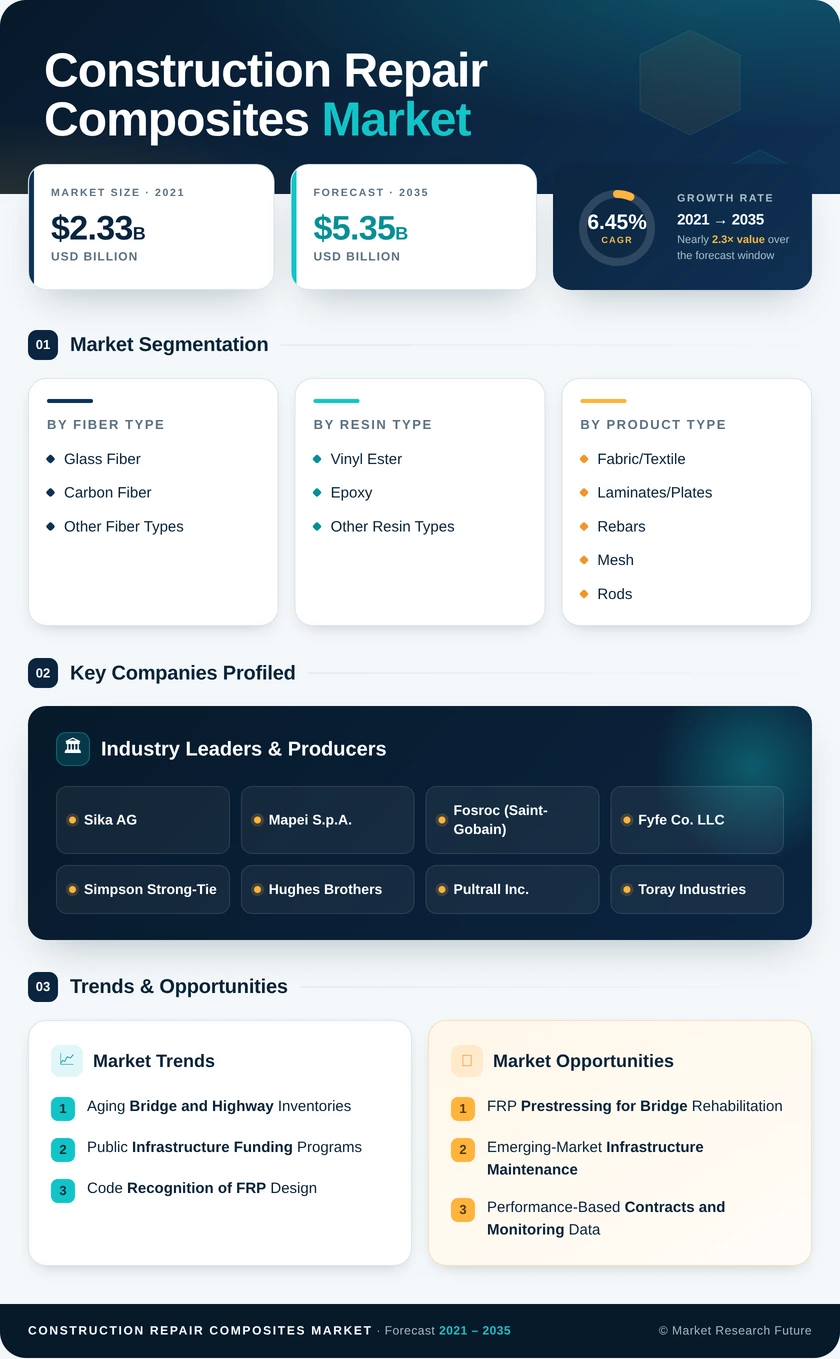
Segmentation Quick Reference
| Dimension | Sub-Segments | Dominant Segment | Fastest Growing Segment |
|---|
| By Fiber Type | Glass Fiber, Carbon Fiber, Other Fiber Types | Glass Fiber (60.4% share) | Carbon Fiber (7.3% CAGR) |
| By Resin Type | Vinyl Ester, Epoxy, Other Resin Types | Epoxy (56.9% share) | Other Resin Types (7.0% CAGR) |
| By Product Type | Fabric/Textile, Laminates/Plates, Rebars, Mesh, Rods and Tendons, Other Product Types | Fabric/Textile (45.3% share) | Rods and Tendons (7.4% CAGR) |
| By Application | Residential Buildings, Commercial Buildings, Industrial Facilities, Infrastructure | Infrastructure (53.2% share) | Commercial Buildings (7.2% CAGR) |
| By Region | North America, Europe, Asia-Pacific, South America, Middle East & Africa | Asia-Pacific (41.5% share) | Asia-Pacific (41.5% share) |
Market Segmentation Overview
| Sub-Segment | Key Trend |
|---|
| Glass Fiber | Default choice for cost-driven wrapping and GFRP bar repairs |
| Carbon Fiber | Rising use in seismic and high-load bridge strengthening |
| Other Fiber Types | Basalt and aramid adopted for specialty exposures |
Glass Fiber leads because contractors can install it with familiar wet layup methods at a much lower material cost than carbon. Carbon Fiber grows fastest, since its stiffness lets engineers meet seismic and bridge load targets with fewer plies. Other Fiber Types remain niche, chosen where impact resistance or embodied carbon matters most.
| Sub-Segment | Key Trend |
|---|
| Vinyl Ester | Preferred in acid and solvent exposure |
| Epoxy | New hardeners improve cold-weather curing and lower VOC content |
| Other Resin Types | Bio-based matrices enter low-carbon specifications |
Epoxy leads because its adhesion and low shrinkage suit bonded structural repair, and new curing agents widen its field window. Other Resin Types grow fastest as tender rules start scoring embodied carbon. Vinyl Ester keeps a stable role in industrial plants where chemical resistance outweighs bond strength.
| Sub-Segment | Key Trend |
|---|
| Fabric/Textile | Column confinement in seismic projects |
| Laminates/Plates | Bonded flexural strengthening of decks and slabs |
| Rebars | GFRP bars replace corroded steel in marine work |
| Mesh | Thin overlays for masonry and tunnel linings |
| Rods and Tendons | Steel-free prestressing for long-life bridges |
| Other Product Types | Near-surface mounted strips and FRP anchors |
Fabric/Textile leads because it conforms to columns and irregular members on site. Rods and Tendons grow fastest as owners seek prestressing that cannot suffer stress corrosion cracking, a shift demonstrated by carbon-prestressed bridge projects in Germany. Laminates/Plates hold second place on flat slab and deck work.
| Sub-Segment | Key Trend |
|---|
| Residential Buildings | Multifamily balcony and foundation repair |
| Commercial Buildings | Parking structure rehabilitation and seismic ordinances |
| Industrial Facilities | Corrosion repair in chemical and mining plants |
| Infrastructure | Funded bridge and highway rehabilitation |
Infrastructure leads because dedicated bridge funding in the U.S., China and Europe converts deterioration into contracts. Commercial Buildings grow fastest as aging parking garages and municipal retrofit ordinances create mandatory work. Industrial Facilities and Residential Buildings add steady, smaller project volumes.


 Noah Malgeri
Co-Founder

 Peter Groot koerkamp
Account and Business Manager

 Younghwan Choi
Senior Retail Manager

 Mark Irwin
Management Consultant

 Akif Moroglu
Strategy & Business Development Director

 Guilherme Gomes Martins
Product Management Director

 Joseph Aguayo
Sales Operations & Pricing Manager

 La Terria Dodd
Program Support Specialist

 Rob Kooiker
Group Product Manager HVAC & Fire Protection GMA