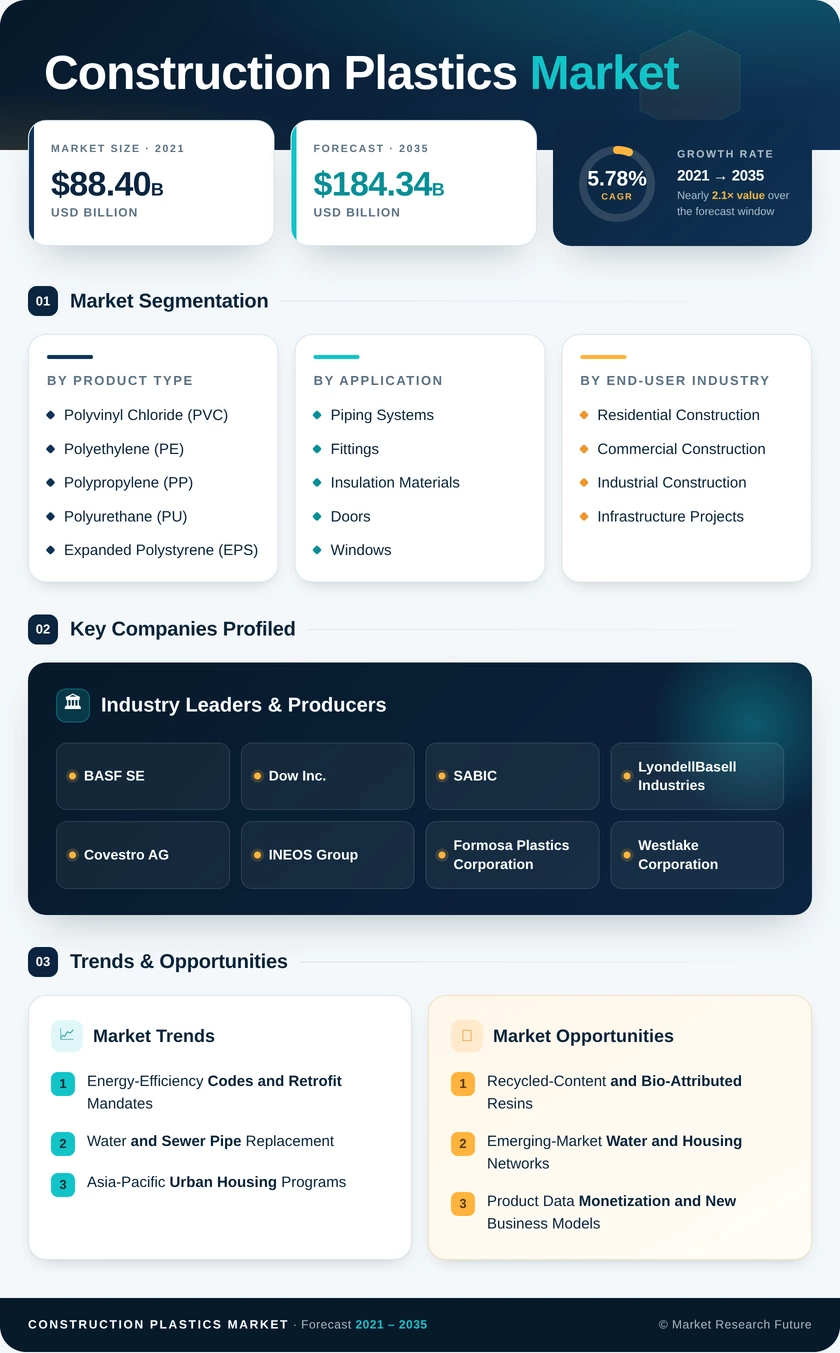
Construction Plastics Market (2026 - 2035)

ID: MRFR/CnM/5705-HCR 111 Pages Chitranshi Jaiswal Last Updated: October 27, 2026
Construction Plastics Market Research Report Information By Product Type (Polyvinyl Chloride (PVC), Polyethylene (PE), Polypropylene (PP), Polyurethane (PU), Expanded Polystyrene (EPS), Polycarbonate (PC), and Other Product Types), By Application (Piping Systems and Fittings, Insulation Materials, Doors and Windows, Flooring, Roofing, Wall Panels and Cladding, and Other Applications), and By End-user Industry (Residential Construction, Commercial Construction, Industrial Construction, and Infrastructure Projects) – Forecast Till 2035.
Construction Plastics Market
Market Size
Forecast Period2026-2035
CAGR (2026-2035)5.78%
2025 Market SizeUSD 105.10 Billion
2035 Market SizeUSD 184.34 Billion
Key Players
BASF SE
Dow Inc.
SABIC
LyondellBasell Industries
Covestro AG
INEOS Group
Opportunities
  • Recycled-Content and Bio-Attributed Resins
  • Emerging-Market Water and Housing Networks
  • Product Data Monetization and New Business Models
  1. 1 Market Summary | |
  2. 2 Key Report Takeaways | |
    1. 2.1 By Product Type | |
    2. 2.2 By Application | |
    3. 2.3 By End-user Industry | |
    4. 2.4 By Region | |
  3. 3 Market Size and Forecast (2021–2035) | |
    1. 3.1 Historical Market Size (2021–2025) | |
    2. 3.2 Forecast Market Size (2026–2035) | |
    3. 3.3 Year-over-Year Growth Analysis | |
  4. 4 Driver Impact Analysis | |
    1. 4.1 Energy-Efficiency Codes and Retrofit Mandates | |
    2. 4.2 Water and Sewer Pipe Replacement | |
    3. 4.3 Asia-Pacific Urban Housing Programs | |
    4. 4.4 Rural Drinking Water Connectivity | |
    5. 4.5 Data Center and Cold-Chain Construction | |
    6. 4.6 Prefabrication and Modular Building | |
    7. 4.7 Gulf Mega-Project Pipeline | |
  5. 5 Restraints Impact Analysis | |
    1. 5.1 Resin Feedstock Price Volatility | |
    2. 5.2 Fire-Safety Limits on Combustible Products | |
    3. 5.3 Chemical and Additive Regulation | |
    4. 5.4 High Interest Rates Suppressing Housing | |
    5. 5.5 End-of-Life Recycling Gaps | |
  6. 6 Opportunities | |
    1. 6.1 Recycled-Content and Bio-Attributed Resins | |
    2. 6.2 Emerging-Market Water and Housing Networks | |
    3. 6.3 Product Data Monetization and New Business Models | |
    4. 6.4 Trenchless Rehabilitation for Lead Line Replacement | |
    5. 6.5 Insulated Panels for Digital Infrastructure | |
  7. 7 Regional Market Share and Country-Level Analysis | |
    1. 7.1 North America | | |
      1. 7.1.1 US | | |
      2. 7.1.2 Canada | | |
      3. 7.1.3 Mexico | |
    2. 7.2 Europe | | |
      1. 7.2.1 Germany | | |
      2. 7.2.2 UK | | |
      3. 7.2.3 France | | |
      4. 7.2.4 Italy | | |
      5. 7.2.5 Spain | | |
      6. 7.2.6 Nordic Countries | | |
      7. 7.2.7 Russia | | |
      8. 7.2.8 Rest of Europe | |
    3. 7.3 Asia-Pacific | | |
      1. 7.3.1 China | | |
      2. 7.3.2 India | | |
      3. 7.3.3 Japan | | |
      4. 7.3.4 South Korea | | |
      5. 7.3.5 ASEAN | | |
      6. 7.3.6 Rest of Asia-Pacific | |
    4. 7.4 South America | | |
      1. 7.4.1 Brazil | | |
      2. 7.4.2 Argentina | | |
      3. 7.4.3 Rest of South America | |
    5. 7.5 Middle East & Africa | | |
      1. 7.5.1 Saudi Arabia | | |
      2. 7.5.2 UAE | | |
      3. 7.5.3 South Africa | | |
      4. 7.5.4 Egypt | | |
      5. 7.5.5 Rest of MEA | |
  8. 8 Future Outlook (2026–2035) | |
    1. 8.1 Circularity Becomes a Procurement Standard | |
    2. 8.2 The Deep Retrofit Supercycle | |
    3. 8.3 Digital Construction and Prefabrication | |
    4. 8.4 Embodied Carbon Disclosure | |
  9. 9 Segmentation Analysis | |
    1. 9.1 By Product Type | | |
      1. 9.1.1 Polyvinyl Chloride | | |
      2. 9.1.2 Polyethylene | | |
      3. 9.1.3 Polypropylene | | |
      4. 9.1.4 Polyurethane | | |
      5. 9.1.5 Expanded Polystyrene | | |
      6. 9.1.6 Polycarbonate | | |
      7. 9.1.7 Other Product Types | |
    2. 9.2 By Application | | |
      1. 9.2.1 Piping Systems and Fittings | | |
      2. 9.2.2 Insulation Materials | | |
      3. 9.2.3 Doors and Windows | | |
      4. 9.2.4 Flooring | | |
      5. 9.2.5 Roofing | | |
      6. 9.2.6 Wall Panels and Cladding | | |
      7. 9.2.7 Other Applications | |
    3. 9.3 By End-user Industry | | |
      1. 9.3.1 Residential Construction | | |
      2. 9.3.2 Commercial Construction | | |
      3. 9.3.3 Industrial Construction | | |
      4. 9.3.4 Infrastructure Projects | |
  10. 10 Competitive Landscape | |
    1. 10.1 Market Concentration Analysis | |
    2. 10.2 Competitive Benchmarking Matrix | |
    3. 10.3 Company Profiles | | |
      1. 10.3.1 BASF SE | | |
      2. 10.3.2 Dow Inc. | | |
      3. 10.3.3 SABIC | | |
      4. 10.3.4 LyondellBasell Industries | | |
      5. 10.3.5 Covestro AG | | |
      6. 10.3.6 INEOS Group | | |
      7. 10.3.7 Formosa Plastics Corporation | | |
      8. 10.3.8 Westlake Corporation | | |
      9. 10.3.9 Orbia (Wavin) | | |
      10. 10.3.10 Kingspan Group | | |
      11. 10.3.11 Arkema S.A. | |
  11. 11 Recent News & Developments | |
  12. 12 Report Scope and Methodology | |
  13. 13 Detailed Sources and Citations | |
  14. 14 Frequently Asked Questions (FAQs) | | LIST OF TABLES | |
  15. TABLE 1 Report Summary – Key Market Parameters, 2025–2035 | |
  16. TABLE 2 Global Market Size & Forecast, by Revenue (USD Billion), 2021–2035 | |
  17. TABLE 3 Driver Impact Analysis, 2026–2035 | |
  18. TABLE 4 Restraints Impact Analysis, 2026–2035 | |
  19. TABLE 5 Regional Summary, by Key Metric, 2025 | |
  20. TABLE 6 North America Market, by Country, 2025 | |
  21. TABLE 7 Europe Market, by Country, 2025 | |
  22. TABLE 8 Asia-Pacific Market, by Country, 2025 | |
  23. TABLE 9 South America Market, by Country, 2025 | |
  24. TABLE 10 Middle East & Africa Market, by Country, 2025 | |
  25. TABLE 11 Global Market, by Product Type, 2025 | |
  26. TABLE 12 Global Market, by Application, 2025 | |
  27. TABLE 13 Global Market, by End-user Industry, 2025 | |
  28. TABLE 14 Competitive Benchmarking Matrix, 2025 | |
  29. TABLE 15 Report Scope and Methodology | |
  30. TABLE 16 Detailed Sources and Citations | |
  31. TABLE 17 Segmentation Quick Reference | |
  32. TABLE 18 Segmentation Overview – By Product Type | |
  33. TABLE 19 Segmentation Overview – By Application | |
  34. TABLE 20 Segmentation Overview – By End-user Industry | | LIST OF FIGURES | |
  35. FIGURE 1 Market Dynamics Overview – Drivers, Restraints and Opportunities | |
  36. FIGURE 2 Industry Value Chain Analysis | |
  37. FIGURE 3 Porter's Five Forces Analysis | |
  38. FIGURE 4 Global Market Size Trend, 2021–2035 (USD Billion) | |
  39. FIGURE 5 Market Share by Product Type, 2025 | |
  40. FIGURE 6 Market Share by Application, 2025 | |
  41. FIGURE 7 Market Share by End-user Industry, 2025 | |
  42. FIGURE 8 Regional Market Share, 2025 | |
  43. FIGURE 9 North America Market Share, by Country, 2025 | |
  44. FIGURE 10 Europe Market Share, by Country, 2025 | |
  45. FIGURE 11 Asia-Pacific Market Share, by Country, 2025 | |
  46. FIGURE 12 South America Market Share, by Country, 2025 | |
  47. FIGURE 13 Middle East & Africa Market Share, by Country, 2025 | |
  48. FIGURE 14 Competitive Landscape – Estimated Revenue Share Ranges, 2025 | |
  49. FIGURE 15 Competitive Positioning Matrix

Segmentation Quick Reference

DimensionSub-SegmentsDominant SegmentFastest Growing Segment
By Product TypePolyvinyl Chloride (PVC), Polyethylene (PE), Polypropylene (PP), Polyurethane (PU), Expanded Polystyrene (EPS), Polycarbonate (PC), Other Product TypesPolyvinyl Chloride (PVC) — Share: 39.4%Polyurethane (PU) — CAGR: 6.35%
By ApplicationPiping Systems and Fittings, Insulation Materials, Doors and Windows, Flooring, Roofing, Wall Panels and Cladding, Other ApplicationsPiping Systems and Fittings — Share: 31.2%Insulation Materials — CAGR: 6.52%
By End-user IndustryResidential Construction, Commercial Construction, Industrial Construction, Infrastructure ProjectsResidential Construction — Share: 40.1%Commercial Construction — CAGR: 6.42%
By RegionNorth America, Europe, Asia-Pacific, South America, Middle East & AfricaAsia-Pacific — Share: 46.8%Asia-Pacific — Share: 46.8%


Market Segmentation Overview

By Product Type

Sub-SegmentKey Trend
Polyvinyl Chloride (PVC)Lead-free formulations and recycled-content profiles
Polyethylene (PE)HDPE pressure pipe for trenchless replacement
Polypropylene (PP)Drainage composites resistant to alkaline concrete
Polyurethane (PU)Spray foam and PIR boards for deep retrofits
Expanded Polystyrene (EPS)Continuous insulation on mid-rise buildings
Polycarbonate (PC)Lightweight daylighting and roofing sheets
Other Product TypesSpecialty fluoropolymers and acrylics for façades


Polyvinyl Chloride (PVC) leads this dimension because its code acceptance across pipe, window profiles and siding keeps it the default specification on housing and utility projects. Polyurethane (PU) grows fastest since retrofit rules demand high thermal resistance in thin wall and roof assemblies, where it outperforms Expanded Polystyrene (EPS) per inch. Polyethylene (PE) holds a steady position through pressure-pipe replacement funded by water infrastructure programs.

By Application

Sub-SegmentKey Trend
Piping Systems and FittingsFunded lead line and water main replacement
Insulation MaterialsTighter envelope requirements under EPBD and IECC
Doors and WindowsMulti-chamber uPVC replacing timber and aluminum
FlooringVinyl tile gaining in residential remodeling
RoofingSingle-ply membranes on commercial roofs
Wall Panels and CladdingGrowth limited by high-rise fire restrictions
Other ApplicationsConduit and geocomposites for infrastructure


Piping Systems and Fittings remain the largest application because regulated replacement programs in the United States and India guarantee multi-year pipe orders. Insulation Materials grow fastest as European and North American energy codes raise required insulation levels in every envelope assembly. Wall Panels and Cladding trail the dimension, since combustible-materials bans on taller residential buildings push specifiers toward mineral alternatives.

By End-user Industry

Sub-SegmentKey Trend
Residential ConstructionRemodeling recovery as mortgage rates ease
Commercial ConstructionData center and cold-storage envelope demand
Industrial ConstructionReshoring-driven plant and warehouse builds
Infrastructure ProjectsLong-dated water, sewer and transport programs


Residential Construction leads because housing uses polymers across plumbing, windows, insulation and flooring, giving it the highest material breadth per project. Commercial Construction grows fastest as data center and cold-storage operators specify insulated panels with strict thermal and fire performance. Infrastructure Projects provide stability to the mix, since publicly funded water and sewer programs are less sensitive to interest-rate cycles than Industrial Construction.


 

Download PDF ×

We do not share your information with anyone. However, we may send you emails based on your report interest from time to time. You may contact us at any time to opt-out.