
Request Free Sample ×

Kindly complete the form below to receive a free sample of this Report

* Please use a valid business email

Leading companies partner with us for data-driven Insights

clients tt-cursor
Hero Background
English
Chinese
French
Japanese
Korean
German
Spanish

Construction Market Share

ID: MRFR/PCM/14538-HCR
138 Pages
Snehal Singh
March 2026

Construction Market Research Report Information by Type of Construction (Buildings Construction, Heavy and Civil Engineering Construction, Specialty Trade Contractors, Land Planning And Development), by End-Use Sector (Private, Public), by Type Of Contractor (Large Contractor, Small Contractor) and Region (North America, Europe, Asia-Pacific, South America, Middle East & Africa) - Forecast till 2035

Share:
Download PDF ×

We do not share your information with anyone. However, we may send you emails based on your report interest from time to time. You may contact us at any time to opt-out.

Construction Market Infographic
Purchase Options

Market Share

Construction Market Share Analysis

In the vast and competitive landscape of the construction market, companies employ a variety of strategies to establish and fortify their market share positioning. Differentiation is a fundamental approach where companies strive to set themselves apart by offering unique services, construction methods, or innovative technologies. This might involve adopting cutting-edge building materials, sustainable construction practices, or introducing advanced project management tools. Through differentiation, companies attract clients seeking specific attributes, allowing them to secure a distinctive market share within the construction industry.

Cost leadership is another prevalent strategy in the construction market, where companies aim to become the low-cost providers without compromising quality. This involves optimizing construction processes, negotiating favorable deals with suppliers, and leveraging economies of scale. Cost leadership is effective in attracting clients with budget constraints, particularly in sectors like infrastructure development or residential construction. However, maintaining high-quality standards and adherence to safety regulations is crucial to ensure customer satisfaction and loyalty in this cost-driven strategy.

Market segmentation is a widely adopted strategy in the construction industry. Companies analyze the diverse needs of their customer base and develop specialized services tailored for specific market segments. For instance, they might specialize in residential construction, commercial projects, or infrastructure development. By addressing the unique requirements of each segment, companies can establish a robust presence within different markets, contributing to an overall enhanced market share.

Strategic partnerships and collaborations play a pivotal role in the construction market. Companies often form alliances with architects, engineering firms, or suppliers to strengthen their capabilities, enhance brand visibility, and expand market reach. Collaborative efforts can lead to shared resources, access to new technologies, and entry into new geographic markets. Through strategic partnerships, companies can navigate industry challenges more effectively, ultimately contributing to a more secure market share position.

Innovation stands as a cornerstone strategy in the construction market, driven by the continual pursuit of improved efficiency, sustainability, and safety. Companies invest in research and development to introduce new construction materials, methodologies, or digital technologies. Innovations in modular construction, green building practices, or the use of Building Information Modeling (BIM) contribute to staying competitive and attracting clients seeking modern and sustainable solutions. By being at the forefront of innovation, companies position themselves as leaders in the construction market, securing a significant market share.

Customer-centric strategies are gaining prominence as companies recognize the importance of providing exceptional customer experiences. This involves not only delivering construction projects on time and within budget but also offering transparent communication, flexibility, and post-construction support. Exceptional customer service contributes to satisfaction and loyalty, encouraging clients to choose a particular construction company for their future projects. By focusing on building strong relationships with clients, companies can solidify their market share and maintain a competitive edge in the construction industry.


Author
Author Profile
Snehal Singh
Manager - Research

High acumen in analyzing complex macro & micro markets with more than 6 years of work experience in the field of market research. By implementing her analytical skills in forecasting and estimation into market research reports, she has expertise in Packaging, Construction, and Equipment domains. She handles a team size of 20-25 resources and ensures smooth running of the projects, associated marketing activities, and client servicing.

Leave a Comment

FAQs

What is the current valuation of the construction market in 2025?

<p>The construction market valuation stands at 2000.0 USD Billion in 2025.</p>

What is the projected market size for the construction industry by 2035?

<p>The construction market is projected to reach 2800.0 USD Billion by 2035.</p>

What is the expected CAGR for the construction market during the forecast period 2025 - 2035?

<p>The expected CAGR for the construction market during the forecast period 2025 - 2035 is 3.11%.</p>

Which segments are expected to drive growth in the construction market?

<p>Segments such as Residential Construction and Infrastructure Development are likely to drive growth, with valuations ranging from 600.0 to 700.0 USD Billion.</p>

How does the valuation of residential construction compare to commercial construction?

<p>In 2025, residential construction is valued between 600.0 and 800.0 USD Billion, whereas commercial construction ranges from 500.0 to 700.0 USD Billion.</p>

What are the key materials used in the construction market and their valuations?

<p>Key materials include Concrete, valued between 800.0 and 1100.0 USD Billion, and Steel, valued between 600.0 and 800.0 USD Billion.</p>

What construction methods are gaining traction in the market?

<p>Traditional Construction remains dominant, valued between 1200.0 and 1600.0 USD Billion, while Modular Construction is emerging with a valuation of 300.0 to 500.0 USD Billion.</p>

Which project sizes are most prevalent in the construction market?

<p>Medium Scale Projects, valued between 800.0 and 1120.0 USD Billion, appear to be the most prevalent in the construction market.</p>

Who are the leading players in the construction market?

<p>Key players include China State Construction Engineering, Vinci, and Bechtel, among others.</p>

What is the valuation range for utility construction in 2025?

<p>Utility Construction is valued between 300.0 and 400.0 USD Billion in 2025.</p>

Market Summary

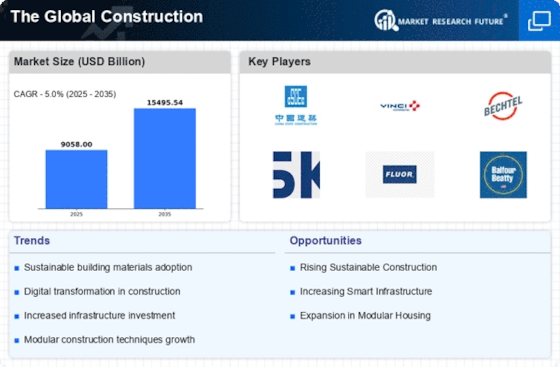
As per Market Research Future analysis, The Global Construction Market Size was estimated at 11215.6 USD Billion in 2024. The construction industry is projected to grow from 11742.7 USD Billion in 2025 to 18588.1 USD Billion by 2035, exhibiting a compound annual growth rate (CAGR) of 4.70% during the forecast period 2025 - 2035

Key Market Trends & Highlights

The Global Construction Market is poised for robust growth driven by sustainability and technological advancements.

  • Sustainable construction practices are increasingly being adopted across the industry, particularly in North America. Digital transformation is reshaping project management and operational efficiency in the construction sector. Smart infrastructure development is gaining traction, especially in urban areas of the Asia-Pacific region. Urbanization and government infrastructure investments are key drivers propelling growth in the buildings construction and public segments.

Market Size & Forecast

2024 Market Size 11215.6 (USD Billion)
2035 Market Size 18588.1 (USD Billion)
CAGR (2025 - 2035) 4.70%
Largest Regional Market Share in 2024 Asia Pacific

Major Players

China State Construction Engineering (CN), Vinci (FR), Bechtel (US), Skanska (SE), Fluor Corporation (US), Balfour Beatty (GB), Obayashi Corporation (JP), Larsen &amp; Toubro (IN), Kiewit Corporation (US), Strabag (AT)

Market Trends

The Global Construction Market trends is currently experiencing a dynamic transformation, driven by various factors that shape its landscape. Emerging technologies, such as artificial intelligence and advanced materials, are redefining traditional construction practices. This evolution appears to enhance efficiency and sustainability, as stakeholders increasingly prioritize eco-friendly solutions. Furthermore, urbanization trends continue to escalate, leading to heightened demand for residential and commercial infrastructure. As cities expand, the need for innovative designs and smart buildings becomes more pronounced, suggesting a shift towards integrated construction approaches that embrace modernity and functionality. In addition, The Global Construction Market is witnessing a growing emphasis on safety and regulatory compliance. Industry players are adapting to stringent guidelines, which may lead to enhanced project management practices. Collaboration among various sectors, including engineering and technology, seems to foster a more cohesive environment for construction activities. Overall, the market's trajectory indicates a blend of innovation and responsibility, as it navigates the complexities of contemporary demands and environmental considerations.

Sustainable Construction Market Practices

There is a noticeable shift towards sustainable construction practices within The Global Construction Market. Stakeholders are increasingly adopting eco-friendly materials and energy-efficient designs, reflecting a commitment to reducing environmental impact. This trend not only addresses regulatory pressures but also aligns with consumer preferences for greener solutions.

Digital Transformation

The integration of digital technologies is reshaping The Global Construction Market. Tools such as Building Information Modeling (BIM) and project management software are enhancing collaboration and efficiency. This digital transformation appears to streamline processes, reduce costs, and improve overall project outcomes.

Smart Infrastructure Development

The focus on smart infrastructure is gaining momentum in The Global Construction Market. As urban areas evolve, there is a growing demand for intelligent systems that enhance connectivity and functionality. This trend suggests a future where construction projects incorporate advanced technologies to create more responsive and adaptive environments.

Construction Market Market Drivers

Technological Advancements

Technological advancements are reshaping the construction landscape, driving efficiency and innovation within the industry. The integration of Building Information Modeling (BIM), drones, and 3D printing is revolutionizing project management and execution. For instance, the adoption of BIM can reduce project costs by up to 20% and improve collaboration among stakeholders. The Global Construction Industry is experiencing a shift towards digital tools that enhance productivity and reduce waste. Moreover, the rise of smart construction technologies, such as IoT and AI, is expected to streamline operations and improve safety on job sites. As these technologies become more prevalent, they are likely to attract investment and foster growth in the construction sector.

Urbanization and Population Growth

The rapid pace of urbanization and population growth is a primary driver of the construction market. As more individuals migrate to urban areas, the demand for housing, infrastructure, and commercial spaces intensifies. According to recent data, urban areas are expected to house nearly 68% of the world's population by 2050. This trend necessitates significant investment in the construction sector to accommodate the increasing population density. The Global Construction Industry is likely to see substantial growth as cities expand and require new residential and commercial developments. Furthermore, the need for improved transportation networks and public facilities will further stimulate construction activities, leading to a robust market environment.

Government Infrastructure Investments

Government infrastructure investments play a crucial role in driving the construction market. Many nations are prioritizing infrastructure development to stimulate economic growth and improve public services. For example, in 2025, it is projected that global infrastructure spending will reach approximately 4 trillion USD annually. This surge in investment is expected to create numerous opportunities within The Global Construction Industry, particularly in sectors such as transportation, energy, and water management. Additionally, public-private partnerships are becoming increasingly common, allowing for collaborative efforts in funding and executing large-scale projects. Such initiatives are likely to enhance the overall market landscape and encourage further investment in construction.

Sustainability and Green Building Initiatives

Sustainability and green building initiatives are gaining traction within the construction market, driven by increasing awareness of environmental issues. The demand for eco-friendly materials and energy-efficient designs is reshaping construction practices. The Global Construction Industry is witnessing a shift towards sustainable practices, with many projects aiming for certifications such as LEED or BREEAM. This trend is not only beneficial for the environment but also appeals to consumers who prioritize sustainability. As regulations become stricter and incentives for green building increase, construction firms are likely to adapt their strategies to meet these demands, potentially leading to a more sustainable future for the industry.

Economic Recovery and Investment Opportunities

Economic recovery in various regions is fostering investment opportunities within the construction market. As economies stabilize, there is a renewed focus on infrastructure development and real estate projects. The Global Construction Industry is poised to benefit from increased private and public sector investments, particularly in emerging markets where growth potential is substantial. Analysts suggest that the construction sector could see a compound annual growth rate of around 5% over the next few years. This recovery phase presents a unique opportunity for construction firms to expand their operations and explore new markets, ultimately contributing to the overall growth of the industry.

Market Segment Insights

By Application: Residential Construction (Largest) vs. Infrastructure Development (Fastest-Growing)

<p>The construction market is primarily segmented into residential construction, commercial construction, industrial construction, and infrastructure development. Among these, residential construction holds the largest share of the market, driven by increasing urbanization and a growing population that requires housing. Commercial construction, while significant, follows behind but remains strong due to the demand for new retail, office spaces, and hospitality sectors. Industrial construction is steady, focusing on manufacturing and logistics, whereas infrastructure development is rapidly gaining traction as governments invest heavily in upgrading and expanding public services.</p>

<p>Residential Construction: Dominant vs. Infrastructure Development: Emerging</p>

<p>Residential construction is characterized by a strong demand for single-family homes and multi-family units, influenced by demographic shifts and economic conditions that favor home ownership. Its dominance in the market reflects societal needs for housing and living spaces. In contrast, infrastructure development is emerging as a critical player, fueled by government initiatives and funding aimed at enhancing transportation, utilities, and public facilities. This segment's growth is driven by increasing urbanization and the need for sustainable development, positioning it as a vital area for future investment and innovation.</p>

By End Use: Building Construction (Largest) vs. Road Construction (Fastest-Growing)

<p>In the construction market, the distribution of market share among the end-use segments showcases Building Construction as the cornerstone with significant dominance. This segment includes residential, commercial, and industrial constructions, leading in terms of volume. Conversely, Road Construction is emerging swiftly as a vital segment, buoyed by increased infrastructure investment and urbanization efforts. As urban settings expand, the demand for road facilities to support transport and logistics systems is surging, making it a vital component of the growth narrative.</p>

<p>Building Construction (Dominant) vs. Road Construction (Emerging)</p>

<p>Building Construction remains dominant in the end-use segments due to its essential role in establishing infrastructural foundations across varying formats, including homes, offices, and industrial sites. Its broad applications not only contribute to shelter and utility but also drive employment and economic stability. On the other hand, Road Construction is classified as an emerging segment. Its recent surge stems from governments investing significantly in transport systems to accommodate growing populations and urban sprawl. Enhanced road networks lead to improved accessibility and transport efficiency, essential for sustaining economic growth, thus making it a vital area within the construction market.</p>

By Material Type: Concrete (Largest) vs. Steel (Fastest-Growing)

<p>In the construction market, Concrete leads with significant market share due to its widespread use in various applications, including foundations, pavements, and structures. Steel follows closely behind, experiencing rapid growth as it becomes increasingly favored for its strength-to-weight ratio and versatility in modern construction projects. Wood and masonry, while important, tend to share a smaller portion of the overall market, with wood mainly used in residential buildings and masonry in specialized structures.</p>

<p>Concrete (Dominant) vs. Steel (Emerging)</p>

<p>Concrete has been the dominant material in construction for years, prized for its durability, low maintenance, and ability to be molded into various shapes. It is extensively utilized in urban infrastructure, commercial buildings, and housing. On the other hand, steel is rapidly emerging as a material of choice, especially in industrial and high-rise constructions, due to its superior strength, recyclability, and the ability to construct lighter frameworks. This growing trend is driven by innovations in steel production and construction techniques that allow for faster build times and reduced costs.</p>

By Construction Method: Traditional Construction (Largest) vs. Modular Construction (Fastest-Growing)

<p>In the construction market, Traditional Construction dominates the landscape, commanding the largest market share thanks to its long-standing presence and established methodologies. This segment encompasses various building techniques that have been tried and tested over decades. In contrast, Modular Construction is emerging rapidly as an innovative alternative, characterized by the pre-fabrication of sections of buildings off-site. Demand for faster completion times and the need for flexible building designs are pivotal in this shift towards modular approaches.</p>

<p>Construction Methods: Traditional Construction (Dominant) vs. Modular Construction (Emerging)</p>

<p>Traditional Construction is characterized by brick-and-mortar methods that rely heavily on labor-intensive processes. Its long-standing practices and familiarity in the construction industry contribute to its dominance. However, Modular Construction is quickly gaining traction due to its efficiency and sustainability. With off-site manufacturing, projects can be completed faster, thereby reducing costs and onsite waste. The appeal of Modular Construction also lies in its adaptability, allowing for customized designs while adhering to timelines. This combination of speed and flexibility positions Modular Construction as a formidable force in the evolving construction market.</p>

By Project Size: Large Scale Projects (Largest) vs. Small Scale Projects (Fastest-Growing)

<p>In the construction market, project size significantly influences the distribution of market share. Large Scale Projects dominate the landscape, comprising a substantial portion of the market due to their capacity to attract significant investment and resources. In contrast, Small Scale Projects, while smaller in overall market share, have shown remarkable growth and adaptability, reflecting a shift towards more rapid and flexible construction methods. This dynamic distribution illustrates the diverse opportunities across the project size spectrum. The growth trends within the Project Size segment are primarily driven by urbanization and evolving consumer preferences. Large Scale Projects benefit from economies of scale and government initiatives aimed at infrastructure development. On the other hand, Small Scale Projects are emerging as an agile response to local demands and sustainability practices, capitalizing on shorter timelines and lower investment risks. This duality reflects the shifting priorities of stakeholders in a rapidly evolving construction environment.</p>

<p>Large Scale Projects (Dominant) vs. Small Scale Projects (Emerging)</p>

<p>Large Scale Projects are characterized by their extensive scope, requiring substantial investment and involvement from multiple stakeholders. They often encompass infrastructure development, such as highways, airports, and commercial complexes, and are typically backed by significant government support and financing. This dominance is fueled by the pressing need for urban development and public private partnerships, making them the backbone of the construction industry. Conversely, Small Scale Projects, which include residential buildings and localized commercial developments, are emerging rapidly due to their flexibility and lower budget requirements. They align with the growing trend of sustainable development, catering to a diverse range of client needs while allowing for quicker turnaround times and customization, thus appealing to a broader market segment.</p>

Get more detailed insights about Construction Market Research Report – Forecast Till 2035

Regional Insights

North America : Construction Market Innovation Leader

North America is witnessing significant growth in the construction market, driven by urbanization, infrastructure development, and government investments. The United States holds the largest market share at approximately 70%, followed by Canada at around 15%. Regulatory support, including infrastructure bills and green building initiatives, is further catalyzing this growth. The demand for residential and commercial construction is on the rise, fueled by population growth and economic recovery. The competitive landscape in North America is dominated by key players such as Bechtel, Fluor Corporation, and Kiewit Corporation. These companies are leveraging advanced technologies and sustainable practices to enhance project efficiency. The presence of strong regulatory frameworks and a skilled workforce further strengthens the market. As the region continues to invest in smart city projects and renewable energy infrastructure, the construction sector is poised for sustained growth.

Europe : Sustainable Construction Market Hub

Europe's construction market is characterized by a strong emphasis on sustainability and innovation. The region is the second largest market globally, with a share of approximately 20%. Key drivers include stringent environmental regulations, urbanization, and a shift towards energy-efficient buildings. Countries like Germany and France lead the market, supported by government initiatives aimed at reducing carbon footprints and promoting green technologies. The European Union's Green Deal is a significant regulatory catalyst, pushing for sustainable construction practices across member states. Leading countries in Europe, such as Germany, France, and the UK, are home to major construction firms like Vinci and Strabag. The competitive landscape is marked by a focus on collaboration and innovation, with companies investing in digital technologies and sustainable materials. As the region adapts to changing regulations and consumer preferences, the construction market is expected to evolve, prioritizing eco-friendly solutions and smart infrastructure.

Asia-Pacific : Emerging Market Powerhouse

The Asia-Pacific region is emerging as a powerhouse in The Global Construction Market, driven by rapid urbanization, population growth, and significant infrastructure investments. China holds the largest market share at approximately 50%, followed by India at around 10%. Government initiatives aimed at enhancing infrastructure, such as the Belt and Road Initiative, are key growth drivers. The region's construction market is expected to expand significantly as urban areas continue to develop and modernize, creating a robust demand for residential and commercial projects. Leading countries in the Asia-Pacific region include China, India, and Japan, with major players like China State Construction Market Engineering and Obayashi Corporation dominating the landscape. The competitive environment is characterized by a mix of local and international firms, all vying for market share in a rapidly growing sector. As the region embraces technological advancements and sustainable practices, the construction market is set for transformative growth, addressing the needs of its burgeoning urban populations.

Middle East and Africa : Resource-Rich Construction Market

The Middle East and Africa region is witnessing a surge in construction activities, driven by infrastructure development and urbanization. The market share is approximately 10%, with countries like the UAE and South Africa leading the charge. Government investments in mega-projects, such as smart cities and transportation networks, are key growth drivers. The region's construction market is expected to grow as it capitalizes on its resource wealth and seeks to diversify economies away from oil dependency. In the competitive landscape, key players such as Larsen & Toubro and Balfour Beatty are making significant inroads. The presence of international firms is also notable, as they collaborate with local companies to leverage expertise and resources. As the region continues to invest in infrastructure and sustainable practices, the construction market is poised for growth, addressing both economic and social needs.

Key Players and Competitive Insights

Many global, regional, and local vendors characterize the Construction Market. The market is highly competitive, with all the players competing to gain market share. Intense competition, rapid advances in technology, frequent changes in government policies, and environmental regulations are key factors that confront market growth. The vendors compete based on cost, product quality, reliability, and government regulations. Vendors must provide cost-efficient, high-quality products to survive and succeed in an intensely competitive market. The major competitors in the market are Acs Group, Lennar Corporation, D.R. Horton, Inc, Bouygues S.A, Power Construction Market Corporation of China, Cimic Group Limited, Shimizu Corporation, Lendlease Group, CAPITALAND Group Pte. Ltd, Larsen & Toubro Limited are among others. The Construction Market is a consolidated market due to increasing competition, acquisitions, mergers and other strategic market developments and decisions to improve operational effectiveness.

Key Companies in the Construction Market include

Industry Developments

February 2025: Lennar completed the acquisition of Rausch Coleman Homes, a residential homebuilder, expanding its footprint into new markets including Arkansas (Bentonville/Fayetteville, Little Rock, Jonesboro), Oklahoma (Tulsa, Stillwater), Alabama (Birmingham, Tuscaloosa), and Kansas/Missouri (Kansas City). This acquisition also added to Lennar’s existing markets in Texas, Oklahoma, Alabama, and Florida.

March 2025: L&T's Buildings & Factories vertical secured a large order from Brigade Group to construct residential and commercial towers in Hyderabad and Chennai. This is the largest residential project received from a private customer by this vertical, to be executed on a design-and-build basis within stringent timelines.

March 2025: CIMIC Group’s UGL secured several new contracts and extensions with clients in Western Australia, totaling approximately $150 million in revenue. Highlights include: 11-month contract extension with Alcoa for mining and refining maintenance, new contract with Chevron Australia for construction services, two-year extension with bp at Kwinana Energy Hub, and One-year extension of a framework agreement with Woodside Energy Global through IAS Group for technical and maintenance services

February 2025: Shimizu Corporation was awarded a contract by the Tanzania Ports Authority to renovate the Port of Kigoma on Lake Tanganyika, Tanzania. The project, valued at approximately 2.5 billion Japanese yen, is Shimizu’s first construction project in Tanzania and marks its entry into the 16th African country. The project includes expanding a 130-meter passenger wharf, constructing a passenger terminal building, and developing an access road, with construction scheduled from April 2025 to March 2027.

Future Outlook

Construction Market Future Outlook

The Global Construction Market is projected to grow at a 4.70% CAGR from 2025 to 2035, driven by urbanization, technological advancements, and sustainable building practices.

New opportunities lie in:

  • <p>Integration of <a href="https://www.marketresearchfuture.com/reports/smart-building-market-1860" target="_blank" title="smart building">smart building</a> technologies for energy efficiency Expansion of modular construction techniques to reduce costs Development of green building materials to meet regulatory demands</p>

By 2035, the market is expected to be robust, reflecting substantial growth and innovation.

Market Segmentation

Construction Market End-Use Sector Outlook

  • Private
  • Public

Construction Market Type of Contractor Outlook

  • Large Contractor
  • Small Contractor

Construction Market Type of Construction Outlook

  • Buildings Construction
  • Heavy and Civil Engineering Construction
  • Specialty Trade Contractors
  • Land Planning and Development

Report Scope

MARKET SIZE 2024 11215.6 (USD Billion)
MARKET SIZE 2025 11742.7 (USD Billion)
MARKET SIZE 2035 18588.1 (USD Billion)
COMPOUND ANNUAL GROWTH RATE (CAGR) 4.70% (2025 - 2035)
REPORT COVERAGE Revenue Forecast, Competitive Landscape, Growth Factors, and Trends
BASE YEAR 2024
Market Forecast Period 2025 - 2035
Historical Data 2019 - 2024
Market Forecast Units USD Billion
Key Companies Profiled China State Construction Engineering (CN), Vinci (FR), Bechtel (US), Skanska (SE), Fluor Corporation (US), Balfour Beatty (GB), Obayashi Corporation (JP), Larsen & Toubro (IN), Kiewit Corporation (US), Strabag (AT)
Segments Covered Type of Construction, End-Use Sector, Type Of Contractor
Key Market Opportunities Integration of sustainable building materials and smart technologies in The Global Construction.
Key Market Dynamics Technological advancements and sustainability initiatives reshape competitive dynamics in the construction industry.

Countries Covered North America, Europe, APAC, South America, MEA

FAQs

What is the current valuation of the construction market in 2025?

<p>The construction market valuation stands at 2000.0 USD Billion in 2025.</p>

What is the projected market size for the construction industry by 2035?

<p>The construction market is projected to reach 2800.0 USD Billion by 2035.</p>

What is the expected CAGR for the construction market during the forecast period 2025 - 2035?

<p>The expected CAGR for the construction market during the forecast period 2025 - 2035 is 3.11%.</p>

Which segments are expected to drive growth in the construction market?

<p>Segments such as Residential Construction and Infrastructure Development are likely to drive growth, with valuations ranging from 600.0 to 700.0 USD Billion.</p>

How does the valuation of residential construction compare to commercial construction?

<p>In 2025, residential construction is valued between 600.0 and 800.0 USD Billion, whereas commercial construction ranges from 500.0 to 700.0 USD Billion.</p>

What are the key materials used in the construction market and their valuations?

<p>Key materials include Concrete, valued between 800.0 and 1100.0 USD Billion, and Steel, valued between 600.0 and 800.0 USD Billion.</p>

What construction methods are gaining traction in the market?

<p>Traditional Construction remains dominant, valued between 1200.0 and 1600.0 USD Billion, while Modular Construction is emerging with a valuation of 300.0 to 500.0 USD Billion.</p>

Which project sizes are most prevalent in the construction market?

<p>Medium Scale Projects, valued between 800.0 and 1120.0 USD Billion, appear to be the most prevalent in the construction market.</p>

Who are the leading players in the construction market?

<p>Key players include China State Construction Engineering, Vinci, and Bechtel, among others.</p>

What is the valuation range for utility construction in 2025?

<p>Utility Construction is valued between 300.0 and 400.0 USD Billion in 2025.</p>

  1. SECTION I: EXECUTIVE SUMMARY AND KEY HIGHLIGHTS
    1. | 1.1 EXECUTIVE SUMMARY
    2. | | 1.1.1 Market Overview
    3. | | 1.1.2 Key Findings
    4. | | 1.1.3 Market Segmentation
    5. | | 1.1.4 Competitive Landscape
    6. | | 1.1.5 Challenges and Opportunities
    7. | | 1.1.6 Future Outlook
  2. SECTION II: SCOPING, METHODOLOGY AND MARKET STRUCTURE
    1. | 2.1 MARKET INTRODUCTION
    2. | | 2.1.1 Definition
    3. | | 2.1.2 Scope of the study
    4. | | | 2.1.2.1 Research Objective
    5. | | | 2.1.2.2 Assumption
    6. | | | 2.1.2.3 Limitations
    7. | 2.2 RESEARCH METHODOLOGY
    8. | | 2.2.1 Overview
    9. | | 2.2.2 Data Mining
    10. | | 2.2.3 Secondary Research
    11. | | 2.2.4 Primary Research
    12. | | | 2.2.4.1 Primary Interviews and Information Gathering Process
    13. | | | 2.2.4.2 Breakdown of Primary Respondents
    14. | | 2.2.5 Forecasting Model
    15. | | 2.2.6 Market Size Estimation
    16. | | | 2.2.6.1 Bottom-Up Approach
    17. | | | 2.2.6.2 Top-Down Approach
    18. | | 2.2.7 Data Triangulation
    19. | | 2.2.8 Validation
  3. SECTION III: QUALITATIVE ANALYSIS
    1. | 3.1 MARKET DYNAMICS
    2. | | 3.1.1 Overview
    3. | | 3.1.2 Drivers
    4. | | 3.1.3 Restraints
    5. | | 3.1.4 Opportunities
    6. | 3.2 MARKET FACTOR ANALYSIS
    7. | | 3.2.1 Value chain Analysis
    8. | | 3.2.2 Porter's Five Forces Analysis
    9. | | | 3.2.2.1 Bargaining Power of Suppliers
    10. | | | 3.2.2.2 Bargaining Power of Buyers
    11. | | | 3.2.2.3 Threat of New Entrants
    12. | | | 3.2.2.4 Threat of Substitutes
    13. | | | 3.2.2.5 Intensity of Rivalry
    14. | | 3.2.3 COVID-19 Impact Analysis
    15. | | | 3.2.3.1 Market Impact Analysis
    16. | | | 3.2.3.2 Regional Impact
    17. | | | 3.2.3.3 Opportunity and Threat Analysis
  4. SECTION IV: QUANTITATIVE ANALYSIS
    1. | 4.1 Packaging & Transport, BY Application (USD Billion)
    2. | | 4.1.1 Residential Construction
    3. | | 4.1.2 Commercial Construction
    4. | | 4.1.3 Industrial Construction
    5. | | 4.1.4 Infrastructure Development
    6. | 4.2 Packaging & Transport, BY End Use (USD Billion)
    7. | | 4.2.1 Building Construction
    8. | | 4.2.2 Road Construction
    9. | | 4.2.3 Bridge Construction
    10. | | 4.2.4 Utility Construction
    11. | 4.3 Packaging & Transport, BY Material Type (USD Billion)
    12. | | 4.3.1 Concrete
    13. | | 4.3.2 Steel
    14. | | 4.3.3 Wood
    15. | | 4.3.4 Masonry
    16. | 4.4 Packaging & Transport, BY Construction Method (USD Billion)
    17. | | 4.4.1 Traditional Construction
    18. | | 4.4.2 Modular Construction
    19. | | 4.4.3 Precast Construction
    20. | | 4.4.4 Green Building
    21. | 4.5 Packaging & Transport, BY Project Size (USD Billion)
    22. | | 4.5.1 Small Scale Projects
    23. | | 4.5.2 Medium Scale Projects
    24. | | 4.5.3 Large Scale Projects
    25. | 4.6 Packaging & Transport, BY Region (USD Billion)
    26. | | 4.6.1 North America
    27. | | | 4.6.1.1 US
    28. | | | 4.6.1.2 Canada
    29. | | 4.6.2 Europe
    30. | | | 4.6.2.1 Germany
    31. | | | 4.6.2.2 UK
    32. | | | 4.6.2.3 France
    33. | | | 4.6.2.4 Russia
    34. | | | 4.6.2.5 Italy
    35. | | | 4.6.2.6 Spain
    36. | | | 4.6.2.7 Rest of Europe
    37. | | 4.6.3 APAC
    38. | | | 4.6.3.1 China
    39. | | | 4.6.3.2 India
    40. | | | 4.6.3.3 Japan
    41. | | | 4.6.3.4 South Korea
    42. | | | 4.6.3.5 Malaysia
    43. | | | 4.6.3.6 Thailand
    44. | | | 4.6.3.7 Indonesia
    45. | | | 4.6.3.8 Rest of APAC
    46. | | 4.6.4 South America
    47. | | | 4.6.4.1 Brazil
    48. | | | 4.6.4.2 Mexico
    49. | | | 4.6.4.3 Argentina
    50. | | | 4.6.4.4 Rest of South America
    51. | | 4.6.5 MEA
    52. | | | 4.6.5.1 GCC Countries
    53. | | | 4.6.5.2 South Africa
    54. | | | 4.6.5.3 Rest of MEA
  5. SECTION V: COMPETITIVE ANALYSIS
    1. | 5.1 Competitive Landscape
    2. | | 5.1.1 Overview
    3. | | 5.1.2 Competitive Analysis
    4. | | 5.1.3 Market share Analysis
    5. | | 5.1.4 Major Growth Strategy in the Packaging & Transport
    6. | | 5.1.5 Competitive Benchmarking
    7. | | 5.1.6 Leading Players in Terms of Number of Developments in the Packaging & Transport
    8. | | 5.1.7 Key developments and growth strategies
    9. | | | 5.1.7.1 New Product Launch/Service Deployment
    10. | | | 5.1.7.2 Merger & Acquisitions
    11. | | | 5.1.7.3 Joint Ventures
    12. | | 5.1.8 Major Players Financial Matrix
    13. | | | 5.1.8.1 Sales and Operating Income
    14. | | | 5.1.8.2 Major Players R&D Expenditure. 2023
    15. | 5.2 Company Profiles
    16. | | 5.2.1 China State Construction Engineering (CN)
    17. | | | 5.2.1.1 Financial Overview
    18. | | | 5.2.1.2 Products Offered
    19. | | | 5.2.1.3 Key Developments
    20. | | | 5.2.1.4 SWOT Analysis
    21. | | | 5.2.1.5 Key Strategies
    22. | | 5.2.2 Vinci (FR)
    23. | | | 5.2.2.1 Financial Overview
    24. | | | 5.2.2.2 Products Offered
    25. | | | 5.2.2.3 Key Developments
    26. | | | 5.2.2.4 SWOT Analysis
    27. | | | 5.2.2.5 Key Strategies
    28. | | 5.2.3 Bechtel (US)
    29. | | | 5.2.3.1 Financial Overview
    30. | | | 5.2.3.2 Products Offered
    31. | | | 5.2.3.3 Key Developments
    32. | | | 5.2.3.4 SWOT Analysis
    33. | | | 5.2.3.5 Key Strategies
    34. | | 5.2.4 Skanska (SE)
    35. | | | 5.2.4.1 Financial Overview
    36. | | | 5.2.4.2 Products Offered
    37. | | | 5.2.4.3 Key Developments
    38. | | | 5.2.4.4 SWOT Analysis
    39. | | | 5.2.4.5 Key Strategies
    40. | | 5.2.5 Fluor Corporation (US)
    41. | | | 5.2.5.1 Financial Overview
    42. | | | 5.2.5.2 Products Offered
    43. | | | 5.2.5.3 Key Developments
    44. | | | 5.2.5.4 SWOT Analysis
    45. | | | 5.2.5.5 Key Strategies
    46. | | 5.2.6 Kiewit Corporation (US)
    47. | | | 5.2.6.1 Financial Overview
    48. | | | 5.2.6.2 Products Offered
    49. | | | 5.2.6.3 Key Developments
    50. | | | 5.2.6.4 SWOT Analysis
    51. | | | 5.2.6.5 Key Strategies
    52. | | 5.2.7 Balfour Beatty (GB)
    53. | | | 5.2.7.1 Financial Overview
    54. | | | 5.2.7.2 Products Offered
    55. | | | 5.2.7.3 Key Developments
    56. | | | 5.2.7.4 SWOT Analysis
    57. | | | 5.2.7.5 Key Strategies
    58. | | 5.2.8 Larsen & Toubro (IN)
    59. | | | 5.2.8.1 Financial Overview
    60. | | | 5.2.8.2 Products Offered
    61. | | | 5.2.8.3 Key Developments
    62. | | | 5.2.8.4 SWOT Analysis
    63. | | | 5.2.8.5 Key Strategies
    64. | | 5.2.9 Obayashi Corporation (JP)
    65. | | | 5.2.9.1 Financial Overview
    66. | | | 5.2.9.2 Products Offered
    67. | | | 5.2.9.3 Key Developments
    68. | | | 5.2.9.4 SWOT Analysis
    69. | | | 5.2.9.5 Key Strategies
    70. | 5.3 Appendix
    71. | | 5.3.1 References
    72. | | 5.3.2 Related Reports
  6. LIST OF FIGURES
    1. | 6.1 MARKET SYNOPSIS
    2. | 6.2 NORTH AMERICA MARKET ANALYSIS
    3. | 6.3 US MARKET ANALYSIS BY APPLICATION
    4. | 6.4 US MARKET ANALYSIS BY END USE
    5. | 6.5 US MARKET ANALYSIS BY MATERIAL TYPE
    6. | 6.6 US MARKET ANALYSIS BY CONSTRUCTION METHOD
    7. | 6.7 US MARKET ANALYSIS BY PROJECT SIZE
    8. | 6.8 CANADA MARKET ANALYSIS BY APPLICATION
    9. | 6.9 CANADA MARKET ANALYSIS BY END USE
    10. | 6.10 CANADA MARKET ANALYSIS BY MATERIAL TYPE
    11. | 6.11 CANADA MARKET ANALYSIS BY CONSTRUCTION METHOD
    12. | 6.12 CANADA MARKET ANALYSIS BY PROJECT SIZE
    13. | 6.13 EUROPE MARKET ANALYSIS
    14. | 6.14 GERMANY MARKET ANALYSIS BY APPLICATION
    15. | 6.15 GERMANY MARKET ANALYSIS BY END USE
    16. | 6.16 GERMANY MARKET ANALYSIS BY MATERIAL TYPE
    17. | 6.17 GERMANY MARKET ANALYSIS BY CONSTRUCTION METHOD
    18. | 6.18 GERMANY MARKET ANALYSIS BY PROJECT SIZE
    19. | 6.19 UK MARKET ANALYSIS BY APPLICATION
    20. | 6.20 UK MARKET ANALYSIS BY END USE
    21. | 6.21 UK MARKET ANALYSIS BY MATERIAL TYPE
    22. | 6.22 UK MARKET ANALYSIS BY CONSTRUCTION METHOD
    23. | 6.23 UK MARKET ANALYSIS BY PROJECT SIZE
    24. | 6.24 FRANCE MARKET ANALYSIS BY APPLICATION
    25. | 6.25 FRANCE MARKET ANALYSIS BY END USE
    26. | 6.26 FRANCE MARKET ANALYSIS BY MATERIAL TYPE
    27. | 6.27 FRANCE MARKET ANALYSIS BY CONSTRUCTION METHOD
    28. | 6.28 FRANCE MARKET ANALYSIS BY PROJECT SIZE
    29. | 6.29 RUSSIA MARKET ANALYSIS BY APPLICATION
    30. | 6.30 RUSSIA MARKET ANALYSIS BY END USE
    31. | 6.31 RUSSIA MARKET ANALYSIS BY MATERIAL TYPE
    32. | 6.32 RUSSIA MARKET ANALYSIS BY CONSTRUCTION METHOD
    33. | 6.33 RUSSIA MARKET ANALYSIS BY PROJECT SIZE
    34. | 6.34 ITALY MARKET ANALYSIS BY APPLICATION
    35. | 6.35 ITALY MARKET ANALYSIS BY END USE
    36. | 6.36 ITALY MARKET ANALYSIS BY MATERIAL TYPE
    37. | 6.37 ITALY MARKET ANALYSIS BY CONSTRUCTION METHOD
    38. | 6.38 ITALY MARKET ANALYSIS BY PROJECT SIZE
    39. | 6.39 SPAIN MARKET ANALYSIS BY APPLICATION
    40. | 6.40 SPAIN MARKET ANALYSIS BY END USE
    41. | 6.41 SPAIN MARKET ANALYSIS BY MATERIAL TYPE
    42. | 6.42 SPAIN MARKET ANALYSIS BY CONSTRUCTION METHOD
    43. | 6.43 SPAIN MARKET ANALYSIS BY PROJECT SIZE
    44. | 6.44 REST OF EUROPE MARKET ANALYSIS BY APPLICATION
    45. | 6.45 REST OF EUROPE MARKET ANALYSIS BY END USE
    46. | 6.46 REST OF EUROPE MARKET ANALYSIS BY MATERIAL TYPE
    47. | 6.47 REST OF EUROPE MARKET ANALYSIS BY CONSTRUCTION METHOD
    48. | 6.48 REST OF EUROPE MARKET ANALYSIS BY PROJECT SIZE
    49. | 6.49 APAC MARKET ANALYSIS
    50. | 6.50 CHINA MARKET ANALYSIS BY APPLICATION
    51. | 6.51 CHINA MARKET ANALYSIS BY END USE
    52. | 6.52 CHINA MARKET ANALYSIS BY MATERIAL TYPE
    53. | 6.53 CHINA MARKET ANALYSIS BY CONSTRUCTION METHOD
    54. | 6.54 CHINA MARKET ANALYSIS BY PROJECT SIZE
    55. | 6.55 INDIA MARKET ANALYSIS BY APPLICATION
    56. | 6.56 INDIA MARKET ANALYSIS BY END USE
    57. | 6.57 INDIA MARKET ANALYSIS BY MATERIAL TYPE
    58. | 6.58 INDIA MARKET ANALYSIS BY CONSTRUCTION METHOD
    59. | 6.59 INDIA MARKET ANALYSIS BY PROJECT SIZE
    60. | 6.60 JAPAN MARKET ANALYSIS BY APPLICATION
    61. | 6.61 JAPAN MARKET ANALYSIS BY END USE
    62. | 6.62 JAPAN MARKET ANALYSIS BY MATERIAL TYPE
    63. | 6.63 JAPAN MARKET ANALYSIS BY CONSTRUCTION METHOD
    64. | 6.64 JAPAN MARKET ANALYSIS BY PROJECT SIZE
    65. | 6.65 SOUTH KOREA MARKET ANALYSIS BY APPLICATION
    66. | 6.66 SOUTH KOREA MARKET ANALYSIS BY END USE
    67. | 6.67 SOUTH KOREA MARKET ANALYSIS BY MATERIAL TYPE
    68. | 6.68 SOUTH KOREA MARKET ANALYSIS BY CONSTRUCTION METHOD
    69. | 6.69 SOUTH KOREA MARKET ANALYSIS BY PROJECT SIZE
    70. | 6.70 MALAYSIA MARKET ANALYSIS BY APPLICATION
    71. | 6.71 MALAYSIA MARKET ANALYSIS BY END USE
    72. | 6.72 MALAYSIA MARKET ANALYSIS BY MATERIAL TYPE
    73. | 6.73 MALAYSIA MARKET ANALYSIS BY CONSTRUCTION METHOD
    74. | 6.74 MALAYSIA MARKET ANALYSIS BY PROJECT SIZE
    75. | 6.75 THAILAND MARKET ANALYSIS BY APPLICATION
    76. | 6.76 THAILAND MARKET ANALYSIS BY END USE
    77. | 6.77 THAILAND MARKET ANALYSIS BY MATERIAL TYPE
    78. | 6.78 THAILAND MARKET ANALYSIS BY CONSTRUCTION METHOD
    79. | 6.79 THAILAND MARKET ANALYSIS BY PROJECT SIZE
    80. | 6.80 INDONESIA MARKET ANALYSIS BY APPLICATION
    81. | 6.81 INDONESIA MARKET ANALYSIS BY END USE
    82. | 6.82 INDONESIA MARKET ANALYSIS BY MATERIAL TYPE
    83. | 6.83 INDONESIA MARKET ANALYSIS BY CONSTRUCTION METHOD
    84. | 6.84 INDONESIA MARKET ANALYSIS BY PROJECT SIZE
    85. | 6.85 REST OF APAC MARKET ANALYSIS BY APPLICATION
    86. | 6.86 REST OF APAC MARKET ANALYSIS BY END USE
    87. | 6.87 REST OF APAC MARKET ANALYSIS BY MATERIAL TYPE
    88. | 6.88 REST OF APAC MARKET ANALYSIS BY CONSTRUCTION METHOD
    89. | 6.89 REST OF APAC MARKET ANALYSIS BY PROJECT SIZE
    90. | 6.90 SOUTH AMERICA MARKET ANALYSIS
    91. | 6.91 BRAZIL MARKET ANALYSIS BY APPLICATION
    92. | 6.92 BRAZIL MARKET ANALYSIS BY END USE
    93. | 6.93 BRAZIL MARKET ANALYSIS BY MATERIAL TYPE
    94. | 6.94 BRAZIL MARKET ANALYSIS BY CONSTRUCTION METHOD
    95. | 6.95 BRAZIL MARKET ANALYSIS BY PROJECT SIZE
    96. | 6.96 MEXICO MARKET ANALYSIS BY APPLICATION
    97. | 6.97 MEXICO MARKET ANALYSIS BY END USE
    98. | 6.98 MEXICO MARKET ANALYSIS BY MATERIAL TYPE
    99. | 6.99 MEXICO MARKET ANALYSIS BY CONSTRUCTION METHOD
    100. | 6.100 MEXICO MARKET ANALYSIS BY PROJECT SIZE
    101. | 6.101 ARGENTINA MARKET ANALYSIS BY APPLICATION
    102. | 6.102 ARGENTINA MARKET ANALYSIS BY END USE
    103. | 6.103 ARGENTINA MARKET ANALYSIS BY MATERIAL TYPE
    104. | 6.104 ARGENTINA MARKET ANALYSIS BY CONSTRUCTION METHOD
    105. | 6.105 ARGENTINA MARKET ANALYSIS BY PROJECT SIZE
    106. | 6.106 REST OF SOUTH AMERICA MARKET ANALYSIS BY APPLICATION
    107. | 6.107 REST OF SOUTH AMERICA MARKET ANALYSIS BY END USE
    108. | 6.108 REST OF SOUTH AMERICA MARKET ANALYSIS BY MATERIAL TYPE
    109. | 6.109 REST OF SOUTH AMERICA MARKET ANALYSIS BY CONSTRUCTION METHOD
    110. | 6.110 REST OF SOUTH AMERICA MARKET ANALYSIS BY PROJECT SIZE
    111. | 6.111 MEA MARKET ANALYSIS
    112. | 6.112 GCC COUNTRIES MARKET ANALYSIS BY APPLICATION
    113. | 6.113 GCC COUNTRIES MARKET ANALYSIS BY END USE
    114. | 6.114 GCC COUNTRIES MARKET ANALYSIS BY MATERIAL TYPE
    115. | 6.115 GCC COUNTRIES MARKET ANALYSIS BY CONSTRUCTION METHOD
    116. | 6.116 GCC COUNTRIES MARKET ANALYSIS BY PROJECT SIZE
    117. | 6.117 SOUTH AFRICA MARKET ANALYSIS BY APPLICATION
    118. | 6.118 SOUTH AFRICA MARKET ANALYSIS BY END USE
    119. | 6.119 SOUTH AFRICA MARKET ANALYSIS BY MATERIAL TYPE
    120. | 6.120 SOUTH AFRICA MARKET ANALYSIS BY CONSTRUCTION METHOD
    121. | 6.121 SOUTH AFRICA MARKET ANALYSIS BY PROJECT SIZE
    122. | 6.122 REST OF MEA MARKET ANALYSIS BY APPLICATION
    123. | 6.123 REST OF MEA MARKET ANALYSIS BY END USE
    124. | 6.124 REST OF MEA MARKET ANALYSIS BY MATERIAL TYPE
    125. | 6.125 REST OF MEA MARKET ANALYSIS BY CONSTRUCTION METHOD
    126. | 6.126 REST OF MEA MARKET ANALYSIS BY PROJECT SIZE
    127. | 6.127 KEY BUYING CRITERIA OF PACKAGING & TRANSPORT
    128. | 6.128 RESEARCH PROCESS OF MRFR
    129. | 6.129 DRO ANALYSIS OF PACKAGING & TRANSPORT
    130. | 6.130 DRIVERS IMPACT ANALYSIS: PACKAGING & TRANSPORT
    131. | 6.131 RESTRAINTS IMPACT ANALYSIS: PACKAGING & TRANSPORT
    132. | 6.132 SUPPLY / VALUE CHAIN: PACKAGING & TRANSPORT
    133. | 6.133 PACKAGING & TRANSPORT, BY APPLICATION, 2024 (% SHARE)
    134. | 6.134 PACKAGING & TRANSPORT, BY APPLICATION, 2024 TO 2035 (USD Billion)
    135. | 6.135 PACKAGING & TRANSPORT, BY END USE, 2024 (% SHARE)
    136. | 6.136 PACKAGING & TRANSPORT, BY END USE, 2024 TO 2035 (USD Billion)
    137. | 6.137 PACKAGING & TRANSPORT, BY MATERIAL TYPE, 2024 (% SHARE)
    138. | 6.138 PACKAGING & TRANSPORT, BY MATERIAL TYPE, 2024 TO 2035 (USD Billion)
    139. | 6.139 PACKAGING & TRANSPORT, BY CONSTRUCTION METHOD, 2024 (% SHARE)
    140. | 6.140 PACKAGING & TRANSPORT, BY CONSTRUCTION METHOD, 2024 TO 2035 (USD Billion)
    141. | 6.141 PACKAGING & TRANSPORT, BY PROJECT SIZE, 2024 (% SHARE)
    142. | 6.142 PACKAGING & TRANSPORT, BY PROJECT SIZE, 2024 TO 2035 (USD Billion)
    143. | 6.143 BENCHMARKING OF MAJOR COMPETITORS
  7. LIST OF TABLES
    1. | 7.1 LIST OF ASSUMPTIONS
    2. | | 7.1.1
    3. | 7.2 North America MARKET SIZE ESTIMATES; FORECAST
    4. | | 7.2.1 BY APPLICATION, 2025-2035 (USD Billion)
    5. | | 7.2.2 BY END USE, 2025-2035 (USD Billion)
    6. | | 7.2.3 BY MATERIAL TYPE, 2025-2035 (USD Billion)
    7. | | 7.2.4 BY CONSTRUCTION METHOD, 2025-2035 (USD Billion)
    8. | | 7.2.5 BY PROJECT SIZE, 2025-2035 (USD Billion)
    9. | 7.3 US MARKET SIZE ESTIMATES; FORECAST
    10. | | 7.3.1 BY APPLICATION, 2025-2035 (USD Billion)
    11. | | 7.3.2 BY END USE, 2025-2035 (USD Billion)
    12. | | 7.3.3 BY MATERIAL TYPE, 2025-2035 (USD Billion)
    13. | | 7.3.4 BY CONSTRUCTION METHOD, 2025-2035 (USD Billion)
    14. | | 7.3.5 BY PROJECT SIZE, 2025-2035 (USD Billion)
    15. | 7.4 Canada MARKET SIZE ESTIMATES; FORECAST
    16. | | 7.4.1 BY APPLICATION, 2025-2035 (USD Billion)
    17. | | 7.4.2 BY END USE, 2025-2035 (USD Billion)
    18. | | 7.4.3 BY MATERIAL TYPE, 2025-2035 (USD Billion)
    19. | | 7.4.4 BY CONSTRUCTION METHOD, 2025-2035 (USD Billion)
    20. | | 7.4.5 BY PROJECT SIZE, 2025-2035 (USD Billion)
    21. | 7.5 Europe MARKET SIZE ESTIMATES; FORECAST
    22. | | 7.5.1 BY APPLICATION, 2025-2035 (USD Billion)
    23. | | 7.5.2 BY END USE, 2025-2035 (USD Billion)
    24. | | 7.5.3 BY MATERIAL TYPE, 2025-2035 (USD Billion)
    25. | | 7.5.4 BY CONSTRUCTION METHOD, 2025-2035 (USD Billion)
    26. | | 7.5.5 BY PROJECT SIZE, 2025-2035 (USD Billion)
    27. | 7.6 Germany MARKET SIZE ESTIMATES; FORECAST
    28. | | 7.6.1 BY APPLICATION, 2025-2035 (USD Billion)
    29. | | 7.6.2 BY END USE, 2025-2035 (USD Billion)
    30. | | 7.6.3 BY MATERIAL TYPE, 2025-2035 (USD Billion)
    31. | | 7.6.4 BY CONSTRUCTION METHOD, 2025-2035 (USD Billion)
    32. | | 7.6.5 BY PROJECT SIZE, 2025-2035 (USD Billion)
    33. | 7.7 UK MARKET SIZE ESTIMATES; FORECAST
    34. | | 7.7.1 BY APPLICATION, 2025-2035 (USD Billion)
    35. | | 7.7.2 BY END USE, 2025-2035 (USD Billion)
    36. | | 7.7.3 BY MATERIAL TYPE, 2025-2035 (USD Billion)
    37. | | 7.7.4 BY CONSTRUCTION METHOD, 2025-2035 (USD Billion)
    38. | | 7.7.5 BY PROJECT SIZE, 2025-2035 (USD Billion)
    39. | 7.8 France MARKET SIZE ESTIMATES; FORECAST
    40. | | 7.8.1 BY APPLICATION, 2025-2035 (USD Billion)
    41. | | 7.8.2 BY END USE, 2025-2035 (USD Billion)
    42. | | 7.8.3 BY MATERIAL TYPE, 2025-2035 (USD Billion)
    43. | | 7.8.4 BY CONSTRUCTION METHOD, 2025-2035 (USD Billion)
    44. | | 7.8.5 BY PROJECT SIZE, 2025-2035 (USD Billion)
    45. | 7.9 Russia MARKET SIZE ESTIMATES; FORECAST
    46. | | 7.9.1 BY APPLICATION, 2025-2035 (USD Billion)
    47. | | 7.9.2 BY END USE, 2025-2035 (USD Billion)
    48. | | 7.9.3 BY MATERIAL TYPE, 2025-2035 (USD Billion)
    49. | | 7.9.4 BY CONSTRUCTION METHOD, 2025-2035 (USD Billion)
    50. | | 7.9.5 BY PROJECT SIZE, 2025-2035 (USD Billion)
    51. | 7.10 Italy MARKET SIZE ESTIMATES; FORECAST
    52. | | 7.10.1 BY APPLICATION, 2025-2035 (USD Billion)
    53. | | 7.10.2 BY END USE, 2025-2035 (USD Billion)
    54. | | 7.10.3 BY MATERIAL TYPE, 2025-2035 (USD Billion)
    55. | | 7.10.4 BY CONSTRUCTION METHOD, 2025-2035 (USD Billion)
    56. | | 7.10.5 BY PROJECT SIZE, 2025-2035 (USD Billion)
    57. | 7.11 Spain MARKET SIZE ESTIMATES; FORECAST
    58. | | 7.11.1 BY APPLICATION, 2025-2035 (USD Billion)
    59. | | 7.11.2 BY END USE, 2025-2035 (USD Billion)
    60. | | 7.11.3 BY MATERIAL TYPE, 2025-2035 (USD Billion)
    61. | | 7.11.4 BY CONSTRUCTION METHOD, 2025-2035 (USD Billion)
    62. | | 7.11.5 BY PROJECT SIZE, 2025-2035 (USD Billion)
    63. | 7.12 Rest of Europe MARKET SIZE ESTIMATES; FORECAST
    64. | | 7.12.1 BY APPLICATION, 2025-2035 (USD Billion)
    65. | | 7.12.2 BY END USE, 2025-2035 (USD Billion)
    66. | | 7.12.3 BY MATERIAL TYPE, 2025-2035 (USD Billion)
    67. | | 7.12.4 BY CONSTRUCTION METHOD, 2025-2035 (USD Billion)
    68. | | 7.12.5 BY PROJECT SIZE, 2025-2035 (USD Billion)
    69. | 7.13 APAC MARKET SIZE ESTIMATES; FORECAST
    70. | | 7.13.1 BY APPLICATION, 2025-2035 (USD Billion)
    71. | | 7.13.2 BY END USE, 2025-2035 (USD Billion)
    72. | | 7.13.3 BY MATERIAL TYPE, 2025-2035 (USD Billion)
    73. | | 7.13.4 BY CONSTRUCTION METHOD, 2025-2035 (USD Billion)
    74. | | 7.13.5 BY PROJECT SIZE, 2025-2035 (USD Billion)
    75. | 7.14 China MARKET SIZE ESTIMATES; FORECAST
    76. | | 7.14.1 BY APPLICATION, 2025-2035 (USD Billion)
    77. | | 7.14.2 BY END USE, 2025-2035 (USD Billion)
    78. | | 7.14.3 BY MATERIAL TYPE, 2025-2035 (USD Billion)
    79. | | 7.14.4 BY CONSTRUCTION METHOD, 2025-2035 (USD Billion)
    80. | | 7.14.5 BY PROJECT SIZE, 2025-2035 (USD Billion)
    81. | 7.15 India MARKET SIZE ESTIMATES; FORECAST
    82. | | 7.15.1 BY APPLICATION, 2025-2035 (USD Billion)
    83. | | 7.15.2 BY END USE, 2025-2035 (USD Billion)
    84. | | 7.15.3 BY MATERIAL TYPE, 2025-2035 (USD Billion)
    85. | | 7.15.4 BY CONSTRUCTION METHOD, 2025-2035 (USD Billion)
    86. | | 7.15.5 BY PROJECT SIZE, 2025-2035 (USD Billion)
    87. | 7.16 Japan MARKET SIZE ESTIMATES; FORECAST
    88. | | 7.16.1 BY APPLICATION, 2025-2035 (USD Billion)
    89. | | 7.16.2 BY END USE, 2025-2035 (USD Billion)
    90. | | 7.16.3 BY MATERIAL TYPE, 2025-2035 (USD Billion)
    91. | | 7.16.4 BY CONSTRUCTION METHOD, 2025-2035 (USD Billion)
    92. | | 7.16.5 BY PROJECT SIZE, 2025-2035 (USD Billion)
    93. | 7.17 South Korea MARKET SIZE ESTIMATES; FORECAST
    94. | | 7.17.1 BY APPLICATION, 2025-2035 (USD Billion)
    95. | | 7.17.2 BY END USE, 2025-2035 (USD Billion)
    96. | | 7.17.3 BY MATERIAL TYPE, 2025-2035 (USD Billion)
    97. | | 7.17.4 BY CONSTRUCTION METHOD, 2025-2035 (USD Billion)
    98. | | 7.17.5 BY PROJECT SIZE, 2025-2035 (USD Billion)
    99. | 7.18 Malaysia MARKET SIZE ESTIMATES; FORECAST
    100. | | 7.18.1 BY APPLICATION, 2025-2035 (USD Billion)
    101. | | 7.18.2 BY END USE, 2025-2035 (USD Billion)
    102. | | 7.18.3 BY MATERIAL TYPE, 2025-2035 (USD Billion)
    103. | | 7.18.4 BY CONSTRUCTION METHOD, 2025-2035 (USD Billion)
    104. | | 7.18.5 BY PROJECT SIZE, 2025-2035 (USD Billion)
    105. | 7.19 Thailand MARKET SIZE ESTIMATES; FORECAST
    106. | | 7.19.1 BY APPLICATION, 2025-2035 (USD Billion)
    107. | | 7.19.2 BY END USE, 2025-2035 (USD Billion)
    108. | | 7.19.3 BY MATERIAL TYPE, 2025-2035 (USD Billion)
    109. | | 7.19.4 BY CONSTRUCTION METHOD, 2025-2035 (USD Billion)
    110. | | 7.19.5 BY PROJECT SIZE, 2025-2035 (USD Billion)
    111. | 7.20 Indonesia MARKET SIZE ESTIMATES; FORECAST
    112. | | 7.20.1 BY APPLICATION, 2025-2035 (USD Billion)
    113. | | 7.20.2 BY END USE, 2025-2035 (USD Billion)
    114. | | 7.20.3 BY MATERIAL TYPE, 2025-2035 (USD Billion)
    115. | | 7.20.4 BY CONSTRUCTION METHOD, 2025-2035 (USD Billion)
    116. | | 7.20.5 BY PROJECT SIZE, 2025-2035 (USD Billion)
    117. | 7.21 Rest of APAC MARKET SIZE ESTIMATES; FORECAST
    118. | | 7.21.1 BY APPLICATION, 2025-2035 (USD Billion)
    119. | | 7.21.2 BY END USE, 2025-2035 (USD Billion)
    120. | | 7.21.3 BY MATERIAL TYPE, 2025-2035 (USD Billion)
    121. | | 7.21.4 BY CONSTRUCTION METHOD, 2025-2035 (USD Billion)
    122. | | 7.21.5 BY PROJECT SIZE, 2025-2035 (USD Billion)
    123. | 7.22 South America MARKET SIZE ESTIMATES; FORECAST
    124. | | 7.22.1 BY APPLICATION, 2025-2035 (USD Billion)
    125. | | 7.22.2 BY END USE, 2025-2035 (USD Billion)
    126. | | 7.22.3 BY MATERIAL TYPE, 2025-2035 (USD Billion)
    127. | | 7.22.4 BY CONSTRUCTION METHOD, 2025-2035 (USD Billion)
    128. | | 7.22.5 BY PROJECT SIZE, 2025-2035 (USD Billion)
    129. | 7.23 Brazil MARKET SIZE ESTIMATES; FORECAST
    130. | | 7.23.1 BY APPLICATION, 2025-2035 (USD Billion)
    131. | | 7.23.2 BY END USE, 2025-2035 (USD Billion)
    132. | | 7.23.3 BY MATERIAL TYPE, 2025-2035 (USD Billion)
    133. | | 7.23.4 BY CONSTRUCTION METHOD, 2025-2035 (USD Billion)
    134. | | 7.23.5 BY PROJECT SIZE, 2025-2035 (USD Billion)
    135. | 7.24 Mexico MARKET SIZE ESTIMATES; FORECAST
    136. | | 7.24.1 BY APPLICATION, 2025-2035 (USD Billion)
    137. | | 7.24.2 BY END USE, 2025-2035 (USD Billion)
    138. | | 7.24.3 BY MATERIAL TYPE, 2025-2035 (USD Billion)
    139. | | 7.24.4 BY CONSTRUCTION METHOD, 2025-2035 (USD Billion)
    140. | | 7.24.5 BY PROJECT SIZE, 2025-2035 (USD Billion)
    141. | 7.25 Argentina MARKET SIZE ESTIMATES; FORECAST
    142. | | 7.25.1 BY APPLICATION, 2025-2035 (USD Billion)
    143. | | 7.25.2 BY END USE, 2025-2035 (USD Billion)
    144. | | 7.25.3 BY MATERIAL TYPE, 2025-2035 (USD Billion)
    145. | | 7.25.4 BY CONSTRUCTION METHOD, 2025-2035 (USD Billion)
    146. | | 7.25.5 BY PROJECT SIZE, 2025-2035 (USD Billion)
    147. | 7.26 Rest of South America MARKET SIZE ESTIMATES; FORECAST
    148. | | 7.26.1 BY APPLICATION, 2025-2035 (USD Billion)
    149. | | 7.26.2 BY END USE, 2025-2035 (USD Billion)
    150. | | 7.26.3 BY MATERIAL TYPE, 2025-2035 (USD Billion)
    151. | | 7.26.4 BY CONSTRUCTION METHOD, 2025-2035 (USD Billion)
    152. | | 7.26.5 BY PROJECT SIZE, 2025-2035 (USD Billion)
    153. | 7.27 MEA MARKET SIZE ESTIMATES; FORECAST
    154. | | 7.27.1 BY APPLICATION, 2025-2035 (USD Billion)
    155. | | 7.27.2 BY END USE, 2025-2035 (USD Billion)
    156. | | 7.27.3 BY MATERIAL TYPE, 2025-2035 (USD Billion)
    157. | | 7.27.4 BY CONSTRUCTION METHOD, 2025-2035 (USD Billion)
    158. | | 7.27.5 BY PROJECT SIZE, 2025-2035 (USD Billion)
    159. | 7.28 GCC Countries MARKET SIZE ESTIMATES; FORECAST
    160. | | 7.28.1 BY APPLICATION, 2025-2035 (USD Billion)
    161. | | 7.28.2 BY END USE, 2025-2035 (USD Billion)
    162. | | 7.28.3 BY MATERIAL TYPE, 2025-2035 (USD Billion)
    163. | | 7.28.4 BY CONSTRUCTION METHOD, 2025-2035 (USD Billion)
    164. | | 7.28.5 BY PROJECT SIZE, 2025-2035 (USD Billion)
    165. | 7.29 South Africa MARKET SIZE ESTIMATES; FORECAST
    166. | | 7.29.1 BY APPLICATION, 2025-2035 (USD Billion)
    167. | | 7.29.2 BY END USE, 2025-2035 (USD Billion)
    168. | | 7.29.3 BY MATERIAL TYPE, 2025-2035 (USD Billion)
    169. | | 7.29.4 BY CONSTRUCTION METHOD, 2025-2035 (USD Billion)
    170. | | 7.29.5 BY PROJECT SIZE, 2025-2035 (USD Billion)
    171. | 7.30 Rest of MEA MARKET SIZE ESTIMATES; FORECAST
    172. | | 7.30.1 BY APPLICATION, 2025-2035 (USD Billion)
    173. | | 7.30.2 BY END USE, 2025-2035 (USD Billion)
    174. | | 7.30.3 BY MATERIAL TYPE, 2025-2035 (USD Billion)
    175. | | 7.30.4 BY CONSTRUCTION METHOD, 2025-2035 (USD Billion)
    176. | | 7.30.5 BY PROJECT SIZE, 2025-2035 (USD Billion)
    177. | 7.31 PRODUCT LAUNCH/PRODUCT DEVELOPMENT/APPROVAL
    178. | | 7.31.1
    179. | 7.32 ACQUISITION/PARTNERSHIP
    180. | | 7.32.1

Packaging & Transport Market Segmentation

Packaging & Transport By Application (USD Billion, 2025-2035)

  • Residential Construction
  • Commercial Construction
  • Industrial Construction
  • Infrastructure Development

Packaging & Transport By End Use (USD Billion, 2025-2035)

  • Building Construction
  • Road Construction
  • Bridge Construction
  • Utility Construction

Packaging & Transport By Material Type (USD Billion, 2025-2035)

  • Concrete
  • Steel
  • Wood
  • Masonry

Packaging & Transport By Construction Method (USD Billion, 2025-2035)

  • Traditional Construction
  • Modular Construction
  • Precast Construction
  • Green Building

Packaging & Transport By Project Size (USD Billion, 2025-2035)

  • Small Scale Projects
  • Medium Scale Projects
  • Large Scale Projects
Infographic

Free Sample Request

Kindly complete the form below to receive a free sample of this Report

Get Free Sample

Customer Strories

Compare Licence

×
Features License Type
Single User Multiuser License Enterprise User
Price $4,950 $5,950 $7,250
Maximum User Access Limit 1 User Upto 10 Users Unrestricted Access Throughout the Organization
Free Customization
Direct Access to Analyst
Deliverable Format
Platform Access
Discount on Next Purchase 10% 15% 15%
Printable Versions