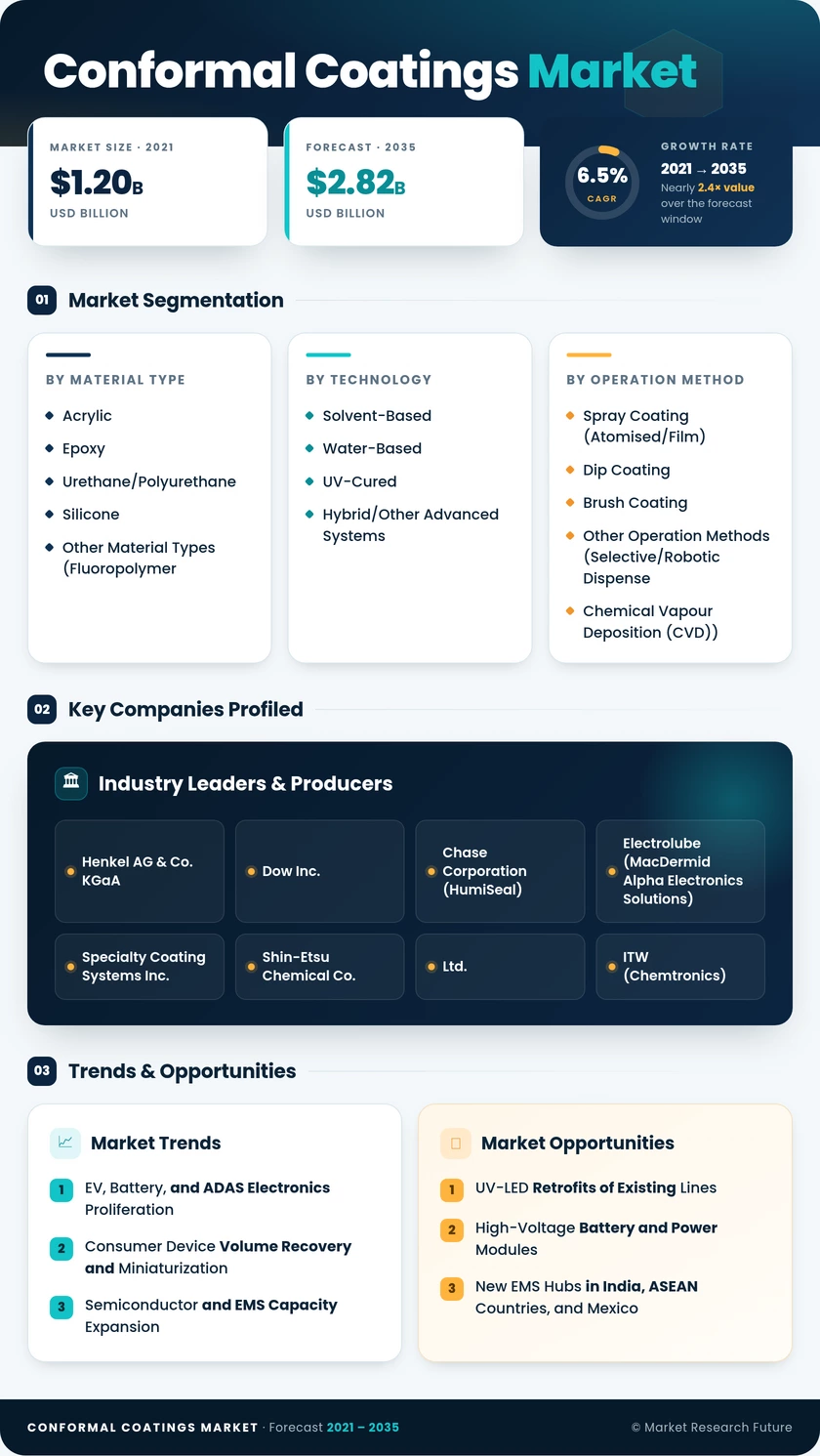
Conformal Coatings Market (2026 - 2035)

ID: MRFR/CnM/4330-HCR 111 Pages Chitranshi Jaiswal Last Updated: October 26, 2026
Conformal Coatings Market Research Report Information By Material Type (Acrylic, Epoxy, Urethane/Polyurethane, Silicone, and Other Material Types (Fluoropolymer and Nano-Coatings)), By Technology (Solvent-Based, Water-Based, UV-Cured, and Hybrid/Other Advanced Systems), By Operation Method (Spray Coating (Atomised/Film), Dip Coating, Brush Coating, and Other Operation Methods (Selective/Robotic Dispense and Chemical Vapour Deposition (CVD))), By End-User Industry (Consumer Electronics, Automotive (ICE, EV, ADAS), Aerospace and Defense, Medical and Life-Sciences Electronics, and Other End-User Industries (Industrial, Power and Energy)), And By Region (North America, Europe, Asia-Pacific, and Rest of the World) – Market Forecast Till 2035.
Conformal Coatings Market
Market Size
Forecast Period2026-2035
CAGR (2026-2035)6.5%
2025 Market SizeUSD 1.50 billion
2035 Market SizeUSD 2.82 billion
Key Players
Henkel AG & Co. KGaA
Dow Inc.
Chase Corporation
Electrolube
Specialty Coating Systems Inc.
Shin-Etsu Chemical Co., Ltd.
Opportunities
  • UV-LED Retrofits of Existing Lines
  • High-Voltage Battery and Power Modules
  • New EMS Hubs in India, ASEAN Countries, and Mexico
  1. 1 Market Summary | |
  2. 2 Key Report Takeaways | |
    1. 2.1 By Material Type | |
    2. 2.2 By Technology | |
    3. 2.3 By Operation Method | |
    4. 2.4 By End-user Industry | |
    5. 2.5 By Region | |
  3. 3 Market Size and Forecast (2021–2035) | |
  4. 4 Driver Impact Analysis | |
    1. 4.1 EV, Battery, and ADAS Electronics Proliferation | |
    2. 4.2 Consumer Device Volume Recovery and Miniaturization | |
    3. 4.3 Semiconductor and EMS Capacity Expansion | |
    4. 4.4 Aerospace and Defense Reliability Requirements | |
    5. 4.5 VOC and Hazardous-Substance Regulation | |
    6. 4.6 Grid, Renewable, and Industrial Power Electronics | |
    7. 4.7 Medical and Wearable Electronics Growth | |
  5. 5 Restraints Impact Analysis | |
    1. 5.1 Raw Material Price Volatility | |
    2. 5.2 PFAS Restrictions on Fluoropolymer Coatings | |
    3. 5.3 High Capital Cost of Selective and CVD Equipment | |
    4. 5.4 Solvent Compliance and Disposal Costs | |
    5. 5.5 Inspection and Rework Difficulty | |
  6. 6 Opportunities | |
    1. 6.1 UV-LED Retrofits of Existing Lines | |
    2. 6.2 High-Voltage Battery and Power Modules | |
    3. 6.3 New EMS Hubs in India, ASEAN Countries, and Mexico | |
    4. 6.4 Coating-as-a-Service and Process Data | |
    5. 6.5 PFAS-Free Thin-Film Alternatives | |
  7. 7 Regional Market Share and Country-Level Analysis | |
    1. 7.1 North America | | |
      1. 7.1.1 United States | | |
      2. 7.1.2 Canada | | |
      3. 7.1.3 Mexico | |
    2. 7.2 Europe | | |
      1. 7.2.1 Germany | | |
      2. 7.2.2 United Kingdom | | |
      3. 7.2.3 Italy | | |
      4. 7.2.4 France | | |
      5. 7.2.5 NORDIC Countries | | |
      6. 7.2.6 Rest of Europe | |
    3. 7.3 Asia-Pacific | | |
      1. 7.3.1 China | | |
      2. 7.3.2 India | | |
      3. 7.3.3 Japan | | |
      4. 7.3.4 South Korea | | |
      5. 7.3.5 ASEAN Countries | | |
      6. 7.3.6 Rest of Asia-Pacific | |
    4. 7.4 South America | | |
      1. 7.4.1 Brazil | | |
      2. 7.4.2 Argentina | | |
      3. 7.4.3 Rest of South America | |
    5. 7.5 Middle East and Africa | | |
      1. 7.5.1 Saudi Arabia | | |
      2. 7.5.2 South Africa | | |
      3. 7.5.3 Rest of Middle East and Africa | |
  8. 8 Future Outlook (2026–2035) | |
    1. 8.1 Automated Application and AI-Guided Inspection | |
    2. 8.2 The Electrification Supercycle | |
    3. 8.3 Chemical Regulation and Sustainability Reporting | |
    4. 8.4 Regionalized Electronics Supply Chains | |
  9. 9 Segmentation Analysis | |
    1. 9.1 By Material Type | | |
      1. 9.1.1 Acrylic | | |
      2. 9.1.2 Epoxy | | |
      3. 9.1.3 Urethane/Polyurethane | | |
      4. 9.1.4 Silicone | | |
      5. 9.1.5 Other Material Types (Fluoropolymer, Nano-coatings) | |
    2. 9.2 By Technology | | |
      1. 9.2.1 Solvent-Based | | |
      2. 9.2.2 Water-Based | | |
      3. 9.2.3 UV-Cured | | |
      4. 9.2.4 Hybrid/Other Advanced Systems | |
    3. 9.3 By Operation Method | | |
      1. 9.3.1 Spray Coating (Atomised/Film) | | |
      2. 9.3.2 Dip Coating | | |
      3. 9.3.3 Brush Coating | | |
      4. 9.3.4 Other Operation Methods (Selective/Robotic Dispense and Chemical Vapour Deposition (CVD)) | |
    4. 9.4 By End-user Industry | | |
      1. 9.4.1 Consumer Electronics | | |
      2. 9.4.2 Automotive (ICE, EV, ADAS) | | |
      3. 9.4.3 Aerospace and Defense | | |
      4. 9.4.4 Medical and Life-Sciences Electronics | | |
      5. 9.4.5 Other End-user Industries (Industrial, Power and Energy) | |
  10. 10 Competitive Landscape | |
    1. 10.1 Market Concentration Analysis | |
    2. 10.2 Competitive Benchmarking Matrix | |
    3. 10.3 Company Profiles | | |
      1. 10.3.1 Henkel AG & Co. KGaA | | |
      2. 10.3.2 Dow Inc. | | |
      3. 10.3.3 Chase Corporation (HumiSeal) | | |
      4. 10.3.4 Electrolube (MacDermid Alpha Electronics Solutions) | | |
      5. 10.3.5 Specialty Coating Systems Inc. | | |
      6. 10.3.6 Shin-Etsu Chemical Co., Ltd. | | |
      7. 10.3.7 H.B. Fuller Company | | |
      8. 10.3.8 ITW (Chemtronics) | | |
      9. 10.3.9 MG Chemicals | | |
      10. 10.3.10 Dymax Corporation | | |
      11. 10.3.11 CHT Group | | |
      12. 10.3.12 Momentive Performance Materials | |
  11. 11 Recent News & Developments | |
  12. 12 Report Scope and Methodology | |
  13. 13 Detailed Sources and Citations | |
  14. 14 Frequently Asked Questions (FAQs) | | LIST OF TABLES | |
  15. TABLE 1 Global Conformal Coatings Market Snapshot, 2025–2035 | |
  16. TABLE 2 Global Conformal Coatings Market Size & Forecast, by Revenue (USD billion), 2021–2035 | |
  17. TABLE 3 Driver Impact Analysis, 2026–2035 | |
  18. TABLE 4 Restraints Impact Analysis, 2026–2035 | |
  19. TABLE 5 Global Conformal Coatings Market, by Region, 2025 | |
  20. TABLE 6 North America Conformal Coatings Market, by Country, 2025 | |
  21. TABLE 7 Europe Conformal Coatings Market, by Country, 2025 | |
  22. TABLE 8 Asia-Pacific Conformal Coatings Market, by Country, 2025 | |
  23. TABLE 9 South America Conformal Coatings Market, by Country, 2025 | |
  24. TABLE 10 Middle East and Africa Conformal Coatings Market, by Country, 2025 | |
  25. TABLE 11 Global Conformal Coatings Market, by Material Type, 2025 | |
  26. TABLE 12 Global Conformal Coatings Market, by Technology, 2025 | |
  27. TABLE 13 Global Conformal Coatings Market, by Operation Method, 2025 | |
  28. TABLE 14 Global Conformal Coatings Market, by End-user Industry, 2025 | |
  29. TABLE 15 Competitive Benchmarking Matrix, 2025 | |
  30. TABLE 16 Report Scope and Methodology | |
  31. TABLE 17 Detailed Sources and Citations | | LIST OF FIGURES | |
  32. FIGURE 1 Conformal Coatings Market Dynamics Overview | |
  33. FIGURE 2 Conformal Coatings Industry Value Chain | |
  34. FIGURE 3 Porter's Five Forces Analysis | |
  35. FIGURE 4 Global Conformal Coatings Market Size Trend, 2021–2035 (USD billion) | |
  36. FIGURE 5 Market Share by Material Type, 2025 | |
  37. FIGURE 6 Market Share by Technology, 2025 | |
  38. FIGURE 7 Market Share by Operation Method, 2025 | |
  39. FIGURE 8 Market Share by End-user Industry, 2025 | |
  40. FIGURE 9 Regional Market Share, 2025 | |
  41. FIGURE 10 Competitive Landscape Positioning Map, 2025

Segmentation Quick Reference

DimensionSub-SegmentsDominant SegmentFastest Growing Segment
By Material TypeAcrylic; Epoxy; Urethane/Polyurethane; Silicone; Other Material Types (Fluoropolymer, Nano-coatings)Acrylic (47.0% share)Silicone (7.1% CAGR)
By TechnologySolvent-Based; Water-Based; UV-Cured; Hybrid/Other Advanced SystemsSolvent-Based (52.4% share)UV-Cured (7.6% CAGR)
By Operation MethodSpray Coating (Atomised/Film); Dip Coating; Brush Coating; Other Operation Methods (Selective/Robotic Dispense and Chemical Vapour Deposition (CVD))Spray Coating (Atomised/Film) (64.0% share)Other Operation Methods (Selective/Robotic Dispense and Chemical Vapour Deposition (CVD)) (7.4% CAGR)
By End-user IndustryConsumer Electronics; Automotive (ICE, EV, ADAS); Aerospace and Defense; Medical and Life-Sciences Electronics; Other End-user Industries (Industrial, Power and Energy)Consumer Electronics (37.0% share)Automotive (ICE, EV, ADAS) (7.3% CAGR)
By RegionNorth America; Europe; Asia-Pacific; South America; Middle-East and AfricaAsia-Pacific (44.0% share)Asia-Pacific (44.0% share; fastest-growing region)

Market Segmentation Overview

By Material Type

Sub-SegmentKey Trend
AcrylicDefault choice for reworkable consumer and industrial boards
EpoxyRetained for chemically harsh under-hood modules
Urethane/PolyurethaneGaining in flexible and foldable devices
SiliconeExpanding in EV power electronics and aerospace
Other Material Types (Fluoropolymer, Nano-coatings)Under PFAS review; hydrocarbon nano-films emerging

Acrylic leads because it balances cost, cure speed, and easy removal for repair, which matters most on high-volume consumer lines. Silicone grows fastest as EV inverters and aerospace boards demand stability across wide temperature ranges and low stress on solder joints. Epoxy and Urethane/Polyurethane hold specialized positions, while Fluoropolymer and Nano-coatings must navigate PFAS restrictions.

By Technology

Sub-SegmentKey Trend
Solvent-BasedProtected by existing automotive qualifications
Water-BasedAdopted where VOC rules outweigh line speed
UV-CuredFastest adoption via UV-LED tunnel retrofits
Hybrid/Other Advanced SystemsServing high-voltage inverter and BMS modules

Solvent-Based coatings keep the lead because requalifying approved automotive parts is slow and expensive. UV-Cured systems grow fastest, curing in seconds without solvent emissions and saving oven energy, with dual-cure grades solving shadow areas. Water-Based and Hybrid/Other Advanced Systems fill regulatory and high-voltage niches respectively.

By Operation Method

Sub-SegmentKey Trend
Spray Coating (Atomised/Film)Low-cost incumbent across EMS lines
Dip CoatingPersistent in commodity power supplies
Brush CoatingLimited to rework and prototypes
Other Operation Methods (Selective/Robotic Dispense and Chemical Vapour Deposition (CVD))Replacing masking-heavy spray and enabling pinhole-free films

Spray Coating (Atomised/Film) dominates through low capital cost and operator familiarity. Other Operation Methods grow fastest because robotic selective dispense eliminates masking labor and material waste, while CVD serves aerospace and implant boards needing pinhole-free coverage. Dip Coating and Brush Coating remain tied to commodity and repair work.

By End-user Industry

Sub-SegmentKey Trend
Consumer ElectronicsVolume recovery in phones and wearables
Automotive (ICE, EV, ADAS)High-voltage platforms and sensor proliferation
Aerospace and DefensePremium, qualification-driven demand
Medical and Life-Sciences ElectronicsBiocompatibility and sterilization requirements
Other End-user Industries (Industrial, Power and Energy)Outdoor inverters and grid controls

Consumer Electronics leads on sheer board volume from smartphones, wearables, and laptops. Automotive (ICE, EV, ADAS) grows fastest as battery management, inverter, and radar modules require high-dielectric protection under functional-safety standards. Aerospace and Defense and Medical and Life-Sciences Electronics pay premiums for qualified silicone and parylene films.


Download PDF ×

We do not share your information with anyone. However, we may send you emails based on your report interest from time to time. You may contact us at any time to opt-out.