×
Request Free Sample ×

Kindly complete the form below to receive a free sample of this Report

Leading companies partner with us for data-driven Insights

clients tt-cursor
Hero Background

Soft Skills Training Market

ID: MRFR/ICT/22805-HCR
100 Pages
Ankit Gupta
October 2025

Soft Skills Training Market Research Report By Delivery Format (Instructor-Led, Virtual Instructor-Led, Self-Paced E-Learning), By Skill Type (Communication and Interpersonal Skills, Leadership and Management Skills, Problem-Solving and Critical Thinking Skills, Emotional Intelligence and Self-Awareness), By Industry (Healthcare, IT and Telecom, Banking and Financial Services, Education, Manufacturing), By Job Title (Managers, Supervisors, Team Leaders, Entry-Level Employees, Mid-Level Professionals) and By Regional (North America, Europe, S... read more

Share:
Download PDF ×

We do not share your information with anyone. However, we may send you emails based on your report interest from time to time. You may contact us at any time to opt-out.

Soft Skills Training Market Infographic
Purchase Options

Soft Skills Training Market Summary

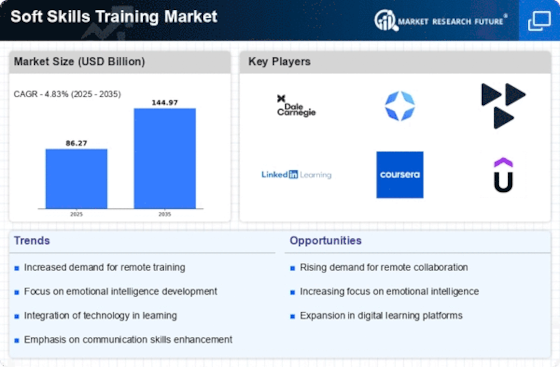
As per MRFR analysis, the Soft Skills Training Market was estimated at 86.27 USD Billion in 2024. The Soft Skills Training industry is projected to grow from 90.44 USD Billion in 2025 to 144.97 USD Billion by 2035, exhibiting a compound annual growth rate (CAGR) of 4.83 during the forecast period 2025 - 2035.

Key Market Trends & Highlights

The Soft Skills Training Market is experiencing a dynamic evolution driven by technological integration and personalized learning approaches.

  • North America remains the largest market for soft skills training, reflecting a robust demand for effective communication and interpersonal skills.
  • Asia-Pacific is emerging as the fastest-growing region, indicating a rising awareness of the importance of soft skills in diverse workforces.
  • Instructor-led training continues to dominate the market, while virtual instructor-led training is rapidly gaining traction due to its flexibility and accessibility.
  • The rising demand for soft skills and technological advancements in training delivery are key drivers propelling market growth.

Market Size & Forecast

2024 Market Size 86.27 (USD Billion)
2035 Market Size 144.97 (USD Billion)
CAGR (2025 - 2035) 4.83%

Major Players

Dale Carnegie Training (US), FranklinCovey (US), Skillsoft (US), LinkedIn Learning (US), Coursera (US), Udemy (US), The Ken Blanchard Companies (US), Mind Gym (GB), Zenger Folkman (US)

Soft Skills Training Market Trends

The Soft Skills Training Market is currently experiencing a notable evolution, driven by the increasing recognition of the importance of interpersonal skills in various professional environments. Organizations are increasingly prioritizing the development of soft skills among their workforce, as these competencies are essential for effective communication, teamwork, and leadership. This shift appears to be influenced by the growing complexity of workplace dynamics, where technical skills alone may not suffice for success. As a result, training programs are being tailored to address specific soft skills, such as emotional intelligence, adaptability, and conflict resolution, which are deemed crucial for fostering a collaborative and productive work atmosphere. Moreover, the Soft Skills Training Market seems to be expanding due to the rise of remote work and digital communication platforms. As employees engage in virtual interactions, the need for strong soft skills becomes even more pronounced. Companies are investing in innovative training solutions that leverage technology, such as online courses and interactive workshops, to enhance the learning experience. This trend indicates a shift towards more flexible and accessible training methods, allowing individuals to develop their soft skills at their own pace. Overall, the Soft Skills Training Market is poised for continued growth, reflecting the evolving demands of the modern workforce and the increasing emphasis on holistic employee development.

Personalized Learning Approaches

The Soft Skills Training Market is witnessing a trend towards personalized learning experiences. Organizations are recognizing that employees have diverse learning styles and preferences. Consequently, training programs are being customized to cater to individual needs, allowing for a more effective acquisition of soft skills. This tailored approach not only enhances engagement but also improves retention of knowledge, as employees feel more connected to the material.

Integration of Technology in Training

There is a growing integration of technology within the Soft Skills Training Market. Companies are increasingly utilizing digital platforms, such as virtual reality and gamification, to create immersive training experiences. These technological advancements facilitate interactive learning, making it easier for employees to practice and refine their soft skills in realistic scenarios. This trend suggests a shift towards more engaging and effective training methodologies.

Focus on Emotional Intelligence

The emphasis on emotional intelligence is becoming more pronounced within the Soft Skills Training Market. Organizations are acknowledging the critical role that emotional awareness plays in effective communication and collaboration. Training programs are increasingly incorporating modules that focus on developing emotional intelligence, equipping employees with the skills necessary to navigate interpersonal relationships and manage conflicts effectively.

Soft Skills Training Market Drivers

Rising Demand for Soft Skills

The increasing recognition of the importance of soft skills in the workplace is a primary driver for the Soft Skills Training Market. Employers are increasingly seeking candidates who possess strong interpersonal skills, adaptability, and emotional intelligence. According to recent data, approximately 92% of employers prioritize soft skills over technical skills when hiring. This trend indicates a shift in hiring practices, emphasizing the need for training programs that enhance these competencies. As organizations strive to improve team dynamics and overall productivity, the demand for effective soft skills training solutions continues to grow. Consequently, training providers are adapting their offerings to meet this demand, leading to a robust expansion of the Soft Skills Training Market.

Globalization and Diverse Workforces

The increasing globalization of businesses is a significant driver for the Soft Skills Training Market. As companies expand their operations across borders, they encounter diverse workforces with varying cultural backgrounds. This diversity necessitates the development of soft skills such as cross-cultural communication, teamwork, and adaptability. Organizations are investing in training programs that prepare employees to navigate these complexities effectively. Data indicates that companies with diverse teams are 35% more likely to outperform their competitors. This competitive advantage underscores the importance of soft skills training in fostering an inclusive workplace culture. As a result, the Soft Skills Training Market is likely to see continued growth as organizations prioritize training that enhances employees' ability to work in diverse environments.

Increased Focus on Employee Well-being

The growing emphasis on employee well-being and mental health is influencing the Soft Skills Training Market. Organizations are recognizing that fostering a supportive work environment enhances employee satisfaction and productivity. As a result, there is a rising demand for training programs that equip employees with skills to manage stress, communicate effectively, and collaborate with colleagues. Research indicates that companies investing in employee well-being see a return on investment of up to 4 dollars for every dollar spent. This focus on holistic employee development is prompting organizations to incorporate soft skills training into their professional development initiatives. Consequently, the Soft Skills Training Market is experiencing a surge in demand for programs that address these critical areas.

Regulatory and Compliance Requirements

The evolving landscape of regulatory and compliance requirements is shaping the Soft Skills Training Market. Many industries are now mandated to provide training that includes soft skills development, particularly in sectors such as healthcare, finance, and education. Compliance with these regulations not only ensures legal adherence but also enhances organizational effectiveness. For instance, training programs that focus on communication and ethical decision-making are becoming essential components of compliance training. This trend is driving organizations to seek specialized training providers that can deliver effective soft skills training solutions. As regulatory frameworks continue to evolve, the demand for soft skills training is expected to rise, further propelling the growth of the Soft Skills Training Market.

Technological Advancements in Training Delivery

The integration of technology into training methodologies is transforming the Soft Skills Training Market. With the advent of e-learning platforms, virtual reality, and mobile applications, training programs are becoming more accessible and engaging. Data suggests that the e-learning market is projected to reach over 375 billion dollars by 2026, indicating a significant shift towards digital learning solutions. These technological advancements allow for personalized learning experiences, enabling individuals to develop soft skills at their own pace. Furthermore, organizations are leveraging data analytics to assess training effectiveness, ensuring that programs are tailored to meet specific needs. This evolution in training delivery methods is likely to enhance the overall effectiveness of soft skills training, thereby driving growth in the Soft Skills Training Market.


Market Segment Insights

By Delivery Format: Instructor-Led (Largest) vs. Virtual Instructor-Led (Fastest-Growing)

The soft skills training market showcases a diverse range of delivery formats, with instructor-led training currently commanding the largest share due to its traditional and effective teaching methods. This format allows for personalized interactions and immediate feedback, which many learners prefer for complex skill acquisition. In contrast, virtual instructor-led training is increasingly gaining traction, appealing to organizations seeking flexibility and broader access for participants across various locations. As remote working trends continue to shape the workforce, the demand for virtual instructor-led training is accelerating, as it combines the interactivity of traditional methods with the convenience of online access. The self-paced e-learning format also remains popular, catering to those who prefer to learn at their own pace, but it lacks the immediacy of interaction found in the other formats, making it less predominant in this particular market.

Instructor-Led (Dominant) vs. Self-Paced E-Learning (Emerging)

Instructor-led training remains the dominant format in the soft skills training market, characterized by face-to-face interaction and real-time feedback, essential for developing interpersonal skills. This format thrives in environments where personal connection and live demonstrations are critical for effective learning outcomes. Conversely, self-paced e-learning is emerging as a valuable alternative, especially among learners who seek flexibility in their training schedules. While it often lacks the immediacy of instructor-led formats, it provides scalability in training delivery, appealing to organizations with a diverse workforce that requires a cost-effective solution. As technology evolves, the combination of these formats could present a hybrid approach that caters to various learning preferences.

By Skill Type: Communication and Interpersonal Skills (Largest) vs. Leadership and Management Skills (Fastest-Growing)

The Soft Skills Training Market showcases a diverse array of skill types, with Communication and Interpersonal Skills being the largest segment, driven by the increasing demand for effective interaction in workplace environments. This category encompasses skills that enhance personal communication, teamwork, and relationship-building, catering to professionals across various industries. In contrast, Leadership and Management Skills are recognized as the fastest-growing segment, reflecting the rising importance of strong managerial capabilities in fostering employee engagement and organizational success.

Communication and Interpersonal Skills (Dominant) vs. Leadership and Management Skills (Emerging)

Communication and Interpersonal Skills dominate the Soft Skills Training Market as they are fundamental to workforce collaboration and cohesion. Organizations increasingly prioritize this skill set to enhance employee interaction and teamwork, making it essential in today’s interconnected work environments. On the other hand, Leadership and Management Skills are an emerging focal point driven by the need for effective leadership in dynamic workforces. This segment is gaining traction as businesses recognize the importance of skilled leaders in navigating change, inspiring teams, and achieving strategic objectives.

By Industry: Healthcare (Largest) vs. IT and Telecom (Fastest-Growing)

In the Soft Skills Training Market, the industry segment is characterized by diverse adoption patterns across various fields. The Healthcare sector holds the largest market share, driven by the need for enhanced patient interactions and teamwork among healthcare professionals. Conversely, the IT and Telecom sector is experiencing the fastest growth, with increasing emphasis on soft skills training tailored for remote collaboration and agile project management.

Healthcare: Leadership Skills (Dominant) vs. IT and Telecom: Communication Skills (Emerging)

In the Healthcare sector, leadership skills training has become dominant, as organizations prioritize effective management in high-pressure environments. Training programs are often tailored to foster empathy, resilience, and conflict resolution among healthcare leaders. Meanwhile, the IT and Telecom sector is emerging as a hotspot for communication skills development, spurred by technological advancements that necessitate clear and effective communication. As remote work increases, these sectors are investing in training that enhances interpersonal skills, crucial for team dynamics and customer interactions.

By Job Title: Managers (Largest) vs. Entry-Level Employees (Fastest-Growing)

The Soft Skills Training Market showcases a diverse distribution across various job titles, with Managers holding the largest share due to their pivotal role in organizational success. This segment seeks advanced soft skills training to enhance leadership qualities, team dynamics, and conflict resolution capabilities. Following closely are Mid-Level Professionals and Team Leaders, emphasizing the need for effective communication and decision-making prowess, allowing them to navigate complex workplace challenges efficiently. Entry-Level Employees represent the fastest-growing segment within this market. As organizations increasingly prioritize early skill development, more companies are integrating soft skills training into onboarding programs. This shift catalyzes significant growth for this segment, targeting competencies such as teamwork, adaptability, and emotional intelligence, foundational to career advancement.

Managers: (Dominant) vs. Entry-Level Employees (Emerging)

Managers are categorized as the dominant force within the Soft Skills Training Market, requiring extensive training to refine their leadership, negotiation, and interpersonal skills. They often undergo various training programs aimed at enhancing their capacity to inspire teams, drive performance, and manage change effectively. In contrast, Entry-Level Employees are an emerging segment, rapidly gaining attention from trainers and organizations. These employees are often introduced to foundational soft skills training to ensure they possess the essential skills necessary for collaboration and communication in the workplace. Their engagement with soft skills training is characterized by a growing emphasis on creating a skilled workforce, promoting an environment of inclusivity, and adapting to evolving industry needs.

Get more detailed insights about Soft Skills Training Market

Regional Insights

North America : Training and Development Leader

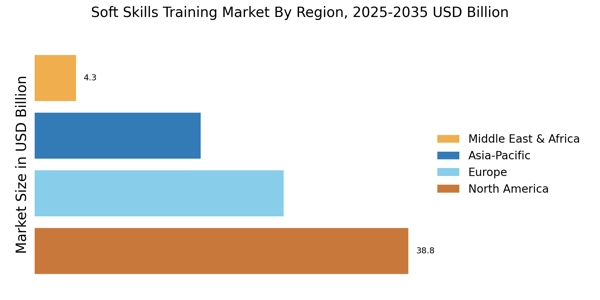
North America is the largest market for soft skills training, accounting for approximately 45% of the global market share. The region's growth is driven by a strong emphasis on employee development, technological advancements, and a growing recognition of the importance of soft skills in the workplace. Companies are increasingly investing in training programs to enhance communication, teamwork, and leadership skills among employees. The United States is the leading country in this market, with major players like Dale Carnegie Training, FranklinCovey, and LinkedIn Learning dominating the landscape. The competitive environment is characterized by a mix of established firms and emerging startups, all vying to offer innovative training solutions. The presence of these key players ensures a diverse range of offerings tailored to various industries and organizational needs.

Europe : Emerging Training Hub

Europe is witnessing a significant rise in the demand for soft skills training, holding approximately 30% of the global market share. The region's growth is fueled by increasing awareness of the importance of interpersonal skills in enhancing workplace productivity and employee satisfaction. Regulatory initiatives aimed at improving workforce skills further catalyze this trend, as organizations seek to comply with evolving labor market demands. Leading countries in Europe include the United Kingdom, Germany, and France, where companies are investing heavily in training programs. The competitive landscape features a mix of local and international players, including Mind Gym and Zenger Folkman. This diversity fosters innovation and ensures that training solutions are aligned with the specific needs of various sectors, enhancing overall workforce capabilities.

Asia-Pacific : Rapidly Growing Market

Asia-Pacific is emerging as a rapidly growing market for soft skills training, accounting for about 20% of the global market share. The region's growth is driven by a burgeoning workforce, increasing globalization, and a rising awareness of the importance of soft skills in enhancing employability. Governments are also promoting educational reforms that emphasize soft skills development, further boosting demand for training programs. Countries like China, India, and Australia are at the forefront of this trend, with a mix of local and international training providers. The competitive landscape is evolving, with key players such as Skillsoft and Coursera expanding their offerings to cater to diverse audiences. This dynamic environment is fostering innovation and creating opportunities for tailored training solutions that meet the unique needs of the region's workforce.

Middle East and Africa : Emerging Training Frontier

The Middle East and Africa region is an emerging frontier for soft skills training, holding approximately 5% of the global market share. The growth in this region is driven by a young and dynamic workforce, increasing investment in education, and a growing recognition of the importance of soft skills in various sectors. Governments are also implementing initiatives to enhance workforce skills, which is expected to further stimulate market growth. Countries like South Africa, UAE, and Nigeria are leading the charge in adopting soft skills training programs. The competitive landscape is characterized by a mix of local training providers and international players looking to expand their footprint. This presents a unique opportunity for innovative training solutions that cater to the diverse cultural and economic contexts of the region.

Soft Skills Training Market Regional Image

Key Players and Competitive Insights

The Soft Skills Training Market industry is highly competitive, with numerous major players vying for market share. Leading Soft Skills Training Market players are constantly developing and refining their offerings to meet the evolving needs of customers. This competitive landscape fosters innovation and drives the Soft Skills Training Market development forward. Key players in the Soft Skills Training Market are investing heavily in research and development to create customized and tailored solutions for clients. The competitive environment encourages companies to adopt cutting-edge technologies and methodologies to enhance their training programs.

As a result, the Soft Skills Training Market is witnessing constant advancements and improvements, ensuring that customers have access to high-quality and effective training solutions.One of the notable competitors in the Soft Skills Training Market is Dale Carnegie Training. The company has a global presence and offers a wide range of soft skills training programs. Dale Carnegie Training focuses on developing essential soft skills such as leadership, communication, and interpersonal relationships. Their training programs are designed to enhance individual and organizational performance, helping clients achieve their business objectives.Another key player in the Soft Skills Training Market is FranklinCovey.

The company is renowned for its leadership and organizational development programs. FranklinCovey's training solutions are designed to improve productivity, collaboration, and teamwork within organizations. The company offers customizable training programs tailored to meet the specific needs of clients, helping them achieve their desired outcomes.

Key Companies in the Soft Skills Training Market market include

Industry Developments

The Soft Skills Training Market is projected to reach USD 120.0 billion by 2032, exhibiting a CAGR of 4.83% during the forecast period (2023-2032). The rising demand for soft skills training is attributed to the increasing emphasis on employee development and the need to enhance workplace productivity and innovation. Recent news developments in the market include the acquisition of Skill Soft by Cornerstone OnDemand, a leading provider of cloud-based talent management solutions, and the launch of new soft skills training programs by companies like LinkedIn Learning and Coursera.

These developments indicate the growing importance of soft skills training in the modern workplace and the increasing investment in this market.

Future Outlook

Soft Skills Training Market Future Outlook

The Soft Skills Training Market is projected to grow at a 4.83% CAGR from 2024 to 2035, driven by increasing demand for interpersonal skills and remote work adaptability.

New opportunities lie in:

  • Development of AI-driven personalized training platforms
  • Expansion of virtual reality training modules for immersive learning
  • Partnerships with corporations for tailored employee development programs

By 2035, the market is expected to be robust, reflecting a strong emphasis on soft skills across industries.

Market Segmentation

Soft Skills Training Market Industry Outlook

  • Healthcare
  • IT and Telecom
  • Banking and Financial Services
  • Education
  • Manufacturing

Soft Skills Training Market Job Title Outlook

  • Managers
  • Supervisors
  • Team Leaders
  • Entry-Level Employees
  • Mid-Level Professionals

Soft Skills Training Market Skill Type Outlook

  • Communication and Interpersonal Skills
  • Leadership and Management Skills
  • Problem-Solving and Critical Thinking Skills
  • Emotional Intelligence and Self-Awareness

Soft Skills Training Market Delivery Format Outlook

  • Instructor-Led
  • Virtual Instructor-Led
  • Self-Paced E-Learning

Report Scope

MARKET SIZE 202486.27(USD Billion)
MARKET SIZE 202590.44(USD Billion)
MARKET SIZE 2035144.97(USD Billion)
COMPOUND ANNUAL GROWTH RATE (CAGR)4.83% (2024 - 2035)
REPORT COVERAGERevenue Forecast, Competitive Landscape, Growth Factors, and Trends
BASE YEAR2024
Market Forecast Period2025 - 2035
Historical Data2019 - 2024
Market Forecast UnitsUSD Billion
Key Companies ProfiledMarket analysis in progress
Segments CoveredMarket segmentation analysis in progress
Key Market OpportunitiesIntegration of artificial intelligence in Soft Skills Training Market enhances personalized learning experiences.
Key Market DynamicsRising demand for remote learning solutions drives innovation in soft skills training methodologies and delivery platforms.
Countries CoveredNorth America, Europe, APAC, South America, MEA

Leave a Comment

FAQs

What is the current valuation of the Soft Skills Training Market?

The Soft Skills Training Market was valued at 86.27 USD Billion in 2024.

What is the projected market size for the Soft Skills Training Market by 2035?

The market is projected to reach 144.97 USD Billion by 2035.

What is the expected CAGR for the Soft Skills Training Market during the forecast period?

The expected CAGR for the Soft Skills Training Market from 2025 to 2035 is 4.83%.

Which delivery format generated the highest revenue in the Soft Skills Training Market?

Instructor-Led training generated the highest revenue, with values ranging from 34.0 to 56.0 USD Billion.

What are the leading skill types in the Soft Skills Training Market?

Communication and Interpersonal Skills lead the market, with a valuation range of 34.0 to 56.0 USD Billion.

Which industries are the largest consumers of Soft Skills Training?

The IT and Telecom industry is a major consumer, with a valuation range of 20.0 to 30.0 USD Billion.

What job titles are most likely to invest in Soft Skills Training?

Managers are among the top job titles investing in training, with a valuation range of 20.0 to 34.0 USD Billion.

Who are the key players in the Soft Skills Training Market?

Key players include Dale Carnegie Training, FranklinCovey, Skillsoft, and LinkedIn Learning.

What is the projected growth for Self-Paced E-Learning in the Soft Skills Training Market?

Self-Paced E-Learning is projected to grow, with values expected to range from 22.27 to 38.97 USD Billion.

How does the market for Emotional Intelligence and Self-Awareness skills compare to others?

The market for Emotional Intelligence and Self-Awareness skills ranges from 14.27 to 30.97 USD Billion, indicating substantial demand.

Download Free Sample

Kindly complete the form below to receive a free sample of this Report

Compare Licence

×
Features License Type
Single User Multiuser License Enterprise User
Price $4,950 $5,950 $7,250
Maximum User Access Limit 1 User Upto 10 Users Unrestricted Access Throughout the Organization
Free Customization
Direct Access to Analyst
Deliverable Format
Platform Access
Discount on Next Purchase 10% 15% 15%
Printable Versions