Conductive Polymers Market (2026 - 2035)

ID: MRFR/CnM/0424-HCR 147 Pages Priya Nagrale Last Updated: October 22, 2026
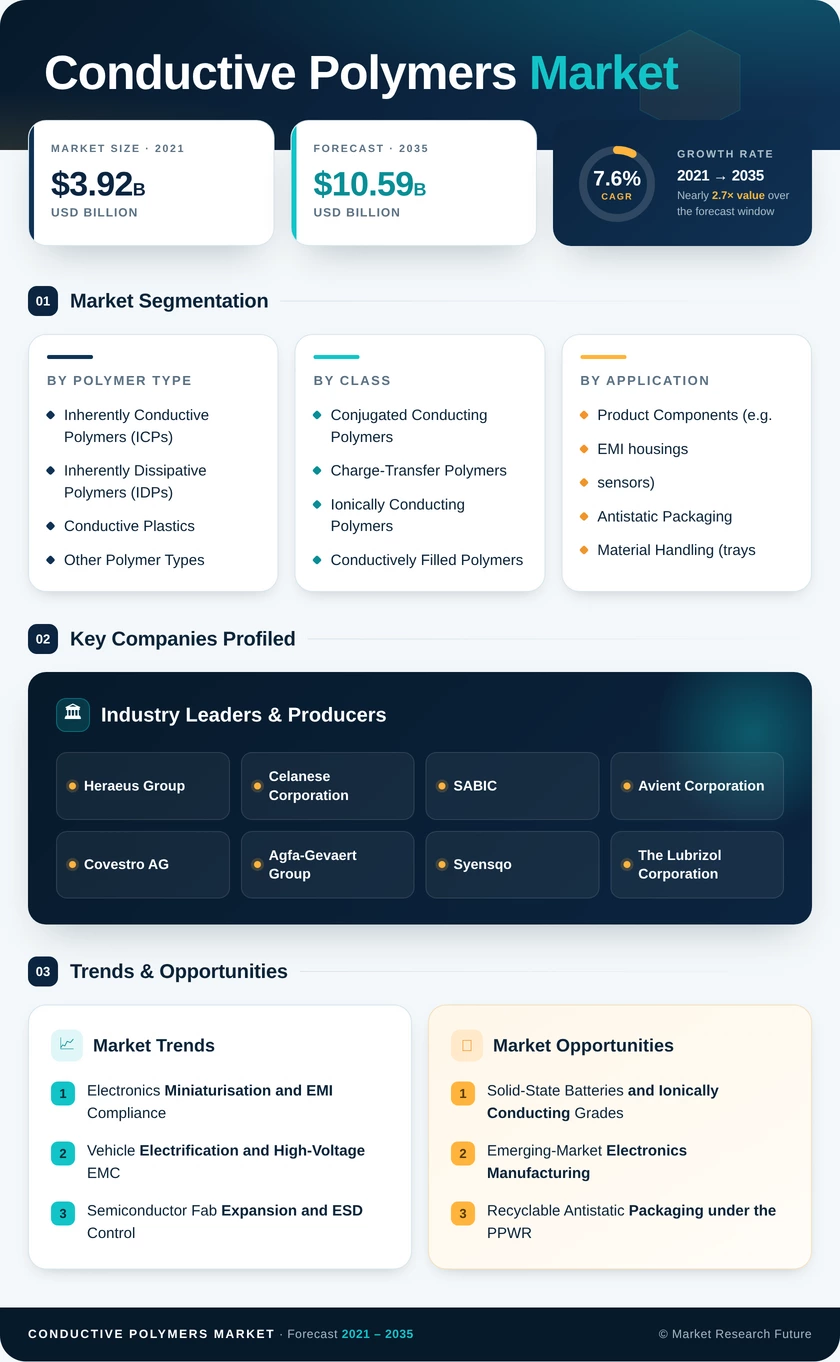
Conductive Polymers Market Research Report Information By Polymer Type (Inherently Conductive Polymers (ICPs), Inherently Dissipative Polymers (IDPs), Conductive Plastics, and Other Polymer Types), By Class (Conjugated Conducting Polymers, Charge-Transfer Polymers, Ionically Conducting Polymers, and Conductively Filled Polymers), By Application (Product Components (e.g., EMI Housings, Sensors), Antistatic Packaging, Material Handling (Trays, Totes), Work-Surface and Flooring, and Others), By End-User Industry (Electrical and Electronics, Automotive and E-Mobility, Aerospace and Defense, Healthcare and Wearables, and Others (Industrial Packaging and Logistics)), And By Region (North America, Europe, Asia-Pacific, and Rest of the World) – Market Forecast Till 2035.
Conductive Polymers Market
Market Size
Forecast Period2026-2035
CAGR (2026-2035)7.6%
2025 Market SizeUSD 5.09 Billion
2035 Market SizeUSD 10.59 Billion
Key Players
Heraeus Group
Celanese Corporation
SABIC
Avient Corporation
Covestro AG
Agfa-Gevaert Group
Opportunities
  • Solid-State Batteries and Ionically Conducting Grades
  • Emerging-Market Electronics Manufacturing
  • Recyclable Antistatic Packaging under the PPWR
  1. 1 Market Summary | |
  2. 2 Key Report Takeaways | |
    1. 2.1 By Polymer Type | |
    2. 2.2 By Class | |
    3. 2.3 By Application | |
    4. 2.4 By End-user Industry | |
    5. 2.5 By Region | |
  3. 3 Market Size and Forecast (2021–2035) | |
    1. 3.1 Historical Market Size (2021–2024) | |
    2. 3.2 Base Year and Forecast Market Size (2025–2035) | |
    3. 3.3 Year-over-Year Growth Analysis | |
  4. 4 Driver Impact Analysis | |
    1. 4.1 Electronics Miniaturisation and EMI Compliance | |
    2. 4.2 Vehicle Electrification and High-Voltage EMC | |
    3. 4.3 Semiconductor Fab Expansion and ESD Control | |
    4. 4.4 Wearables and Printed Bioelectronics | |
    5. 4.5 Lightweighting Mandates | |
    6. 4.6 Asian Industrial Policy and Capacity Localisation | |
  5. 5 Restraints Impact Analysis | |
    1. 5.1 Cost Premium of Inherently Conductive Grades | |
    2. 5.2 Environmental Stability and Conductivity Drift | |
    3. 5.3 Processability Constraints | |
    4. 5.4 PFAS and Additive Regulation | |
    5. 5.5 Electronics Cyclicality and Substitute Materials | |
  6. 6 Opportunities | |
    1. 6.1 Solid-State Batteries and Ionically Conducting Grades | |
    2. 6.2 Emerging-Market Electronics Manufacturing | |
    3. 6.3 Recyclable Antistatic Packaging under the PPWR | |
    4. 6.4 Data-Linked Packaging and Materials-as-a-Service | |
    5. 6.5 In-Mould and Structural Electronics | |
  7. 7 Regional Market Share and Country-Level Analysis | |
    1. 7.1 Asia-Pacific | | |
      1. 7.1.1 China | | |
      2. 7.1.2 India | | |
      3. 7.1.3 Japan | | |
      4. 7.1.4 South Korea | | |
      5. 7.1.5 ASEAN Countries | | |
      6. 7.1.6 Rest of Asia-Pacific | |
    2. 7.2 North America | | |
      1. 7.2.1 United States | | |
      2. 7.2.2 Canada | | |
      3. 7.2.3 Mexico | |
    3. 7.3 Europe | | |
      1. 7.3.1 Germany | | |
      2. 7.3.2 United Kingdom | | |
      3. 7.3.3 France | | |
      4. 7.3.4 Italy | | |
      5. 7.3.5 NORDIC | | |
      6. 7.3.6 Russia | | |
      7. 7.3.7 Rest of Europe | |
    4. 7.4 South America | | |
      1. 7.4.1 Brazil | | |
      2. 7.4.2 Argentina | | |
      3. 7.4.3 Rest of South America | |
    5. 7.5 Middle East and Africa | | |
      1. 7.5.1 Saudi Arabia | | |
      2. 7.5.2 United Arab Emirates | | |
      3. 7.5.3 South Africa | | |
      4. 7.5.4 Rest of Middle East and Africa | |
  8. 8 Future Outlook (2026–2035) | |
    1. 8.1 Electrification Supercycle | |
    2. 8.2 Fab Localisation and Zero-Defect ESD Regimes | |
    3. 8.3 Bioelectronics and Human-Machine Interfaces | |
    4. 8.4 Circularity and Scope 3 Reporting | |
  9. 9 Segmentation Analysis | |
    1. 9.1 By Polymer Type | | |
      1. 9.1.1 Inherently Conductive Polymers (ICPs) | | |
      2. 9.1.2 Inherently Dissipative Polymers (IDPs) | | |
      3. 9.1.3 Conductive Plastics | | |
      4. 9.1.4 Other Polymer Types | |
    2. 9.2 By Class | | |
      1. 9.2.1 Conjugated Conducting Polymers | | |
      2. 9.2.2 Charge-Transfer Polymers | | |
      3. 9.2.3 Ionically Conducting Polymers | | |
      4. 9.2.4 Conductively Filled Polymers | |
    3. 9.3 By Application | | |
      1. 9.3.1 Product Components (e.g., EMI housings, sensors) | | |
      2. 9.3.2 Antistatic Packaging | | |
      3. 9.3.3 Material Handling (trays, totes) | | |
      4. 9.3.4 Work-surface and Flooring | | |
      5. 9.3.5 Others | |
    4. 9.4 By End-user Industry | | |
      1. 9.4.1 Electrical and Electronics | | |
      2. 9.4.2 Automotive and E-Mobility | | |
      3. 9.4.3 Aerospace and Defense | | |
      4. 9.4.4 Healthcare and Wearables | | |
      5. 9.4.5 Others (Industrial Packaging and Logistics) | |
  10. 10 Competitive Landscape | |
    1. 10.1 Market Concentration Analysis | |
    2. 10.2 Competitive Benchmarking Matrix | |
    3. 10.3 Company Profiles | | |
      1. 10.3.1 Heraeus Group | | |
      2. 10.3.2 Celanese Corporation | | |
      3. 10.3.3 SABIC | | |
      4. 10.3.4 Avient Corporation | | |
      5. 10.3.5 Covestro AG | | |
      6. 10.3.6 Agfa-Gevaert Group | | |
      7. 10.3.7 Syensqo | | |
      8. 10.3.8 3M Company | | |
      9. 10.3.9 The Lubrizol Corporation | | |
      10. 10.3.10 RTP Company | | |
      11. 10.3.11 Premix Group | |
  11. 11 Recent News & Developments | |
  12. 12 Report Scope and Methodology | |
  13. 13 Detailed Sources and Citations | |
  14. 14 Frequently Asked Questions (FAQs) | | LIST OF TABLES | |
  15. TABLE 1 Global Market Snapshot, 2025–2035 | |
  16. TABLE 2 Global Market Size & Forecast, by Revenue (USD Billion), 2021–2035 | |
  17. TABLE 3 Driver Impact Analysis, 2026–2035 | |
  18. TABLE 4 Restraints Impact Analysis, 2026–2035 | |
  19. TABLE 5 Regional Market Summary, 2025 | |
  20. TABLE 6 Asia-Pacific Market, by Country, 2025 | |
  21. TABLE 7 North America Market, by Country, 2025 | |
  22. TABLE 8 Europe Market, by Country, 2025 | |
  23. TABLE 9 South America Market, by Country, 2025 | |
  24. TABLE 10 Middle East and Africa Market, by Country, 2025 | |
  25. TABLE 11 Global Market, by Polymer Type, 2025 | |
  26. TABLE 12 Global Market, by Class, 2025 | |
  27. TABLE 13 Global Market, by Application, 2025 | |
  28. TABLE 14 Global Market, by End-user Industry, 2025 | |
  29. TABLE 15 Competitive Benchmarking Matrix, 2025 | |
  30. TABLE 16 Report Scope and Methodology | |
  31. TABLE 17 Detailed Sources and Citations | |
  32. TABLE 18 Segmentation Quick Reference | | LIST OF FIGURES | |
  33. FIGURE 1 Market Dynamics Overview (Drivers, Restraints, Opportunities) | |
  34. FIGURE 2 Industry Value Chain Analysis | |
  35. FIGURE 3 Porter's Five Forces Analysis | |
  36. FIGURE 4 Global Market Size Trend, 2021–2035 (USD Billion) | |
  37. FIGURE 5 Year-over-Year Growth Rate, 2022–2035 | |
  38. FIGURE 6 Market Share by Polymer Type, 2025 | |
  39. FIGURE 7 Market Share by Class, 2025 | |
  40. FIGURE 8 Market Share by Application, 2025 | |
  41. FIGURE 9 Market Share by End-user Industry, 2025 | |
  42. FIGURE 10 Regional Market Share, 2025 | |
  43. FIGURE 11 Country-Level Share within Each Region, 2025 | |
  44. FIGURE 12 Competitive Landscape Positioning Matrix, 2025 | |
  45. FIGURE 13 Estimated Revenue Share of Key Players, 2025

Segmentation Quick Reference

DimensionSub-SegmentsDominant SegmentFastest Growing Segment
By Polymer TypeInherently Conductive Polymers (ICPs); Inherently Dissipative Polymers (IDPs); Conductive Plastics; Other Polymer TypesConductive Plastics (41.5% share)Inherently Conductive Polymers (ICPs) (7.8% CAGR)
By ClassConjugated Conducting Polymers; Charge-Transfer Polymers; Ionically Conducting Polymers; Conductively Filled PolymersConjugated Conducting Polymers (43.0% share)Ionically Conducting Polymers (8.1% CAGR)
By ApplicationProduct Components (e.g., EMI housings, sensors); Antistatic Packaging; Material Handling (trays, totes); Work-surface and Flooring; OthersProduct Components (e.g., EMI housings, sensors) (41.0% share)Product Components (e.g., EMI housings, sensors) (41.0% share)
By End-user IndustryElectrical and Electronics; Automotive and E-Mobility; Aerospace and Defense; Healthcare and Wearables; Others (Industrial Packaging and Logistics)Electrical and Electronics (44.5% share)Automotive and E-Mobility (8.6% CAGR)
By RegionAsia-Pacific; North America; Europe; South America; Middle-East and AfricaAsia-Pacific (47.2% share)Asia-Pacific (47.2% share)

Market Segmentation Overview

By Polymer Type

Sub-SegmentKey Trend
Inherently Conductive Polymers (ICPs)Vapour-phase polymerisation narrows the performance gap with metals
Inherently Dissipative Polymers (IDPs)Steady demand from fab floors and assembly lines
Conductive PlasticsScale economics in moulded EMI housings
Other Polymer TypesNano-carbon and TPU hybrids for stretchable devices

Conductive Plastics lead because existing moulding and extrusion assets deliver shielded housings at the lowest cost per part. Inherently Conductive Polymers (ICPs) grow fastest as wearable and antenna designers pay a premium for conductivity per gram that filled compounds cannot reach. Inherently Dissipative Polymers (IDPs) hold a stable niche where controlled static bleed-off matters more than peak conductivity.

By Class

Sub-SegmentKey Trend
Conjugated Conducting PolymersTransparent electrodes and diagnostic transistors
Charge-Transfer PolymersRedox-tuned sensing applications
Ionically Conducting PolymersSolid-state battery and biointerface development
Conductively Filled PolymersCost-led antistatic trays and housings

Conjugated Conducting Polymers lead on the strength of proven synthesis and ambient stability in displays and electrochemical transistors. Ionically Conducting Polymers grow fastest because their mixed ionic-electronic conduction suits solid polymer electrolytes and tissue interfaces. Conductively Filled Polymers retain volume where moderate conductivity at low cost is enough.

By Application

Sub-SegmentKey Trend
Product Components (e.g., EMI housings, sensors)Moulded shielding replaces machined metal parts
Antistatic PackagingShift toward recyclable mono-material formats
Material Handling (trays, totes)Automated warehouses demand durable dissipative grades
Work-surface and FlooringTighter ESD specifications in advanced-node fabs
OthersPrinted tags and conductive coatings

Product Components (e.g., EMI housings, sensors) both lead and grow fastest because every new device and EV power module adds shielded parts that can be moulded in one step. Antistatic Packaging is being reshaped by the PPWR's recyclability requirement, favouring mono-material dissipative films over metallised laminates. Material Handling (trays, totes) gains from warehouse automation, where static-induced misfires carry high costs.

By End-user Industry

Sub-SegmentKey Trend
Electrical and ElectronicsThinner devices and AI servers raise shielding density
Automotive and E-MobilityHigh-voltage drivetrains multiply EMC requirements
Aerospace and DefenseWeight-sensitive harsh-environment electronics
Healthcare and WearablesSkin-worn diagnostics and smart garments
Others (Industrial Packaging and Logistics)Baseline antistatic shipping demand

Electrical and Electronics remains the largest end use as phones, laptops and servers pack more emitters into slimmer enclosures. Automotive and E-Mobility grows fastest because battery casings, inverter housings and charge-port gaskets all move from metal to lighter polymer shielding under UNECE EMC rules. Healthcare and wearables are smaller but rising as biocompatible, stretchable conductors move from pilot to production.


Download PDF ×

We do not share your information with anyone. However, we may send you emails based on your report interest from time to time. You may contact us at any time to opt-out.