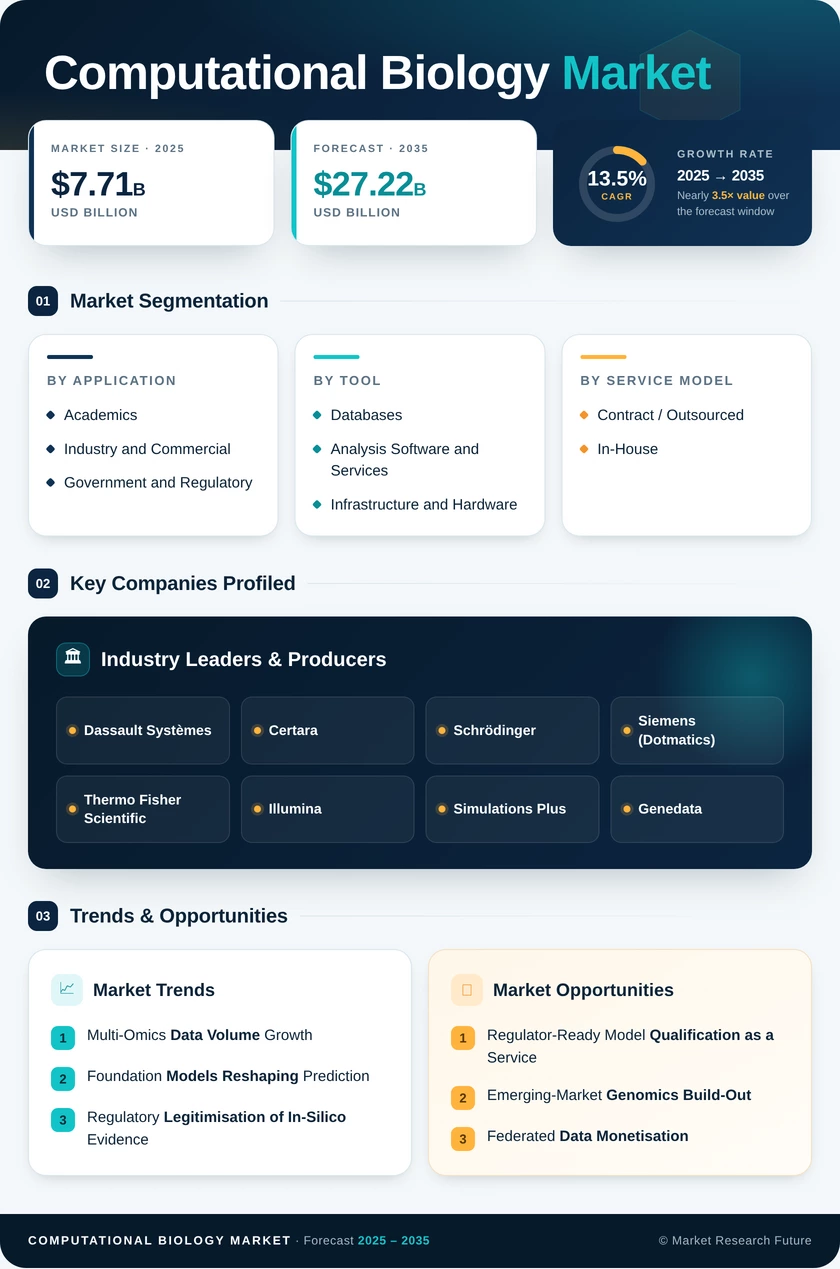
Segmentation Quick Reference
| Dimension | Sub-Segments | Dominant Segment | Fastest Growing Segment |
| By Application | Cellular and Biological Simulation; Drug Discovery and Disease Modelling; Preclinical Drug Development; Clinical Trials and Human Body Simulation | Cellular and Biological Simulation | Drug Discovery and Disease Modelling |
| By Tool | Databases; Analysis Software and Services; Infrastructure and Hardware | Databases | Analysis Software and Services |
| By Service | In-House; Contract / Outsourced | Contract / Outsourced | In-House |
| By End-User | Academics; Industry and Commercial; Government and Regulatory | Academics | Industry and Commercial |
| By Geography | North America; Europe; Asia-Pacific; South America; Middle East & Africa | North America | Asia-Pacific |
Market Segmentation Overview
By Application
| Sub-Segment | Key Trend |
| Cellular and Biological Simulation | Pathway-level digital twins replacing static network diagrams |
| Drug Discovery and Disease Modelling | Structural prediction compressing hit-identification timelines |
| Preclinical Drug Development | Physiologically based pharmacokinetic models entering regulatory submissions |
| Clinical Trials and Human Body Simulation | Virtual control arms reducing recruitment burden in rare-disease studies |
Application demand splits cleanly between breadth and intensity. Simulation workloads support the widest user base, while discovery and preclinical modelling attract the highest revenue per account because sponsors link them directly to pipeline decisions.
By Tool
| Sub-Segment | Key Trend |
| Databases | Subscription curation shifting toward federated, access-controlled models |
| Analysis Software and Services | Managed pipelines displacing self-maintained toolchains |
| Infrastructure and Hardware | GPU tenancy replacing capital purchase of on-premise clusters |
Tooling spend is migrating from assets to outcomes. Buyers increasingly accept bundled compute inside software contracts, which simplifies budgeting and transfers infrastructure risk to the vendor.
By Service
| Sub-Segment | Key Trend |
| In-House | Large sponsors internalising platforms once regulatory qualification is achieved |
| Contract / Outsourced | Specialist providers absorbing variable analytical load from mid-tier biotechs |
Outsourcing dominates today because talent is scarce and project load is lumpy. Internalisation grows faster among the largest sponsors, who reach the volume threshold where owning the capability beats renting it.
By End-User
| Sub-Segment | Key Trend |
| Academics | Grant-funded adoption sustaining the widest installed licence base |
| Industry and Commercial | Pipeline productivity pressure driving premium platform spend |
| Government and Regulatory | Review agencies and surveillance networks building internal modelling capacity |
Academic users establish tool familiarity that follows researchers into industry, giving vendors a low-cost acquisition channel. Commercial accounts convert that familiarity into support contracts, multi-year renewals, and the bulk of realised revenue.
By Region
| Sub-Segment | Key Trend |
| North America | Regulatory qualification pathways anchoring premium pricing |
| Europe | Data-residency requirements shaping architecture and vendor selection |
| Asia-Pacific | State-funded supercomputing and population genomics driving fastest growth |
| South America | Cloud consumption pricing removing capital-expenditure barriers |
| Middle East & Africa | Sovereign genome programmes and pathogen surveillance creating greenfield demand |
Geographic performance follows funding architecture more than population. Where public money underwrites data generation, commercial analysis demand reliably follows within two to three years.


 Noah Malgeri
Co-Founder

 Peter Groot koerkamp
Account and Business Manager

 Younghwan Choi
Senior Retail Manager

 Mark Irwin
Management Consultant

 Akif Moroglu
Strategy & Business Development Director

 Guilherme Gomes Martins
Product Management Director

 Joseph Aguayo
Sales Operations & Pricing Manager

 La Terria Dodd
Program Support Specialist

 Rob Kooiker
Group Product Manager HVAC & Fire Protection GMA