
Request Free Sample ×

Kindly complete the form below to receive a free sample of this Report

* Please use a valid business email

Leading companies partner with us for data-driven Insights

clients tt-cursor
Hero Background
English
Chinese
French
Japanese
Korean
German
Spanish

Commercial Security Market Analysis

ID: MRFR/SEM/2115-HCR
100 Pages
Ankit Gupta
April 2026

Commercial Security Market Size, Share and Research Report By Product (Smart Locks, Security Cameras, and Sensors), By Type (Intruder Alarms, Software, Access control, and Surveillance systems) By End-users (Retail, Healthcare, and Banking), And By Region (North America, Europe, Asia-Pacific, And Rest Of The World) – Industry Forecast Till 2035

Share:
Download PDF ×

We do not share your information with anyone. However, we may send you emails based on your report interest from time to time. You may contact us at any time to opt-out.

Commercial Security Market Infographic
Purchase Options

Market Analysis

In-depth Analysis of Commercial Security Market Industry Landscape

The global commercial security market is undergoing significant shifts in its dynamics, driven by a confluence of technological advancements, evolving threat landscapes, and increasing awareness of security needs across industries. As businesses worldwide grapple with the escalating risks associated with cyber threats, physical intrusions, and other security challenges, the market has witnessed a surge in demand for innovative solutions.

One key driver of market dynamics is the rapid integration of cutting-edge technologies. The adoption of artificial intelligence (AI), machine learning, and advanced analytics has empowered commercial security systems to detect and respond to threats in real time. This technological leap has not only enhanced the efficiency of security measures but has also led to the development of predictive capabilities, allowing organizations to proactively address potential risks before they escalate. Biometric authentication, video analytics, and access control systems are becoming integral components of modern commercial security setups, contributing to a robust and layered defense against diverse threats.

Another pivotal factor shaping the market is the growing emphasis on cybersecurity. With the escalating frequency and sophistication of cyberattacks, businesses are prioritizing the protection of their digital assets and sensitive information. As a result, the commercial security market is witnessing a surge in demand for comprehensive cybersecurity solutions that encompass network security, endpoint protection, and data encryption. The convergence of physical and cybersecurity is a notable trend, with integrated solutions offering a holistic approach to safeguarding both digital and physical assets.

The geographical landscape plays a crucial role in market dynamics as well. Different regions exhibit unique security challenges, influenced by factors such as geopolitical tensions, economic stability, and local regulatory frameworks. In regions prone to geopolitical instability, there is a heightened demand for security solutions that can mitigate risks associated with political unrest, terrorism, and civil disturbances. On the other hand, economically prosperous regions are witnessing increased investments in advanced commercial security technologies as businesses prioritize the protection of valuable assets and intellectual property.

Moreover, the market dynamics are influenced by the vertical-specific requirements of various industries. For example, the healthcare sector places a premium on the security of patient data and medical facilities, driving the adoption of specialized security solutions. Similarly, the financial sector emphasizes the protection of financial transactions and client information, leading to the implementation of robust cybersecurity measures. Understanding and addressing industry-specific security needs are essential for security solution providers to remain competitive and relevant in the rapidly evolving commercial security landscape.

The market dynamics are also shaped by regulatory changes and compliance requirements. Governments and regulatory bodies around the world are enacting stringent measures to ensure the protection of sensitive information and the privacy of individuals. Compliance with these regulations is not only a legal imperative but also a critical aspect of building trust among customers and stakeholders. Security solution providers must stay abreast of evolving regulatory landscapes to offer solutions that align with the latest compliance requirements.


Author
Author Profile
Ankit Gupta
Team Lead - Research

Ankit Gupta is a seasoned market intelligence and strategic research professional with over six plus years of experience in the ICT and Semiconductor industries. With academic roots in Telecom, Marketing, and Electronics, he blends technical insight with business strategy. Ankit has led 200+ projects, including work for Fortune 500 clients like Microsoft and Rio Tinto, covering market sizing, tech forecasting, and go-to-market strategies. Known for bridging engineering and enterprise decision-making, his insights support growth, innovation, and investment planning across diverse technology markets.

Leave a Comment

FAQs

What is the projected market valuation of the Commercial Security Market by 2035?

<p>The Commercial Security Market is projected to reach a valuation of 640.84 USD Billion by 2035.</p>

What was the market valuation of the Commercial Security Market in 2024?

<p>In 2024, the overall market valuation was 250.82 USD Billion.</p>

What is the expected CAGR for the Commercial Security Market during the forecast period 2025 - 2035?

<p>The expected CAGR for the Commercial Security Market during the forecast period 2025 - 2035 is 8.9%.</p>

Which segment of the Commercial Security Market had the highest valuation in 2024?

<p>The Integrated Security Systems segment had the highest valuation at 70.82 USD Billion in 2024.</p>

What are the key players in the Commercial Security Market?

<p>Key players in the Commercial Security Market include Johnson Controls, Tyco International, ADT Inc., Hikvision, and Axis Communications.</p>

How does the valuation of Video Surveillance compare to Access Control in 2024?

<p>In 2024, Video Surveillance was valued at 60.0 USD Billion, while Access Control was valued at 50.0 USD Billion.</p>

What is the projected valuation for the Cloud-Based Security Solutions segment by 2035?

The Cloud-Based Security Solutions segment is projected to reach a valuation of 150.0 USD Billion by 2035.

Which service type is expected to have the highest valuation in the Commercial Security Market?

Monitoring Services is expected to have the highest valuation, projected at 200.0 USD Billion by 2035.

What is the valuation range for Intrusion Detection in 2024?

In 2024, the valuation range for Intrusion Detection was between 40.0 and 100.0 USD Billion.

What is the expected growth trend for the Healthcare Facilities segment in the Commercial Security Market?

The Healthcare Facilities segment is projected to grow from 30.0 USD Billion in 2024 to 80.0 USD Billion by 2035.

Market Summary

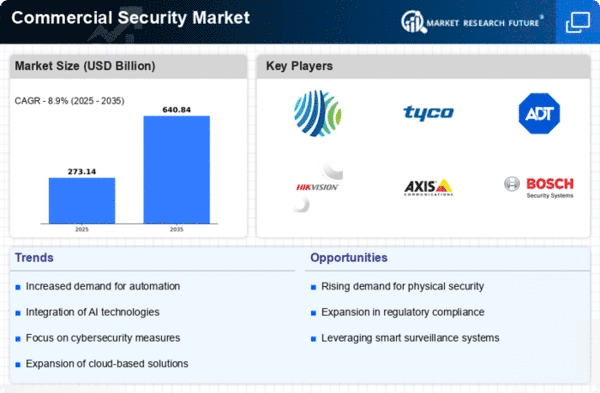
As per MRFR analysis, the Commercial Security Market Size was estimated at 250.82 USD Billion in 2024. The Commercial Security industry is projected to grow from 273.14 in 2025 to 640.84 by 2035, exhibiting a compound annual growth rate (CAGR) of 8.9% during the forecast period 2025 - 2035.

Key Market Trends & Highlights

The Commercial Security Market is experiencing robust growth driven by technological advancements and increasing security concerns.

  • The integration of AI and Machine Learning is transforming security solutions, enhancing efficiency and effectiveness. Cloud-based security solutions are gaining traction, providing flexibility and scalability for businesses. Cybersecurity measures are becoming paramount as organizations recognize the importance of protecting digital assets. Increasing crime rates and growing awareness of security risks are driving demand, particularly in the Video Surveillance and Commercial Buildings segments in North America.

Market Size & Forecast

2024 Market Size 250.82 (USD Billion)
2035 Market Size 640.84 (USD Billion)
CAGR (2025 - 2035) 8.9%
Largest Regional Market Share in 2024 North America

Major Players

Johnson Controls (US), Tyco International (US), ADT Inc. (US), Hikvision (CN), Axis Communications (SE), Bosch Security Systems (DE), Honeywell International (US), Dahua Technology (CN), Genetec (CA), Milestone Systems (DK)

Market Trends

The Commercial Security Market is currently experiencing a dynamic evolution, driven by advancements in technology and an increasing emphasis on safety and risk management. Organizations across various sectors are investing in sophisticated security solutions to protect their assets, personnel, and sensitive information. This trend is underscored by the growing integration of artificial intelligence and machine learning into security systems, which enhances threat detection and response capabilities. Furthermore, the rise of smart buildings and the Internet of Things (IoT) is reshaping the landscape, as interconnected devices require robust security measures to mitigate vulnerabilities. The commercial mortgage backed securities market plays a critical role in commercial real estate financing, providing liquidity and risk distribution for lenders and institutional investors.

In addition to technological advancements, regulatory frameworks are becoming more stringent, compelling businesses to adopt comprehensive security strategies. Growth in the commercial mortgage backed securities market is influenced by interest rate movements, property performance, and regulatory developments within the financial services sector. The focus on compliance and risk assessment is likely to drive demand for integrated security solutions that encompass physical and cyber elements. As organizations navigate an increasingly complex threat environment, the Commercial Security Market appears poised for continued growth, with an emphasis on innovation and adaptability. Stakeholders must remain vigilant and responsive to emerging trends to ensure effective security measures are in place, safeguarding their operations against potential threats. The commercial security system market is experiencing steady growth, driven by increasing demand for advanced surveillance, access control, and intrusion detection solutions across commercial properties.

Integration of AI and Machine Learning

The incorporation of artificial intelligence and machine learning into security systems is transforming the Commercial Security Market. These technologies enhance the ability to analyze vast amounts of data, enabling quicker threat detection and more effective response strategies. As organizations seek to improve their security posture, the demand for AI-driven solutions is likely to increase.

Rise of Cloud-Based Security Solutions

Cloud-based security solutions are becoming increasingly popular within the Commercial Security Market. These services offer flexibility, scalability, and cost-effectiveness, allowing businesses to manage their security needs remotely. The shift towards cloud technology may facilitate easier access to advanced security features and real-time monitoring.

Focus on Cybersecurity Measures

As cyber threats continue to evolve, there is a growing emphasis on cybersecurity within the Commercial Security Market. Organizations are prioritizing the protection of their digital assets, leading to increased investments in cybersecurity solutions. This trend suggests a shift towards a more holistic approach to security, encompassing both physical and digital realms.

Commercial Security Market Market Drivers

Regulatory Compliance

Regulatory compliance is a critical driver for the Global Commercial Security Market Industry, as organizations must adhere to various security standards and regulations. Governments worldwide are implementing stringent guidelines to protect sensitive data and ensure the safety of public spaces. For instance, the General Data Protection Regulation (GDPR) in Europe mandates strict data protection measures, compelling businesses to invest in robust security systems. This regulatory landscape not only fosters a culture of accountability but also propels the demand for advanced security solutions. As compliance becomes increasingly complex, organizations are likely to allocate significant resources to meet these requirements, thereby bolstering market growth.

Rising Security Concerns

The Global Commercial Security Market Industry experiences a notable surge in demand due to escalating security concerns across various sectors. Organizations are increasingly investing in advanced security solutions to mitigate risks associated with theft, vandalism, and cyber threats. For instance, the global market is projected to reach 250.8 USD Billion in 2024, reflecting a growing recognition of the importance of safeguarding assets. This trend is particularly evident in retail and banking sectors, where the implementation of integrated security systems has become paramount. As threats evolve, businesses are likely to prioritize comprehensive security measures, further driving market growth.

Market Growth Projections

The Global Commercial Security Market Industry is poised for substantial growth, with projections indicating a rise from 250.8 USD Billion in 2024 to 640.8 USD Billion by 2035. This growth trajectory suggests a compound annual growth rate (CAGR) of 8.9% from 2025 to 2035. Such figures reflect the increasing prioritization of security measures across various sectors, driven by factors such as technological advancements, regulatory compliance, and rising security concerns. Stakeholders are likely to capitalize on this growth by investing in innovative security solutions that address evolving threats, thereby shaping the future landscape of the commercial security market.

Technological Advancements

Technological innovations play a pivotal role in shaping the Global Commercial Security Market Industry. The integration of artificial intelligence, machine learning, and IoT devices into security systems enhances their effectiveness and efficiency. For example, smart surveillance cameras equipped with facial recognition capabilities are increasingly adopted in commercial spaces. These advancements not only improve threat detection but also streamline security operations. The anticipated growth from 250.8 USD Billion in 2024 to 640.8 USD Billion by 2035, with a CAGR of 8.9% from 2025 to 2035, underscores the impact of technology on market dynamics, as businesses seek to leverage cutting-edge solutions.

Growing Awareness of Cybersecurity

The Global Commercial Security Market Industry is increasingly influenced by the growing awareness of cybersecurity threats among businesses. As digital transformation accelerates, organizations face heightened risks associated with data breaches and cyberattacks. This awareness drives companies to invest in comprehensive cybersecurity measures, including firewalls, intrusion detection systems, and employee training programs. The emphasis on protecting sensitive information is reflected in the market's projected growth, with an expected increase from 250.8 USD Billion in 2024 to 640.8 USD Billion by 2035. As businesses recognize the potential financial and reputational damage of cyber incidents, the demand for robust security solutions is likely to intensify.

Increased Investment in Infrastructure

The Global Commercial Security Market Industry benefits from heightened investments in infrastructure development across the globe. As urbanization accelerates, cities are expanding, leading to a greater need for comprehensive security solutions in public and private spaces. Governments and private entities are investing heavily in smart city initiatives, which often include integrated security systems. This trend is evident in various regions, where infrastructure projects prioritize safety and surveillance. The projected growth from 250.8 USD Billion in 2024 to 640.8 USD Billion by 2035 indicates a robust market response to these infrastructural demands, as stakeholders recognize the necessity of secure environments.

Market Segment Insights

By Application: Video Surveillance (Largest) vs. Access Control (Fastest-Growing)

In the Commercial Security Market, the application segments reveal a diverse distribution of market shares among Video Surveillance, Access Control, Intrusion Detection, Fire and Life Safety, and Integrated Security Systems. Video Surveillance holds a significant portion of the market, being widely adopted across various sectors for its effectiveness in crime prevention and monitoring. Access Control follows closely, showing robust uptake due to the rising importance of securing premises and adjusting access levels based on user roles, making it a critical component of commercial security strategies.

Video Surveillance (Dominant) vs. Access Control (Emerging)

Video Surveillance has established itself as a dominant application within the Commercial Security Market, attributed to advancements in technology such as AI and cloud storage. It plays a crucial role in deterrence and detection, with systems ranging from traditional CCTV to sophisticated IP cameras. Access Control, on the other hand, is emerging rapidly, reflecting the growing focus on personalized security measures. The need for greater accountability and safety within commercial environments drives the demand for advanced access control solutions, which include biometric scanning and mobile credentialing technologies that enhance security by managing entry points effectively.

By End Use: Commercial Buildings (Largest) vs. Retail Stores (Fastest-Growing)

The Commercial Security Market exhibits a diverse distribution across various end-use segments. Commercial buildings hold the largest share, driven by the need for robust security solutions to protect valuable assets and sensitive information. Retail stores follow closely, catering to an increasing demand for surveillance systems that prevent theft and enhance customer safety. As more businesses prioritize security, both sectors are poised for substantial growth. In contrast, retail stores are emerging as the fastest-growing segment, propelled by the rise of e-commerce and enhanced security requirements in brick-and-mortar establishments. Factors such as technological advancements in security systems and increasing awareness of crime prevention are contributing to this upward trend. The demand for integrated security solutions that offer real-time monitoring and analytics further supports this growth trajectory.

Commercial Buildings (Dominant) vs. Industrial Facilities (Emerging)

Commercial buildings dominate the Commercial Security Market, characterized by their extensive security needs, including access control and comprehensive surveillance systems. This segment encompasses various facilities, such as office complexes and educational institutions, all of which require advanced security measures to safeguard against threats. As technology evolves, commercial buildings are increasingly integrating smart security solutions that enhance operational efficiency and response times. In contrast, industrial facilities represent an emerging segment with unique challenges, such as protecting large perimeters and sensitive areas like warehouses and manufacturing plants. These facilities demand specialized security solutions that can withstand physical threats and provide effective monitoring, indicating a growing opportunity for security providers to tailor offerings to meet specific industrial needs.

By Technology: Biometric Systems (Largest) vs. Cloud-Based Security Solutions (Fastest-Growing)

The Commercial Security Market showcases a diverse array of technology-driven solutions, with biometric systems holding the largest market share. Other significant segments include cloud-based security solutions, Internet of Things security, artificial intelligence security, and video analytics, each contributing to the evolving landscape of commercial security. The demand for reliable identification methods and enhanced security features powered by biometric systems is a key driver of its leading position. Meanwhile, cloud-based solutions are emerging rapidly due to their flexibility and scalability, catering to businesses of all sizes.

Biometric Systems (Dominant) vs. Cloud-Based Security Solutions (Emerging)

Biometric systems have established themselves as a dominant force in the Commercial Security Market, providing unparalleled levels of security and user identification through technologies like fingerprint recognition and facial scanning. Their robustness against fraud and ease of integration into existing systems make them a preferred solution for many organizations. On the other hand, cloud-based security solutions are quickly gaining traction as an emerging segment, offering businesses the ability to monitor and manage security systems remotely. These solutions benefit from innovation in connectivity and data analytics, which enhance efficiency and decision-making in real-time. The convergence of both technologies promises a robust security framework for businesses.

By Service Type: Monitoring Services (Largest) vs. Installation Services (Fastest-Growing)

Within the Commercial Security Market, the service type segment exhibits a diverse array of offerings, each contributing uniquely to the market landscape. Monitoring Services hold the largest share, appealing to a broad customer base seeking enhanced security through real-time surveillance and response capabilities. In contrast, Installation Services, while significant, have been identified as the fastest-growing segment as businesses increasingly recognize the importance of professional setup to ensure optimal system performance and integration. The growth trends within the service type segment are driven by escalating security concerns across various industries, coupled with technological advancements. Monitoring Services benefit from an expanding demand for remote solutions and cloud-based systems, which allow for greater flexibility and control. Installation Services are flourishing as organizations invest in comprehensive security systems that necessitate expert installation, ensuring infrastructure resilience and compliance with safety regulations.

Monitoring Services (Dominant) vs. Installation Services (Emerging)

Monitoring Services dominate the Commercial Security Market by offering essential features such as real-time surveillance, unauthorized access alerts, and emergency response coordination. This segment caters particularly to sectors requiring stringent security measures, such as finance, healthcare, and retail, thus expanding its reach. On the other hand, Installation Services are emerging as they become vital for businesses implementing new security technologies. The complexity of modern security systems necessitates professional installation, leading to increased demand; organizations prioritize accuracy and efficiency, creating opportunities for providers specializing in customized and scalable solutions. Both segments are crucial in addressing the heightened need for versatile security measures in an evolving threat landscape.

By Product Type: CCTV Cameras (Largest) vs. Alarm Systems (Fastest-Growing)

The Commercial Security Market has seen a diverse range of product types contributing to its overall landscape. Currently, CCTV cameras hold the largest market share, given their pivotal role in surveillance and security installations across various sectors. Alarm systems follow closely behind but are gaining traction, particularly in urban environments where rapid technological advancements and consumer awareness of security benefits escalate demand significantly.

Surveillance: CCTV Cameras (Dominant) vs. Alarm Systems (Emerging)

CCTV cameras are at the forefront of the Commercial Security Market, appreciated for their ability to provide comprehensive surveillance solutions. Their robust network infrastructure allows for real-time monitoring and data collection, enhancing security measures for businesses. Conversely, alarm systems are rapidly emerging as a key player, driven by innovations in technology such as smart home integration and user-friendly interfaces. This sector responds dynamically to increasing urban crime rates and consumer demand for enhanced protection levels, solidifying its place as an essential element of contemporary security strategies.

Get more detailed insights about Global Commercial Security Market Research Report- Forecast 2035

Regional Insights

North America : Market Leader in Security Solutions

North America continues to lead the commercial security market, holding a significant share of 125.41 million in 2024. The region's growth is driven by increasing security concerns, technological advancements, and stringent regulations. The demand for integrated security solutions is rising, fueled by the need for enhanced safety in commercial spaces. Regulatory frameworks are also evolving to support the adoption of advanced security technologies, ensuring compliance and safety across various sectors. The competitive landscape in North America is robust, with key players like Johnson Controls, ADT Inc., and Honeywell International dominating the market. The U.S. is the largest contributor, driven by high investments in security infrastructure and innovation. Companies are focusing on developing smart security solutions, integrating AI and IoT technologies to meet the growing demand. This competitive environment fosters continuous improvement and innovation, ensuring that North America remains at the forefront of the commercial security market.

Europe : Emerging Security Innovations

Europe's commercial security market is valued at 70.25 million, reflecting a growing emphasis on safety and security across various industries. The region is witnessing a surge in demand for advanced security systems, driven by increasing regulatory requirements and the need for enhanced protection against threats. Governments are investing in smart city initiatives, which further propels the adoption of integrated security solutions, ensuring compliance with evolving regulations. Leading countries in Europe, such as Germany, the UK, and France, are at the forefront of this market, with key players like Bosch Security Systems and Axis Communications driving innovation. The competitive landscape is characterized by a mix of established firms and emerging startups, all striving to offer cutting-edge solutions. The European market is also seeing collaborations between technology providers and security firms, enhancing the overall service offerings and ensuring a comprehensive approach to security management.

Asia-Pacific : Rapid Growth in Security Demand

The Asia-Pacific commercial security market, valued at 45.0 million, is experiencing rapid growth, fueled by urbanization, rising crime rates, and increasing awareness of security solutions. Countries in this region are investing heavily in security infrastructure, driven by government initiatives and the need for enhanced safety in commercial establishments. The demand for advanced surveillance systems and access control solutions is on the rise, supported by favorable regulatory environments that encourage technology adoption. China and India are leading the charge in this market, with significant contributions from companies like Hikvision and Dahua Technology. The competitive landscape is dynamic, with both local and international players vying for market share. The presence of key players is fostering innovation, as they develop tailored solutions to meet the unique security needs of the region. This competitive environment is expected to drive further growth and technological advancements in the Asia-Pacific commercial security market.

Middle East and Africa : Emerging Security Solutions Market

The Middle East and Africa (MEA) commercial security market, valued at 10.16 million, is gradually emerging as a significant player in the global landscape. The region is witnessing increased investments in security infrastructure, driven by rising concerns over safety and security in commercial spaces. Government initiatives aimed at enhancing public safety and security are catalyzing the adoption of advanced security technologies, creating a favorable environment for market growth. Countries like the UAE and South Africa are leading the market, with key players such as Genetec and Milestone Systems establishing a strong presence. The competitive landscape is characterized by a mix of local and international firms, all striving to offer innovative solutions tailored to the region's unique challenges. As the demand for integrated security solutions grows, the MEA market is poised for significant expansion, driven by technological advancements and increasing awareness of security needs.

Key Players and Competitive Insights

The Commercial Security Market is characterized by a dynamic competitive landscape, driven by technological advancements and an increasing emphasis on safety and security across various sectors. Key players such as Johnson Controls (US), Hikvision (CN), and Honeywell International (US) are at the forefront, each adopting distinct strategies to enhance their market positioning. Johnson Controls (US) focuses on integrating smart building technologies with security solutions, thereby promoting a holistic approach to facility management. Meanwhile, Hikvision (CN) continues to leverage its strong R&D capabilities to innovate in video surveillance and AI analytics, positioning itself as a leader in intelligent security solutions. Honeywell International (US) emphasizes digital transformation, integrating IoT capabilities into its security offerings, which enhances operational efficiency and customer engagement. The business tactics employed by these companies reflect a trend towards localization and supply chain optimization, which are crucial in a moderately fragmented market. Technological advancements in video analytics, cloud-based monitoring, and integrated security platforms are positively influencing the commercial security system market. The competitive structure is shaped by the collective influence of these key players, who are increasingly collaborating with local partners to enhance their service delivery and market reach. This strategy not only mitigates risks associated with global supply chains but also allows for tailored solutions that meet regional security needs.
In November 2025, Hikvision (CN) announced a strategic partnership with a leading AI firm to enhance its video analytics capabilities. This collaboration is expected to significantly improve the accuracy and efficiency of surveillance systems, thereby reinforcing Hikvision's competitive edge in the market. The integration of advanced AI technologies into their product line is likely to attract a broader customer base, particularly in sectors requiring high-level security measures. In October 2025, Johnson Controls (US) launched a new suite of integrated security solutions designed for smart cities. This initiative underscores the company's commitment to innovation and its strategic focus on urban security challenges. By addressing the unique needs of smart city infrastructures, Johnson Controls (US) positions itself as a pivotal player in the evolving landscape of urban security, potentially increasing its market share in this burgeoning segment.
 
In September 2025, Honeywell International (US) expanded its cybersecurity offerings to include advanced threat detection for physical security systems. This move highlights the growing intersection of cybersecurity and physical security, reflecting a broader trend in the industry. By enhancing its product portfolio to address these dual concerns, Honeywell International (US) is likely to strengthen its market position and appeal to clients seeking comprehensive security solutions. The broader commercial security market continues to evolve as organizations prioritize asset protection, regulatory compliance, and operational safety across office buildings, retail spaces, and industrial facilities. As of December 2025, the Commercial Security Market is witnessing a pronounced shift towards digitalization, sustainability, and AI integration. Strategic alliances are increasingly shaping the competitive landscape, enabling companies to pool resources and expertise to innovate more effectively. The evolution of competitive differentiation appears to be moving away from price-based competition towards a focus on technological innovation and supply chain reliability. This trend suggests that companies that prioritize R&D and strategic partnerships will likely emerge as leaders in the market.

Key Companies in the Commercial Security Market include

Industry Developments

Hangzhou Hikvision Digital Technology Co., Ltd, in May 2023, launched a 4G solar-powered camera kit, a wireless bridge and mobile solar security tower solutions; remote locations and momentary standalone applications often lack internet access and energy as well. In an easy, reliable, yet affordable approach to enable the users of these places to keep them safe, Hikvision has embarked on a series of solar solutions.

Carrier launched i-Vu Pro v8.5 software in May 2023. It is an i-Vu building automation system (BAS). The digital lifecycle solution provides a phased download procedure for more efficient controller upgrades, operator information reports for improved security and interaction with Message Queueing Telemetry Transport (MQTT). Johnson Controls launched a new IQ Pro Hybrid Security Panel in March 2023, refining the commercial security sector with IQ Pro that enables future hardware and software modifications and connections through its modular architecture.

Securitas Technology was established back in March 2023 as a firm specializing in integrated security systems.The company aims at redefining commercial security landscape.

Johnson Controls has recently unveiled a new hybrid security panel called the IQ Pro in March 2023. The goal of the IQ Pro hybrid security panel is to enhance intrusion detection capabilities in commercial facilities and other large public spaces.

In February 2023, Hangzhou Hikvision Digital Technology Co., Ltd partnered with Evercam Construction Cameras to provide a collaboration solution that can help construction companies maximize their results while minimizing risks on their major projects.

zeroRISC claims that in October of 2023, it raised USD 5 million in seed capital from Cambridge Angels, which will be used towards the development of OpenTitan's cloud-based commercial security offering.

In October of 2022, Marioff, a subsidiary company of Carrier extends its service agreement with BluEdge Elite to maintain Marioff HI-FOG systems. Currently, HI-FOGs are installed onboard 46 cruise ships operated by the Royal Caribbean Group.

ADT Commercial has acquired Edwards Electronic Systems, Inc., based out of Clayton and Concord, North Carolina, USA; premier fire, life safety and security systems provider for January 2022. This acquisition further deepens the ADT Commercial organization's integration capabilities and fire and life safety expertise to serve the Carolinas region's mid-market, national, and large-scale commercial customers.

American Alarm & Communications announced the acquisition of Phoenix Security Systems Inc., Wilmington, Mass, which serves over 800 businesses and homes with security services, including surveillance cameras and fire alarms, among others, from January 2022.

In September of 2021, Allegion US (Allegion plc) and Gallagher (Gallagher Security) announced that they had been granted permission by the US Government to use their new electronic access solution. Schlage AD-302 FIPS 201-2 integrates with Gallagher’s Command Center security software and becomes the very first electronics lock on General Services Administration (GSA) Approved Product List (APL); this opens a door for more government clients.

Future Outlook

Commercial Security Market Future Outlook

The Commercial Security Market is projected to grow at an 8.9% CAGR from 2025 to 2035, driven by technological advancements, increasing security concerns, and regulatory requirements.

New opportunities lie in:

  • <p>Integration of AI-driven surveillance systems for enhanced threat detection. Development of cloud-based security management platforms for scalability. Expansion into emerging markets with tailored security solutions.</p>

By 2035, the market is expected to be robust, reflecting substantial growth and innovation. Expansion of the commercial security market is supported by rising security concerns, urbanization, and increased investments in smart building infrastructure.

Market Segmentation

Commercial Security Market End Use Outlook

  • Commercial Buildings
  • Retail Stores
  • Industrial Facilities
  • Government Institutions
  • Healthcare Facilities

Commercial Security Market Technology Outlook

  • Biometric Systems
  • Cloud-Based Security Solutions
  • Internet of Things Security
  • Artificial Intelligence Security
  • Video Analytics

Commercial Security Market Application Outlook

  • Video Surveillance
  • Access Control
  • Intrusion Detection
  • Fire and Life Safety
  • Integrated Security Systems

Commercial Security Market Product Type Outlook

  • CCTV Cameras
  • Alarm Systems
  • Access Control Systems
  • Intercom Systems
  • Security Software

Commercial Security Market Service Type Outlook

  • Installation Services
  • Maintenance Services
  • Monitoring Services
  • Consulting Services
  • Training Services

Report Scope

MARKET SIZE 2024 250.82(USD Billion)
MARKET SIZE 2025 273.14(USD Billion)
MARKET SIZE 2035 640.84(USD Billion)
COMPOUND ANNUAL GROWTH RATE (CAGR) 8.9% (2025 - 2035)
REPORT COVERAGE Revenue Forecast, Competitive Landscape, Growth Factors, and Trends
BASE YEAR 2024
Market Forecast Period 2025 - 2035
Historical Data 2019 - 2024
Market Forecast Units USD Billion
Key Companies Profiled Johnson Controls (US), Tyco International (US), ADT Inc. (US), Hikvision (CN), Axis Communications (SE), Bosch Security Systems (DE), Honeywell International (US), Dahua Technology (CN), Genetec (CA), Milestone Systems (DK)
Segments Covered Application, End Use, Technology, Service Type, Product Type
Key Market Opportunities Integration of artificial intelligence and machine learning in surveillance systems enhances security effectiveness.
Key Market Dynamics Rising demand for integrated security solutions drives innovation and competition in the Commercial Security Market.
Countries Covered North America, Europe, APAC, South America, MEA

FAQs

What is the projected market valuation of the Commercial Security Market by 2035?

<p>The Commercial Security Market is projected to reach a valuation of 640.84 USD Billion by 2035.</p>

What was the market valuation of the Commercial Security Market in 2024?

<p>In 2024, the overall market valuation was 250.82 USD Billion.</p>

What is the expected CAGR for the Commercial Security Market during the forecast period 2025 - 2035?

<p>The expected CAGR for the Commercial Security Market during the forecast period 2025 - 2035 is 8.9%.</p>

Which segment of the Commercial Security Market had the highest valuation in 2024?

<p>The Integrated Security Systems segment had the highest valuation at 70.82 USD Billion in 2024.</p>

What are the key players in the Commercial Security Market?

<p>Key players in the Commercial Security Market include Johnson Controls, Tyco International, ADT Inc., Hikvision, and Axis Communications.</p>

How does the valuation of Video Surveillance compare to Access Control in 2024?

<p>In 2024, Video Surveillance was valued at 60.0 USD Billion, while Access Control was valued at 50.0 USD Billion.</p>

What is the projected valuation for the Cloud-Based Security Solutions segment by 2035?

The Cloud-Based Security Solutions segment is projected to reach a valuation of 150.0 USD Billion by 2035.

Which service type is expected to have the highest valuation in the Commercial Security Market?

Monitoring Services is expected to have the highest valuation, projected at 200.0 USD Billion by 2035.

What is the valuation range for Intrusion Detection in 2024?

In 2024, the valuation range for Intrusion Detection was between 40.0 and 100.0 USD Billion.

What is the expected growth trend for the Healthcare Facilities segment in the Commercial Security Market?

The Healthcare Facilities segment is projected to grow from 30.0 USD Billion in 2024 to 80.0 USD Billion by 2035.

  1. SECTION I: EXECUTIVE SUMMARY AND KEY HIGHLIGHTS
    1. | 1.1 EXECUTIVE SUMMARY
    2. | | 1.1.1 Market Overview
    3. | | 1.1.2 Key Findings
    4. | | 1.1.3 Market Segmentation
    5. | | 1.1.4 Competitive Landscape
    6. | | 1.1.5 Challenges and Opportunities
    7. | | 1.1.6 Future Outlook
  2. SECTION II: SCOPING, METHODOLOGY AND MARKET STRUCTURE
    1. | 2.1 MARKET INTRODUCTION
    2. | | 2.1.1 Definition
    3. | | 2.1.2 Scope of the study
    4. | | | 2.1.2.1 Research Objective
    5. | | | 2.1.2.2 Assumption
    6. | | | 2.1.2.3 Limitations
    7. | 2.2 RESEARCH METHODOLOGY
    8. | | 2.2.1 Overview
    9. | | 2.2.2 Data Mining
    10. | | 2.2.3 Secondary Research
    11. | | 2.2.4 Primary Research
    12. | | | 2.2.4.1 Primary Interviews and Information Gathering Process
    13. | | | 2.2.4.2 Breakdown of Primary Respondents
    14. | | 2.2.5 Forecasting Model
    15. | | 2.2.6 Market Size Estimation
    16. | | | 2.2.6.1 Bottom-Up Approach
    17. | | | 2.2.6.2 Top-Down Approach
    18. | | 2.2.7 Data Triangulation
    19. | | 2.2.8 Validation
  3. SECTION III: QUALITATIVE ANALYSIS
    1. | 3.1 MARKET DYNAMICS
    2. | | 3.1.1 Overview
    3. | | 3.1.2 Drivers
    4. | | 3.1.3 Restraints
    5. | | 3.1.4 Opportunities
    6. | 3.2 MARKET FACTOR ANALYSIS
    7. | | 3.2.1 Value chain Analysis
    8. | | 3.2.2 Porter's Five Forces Analysis
    9. | | | 3.2.2.1 Bargaining Power of Suppliers
    10. | | | 3.2.2.2 Bargaining Power of Buyers
    11. | | | 3.2.2.3 Threat of New Entrants
    12. | | | 3.2.2.4 Threat of Substitutes
    13. | | | 3.2.2.5 Intensity of Rivalry
    14. | | 3.2.3 COVID-19 Impact Analysis
    15. | | | 3.2.3.1 Market Impact Analysis
    16. | | | 3.2.3.2 Regional Impact
    17. | | | 3.2.3.3 Opportunity and Threat Analysis
  4. SECTION IV: QUANTITATIVE ANALYSIS
    1. | 4.1 Semiconductor & Electronics, BY Application (USD Billion)
    2. | | 4.1.1 Video Surveillance
    3. | | 4.1.2 Access Control
    4. | | 4.1.3 Intrusion Detection
    5. | | 4.1.4 Fire and Life Safety
    6. | | 4.1.5 Integrated Security Systems
    7. | 4.2 Semiconductor & Electronics, BY End Use (USD Billion)
    8. | | 4.2.1 Commercial Buildings
    9. | | 4.2.2 Retail Stores
    10. | | 4.2.3 Healthcare Facilities
    11. | | 4.2.4 Educational Institutions
    12. | | 4.2.5 Transportation
    13. | 4.3 Semiconductor & Electronics, BY Technology (USD Billion)
    14. | | 4.3.1 Biometric Systems
    15. | | 4.3.2 Cloud-Based Security Solutions
    16. | | 4.3.3 Artificial Intelligence
    17. | | 4.3.4 Internet of Things
    18. | | 4.3.5 Surveillance Cameras
    19. | 4.4 Semiconductor & Electronics, BY Service Type (USD Billion)
    20. | | 4.4.1 Installation Services
    21. | | 4.4.2 Maintenance Services
    22. | | 4.4.3 Monitoring Services
    23. | | 4.4.4 Consulting Services
    24. | 4.5 Semiconductor & Electronics, BY Product Type (USD Billion)
    25. | | 4.5.1 CCTV Cameras
    26. | | 4.5.2 Alarm Systems
    27. | | 4.5.3 Access Control Systems
    28. | | 4.5.4 Intercom Systems
    29. | 4.6 Semiconductor & Electronics, BY Region (USD Billion)
    30. | | 4.6.1 North America
    31. | | | 4.6.1.1 US
    32. | | | 4.6.1.2 Canada
    33. | | 4.6.2 Europe
    34. | | | 4.6.2.1 Germany
    35. | | | 4.6.2.2 UK
    36. | | | 4.6.2.3 France
    37. | | | 4.6.2.4 Russia
    38. | | | 4.6.2.5 Italy
    39. | | | 4.6.2.6 Spain
    40. | | | 4.6.2.7 Rest of Europe
    41. | | 4.6.3 APAC
    42. | | | 4.6.3.1 China
    43. | | | 4.6.3.2 India
    44. | | | 4.6.3.3 Japan
    45. | | | 4.6.3.4 South Korea
    46. | | | 4.6.3.5 Malaysia
    47. | | | 4.6.3.6 Thailand
    48. | | | 4.6.3.7 Indonesia
    49. | | | 4.6.3.8 Rest of APAC
    50. | | 4.6.4 South America
    51. | | | 4.6.4.1 Brazil
    52. | | | 4.6.4.2 Mexico
    53. | | | 4.6.4.3 Argentina
    54. | | | 4.6.4.4 Rest of South America
    55. | | 4.6.5 MEA
    56. | | | 4.6.5.1 GCC Countries
    57. | | | 4.6.5.2 South Africa
    58. | | | 4.6.5.3 Rest of MEA
  5. SECTION V: COMPETITIVE ANALYSIS
    1. | 5.1 Competitive Landscape
    2. | | 5.1.1 Overview
    3. | | 5.1.2 Competitive Analysis
    4. | | 5.1.3 Market share Analysis
    5. | | 5.1.4 Major Growth Strategy in the Semiconductor & Electronics
    6. | | 5.1.5 Competitive Benchmarking
    7. | | 5.1.6 Leading Players in Terms of Number of Developments in the Semiconductor & Electronics
    8. | | 5.1.7 Key developments and growth strategies
    9. | | | 5.1.7.1 New Product Launch/Service Deployment
    10. | | | 5.1.7.2 Merger & Acquisitions
    11. | | | 5.1.7.3 Joint Ventures
    12. | | 5.1.8 Major Players Financial Matrix
    13. | | | 5.1.8.1 Sales and Operating Income
    14. | | | 5.1.8.2 Major Players R&D Expenditure. 2023
    15. | 5.2 Company Profiles
    16. | | 5.2.1 Johnson Controls (US)
    17. | | | 5.2.1.1 Financial Overview
    18. | | | 5.2.1.2 Products Offered
    19. | | | 5.2.1.3 Key Developments
    20. | | | 5.2.1.4 SWOT Analysis
    21. | | | 5.2.1.5 Key Strategies
    22. | | 5.2.2 Tyco International (US)
    23. | | | 5.2.2.1 Financial Overview
    24. | | | 5.2.2.2 Products Offered
    25. | | | 5.2.2.3 Key Developments
    26. | | | 5.2.2.4 SWOT Analysis
    27. | | | 5.2.2.5 Key Strategies
    28. | | 5.2.3 ADT Inc. (US)
    29. | | | 5.2.3.1 Financial Overview
    30. | | | 5.2.3.2 Products Offered
    31. | | | 5.2.3.3 Key Developments
    32. | | | 5.2.3.4 SWOT Analysis
    33. | | | 5.2.3.5 Key Strategies
    34. | | 5.2.4 Hikvision (CN)
    35. | | | 5.2.4.1 Financial Overview
    36. | | | 5.2.4.2 Products Offered
    37. | | | 5.2.4.3 Key Developments
    38. | | | 5.2.4.4 SWOT Analysis
    39. | | | 5.2.4.5 Key Strategies
    40. | | 5.2.5 Axis Communications (SE)
    41. | | | 5.2.5.1 Financial Overview
    42. | | | 5.2.5.2 Products Offered
    43. | | | 5.2.5.3 Key Developments
    44. | | | 5.2.5.4 SWOT Analysis
    45. | | | 5.2.5.5 Key Strategies
    46. | | 5.2.6 Bosch Security Systems (DE)
    47. | | | 5.2.6.1 Financial Overview
    48. | | | 5.2.6.2 Products Offered
    49. | | | 5.2.6.3 Key Developments
    50. | | | 5.2.6.4 SWOT Analysis
    51. | | | 5.2.6.5 Key Strategies
    52. | | 5.2.7 Honeywell International (US)
    53. | | | 5.2.7.1 Financial Overview
    54. | | | 5.2.7.2 Products Offered
    55. | | | 5.2.7.3 Key Developments
    56. | | | 5.2.7.4 SWOT Analysis
    57. | | | 5.2.7.5 Key Strategies
    58. | | 5.2.8 Dahua Technology (CN)
    59. | | | 5.2.8.1 Financial Overview
    60. | | | 5.2.8.2 Products Offered
    61. | | | 5.2.8.3 Key Developments
    62. | | | 5.2.8.4 SWOT Analysis
    63. | | | 5.2.8.5 Key Strategies
    64. | | 5.2.9 Genetec (CA)
    65. | | | 5.2.9.1 Financial Overview
    66. | | | 5.2.9.2 Products Offered
    67. | | | 5.2.9.3 Key Developments
    68. | | | 5.2.9.4 SWOT Analysis
    69. | | | 5.2.9.5 Key Strategies
    70. | | 5.2.10 Milestone Systems (DK)
    71. | | | 5.2.10.1 Financial Overview
    72. | | | 5.2.10.2 Products Offered
    73. | | | 5.2.10.3 Key Developments
    74. | | | 5.2.10.4 SWOT Analysis
    75. | | | 5.2.10.5 Key Strategies
    76. | 5.3 Appendix
    77. | | 5.3.1 References
    78. | | 5.3.2 Related Reports
  6. LIST OF FIGURES
    1. | 6.1 MARKET SYNOPSIS
    2. | 6.2 NORTH AMERICA MARKET ANALYSIS
    3. | 6.3 US MARKET ANALYSIS BY APPLICATION
    4. | 6.4 US MARKET ANALYSIS BY END USE
    5. | 6.5 US MARKET ANALYSIS BY TECHNOLOGY
    6. | 6.6 US MARKET ANALYSIS BY SERVICE TYPE
    7. | 6.7 US MARKET ANALYSIS BY PRODUCT TYPE
    8. | 6.8 CANADA MARKET ANALYSIS BY APPLICATION
    9. | 6.9 CANADA MARKET ANALYSIS BY END USE
    10. | 6.10 CANADA MARKET ANALYSIS BY TECHNOLOGY
    11. | 6.11 CANADA MARKET ANALYSIS BY SERVICE TYPE
    12. | 6.12 CANADA MARKET ANALYSIS BY PRODUCT TYPE
    13. | 6.13 EUROPE MARKET ANALYSIS
    14. | 6.14 GERMANY MARKET ANALYSIS BY APPLICATION
    15. | 6.15 GERMANY MARKET ANALYSIS BY END USE
    16. | 6.16 GERMANY MARKET ANALYSIS BY TECHNOLOGY
    17. | 6.17 GERMANY MARKET ANALYSIS BY SERVICE TYPE
    18. | 6.18 GERMANY MARKET ANALYSIS BY PRODUCT TYPE
    19. | 6.19 UK MARKET ANALYSIS BY APPLICATION
    20. | 6.20 UK MARKET ANALYSIS BY END USE
    21. | 6.21 UK MARKET ANALYSIS BY TECHNOLOGY
    22. | 6.22 UK MARKET ANALYSIS BY SERVICE TYPE
    23. | 6.23 UK MARKET ANALYSIS BY PRODUCT TYPE
    24. | 6.24 FRANCE MARKET ANALYSIS BY APPLICATION
    25. | 6.25 FRANCE MARKET ANALYSIS BY END USE
    26. | 6.26 FRANCE MARKET ANALYSIS BY TECHNOLOGY
    27. | 6.27 FRANCE MARKET ANALYSIS BY SERVICE TYPE
    28. | 6.28 FRANCE MARKET ANALYSIS BY PRODUCT TYPE
    29. | 6.29 RUSSIA MARKET ANALYSIS BY APPLICATION
    30. | 6.30 RUSSIA MARKET ANALYSIS BY END USE
    31. | 6.31 RUSSIA MARKET ANALYSIS BY TECHNOLOGY
    32. | 6.32 RUSSIA MARKET ANALYSIS BY SERVICE TYPE
    33. | 6.33 RUSSIA MARKET ANALYSIS BY PRODUCT TYPE
    34. | 6.34 ITALY MARKET ANALYSIS BY APPLICATION
    35. | 6.35 ITALY MARKET ANALYSIS BY END USE
    36. | 6.36 ITALY MARKET ANALYSIS BY TECHNOLOGY
    37. | 6.37 ITALY MARKET ANALYSIS BY SERVICE TYPE
    38. | 6.38 ITALY MARKET ANALYSIS BY PRODUCT TYPE
    39. | 6.39 SPAIN MARKET ANALYSIS BY APPLICATION
    40. | 6.40 SPAIN MARKET ANALYSIS BY END USE
    41. | 6.41 SPAIN MARKET ANALYSIS BY TECHNOLOGY
    42. | 6.42 SPAIN MARKET ANALYSIS BY SERVICE TYPE
    43. | 6.43 SPAIN MARKET ANALYSIS BY PRODUCT TYPE
    44. | 6.44 REST OF EUROPE MARKET ANALYSIS BY APPLICATION
    45. | 6.45 REST OF EUROPE MARKET ANALYSIS BY END USE
    46. | 6.46 REST OF EUROPE MARKET ANALYSIS BY TECHNOLOGY
    47. | 6.47 REST OF EUROPE MARKET ANALYSIS BY SERVICE TYPE
    48. | 6.48 REST OF EUROPE MARKET ANALYSIS BY PRODUCT TYPE
    49. | 6.49 APAC MARKET ANALYSIS
    50. | 6.50 CHINA MARKET ANALYSIS BY APPLICATION
    51. | 6.51 CHINA MARKET ANALYSIS BY END USE
    52. | 6.52 CHINA MARKET ANALYSIS BY TECHNOLOGY
    53. | 6.53 CHINA MARKET ANALYSIS BY SERVICE TYPE
    54. | 6.54 CHINA MARKET ANALYSIS BY PRODUCT TYPE
    55. | 6.55 INDIA MARKET ANALYSIS BY APPLICATION
    56. | 6.56 INDIA MARKET ANALYSIS BY END USE
    57. | 6.57 INDIA MARKET ANALYSIS BY TECHNOLOGY
    58. | 6.58 INDIA MARKET ANALYSIS BY SERVICE TYPE
    59. | 6.59 INDIA MARKET ANALYSIS BY PRODUCT TYPE
    60. | 6.60 JAPAN MARKET ANALYSIS BY APPLICATION
    61. | 6.61 JAPAN MARKET ANALYSIS BY END USE
    62. | 6.62 JAPAN MARKET ANALYSIS BY TECHNOLOGY
    63. | 6.63 JAPAN MARKET ANALYSIS BY SERVICE TYPE
    64. | 6.64 JAPAN MARKET ANALYSIS BY PRODUCT TYPE
    65. | 6.65 SOUTH KOREA MARKET ANALYSIS BY APPLICATION
    66. | 6.66 SOUTH KOREA MARKET ANALYSIS BY END USE
    67. | 6.67 SOUTH KOREA MARKET ANALYSIS BY TECHNOLOGY
    68. | 6.68 SOUTH KOREA MARKET ANALYSIS BY SERVICE TYPE
    69. | 6.69 SOUTH KOREA MARKET ANALYSIS BY PRODUCT TYPE
    70. | 6.70 MALAYSIA MARKET ANALYSIS BY APPLICATION
    71. | 6.71 MALAYSIA MARKET ANALYSIS BY END USE
    72. | 6.72 MALAYSIA MARKET ANALYSIS BY TECHNOLOGY
    73. | 6.73 MALAYSIA MARKET ANALYSIS BY SERVICE TYPE
    74. | 6.74 MALAYSIA MARKET ANALYSIS BY PRODUCT TYPE
    75. | 6.75 THAILAND MARKET ANALYSIS BY APPLICATION
    76. | 6.76 THAILAND MARKET ANALYSIS BY END USE
    77. | 6.77 THAILAND MARKET ANALYSIS BY TECHNOLOGY
    78. | 6.78 THAILAND MARKET ANALYSIS BY SERVICE TYPE
    79. | 6.79 THAILAND MARKET ANALYSIS BY PRODUCT TYPE
    80. | 6.80 INDONESIA MARKET ANALYSIS BY APPLICATION
    81. | 6.81 INDONESIA MARKET ANALYSIS BY END USE
    82. | 6.82 INDONESIA MARKET ANALYSIS BY TECHNOLOGY
    83. | 6.83 INDONESIA MARKET ANALYSIS BY SERVICE TYPE
    84. | 6.84 INDONESIA MARKET ANALYSIS BY PRODUCT TYPE
    85. | 6.85 REST OF APAC MARKET ANALYSIS BY APPLICATION
    86. | 6.86 REST OF APAC MARKET ANALYSIS BY END USE
    87. | 6.87 REST OF APAC MARKET ANALYSIS BY TECHNOLOGY
    88. | 6.88 REST OF APAC MARKET ANALYSIS BY SERVICE TYPE
    89. | 6.89 REST OF APAC MARKET ANALYSIS BY PRODUCT TYPE
    90. | 6.90 SOUTH AMERICA MARKET ANALYSIS
    91. | 6.91 BRAZIL MARKET ANALYSIS BY APPLICATION
    92. | 6.92 BRAZIL MARKET ANALYSIS BY END USE
    93. | 6.93 BRAZIL MARKET ANALYSIS BY TECHNOLOGY
    94. | 6.94 BRAZIL MARKET ANALYSIS BY SERVICE TYPE
    95. | 6.95 BRAZIL MARKET ANALYSIS BY PRODUCT TYPE
    96. | 6.96 MEXICO MARKET ANALYSIS BY APPLICATION
    97. | 6.97 MEXICO MARKET ANALYSIS BY END USE
    98. | 6.98 MEXICO MARKET ANALYSIS BY TECHNOLOGY
    99. | 6.99 MEXICO MARKET ANALYSIS BY SERVICE TYPE
    100. | 6.100 MEXICO MARKET ANALYSIS BY PRODUCT TYPE
    101. | 6.101 ARGENTINA MARKET ANALYSIS BY APPLICATION
    102. | 6.102 ARGENTINA MARKET ANALYSIS BY END USE
    103. | 6.103 ARGENTINA MARKET ANALYSIS BY TECHNOLOGY
    104. | 6.104 ARGENTINA MARKET ANALYSIS BY SERVICE TYPE
    105. | 6.105 ARGENTINA MARKET ANALYSIS BY PRODUCT TYPE
    106. | 6.106 REST OF SOUTH AMERICA MARKET ANALYSIS BY APPLICATION
    107. | 6.107 REST OF SOUTH AMERICA MARKET ANALYSIS BY END USE
    108. | 6.108 REST OF SOUTH AMERICA MARKET ANALYSIS BY TECHNOLOGY
    109. | 6.109 REST OF SOUTH AMERICA MARKET ANALYSIS BY SERVICE TYPE
    110. | 6.110 REST OF SOUTH AMERICA MARKET ANALYSIS BY PRODUCT TYPE
    111. | 6.111 MEA MARKET ANALYSIS
    112. | 6.112 GCC COUNTRIES MARKET ANALYSIS BY APPLICATION
    113. | 6.113 GCC COUNTRIES MARKET ANALYSIS BY END USE
    114. | 6.114 GCC COUNTRIES MARKET ANALYSIS BY TECHNOLOGY
    115. | 6.115 GCC COUNTRIES MARKET ANALYSIS BY SERVICE TYPE
    116. | 6.116 GCC COUNTRIES MARKET ANALYSIS BY PRODUCT TYPE
    117. | 6.117 SOUTH AFRICA MARKET ANALYSIS BY APPLICATION
    118. | 6.118 SOUTH AFRICA MARKET ANALYSIS BY END USE
    119. | 6.119 SOUTH AFRICA MARKET ANALYSIS BY TECHNOLOGY
    120. | 6.120 SOUTH AFRICA MARKET ANALYSIS BY SERVICE TYPE
    121. | 6.121 SOUTH AFRICA MARKET ANALYSIS BY PRODUCT TYPE
    122. | 6.122 REST OF MEA MARKET ANALYSIS BY APPLICATION
    123. | 6.123 REST OF MEA MARKET ANALYSIS BY END USE
    124. | 6.124 REST OF MEA MARKET ANALYSIS BY TECHNOLOGY
    125. | 6.125 REST OF MEA MARKET ANALYSIS BY SERVICE TYPE
    126. | 6.126 REST OF MEA MARKET ANALYSIS BY PRODUCT TYPE
    127. | 6.127 KEY BUYING CRITERIA OF SEMICONDUCTOR & ELECTRONICS
    128. | 6.128 RESEARCH PROCESS OF MRFR
    129. | 6.129 DRO ANALYSIS OF SEMICONDUCTOR & ELECTRONICS
    130. | 6.130 DRIVERS IMPACT ANALYSIS: SEMICONDUCTOR & ELECTRONICS
    131. | 6.131 RESTRAINTS IMPACT ANALYSIS: SEMICONDUCTOR & ELECTRONICS
    132. | 6.132 SUPPLY / VALUE CHAIN: SEMICONDUCTOR & ELECTRONICS
    133. | 6.133 SEMICONDUCTOR & ELECTRONICS, BY APPLICATION, 2024 (% SHARE)
    134. | 6.134 SEMICONDUCTOR & ELECTRONICS, BY APPLICATION, 2024 TO 2035 (USD Billion)
    135. | 6.135 SEMICONDUCTOR & ELECTRONICS, BY END USE, 2024 (% SHARE)
    136. | 6.136 SEMICONDUCTOR & ELECTRONICS, BY END USE, 2024 TO 2035 (USD Billion)
    137. | 6.137 SEMICONDUCTOR & ELECTRONICS, BY TECHNOLOGY, 2024 (% SHARE)
    138. | 6.138 SEMICONDUCTOR & ELECTRONICS, BY TECHNOLOGY, 2024 TO 2035 (USD Billion)
    139. | 6.139 SEMICONDUCTOR & ELECTRONICS, BY SERVICE TYPE, 2024 (% SHARE)
    140. | 6.140 SEMICONDUCTOR & ELECTRONICS, BY SERVICE TYPE, 2024 TO 2035 (USD Billion)
    141. | 6.141 SEMICONDUCTOR & ELECTRONICS, BY PRODUCT TYPE, 2024 (% SHARE)
    142. | 6.142 SEMICONDUCTOR & ELECTRONICS, BY PRODUCT TYPE, 2024 TO 2035 (USD Billion)
    143. | 6.143 BENCHMARKING OF MAJOR COMPETITORS
  7. LIST OF TABLES
    1. | 7.1 LIST OF ASSUMPTIONS
    2. | | 7.1.1
    3. | 7.2 North America MARKET SIZE ESTIMATES; FORECAST
    4. | | 7.2.1 BY APPLICATION, 2025-2035 (USD Billion)
    5. | | 7.2.2 BY END USE, 2025-2035 (USD Billion)
    6. | | 7.2.3 BY TECHNOLOGY, 2025-2035 (USD Billion)
    7. | | 7.2.4 BY SERVICE TYPE, 2025-2035 (USD Billion)
    8. | | 7.2.5 BY PRODUCT TYPE, 2025-2035 (USD Billion)
    9. | 7.3 US MARKET SIZE ESTIMATES; FORECAST
    10. | | 7.3.1 BY APPLICATION, 2025-2035 (USD Billion)
    11. | | 7.3.2 BY END USE, 2025-2035 (USD Billion)
    12. | | 7.3.3 BY TECHNOLOGY, 2025-2035 (USD Billion)
    13. | | 7.3.4 BY SERVICE TYPE, 2025-2035 (USD Billion)
    14. | | 7.3.5 BY PRODUCT TYPE, 2025-2035 (USD Billion)
    15. | 7.4 Canada MARKET SIZE ESTIMATES; FORECAST
    16. | | 7.4.1 BY APPLICATION, 2025-2035 (USD Billion)
    17. | | 7.4.2 BY END USE, 2025-2035 (USD Billion)
    18. | | 7.4.3 BY TECHNOLOGY, 2025-2035 (USD Billion)
    19. | | 7.4.4 BY SERVICE TYPE, 2025-2035 (USD Billion)
    20. | | 7.4.5 BY PRODUCT TYPE, 2025-2035 (USD Billion)
    21. | 7.5 Europe MARKET SIZE ESTIMATES; FORECAST
    22. | | 7.5.1 BY APPLICATION, 2025-2035 (USD Billion)
    23. | | 7.5.2 BY END USE, 2025-2035 (USD Billion)
    24. | | 7.5.3 BY TECHNOLOGY, 2025-2035 (USD Billion)
    25. | | 7.5.4 BY SERVICE TYPE, 2025-2035 (USD Billion)
    26. | | 7.5.5 BY PRODUCT TYPE, 2025-2035 (USD Billion)
    27. | 7.6 Germany MARKET SIZE ESTIMATES; FORECAST
    28. | | 7.6.1 BY APPLICATION, 2025-2035 (USD Billion)
    29. | | 7.6.2 BY END USE, 2025-2035 (USD Billion)
    30. | | 7.6.3 BY TECHNOLOGY, 2025-2035 (USD Billion)
    31. | | 7.6.4 BY SERVICE TYPE, 2025-2035 (USD Billion)
    32. | | 7.6.5 BY PRODUCT TYPE, 2025-2035 (USD Billion)
    33. | 7.7 UK MARKET SIZE ESTIMATES; FORECAST
    34. | | 7.7.1 BY APPLICATION, 2025-2035 (USD Billion)
    35. | | 7.7.2 BY END USE, 2025-2035 (USD Billion)
    36. | | 7.7.3 BY TECHNOLOGY, 2025-2035 (USD Billion)
    37. | | 7.7.4 BY SERVICE TYPE, 2025-2035 (USD Billion)
    38. | | 7.7.5 BY PRODUCT TYPE, 2025-2035 (USD Billion)
    39. | 7.8 France MARKET SIZE ESTIMATES; FORECAST
    40. | | 7.8.1 BY APPLICATION, 2025-2035 (USD Billion)
    41. | | 7.8.2 BY END USE, 2025-2035 (USD Billion)
    42. | | 7.8.3 BY TECHNOLOGY, 2025-2035 (USD Billion)
    43. | | 7.8.4 BY SERVICE TYPE, 2025-2035 (USD Billion)
    44. | | 7.8.5 BY PRODUCT TYPE, 2025-2035 (USD Billion)
    45. | 7.9 Russia MARKET SIZE ESTIMATES; FORECAST
    46. | | 7.9.1 BY APPLICATION, 2025-2035 (USD Billion)
    47. | | 7.9.2 BY END USE, 2025-2035 (USD Billion)
    48. | | 7.9.3 BY TECHNOLOGY, 2025-2035 (USD Billion)
    49. | | 7.9.4 BY SERVICE TYPE, 2025-2035 (USD Billion)
    50. | | 7.9.5 BY PRODUCT TYPE, 2025-2035 (USD Billion)
    51. | 7.10 Italy MARKET SIZE ESTIMATES; FORECAST
    52. | | 7.10.1 BY APPLICATION, 2025-2035 (USD Billion)
    53. | | 7.10.2 BY END USE, 2025-2035 (USD Billion)
    54. | | 7.10.3 BY TECHNOLOGY, 2025-2035 (USD Billion)
    55. | | 7.10.4 BY SERVICE TYPE, 2025-2035 (USD Billion)
    56. | | 7.10.5 BY PRODUCT TYPE, 2025-2035 (USD Billion)
    57. | 7.11 Spain MARKET SIZE ESTIMATES; FORECAST
    58. | | 7.11.1 BY APPLICATION, 2025-2035 (USD Billion)
    59. | | 7.11.2 BY END USE, 2025-2035 (USD Billion)
    60. | | 7.11.3 BY TECHNOLOGY, 2025-2035 (USD Billion)
    61. | | 7.11.4 BY SERVICE TYPE, 2025-2035 (USD Billion)
    62. | | 7.11.5 BY PRODUCT TYPE, 2025-2035 (USD Billion)
    63. | 7.12 Rest of Europe MARKET SIZE ESTIMATES; FORECAST
    64. | | 7.12.1 BY APPLICATION, 2025-2035 (USD Billion)
    65. | | 7.12.2 BY END USE, 2025-2035 (USD Billion)
    66. | | 7.12.3 BY TECHNOLOGY, 2025-2035 (USD Billion)
    67. | | 7.12.4 BY SERVICE TYPE, 2025-2035 (USD Billion)
    68. | | 7.12.5 BY PRODUCT TYPE, 2025-2035 (USD Billion)
    69. | 7.13 APAC MARKET SIZE ESTIMATES; FORECAST
    70. | | 7.13.1 BY APPLICATION, 2025-2035 (USD Billion)
    71. | | 7.13.2 BY END USE, 2025-2035 (USD Billion)
    72. | | 7.13.3 BY TECHNOLOGY, 2025-2035 (USD Billion)
    73. | | 7.13.4 BY SERVICE TYPE, 2025-2035 (USD Billion)
    74. | | 7.13.5 BY PRODUCT TYPE, 2025-2035 (USD Billion)
    75. | 7.14 China MARKET SIZE ESTIMATES; FORECAST
    76. | | 7.14.1 BY APPLICATION, 2025-2035 (USD Billion)
    77. | | 7.14.2 BY END USE, 2025-2035 (USD Billion)
    78. | | 7.14.3 BY TECHNOLOGY, 2025-2035 (USD Billion)
    79. | | 7.14.4 BY SERVICE TYPE, 2025-2035 (USD Billion)
    80. | | 7.14.5 BY PRODUCT TYPE, 2025-2035 (USD Billion)
    81. | 7.15 India MARKET SIZE ESTIMATES; FORECAST
    82. | | 7.15.1 BY APPLICATION, 2025-2035 (USD Billion)
    83. | | 7.15.2 BY END USE, 2025-2035 (USD Billion)
    84. | | 7.15.3 BY TECHNOLOGY, 2025-2035 (USD Billion)
    85. | | 7.15.4 BY SERVICE TYPE, 2025-2035 (USD Billion)
    86. | | 7.15.5 BY PRODUCT TYPE, 2025-2035 (USD Billion)
    87. | 7.16 Japan MARKET SIZE ESTIMATES; FORECAST
    88. | | 7.16.1 BY APPLICATION, 2025-2035 (USD Billion)
    89. | | 7.16.2 BY END USE, 2025-2035 (USD Billion)
    90. | | 7.16.3 BY TECHNOLOGY, 2025-2035 (USD Billion)
    91. | | 7.16.4 BY SERVICE TYPE, 2025-2035 (USD Billion)
    92. | | 7.16.5 BY PRODUCT TYPE, 2025-2035 (USD Billion)
    93. | 7.17 South Korea MARKET SIZE ESTIMATES; FORECAST
    94. | | 7.17.1 BY APPLICATION, 2025-2035 (USD Billion)
    95. | | 7.17.2 BY END USE, 2025-2035 (USD Billion)
    96. | | 7.17.3 BY TECHNOLOGY, 2025-2035 (USD Billion)
    97. | | 7.17.4 BY SERVICE TYPE, 2025-2035 (USD Billion)
    98. | | 7.17.5 BY PRODUCT TYPE, 2025-2035 (USD Billion)
    99. | 7.18 Malaysia MARKET SIZE ESTIMATES; FORECAST
    100. | | 7.18.1 BY APPLICATION, 2025-2035 (USD Billion)
    101. | | 7.18.2 BY END USE, 2025-2035 (USD Billion)
    102. | | 7.18.3 BY TECHNOLOGY, 2025-2035 (USD Billion)
    103. | | 7.18.4 BY SERVICE TYPE, 2025-2035 (USD Billion)
    104. | | 7.18.5 BY PRODUCT TYPE, 2025-2035 (USD Billion)
    105. | 7.19 Thailand MARKET SIZE ESTIMATES; FORECAST
    106. | | 7.19.1 BY APPLICATION, 2025-2035 (USD Billion)
    107. | | 7.19.2 BY END USE, 2025-2035 (USD Billion)
    108. | | 7.19.3 BY TECHNOLOGY, 2025-2035 (USD Billion)
    109. | | 7.19.4 BY SERVICE TYPE, 2025-2035 (USD Billion)
    110. | | 7.19.5 BY PRODUCT TYPE, 2025-2035 (USD Billion)
    111. | 7.20 Indonesia MARKET SIZE ESTIMATES; FORECAST
    112. | | 7.20.1 BY APPLICATION, 2025-2035 (USD Billion)
    113. | | 7.20.2 BY END USE, 2025-2035 (USD Billion)
    114. | | 7.20.3 BY TECHNOLOGY, 2025-2035 (USD Billion)
    115. | | 7.20.4 BY SERVICE TYPE, 2025-2035 (USD Billion)
    116. | | 7.20.5 BY PRODUCT TYPE, 2025-2035 (USD Billion)
    117. | 7.21 Rest of APAC MARKET SIZE ESTIMATES; FORECAST
    118. | | 7.21.1 BY APPLICATION, 2025-2035 (USD Billion)
    119. | | 7.21.2 BY END USE, 2025-2035 (USD Billion)
    120. | | 7.21.3 BY TECHNOLOGY, 2025-2035 (USD Billion)
    121. | | 7.21.4 BY SERVICE TYPE, 2025-2035 (USD Billion)
    122. | | 7.21.5 BY PRODUCT TYPE, 2025-2035 (USD Billion)
    123. | 7.22 South America MARKET SIZE ESTIMATES; FORECAST
    124. | | 7.22.1 BY APPLICATION, 2025-2035 (USD Billion)
    125. | | 7.22.2 BY END USE, 2025-2035 (USD Billion)
    126. | | 7.22.3 BY TECHNOLOGY, 2025-2035 (USD Billion)
    127. | | 7.22.4 BY SERVICE TYPE, 2025-2035 (USD Billion)
    128. | | 7.22.5 BY PRODUCT TYPE, 2025-2035 (USD Billion)
    129. | 7.23 Brazil MARKET SIZE ESTIMATES; FORECAST
    130. | | 7.23.1 BY APPLICATION, 2025-2035 (USD Billion)
    131. | | 7.23.2 BY END USE, 2025-2035 (USD Billion)
    132. | | 7.23.3 BY TECHNOLOGY, 2025-2035 (USD Billion)
    133. | | 7.23.4 BY SERVICE TYPE, 2025-2035 (USD Billion)
    134. | | 7.23.5 BY PRODUCT TYPE, 2025-2035 (USD Billion)
    135. | 7.24 Mexico MARKET SIZE ESTIMATES; FORECAST
    136. | | 7.24.1 BY APPLICATION, 2025-2035 (USD Billion)
    137. | | 7.24.2 BY END USE, 2025-2035 (USD Billion)
    138. | | 7.24.3 BY TECHNOLOGY, 2025-2035 (USD Billion)
    139. | | 7.24.4 BY SERVICE TYPE, 2025-2035 (USD Billion)
    140. | | 7.24.5 BY PRODUCT TYPE, 2025-2035 (USD Billion)
    141. | 7.25 Argentina MARKET SIZE ESTIMATES; FORECAST
    142. | | 7.25.1 BY APPLICATION, 2025-2035 (USD Billion)
    143. | | 7.25.2 BY END USE, 2025-2035 (USD Billion)
    144. | | 7.25.3 BY TECHNOLOGY, 2025-2035 (USD Billion)
    145. | | 7.25.4 BY SERVICE TYPE, 2025-2035 (USD Billion)
    146. | | 7.25.5 BY PRODUCT TYPE, 2025-2035 (USD Billion)
    147. | 7.26 Rest of South America MARKET SIZE ESTIMATES; FORECAST
    148. | | 7.26.1 BY APPLICATION, 2025-2035 (USD Billion)
    149. | | 7.26.2 BY END USE, 2025-2035 (USD Billion)
    150. | | 7.26.3 BY TECHNOLOGY, 2025-2035 (USD Billion)
    151. | | 7.26.4 BY SERVICE TYPE, 2025-2035 (USD Billion)
    152. | | 7.26.5 BY PRODUCT TYPE, 2025-2035 (USD Billion)
    153. | 7.27 MEA MARKET SIZE ESTIMATES; FORECAST
    154. | | 7.27.1 BY APPLICATION, 2025-2035 (USD Billion)
    155. | | 7.27.2 BY END USE, 2025-2035 (USD Billion)
    156. | | 7.27.3 BY TECHNOLOGY, 2025-2035 (USD Billion)
    157. | | 7.27.4 BY SERVICE TYPE, 2025-2035 (USD Billion)
    158. | | 7.27.5 BY PRODUCT TYPE, 2025-2035 (USD Billion)
    159. | 7.28 GCC Countries MARKET SIZE ESTIMATES; FORECAST
    160. | | 7.28.1 BY APPLICATION, 2025-2035 (USD Billion)
    161. | | 7.28.2 BY END USE, 2025-2035 (USD Billion)
    162. | | 7.28.3 BY TECHNOLOGY, 2025-2035 (USD Billion)
    163. | | 7.28.4 BY SERVICE TYPE, 2025-2035 (USD Billion)
    164. | | 7.28.5 BY PRODUCT TYPE, 2025-2035 (USD Billion)
    165. | 7.29 South Africa MARKET SIZE ESTIMATES; FORECAST
    166. | | 7.29.1 BY APPLICATION, 2025-2035 (USD Billion)
    167. | | 7.29.2 BY END USE, 2025-2035 (USD Billion)
    168. | | 7.29.3 BY TECHNOLOGY, 2025-2035 (USD Billion)
    169. | | 7.29.4 BY SERVICE TYPE, 2025-2035 (USD Billion)
    170. | | 7.29.5 BY PRODUCT TYPE, 2025-2035 (USD Billion)
    171. | 7.30 Rest of MEA MARKET SIZE ESTIMATES; FORECAST
    172. | | 7.30.1 BY APPLICATION, 2025-2035 (USD Billion)
    173. | | 7.30.2 BY END USE, 2025-2035 (USD Billion)
    174. | | 7.30.3 BY TECHNOLOGY, 2025-2035 (USD Billion)
    175. | | 7.30.4 BY SERVICE TYPE, 2025-2035 (USD Billion)
    176. | | 7.30.5 BY PRODUCT TYPE, 2025-2035 (USD Billion)
    177. | 7.31 PRODUCT LAUNCH/PRODUCT DEVELOPMENT/APPROVAL
    178. | | 7.31.1
    179. | 7.32 ACQUISITION/PARTNERSHIP
    180. | | 7.32.1

Semiconductor & Electronics Market Segmentation

Semiconductor & Electronics By Application (USD Billion, 2025-2035)

  • Video Surveillance
  • Access Control
  • Intrusion Detection
  • Fire and Life Safety
  • Integrated Security Systems

Semiconductor & Electronics By End Use (USD Billion, 2025-2035)

  • Commercial Buildings
  • Retail Stores
  • Healthcare Facilities
  • Educational Institutions
  • Transportation

Semiconductor & Electronics By Technology (USD Billion, 2025-2035)

  • Biometric Systems
  • Cloud-Based Security Solutions
  • Artificial Intelligence
  • Internet of Things
  • Surveillance Cameras

Semiconductor & Electronics By Service Type (USD Billion, 2025-2035)

  • Installation Services
  • Maintenance Services
  • Monitoring Services
  • Consulting Services

Semiconductor & Electronics By Product Type (USD Billion, 2025-2035)

  • CCTV Cameras
  • Alarm Systems
  • Access Control Systems
  • Intercom Systems
Infographic

Free Sample Request

Kindly complete the form below to receive a free sample of this Report

Get Free Sample

Customer Strories

Compare Licence

×
Features License Type
Single User Multiuser License Enterprise User
Price $4,950 $5,950 $7,250
Maximum User Access Limit 1 User Upto 10 Users Unrestricted Access Throughout the Organization
Free Customization
Direct Access to Analyst
Deliverable Format
Platform Access
Discount on Next Purchase 10% 15% 15%
Printable Versions
%>