
Request Free Sample ×

Kindly complete the form below to receive a free sample of this Report

* Please use a valid business email

Leading companies partner with us for data-driven Insights

clients tt-cursor
Hero Background
English
Chinese
French
Japanese
Korean
German
Spanish

Commercial Laundry Machines Market Analysis

ID: MRFR/CG/10895-CR
220 Pages
Pradeep Nandi
October 2023

Commercial Laundry Machines Market Size, Share, Industry Trend & Analysis Research Report Information by Product Type (Washers, Dryers, Ironers, Dry Cleaner, Special Laundry Solution, Combo Washer & Dryer, and Others), Mode of Operation (Semi-Automatic, and Fully Automatic), Capacity (Up to 15 kg, 15–30 Kg, 31–50 Kg, and Above 50 Kg), Application (Healthcare, Hospitality, Laundry Stores/Self Service Laundry, and Others), Distribution Channel (Online, and Offline), And By Region - Forecast Till 2035

Share:
Download PDF ×

We do not share your information with anyone. However, we may send you emails based on your report interest from time to time. You may contact us at any time to opt-out.

Commercial Laundry Machines Market Infographic
Purchase Options

Market Analysis

In-depth Analysis of Commercial Laundry Machines Market Industry Landscape

The dynamics of the market of commercial washing machines are changing significantly due to a variety of variables impacting the manufacturing and hospitality sectors. One of the key drivers influencing this particular area of the financial system is the increased need for efficiency and reasonable prices in laundry operations. All motels, hospitals, and laundry rooms use commercial laundry, which include industrial washers & dryers. The demand for speedy and massive amounts laundry processing has resulted in a greater desire for technologically improved machines with faster cycles, greater energy efficiency, and lower water use. Companies are responded to this need by incorporating novel features and automation into commercial washing machines to increase performance and optimize performance. Another important aspect impacting market dynamics is a rising focus on durability and environmentally friendly activities. With growing environmental concerns, businesses are searching for commercial laundry machines which require fewer resources such as energy and water while using less hazardous chemicals. Friendly to the environment dryers and washers are becoming more popular in the market as businesses attempt to align their operations with sustainable practices and demonstrate corporate responsibility. The incorporation of smart technology is also having a significant impact on the market characteristics of commercial washing machines. The IoT (Internet of Things) capacity, monitoring via the internet, and information analytics are being integrated into modern laundry machines in order to give real-time insights, scheduled upkeep, and more control over laundry operations. This connection not only increases efficiency in operations by reducing downtime, but it also enables firms to maximize resource use and lower total operating expenses. Smart commercial washing machines are projected to gain popularity as businesses attempt to use technology for more efficient and based on data laundry management. Market dynamics are also impacted by the differing demands of various sectors in the business laundry industry. For example, the hotel business requires washing machines that can handle vast amounts of bedding, towels, and clothing, whereas healthcare institutions require equipment that can fulfill strict cleanliness standards for healthcare textiles. The individualization and personalization of commercial washing machines to meet specific industrial needs contributes to a dynamic and changing market environment. Standards of regulation and qualifications additionally have an important role in determining market dynamics. As governments and business groups create and update legislation governing the use of energy, conservation of water, and impact on the environment, manufacturers are required to develop and build commercial washing machines that meet these criteria. . Meeting and surpassing regulatory criteria not only assures market compliance, but also helps manufacturers build a reputation as green laundry solution suppliers. Furthermore, financial circumstances and global trends, such as the COVID-19 epidemic, have an impact upon the commercial laundry market. The outbreak improved hygiene awareness, which increased demand for equipment in businesses including healthcare and hospitality. To satisfy higher hygiene standards, businesses are preferring washing solutions that can efficiently disinfect and clean linens and fabrics. To summarize, the market characteristics of commercial washing machines are determined through a combination of technology breakthroughs, environmental concerns, industry-specific demands, regulatory constraints, and worldwide trends. The development of this market shows manufacturers' continual attempts to meet the changing expectations of companies looking for efficient, environmentally friendly, and highly technological alternatives for their washing operations. As organizations prioritize efficiency in operation and environmental responsibility, the commercial washing machines market is expected to see further innovation and expansion in the coming years.


Author
Author Profile
Pradeep Nandi
Senior Research Analyst

I have a bachelor's degree in mechanical engineering and an MBA. I have more than two years of expertise in the retail, food, and beverage, chemical, and material industries, and hence have developed a sound cross-domain expertise. A firm believer in lifelong learning and sharing of knowledge. Having a proclivity for hatching ideas and trying to absorb as much information as possible in a short amount of time. Introducing corporates to the data and insight, which enables them to move from probability to possibility, has been my key areas of interest. 

Leave a Comment

FAQs

What is the projected market valuation of The Global Commercial Laundry Machines by 2035?

<p>The projected market valuation is expected to reach 5.677 USD Billion by 2035.</p>

What was the market valuation of The Global Commercial Laundry Machines in 2024?

<p>The market valuation was 3.889 USD Billion in 2024.</p>

What is the expected CAGR for The Global Commercial Laundry Machines during the forecast period 2025 - 2035?

<p>The expected CAGR is 3.5% during the forecast period 2025 - 2035.</p>

Which product type segment had the highest valuation in 2024?

<p>The Washers segment had the highest valuation at 1.2 USD Billion in 2024.</p>

What is the projected valuation for the Dryers segment by 2035?

<p>The projected valuation for the Dryers segment is expected to reach 1.4 USD Billion by 2035.</p>

Which mode of operation segment is anticipated to grow more rapidly from 2025 to 2035?

<p>The Fully Automatic segment is anticipated to grow more rapidly, with a projected valuation of 2.929 USD Billion by 2035.</p>

What is the expected market size for the Healthcare application segment by 2035?

<p>The expected market size for the Healthcare application segment is projected to reach 1.7 USD Billion by 2035.</p>

Which distribution channel is likely to dominate the market by 2035?

<p>The Offline distribution channel is likely to dominate, with a projected valuation of 2.8915 USD Billion by 2035.</p>

What is the projected valuation for laundry stores/self-service laundry applications by 2035?

<p>The projected valuation for laundry stores/self-service laundry applications is expected to reach 1.9 USD Billion by 2035.</p>

Who are the key players in The Global Commercial Laundry Machines?

<p>Key players include Alliance Laundry Systems, Electrolux Professional, and Speed Queen, among others.</p>

Market Summary

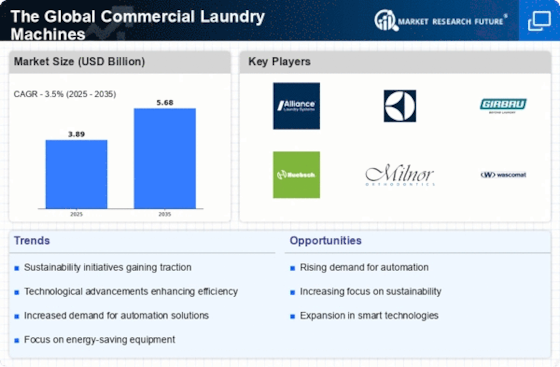
As per Market Research Future analysis, The Global Commercial Laundry Machines Market was estimated at 3.889 USD Billion in 2024. The commercial laundry machines industry is projected to grow from 4.025 USD Billion in 2025 to 5.677 USD Billion by 2035, exhibiting a compound annual growth rate (CAGR) of 3.5% during the forecast period 2025 - 2035

Key Market Trends & Highlights

The Global Commercial Laundry Machines Market is experiencing a dynamic shift driven by technological advancements and sustainability initiatives.

  • North America remains the largest market for commercial laundry machines, driven by a robust hospitality sector. Asia-Pacific is emerging as the fastest-growing region, fueled by rapid urbanization and increasing demand for laundry services. Washers dominate the market as the largest segment, while dryers are witnessing the fastest growth due to evolving consumer preferences. Technological advancements and a strong focus on sustainability are key drivers propelling market expansion.

Market Size & Forecast

2024 Market Size 3.889 (USD Billion)
2035 Market Size 5.677 (USD Billion)
CAGR (2025 - 2035) 3.5%
Largest Regional Market Share in 2024 Asia Pacific

Major Players

Alliance Laundry Systems (US), <a href="https://www.electroluxprofessional.com/sg/">Electrolux Professional (SE)</a>, Girbau (ES), Huebsch (US), Milnor (US), <a href="https://www.wascomat.com/">Wascomat (US)</a>, Speed Queen (US), Maytag Commercial (US), Dexter Laundry (US)

Market Trends

The Global Commercial Laundry Machines is currently experiencing a transformative phase, driven by advancements in technology and evolving consumer preferences. The integration of smart technologies into laundry machines appears to enhance operational efficiency and reduce energy consumption. This trend is likely to attract businesses seeking to optimize their laundry processes while minimizing environmental impact. Furthermore, the increasing demand for sustainable practices in various industries suggests that manufacturers are focusing on eco-friendly solutions, which may lead to the development of innovative products that align with these values. In addition, the market seems to be influenced by the growing trend of automation in commercial settings. As businesses strive to improve productivity, automated laundry systems are gaining traction. This shift could potentially reshape the competitive landscape, as companies that adopt these technologies may gain a significant advantage. Moreover, the rise of e-commerce platforms for laundry services indicates a shift in consumer behavior, where convenience and accessibility are prioritized. Overall, The Global Commercial Laundry Machines is poised for growth, with several factors contributing to its evolution and expansion.

Technological Advancements

The integration of smart technologies into commercial laundry machines is reshaping the market. These innovations enhance efficiency, reduce water and energy usage, and provide real-time monitoring capabilities, appealing to businesses focused on sustainability.

Automation Trends

The increasing adoption of automation in laundry operations is transforming the industry. Automated systems streamline processes, reduce labor costs, and improve turnaround times, making them attractive to various commercial sectors.

E-commerce Influence

The rise of e-commerce platforms for laundry services is changing consumer expectations. Customers now seek convenience and flexibility, prompting businesses to adapt their offerings to meet these new demands.

Commercial Laundry Machines Market Market Drivers

Rising Urbanization

Rising urbanization is significantly impacting The Global commercial laundry machines Industry. As urban populations expand, the demand for laundry services is increasing, particularly in densely populated areas where space is limited. This trend is leading to a greater reliance on commercial laundries, which require efficient and high-capacity machines to meet the growing demand. Data indicates that urban areas are projected to account for over 60% of the global population by 2030, further emphasizing the need for scalable laundry solutions. Additionally, urbanization often correlates with a shift in consumer behavior, as more individuals seek convenient laundry services. This shift is likely to drive investments in commercial laundry facilities, thereby boosting the demand for advanced laundry machines that can cater to the needs of urban consumers.

Sustainability Focus

Sustainability has emerged as a critical driver in The Global Commercial Laundry Machines Industry. As environmental concerns continue to rise, businesses are increasingly seeking eco-friendly laundry solutions. Machines that utilize less water and energy are becoming more popular, as they not only reduce operational costs but also align with corporate social responsibility goals. The market is witnessing a surge in demand for energy-efficient models, with some manufacturers reporting that up to 30% of energy consumption can be reduced through advanced technologies. Additionally, the implementation of sustainable practices is often a requirement for compliance with regulations, further propelling the adoption of green laundry machines. This focus on sustainability is expected to shape product development and influence purchasing decisions in the coming years.

Demand for Versatility

The demand for versatility in laundry solutions is significantly influencing The Global Commercial Laundry Machines Industry. Businesses across various sectors, including hospitality, healthcare, and retail, require machines that can handle a diverse range of fabrics and load sizes. This need for adaptability is driving manufacturers to develop multi-functional machines capable of performing various washing and drying cycles. Recent market analysis indicates that machines with customizable settings are gaining traction, as they allow users to optimize performance based on specific requirements. This versatility not only enhances operational efficiency but also caters to the unique needs of different industries. As a result, the market is likely to see an increase in the production of machines that offer a wide array of features, appealing to a broader customer base.

Technological Advancements

The Global Commercial Laundry Machines Industry is experiencing a notable transformation driven by rapid technological advancements. Innovations such as IoT-enabled machines and automated washing systems are enhancing operational efficiency and reducing labor costs. For instance, the integration of smart technology allows for remote monitoring and control, which can lead to significant energy savings. According to recent data, the market for smart laundry machines is projected to grow at a compound annual growth rate of 8.5% over the next five years. This trend indicates a shift towards more efficient and user-friendly solutions, appealing to both commercial laundries and end-users. Furthermore, advancements in machine design and functionality are likely to improve the overall user experience, making these machines more attractive to potential buyers.

Growth of the Hospitality Sector

The growth of the hospitality sector is a pivotal factor propelling The Global Commercial Laundry Machines Industry. As the number of hotels, restaurants, and catering services continues to rise, so does the demand for efficient laundry solutions. The hospitality industry requires high-capacity machines that can handle large volumes of linens, towels, and uniforms. Recent statistics suggest that The Global Commercial Laundry Machines Market size of over 1 trillion USD by 2026, which will likely drive the demand for commercial laundry machines. Furthermore, the need for quick turnaround times in this sector necessitates the use of advanced laundry technology, which can enhance productivity and service quality. Consequently, manufacturers are focusing on developing robust machines tailored to meet the specific needs of the hospitality industry.

Market Segment Insights

By Product Type: Washers (Largest) vs. Dryers (Fastest-Growing)

In The Global Commercial Laundry Machines Market, the product type segment is crucial, with washers holding the largest market share due to their essential role in laundry operations. Following closely are dryers, which have seen an increase in demand driven by the need for efficient drying solutions in commercial settings. Other significant contributors include ironers and dry cleaners, which cater to specific needs in the laundry process. Each of these segments plays a vital role in the overall performance and efficacy of commercial laundry services. Growth trends in this segment are primarily driven by advancements in technology, such as energy-efficient machines and smart laundry solutions. The increasing preference for automated systems and eco-friendly machines has further propelled the demand for high-quality washers and dryers. Additionally, the rise in laundry service businesses globally creates a strong market for special laundry solutions and combo machines that offer versatility and convenience. As consumers become more conscious about environmental impacts, innovation in this market segment is expected to accelerate.

Washers (Dominant) vs. Combo Washers and Dryers (Emerging)

Washers remain the dominant force in The Global Commercial Laundry Machines Market, characterized by their essential functionality and reliability in various commercial settings. They are designed for high capacity and efficiency, making them a preferred choice for laundries and hospitality businesses. On the other hand, combo washers and dryers are emerging as a significant trend owing to their compact design and dual functionality, making them ideal for establishments with space limitations. The growing demand for these machines reflects changing customer preferences towards convenience and multifunctionality. As urban living spaces become smaller, the combo systems boast a versatility that appeals to laundries aiming for efficiency without sacrificing quality. This complementarity positions them well in a market seeking innovation and adaptability.

By Mode of Operation: Fully Automatic (Largest) vs. Semi-Automatic (Fastest-Growing)

In The Global Commercial Laundry Machines Market, the mode of operation plays a critical role in the selection and usage of laundry machines. Fully automatic machines hold the largest share, appealing to a broad range of customers due to their ease of use and efficiency. They cater to establishments looking for high throughput and minimal manual intervention, allowing for streamlined operations and enhanced productivity. Conversely, semi-automatic machines, while smaller in market share, are gaining traction in specific segments, particularly among smaller businesses and laundromats that require cost-effective solutions without compromising on quality.

Mode of Operation: Fully Automatic (Dominant) vs. Semi-Automatic (Emerging)

Fully automatic commercial laundry machines are the dominant choice in the market, regarded for their convenience and advanced features that automate the entire washing process. They are ideal for larger facilities, delivering consistent results with minimal supervision. On the other hand, semi-automatic machines are emerging as a viable alternative for businesses that cannot invest heavily in fully automated systems. They provide flexibility and control over the laundry process, attracting budget-conscious customers. Despite being labeled as 'emerging', semi-automatic machines are rapidly evolving, featuring enhancements in design and functionality that cater to specific operational needs, thus capturing a growing share of the market.

By Capacity: 15–30 kg (Largest) vs. Above 50 kg (Fastest-Growing)

In The Global Commercial Laundry Machines Market, the capacity segment is divided into four categories: Up to 15 kg, 15–30 kg, 31–50 kg, and Above 50 kg. Among these, the 15-30 kg category holds the largest market share, favored by a significant number of commercial establishments due to its versatility and efficiency in handling daily laundry needs. Conversely, the Above 50 kg segment is registering rapid growth as institutions and industrial sectors lean towards larger machines to accommodate increased laundry volumes, driven by rising operational demands. Growth trends in this segment are largely being influenced by the expanding hospitality and healthcare sectors, which require efficient laundry solutions to handle substantial loads. Moreover, innovations in machine design and technology are making larger capacity machines more energy-efficient and cost-effective. The growing awareness of sustainable practices and eco-friendly operations also contributes to the increasing adoption of larger <a href="https://www.marketresearchfuture.com/reports/commercial-laundry-equipment-market-34455" target="_blank" rel="noopener">commercial laundry equipment</a> intended for high-capacity tasks.

15–30 kg (Dominant) vs. Above 50 kg (Emerging)

The 15-30 kg capacity range is considered dominant in the commercial laundry machines market, as it caters to mid-sized businesses like hotels and restaurants, offering a balance between washing capacity and machine footprint. These machines are known for their efficiency, cost-effectiveness, and user-friendly features, making them an ideal choice for establishments with moderate laundry demands. On the other hand, the Above 50 kg category is emerging rapidly, serving large institutions, such as hospitals and laundromats, which require high-capacity solutions for bulk laundry processing. Innovations are making these larger machines more energy-efficient and versatile, thus appealing to a growing number of users seeking to minimize operational costs while maximizing productivity.

By Application: Healthcare (Largest) vs. Hospitality (Fastest-Growing)

In The Global Commercial Laundry Machines Market, the application segment is primarily driven by healthcare, hospitality, and laundry stores. Healthcare holds a significant share, accounting for a large portion of the market due to the constant demand for hygienically clean linens and garments. Hospitality follows closely, with an increasing focus on maintaining cleanliness and hygiene standards, especially in the wake of the pandemic. Meanwhile, self-service launderettes carve out a niche with steady demand, despite the overshadowing presence of healthcare and hospitality. Growth trends indicate an expanding market driven by innovations in automation and energy efficiency in laundry machines. The healthcare sector's relentless need for clean textiles fuels continuous investment in advanced laundering solutions. Concurrently, the hospitality industry's rapid growth, especially in areas like boutique hotels and resorts, is leading to an acceleration in demand for commercial laundry machines that are efficient and reliable. These factors highlight the dynamic nature of the segment and its resilience in a competitive landscape.

Healthcare (Dominant) vs. Hospitality (Emerging)

The healthcare sector stands as the dominant application in The Global Commercial Laundry Machines Market due to its rigorous hygiene standards, which necessitate high-capacity machines capable of handling large volumes of linens and garments. Healthcare facilities prioritize durability and efficiency to meet the daily laundering needs of bed sheets, towels, and surgical uniforms. On the other hand, the hospitality market is emerging as a key player, showing substantial growth potential. As hotels enhance guest experiences through impeccable cleanliness, investments in commercial laundry machines with advanced technology and improved efficiency are rising. Consequently, while healthcare remains the steady cornerstone of demand, the hospitality industry is rapidly evolving, creating a competitive landscape characterized by innovation and heightened customer expectations.

By Distribution Channel: Online (Largest) vs. Offline (Fastest-Growing)

In The Global Commercial Laundry Machines Market, the distribution of market share between online and offline channels has been notable, with online sales emerging as the largest segment. The convenience and accessibility of online platforms have significantly contributed to the prevalence of online sales among various commercial clients. Meanwhile, offline sales continue to maintain a strong presence, appealing to businesses that prefer direct interaction and immediate service with suppliers.

Distribution Channel: Online (Dominant) vs. Offline (Emerging)

The online distribution channel represents a dominant force within The Global Commercial Laundry Machines Market, characterized by its ability to cater to a wide range of customers through extensive digital reach and convenience. Customers can easily compare products and prices, leading to informed purchasing decisions. Conversely, the offline distribution channel is considered an emerging segment due to its consistent growth driven by businesses seeking personalized service and hands-on demonstrations. Retail locations and trade shows play a significant role in allowing clients to interact with products before purchase, thereby reinforcing the importance of both channels in a holistic market strategy.

Get more detailed insights about Commercial Laundry Machines Market Research Report—Global Forecast till 2035

Regional Insights

North America : Market Leader in Innovation

North America is the largest market for commercial laundry machines, holding approximately 40% of the global market share. The region's growth is driven by increasing demand for energy-efficient and technologically advanced laundry solutions, alongside stringent regulations promoting sustainability. The U.S. leads this market, followed by Canada, which contributes around 10% to the overall share. Regulatory incentives for energy-efficient appliances further catalyze market expansion. The competitive landscape in North America is robust, featuring key players such as Alliance Laundry Systems, Electrolux Professional, and Speed Queen. These companies are at the forefront of innovation, offering a range of products tailored to commercial needs. The presence of established brands and a growing trend towards automation in laundry services are expected to bolster market growth in the coming years.

Europe : Emerging Market with Regulations

Europe is witnessing significant growth in the commercial laundry machines market, accounting for approximately 30% of the global share. The region's expansion is fueled by increasing environmental regulations and a shift towards sustainable practices in the laundry sector. Countries like Germany and the UK are leading this market, with Germany holding about 12% of the total share. The European Union's stringent energy efficiency standards are acting as a catalyst for innovation and investment in this sector. The competitive landscape in Europe is characterized by a mix of established players and emerging companies. Key players such as Electrolux Professional and Girbau are focusing on developing eco-friendly products to meet regulatory demands. The presence of a diverse range of manufacturers enhances competition, driving technological advancements and improving service offerings across the region.

Asia-Pacific : Rapid Growth and Adoption

Asia-Pacific is rapidly emerging as a significant player in the commercial laundry machines market, holding approximately 25% of the global share. The region's growth is driven by urbanization, increasing disposable incomes, and a rising demand for laundry services in both residential and commercial sectors. China and India are the largest markets, with China alone contributing around 15% to the global share. The increasing focus on hygiene and cleanliness, especially post-pandemic, is further propelling market demand. The competitive landscape in Asia-Pacific is diverse, with both local and international players vying for market share. Companies like Milnor and Wascomat are expanding their presence in this region, capitalizing on the growing demand for advanced laundry solutions. The market is characterized by rapid technological advancements and a shift towards automated laundry systems, which are expected to dominate the future landscape.

Middle East and Africa : Untapped Potential in Growth

The Middle East and Africa region is gradually emerging in the commercial laundry machines market, currently holding about 5% of the global share. The growth is primarily driven by increasing urbanization, a growing hospitality sector, and rising awareness of hygiene standards. Countries like South Africa and the UAE are leading this market, with South Africa contributing approximately 2% to the global share. The region's potential is further enhanced by government initiatives aimed at improving infrastructure and promoting foreign investments. The competitive landscape in the Middle East and Africa is still developing, with a mix of local and international players. Companies are increasingly focusing on providing tailored solutions to meet the unique needs of the region. The presence of key players like Dexter Laundry is expected to drive innovation and improve service delivery, paving the way for future growth in this untapped market.

Key Players and Competitive Insights

The Global Commercial Laundry Machines is currently characterized by a dynamic competitive landscape, driven by technological advancements, sustainability initiatives, and evolving consumer preferences. Key players such as Alliance Laundry Systems (US), Electrolux Professional (SE), and Miele Professional (DE) are strategically positioning themselves through innovation and regional expansion. Alliance Laundry Systems (US) focuses on enhancing its product offerings with energy-efficient machines, while Electrolux Professional (SE) emphasizes digital transformation to improve operational efficiency. Miele Professional (DE) is leveraging its reputation for quality to penetrate emerging markets, thereby shaping a competitive environment that prioritizes technological prowess and customer-centric solutions.

The market structure appears moderately fragmented, with numerous players vying for market share. Key business tactics include localizing manufacturing to reduce costs and optimize supply chains, which is particularly relevant in the context of fluctuating global trade dynamics. The collective influence of these major players fosters a competitive atmosphere where innovation and operational efficiency are paramount, allowing them to respond adeptly to market demands.

In August 2025, Electrolux Professional (SE) announced the launch of its new line of eco-friendly laundry machines designed to reduce water and energy consumption significantly. This strategic move not only aligns with global sustainability trends but also positions the company as a leader in environmentally responsible practices within the commercial laundry sector. By prioritizing sustainability, Electrolux Professional (SE) enhances its brand image and appeals to a growing segment of environmentally conscious consumers.

In September 2025, Alliance Laundry Systems (US) unveiled a partnership with a leading technology firm to integrate AI-driven analytics into its laundry machines. This initiative aims to optimize machine performance and predictive maintenance, thereby reducing downtime for commercial operators. The integration of AI signifies a shift towards smarter, more efficient laundry solutions, potentially setting a new standard in the industry and enhancing customer satisfaction through improved service reliability.

In October 2025, Miele Professional (DE) expanded its distribution network in Asia by collaborating with local distributors to enhance market penetration. This strategic expansion is indicative of Miele's commitment to capturing growth opportunities in emerging markets, where demand for high-quality commercial laundry solutions is on the rise. By localizing its approach, Miele Professional (DE) not only increases its market presence but also tailors its offerings to meet regional needs, thereby fostering customer loyalty.

As of October 2025, the competitive trends in The Global Commercial Laundry Machines are increasingly defined by digitalization, sustainability, and the integration of advanced technologies such as AI. Strategic alliances are becoming more prevalent, enabling companies to leverage complementary strengths and enhance their market positions. Looking ahead, competitive differentiation is likely to evolve from traditional price-based competition to a focus on innovation, technological advancements, and supply chain reliability, reflecting a broader shift towards value-driven strategies in the industry.

Key Companies in the Commercial Laundry Machines Market include

Industry Developments

Future Outlook

Commercial Laundry Machines Market Future Outlook

The Global Commercial Laundry Machines Market is projected to grow at a 3.5% CAGR from 2025 to 2035, driven by technological advancements, increasing demand for efficiency, and sustainability initiatives.

New opportunities lie in:

  • <p>Integration of IoT for real-time monitoring and maintenance solutions. Expansion into eco-friendly machine production to meet regulatory standards. Development of subscription-based service models for consistent revenue streams.</p>

By 2035, the market is expected to be robust, driven by innovation and sustainability.

Market Segmentation

Commercial Laundry Machines Market Capacity Outlook

  • Up to 15 kg
  • 15–30 kg
  • 31–50 kg
  • Above 50 kg

Commercial Laundry Machines Market Application Outlook

  • Healthcare
  • Hospitality
  • Laundry Stores/Self-Service Laundry
  • Others

Commercial Laundry Machines Market Product Type Outlook

  • Washers
  • Dryers
  • Ironers
  • Dry Cleaners
  • Special Laundry Solutions
  • Combo Washers and Dryers
  • Others

Commercial Laundry Machines Market Mode of Operation Outlook

  • Semi-Automatic
  • Fully Automatic

Commercial Laundry Machines Market Distribution Channel Outlook

  • Online
  • Offline

Report Scope

MARKET SIZE 2024 3.889(USD Billion)
MARKET SIZE 2025 4.025(USD Billion)
MARKET SIZE 2035 5.677(USD Billion)
COMPOUND ANNUAL GROWTH RATE (CAGR) 3.5% (2025 - 2035)
REPORT COVERAGE Revenue Forecast, Competitive Landscape, Growth Factors, and Trends
BASE YEAR 2024
Market Forecast Period 2025 - 2035
Historical Data 2019 - 2024
Market Forecast Units USD Billion
Key Companies Profiled Alliance Laundry Systems (US), Electrolux Professional (SE), Girbau (ES), Huebsch (US), Milnor (US), Wascomat (US), Speed Queen (US), Maytag Commercial (US), Dexter Laundry (US)
Segments Covered Product Type, Region - Forecast Till 2035
Key Market Opportunities Integration of smart technology and automation in The Global Commercial Laundry Machines presents substantial growth opportunities.
Key Market Dynamics Technological advancements drive efficiency and sustainability in commercial laundry machines, reshaping competitive dynamics and consumer preferences.
Countries Covered North America, Europe, APAC, South America, MEA

FAQs

What is the projected market valuation of The Global Commercial Laundry Machines by 2035?

<p>The projected market valuation is expected to reach 5.677 USD Billion by 2035.</p>

What was the market valuation of The Global Commercial Laundry Machines in 2024?

<p>The market valuation was 3.889 USD Billion in 2024.</p>

What is the expected CAGR for The Global Commercial Laundry Machines during the forecast period 2025 - 2035?

<p>The expected CAGR is 3.5% during the forecast period 2025 - 2035.</p>

Which product type segment had the highest valuation in 2024?

<p>The Washers segment had the highest valuation at 1.2 USD Billion in 2024.</p>

What is the projected valuation for the Dryers segment by 2035?

<p>The projected valuation for the Dryers segment is expected to reach 1.4 USD Billion by 2035.</p>

Which mode of operation segment is anticipated to grow more rapidly from 2025 to 2035?

<p>The Fully Automatic segment is anticipated to grow more rapidly, with a projected valuation of 2.929 USD Billion by 2035.</p>

What is the expected market size for the Healthcare application segment by 2035?

<p>The expected market size for the Healthcare application segment is projected to reach 1.7 USD Billion by 2035.</p>

Which distribution channel is likely to dominate the market by 2035?

<p>The Offline distribution channel is likely to dominate, with a projected valuation of 2.8915 USD Billion by 2035.</p>

What is the projected valuation for laundry stores/self-service laundry applications by 2035?

<p>The projected valuation for laundry stores/self-service laundry applications is expected to reach 1.9 USD Billion by 2035.</p>

Who are the key players in The Global Commercial Laundry Machines?

<p>Key players include Alliance Laundry Systems, Electrolux Professional, and Speed Queen, among others.</p>

  1. SECTION I: EXECUTIVE SUMMARY AND KEY HIGHLIGHTS
    1. | 1.1 EXECUTIVE SUMMARY
    2. | | 1.1.1 Market Overview
    3. | | 1.1.2 Key Findings
    4. | | 1.1.3 Market Segmentation
    5. | | 1.1.4 Competitive Landscape
    6. | | 1.1.5 Challenges and Opportunities
    7. | | 1.1.6 Future Outlook
  2. SECTION II: SCOPING, METHODOLOGY AND MARKET STRUCTURE
    1. | 2.1 MARKET INTRODUCTION
    2. | | 2.1.1 Definition
    3. | | 2.1.2 Scope of the study
    4. | | | 2.1.2.1 Research Objective
    5. | | | 2.1.2.2 Assumption
    6. | | | 2.1.2.3 Limitations
    7. | 2.2 RESEARCH METHODOLOGY
    8. | | 2.2.1 Overview
    9. | | 2.2.2 Data Mining
    10. | | 2.2.3 Secondary Research
    11. | | 2.2.4 Primary Research
    12. | | | 2.2.4.1 Primary Interviews and Information Gathering Process
    13. | | | 2.2.4.2 Breakdown of Primary Respondents
    14. | | 2.2.5 Forecasting Model
    15. | | 2.2.6 Market Size Estimation
    16. | | | 2.2.6.1 Bottom-Up Approach
    17. | | | 2.2.6.2 Top-Down Approach
    18. | | 2.2.7 Data Triangulation
    19. | | 2.2.8 Validation
  3. SECTION III: QUALITATIVE ANALYSIS
    1. | 3.1 MARKET DYNAMICS
    2. | | 3.1.1 Overview
    3. | | 3.1.2 Drivers
    4. | | 3.1.3 Restraints
    5. | | 3.1.4 Opportunities
    6. | 3.2 MARKET FACTOR ANALYSIS
    7. | | 3.2.1 Value chain Analysis
    8. | | 3.2.2 Porter's Five Forces Analysis
    9. | | | 3.2.2.1 Bargaining Power of Suppliers
    10. | | | 3.2.2.2 Bargaining Power of Buyers
    11. | | | 3.2.2.3 Threat of New Entrants
    12. | | | 3.2.2.4 Threat of Substitutes
    13. | | | 3.2.2.5 Intensity of Rivalry
    14. | | 3.2.3 COVID-19 Impact Analysis
    15. | | | 3.2.3.1 Market Impact Analysis
    16. | | | 3.2.3.2 Regional Impact
    17. | | | 3.2.3.3 Opportunity and Threat Analysis
  4. SECTION IV: QUANTITATIVE ANALYSIS
    1. | 4.1 Consumer and Retail, BY Product Type (USD Billion)
    2. | | 4.1.1 Washers
    3. | | 4.1.2 Dryers
    4. | | 4.1.3 Ironers
    5. | | 4.1.4 Dry Cleaners
    6. | | 4.1.5 Special Laundry Solutions
    7. | | 4.1.6 Combo Washers and Dryers
    8. | | 4.1.7 Others
    9. | 4.2 Consumer and Retail, BY Mode of Operation (USD Billion)
    10. | | 4.2.1 Semi-Automatic
    11. | | 4.2.2 Fully Automatic
    12. | 4.3 Consumer and Retail, BY Capacity (USD Billion)
    13. | | 4.3.1 Up to 15 kg
    14. | | 4.3.2 15–30 kg
    15. | | 4.3.3 31–50 kg
    16. | | 4.3.4 Above 50 kg
    17. | 4.4 Consumer and Retail, BY Application (USD Billion)
    18. | | 4.4.1 Healthcare
    19. | | 4.4.2 Hospitality
    20. | | 4.4.3 Laundry Stores/Self-Service Laundry
    21. | | 4.4.4 Others
    22. | 4.5 Consumer and Retail, BY Distribution Channel (USD Billion)
    23. | | 4.5.1 Online
    24. | | 4.5.2 Offline
    25. | 4.6 Consumer and Retail, BY Region (USD Billion)
    26. | | 4.6.1 North America
    27. | | | 4.6.1.1 US
    28. | | | 4.6.1.2 Canada
    29. | | 4.6.2 Europe
    30. | | | 4.6.2.1 Germany
    31. | | | 4.6.2.2 UK
    32. | | | 4.6.2.3 France
    33. | | | 4.6.2.4 Russia
    34. | | | 4.6.2.5 Italy
    35. | | | 4.6.2.6 Spain
    36. | | | 4.6.2.7 Rest of Europe
    37. | | 4.6.3 APAC
    38. | | | 4.6.3.1 China
    39. | | | 4.6.3.2 India
    40. | | | 4.6.3.3 Japan
    41. | | | 4.6.3.4 South Korea
    42. | | | 4.6.3.5 Malaysia
    43. | | | 4.6.3.6 Thailand
    44. | | | 4.6.3.7 Indonesia
    45. | | | 4.6.3.8 Rest of APAC
    46. | | 4.6.4 South America
    47. | | | 4.6.4.1 Brazil
    48. | | | 4.6.4.2 Mexico
    49. | | | 4.6.4.3 Argentina
    50. | | | 4.6.4.4 Rest of South America
    51. | | 4.6.5 MEA
    52. | | | 4.6.5.1 GCC Countries
    53. | | | 4.6.5.2 South Africa
    54. | | | 4.6.5.3 Rest of MEA
  5. SECTION V: COMPETITIVE ANALYSIS
    1. | 5.1 Competitive Landscape
    2. | | 5.1.1 Overview
    3. | | 5.1.2 Competitive Analysis
    4. | | 5.1.3 Market share Analysis
    5. | | 5.1.4 Major Growth Strategy in the Consumer and Retail
    6. | | 5.1.5 Competitive Benchmarking
    7. | | 5.1.6 Leading Players in Terms of Number of Developments in the Consumer and Retail
    8. | | 5.1.7 Key developments and growth strategies
    9. | | | 5.1.7.1 New Product Launch/Service Deployment
    10. | | | 5.1.7.2 Merger & Acquisitions
    11. | | | 5.1.7.3 Joint Ventures
    12. | | 5.1.8 Major Players Financial Matrix
    13. | | | 5.1.8.1 Sales and Operating Income
    14. | | | 5.1.8.2 Major Players R&D Expenditure. 2023
    15. | 5.2 Company Profiles
    16. | | 5.2.1 Alliance Laundry Systems (US)
    17. | | | 5.2.1.1 Financial Overview
    18. | | | 5.2.1.2 Products Offered
    19. | | | 5.2.1.3 Key Developments
    20. | | | 5.2.1.4 SWOT Analysis
    21. | | | 5.2.1.5 Key Strategies
    22. | | 5.2.2 Electrolux Professional (SE)
    23. | | | 5.2.2.1 Financial Overview
    24. | | | 5.2.2.2 Products Offered
    25. | | | 5.2.2.3 Key Developments
    26. | | | 5.2.2.4 SWOT Analysis
    27. | | | 5.2.2.5 Key Strategies
    28. | | 5.2.3 Girbau (ES)
    29. | | | 5.2.3.1 Financial Overview
    30. | | | 5.2.3.2 Products Offered
    31. | | | 5.2.3.3 Key Developments
    32. | | | 5.2.3.4 SWOT Analysis
    33. | | | 5.2.3.5 Key Strategies
    34. | | 5.2.4 Huebsch (US)
    35. | | | 5.2.4.1 Financial Overview
    36. | | | 5.2.4.2 Products Offered
    37. | | | 5.2.4.3 Key Developments
    38. | | | 5.2.4.4 SWOT Analysis
    39. | | | 5.2.4.5 Key Strategies
    40. | | 5.2.5 Milnor (US)
    41. | | | 5.2.5.1 Financial Overview
    42. | | | 5.2.5.2 Products Offered
    43. | | | 5.2.5.3 Key Developments
    44. | | | 5.2.5.4 SWOT Analysis
    45. | | | 5.2.5.5 Key Strategies
    46. | | 5.2.6 Wascomat (US)
    47. | | | 5.2.6.1 Financial Overview
    48. | | | 5.2.6.2 Products Offered
    49. | | | 5.2.6.3 Key Developments
    50. | | | 5.2.6.4 SWOT Analysis
    51. | | | 5.2.6.5 Key Strategies
    52. | | 5.2.7 Speed Queen (US)
    53. | | | 5.2.7.1 Financial Overview
    54. | | | 5.2.7.2 Products Offered
    55. | | | 5.2.7.3 Key Developments
    56. | | | 5.2.7.4 SWOT Analysis
    57. | | | 5.2.7.5 Key Strategies
    58. | | 5.2.8 Maytag Commercial (US)
    59. | | | 5.2.8.1 Financial Overview
    60. | | | 5.2.8.2 Products Offered
    61. | | | 5.2.8.3 Key Developments
    62. | | | 5.2.8.4 SWOT Analysis
    63. | | | 5.2.8.5 Key Strategies
    64. | | 5.2.9 Dexter Laundry (US)
    65. | | | 5.2.9.1 Financial Overview
    66. | | | 5.2.9.2 Products Offered
    67. | | | 5.2.9.3 Key Developments
    68. | | | 5.2.9.4 SWOT Analysis
    69. | | | 5.2.9.5 Key Strategies
    70. | 5.3 Appendix
    71. | | 5.3.1 References
    72. | | 5.3.2 Related Reports
  6. LIST OF FIGURES
    1. | 6.1 MARKET SYNOPSIS
    2. | 6.2 NORTH AMERICA MARKET ANALYSIS
    3. | 6.3 US MARKET ANALYSIS BY PRODUCT TYPE
    4. | 6.4 US MARKET ANALYSIS BY MODE OF OPERATION
    5. | 6.5 US MARKET ANALYSIS BY CAPACITY
    6. | 6.6 US MARKET ANALYSIS BY APPLICATION
    7. | 6.7 US MARKET ANALYSIS BY DISTRIBUTION CHANNEL
    8. | 6.8 CANADA MARKET ANALYSIS BY PRODUCT TYPE
    9. | 6.9 CANADA MARKET ANALYSIS BY MODE OF OPERATION
    10. | 6.10 CANADA MARKET ANALYSIS BY CAPACITY
    11. | 6.11 CANADA MARKET ANALYSIS BY APPLICATION
    12. | 6.12 CANADA MARKET ANALYSIS BY DISTRIBUTION CHANNEL
    13. | 6.13 EUROPE MARKET ANALYSIS
    14. | 6.14 GERMANY MARKET ANALYSIS BY PRODUCT TYPE
    15. | 6.15 GERMANY MARKET ANALYSIS BY MODE OF OPERATION
    16. | 6.16 GERMANY MARKET ANALYSIS BY CAPACITY
    17. | 6.17 GERMANY MARKET ANALYSIS BY APPLICATION
    18. | 6.18 GERMANY MARKET ANALYSIS BY DISTRIBUTION CHANNEL
    19. | 6.19 UK MARKET ANALYSIS BY PRODUCT TYPE
    20. | 6.20 UK MARKET ANALYSIS BY MODE OF OPERATION
    21. | 6.21 UK MARKET ANALYSIS BY CAPACITY
    22. | 6.22 UK MARKET ANALYSIS BY APPLICATION
    23. | 6.23 UK MARKET ANALYSIS BY DISTRIBUTION CHANNEL
    24. | 6.24 FRANCE MARKET ANALYSIS BY PRODUCT TYPE
    25. | 6.25 FRANCE MARKET ANALYSIS BY MODE OF OPERATION
    26. | 6.26 FRANCE MARKET ANALYSIS BY CAPACITY
    27. | 6.27 FRANCE MARKET ANALYSIS BY APPLICATION
    28. | 6.28 FRANCE MARKET ANALYSIS BY DISTRIBUTION CHANNEL
    29. | 6.29 RUSSIA MARKET ANALYSIS BY PRODUCT TYPE
    30. | 6.30 RUSSIA MARKET ANALYSIS BY MODE OF OPERATION
    31. | 6.31 RUSSIA MARKET ANALYSIS BY CAPACITY
    32. | 6.32 RUSSIA MARKET ANALYSIS BY APPLICATION
    33. | 6.33 RUSSIA MARKET ANALYSIS BY DISTRIBUTION CHANNEL
    34. | 6.34 ITALY MARKET ANALYSIS BY PRODUCT TYPE
    35. | 6.35 ITALY MARKET ANALYSIS BY MODE OF OPERATION
    36. | 6.36 ITALY MARKET ANALYSIS BY CAPACITY
    37. | 6.37 ITALY MARKET ANALYSIS BY APPLICATION
    38. | 6.38 ITALY MARKET ANALYSIS BY DISTRIBUTION CHANNEL
    39. | 6.39 SPAIN MARKET ANALYSIS BY PRODUCT TYPE
    40. | 6.40 SPAIN MARKET ANALYSIS BY MODE OF OPERATION
    41. | 6.41 SPAIN MARKET ANALYSIS BY CAPACITY
    42. | 6.42 SPAIN MARKET ANALYSIS BY APPLICATION
    43. | 6.43 SPAIN MARKET ANALYSIS BY DISTRIBUTION CHANNEL
    44. | 6.44 REST OF EUROPE MARKET ANALYSIS BY PRODUCT TYPE
    45. | 6.45 REST OF EUROPE MARKET ANALYSIS BY MODE OF OPERATION
    46. | 6.46 REST OF EUROPE MARKET ANALYSIS BY CAPACITY
    47. | 6.47 REST OF EUROPE MARKET ANALYSIS BY APPLICATION
    48. | 6.48 REST OF EUROPE MARKET ANALYSIS BY DISTRIBUTION CHANNEL
    49. | 6.49 APAC MARKET ANALYSIS
    50. | 6.50 CHINA MARKET ANALYSIS BY PRODUCT TYPE
    51. | 6.51 CHINA MARKET ANALYSIS BY MODE OF OPERATION
    52. | 6.52 CHINA MARKET ANALYSIS BY CAPACITY
    53. | 6.53 CHINA MARKET ANALYSIS BY APPLICATION
    54. | 6.54 CHINA MARKET ANALYSIS BY DISTRIBUTION CHANNEL
    55. | 6.55 INDIA MARKET ANALYSIS BY PRODUCT TYPE
    56. | 6.56 INDIA MARKET ANALYSIS BY MODE OF OPERATION
    57. | 6.57 INDIA MARKET ANALYSIS BY CAPACITY
    58. | 6.58 INDIA MARKET ANALYSIS BY APPLICATION
    59. | 6.59 INDIA MARKET ANALYSIS BY DISTRIBUTION CHANNEL
    60. | 6.60 JAPAN MARKET ANALYSIS BY PRODUCT TYPE
    61. | 6.61 JAPAN MARKET ANALYSIS BY MODE OF OPERATION
    62. | 6.62 JAPAN MARKET ANALYSIS BY CAPACITY
    63. | 6.63 JAPAN MARKET ANALYSIS BY APPLICATION
    64. | 6.64 JAPAN MARKET ANALYSIS BY DISTRIBUTION CHANNEL
    65. | 6.65 SOUTH KOREA MARKET ANALYSIS BY PRODUCT TYPE
    66. | 6.66 SOUTH KOREA MARKET ANALYSIS BY MODE OF OPERATION
    67. | 6.67 SOUTH KOREA MARKET ANALYSIS BY CAPACITY
    68. | 6.68 SOUTH KOREA MARKET ANALYSIS BY APPLICATION
    69. | 6.69 SOUTH KOREA MARKET ANALYSIS BY DISTRIBUTION CHANNEL
    70. | 6.70 MALAYSIA MARKET ANALYSIS BY PRODUCT TYPE
    71. | 6.71 MALAYSIA MARKET ANALYSIS BY MODE OF OPERATION
    72. | 6.72 MALAYSIA MARKET ANALYSIS BY CAPACITY
    73. | 6.73 MALAYSIA MARKET ANALYSIS BY APPLICATION
    74. | 6.74 MALAYSIA MARKET ANALYSIS BY DISTRIBUTION CHANNEL
    75. | 6.75 THAILAND MARKET ANALYSIS BY PRODUCT TYPE
    76. | 6.76 THAILAND MARKET ANALYSIS BY MODE OF OPERATION
    77. | 6.77 THAILAND MARKET ANALYSIS BY CAPACITY
    78. | 6.78 THAILAND MARKET ANALYSIS BY APPLICATION
    79. | 6.79 THAILAND MARKET ANALYSIS BY DISTRIBUTION CHANNEL
    80. | 6.80 INDONESIA MARKET ANALYSIS BY PRODUCT TYPE
    81. | 6.81 INDONESIA MARKET ANALYSIS BY MODE OF OPERATION
    82. | 6.82 INDONESIA MARKET ANALYSIS BY CAPACITY
    83. | 6.83 INDONESIA MARKET ANALYSIS BY APPLICATION
    84. | 6.84 INDONESIA MARKET ANALYSIS BY DISTRIBUTION CHANNEL
    85. | 6.85 REST OF APAC MARKET ANALYSIS BY PRODUCT TYPE
    86. | 6.86 REST OF APAC MARKET ANALYSIS BY MODE OF OPERATION
    87. | 6.87 REST OF APAC MARKET ANALYSIS BY CAPACITY
    88. | 6.88 REST OF APAC MARKET ANALYSIS BY APPLICATION
    89. | 6.89 REST OF APAC MARKET ANALYSIS BY DISTRIBUTION CHANNEL
    90. | 6.90 SOUTH AMERICA MARKET ANALYSIS
    91. | 6.91 BRAZIL MARKET ANALYSIS BY PRODUCT TYPE
    92. | 6.92 BRAZIL MARKET ANALYSIS BY MODE OF OPERATION
    93. | 6.93 BRAZIL MARKET ANALYSIS BY CAPACITY
    94. | 6.94 BRAZIL MARKET ANALYSIS BY APPLICATION
    95. | 6.95 BRAZIL MARKET ANALYSIS BY DISTRIBUTION CHANNEL
    96. | 6.96 MEXICO MARKET ANALYSIS BY PRODUCT TYPE
    97. | 6.97 MEXICO MARKET ANALYSIS BY MODE OF OPERATION
    98. | 6.98 MEXICO MARKET ANALYSIS BY CAPACITY
    99. | 6.99 MEXICO MARKET ANALYSIS BY APPLICATION
    100. | 6.100 MEXICO MARKET ANALYSIS BY DISTRIBUTION CHANNEL
    101. | 6.101 ARGENTINA MARKET ANALYSIS BY PRODUCT TYPE
    102. | 6.102 ARGENTINA MARKET ANALYSIS BY MODE OF OPERATION
    103. | 6.103 ARGENTINA MARKET ANALYSIS BY CAPACITY
    104. | 6.104 ARGENTINA MARKET ANALYSIS BY APPLICATION
    105. | 6.105 ARGENTINA MARKET ANALYSIS BY DISTRIBUTION CHANNEL
    106. | 6.106 REST OF SOUTH AMERICA MARKET ANALYSIS BY PRODUCT TYPE
    107. | 6.107 REST OF SOUTH AMERICA MARKET ANALYSIS BY MODE OF OPERATION
    108. | 6.108 REST OF SOUTH AMERICA MARKET ANALYSIS BY CAPACITY
    109. | 6.109 REST OF SOUTH AMERICA MARKET ANALYSIS BY APPLICATION
    110. | 6.110 REST OF SOUTH AMERICA MARKET ANALYSIS BY DISTRIBUTION CHANNEL
    111. | 6.111 MEA MARKET ANALYSIS
    112. | 6.112 GCC COUNTRIES MARKET ANALYSIS BY PRODUCT TYPE
    113. | 6.113 GCC COUNTRIES MARKET ANALYSIS BY MODE OF OPERATION
    114. | 6.114 GCC COUNTRIES MARKET ANALYSIS BY CAPACITY
    115. | 6.115 GCC COUNTRIES MARKET ANALYSIS BY APPLICATION
    116. | 6.116 GCC COUNTRIES MARKET ANALYSIS BY DISTRIBUTION CHANNEL
    117. | 6.117 SOUTH AFRICA MARKET ANALYSIS BY PRODUCT TYPE
    118. | 6.118 SOUTH AFRICA MARKET ANALYSIS BY MODE OF OPERATION
    119. | 6.119 SOUTH AFRICA MARKET ANALYSIS BY CAPACITY
    120. | 6.120 SOUTH AFRICA MARKET ANALYSIS BY APPLICATION
    121. | 6.121 SOUTH AFRICA MARKET ANALYSIS BY DISTRIBUTION CHANNEL
    122. | 6.122 REST OF MEA MARKET ANALYSIS BY PRODUCT TYPE
    123. | 6.123 REST OF MEA MARKET ANALYSIS BY MODE OF OPERATION
    124. | 6.124 REST OF MEA MARKET ANALYSIS BY CAPACITY
    125. | 6.125 REST OF MEA MARKET ANALYSIS BY APPLICATION
    126. | 6.126 REST OF MEA MARKET ANALYSIS BY DISTRIBUTION CHANNEL
    127. | 6.127 KEY BUYING CRITERIA OF CONSUMER AND RETAIL
    128. | 6.128 RESEARCH PROCESS OF MRFR
    129. | 6.129 DRO ANALYSIS OF CONSUMER AND RETAIL
    130. | 6.130 DRIVERS IMPACT ANALYSIS: CONSUMER AND RETAIL
    131. | 6.131 RESTRAINTS IMPACT ANALYSIS: CONSUMER AND RETAIL
    132. | 6.132 SUPPLY / VALUE CHAIN: CONSUMER AND RETAIL
    133. | 6.133 CONSUMER AND RETAIL, BY PRODUCT TYPE, 2024 (% SHARE)
    134. | 6.134 CONSUMER AND RETAIL, BY PRODUCT TYPE, 2024 TO 2035 (USD Billion)
    135. | 6.135 CONSUMER AND RETAIL, BY MODE OF OPERATION, 2024 (% SHARE)
    136. | 6.136 CONSUMER AND RETAIL, BY MODE OF OPERATION, 2024 TO 2035 (USD Billion)
    137. | 6.137 CONSUMER AND RETAIL, BY CAPACITY, 2024 (% SHARE)
    138. | 6.138 CONSUMER AND RETAIL, BY CAPACITY, 2024 TO 2035 (USD Billion)
    139. | 6.139 CONSUMER AND RETAIL, BY APPLICATION, 2024 (% SHARE)
    140. | 6.140 CONSUMER AND RETAIL, BY APPLICATION, 2024 TO 2035 (USD Billion)
    141. | 6.141 CONSUMER AND RETAIL, BY DISTRIBUTION CHANNEL, 2024 (% SHARE)
    142. | 6.142 CONSUMER AND RETAIL, BY DISTRIBUTION CHANNEL, 2024 TO 2035 (USD Billion)
    143. | 6.143 BENCHMARKING OF MAJOR COMPETITORS
  7. LIST OF TABLES
    1. | 7.1 LIST OF ASSUMPTIONS
    2. | | 7.1.1
    3. | 7.2 North America MARKET SIZE ESTIMATES; FORECAST
    4. | | 7.2.1 BY PRODUCT TYPE, 2025-2035 (USD Billion)
    5. | | 7.2.2 BY MODE OF OPERATION, 2025-2035 (USD Billion)
    6. | | 7.2.3 BY CAPACITY, 2025-2035 (USD Billion)
    7. | | 7.2.4 BY APPLICATION, 2025-2035 (USD Billion)
    8. | | 7.2.5 BY DISTRIBUTION CHANNEL, 2025-2035 (USD Billion)
    9. | 7.3 US MARKET SIZE ESTIMATES; FORECAST
    10. | | 7.3.1 BY PRODUCT TYPE, 2025-2035 (USD Billion)
    11. | | 7.3.2 BY MODE OF OPERATION, 2025-2035 (USD Billion)
    12. | | 7.3.3 BY CAPACITY, 2025-2035 (USD Billion)
    13. | | 7.3.4 BY APPLICATION, 2025-2035 (USD Billion)
    14. | | 7.3.5 BY DISTRIBUTION CHANNEL, 2025-2035 (USD Billion)
    15. | 7.4 Canada MARKET SIZE ESTIMATES; FORECAST
    16. | | 7.4.1 BY PRODUCT TYPE, 2025-2035 (USD Billion)
    17. | | 7.4.2 BY MODE OF OPERATION, 2025-2035 (USD Billion)
    18. | | 7.4.3 BY CAPACITY, 2025-2035 (USD Billion)
    19. | | 7.4.4 BY APPLICATION, 2025-2035 (USD Billion)
    20. | | 7.4.5 BY DISTRIBUTION CHANNEL, 2025-2035 (USD Billion)
    21. | 7.5 Europe MARKET SIZE ESTIMATES; FORECAST
    22. | | 7.5.1 BY PRODUCT TYPE, 2025-2035 (USD Billion)
    23. | | 7.5.2 BY MODE OF OPERATION, 2025-2035 (USD Billion)
    24. | | 7.5.3 BY CAPACITY, 2025-2035 (USD Billion)
    25. | | 7.5.4 BY APPLICATION, 2025-2035 (USD Billion)
    26. | | 7.5.5 BY DISTRIBUTION CHANNEL, 2025-2035 (USD Billion)
    27. | 7.6 Germany MARKET SIZE ESTIMATES; FORECAST
    28. | | 7.6.1 BY PRODUCT TYPE, 2025-2035 (USD Billion)
    29. | | 7.6.2 BY MODE OF OPERATION, 2025-2035 (USD Billion)
    30. | | 7.6.3 BY CAPACITY, 2025-2035 (USD Billion)
    31. | | 7.6.4 BY APPLICATION, 2025-2035 (USD Billion)
    32. | | 7.6.5 BY DISTRIBUTION CHANNEL, 2025-2035 (USD Billion)
    33. | 7.7 UK MARKET SIZE ESTIMATES; FORECAST
    34. | | 7.7.1 BY PRODUCT TYPE, 2025-2035 (USD Billion)
    35. | | 7.7.2 BY MODE OF OPERATION, 2025-2035 (USD Billion)
    36. | | 7.7.3 BY CAPACITY, 2025-2035 (USD Billion)
    37. | | 7.7.4 BY APPLICATION, 2025-2035 (USD Billion)
    38. | | 7.7.5 BY DISTRIBUTION CHANNEL, 2025-2035 (USD Billion)
    39. | 7.8 France MARKET SIZE ESTIMATES; FORECAST
    40. | | 7.8.1 BY PRODUCT TYPE, 2025-2035 (USD Billion)
    41. | | 7.8.2 BY MODE OF OPERATION, 2025-2035 (USD Billion)
    42. | | 7.8.3 BY CAPACITY, 2025-2035 (USD Billion)
    43. | | 7.8.4 BY APPLICATION, 2025-2035 (USD Billion)
    44. | | 7.8.5 BY DISTRIBUTION CHANNEL, 2025-2035 (USD Billion)
    45. | 7.9 Russia MARKET SIZE ESTIMATES; FORECAST
    46. | | 7.9.1 BY PRODUCT TYPE, 2025-2035 (USD Billion)
    47. | | 7.9.2 BY MODE OF OPERATION, 2025-2035 (USD Billion)
    48. | | 7.9.3 BY CAPACITY, 2025-2035 (USD Billion)
    49. | | 7.9.4 BY APPLICATION, 2025-2035 (USD Billion)
    50. | | 7.9.5 BY DISTRIBUTION CHANNEL, 2025-2035 (USD Billion)
    51. | 7.10 Italy MARKET SIZE ESTIMATES; FORECAST
    52. | | 7.10.1 BY PRODUCT TYPE, 2025-2035 (USD Billion)
    53. | | 7.10.2 BY MODE OF OPERATION, 2025-2035 (USD Billion)
    54. | | 7.10.3 BY CAPACITY, 2025-2035 (USD Billion)
    55. | | 7.10.4 BY APPLICATION, 2025-2035 (USD Billion)
    56. | | 7.10.5 BY DISTRIBUTION CHANNEL, 2025-2035 (USD Billion)
    57. | 7.11 Spain MARKET SIZE ESTIMATES; FORECAST
    58. | | 7.11.1 BY PRODUCT TYPE, 2025-2035 (USD Billion)
    59. | | 7.11.2 BY MODE OF OPERATION, 2025-2035 (USD Billion)
    60. | | 7.11.3 BY CAPACITY, 2025-2035 (USD Billion)
    61. | | 7.11.4 BY APPLICATION, 2025-2035 (USD Billion)
    62. | | 7.11.5 BY DISTRIBUTION CHANNEL, 2025-2035 (USD Billion)
    63. | 7.12 Rest of Europe MARKET SIZE ESTIMATES; FORECAST
    64. | | 7.12.1 BY PRODUCT TYPE, 2025-2035 (USD Billion)
    65. | | 7.12.2 BY MODE OF OPERATION, 2025-2035 (USD Billion)
    66. | | 7.12.3 BY CAPACITY, 2025-2035 (USD Billion)
    67. | | 7.12.4 BY APPLICATION, 2025-2035 (USD Billion)
    68. | | 7.12.5 BY DISTRIBUTION CHANNEL, 2025-2035 (USD Billion)
    69. | 7.13 APAC MARKET SIZE ESTIMATES; FORECAST
    70. | | 7.13.1 BY PRODUCT TYPE, 2025-2035 (USD Billion)
    71. | | 7.13.2 BY MODE OF OPERATION, 2025-2035 (USD Billion)
    72. | | 7.13.3 BY CAPACITY, 2025-2035 (USD Billion)
    73. | | 7.13.4 BY APPLICATION, 2025-2035 (USD Billion)
    74. | | 7.13.5 BY DISTRIBUTION CHANNEL, 2025-2035 (USD Billion)
    75. | 7.14 China MARKET SIZE ESTIMATES; FORECAST
    76. | | 7.14.1 BY PRODUCT TYPE, 2025-2035 (USD Billion)
    77. | | 7.14.2 BY MODE OF OPERATION, 2025-2035 (USD Billion)
    78. | | 7.14.3 BY CAPACITY, 2025-2035 (USD Billion)
    79. | | 7.14.4 BY APPLICATION, 2025-2035 (USD Billion)
    80. | | 7.14.5 BY DISTRIBUTION CHANNEL, 2025-2035 (USD Billion)
    81. | 7.15 India MARKET SIZE ESTIMATES; FORECAST
    82. | | 7.15.1 BY PRODUCT TYPE, 2025-2035 (USD Billion)
    83. | | 7.15.2 BY MODE OF OPERATION, 2025-2035 (USD Billion)
    84. | | 7.15.3 BY CAPACITY, 2025-2035 (USD Billion)
    85. | | 7.15.4 BY APPLICATION, 2025-2035 (USD Billion)
    86. | | 7.15.5 BY DISTRIBUTION CHANNEL, 2025-2035 (USD Billion)
    87. | 7.16 Japan MARKET SIZE ESTIMATES; FORECAST
    88. | | 7.16.1 BY PRODUCT TYPE, 2025-2035 (USD Billion)
    89. | | 7.16.2 BY MODE OF OPERATION, 2025-2035 (USD Billion)
    90. | | 7.16.3 BY CAPACITY, 2025-2035 (USD Billion)
    91. | | 7.16.4 BY APPLICATION, 2025-2035 (USD Billion)
    92. | | 7.16.5 BY DISTRIBUTION CHANNEL, 2025-2035 (USD Billion)
    93. | 7.17 South Korea MARKET SIZE ESTIMATES; FORECAST
    94. | | 7.17.1 BY PRODUCT TYPE, 2025-2035 (USD Billion)
    95. | | 7.17.2 BY MODE OF OPERATION, 2025-2035 (USD Billion)
    96. | | 7.17.3 BY CAPACITY, 2025-2035 (USD Billion)
    97. | | 7.17.4 BY APPLICATION, 2025-2035 (USD Billion)
    98. | | 7.17.5 BY DISTRIBUTION CHANNEL, 2025-2035 (USD Billion)
    99. | 7.18 Malaysia MARKET SIZE ESTIMATES; FORECAST
    100. | | 7.18.1 BY PRODUCT TYPE, 2025-2035 (USD Billion)
    101. | | 7.18.2 BY MODE OF OPERATION, 2025-2035 (USD Billion)
    102. | | 7.18.3 BY CAPACITY, 2025-2035 (USD Billion)
    103. | | 7.18.4 BY APPLICATION, 2025-2035 (USD Billion)
    104. | | 7.18.5 BY DISTRIBUTION CHANNEL, 2025-2035 (USD Billion)
    105. | 7.19 Thailand MARKET SIZE ESTIMATES; FORECAST
    106. | | 7.19.1 BY PRODUCT TYPE, 2025-2035 (USD Billion)
    107. | | 7.19.2 BY MODE OF OPERATION, 2025-2035 (USD Billion)
    108. | | 7.19.3 BY CAPACITY, 2025-2035 (USD Billion)
    109. | | 7.19.4 BY APPLICATION, 2025-2035 (USD Billion)
    110. | | 7.19.5 BY DISTRIBUTION CHANNEL, 2025-2035 (USD Billion)
    111. | 7.20 Indonesia MARKET SIZE ESTIMATES; FORECAST
    112. | | 7.20.1 BY PRODUCT TYPE, 2025-2035 (USD Billion)
    113. | | 7.20.2 BY MODE OF OPERATION, 2025-2035 (USD Billion)
    114. | | 7.20.3 BY CAPACITY, 2025-2035 (USD Billion)
    115. | | 7.20.4 BY APPLICATION, 2025-2035 (USD Billion)
    116. | | 7.20.5 BY DISTRIBUTION CHANNEL, 2025-2035 (USD Billion)
    117. | 7.21 Rest of APAC MARKET SIZE ESTIMATES; FORECAST
    118. | | 7.21.1 BY PRODUCT TYPE, 2025-2035 (USD Billion)
    119. | | 7.21.2 BY MODE OF OPERATION, 2025-2035 (USD Billion)
    120. | | 7.21.3 BY CAPACITY, 2025-2035 (USD Billion)
    121. | | 7.21.4 BY APPLICATION, 2025-2035 (USD Billion)
    122. | | 7.21.5 BY DISTRIBUTION CHANNEL, 2025-2035 (USD Billion)
    123. | 7.22 South America MARKET SIZE ESTIMATES; FORECAST
    124. | | 7.22.1 BY PRODUCT TYPE, 2025-2035 (USD Billion)
    125. | | 7.22.2 BY MODE OF OPERATION, 2025-2035 (USD Billion)
    126. | | 7.22.3 BY CAPACITY, 2025-2035 (USD Billion)
    127. | | 7.22.4 BY APPLICATION, 2025-2035 (USD Billion)
    128. | | 7.22.5 BY DISTRIBUTION CHANNEL, 2025-2035 (USD Billion)
    129. | 7.23 Brazil MARKET SIZE ESTIMATES; FORECAST
    130. | | 7.23.1 BY PRODUCT TYPE, 2025-2035 (USD Billion)
    131. | | 7.23.2 BY MODE OF OPERATION, 2025-2035 (USD Billion)
    132. | | 7.23.3 BY CAPACITY, 2025-2035 (USD Billion)
    133. | | 7.23.4 BY APPLICATION, 2025-2035 (USD Billion)
    134. | | 7.23.5 BY DISTRIBUTION CHANNEL, 2025-2035 (USD Billion)
    135. | 7.24 Mexico MARKET SIZE ESTIMATES; FORECAST
    136. | | 7.24.1 BY PRODUCT TYPE, 2025-2035 (USD Billion)
    137. | | 7.24.2 BY MODE OF OPERATION, 2025-2035 (USD Billion)
    138. | | 7.24.3 BY CAPACITY, 2025-2035 (USD Billion)
    139. | | 7.24.4 BY APPLICATION, 2025-2035 (USD Billion)
    140. | | 7.24.5 BY DISTRIBUTION CHANNEL, 2025-2035 (USD Billion)
    141. | 7.25 Argentina MARKET SIZE ESTIMATES; FORECAST
    142. | | 7.25.1 BY PRODUCT TYPE, 2025-2035 (USD Billion)
    143. | | 7.25.2 BY MODE OF OPERATION, 2025-2035 (USD Billion)
    144. | | 7.25.3 BY CAPACITY, 2025-2035 (USD Billion)
    145. | | 7.25.4 BY APPLICATION, 2025-2035 (USD Billion)
    146. | | 7.25.5 BY DISTRIBUTION CHANNEL, 2025-2035 (USD Billion)
    147. | 7.26 Rest of South America MARKET SIZE ESTIMATES; FORECAST
    148. | | 7.26.1 BY PRODUCT TYPE, 2025-2035 (USD Billion)
    149. | | 7.26.2 BY MODE OF OPERATION, 2025-2035 (USD Billion)
    150. | | 7.26.3 BY CAPACITY, 2025-2035 (USD Billion)
    151. | | 7.26.4 BY APPLICATION, 2025-2035 (USD Billion)
    152. | | 7.26.5 BY DISTRIBUTION CHANNEL, 2025-2035 (USD Billion)
    153. | 7.27 MEA MARKET SIZE ESTIMATES; FORECAST
    154. | | 7.27.1 BY PRODUCT TYPE, 2025-2035 (USD Billion)
    155. | | 7.27.2 BY MODE OF OPERATION, 2025-2035 (USD Billion)
    156. | | 7.27.3 BY CAPACITY, 2025-2035 (USD Billion)
    157. | | 7.27.4 BY APPLICATION, 2025-2035 (USD Billion)
    158. | | 7.27.5 BY DISTRIBUTION CHANNEL, 2025-2035 (USD Billion)
    159. | 7.28 GCC Countries MARKET SIZE ESTIMATES; FORECAST
    160. | | 7.28.1 BY PRODUCT TYPE, 2025-2035 (USD Billion)
    161. | | 7.28.2 BY MODE OF OPERATION, 2025-2035 (USD Billion)
    162. | | 7.28.3 BY CAPACITY, 2025-2035 (USD Billion)
    163. | | 7.28.4 BY APPLICATION, 2025-2035 (USD Billion)
    164. | | 7.28.5 BY DISTRIBUTION CHANNEL, 2025-2035 (USD Billion)
    165. | 7.29 South Africa MARKET SIZE ESTIMATES; FORECAST
    166. | | 7.29.1 BY PRODUCT TYPE, 2025-2035 (USD Billion)
    167. | | 7.29.2 BY MODE OF OPERATION, 2025-2035 (USD Billion)
    168. | | 7.29.3 BY CAPACITY, 2025-2035 (USD Billion)
    169. | | 7.29.4 BY APPLICATION, 2025-2035 (USD Billion)
    170. | | 7.29.5 BY DISTRIBUTION CHANNEL, 2025-2035 (USD Billion)
    171. | 7.30 Rest of MEA MARKET SIZE ESTIMATES; FORECAST
    172. | | 7.30.1 BY PRODUCT TYPE, 2025-2035 (USD Billion)
    173. | | 7.30.2 BY MODE OF OPERATION, 2025-2035 (USD Billion)
    174. | | 7.30.3 BY CAPACITY, 2025-2035 (USD Billion)
    175. | | 7.30.4 BY APPLICATION, 2025-2035 (USD Billion)
    176. | | 7.30.5 BY DISTRIBUTION CHANNEL, 2025-2035 (USD Billion)
    177. | 7.31 PRODUCT LAUNCH/PRODUCT DEVELOPMENT/APPROVAL
    178. | | 7.31.1
    179. | 7.32 ACQUISITION/PARTNERSHIP
    180. | | 7.32.1

Consumer and Retail Market Segmentation

Consumer and Retail By Product Type (USD Billion, 2025-2035)

  • Washers
  • Dryers
  • Ironers
  • Dry Cleaners
  • Special Laundry Solutions
  • Combo Washers and Dryers
  • Others

Consumer and Retail By Mode of Operation (USD Billion, 2025-2035)

  • Semi-Automatic
  • Fully Automatic

Consumer and Retail By Capacity (USD Billion, 2025-2035)

  • Up to 15 kg
  • 15–30 kg
  • 31–50 kg
  • Above 50 kg

Consumer and Retail By Application (USD Billion, 2025-2035)

  • Healthcare
  • Hospitality
  • Laundry Stores/Self-Service Laundry
  • Others

Consumer and Retail By Distribution Channel (USD Billion, 2025-2035)

  • Online
  • Offline
Infographic

Free Sample Request

Kindly complete the form below to receive a free sample of this Report

Get Free Sample

Customer Strories

Compare Licence

×
Features License Type
Single User Multiuser License Enterprise User
Price $4,950 $5,950 $7,250
Maximum User Access Limit 1 User Upto 10 Users Unrestricted Access Throughout the Organization
Free Customization
Direct Access to Analyst
Deliverable Format
Platform Access
Discount on Next Purchase 10% 15% 15%
Printable Versions