×
Request Free Sample ×

Kindly complete the form below to receive a free sample of this Report

* Please use a valid business email

Leading companies partner with us for data-driven Insights

clients tt-cursor
Hero Background
English
Chinese
French
Japanese
Korean
German
Spanish

Colour Cosmetics Market Trends

ID: MRFR/CG/10802-HCR
128 Pages
Priya Nagrale
February 2026

Colour Cosmetics Market Size, Share, Industry Trend & Analysis Research Report Information By Target Market Size, Share, Industry Trend & Analysis (Prestige Products and Mass Products), By Distribution Channel (Offline and Online), By Application (Nail Products, Hair Products, Lip Products, Face Products, and Others), And By Region (North America, Europe, Asia-Pacific, And Rest Of The World) – Forecast Till 2035

Share:
Download PDF ×

We do not share your information with anyone. However, we may send you emails based on your report interest from time to time. You may contact us at any time to opt-out.

Colour Cosmetics Market Infographic
Purchase Options

Market Trends

Key Emerging Trends in the Colour Cosmetics Market

In the Color Cosmetics Market, there is a noticeable shift toward clean beauty, with consumers seeking products formulated with natural and non-toxic ingredients." Businesses are changing their formulas and releasing new products that follow the ethical and environmentally friendly ideas of clean, sustainable, and cruelty-free makeup because there is a greater demand for them. The Color Cosmetics Market is known for being open and accepting of everyone. Brands are adding more shade options so they can appeal to people with a wide range of skin tones. The advertising and product-making industries are trying to include and promote more people, so that they can show the wide range of beauty standards around the world. People buy makeup in different ways now that e-commerce is growing faster. Online tools make things easier, more accessible, and give you a lot of choices. Brands are changing how they sell and spending in online experiences to get the attention of customers who know a lot about technology. Social media stars are still very important in the Color Cosmetics Market when it comes to deciding what to buy. Brands are working together with beauty stars to push their products, connect with customers, and make the most of social media's marketing and sales potential. More and more people are customizing and making their own color cosmetics. Brands are giving users personalized beauty experiences that let them make their own goods based on their tastes. More and more people are buying customizable kits, makeup colors, and beauty packages. There is a big shift in the market toward veggie and cruelty-free goods. People who care about animal safety and doing the right thing are driving demand for products that don't use animal-derived ingredients or test on animals. In the Color Cosmetics Market, small beauty companies are becoming more and more common. A lot of the time, these smaller, independent businesses encourage new ideas, special recipes, and direct touch with customers. They can quickly adapt to changing customer tastes and fashion trends because they are flexible. There are still problems in the market with making sure that products are real and that ingredients are clear. In response to these concerns, brands are giving customers a lot of information about recipes, buying methods, and where the raw materials come from in order to build trust with them.

Author
Priya Nagrale
Senior Research Analyst

With an experience of over five years in market research industry (Chemicals & Materials domain), I gather and analyze market data from diverse sources to produce results, which are then presented back to a client. Also, provide recommendations based on the findings. As a Senior Research Analyst, I perform quality checks (QC) for market estimations, QC for reports, and handle queries and work extensively on client customizations. Also, handle the responsibilities of client proposals, report planning, report finalization, and execution

Leave a Comment

FAQs

What is the current valuation of the Colour Cosmetics Market as of 2024?

<p>The Colour Cosmetics Market was valued at 82.21 USD Billion in 2024.</p>

What is the projected market size for the Colour Cosmetics Market in 2035?

<p>The market is projected to reach 159.36 USD Billion by 2035.</p>

What is the expected CAGR for the Colour Cosmetics Market during the forecast period 2025 - 2035?

<p>The expected CAGR for the Colour Cosmetics Market during 2025 - 2035 is 6.2%.</p>

Which companies are considered key players in the Colour Cosmetics Market?

<p>Key players include L'Oreal, Estée Lauder, Procter & Gamble, Revlon, Shiseido, Coty, Unilever, Mary Kay, and Avon.</p>

How do prestige and mass products compare in terms of market valuation?

<p>In 2024, prestige products were valued at 32.88 USD Billion, while mass products reached 49.33 USD Billion.</p>

What are the projected valuations for offline and online distribution channels by 2035?

<p>By 2035, offline distribution is projected to reach 94.12 USD Billion, while online distribution is expected to reach 65.24 USD Billion.</p>

Which application segment holds the highest market value in 2024?

In 2024, face products held the highest market value at 30.66 USD Billion.

What is the projected growth for nail products in the Colour Cosmetics Market by 2035?

Nail products are projected to grow from 8.22 USD Billion in 2024 to 15.94 USD Billion by 2035.

How does the Colour Cosmetics Market's growth potential compare across different applications?

The market shows varied growth potential, with lip products projected to grow from 20.44 USD Billion to 39.88 USD Billion by 2035.

What trends are influencing the Colour Cosmetics Market's growth in 2025?

Trends influencing growth include increasing consumer demand for diverse product offerings and the rise of online shopping.

Market Summary

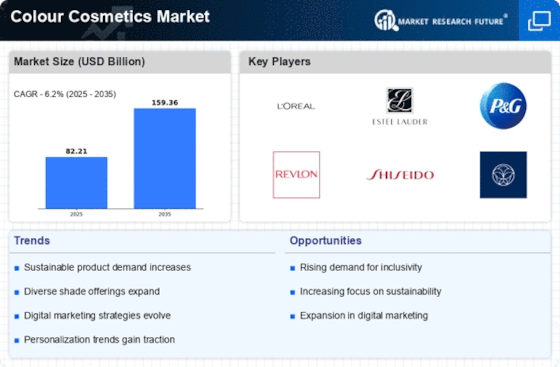
As per Market Research Future analysis, the Colour Cosmetics Market was estimated at 82.21 USD Billion in 2024. The Colour Cosmetics industry is projected to grow from 87.31 USD Billion in 2025 to 159.36 USD Billion by 2035, exhibiting a compound annual growth rate (CAGR) of 6.2% during the forecast period 2025 - 2035

Key Market Trends & Highlights

The Colour Cosmetics Market is currently experiencing a transformative shift towards sustainability and personalization.

  • The rise of clean beauty is reshaping consumer preferences, particularly in North America, where demand for natural ingredients is surging. Personalization and customization are becoming increasingly important, especially in the prestige products segment, which remains the largest market. Sustainable practices are gaining traction in the Asia-Pacific region, contributing to its status as the fastest-growing market for colour cosmetics. The influence of social media and digital marketing, alongside the increasing demand for natural ingredients, are key drivers propelling market growth.

Market Size & Forecast

2024 Market Size 82.21 (USD Billion)
2035 Market Size 159.36 (USD Billion)
CAGR (2025 - 2035) 6.2%
Largest Regional Market Share in 2024 North America

Major Players

<a href="https://www.loreal-paris.fr/">L'Oreal (FR)</a>, Estée Lauder (US), Procter &amp; Gamble (US), Revlon (US), Shiseido (JP), Coty (US), Unilever (GB), Mary Kay (US), Avon (GB)

Market Trends

The Colour Cosmetics Market is currently experiencing a dynamic evolution, driven by shifting consumer preferences and an increasing emphasis on personal expression. As individuals seek to enhance their appearance and convey their unique identities, the demand for diverse and innovative products continues to rise. This market encompasses a wide array of items, including foundations, lipsticks, eyeshadows, and blushes, catering to various skin tones and types. Furthermore, the integration of technology in product development and marketing strategies appears to play a crucial role in shaping consumer engagement and brand loyalty. Companies are increasingly leveraging social media platforms and influencer partnerships to reach target audiences, thereby fostering a more interactive shopping experience. In addition to the growing focus on inclusivity and personalization, sustainability has emerged as a pivotal consideration within the Colour Cosmetics Market. Consumers are becoming more conscious of the environmental impact of their purchases, prompting brands to adopt eco-friendly practices and formulations. This shift towards sustainability not only influences product development but also affects packaging choices and supply chain management. As the market continues to evolve, it seems likely that brands prioritizing ethical practices and transparency will resonate more with consumers, ultimately shaping the future landscape of the Colour Cosmetics Market.

Rise of Clean Beauty

The trend towards clean beauty is gaining momentum, as consumers increasingly seek products free from harmful chemicals and synthetic ingredients. This shift reflects a broader desire for transparency and safety in personal care items, prompting brands to reformulate their offerings to align with these values.

Personalization and Customization

Personalization is becoming a key focus in the Colour Cosmetics Market, with brands offering tailored solutions to meet individual preferences. This trend encompasses customizable shades, formulations, and packaging, allowing consumers to create products that resonate with their unique identities.

Sustainable Practices

Sustainability is emerging as a critical factor influencing consumer choices in the Colour Cosmetics Market. Brands are adopting eco-friendly practices, from sourcing ingredients responsibly to utilizing recyclable packaging, in response to growing consumer demand for environmentally conscious products.

Colour Cosmetics Market Market Drivers

Growth of E-commerce Platforms

The Colour Cosmetics Market is experiencing a substantial transformation due to the proliferation of e-commerce platforms. Online shopping has become increasingly popular, providing consumers with convenient access to a wide array of cosmetic products. This shift is supported by data showing that e-commerce sales in the beauty sector have surged, with projections indicating a growth rate of over 15% annually. The ability to compare products, read reviews, and access exclusive online deals enhances the shopping experience, thereby driving sales in the Colour Cosmetics Market. As more consumers turn to online channels, brands are adapting their strategies to optimize their digital presence.

Focus on Inclusivity and Diversity

The Colour Cosmetics Market is increasingly prioritizing inclusivity and diversity in product offerings. Brands are recognizing the importance of catering to a wide range of skin tones and types, which has led to the development of more inclusive product lines. This trend is evidenced by the introduction of foundations and concealers in an extensive array of shades, appealing to a broader demographic. Market Research Future suggests that brands embracing diversity are likely to capture a larger market share, as consumers gravitate towards companies that reflect their values. This focus on inclusivity not only enhances brand loyalty but also drives growth within the Colour Cosmetics Market.

Emergence of Male Grooming Products

The Colour Cosmetics Market is witnessing a notable expansion with the emergence of male grooming products. Traditionally dominated by female consumers, the cosmetics sector is now seeing increased interest from men seeking products that enhance their appearance. This trend is supported by market data indicating that the male grooming segment is expected to grow at a rate of approximately 8% annually. As societal norms evolve and the stigma around male cosmetics diminishes, brands are introducing tailored products for men, thereby diversifying their offerings and tapping into a new consumer base within the Colour Cosmetics Market.

Increasing Demand for Natural Ingredients

The Colour Cosmetics Market is witnessing a pronounced shift towards products formulated with natural ingredients. Consumers are increasingly discerning about the components in their cosmetics, favoring items that are free from harmful chemicals. This trend is reflected in the rising sales of brands that emphasize organic and natural formulations. According to recent data, the market for natural cosmetics is projected to grow at a compound annual growth rate of over 10% in the coming years. This inclination towards clean beauty not only enhances consumer trust but also aligns with broader health and wellness trends, thereby driving growth in the Colour Cosmetics Market.

Influence of Social Media and Digital Marketing

The Colour Cosmetics Market is significantly influenced by the rise of social media platforms and digital marketing strategies. Brands are leveraging these channels to engage with consumers, showcase products, and build brand loyalty. Influencer marketing, in particular, has emerged as a powerful tool, with beauty influencers driving trends and consumer preferences. Data indicates that nearly 70% of consumers are influenced by social media when making beauty purchases. This digital engagement not only enhances brand visibility but also fosters a community around cosmetic products, thereby propelling the Colour Cosmetics Market forward.

Market Segment Insights

By Target Market: Prestige Products (Largest) vs. Mass Products (Fastest-Growing)

<p>In the Colour Cosmetics Market, the distribution of market share is notably pronounced between Prestige and Mass Products. Prestige Products hold the largest share, appealing to consumers through high-quality formulations and premium branding. In contrast, Mass Products cater to a broader audience with more affordable price points, rapidly gaining traction due to their widespread availability and effective marketing strategies targeting the mass consumer base.</p>

<p>Prestige Products: Dominant vs. Mass Products: Emerging</p>

<p>Prestige Products in the Colour Cosmetics Market are characterized by their emphasis on luxury, quality, and brand prestige. They typically feature innovative formulations and packaging, attracting consumers who prioritize high-end products and are willing to invest in personal beauty. Conversely, Mass Products have emerged as a key player, focusing on affordability and accessibility. They are formulated to appeal to a wide range of consumers, often reflecting current beauty trends and catering to a diverse demographic. This segment's growth is driven by a strong demand for affordability without compromising on quality, making it increasingly competitive.</p>

By Distribution Channel: Offline (Largest) vs. Online (Fastest-Growing)

<p>The Colour Cosmetics Market is significantly influenced by its distribution channels, with the offline segment holding the largest share. Traditional retail outlets, including beauty supply stores and department stores, play a critical role in allowing customers to access a wide array of colour cosmetics products. These channels are preferred for their ability to offer customers the chance to test products in-person, fostering consumer confidence and satisfaction. In contrast, the online distribution channel has emerged as the fastest-growing segment in the Colour Cosmetics Market. This surge can be attributed to the increasing adoption of e-commerce and social media marketing. Brands are leveraging digital platforms to reach a broader audience and provide consumers with convenience and a wide selection of products, driving significant growth in online sales of colour cosmetics.</p>

<p>Offline (Dominant) vs. Online (Emerging)</p>

<p>The offline distribution channel remains dominant in the Colour Cosmetics Market, characterized by direct interaction with the products and brand representatives. This approach allows consumers to engage with products before purchase, enhancing the shopping experience. Major beauty retailers and stores often curate extensive selections, catering to diverse consumer preferences. Conversely, the online channel represents an emerging force, showcasing rapid growth spurred by advancements in technology and changing consumer habits. E-commerce platforms are revolutionizing how consumers access cosmetics, offering personalized recommendations and seamless purchasing experiences. The convenience of online shopping, combined with extensive product offerings, positions this channel as a critical player in the evolving landscape of the Colour Cosmetics Market.</p>

By Application: Lip Products (Largest) vs. Nail Products (Fastest-Growing)

<p>The Colour Cosmetics Market reveals a diverse distribution among application segments. Lip Products dominate the market, capturing significant consumer interest due to their variety and ability to enhance beauty. Following closely, Face Products and Hair Products hold substantial shares, reflecting their essential role in daily beauty routines. Nail Products, while smaller in market share, showcase a growing consumer trend, evolving with innovative designs and formulations, appealing to a younger demographic eager for creative expression through nail art.</p>

<p>Lip Products (Dominant) vs. Nail Products (Emerging)</p>

<p>Lip Products stand as the cornerstone of the Colour Cosmetics Market. Renowned for a broad spectrum of shades and formulations, ranging from lipsticks and glosses to balms, they cater to varying consumer preferences and occasions, solidifying their dominant market position. Conversely, Nail Products exhibit a rising trend, emerging as a canvas for personal creativity. With the advent of gel polishes and nail art, they attract a dedicated consumer base desiring unique expression. This segment's rapid innovation and social media influence fuel its growth, positioning it as a vibrant player within the Colour Cosmetics landscape.</p>

By Consumer Demographics: Age Group (Largest) vs. Gender (Fastest-Growing)

<p>In the color cosmetics market, the age group segment exhibits significant diversity, with millennials accounting for the largest market share. This demographic tends to favor innovative and bold products, prioritizing quality and sustainability. On the other hand, Gen Z is emerging as a force with growing purchasing power, leading to an increase in demand for more expressive and versatile color cosmetics. Gender representation is also shifting, with a noticeable rise in demand among male consumers, marking a pivotal change in market dynamics. The competition among brands is intensifying as the younger consumers not only seek personalization in their cosmetics but also gravitate towards brands that champion inclusivity and representation. Gender-neutral products and marketing strategies continue to gain momentum, driving brands to innovate their offerings to cater to a broader audience. This growing interest in diverse color cosmetic products signifies a transition towards a more inclusive market, stimulating growth across multiple demographics.</p>

<p>Age Group: Millennials (Dominant) vs. Gen Z (Emerging)</p>

<p>Millennials are currently the dominant age group in the color cosmetics market, driven by their inclination for high-quality, multifunctional products that align with their values of sustainability and ethical sourcing. This demographic often looks for brands that resonate with their lifestyle choices, influencing their purchasing decisions. In contrast, Gen Z is the emerging segment, characterized by their preference for vibrant colors and creative expression. This younger generation seeks dynamic engagement through social media platforms, prompting brands to design products that reflect their individual identities. As Gen Z matures and their influence in the market expands, companies are increasingly focusing on developing products that appeal to their desire for uniqueness and authenticity, suggesting a significant shift in consumer behavior towards more adventurous color cosmetic choices.</p>

By Distribution Channel: Online Retail (Largest) vs. Department Stores (Fastest-Growing)

<p>In the color cosmetics market, the distribution landscape is significantly shaped by various channels. Online retail stands out as the largest segment, offering consumers convenience and an extensive range of products at competitive prices. The rise of e-commerce has transformed shopping habits, enabling brands to reach a broader audience beyond geographical limitations. Meanwhile, department stores remain vital, serving as a key physical presence where consumers can experience products firsthand. However, they are being challenged by the accelerating growth of online shopping. The growth trends within the distribution channels are dynamic, with each segment showcasing unique drivers. Online retail continues to flourish due to the increasing preference for digital shopping and enhanced delivery mechanisms, making it a preferred choice among consumers. On the other hand, department stores are adapting by integrating online strategies to improve customer engagement and offer unique in-store experiences. Specialty stores and pharmacies also hold significant market share, with a focus on personalized service and curated offerings, while direct sales benefit from a strong relationship between sales representatives and customers, reinforcing brand loyalty.</p>

<p>Online Retail: Dominant vs. Direct Sales: Emerging</p>

<p>In the distribution channel landscape of the color cosmetics market, Online Retail emerges as the dominant force. It leverages technological advancements and a surge in smartphone usage, allowing consumers seamless purchasing experiences. The vast array of options, coupled with competitive pricing, reinforces its appeal. On the contrary, Direct Sales represents an emerging channel, thriving on personalized interactions and unique customer relationships. This segment often utilizes social media platforms and influencer partnerships to connect with potential buyers. Despite being smaller in scale compared to Online Retail, Direct Sales is steadily gaining traction, offering curated experiences that resonate well with niche markets, thereby promoting brand loyalty and sustained growth.</p>

Get more detailed insights about Colour Cosmetics Market Research Report—Global Forecast till 2035

Regional Insights

North America : Market Leader in Innovation

North America is the largest market for colour cosmetics, holding approximately 35% of the global share. The region's growth is driven by increasing consumer demand for innovative products, particularly in the clean beauty segment. Regulatory support for safety standards and sustainable practices further catalyzes market expansion. The U.S. leads this market, followed closely by Canada, which contributes around 10% to the overall market share. The competitive landscape in North America is robust, featuring key players such as Estée Lauder, Procter & Gamble, and Revlon. These companies are continuously innovating to meet consumer preferences for high-quality, diverse product offerings. The presence of major retail chains and e-commerce platforms enhances product accessibility, driving sales growth. The region's focus on inclusivity and diversity in beauty products also plays a significant role in shaping market dynamics.

Europe : Diverse Market with Trends

Europe is a significant player in the colour cosmetics market, accounting for approximately 30% of the global share. The region's growth is fueled by rising consumer awareness regarding beauty products and a shift towards sustainable and organic cosmetics. Regulatory frameworks, such as the EU Cosmetics Regulation, ensure product safety and efficacy, further boosting consumer confidence. Germany and France are the largest markets, together holding about 15% of the total market share. Leading countries in Europe include France, Germany, and the UK, with a competitive landscape featuring brands like L'Oreal and Coty. The market is characterized by a strong emphasis on innovation and luxury products, catering to diverse consumer preferences. The presence of numerous beauty trade shows and exhibitions fosters collaboration and showcases new trends, enhancing the region's attractiveness for both consumers and manufacturers.

Asia-Pacific : Rapid Growth and Expansion

Asia-Pacific is rapidly emerging as a powerhouse in the colour cosmetics market, holding approximately 25% of the global share. The region's growth is driven by increasing disposable incomes, urbanization, and a growing middle class that seeks premium beauty products. Countries like China and India are at the forefront, with China alone contributing around 15% to the global market. Regulatory initiatives aimed at enhancing product safety and quality are also pivotal in shaping market dynamics. The competitive landscape in Asia-Pacific is diverse, with local and international brands vying for market share. Key players such as Shiseido and Unilever are expanding their product lines to cater to the unique preferences of consumers in this region. The rise of e-commerce and social media influencers is further propelling the demand for colour cosmetics, making it a dynamic and rapidly evolving market.

Middle East and Africa : Emerging Market Potential

The Middle East and Africa (MEA) region is witnessing significant growth in the colour cosmetics market, accounting for approximately 10% of the global share. The growth is driven by increasing urbanization, a young population, and rising disposable incomes. Regulatory bodies are also focusing on enhancing product safety and quality, which is crucial for building consumer trust. The UAE and South Africa are the largest markets in this region, contributing around 5% each to the overall market share. Leading countries in the MEA region include the UAE, South Africa, and Nigeria, with a competitive landscape featuring both local and international brands. Companies like Avon and Mary Kay are expanding their presence to tap into the growing demand for colour cosmetics. The region's unique cultural diversity influences product offerings, creating opportunities for brands to innovate and cater to specific consumer needs.

Key Players and Competitive Insights

The Colour Cosmetics Market is currently characterized by a dynamic competitive landscape, driven by innovation, sustainability, and digital transformation. Major players such as L'Oreal (France), Estée Lauder (US), and Coty (US) are actively shaping the market through strategic initiatives that emphasize product diversification and consumer engagement. L'Oreal (France) has positioned itself as a leader in sustainability, focusing on eco-friendly formulations and packaging, which resonates with the growing consumer demand for environmentally responsible products. Meanwhile, Estée Lauder (US) continues to leverage its strong brand portfolio and digital marketing strategies to enhance customer experiences, particularly through personalized offerings. Coty (US) is also making strides in the market by expanding its influencer partnerships and enhancing its e-commerce capabilities, thereby adapting to the shifting consumer preferences towards online shopping.The business tactics employed by these companies reflect a concerted effort to optimize supply chains and localize manufacturing processes. The Colour Cosmetics Market appears moderately fragmented, with a mix of established brands and emerging players vying for market share. The collective influence of key players is significant, as they not only set trends but also establish benchmarks for quality and innovation that smaller brands often strive to meet.
In August L'Oreal (France) announced a partnership with a leading tech firm to develop augmented reality (AR) tools for virtual makeup try-ons. This strategic move is likely to enhance customer engagement and streamline the purchasing process, aligning with the increasing consumer preference for digital experiences. Such innovations may provide L'Oreal with a competitive edge in attracting tech-savvy consumers who value convenience and personalization.
In September Estée Lauder (US) launched a new line of vegan and cruelty-free products, reflecting a growing trend towards ethical consumption. This initiative not only caters to the rising demand for sustainable beauty products but also reinforces Estée Lauder's commitment to corporate social responsibility. The introduction of this line could potentially attract a broader customer base, particularly among younger consumers who prioritize ethical considerations in their purchasing decisions.
In July Coty (US) expanded its collaboration with social media influencers to promote its latest product launches. This strategy appears to be a response to the increasing importance of social media in shaping consumer preferences. By leveraging influencer marketing, Coty aims to enhance brand visibility and drive sales, particularly among younger demographics who are more likely to engage with brands through social platforms.
As of October the Colour Cosmetics Market is witnessing a shift towards digitalization, sustainability, and the integration of artificial intelligence in product development and marketing strategies. Strategic alliances among key players are increasingly shaping the competitive landscape, fostering innovation and collaboration. The evolution of competitive differentiation is likely to move away from traditional price-based competition towards a focus on technological advancements, innovative product offerings, and reliable supply chains. This shift suggests that companies that prioritize these aspects may be better positioned to thrive in the evolving market.

Key Companies in the Colour Cosmetics Market include

Industry Developments

April 2023: India's Juicy Cosmetics reports that its organic color cosmetics range contributes 30% of its revenue just four months after its introduction, and the company plans to launch more 'technology-driven products' and increase offline touchpoints to boost growth.

February 2023: BO International has introduced various private-label solutions for individuals who wish to launch their own skincare and cosmetics brands. The cosmetics line from BO International, a reputable name in private label, offers high-quality, long-lasting makeup items that meet a range of demands and tastes.

July 2021: Bloomers has some exciting news for Indian cosmetics enthusiasts as it has introduced an independent brand called Colors Cosmetics, which will cater to consumers through neighborhood pharmacies and markets. Given that the brand strives to provide a broad selection of goods, spanning everything from foundations to lipsticks, this appears to be a viable path for those who enjoy wearing makeup.

Future Outlook

Colour Cosmetics Market Future Outlook

The Colour Cosmetics Market is projected to grow at a 6.2% CAGR from 2025 to 2035, driven by innovation, sustainability, and increasing consumer demand for personalized products.

New opportunities lie in:

  • <p>Expansion of e-commerce platforms for direct-to-consumer sales. Development of eco-friendly packaging solutions to attract environmentally conscious consumers. Introduction of augmented reality tools for virtual try-ons to enhance customer engagement.</p>

By 2035, the Colour Cosmetics Market is expected to achieve substantial growth, reflecting evolving consumer preferences and technological advancements.

Market Segmentation

Colour Cosmetics Market Application Outlook

  • Nail Products
  • Hair Products
  • Lip Products
  • Face Products
  • Others

Colour Cosmetics Market Target Market Outlook

  • Prestige Products
  • Mass Products

Colour Cosmetics Market Distribution Channel Outlook

  • Offline
  • Online

Report Scope

MARKET SIZE 2024 82.21(USD Billion)
MARKET SIZE 2025 87.31(USD Billion)
MARKET SIZE 2035 159.36(USD Billion)
COMPOUND ANNUAL GROWTH RATE (CAGR) 6.2% (2025 - 2035)
REPORT COVERAGE Revenue Forecast, Competitive Landscape, Growth Factors, and Trends
BASE YEAR 2024
Market Forecast Period 2025 - 2035
Historical Data 2019 - 2024
Market Forecast Units USD Billion
Key Companies Profiled L'Oreal (FR), Estée Lauder (US), Procter & Gamble (US), Revlon (US), Shiseido (JP), Coty (US), Unilever (GB), Mary Kay (US), Avon (GB)
Segments Covered Target Market Size, Share, Industry Trend & Analysis, Distribution Channel, Application, Region
Key Market Opportunities Growing demand for sustainable and clean beauty products in the Colour Cosmetics Market.
Key Market Dynamics Rising consumer demand for sustainable and cruelty-free products drives innovation in the Colour Cosmetics Market.
Countries Covered North America, Europe, APAC, South America, MEA

FAQs

What is the current valuation of the Colour Cosmetics Market as of 2024?

<p>The Colour Cosmetics Market was valued at 82.21 USD Billion in 2024.</p>

What is the projected market size for the Colour Cosmetics Market in 2035?

<p>The market is projected to reach 159.36 USD Billion by 2035.</p>

What is the expected CAGR for the Colour Cosmetics Market during the forecast period 2025 - 2035?

<p>The expected CAGR for the Colour Cosmetics Market during 2025 - 2035 is 6.2%.</p>

Which companies are considered key players in the Colour Cosmetics Market?

<p>Key players include L'Oreal, Estée Lauder, Procter & Gamble, Revlon, Shiseido, Coty, Unilever, Mary Kay, and Avon.</p>

How do prestige and mass products compare in terms of market valuation?

<p>In 2024, prestige products were valued at 32.88 USD Billion, while mass products reached 49.33 USD Billion.</p>

What are the projected valuations for offline and online distribution channels by 2035?

<p>By 2035, offline distribution is projected to reach 94.12 USD Billion, while online distribution is expected to reach 65.24 USD Billion.</p>

Which application segment holds the highest market value in 2024?

In 2024, face products held the highest market value at 30.66 USD Billion.

What is the projected growth for nail products in the Colour Cosmetics Market by 2035?

Nail products are projected to grow from 8.22 USD Billion in 2024 to 15.94 USD Billion by 2035.

How does the Colour Cosmetics Market's growth potential compare across different applications?

The market shows varied growth potential, with lip products projected to grow from 20.44 USD Billion to 39.88 USD Billion by 2035.

What trends are influencing the Colour Cosmetics Market's growth in 2025?

Trends influencing growth include increasing consumer demand for diverse product offerings and the rise of online shopping.

  1. SECTION I: EXECUTIVE SUMMARY AND KEY HIGHLIGHTS
    1. | 1.1 EXECUTIVE SUMMARY
    2. | | 1.1.1 Market Overview
    3. | | 1.1.2 Key Findings
    4. | | 1.1.3 Market Segmentation
    5. | | 1.1.4 Competitive Landscape
    6. | | 1.1.5 Challenges and Opportunities
    7. | | 1.1.6 Future Outlook
  2. SECTION II: SCOPING, METHODOLOGY AND MARKET STRUCTURE
    1. | 2.1 MARKET INTRODUCTION
    2. | | 2.1.1 Definition
    3. | | 2.1.2 Scope of the study
    4. | | | 2.1.2.1 Research Objective
    5. | | | 2.1.2.2 Assumption
    6. | | | 2.1.2.3 Limitations
    7. | 2.2 RESEARCH METHODOLOGY
    8. | | 2.2.1 Overview
    9. | | 2.2.2 Data Mining
    10. | | 2.2.3 Secondary Research
    11. | | 2.2.4 Primary Research
    12. | | | 2.2.4.1 Primary Interviews and Information Gathering Process
    13. | | | 2.2.4.2 Breakdown of Primary Respondents
    14. | | 2.2.5 Forecasting Model
    15. | | 2.2.6 Market Size Estimation
    16. | | | 2.2.6.1 Bottom-Up Approach
    17. | | | 2.2.6.2 Top-Down Approach
    18. | | 2.2.7 Data Triangulation
    19. | | 2.2.8 Validation
  3. SECTION III: QUALITATIVE ANALYSIS
    1. | 3.1 MARKET DYNAMICS
    2. | | 3.1.1 Overview
    3. | | 3.1.2 Drivers
    4. | | 3.1.3 Restraints
    5. | | 3.1.4 Opportunities
    6. | 3.2 MARKET FACTOR ANALYSIS
    7. | | 3.2.1 Value chain Analysis
    8. | | 3.2.2 Porter's Five Forces Analysis
    9. | | | 3.2.2.1 Bargaining Power of Suppliers
    10. | | | 3.2.2.2 Bargaining Power of Buyers
    11. | | | 3.2.2.3 Threat of New Entrants
    12. | | | 3.2.2.4 Threat of Substitutes
    13. | | | 3.2.2.5 Intensity of Rivalry
    14. | | 3.2.3 COVID-19 Impact Analysis
    15. | | | 3.2.3.1 Market Impact Analysis
    16. | | | 3.2.3.2 Regional Impact
    17. | | | 3.2.3.3 Opportunity and Threat Analysis
  4. SECTION IV: QUANTITATIVE ANALYSIS
    1. | 4.1 Chemicals and Materials, BY Target Market (USD Billion)
    2. | | 4.1.1 Prestige Products
    3. | | 4.1.2 Mass Products
    4. | 4.2 Chemicals and Materials, BY Distribution Channel (USD Billion)
    5. | | 4.2.1 Offline
    6. | | 4.2.2 Online
    7. | 4.3 Chemicals and Materials, BY Application (USD Billion)
    8. | | 4.3.1 Nail Products
    9. | | 4.3.2 Hair Products
    10. | | 4.3.3 Lip Products
    11. | | 4.3.4 Face Products
    12. | | 4.3.5 Others
    13. | 4.4 Chemicals and Materials, BY Region (USD Billion)
    14. | | 4.4.1 North America
    15. | | | 4.4.1.1 US
    16. | | | 4.4.1.2 Canada
    17. | | 4.4.2 Europe
    18. | | | 4.4.2.1 Germany
    19. | | | 4.4.2.2 UK
    20. | | | 4.4.2.3 France
    21. | | | 4.4.2.4 Russia
    22. | | | 4.4.2.5 Italy
    23. | | | 4.4.2.6 Spain
    24. | | | 4.4.2.7 Rest of Europe
    25. | | 4.4.3 APAC
    26. | | | 4.4.3.1 China
    27. | | | 4.4.3.2 India
    28. | | | 4.4.3.3 Japan
    29. | | | 4.4.3.4 South Korea
    30. | | | 4.4.3.5 Malaysia
    31. | | | 4.4.3.6 Thailand
    32. | | | 4.4.3.7 Indonesia
    33. | | | 4.4.3.8 Rest of APAC
    34. | | 4.4.4 South America
    35. | | | 4.4.4.1 Brazil
    36. | | | 4.4.4.2 Mexico
    37. | | | 4.4.4.3 Argentina
    38. | | | 4.4.4.4 Rest of South America
    39. | | 4.4.5 MEA
    40. | | | 4.4.5.1 GCC Countries
    41. | | | 4.4.5.2 South Africa
    42. | | | 4.4.5.3 Rest of MEA
  5. SECTION V: COMPETITIVE ANALYSIS
    1. | 5.1 Competitive Landscape
    2. | | 5.1.1 Overview
    3. | | 5.1.2 Competitive Analysis
    4. | | 5.1.3 Market share Analysis
    5. | | 5.1.4 Major Growth Strategy in the Chemicals and Materials
    6. | | 5.1.5 Competitive Benchmarking
    7. | | 5.1.6 Leading Players in Terms of Number of Developments in the Chemicals and Materials
    8. | | 5.1.7 Key developments and growth strategies
    9. | | | 5.1.7.1 New Product Launch/Service Deployment
    10. | | | 5.1.7.2 Merger & Acquisitions
    11. | | | 5.1.7.3 Joint Ventures
    12. | | 5.1.8 Major Players Financial Matrix
    13. | | | 5.1.8.1 Sales and Operating Income
    14. | | | 5.1.8.2 Major Players R&D Expenditure. 2023
    15. | 5.2 Company Profiles
    16. | | 5.2.1 L'Oreal (FR)
    17. | | | 5.2.1.1 Financial Overview
    18. | | | 5.2.1.2 Products Offered
    19. | | | 5.2.1.3 Key Developments
    20. | | | 5.2.1.4 SWOT Analysis
    21. | | | 5.2.1.5 Key Strategies
    22. | | 5.2.2 Estée Lauder (US)
    23. | | | 5.2.2.1 Financial Overview
    24. | | | 5.2.2.2 Products Offered
    25. | | | 5.2.2.3 Key Developments
    26. | | | 5.2.2.4 SWOT Analysis
    27. | | | 5.2.2.5 Key Strategies
    28. | | 5.2.3 Procter & Gamble (US)
    29. | | | 5.2.3.1 Financial Overview
    30. | | | 5.2.3.2 Products Offered
    31. | | | 5.2.3.3 Key Developments
    32. | | | 5.2.3.4 SWOT Analysis
    33. | | | 5.2.3.5 Key Strategies
    34. | | 5.2.4 Revlon (US)
    35. | | | 5.2.4.1 Financial Overview
    36. | | | 5.2.4.2 Products Offered
    37. | | | 5.2.4.3 Key Developments
    38. | | | 5.2.4.4 SWOT Analysis
    39. | | | 5.2.4.5 Key Strategies
    40. | | 5.2.5 Shiseido (JP)
    41. | | | 5.2.5.1 Financial Overview
    42. | | | 5.2.5.2 Products Offered
    43. | | | 5.2.5.3 Key Developments
    44. | | | 5.2.5.4 SWOT Analysis
    45. | | | 5.2.5.5 Key Strategies
    46. | | 5.2.6 Coty (US)
    47. | | | 5.2.6.1 Financial Overview
    48. | | | 5.2.6.2 Products Offered
    49. | | | 5.2.6.3 Key Developments
    50. | | | 5.2.6.4 SWOT Analysis
    51. | | | 5.2.6.5 Key Strategies
    52. | | 5.2.7 Unilever (GB)
    53. | | | 5.2.7.1 Financial Overview
    54. | | | 5.2.7.2 Products Offered
    55. | | | 5.2.7.3 Key Developments
    56. | | | 5.2.7.4 SWOT Analysis
    57. | | | 5.2.7.5 Key Strategies
    58. | | 5.2.8 Mary Kay (US)
    59. | | | 5.2.8.1 Financial Overview
    60. | | | 5.2.8.2 Products Offered
    61. | | | 5.2.8.3 Key Developments
    62. | | | 5.2.8.4 SWOT Analysis
    63. | | | 5.2.8.5 Key Strategies
    64. | | 5.2.9 Avon (GB)
    65. | | | 5.2.9.1 Financial Overview
    66. | | | 5.2.9.2 Products Offered
    67. | | | 5.2.9.3 Key Developments
    68. | | | 5.2.9.4 SWOT Analysis
    69. | | | 5.2.9.5 Key Strategies
    70. | 5.3 Appendix
    71. | | 5.3.1 References
    72. | | 5.3.2 Related Reports
  6. LIST OF FIGURES
    1. | 6.1 MARKET SYNOPSIS
    2. | 6.2 NORTH AMERICA MARKET ANALYSIS
    3. | 6.3 US MARKET ANALYSIS BY TARGET MARKET
    4. | 6.4 US MARKET ANALYSIS BY DISTRIBUTION CHANNEL
    5. | 6.5 US MARKET ANALYSIS BY APPLICATION
    6. | 6.6 CANADA MARKET ANALYSIS BY TARGET MARKET
    7. | 6.7 CANADA MARKET ANALYSIS BY DISTRIBUTION CHANNEL
    8. | 6.8 CANADA MARKET ANALYSIS BY APPLICATION
    9. | 6.9 EUROPE MARKET ANALYSIS
    10. | 6.10 GERMANY MARKET ANALYSIS BY TARGET MARKET
    11. | 6.11 GERMANY MARKET ANALYSIS BY DISTRIBUTION CHANNEL
    12. | 6.12 GERMANY MARKET ANALYSIS BY APPLICATION
    13. | 6.13 UK MARKET ANALYSIS BY TARGET MARKET
    14. | 6.14 UK MARKET ANALYSIS BY DISTRIBUTION CHANNEL
    15. | 6.15 UK MARKET ANALYSIS BY APPLICATION
    16. | 6.16 FRANCE MARKET ANALYSIS BY TARGET MARKET
    17. | 6.17 FRANCE MARKET ANALYSIS BY DISTRIBUTION CHANNEL
    18. | 6.18 FRANCE MARKET ANALYSIS BY APPLICATION
    19. | 6.19 RUSSIA MARKET ANALYSIS BY TARGET MARKET
    20. | 6.20 RUSSIA MARKET ANALYSIS BY DISTRIBUTION CHANNEL
    21. | 6.21 RUSSIA MARKET ANALYSIS BY APPLICATION
    22. | 6.22 ITALY MARKET ANALYSIS BY TARGET MARKET
    23. | 6.23 ITALY MARKET ANALYSIS BY DISTRIBUTION CHANNEL
    24. | 6.24 ITALY MARKET ANALYSIS BY APPLICATION
    25. | 6.25 SPAIN MARKET ANALYSIS BY TARGET MARKET
    26. | 6.26 SPAIN MARKET ANALYSIS BY DISTRIBUTION CHANNEL
    27. | 6.27 SPAIN MARKET ANALYSIS BY APPLICATION
    28. | 6.28 REST OF EUROPE MARKET ANALYSIS BY TARGET MARKET
    29. | 6.29 REST OF EUROPE MARKET ANALYSIS BY DISTRIBUTION CHANNEL
    30. | 6.30 REST OF EUROPE MARKET ANALYSIS BY APPLICATION
    31. | 6.31 APAC MARKET ANALYSIS
    32. | 6.32 CHINA MARKET ANALYSIS BY TARGET MARKET
    33. | 6.33 CHINA MARKET ANALYSIS BY DISTRIBUTION CHANNEL
    34. | 6.34 CHINA MARKET ANALYSIS BY APPLICATION
    35. | 6.35 INDIA MARKET ANALYSIS BY TARGET MARKET
    36. | 6.36 INDIA MARKET ANALYSIS BY DISTRIBUTION CHANNEL
    37. | 6.37 INDIA MARKET ANALYSIS BY APPLICATION
    38. | 6.38 JAPAN MARKET ANALYSIS BY TARGET MARKET
    39. | 6.39 JAPAN MARKET ANALYSIS BY DISTRIBUTION CHANNEL
    40. | 6.40 JAPAN MARKET ANALYSIS BY APPLICATION
    41. | 6.41 SOUTH KOREA MARKET ANALYSIS BY TARGET MARKET
    42. | 6.42 SOUTH KOREA MARKET ANALYSIS BY DISTRIBUTION CHANNEL
    43. | 6.43 SOUTH KOREA MARKET ANALYSIS BY APPLICATION
    44. | 6.44 MALAYSIA MARKET ANALYSIS BY TARGET MARKET
    45. | 6.45 MALAYSIA MARKET ANALYSIS BY DISTRIBUTION CHANNEL
    46. | 6.46 MALAYSIA MARKET ANALYSIS BY APPLICATION
    47. | 6.47 THAILAND MARKET ANALYSIS BY TARGET MARKET
    48. | 6.48 THAILAND MARKET ANALYSIS BY DISTRIBUTION CHANNEL
    49. | 6.49 THAILAND MARKET ANALYSIS BY APPLICATION
    50. | 6.50 INDONESIA MARKET ANALYSIS BY TARGET MARKET
    51. | 6.51 INDONESIA MARKET ANALYSIS BY DISTRIBUTION CHANNEL
    52. | 6.52 INDONESIA MARKET ANALYSIS BY APPLICATION
    53. | 6.53 REST OF APAC MARKET ANALYSIS BY TARGET MARKET
    54. | 6.54 REST OF APAC MARKET ANALYSIS BY DISTRIBUTION CHANNEL
    55. | 6.55 REST OF APAC MARKET ANALYSIS BY APPLICATION
    56. | 6.56 SOUTH AMERICA MARKET ANALYSIS
    57. | 6.57 BRAZIL MARKET ANALYSIS BY TARGET MARKET
    58. | 6.58 BRAZIL MARKET ANALYSIS BY DISTRIBUTION CHANNEL
    59. | 6.59 BRAZIL MARKET ANALYSIS BY APPLICATION
    60. | 6.60 MEXICO MARKET ANALYSIS BY TARGET MARKET
    61. | 6.61 MEXICO MARKET ANALYSIS BY DISTRIBUTION CHANNEL
    62. | 6.62 MEXICO MARKET ANALYSIS BY APPLICATION
    63. | 6.63 ARGENTINA MARKET ANALYSIS BY TARGET MARKET
    64. | 6.64 ARGENTINA MARKET ANALYSIS BY DISTRIBUTION CHANNEL
    65. | 6.65 ARGENTINA MARKET ANALYSIS BY APPLICATION
    66. | 6.66 REST OF SOUTH AMERICA MARKET ANALYSIS BY TARGET MARKET
    67. | 6.67 REST OF SOUTH AMERICA MARKET ANALYSIS BY DISTRIBUTION CHANNEL
    68. | 6.68 REST OF SOUTH AMERICA MARKET ANALYSIS BY APPLICATION
    69. | 6.69 MEA MARKET ANALYSIS
    70. | 6.70 GCC COUNTRIES MARKET ANALYSIS BY TARGET MARKET
    71. | 6.71 GCC COUNTRIES MARKET ANALYSIS BY DISTRIBUTION CHANNEL
    72. | 6.72 GCC COUNTRIES MARKET ANALYSIS BY APPLICATION
    73. | 6.73 SOUTH AFRICA MARKET ANALYSIS BY TARGET MARKET
    74. | 6.74 SOUTH AFRICA MARKET ANALYSIS BY DISTRIBUTION CHANNEL
    75. | 6.75 SOUTH AFRICA MARKET ANALYSIS BY APPLICATION
    76. | 6.76 REST OF MEA MARKET ANALYSIS BY TARGET MARKET
    77. | 6.77 REST OF MEA MARKET ANALYSIS BY DISTRIBUTION CHANNEL
    78. | 6.78 REST OF MEA MARKET ANALYSIS BY APPLICATION
    79. | 6.79 KEY BUYING CRITERIA OF CHEMICALS AND MATERIALS
    80. | 6.80 RESEARCH PROCESS OF MRFR
    81. | 6.81 DRO ANALYSIS OF CHEMICALS AND MATERIALS
    82. | 6.82 DRIVERS IMPACT ANALYSIS: CHEMICALS AND MATERIALS
    83. | 6.83 RESTRAINTS IMPACT ANALYSIS: CHEMICALS AND MATERIALS
    84. | 6.84 SUPPLY / VALUE CHAIN: CHEMICALS AND MATERIALS
    85. | 6.85 CHEMICALS AND MATERIALS, BY TARGET MARKET, 2024 (% SHARE)
    86. | 6.86 CHEMICALS AND MATERIALS, BY TARGET MARKET, 2024 TO 2035 (USD Billion)
    87. | 6.87 CHEMICALS AND MATERIALS, BY DISTRIBUTION CHANNEL, 2024 (% SHARE)
    88. | 6.88 CHEMICALS AND MATERIALS, BY DISTRIBUTION CHANNEL, 2024 TO 2035 (USD Billion)
    89. | 6.89 CHEMICALS AND MATERIALS, BY APPLICATION, 2024 (% SHARE)
    90. | 6.90 CHEMICALS AND MATERIALS, BY APPLICATION, 2024 TO 2035 (USD Billion)
    91. | 6.91 BENCHMARKING OF MAJOR COMPETITORS
  7. LIST OF TABLES
    1. | 7.1 LIST OF ASSUMPTIONS
    2. | | 7.1.1
    3. | 7.2 North America MARKET SIZE ESTIMATES; FORECAST
    4. | | 7.2.1 BY TARGET MARKET, 2025-2035 (USD Billion)
    5. | | 7.2.2 BY DISTRIBUTION CHANNEL, 2025-2035 (USD Billion)
    6. | | 7.2.3 BY APPLICATION, 2025-2035 (USD Billion)
    7. | 7.3 US MARKET SIZE ESTIMATES; FORECAST
    8. | | 7.3.1 BY TARGET MARKET, 2025-2035 (USD Billion)
    9. | | 7.3.2 BY DISTRIBUTION CHANNEL, 2025-2035 (USD Billion)
    10. | | 7.3.3 BY APPLICATION, 2025-2035 (USD Billion)
    11. | 7.4 Canada MARKET SIZE ESTIMATES; FORECAST
    12. | | 7.4.1 BY TARGET MARKET, 2025-2035 (USD Billion)
    13. | | 7.4.2 BY DISTRIBUTION CHANNEL, 2025-2035 (USD Billion)
    14. | | 7.4.3 BY APPLICATION, 2025-2035 (USD Billion)
    15. | 7.5 Europe MARKET SIZE ESTIMATES; FORECAST
    16. | | 7.5.1 BY TARGET MARKET, 2025-2035 (USD Billion)
    17. | | 7.5.2 BY DISTRIBUTION CHANNEL, 2025-2035 (USD Billion)
    18. | | 7.5.3 BY APPLICATION, 2025-2035 (USD Billion)
    19. | 7.6 Germany MARKET SIZE ESTIMATES; FORECAST
    20. | | 7.6.1 BY TARGET MARKET, 2025-2035 (USD Billion)
    21. | | 7.6.2 BY DISTRIBUTION CHANNEL, 2025-2035 (USD Billion)
    22. | | 7.6.3 BY APPLICATION, 2025-2035 (USD Billion)
    23. | 7.7 UK MARKET SIZE ESTIMATES; FORECAST
    24. | | 7.7.1 BY TARGET MARKET, 2025-2035 (USD Billion)
    25. | | 7.7.2 BY DISTRIBUTION CHANNEL, 2025-2035 (USD Billion)
    26. | | 7.7.3 BY APPLICATION, 2025-2035 (USD Billion)
    27. | 7.8 France MARKET SIZE ESTIMATES; FORECAST
    28. | | 7.8.1 BY TARGET MARKET, 2025-2035 (USD Billion)
    29. | | 7.8.2 BY DISTRIBUTION CHANNEL, 2025-2035 (USD Billion)
    30. | | 7.8.3 BY APPLICATION, 2025-2035 (USD Billion)
    31. | 7.9 Russia MARKET SIZE ESTIMATES; FORECAST
    32. | | 7.9.1 BY TARGET MARKET, 2025-2035 (USD Billion)
    33. | | 7.9.2 BY DISTRIBUTION CHANNEL, 2025-2035 (USD Billion)
    34. | | 7.9.3 BY APPLICATION, 2025-2035 (USD Billion)
    35. | 7.10 Italy MARKET SIZE ESTIMATES; FORECAST
    36. | | 7.10.1 BY TARGET MARKET, 2025-2035 (USD Billion)
    37. | | 7.10.2 BY DISTRIBUTION CHANNEL, 2025-2035 (USD Billion)
    38. | | 7.10.3 BY APPLICATION, 2025-2035 (USD Billion)
    39. | 7.11 Spain MARKET SIZE ESTIMATES; FORECAST
    40. | | 7.11.1 BY TARGET MARKET, 2025-2035 (USD Billion)
    41. | | 7.11.2 BY DISTRIBUTION CHANNEL, 2025-2035 (USD Billion)
    42. | | 7.11.3 BY APPLICATION, 2025-2035 (USD Billion)
    43. | 7.12 Rest of Europe MARKET SIZE ESTIMATES; FORECAST
    44. | | 7.12.1 BY TARGET MARKET, 2025-2035 (USD Billion)
    45. | | 7.12.2 BY DISTRIBUTION CHANNEL, 2025-2035 (USD Billion)
    46. | | 7.12.3 BY APPLICATION, 2025-2035 (USD Billion)
    47. | 7.13 APAC MARKET SIZE ESTIMATES; FORECAST
    48. | | 7.13.1 BY TARGET MARKET, 2025-2035 (USD Billion)
    49. | | 7.13.2 BY DISTRIBUTION CHANNEL, 2025-2035 (USD Billion)
    50. | | 7.13.3 BY APPLICATION, 2025-2035 (USD Billion)
    51. | 7.14 China MARKET SIZE ESTIMATES; FORECAST
    52. | | 7.14.1 BY TARGET MARKET, 2025-2035 (USD Billion)
    53. | | 7.14.2 BY DISTRIBUTION CHANNEL, 2025-2035 (USD Billion)
    54. | | 7.14.3 BY APPLICATION, 2025-2035 (USD Billion)
    55. | 7.15 India MARKET SIZE ESTIMATES; FORECAST
    56. | | 7.15.1 BY TARGET MARKET, 2025-2035 (USD Billion)
    57. | | 7.15.2 BY DISTRIBUTION CHANNEL, 2025-2035 (USD Billion)
    58. | | 7.15.3 BY APPLICATION, 2025-2035 (USD Billion)
    59. | 7.16 Japan MARKET SIZE ESTIMATES; FORECAST
    60. | | 7.16.1 BY TARGET MARKET, 2025-2035 (USD Billion)
    61. | | 7.16.2 BY DISTRIBUTION CHANNEL, 2025-2035 (USD Billion)
    62. | | 7.16.3 BY APPLICATION, 2025-2035 (USD Billion)
    63. | 7.17 South Korea MARKET SIZE ESTIMATES; FORECAST
    64. | | 7.17.1 BY TARGET MARKET, 2025-2035 (USD Billion)
    65. | | 7.17.2 BY DISTRIBUTION CHANNEL, 2025-2035 (USD Billion)
    66. | | 7.17.3 BY APPLICATION, 2025-2035 (USD Billion)
    67. | 7.18 Malaysia MARKET SIZE ESTIMATES; FORECAST
    68. | | 7.18.1 BY TARGET MARKET, 2025-2035 (USD Billion)
    69. | | 7.18.2 BY DISTRIBUTION CHANNEL, 2025-2035 (USD Billion)
    70. | | 7.18.3 BY APPLICATION, 2025-2035 (USD Billion)
    71. | 7.19 Thailand MARKET SIZE ESTIMATES; FORECAST
    72. | | 7.19.1 BY TARGET MARKET, 2025-2035 (USD Billion)
    73. | | 7.19.2 BY DISTRIBUTION CHANNEL, 2025-2035 (USD Billion)
    74. | | 7.19.3 BY APPLICATION, 2025-2035 (USD Billion)
    75. | 7.20 Indonesia MARKET SIZE ESTIMATES; FORECAST
    76. | | 7.20.1 BY TARGET MARKET, 2025-2035 (USD Billion)
    77. | | 7.20.2 BY DISTRIBUTION CHANNEL, 2025-2035 (USD Billion)
    78. | | 7.20.3 BY APPLICATION, 2025-2035 (USD Billion)
    79. | 7.21 Rest of APAC MARKET SIZE ESTIMATES; FORECAST
    80. | | 7.21.1 BY TARGET MARKET, 2025-2035 (USD Billion)
    81. | | 7.21.2 BY DISTRIBUTION CHANNEL, 2025-2035 (USD Billion)
    82. | | 7.21.3 BY APPLICATION, 2025-2035 (USD Billion)
    83. | 7.22 South America MARKET SIZE ESTIMATES; FORECAST
    84. | | 7.22.1 BY TARGET MARKET, 2025-2035 (USD Billion)
    85. | | 7.22.2 BY DISTRIBUTION CHANNEL, 2025-2035 (USD Billion)
    86. | | 7.22.3 BY APPLICATION, 2025-2035 (USD Billion)
    87. | 7.23 Brazil MARKET SIZE ESTIMATES; FORECAST
    88. | | 7.23.1 BY TARGET MARKET, 2025-2035 (USD Billion)
    89. | | 7.23.2 BY DISTRIBUTION CHANNEL, 2025-2035 (USD Billion)
    90. | | 7.23.3 BY APPLICATION, 2025-2035 (USD Billion)
    91. | 7.24 Mexico MARKET SIZE ESTIMATES; FORECAST
    92. | | 7.24.1 BY TARGET MARKET, 2025-2035 (USD Billion)
    93. | | 7.24.2 BY DISTRIBUTION CHANNEL, 2025-2035 (USD Billion)
    94. | | 7.24.3 BY APPLICATION, 2025-2035 (USD Billion)
    95. | 7.25 Argentina MARKET SIZE ESTIMATES; FORECAST
    96. | | 7.25.1 BY TARGET MARKET, 2025-2035 (USD Billion)
    97. | | 7.25.2 BY DISTRIBUTION CHANNEL, 2025-2035 (USD Billion)
    98. | | 7.25.3 BY APPLICATION, 2025-2035 (USD Billion)
    99. | 7.26 Rest of South America MARKET SIZE ESTIMATES; FORECAST
    100. | | 7.26.1 BY TARGET MARKET, 2025-2035 (USD Billion)
    101. | | 7.26.2 BY DISTRIBUTION CHANNEL, 2025-2035 (USD Billion)
    102. | | 7.26.3 BY APPLICATION, 2025-2035 (USD Billion)
    103. | 7.27 MEA MARKET SIZE ESTIMATES; FORECAST
    104. | | 7.27.1 BY TARGET MARKET, 2025-2035 (USD Billion)
    105. | | 7.27.2 BY DISTRIBUTION CHANNEL, 2025-2035 (USD Billion)
    106. | | 7.27.3 BY APPLICATION, 2025-2035 (USD Billion)
    107. | 7.28 GCC Countries MARKET SIZE ESTIMATES; FORECAST
    108. | | 7.28.1 BY TARGET MARKET, 2025-2035 (USD Billion)
    109. | | 7.28.2 BY DISTRIBUTION CHANNEL, 2025-2035 (USD Billion)
    110. | | 7.28.3 BY APPLICATION, 2025-2035 (USD Billion)
    111. | 7.29 South Africa MARKET SIZE ESTIMATES; FORECAST
    112. | | 7.29.1 BY TARGET MARKET, 2025-2035 (USD Billion)
    113. | | 7.29.2 BY DISTRIBUTION CHANNEL, 2025-2035 (USD Billion)
    114. | | 7.29.3 BY APPLICATION, 2025-2035 (USD Billion)
    115. | 7.30 Rest of MEA MARKET SIZE ESTIMATES; FORECAST
    116. | | 7.30.1 BY TARGET MARKET, 2025-2035 (USD Billion)
    117. | | 7.30.2 BY DISTRIBUTION CHANNEL, 2025-2035 (USD Billion)
    118. | | 7.30.3 BY APPLICATION, 2025-2035 (USD Billion)
    119. | 7.31 PRODUCT LAUNCH/PRODUCT DEVELOPMENT/APPROVAL
    120. | | 7.31.1
    121. | 7.32 ACQUISITION/PARTNERSHIP
    122. | | 7.32.1

Chemicals and Materials Market Segmentation

Chemicals and Materials By Target Market (USD Billion, 2025-2035)

  • Prestige Products
  • Mass Products

Chemicals and Materials By Distribution Channel (USD Billion, 2025-2035)

  • Offline
  • Online

Chemicals and Materials By Application (USD Billion, 2025-2035)

  • Nail Products
  • Hair Products
  • Lip Products
  • Face Products
  • Others
Infographic

Free Sample Request

Kindly complete the form below to receive a free sample of this Report

Get Free Sample

Customer Strories

Compare Licence

×
Features License Type
Single User Multiuser License Enterprise User
Price $4,950 $5,950 $7,250
Maximum User Access Limit 1 User Upto 10 Users Unrestricted Access Throughout the Organization
Free Customization
Direct Access to Analyst
Deliverable Format
Platform Access
Discount on Next Purchase 10% 15% 15%
Printable Versions