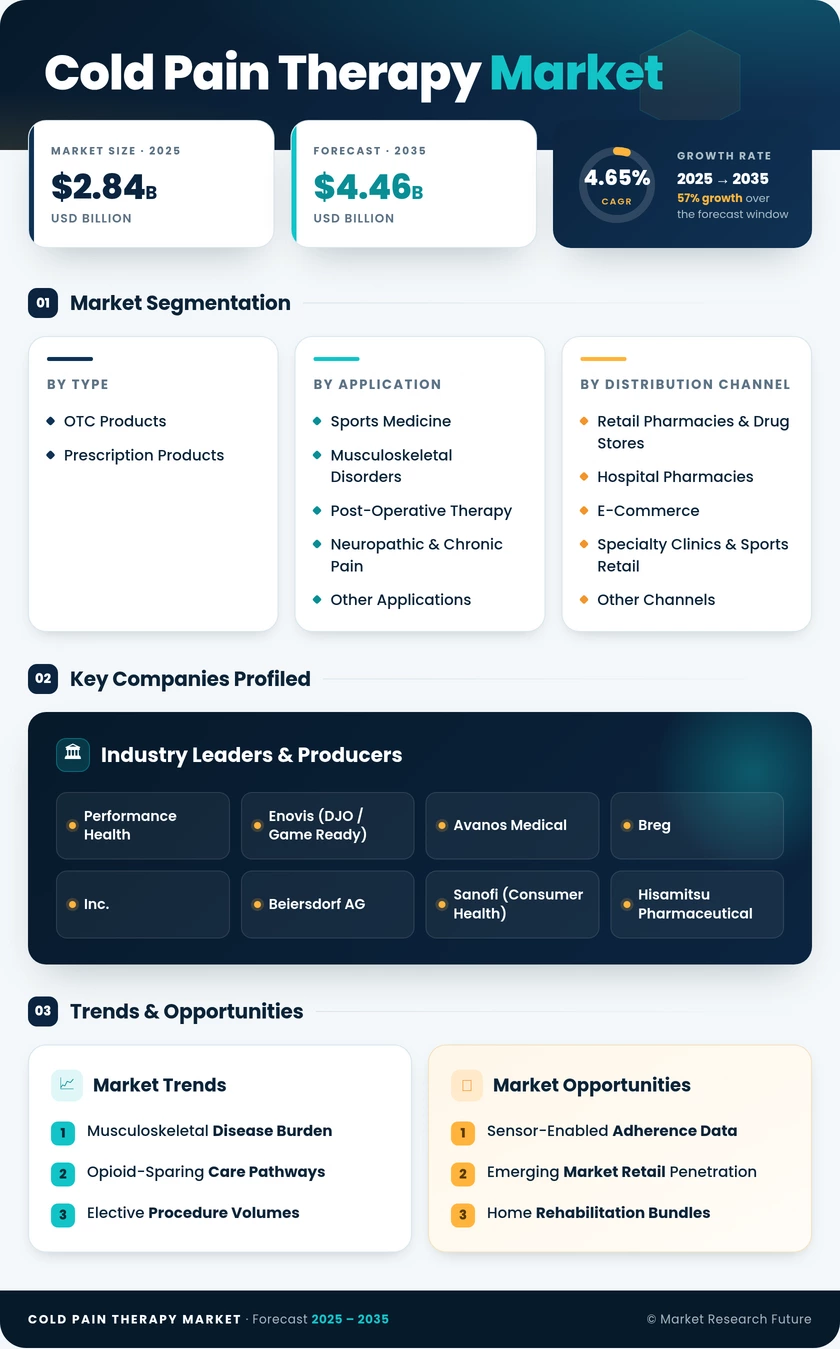
Segmentation Quick Reference
| Dimension | Sub-Segments | Dominant Segment | Fastest Growing Segment |
| By Product | OTC Products; Prescription Products | OTC Products | Prescription Products |
| By Application | Sports Medicine; Musculoskeletal Disorders; Post-Operative Therapy; Neuropathic & Chronic Pain; Other Applications | Sports Medicine | Neuropathic & Chronic Pain |
| By Distribution Channel | Retail Pharmacies & Drug Stores; Hospital Pharmacies; E-Commerce; Specialty Clinics & Sports Retail; Other Channels | Retail Pharmacies & Drug Stores | E-Commerce |
| By Age Group | Adults; Geriatric; Pediatric | Adults | Geriatric |
| By Geography | North America; Europe; Asia-Pacific; South America; Middle East & Africa | North America | Asia-Pacific |
Market Segmentation Overview
By Product
| Sub-Segment | Key Trend |
| OTC Products | Private-label expansion compresses pricing while premium wraps defend margin. |
| Prescription Products | Rental-fleet economics displace outright purchase in post-surgical settings. |
Product strategy now hinges on whether a supplier can attach recurring revenue. Consumer brands defend shelf position through format innovation, while clinical suppliers convert equipment into rental and service contracts tied to defined recovery episodes.
By Application
| Sub-Segment | Key Trend |
| Sports Medicine | Team and club procurement moves toward multi-year equipment contracts |
| Musculoskeletal Disorders | Osteoarthritis self-management guidance formalizes cold application. |
| Post-Operative Therapy | Shorter hospital stays relocate spend into the home setting. |
| Neuropathic & Chronic Pain | Structured regimens replace ad hoc comfort use. |
| Other Applications | Dermatologic and occupational first response add incremental volume. |
Application demand is diverging in character rather than direction. Acute injury use stays episodic and retail-driven, while chronic and post-surgical use is becoming protocol-driven, longer-duration, and increasingly specified by clinicians rather than chosen by patients.
By Distribution Channel
| Sub-Segment | Key Trend |
| Retail Pharmacies & Drug Stores | Pharmacist recommendation remains the strongest conversion lever |
| Hospital Pharmacies | Discharge kit bundling standardizes post-operative supply. |
| E-Commerce | Subscription replenishment lifts repeat-purchase rates. |
| Specialty Clinics & Sports Retail | Practitioner specification drives premium format sales. |
| Other Channels | Occupational health and institutional supply grow through bulk contracts. |
Channel economics reward brands that control both discovery and replenishment. Pure retail players face rising customer acquisition costs online, whereas suppliers embedded in clinical discharge workflows capture demand before the patient reaches a store.
By Age Group
| Sub-Segment | Key Trend |
| Adults | Workplace and recreational injury sustains baseline volume |
| Geriatric | Low-dexterity design and reusable formats gain share. |
| Pediatric | School and youth sports programmes drive institutional purchasing. |
Demographic shift favours simplicity. Products requiring fine motor control, precise timing, or complex fastening lose relevance as the geriatric cohort expands, making ergonomic design a competitive variable rather than a cosmetic one.
By Geography
| Sub-Segment | Key Trend |
| North America | Rental fleets and bundled-payment contracts anchor clinical demand |
| Europe | MDR compliance costs consolidate the supplier base |
| Asia-Pacific | Local manufacturing lowers price barriers across mid-tier segments. |
| South America | Fitness and club networks form a channel outside pharmacy. |
| Middle East & Africa | Sports infrastructure investment seeds first-time institutional tenders |
Regional strategy cannot be uniform. Mature markets reward service and evidence, emerging markets reward price and availability, and suppliers attempting a single global playbook typically underperform in both.


 Noah Malgeri
Co-Founder

 Peter Groot koerkamp
Account and Business Manager

 Younghwan Choi
Senior Retail Manager

 Mark Irwin
Management Consultant

 Akif Moroglu
Strategy & Business Development Director

 Guilherme Gomes Martins
Product Management Director

 Joseph Aguayo
Sales Operations & Pricing Manager

 La Terria Dodd
Program Support Specialist

 Rob Kooiker
Group Product Manager HVAC & Fire Protection GMA