
Request Free Sample ×

Kindly complete the form below to receive a free sample of this Report

* Please use a valid business email

Leading companies partner with us for data-driven Insights

clients tt-cursor
Hero Background
English
Chinese
French
Japanese
Korean
German
Spanish

Cloud Security Market Trends

ID: MRFR/SEM/1585-HCR
200 Pages
Nirmit Biswas
April 2026

Cloud Security Market Size, Share and Research Report By Deployment (Private, Public, and Hybrid), By Types (Virtualization, Cloud Database Security, and Network Security), By End-Users (Healthcare, Retail, BFSI, and IT & Telecom), And By Region (North America, Europe, Asia-Pacific, And Rest Of The World) – Industry Forecast Till 2035

Share:
Download PDF ×

We do not share your information with anyone. However, we may send you emails based on your report interest from time to time. You may contact us at any time to opt-out.

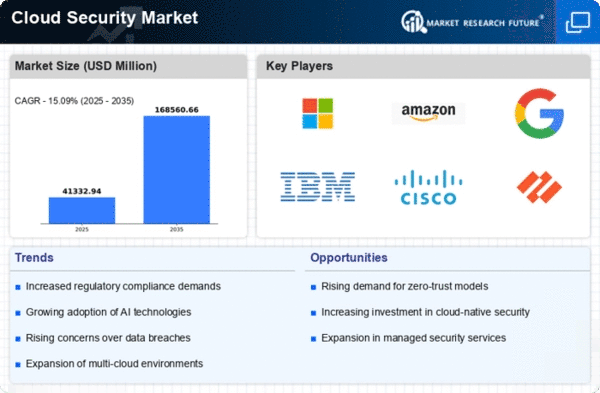
Cloud Security Market Infographic
Purchase Options

Market Trends

Key Emerging Trends in the Cloud Security Market

Numerous noteworthy changes are changing the face of the cloud security sector. A greater focus on zero-trust security is one such development. In the past, security models worked under the presumption that one could trust everything on an organization's network. In the cloud security space, the growing use of Secure Access Service Edge solutions is another noteworthy development. A move toward a more comprehensive and cloud-centric security strategy is reflected in SASE, which combines network security features with WAN features to serve enterprises' dynamic and safe access needs. Market trends are also being shaped by the growing use of multi-cloud setups. Utilizing a variety of cloud service providers allows many firms to address a range of business demands while reducing the risk associated with vendor lock-in. As businesses look for more proactive and adaptable methods for threat detection and response, the use of AI and algorithmic learning within security solutions for the cloud is becoming more and more popular. Security systems can now analyze enormous volumes of data, spot patterns, and anticipate possible security issues before they happen thanks to AI and ML technology. This pattern reflects a larger industry move to improve the effectiveness and efficacy of cloud security measures by utilizing cutting-edge technologies. The lack of cybersecurity expertise is also having an impact on the market. It can be difficult for many firms to hire and retain qualified cybersecurity specialists. Consequently, an increasing dependence on automated solutions and managed security services is observed to bridge the knowledge gap. The market is moving toward more automated and user-friendly security solutions because of this trend, allowing businesses to strengthen their safety record without requiring a high level of internal expertise. Adoption of threat surveillance and data sharing throughout the cloud security sector is also influenced by the changing threat landscape. This pattern emphasizes the value of a team-based and collaborative approach to cybersecurity, encouraging a community-driven defense against changing threats. The future of cloud security is being shaped by several themes, including the adoption of Zero Trust Security and SASE solutions, the integration of AI and ML, the growing multi-cloud environment, regulatory consideration, a lack of talent, and coordinated threat intelligence sharing. It becomes essential to keep up with these trends as enterprises negotiate the complexity of the digital ecosystem to guarantee a strong and flexible strategy to cloud security.


Author
Author Profile
Nirmit Biswas
Senior Research Analyst

With 5+ years of expertise in Market Intelligence and Strategic Research, Nirmit Biswas specializes in ICT, Semiconductors, and BFSI. Backed by an MBA in Financial Services and a Computer Science foundation, Nirmit blends technical depth with business acumen. He has successfully led 100+ projects for global enterprises and startups, including Amazon, Cisco, L&T and Huawei, delivering market estimations, competitive benchmarking, and GTM strategies. His focus lies in transforming complex data into clear, actionable insights that drive growth, innovation, and investment decisions. Recognized for bridging engineering innovation with executive strategy, Nirmit helps businesses navigate dynamic markets with confidence.

Leave a Comment

FAQs

What is the projected market valuation of the Cloud Security Market by 2035?

<p>The Cloud Security Market is projected to reach a valuation of 168560.66 USD Million by 2035.</p>

What was the overall market valuation of the Cloud Security Market in 2024?

<p>In 2024, the overall market valuation of the Cloud Security Market was 35913.58 USD Million.</p>

What is the expected CAGR for the Cloud Security Market during the forecast period 2025 - 2035?

<p>The expected CAGR for the Cloud Security Market during the forecast period 2025 - 2035 is 15.09%.</p>

Which companies are considered key players in the Cloud Security Market?

<p>Key players in the Cloud Security Market include Microsoft, Amazon, Google, IBM, Cisco, Palo Alto Networks, Fortinet, Check Point Software, McAfee, and Trend Micro.</p>

What are the main segments of the Cloud Security Market by application?

<p>The main segments by application include Data Security, Identity and Access Management, Network Security, Application Security, and Cloud Security Posture Management.</p>

How does the valuation of Data Security compare to other applications in 2024?

<p>In 2024, Data Security was valued at 10700.0 USD Million, which is lower than Network Security at 9000.0 USD Million and higher than Application Security at 6000.0 USD Million.</p>

What is the projected valuation for the Public Cloud segment by 2035?

The Public Cloud segment is projected to reach a valuation of 65000.0 USD Million by 2035.

What was the valuation of the Software as a Service segment in 2024?

In 2024, the Software as a Service segment was valued at 18213.58 USD Million.

Which end-user segment is expected to have the highest valuation by 2035?

By 2035, the Large Enterprises segment is expected to have the highest valuation at 70000.0 USD Million.

What is the projected valuation for the Hybrid Cloud segment by 2035?

The Hybrid Cloud segment is projected to reach a valuation of 40000.0 USD Million by 2035.

Market Summary

Cloud Security Market - Quick Answer
 
The global Cloud Security market was valued at USD 35.91 Billion in 2024 and is projected to grow from USD 41.33 Billion in 2025 to USD 168.56 Billion by 2035, at a CAGR of 15.09% (2025–2035). Growth is driven by rising cybersecurity threats including ransomware and data breaches, stringent regulatory compliance (GDPR, HIPAA, CCPA), rapid cloud adoption across enterprises, Zero Trust Architecture adoption, AI integration into security solutions, and the surge in remote work securing demands. North America is the largest market (USD 17.90 Billion in 2024); Asia-Pacific is the fastest-growing region.
 
Source: Market Research Future (MRFR)
 

USD 168.56 Billion by 2035 15.09% CAGR (2025–2035) N. America - USD 17.90B
Projected Market Value Cybersecurity-Led Growth Asia-Pacific - Fastest Growing
 
Published by: Market Research Future (MRFR)   |   Last Updated: March 2026   |   Forecast Period: 2025–2035   |   Base Year: 2024

Key Market Trends & Highlights

The Cloud Security Market is experiencing robust growth driven by evolving security needs and technological advancements.

  • The adoption of Zero Trust Architecture is becoming increasingly prevalent across organizations in North America. Artificial Intelligence is being integrated into security solutions, enhancing threat detection and response capabilities. Compliance and data privacy are gaining heightened focus, particularly in the Asia-Pacific region. Rising cybersecurity threats and regulatory compliance requirements are major drivers propelling the growth of Identity and Access Management and Hybrid Cloud segments.

Market Size & Forecast

2024 Market Value $35.91B
2025 Projected Value $41.33B
CAGR 2025–2035 15.09%
Largest Regional Market Share in 2024 North America

Major Players

Key companies such as Microsoft, Amazon, Google, IBM, Cisco, Palo Alto Networks, Fortinet, Check Point Software, McAfee, and Trend Micro are strengthening cloud environments using AI-powered security solutions. These organizations focus on threat intelligence, anomaly detection, and automated response systems. The integration of AI is enabling predictive and proactive cybersecurity frameworks. This is essential for managing rising cloud-based threats.

Market Trends

The Cloud Security Market is currently experiencing a transformative phase, driven by the increasing reliance on digital infrastructure and the growing awareness of cybersecurity threats. Organizations across various sectors are prioritizing the protection of sensitive data and applications, leading to a surge in demand for advanced security solutions. This heightened focus on safeguarding information is prompting businesses to adopt cloud-based security measures that offer flexibility, scalability, and enhanced protection against evolving cyber threats. As a result, the market is witnessing a proliferation of innovative technologies and services designed to address the complexities of securing cloud environments. Moreover, regulatory compliance is becoming a pivotal factor influencing the Cloud Security Market. Organizations are compelled to adhere to stringent data protection regulations, which necessitate the implementation of robust security frameworks. This compliance-driven approach is fostering collaboration between cloud service providers and security vendors, resulting in the development of integrated solutions that streamline security management. The ongoing evolution of the threat landscape, coupled with the increasing sophistication of cyberattacks, underscores the necessity for organizations to remain vigilant and proactive in their security strategies. Consequently, the Cloud Security Market is poised for sustained growth as businesses seek to fortify their defenses against potential vulnerabilities.

Increased Adoption of Zero Trust Architecture

Organizations are increasingly embracing Zero Trust principles, which advocate for strict verification of users and devices before granting access to resources. This approach minimizes the risk of unauthorized access and enhances overall security posture. As cyber threats become more sophisticated, the adoption of Zero Trust is likely to gain momentum, reshaping security strategies across the Cloud Security Market.

Integration of Artificial Intelligence in Security Solutions

The integration of artificial intelligence into cloud security solutions is emerging as a key trend. AI technologies can analyze vast amounts of data to identify anomalies and potential threats in real-time. This capability not only improves threat detection but also streamlines incident response, making AI a vital component in the evolving landscape of the Cloud Security Market.

Focus on Compliance and Data Privacy

With the increasing emphasis on data privacy regulations, organizations are prioritizing compliance in their cloud security strategies. This trend is driving the demand for solutions that ensure adherence to various regulatory frameworks. As businesses navigate complex compliance requirements, the Cloud Security Market is likely to see a rise in offerings that facilitate data protection and regulatory alignment.

Cloud Security Market Market Drivers

Increased Cloud Adoption

The rapid adoption of cloud computing technologies is a crucial driver for the Global Cloud Security Industry. As businesses migrate their operations to the cloud, the need for comprehensive security measures becomes paramount. According to industry reports, the global cloud adoption rate is expected to continue its upward trajectory, with many organizations prioritizing cloud-first strategies. This trend is likely to propel the Global Cloud Security Market Size to an estimated value of 168.5 USD Billion by 2035, as organizations recognize the importance of securing their cloud environments against emerging threats.

Market Growth Projections

The Cloud Security Industry Size is poised for substantial growth, with projections indicating a market value of 35.9 USD Billion in 2024 and an anticipated increase to 168.5 USD Billion by 2035. This growth trajectory suggests a compound annual growth rate of 15.09% from 2025 to 2035, reflecting the escalating demand for cloud security solutions. Factors such as rising cyber threats, regulatory compliance, and increased cloud adoption are contributing to this upward trend, positioning the Global Cloud Security Market as a critical component of modern business strategies.

Rising Cybersecurity Threats

The increasing frequency and sophistication of cyber threats is a primary driver of the Cloud Security Industry. Organizations are facing a surge in ransomware attacks, data breaches, and phishing schemes, necessitating robust cloud security solutions. For instance, the FBI reported a significant rise in cybercrime incidents, prompting businesses to invest heavily in cloud security measures. As a result, the Global Cloud Security Market Share is projected to reach 35.9 USD Billion in 2024, reflecting the urgent need for enhanced security protocols to protect sensitive data stored in the cloud.

Regulatory Compliance Requirements

Stringent regulatory frameworks across various sectors are compelling organizations to adopt cloud security solutions. Regulations such as GDPR, HIPAA, and CCPA impose strict data protection standards, driving the demand for compliant cloud security services. Organizations must ensure that their cloud environments adhere to these regulations to avoid hefty fines and reputational damage. This compliance imperative is a significant factor contributing to the growth of the Global Cloud Security Industry, as businesses increasingly seek solutions that not only secure their data but also align with regulatory mandates.

Integration of Advanced Technologies

The integration of advanced technologies such as artificial intelligence and machine learning is transforming the Global Cloud Security Industry. These technologies enhance threat detection and response capabilities, allowing organizations to proactively address security vulnerabilities. By leveraging AI-driven analytics, businesses can identify anomalies and potential threats in real-time, significantly reducing the risk of data breaches. This technological advancement is likely to drive further investments in cloud security solutions, as organizations strive to stay ahead of increasingly sophisticated cyber threats.

Growing Demand for Remote Work Solutions

The shift towards remote work has significantly influenced the Global Cloud Security Industry. With more employees accessing corporate resources from various locations, the risk of data exposure and cyber threats has escalated. Organizations are increasingly investing in cloud security solutions that facilitate secure remote access, ensuring that sensitive information remains protected. This trend is expected to contribute to a compound annual growth rate of 15.09% from 2025 to 2035, as businesses seek to bolster their security frameworks in response to the evolving work landscape.

Market Segment Insights

By Application: Data Security (Largest) vs. Identity and Access Management (Fastest-Growing)

The Cloud Security Market exhibits a diverse array of application segments, with Data Security holding the largest share. This segment's dominance is driven by the increasing volume of sensitive data being stored in the cloud, leading organizations to focus heavily on data protection mechanisms. In contrast, Identity and Access Management (IAM) is emerging as the fastest-growing segment, fueled by the rising demand for secure and convenient authentication processes that safeguard user identities in digital spaces.

IAM (Dominant) vs. Application Security (Emerging)

Data Security remains the cornerstone of cloud security, as businesses increasingly prioritize the safeguarding of confidential information. In contrast, Identity and Access Management (IAM) has surged in importance, emerging as a dominant force due to the escalation of cyber threats and the need for robust identity verification protocols. Additionally, Network Security serves as a crucial protective layer, while Application Security is becoming increasingly vital as more applications migrate to the cloud. The Cloud Security Posture Management segment is gaining traction as organizations seek to regularly assess and improve their security posture, indicating a robust trend toward enhancing overall cloud security strategies.

By Deployment Model: Public Cloud (Largest) vs. Private Cloud (Fastest-Growing)

The Cloud Security Market is predominantly driven by the Public Cloud segment, which holds the largest market share among the deployment models. This segment benefits from scalable solutions and widespread adoption among enterprises looking to reduce infrastructure costs. On the other hand, Private Cloud solutions are gaining traction, particularly among organizations with stringent regulatory and compliance requirements. This shift reflects a growing preference for customized security solutions tailored to specific business needs.

Public Cloud (Dominant) vs. Private Cloud (Emerging)

The Public Cloud segment is characterized by its extensive adoption across various industries, offering a flexible and scalable security framework. Its dominance stems from the ability to provide comprehensive security measures at lower costs, appealing to a broad customer base. In contrast, the Private Cloud segment is increasingly recognized for its robust security features, which cater to organizations that prioritize data privacy and control. As businesses navigate complex regulatory frameworks, the demand for Private Cloud solutions is rising, reflecting an industry trend towards more secure and personalized cloud environments.

By Service Model: Software as a Service (Largest) vs. Infrastructure as a Service (Fastest-Growing)

In the Cloud Security Market, the service model segment is primarily divided into three categories: Infrastructure as a Service (IaaS), Platform as a Service (PaaS), and Software as a Service (SaaS). Among these, SaaS holds the largest market share, primarily due to its accessibility and ease of implementation, which cater to companies of varying sizes. IaaS and PaaS follow closely, capturing significant portions of the market as organizations increasingly move towards cloud-native architectures and require robust security measures.

Service Model: SaaS (Dominant) vs. IaaS (Emerging)

SaaS has emerged as a dominant force in the Cloud Security Market, being favored for its cost-effectiveness and flexibility, allowing enterprises to leverage security features without extensive on-premises infrastructure. Organizations benefit from automatic updates and scalability, making SaaS attractive for security solutions. In contrast, IaaS, though classified as emerging, is rapidly gaining traction as businesses seek comprehensive control over their infrastructure and security configurations. With its fast-growing adoption, IaaS presents opportunities for tailored security solutions that address specific regulatory requirements and compliance challenges. As companies continue to embrace cloud technologies, both segments are essential for an integrated security approach.

By End User: Large Enterprises (Largest) vs. Small and Medium Enterprises (Fastest-Growing)

In the Cloud Security Market, the distribution of market share among various end users reveals that large enterprises hold the largest segment, leveraging substantial budgets for robust security measures. Small and Medium Enterprises (SMEs) are emerging as a crucial player, rapidly adopting cloud security solutions to safeguard their data while facing increasing cyber threats. Government organizations and healthcare organizations follow, focusing on compliance and data integrity in their security frameworks, but are significantly outpaced by the investment in cloud security by large enterprises and the growth rate of SMEs. The growth trends in this segment are driven by increasing cybersecurity threats and the accelerating digitization of business operations. Large enterprises invest heavily in comprehensive security solutions to protect vast amounts of sensitive data, while SMEs are quickly realizing the importance of cloud security to enhance their operational resilience. As cybersecurity becomes a priority across all sectors, government and healthcare organizations are adapting their strategies, ensuring compliance with regulations and improving their overall security posture, further contributing to market growth.

Large Enterprises: Dominant vs. Small and Medium Enterprises: Emerging

Large enterprises are characterized by their extensive resources and sophisticated IT infrastructures, enabling them to implement advanced cloud security measures. These organizations often have dedicated cybersecurity teams, allowing them to stay ahead of emerging threats and comply with stringent regulatory requirements. In contrast, small and medium enterprises have traditionally faced challenges due to limited budgets and personnel. However, the rapid adoption of cloud services among SMEs has fostered an increasing demand for scalable and accessible cloud security solutions. While large enterprises dominate the market, the agility and flexibility of SMEs position them as a rapidly growing segment, driven by the necessity to protect sensitive information and meet the demands of an increasingly complex cyber landscape.

By Security Type: Network Security (Largest) vs. Endpoint Security (Fastest-Growing)

In the Cloud Security Market, the distribution of market share among different security types is varied. Network Security currently holds a significant portion of the market, reflecting its essential role in protecting organizational infrastructures. As threats become more sophisticated, the reliance on Network Security solutions continues to grow, highlighting its established position in the sector. In contrast, Endpoint Security is gaining traction as organizations increasingly adopt cloud-based solutions and remote work arrangements, leading to a surge in demand for securing endpoints effectively.

Cybersecurity: Network Security (Dominant) vs. Endpoint Security (Emerging)

Network Security is viewed as the dominant player in the Cloud Security Market, focusing on safeguarding networks from unauthorized access and cyber threats. Its solutions are central to enterprise security strategies, utilizing advanced technologies such as firewalls, intrusion detection systems, and secure gateways. Conversely, Endpoint Security is emerging rapidly, driven by the proliferation of mobile devices and remote work. This segment addresses vulnerabilities at individual devices, ensuring robust protection against malware and data breaches. As both segments evolve, their interplay will define the future landscape of cloud security.

Get more detailed insights about Cloud Security Market Research Report- Forecast to 2035

Regional Insights

North America : Market Leader in Cloud Security

North America continues to lead the Cloud Security Market, holding a significant share of 17900.0. The region's growth is driven by increasing cyber threats, regulatory compliance requirements, and a shift towards digital transformation. Companies are investing heavily in cloud security solutions to protect sensitive data and maintain customer trust. The demand for advanced security technologies is further fueled by the rise of remote work and cloud adoption across various sectors. The competitive landscape in North America is robust, featuring key players such as Microsoft, Amazon, and Google, which dominate the market. These companies are continuously innovating to enhance their offerings, ensuring they meet the evolving security needs of businesses. The presence of established firms like IBM and Cisco also contributes to a dynamic market environment, fostering competition and driving technological advancements.

Europe : Growing Adoption of Cloud Security

Europe's Cloud Security Market is expanding, with a market size of 10000.0. The growth is propelled by stringent data protection regulations like GDPR, which mandate robust security measures for cloud services. Organizations are increasingly recognizing the importance of cloud security to safeguard sensitive information and comply with legal requirements. The rising number of cyber incidents has further heightened awareness and investment in security solutions across the region. Leading countries such as Germany, the UK, and France are at the forefront of this growth, with a strong presence of key players like IBM and Cisco. The competitive landscape is characterized by a mix of established firms and emerging startups, all vying to offer innovative solutions. The European market is also witnessing collaborations between tech companies and government bodies to enhance cybersecurity frameworks, ensuring a secure cloud environment for businesses.

Asia-Pacific : Emerging Cloud Security Market

The Asia-Pacific region is witnessing a surge in demand for cloud security solutions, with a market size of 7000.0. This growth is driven by the rapid digital transformation across industries, increasing internet penetration, and a rise in cyber threats. Governments in the region are also implementing regulations to enhance data protection, further fueling the demand for cloud security services. Organizations are prioritizing security investments to protect their digital assets and maintain compliance with emerging regulations. Countries like China, India, and Japan are leading the charge in adopting cloud security solutions. The competitive landscape is vibrant, with key players such as Trend Micro and Fortinet making significant inroads. The presence of both global and local companies fosters innovation and competition, ensuring that businesses have access to a wide range of security solutions tailored to their specific needs.

Middle East and Africa : Developing Cloud Security Landscape

The Middle East and Africa region is gradually developing its Cloud Security Market, currently valued at 2013.58. The growth is driven by increasing awareness of cybersecurity threats and the need for robust security measures in the face of rising digital transformation. Governments are beginning to implement regulations aimed at enhancing data protection and cybersecurity, which is expected to further stimulate market growth. Organizations are increasingly investing in cloud security solutions to protect sensitive information and ensure business continuity. Leading countries in this region include the UAE and South Africa, where there is a growing presence of both local and international players. The competitive landscape is evolving, with companies focusing on providing tailored solutions to meet the unique challenges faced by businesses in the region. Partnerships between tech firms and government agencies are also emerging, aimed at strengthening the overall cybersecurity framework.

Key Players and Competitive Insights

The Cloud Security Market is currently characterized by intense competition and rapid evolution, driven by increasing demand for robust security solutions amid rising cyber threats. Major players such as Microsoft (US), Amazon (US), and Palo Alto Networks (US) are strategically positioning themselves through innovation and partnerships. Microsoft (US) emphasizes its Azure platform, integrating advanced security features to enhance user trust and compliance. Amazon (US) continues to expand its AWS offerings, focusing on scalability and flexibility, while Palo Alto Networks (US) is enhancing its AI-driven security solutions to address sophisticated threats. Collectively, these strategies contribute to a dynamic competitive environment, where agility and technological advancement are paramount. Key business tactics within the Cloud Security Market include localized service offerings and supply chain optimization, which are essential for meeting diverse customer needs across regions. The market structure appears moderately fragmented, with a mix of established players and emerging startups. This fragmentation allows for innovation and niche solutions, although the influence of key players remains substantial, shaping market trends and customer expectations. In November 2025, Microsoft (US) announced a significant partnership with a leading cybersecurity firm to enhance its threat detection capabilities. This collaboration is expected to bolster Microsoft's security offerings, allowing for more proactive measures against emerging threats. The strategic importance of this partnership lies in its potential to enhance customer confidence and expand market share in an increasingly competitive landscape. In October 2025, Amazon (US) launched a new suite of security tools within its AWS platform, aimed at small to medium-sized enterprises (SMEs). This initiative reflects Amazon's commitment to democratizing access to advanced security solutions, enabling SMEs to protect their digital assets effectively. The strategic move is likely to attract a broader customer base, positioning Amazon as a leader in providing scalable security solutions tailored to diverse business needs. In September 2025, Palo Alto Networks (US) unveiled a groundbreaking AI-driven security platform designed to automate threat response. This innovation is particularly significant as it addresses the growing complexity of cyber threats, allowing organizations to respond swiftly and effectively. The introduction of such advanced technology underscores Palo Alto's focus on maintaining a competitive edge through continuous innovation and adaptation to market demands. As of December 2025, current trends in the Cloud Security Market are heavily influenced by digitalization, sustainability, and the integration of AI technologies. Strategic alliances are increasingly shaping the competitive landscape, fostering collaboration that enhances innovation and service delivery. Looking ahead, competitive differentiation is likely to evolve, with a pronounced shift from price-based competition to a focus on technological innovation and supply chain reliability. This transition suggests that companies will need to invest in cutting-edge solutions and partnerships to maintain their competitive advantage.

Key Companies in the Cloud Security Market include

Industry Developments

  • Q2 2025: Thales 2025 Global Cloud Security Market Study Reveals Organizations Struggle to Secure Expanding, AI-Driven Cloud Environments Thales released its 2025 Global Cloud Security Industry Study, highlighting a significant shift in enterprise security budgets toward AI-specific security, now ranking just behind cloud security. The study, based on responses from nearly 3,200 professionals, underscores the growing complexity and priority of securing cloud environments as AI adoption accelerates.

Future Outlook

Cloud Security Market Future Outlook

The Cloud Security Market is projected to grow at a 15.09% CAGR from 2025 to 2035, driven by increasing cyber threats, regulatory compliance, and the shift to remote work.

New opportunities lie in:

  • <p>Development of AI-driven threat detection systems Expansion of multi-cloud security solutions Integration of zero-trust security frameworks into existing infrastructures</p>

By 2035, the Cloud Security Market is expected to be robust, reflecting substantial growth and innovation.

Market Segmentation

Cloud Security Market End User Outlook

  • Small and Medium Enterprises
  • Large Enterprises
  • Government Organizations
  • Healthcare Organizations

Cloud Security Market Application Outlook

  • Data Security
  • Identity and Access Management
  • Network Security
  • Application Security
  • Cloud Security Posture Management

Cloud Security Market Security Type Outlook

  • Network Security
  • Endpoint Security
  • Application Security
  • Data Security

Cloud Security Market Service Model Outlook

  • Infrastructure as a Service
  • Platform as a Service
  • Software as a Service

Cloud Security Market Deployment Model Outlook

  • Public Cloud
  • Private Cloud
  • Hybrid Cloud
  • Multi-Cloud

Report Scope

MARKET SIZE 2024 35913.58(USD Million)
MARKET SIZE 2025 41333.67(USD Million)
MARKET SIZE 2035 168560.66(USD Million)
COMPOUND ANNUAL GROWTH RATE (CAGR) 15.09% (2025 - 2035)
REPORT COVERAGE Revenue Forecast, Competitive Landscape, Growth Factors, and Trends
BASE YEAR 2024
Market Forecast Period 2025 - 2035
Historical Data 2019 - 2024
Market Forecast Units USD Million
Key Companies Profiled Microsoft (US), Amazon (US), Google (US), IBM (US), Cisco (US), Palo Alto Networks (US), Fortinet (US), Check Point Software (IL), McAfee (US), Trend Micro (JP)
Segments Covered Application, Deployment Model, Service Model, End User, Security Type
Key Market Opportunities Integration of artificial intelligence enhances threat detection in the Cloud Security Market.
Key Market Dynamics Rising regulatory requirements drive demand for advanced cloud security solutions amid evolving cyber threats.
Countries Covered North America, Europe, APAC, South America, MEA

FAQs

What is the projected market valuation of the Cloud Security Market by 2035?

<p>The Cloud Security Market is projected to reach a valuation of 168560.66 USD Million by 2035.</p>

What was the overall market valuation of the Cloud Security Market in 2024?

<p>In 2024, the overall market valuation of the Cloud Security Market was 35913.58 USD Million.</p>

What is the expected CAGR for the Cloud Security Market during the forecast period 2025 - 2035?

<p>The expected CAGR for the Cloud Security Market during the forecast period 2025 - 2035 is 15.09%.</p>

Which companies are considered key players in the Cloud Security Market?

<p>Key players in the Cloud Security Market include Microsoft, Amazon, Google, IBM, Cisco, Palo Alto Networks, Fortinet, Check Point Software, McAfee, and Trend Micro.</p>

What are the main segments of the Cloud Security Market by application?

<p>The main segments by application include Data Security, Identity and Access Management, Network Security, Application Security, and Cloud Security Posture Management.</p>

How does the valuation of Data Security compare to other applications in 2024?

<p>In 2024, Data Security was valued at 10700.0 USD Million, which is lower than Network Security at 9000.0 USD Million and higher than Application Security at 6000.0 USD Million.</p>

What is the projected valuation for the Public Cloud segment by 2035?

The Public Cloud segment is projected to reach a valuation of 65000.0 USD Million by 2035.

What was the valuation of the Software as a Service segment in 2024?

In 2024, the Software as a Service segment was valued at 18213.58 USD Million.

Which end-user segment is expected to have the highest valuation by 2035?

By 2035, the Large Enterprises segment is expected to have the highest valuation at 70000.0 USD Million.

What is the projected valuation for the Hybrid Cloud segment by 2035?

The Hybrid Cloud segment is projected to reach a valuation of 40000.0 USD Million by 2035.

  1. SECTION I: EXECUTIVE SUMMARY AND KEY HIGHLIGHTS |
    1. EXECUTIVE SUMMARY | |
      1. Market Overview | |
      2. Key Findings | |
      3. Market Segmentation | |
      4. Competitive Landscape | |
      5. Challenges and Opportunities | |
      6. Future Outlook 2
  2. SECTION II: SCOPING, METHODOLOGY AND MARKET STRUCTURE |
    1. MARKET INTRODUCTION | |
      1. Definition | |
      2. Scope of the study | | |
    2. RESEARCH METHODOLOGY | |
      1. Overview | |
      2. Data Mining | |
      3. Secondary Research | |
      4. Primary Research | | |
      5. Forecasting Model | |
      6. Market Size Estimation | | |
      7. Data Triangulation | |
      8. Validation 3
  3. SECTION III: QUALITATIVE ANALYSIS |
    1. MARKET DYNAMICS | |
      1. Overview | |
      2. Drivers | |
      3. Restraints | |
      4. Opportunities |
    2. MARKET FACTOR ANALYSIS | |
      1. Value chain Analysis | |
      2. Porter's Five Forces Analysis | | |
      3. COVID-19 Impact Analysis | | |
  4. SECTION IV: QUANTITATIVE ANALYSIS |
    1. Semiconductor & Electronics, BY Application (USD Million) | |
      1. Data Security | |
      2. Identity and Access Management | |
      3. Network Security | |
      4. Application Security | |
      5. Cloud Security Posture Management |
    2. Semiconductor & Electronics, BY Deployment Model (USD Million) | |
      1. Public Cloud | |
      2. Private Cloud | |
      3. Hybrid Cloud | |
      4. Multi-Cloud |
    3. Semiconductor & Electronics, BY Service Model (USD Million) | |
      1. Infrastructure as a Service | |
      2. Platform as a Service | |
      3. Software as a Service |
    4. Semiconductor & Electronics, BY End User (USD Million) | |
      1. Small and Medium Enterprises | |
      2. Large Enterprises | |
      3. Government Organizations | |
      4. Healthcare Organizations |
    5. Semiconductor & Electronics, BY Security Type (USD Million) | |
      1. Network Security | |
      2. Endpoint Security | |
      3. Application Security | |
      4. Data Security |
    6. Semiconductor & Electronics, BY Region (USD Million) | |
      1. North America | | |
      2. Europe | | |
      3. APAC | | |
      4. South America | | |
      5. MEA | | |
  5. SECTION V: COMPETITIVE ANALYSIS |
    1. Competitive Landscape | |
      1. Overview | |
      2. Competitive Analysis | |
      3. Market share Analysis | |
      4. Major Growth Strategy in the Semiconductor & Electronics | |
      5. Competitive Benchmarking | |
      6. Leading Players in Terms of Number of Developments in the Semiconductor & Electronics | |
      7. Key developments and growth strategies | | |
      8. Major Players Financial Matrix | | |
    2. Company Profiles | |
      1. Microsoft (US) | | |
      2. Amazon (US) | | |
      3. Google (US) | | |
      4. IBM (US) | | |
      5. Cisco (US) | | |
      6. Palo Alto Networks (US) | | |
      7. Fortinet (US) | | |
      8. Check Point Software (IL) | | |
      9. McAfee (US) | | |
      10. Trend Micro (JP) | | |
    3. Appendix | |
      1. References | |
      2. Related Reports 6 LIST OF FIGURES |
    4. MARKET SYNOPSIS |
    5. NORTH AMERICA MARKET ANALYSIS |
    6. US MARKET ANALYSIS BY APPLICATION |
    7. US MARKET ANALYSIS BY DEPLOYMENT MODEL |
    8. US MARKET ANALYSIS BY SERVICE MODEL |
    9. US MARKET ANALYSIS BY END USER |
    10. US MARKET ANALYSIS BY SECURITY TYPE |
    11. CANADA MARKET ANALYSIS BY APPLICATION |
    12. CANADA MARKET ANALYSIS BY DEPLOYMENT MODEL |
    13. CANADA MARKET ANALYSIS BY SERVICE MODEL |
    14. CANADA MARKET ANALYSIS BY END USER |
    15. CANADA MARKET ANALYSIS BY SECURITY TYPE |
    16. EUROPE MARKET ANALYSIS |
    17. GERMANY MARKET ANALYSIS BY APPLICATION |
    18. GERMANY MARKET ANALYSIS BY DEPLOYMENT MODEL |
    19. GERMANY MARKET ANALYSIS BY SERVICE MODEL |
    20. GERMANY MARKET ANALYSIS BY END USER |
    21. GERMANY MARKET ANALYSIS BY SECURITY TYPE |
    22. UK MARKET ANALYSIS BY APPLICATION |
    23. UK MARKET ANALYSIS BY DEPLOYMENT MODEL |
    24. UK MARKET ANALYSIS BY SERVICE MODEL |
    25. UK MARKET ANALYSIS BY END USER |
    26. UK MARKET ANALYSIS BY SECURITY TYPE |
    27. FRANCE MARKET ANALYSIS BY APPLICATION |
    28. FRANCE MARKET ANALYSIS BY DEPLOYMENT MODEL |
    29. FRANCE MARKET ANALYSIS BY SERVICE MODEL |
    30. FRANCE MARKET ANALYSIS BY END USER |
    31. FRANCE MARKET ANALYSIS BY SECURITY TYPE |
    32. RUSSIA MARKET ANALYSIS BY APPLICATION |
    33. RUSSIA MARKET ANALYSIS BY DEPLOYMENT MODEL |
    34. RUSSIA MARKET ANALYSIS BY SERVICE MODEL |
    35. RUSSIA MARKET ANALYSIS BY END USER |
    36. RUSSIA MARKET ANALYSIS BY SECURITY TYPE |
    37. ITALY MARKET ANALYSIS BY APPLICATION |
    38. ITALY MARKET ANALYSIS BY DEPLOYMENT MODEL |
    39. ITALY MARKET ANALYSIS BY SERVICE MODEL |
    40. ITALY MARKET ANALYSIS BY END USER |
    41. ITALY MARKET ANALYSIS BY SECURITY TYPE |
    42. SPAIN MARKET ANALYSIS BY APPLICATION |
    43. SPAIN MARKET ANALYSIS BY DEPLOYMENT MODEL |
    44. SPAIN MARKET ANALYSIS BY SERVICE MODEL |
    45. SPAIN MARKET ANALYSIS BY END USER |
    46. SPAIN MARKET ANALYSIS BY SECURITY TYPE |
    47. REST OF EUROPE MARKET ANALYSIS BY APPLICATION |
    48. REST OF EUROPE MARKET ANALYSIS BY DEPLOYMENT MODEL |
    49. REST OF EUROPE MARKET ANALYSIS BY SERVICE MODEL |
    50. REST OF EUROPE MARKET ANALYSIS BY END USER |
    51. REST OF EUROPE MARKET ANALYSIS BY SECURITY TYPE |
    52. APAC MARKET ANALYSIS |
    53. CHINA MARKET ANALYSIS BY APPLICATION |
    54. CHINA MARKET ANALYSIS BY DEPLOYMENT MODEL |
    55. CHINA MARKET ANALYSIS BY SERVICE MODEL |
    56. CHINA MARKET ANALYSIS BY END USER |
    57. CHINA MARKET ANALYSIS BY SECURITY TYPE |
    58. INDIA MARKET ANALYSIS BY APPLICATION |
    59. INDIA MARKET ANALYSIS BY DEPLOYMENT MODEL |
    60. INDIA MARKET ANALYSIS BY SERVICE MODEL |
    61. INDIA MARKET ANALYSIS BY END USER |
    62. INDIA MARKET ANALYSIS BY SECURITY TYPE |
    63. JAPAN MARKET ANALYSIS BY APPLICATION |
    64. JAPAN MARKET ANALYSIS BY DEPLOYMENT MODEL |
    65. JAPAN MARKET ANALYSIS BY SERVICE MODEL |
    66. JAPAN MARKET ANALYSIS BY END USER |
    67. JAPAN MARKET ANALYSIS BY SECURITY TYPE |
    68. SOUTH KOREA MARKET ANALYSIS BY APPLICATION |
    69. SOUTH KOREA MARKET ANALYSIS BY DEPLOYMENT MODEL |
    70. SOUTH KOREA MARKET ANALYSIS BY SERVICE MODEL |
    71. SOUTH KOREA MARKET ANALYSIS BY END USER |
    72. SOUTH KOREA MARKET ANALYSIS BY SECURITY TYPE |
    73. MALAYSIA MARKET ANALYSIS BY APPLICATION |
    74. MALAYSIA MARKET ANALYSIS BY DEPLOYMENT MODEL |
    75. MALAYSIA MARKET ANALYSIS BY SERVICE MODEL |
    76. MALAYSIA MARKET ANALYSIS BY END USER |
    77. MALAYSIA MARKET ANALYSIS BY SECURITY TYPE |
    78. THAILAND MARKET ANALYSIS BY APPLICATION |
    79. THAILAND MARKET ANALYSIS BY DEPLOYMENT MODEL |
    80. THAILAND MARKET ANALYSIS BY SERVICE MODEL |
    81. THAILAND MARKET ANALYSIS BY END USER |
    82. THAILAND MARKET ANALYSIS BY SECURITY TYPE |
    83. INDONESIA MARKET ANALYSIS BY APPLICATION |
    84. INDONESIA MARKET ANALYSIS BY DEPLOYMENT MODEL |
    85. INDONESIA MARKET ANALYSIS BY SERVICE MODEL |
    86. INDONESIA MARKET ANALYSIS BY END USER |
    87. INDONESIA MARKET ANALYSIS BY SECURITY TYPE |
    88. REST OF APAC MARKET ANALYSIS BY APPLICATION |
    89. REST OF APAC MARKET ANALYSIS BY DEPLOYMENT MODEL |
    90. REST OF APAC MARKET ANALYSIS BY SERVICE MODEL |
    91. REST OF APAC MARKET ANALYSIS BY END USER |
    92. REST OF APAC MARKET ANALYSIS BY SECURITY TYPE |
    93. SOUTH AMERICA MARKET ANALYSIS |
    94. BRAZIL MARKET ANALYSIS BY APPLICATION |
    95. BRAZIL MARKET ANALYSIS BY DEPLOYMENT MODEL |
    96. BRAZIL MARKET ANALYSIS BY SERVICE MODEL |
    97. BRAZIL MARKET ANALYSIS BY END USER |
    98. BRAZIL MARKET ANALYSIS BY SECURITY TYPE |
    99. MEXICO MARKET ANALYSIS BY APPLICATION |
    100. MEXICO MARKET ANALYSIS BY DEPLOYMENT MODEL |
    101. MEXICO MARKET ANALYSIS BY SERVICE MODEL |
    102. MEXICO MARKET ANALYSIS BY END USER |
    103. MEXICO MARKET ANALYSIS BY SECURITY TYPE |
    104. ARGENTINA MARKET ANALYSIS BY APPLICATION |
    105. ARGENTINA MARKET ANALYSIS BY DEPLOYMENT MODEL |
    106. ARGENTINA MARKET ANALYSIS BY SERVICE MODEL |
    107. ARGENTINA MARKET ANALYSIS BY END USER |
    108. ARGENTINA MARKET ANALYSIS BY SECURITY TYPE |
    109. REST OF SOUTH AMERICA MARKET ANALYSIS BY APPLICATION |
    110. REST OF SOUTH AMERICA MARKET ANALYSIS BY DEPLOYMENT MODEL |
    111. REST OF SOUTH AMERICA MARKET ANALYSIS BY SERVICE MODEL |
    112. REST OF SOUTH AMERICA MARKET ANALYSIS BY END USER |
    113. REST OF SOUTH AMERICA MARKET ANALYSIS BY SECURITY TYPE |
    114. MEA MARKET ANALYSIS |
    115. GCC COUNTRIES MARKET ANALYSIS BY APPLICATION |
    116. GCC COUNTRIES MARKET ANALYSIS BY DEPLOYMENT MODEL |
    117. GCC COUNTRIES MARKET ANALYSIS BY SERVICE MODEL |
    118. GCC COUNTRIES MARKET ANALYSIS BY END USER |
    119. GCC COUNTRIES MARKET ANALYSIS BY SECURITY TYPE |
    120. SOUTH AFRICA MARKET ANALYSIS BY APPLICATION |
    121. SOUTH AFRICA MARKET ANALYSIS BY DEPLOYMENT MODEL |
    122. SOUTH AFRICA MARKET ANALYSIS BY SERVICE MODEL |
    123. SOUTH AFRICA MARKET ANALYSIS BY END USER |
    124. SOUTH AFRICA MARKET ANALYSIS BY SECURITY TYPE |
    125. REST OF MEA MARKET ANALYSIS BY APPLICATION |
    126. REST OF MEA MARKET ANALYSIS BY DEPLOYMENT MODEL |
    127. REST OF MEA MARKET ANALYSIS BY SERVICE MODEL |
    128. REST OF MEA MARKET ANALYSIS BY END USER |
    129. REST OF MEA MARKET ANALYSIS BY SECURITY TYPE |
    130. KEY BUYING CRITERIA OF SEMICONDUCTOR & ELECTRONICS |
    131. RESEARCH PROCESS OF MRFR |
    132. DRO ANALYSIS OF SEMICONDUCTOR & ELECTRONICS |
    133. DRIVERS IMPACT ANALYSIS: SEMICONDUCTOR & ELECTRONICS |
    134. RESTRAINTS IMPACT ANALYSIS: SEMICONDUCTOR & ELECTRONICS |
    135. SUPPLY / VALUE CHAIN: SEMICONDUCTOR & ELECTRONICS |
    136. SEMICONDUCTOR & ELECTRONICS, BY APPLICATION, 2024 (% SHARE) |
    137. SEMICONDUCTOR & ELECTRONICS, BY APPLICATION, 2024 TO 2035 (USD Million) |
    138. SEMICONDUCTOR & ELECTRONICS, BY DEPLOYMENT MODEL, 2024 (% SHARE) |
    139. SEMICONDUCTOR & ELECTRONICS, BY DEPLOYMENT MODEL, 2024 TO 2035 (USD Million) |
    140. SEMICONDUCTOR & ELECTRONICS, BY SERVICE MODEL, 2024 (% SHARE) |
    141. SEMICONDUCTOR & ELECTRONICS, BY SERVICE MODEL, 2024 TO 2035 (USD Million) |
    142. SEMICONDUCTOR & ELECTRONICS, BY END USER, 2024 (% SHARE) |
    143. SEMICONDUCTOR & ELECTRONICS, BY END USER, 2024 TO 2035 (USD Million) |
    144. SEMICONDUCTOR & ELECTRONICS, BY SECURITY TYPE, 2024 (% SHARE) |
    145. SEMICONDUCTOR & ELECTRONICS, BY SECURITY TYPE, 2024 TO 2035 (USD Million) |
    146. BENCHMARKING OF MAJOR COMPETITORS 7 LIST OF TABLES |
    147. LIST OF ASSUMPTIONS | |
      1. |
    148. North America MARKET SIZE ESTIMATES; FORECAST | |
      1. BY APPLICATION, 2025-2035 (USD Million) | |
      2. BY DEPLOYMENT MODEL, 2025-2035 (USD Million) | |
      3. BY SERVICE MODEL, 2025-2035 (USD Million) | |
      4. BY END USER, 2025-2035 (USD Million) | |
      5. BY SECURITY TYPE, 2025-2035 (USD Million) |
    149. US MARKET SIZE ESTIMATES; FORECAST | |
      1. BY APPLICATION, 2025-2035 (USD Million) | |
      2. BY DEPLOYMENT MODEL, 2025-2035 (USD Million) | |
      3. BY SERVICE MODEL, 2025-2035 (USD Million) | |
      4. BY END USER, 2025-2035 (USD Million) | |
      5. BY SECURITY TYPE, 2025-2035 (USD Million) |
    150. Canada MARKET SIZE ESTIMATES; FORECAST | |
      1. BY APPLICATION, 2025-2035 (USD Million) | |
      2. BY DEPLOYMENT MODEL, 2025-2035 (USD Million) | |
      3. BY SERVICE MODEL, 2025-2035 (USD Million) | |
      4. BY END USER, 2025-2035 (USD Million) | |
      5. BY SECURITY TYPE, 2025-2035 (USD Million) |
    151. Europe MARKET SIZE ESTIMATES; FORECAST | |
      1. BY APPLICATION, 2025-2035 (USD Million) | |
      2. BY DEPLOYMENT MODEL, 2025-2035 (USD Million) | |
      3. BY SERVICE MODEL, 2025-2035 (USD Million) | |
      4. BY END USER, 2025-2035 (USD Million) | |
      5. BY SECURITY TYPE, 2025-2035 (USD Million) |
    152. Germany MARKET SIZE ESTIMATES; FORECAST | |
      1. BY APPLICATION, 2025-2035 (USD Million) | |
      2. BY DEPLOYMENT MODEL, 2025-2035 (USD Million) | |
      3. BY SERVICE MODEL, 2025-2035 (USD Million) | |
      4. BY END USER, 2025-2035 (USD Million) | |
      5. BY SECURITY TYPE, 2025-2035 (USD Million) |
    153. UK MARKET SIZE ESTIMATES; FORECAST | |
      1. BY APPLICATION, 2025-2035 (USD Million) | |
      2. BY DEPLOYMENT MODEL, 2025-2035 (USD Million) | |
      3. BY SERVICE MODEL, 2025-2035 (USD Million) | |
      4. BY END USER, 2025-2035 (USD Million) | |
      5. BY SECURITY TYPE, 2025-2035 (USD Million) |
    154. France MARKET SIZE ESTIMATES; FORECAST | |
      1. BY APPLICATION, 2025-2035 (USD Million) | |
      2. BY DEPLOYMENT MODEL, 2025-2035 (USD Million) | |
      3. BY SERVICE MODEL, 2025-2035 (USD Million) | |
      4. BY END USER, 2025-2035 (USD Million) | |
      5. BY SECURITY TYPE, 2025-2035 (USD Million) |
    155. Russia MARKET SIZE ESTIMATES; FORECAST | |
      1. BY APPLICATION, 2025-2035 (USD Million) | |
      2. BY DEPLOYMENT MODEL, 2025-2035 (USD Million) | |
      3. BY SERVICE MODEL, 2025-2035 (USD Million) | |
      4. BY END USER, 2025-2035 (USD Million) | |
      5. BY SECURITY TYPE, 2025-2035 (USD Million) |
    156. Italy MARKET SIZE ESTIMATES; FORECAST | |
      1. BY APPLICATION, 2025-2035 (USD Million) | |
      2. BY DEPLOYMENT MODEL, 2025-2035 (USD Million) | |
      3. BY SERVICE MODEL, 2025-2035 (USD Million) | |
      4. BY END USER, 2025-2035 (USD Million) | |
      5. BY SECURITY TYPE, 2025-2035 (USD Million) |
    157. Spain MARKET SIZE ESTIMATES; FORECAST | |
      1. BY APPLICATION, 2025-2035 (USD Million) | |
      2. BY DEPLOYMENT MODEL, 2025-2035 (USD Million) | |
      3. BY SERVICE MODEL, 2025-2035 (USD Million) | |
      4. BY END USER, 2025-2035 (USD Million) | |
      5. BY SECURITY TYPE, 2025-2035 (USD Million) |
    158. Rest of Europe MARKET SIZE ESTIMATES; FORECAST | |
      1. BY APPLICATION, 2025-2035 (USD Million) | |
      2. BY DEPLOYMENT MODEL, 2025-2035 (USD Million) | |
      3. BY SERVICE MODEL, 2025-2035 (USD Million) | |
      4. BY END USER, 2025-2035 (USD Million) | |
      5. BY SECURITY TYPE, 2025-2035 (USD Million) |
    159. APAC MARKET SIZE ESTIMATES; FORECAST | |
      1. BY APPLICATION, 2025-2035 (USD Million) | |
      2. BY DEPLOYMENT MODEL, 2025-2035 (USD Million) | |
      3. BY SERVICE MODEL, 2025-2035 (USD Million) | |
      4. BY END USER, 2025-2035 (USD Million) | |
      5. BY SECURITY TYPE, 2025-2035 (USD Million) |
    160. China MARKET SIZE ESTIMATES; FORECAST | |
      1. BY APPLICATION, 2025-2035 (USD Million) | |
      2. BY DEPLOYMENT MODEL, 2025-2035 (USD Million) | |
      3. BY SERVICE MODEL, 2025-2035 (USD Million) | |
      4. BY END USER, 2025-2035 (USD Million) | |
      5. BY SECURITY TYPE, 2025-2035 (USD Million) |
    161. India MARKET SIZE ESTIMATES; FORECAST | |
      1. BY APPLICATION, 2025-2035 (USD Million) | |
      2. BY DEPLOYMENT MODEL, 2025-2035 (USD Million) | |
      3. BY SERVICE MODEL, 2025-2035 (USD Million) | |
      4. BY END USER, 2025-2035 (USD Million) | |
      5. BY SECURITY TYPE, 2025-2035 (USD Million) |
    162. Japan MARKET SIZE ESTIMATES; FORECAST | |
      1. BY APPLICATION, 2025-2035 (USD Million) | |
      2. BY DEPLOYMENT MODEL, 2025-2035 (USD Million) | |
      3. BY SERVICE MODEL, 2025-2035 (USD Million) | |
      4. BY END USER, 2025-2035 (USD Million) | |
      5. BY SECURITY TYPE, 2025-2035 (USD Million) |
    163. South Korea MARKET SIZE ESTIMATES; FORECAST | |
      1. BY APPLICATION, 2025-2035 (USD Million) | |
      2. BY DEPLOYMENT MODEL, 2025-2035 (USD Million) | |
      3. BY SERVICE MODEL, 2025-2035 (USD Million) | |
      4. BY END USER, 2025-2035 (USD Million) | |
      5. BY SECURITY TYPE, 2025-2035 (USD Million) |
    164. Malaysia MARKET SIZE ESTIMATES; FORECAST | |
      1. BY APPLICATION, 2025-2035 (USD Million) | |
      2. BY DEPLOYMENT MODEL, 2025-2035 (USD Million) | |
      3. BY SERVICE MODEL, 2025-2035 (USD Million) | |
      4. BY END USER, 2025-2035 (USD Million) | |
      5. BY SECURITY TYPE, 2025-2035 (USD Million) |
    165. Thailand MARKET SIZE ESTIMATES; FORECAST | |
      1. BY APPLICATION, 2025-2035 (USD Million) | |
      2. BY DEPLOYMENT MODEL, 2025-2035 (USD Million) | |
      3. BY SERVICE MODEL, 2025-2035 (USD Million) | |
      4. BY END USER, 2025-2035 (USD Million) | |
      5. BY SECURITY TYPE, 2025-2035 (USD Million) |
    166. Indonesia MARKET SIZE ESTIMATES; FORECAST | |
      1. BY APPLICATION, 2025-2035 (USD Million) | |
      2. BY DEPLOYMENT MODEL, 2025-2035 (USD Million) | |
      3. BY SERVICE MODEL, 2025-2035 (USD Million) | |
      4. BY END USER, 2025-2035 (USD Million) | |
      5. BY SECURITY TYPE, 2025-2035 (USD Million) |
    167. Rest of APAC MARKET SIZE ESTIMATES; FORECAST | |
      1. BY APPLICATION, 2025-2035 (USD Million) | |
      2. BY DEPLOYMENT MODEL, 2025-2035 (USD Million) | |
      3. BY SERVICE MODEL, 2025-2035 (USD Million) | |
      4. BY END USER, 2025-2035 (USD Million) | |
      5. BY SECURITY TYPE, 2025-2035 (USD Million) |
    168. South America MARKET SIZE ESTIMATES; FORECAST | |
      1. BY APPLICATION, 2025-2035 (USD Million) | |
      2. BY DEPLOYMENT MODEL, 2025-2035 (USD Million) | |
      3. BY SERVICE MODEL, 2025-2035 (USD Million) | |
      4. BY END USER, 2025-2035 (USD Million) | |
      5. BY SECURITY TYPE, 2025-2035 (USD Million) |
    169. Brazil MARKET SIZE ESTIMATES; FORECAST | |
      1. BY APPLICATION, 2025-2035 (USD Million) | |
      2. BY DEPLOYMENT MODEL, 2025-2035 (USD Million) | |
      3. BY SERVICE MODEL, 2025-2035 (USD Million) | |
      4. BY END USER, 2025-2035 (USD Million) | |
      5. BY SECURITY TYPE, 2025-2035 (USD Million) |
    170. Mexico MARKET SIZE ESTIMATES; FORECAST | |
      1. BY APPLICATION, 2025-2035 (USD Million) | |
      2. BY DEPLOYMENT MODEL, 2025-2035 (USD Million) | |
      3. BY SERVICE MODEL, 2025-2035 (USD Million) | |
      4. BY END USER, 2025-2035 (USD Million) | |
      5. BY SECURITY TYPE, 2025-2035 (USD Million) |
    171. Argentina MARKET SIZE ESTIMATES; FORECAST | |
      1. BY APPLICATION, 2025-2035 (USD Million) | |
      2. BY DEPLOYMENT MODEL, 2025-2035 (USD Million) | |
      3. BY SERVICE MODEL, 2025-2035 (USD Million) | |
      4. BY END USER, 2025-2035 (USD Million) | |
      5. BY SECURITY TYPE, 2025-2035 (USD Million) |
    172. Rest of South America MARKET SIZE ESTIMATES; FORECAST | |
      1. BY APPLICATION, 2025-2035 (USD Million) | |
      2. BY DEPLOYMENT MODEL, 2025-2035 (USD Million) | |
      3. BY SERVICE MODEL, 2025-2035 (USD Million) | |
      4. BY END USER, 2025-2035 (USD Million) | |
      5. BY SECURITY TYPE, 2025-2035 (USD Million) |
    173. MEA MARKET SIZE ESTIMATES; FORECAST | |
      1. BY APPLICATION, 2025-2035 (USD Million) | |
      2. BY DEPLOYMENT MODEL, 2025-2035 (USD Million) | |
      3. BY SERVICE MODEL, 2025-2035 (USD Million) | |
      4. BY END USER, 2025-2035 (USD Million) | |
      5. BY SECURITY TYPE, 2025-2035 (USD Million) |
    174. GCC Countries MARKET SIZE ESTIMATES; FORECAST | |
      1. BY APPLICATION, 2025-2035 (USD Million) | |
      2. BY DEPLOYMENT MODEL, 2025-2035 (USD Million) | |
      3. BY SERVICE MODEL, 2025-2035 (USD Million) | |
      4. BY END USER, 2025-2035 (USD Million) | |
      5. BY SECURITY TYPE, 2025-2035 (USD Million) |
    175. South Africa MARKET SIZE ESTIMATES; FORECAST | |
      1. BY APPLICATION, 2025-2035 (USD Million) | |
      2. BY DEPLOYMENT MODEL, 2025-2035 (USD Million) | |
      3. BY SERVICE MODEL, 2025-2035 (USD Million) | |
      4. BY END USER, 2025-2035 (USD Million) | |
      5. BY SECURITY TYPE, 2025-2035 (USD Million) |
    176. Rest of MEA MARKET SIZE ESTIMATES; FORECAST | |
      1. BY APPLICATION, 2025-2035 (USD Million) | |
      2. BY DEPLOYMENT MODEL, 2025-2035 (USD Million) | |
      3. BY SERVICE MODEL, 2025-2035 (USD Million) | |
      4. BY END USER, 2025-2035 (USD Million) | |
      5. BY SECURITY TYPE, 2025-2035 (USD Million) |
    177. PRODUCT LAUNCH/PRODUCT DEVELOPMENT/APPROVAL | |
      1. |
    178. ACQUISITION/PARTNERSHIP | |

Semiconductor & Electronics Market Segmentation

Semiconductor & Electronics By Application (USD Million, 2025-2035)

  • Data Security
  • Identity and Access Management
  • Network Security
  • Application Security
  • Cloud Security Posture Management

Semiconductor & Electronics By Deployment Model (USD Million, 2025-2035)

  • Public Cloud
  • Private Cloud
  • Hybrid Cloud
  • Multi-Cloud

Semiconductor & Electronics By Service Model (USD Million, 2025-2035)

  • Infrastructure as a Service
  • Platform as a Service
  • Software as a Service

Semiconductor & Electronics By End User (USD Million, 2025-2035)

  • Small and Medium Enterprises
  • Large Enterprises
  • Government Organizations
  • Healthcare Organizations

Semiconductor & Electronics By Security Type (USD Million, 2025-2035)

  • Network Security
  • Endpoint Security
  • Application Security
  • Data Security
Infographic

Free Sample Request

Kindly complete the form below to receive a free sample of this Report

Get Free Sample

Customer Strories

Compare Licence

×
Features License Type
Single User Multiuser License Enterprise User
Price $4,950 $5,950 $7,250
Maximum User Access Limit 1 User Upto 10 Users Unrestricted Access Throughout the Organization
Free Customization
Direct Access to Analyst
Deliverable Format
Platform Access
Discount on Next Purchase 10% 15% 15%
Printable Versions
%>