
Request Free Sample ×

Kindly complete the form below to receive a free sample of this Report

* Please use a valid business email

Leading companies partner with us for data-driven Insights

clients tt-cursor
Hero Background
English
Chinese
French
Japanese
Korean
German
Spanish

Cloud Gaming Market Share

ID: MRFR/ICT/0860-CR
126 Pages
Ankit Gupta
February 2020

Cloud Gaming Market Size, Share and Research Report: By Platform (PC, Mobile, Console, Smart TV), By Game Type (Action, Adventure, Role-playing, Strategy, Sports), By Service Model (Subscription-Based, Pay-Per-Use, Freemium), By User Type (Casual Gamers, Core Gamers, Professional Gamers) andBy Regional (North America, Europe, South America, Asia Pacific, Middle East and Africa)- Industry Forecast to 2035

Share:
Download PDF ×

We do not share your information with anyone. However, we may send you emails based on your report interest from time to time. You may contact us at any time to opt-out.

Cloud Gaming Market Infographic
Purchase Options

Market Share

Cloud Gaming Market Share Analysis

Cloud gaming market is highly competitive, so strategies and positioning are important to be successful in the industry. One of the methods often used is when the focus is put on special or exclusive content. Cloud gaming companies try to boost their competitiveness by getting an exclusive license of well-known games or by creating games on their own. In essence, this strategy pulls in individuals and fosters attachments among gaming enthusiasts who yearn for intense and engaging experiences. Through providing unique games, websites can appeal to gamers and generate a feel of exclusivity to make them use their platform rather than other providers. Strategic partnerships and collaborations can help in gaining market share positioning.

Many big gaming companies join hands with big tech or telecommunication companies to expand their network and profitability. These collaborations can lead to the provision of simultaneous services along with cloud gaming, thereby generating holistic platforms. Collaborations can benefit platforms by accessing a wider audience, improving infrastructure and expanding their content offering, which will secure their dominance in the market.

Market share positioning strategies in the cloud gaming sector involve pricing and subscription models to remain competitive. Gaming companies put a lot of efforts into how much they charge for their services so that they can appeal to a wide variety of consumers. They have to make sure that their prices are right where it makes sense for people to buy their games, but also make sure that people think the experience is worth paying for. These type of models are becoming popular now a day as user have to pay regular fee to use games library. Providing different subscription plans with various features helps in attracting more consumers because of its flexible and inclusive approach. Well, introducing cloud gaming services is a good way to increase business. It can also be combined with other devices and software. This way, people could play games anytime, anywhere and on any device they feel like. In this way, they can attract more people and take into account the different tastes and behaviors of gamers. The goal of this approach is to improve the platform's acceptance and acknowledge its position in the game industry.


Author
Author Profile
Ankit Gupta
Team Lead - Research

Ankit Gupta is a seasoned market intelligence and strategic research professional with over six plus years of experience in the ICT and Semiconductor industries. With academic roots in Telecom, Marketing, and Electronics, he blends technical insight with business strategy. Ankit has led 200+ projects, including work for Fortune 500 clients like Microsoft and Rio Tinto, covering market sizing, tech forecasting, and go-to-market strategies. Known for bridging engineering and enterprise decision-making, his insights support growth, innovation, and investment planning across diverse technology markets.

Leave a Comment

FAQs

What is the current valuation of the cloud gaming market in 2025?

<p>The cloud gaming market valuation stands at 18.0 USD Billion in 2025.</p>

What is the projected market size for cloud gaming by 2035?

<p>The market is expected to reach a valuation of 37.0 USD Billion by 2035.</p>

What is the expected CAGR for the cloud gaming market during the forecast period 2025 - 2035?

<p>The cloud gaming market is anticipated to grow at a CAGR of 6.77% from 2025 to 2035.</p>

Which companies are considered key players in the cloud gaming market?

<p>Key players include NVIDIA, Microsoft, Sony, Google, Amazon, Tencent, Samsung, Apple, and Ubisoft.</p>

What are the primary applications driving the cloud gaming market?

<p>The main applications include Gaming, Streaming, Social Interaction, Virtual Reality, and Augmented Reality.</p>

How do the revenues from casual gamers compare to professional gamers in 2025?

<p>In 2025, revenues from casual gamers are projected to be 12.0 USD Billion, while professional gamers are expected to generate 8.0 USD Billion.</p>

What technological segments contribute to the cloud gaming market's growth?

<p>Technological segments include Cloud Infrastructure, Network Latency Solutions, Content Delivery Networks, and Data Compression Techniques.</p>

Which devices are most commonly used for cloud gaming in 2025?

<p>The most common devices for cloud gaming include Smartphones, Personal Computers, Smart TVs, and Tablets.</p>

What is the revenue projection for streaming platforms in the cloud gaming market?

<p>Streaming platforms are projected to generate revenues of 11.0 USD Billion by 2035.</p>

How does the revenue from content delivery networks impact the cloud gaming market?

<p>Content Delivery Networks are expected to contribute between 5.0 and 10.0 USD Billion, indicating their importance in the market.</p>

Market Summary

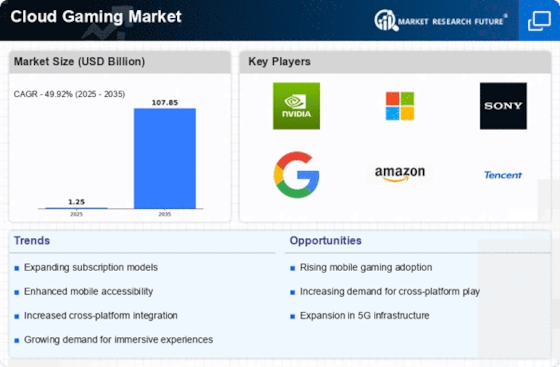
As per Market Research Future analysis, the Cloud Gaming Market Size was estimated at 1.254 USD Billion in 2024. The Cloud Gaming industry is projected to grow from USD 1.88 Billion in 2025 to USD 107.85 Billion by 2035, exhibiting a compound annual growth rate (CAGR) of 49.92% during the forecast period 2025 - 2035

Key Market Trends & Highlights

The Cloud Gaming Market is experiencing robust growth driven by technological advancements and evolving consumer preferences.

  • The market is witnessing increased accessibility, allowing a broader audience to engage with cloud gaming services. Subscription-based models are becoming prevalent, providing gamers with flexible access to extensive game libraries. Collaborative partnerships among gaming companies and cloud service providers are enhancing service offerings and user experiences. Technological advancements and rising demand for mobile gaming are key drivers propelling the market, particularly in North America and Asia-Pacific, with mobile being the largest segment and adventure games growing rapidly.

Market Size & Forecast

2024 Market Size 1.254 (USD Billion)
2035 Market Size 107.85 (USD Billion)
CAGR (2025 - 2035) 49.92%
Largest Regional Market Share in 2024 North America

Major Players

NVIDIA (US), Microsoft (US), Sony (JP), Google (US), Amazon (US), Tencent (CN), Samsung (KR), Apple (US), Ubisoft (FR)

Market Trends

The Cloud Gaming Market is currently experiencing a transformative phase, characterized by rapid technological advancements and shifting consumer preferences. As internet connectivity improves globally, more players are gravitating towards cloud-based gaming solutions, which offer the convenience of accessing high-quality games without the need for expensive hardware. This trend appears to be driven by the increasing demand for seamless gaming experiences, allowing users to engage with their favorite titles across various devices. Furthermore, the rise of subscription-based models is reshaping the landscape, providing gamers with flexible options that enhance accessibility and affordability.

Growth in pc gaming apps reflects increasing demand for high-performance gaming app for PC environments. The mobile gaming market size continues to expand as cloud streaming reduces hardware dependency. Leading cloud gaming companies are investing in scalable cloud based gaming platforms to improve user engagement. Subscription-driven cloud based gaming services are reshaping monetization strategies. Current gaming insights highlight increasing consolidation within the global video game industry. The gaming industry market share continues shifting toward cloud-enabled ecosystems. The cloud based gaming market continues to expand as industry players increase their market share through subscription-driven platforms.

In addition to technological improvements, the Cloud Gaming Market is witnessing a surge in partnerships between gaming companies and cloud service providers. These collaborations seem to facilitate the development of innovative platforms that enhance user engagement and retention. Moreover, the growing interest in esports and competitive gaming is likely to further propel the market, as cloud gaming solutions offer unique opportunities for real-time participation and interaction. Overall, the Cloud Gaming Market appears poised for continued growth, driven by evolving consumer expectations and advancements in digital infrastructure.

The global cloud based gaming market is witnessing rapid gaming industry growth, driven by demand for high-performance streaming and cross-device accessibility. The gaming market size is expanding rapidly as cloud infrastructure enables scalable distribution models. The gaming industry worth is projected to grow significantly, supported by subscription-based ecosystems. The gaming forecast indicates sustained adoption across mobile and console platforms. Improvements in gaming in the cloud are enabling smooth video streaming cloud gaming experiences across devices. Advanced infrastructure supports smoother video streaming cloud gaming, reducing latency and enhancing responsiveness.

Increased Accessibility

The Cloud Gaming Market is becoming more accessible to a broader audience. As internet speeds improve and mobile devices become more powerful, gamers can enjoy high-quality experiences without the need for dedicated consoles or PCs. This trend suggests that gaming is evolving into a more inclusive form of entertainment, appealing to casual players and hardcore enthusiasts alike.

Subscription-Based Models

The emergence of subscription-based models is reshaping the Cloud Gaming Market. These services allow users to access a vast library of games for a fixed monthly fee, which may enhance user engagement and retention. This shift indicates a move away from traditional purchasing methods, potentially making gaming more affordable and appealing to a wider demographic.

Collaborative Partnerships

Collaborations between gaming developers and cloud service providers are on the rise within the Cloud Gaming Market. These partnerships appear to foster innovation, leading to the creation of advanced platforms that enhance user experiences. Such alliances may also streamline the development process, allowing for quicker deployment of new titles and features.

Cloud Gaming Market Market Drivers

Technological Advancements

The Cloud Gaming Market is experiencing rapid technological advancements that enhance user experience and accessibility. Innovations in cloud infrastructure, such as edge computing and 5G networks, are pivotal in reducing latency and improving streaming quality. As of October 2025, the integration of artificial intelligence and machine learning into gaming platforms is likely to personalize user experiences, making games more engaging. Furthermore, advancements in graphics rendering technology enable high-quality visuals without the need for powerful local hardware. This shift towards more sophisticated technology not only attracts gamers but also encourages developers to create more complex and immersive games. The increasing availability of high-speed internet connections further supports the growth of the Cloud Gaming Market, allowing more users to access cloud gaming services seamlessly.

Expansion of Game Libraries

The Cloud Gaming Market is benefiting from the expansion of game libraries offered by various platforms. As of October 2025, many cloud gaming services are partnering with game developers to provide an extensive range of titles, including both classic and newly released games. This diversification of content is crucial in attracting a wider audience, as gamers are increasingly looking for platforms that offer a comprehensive selection of games. The availability of exclusive titles and popular franchises can significantly enhance a service's appeal, potentially leading to increased subscriptions and user engagement. Furthermore, the expansion of game libraries is likely to foster a competitive environment among cloud gaming providers, encouraging innovation and improved service offerings within the Cloud Gaming Market.

Evolving Consumer Preferences

The Cloud Gaming Market is significantly influenced by evolving consumer preferences, particularly among younger demographics. As of October 2025, there is a noticeable shift towards on-demand gaming experiences, where players prefer instant access to a wide variety of games without the need for physical copies. This trend aligns with the increasing popularity of subscription-based models, which offer gamers the flexibility to play multiple titles for a fixed monthly fee. Additionally, consumers are becoming more environmentally conscious, favoring digital solutions over traditional gaming methods that require physical media. This shift in preferences is likely to drive the growth of the Cloud Gaming Market, as it aligns with the desires of a new generation of gamers who prioritize convenience and sustainability.

Rising Demand for Mobile Gaming

The Cloud Gaming Market is witnessing a surge in demand for mobile gaming, driven by the proliferation of smartphones and tablets. As of October 2025, mobile gaming accounts for a substantial portion of the overall gaming market, with estimates suggesting that it could represent over 50% of total gaming revenue. This trend is compelling cloud gaming providers to optimize their services for mobile platforms, ensuring that users can enjoy high-quality gaming experiences on the go. The convenience of mobile gaming, combined with the ability to access a vast library of games without the need for expensive hardware, is likely to attract a broader audience. Consequently, the Cloud Gaming Market is expected to expand as more players engage with cloud-based gaming solutions through their mobile devices.

Increased Investment in Cloud Infrastructure

The Cloud Gaming Market is experiencing increased investment in cloud infrastructure, which is essential for supporting the growing demand for gaming services. As of October 2025, major technology companies are allocating substantial resources to enhance their cloud capabilities, focusing on improving server performance and reducing latency. This investment is critical for delivering high-quality gaming experiences, as it allows for smoother gameplay and faster load times. Additionally, the expansion of data centers across various regions is likely to improve accessibility for users, ensuring that more gamers can benefit from cloud gaming services. The ongoing development of robust cloud infrastructure is expected to play a vital role in the future growth of the Cloud Gaming Market, as it lays the foundation for more advanced gaming solutions.

Market Segment Insights

By Application: Gaming (Largest) vs. Virtual Reality (Fastest-Growing)

<p>In the cloud gaming market, the application segment is primarily driven by Gaming, which currently commands the largest market share. The convenience of playing AAA games without the need for high-end hardware has contributed to its widespread adoption. Streaming also plays a vital role, catering to users who prefer watching gameplay live or on-demand, while Social Interaction features enhance the gaming experience further. On the other hand, Virtual Reality and Augmented Reality represent the emerging frontier with significant growth potential, appealing to users seeking immersive experiences.</p>

<p>Gaming: Dominant vs. Virtual Reality: Emerging</p>

<p>The dominant segment of Gaming is characterized by its broad appeal and established user base, offering a rich library of titles that cater to diverse interests. This segment is well-supported by cloud infrastructure, reducing latency and enabling seamless multiplayer experiences. In contrast, Virtual Reality is emerging as a game-changer within the cloud gaming market, leveraging technological advancements to provide immersive environments. While currently smaller in market share, its rapid growth rate indicates a rising demand among gamers eager for new experiences. As hardware becomes more affordable and content libraries expand, Virtual Reality is poised to redefine the gaming landscape.</p>

By End User: Casual Gamers (Largest) vs. Professional Gamers (Fastest-Growing)

<p>In the cloud gaming market, consumptions by end users are heavily skewed. Casual gamers hold the largest portion of the market due to their preference for easy accessibility and diverse game offerings. With various games catering to varying skill levels, this group attracts a vast audience, gravitating towards user-friendly interfaces and affordable options. On the other hand, professional gamers, while a smaller segment, are rapidly increasing their market share. Their commitment to competitive gaming and emerging esports trends significantly enhances their influence on the cloud gaming landscape.</p>

<p>Casual Gamers (Dominant) vs. Professional Gamers (Emerging)</p>

<p>Casual gamers are characterized by their diverse preferences and flexibility, seeking games that are easily accessible and enjoyable without necessitating extensive time investment. This segment significantly benefits from cloud gaming platforms that offer a myriad of titles across various genres, ensuring broad appeal. In contrast, professional gamers, often niche but growing, demand high-performance gaming experiences with minimal latency and advanced features. Their focus on competitive play and participation in esports is prompting platforms to enhance their offerings to cater to this group's specific needs. As the market evolves, the interaction between these segment values will shape the future of cloud gaming.</p>

By Technology: Cloud Infrastructure (Largest) vs. Content Delivery Networks (Fastest-Growing)

<p>In the cloud gaming market, the technology segment is primarily composed of Cloud Infrastructure, Network Latency Solutions, Content Delivery Networks, and Data Compression Techniques. Among these, Cloud Infrastructure holds the largest market share, as it forms the backbone of cloud gaming services, providing the necessary support for game storage and processing. In contrast, Content Delivery Networks are emerging rapidly, driven by the increasing emphasis on low latency and high-quality streaming experiences that gamers demand.</p>

<p>Technology: Cloud Infrastructure (Dominant) vs. Content Delivery Networks (Emerging)</p>

<p>Cloud Infrastructure stands as the dominant force in the cloud gaming segment, owing to its robust architecture that supports seamless game streaming and scalability. It includes powerful servers and storage solutions, thus ensuring that players have access to a vast library of games with minimal downtime. On the other hand, Content Delivery Networks are emerging as a crucial component for enhancing gaming experiences by minimizing latency and buffering issues. As gamers increasingly seek speed and reliability, CDNs are witnessing rapid growth, and their strategic implementation will significantly shape the future landscape of cloud gaming.</p>

By Device Type: Smartphones (Largest) vs. Personal Computers (Fastest-Growing)

<p>In the cloud gaming market, device type segments exhibit distinct preferences among consumers. Smartphones currently dominate the market, appealing to a wide user base due to their accessibility and convenience. Personal computers, while historically strong in gaming, are finding renewed interest as they adapt to the demands of cloud gaming, optimizing performance and gameplay experience. Tablets and Smart TVs also contribute to the ecosystem, albeit to a lesser degree. As these devices strive for greater integration with cloud platforms, their share remains stable but modest. The growth trajectory for device types in cloud gaming is particularly influenced by technological advancements and changes in consumer behavior. Smartphones are benefiting from the increasing capabilities of mobile networks, enhancing gaming experiences on the go. Meanwhile, personal computers are emerging as the fastest-growing segment, with gamers seeking high-performance options for cloud solutions. This trend indicates a shift toward more immersive experiences on larger screens, reflecting the evolving preferences of the gaming demographic, which increasingly values versatility and performance across multiple devices.</p>

<p>Smartphones (Dominant) vs. Personal Computers (Emerging)</p>

<p>Smartphones have emerged as the dominant device in the cloud gaming segment due to their portability, widespread adoption, and improvement in processing capabilities. Their user-friendly interfaces and easy access to game libraries play a significant role in attracting casual gamers and those who prefer gaming on the go. In contrast, personal computers are positioning themselves as an emerging segment in the cloud gaming realm. With gamers increasingly seeking superior gameplay and graphics performance, PCs are adapting rapidly by enhancing their specifications and optimizing for cloud gaming environments. This adaptability underscores the importance of high-performance hardware, offering gamers a richer, larger-than-life experience that aligns well with the demands of modern gaming.</p>

Get more detailed insights about Cloud Gaming Market Research Report - Global Forecast till 2035

Regional Insights

North America : Innovation and Market Leadership

North America is the largest market for cloud gaming, holding approximately 45% of the global share. The region's growth is driven by high internet penetration, advanced gaming infrastructure, and a strong consumer base eager for innovative gaming experiences. Regulatory support for digital services and cloud technologies further catalyzes market expansion, making it a hub for investment and development in gaming technologies. The competitive landscape is dominated by major players such as NVIDIA, Microsoft, and Google, which are continuously innovating to enhance user experience. The U.S. leads in cloud gaming adoption, with significant contributions from Canada. The presence of tech giants and a robust startup ecosystem fosters a dynamic environment for cloud gaming, ensuring a steady influx of new technologies and services.

Europe : Emerging Market with Potential

Europe is witnessing a rapid increase in cloud gaming adoption, currently holding about 30% of the global market share. The region benefits from a diverse consumer base and strong regulatory frameworks that support digital innovation. Countries like Germany and the UK are leading this growth, driven by high-speed internet access and increasing demand for flexible gaming solutions. Regulatory bodies are also promoting digital services, which enhances market potential. Leading countries in Europe include the UK, Germany, and France, where companies like Ubisoft and Sony are making significant investments. The competitive landscape is characterized by both established players and emerging startups, creating a vibrant ecosystem. The presence of key players and a focus on user experience are pivotal in shaping the future of cloud gaming in Europe.

Asia-Pacific : Rapid Growth and Innovation

Asia-Pacific is rapidly emerging as a significant player in the cloud gaming market, accounting for approximately 20% of the global share. The region's growth is fueled by increasing smartphone penetration, a young population, and a growing appetite for gaming. Countries like China and Japan are at the forefront, with supportive government policies that encourage technological advancements and digital entertainment, driving market expansion. China, with its vast gaming community, is a key player, alongside Japan, which has a strong gaming culture. The competitive landscape features major companies like Tencent and Sony, which are investing heavily in cloud gaming technologies. The region's unique blend of traditional gaming and modern cloud solutions is creating a dynamic environment for growth, attracting both local and international investments.

Middle East and Africa : Emerging Market with Challenges

The Middle East and Africa region is gradually emerging in the cloud gaming market, currently holding about 5% of the global share. The growth is driven by increasing internet accessibility and a young, tech-savvy population eager for new gaming experiences. However, challenges such as infrastructure limitations and regulatory hurdles remain. Countries like South Africa and the UAE are leading the charge, with initiatives aimed at enhancing digital services and gaming infrastructure. In this region, the competitive landscape is still developing, with local startups and international players vying for market share. The presence of key players like Samsung and emerging local companies is fostering innovation. As governments focus on improving digital infrastructure, the potential for cloud gaming in the Middle East and Africa is significant, paving the way for future growth.

Key Players and Competitive Insights

The Cloud Gaming Market is currently characterized by a dynamic competitive landscape, driven by rapid technological advancements and increasing consumer demand for seamless gaming experiences. Major players such as NVIDIA (US), Microsoft (US), and Sony (JP) are at the forefront, each adopting distinct strategies to enhance their market positioning. NVIDIA (US) focuses on leveraging its powerful graphics processing units (GPUs) to deliver high-quality cloud gaming experiences, while Microsoft (US) emphasizes its Xbox Game Pass service, integrating cloud gaming with its extensive library of games. Sony (JP), on the other hand, is enhancing its PlayStation Now service, aiming to create a more immersive gaming ecosystem. Collectively, these strategies indicate a trend towards innovation and user-centric offerings, shaping a competitive environment that prioritizes quality and accessibility.In terms of business tactics, companies are increasingly localizing their services to cater to regional preferences and optimizing their supply chains to enhance efficiency. The Cloud Gaming Market appears moderately fragmented, with a mix of established players and emerging startups. The collective influence of key players is significant, as they not only drive technological advancements but also set industry standards that smaller competitors often follow.
In August NVIDIA (US) announced the launch of its new cloud gaming platform, which utilizes advanced AI algorithms to optimize game streaming quality. This strategic move is pivotal as it positions NVIDIA to capitalize on the growing demand for high-fidelity gaming experiences, potentially attracting a broader audience and enhancing user engagement. The integration of AI into their platform may also provide a competitive edge by improving latency and overall performance.
In September Microsoft (US) unveiled a partnership with several telecommunications companies to enhance its cloud gaming infrastructure. This collaboration aims to improve network reliability and reduce latency for gamers across various regions. Such strategic alliances are crucial, as they not only bolster Microsoft's service delivery but also reflect a broader trend of companies seeking synergies to enhance their competitive positioning in the market.
In October Sony (JP) announced an expansion of its PlayStation Now service into new international markets, including several countries in Southeast Asia. This move is significant as it demonstrates Sony's commitment to global expansion and its strategy to tap into emerging markets with high growth potential. By localizing content and services, Sony aims to strengthen its foothold in these regions, potentially increasing its market share in the cloud gaming sector.
As of October current competitive trends in the Cloud Gaming Market are heavily influenced by digitalization, sustainability, and the integration of AI technologies. Strategic alliances among key players are reshaping the landscape, fostering innovation and collaboration. Looking ahead, competitive differentiation is likely to evolve, with a shift from price-based competition towards a focus on technological innovation, user experience, and supply chain reliability. This transition suggests that companies will need to invest in cutting-edge technologies and sustainable practices to maintain their competitive edge.

Key Companies in the Cloud Gaming Market include

Industry Developments

Recent developments in the Global Cloud Gaming Market highlight significant growth and strategic moves by key players. In October 2023, Tencent announced an expansion of its cloud gaming service to enhance accessibility in emerging markets, aiming to capture a larger user base. AMD and Nvidia are competing to improve graphics capabilities, impacting the performance of cloud gaming platforms. Microsoft continues to invest heavily in its Xbox Cloud Gaming Market services, emphasizing user experience and platform integration.

In September 2023, Google rebranded its cloud gaming service, effectively positioning it to compete with traditional console gaming, while Sony's PlayStation now offers extensive cloud-based features. Notably, in August 2023, Valve entered a partnership with Epic Games to provide a more diverse library of games for cloud users. Recent acquisitions include Blacknut acquiring additional IPs to bolster its game catalog, enhancing its competitive stance. Over the past two to three years, the market has seen a robust annual growth rate, driven by increased internet penetration and demand for remote gaming experiences, effectively reshaping the industry's landscape worldwide.

Future Outlook

Cloud Gaming Market Future Outlook

The Cloud Gaming Market is projected to grow at a 49.92% CAGR from 2025 to 2035, driven by technological advancements, increased internet penetration, and evolving consumer preferences.

New opportunities lie in:

  • <p>Development of subscription-based gaming platforms targeting diverse demographics. Partnerships with telecom providers to enhance bandwidth and reduce latency. Investment in AI-driven personalized gaming experiences to boost user engagement.</p>

By 2035, the Cloud Gaming Market is expected to be a dominant force in the global gaming industry.

Market Segmentation

Cloud Gaming Market Platform Outlook

  • PC
  • Mobile
  • Console
  • Smart TV

Cloud Gaming Market Game Type Outlook

  • Action
  • Adventure
  • Role-playing
  • Strategy
  • Sports

Cloud Gaming Market User Type Outlook

  • Casual Gamers
  • Core Gamers
  • Professional Gamers

Cloud Gaming Market Service Model Outlook

  • Subscription-Based
  • Pay-Per-Use
  • Freemium

Report Scope

MARKET SIZE 2024 1.254(USD Billion)
MARKET SIZE 2025 1.88(USD Billion)
MARKET SIZE 2035 107.85(USD Billion)
COMPOUND ANNUAL GROWTH RATE (CAGR) 49.92% (2025 - 2035)
REPORT COVERAGE Revenue Forecast, Competitive Landscape, Growth Factors, and Trends
BASE YEAR 2024
Market Forecast Period 2025 - 2035
Historical Data 2019 - 2024
Market Forecast Units USD Billion
Key Companies Profiled NVIDIA (US), Microsoft (US), Sony (JP), Google (US), Amazon (US), Tencent (CN), Samsung (KR), Apple (US), Ubisoft (FR)
Segments Covered Platform, Game Type, Service Model, User Type, Regional
Key Market Opportunities Integration of advanced artificial intelligence enhances user experience in the Cloud Gaming Market.
Key Market Dynamics Rising consumer demand for seamless gaming experiences drives technological advancements and competitive dynamics in the Cloud Gaming Market.
Countries Covered North America, Europe, APAC, South America, MEA

FAQs

What is the current valuation of the cloud gaming market in 2025?

<p>The cloud gaming market valuation stands at 18.0 USD Billion in 2025.</p>

What is the projected market size for cloud gaming by 2035?

<p>The market is expected to reach a valuation of 37.0 USD Billion by 2035.</p>

What is the expected CAGR for the cloud gaming market during the forecast period 2025 - 2035?

<p>The cloud gaming market is anticipated to grow at a CAGR of 6.77% from 2025 to 2035.</p>

Which companies are considered key players in the cloud gaming market?

<p>Key players include NVIDIA, Microsoft, Sony, Google, Amazon, Tencent, Samsung, Apple, and Ubisoft.</p>

What are the primary applications driving the cloud gaming market?

<p>The main applications include Gaming, Streaming, Social Interaction, Virtual Reality, and Augmented Reality.</p>

How do the revenues from casual gamers compare to professional gamers in 2025?

<p>In 2025, revenues from casual gamers are projected to be 12.0 USD Billion, while professional gamers are expected to generate 8.0 USD Billion.</p>

What technological segments contribute to the cloud gaming market's growth?

<p>Technological segments include Cloud Infrastructure, Network Latency Solutions, Content Delivery Networks, and Data Compression Techniques.</p>

Which devices are most commonly used for cloud gaming in 2025?

<p>The most common devices for cloud gaming include Smartphones, Personal Computers, Smart TVs, and Tablets.</p>

What is the revenue projection for streaming platforms in the cloud gaming market?

<p>Streaming platforms are projected to generate revenues of 11.0 USD Billion by 2035.</p>

How does the revenue from content delivery networks impact the cloud gaming market?

<p>Content Delivery Networks are expected to contribute between 5.0 and 10.0 USD Billion, indicating their importance in the market.</p>

  1. SECTION I: EXECUTIVE SUMMARY AND KEY HIGHLIGHTS
    1. | 1.1 EXECUTIVE SUMMARY
    2. | | 1.1.1 Market Overview
    3. | | 1.1.2 Key Findings
    4. | | 1.1.3 Market Segmentation
    5. | | 1.1.4 Competitive Landscape
    6. | | 1.1.5 Challenges and Opportunities
    7. | | 1.1.6 Future Outlook
  2. SECTION II: SCOPING, METHODOLOGY AND MARKET STRUCTURE
    1. | 2.1 MARKET INTRODUCTION
    2. | | 2.1.1 Definition
    3. | | 2.1.2 Scope of the study
    4. | | | 2.1.2.1 Research Objective
    5. | | | 2.1.2.2 Assumption
    6. | | | 2.1.2.3 Limitations
    7. | 2.2 RESEARCH METHODOLOGY
    8. | | 2.2.1 Overview
    9. | | 2.2.2 Data Mining
    10. | | 2.2.3 Secondary Research
    11. | | 2.2.4 Primary Research
    12. | | | 2.2.4.1 Primary Interviews and Information Gathering Process
    13. | | | 2.2.4.2 Breakdown of Primary Respondents
    14. | | 2.2.5 Forecasting Model
    15. | | 2.2.6 Market Size Estimation
    16. | | | 2.2.6.1 Bottom-Up Approach
    17. | | | 2.2.6.2 Top-Down Approach
    18. | | 2.2.7 Data Triangulation
    19. | | 2.2.8 Validation
  3. SECTION III: QUALITATIVE ANALYSIS
    1. | 3.1 MARKET DYNAMICS
    2. | | 3.1.1 Overview
    3. | | 3.1.2 Drivers
    4. | | 3.1.3 Restraints
    5. | | 3.1.4 Opportunities
    6. | 3.2 MARKET FACTOR ANALYSIS
    7. | | 3.2.1 Value chain Analysis
    8. | | 3.2.2 Porter's Five Forces Analysis
    9. | | | 3.2.2.1 Bargaining Power of Suppliers
    10. | | | 3.2.2.2 Bargaining Power of Buyers
    11. | | | 3.2.2.3 Threat of New Entrants
    12. | | | 3.2.2.4 Threat of Substitutes
    13. | | | 3.2.2.5 Intensity of Rivalry
    14. | | 3.2.3 COVID-19 Impact Analysis
    15. | | | 3.2.3.1 Market Impact Analysis
    16. | | | 3.2.3.2 Regional Impact
    17. | | | 3.2.3.3 Opportunity and Threat Analysis
  4. SECTION IV: QUANTITATIVE ANALYSIS
    1. | 4.1 Information and Communications Technology, BY Application (USD Billion)
    2. | | 4.1.1 Gaming
    3. | | 4.1.2 Streaming
    4. | | 4.1.3 Social Interaction
    5. | | 4.1.4 Virtual Reality
    6. | | 4.1.5 Augmented Reality
    7. | 4.2 Information and Communications Technology, BY End User (USD Billion)
    8. | | 4.2.1 Casual Gamers
    9. | | 4.2.2 Professional Gamers
    10. | | 4.2.3 Game Developers
    11. | | 4.2.4 Streaming Platforms
    12. | 4.3 Information and Communications Technology, BY Technology (USD Billion)
    13. | | 4.3.1 Cloud Infrastructure
    14. | | 4.3.2 Network Latency Solutions
    15. | | 4.3.3 Content Delivery Networks
    16. | | 4.3.4 Data Compression Techniques
    17. | 4.4 Information and Communications Technology, BY Device Type (USD Billion)
    18. | | 4.4.1 Smartphones
    19. | | 4.4.2 Tablets
    20. | | 4.4.3 Personal Computers
    21. | | 4.4.4 Smart TVs
    22. | 4.5 Information and Communications Technology, BY Region (USD Billion)
    23. | | 4.5.1 North America
    24. | | | 4.5.1.1 US
    25. | | | 4.5.1.2 Canada
    26. | | 4.5.2 Europe
    27. | | | 4.5.2.1 Germany
    28. | | | 4.5.2.2 UK
    29. | | | 4.5.2.3 France
    30. | | | 4.5.2.4 Russia
    31. | | | 4.5.2.5 Italy
    32. | | | 4.5.2.6 Spain
    33. | | | 4.5.2.7 Rest of Europe
    34. | | 4.5.3 APAC
    35. | | | 4.5.3.1 China
    36. | | | 4.5.3.2 India
    37. | | | 4.5.3.3 Japan
    38. | | | 4.5.3.4 South Korea
    39. | | | 4.5.3.5 Malaysia
    40. | | | 4.5.3.6 Thailand
    41. | | | 4.5.3.7 Indonesia
    42. | | | 4.5.3.8 Rest of APAC
    43. | | 4.5.4 South America
    44. | | | 4.5.4.1 Brazil
    45. | | | 4.5.4.2 Mexico
    46. | | | 4.5.4.3 Argentina
    47. | | | 4.5.4.4 Rest of South America
    48. | | 4.5.5 MEA
    49. | | | 4.5.5.1 GCC Countries
    50. | | | 4.5.5.2 South Africa
    51. | | | 4.5.5.3 Rest of MEA
  5. SECTION V: COMPETITIVE ANALYSIS
    1. | 5.1 Competitive Landscape
    2. | | 5.1.1 Overview
    3. | | 5.1.2 Competitive Analysis
    4. | | 5.1.3 Market share Analysis
    5. | | 5.1.4 Major Growth Strategy in the Information and Communications Technology
    6. | | 5.1.5 Competitive Benchmarking
    7. | | 5.1.6 Leading Players in Terms of Number of Developments in the Information and Communications Technology
    8. | | 5.1.7 Key developments and growth strategies
    9. | | | 5.1.7.1 New Product Launch/Service Deployment
    10. | | | 5.1.7.2 Merger & Acquisitions
    11. | | | 5.1.7.3 Joint Ventures
    12. | | 5.1.8 Major Players Financial Matrix
    13. | | | 5.1.8.1 Sales and Operating Income
    14. | | | 5.1.8.2 Major Players R&D Expenditure. 2023
    15. | 5.2 Company Profiles
    16. | | 5.2.1 NVIDIA (US)
    17. | | | 5.2.1.1 Financial Overview
    18. | | | 5.2.1.2 Products Offered
    19. | | | 5.2.1.3 Key Developments
    20. | | | 5.2.1.4 SWOT Analysis
    21. | | | 5.2.1.5 Key Strategies
    22. | | 5.2.2 Microsoft (US)
    23. | | | 5.2.2.1 Financial Overview
    24. | | | 5.2.2.2 Products Offered
    25. | | | 5.2.2.3 Key Developments
    26. | | | 5.2.2.4 SWOT Analysis
    27. | | | 5.2.2.5 Key Strategies
    28. | | 5.2.3 Sony (JP)
    29. | | | 5.2.3.1 Financial Overview
    30. | | | 5.2.3.2 Products Offered
    31. | | | 5.2.3.3 Key Developments
    32. | | | 5.2.3.4 SWOT Analysis
    33. | | | 5.2.3.5 Key Strategies
    34. | | 5.2.4 Google (US)
    35. | | | 5.2.4.1 Financial Overview
    36. | | | 5.2.4.2 Products Offered
    37. | | | 5.2.4.3 Key Developments
    38. | | | 5.2.4.4 SWOT Analysis
    39. | | | 5.2.4.5 Key Strategies
    40. | | 5.2.5 Amazon (US)
    41. | | | 5.2.5.1 Financial Overview
    42. | | | 5.2.5.2 Products Offered
    43. | | | 5.2.5.3 Key Developments
    44. | | | 5.2.5.4 SWOT Analysis
    45. | | | 5.2.5.5 Key Strategies
    46. | | 5.2.6 Tencent (CN)
    47. | | | 5.2.6.1 Financial Overview
    48. | | | 5.2.6.2 Products Offered
    49. | | | 5.2.6.3 Key Developments
    50. | | | 5.2.6.4 SWOT Analysis
    51. | | | 5.2.6.5 Key Strategies
    52. | | 5.2.7 Samsung (KR)
    53. | | | 5.2.7.1 Financial Overview
    54. | | | 5.2.7.2 Products Offered
    55. | | | 5.2.7.3 Key Developments
    56. | | | 5.2.7.4 SWOT Analysis
    57. | | | 5.2.7.5 Key Strategies
    58. | | 5.2.8 Apple (US)
    59. | | | 5.2.8.1 Financial Overview
    60. | | | 5.2.8.2 Products Offered
    61. | | | 5.2.8.3 Key Developments
    62. | | | 5.2.8.4 SWOT Analysis
    63. | | | 5.2.8.5 Key Strategies
    64. | | 5.2.9 Ubisoft (FR)
    65. | | | 5.2.9.1 Financial Overview
    66. | | | 5.2.9.2 Products Offered
    67. | | | 5.2.9.3 Key Developments
    68. | | | 5.2.9.4 SWOT Analysis
    69. | | | 5.2.9.5 Key Strategies
    70. | 5.3 Appendix
    71. | | 5.3.1 References
    72. | | 5.3.2 Related Reports
  6. LIST OF FIGURES
    1. | 6.1 MARKET SYNOPSIS
    2. | 6.2 NORTH AMERICA MARKET ANALYSIS
    3. | 6.3 US MARKET ANALYSIS BY APPLICATION
    4. | 6.4 US MARKET ANALYSIS BY END USER
    5. | 6.5 US MARKET ANALYSIS BY TECHNOLOGY
    6. | 6.6 US MARKET ANALYSIS BY DEVICE TYPE
    7. | 6.7 CANADA MARKET ANALYSIS BY APPLICATION
    8. | 6.8 CANADA MARKET ANALYSIS BY END USER
    9. | 6.9 CANADA MARKET ANALYSIS BY TECHNOLOGY
    10. | 6.10 CANADA MARKET ANALYSIS BY DEVICE TYPE
    11. | 6.11 EUROPE MARKET ANALYSIS
    12. | 6.12 GERMANY MARKET ANALYSIS BY APPLICATION
    13. | 6.13 GERMANY MARKET ANALYSIS BY END USER
    14. | 6.14 GERMANY MARKET ANALYSIS BY TECHNOLOGY
    15. | 6.15 GERMANY MARKET ANALYSIS BY DEVICE TYPE
    16. | 6.16 UK MARKET ANALYSIS BY APPLICATION
    17. | 6.17 UK MARKET ANALYSIS BY END USER
    18. | 6.18 UK MARKET ANALYSIS BY TECHNOLOGY
    19. | 6.19 UK MARKET ANALYSIS BY DEVICE TYPE
    20. | 6.20 FRANCE MARKET ANALYSIS BY APPLICATION
    21. | 6.21 FRANCE MARKET ANALYSIS BY END USER
    22. | 6.22 FRANCE MARKET ANALYSIS BY TECHNOLOGY
    23. | 6.23 FRANCE MARKET ANALYSIS BY DEVICE TYPE
    24. | 6.24 RUSSIA MARKET ANALYSIS BY APPLICATION
    25. | 6.25 RUSSIA MARKET ANALYSIS BY END USER
    26. | 6.26 RUSSIA MARKET ANALYSIS BY TECHNOLOGY
    27. | 6.27 RUSSIA MARKET ANALYSIS BY DEVICE TYPE
    28. | 6.28 ITALY MARKET ANALYSIS BY APPLICATION
    29. | 6.29 ITALY MARKET ANALYSIS BY END USER
    30. | 6.30 ITALY MARKET ANALYSIS BY TECHNOLOGY
    31. | 6.31 ITALY MARKET ANALYSIS BY DEVICE TYPE
    32. | 6.32 SPAIN MARKET ANALYSIS BY APPLICATION
    33. | 6.33 SPAIN MARKET ANALYSIS BY END USER
    34. | 6.34 SPAIN MARKET ANALYSIS BY TECHNOLOGY
    35. | 6.35 SPAIN MARKET ANALYSIS BY DEVICE TYPE
    36. | 6.36 REST OF EUROPE MARKET ANALYSIS BY APPLICATION
    37. | 6.37 REST OF EUROPE MARKET ANALYSIS BY END USER
    38. | 6.38 REST OF EUROPE MARKET ANALYSIS BY TECHNOLOGY
    39. | 6.39 REST OF EUROPE MARKET ANALYSIS BY DEVICE TYPE
    40. | 6.40 APAC MARKET ANALYSIS
    41. | 6.41 CHINA MARKET ANALYSIS BY APPLICATION
    42. | 6.42 CHINA MARKET ANALYSIS BY END USER
    43. | 6.43 CHINA MARKET ANALYSIS BY TECHNOLOGY
    44. | 6.44 CHINA MARKET ANALYSIS BY DEVICE TYPE
    45. | 6.45 INDIA MARKET ANALYSIS BY APPLICATION
    46. | 6.46 INDIA MARKET ANALYSIS BY END USER
    47. | 6.47 INDIA MARKET ANALYSIS BY TECHNOLOGY
    48. | 6.48 INDIA MARKET ANALYSIS BY DEVICE TYPE
    49. | 6.49 JAPAN MARKET ANALYSIS BY APPLICATION
    50. | 6.50 JAPAN MARKET ANALYSIS BY END USER
    51. | 6.51 JAPAN MARKET ANALYSIS BY TECHNOLOGY
    52. | 6.52 JAPAN MARKET ANALYSIS BY DEVICE TYPE
    53. | 6.53 SOUTH KOREA MARKET ANALYSIS BY APPLICATION
    54. | 6.54 SOUTH KOREA MARKET ANALYSIS BY END USER
    55. | 6.55 SOUTH KOREA MARKET ANALYSIS BY TECHNOLOGY
    56. | 6.56 SOUTH KOREA MARKET ANALYSIS BY DEVICE TYPE
    57. | 6.57 MALAYSIA MARKET ANALYSIS BY APPLICATION
    58. | 6.58 MALAYSIA MARKET ANALYSIS BY END USER
    59. | 6.59 MALAYSIA MARKET ANALYSIS BY TECHNOLOGY
    60. | 6.60 MALAYSIA MARKET ANALYSIS BY DEVICE TYPE
    61. | 6.61 THAILAND MARKET ANALYSIS BY APPLICATION
    62. | 6.62 THAILAND MARKET ANALYSIS BY END USER
    63. | 6.63 THAILAND MARKET ANALYSIS BY TECHNOLOGY
    64. | 6.64 THAILAND MARKET ANALYSIS BY DEVICE TYPE
    65. | 6.65 INDONESIA MARKET ANALYSIS BY APPLICATION
    66. | 6.66 INDONESIA MARKET ANALYSIS BY END USER
    67. | 6.67 INDONESIA MARKET ANALYSIS BY TECHNOLOGY
    68. | 6.68 INDONESIA MARKET ANALYSIS BY DEVICE TYPE
    69. | 6.69 REST OF APAC MARKET ANALYSIS BY APPLICATION
    70. | 6.70 REST OF APAC MARKET ANALYSIS BY END USER
    71. | 6.71 REST OF APAC MARKET ANALYSIS BY TECHNOLOGY
    72. | 6.72 REST OF APAC MARKET ANALYSIS BY DEVICE TYPE
    73. | 6.73 SOUTH AMERICA MARKET ANALYSIS
    74. | 6.74 BRAZIL MARKET ANALYSIS BY APPLICATION
    75. | 6.75 BRAZIL MARKET ANALYSIS BY END USER
    76. | 6.76 BRAZIL MARKET ANALYSIS BY TECHNOLOGY
    77. | 6.77 BRAZIL MARKET ANALYSIS BY DEVICE TYPE
    78. | 6.78 MEXICO MARKET ANALYSIS BY APPLICATION
    79. | 6.79 MEXICO MARKET ANALYSIS BY END USER
    80. | 6.80 MEXICO MARKET ANALYSIS BY TECHNOLOGY
    81. | 6.81 MEXICO MARKET ANALYSIS BY DEVICE TYPE
    82. | 6.82 ARGENTINA MARKET ANALYSIS BY APPLICATION
    83. | 6.83 ARGENTINA MARKET ANALYSIS BY END USER
    84. | 6.84 ARGENTINA MARKET ANALYSIS BY TECHNOLOGY
    85. | 6.85 ARGENTINA MARKET ANALYSIS BY DEVICE TYPE
    86. | 6.86 REST OF SOUTH AMERICA MARKET ANALYSIS BY APPLICATION
    87. | 6.87 REST OF SOUTH AMERICA MARKET ANALYSIS BY END USER
    88. | 6.88 REST OF SOUTH AMERICA MARKET ANALYSIS BY TECHNOLOGY
    89. | 6.89 REST OF SOUTH AMERICA MARKET ANALYSIS BY DEVICE TYPE
    90. | 6.90 MEA MARKET ANALYSIS
    91. | 6.91 GCC COUNTRIES MARKET ANALYSIS BY APPLICATION
    92. | 6.92 GCC COUNTRIES MARKET ANALYSIS BY END USER
    93. | 6.93 GCC COUNTRIES MARKET ANALYSIS BY TECHNOLOGY
    94. | 6.94 GCC COUNTRIES MARKET ANALYSIS BY DEVICE TYPE
    95. | 6.95 SOUTH AFRICA MARKET ANALYSIS BY APPLICATION
    96. | 6.96 SOUTH AFRICA MARKET ANALYSIS BY END USER
    97. | 6.97 SOUTH AFRICA MARKET ANALYSIS BY TECHNOLOGY
    98. | 6.98 SOUTH AFRICA MARKET ANALYSIS BY DEVICE TYPE
    99. | 6.99 REST OF MEA MARKET ANALYSIS BY APPLICATION
    100. | 6.100 REST OF MEA MARKET ANALYSIS BY END USER
    101. | 6.101 REST OF MEA MARKET ANALYSIS BY TECHNOLOGY
    102. | 6.102 REST OF MEA MARKET ANALYSIS BY DEVICE TYPE
    103. | 6.103 KEY BUYING CRITERIA OF INFORMATION AND COMMUNICATIONS TECHNOLOGY
    104. | 6.104 RESEARCH PROCESS OF MRFR
    105. | 6.105 DRO ANALYSIS OF INFORMATION AND COMMUNICATIONS TECHNOLOGY
    106. | 6.106 DRIVERS IMPACT ANALYSIS: INFORMATION AND COMMUNICATIONS TECHNOLOGY
    107. | 6.107 RESTRAINTS IMPACT ANALYSIS: INFORMATION AND COMMUNICATIONS TECHNOLOGY
    108. | 6.108 SUPPLY / VALUE CHAIN: INFORMATION AND COMMUNICATIONS TECHNOLOGY
    109. | 6.109 INFORMATION AND COMMUNICATIONS TECHNOLOGY, BY APPLICATION, 2024 (% SHARE)
    110. | 6.110 INFORMATION AND COMMUNICATIONS TECHNOLOGY, BY APPLICATION, 2024 TO 2035 (USD Billion)
    111. | 6.111 INFORMATION AND COMMUNICATIONS TECHNOLOGY, BY END USER, 2024 (% SHARE)
    112. | 6.112 INFORMATION AND COMMUNICATIONS TECHNOLOGY, BY END USER, 2024 TO 2035 (USD Billion)
    113. | 6.113 INFORMATION AND COMMUNICATIONS TECHNOLOGY, BY TECHNOLOGY, 2024 (% SHARE)
    114. | 6.114 INFORMATION AND COMMUNICATIONS TECHNOLOGY, BY TECHNOLOGY, 2024 TO 2035 (USD Billion)
    115. | 6.115 INFORMATION AND COMMUNICATIONS TECHNOLOGY, BY DEVICE TYPE, 2024 (% SHARE)
    116. | 6.116 INFORMATION AND COMMUNICATIONS TECHNOLOGY, BY DEVICE TYPE, 2024 TO 2035 (USD Billion)
    117. | 6.117 BENCHMARKING OF MAJOR COMPETITORS
  7. LIST OF TABLES
    1. | 7.1 LIST OF ASSUMPTIONS
    2. | | 7.1.1
    3. | 7.2 North America MARKET SIZE ESTIMATES; FORECAST
    4. | | 7.2.1 BY APPLICATION, 2025-2035 (USD Billion)
    5. | | 7.2.2 BY END USER, 2025-2035 (USD Billion)
    6. | | 7.2.3 BY TECHNOLOGY, 2025-2035 (USD Billion)
    7. | | 7.2.4 BY DEVICE TYPE, 2025-2035 (USD Billion)
    8. | 7.3 US MARKET SIZE ESTIMATES; FORECAST
    9. | | 7.3.1 BY APPLICATION, 2025-2035 (USD Billion)
    10. | | 7.3.2 BY END USER, 2025-2035 (USD Billion)
    11. | | 7.3.3 BY TECHNOLOGY, 2025-2035 (USD Billion)
    12. | | 7.3.4 BY DEVICE TYPE, 2025-2035 (USD Billion)
    13. | 7.4 Canada MARKET SIZE ESTIMATES; FORECAST
    14. | | 7.4.1 BY APPLICATION, 2025-2035 (USD Billion)
    15. | | 7.4.2 BY END USER, 2025-2035 (USD Billion)
    16. | | 7.4.3 BY TECHNOLOGY, 2025-2035 (USD Billion)
    17. | | 7.4.4 BY DEVICE TYPE, 2025-2035 (USD Billion)
    18. | 7.5 Europe MARKET SIZE ESTIMATES; FORECAST
    19. | | 7.5.1 BY APPLICATION, 2025-2035 (USD Billion)
    20. | | 7.5.2 BY END USER, 2025-2035 (USD Billion)
    21. | | 7.5.3 BY TECHNOLOGY, 2025-2035 (USD Billion)
    22. | | 7.5.4 BY DEVICE TYPE, 2025-2035 (USD Billion)
    23. | 7.6 Germany MARKET SIZE ESTIMATES; FORECAST
    24. | | 7.6.1 BY APPLICATION, 2025-2035 (USD Billion)
    25. | | 7.6.2 BY END USER, 2025-2035 (USD Billion)
    26. | | 7.6.3 BY TECHNOLOGY, 2025-2035 (USD Billion)
    27. | | 7.6.4 BY DEVICE TYPE, 2025-2035 (USD Billion)
    28. | 7.7 UK MARKET SIZE ESTIMATES; FORECAST
    29. | | 7.7.1 BY APPLICATION, 2025-2035 (USD Billion)
    30. | | 7.7.2 BY END USER, 2025-2035 (USD Billion)
    31. | | 7.7.3 BY TECHNOLOGY, 2025-2035 (USD Billion)
    32. | | 7.7.4 BY DEVICE TYPE, 2025-2035 (USD Billion)
    33. | 7.8 France MARKET SIZE ESTIMATES; FORECAST
    34. | | 7.8.1 BY APPLICATION, 2025-2035 (USD Billion)
    35. | | 7.8.2 BY END USER, 2025-2035 (USD Billion)
    36. | | 7.8.3 BY TECHNOLOGY, 2025-2035 (USD Billion)
    37. | | 7.8.4 BY DEVICE TYPE, 2025-2035 (USD Billion)
    38. | 7.9 Russia MARKET SIZE ESTIMATES; FORECAST
    39. | | 7.9.1 BY APPLICATION, 2025-2035 (USD Billion)
    40. | | 7.9.2 BY END USER, 2025-2035 (USD Billion)
    41. | | 7.9.3 BY TECHNOLOGY, 2025-2035 (USD Billion)
    42. | | 7.9.4 BY DEVICE TYPE, 2025-2035 (USD Billion)
    43. | 7.10 Italy MARKET SIZE ESTIMATES; FORECAST
    44. | | 7.10.1 BY APPLICATION, 2025-2035 (USD Billion)
    45. | | 7.10.2 BY END USER, 2025-2035 (USD Billion)
    46. | | 7.10.3 BY TECHNOLOGY, 2025-2035 (USD Billion)
    47. | | 7.10.4 BY DEVICE TYPE, 2025-2035 (USD Billion)
    48. | 7.11 Spain MARKET SIZE ESTIMATES; FORECAST
    49. | | 7.11.1 BY APPLICATION, 2025-2035 (USD Billion)
    50. | | 7.11.2 BY END USER, 2025-2035 (USD Billion)
    51. | | 7.11.3 BY TECHNOLOGY, 2025-2035 (USD Billion)
    52. | | 7.11.4 BY DEVICE TYPE, 2025-2035 (USD Billion)
    53. | 7.12 Rest of Europe MARKET SIZE ESTIMATES; FORECAST
    54. | | 7.12.1 BY APPLICATION, 2025-2035 (USD Billion)
    55. | | 7.12.2 BY END USER, 2025-2035 (USD Billion)
    56. | | 7.12.3 BY TECHNOLOGY, 2025-2035 (USD Billion)
    57. | | 7.12.4 BY DEVICE TYPE, 2025-2035 (USD Billion)
    58. | 7.13 APAC MARKET SIZE ESTIMATES; FORECAST
    59. | | 7.13.1 BY APPLICATION, 2025-2035 (USD Billion)
    60. | | 7.13.2 BY END USER, 2025-2035 (USD Billion)
    61. | | 7.13.3 BY TECHNOLOGY, 2025-2035 (USD Billion)
    62. | | 7.13.4 BY DEVICE TYPE, 2025-2035 (USD Billion)
    63. | 7.14 China MARKET SIZE ESTIMATES; FORECAST
    64. | | 7.14.1 BY APPLICATION, 2025-2035 (USD Billion)
    65. | | 7.14.2 BY END USER, 2025-2035 (USD Billion)
    66. | | 7.14.3 BY TECHNOLOGY, 2025-2035 (USD Billion)
    67. | | 7.14.4 BY DEVICE TYPE, 2025-2035 (USD Billion)
    68. | 7.15 India MARKET SIZE ESTIMATES; FORECAST
    69. | | 7.15.1 BY APPLICATION, 2025-2035 (USD Billion)
    70. | | 7.15.2 BY END USER, 2025-2035 (USD Billion)
    71. | | 7.15.3 BY TECHNOLOGY, 2025-2035 (USD Billion)
    72. | | 7.15.4 BY DEVICE TYPE, 2025-2035 (USD Billion)
    73. | 7.16 Japan MARKET SIZE ESTIMATES; FORECAST
    74. | | 7.16.1 BY APPLICATION, 2025-2035 (USD Billion)
    75. | | 7.16.2 BY END USER, 2025-2035 (USD Billion)
    76. | | 7.16.3 BY TECHNOLOGY, 2025-2035 (USD Billion)
    77. | | 7.16.4 BY DEVICE TYPE, 2025-2035 (USD Billion)
    78. | 7.17 South Korea MARKET SIZE ESTIMATES; FORECAST
    79. | | 7.17.1 BY APPLICATION, 2025-2035 (USD Billion)
    80. | | 7.17.2 BY END USER, 2025-2035 (USD Billion)
    81. | | 7.17.3 BY TECHNOLOGY, 2025-2035 (USD Billion)
    82. | | 7.17.4 BY DEVICE TYPE, 2025-2035 (USD Billion)
    83. | 7.18 Malaysia MARKET SIZE ESTIMATES; FORECAST
    84. | | 7.18.1 BY APPLICATION, 2025-2035 (USD Billion)
    85. | | 7.18.2 BY END USER, 2025-2035 (USD Billion)
    86. | | 7.18.3 BY TECHNOLOGY, 2025-2035 (USD Billion)
    87. | | 7.18.4 BY DEVICE TYPE, 2025-2035 (USD Billion)
    88. | 7.19 Thailand MARKET SIZE ESTIMATES; FORECAST
    89. | | 7.19.1 BY APPLICATION, 2025-2035 (USD Billion)
    90. | | 7.19.2 BY END USER, 2025-2035 (USD Billion)
    91. | | 7.19.3 BY TECHNOLOGY, 2025-2035 (USD Billion)
    92. | | 7.19.4 BY DEVICE TYPE, 2025-2035 (USD Billion)
    93. | 7.20 Indonesia MARKET SIZE ESTIMATES; FORECAST
    94. | | 7.20.1 BY APPLICATION, 2025-2035 (USD Billion)
    95. | | 7.20.2 BY END USER, 2025-2035 (USD Billion)
    96. | | 7.20.3 BY TECHNOLOGY, 2025-2035 (USD Billion)
    97. | | 7.20.4 BY DEVICE TYPE, 2025-2035 (USD Billion)
    98. | 7.21 Rest of APAC MARKET SIZE ESTIMATES; FORECAST
    99. | | 7.21.1 BY APPLICATION, 2025-2035 (USD Billion)
    100. | | 7.21.2 BY END USER, 2025-2035 (USD Billion)
    101. | | 7.21.3 BY TECHNOLOGY, 2025-2035 (USD Billion)
    102. | | 7.21.4 BY DEVICE TYPE, 2025-2035 (USD Billion)
    103. | 7.22 South America MARKET SIZE ESTIMATES; FORECAST
    104. | | 7.22.1 BY APPLICATION, 2025-2035 (USD Billion)
    105. | | 7.22.2 BY END USER, 2025-2035 (USD Billion)
    106. | | 7.22.3 BY TECHNOLOGY, 2025-2035 (USD Billion)
    107. | | 7.22.4 BY DEVICE TYPE, 2025-2035 (USD Billion)
    108. | 7.23 Brazil MARKET SIZE ESTIMATES; FORECAST
    109. | | 7.23.1 BY APPLICATION, 2025-2035 (USD Billion)
    110. | | 7.23.2 BY END USER, 2025-2035 (USD Billion)
    111. | | 7.23.3 BY TECHNOLOGY, 2025-2035 (USD Billion)
    112. | | 7.23.4 BY DEVICE TYPE, 2025-2035 (USD Billion)
    113. | 7.24 Mexico MARKET SIZE ESTIMATES; FORECAST
    114. | | 7.24.1 BY APPLICATION, 2025-2035 (USD Billion)
    115. | | 7.24.2 BY END USER, 2025-2035 (USD Billion)
    116. | | 7.24.3 BY TECHNOLOGY, 2025-2035 (USD Billion)
    117. | | 7.24.4 BY DEVICE TYPE, 2025-2035 (USD Billion)
    118. | 7.25 Argentina MARKET SIZE ESTIMATES; FORECAST
    119. | | 7.25.1 BY APPLICATION, 2025-2035 (USD Billion)
    120. | | 7.25.2 BY END USER, 2025-2035 (USD Billion)
    121. | | 7.25.3 BY TECHNOLOGY, 2025-2035 (USD Billion)
    122. | | 7.25.4 BY DEVICE TYPE, 2025-2035 (USD Billion)
    123. | 7.26 Rest of South America MARKET SIZE ESTIMATES; FORECAST
    124. | | 7.26.1 BY APPLICATION, 2025-2035 (USD Billion)
    125. | | 7.26.2 BY END USER, 2025-2035 (USD Billion)
    126. | | 7.26.3 BY TECHNOLOGY, 2025-2035 (USD Billion)
    127. | | 7.26.4 BY DEVICE TYPE, 2025-2035 (USD Billion)
    128. | 7.27 MEA MARKET SIZE ESTIMATES; FORECAST
    129. | | 7.27.1 BY APPLICATION, 2025-2035 (USD Billion)
    130. | | 7.27.2 BY END USER, 2025-2035 (USD Billion)
    131. | | 7.27.3 BY TECHNOLOGY, 2025-2035 (USD Billion)
    132. | | 7.27.4 BY DEVICE TYPE, 2025-2035 (USD Billion)
    133. | 7.28 GCC Countries MARKET SIZE ESTIMATES; FORECAST
    134. | | 7.28.1 BY APPLICATION, 2025-2035 (USD Billion)
    135. | | 7.28.2 BY END USER, 2025-2035 (USD Billion)
    136. | | 7.28.3 BY TECHNOLOGY, 2025-2035 (USD Billion)
    137. | | 7.28.4 BY DEVICE TYPE, 2025-2035 (USD Billion)
    138. | 7.29 South Africa MARKET SIZE ESTIMATES; FORECAST
    139. | | 7.29.1 BY APPLICATION, 2025-2035 (USD Billion)
    140. | | 7.29.2 BY END USER, 2025-2035 (USD Billion)
    141. | | 7.29.3 BY TECHNOLOGY, 2025-2035 (USD Billion)
    142. | | 7.29.4 BY DEVICE TYPE, 2025-2035 (USD Billion)
    143. | 7.30 Rest of MEA MARKET SIZE ESTIMATES; FORECAST
    144. | | 7.30.1 BY APPLICATION, 2025-2035 (USD Billion)
    145. | | 7.30.2 BY END USER, 2025-2035 (USD Billion)
    146. | | 7.30.3 BY TECHNOLOGY, 2025-2035 (USD Billion)
    147. | | 7.30.4 BY DEVICE TYPE, 2025-2035 (USD Billion)
    148. | 7.31 PRODUCT LAUNCH/PRODUCT DEVELOPMENT/APPROVAL
    149. | | 7.31.1
    150. | 7.32 ACQUISITION/PARTNERSHIP
    151. | | 7.32.1

Information and Communications Technology Market Segmentation

Information and Communications Technology By Application (USD Billion, 2025-2035)

  • Gaming
  • Streaming
  • Social Interaction
  • Virtual Reality
  • Augmented Reality

Information and Communications Technology By End User (USD Billion, 2025-2035)

  • Casual Gamers
  • Professional Gamers
  • Game Developers
  • Streaming Platforms

Information and Communications Technology By Technology (USD Billion, 2025-2035)

  • Cloud Infrastructure
  • Network Latency Solutions
  • Content Delivery Networks
  • Data Compression Techniques

Information and Communications Technology By Device Type (USD Billion, 2025-2035)

  • Smartphones
  • Tablets
  • Personal Computers
  • Smart TVs
Infographic

Free Sample Request

Kindly complete the form below to receive a free sample of this Report

Get Free Sample

Customer Strories

Compare Licence

×
Features License Type
Single User Multiuser License Enterprise User
Price $4,950 $5,950 $7,250
Maximum User Access Limit 1 User Upto 10 Users Unrestricted Access Throughout the Organization
Free Customization
Direct Access to Analyst
Deliverable Format
Platform Access
Discount on Next Purchase 10% 15% 15%
Printable Versions