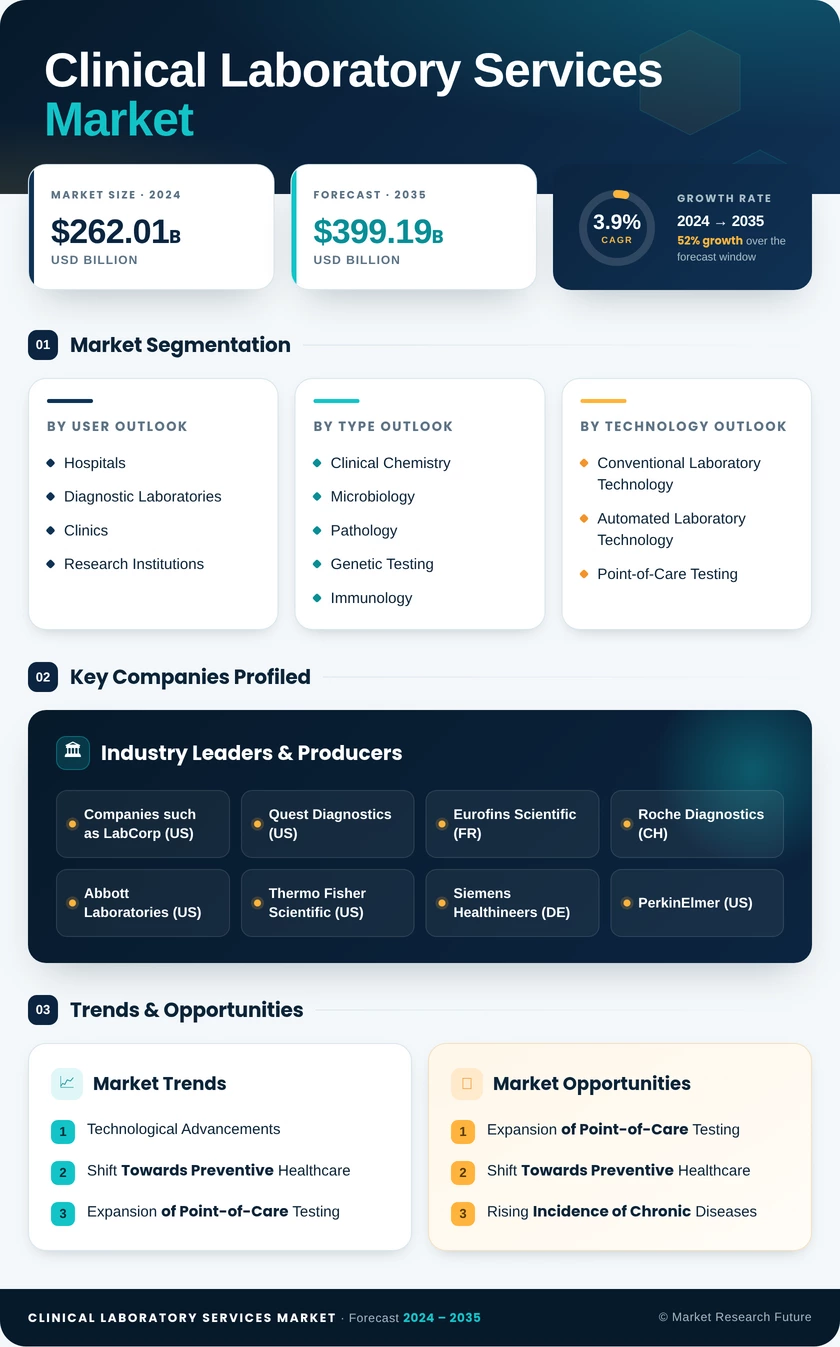
Segmentation Quick Reference
| Dimension | Sub-Segments | Dominant Segment | Fastest Growing Segment |
|---|---|---|---|
| By Test Type | Clinical Chemistry; Immunology/Serology; Microbiology & Cytology; Genetics & Molecular Diagnostics; Hematology | Clinical Chemistry — 53.5% (2025 share) | Genetics & Molecular Diagnostics — 10.0% CAGR (2026–2035) |
| By Service Provider | Hospital-Based Laboratories (In-Patient & Out-Patient); Stand-alone & Independent Laboratories; Clinic-Based Laboratories | Hospital-Based Laboratories (In-Patient & Out-Patient) — 50.7% (2025 share) | Stand-alone & Independent Laboratories — 8.7% CAGR (2026–2035) |
| By Application | Infectious Disease Testing; Oncology & Tumor Marker Testing; Endocrinology & Metabolic Testing; Cardiovascular Testing; Drug Discovery & Clinical Trial Support | Infectious Disease Testing — 29.6% (2025 share) | Oncology & Tumor Marker Testing — 11.3% CAGR (2026–2035) |
| By Region | North America; Europe; Asia-Pacific; South America; Middle East & Africa | North America — 43.6% (2025 share) | Asia-Pacific — 8.3% CAGR (2026–2035) |
Market Segmentation Overview
By Test Type
| Sub-Segment | Key Trend |
|---|---|
| Clinical Chemistry | Mass spectrometry and auto-verification protect margins on high-volume panels |
| Immunology/Serology | Expanded autoimmune and allergy profiling |
| Microbiology & Cytology | Shift from culture to rapid molecular identification |
| Genetics & Molecular Diagnostics | Sequencing-based oncology and hereditary testing scale up |
| Hematology | Automated differentials under fee-schedule pressure |
Clinical Chemistry leads this dimension with a 53.5% share because chronic disease management depends on repeat metabolic, renal and lipid panels. Genetics & Molecular Diagnostics grows fastest at a 10.0% CAGR as companion diagnostics and liquid biopsy gain regulatory approval and payer coverage. Microbiology & Cytology is adopting molecular platforms that return pathogen identification within hours rather than days.
By Service Provider
| Sub-Segment | Key Trend |
|---|---|
| Hospital-Based Laboratories (In-Patient & Out-Patient) | Focus narrows to stat and inpatient testing as outreach is divested |
| Stand-alone & Independent Laboratories | Centralized hubs and mobile collection lower per-test cost |
| Clinic-Based Laboratories | Point-of-care testing within CLIA complexity limits |
Hospital-Based Laboratories (In-Patient & Out-Patient) remain dominant at 50.7% because emergency departments and inpatient wards need on-site results. Stand-alone & Independent Laboratories grow fastest at an 8.7% CAGR by acquiring hospital outreach books and routing specimens to automated hubs. Clinic-Based Laboratories stay niche, since CLIA complexity rules restrict the tests they can run on-site.
By Application
| Sub-Segment | Key Trend |
|---|---|
| Infectious Disease Testing | Multiplex respiratory panels replace single-pathogen assays |
| Oncology & Tumor Marker Testing | Liquid biopsy and residual disease monitoring expand. |
| Endocrinology & Metabolic Testing | Diabetes and thyroid monitoring drive recurring volume. |
| Cardiovascular Testing | Advanced lipoprotein and high-sensitivity troponin assays |
| Drug Discovery & Clinical Trial Support | Home-collection kits for decentralized trials |
Infectious Disease Testing holds the lead at 29.6% of 2025 revenue, supported by multiplex respiratory panels and public screening mandates. Oncology & Tumor Marker Testing grows fastest at an 11.3% CAGR because genomic assays earn reimbursement far above routine screens. Drug Discovery & Clinical Trial Support benefits as sponsors adopt remote specimen collection that depends on harmonized central laboratory testing.


 Noah Malgeri
Co-Founder

 Peter Groot koerkamp
Account and Business Manager

 Younghwan Choi
Senior Retail Manager

 Mark Irwin
Management Consultant

 Akif Moroglu
Strategy & Business Development Director

 Guilherme Gomes Martins
Product Management Director

 Joseph Aguayo
Sales Operations & Pricing Manager

 La Terria Dodd
Program Support Specialist

 Rob Kooiker
Group Product Manager HVAC & Fire Protection GMA