Request Free Sample ×

Kindly complete the form below to receive a free sample of this Report

* Please use a valid business email

Leading companies partner with us for data-driven Insights

clients tt-cursor
Hero Background
English
Chinese
French
Japanese
Korean
German
Spanish

Citicoline as an ingredient Market Trends

ID: MRFR/FnB/10909-CR
184 Pages
Sakshi Gupta
Last Updated: April 15, 2026

Citicoline as an ingredient Market Size, Share, Industry Trend & Analysis Research Report Information by Form (Powder and Liquid), by Application (Dietary Supplements and Others), Distribution Channel (Direct and Indirect), and Region (North America, Europe, Asia-Pacific, and the Rest of the World) Forecast till 2035

Share:
Download PDF ×

We do not share your information with anyone. However, we may send you emails based on your report interest from time to time. You may contact us at any time to opt-out.

Citicoline as an ingredient Market Infographic
Purchase Options

Market Trends

Key Emerging Trends in the Citicoline as an ingredient Market

Citicoline, as an ingredient, is experiencing notable trends driven by advancements in healthcare, increasing awareness of cognitive health, and innovations in the pharmaceutical and nutraceutical industries. One significant trend is the growing interest in cognitive enhancement and brain health among consumers of all ages. With aging populations and rising concerns about cognitive decline, there's a heightened focus on ingredients like citicoline that are believed to support memory, concentration, and overall brain function. This trend is fueled by research highlighting citicoline's potential benefits for cognitive health, including improved attention, memory recall, and mental clarity.

Moreover, there's a rising demand for citicoline as an ingredient in dietary supplements and functional foods aimed at enhancing cognitive performance and promoting brain health. Manufacturers are incorporating citicoline into a wide range of products, including brain health supplements, energy drinks, nootropic formulas, and memory-enhancing foods. This trend reflects consumers' growing interest in proactive approaches to maintaining cognitive function and improving mental well-being, driving the expansion of the citicoline market across various product categories.

Furthermore, there's an increasing focus on sports nutrition and performance enhancement, driving demand for citicoline as a supplement for athletes and fitness enthusiasts. Citicoline is believed to support brain health and cognitive function during intense physical activity, making it a popular ingredient in pre-workout supplements and energy drinks. Athletes and fitness enthusiasts are seeking products that not only enhance physical performance but also support mental focus, concentration, and reaction time, driving the incorporation of citicoline into sports nutrition formulations.

In addition, there's a growing interest in citicoline's potential therapeutic applications beyond cognitive health. Research suggests that citicoline may have neuroprotective properties and could be beneficial for conditions such as stroke, traumatic brain injury, age-related cognitive decline, and neurodegenerative diseases like Alzheimer's and Parkinson's. As scientific understanding of citicoline's mechanisms of action expands, there's growing interest in exploring its therapeutic potential in various neurological disorders, driving research and development efforts in the pharmaceutical industry.

Moreover, there's a trend towards innovation and diversification in citicoline formulations and delivery formats. Manufacturers are developing novel citicoline products with improved bioavailability, stability, and ease of use. These innovations include citicoline liposomes, nanoemulsions, and microencapsulated formulations designed to enhance absorption and efficacy. Additionally, there's a growing market for citicoline-based combination products that combine citicoline with other complementary ingredients such as vitamins, minerals, amino acids, and herbal extracts to target specific cognitive health concerns or enhance overall brain function.

Furthermore, there's a focus on regulatory compliance and quality assurance in the citicoline market. As demand for citicoline-containing products grows, there's increased scrutiny on product safety, purity, and efficacy. Manufacturers are investing in quality control measures, third-party testing, and adherence to regulatory standards to ensure the integrity and reliability of citicoline-based products. This trend reflects the importance of transparency and consumer trust in the increasingly competitive citicoline market, driving industry efforts to maintain high standards of quality and compliance.


Author
Author Profile
Sakshi Gupta
Team Lead - Research

Currently a Team Lead in consumer goods, FMCG, and F&B, she translates rigorous research into decisive strategy. She develops GTM roadmaps, pricing architectures, and competitive benchmarks for companies across Europe, the US, and APAC. She synthesize insights, align cross-functional teams, and drive execution from brief to measurable outcomes. She leads end-to-end engagements with crisp analysis, compelling storytelling, and a strong command of Power BI, Tableau, SQL, and advanced research platforms.

Leave a Comment

FAQs

What is the projected market valuation for Citicoline as an ingredient by 2035?

<p>The projected market valuation for Citicoline as an ingredient is expected to reach 820.15 USD Million by 2035.</p>

What was the overall market valuation for Citicoline in 2024?

<p>The overall market valuation for Citicoline as an ingredient was 299.51 USD Million in 2024.</p>

What is the expected CAGR for the Citicoline market during the forecast period 2025 - 2035?

<p>The expected CAGR for the Citicoline as an ingredient market during the forecast period 2025 - 2035 is 9.59%.</p>

Which companies are considered key players in the Citicoline market?

<p>Key players in the Citicoline market include Kyowa Hakko Bio Co, Nutraceutical Corporation, and several pharmaceutical companies from China.</p>

What are the main applications of Citicoline in the market?

<p>The main applications of Citicoline include Nootropic, Neuroprotective, Cognitive Enhancement, and Memory Improvement.</p>

How does the market for Citicoline in pharmaceuticals compare to nutraceuticals?

<p>In 2024, the market for Citicoline in pharmaceuticals was valued at 80.0 USD Million, while nutraceuticals were valued at 70.0 USD Million.</p>

What formulation types are available for Citicoline products?

<p>Citicoline products are available in various formulation types, including Powder, Capsule, Tablet, and Liquid.</p>

Which distribution channels are most prominent for Citicoline products?

Prominent distribution channels for Citicoline products include Online Retail, Pharmacy, Health Food Stores, and Supermarkets.

What consumer demographics are targeted in the Citicoline market?

The Citicoline market targets various consumer demographics, including Health Conscious Individuals, Athletes, and Students.

What was the market valuation for Citicoline in the tablet formulation type in 2024?

The market valuation for Citicoline in the tablet formulation type was 89.9 USD Million in 2024.

Market Summary

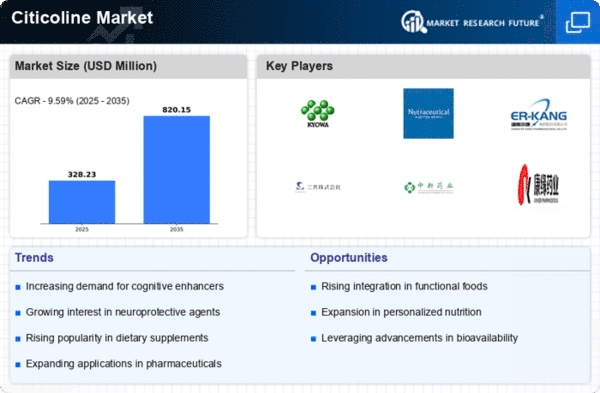
As per MRFR analysis, the Citicoline Market Size was estimated at 299.51 USD Million in 2024. The Citicoline industry is projected to grow from 328.23 in 2025 to 820.15 by 2035, exhibiting a compound annual growth rate (CAGR) of 9.59% during the forecast period 2025 - 2035.

Key Market Trends & Highlights

The Citicoline as an ingredient market is experiencing robust growth driven by increasing demand for cognitive health products and natural ingredients.

  • The market is witnessing a rising demand for cognitive health products, particularly in North America, which remains the largest market. There is a notable shift towards natural ingredients, reflecting consumer preferences for clean-label products in the Asia-Pacific region. Research and development efforts are intensifying, particularly in the cognitive enhancement segment, which is currently the largest. Key market drivers include increasing awareness of cognitive health and the expansion of the nutraceuticals sector, particularly influencing the neuroprotective and capsule segments.

Market Size & Forecast

2024 Market Size 299.51 (USD Million)
2035 Market Size 820.15 (USD Million)
CAGR (2025 - 2035) 9.59%
Largest Regional Market Share in 2024 North America

Major Players

Kyowa Hakko Bio Co., Ltd. (JP), Nutraceutical Corporation (US), Hunan Er-Kang Pharmaceutical Co., Ltd. (CN), Sankyo Pharma Co., Ltd. (JP), Tianjin Zhongxin Pharmaceutical Group Corp. (CN), Jiangsu Kanion Pharmaceutical Co., Ltd. (CN), Hubei Yichang Humanwell Pharmaceutical Co., Ltd. (CN), Hunan Huitian Pharmaceutical Co., Ltd. (CN)

Market Trends

The Citicoline as an ingredient Market is currently experiencing a notable evolution, driven by increasing awareness regarding cognitive health and the potential benefits of citicoline. This compound, recognized for its role in enhancing memory and supporting brain function, is gaining traction among consumers seeking cognitive enhancement products. The market appears to be expanding as more manufacturers incorporate citicoline into dietary supplements, functional foods, and beverages, reflecting a growing trend towards health-conscious consumption. Furthermore, the rising prevalence of neurological disorders may also contribute to the heightened interest in citicoline, as individuals look for preventive measures and supportive therapies. In addition to cognitive health, the Citicoline as an ingredient Market is influenced by the increasing demand for natural and plant-based ingredients. Consumers are becoming more discerning, favoring products that are perceived as safe and effective. This shift is prompting manufacturers to explore innovative formulations that include citicoline, aligning with the broader trend of clean label products. As the market continues to evolve, it is likely that research and development efforts will focus on optimizing the delivery and efficacy of citicoline, further solidifying its position as a valuable ingredient in various applications.

Rising Demand for Cognitive Health Products

The Citicoline as an ingredient Market is witnessing a surge in demand for products aimed at enhancing cognitive function. This trend is largely driven by consumers' increasing interest in mental clarity, memory improvement, and overall brain health. As awareness of cognitive health grows, manufacturers are responding by developing innovative formulations that incorporate citicoline, appealing to a health-conscious demographic.

Shift Towards Natural Ingredients

There is a discernible shift in consumer preferences towards natural and plant-based ingredients within the Citicoline as an ingredient Market. This trend reflects a broader movement towards clean label products, where consumers seek transparency and safety in their dietary choices. As a result, manufacturers are increasingly incorporating citicoline into their offerings to meet this demand for natural solutions.

Focus on Research and Development

The Citicoline as an ingredient Market is likely to see intensified research and development efforts aimed at enhancing the efficacy and delivery of citicoline. As scientific understanding of citicoline's benefits expands, manufacturers may invest in innovative technologies and formulations. This focus on R&D could lead to new applications and increased market penetration, further establishing citicoline as a key ingredient in cognitive health products.

Citicoline as an ingredient Market Market Drivers

Regulatory Support for Health Claims

The Global citicoline as an ingredient Market Industry is positively impacted by regulatory support for health claims associated with Citicoline. Regulatory bodies are increasingly recognizing the potential health benefits of Citicoline, which may facilitate its inclusion in dietary supplements and functional foods. This support can enhance consumer trust and drive market growth, as products containing Citicoline may be perceived as more credible and effective. As regulations evolve to accommodate the growing body of research on Citicoline, manufacturers may find it easier to market their products, thereby contributing to the overall expansion of the market.

Expansion of the Nutraceutical Sector

The Global Citicoline as an ingredient Market Industry is benefiting from the rapid expansion of the nutraceutical sector. As consumers increasingly seek natural and functional ingredients, Citicoline's profile as a cognitive enhancer positions it favorably within this market. The nutraceutical industry is projected to grow significantly, with Citicoline being a key ingredient in various formulations aimed at enhancing mental performance. This trend is indicative of a broader shift towards preventive healthcare, where consumers are more inclined to invest in products that support long-term health. The integration of Citicoline into nutraceuticals is expected to contribute to a robust market trajectory.

Rising Prevalence of Neurological Disorders

The Global Citicoline as an ingredient Market Industry is significantly influenced by the increasing prevalence of neurological disorders. Conditions such as Alzheimer's disease, Parkinson's disease, and stroke are becoming more common, prompting a search for effective management strategies. Citicoline has been studied for its potential benefits in improving cognitive function and recovery in patients with these disorders. This growing health concern is likely to drive the demand for Citicoline-based products, as healthcare providers and patients seek innovative solutions. The market's expansion is anticipated to align with the overall growth of the healthcare sector, further enhancing the visibility of Citicoline.

Growing Demand for Cognitive Health Products

The Global Citicoline as an ingredient Market Industry is experiencing a notable increase in demand for cognitive health products. This trend is driven by a rising awareness of brain health and the importance of cognitive function among consumers. Citicoline, recognized for its potential neuroprotective properties, is increasingly incorporated into dietary supplements and functional foods. As of 2024, the market is valued at approximately 299.1 USD Million, reflecting a growing consumer base that prioritizes mental clarity and focus. This demand is expected to continue, contributing to the projected market growth towards 2035, where it may reach 820.2 USD Million.

Increased Research and Development Activities

The Global Citicoline as an ingredient Market Industry is witnessing a surge in research and development activities aimed at exploring the full potential of Citicoline. Scientific studies are increasingly focusing on its benefits for cognitive health, neuroprotection, and recovery from brain injuries. This heightened research interest is likely to lead to new product formulations and applications, thereby expanding the market. As more evidence emerges regarding the efficacy of Citicoline, manufacturers may be encouraged to innovate and diversify their offerings. This trend not only enhances the credibility of Citicoline but also supports its integration into a wider array of health products.

Market Segment Insights

By Application: Cognitive Enhancement (Largest) vs. Memory Improvement (Fastest-Growing)

In the Citicoline as an ingredient market, the application segment showcases a diverse range comprising Nootropic, Neuroprotective, Cognitive Enhancement, and Memory Improvement. Cognitive Enhancement holds a significant share, reflecting its broad acceptance among consumers seeking to improve mental performance. Meanwhile, Memory Improvement is rapidly gaining traction, driven by the increasing awareness of cognitive health and the aging population prioritizing memory retention.

Cognitive Enhancement (Dominant) vs. Memory Improvement (Emerging)

Cognitive Enhancement remains the dominant application of Citicoline, appealing to those looking to boost cognitive functions such as focus, creativity, and overall mental clarity. This segment's strength lies in its well-established market presence, supported by scientific research endorsing its benefits. On the other hand, Memory Improvement is emerging as a vital player due to rising consumer demand fueled by aging demographics and a growing emphasis on brain health. Consumers are increasingly turning to products that support memory retention and cognitive longevity, marking this segment as one to watch closely for future growth.

By End Use: Pharmaceuticals (Largest) vs. Nutraceuticals (Fastest-Growing)

In the Citicoline as an ingredient market, the distribution of market share among end-use segments reflects a clear hierarchy, with Pharmaceuticals leading the pack. This segment benefits significantly from the rising awareness of cognitive health and the growing prescription of Citicoline for various neurological conditions. Nutraceuticals, while currently smaller, are rapidly growing as consumers increasingly prioritize natural ingredients for health benefits, thereby driving demand in this segment. The surge in interest in mental wellness and cognitive enhancement is further contributing to the overall market dynamics.

Pharmaceuticals: Dominant vs. Nutraceuticals: Emerging

Pharmaceuticals represent the dominant end-use segment in the Citicoline market. This strength is underpinned by extensive clinical research validating Citicoline’s efficacy in treating cognitive impairments and neurodegenerative disorders. In contrast, Nutraceuticals are categorized as an emerging segment, driven by trends towards preventive healthcare and holistic wellness. The consumer shift towards clean labels and <a title="functional ingredient" href="https://www.marketresearchfuture.com/reports/functional-ingredient-market-26922" target="_blank" rel="noopener">functional ingredients</a> enhances the attractiveness of Nutraceuticals, making them a formidable growth contender. As the demand for dietary solutions that support both physical and cognitive health escalates, the nutritional application of Citicoline is set to gain increased traction in the near future.

By Formulation Type: Powder (Largest) vs. Capsule (Fastest-Growing)

Within the Citicoline as an ingredient Market, the formulation type segment comprises various formats, including powder, capsule, tablet, and liquid. Among these, the powder formulation holds the largest market share due to its versatility and ease of use in various applications. Capsules, on the other hand, are gaining rapid popularity, especially among consumers seeking convenient and portable options for supplementation. Tablets and liquids, while still relevant, have seen slower growth compared to these primary formats.

Powder (Dominant) vs. Capsule (Emerging)

The powder formulation of Citicoline is recognized for its superior bioavailability and flexibility in dosage, making it the dominant player in the market. Manufacturers often leverage this format for blending with other supplements, enhancing its appeal to fitness enthusiasts and individuals seeking cognitive support. Conversely, capsules have emerged as a popular choice for consumers favoring convenience, with rapid growth driven by rising awareness of the benefits of Citicoline in cognitive health. This emerging segment is characterized by attractive packaging and marketing strategies that emphasize ease of use, appealing to a broad demographic that prioritizes dietary supplements for mental enhancement.

By Distribution Channel: Online Retail (Largest) vs. Pharmacy (Fastest-Growing)

In the Citicoline as an ingredient market, online retail has emerged as the largest distribution channel, capturing a significant portion of the market share. This channel is preferred by consumers for its convenience and the wide variety of products available. Pharmacy and health food stores also hold substantial shares, appealing to health-conscious consumers seeking over-the-counter solutions and specialized dietary options. Supermarkets, while important, contribute a smaller segment of the distribution landscape as consumers tend to seek specific <a title="health supplements" href="https://www.marketresearchfuture.com/reports/health-supplements-market-1646" target="_blank" rel="noopener">health supplements</a> elsewhere. The growth trends for these distribution channels indicate a robust shift towards online retail, driven by increasing digitalization and consumer preference for hassle-free shopping experiences. Pharmacies represent the fastest-growing segment, attributed to rising health awareness and an increase in prescription and non-prescription Citicoline products. The preference for direct-to-consumer models in health-related purchasing, along with promotional efforts by health food stores and supermarkets, complicates the growth dynamics, highlighting the need for strategic marketing across all channels.

Online Retail (Dominant) vs. Pharmacy (Emerging)

Online retail stands as the dominant distribution channel in the Citicoline as an ingredient market, characterized by its extensive reach and convenience for consumers. E-commerce platforms provide a wide array of Citicoline products, often at competitive prices, attracting a tech-savvy clientele eager for quick access to health supplements. The growth of this segment is bolstered by advancements in logistics and targeted digital marketing strategies. In contrast, pharmacies are emerging as a vital channel for Citicoline distribution, leveraging customer trust and the increasing demand for health solutions. Pharmacies cater to consumers seeking expert advice and readily available options, thereby enhancing the overall market appeal of Citicoline as an ingredient. As consumer priorities evolve, both channels must adapt to maintain their competitive positions.

By Consumer Demographics: Health-Conscious Individuals (Largest) vs. Athletes (Fastest-Growing)

The consumer demographics segment in the Citicoline market highlights a diverse array of user profiles, prominently featuring health-conscious individuals who hold the largest share. This group is notably engaged in seeking cognitive enhancement through supplements, benefiting from increased awareness regarding mental health and the role of citicoline. In contrast, athletes are emerging as a significant demographic, reflecting a growing trend toward using citicoline to enhance performance and recovery. Their increasing focus on cognitive function for improved athletic outcomes positions them as a notable segment in the market.

Health-Conscious Individuals (Dominant) vs. Athletes (Emerging)

Health-conscious individuals are at the forefront of the Citicoline market, leveraging the ingredient for its cognitive benefits. This dominant segment prioritizes overall wellness, making informed choices to enhance mental clarity and memory. Their preference for natural and effective supplements drives demand in the market. Conversely, athletes represent an emerging segment, increasingly recognizing citicoline's value in cognitive performance during training and competition. Their demand is fueled by research supporting citicoline's role in enhancing focus, decision-making, and overall mental acuity, indicating a transformative shift as athletes incorporate cognitive support alongside physical training.

Get more detailed insights about Citicoline as an ingredient Market Research Report—Global Forecast till 2035

Regional Insights

North America : Market Leader in Citicoline

North America is poised to maintain its leadership in the Citicoline market, with a projected market size of $150.0 million by December 2025. The region's growth is driven by increasing awareness of cognitive health and the rising prevalence of neurological disorders. Regulatory support for dietary supplements further enhances market dynamics, fostering innovation and product development. The demand for Citicoline is expected to surge as consumers seek natural solutions for cognitive enhancement and memory support. The competitive landscape in North America is robust, featuring key players such as Nutraceutical Corporation and Kyowa Hakko Bio Co., Ltd. The U.S. stands out as the leading country, accounting for a significant share of the market. The presence of established pharmaceutical companies and a strong distribution network contribute to the region's dominance. As the market evolves, partnerships and collaborations among key players are likely to shape future growth trajectories.

Europe : Emerging Market Potential

Europe is witnessing a growing interest in Citicoline, with a market size of $90.0 million anticipated by December 2025. The region's growth is fueled by increasing consumer awareness regarding cognitive health and the benefits of Citicoline in enhancing memory and focus. Regulatory frameworks in Europe are becoming more supportive of dietary supplements, which is expected to further stimulate market growth. The rising trend of preventive healthcare is also driving demand for cognitive enhancers like Citicoline. Leading countries in Europe include Germany, France, and the UK, where the demand for Citicoline is particularly strong. The competitive landscape features both local and international players, with companies like Kyowa Hakko Bio Co., Ltd. and Nutraceutical Corporation making significant inroads. The European market is characterized by a diverse range of products, catering to various consumer preferences and health needs. As the market matures, innovation and product differentiation will be key to capturing consumer interest.

Asia-Pacific : Rapid Growth in Cognitive Health

The Asia-Pacific region is emerging as a significant player in the Citicoline market, with a projected size of $50.0 million by December 2025. The growth is driven by increasing awareness of cognitive health and the rising incidence of neurological disorders. Countries like China and Japan are leading the charge, supported by favorable regulatory environments that encourage the use of dietary supplements. The demand for Citicoline is expected to rise as consumers seek effective solutions for cognitive enhancement and overall brain health. China is the largest market in the region, with a growing number of local manufacturers entering the Citicoline space. The competitive landscape is becoming increasingly dynamic, with key players such as Hunan Er-Kang Pharmaceutical Co., Ltd. and Jiangsu Kanion Pharmaceutical Co., Ltd. gaining traction. As the market evolves, the focus on research and development will be crucial for companies aiming to differentiate their products and meet the diverse needs of consumers in this rapidly growing market.

Middle East and Africa : Niche Market Development

The Middle East and Africa (MEA) region is gradually developing its Citicoline market, with a projected size of $9.51 million by December 2025. The growth in this region is primarily driven by increasing awareness of cognitive health and the potential benefits of Citicoline in enhancing mental performance. Regulatory bodies are beginning to recognize the importance of dietary supplements, which is expected to create a more favorable environment for market growth. The rising trend of health consciousness among consumers is also contributing to the demand for cognitive enhancers. Countries like South Africa and the UAE are leading the market in the MEA region, with a growing number of local and international players entering the space. The competitive landscape is characterized by a mix of established pharmaceutical companies and emerging startups. As the market matures, the focus on quality and efficacy will be essential for companies looking to capture market share and meet the evolving needs of consumers in this niche market.

Key Players and Competitive Insights

The Citicoline as an ingredient Market is characterized by a dynamic competitive landscape, driven by increasing consumer awareness regarding cognitive health and the growing demand for dietary supplements. Key players such as Kyowa Hakko Bio Co., Ltd. (Japan), Nutraceutical Corporation (US), and Hunan Er-Kang Pharmaceutical Co., Ltd. (China) are strategically positioned to leverage these trends. Kyowa Hakko Bio Co., Ltd. focuses on innovation in product development, emphasizing high-quality ingredients that cater to the health-conscious consumer. Nutraceutical Corporation (US) has adopted a strategy of regional expansion, enhancing its distribution networks to reach a broader audience. Meanwhile, Hunan Er-Kang Pharmaceutical Co., Ltd. is concentrating on partnerships with local health food brands, thereby strengthening its market presence and operational capabilities. Collectively, these strategies contribute to a competitive environment that is increasingly focused on quality, accessibility, and consumer engagement.In terms of business tactics, companies are localizing manufacturing to reduce costs and improve supply chain efficiency. This approach is particularly evident in the moderately fragmented structure of the market, where several players vie for market share. The collective influence of these key players is shaping a landscape that favors innovation and strategic partnerships, allowing companies to differentiate themselves in a crowded marketplace.
In November Kyowa Hakko Bio Co., Ltd. (Japan) announced a collaboration with a leading nutritional supplement brand to develop a new line of cognitive health products featuring Citicoline. This strategic move is significant as it not only enhances Kyowa's product portfolio but also positions the company as a key player in the rapidly growing cognitive health segment. The partnership is expected to leverage both companies' strengths, potentially leading to increased market penetration and consumer trust.
In October Nutraceutical Corporation (US) launched a new marketing campaign aimed at promoting the cognitive benefits of Citicoline. This initiative is crucial as it aligns with the rising consumer interest in mental wellness and cognitive enhancement. By focusing on educational content and consumer engagement, Nutraceutical Corporation aims to solidify its brand presence and drive sales growth in a competitive market.
In September Hunan Er-Kang Pharmaceutical Co., Ltd. (China) expanded its manufacturing capabilities by investing in advanced production technologies. This investment is likely to enhance product quality and increase production efficiency, allowing the company to meet the growing demand for Citicoline-based products. Such advancements may provide Hunan Er-Kang with a competitive edge, particularly in the Asian markets where demand is surging.
As of December the competitive trends in the Citicoline market are increasingly defined by digitalization, sustainability, and the integration of AI technologies. Strategic alliances are becoming more prevalent, enabling companies to pool resources and expertise to innovate more effectively. The competitive differentiation is expected to evolve, shifting from price-based competition to a focus on innovation, technology, and supply chain reliability. This transition suggests that companies that prioritize these aspects will likely emerge as leaders in the Citicoline as an ingredient Market.

Key Companies in the Citicoline as an ingredient Market include

Industry Developments

Future Outlook

Citicoline as an ingredient Market Future Outlook

The Citicoline as an ingredient market is projected to grow at a 9.59% CAGR from 2025 to 2035, driven by increasing demand in cognitive health and <a title="dietary supplements" href="https://www.marketresearchfuture.com/reports/dietary-supplements-market-1134" target="_blank" rel="noopener">dietary supplements</a>.

New opportunities lie in:

  • <p>Expansion into emerging markets with tailored formulations Development of innovative delivery systems for enhanced bioavailability Strategic partnerships with nutraceutical companies for co-branding initiatives</p>

By 2035, the Citicoline market is expected to achieve robust growth, solidifying its position in the health and wellness sector.

Market Segmentation

Citicoline as an ingredient Market End Use Outlook

  • Pharmaceuticals
  • Nutraceuticals
  • Dietary Supplements
  • Functional Foods

Citicoline as an ingredient Market Application Outlook

  • Nootropic
  • Neuroprotective
  • Cognitive Enhancement
  • Memory Improvement

Citicoline as an ingredient Market Formulation Type Outlook

  • Powder
  • Capsule
  • Tablet
  • Liquid

Citicoline as an ingredient Market Distribution Channel Outlook

  • Online Retail
  • Pharmacy
  • Health Food Stores
  • Supermarkets

Citicoline as an ingredient Market Consumer Demographics Outlook

  • Age Group
  • Health Conscious Individuals
  • Athletes
  • Students

Report Scope

MARKET SIZE 2024 299.51(USD Million)
MARKET SIZE 2025 328.23(USD Million)
MARKET SIZE 2035 820.15(USD Million)
COMPOUND ANNUAL GROWTH RATE (CAGR) 9.59% (2025 - 2035)
REPORT COVERAGE Revenue Forecast, Competitive Landscape, Growth Factors, and Trends
BASE YEAR 2024
Market Forecast Period 2025 - 2035
Historical Data 2019 - 2024
Market Forecast Units USD Million
Key Companies Profiled Kyowa Hakko Bio Co., Ltd. (JP), Nutraceutical Corporation (US), Hunan Er-Kang Pharmaceutical Co., Ltd. (CN), Sankyo Pharma Co., Ltd. (JP), Tianjin Zhongxin Pharmaceutical Group Corp. (CN), Jiangsu Kanion Pharmaceutical Co., Ltd. (CN), Hubei Yichang Humanwell Pharmaceutical Co., Ltd. (CN), Hunan Huitian Pharmaceutical Co., Ltd. (CN)
Segments Covered Application, Formulation Type, End Use, Distribution Channel, Consumer Demographics
Key Market Opportunities Growing demand for cognitive health supplements drives innovation in the Citicoline as an ingredient Market.
Key Market Dynamics Rising demand for cognitive health supplements drives innovation and competition in the Citicoline ingredient market.
Countries Covered North America, Europe, APAC, South America, MEA

FAQs

What is the projected market valuation for Citicoline as an ingredient by 2035?

<p>The projected market valuation for Citicoline as an ingredient is expected to reach 820.15 USD Million by 2035.</p>

What was the overall market valuation for Citicoline in 2024?

<p>The overall market valuation for Citicoline as an ingredient was 299.51 USD Million in 2024.</p>

What is the expected CAGR for the Citicoline market during the forecast period 2025 - 2035?

<p>The expected CAGR for the Citicoline as an ingredient market during the forecast period 2025 - 2035 is 9.59%.</p>

Which companies are considered key players in the Citicoline market?

<p>Key players in the Citicoline market include Kyowa Hakko Bio Co, Nutraceutical Corporation, and several pharmaceutical companies from China.</p>

What are the main applications of Citicoline in the market?

<p>The main applications of Citicoline include Nootropic, Neuroprotective, Cognitive Enhancement, and Memory Improvement.</p>

How does the market for Citicoline in pharmaceuticals compare to nutraceuticals?

<p>In 2024, the market for Citicoline in pharmaceuticals was valued at 80.0 USD Million, while nutraceuticals were valued at 70.0 USD Million.</p>

What formulation types are available for Citicoline products?

<p>Citicoline products are available in various formulation types, including Powder, Capsule, Tablet, and Liquid.</p>

Which distribution channels are most prominent for Citicoline products?

Prominent distribution channels for Citicoline products include Online Retail, Pharmacy, Health Food Stores, and Supermarkets.

What consumer demographics are targeted in the Citicoline market?

The Citicoline market targets various consumer demographics, including Health Conscious Individuals, Athletes, and Students.

What was the market valuation for Citicoline in the tablet formulation type in 2024?

The market valuation for Citicoline in the tablet formulation type was 89.9 USD Million in 2024.

  1. SECTION I: EXECUTIVE SUMMARY AND KEY HIGHLIGHTS |
    1. EXECUTIVE SUMMARY | |
      1. Market Overview | |
      2. Key Findings | |
      3. Market Segmentation | |
      4. Competitive Landscape | |
      5. Challenges and Opportunities | |
      6. Future Outlook 2
  2. SECTION II: SCOPING, METHODOLOGY AND MARKET STRUCTURE |
    1. MARKET INTRODUCTION | |
      1. Definition | |
      2. Scope of the study | | |
    2. RESEARCH METHODOLOGY | |
      1. Overview | |
      2. Data Mining | |
      3. Secondary Research | |
      4. Primary Research | | |
      5. Forecasting Model | |
      6. Market Size Estimation | | |
      7. Data Triangulation | |
      8. Validation 3
  3. SECTION III: QUALITATIVE ANALYSIS |
    1. MARKET DYNAMICS | |
      1. Overview | |
      2. Drivers | |
      3. Restraints | |
      4. Opportunities |
    2. MARKET FACTOR ANALYSIS | |
      1. Value chain Analysis | |
      2. Porter's Five Forces Analysis | | |
      3. COVID-19 Impact Analysis | | |
  4. SECTION IV: QUANTITATIVE ANALYSIS |
    1. Food, Beverages & Nutrition, BY Application (USD Million) | |
      1. Nootropic | |
      2. Neuroprotective | |
      3. Cognitive Enhancement | |
      4. Memory Improvement |
    2. Food, Beverages & Nutrition, BY End Use (USD Million) | |
      1. Pharmaceuticals | |
      2. Nutraceuticals | |
      3. Dietary Supplements | |
      4. Functional Foods |
    3. Food, Beverages & Nutrition, BY Formulation Type (USD Million) | |
      1. Powder | |
      2. Capsule | |
      3. Tablet | |
      4. Liquid |
    4. Food, Beverages & Nutrition, BY Distribution Channel (USD Million) | |
      1. Online Retail | |
      2. Pharmacy | |
      3. Health Food Stores | |
      4. Supermarkets |
    5. Food, Beverages & Nutrition, BY Consumer Demographics (USD Million) | |
      1. Age Group | |
      2. Health Conscious Individuals | |
      3. Athletes | |
      4. Students |
    6. Food, Beverages & Nutrition, BY Region (USD Million) | |
      1. North America | | |
      2. Europe | | |
      3. APAC | | |
      4. South America | | |
      5. MEA | | |
  5. SECTION V: COMPETITIVE ANALYSIS |
    1. Competitive Landscape | |
      1. Overview | |
      2. Competitive Analysis | |
      3. Market share Analysis | |
      4. Major Growth Strategy in the Food, Beverages & Nutrition | |
      5. Competitive Benchmarking | |
      6. Leading Players in Terms of Number of Developments in the Food, Beverages & Nutrition | |
      7. Key developments and growth strategies | | |
      8. Major Players Financial Matrix | | |
    2. Company Profiles | |
      1. Kyowa Hakko Bio Co (JP) | | |
      2. Nutraceutical Corporation (US) | | |
      3. Hunan Er-Kang Pharmaceutical Co (CN) | | |
      4. Hubei Yichun Pharmaceutical Co (CN) | | |
      5. Hunan Huitong Pharmaceutical Co (CN) | | |
      6. Hubei Huitong Pharmaceutical Co (CN) | | |
      7. Hunan Huacheng Pharmaceutical Co (CN) | | |
      8. Hunan Huitong Pharmaceutical Co (CN) | | |
    3. Appendix | |
      1. References | |
      2. Related Reports 6 LIST OF FIGURES |
    4. MARKET SYNOPSIS |
    5. NORTH AMERICA MARKET ANALYSIS |
    6. US MARKET ANALYSIS BY APPLICATION |
    7. US MARKET ANALYSIS BY END USE |
    8. US MARKET ANALYSIS BY FORMULATION TYPE |
    9. US MARKET ANALYSIS BY DISTRIBUTION CHANNEL |
    10. US MARKET ANALYSIS BY CONSUMER DEMOGRAPHICS |
    11. CANADA MARKET ANALYSIS BY APPLICATION |
    12. CANADA MARKET ANALYSIS BY END USE |
    13. CANADA MARKET ANALYSIS BY FORMULATION TYPE |
    14. CANADA MARKET ANALYSIS BY DISTRIBUTION CHANNEL |
    15. CANADA MARKET ANALYSIS BY CONSUMER DEMOGRAPHICS |
    16. EUROPE MARKET ANALYSIS |
    17. GERMANY MARKET ANALYSIS BY APPLICATION |
    18. GERMANY MARKET ANALYSIS BY END USE |
    19. GERMANY MARKET ANALYSIS BY FORMULATION TYPE |
    20. GERMANY MARKET ANALYSIS BY DISTRIBUTION CHANNEL |
    21. GERMANY MARKET ANALYSIS BY CONSUMER DEMOGRAPHICS |
    22. UK MARKET ANALYSIS BY APPLICATION |
    23. UK MARKET ANALYSIS BY END USE |
    24. UK MARKET ANALYSIS BY FORMULATION TYPE |
    25. UK MARKET ANALYSIS BY DISTRIBUTION CHANNEL |
    26. UK MARKET ANALYSIS BY CONSUMER DEMOGRAPHICS |
    27. FRANCE MARKET ANALYSIS BY APPLICATION |
    28. FRANCE MARKET ANALYSIS BY END USE |
    29. FRANCE MARKET ANALYSIS BY FORMULATION TYPE |
    30. FRANCE MARKET ANALYSIS BY DISTRIBUTION CHANNEL |
    31. FRANCE MARKET ANALYSIS BY CONSUMER DEMOGRAPHICS |
    32. RUSSIA MARKET ANALYSIS BY APPLICATION |
    33. RUSSIA MARKET ANALYSIS BY END USE |
    34. RUSSIA MARKET ANALYSIS BY FORMULATION TYPE |
    35. RUSSIA MARKET ANALYSIS BY DISTRIBUTION CHANNEL |
    36. RUSSIA MARKET ANALYSIS BY CONSUMER DEMOGRAPHICS |
    37. ITALY MARKET ANALYSIS BY APPLICATION |
    38. ITALY MARKET ANALYSIS BY END USE |
    39. ITALY MARKET ANALYSIS BY FORMULATION TYPE |
    40. ITALY MARKET ANALYSIS BY DISTRIBUTION CHANNEL |
    41. ITALY MARKET ANALYSIS BY CONSUMER DEMOGRAPHICS |
    42. SPAIN MARKET ANALYSIS BY APPLICATION |
    43. SPAIN MARKET ANALYSIS BY END USE |
    44. SPAIN MARKET ANALYSIS BY FORMULATION TYPE |
    45. SPAIN MARKET ANALYSIS BY DISTRIBUTION CHANNEL |
    46. SPAIN MARKET ANALYSIS BY CONSUMER DEMOGRAPHICS |
    47. REST OF EUROPE MARKET ANALYSIS BY APPLICATION |
    48. REST OF EUROPE MARKET ANALYSIS BY END USE |
    49. REST OF EUROPE MARKET ANALYSIS BY FORMULATION TYPE |
    50. REST OF EUROPE MARKET ANALYSIS BY DISTRIBUTION CHANNEL |
    51. REST OF EUROPE MARKET ANALYSIS BY CONSUMER DEMOGRAPHICS |
    52. APAC MARKET ANALYSIS |
    53. CHINA MARKET ANALYSIS BY APPLICATION |
    54. CHINA MARKET ANALYSIS BY END USE |
    55. CHINA MARKET ANALYSIS BY FORMULATION TYPE |
    56. CHINA MARKET ANALYSIS BY DISTRIBUTION CHANNEL |
    57. CHINA MARKET ANALYSIS BY CONSUMER DEMOGRAPHICS |
    58. INDIA MARKET ANALYSIS BY APPLICATION |
    59. INDIA MARKET ANALYSIS BY END USE |
    60. INDIA MARKET ANALYSIS BY FORMULATION TYPE |
    61. INDIA MARKET ANALYSIS BY DISTRIBUTION CHANNEL |
    62. INDIA MARKET ANALYSIS BY CONSUMER DEMOGRAPHICS |
    63. JAPAN MARKET ANALYSIS BY APPLICATION |
    64. JAPAN MARKET ANALYSIS BY END USE |
    65. JAPAN MARKET ANALYSIS BY FORMULATION TYPE |
    66. JAPAN MARKET ANALYSIS BY DISTRIBUTION CHANNEL |
    67. JAPAN MARKET ANALYSIS BY CONSUMER DEMOGRAPHICS |
    68. SOUTH KOREA MARKET ANALYSIS BY APPLICATION |
    69. SOUTH KOREA MARKET ANALYSIS BY END USE |
    70. SOUTH KOREA MARKET ANALYSIS BY FORMULATION TYPE |
    71. SOUTH KOREA MARKET ANALYSIS BY DISTRIBUTION CHANNEL |
    72. SOUTH KOREA MARKET ANALYSIS BY CONSUMER DEMOGRAPHICS |
    73. MALAYSIA MARKET ANALYSIS BY APPLICATION |
    74. MALAYSIA MARKET ANALYSIS BY END USE |
    75. MALAYSIA MARKET ANALYSIS BY FORMULATION TYPE |
    76. MALAYSIA MARKET ANALYSIS BY DISTRIBUTION CHANNEL |
    77. MALAYSIA MARKET ANALYSIS BY CONSUMER DEMOGRAPHICS |
    78. THAILAND MARKET ANALYSIS BY APPLICATION |
    79. THAILAND MARKET ANALYSIS BY END USE |
    80. THAILAND MARKET ANALYSIS BY FORMULATION TYPE |
    81. THAILAND MARKET ANALYSIS BY DISTRIBUTION CHANNEL |
    82. THAILAND MARKET ANALYSIS BY CONSUMER DEMOGRAPHICS |
    83. INDONESIA MARKET ANALYSIS BY APPLICATION |
    84. INDONESIA MARKET ANALYSIS BY END USE |
    85. INDONESIA MARKET ANALYSIS BY FORMULATION TYPE |
    86. INDONESIA MARKET ANALYSIS BY DISTRIBUTION CHANNEL |
    87. INDONESIA MARKET ANALYSIS BY CONSUMER DEMOGRAPHICS |
    88. REST OF APAC MARKET ANALYSIS BY APPLICATION |
    89. REST OF APAC MARKET ANALYSIS BY END USE |
    90. REST OF APAC MARKET ANALYSIS BY FORMULATION TYPE |
    91. REST OF APAC MARKET ANALYSIS BY DISTRIBUTION CHANNEL |
    92. REST OF APAC MARKET ANALYSIS BY CONSUMER DEMOGRAPHICS |
    93. SOUTH AMERICA MARKET ANALYSIS |
    94. BRAZIL MARKET ANALYSIS BY APPLICATION |
    95. BRAZIL MARKET ANALYSIS BY END USE |
    96. BRAZIL MARKET ANALYSIS BY FORMULATION TYPE |
    97. BRAZIL MARKET ANALYSIS BY DISTRIBUTION CHANNEL |
    98. BRAZIL MARKET ANALYSIS BY CONSUMER DEMOGRAPHICS |
    99. MEXICO MARKET ANALYSIS BY APPLICATION |
    100. MEXICO MARKET ANALYSIS BY END USE |
    101. MEXICO MARKET ANALYSIS BY FORMULATION TYPE |
    102. MEXICO MARKET ANALYSIS BY DISTRIBUTION CHANNEL |
    103. MEXICO MARKET ANALYSIS BY CONSUMER DEMOGRAPHICS |
    104. ARGENTINA MARKET ANALYSIS BY APPLICATION |
    105. ARGENTINA MARKET ANALYSIS BY END USE |
    106. ARGENTINA MARKET ANALYSIS BY FORMULATION TYPE |
    107. ARGENTINA MARKET ANALYSIS BY DISTRIBUTION CHANNEL |
    108. ARGENTINA MARKET ANALYSIS BY CONSUMER DEMOGRAPHICS |
    109. REST OF SOUTH AMERICA MARKET ANALYSIS BY APPLICATION |
    110. REST OF SOUTH AMERICA MARKET ANALYSIS BY END USE |
    111. REST OF SOUTH AMERICA MARKET ANALYSIS BY FORMULATION TYPE |
    112. REST OF SOUTH AMERICA MARKET ANALYSIS BY DISTRIBUTION CHANNEL |
    113. REST OF SOUTH AMERICA MARKET ANALYSIS BY CONSUMER DEMOGRAPHICS |
    114. MEA MARKET ANALYSIS |
    115. GCC COUNTRIES MARKET ANALYSIS BY APPLICATION |
    116. GCC COUNTRIES MARKET ANALYSIS BY END USE |
    117. GCC COUNTRIES MARKET ANALYSIS BY FORMULATION TYPE |
    118. GCC COUNTRIES MARKET ANALYSIS BY DISTRIBUTION CHANNEL |
    119. GCC COUNTRIES MARKET ANALYSIS BY CONSUMER DEMOGRAPHICS |
    120. SOUTH AFRICA MARKET ANALYSIS BY APPLICATION |
    121. SOUTH AFRICA MARKET ANALYSIS BY END USE |
    122. SOUTH AFRICA MARKET ANALYSIS BY FORMULATION TYPE |
    123. SOUTH AFRICA MARKET ANALYSIS BY DISTRIBUTION CHANNEL |
    124. SOUTH AFRICA MARKET ANALYSIS BY CONSUMER DEMOGRAPHICS |
    125. REST OF MEA MARKET ANALYSIS BY APPLICATION |
    126. REST OF MEA MARKET ANALYSIS BY END USE |
    127. REST OF MEA MARKET ANALYSIS BY FORMULATION TYPE |
    128. REST OF MEA MARKET ANALYSIS BY DISTRIBUTION CHANNEL |
    129. REST OF MEA MARKET ANALYSIS BY CONSUMER DEMOGRAPHICS |
    130. KEY BUYING CRITERIA OF FOOD, BEVERAGES & NUTRITION |
    131. RESEARCH PROCESS OF MRFR |
    132. DRO ANALYSIS OF FOOD, BEVERAGES & NUTRITION |
    133. DRIVERS IMPACT ANALYSIS: FOOD, BEVERAGES & NUTRITION |
    134. RESTRAINTS IMPACT ANALYSIS: FOOD, BEVERAGES & NUTRITION |
    135. SUPPLY / VALUE CHAIN: FOOD, BEVERAGES & NUTRITION |
    136. FOOD, BEVERAGES & NUTRITION, BY APPLICATION, 2024 (% SHARE) |
    137. FOOD, BEVERAGES & NUTRITION, BY APPLICATION, 2024 TO 2035 (USD Million) |
    138. FOOD, BEVERAGES & NUTRITION, BY END USE, 2024 (% SHARE) |
    139. FOOD, BEVERAGES & NUTRITION, BY END USE, 2024 TO 2035 (USD Million) |
    140. FOOD, BEVERAGES & NUTRITION, BY FORMULATION TYPE, 2024 (% SHARE) |
    141. FOOD, BEVERAGES & NUTRITION, BY FORMULATION TYPE, 2024 TO 2035 (USD Million) |
    142. FOOD, BEVERAGES & NUTRITION, BY DISTRIBUTION CHANNEL, 2024 (% SHARE) |
    143. FOOD, BEVERAGES & NUTRITION, BY DISTRIBUTION CHANNEL, 2024 TO 2035 (USD Million) |
    144. FOOD, BEVERAGES & NUTRITION, BY CONSUMER DEMOGRAPHICS, 2024 (% SHARE) |
    145. FOOD, BEVERAGES & NUTRITION, BY CONSUMER DEMOGRAPHICS, 2024 TO 2035 (USD Million) |
    146. BENCHMARKING OF MAJOR COMPETITORS 7 LIST OF TABLES |
    147. LIST OF ASSUMPTIONS | |
      1. |
    148. North America MARKET SIZE ESTIMATES; FORECAST | |
      1. BY APPLICATION, 2025-2035 (USD Million) | |
      2. BY END USE, 2025-2035 (USD Million) | |
      3. BY FORMULATION TYPE, 2025-2035 (USD Million) | |
      4. BY DISTRIBUTION CHANNEL, 2025-2035 (USD Million) | |
      5. BY CONSUMER DEMOGRAPHICS, 2025-2035 (USD Million) |
    149. US MARKET SIZE ESTIMATES; FORECAST | |
      1. BY APPLICATION, 2025-2035 (USD Million) | |
      2. BY END USE, 2025-2035 (USD Million) | |
      3. BY FORMULATION TYPE, 2025-2035 (USD Million) | |
      4. BY DISTRIBUTION CHANNEL, 2025-2035 (USD Million) | |
      5. BY CONSUMER DEMOGRAPHICS, 2025-2035 (USD Million) |
    150. Canada MARKET SIZE ESTIMATES; FORECAST | |
      1. BY APPLICATION, 2025-2035 (USD Million) | |
      2. BY END USE, 2025-2035 (USD Million) | |
      3. BY FORMULATION TYPE, 2025-2035 (USD Million) | |
      4. BY DISTRIBUTION CHANNEL, 2025-2035 (USD Million) | |
      5. BY CONSUMER DEMOGRAPHICS, 2025-2035 (USD Million) |
    151. Europe MARKET SIZE ESTIMATES; FORECAST | |
      1. BY APPLICATION, 2025-2035 (USD Million) | |
      2. BY END USE, 2025-2035 (USD Million) | |
      3. BY FORMULATION TYPE, 2025-2035 (USD Million) | |
      4. BY DISTRIBUTION CHANNEL, 2025-2035 (USD Million) | |
      5. BY CONSUMER DEMOGRAPHICS, 2025-2035 (USD Million) |
    152. Germany MARKET SIZE ESTIMATES; FORECAST | |
      1. BY APPLICATION, 2025-2035 (USD Million) | |
      2. BY END USE, 2025-2035 (USD Million) | |
      3. BY FORMULATION TYPE, 2025-2035 (USD Million) | |
      4. BY DISTRIBUTION CHANNEL, 2025-2035 (USD Million) | |
      5. BY CONSUMER DEMOGRAPHICS, 2025-2035 (USD Million) |
    153. UK MARKET SIZE ESTIMATES; FORECAST | |
      1. BY APPLICATION, 2025-2035 (USD Million) | |
      2. BY END USE, 2025-2035 (USD Million) | |
      3. BY FORMULATION TYPE, 2025-2035 (USD Million) | |
      4. BY DISTRIBUTION CHANNEL, 2025-2035 (USD Million) | |
      5. BY CONSUMER DEMOGRAPHICS, 2025-2035 (USD Million) |
    154. France MARKET SIZE ESTIMATES; FORECAST | |
      1. BY APPLICATION, 2025-2035 (USD Million) | |
      2. BY END USE, 2025-2035 (USD Million) | |
      3. BY FORMULATION TYPE, 2025-2035 (USD Million) | |
      4. BY DISTRIBUTION CHANNEL, 2025-2035 (USD Million) | |
      5. BY CONSUMER DEMOGRAPHICS, 2025-2035 (USD Million) |
    155. Russia MARKET SIZE ESTIMATES; FORECAST | |
      1. BY APPLICATION, 2025-2035 (USD Million) | |
      2. BY END USE, 2025-2035 (USD Million) | |
      3. BY FORMULATION TYPE, 2025-2035 (USD Million) | |
      4. BY DISTRIBUTION CHANNEL, 2025-2035 (USD Million) | |
      5. BY CONSUMER DEMOGRAPHICS, 2025-2035 (USD Million) |
    156. Italy MARKET SIZE ESTIMATES; FORECAST | |
      1. BY APPLICATION, 2025-2035 (USD Million) | |
      2. BY END USE, 2025-2035 (USD Million) | |
      3. BY FORMULATION TYPE, 2025-2035 (USD Million) | |
      4. BY DISTRIBUTION CHANNEL, 2025-2035 (USD Million) | |
      5. BY CONSUMER DEMOGRAPHICS, 2025-2035 (USD Million) |
    157. Spain MARKET SIZE ESTIMATES; FORECAST | |
      1. BY APPLICATION, 2025-2035 (USD Million) | |
      2. BY END USE, 2025-2035 (USD Million) | |
      3. BY FORMULATION TYPE, 2025-2035 (USD Million) | |
      4. BY DISTRIBUTION CHANNEL, 2025-2035 (USD Million) | |
      5. BY CONSUMER DEMOGRAPHICS, 2025-2035 (USD Million) |
    158. Rest of Europe MARKET SIZE ESTIMATES; FORECAST | |
      1. BY APPLICATION, 2025-2035 (USD Million) | |
      2. BY END USE, 2025-2035 (USD Million) | |
      3. BY FORMULATION TYPE, 2025-2035 (USD Million) | |
      4. BY DISTRIBUTION CHANNEL, 2025-2035 (USD Million) | |
      5. BY CONSUMER DEMOGRAPHICS, 2025-2035 (USD Million) |
    159. APAC MARKET SIZE ESTIMATES; FORECAST | |
      1. BY APPLICATION, 2025-2035 (USD Million) | |
      2. BY END USE, 2025-2035 (USD Million) | |
      3. BY FORMULATION TYPE, 2025-2035 (USD Million) | |
      4. BY DISTRIBUTION CHANNEL, 2025-2035 (USD Million) | |
      5. BY CONSUMER DEMOGRAPHICS, 2025-2035 (USD Million) |
    160. China MARKET SIZE ESTIMATES; FORECAST | |
      1. BY APPLICATION, 2025-2035 (USD Million) | |
      2. BY END USE, 2025-2035 (USD Million) | |
      3. BY FORMULATION TYPE, 2025-2035 (USD Million) | |
      4. BY DISTRIBUTION CHANNEL, 2025-2035 (USD Million) | |
      5. BY CONSUMER DEMOGRAPHICS, 2025-2035 (USD Million) |
    161. India MARKET SIZE ESTIMATES; FORECAST | |
      1. BY APPLICATION, 2025-2035 (USD Million) | |
      2. BY END USE, 2025-2035 (USD Million) | |
      3. BY FORMULATION TYPE, 2025-2035 (USD Million) | |
      4. BY DISTRIBUTION CHANNEL, 2025-2035 (USD Million) | |
      5. BY CONSUMER DEMOGRAPHICS, 2025-2035 (USD Million) |
    162. Japan MARKET SIZE ESTIMATES; FORECAST | |
      1. BY APPLICATION, 2025-2035 (USD Million) | |
      2. BY END USE, 2025-2035 (USD Million) | |
      3. BY FORMULATION TYPE, 2025-2035 (USD Million) | |
      4. BY DISTRIBUTION CHANNEL, 2025-2035 (USD Million) | |
      5. BY CONSUMER DEMOGRAPHICS, 2025-2035 (USD Million) |
    163. South Korea MARKET SIZE ESTIMATES; FORECAST | |
      1. BY APPLICATION, 2025-2035 (USD Million) | |
      2. BY END USE, 2025-2035 (USD Million) | |
      3. BY FORMULATION TYPE, 2025-2035 (USD Million) | |
      4. BY DISTRIBUTION CHANNEL, 2025-2035 (USD Million) | |
      5. BY CONSUMER DEMOGRAPHICS, 2025-2035 (USD Million) |
    164. Malaysia MARKET SIZE ESTIMATES; FORECAST | |
      1. BY APPLICATION, 2025-2035 (USD Million) | |
      2. BY END USE, 2025-2035 (USD Million) | |
      3. BY FORMULATION TYPE, 2025-2035 (USD Million) | |
      4. BY DISTRIBUTION CHANNEL, 2025-2035 (USD Million) | |
      5. BY CONSUMER DEMOGRAPHICS, 2025-2035 (USD Million) |
    165. Thailand MARKET SIZE ESTIMATES; FORECAST | |
      1. BY APPLICATION, 2025-2035 (USD Million) | |
      2. BY END USE, 2025-2035 (USD Million) | |
      3. BY FORMULATION TYPE, 2025-2035 (USD Million) | |
      4. BY DISTRIBUTION CHANNEL, 2025-2035 (USD Million) | |
      5. BY CONSUMER DEMOGRAPHICS, 2025-2035 (USD Million) |
    166. Indonesia MARKET SIZE ESTIMATES; FORECAST | |
      1. BY APPLICATION, 2025-2035 (USD Million) | |
      2. BY END USE, 2025-2035 (USD Million) | |
      3. BY FORMULATION TYPE, 2025-2035 (USD Million) | |
      4. BY DISTRIBUTION CHANNEL, 2025-2035 (USD Million) | |
      5. BY CONSUMER DEMOGRAPHICS, 2025-2035 (USD Million) |
    167. Rest of APAC MARKET SIZE ESTIMATES; FORECAST | |
      1. BY APPLICATION, 2025-2035 (USD Million) | |
      2. BY END USE, 2025-2035 (USD Million) | |
      3. BY FORMULATION TYPE, 2025-2035 (USD Million) | |
      4. BY DISTRIBUTION CHANNEL, 2025-2035 (USD Million) | |
      5. BY CONSUMER DEMOGRAPHICS, 2025-2035 (USD Million) |
    168. South America MARKET SIZE ESTIMATES; FORECAST | |
      1. BY APPLICATION, 2025-2035 (USD Million) | |
      2. BY END USE, 2025-2035 (USD Million) | |
      3. BY FORMULATION TYPE, 2025-2035 (USD Million) | |
      4. BY DISTRIBUTION CHANNEL, 2025-2035 (USD Million) | |
      5. BY CONSUMER DEMOGRAPHICS, 2025-2035 (USD Million) |
    169. Brazil MARKET SIZE ESTIMATES; FORECAST | |
      1. BY APPLICATION, 2025-2035 (USD Million) | |
      2. BY END USE, 2025-2035 (USD Million) | |
      3. BY FORMULATION TYPE, 2025-2035 (USD Million) | |
      4. BY DISTRIBUTION CHANNEL, 2025-2035 (USD Million) | |
      5. BY CONSUMER DEMOGRAPHICS, 2025-2035 (USD Million) |
    170. Mexico MARKET SIZE ESTIMATES; FORECAST | |
      1. BY APPLICATION, 2025-2035 (USD Million) | |
      2. BY END USE, 2025-2035 (USD Million) | |
      3. BY FORMULATION TYPE, 2025-2035 (USD Million) | |
      4. BY DISTRIBUTION CHANNEL, 2025-2035 (USD Million) | |
      5. BY CONSUMER DEMOGRAPHICS, 2025-2035 (USD Million) |
    171. Argentina MARKET SIZE ESTIMATES; FORECAST | |
      1. BY APPLICATION, 2025-2035 (USD Million) | |
      2. BY END USE, 2025-2035 (USD Million) | |
      3. BY FORMULATION TYPE, 2025-2035 (USD Million) | |
      4. BY DISTRIBUTION CHANNEL, 2025-2035 (USD Million) | |
      5. BY CONSUMER DEMOGRAPHICS, 2025-2035 (USD Million) |
    172. Rest of South America MARKET SIZE ESTIMATES; FORECAST | |
      1. BY APPLICATION, 2025-2035 (USD Million) | |
      2. BY END USE, 2025-2035 (USD Million) | |
      3. BY FORMULATION TYPE, 2025-2035 (USD Million) | |
      4. BY DISTRIBUTION CHANNEL, 2025-2035 (USD Million) | |
      5. BY CONSUMER DEMOGRAPHICS, 2025-2035 (USD Million) |
    173. MEA MARKET SIZE ESTIMATES; FORECAST | |
      1. BY APPLICATION, 2025-2035 (USD Million) | |
      2. BY END USE, 2025-2035 (USD Million) | |
      3. BY FORMULATION TYPE, 2025-2035 (USD Million) | |
      4. BY DISTRIBUTION CHANNEL, 2025-2035 (USD Million) | |
      5. BY CONSUMER DEMOGRAPHICS, 2025-2035 (USD Million) |
    174. GCC Countries MARKET SIZE ESTIMATES; FORECAST | |
      1. BY APPLICATION, 2025-2035 (USD Million) | |
      2. BY END USE, 2025-2035 (USD Million) | |
      3. BY FORMULATION TYPE, 2025-2035 (USD Million) | |
      4. BY DISTRIBUTION CHANNEL, 2025-2035 (USD Million) | |
      5. BY CONSUMER DEMOGRAPHICS, 2025-2035 (USD Million) |
    175. South Africa MARKET SIZE ESTIMATES; FORECAST | |
      1. BY APPLICATION, 2025-2035 (USD Million) | |
      2. BY END USE, 2025-2035 (USD Million) | |
      3. BY FORMULATION TYPE, 2025-2035 (USD Million) | |
      4. BY DISTRIBUTION CHANNEL, 2025-2035 (USD Million) | |
      5. BY CONSUMER DEMOGRAPHICS, 2025-2035 (USD Million) |
    176. Rest of MEA MARKET SIZE ESTIMATES; FORECAST | |
      1. BY APPLICATION, 2025-2035 (USD Million) | |
      2. BY END USE, 2025-2035 (USD Million) | |
      3. BY FORMULATION TYPE, 2025-2035 (USD Million) | |
      4. BY DISTRIBUTION CHANNEL, 2025-2035 (USD Million) | |
      5. BY CONSUMER DEMOGRAPHICS, 2025-2035 (USD Million) |
    177. PRODUCT LAUNCH/PRODUCT DEVELOPMENT/APPROVAL | |
      1. |
    178. ACQUISITION/PARTNERSHIP | |

Food, Beverages & Nutrition Market Segmentation

Food, Beverages & Nutrition By Application (USD Million, 2025-2035)

  • Nootropic
  • Neuroprotective
  • Cognitive Enhancement
  • Memory Improvement

Food, Beverages & Nutrition By End Use (USD Million, 2025-2035)

  • Pharmaceuticals
  • Nutraceuticals
  • Dietary Supplements
  • Functional Foods

Food, Beverages & Nutrition By Formulation Type (USD Million, 2025-2035)

  • Powder
  • Capsule
  • Tablet
  • Liquid

Food, Beverages & Nutrition By Distribution Channel (USD Million, 2025-2035)

  • Online Retail
  • Pharmacy
  • Health Food Stores
  • Supermarkets

Food, Beverages & Nutrition By Consumer Demographics (USD Million, 2025-2035)

  • Age Group
  • Health Conscious Individuals
  • Athletes
  • Students
Infographic

Free Sample Request

Kindly complete the form below to receive a free sample of this Report

Get Free Sample

Customer Strories

Compare Licence

×
Features License Type
Single User Multiuser License Enterprise User
Price $4,950 $5,950 $7,250
Maximum User Access Limit 1 User Upto 10 Users Unrestricted Access Throughout the Organization
Free Customization
Direct Access to Analyst
Deliverable Format
Platform Access
Discount on Next Purchase 10% 15% 15%
Printable Versions