×
Request Free Sample ×

Kindly complete the form below to receive a free sample of this Report

* Please use a valid business email

Leading companies partner with us for data-driven Insights

clients tt-cursor
Hero Background
English
Chinese
French
Japanese
Korean
German
Spanish

China Recycled Polypropylene Market Analysis

ID: MRFR/CnM/10944-HCR
128 Pages
Garvit Vyas
February 2026

China Recycled Polypropylene Market Research Report Information By Process (Mechanical and Chemical), By Application (Packaging, Automotive, Building & Construction and Textiles) –Market Forecast Till 2035.

Share:
Download PDF ×

We do not share your information with anyone. However, we may send you emails based on your report interest from time to time. You may contact us at any time to opt-out.

China Recycled Polypropylene Market Infographic
Purchase Options

Market Analysis

In-depth Analysis of China Recycled Polypropylene Market Industry Landscape

The China Recycled Polypropylene (PP) Market is changing rapidly due to environmental concerns, circular economy pushes, and the growing demand for affordable building materials. Recycled polypropylene from post-consumer or post-modern plastic waste is becoming a viable solution to plastic pollution and virgin plastic production. Growing concern for environmental sustainability drives market aspects. To reduce plastic waste's environmental impact, the Chinese government and industry partners are promoting round economy practices and recycled materials.

Mechanical advances in plastic recycling are shaping China's recovered polypropylene market. Recycled polypropylene is more viable than virgin plastic due to improvements in organizing, cleaning, and handling. As innovation continues, manufactures are poised to create recycled polypropylene with virgin-like qualities, contributing to market vibrancy.

With reusers and manufacturers using recycled polypropylene, the serious scene affects market factors. Market intensity is increased by product quality, accreditation, and coordinated actions with the entire value chain, including waste authorities and brand owners. In this growing industry, companies that reuse framework, provide a stable supply of post-customer plastic feedstock, and build strength for out win.

Administrative factors also shape China's recycled polypropylene market. The government has implemented policies to promote plastic recycling, reduce single-use plastics, and employ recycled materials in construction. Producers must follow these requirements to compete in the recycled polypropylene market. The company' ability to adapt and follow changing rules affects market elements as administrative systems improve to meet natural disasters.

Financial conditions and market demand for practical products also affect recycled polypropylene markets in China. Financial factors like recycled polypropylene's cost versus virgin plastic affect business purchases. The recycled polypropylene market is growing because to consumer goods, bundling, and car industries' demand for controllable materials.

Recycled polypropylene market factors include customer preferences in packaging, materials, and consumer products. Customers are becoming more eco-conscious and want recycled products and packaging. Manufacturers that offer practical and recycled content options consider evolving consumer preferences, which affect buying decisions and market factors.

The Chinese recycled polypropylene market is affected by global trends including the circular economy and plastic waste reduction. The circular economy, which emphasizes material reuse, fits China's goal of being more economically and asset-efficient. As global awareness of plastic contamination grows, recycled polypropylene will likely become more popular, helping to reduce plastic waste.

Author
Garvit Vyas
Analyst

Explore the profile of Garvit Vyas, one of our esteemed authors at Market Research Future, and access their expert research contributions in the field of market research and industry analysis

Leave a Comment

FAQs

What is the projected market valuation of the China recycled polypropylene market by 2035?

<p>The projected market valuation for the China recycled polypropylene market is 1.97 USD Billion by 2035.</p>

What was the market valuation of the China recycled polypropylene market in 2024?

<p>The overall market valuation of the China recycled polypropylene market was 1.1 USD Billion in 2024.</p>

What is the expected CAGR for the China recycled polypropylene market during the forecast period 2025 - 2035?

<p>The expected CAGR for the China recycled polypropylene market during the forecast period 2025 - 2035 is 5.47%.</p>

Which companies are considered key players in the China recycled polypropylene market?

<p>Key players in the China recycled polypropylene market include SABIC, China National Petroleum Corporation, and Sinopec Limited.</p>

What are the main applications of recycled polypropylene in China?

<p>The main applications of recycled polypropylene in China include automotive, packaging, textiles, consumer goods, and construction.</p>

How does the automotive segment perform in the China recycled polypropylene market?

<p>The automotive segment was valued between 0.25 and 0.45 USD Billion in 2024 and is expected to grow during the forecast period.</p>

What is the valuation range for food packaging in the China recycled polypropylene market?

<p>The food packaging segment was valued between 0.3 and 0.55 USD Billion in 2024, indicating its importance in the market.</p>

What recycling processes are utilized in the China recycled polypropylene market?

<p>The recycling processes utilized include mechanical recycling, chemical recycling, thermal recycling, and biological recycling.</p>

What is the valuation range for homopolymer materials in the China recycled polypropylene market?

<p>The homopolymer segment was valued between 0.44 and 0.77 USD Billion in 2024, reflecting its substantial market presence.</p>

How do the projected growth rates of different segments compare in the China recycled polypropylene market?

<p>Segments such as automotive and food packaging are likely to experience notable growth, contributing to the overall market expansion.</p>

Market Summary

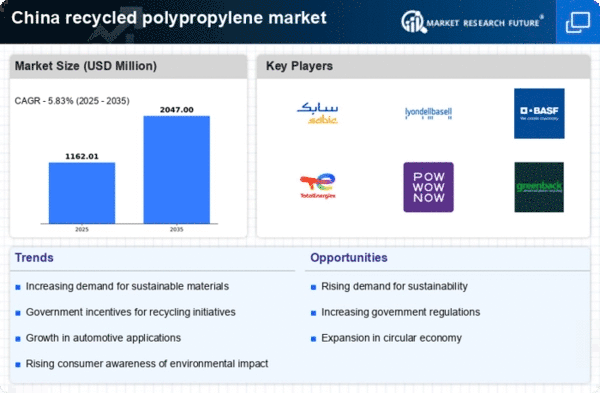
As per Market Research Future analysis, the Recycled Polypropylene market size was estimated at 1098.0 $ Million in 2024. The recycled polypropylene market is projected to grow from 1162.01 $ Million in 2025 to 2047.0 $ Million by 2035, exhibiting a compound annual growth rate (CAGR) of 5.8% during the forecast period 2025 - 2035

Key Market Trends & Highlights

The China recycled polypropylene market is experiencing robust growth driven by sustainability and innovation.

  • The demand for sustainable materials is rising, reflecting a broader shift towards eco-friendly practices.
  • Technological innovations in recycling processes are enhancing the efficiency and quality of recycled polypropylene.
  • Government support and regulations are increasingly promoting the use of recycled materials across various industries.
  • Key market drivers include increasing environmental awareness and rising costs of virgin materials, which are pushing companies towards recycled alternatives.

Market Size & Forecast

2024 Market Size 1098.0 (USD Million)
2035 Market Size 2047.0 (USD Million)
CAGR (2025 - 2035) 5.83%

Major Players

SABIC (SA), LyondellBasell Industries (US), BASF (DE), TotalEnergies (FR), Recycling Technologies (GB), Greenback Recycling Technologies (US), PureCycle Technologies (US), Veolia (FR)

Market Trends

The The recycled polypropylene market is currently experiencing a notable transformation, driven by increasing environmental awareness and regulatory support. As industries seek sustainable alternatives, the demand for recycled materials is on the rise. This shift is not merely a trend but appears to be a fundamental change in how materials are sourced and utilized. The emphasis on circular economy principles is reshaping production processes, encouraging manufacturers to adopt recycled polypropylene in various applications, from packaging to automotive components. Furthermore, government initiatives aimed at reducing plastic waste are likely to bolster this market, creating a favorable environment for growth. In addition, technological advancements in recycling processes are enhancing the quality and efficiency of recycled polypropylene production. Innovations in sorting and processing technologies may lead to higher recovery rates and better material properties. This makes recycled polypropylene more competitive against virgin materials. As the market evolves, collaboration among stakeholders, including manufacturers, recyclers, and policymakers, is essential to address challenges and maximize the potential of recycled polypropylene. The future of this market seems promising, with opportunities for expansion and increased adoption across multiple sectors.

Rising Demand for Sustainable Materials

The recycled polypropylene market is witnessing a surge in demand as industries increasingly prioritize sustainability. This trend is driven by consumer preferences for eco-friendly products and regulatory pressures to reduce plastic waste. Companies are actively seeking recycled materials to meet these demands, indicating a shift towards more responsible sourcing practices.

Technological Innovations in Recycling

Advancements in recycling technologies are playing a crucial role in enhancing the efficiency of recycled polypropylene production. Improved sorting and processing methods are likely to increase recovery rates and the quality of recycled materials. This technological progress may make recycled polypropylene more appealing to manufacturers, further driving market growth.

Government Support and Regulations

Government initiatives aimed at promoting recycling and reducing plastic waste are significantly influencing the recycled polypropylene market. Policies that encourage the use of recycled materials and impose restrictions on single-use plastics are likely to create a more favorable regulatory environment. This support may lead to increased investments in recycling infrastructure and innovation.

China Recycled Polypropylene Market Market Drivers

Government Incentives and Policies

Government initiatives aimed at promoting recycling and reducing plastic waste are playing a crucial role in shaping the China Recycled Polypropylene Market. Policies that incentivize the use of recycled materials, such as tax breaks and subsidies for manufacturers, are becoming more prevalent. In 2025, it is anticipated that the Chinese government will implement stricter regulations on plastic waste, further encouraging the adoption of recycled polypropylene. These measures not only support environmental goals but also stimulate economic growth within the recycling sector. As a result, the China Recycled Polypropylene Market is likely to benefit from enhanced regulatory frameworks that promote sustainable practices and increase the competitiveness of recycled materials.

Growing Applications Across Industries

The versatility of recycled polypropylene is contributing to its growing applications across various industries, thereby driving the China Recycled Polypropylene Market. From packaging to automotive components, the demand for recycled polypropylene is expanding as manufacturers seek to reduce their environmental footprint. In 2025, it is projected that the automotive sector will account for a significant portion of recycled polypropylene usage, as companies increasingly incorporate sustainable materials into their production processes. This diversification of applications not only broadens the market base but also enhances the overall demand for recycled polypropylene, indicating a robust growth trajectory for the China Recycled Polypropylene Market.

Increasing Demand for Sustainable Materials

The rising awareness regarding environmental sustainability is driving the demand for recycled materials, particularly in the China Recycled Polypropylene Market. As consumers and businesses alike prioritize eco-friendly products, the market for recycled polypropylene is expected to expand. In 2025, the demand for recycled polypropylene is projected to grow by approximately 15%, reflecting a shift towards sustainable practices. This trend is further supported by the increasing number of companies committing to sustainability goals, which often include the use of recycled materials in their supply chains. Consequently, the China Recycled Polypropylene Market is likely to witness a surge in investment and innovation aimed at enhancing the quality and availability of recycled polypropylene.

Technological Innovations in Recycling Processes

Advancements in recycling technologies are significantly impacting the China Recycled Polypropylene Market. Innovations such as improved sorting and processing techniques are enhancing the efficiency and quality of recycled polypropylene. In 2025, it is expected that new technologies will enable the recycling of polypropylene at a higher rate, potentially increasing the overall supply of recycled materials. This could lead to a reduction in production costs and an increase in the market share of recycled polypropylene compared to virgin materials. As these technologies continue to evolve, the China Recycled Polypropylene Market may experience a transformation that enhances its sustainability and economic viability.

Consumer Preferences Shifting Towards Eco-Friendly Products

Consumer preferences are increasingly shifting towards eco-friendly products, which is positively influencing the China Recycled Polypropylene Market. As awareness of environmental issues grows, consumers are more inclined to choose products made from recycled materials. This trend is reflected in market data, which suggests that sales of products containing recycled polypropylene are expected to rise by 20% in 2025. Retailers and manufacturers are responding to this shift by expanding their offerings of sustainable products, thereby driving demand for recycled polypropylene. Consequently, the China Recycled Polypropylene Market is likely to see a significant increase in market penetration as eco-conscious consumers continue to influence purchasing decisions.

Market Segment Insights

By Application: Packaging (Largest) vs. Automotive (Fastest-Growing)

<p>In the China <a href="https://www.marketresearchfuture.com/reports/recycled-polypropylene-market-7502" target="_blank" title="recycled polypropylene">recycled polypropylene</a> market, the application segment displays a diverse distribution with Packaging leading as the largest segment. This dominance is driven by the increasing demand for sustainable packaging solutions across various industries. Following closely are the Automotive and Textiles sectors, contributing significantly to the overall market share. Consumer Goods and Construction also play a role, albeit to a lesser extent, reflecting the versatile applications of recycled polypropylene in multiple domains. The growth trends within the application segment indicate a robust upward trajectory, particularly for Automotive, which is emerging as the fastest-growing segment. Key drivers include the automotive industry's shift towards sustainable materials, regulatory pushes for recyclability, and heightened consumer awareness. Additionally, the Packaging sector is witnessing innovations that align with environmental concerns, further propelling its market presence. Overall, the intersection of sustainability and technology is fostering significant growth within these application areas in China.</p>

<p>Packaging (Dominant) vs. Automotive (Emerging)</p>

<p>In the context of the China recycled polypropylene market, Packaging stands out as the dominant application, primarily due to its extensive use in food packaging, retail, and consumer goods. The shift towards eco-friendly materials, coupled with stringent regulations on waste and recycling, has solidified Packaging's position. On the other hand, Automotive is emerging as a pivotal application segment. The increasing adoption of recycled materials in car manufacturing reflects a broader trend towards sustainability and regulatory compliance within the automotive industry. This segment is characterized by innovative uses of recycled polypropylene, such as in interior components and lightweight structures, positioning it as a critical area for growth and development in the coming years.</p>

By End Use: Food Packaging (Largest) vs. Automotive Parts (Fastest-Growing)

<p>In the China recycled polypropylene market, the end use segment showcases a diverse distribution of applications. Leading the market is food packaging, which has gained significant traction due to heightened consumer awareness about sustainability and the demand for eco-friendly packaging. Following closely, automotive parts are gaining ground, attributed to the automotive industry's push towards lightweight materials and recycling initiatives. Household items, industrial applications, and medical supplies also contribute to the segment, but at a more modest share compared to the top two.</p>

<p>Food Packaging: Dominant vs. Automotive Parts: Emerging</p>

<p>Food packaging represents a dominant segment within the China recycled polypropylene market, driven by stringent regulations on plastic waste and the increasing preference for recyclable materials among consumers. The transition to recycled polypropylene not only enhances brand image but also meets consumer demand for environmental responsibility. Conversely, automotive parts are emerging as a rapidly growing segment, propelled by the automotive sector's shift towards sustainability. Innovations in recycling technologies and the need for lightweight materials for fuel efficiency are major drivers behind this growth. This segment is expected to witness a surge in adoption as manufacturers look to reduce their environmental footprint.</p>

By Recycling Process: Mechanical Recycling (Largest) vs. Chemical Recycling (Fastest-Growing)

<p>In the China recycled polypropylene market, Mechanical Recycling stands out as the largest segment, accounting for a significant portion of the market share. This widespread method typically involves the physical reprocessing of polypropylene materials, making it a favorable choice among manufacturers. On the other hand, Chemical Recycling is rapidly gaining traction due to its ability to process a wider variety of contaminated materials and its more efficient recovery rates. The shift towards more sustainable practices is encouraging more investment in both methods.</p>

<p>Mechanical Recycling (Dominant) vs. Chemical Recycling (Emerging)</p>

<p>Mechanical Recycling is widely regarded as the dominant force in the recycled polypropylene segment in China. This method focuses on physically breaking down plastic waste into reusable granules, making it highly effective for clean waste streams. Conversely, Chemical Recycling, which breaks down plastics into their original monomers, is emerging as a viable alternative, especially for complex waste streams that cannot be mechanically processed. While Mechanical Recycling is well-established and cost-effective, Chemical Recycling offers the promise of higher purity and quality for recycled materials, positioning it as a key innovation in future recycling efforts.</p>

By Material Type: Homopolymer (Largest) vs. Copolymer (Fastest-Growing)

<p>In the China recycled polypropylene market, the material type segment is predominantly occupied by Homopolymer, which holds the largest share due to its widespread application in various industries such as packaging, automotive, and consumer goods. Following closely, Copolymer has emerged as a fast-growing segment, appealing particularly to specifications requiring enhanced flexibility and impact resistance. The distribution of these materials illustrates a dynamic landscape driven by varied industry demands and recycling capabilities. As sustainable practices gain traction, there is a notable increase in the desire for high-performance materials that also meet eco-friendly criteria. This change drives the growth of Copolymer, which is seen as a versatile option for modern manufacturing needs. Additionally, Blends and Compounds are gaining attention as companies seek innovative solutions that leverage the properties of recycled polypropylene. Increased awareness of environmental impact and legislative support for recycling initiatives further encourage the growth of these materials in the marketplace.</p>

<p>Homopolymer (Dominant) vs. Blends (Emerging)</p>

<p>Homopolymer continues to remain dominant in the China recycled polypropylene market, characterized by its robust mechanical properties and cost-effectiveness, making it ideal for a wide range of applications. As manufacturers prioritize performance and durability, this material type showcases considerable sustainability advantages. On the other hand, Blends represent an emerging market player that combines properties of various materials, delivering tailored characteristics suited for niche applications. Blends enhance compatibility and processing ease, allowing for innovative products that cater to evolving consumer needs. As the industry witnesses a shift towards customization, Blends are expected to play an increasingly significant role, driven by ongoing advancements in polymer technology and rising demands for differentiated solutions.</p>

Get more detailed insights about China Recycled Polypropylene Market Research Report - Forecast by 2035

Regional Insights

North America : Sustainable Innovation Leader

North America is witnessing a significant surge in the demand for recycled polypropylene, driven by stringent environmental regulations and a growing consumer preference for sustainable products. The region is the largest market, holding approximately 40% of the global share, followed closely by Europe at 30%. Regulatory catalysts, such as the EPA's initiatives to promote recycling, are further propelling market growth. The competitive landscape is characterized by major players like LyondellBasell and Green Dot Corporation, who are investing heavily in recycling technologies. The presence of established companies, along with a robust supply chain, enhances market dynamics. Additionally, collaborations between private and public sectors are fostering innovation in recycling processes, ensuring a steady supply of recycled polypropylene to meet increasing demand.

Europe : Regulatory Framework Driving Growth

Europe is emerging as a pivotal market for recycled polypropylene, driven by ambitious sustainability goals and regulatory frameworks aimed at reducing plastic waste. The region holds approximately 30% of the global market share, making it the second-largest market after North America. The European Union's Circular Economy Action Plan is a key regulatory catalyst, promoting recycling and the use of recycled materials in production processes. Leading countries such as Germany, France, and the UK are at the forefront of this market, with significant investments in recycling infrastructure. Key players like BASF and Veolia Environnement are actively involved in developing innovative recycling technologies. The competitive landscape is marked by a focus on sustainability, with companies striving to meet stringent EU regulations while catering to the growing demand for eco-friendly products.

Asia-Pacific : Emerging Market Potential

Asia-Pacific is rapidly becoming a significant player in the recycled polypropylene market, driven by increasing industrialization and urbanization. The region is projected to hold around 25% of the global market share, with China being the largest contributor. The government's initiatives to promote recycling and reduce plastic waste are key growth drivers, alongside rising consumer awareness regarding sustainability. China, as the leading country in this region, is home to major players like Sinopec Limited and China National Petroleum Corporation. The competitive landscape is evolving, with local companies increasingly adopting advanced recycling technologies. Additionally, partnerships between government and private sectors are enhancing the recycling infrastructure, ensuring a steady supply of recycled polypropylene to meet the growing demand in various industries.

Middle East and Africa : Resource-Rich Market Dynamics

The Middle East and Africa region is gradually developing its recycled polypropylene market, driven by increasing awareness of environmental issues and the need for sustainable practices. The market share in this region is currently around 5%, with potential for growth as governments implement policies to encourage recycling. Countries like South Africa and the UAE are leading the charge, focusing on waste management and recycling initiatives. The competitive landscape is still emerging, with local players beginning to invest in recycling technologies. Key players are exploring partnerships to enhance their capabilities in recycling processes. As the region's infrastructure improves, the demand for recycled polypropylene is expected to rise, supported by both governmental and private sector efforts to promote sustainability and reduce plastic waste.

Key Players and Competitive Insights

The recycled polypropylene market in China is characterized by a dynamic competitive landscape, driven by increasing environmental regulations and a growing demand for sustainable materials. Key players are actively pursuing strategies that emphasize innovation, partnerships, and regional expansion to enhance their market positions. Companies such as SABIC (SA), LyondellBasell Industries (US), and BASF (DE) are at the forefront, leveraging their technological expertise and extensive supply chains to capitalize on the rising demand for recycled materials. Their collective focus on sustainability and operational efficiency is reshaping the competitive environment, fostering a landscape where innovation is paramount.In terms of business tactics, companies are increasingly localizing manufacturing to reduce transportation costs and enhance supply chain resilience. The market structure appears moderately fragmented, with several players vying for market share while also collaborating on sustainability initiatives. This collective influence of key players is likely to drive further consolidation and strategic partnerships, as companies seek to optimize their operations and expand their geographical reach.

In October LyondellBasell Industries (US) announced a strategic partnership with a leading Chinese recycling firm to enhance its recycling capabilities in the region. This collaboration is expected to bolster LyondellBasell's position in the market by increasing its access to local recycled polypropylene sources, thereby improving its supply chain efficiency and sustainability profile. Such strategic moves indicate a growing trend towards localized operations and partnerships that can enhance competitive advantage.

In September BASF (DE) unveiled a new recycling technology aimed at improving the quality of recycled polypropylene. This innovation is anticipated to significantly enhance the performance characteristics of recycled materials, making them more appealing to manufacturers. The introduction of advanced recycling technologies not only positions BASF as a leader in innovation but also reflects the broader industry trend towards enhancing the quality and usability of recycled products.

In August SABIC (SA) launched a new initiative focused on increasing the circularity of its product offerings, which includes a commitment to using 50% recycled content in its polypropylene products by 2030. This ambitious goal underscores the company's dedication to sustainability and positions it favorably in a market that increasingly values eco-friendly practices. Such initiatives are likely to resonate with consumers and businesses alike, further driving demand for recycled materials.

As of November current competitive trends in the recycled polypropylene market are heavily influenced by digitalization, sustainability, and the integration of advanced technologies such as AI. Strategic alliances are becoming increasingly important, as companies recognize the need to collaborate to enhance their capabilities and market reach. Looking ahead, competitive differentiation is expected to evolve from traditional price-based competition to a focus on innovation, technological advancements, and supply chain reliability. This shift suggests that companies that prioritize sustainable practices and technological integration will likely emerge as leaders in the market.

Key Companies in the China Recycled Polypropylene Market include

Industry Developments

Future Outlook

China Recycled Polypropylene Market Future Outlook

The recycled polypropylene market is projected to grow at a 5.83% CAGR from 2025 to 2035, driven by increasing demand for sustainable materials and regulatory support.

New opportunities lie in:

  • Investment in advanced recycling technologies to enhance material quality.
  • Development of branded recycled polypropylene products for consumer markets.
  • Partnerships with manufacturers for closed-loop recycling systems.

By 2035, the market is expected to achieve substantial growth, driven by innovation and sustainability initiatives.

Market Segmentation

China Recycled Polypropylene Market Process Outlook

  • Mechanical
  • Chemical

China Recycled Polypropylene Market Application Outlook

  • Packaging
  • Automotive
  • Building & Construction
  • Textiles

Report Scope

MARKET SIZE 2024 1098.0(USD Million)
MARKET SIZE 2025 1162.01(USD Million)
MARKET SIZE 2035 2047.0(USD Million)
COMPOUND ANNUAL GROWTH RATE (CAGR) 5.83% (2025 - 2035)
REPORT COVERAGE Revenue Forecast, Competitive Landscape, Growth Factors, and Trends
BASE YEAR 2024
Market Forecast Period 2025 - 2035
Historical Data 2019 - 2024
Market Forecast Units USD Million
Key Companies Profiled SABIC (SA), LyondellBasell Industries (US), BASF (DE), TotalEnergies (FR), Recycling Technologies (GB), Greenback Recycling Technologies (US), PureCycle Technologies (US), Veolia (FR)
Segments Covered Process, Application
Key Market Opportunities Growing demand for sustainable packaging solutions drives innovation in the recycled polypropylene market.
Key Market Dynamics Rising demand for sustainable materials drives innovation and competition in the recycled polypropylene market.
Countries Covered China

FAQs

What is the projected market valuation of the China recycled polypropylene market by 2035?

<p>The projected market valuation for the China recycled polypropylene market is 1.97 USD Billion by 2035.</p>

What was the market valuation of the China recycled polypropylene market in 2024?

<p>The overall market valuation of the China recycled polypropylene market was 1.1 USD Billion in 2024.</p>

What is the expected CAGR for the China recycled polypropylene market during the forecast period 2025 - 2035?

<p>The expected CAGR for the China recycled polypropylene market during the forecast period 2025 - 2035 is 5.47%.</p>

Which companies are considered key players in the China recycled polypropylene market?

<p>Key players in the China recycled polypropylene market include SABIC, China National Petroleum Corporation, and Sinopec Limited.</p>

What are the main applications of recycled polypropylene in China?

<p>The main applications of recycled polypropylene in China include automotive, packaging, textiles, consumer goods, and construction.</p>

How does the automotive segment perform in the China recycled polypropylene market?

<p>The automotive segment was valued between 0.25 and 0.45 USD Billion in 2024 and is expected to grow during the forecast period.</p>

What is the valuation range for food packaging in the China recycled polypropylene market?

<p>The food packaging segment was valued between 0.3 and 0.55 USD Billion in 2024, indicating its importance in the market.</p>

What recycling processes are utilized in the China recycled polypropylene market?

<p>The recycling processes utilized include mechanical recycling, chemical recycling, thermal recycling, and biological recycling.</p>

What is the valuation range for homopolymer materials in the China recycled polypropylene market?

<p>The homopolymer segment was valued between 0.44 and 0.77 USD Billion in 2024, reflecting its substantial market presence.</p>

How do the projected growth rates of different segments compare in the China recycled polypropylene market?

<p>Segments such as automotive and food packaging are likely to experience notable growth, contributing to the overall market expansion.</p>

  1. SECTION I: EXECUTIVE SUMMARY AND KEY HIGHLIGHTS
    1. | 1.1 EXECUTIVE SUMMARY
    2. | | 1.1.1 Market Overview
    3. | | 1.1.2 Key Findings
    4. | | 1.1.3 Market Segmentation
    5. | | 1.1.4 Competitive Landscape
    6. | | 1.1.5 Challenges and Opportunities
    7. | | 1.1.6 Future Outlook
  2. SECTION II: SCOPING, METHODOLOGY AND MARKET STRUCTURE
    1. | 2.1 MARKET INTRODUCTION
    2. | | 2.1.1 Definition
    3. | | 2.1.2 Scope of the study
    4. | | | 2.1.2.1 Research Objective
    5. | | | 2.1.2.2 Assumption
    6. | | | 2.1.2.3 Limitations
    7. | 2.2 RESEARCH METHODOLOGY
    8. | | 2.2.1 Overview
    9. | | 2.2.2 Data Mining
    10. | | 2.2.3 Secondary Research
    11. | | 2.2.4 Primary Research
    12. | | | 2.2.4.1 Primary Interviews and Information Gathering Process
    13. | | | 2.2.4.2 Breakdown of Primary Respondents
    14. | | 2.2.5 Forecasting Model
    15. | | 2.2.6 Market Size Estimation
    16. | | | 2.2.6.1 Bottom-Up Approach
    17. | | | 2.2.6.2 Top-Down Approach
    18. | | 2.2.7 Data Triangulation
    19. | | 2.2.8 Validation
  3. SECTION III: QUALITATIVE ANALYSIS
    1. | 3.1 MARKET DYNAMICS
    2. | | 3.1.1 Overview
    3. | | 3.1.2 Drivers
    4. | | 3.1.3 Restraints
    5. | | 3.1.4 Opportunities
    6. | 3.2 MARKET FACTOR ANALYSIS
    7. | | 3.2.1 Value chain Analysis
    8. | | 3.2.2 Porter's Five Forces Analysis
    9. | | | 3.2.2.1 Bargaining Power of Suppliers
    10. | | | 3.2.2.2 Bargaining Power of Buyers
    11. | | | 3.2.2.3 Threat of New Entrants
    12. | | | 3.2.2.4 Threat of Substitutes
    13. | | | 3.2.2.5 Intensity of Rivalry
    14. | | 3.2.3 COVID-19 Impact Analysis
    15. | | | 3.2.3.1 Market Impact Analysis
    16. | | | 3.2.3.2 Regional Impact
    17. | | | 3.2.3.3 Opportunity and Threat Analysis
  4. SECTION IV: QUANTITATIVE ANALYSIS
    1. | 4.1 Chemicals and Materials, BY Application (USD Billion)
    2. | | 4.1.1 Automotive
    3. | | 4.1.2 Packaging
    4. | | 4.1.3 Textiles
    5. | | 4.1.4 Consumer Goods
    6. | | 4.1.5 Construction
    7. | 4.2 Chemicals and Materials, BY End Use (USD Billion)
    8. | | 4.2.1 Automotive Parts
    9. | | 4.2.2 Food Packaging
    10. | | 4.2.3 Household Items
    11. | | 4.2.4 Industrial Applications
    12. | | 4.2.5 Medical Supplies
    13. | 4.3 Chemicals and Materials, BY Recycling Process (USD Billion)
    14. | | 4.3.1 Mechanical Recycling
    15. | | 4.3.2 Chemical Recycling
    16. | | 4.3.3 Thermal Recycling
    17. | | 4.3.4 Biological Recycling
    18. | 4.4 Chemicals and Materials, BY Material Type (USD Billion)
    19. | | 4.4.1 Homopolymer
    20. | | 4.4.2 Copolymer
    21. | | 4.4.3 Blends
    22. | | 4.4.4 Compounds
  5. SECTION V: COMPETITIVE ANALYSIS
    1. | 5.1 Competitive Landscape
    2. | | 5.1.1 Overview
    3. | | 5.1.2 Competitive Analysis
    4. | | 5.1.3 Market share Analysis
    5. | | 5.1.4 Major Growth Strategy in the Chemicals and Materials
    6. | | 5.1.5 Competitive Benchmarking
    7. | | 5.1.6 Leading Players in Terms of Number of Developments in the Chemicals and Materials
    8. | | 5.1.7 Key developments and growth strategies
    9. | | | 5.1.7.1 New Product Launch/Service Deployment
    10. | | | 5.1.7.2 Merger & Acquisitions
    11. | | | 5.1.7.3 Joint Ventures
    12. | | 5.1.8 Major Players Financial Matrix
    13. | | | 5.1.8.1 Sales and Operating Income
    14. | | | 5.1.8.2 Major Players R&D Expenditure. 2023
    15. | 5.2 Company Profiles
    16. | | 5.2.1 SABIC (SA)
    17. | | | 5.2.1.1 Financial Overview
    18. | | | 5.2.1.2 Products Offered
    19. | | | 5.2.1.3 Key Developments
    20. | | | 5.2.1.4 SWOT Analysis
    21. | | | 5.2.1.5 Key Strategies
    22. | | 5.2.2 China National Petroleum Corporation (CN)
    23. | | | 5.2.2.1 Financial Overview
    24. | | | 5.2.2.2 Products Offered
    25. | | | 5.2.2.3 Key Developments
    26. | | | 5.2.2.4 SWOT Analysis
    27. | | | 5.2.2.5 Key Strategies
    28. | | 5.2.3 China Petroleum & Chemical Corporation (CN)
    29. | | | 5.2.3.1 Financial Overview
    30. | | | 5.2.3.2 Products Offered
    31. | | | 5.2.3.3 Key Developments
    32. | | | 5.2.3.4 SWOT Analysis
    33. | | | 5.2.3.5 Key Strategies
    34. | | 5.2.4 China National Chemical Corporation (CN)
    35. | | | 5.2.4.1 Financial Overview
    36. | | | 5.2.4.2 Products Offered
    37. | | | 5.2.4.3 Key Developments
    38. | | | 5.2.4.4 SWOT Analysis
    39. | | | 5.2.4.5 Key Strategies
    40. | | 5.2.5 Zhejiang Jianye Chemical Co., Ltd. (CN)
    41. | | | 5.2.5.1 Financial Overview
    42. | | | 5.2.5.2 Products Offered
    43. | | | 5.2.5.3 Key Developments
    44. | | | 5.2.5.4 SWOT Analysis
    45. | | | 5.2.5.5 Key Strategies
    46. | | 5.2.6 Shenzhen Jinhui Zhaofeng Technology Co., Ltd. (CN)
    47. | | | 5.2.6.1 Financial Overview
    48. | | | 5.2.6.2 Products Offered
    49. | | | 5.2.6.3 Key Developments
    50. | | | 5.2.6.4 SWOT Analysis
    51. | | | 5.2.6.5 Key Strategies
    52. | | 5.2.7 Sinopec Limited (CN)
    53. | | | 5.2.7.1 Financial Overview
    54. | | | 5.2.7.2 Products Offered
    55. | | | 5.2.7.3 Key Developments
    56. | | | 5.2.7.4 SWOT Analysis
    57. | | | 5.2.7.5 Key Strategies
    58. | | 5.2.8 Wuxi Huasheng Plastic Co., Ltd. (CN)
    59. | | | 5.2.8.1 Financial Overview
    60. | | | 5.2.8.2 Products Offered
    61. | | | 5.2.8.3 Key Developments
    62. | | | 5.2.8.4 SWOT Analysis
    63. | | | 5.2.8.5 Key Strategies
    64. | 5.3 Appendix
    65. | | 5.3.1 References
    66. | | 5.3.2 Related Reports
  6. LIST OF FIGURES
    1. | 6.1 MARKET SYNOPSIS
    2. | 6.2 CHINA MARKET ANALYSIS BY APPLICATION
    3. | 6.3 CHINA MARKET ANALYSIS BY END USE
    4. | 6.4 CHINA MARKET ANALYSIS BY RECYCLING PROCESS
    5. | 6.5 CHINA MARKET ANALYSIS BY MATERIAL TYPE
    6. | 6.6 KEY BUYING CRITERIA OF CHEMICALS AND MATERIALS
    7. | 6.7 RESEARCH PROCESS OF MRFR
    8. | 6.8 DRO ANALYSIS OF CHEMICALS AND MATERIALS
    9. | 6.9 DRIVERS IMPACT ANALYSIS: CHEMICALS AND MATERIALS
    10. | 6.10 RESTRAINTS IMPACT ANALYSIS: CHEMICALS AND MATERIALS
    11. | 6.11 SUPPLY / VALUE CHAIN: CHEMICALS AND MATERIALS
    12. | 6.12 CHEMICALS AND MATERIALS, BY APPLICATION, 2024 (% SHARE)
    13. | 6.13 CHEMICALS AND MATERIALS, BY APPLICATION, 2024 TO 2035 (USD Billion)
    14. | 6.14 CHEMICALS AND MATERIALS, BY END USE, 2024 (% SHARE)
    15. | 6.15 CHEMICALS AND MATERIALS, BY END USE, 2024 TO 2035 (USD Billion)
    16. | 6.16 CHEMICALS AND MATERIALS, BY RECYCLING PROCESS, 2024 (% SHARE)
    17. | 6.17 CHEMICALS AND MATERIALS, BY RECYCLING PROCESS, 2024 TO 2035 (USD Billion)
    18. | 6.18 CHEMICALS AND MATERIALS, BY MATERIAL TYPE, 2024 (% SHARE)
    19. | 6.19 CHEMICALS AND MATERIALS, BY MATERIAL TYPE, 2024 TO 2035 (USD Billion)
    20. | 6.20 BENCHMARKING OF MAJOR COMPETITORS
  7. LIST OF TABLES
    1. | 7.1 LIST OF ASSUMPTIONS
    2. | | 7.1.1
    3. | 7.2 China MARKET SIZE ESTIMATES; FORECAST
    4. | | 7.2.1 BY APPLICATION, 2025-2035 (USD Billion)
    5. | | 7.2.2 BY END USE, 2025-2035 (USD Billion)
    6. | | 7.2.3 BY RECYCLING PROCESS, 2025-2035 (USD Billion)
    7. | | 7.2.4 BY MATERIAL TYPE, 2025-2035 (USD Billion)
    8. | 7.3 PRODUCT LAUNCH/PRODUCT DEVELOPMENT/APPROVAL
    9. | | 7.3.1
    10. | 7.4 ACQUISITION/PARTNERSHIP
    11. | | 7.4.1

China Chemicals and Materials Market Segmentation

Chemicals and Materials By Application (USD Billion, 2025-2035)

  • Automotive
  • Packaging
  • Textiles
  • Consumer Goods
  • Construction

Chemicals and Materials By End Use (USD Billion, 2025-2035)

  • Automotive Parts
  • Food Packaging
  • Household Items
  • Industrial Applications
  • Medical Supplies

Chemicals and Materials By Recycling Process (USD Billion, 2025-2035)

  • Mechanical Recycling
  • Chemical Recycling
  • Thermal Recycling
  • Biological Recycling

Chemicals and Materials By Material Type (USD Billion, 2025-2035)

  • Homopolymer
  • Copolymer
  • Blends
  • Compounds
Infographic

Free Sample Request

Kindly complete the form below to receive a free sample of this Report

Get Free Sample

Customer Strories

Compare Licence

×
Features License Type
Single User Multiuser License Enterprise User
Price $4,950 $5,950 $7,250
Maximum User Access Limit 1 User Upto 10 Users Unrestricted Access Throughout the Organization
Free Customization
Direct Access to Analyst
Deliverable Format
Platform Access
Discount on Next Purchase 10% 15% 15%
Printable Versions