×
  • Cat-intel
  • MedIntelliX
  • Resources
  • About Us
  • Hero Background
    English
    Chinese
    French
    Japanese
    Korean
    German
    Spanish

    Ceramic Armor Materials Market Trends

    ID: MRFR/CnM/6702-HCR
    140 Pages
    Anshula Mandaokar
    October 2025

    Ceramic Armor Materials Market Research Report Information by Material (Boron Carbide, Silicon Carbide, Alumina, Ceramic Matrix Composite, Titanium Boride, Aluminum Nitride and others), Application (Body Armor, Aircraft Armor, Marine Armor, Vehicles Armor and others) and Region (North America, Latin America, Asia-Pacific, Middle East & Africa and Latin America) - Forecast till 2035

    Share:
    Download PDF ×

    We do not share your information with anyone. However, we may send you emails based on your report interest from time to time. You may contact us at any time to opt-out.

    Ceramic Armor Materials Market Infographic
    Purchase Options

    Market Trends

    Key Emerging Trends in the Ceramic Armor Materials Market

    In recent years, the Ceramic Armor Materials Market has changed, reflecting the worldwide military and security sector. Due to their hardness, lightweight, and ballistic resistance, ceramic armor materials are used to make protective gear. Due to global security concerns and the necessity for effective personal protection equipment, innovative ceramic materials with improved ballistic performance are in demand. The market has shifted toward next-generation ceramic armor materials, driven by research and innovation. Manufacturers are spending substantially in R&D to find materials that provide improved ballistic protection, flexibility, durability, and cost-effectiveness. In response, new ceramic composite materials have emerged, combining elements to balance strength and practicality. These advances are crucial as military and law enforcement agencies seek to equip personnel with cutting-edge gear. Geopolitical tensions have driven defense and security investments, shaping market trends. Advanced armor systems are in demand as militaries worldwide modernize. Ceramic materials have a dependable and effective record of protecting workers against ballistic threats. Government contracts and agreements between defense organizations and ceramic armor manufacturers have increased, boosting industry growth. Additionally, the civilian market has helped the ceramic armor materials sector grow. Personal safety concerns and knowledge of possible dangers have raised demand for protective gear in law enforcement, private security, and civilian uses. The market has reacted with a variety of ceramic armor solutions for various end-users, indicating the democratization of superior defensive technology. Multi-functional solutions are another ceramic armor materials industry trend. Manufacturers want materials that withstand severe temperatures, chemicals, and electrical interference in addition to ballistic protection. This tendency coincides with the increasing nature of contemporary combat and security concerns, where soldiers require full protection against a range of threats. However, difficulties exist in the sector, particularly the high production costs associated with advanced ceramic materials. Achieving a balance between performance and price is a fundamental problem for both producers and end-users. Additionally, the market faces competition from alternative materials and technologies, such as sophisticated fibers and polymers, which also provide lightweight and durable qualities. In conclusion, the Ceramic Armor Materials Market is witnessing a dynamic period marked by technical developments, rising global security concerns, and a growing need for varied protection solutions. The industry's innovative and collaborative response to these trends will shape ceramic armor materials' future and their widespread use in diverse applications.


    Author
    Anshula Mandaokar
    Team Lead - Research

    Anshula Mandaokar holds an academic degree in Chemical Engineering and has been contributing to the field for more than 5 years. She has expertise in Market Research and Business Consulting and serves as a Team Lead for a reputed Market Research firm under the Chemicals and Materials domain spectrum. She has worked on multiple projects, generating explicit results in a quick turnaround time. Her understanding of data interpretation justifies her role as a leader.

    Leave a Comment

    FAQs

    What would be the ceramic armor materials market valuation by 2025?

    The ceramic armor materials market valuation would be USD 2.8 billion by 2025.

    What would be the CAGR of the ceramic armor materials market during the forecast period of 2019 to 2025?

    The CAGR would be 7.65% during the forecast period (2019-2025).

    What would primarily drive the ceramic armor materials market?

    Aerospace and defense industries would drive the ceramic armor materials market growth.

    Which region leads the global ceramic armor materials market?

    North America leads the ceramic armor materials market.

    What applications have been discussed in the ceramic armor materials market report?

    Applications discussed are aircraft armor, body armor, vehicle armor, marine armor, and others.

    Market Summary

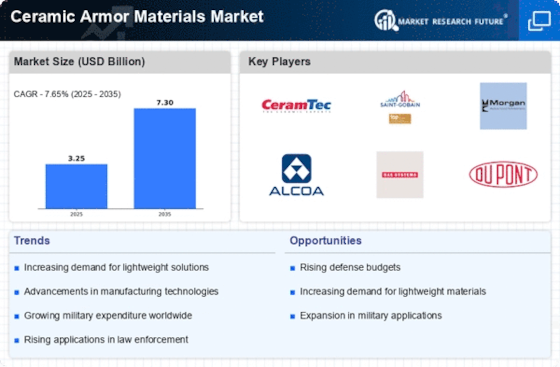
    As per MRFR analysis, the Ceramic Armor Materials Market Size was estimated at 3.245 USD Billion in 2024. The Ceramic Armor Materials industry is projected to grow from 3.493 USD Billion in 2025 to 7.3 USD Billion by 2035, exhibiting a compound annual growth rate (CAGR) of 7.65 during the forecast period 2025 - 2035.

    Key Market Trends & Highlights

    The Ceramic Armor Materials Market is poised for substantial growth driven by technological advancements and increasing demand for protection.

    • North America remains the largest market for ceramic armor materials, driven by heightened defense spending and technological innovation.
    • The Asia-Pacific region is emerging as the fastest-growing market, fueled by rising geopolitical tensions and increased investment in defense.
    • Boron carbide continues to dominate the market as the largest segment, while silicon carbide is recognized as the fastest-growing segment due to its superior performance characteristics.
    • Key market drivers include technological advancements in armor design and the growing demand from law enforcement agencies for enhanced protective solutions.

    Market Size & Forecast

    2024 Market Size 3.245 (USD Billion)
    2035 Market Size 7.3 (USD Billion)
    CAGR (2025 - 2035) 7.65%
    Largest Regional Market Share in 2024 North America

    Major Players

    <p>CeramTec GmbH (DE), Saint-Gobain (FR), Morgan Advanced Materials (GB), Alcoa Corporation (US), Bae Systems (GB), DuPont (US), 3M Company (US), Nippon Electric Glass (JP)</p>

    Market Trends

    The Ceramic Armor Materials Market is currently experiencing a notable evolution, driven by advancements in material science and increasing demand for enhanced protection in military and law enforcement applications. The ongoing development of lightweight, high-performance ceramics is reshaping the landscape, as manufacturers strive to create products that offer superior ballistic resistance while minimizing weight. This trend is particularly relevant in the context of modern warfare, where mobility and agility are paramount. Furthermore, the integration of innovative manufacturing techniques, such as additive manufacturing, is likely to enhance the customization and efficiency of ceramic armor production, potentially leading to more tailored solutions for specific operational needs. In addition to military applications, the Ceramic Armor Materials Market is witnessing growing interest from the civilian sector, particularly in personal protective equipment and vehicle armor. As security concerns escalate globally, the demand for effective protective solutions is expected to rise. This shift may encourage manufacturers to explore new applications and expand their product offerings. Moreover, collaborations between industry players and research institutions could foster the development of next-generation materials, further propelling market growth. Overall, the Ceramic Armor Materials Market appears poised for continued expansion, driven by innovation and a diverse range of applications.

    Advancements in Material Science

    Recent innovations in material science are significantly influencing the Ceramic Armor Materials Market. The development of new composite materials and nanostructured ceramics is enhancing the performance characteristics of armor solutions, making them lighter and more effective against various threats. This trend suggests a shift towards more sophisticated materials that can meet the evolving demands of both military and civilian applications.

    Increased Demand for Personal Protection

    The rising global emphasis on personal safety is contributing to a growing interest in ceramic armor solutions beyond traditional military uses. As security threats become more prevalent, there is a noticeable uptick in demand for personal protective equipment, including body armor and vehicle protection. This trend indicates a broader market potential as manufacturers seek to cater to diverse consumer needs.

    Sustainability Initiatives in Production

    Sustainability is becoming an increasingly important consideration within the Ceramic Armor Materials Market. Manufacturers are exploring eco-friendly production methods and materials to reduce environmental impact. This trend reflects a growing awareness of sustainability issues and may lead to the development of greener alternatives in armor solutions, appealing to environmentally conscious consumers.

    Ceramic Armor Materials Market Market Drivers

    Rising Geopolitical Tensions

    The Ceramic Armor Materials Market is influenced by the rising geopolitical tensions across various regions. As nations prioritize national security and defense capabilities, there is a marked increase in military spending, particularly in countries facing security threats. This trend has led to a heightened demand for advanced armor solutions, including ceramic armor, which is favored for its lightweight and high-performance characteristics. According to recent data, defense budgets in several countries have seen an increase of approximately 5-10% annually, directly impacting the procurement of advanced armor materials. Consequently, manufacturers in the ceramic armor sector are likely to benefit from this increased demand, as governments seek to enhance their military capabilities and protect personnel in conflict zones.

    Emerging Applications in Civilian Sectors

    The Ceramic Armor Materials Market is expanding beyond traditional military applications, with emerging opportunities in civilian sectors. Industries such as automotive, aerospace, and construction are increasingly recognizing the benefits of ceramic armor materials for protective applications. For instance, the automotive sector is exploring the use of ceramic composites in vehicle armor to enhance passenger safety without significantly increasing weight. Market analysis suggests that the civilian applications segment could grow at a rate of 5% annually, driven by the need for enhanced safety measures in various industries. This diversification not only broadens the market scope but also encourages innovation in ceramic armor technologies, as manufacturers seek to meet the specific requirements of different sectors.

    Technological Advancements in Armor Design

    The Ceramic Armor Materials Market is experiencing a surge in technological advancements that enhance the performance and effectiveness of armor systems. Innovations in material science, such as the development of lightweight composites and advanced ceramics, are driving this trend. These materials not only provide superior ballistic protection but also reduce the overall weight of armor systems, making them more suitable for various applications, including military and law enforcement. The integration of smart technologies, such as sensors and adaptive materials, further augments the capabilities of ceramic armor. As a result, the market is projected to grow significantly, with estimates suggesting a compound annual growth rate of over 7% in the coming years. This growth is indicative of the increasing reliance on advanced armor solutions in both defense and civilian sectors.

    Growing Demand from Law Enforcement Agencies

    The Ceramic Armor Materials Market is witnessing a growing demand from law enforcement agencies, driven by the need for enhanced personal protection for officers. As crime rates fluctuate and public safety concerns rise, police forces are increasingly adopting advanced armor solutions, including ceramic body armor. This shift is reflected in market data, which indicates that the law enforcement segment is expected to account for a significant share of the ceramic armor market, with projections suggesting a growth rate of around 6% over the next few years. The lightweight nature and superior ballistic resistance of ceramic materials make them an ideal choice for law enforcement applications, thereby propelling the market forward. Additionally, the emphasis on officer safety and the need for effective protective gear are likely to sustain this demand in the foreseeable future.

    Increased Investment in Defense Research and Development

    The Ceramic Armor Materials Market is benefiting from increased investment in defense research and development (R&D) initiatives. Governments and private entities are allocating substantial resources to explore innovative materials and technologies that can enhance the performance of armor systems. This focus on R&D is crucial, as it leads to the discovery of new ceramic composites and manufacturing techniques that improve the durability and effectiveness of armor. Recent reports indicate that defense R&D spending has risen by approximately 8% in several countries, reflecting a commitment to advancing military capabilities. As a result, the ceramic armor sector is likely to see a surge in new product offerings and improved performance standards, which could further stimulate market growth and attract new players to the industry.

    Market Segment Insights

    By Material: Boron Carbide (Largest) vs. Silicon Carbide (Fastest-Growing)

    <p>The Ceramic Armor Materials Market demonstrates a significant distribution of market share among various material segments, with boron carbide leading as the largest contributor owing to its exceptional hardness and lightweight properties. Silicon carbide follows closely, gaining traction due to its enhanced ballistic resistance and thermal stability. Other segments such as alumina and ceramic matrix composites also play vital roles, yet their market shares remain relatively smaller in comparison to the dominant energies of boron carbide and silicon carbide.</p>

    <p>Boron Carbide (Dominant) vs. Silicon Carbide (Emerging)</p>

    <p>Boron carbide is recognized for its unparalleled hardness and lightweight characteristics, making it a preferred choice in the military and defense sectors for its effective ballistic protection. This material's dominance in the Ceramic Armor Materials Market is attributed to its well-established manufacturing processes and proven performance in various applications. In contrast, silicon carbide is emergent due to its increasing integration into advanced armor solutions, benefiting from innovations that enhance its strength and durability, thus appealing to modern-day defense requirements. The comparative advantages of boron carbide and silicon carbide highlight a pivotal dynamic in material selection, with boron carbide maintaining a stronghold while silicon carbide is on the verge of rapid expansion.</p>

    By Application: Body Armor (Largest) vs. Aircraft Armor (Fastest-Growing)

    <p>In the Ceramic Armor Materials Market, body armor holds the largest share, being essential for personal protection in military and law enforcement applications. This segment dominates due to the increasing focus on soldier safety and advancements in material technology. Following closely, aircraft armor is emerging as the fastest-growing segment, driven by the rising need for enhanced protection in military aircraft amid evolving threats from advanced weaponry. The growth trends within this segment are significantly influenced by government defense budgets expanding to address security concerns globally. Innovations in ceramic composites are driving the development of lighter and more effective armor solutions, catering not only to military applications but also to commercial sectors such as private security and aviation. This reflects a broader trend of increasing demand for ceramic armor across various platforms, including vehicles and marine applications.</p>

    <p>Body Armor (Dominant) vs. Aircraft Armor (Emerging)</p>

    <p>Body armor is recognized as the dominant segment in the Ceramic Armor Materials Market, primarily due to its critical role in protecting military personnel and law enforcement officers. Designed to withstand ballistic impacts, these armor systems utilize advanced ceramic materials for optimal performance. On the other hand, aircraft armor is classified as an emerging segment, characterized by rapid development and the integration of innovative materials aimed at enhancing the protection of aircraft from missile and ballistic threats. The evolution in aircraft armor technologies showcases lighter and more efficient designs, reflecting the increasing demand for high-performance protective equipment in the defense sector.</p>

    Get more detailed insights about Ceramic Armor Materials Market Report - Global Forecast till 2035

    Regional Insights

    Key Companies in the Ceramic Armor Materials Market market include

    Industry Developments

    Future Outlook

    Ceramic Armor Materials Market Future Outlook

    <p>The Ceramic Armor Materials Market is projected to grow at a 7.65% CAGR from 2024 to 2035, driven by increasing defense budgets and technological advancements.</p>

    New opportunities lie in:

    • <p>Development of lightweight composite armor solutions for enhanced mobility.</p>
    • <p>Expansion into emerging markets with tailored ceramic armor products.</p>
    • <p>Investment in R&D for next-generation ceramics with superior ballistic performance.</p>

    <p>By 2035, the market is expected to achieve robust growth, solidifying its position as a leader in protective materials.</p>

    Market Segmentation

    Ceramic Armor Materials Market Material Outlook

    • boron carbide
    • silicon carbide
    • alumina
    • ceramic matrix composite
    • titanium boride
    • aluminum nitride
    • others

    Ceramic Armor Materials Market Application Outlook

    • body armor
    • aircraft armor
    • marine armor
    • vehicles armor
    • others

    Report Scope

    MARKET SIZE 20243.245(USD Billion)
    MARKET SIZE 20253.493(USD Billion)
    MARKET SIZE 20357.3(USD Billion)
    COMPOUND ANNUAL GROWTH RATE (CAGR)7.65% (2024 - 2035)
    REPORT COVERAGERevenue Forecast, Competitive Landscape, Growth Factors, and Trends
    BASE YEAR2024
    Market Forecast Period2025 - 2035
    Historical Data2019 - 2024
    Market Forecast UnitsUSD Billion
    Key Companies ProfiledMarket analysis in progress
    Segments CoveredMarket segmentation analysis in progress
    Key Market OpportunitiesAdvancements in lightweight materials enhance performance and expand applications in the Ceramic Armor Materials Market.
    Key Market DynamicsRising demand for lightweight, high-performance ceramic armor materials driven by defense and law enforcement sectors.
    Countries CoveredNorth America, Europe, APAC, South America, MEA

    FAQs

    What would be the ceramic armor materials market valuation by 2025?

    The ceramic armor materials market valuation would be USD 2.8 billion by 2025.

    What would be the CAGR of the ceramic armor materials market during the forecast period of 2019 to 2025?

    The CAGR would be 7.65% during the forecast period (2019-2025).

    What would primarily drive the ceramic armor materials market?

    Aerospace and defense industries would drive the ceramic armor materials market growth.

    Which region leads the global ceramic armor materials market?

    North America leads the ceramic armor materials market.

    What applications have been discussed in the ceramic armor materials market report?

    Applications discussed are aircraft armor, body armor, vehicle armor, marine armor, and others.

    1. SECTION I: EXECUTIVE SUMMARY AND KEY HIGHLIGHTS
      1. | 1.1 EXECUTIVE SUMMARY
      2. | | 1.1.1 Market Overview
      3. | | 1.1.2 Key Findings
      4. | | 1.1.3 Market Segmentation
      5. | | 1.1.4 Competitive Landscape
      6. | | 1.1.5 Challenges and Opportunities
      7. | | 1.1.6 Future Outlook
    2. SECTION II: SCOPING, METHODOLOGY AND MARKET STRUCTURE
      1. | 2.1 MARKET INTRODUCTION
      2. | | 2.1.1 Definition
      3. | | 2.1.2 Scope of the study
      4. | | | 2.1.2.1 Research Objective
      5. | | | 2.1.2.2 Assumption
      6. | | | 2.1.2.3 Limitations
      7. | 2.2 RESEARCH METHODOLOGY
      8. | | 2.2.1 Overview
      9. | | 2.2.2 Data Mining
      10. | | 2.2.3 Secondary Research
      11. | | 2.2.4 Primary Research
      12. | | | 2.2.4.1 Primary Interviews and Information Gathering Process
      13. | | | 2.2.4.2 Breakdown of Primary Respondents
      14. | | 2.2.5 Forecasting Model
      15. | | 2.2.6 Market Size Estimation
      16. | | | 2.2.6.1 Bottom-Up Approach
      17. | | | 2.2.6.2 Top-Down Approach
      18. | | 2.2.7 Data Triangulation
      19. | | 2.2.8 Validation
    3. SECTION III: QUALITATIVE ANALYSIS
      1. | 3.1 MARKET DYNAMICS
      2. | | 3.1.1 Overview
      3. | | 3.1.2 Drivers
      4. | | 3.1.3 Restraints
      5. | | 3.1.4 Opportunities
      6. | 3.2 MARKET FACTOR ANALYSIS
      7. | | 3.2.1 Value chain Analysis
      8. | | 3.2.2 Porter's Five Forces Analysis
      9. | | | 3.2.2.1 Bargaining Power of Suppliers
      10. | | | 3.2.2.2 Bargaining Power of Buyers
      11. | | | 3.2.2.3 Threat of New Entrants
      12. | | | 3.2.2.4 Threat of Substitutes
      13. | | | 3.2.2.5 Intensity of Rivalry
      14. | | 3.2.3 COVID-19 Impact Analysis
      15. | | | 3.2.3.1 Market Impact Analysis
      16. | | | 3.2.3.2 Regional Impact
      17. | | | 3.2.3.3 Opportunity and Threat Analysis
    4. SECTION IV: QUANTITATIVE ANALYSIS
      1. | 4.1 Chemicals and Materials, BY Material (USD Billion)
      2. | | 4.1.1 boron carbide
      3. | | 4.1.2 silicon carbide
      4. | | 4.1.3 alumina
      5. | | 4.1.4 ceramic matrix composite
      6. | | 4.1.5 titanium boride
      7. | | 4.1.6 aluminum nitride
      8. | | 4.1.7 others
      9. | 4.2 Chemicals and Materials, BY Application (USD Billion)
      10. | | 4.2.1 body armor
      11. | | 4.2.2 aircraft armor
      12. | | 4.2.3 marine armor
      13. | | 4.2.4 vehicles armor
      14. | | 4.2.5 others
      15. | 4.3 Chemicals and Materials, BY Region (USD Billion)
      16. | | 4.3.1 North America
      17. | | | 4.3.1.1 US
      18. | | | 4.3.1.2 Canada
      19. | | 4.3.2 Europe
      20. | | | 4.3.2.1 Germany
      21. | | | 4.3.2.2 UK
      22. | | | 4.3.2.3 France
      23. | | | 4.3.2.4 Russia
      24. | | | 4.3.2.5 Italy
      25. | | | 4.3.2.6 Spain
      26. | | | 4.3.2.7 Rest of Europe
      27. | | 4.3.3 APAC
      28. | | | 4.3.3.1 China
      29. | | | 4.3.3.2 India
      30. | | | 4.3.3.3 Japan
      31. | | | 4.3.3.4 South Korea
      32. | | | 4.3.3.5 Malaysia
      33. | | | 4.3.3.6 Thailand
      34. | | | 4.3.3.7 Indonesia
      35. | | | 4.3.3.8 Rest of APAC
      36. | | 4.3.4 South America
      37. | | | 4.3.4.1 Brazil
      38. | | | 4.3.4.2 Mexico
      39. | | | 4.3.4.3 Argentina
      40. | | | 4.3.4.4 Rest of South America
      41. | | 4.3.5 MEA
      42. | | | 4.3.5.1 GCC Countries
      43. | | | 4.3.5.2 South Africa
      44. | | | 4.3.5.3 Rest of MEA
    5. SECTION V: COMPETITIVE ANALYSIS
      1. | 5.1 Competitive Landscape
      2. | | 5.1.1 Overview
      3. | | 5.1.2 Competitive Analysis
      4. | | 5.1.3 Market share Analysis
      5. | | 5.1.4 Major Growth Strategy in the Chemicals and Materials
      6. | | 5.1.5 Competitive Benchmarking
      7. | | 5.1.6 Leading Players in Terms of Number of Developments in the Chemicals and Materials
      8. | | 5.1.7 Key developments and growth strategies
      9. | | | 5.1.7.1 New Product Launch/Service Deployment
      10. | | | 5.1.7.2 Merger & Acquisitions
      11. | | | 5.1.7.3 Joint Ventures
      12. | | 5.1.8 Major Players Financial Matrix
      13. | | | 5.1.8.1 Sales and Operating Income
      14. | | | 5.1.8.2 Major Players R&D Expenditure. 2023
      15. | 5.2 Company Profiles
      16. | | 5.2.1 CeramTec GmbH (DE)
      17. | | | 5.2.1.1 Financial Overview
      18. | | | 5.2.1.2 Products Offered
      19. | | | 5.2.1.3 Key Developments
      20. | | | 5.2.1.4 SWOT Analysis
      21. | | | 5.2.1.5 Key Strategies
      22. | | 5.2.2 Saint-Gobain (FR)
      23. | | | 5.2.2.1 Financial Overview
      24. | | | 5.2.2.2 Products Offered
      25. | | | 5.2.2.3 Key Developments
      26. | | | 5.2.2.4 SWOT Analysis
      27. | | | 5.2.2.5 Key Strategies
      28. | | 5.2.3 Morgan Advanced Materials (GB)
      29. | | | 5.2.3.1 Financial Overview
      30. | | | 5.2.3.2 Products Offered
      31. | | | 5.2.3.3 Key Developments
      32. | | | 5.2.3.4 SWOT Analysis
      33. | | | 5.2.3.5 Key Strategies
      34. | | 5.2.4 Alcoa Corporation (US)
      35. | | | 5.2.4.1 Financial Overview
      36. | | | 5.2.4.2 Products Offered
      37. | | | 5.2.4.3 Key Developments
      38. | | | 5.2.4.4 SWOT Analysis
      39. | | | 5.2.4.5 Key Strategies
      40. | | 5.2.5 Bae Systems (GB)
      41. | | | 5.2.5.1 Financial Overview
      42. | | | 5.2.5.2 Products Offered
      43. | | | 5.2.5.3 Key Developments
      44. | | | 5.2.5.4 SWOT Analysis
      45. | | | 5.2.5.5 Key Strategies
      46. | | 5.2.6 DuPont (US)
      47. | | | 5.2.6.1 Financial Overview
      48. | | | 5.2.6.2 Products Offered
      49. | | | 5.2.6.3 Key Developments
      50. | | | 5.2.6.4 SWOT Analysis
      51. | | | 5.2.6.5 Key Strategies
      52. | | 5.2.7 3M Company (US)
      53. | | | 5.2.7.1 Financial Overview
      54. | | | 5.2.7.2 Products Offered
      55. | | | 5.2.7.3 Key Developments
      56. | | | 5.2.7.4 SWOT Analysis
      57. | | | 5.2.7.5 Key Strategies
      58. | | 5.2.8 Nippon Electric Glass (JP)
      59. | | | 5.2.8.1 Financial Overview
      60. | | | 5.2.8.2 Products Offered
      61. | | | 5.2.8.3 Key Developments
      62. | | | 5.2.8.4 SWOT Analysis
      63. | | | 5.2.8.5 Key Strategies
      64. | 5.3 Appendix
      65. | | 5.3.1 References
      66. | | 5.3.2 Related Reports
    6. LIST OF FIGURES
      1. | 6.1 MARKET SYNOPSIS
      2. | 6.2 NORTH AMERICA MARKET ANALYSIS
      3. | 6.3 US MARKET ANALYSIS BY MATERIAL
      4. | 6.4 US MARKET ANALYSIS BY APPLICATION
      5. | 6.5 CANADA MARKET ANALYSIS BY MATERIAL
      6. | 6.6 CANADA MARKET ANALYSIS BY APPLICATION
      7. | 6.7 EUROPE MARKET ANALYSIS
      8. | 6.8 GERMANY MARKET ANALYSIS BY MATERIAL
      9. | 6.9 GERMANY MARKET ANALYSIS BY APPLICATION
      10. | 6.10 UK MARKET ANALYSIS BY MATERIAL
      11. | 6.11 UK MARKET ANALYSIS BY APPLICATION
      12. | 6.12 FRANCE MARKET ANALYSIS BY MATERIAL
      13. | 6.13 FRANCE MARKET ANALYSIS BY APPLICATION
      14. | 6.14 RUSSIA MARKET ANALYSIS BY MATERIAL
      15. | 6.15 RUSSIA MARKET ANALYSIS BY APPLICATION
      16. | 6.16 ITALY MARKET ANALYSIS BY MATERIAL
      17. | 6.17 ITALY MARKET ANALYSIS BY APPLICATION
      18. | 6.18 SPAIN MARKET ANALYSIS BY MATERIAL
      19. | 6.19 SPAIN MARKET ANALYSIS BY APPLICATION
      20. | 6.20 REST OF EUROPE MARKET ANALYSIS BY MATERIAL
      21. | 6.21 REST OF EUROPE MARKET ANALYSIS BY APPLICATION
      22. | 6.22 APAC MARKET ANALYSIS
      23. | 6.23 CHINA MARKET ANALYSIS BY MATERIAL
      24. | 6.24 CHINA MARKET ANALYSIS BY APPLICATION
      25. | 6.25 INDIA MARKET ANALYSIS BY MATERIAL
      26. | 6.26 INDIA MARKET ANALYSIS BY APPLICATION
      27. | 6.27 JAPAN MARKET ANALYSIS BY MATERIAL
      28. | 6.28 JAPAN MARKET ANALYSIS BY APPLICATION
      29. | 6.29 SOUTH KOREA MARKET ANALYSIS BY MATERIAL
      30. | 6.30 SOUTH KOREA MARKET ANALYSIS BY APPLICATION
      31. | 6.31 MALAYSIA MARKET ANALYSIS BY MATERIAL
      32. | 6.32 MALAYSIA MARKET ANALYSIS BY APPLICATION
      33. | 6.33 THAILAND MARKET ANALYSIS BY MATERIAL
      34. | 6.34 THAILAND MARKET ANALYSIS BY APPLICATION
      35. | 6.35 INDONESIA MARKET ANALYSIS BY MATERIAL
      36. | 6.36 INDONESIA MARKET ANALYSIS BY APPLICATION
      37. | 6.37 REST OF APAC MARKET ANALYSIS BY MATERIAL
      38. | 6.38 REST OF APAC MARKET ANALYSIS BY APPLICATION
      39. | 6.39 SOUTH AMERICA MARKET ANALYSIS
      40. | 6.40 BRAZIL MARKET ANALYSIS BY MATERIAL
      41. | 6.41 BRAZIL MARKET ANALYSIS BY APPLICATION
      42. | 6.42 MEXICO MARKET ANALYSIS BY MATERIAL
      43. | 6.43 MEXICO MARKET ANALYSIS BY APPLICATION
      44. | 6.44 ARGENTINA MARKET ANALYSIS BY MATERIAL
      45. | 6.45 ARGENTINA MARKET ANALYSIS BY APPLICATION
      46. | 6.46 REST OF SOUTH AMERICA MARKET ANALYSIS BY MATERIAL
      47. | 6.47 REST OF SOUTH AMERICA MARKET ANALYSIS BY APPLICATION
      48. | 6.48 MEA MARKET ANALYSIS
      49. | 6.49 GCC COUNTRIES MARKET ANALYSIS BY MATERIAL
      50. | 6.50 GCC COUNTRIES MARKET ANALYSIS BY APPLICATION
      51. | 6.51 SOUTH AFRICA MARKET ANALYSIS BY MATERIAL
      52. | 6.52 SOUTH AFRICA MARKET ANALYSIS BY APPLICATION
      53. | 6.53 REST OF MEA MARKET ANALYSIS BY MATERIAL
      54. | 6.54 REST OF MEA MARKET ANALYSIS BY APPLICATION
      55. | 6.55 KEY BUYING CRITERIA OF CHEMICALS AND MATERIALS
      56. | 6.56 RESEARCH PROCESS OF MRFR
      57. | 6.57 DRO ANALYSIS OF CHEMICALS AND MATERIALS
      58. | 6.58 DRIVERS IMPACT ANALYSIS: CHEMICALS AND MATERIALS
      59. | 6.59 RESTRAINTS IMPACT ANALYSIS: CHEMICALS AND MATERIALS
      60. | 6.60 SUPPLY / VALUE CHAIN: CHEMICALS AND MATERIALS
      61. | 6.61 CHEMICALS AND MATERIALS, BY MATERIAL, 2024 (% SHARE)
      62. | 6.62 CHEMICALS AND MATERIALS, BY MATERIAL, 2024 TO 2035 (USD Billion)
      63. | 6.63 CHEMICALS AND MATERIALS, BY APPLICATION, 2024 (% SHARE)
      64. | 6.64 CHEMICALS AND MATERIALS, BY APPLICATION, 2024 TO 2035 (USD Billion)
      65. | 6.65 BENCHMARKING OF MAJOR COMPETITORS
    7. LIST OF TABLES
      1. | 7.1 LIST OF ASSUMPTIONS
      2. | | 7.1.1
      3. | 7.2 North America MARKET SIZE ESTIMATES; FORECAST
      4. | | 7.2.1 BY MATERIAL, 2025-2035 (USD Billion)
      5. | | 7.2.2 BY APPLICATION, 2025-2035 (USD Billion)
      6. | 7.3 US MARKET SIZE ESTIMATES; FORECAST
      7. | | 7.3.1 BY MATERIAL, 2025-2035 (USD Billion)
      8. | | 7.3.2 BY APPLICATION, 2025-2035 (USD Billion)
      9. | 7.4 Canada MARKET SIZE ESTIMATES; FORECAST
      10. | | 7.4.1 BY MATERIAL, 2025-2035 (USD Billion)
      11. | | 7.4.2 BY APPLICATION, 2025-2035 (USD Billion)
      12. | 7.5 Europe MARKET SIZE ESTIMATES; FORECAST
      13. | | 7.5.1 BY MATERIAL, 2025-2035 (USD Billion)
      14. | | 7.5.2 BY APPLICATION, 2025-2035 (USD Billion)
      15. | 7.6 Germany MARKET SIZE ESTIMATES; FORECAST
      16. | | 7.6.1 BY MATERIAL, 2025-2035 (USD Billion)
      17. | | 7.6.2 BY APPLICATION, 2025-2035 (USD Billion)
      18. | 7.7 UK MARKET SIZE ESTIMATES; FORECAST
      19. | | 7.7.1 BY MATERIAL, 2025-2035 (USD Billion)
      20. | | 7.7.2 BY APPLICATION, 2025-2035 (USD Billion)
      21. | 7.8 France MARKET SIZE ESTIMATES; FORECAST
      22. | | 7.8.1 BY MATERIAL, 2025-2035 (USD Billion)
      23. | | 7.8.2 BY APPLICATION, 2025-2035 (USD Billion)
      24. | 7.9 Russia MARKET SIZE ESTIMATES; FORECAST
      25. | | 7.9.1 BY MATERIAL, 2025-2035 (USD Billion)
      26. | | 7.9.2 BY APPLICATION, 2025-2035 (USD Billion)
      27. | 7.10 Italy MARKET SIZE ESTIMATES; FORECAST
      28. | | 7.10.1 BY MATERIAL, 2025-2035 (USD Billion)
      29. | | 7.10.2 BY APPLICATION, 2025-2035 (USD Billion)
      30. | 7.11 Spain MARKET SIZE ESTIMATES; FORECAST
      31. | | 7.11.1 BY MATERIAL, 2025-2035 (USD Billion)
      32. | | 7.11.2 BY APPLICATION, 2025-2035 (USD Billion)
      33. | 7.12 Rest of Europe MARKET SIZE ESTIMATES; FORECAST
      34. | | 7.12.1 BY MATERIAL, 2025-2035 (USD Billion)
      35. | | 7.12.2 BY APPLICATION, 2025-2035 (USD Billion)
      36. | 7.13 APAC MARKET SIZE ESTIMATES; FORECAST
      37. | | 7.13.1 BY MATERIAL, 2025-2035 (USD Billion)
      38. | | 7.13.2 BY APPLICATION, 2025-2035 (USD Billion)
      39. | 7.14 China MARKET SIZE ESTIMATES; FORECAST
      40. | | 7.14.1 BY MATERIAL, 2025-2035 (USD Billion)
      41. | | 7.14.2 BY APPLICATION, 2025-2035 (USD Billion)
      42. | 7.15 India MARKET SIZE ESTIMATES; FORECAST
      43. | | 7.15.1 BY MATERIAL, 2025-2035 (USD Billion)
      44. | | 7.15.2 BY APPLICATION, 2025-2035 (USD Billion)
      45. | 7.16 Japan MARKET SIZE ESTIMATES; FORECAST
      46. | | 7.16.1 BY MATERIAL, 2025-2035 (USD Billion)
      47. | | 7.16.2 BY APPLICATION, 2025-2035 (USD Billion)
      48. | 7.17 South Korea MARKET SIZE ESTIMATES; FORECAST
      49. | | 7.17.1 BY MATERIAL, 2025-2035 (USD Billion)
      50. | | 7.17.2 BY APPLICATION, 2025-2035 (USD Billion)
      51. | 7.18 Malaysia MARKET SIZE ESTIMATES; FORECAST
      52. | | 7.18.1 BY MATERIAL, 2025-2035 (USD Billion)
      53. | | 7.18.2 BY APPLICATION, 2025-2035 (USD Billion)
      54. | 7.19 Thailand MARKET SIZE ESTIMATES; FORECAST
      55. | | 7.19.1 BY MATERIAL, 2025-2035 (USD Billion)
      56. | | 7.19.2 BY APPLICATION, 2025-2035 (USD Billion)
      57. | 7.20 Indonesia MARKET SIZE ESTIMATES; FORECAST
      58. | | 7.20.1 BY MATERIAL, 2025-2035 (USD Billion)
      59. | | 7.20.2 BY APPLICATION, 2025-2035 (USD Billion)
      60. | 7.21 Rest of APAC MARKET SIZE ESTIMATES; FORECAST
      61. | | 7.21.1 BY MATERIAL, 2025-2035 (USD Billion)
      62. | | 7.21.2 BY APPLICATION, 2025-2035 (USD Billion)
      63. | 7.22 South America MARKET SIZE ESTIMATES; FORECAST
      64. | | 7.22.1 BY MATERIAL, 2025-2035 (USD Billion)
      65. | | 7.22.2 BY APPLICATION, 2025-2035 (USD Billion)
      66. | 7.23 Brazil MARKET SIZE ESTIMATES; FORECAST
      67. | | 7.23.1 BY MATERIAL, 2025-2035 (USD Billion)
      68. | | 7.23.2 BY APPLICATION, 2025-2035 (USD Billion)
      69. | 7.24 Mexico MARKET SIZE ESTIMATES; FORECAST
      70. | | 7.24.1 BY MATERIAL, 2025-2035 (USD Billion)
      71. | | 7.24.2 BY APPLICATION, 2025-2035 (USD Billion)
      72. | 7.25 Argentina MARKET SIZE ESTIMATES; FORECAST
      73. | | 7.25.1 BY MATERIAL, 2025-2035 (USD Billion)
      74. | | 7.25.2 BY APPLICATION, 2025-2035 (USD Billion)
      75. | 7.26 Rest of South America MARKET SIZE ESTIMATES; FORECAST
      76. | | 7.26.1 BY MATERIAL, 2025-2035 (USD Billion)
      77. | | 7.26.2 BY APPLICATION, 2025-2035 (USD Billion)
      78. | 7.27 MEA MARKET SIZE ESTIMATES; FORECAST
      79. | | 7.27.1 BY MATERIAL, 2025-2035 (USD Billion)
      80. | | 7.27.2 BY APPLICATION, 2025-2035 (USD Billion)
      81. | 7.28 GCC Countries MARKET SIZE ESTIMATES; FORECAST
      82. | | 7.28.1 BY MATERIAL, 2025-2035 (USD Billion)
      83. | | 7.28.2 BY APPLICATION, 2025-2035 (USD Billion)
      84. | 7.29 South Africa MARKET SIZE ESTIMATES; FORECAST
      85. | | 7.29.1 BY MATERIAL, 2025-2035 (USD Billion)
      86. | | 7.29.2 BY APPLICATION, 2025-2035 (USD Billion)
      87. | 7.30 Rest of MEA MARKET SIZE ESTIMATES; FORECAST
      88. | | 7.30.1 BY MATERIAL, 2025-2035 (USD Billion)
      89. | | 7.30.2 BY APPLICATION, 2025-2035 (USD Billion)
      90. | 7.31 PRODUCT LAUNCH/PRODUCT DEVELOPMENT/APPROVAL
      91. | | 7.31.1
      92. | 7.32 ACQUISITION/PARTNERSHIP
      93. | | 7.32.1

    Ceramic Armor Materials Market Segmentation

    Market Segmentation Overview

    • Detailed segmentation data will be available in the full report
    • Comprehensive analysis by multiple parameters
    • Regional and country-level breakdowns
    • Market size forecasts by segment
    Infographic

    Free Sample Request

    Kindly complete the form below to receive a free sample of this Report

    Get Free Sample

    Customer Strories

    “I am very pleased with how market segments have been defined in a relevant way for my purposes (such as "Portable Freezers & refrigerators" and "last-mile"). In general the report is well structured. Thanks very much for your efforts.”

    Victoria Milne

    Founder
    Case Study
    Chemicals and Materials

    Compare Licence

    ×
    Features License Type
    Single User Multiuser License Enterprise User
    Price $4,950 $5,950 $7,250
    Maximum User Access Limit 1 User Upto 10 Users Unrestricted Access Throughout the Organization
    Free Customization
    Direct Access to Analyst
    Deliverable Format
    Platform Access
    Discount on Next Purchase 10% 15% 15%
    Printable Versions