Request Free Sample ×

Kindly complete the form below to receive a free sample of this Report

* Please use a valid business email

Leading companies partner with us for data-driven Insights

clients tt-cursor
Hero Background
English
Chinese
French
Japanese
Korean
German
Spanish

Cellulite Treatment Market Trends

ID: MRFR/LS/7665-CR
95 Pages
Satyendra Maurya
July 2025

Cellulite Treatment Market Research Report By Treatment Type (Topical Treatments, Massage Treatments, Laser Treatments, Subcision, Radiofrequency Treatments), By Application Area (Thighs, Abdomen, Buttocks, Arms, Calves), By End User (Women, Men, Clinics, Spas, Home Users) and By Regional (North America, Europe, South America, Asia Pacific, Middle East and Africa) - Growth & Industry Forecast 2025 To 2035

Share:
Download PDF ×

We do not share your information with anyone. However, we may send you emails based on your report interest from time to time. You may contact us at any time to opt-out.

Cellulite Treatment Market Infographic
Purchase Options

Market Trends

Key Emerging Trends in the Cellulite Treatment Market

The escalation in the global prevalence of obesity is a pivotal factor contributing to the development of cellulite. This connection arises from the augmentation of fat volume confined within irregularly sized fat lobules. In individuals grappling with obesity, fat cells, scientifically referred to as adipocytes, undergo an expansion, resulting in bulging due to the accumulation of fat. Notably, obesity stands as the primary catalyst for the manifestation of cellulite, as it induces alterations in the adipose tissue structure. The World Health Organization (WHO) has documented a threefold increase in the population affected by obesity since 1975. Alarming statistics from 2020 revealed that a staggering 39 million children under the age of five were afflicted by obesity, emphasizing the global nature of this health concern.

Data from the Centers for Disease Control and Prevention (CDC) in 2018 underscore the magnitude of obesity as a prevalent issue in the United States. The findings reveal that 40.0% of adults aged 20 to 39, 44.8% of adults aged 40 to 59, and 42.8% of adults aged 60 and older were identified as obese. The classification of adults with a body mass index (BMI) equal to or exceeding 25 denotes an overweight medical condition, while a BMI equal to or surpassing 30 signifies obesity. Consequently, the surge in the number of obesity cases worldwide serves as a driving force behind the burgeoning cellulite treatment market.

Moreover, the demographic encompassing individuals aged 18 to 25 emerges as particularly susceptible to cellulite deposition due to dietary habits characterized by the consumption of energy-dense foods rich in fats and sugars. This younger population segment, driven by lifestyle choices, is predisposed to cellulite development. Additionally, individuals aged 25 to 35, a cohort often focused on career advancement, exhibit tendencies that contribute to cellulite formation. The adoption of unhealthy dietary patterns, prolonged periods of sedentary work, and minimal engagement in physical activities collectively result in the accumulation of fat and tissues in the lower regions of the body. This lifestyle-driven propensity for cellulite formation not only necessitates cellulite treatment but also projects an anticipated surge in market demand during the forecast period.

In essence, the intertwining factors of escalating global obesity rates, particularly among the younger and career-focused demographics, underscore the critical role played by lifestyle choices in cellulite development. The consequential demand for effective cellulite treatment solutions is poised to fuel market growth, emphasizing the imperative for innovative approaches to address this prevalent cosmetic concern. As the cellulite treatment market responds to the evolving landscape of lifestyle-related health issues, its trajectory is likely to witness sustained expansion in the foreseeable future.


Author
Author Profile
Satyendra Maurya
Research Analyst

An accomplished research analyst with high proficiency in market forecasting, data visualization, competitive benchmarking, and others. He holds a pronounced track record in research and consulting projects for sectors such as life sciences, medical devices, and healthcare IT. His capabilities in qualitative and quantitative analysis have resulted in positive client outcomes. Working on niche market trends, opportunities, sales, and forecasted value is part of his skill set.

Leave a Comment

FAQs

What is the current valuation of the Cellulite Treatment Market as of 2024?

<p>The Cellulite Treatment Market was valued at 614.4 USD Million in 2024.</p>

What is the projected market valuation for the Cellulite Treatment Market in 2035?

<p>The market is projected to reach 1917.71 USD Million by 2035.</p>

What is the expected CAGR for the Cellulite Treatment Market during the forecast period 2025 - 2035?

<p>The expected CAGR for the market during 2025 - 2035 is 10.9%.</p>

Which treatment type generated the highest revenue in 2024?

<p>Surgical Treatments generated the highest revenue, amounting to 215.04 USD Million in 2024.</p>

How do the revenues from topical treatments compare to laser treatments in 2024?

<p>Topical Treatments generated 122.88 USD Million, while Laser Treatments generated 153.6 USD Million in 2024.</p>

What segment accounted for the largest share of the market by end user in 2024?

<p>Women accounted for the largest share, generating 245.76 USD Million in 2024.</p>

What is the revenue generated by clinics in the Cellulite Treatment Market in 2024?

<p>Clinics generated 184.32 USD Million in revenue in 2024.</p>

Which distribution channel had the highest revenue in 2024?

<p>Pharmacies had the highest revenue, generating 184.32 USD Million in 2024.</p>

What is the projected revenue for men in the Cellulite Treatment Market by 2035?

<p>The revenue for men is projected to reach 200.0 USD Million by 2035.</p>

Which key players are leading the Cellulite Treatment Market?

<p>Key players include Allergan, Revance Therapeutics, Galderma, and Cynosure, among others.</p>

Market Summary

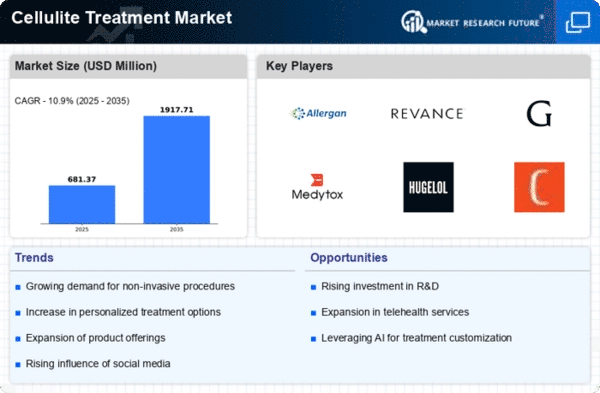
As per MRFR analysis, the Cellulite Treatment Market Size was estimated at 614.4 USD Million in 2024. The Cellulite Treatment industry is projected to grow from 681.38 USD Million in 2025 to 1917.71 USD Million by 2035, exhibiting a compound annual growth rate (CAGR) of 10.9% during the forecast period 2025 - 2035.

Key Market Trends & Highlights

The Cellulite Treatment Market is experiencing a shift towards non-invasive solutions driven by technological advancements and changing consumer preferences.

  • The market is witnessing a rise in non-invasive treatments, reflecting a broader trend towards less invasive aesthetic procedures. Technological advancements are enhancing the efficacy and safety of cellulite treatments, appealing to a wider audience. Social media influences consumer choices, with increased visibility of body positivity campaigns driving demand for cellulite treatments. The increasing demand for aesthetic procedures and rising awareness of health and wellness are key drivers propelling market growth, particularly in North America and Asia-Pacific.

Market Size & Forecast

2024 Market Size 614.4 (USD Million)
2035 Market Size 1917.71 (USD Million)
CAGR (2025 - 2035) 10.9%
Largest Regional Market Share in 2024 North America

Major Players

Allergan (US), Revance Therapeutics (US), Galderma (CH), Medytox (KR), Hugel (KR), <a title="Cynosure" href="https://www.cynosure.com/treatments/non-invasive-cellulite-treatment/" target="_blank" rel="noopener">Cynosure</a> (US), EndyMed (IL), Sientra (US), Aesthetic Science (US)

Market Trends

The Cellulite Treatment Market is currently experiencing a notable evolution, driven by a growing awareness of body aesthetics and the increasing demand for non-invasive procedures. Consumers are becoming more informed about available options, leading to a rise in the popularity of various treatments, including topical solutions, laser therapies, and radiofrequency treatments. This shift reflects a broader societal trend towards self-care, Health and wellness, where individuals seek effective methods to enhance their appearance without undergoing surgical interventions. Furthermore, advancements in technology are facilitating the development of innovative products and services, which are likely to attract a diverse clientele seeking effective solutions for cellulite reduction. 

In addition, the Cellulite Treatment Market appears to be influenced by changing demographics, particularly among younger populations who are more inclined to invest in aesthetic treatments. The rise of social media platforms has also played a role in shaping consumer perceptions and preferences, as individuals share their experiences and results online. This interconnectedness fosters a community that values transparency and authenticity in beauty treatments. As the market continues to evolve, it is essential for stakeholders to remain attuned to consumer preferences and emerging technologies to maintain a competitive edge in this dynamic landscape.

Rise of Non-Invasive Treatments

There is a growing preference for non-invasive treatments within the Cellulite Treatment Market. Consumers increasingly favor options that require minimal downtime and offer quicker recovery, leading to a surge in demand for procedures such as laser therapy and ultrasound treatments.

Technological Advancements

Innovations in technology are significantly shaping the Cellulite Treatment Market. New devices and formulations are being developed, enhancing the efficacy of treatments and providing consumers with more effective solutions for cellulite reduction.

Influence of Social Media

The impact of social media on the Cellulite Treatment Market cannot be overlooked. Platforms that promote beauty and wellness are influencing consumer choices, as individuals seek recommendations and share their treatment journeys, thereby driving market growth.

Cellulite Treatment Market Market Drivers

Increase in Obesity Rates

The rising prevalence of obesity is a significant factor impacting the Global Cellulite Treatment Market Industry. As obesity rates continue to climb globally, the demand for cellulite treatments is expected to increase correspondingly. Excess body fat is often associated with the development of cellulite, leading individuals to seek effective solutions to improve their appearance. This trend is particularly evident in regions with high obesity rates, where the market is likely to see accelerated growth. The correlation between obesity and cellulite is prompting healthcare providers to offer targeted treatments, thereby expanding the market's reach and potential.

Expansion of Distribution Channels

The expansion of distribution channels is enhancing accessibility within the Global Cellulite Treatment Market Industry. With the rise of e-commerce and online retail platforms, consumers can now easily access a wide range of cellulite treatment products and services. This increased availability is likely to drive market growth, as consumers are more inclined to purchase treatments that are readily accessible. Additionally, partnerships between manufacturers and healthcare providers are facilitating the distribution of innovative treatment options. As the market continues to evolve, the integration of various distribution channels is expected to play a pivotal role in meeting consumer demand.

Rising Awareness of Aesthetic Treatments

The increasing awareness regarding aesthetic treatments is a notable driver for the Global Cellulite Treatment Market Industry. Consumers are becoming more informed about various treatment options available for cellulite, which has led to a surge in demand for effective solutions. This heightened awareness is reflected in the projected market value of 3.96 USD Billion in 2024, with expectations to reach 8.5 USD Billion by 2035. The growing interest in body positivity and self-care has further fueled this trend, as individuals seek treatments that enhance their appearance and boost confidence. As a result, the industry is likely to witness substantial growth in the coming years.

Growing Demand for Non-Invasive Procedures

The demand for non-invasive procedures is significantly influencing the Global Cellulite Treatment Market Industry. As consumers increasingly prefer treatments that do not require surgical intervention, practitioners are adapting their offerings to meet this preference. Non-invasive options, such as topical treatments and body contouring devices, are gaining popularity due to their convenience and lower risk profiles. This shift in consumer preference is expected to contribute to the market's growth, with the industry projected to expand from 3.96 USD Billion in 2024 to 8.5 USD Billion by 2035. The focus on safety and minimal downtime is likely to drive further innovation in this segment.

Technological Advancements in Treatment Methods

Technological innovations play a crucial role in shaping the Global Cellulite Treatment Market Industry. Newer, more effective treatment modalities, such as laser therapy, radiofrequency, and ultrasound, are emerging, providing patients with less invasive options and quicker recovery times. These advancements not only enhance treatment efficacy but also improve patient satisfaction, leading to increased adoption rates. As technology continues to evolve, it is anticipated that the market will experience a compound annual growth rate (CAGR) of 7.19% from 2025 to 2035. This growth is indicative of a broader trend towards minimally invasive procedures that cater to the modern consumer's preferences.

Market Segment Insights

By Treatment Type: Topical Treatments (Largest) vs. Laser Treatments (Fastest-Growing)

<p>The Cellulite Treatment Market exhibits a diverse distribution of treatment types, with Topical Treatments holding the largest share. This segment benefits from consumer accessibility and an increasing preference for non-invasive options, making it a popular choice among users. In contrast, Laser Treatments are gaining traction and are recognized as the fastest-growing segment due to technological advancements and rising consumer awareness of long-term results. As the market continues to evolve, these segments are defining the landscape of cellulite treatments.</p>

<p>Topical Treatments (Dominant) vs. Laser Treatments (Emerging)</p>

<p>Topical Treatments dominate the market due to their broad availability and consumer familiarity, offering creams and gels that promise to improve skin texture and reduce the appearance of cellulite. They appeal to those seeking easy, at-home solutions with minimal side effects. On the other hand, Laser Treatments are emerging as a preferred choice for those looking for effective and lasting results. Their rise can be attributed to advances in technology and the ability to provide significant improvements in skin smoothness. As more consumers seek professional options, Laser Treatments are becoming synonymous with efficacy, paving the way for a robust growth trajectory in this segment.</p>

By End User: Women (Largest) vs. Men (Fastest-Growing)

In the Cellulite Treatment Market, women represent the largest end user segment due to the high prevalence of cellulite among females and their proactive approach to beauty and body image. The ongoing trend of body positivity and self-care has led women to seek effective treatment solutions that address their concerns over cellulite. This demographic holds a significant market share, driven by increased awareness and the availability of various treatment options tailored specifically for women. Conversely, men are emerging as the fastest-growing segment in the Cellulite Treatment Market. Historically, cellulite treatments were predominantly associated with women; however, recent trends show a shift with more men seeking these treatments. Increased focus on fitness and body aesthetics among men has led to rising demand, suggesting that clinics and spas are beginning to target this demographic with specialized treatments and marketing strategies designed to address their unique concerns.

Women: Dominant vs. Men: Emerging

The Women segment of the Cellulite Treatment Market is currently the dominant sector, characterized by greater awareness and acceptance of treatment options. Women are more likely to seek aesthetic procedures that enhance body image and boost self-esteem, resulting in a robust demand for various cellulite treatments, from topical applications to advanced procedures like laser therapies. In contrast, the Men segment is emerging, with a rapidly growing interest in body care treatments. This shift can be attributed to changing cultural perceptions, where more men are conscious about physical appearance and seeking solutions for cosmetic concerns traditionally associated with women. As this trend grows, companies are increasingly developing targeted marketing strategies and product offerings tailored to male consumers.

By Distribution Channel: Online Retail (Largest) vs. Pharmacies (Fastest-Growing)

In the Cellulite Treatment Market, the distribution of sales among various channels reveals a clear hierarchy. Online Retail stands as the largest segment, driven by the increasing consumer preference for convenience and a wide range of product offerings. Pharmacies follow, capturing a substantial share thanks to their accessibility and increasing trust among consumers. Specialty Stores and Direct Sales contribute smaller portions to the overall market but are essential in reaching targeted consumer bases.

Online Retail (Dominant) vs. Pharmacies (Emerging)

Online Retail in the Cellulite Treatment Market represents a dominant force, capitalizing on the convenience of shopping from home and access to extensive product information. This channel is characterized by a wide array of options ranging from creams to advanced treatments, catering to diverse consumer preferences. In contrast, Pharmacies are emerging as a key player by providing readily available products combined with professional guidance. The trust associated with pharmacy purchasing, paired with the emotional reassurance from consultations, positions pharmacies as an evolving channel, becoming increasingly relevant in the consumer journey as wellness and personal care gain prominence.

Get more detailed insights about Cellulite Treatment Market Research Report- Forecast To 2035

Regional Insights

North America : Market Leader in Treatments

North America is poised to maintain its leadership in the cellulite treatment market, holding a significant share of 307.2M in 2025. The region's growth is driven by increasing consumer awareness, advancements in treatment technologies, and a robust healthcare infrastructure. Regulatory support for innovative treatments further fuels demand, as consumers seek effective solutions for cellulite reduction. The rising trend of aesthetic procedures among both men and women is also a key driver of market expansion. The competitive landscape in North America is characterized by the presence of major players such as Allergan, Revance Therapeutics, and Cynosure. These companies are investing heavily in research and development to introduce new and effective treatments. The U.S. leads the market, followed by Canada, with a growing interest in non-invasive procedures. The increasing number of clinics offering cellulite treatments is also contributing to market growth, making it a vibrant sector for investment and innovation.

Europe : Emerging Market Dynamics

Europe's cellulite treatment market is projected to reach 184.32M by 2025, driven by rising disposable incomes and a growing focus on body aesthetics. The demand for non-invasive and minimally invasive procedures is increasing, supported by favorable regulations and a shift in consumer attitudes towards cosmetic treatments. Countries like Germany and France are leading the charge, with a significant rise in the number of clinics offering specialized services. The regulatory environment is becoming more supportive, encouraging innovation in treatment options. The competitive landscape in Europe features key players such as Galderma and Medytox, who are expanding their product offerings to cater to diverse consumer needs. The market is characterized by a mix of established brands and emerging companies, fostering a dynamic environment for growth. The increasing popularity of aesthetic procedures among younger demographics is also contributing to market expansion, making Europe a key region for future investments in cellulite treatments.

Asia-Pacific : Rapidly Growing Market

The Asia-Pacific cellulite treatment market is estimated at 100.8M in 2025, reflecting a growing interest in aesthetic procedures among consumers. Factors such as urbanization, rising disposable incomes, and increased awareness of body image are driving demand for cellulite treatments. Countries like South Korea and Japan are at the forefront, with a surge in clinics offering advanced treatment options. Regulatory bodies are also becoming more supportive, facilitating the introduction of new technologies in the market. The competitive landscape in Asia-Pacific is evolving, with key players like Hugel and EndyMed making significant inroads. The region is witnessing a blend of traditional and modern treatment methods, appealing to a diverse consumer base. The increasing number of beauty and wellness centers is further enhancing market accessibility, positioning Asia-Pacific as a rapidly growing hub for cellulite treatments and aesthetic solutions.

Middle East and Africa : Emerging Market Potential

The Middle East and Africa (MEA) cellulite treatment market is projected to reach 22.08M by 2025, driven by increasing awareness of aesthetic treatments and rising disposable incomes. The region is witnessing a gradual shift in consumer attitudes towards body image, leading to a growing demand for cellulite solutions. Regulatory frameworks are evolving, supporting the introduction of innovative treatments and enhancing market growth potential. Countries like the UAE and South Africa are leading the market, with a rise in aesthetic clinics offering specialized services. The competitive landscape in MEA is characterized by a mix of local and international players, creating a dynamic environment for growth. Companies are increasingly focusing on marketing and education to raise awareness about cellulite treatments. The presence of key players is expanding, with a focus on non-invasive procedures that cater to the growing demand for aesthetic solutions. This trend is expected to continue, positioning MEA as an emerging market in the cellulite treatment sector.

Key Players and Competitive Insights

The Cellulite Treatment Market is currently characterized by a dynamic competitive landscape, driven by increasing consumer demand for effective solutions and advancements in treatment technologies. Key players such as Allergan (US), Revance Therapeutics (US), and Galderma (CH) are strategically positioned to leverage innovation and expand their market presence. Allergan (US) focuses on enhancing its product portfolio through continuous research and development, while Revance Therapeutics (US) emphasizes the integration of novel technologies in its offerings. Galderma (CH) adopts a multifaceted approach, combining product innovation with strategic partnerships to enhance its competitive edge. Collectively, these strategies contribute to a robust competitive environment, fostering a climate of innovation and growth.
In terms of business tactics, companies are increasingly localizing manufacturing and optimizing supply chains to enhance operational efficiency. The market structure appears moderately fragmented, with several players vying for market share. However, the influence of key players is substantial, as they set industry standards and drive technological advancements. This competitive structure encourages smaller firms to innovate and differentiate their offerings, thereby enriching the overall market landscape.
In November 2025, Allergan (US) announced the launch of a new cellulite treatment that utilizes a proprietary technology aimed at enhancing efficacy and patient satisfaction. This strategic move is likely to solidify Allergan's position as a leader in the market, as it not only addresses consumer needs but also showcases the company's commitment to innovation. The introduction of this product may also stimulate competitive responses from other players, further intensifying market dynamics.
In October 2025, Revance Therapeutics (US) entered into a strategic partnership with a leading aesthetic clinic chain to expand its distribution network for its cellulite treatment products. This collaboration is expected to enhance Revance's market reach and facilitate access to a broader customer base. By aligning with established clinics, Revance may effectively leverage existing patient relationships, thereby accelerating adoption of its innovative treatments.
In September 2025, Galderma (CH) unveiled a new marketing campaign aimed at educating consumers about the benefits of its cellulite treatment solutions. This initiative reflects a growing trend towards consumer education in the aesthetic market, as companies recognize the importance of informed decision-making among potential clients. By enhancing awareness and understanding of its products, Galderma is likely to foster greater consumer trust and loyalty, which are critical in a competitive landscape.
As of December 2025, the Cellulite Treatment Market is witnessing trends such as digitalization, sustainability, and the integration of artificial intelligence (AI) in treatment protocols. Strategic alliances are increasingly shaping the competitive landscape, as companies collaborate to enhance their technological capabilities and market reach. Looking ahead, competitive differentiation is expected to evolve, with a pronounced shift from price-based competition to a focus on innovation, technology, and supply chain reliability. This transition underscores the necessity for companies to invest in R&D and forge strategic partnerships to maintain a competitive edge.

Key Companies in the Cellulite Treatment Market include

Industry Developments

Recent changes in the Cellulite Treatment Market have been important, with many companies improving their products and making plans for the future. Allergan (AbbVie) has kept adding to its aesthetics portfolio, especially after it made QWO, the first FDA-approved injectable for cellulite. Even though it was pulled from the market in July 2022, it was a big step forward in non-surgical cellulite treatment. In October 2022, Galderma added more non-invasive aesthetic options to its line. This is in line with a trend of people wanting less invasive solutions. 

In the meantime, Revance Therapeutics made waves in the beauty industry with its FDA-approved Daxxify injectable (September 2022). It is mostly used for glabellar lines, but it could also be used for body aesthetics. Sientra launched better training programs for aesthetic practitioners in September 2023. These programs were meant to help people use its body contouring solutions more, which is related to reducing cellulite. Also, Merz Pharmaceuticals keeps supporting Cellfina, which is FDA-approved and minimally invasive for treating cellulite. This strengthens the company's strong position in the market. 

Corporate moves have also changed how the market works. For example, Ipsen's stock price has been going up as it grows its aesthetics division, even though it doesn't make treatments for cellulite. Evolus, which is known for Jeuveau, is actively looking for ways to grow its business in the aesthetic market by changing its strategy to meet the growing demand for effective skin and body treatments. More people are aware of cellulite treatments, there is more demand from consumers, and companies are continuing to put money into research and development.

These efforts aim to provide treatment options that are more effective, last longer, and are less invasive. This makes this part of the global aesthetic medicine market dynamic and constantly changing.

Future Outlook

Cellulite Treatment Market Future Outlook

The Cellulite Treatment Market is projected to grow at a 10.9% CAGR from 2025 to 2035, driven by increasing consumer awareness, technological advancements, and rising demand for non-invasive treatments.

New opportunities lie in:

  • Expansion of telehealth services for remote consultations and follow-ups.
  • Development of personalized treatment plans using AI-driven analytics.
  • Introduction of subscription-based models for ongoing treatment and product supply.

By 2035, the market is expected to be robust, reflecting substantial growth and innovation.

Market Segmentation

Cellulite Treatment Market End User Outlook

  • Women
  • Men
  • Clinics
  • Spa Centers

Cellulite Treatment Market Treatment Type Outlook

  • Topical Treatments
  • Laser Treatments
  • Radiofrequency Treatments
  • Surgical Treatments

Cellulite Treatment Market Distribution Channel Outlook

  • Online Retail
  • Pharmacies
  • Specialty Stores
  • Direct Sales

Report Scope

MARKET SIZE 2024 614.4(USD Million)
MARKET SIZE 2025 681.38(USD Million)
MARKET SIZE 2035 1917.71(USD Million)
COMPOUND ANNUAL GROWTH RATE (CAGR) 10.9% (2025 - 2035)
REPORT COVERAGE Revenue Forecast, Competitive Landscape, Growth Factors, and Trends
BASE YEAR 2024
Market Forecast Period 2025 - 2035
Historical Data 2019 - 2024
Market Forecast Units USD Million
Key Companies Profiled Allergan (US), Revance Therapeutics (US), Galderma (CH), Medytox (KR), Hugel (KR), Cynosure (US), EndyMed (IL), Sientra (US), Aesthetic Science (US)
Segments Covered Treatment Type, End User, Distribution Channel
Key Market Opportunities Emergence of non-invasive technologies enhances consumer accessibility in the Cellulite Treatment Market.
Key Market Dynamics Rising consumer demand for non-invasive cellulite treatments drives innovation and competition among market players.
Countries Covered North America, Europe, APAC, South America, MEA

FAQs

What is the current valuation of the Cellulite Treatment Market as of 2024?

<p>The Cellulite Treatment Market was valued at 614.4 USD Million in 2024.</p>

What is the projected market valuation for the Cellulite Treatment Market in 2035?

<p>The market is projected to reach 1917.71 USD Million by 2035.</p>

What is the expected CAGR for the Cellulite Treatment Market during the forecast period 2025 - 2035?

<p>The expected CAGR for the market during 2025 - 2035 is 10.9%.</p>

Which treatment type generated the highest revenue in 2024?

<p>Surgical Treatments generated the highest revenue, amounting to 215.04 USD Million in 2024.</p>

How do the revenues from topical treatments compare to laser treatments in 2024?

<p>Topical Treatments generated 122.88 USD Million, while Laser Treatments generated 153.6 USD Million in 2024.</p>

What segment accounted for the largest share of the market by end user in 2024?

<p>Women accounted for the largest share, generating 245.76 USD Million in 2024.</p>

What is the revenue generated by clinics in the Cellulite Treatment Market in 2024?

<p>Clinics generated 184.32 USD Million in revenue in 2024.</p>

Which distribution channel had the highest revenue in 2024?

<p>Pharmacies had the highest revenue, generating 184.32 USD Million in 2024.</p>

What is the projected revenue for men in the Cellulite Treatment Market by 2035?

<p>The revenue for men is projected to reach 200.0 USD Million by 2035.</p>

Which key players are leading the Cellulite Treatment Market?

<p>Key players include Allergan, Revance Therapeutics, Galderma, and Cynosure, among others.</p>

  1. SECTION I: EXECUTIVE SUMMARY AND KEY HIGHLIGHTS
    1. | 1.1 EXECUTIVE SUMMARY
    2. | | 1.1.1 Market Overview
    3. | | 1.1.2 Key Findings
    4. | | 1.1.3 Market Segmentation
    5. | | 1.1.4 Competitive Landscape
    6. | | 1.1.5 Challenges and Opportunities
    7. | | 1.1.6 Future Outlook
  2. SECTION II: SCOPING, METHODOLOGY AND MARKET STRUCTURE
    1. | 2.1 MARKET INTRODUCTION
    2. | | 2.1.1 Definition
    3. | | 2.1.2 Scope of the study
    4. | | | 2.1.2.1 Research Objective
    5. | | | 2.1.2.2 Assumption
    6. | | | 2.1.2.3 Limitations
    7. | 2.2 RESEARCH METHODOLOGY
    8. | | 2.2.1 Overview
    9. | | 2.2.2 Data Mining
    10. | | 2.2.3 Secondary Research
    11. | | 2.2.4 Primary Research
    12. | | | 2.2.4.1 Primary Interviews and Information Gathering Process
    13. | | | 2.2.4.2 Breakdown of Primary Respondents
    14. | | 2.2.5 Forecasting Model
    15. | | 2.2.6 Market Size Estimation
    16. | | | 2.2.6.1 Bottom-Up Approach
    17. | | | 2.2.6.2 Top-Down Approach
    18. | | 2.2.7 Data Triangulation
    19. | | 2.2.8 Validation
  3. SECTION III: QUALITATIVE ANALYSIS
    1. | 3.1 MARKET DYNAMICS
    2. | | 3.1.1 Overview
    3. | | 3.1.2 Drivers
    4. | | 3.1.3 Restraints
    5. | | 3.1.4 Opportunities
    6. | 3.2 MARKET FACTOR ANALYSIS
    7. | | 3.2.1 Value chain Analysis
    8. | | 3.2.2 Porter's Five Forces Analysis
    9. | | | 3.2.2.1 Bargaining Power of Suppliers
    10. | | | 3.2.2.2 Bargaining Power of Buyers
    11. | | | 3.2.2.3 Threat of New Entrants
    12. | | | 3.2.2.4 Threat of Substitutes
    13. | | | 3.2.2.5 Intensity of Rivalry
    14. | | 3.2.3 COVID-19 Impact Analysis
    15. | | | 3.2.3.1 Market Impact Analysis
    16. | | | 3.2.3.2 Regional Impact
    17. | | | 3.2.3.3 Opportunity and Threat Analysis
  4. SECTION IV: QUANTITATIVE ANALYSIS
    1. | 4.1 Healthcare, BY Treatment Type (USD Million)
    2. | | 4.1.1 Topical Treatments
    3. | | 4.1.2 Laser Treatments
    4. | | 4.1.3 Radiofrequency Treatments
    5. | | 4.1.4 Surgical Treatments
    6. | 4.2 Healthcare, BY End User (USD Million)
    7. | | 4.2.1 Women
    8. | | 4.2.2 Men
    9. | | 4.2.3 Clinics
    10. | | 4.2.4 Spa Centers
    11. | 4.3 Healthcare, BY Distribution Channel (USD Million)
    12. | | 4.3.1 Online Retail
    13. | | 4.3.2 Pharmacies
    14. | | 4.3.3 Specialty Stores
    15. | | 4.3.4 Direct Sales
    16. | 4.4 Healthcare, BY Region (USD Million)
    17. | | 4.4.1 North America
    18. | | | 4.4.1.1 US
    19. | | | 4.4.1.2 Canada
    20. | | 4.4.2 Europe
    21. | | | 4.4.2.1 Germany
    22. | | | 4.4.2.2 UK
    23. | | | 4.4.2.3 France
    24. | | | 4.4.2.4 Russia
    25. | | | 4.4.2.5 Italy
    26. | | | 4.4.2.6 Spain
    27. | | | 4.4.2.7 Rest of Europe
    28. | | 4.4.3 APAC
    29. | | | 4.4.3.1 China
    30. | | | 4.4.3.2 India
    31. | | | 4.4.3.3 Japan
    32. | | | 4.4.3.4 South Korea
    33. | | | 4.4.3.5 Malaysia
    34. | | | 4.4.3.6 Thailand
    35. | | | 4.4.3.7 Indonesia
    36. | | | 4.4.3.8 Rest of APAC
    37. | | 4.4.4 South America
    38. | | | 4.4.4.1 Brazil
    39. | | | 4.4.4.2 Mexico
    40. | | | 4.4.4.3 Argentina
    41. | | | 4.4.4.4 Rest of South America
    42. | | 4.4.5 MEA
    43. | | | 4.4.5.1 GCC Countries
    44. | | | 4.4.5.2 South Africa
    45. | | | 4.4.5.3 Rest of MEA
  5. SECTION V: COMPETITIVE ANALYSIS
    1. | 5.1 Competitive Landscape
    2. | | 5.1.1 Overview
    3. | | 5.1.2 Competitive Analysis
    4. | | 5.1.3 Market share Analysis
    5. | | 5.1.4 Major Growth Strategy in the Healthcare
    6. | | 5.1.5 Competitive Benchmarking
    7. | | 5.1.6 Leading Players in Terms of Number of Developments in the Healthcare
    8. | | 5.1.7 Key developments and growth strategies
    9. | | | 5.1.7.1 New Product Launch/Service Deployment
    10. | | | 5.1.7.2 Merger & Acquisitions
    11. | | | 5.1.7.3 Joint Ventures
    12. | | 5.1.8 Major Players Financial Matrix
    13. | | | 5.1.8.1 Sales and Operating Income
    14. | | | 5.1.8.2 Major Players R&D Expenditure. 2023
    15. | 5.2 Company Profiles
    16. | | 5.2.1 Allergan (US)
    17. | | | 5.2.1.1 Financial Overview
    18. | | | 5.2.1.2 Products Offered
    19. | | | 5.2.1.3 Key Developments
    20. | | | 5.2.1.4 SWOT Analysis
    21. | | | 5.2.1.5 Key Strategies
    22. | | 5.2.2 Revance Therapeutics (US)
    23. | | | 5.2.2.1 Financial Overview
    24. | | | 5.2.2.2 Products Offered
    25. | | | 5.2.2.3 Key Developments
    26. | | | 5.2.2.4 SWOT Analysis
    27. | | | 5.2.2.5 Key Strategies
    28. | | 5.2.3 Galderma (CH)
    29. | | | 5.2.3.1 Financial Overview
    30. | | | 5.2.3.2 Products Offered
    31. | | | 5.2.3.3 Key Developments
    32. | | | 5.2.3.4 SWOT Analysis
    33. | | | 5.2.3.5 Key Strategies
    34. | | 5.2.4 Medytox (KR)
    35. | | | 5.2.4.1 Financial Overview
    36. | | | 5.2.4.2 Products Offered
    37. | | | 5.2.4.3 Key Developments
    38. | | | 5.2.4.4 SWOT Analysis
    39. | | | 5.2.4.5 Key Strategies
    40. | | 5.2.5 Hugel (KR)
    41. | | | 5.2.5.1 Financial Overview
    42. | | | 5.2.5.2 Products Offered
    43. | | | 5.2.5.3 Key Developments
    44. | | | 5.2.5.4 SWOT Analysis
    45. | | | 5.2.5.5 Key Strategies
    46. | | 5.2.6 Cynosure (US)
    47. | | | 5.2.6.1 Financial Overview
    48. | | | 5.2.6.2 Products Offered
    49. | | | 5.2.6.3 Key Developments
    50. | | | 5.2.6.4 SWOT Analysis
    51. | | | 5.2.6.5 Key Strategies
    52. | | 5.2.7 EndyMed (IL)
    53. | | | 5.2.7.1 Financial Overview
    54. | | | 5.2.7.2 Products Offered
    55. | | | 5.2.7.3 Key Developments
    56. | | | 5.2.7.4 SWOT Analysis
    57. | | | 5.2.7.5 Key Strategies
    58. | | 5.2.8 Sientra (US)
    59. | | | 5.2.8.1 Financial Overview
    60. | | | 5.2.8.2 Products Offered
    61. | | | 5.2.8.3 Key Developments
    62. | | | 5.2.8.4 SWOT Analysis
    63. | | | 5.2.8.5 Key Strategies
    64. | | 5.2.9 InMode (IL)
    65. | | | 5.2.9.1 Financial Overview
    66. | | | 5.2.9.2 Products Offered
    67. | | | 5.2.9.3 Key Developments
    68. | | | 5.2.9.4 SWOT Analysis
    69. | | | 5.2.9.5 Key Strategies
    70. | | 5.2.10 Merz Pharmaceuticals (DE)
    71. | | | 5.2.10.1 Financial Overview
    72. | | | 5.2.10.2 Products Offered
    73. | | | 5.2.10.3 Key Developments
    74. | | | 5.2.10.4 SWOT Analysis
    75. | | | 5.2.10.5 Key Strategies
    76. | 5.3 Appendix
    77. | | 5.3.1 References
    78. | | 5.3.2 Related Reports
  6. LIST OF FIGURES
    1. | 6.1 MARKET SYNOPSIS
    2. | 6.2 NORTH AMERICA MARKET ANALYSIS
    3. | 6.3 US MARKET ANALYSIS BY TREATMENT TYPE
    4. | 6.4 US MARKET ANALYSIS BY END USER
    5. | 6.5 US MARKET ANALYSIS BY DISTRIBUTION CHANNEL
    6. | 6.6 CANADA MARKET ANALYSIS BY TREATMENT TYPE
    7. | 6.7 CANADA MARKET ANALYSIS BY END USER
    8. | 6.8 CANADA MARKET ANALYSIS BY DISTRIBUTION CHANNEL
    9. | 6.9 EUROPE MARKET ANALYSIS
    10. | 6.10 GERMANY MARKET ANALYSIS BY TREATMENT TYPE
    11. | 6.11 GERMANY MARKET ANALYSIS BY END USER
    12. | 6.12 GERMANY MARKET ANALYSIS BY DISTRIBUTION CHANNEL
    13. | 6.13 UK MARKET ANALYSIS BY TREATMENT TYPE
    14. | 6.14 UK MARKET ANALYSIS BY END USER
    15. | 6.15 UK MARKET ANALYSIS BY DISTRIBUTION CHANNEL
    16. | 6.16 FRANCE MARKET ANALYSIS BY TREATMENT TYPE
    17. | 6.17 FRANCE MARKET ANALYSIS BY END USER
    18. | 6.18 FRANCE MARKET ANALYSIS BY DISTRIBUTION CHANNEL
    19. | 6.19 RUSSIA MARKET ANALYSIS BY TREATMENT TYPE
    20. | 6.20 RUSSIA MARKET ANALYSIS BY END USER
    21. | 6.21 RUSSIA MARKET ANALYSIS BY DISTRIBUTION CHANNEL
    22. | 6.22 ITALY MARKET ANALYSIS BY TREATMENT TYPE
    23. | 6.23 ITALY MARKET ANALYSIS BY END USER
    24. | 6.24 ITALY MARKET ANALYSIS BY DISTRIBUTION CHANNEL
    25. | 6.25 SPAIN MARKET ANALYSIS BY TREATMENT TYPE
    26. | 6.26 SPAIN MARKET ANALYSIS BY END USER
    27. | 6.27 SPAIN MARKET ANALYSIS BY DISTRIBUTION CHANNEL
    28. | 6.28 REST OF EUROPE MARKET ANALYSIS BY TREATMENT TYPE
    29. | 6.29 REST OF EUROPE MARKET ANALYSIS BY END USER
    30. | 6.30 REST OF EUROPE MARKET ANALYSIS BY DISTRIBUTION CHANNEL
    31. | 6.31 APAC MARKET ANALYSIS
    32. | 6.32 CHINA MARKET ANALYSIS BY TREATMENT TYPE
    33. | 6.33 CHINA MARKET ANALYSIS BY END USER
    34. | 6.34 CHINA MARKET ANALYSIS BY DISTRIBUTION CHANNEL
    35. | 6.35 INDIA MARKET ANALYSIS BY TREATMENT TYPE
    36. | 6.36 INDIA MARKET ANALYSIS BY END USER
    37. | 6.37 INDIA MARKET ANALYSIS BY DISTRIBUTION CHANNEL
    38. | 6.38 JAPAN MARKET ANALYSIS BY TREATMENT TYPE
    39. | 6.39 JAPAN MARKET ANALYSIS BY END USER
    40. | 6.40 JAPAN MARKET ANALYSIS BY DISTRIBUTION CHANNEL
    41. | 6.41 SOUTH KOREA MARKET ANALYSIS BY TREATMENT TYPE
    42. | 6.42 SOUTH KOREA MARKET ANALYSIS BY END USER
    43. | 6.43 SOUTH KOREA MARKET ANALYSIS BY DISTRIBUTION CHANNEL
    44. | 6.44 MALAYSIA MARKET ANALYSIS BY TREATMENT TYPE
    45. | 6.45 MALAYSIA MARKET ANALYSIS BY END USER
    46. | 6.46 MALAYSIA MARKET ANALYSIS BY DISTRIBUTION CHANNEL
    47. | 6.47 THAILAND MARKET ANALYSIS BY TREATMENT TYPE
    48. | 6.48 THAILAND MARKET ANALYSIS BY END USER
    49. | 6.49 THAILAND MARKET ANALYSIS BY DISTRIBUTION CHANNEL
    50. | 6.50 INDONESIA MARKET ANALYSIS BY TREATMENT TYPE
    51. | 6.51 INDONESIA MARKET ANALYSIS BY END USER
    52. | 6.52 INDONESIA MARKET ANALYSIS BY DISTRIBUTION CHANNEL
    53. | 6.53 REST OF APAC MARKET ANALYSIS BY TREATMENT TYPE
    54. | 6.54 REST OF APAC MARKET ANALYSIS BY END USER
    55. | 6.55 REST OF APAC MARKET ANALYSIS BY DISTRIBUTION CHANNEL
    56. | 6.56 SOUTH AMERICA MARKET ANALYSIS
    57. | 6.57 BRAZIL MARKET ANALYSIS BY TREATMENT TYPE
    58. | 6.58 BRAZIL MARKET ANALYSIS BY END USER
    59. | 6.59 BRAZIL MARKET ANALYSIS BY DISTRIBUTION CHANNEL
    60. | 6.60 MEXICO MARKET ANALYSIS BY TREATMENT TYPE
    61. | 6.61 MEXICO MARKET ANALYSIS BY END USER
    62. | 6.62 MEXICO MARKET ANALYSIS BY DISTRIBUTION CHANNEL
    63. | 6.63 ARGENTINA MARKET ANALYSIS BY TREATMENT TYPE
    64. | 6.64 ARGENTINA MARKET ANALYSIS BY END USER
    65. | 6.65 ARGENTINA MARKET ANALYSIS BY DISTRIBUTION CHANNEL
    66. | 6.66 REST OF SOUTH AMERICA MARKET ANALYSIS BY TREATMENT TYPE
    67. | 6.67 REST OF SOUTH AMERICA MARKET ANALYSIS BY END USER
    68. | 6.68 REST OF SOUTH AMERICA MARKET ANALYSIS BY DISTRIBUTION CHANNEL
    69. | 6.69 MEA MARKET ANALYSIS
    70. | 6.70 GCC COUNTRIES MARKET ANALYSIS BY TREATMENT TYPE
    71. | 6.71 GCC COUNTRIES MARKET ANALYSIS BY END USER
    72. | 6.72 GCC COUNTRIES MARKET ANALYSIS BY DISTRIBUTION CHANNEL
    73. | 6.73 SOUTH AFRICA MARKET ANALYSIS BY TREATMENT TYPE
    74. | 6.74 SOUTH AFRICA MARKET ANALYSIS BY END USER
    75. | 6.75 SOUTH AFRICA MARKET ANALYSIS BY DISTRIBUTION CHANNEL
    76. | 6.76 REST OF MEA MARKET ANALYSIS BY TREATMENT TYPE
    77. | 6.77 REST OF MEA MARKET ANALYSIS BY END USER
    78. | 6.78 REST OF MEA MARKET ANALYSIS BY DISTRIBUTION CHANNEL
    79. | 6.79 KEY BUYING CRITERIA OF HEALTHCARE
    80. | 6.80 RESEARCH PROCESS OF MRFR
    81. | 6.81 DRO ANALYSIS OF HEALTHCARE
    82. | 6.82 DRIVERS IMPACT ANALYSIS: HEALTHCARE
    83. | 6.83 RESTRAINTS IMPACT ANALYSIS: HEALTHCARE
    84. | 6.84 SUPPLY / VALUE CHAIN: HEALTHCARE
    85. | 6.85 HEALTHCARE, BY TREATMENT TYPE, 2024 (% SHARE)
    86. | 6.86 HEALTHCARE, BY TREATMENT TYPE, 2024 TO 2035 (USD Million)
    87. | 6.87 HEALTHCARE, BY END USER, 2024 (% SHARE)
    88. | 6.88 HEALTHCARE, BY END USER, 2024 TO 2035 (USD Million)
    89. | 6.89 HEALTHCARE, BY DISTRIBUTION CHANNEL, 2024 (% SHARE)
    90. | 6.90 HEALTHCARE, BY DISTRIBUTION CHANNEL, 2024 TO 2035 (USD Million)
    91. | 6.91 BENCHMARKING OF MAJOR COMPETITORS
  7. LIST OF TABLES
    1. | 7.1 LIST OF ASSUMPTIONS
    2. | | 7.1.1
    3. | 7.2 North America MARKET SIZE ESTIMATES; FORECAST
    4. | | 7.2.1 BY TREATMENT TYPE, 2025-2035 (USD Million)
    5. | | 7.2.2 BY END USER, 2025-2035 (USD Million)
    6. | | 7.2.3 BY DISTRIBUTION CHANNEL, 2025-2035 (USD Million)
    7. | 7.3 US MARKET SIZE ESTIMATES; FORECAST
    8. | | 7.3.1 BY TREATMENT TYPE, 2025-2035 (USD Million)
    9. | | 7.3.2 BY END USER, 2025-2035 (USD Million)
    10. | | 7.3.3 BY DISTRIBUTION CHANNEL, 2025-2035 (USD Million)
    11. | 7.4 Canada MARKET SIZE ESTIMATES; FORECAST
    12. | | 7.4.1 BY TREATMENT TYPE, 2025-2035 (USD Million)
    13. | | 7.4.2 BY END USER, 2025-2035 (USD Million)
    14. | | 7.4.3 BY DISTRIBUTION CHANNEL, 2025-2035 (USD Million)
    15. | 7.5 Europe MARKET SIZE ESTIMATES; FORECAST
    16. | | 7.5.1 BY TREATMENT TYPE, 2025-2035 (USD Million)
    17. | | 7.5.2 BY END USER, 2025-2035 (USD Million)
    18. | | 7.5.3 BY DISTRIBUTION CHANNEL, 2025-2035 (USD Million)
    19. | 7.6 Germany MARKET SIZE ESTIMATES; FORECAST
    20. | | 7.6.1 BY TREATMENT TYPE, 2025-2035 (USD Million)
    21. | | 7.6.2 BY END USER, 2025-2035 (USD Million)
    22. | | 7.6.3 BY DISTRIBUTION CHANNEL, 2025-2035 (USD Million)
    23. | 7.7 UK MARKET SIZE ESTIMATES; FORECAST
    24. | | 7.7.1 BY TREATMENT TYPE, 2025-2035 (USD Million)
    25. | | 7.7.2 BY END USER, 2025-2035 (USD Million)
    26. | | 7.7.3 BY DISTRIBUTION CHANNEL, 2025-2035 (USD Million)
    27. | 7.8 France MARKET SIZE ESTIMATES; FORECAST
    28. | | 7.8.1 BY TREATMENT TYPE, 2025-2035 (USD Million)
    29. | | 7.8.2 BY END USER, 2025-2035 (USD Million)
    30. | | 7.8.3 BY DISTRIBUTION CHANNEL, 2025-2035 (USD Million)
    31. | 7.9 Russia MARKET SIZE ESTIMATES; FORECAST
    32. | | 7.9.1 BY TREATMENT TYPE, 2025-2035 (USD Million)
    33. | | 7.9.2 BY END USER, 2025-2035 (USD Million)
    34. | | 7.9.3 BY DISTRIBUTION CHANNEL, 2025-2035 (USD Million)
    35. | 7.10 Italy MARKET SIZE ESTIMATES; FORECAST
    36. | | 7.10.1 BY TREATMENT TYPE, 2025-2035 (USD Million)
    37. | | 7.10.2 BY END USER, 2025-2035 (USD Million)
    38. | | 7.10.3 BY DISTRIBUTION CHANNEL, 2025-2035 (USD Million)
    39. | 7.11 Spain MARKET SIZE ESTIMATES; FORECAST
    40. | | 7.11.1 BY TREATMENT TYPE, 2025-2035 (USD Million)
    41. | | 7.11.2 BY END USER, 2025-2035 (USD Million)
    42. | | 7.11.3 BY DISTRIBUTION CHANNEL, 2025-2035 (USD Million)
    43. | 7.12 Rest of Europe MARKET SIZE ESTIMATES; FORECAST
    44. | | 7.12.1 BY TREATMENT TYPE, 2025-2035 (USD Million)
    45. | | 7.12.2 BY END USER, 2025-2035 (USD Million)
    46. | | 7.12.3 BY DISTRIBUTION CHANNEL, 2025-2035 (USD Million)
    47. | 7.13 APAC MARKET SIZE ESTIMATES; FORECAST
    48. | | 7.13.1 BY TREATMENT TYPE, 2025-2035 (USD Million)
    49. | | 7.13.2 BY END USER, 2025-2035 (USD Million)
    50. | | 7.13.3 BY DISTRIBUTION CHANNEL, 2025-2035 (USD Million)
    51. | 7.14 China MARKET SIZE ESTIMATES; FORECAST
    52. | | 7.14.1 BY TREATMENT TYPE, 2025-2035 (USD Million)
    53. | | 7.14.2 BY END USER, 2025-2035 (USD Million)
    54. | | 7.14.3 BY DISTRIBUTION CHANNEL, 2025-2035 (USD Million)
    55. | 7.15 India MARKET SIZE ESTIMATES; FORECAST
    56. | | 7.15.1 BY TREATMENT TYPE, 2025-2035 (USD Million)
    57. | | 7.15.2 BY END USER, 2025-2035 (USD Million)
    58. | | 7.15.3 BY DISTRIBUTION CHANNEL, 2025-2035 (USD Million)
    59. | 7.16 Japan MARKET SIZE ESTIMATES; FORECAST
    60. | | 7.16.1 BY TREATMENT TYPE, 2025-2035 (USD Million)
    61. | | 7.16.2 BY END USER, 2025-2035 (USD Million)
    62. | | 7.16.3 BY DISTRIBUTION CHANNEL, 2025-2035 (USD Million)
    63. | 7.17 South Korea MARKET SIZE ESTIMATES; FORECAST
    64. | | 7.17.1 BY TREATMENT TYPE, 2025-2035 (USD Million)
    65. | | 7.17.2 BY END USER, 2025-2035 (USD Million)
    66. | | 7.17.3 BY DISTRIBUTION CHANNEL, 2025-2035 (USD Million)
    67. | 7.18 Malaysia MARKET SIZE ESTIMATES; FORECAST
    68. | | 7.18.1 BY TREATMENT TYPE, 2025-2035 (USD Million)
    69. | | 7.18.2 BY END USER, 2025-2035 (USD Million)
    70. | | 7.18.3 BY DISTRIBUTION CHANNEL, 2025-2035 (USD Million)
    71. | 7.19 Thailand MARKET SIZE ESTIMATES; FORECAST
    72. | | 7.19.1 BY TREATMENT TYPE, 2025-2035 (USD Million)
    73. | | 7.19.2 BY END USER, 2025-2035 (USD Million)
    74. | | 7.19.3 BY DISTRIBUTION CHANNEL, 2025-2035 (USD Million)
    75. | 7.20 Indonesia MARKET SIZE ESTIMATES; FORECAST
    76. | | 7.20.1 BY TREATMENT TYPE, 2025-2035 (USD Million)
    77. | | 7.20.2 BY END USER, 2025-2035 (USD Million)
    78. | | 7.20.3 BY DISTRIBUTION CHANNEL, 2025-2035 (USD Million)
    79. | 7.21 Rest of APAC MARKET SIZE ESTIMATES; FORECAST
    80. | | 7.21.1 BY TREATMENT TYPE, 2025-2035 (USD Million)
    81. | | 7.21.2 BY END USER, 2025-2035 (USD Million)
    82. | | 7.21.3 BY DISTRIBUTION CHANNEL, 2025-2035 (USD Million)
    83. | 7.22 South America MARKET SIZE ESTIMATES; FORECAST
    84. | | 7.22.1 BY TREATMENT TYPE, 2025-2035 (USD Million)
    85. | | 7.22.2 BY END USER, 2025-2035 (USD Million)
    86. | | 7.22.3 BY DISTRIBUTION CHANNEL, 2025-2035 (USD Million)
    87. | 7.23 Brazil MARKET SIZE ESTIMATES; FORECAST
    88. | | 7.23.1 BY TREATMENT TYPE, 2025-2035 (USD Million)
    89. | | 7.23.2 BY END USER, 2025-2035 (USD Million)
    90. | | 7.23.3 BY DISTRIBUTION CHANNEL, 2025-2035 (USD Million)
    91. | 7.24 Mexico MARKET SIZE ESTIMATES; FORECAST
    92. | | 7.24.1 BY TREATMENT TYPE, 2025-2035 (USD Million)
    93. | | 7.24.2 BY END USER, 2025-2035 (USD Million)
    94. | | 7.24.3 BY DISTRIBUTION CHANNEL, 2025-2035 (USD Million)
    95. | 7.25 Argentina MARKET SIZE ESTIMATES; FORECAST
    96. | | 7.25.1 BY TREATMENT TYPE, 2025-2035 (USD Million)
    97. | | 7.25.2 BY END USER, 2025-2035 (USD Million)
    98. | | 7.25.3 BY DISTRIBUTION CHANNEL, 2025-2035 (USD Million)
    99. | 7.26 Rest of South America MARKET SIZE ESTIMATES; FORECAST
    100. | | 7.26.1 BY TREATMENT TYPE, 2025-2035 (USD Million)
    101. | | 7.26.2 BY END USER, 2025-2035 (USD Million)
    102. | | 7.26.3 BY DISTRIBUTION CHANNEL, 2025-2035 (USD Million)
    103. | 7.27 MEA MARKET SIZE ESTIMATES; FORECAST
    104. | | 7.27.1 BY TREATMENT TYPE, 2025-2035 (USD Million)
    105. | | 7.27.2 BY END USER, 2025-2035 (USD Million)
    106. | | 7.27.3 BY DISTRIBUTION CHANNEL, 2025-2035 (USD Million)
    107. | 7.28 GCC Countries MARKET SIZE ESTIMATES; FORECAST
    108. | | 7.28.1 BY TREATMENT TYPE, 2025-2035 (USD Million)
    109. | | 7.28.2 BY END USER, 2025-2035 (USD Million)
    110. | | 7.28.3 BY DISTRIBUTION CHANNEL, 2025-2035 (USD Million)
    111. | 7.29 South Africa MARKET SIZE ESTIMATES; FORECAST
    112. | | 7.29.1 BY TREATMENT TYPE, 2025-2035 (USD Million)
    113. | | 7.29.2 BY END USER, 2025-2035 (USD Million)
    114. | | 7.29.3 BY DISTRIBUTION CHANNEL, 2025-2035 (USD Million)
    115. | 7.30 Rest of MEA MARKET SIZE ESTIMATES; FORECAST
    116. | | 7.30.1 BY TREATMENT TYPE, 2025-2035 (USD Million)
    117. | | 7.30.2 BY END USER, 2025-2035 (USD Million)
    118. | | 7.30.3 BY DISTRIBUTION CHANNEL, 2025-2035 (USD Million)
    119. | 7.31 PRODUCT LAUNCH/PRODUCT DEVELOPMENT/APPROVAL
    120. | | 7.31.1
    121. | 7.32 ACQUISITION/PARTNERSHIP
    122. | | 7.32.1

Healthcare Market Segmentation

Healthcare By Treatment Type (USD Million, 2025-2035)

  • Topical Treatments
  • Laser Treatments
  • Radiofrequency Treatments
  • Surgical Treatments

Healthcare By End User (USD Million, 2025-2035)

  • Women
  • Men
  • Clinics
  • Spa Centers

Healthcare By Distribution Channel (USD Million, 2025-2035)

  • Online Retail
  • Pharmacies
  • Specialty Stores
  • Direct Sales
Infographic

Free Sample Request

Kindly complete the form below to receive a free sample of this Report

Get Free Sample

Customer Strories

Compare Licence

×
Features License Type
Single User Multiuser License Enterprise User
Price $4,950 $5,950 $7,250
Maximum User Access Limit 1 User Upto 10 Users Unrestricted Access Throughout the Organization
Free Customization
Direct Access to Analyst
Deliverable Format
Platform Access
Discount on Next Purchase 10% 15% 15%
Printable Versions
%>