
Request Free Sample ×

Kindly complete the form below to receive a free sample of this Report

* Please use a valid business email

Leading companies partner with us for data-driven Insights

clients tt-cursor
Hero Background
English
Chinese
French
Japanese
Korean
German
Spanish

CBD Skincare Products Market Share

ID: MRFR/CG/6951-HCR
128 Pages
Snehal Singh
March 2026

Global CBD Skincare Products Market Size, Share, Industry Trend & Analysis Research Report: By Product Type (Moisturizers, Serums, Cleansers, Masks, Oils), By Skin Type (Sensitive, Oily, Dry, Combination, Normal), By Distribution Channel (Online, Offline, Specialty Stores, Supermarkets, Pharmacies), By Consumer Segment (Men, Women, Teenagers, Elderly) and By Regional (North America, Europe, South America, Asia Pacific, Middle East and Africa)- Forecast to 2035

Share:
Download PDF ×

We do not share your information with anyone. However, we may send you emails based on your report interest from time to time. You may contact us at any time to opt-out.

CBD Skincare Products Market Infographic
Purchase Options

Market Share

CBD Skincare Products Market Share Analysis

The CBD skincare products market has experienced remarkable growth in recent years, propelled by increasing consumer interest in natural and holistic skincare solutions, as well as the growing popularity of cannabidiol (CBD) as a skincare ingredient. CBD, a non-psychoactive compound derived from the cannabis plant, is known for its potential anti-inflammatory, antioxidant, and soothing properties, making it a popular choice for skincare formulations targeting various skin concerns. One prominent trend in the CBD skincare products market is the rising demand for natural and plant-based skincare alternatives. As consumers become more conscious of the ingredients in their skincare products, there is a growing preference for formulations made from botanical extracts, essential oils, and natural compounds like CBD. This has led to the emergence of CBD skincare brands that prioritize clean, non-toxic, and cruelty-free formulations, offering consumers a safer and more sustainable option for their skincare routines.

Moreover, the market has seen a proliferation of CBD skincare products tailored to specific skin types, concerns, and preferences. Brands are now offering a wide range of CBD-infused skincare products, including moisturizers, serums, masks, cleansers, and balms, each formulated to address different skincare needs such as hydration, anti-aging, acne, and sensitive skin. Additionally, CBD is often combined with other beneficial ingredients like hyaluronic acid, vitamin C, and retinol to enhance its efficacy and deliver targeted skincare benefits. This trend towards customization and personalization reflects the growing demand for skincare products that cater to individual needs and preferences.

Another significant trend in the CBD skincare products market is the integration of advanced formulation technologies to improve product performance and efficacy. Manufacturers are investing in research and development to create innovative CBD skincare formulations that offer enhanced absorption, stability, and bioavailability. This includes the use of nanoemulsion technology to break down CBD particles into smaller, more easily absorbed molecules, as well as microencapsulation techniques to protect CBD from oxidation and degradation. By leveraging these advanced formulation technologies, CBD skincare brands are able to deliver more potent and effective skincare solutions that yield visible results for consumers.

Furthermore, the COVID-19 pandemic has influenced market trends in the CBD skincare industry, as consumers increasingly prioritize self-care and wellness amidst the uncertainties of the pandemic. With lockdowns and social distancing measures in place, many people have turned to skincare as a form of self-care and stress relief, driving demand for soothing and nourishing skincare products like CBD-infused formulations. Additionally, the pandemic has accelerated the shift towards online shopping and e-commerce, with more consumers opting to purchase skincare products online for safety and convenience. As a result, CBD skincare brands have expanded their online presence and digital marketing efforts to reach a wider audience of consumers seeking wellness-focused skincare solutions.

In addition, the CBD skincare products market has benefited from the growing acceptance and legalization of cannabis-derived products in various regions around the world. As regulatory barriers continue to ease, CBD skincare brands are able to expand their product offerings and distribution channels, reaching new markets and consumers who are eager to explore the potential benefits of CBD for skincare. This has led to increased competition in the market, prompting brands to differentiate themselves through innovative product formulations, transparent sourcing practices, and compelling marketing strategies.

In conclusion, the CBD skincare products market is poised for continued growth and innovation as consumers embrace natural and holistic skincare solutions that prioritize wellness and self-care. From clean and sustainable formulations to advanced technologies and regulatory developments, CBD skincare brands are adapting to meet the evolving needs and preferences of today's consumers. As awareness of CBD's potential benefits for skincare continues to grow, driven by scientific research and consumer testimonials, the market is expected to expand further, offering new opportunities for brands to innovate and thrive in the booming CBD skincare industry.

Author
Author Profile
Snehal Singh
Manager - Research

High acumen in analyzing complex macro & micro markets with more than 6 years of work experience in the field of market research. By implementing her analytical skills in forecasting and estimation into market research reports, she has expertise in Packaging, Construction, and Equipment domains. She handles a team size of 20-25 resources and ensures smooth running of the projects, associated marketing activities, and client servicing.

Leave a Comment

FAQs

What is the projected market valuation for CBD skincare products by 2035?

<p>The projected market valuation for CBD skincare products is expected to reach 10050.76 USD Billion by 2035.</p>

What was the market valuation for CBD skincare products in 2024?

The market valuation for CBD skincare products was 6069.45 USD Billion in 2024.

What is the expected CAGR for the CBD skincare products market from 2025 to 2035?

The expected CAGR for the CBD skincare products market during the forecast period 2025 - 2035 is 4.69%.

Which companies are considered key players in the CBD skincare products market?

Key players in the CBD skincare products market include Charlotte's Web, Medterra, CBDistillery, Joy Organics, and Green Roads.

What segment of CBD skincare products is projected to have the highest valuation by 2035?

By 2035, the segment of creams is projected to have the highest valuation, reaching 3900.0 USD Billion.

How do online and offline distribution channels compare in the CBD skincare market?

Both online and offline distribution channels are projected to reach 3000.0 USD Billion by 2035, indicating a balanced growth.

What is the expected valuation for CBD moisturizers by 2035?

The expected valuation for CBD moisturizers is projected to reach 1950.0 USD Billion by 2035.

What demographic factors are influencing the CBD skincare products market?

Demographic factors such as age group, gender, skin type, and lifestyle are influencing the CBD skincare products market, each projected to reach 1950.0 USD Billion by 2035.

What is the projected valuation for CBD serums by 2035?

The projected valuation for CBD serums is expected to reach 1400.0 USD Billion by 2035.

How does the professional care segment compare to personal care in the CBD skincare market?

The professional care segment is projected to reach 2.5 USD Billion by 2035, while the personal care segment is expected to reach 4.0 USD Billion.

Market Summary

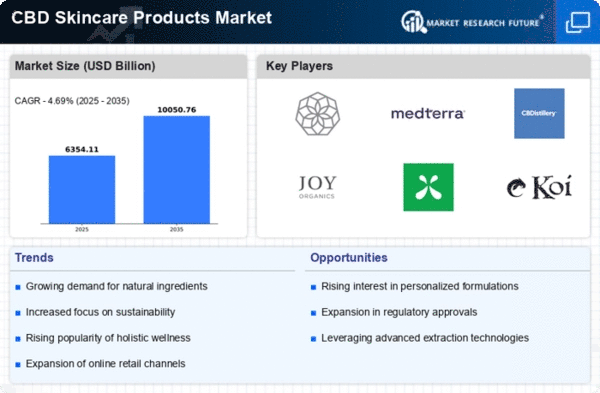
As per MRFR analysis, the CBD Skincare Products Market was estimated at 6069.45 USD Billion in 2024. The CBD Skincare Products industry is projected to grow from 6354.23 USD Billion in 2025 to 10050.76 USD Billion by 2035, exhibiting a compound annual growth rate (CAGR) of 4.69% during the forecast period 2025 - 2035.

Key Market Trends & Highlights

The CBD Skincare Products Market is experiencing a notable shift towards natural ingredients and wellness-focused offerings.

  • The market is witnessing a rise in the demand for natural ingredients, reflecting a broader consumer trend towards clean beauty.
  • North America remains the largest market for CBD skincare products, while Asia-Pacific is emerging as the fastest-growing region.
  • Moisturizers dominate the market, particularly for consumers with dry skin, which represents the largest segment.
  • The increasing consumer awareness and innovative product development are driving the market forward, particularly in the context of anti-aging solutions.

Market Size & Forecast

2024 Market Size 6069.45 (USD Billion)
2035 Market Size 10050.76 (USD Billion)
CAGR (2025 - 2035) 4.69%
Largest Regional Market Share in 2024 North America

Major Players

Charlotte's Web (US), Medterra (US), CBDistillery (US), Joy Organics (US), Green Roads (US), Koi CBD (US), Endoca (NL), HempFusion (US), PureKana (US), Elixinol (AU)

Market Trends

The CBD Skincare Products Market is currently experiencing a notable transformation, driven by increasing consumer awareness regarding the potential benefits of cannabidiol in skincare. This market appears to be expanding as more individuals seek natural and organic alternatives to traditional skincare solutions. The growing interest in holistic wellness and self-care routines seems to be influencing purchasing decisions, leading to a rise in demand for products infused with CBD. Furthermore, the perception of CBD as a therapeutic ingredient may enhance its appeal among consumers looking for solutions to skin issues such as inflammation and dryness. In addition, the regulatory landscape surrounding CBD products is evolving, which could impact market dynamics. As governments around the world continue to clarify regulations, manufacturers may find new opportunities to innovate and expand their product lines. The increasing presence of CBD in mainstream retail channels suggests a shift towards greater acceptance and normalization of these products. This trend may encourage more brands to enter the CBD Skincare Products Market, further diversifying the offerings available to consumers. Overall, the market appears poised for continued growth as it adapts to changing consumer preferences and regulatory frameworks.

Rise of Natural Ingredients

There is a growing trend towards the use of natural and organic ingredients in skincare products. Consumers are increasingly seeking formulations that are free from synthetic chemicals, which has led to a surge in the popularity of CBD-infused products. This shift reflects a broader movement towards clean beauty, where transparency and ingredient integrity are paramount.

Focus on Wellness and Self-Care

The emphasis on wellness and self-care routines is becoming more pronounced among consumers. CBD is often associated with relaxation and stress relief, making it an attractive option for those looking to enhance their skincare rituals. This trend indicates a shift in consumer priorities towards products that not only beautify but also promote overall well-being.

Evolving Regulatory Environment

The regulatory landscape for CBD products is undergoing significant changes, which may influence market growth. As regulations become clearer and more standardized, manufacturers may gain confidence to innovate and expand their offerings. This evolution could lead to increased consumer trust and wider acceptance of CBD in skincare.

CBD Skincare Products Market Market Drivers

Growing Consumer Awareness

The Global CBD Skincare Products Industry is experiencing a surge in consumer awareness regarding the benefits of CBD-infused products. As consumers increasingly seek natural and organic alternatives, the demand for CBD skincare is likely to rise. This trend is supported by educational campaigns and social media influencers promoting the therapeutic properties of CBD, which include anti-inflammatory and antioxidant effects. Consequently, the market is projected to reach 1.63 USD Billion in 2024, reflecting a growing inclination towards wellness-oriented skincare solutions. This heightened awareness could potentially drive further innovation and product development within the industry.

Market Segment Insights

By Application: Moisturizers (Largest) vs. Cleansers (Fastest-Growing)

The CBD skincare products market has a diverse application segment, with moisturizers leading the charge as the largest segment. Their rich formulations and skin-nurturing properties have made them a favorite among consumers seeking hydration and rejuvenation. Cleansers are emerging rapidly, gaining traction for their ability to cleanse without stripping the skin of essential moisture. This growing consumer preference for gentle cleansing products infused with CBD highlights a shift towards self-care and wellness in skincare routines. As consumers increasingly seek natural and effective skincare solutions, the demand for CBD-infused cleansers and moisturizers is expected to grow significantly. Factors such as rising awareness of the benefits of CBD, coupled with a shift towards holistic skincare, are driving growth in this segment. Additionally, the increasing trend of incorporating wellness into beauty routines supports the expanding market presence of CBD skincare products, particularly in the moisturizers and cleansers segments.

Moisturizers: Dominant vs. Cleansers: Emerging

In the CBD skincare market, moisturizers are recognized as the dominant segment due to their therapeutic properties and widespread appeal. Consumers are increasingly gravitating towards products that not only hydrate but also soothe and rejuvenate the skin, benefits associated with CBD’s anti-inflammatory properties. Cleansers, regarded as the emerging segment, are quickly gaining popularity as more consumers prioritize gentle yet effective cleansing solutions that complement their skincare regimens. The innovative formulations incorporating CBD not only reflect a growing awareness but also cater to the evolving preferences for natural ingredients. The synergy between these two segments signifies a comprehensive approach to skincare, where consumers seek effective, multi-functional products.

By End Use: Personal Care (Largest) vs. E-commerce (Fastest-Growing)

<p>The CBD Skincare Products Market is significantly shaped by various end-use segments, prominently featuring Personal Care, which remains the largest segment. With a strong consumer base leaning towards natural and wellness-oriented products, Personal Care has established itself as a principal contributor to the market. Other segments such as Professional Care and Retail also contribute but are comparatively smaller, highlighting a diverse market landscape where consumer preferences dictate value allocation across these segments. In contrast, the E-commerce segment is rapidly gaining momentum, adapting to the growing trend of online shopping. With increased digital engagement and the convenience of doorstep delivery, consumers are gravitating towards online platforms to purchase CBD skincare products. This shift is propelled by the rise in digital marketing efforts and the enhancement of e-commerce platforms that streamline the shopping experience, thus solidifying E-commerce's position as the fastest-growing segment within this market.</p>

<p>Personal Care (Dominant) vs. E-commerce (Emerging)</p>

<p>The Personal Care segment is recognized as the dominant player in the CBD Skincare Products Market, characterized by a robust variety of products tailored to meet individual skin care needs. This segment encompasses a wide range of offerings, including moisturizers, serums, and lotions infused with CBD, appealing to consumers' preferences for wellness-focused skincare. Its position is reinforced by the increasing consumer awareness regarding natural ingredients and the therapeutic benefits associated with CBD. Conversely, the E-commerce segment is emerging as a vital distribution channel, catering to tech-savvy consumers who prefer the convenience of purchasing skincare products online. With an expansive reach, this segment allows for greater accessibility and variety, as well as promotional advantages that traditional retail may not offer. As more brands strengthen their online presence and leverage social media for marketing, the E-commerce segment is positioned to capture a significant share of the market going forward.</p>

By Formulation Type: Oil-based (Largest) vs. Creams (Fastest-Growing)

<p>In the CBD skincare products market, formulation types play a crucial role in consumer preferences. Oil-based products maintain the largest market share due to their perceived effectiveness and moisturizing properties, which align well with consumer needs for hydration and nourishment. This segment has successfully captivated a devoted customer base that favors the richness and versatility of oils in skincare routines. Meanwhile, creams have emerged as the fastest-growing segment due to their multifaceted appeal, offering ease of application and a luxurious feel, effectively attracting a wider audience.</p>

<p>Oils (Dominant) vs. Creams (Emerging)</p>

<p>Oil-based formulations are dominant in the CBD skincare market, known for their deep penetration and ability to deliver hydration, which resonates well with customers seeking intense moisture and nourishment. Often infused with additional beneficial ingredients, these products cater to a discerning clientele that values quality and efficacy. On the other hand, creams are witnessing rapid growth, driven by consumer demand for convenience and innovation in texture. They provide an ideal balance between skincare and ease of use, making them attractive to new consumers. The trend toward multifunctional products further illustrates creams' rising position, as they can integrate CBD with other skincare benefits, enhancing their appeal.</p>

By Distribution Channel: Online (Largest) vs. Specialty Stores (Fastest-Growing)

<p>The CBD skincare products market exhibits a varied distribution channel landscape, with online sales leading in market share due to the increasing popularity of e-commerce platforms. Consumers favor the convenience and wide selection offered online, significantly contributing to its dominance in the market. In contrast, offline channels, including specialty stores and pharmacies, cater to a different consumer base that values personal interaction and product testing before purchase, although they hold a smaller market share compared to online sales. Growth trends in the CBD skincare distribution segment show a shifting consumer preference towards online shopping, particularly post-pandemic, as more customers prioritize digital experiences. Specialty stores are experiencing rapid growth as well, driven by a trend towards artisanal and organic products, as consumers increasingly seek tailored skincare solutions. This has prompted retailers to enhance their online presence while also expanding their physical footprint to capture emerging market opportunities.</p>

<p>Online (Dominant) vs. Pharmacies (Emerging)</p>

<p>Online distribution channels are currently the dominant force in the CBD skincare products market, offering consumers unmatched convenience, a vast selection of products, and often better pricing due to lower overhead costs. This method allows brands to reach a wider audience quickly and efficiently. On the other hand, pharmacies are emerging as a significant channel, as they provide accessibility and consumer trust. As a regulated space, pharmacies can assure customers of product safety and compliance, which is crucial in the CBD market. This combination of trust and accessibility is driving an increase in pharmacy sales, as consumers are becoming more discerning and prefer to purchase from reputable sources.</p>

By Target Demographic: Age Group (Largest) vs. Gender (Fastest-Growing)

<p>In the CBD skincare products market, the age group segment is predominantly led by consumers aged 25-34, who represent the largest share of the market. This demographic is notably attracted to the beneficial properties of CBD, often seeking products that address specific skin concerns. Following closely are individuals aged 35-44, who also contribute significantly to market sales with their increasing awareness of natural skincare solutions. Gender demographics reveal a growing popularity among male consumers, reflected in their increasing adoption of CBD skincare products as part of their grooming routine, thus shaping the future of this segment.</p>

<p>Age Group: 25-34 (Dominant) vs. Gender: Male (Emerging)</p>

<p>The age group of 25-34 is currently the dominant force in the CBD skincare market, characterized by an active interest in wellness and natural products. This demographic values self-care and is typically more open to trying innovative skincare solutions, such as those containing CBD. In contrast, the male demographic is emerging as a significant market segment, driven by changing perceptions of skincare and personal grooming. Males are increasingly aware of the benefits of CBD in addressing skin issues like dryness and irritation, making their entry into the market an essential driver of growth and innovation in product offerings.</p>

Get more detailed insights about CBD Skincare Product Market Research Report - Global Forecast till 2035

Regional Insights

North America : Market Leader in CBD Skincare

North America is the largest market for CBD skincare products, with a market size of $3034.73M in 2025. The region's growth is driven by increasing consumer awareness of CBD benefits, regulatory support, and a robust e-commerce landscape. The demand for natural and organic skincare products is rising, further propelling market expansion. Regulatory frameworks are becoming more favorable, allowing for greater product innovation and market entry. The U.S. is the leading country in this market, hosting key players like Charlotte's Web, Medterra, and CBDistillery. The competitive landscape is characterized by a mix of established brands and emerging startups, all vying for market share. The presence of major retailers and online platforms enhances product accessibility, contributing to the region's dominance in The CBD Skincare Products.

Europe : Emerging Market with Potential

Europe's CBD skincare market is rapidly evolving, with a market size of €1810.67M in 2025. The growth is fueled by increasing consumer interest in wellness products and a shift towards natural ingredients. Regulatory advancements, particularly in countries like Germany and the Netherlands, are paving the way for broader acceptance and distribution of CBD products. The region is witnessing a surge in demand for innovative skincare solutions that incorporate CBD, reflecting changing consumer preferences. Leading countries in this market include Germany, the UK, and France, where consumer education and product availability are improving. Key players such as Endoca and Koi CBD are establishing a strong foothold, while local brands are emerging to cater to specific market needs. The competitive landscape is becoming more dynamic, with collaborations and partnerships enhancing product offerings and market reach.

Asia-Pacific : Rapidly Growing Market Segment

The Asia-Pacific region is witnessing significant growth in the CBD skincare market, with a market size of $1341.9M in 2025. This growth is driven by increasing consumer awareness of CBD's therapeutic properties and a rising demand for natural skincare solutions. Countries like Australia and Japan are leading the charge, supported by favorable regulatory changes that are encouraging product innovation and market entry. The region's diverse consumer base is increasingly seeking holistic wellness products, further boosting market potential. Australia is at the forefront, with a growing number of local brands entering the market. The competitive landscape is characterized by both international and domestic players, including established brands and startups. The presence of e-commerce platforms is enhancing product accessibility, allowing consumers to explore a variety of CBD skincare options tailored to their needs.

Middle East and Africa : Emerging Frontier for CBD

The Middle East and Africa (MEA) region is emerging as a potential market for CBD skincare products, with a market size of $882.15M in 2025. The growth is driven by increasing consumer interest in natural and organic products, alongside a gradual shift in regulatory attitudes towards CBD. Countries like South Africa are leading the way, with evolving regulations that are beginning to support the use of CBD in cosmetics. The region's unique cultural landscape is also influencing product development and consumer preferences. South Africa is the primary market within the region, with local brands beginning to explore CBD-infused skincare solutions. The competitive landscape is still developing, with a mix of international brands and local startups. As awareness grows and regulations become more favorable, the MEA region is poised for significant growth in the CBD skincare sector.

Key Players and Competitive Insights

The CBD Skincare Products Market is currently characterized by a dynamic competitive landscape, driven by increasing consumer awareness regarding the benefits of CBD and a growing demand for natural skincare solutions. Key players such as Charlotte's Web (US), Medterra (US), and Joy Organics (US) are strategically positioning themselves through innovation and product diversification. Charlotte's Web (US) has focused on expanding its product line to include a wider range of skincare items, thereby appealing to a broader consumer base. Meanwhile, Medterra (US) has emphasized partnerships with wellness influencers to enhance brand visibility and consumer trust, which appears to be a growing trend among competitors. Collectively, these strategies contribute to a competitive environment that is increasingly focused on product quality and brand reputation.In terms of business tactics, companies are localizing manufacturing and optimizing supply chains to enhance efficiency and reduce costs. The market structure is moderately fragmented, with several players vying for market share. This fragmentation allows for niche brands to thrive, while larger companies leverage their resources to dominate the market. The collective influence of these key players shapes the competitive dynamics, as they continuously adapt to consumer preferences and regulatory changes.

In November Charlotte's Web (US) announced the launch of a new line of CBD-infused skincare products aimed at the luxury segment. This strategic move is significant as it not only diversifies their product offerings but also positions the brand to capture a higher-end market, potentially increasing profit margins. The introduction of premium products may also enhance brand perception and loyalty among consumers seeking quality skincare solutions.

In October Medterra (US) expanded its distribution channels by partnering with a major online retailer, significantly increasing its market reach. This action is crucial as it allows Medterra to tap into a larger consumer base, particularly among e-commerce shoppers who prefer the convenience of online purchasing. Such partnerships are likely to enhance brand visibility and drive sales growth in a competitive market.

In September Joy Organics (US) launched a sustainability initiative aimed at reducing its carbon footprint through eco-friendly packaging and sourcing practices. This initiative reflects a broader trend within the industry towards sustainability, which is increasingly influencing consumer purchasing decisions. By prioritizing environmental responsibility, Joy Organics (US) not only differentiates itself from competitors but also aligns with the values of a growing segment of eco-conscious consumers.

As of December current competitive trends in the CBD Skincare Products Market include a strong emphasis on digitalization, sustainability, and the integration of AI technologies for personalized consumer experiences. Strategic alliances are becoming more prevalent, as companies recognize the value of collaboration in enhancing product offerings and market reach. Looking ahead, competitive differentiation is likely to evolve from traditional price-based competition to a focus on innovation, technological advancements, and supply chain reliability. This shift suggests that companies that prioritize these areas will be better positioned to thrive in an increasingly competitive landscape.

Key Companies in the CBD Skincare Products Market include

Industry Developments

Recent developments in the Global CBD Skincare Products Market indicate a significant surge in consumer demand and product innovation. Lazarus Naturals and Charlotte's Web have reported notable increases in sales, attributed to the growing popularity of their CBD-infused creams and serums. In terms of market consolidation, Extract Labs announced a strategic merger with Joy Organics in August 2023, enhancing their product offerings and market share. Growth in the sector is also evidenced by the valuation hike of companies such as CV Sciences and Green Roads, reflecting broader industry optimism driven by the expanding legal landscape for hemp-derived products.

Notably, regulations are evolving globally, with the European Union considering new guidelines for CBD products that may impact how companies like Medterra and CannaCraft position themselves in the market. The overall market for CBD skincare has grown by over 20% in the last year, as consumers increasingly seek natural alternatives for skincare. Additionally, the notion of sustainability has gained traction, pushing companies such as Elixinol to adopt eco-friendly practices in their production processes. These trends underscore the dynamic nature of the CBD skincare segment internationally.

Future Outlook

CBD Skincare Products Market Future Outlook

The CBD Skincare Products Market is projected to grow at a 4.69% CAGR from 2025 to 2035, driven by increasing consumer awareness and demand for natural ingredients.

New opportunities lie in:

  • Expansion into emerging markets with tailored product lines
  • Development of subscription-based skincare services
  • Collaboration with wellness influencers for targeted marketing campaigns

By 2035, the market is expected to solidify its position as a leader in the skincare industry.

Market Segmentation

CBD Skincare Products Market Skin Type Outlook

  • Dry Skin
  • Oily Skin
  • Combination Skin
  • Sensitive Skin
  • Normal Skin

CBD Skincare Products Market Application Outlook

  • Moisturizers
  • Cleansers
  • Serums
  • Sunscreens
  • Face Masks

CBD Skincare Products Market Formulation Type Outlook

  • Creams
  • Lotions
  • Gels
  • Oils
  • Balms

CBD Skincare Products Market Target Demographic Outlook

  • Men
  • Women
  • Teenagers
  • Seniors
  • Pregnant Women

CBD Skincare Products Market Distribution Channel Outlook

  • Online Retail
  • Specialty Stores
  • Pharmacies
  • Department Stores
  • Direct Sales

Report Scope

MARKET SIZE 2024 6069.45(USD Billion)
MARKET SIZE 2025 6354.23(USD Billion)
MARKET SIZE 2035 10050.76(USD Billion)
COMPOUND ANNUAL GROWTH RATE (CAGR) 4.69% (2025 - 2035)
REPORT COVERAGE Revenue Forecast, Competitive Landscape, Growth Factors, and Trends
BASE YEAR 2024
Market Forecast Period 2025 - 2035
Historical Data 2019 - 2024
Market Forecast Units USD Billion
Key Companies Profiled Charlotte's Web (US), Medterra (US), CBDistillery (US), Joy Organics (US), Green Roads (US), Koi CBD (US), Endoca (NL), HempFusion (US), PureKana (US), Elixinol (AU)
Segments Covered Application, Skin Type, Distribution Channel, Formulation Type, Target Demographic
Key Market Opportunities Growing consumer interest in natural ingredients drives innovation in the CBD Skincare Products Market.
Key Market Dynamics Rising consumer demand for natural ingredients drives innovation and competition in the CBD skincare products market.
Countries Covered North America, Europe, APAC, South America, MEA

FAQs

What is the projected market valuation for CBD skincare products by 2035?

<p>The projected market valuation for CBD skincare products is expected to reach 10050.76 USD Billion by 2035.</p>

What was the market valuation for CBD skincare products in 2024?

The market valuation for CBD skincare products was 6069.45 USD Billion in 2024.

What is the expected CAGR for the CBD skincare products market from 2025 to 2035?

The expected CAGR for the CBD skincare products market during the forecast period 2025 - 2035 is 4.69%.

Which companies are considered key players in the CBD skincare products market?

Key players in the CBD skincare products market include Charlotte's Web, Medterra, CBDistillery, Joy Organics, and Green Roads.

What segment of CBD skincare products is projected to have the highest valuation by 2035?

By 2035, the segment of creams is projected to have the highest valuation, reaching 3900.0 USD Billion.

How do online and offline distribution channels compare in the CBD skincare market?

Both online and offline distribution channels are projected to reach 3000.0 USD Billion by 2035, indicating a balanced growth.

What is the expected valuation for CBD moisturizers by 2035?

The expected valuation for CBD moisturizers is projected to reach 1950.0 USD Billion by 2035.

What demographic factors are influencing the CBD skincare products market?

Demographic factors such as age group, gender, skin type, and lifestyle are influencing the CBD skincare products market, each projected to reach 1950.0 USD Billion by 2035.

What is the projected valuation for CBD serums by 2035?

The projected valuation for CBD serums is expected to reach 1400.0 USD Billion by 2035.

How does the professional care segment compare to personal care in the CBD skincare market?

The professional care segment is projected to reach 2.5 USD Billion by 2035, while the personal care segment is expected to reach 4.0 USD Billion.

  1. SECTION I: EXECUTIVE SUMMARY AND KEY HIGHLIGHTS
    1. | 1.1 EXECUTIVE SUMMARY
    2. | | 1.1.1 Market Overview
    3. | | 1.1.2 Key Findings
    4. | | 1.1.3 Market Segmentation
    5. | | 1.1.4 Competitive Landscape
    6. | | 1.1.5 Challenges and Opportunities
    7. | | 1.1.6 Future Outlook
  2. SECTION II: SCOPING, METHODOLOGY AND MARKET STRUCTURE
    1. | 2.1 MARKET INTRODUCTION
    2. | | 2.1.1 Definition
    3. | | 2.1.2 Scope of the study
    4. | | | 2.1.2.1 Research Objective
    5. | | | 2.1.2.2 Assumption
    6. | | | 2.1.2.3 Limitations
    7. | 2.2 RESEARCH METHODOLOGY
    8. | | 2.2.1 Overview
    9. | | 2.2.2 Data Mining
    10. | | 2.2.3 Secondary Research
    11. | | 2.2.4 Primary Research
    12. | | | 2.2.4.1 Primary Interviews and Information Gathering Process
    13. | | | 2.2.4.2 Breakdown of Primary Respondents
    14. | | 2.2.5 Forecasting Model
    15. | | 2.2.6 Market Size Estimation
    16. | | | 2.2.6.1 Bottom-Up Approach
    17. | | | 2.2.6.2 Top-Down Approach
    18. | | 2.2.7 Data Triangulation
    19. | | 2.2.8 Validation
  3. SECTION III: QUALITATIVE ANALYSIS
    1. | 3.1 MARKET DYNAMICS
    2. | | 3.1.1 Overview
    3. | | 3.1.2 Drivers
    4. | | 3.1.3 Restraints
    5. | | 3.1.4 Opportunities
    6. | 3.2 MARKET FACTOR ANALYSIS
    7. | | 3.2.1 Value chain Analysis
    8. | | 3.2.2 Porter's Five Forces Analysis
    9. | | | 3.2.2.1 Bargaining Power of Suppliers
    10. | | | 3.2.2.2 Bargaining Power of Buyers
    11. | | | 3.2.2.3 Threat of New Entrants
    12. | | | 3.2.2.4 Threat of Substitutes
    13. | | | 3.2.2.5 Intensity of Rivalry
    14. | | 3.2.3 COVID-19 Impact Analysis
    15. | | | 3.2.3.1 Market Impact Analysis
    16. | | | 3.2.3.2 Regional Impact
    17. | | | 3.2.3.3 Opportunity and Threat Analysis
  4. SECTION IV: QUANTITATIVE ANALYSIS
    1. | 4.1 Consumer and Retail, BY Application (USD Billion)
    2. | | 4.1.1 Moisturizers
    3. | | 4.1.2 Cleansers
    4. | | 4.1.3 Serums
    5. | | 4.1.4 Sunscreens
    6. | | 4.1.5 Face Masks
    7. | 4.2 Consumer and Retail, BY End Use (USD Billion)
    8. | | 4.2.1 Personal Care
    9. | | 4.2.2 Professional Care
    10. | | 4.2.3 Retail
    11. | | 4.2.4 E-commerce
    12. | 4.3 Consumer and Retail, BY Formulation Type (USD Billion)
    13. | | 4.3.1 Oil-based
    14. | | 4.3.2 Water-based
    15. | | 4.3.3 Creams
    16. | | 4.3.4 Gels
    17. | 4.4 Consumer and Retail, BY Distribution Channel (USD Billion)
    18. | | 4.4.1 Online
    19. | | 4.4.2 Offline
    20. | | 4.4.3 Specialty Stores
    21. | | 4.4.4 Pharmacies
    22. | 4.5 Consumer and Retail, BY Target Demographic (USD Billion)
    23. | | 4.5.1 Age Group
    24. | | 4.5.2 Gender
    25. | | 4.5.3 Skin Type
    26. | | 4.5.4 Lifestyle
    27. | 4.6 Consumer and Retail, BY Region (USD Billion)
    28. | | 4.6.1 North America
    29. | | | 4.6.1.1 US
    30. | | | 4.6.1.2 Canada
    31. | | 4.6.2 Europe
    32. | | | 4.6.2.1 Germany
    33. | | | 4.6.2.2 UK
    34. | | | 4.6.2.3 France
    35. | | | 4.6.2.4 Russia
    36. | | | 4.6.2.5 Italy
    37. | | | 4.6.2.6 Spain
    38. | | | 4.6.2.7 Rest of Europe
    39. | | 4.6.3 APAC
    40. | | | 4.6.3.1 China
    41. | | | 4.6.3.2 India
    42. | | | 4.6.3.3 Japan
    43. | | | 4.6.3.4 South Korea
    44. | | | 4.6.3.5 Malaysia
    45. | | | 4.6.3.6 Thailand
    46. | | | 4.6.3.7 Indonesia
    47. | | | 4.6.3.8 Rest of APAC
    48. | | 4.6.4 South America
    49. | | | 4.6.4.1 Brazil
    50. | | | 4.6.4.2 Mexico
    51. | | | 4.6.4.3 Argentina
    52. | | | 4.6.4.4 Rest of South America
    53. | | 4.6.5 MEA
    54. | | | 4.6.5.1 GCC Countries
    55. | | | 4.6.5.2 South Africa
    56. | | | 4.6.5.3 Rest of MEA
  5. SECTION V: COMPETITIVE ANALYSIS
    1. | 5.1 Competitive Landscape
    2. | | 5.1.1 Overview
    3. | | 5.1.2 Competitive Analysis
    4. | | 5.1.3 Market share Analysis
    5. | | 5.1.4 Major Growth Strategy in the Consumer and Retail
    6. | | 5.1.5 Competitive Benchmarking
    7. | | 5.1.6 Leading Players in Terms of Number of Developments in the Consumer and Retail
    8. | | 5.1.7 Key developments and growth strategies
    9. | | | 5.1.7.1 New Product Launch/Service Deployment
    10. | | | 5.1.7.2 Merger & Acquisitions
    11. | | | 5.1.7.3 Joint Ventures
    12. | | 5.1.8 Major Players Financial Matrix
    13. | | | 5.1.8.1 Sales and Operating Income
    14. | | | 5.1.8.2 Major Players R&D Expenditure. 2023
    15. | 5.2 Company Profiles
    16. | | 5.2.1 Charlotte's Web (US)
    17. | | | 5.2.1.1 Financial Overview
    18. | | | 5.2.1.2 Products Offered
    19. | | | 5.2.1.3 Key Developments
    20. | | | 5.2.1.4 SWOT Analysis
    21. | | | 5.2.1.5 Key Strategies
    22. | | 5.2.2 Medterra (US)
    23. | | | 5.2.2.1 Financial Overview
    24. | | | 5.2.2.2 Products Offered
    25. | | | 5.2.2.3 Key Developments
    26. | | | 5.2.2.4 SWOT Analysis
    27. | | | 5.2.2.5 Key Strategies
    28. | | 5.2.3 CBDistillery (US)
    29. | | | 5.2.3.1 Financial Overview
    30. | | | 5.2.3.2 Products Offered
    31. | | | 5.2.3.3 Key Developments
    32. | | | 5.2.3.4 SWOT Analysis
    33. | | | 5.2.3.5 Key Strategies
    34. | | 5.2.4 Joy Organics (US)
    35. | | | 5.2.4.1 Financial Overview
    36. | | | 5.2.4.2 Products Offered
    37. | | | 5.2.4.3 Key Developments
    38. | | | 5.2.4.4 SWOT Analysis
    39. | | | 5.2.4.5 Key Strategies
    40. | | 5.2.5 Green Roads (US)
    41. | | | 5.2.5.1 Financial Overview
    42. | | | 5.2.5.2 Products Offered
    43. | | | 5.2.5.3 Key Developments
    44. | | | 5.2.5.4 SWOT Analysis
    45. | | | 5.2.5.5 Key Strategies
    46. | | 5.2.6 Koi CBD (US)
    47. | | | 5.2.6.1 Financial Overview
    48. | | | 5.2.6.2 Products Offered
    49. | | | 5.2.6.3 Key Developments
    50. | | | 5.2.6.4 SWOT Analysis
    51. | | | 5.2.6.5 Key Strategies
    52. | | 5.2.7 Endoca (NL)
    53. | | | 5.2.7.1 Financial Overview
    54. | | | 5.2.7.2 Products Offered
    55. | | | 5.2.7.3 Key Developments
    56. | | | 5.2.7.4 SWOT Analysis
    57. | | | 5.2.7.5 Key Strategies
    58. | | 5.2.8 HempFusion (US)
    59. | | | 5.2.8.1 Financial Overview
    60. | | | 5.2.8.2 Products Offered
    61. | | | 5.2.8.3 Key Developments
    62. | | | 5.2.8.4 SWOT Analysis
    63. | | | 5.2.8.5 Key Strategies
    64. | | 5.2.9 PureKana (US)
    65. | | | 5.2.9.1 Financial Overview
    66. | | | 5.2.9.2 Products Offered
    67. | | | 5.2.9.3 Key Developments
    68. | | | 5.2.9.4 SWOT Analysis
    69. | | | 5.2.9.5 Key Strategies
    70. | 5.3 Appendix
    71. | | 5.3.1 References
    72. | | 5.3.2 Related Reports
  6. LIST OF FIGURES
    1. | 6.1 MARKET SYNOPSIS
    2. | 6.2 NORTH AMERICA MARKET ANALYSIS
    3. | 6.3 US MARKET ANALYSIS BY APPLICATION
    4. | 6.4 US MARKET ANALYSIS BY END USE
    5. | 6.5 US MARKET ANALYSIS BY FORMULATION TYPE
    6. | 6.6 US MARKET ANALYSIS BY DISTRIBUTION CHANNEL
    7. | 6.7 US MARKET ANALYSIS BY TARGET DEMOGRAPHIC
    8. | 6.8 CANADA MARKET ANALYSIS BY APPLICATION
    9. | 6.9 CANADA MARKET ANALYSIS BY END USE
    10. | 6.10 CANADA MARKET ANALYSIS BY FORMULATION TYPE
    11. | 6.11 CANADA MARKET ANALYSIS BY DISTRIBUTION CHANNEL
    12. | 6.12 CANADA MARKET ANALYSIS BY TARGET DEMOGRAPHIC
    13. | 6.13 EUROPE MARKET ANALYSIS
    14. | 6.14 GERMANY MARKET ANALYSIS BY APPLICATION
    15. | 6.15 GERMANY MARKET ANALYSIS BY END USE
    16. | 6.16 GERMANY MARKET ANALYSIS BY FORMULATION TYPE
    17. | 6.17 GERMANY MARKET ANALYSIS BY DISTRIBUTION CHANNEL
    18. | 6.18 GERMANY MARKET ANALYSIS BY TARGET DEMOGRAPHIC
    19. | 6.19 UK MARKET ANALYSIS BY APPLICATION
    20. | 6.20 UK MARKET ANALYSIS BY END USE
    21. | 6.21 UK MARKET ANALYSIS BY FORMULATION TYPE
    22. | 6.22 UK MARKET ANALYSIS BY DISTRIBUTION CHANNEL
    23. | 6.23 UK MARKET ANALYSIS BY TARGET DEMOGRAPHIC
    24. | 6.24 FRANCE MARKET ANALYSIS BY APPLICATION
    25. | 6.25 FRANCE MARKET ANALYSIS BY END USE
    26. | 6.26 FRANCE MARKET ANALYSIS BY FORMULATION TYPE
    27. | 6.27 FRANCE MARKET ANALYSIS BY DISTRIBUTION CHANNEL
    28. | 6.28 FRANCE MARKET ANALYSIS BY TARGET DEMOGRAPHIC
    29. | 6.29 RUSSIA MARKET ANALYSIS BY APPLICATION
    30. | 6.30 RUSSIA MARKET ANALYSIS BY END USE
    31. | 6.31 RUSSIA MARKET ANALYSIS BY FORMULATION TYPE
    32. | 6.32 RUSSIA MARKET ANALYSIS BY DISTRIBUTION CHANNEL
    33. | 6.33 RUSSIA MARKET ANALYSIS BY TARGET DEMOGRAPHIC
    34. | 6.34 ITALY MARKET ANALYSIS BY APPLICATION
    35. | 6.35 ITALY MARKET ANALYSIS BY END USE
    36. | 6.36 ITALY MARKET ANALYSIS BY FORMULATION TYPE
    37. | 6.37 ITALY MARKET ANALYSIS BY DISTRIBUTION CHANNEL
    38. | 6.38 ITALY MARKET ANALYSIS BY TARGET DEMOGRAPHIC
    39. | 6.39 SPAIN MARKET ANALYSIS BY APPLICATION
    40. | 6.40 SPAIN MARKET ANALYSIS BY END USE
    41. | 6.41 SPAIN MARKET ANALYSIS BY FORMULATION TYPE
    42. | 6.42 SPAIN MARKET ANALYSIS BY DISTRIBUTION CHANNEL
    43. | 6.43 SPAIN MARKET ANALYSIS BY TARGET DEMOGRAPHIC
    44. | 6.44 REST OF EUROPE MARKET ANALYSIS BY APPLICATION
    45. | 6.45 REST OF EUROPE MARKET ANALYSIS BY END USE
    46. | 6.46 REST OF EUROPE MARKET ANALYSIS BY FORMULATION TYPE
    47. | 6.47 REST OF EUROPE MARKET ANALYSIS BY DISTRIBUTION CHANNEL
    48. | 6.48 REST OF EUROPE MARKET ANALYSIS BY TARGET DEMOGRAPHIC
    49. | 6.49 APAC MARKET ANALYSIS
    50. | 6.50 CHINA MARKET ANALYSIS BY APPLICATION
    51. | 6.51 CHINA MARKET ANALYSIS BY END USE
    52. | 6.52 CHINA MARKET ANALYSIS BY FORMULATION TYPE
    53. | 6.53 CHINA MARKET ANALYSIS BY DISTRIBUTION CHANNEL
    54. | 6.54 CHINA MARKET ANALYSIS BY TARGET DEMOGRAPHIC
    55. | 6.55 INDIA MARKET ANALYSIS BY APPLICATION
    56. | 6.56 INDIA MARKET ANALYSIS BY END USE
    57. | 6.57 INDIA MARKET ANALYSIS BY FORMULATION TYPE
    58. | 6.58 INDIA MARKET ANALYSIS BY DISTRIBUTION CHANNEL
    59. | 6.59 INDIA MARKET ANALYSIS BY TARGET DEMOGRAPHIC
    60. | 6.60 JAPAN MARKET ANALYSIS BY APPLICATION
    61. | 6.61 JAPAN MARKET ANALYSIS BY END USE
    62. | 6.62 JAPAN MARKET ANALYSIS BY FORMULATION TYPE
    63. | 6.63 JAPAN MARKET ANALYSIS BY DISTRIBUTION CHANNEL
    64. | 6.64 JAPAN MARKET ANALYSIS BY TARGET DEMOGRAPHIC
    65. | 6.65 SOUTH KOREA MARKET ANALYSIS BY APPLICATION
    66. | 6.66 SOUTH KOREA MARKET ANALYSIS BY END USE
    67. | 6.67 SOUTH KOREA MARKET ANALYSIS BY FORMULATION TYPE
    68. | 6.68 SOUTH KOREA MARKET ANALYSIS BY DISTRIBUTION CHANNEL
    69. | 6.69 SOUTH KOREA MARKET ANALYSIS BY TARGET DEMOGRAPHIC
    70. | 6.70 MALAYSIA MARKET ANALYSIS BY APPLICATION
    71. | 6.71 MALAYSIA MARKET ANALYSIS BY END USE
    72. | 6.72 MALAYSIA MARKET ANALYSIS BY FORMULATION TYPE
    73. | 6.73 MALAYSIA MARKET ANALYSIS BY DISTRIBUTION CHANNEL
    74. | 6.74 MALAYSIA MARKET ANALYSIS BY TARGET DEMOGRAPHIC
    75. | 6.75 THAILAND MARKET ANALYSIS BY APPLICATION
    76. | 6.76 THAILAND MARKET ANALYSIS BY END USE
    77. | 6.77 THAILAND MARKET ANALYSIS BY FORMULATION TYPE
    78. | 6.78 THAILAND MARKET ANALYSIS BY DISTRIBUTION CHANNEL
    79. | 6.79 THAILAND MARKET ANALYSIS BY TARGET DEMOGRAPHIC
    80. | 6.80 INDONESIA MARKET ANALYSIS BY APPLICATION
    81. | 6.81 INDONESIA MARKET ANALYSIS BY END USE
    82. | 6.82 INDONESIA MARKET ANALYSIS BY FORMULATION TYPE
    83. | 6.83 INDONESIA MARKET ANALYSIS BY DISTRIBUTION CHANNEL
    84. | 6.84 INDONESIA MARKET ANALYSIS BY TARGET DEMOGRAPHIC
    85. | 6.85 REST OF APAC MARKET ANALYSIS BY APPLICATION
    86. | 6.86 REST OF APAC MARKET ANALYSIS BY END USE
    87. | 6.87 REST OF APAC MARKET ANALYSIS BY FORMULATION TYPE
    88. | 6.88 REST OF APAC MARKET ANALYSIS BY DISTRIBUTION CHANNEL
    89. | 6.89 REST OF APAC MARKET ANALYSIS BY TARGET DEMOGRAPHIC
    90. | 6.90 SOUTH AMERICA MARKET ANALYSIS
    91. | 6.91 BRAZIL MARKET ANALYSIS BY APPLICATION
    92. | 6.92 BRAZIL MARKET ANALYSIS BY END USE
    93. | 6.93 BRAZIL MARKET ANALYSIS BY FORMULATION TYPE
    94. | 6.94 BRAZIL MARKET ANALYSIS BY DISTRIBUTION CHANNEL
    95. | 6.95 BRAZIL MARKET ANALYSIS BY TARGET DEMOGRAPHIC
    96. | 6.96 MEXICO MARKET ANALYSIS BY APPLICATION
    97. | 6.97 MEXICO MARKET ANALYSIS BY END USE
    98. | 6.98 MEXICO MARKET ANALYSIS BY FORMULATION TYPE
    99. | 6.99 MEXICO MARKET ANALYSIS BY DISTRIBUTION CHANNEL
    100. | 6.100 MEXICO MARKET ANALYSIS BY TARGET DEMOGRAPHIC
    101. | 6.101 ARGENTINA MARKET ANALYSIS BY APPLICATION
    102. | 6.102 ARGENTINA MARKET ANALYSIS BY END USE
    103. | 6.103 ARGENTINA MARKET ANALYSIS BY FORMULATION TYPE
    104. | 6.104 ARGENTINA MARKET ANALYSIS BY DISTRIBUTION CHANNEL
    105. | 6.105 ARGENTINA MARKET ANALYSIS BY TARGET DEMOGRAPHIC
    106. | 6.106 REST OF SOUTH AMERICA MARKET ANALYSIS BY APPLICATION
    107. | 6.107 REST OF SOUTH AMERICA MARKET ANALYSIS BY END USE
    108. | 6.108 REST OF SOUTH AMERICA MARKET ANALYSIS BY FORMULATION TYPE
    109. | 6.109 REST OF SOUTH AMERICA MARKET ANALYSIS BY DISTRIBUTION CHANNEL
    110. | 6.110 REST OF SOUTH AMERICA MARKET ANALYSIS BY TARGET DEMOGRAPHIC
    111. | 6.111 MEA MARKET ANALYSIS
    112. | 6.112 GCC COUNTRIES MARKET ANALYSIS BY APPLICATION
    113. | 6.113 GCC COUNTRIES MARKET ANALYSIS BY END USE
    114. | 6.114 GCC COUNTRIES MARKET ANALYSIS BY FORMULATION TYPE
    115. | 6.115 GCC COUNTRIES MARKET ANALYSIS BY DISTRIBUTION CHANNEL
    116. | 6.116 GCC COUNTRIES MARKET ANALYSIS BY TARGET DEMOGRAPHIC
    117. | 6.117 SOUTH AFRICA MARKET ANALYSIS BY APPLICATION
    118. | 6.118 SOUTH AFRICA MARKET ANALYSIS BY END USE
    119. | 6.119 SOUTH AFRICA MARKET ANALYSIS BY FORMULATION TYPE
    120. | 6.120 SOUTH AFRICA MARKET ANALYSIS BY DISTRIBUTION CHANNEL
    121. | 6.121 SOUTH AFRICA MARKET ANALYSIS BY TARGET DEMOGRAPHIC
    122. | 6.122 REST OF MEA MARKET ANALYSIS BY APPLICATION
    123. | 6.123 REST OF MEA MARKET ANALYSIS BY END USE
    124. | 6.124 REST OF MEA MARKET ANALYSIS BY FORMULATION TYPE
    125. | 6.125 REST OF MEA MARKET ANALYSIS BY DISTRIBUTION CHANNEL
    126. | 6.126 REST OF MEA MARKET ANALYSIS BY TARGET DEMOGRAPHIC
    127. | 6.127 KEY BUYING CRITERIA OF CONSUMER AND RETAIL
    128. | 6.128 RESEARCH PROCESS OF MRFR
    129. | 6.129 DRO ANALYSIS OF CONSUMER AND RETAIL
    130. | 6.130 DRIVERS IMPACT ANALYSIS: CONSUMER AND RETAIL
    131. | 6.131 RESTRAINTS IMPACT ANALYSIS: CONSUMER AND RETAIL
    132. | 6.132 SUPPLY / VALUE CHAIN: CONSUMER AND RETAIL
    133. | 6.133 CONSUMER AND RETAIL, BY APPLICATION, 2024 (% SHARE)
    134. | 6.134 CONSUMER AND RETAIL, BY APPLICATION, 2024 TO 2035 (USD Billion)
    135. | 6.135 CONSUMER AND RETAIL, BY END USE, 2024 (% SHARE)
    136. | 6.136 CONSUMER AND RETAIL, BY END USE, 2024 TO 2035 (USD Billion)
    137. | 6.137 CONSUMER AND RETAIL, BY FORMULATION TYPE, 2024 (% SHARE)
    138. | 6.138 CONSUMER AND RETAIL, BY FORMULATION TYPE, 2024 TO 2035 (USD Billion)
    139. | 6.139 CONSUMER AND RETAIL, BY DISTRIBUTION CHANNEL, 2024 (% SHARE)
    140. | 6.140 CONSUMER AND RETAIL, BY DISTRIBUTION CHANNEL, 2024 TO 2035 (USD Billion)
    141. | 6.141 CONSUMER AND RETAIL, BY TARGET DEMOGRAPHIC, 2024 (% SHARE)
    142. | 6.142 CONSUMER AND RETAIL, BY TARGET DEMOGRAPHIC, 2024 TO 2035 (USD Billion)
    143. | 6.143 BENCHMARKING OF MAJOR COMPETITORS
  7. LIST OF TABLES
    1. | 7.1 LIST OF ASSUMPTIONS
    2. | | 7.1.1
    3. | 7.2 North America MARKET SIZE ESTIMATES; FORECAST
    4. | | 7.2.1 BY APPLICATION, 2025-2035 (USD Billion)
    5. | | 7.2.2 BY END USE, 2025-2035 (USD Billion)
    6. | | 7.2.3 BY FORMULATION TYPE, 2025-2035 (USD Billion)
    7. | | 7.2.4 BY DISTRIBUTION CHANNEL, 2025-2035 (USD Billion)
    8. | | 7.2.5 BY TARGET DEMOGRAPHIC, 2025-2035 (USD Billion)
    9. | 7.3 US MARKET SIZE ESTIMATES; FORECAST
    10. | | 7.3.1 BY APPLICATION, 2025-2035 (USD Billion)
    11. | | 7.3.2 BY END USE, 2025-2035 (USD Billion)
    12. | | 7.3.3 BY FORMULATION TYPE, 2025-2035 (USD Billion)
    13. | | 7.3.4 BY DISTRIBUTION CHANNEL, 2025-2035 (USD Billion)
    14. | | 7.3.5 BY TARGET DEMOGRAPHIC, 2025-2035 (USD Billion)
    15. | 7.4 Canada MARKET SIZE ESTIMATES; FORECAST
    16. | | 7.4.1 BY APPLICATION, 2025-2035 (USD Billion)
    17. | | 7.4.2 BY END USE, 2025-2035 (USD Billion)
    18. | | 7.4.3 BY FORMULATION TYPE, 2025-2035 (USD Billion)
    19. | | 7.4.4 BY DISTRIBUTION CHANNEL, 2025-2035 (USD Billion)
    20. | | 7.4.5 BY TARGET DEMOGRAPHIC, 2025-2035 (USD Billion)
    21. | 7.5 Europe MARKET SIZE ESTIMATES; FORECAST
    22. | | 7.5.1 BY APPLICATION, 2025-2035 (USD Billion)
    23. | | 7.5.2 BY END USE, 2025-2035 (USD Billion)
    24. | | 7.5.3 BY FORMULATION TYPE, 2025-2035 (USD Billion)
    25. | | 7.5.4 BY DISTRIBUTION CHANNEL, 2025-2035 (USD Billion)
    26. | | 7.5.5 BY TARGET DEMOGRAPHIC, 2025-2035 (USD Billion)
    27. | 7.6 Germany MARKET SIZE ESTIMATES; FORECAST
    28. | | 7.6.1 BY APPLICATION, 2025-2035 (USD Billion)
    29. | | 7.6.2 BY END USE, 2025-2035 (USD Billion)
    30. | | 7.6.3 BY FORMULATION TYPE, 2025-2035 (USD Billion)
    31. | | 7.6.4 BY DISTRIBUTION CHANNEL, 2025-2035 (USD Billion)
    32. | | 7.6.5 BY TARGET DEMOGRAPHIC, 2025-2035 (USD Billion)
    33. | 7.7 UK MARKET SIZE ESTIMATES; FORECAST
    34. | | 7.7.1 BY APPLICATION, 2025-2035 (USD Billion)
    35. | | 7.7.2 BY END USE, 2025-2035 (USD Billion)
    36. | | 7.7.3 BY FORMULATION TYPE, 2025-2035 (USD Billion)
    37. | | 7.7.4 BY DISTRIBUTION CHANNEL, 2025-2035 (USD Billion)
    38. | | 7.7.5 BY TARGET DEMOGRAPHIC, 2025-2035 (USD Billion)
    39. | 7.8 France MARKET SIZE ESTIMATES; FORECAST
    40. | | 7.8.1 BY APPLICATION, 2025-2035 (USD Billion)
    41. | | 7.8.2 BY END USE, 2025-2035 (USD Billion)
    42. | | 7.8.3 BY FORMULATION TYPE, 2025-2035 (USD Billion)
    43. | | 7.8.4 BY DISTRIBUTION CHANNEL, 2025-2035 (USD Billion)
    44. | | 7.8.5 BY TARGET DEMOGRAPHIC, 2025-2035 (USD Billion)
    45. | 7.9 Russia MARKET SIZE ESTIMATES; FORECAST
    46. | | 7.9.1 BY APPLICATION, 2025-2035 (USD Billion)
    47. | | 7.9.2 BY END USE, 2025-2035 (USD Billion)
    48. | | 7.9.3 BY FORMULATION TYPE, 2025-2035 (USD Billion)
    49. | | 7.9.4 BY DISTRIBUTION CHANNEL, 2025-2035 (USD Billion)
    50. | | 7.9.5 BY TARGET DEMOGRAPHIC, 2025-2035 (USD Billion)
    51. | 7.10 Italy MARKET SIZE ESTIMATES; FORECAST
    52. | | 7.10.1 BY APPLICATION, 2025-2035 (USD Billion)
    53. | | 7.10.2 BY END USE, 2025-2035 (USD Billion)
    54. | | 7.10.3 BY FORMULATION TYPE, 2025-2035 (USD Billion)
    55. | | 7.10.4 BY DISTRIBUTION CHANNEL, 2025-2035 (USD Billion)
    56. | | 7.10.5 BY TARGET DEMOGRAPHIC, 2025-2035 (USD Billion)
    57. | 7.11 Spain MARKET SIZE ESTIMATES; FORECAST
    58. | | 7.11.1 BY APPLICATION, 2025-2035 (USD Billion)
    59. | | 7.11.2 BY END USE, 2025-2035 (USD Billion)
    60. | | 7.11.3 BY FORMULATION TYPE, 2025-2035 (USD Billion)
    61. | | 7.11.4 BY DISTRIBUTION CHANNEL, 2025-2035 (USD Billion)
    62. | | 7.11.5 BY TARGET DEMOGRAPHIC, 2025-2035 (USD Billion)
    63. | 7.12 Rest of Europe MARKET SIZE ESTIMATES; FORECAST
    64. | | 7.12.1 BY APPLICATION, 2025-2035 (USD Billion)
    65. | | 7.12.2 BY END USE, 2025-2035 (USD Billion)
    66. | | 7.12.3 BY FORMULATION TYPE, 2025-2035 (USD Billion)
    67. | | 7.12.4 BY DISTRIBUTION CHANNEL, 2025-2035 (USD Billion)
    68. | | 7.12.5 BY TARGET DEMOGRAPHIC, 2025-2035 (USD Billion)
    69. | 7.13 APAC MARKET SIZE ESTIMATES; FORECAST
    70. | | 7.13.1 BY APPLICATION, 2025-2035 (USD Billion)
    71. | | 7.13.2 BY END USE, 2025-2035 (USD Billion)
    72. | | 7.13.3 BY FORMULATION TYPE, 2025-2035 (USD Billion)
    73. | | 7.13.4 BY DISTRIBUTION CHANNEL, 2025-2035 (USD Billion)
    74. | | 7.13.5 BY TARGET DEMOGRAPHIC, 2025-2035 (USD Billion)
    75. | 7.14 China MARKET SIZE ESTIMATES; FORECAST
    76. | | 7.14.1 BY APPLICATION, 2025-2035 (USD Billion)
    77. | | 7.14.2 BY END USE, 2025-2035 (USD Billion)
    78. | | 7.14.3 BY FORMULATION TYPE, 2025-2035 (USD Billion)
    79. | | 7.14.4 BY DISTRIBUTION CHANNEL, 2025-2035 (USD Billion)
    80. | | 7.14.5 BY TARGET DEMOGRAPHIC, 2025-2035 (USD Billion)
    81. | 7.15 India MARKET SIZE ESTIMATES; FORECAST
    82. | | 7.15.1 BY APPLICATION, 2025-2035 (USD Billion)
    83. | | 7.15.2 BY END USE, 2025-2035 (USD Billion)
    84. | | 7.15.3 BY FORMULATION TYPE, 2025-2035 (USD Billion)
    85. | | 7.15.4 BY DISTRIBUTION CHANNEL, 2025-2035 (USD Billion)
    86. | | 7.15.5 BY TARGET DEMOGRAPHIC, 2025-2035 (USD Billion)
    87. | 7.16 Japan MARKET SIZE ESTIMATES; FORECAST
    88. | | 7.16.1 BY APPLICATION, 2025-2035 (USD Billion)
    89. | | 7.16.2 BY END USE, 2025-2035 (USD Billion)
    90. | | 7.16.3 BY FORMULATION TYPE, 2025-2035 (USD Billion)
    91. | | 7.16.4 BY DISTRIBUTION CHANNEL, 2025-2035 (USD Billion)
    92. | | 7.16.5 BY TARGET DEMOGRAPHIC, 2025-2035 (USD Billion)
    93. | 7.17 South Korea MARKET SIZE ESTIMATES; FORECAST
    94. | | 7.17.1 BY APPLICATION, 2025-2035 (USD Billion)
    95. | | 7.17.2 BY END USE, 2025-2035 (USD Billion)
    96. | | 7.17.3 BY FORMULATION TYPE, 2025-2035 (USD Billion)
    97. | | 7.17.4 BY DISTRIBUTION CHANNEL, 2025-2035 (USD Billion)
    98. | | 7.17.5 BY TARGET DEMOGRAPHIC, 2025-2035 (USD Billion)
    99. | 7.18 Malaysia MARKET SIZE ESTIMATES; FORECAST
    100. | | 7.18.1 BY APPLICATION, 2025-2035 (USD Billion)
    101. | | 7.18.2 BY END USE, 2025-2035 (USD Billion)
    102. | | 7.18.3 BY FORMULATION TYPE, 2025-2035 (USD Billion)
    103. | | 7.18.4 BY DISTRIBUTION CHANNEL, 2025-2035 (USD Billion)
    104. | | 7.18.5 BY TARGET DEMOGRAPHIC, 2025-2035 (USD Billion)
    105. | 7.19 Thailand MARKET SIZE ESTIMATES; FORECAST
    106. | | 7.19.1 BY APPLICATION, 2025-2035 (USD Billion)
    107. | | 7.19.2 BY END USE, 2025-2035 (USD Billion)
    108. | | 7.19.3 BY FORMULATION TYPE, 2025-2035 (USD Billion)
    109. | | 7.19.4 BY DISTRIBUTION CHANNEL, 2025-2035 (USD Billion)
    110. | | 7.19.5 BY TARGET DEMOGRAPHIC, 2025-2035 (USD Billion)
    111. | 7.20 Indonesia MARKET SIZE ESTIMATES; FORECAST
    112. | | 7.20.1 BY APPLICATION, 2025-2035 (USD Billion)
    113. | | 7.20.2 BY END USE, 2025-2035 (USD Billion)
    114. | | 7.20.3 BY FORMULATION TYPE, 2025-2035 (USD Billion)
    115. | | 7.20.4 BY DISTRIBUTION CHANNEL, 2025-2035 (USD Billion)
    116. | | 7.20.5 BY TARGET DEMOGRAPHIC, 2025-2035 (USD Billion)
    117. | 7.21 Rest of APAC MARKET SIZE ESTIMATES; FORECAST
    118. | | 7.21.1 BY APPLICATION, 2025-2035 (USD Billion)
    119. | | 7.21.2 BY END USE, 2025-2035 (USD Billion)
    120. | | 7.21.3 BY FORMULATION TYPE, 2025-2035 (USD Billion)
    121. | | 7.21.4 BY DISTRIBUTION CHANNEL, 2025-2035 (USD Billion)
    122. | | 7.21.5 BY TARGET DEMOGRAPHIC, 2025-2035 (USD Billion)
    123. | 7.22 South America MARKET SIZE ESTIMATES; FORECAST
    124. | | 7.22.1 BY APPLICATION, 2025-2035 (USD Billion)
    125. | | 7.22.2 BY END USE, 2025-2035 (USD Billion)
    126. | | 7.22.3 BY FORMULATION TYPE, 2025-2035 (USD Billion)
    127. | | 7.22.4 BY DISTRIBUTION CHANNEL, 2025-2035 (USD Billion)
    128. | | 7.22.5 BY TARGET DEMOGRAPHIC, 2025-2035 (USD Billion)
    129. | 7.23 Brazil MARKET SIZE ESTIMATES; FORECAST
    130. | | 7.23.1 BY APPLICATION, 2025-2035 (USD Billion)
    131. | | 7.23.2 BY END USE, 2025-2035 (USD Billion)
    132. | | 7.23.3 BY FORMULATION TYPE, 2025-2035 (USD Billion)
    133. | | 7.23.4 BY DISTRIBUTION CHANNEL, 2025-2035 (USD Billion)
    134. | | 7.23.5 BY TARGET DEMOGRAPHIC, 2025-2035 (USD Billion)
    135. | 7.24 Mexico MARKET SIZE ESTIMATES; FORECAST
    136. | | 7.24.1 BY APPLICATION, 2025-2035 (USD Billion)
    137. | | 7.24.2 BY END USE, 2025-2035 (USD Billion)
    138. | | 7.24.3 BY FORMULATION TYPE, 2025-2035 (USD Billion)
    139. | | 7.24.4 BY DISTRIBUTION CHANNEL, 2025-2035 (USD Billion)
    140. | | 7.24.5 BY TARGET DEMOGRAPHIC, 2025-2035 (USD Billion)
    141. | 7.25 Argentina MARKET SIZE ESTIMATES; FORECAST
    142. | | 7.25.1 BY APPLICATION, 2025-2035 (USD Billion)
    143. | | 7.25.2 BY END USE, 2025-2035 (USD Billion)
    144. | | 7.25.3 BY FORMULATION TYPE, 2025-2035 (USD Billion)
    145. | | 7.25.4 BY DISTRIBUTION CHANNEL, 2025-2035 (USD Billion)
    146. | | 7.25.5 BY TARGET DEMOGRAPHIC, 2025-2035 (USD Billion)
    147. | 7.26 Rest of South America MARKET SIZE ESTIMATES; FORECAST
    148. | | 7.26.1 BY APPLICATION, 2025-2035 (USD Billion)
    149. | | 7.26.2 BY END USE, 2025-2035 (USD Billion)
    150. | | 7.26.3 BY FORMULATION TYPE, 2025-2035 (USD Billion)
    151. | | 7.26.4 BY DISTRIBUTION CHANNEL, 2025-2035 (USD Billion)
    152. | | 7.26.5 BY TARGET DEMOGRAPHIC, 2025-2035 (USD Billion)
    153. | 7.27 MEA MARKET SIZE ESTIMATES; FORECAST
    154. | | 7.27.1 BY APPLICATION, 2025-2035 (USD Billion)
    155. | | 7.27.2 BY END USE, 2025-2035 (USD Billion)
    156. | | 7.27.3 BY FORMULATION TYPE, 2025-2035 (USD Billion)
    157. | | 7.27.4 BY DISTRIBUTION CHANNEL, 2025-2035 (USD Billion)
    158. | | 7.27.5 BY TARGET DEMOGRAPHIC, 2025-2035 (USD Billion)
    159. | 7.28 GCC Countries MARKET SIZE ESTIMATES; FORECAST
    160. | | 7.28.1 BY APPLICATION, 2025-2035 (USD Billion)
    161. | | 7.28.2 BY END USE, 2025-2035 (USD Billion)
    162. | | 7.28.3 BY FORMULATION TYPE, 2025-2035 (USD Billion)
    163. | | 7.28.4 BY DISTRIBUTION CHANNEL, 2025-2035 (USD Billion)
    164. | | 7.28.5 BY TARGET DEMOGRAPHIC, 2025-2035 (USD Billion)
    165. | 7.29 South Africa MARKET SIZE ESTIMATES; FORECAST
    166. | | 7.29.1 BY APPLICATION, 2025-2035 (USD Billion)
    167. | | 7.29.2 BY END USE, 2025-2035 (USD Billion)
    168. | | 7.29.3 BY FORMULATION TYPE, 2025-2035 (USD Billion)
    169. | | 7.29.4 BY DISTRIBUTION CHANNEL, 2025-2035 (USD Billion)
    170. | | 7.29.5 BY TARGET DEMOGRAPHIC, 2025-2035 (USD Billion)
    171. | 7.30 Rest of MEA MARKET SIZE ESTIMATES; FORECAST
    172. | | 7.30.1 BY APPLICATION, 2025-2035 (USD Billion)
    173. | | 7.30.2 BY END USE, 2025-2035 (USD Billion)
    174. | | 7.30.3 BY FORMULATION TYPE, 2025-2035 (USD Billion)
    175. | | 7.30.4 BY DISTRIBUTION CHANNEL, 2025-2035 (USD Billion)
    176. | | 7.30.5 BY TARGET DEMOGRAPHIC, 2025-2035 (USD Billion)
    177. | 7.31 PRODUCT LAUNCH/PRODUCT DEVELOPMENT/APPROVAL
    178. | | 7.31.1
    179. | 7.32 ACQUISITION/PARTNERSHIP
    180. | | 7.32.1

Consumer and Retail Market Segmentation

Consumer and Retail By Application (USD Billion, 2025-2035)

  • Moisturizers
  • Cleansers
  • Serums
  • Sunscreens
  • Face Masks

Consumer and Retail By End Use (USD Billion, 2025-2035)

  • Personal Care
  • Professional Care
  • Retail
  • E-commerce

Consumer and Retail By Formulation Type (USD Billion, 2025-2035)

  • Oil-based
  • Water-based
  • Creams
  • Gels

Consumer and Retail By Distribution Channel (USD Billion, 2025-2035)

  • Online
  • Offline
  • Specialty Stores
  • Pharmacies

Consumer and Retail By Target Demographic (USD Billion, 2025-2035)

  • Age Group
  • Gender
  • Skin Type
  • Lifestyle
Infographic

Free Sample Request

Kindly complete the form below to receive a free sample of this Report

Get Free Sample

Customer Strories

Compare Licence

×
Features License Type
Single User Multiuser License Enterprise User
Price $4,950 $5,950 $7,250
Maximum User Access Limit 1 User Upto 10 Users Unrestricted Access Throughout the Organization
Free Customization
Direct Access to Analyst
Deliverable Format
Platform Access
Discount on Next Purchase 10% 15% 15%
Printable Versions