Request Free Sample ×

Kindly complete the form below to receive a free sample of this Report

* Please use a valid business email

Leading companies partner with us for data-driven Insights

clients tt-cursor
Hero Background
English
Chinese
French
Japanese
Korean
German
Spanish

Cardiac Valve Market Analysis

ID: MRFR/MED/0117-HCR
110 Pages
Rahul Gotadki
March 2026

Cardiac Valve Market Research Report Information By Types (Mechanical Valves, Tissue/Bioprosthetic Valves, Transcatheter Heart Valves/Percutaneous Heart Valves And Others), By Position (Mitral Valve, Aortic Valve And Other Position), By Treatment (Cardiac Valve Replacement, Cardiac Valve Repair And Other), By End User (Cardiac Research Institute, Hospital & Clinics, Specialty Centers And Others), and By Region (North America, Europe, Asia-Pacific, and Rest Of The World) - Growth & Industry Forecast 2025 To 2035

Share:
Download PDF ×

We do not share your information with anyone. However, we may send you emails based on your report interest from time to time. You may contact us at any time to opt-out.

Cardiac Valve Market Infographic
Purchase Options

Market Analysis

In-depth Analysis of Cardiac Valve Market Industry Landscape

The cardiac valve market is evolving rapidly because to an older population, improved heart care, and more heart valve disorders. The market is crucial for developing innovative treatments for valvular diseases and cardiac valves, which keep blood flowing through the heart. Increasing cardiovascular diseases including heart valve difficulties affect the market. Global cardiovascular disease rates increase the need for cardiac valve treatments, replacements, and repairs, changing market patterns. Technology constantly improves, affecting the market. Transcatheter valve replacements, tissue-engineered valves, and less invasive surgery enhance patient outcomes and alter the market. The market prefers less invasive heart valve repair. Transcatheter aortic valve replacement (TAVR) changes the cardiac valve business by reducing recovery time and problems. Pediatric cardiology increasingly uses cardiac valves. The market has changed to accommodate the demands of younger people born with heart abnormalities due to advances in pediatric cardiac procedures and valves. Markets depend on following regulators' rules and approval processes. Strict standards ensure heart valve safety and effectiveness, but they also affect product development, market entry, and maker competitiveness. Global firms compete in the heart valve market. Consolidation, strategic partnerships, and international partnerships and acquisitions alter market dynamics. Valve repair is becoming a preferred alternative to valve replacement. Repairing native valves instead of replacing them changes the market and gives patients options that may improve long-term outcomes. Patients prefer bioprosthetic valves over mechanical ones, affecting the industry. Based on biological tissues, bioprosthetic valves are more natural and lower blood clot risk, altering market need. Less invasive than surgery, transcatheter valve treatments are common. Transcatheter aortic and mitral valve replacements enhance high-risk and geriatric treatment options. The market changes as heart valves are stressed for durability. Durability and re-interventions drive prosthetic valve makers to make them live longer. This affects patient and healthcare staff options. Markets are increasingly concerned about environmental issues. Eco-friendly and socially responsible materials and production processes are being investigated by heart valve makers. This follows healthcare industry trends.


Author
Author Profile
Rahul Gotadki
Research Manager

He holds an experience of about 9+ years in Market Research and Business Consulting, working under the spectrum of Life Sciences and Healthcare domains. Rahul conceptualizes and implements a scalable business strategy and provides strategic leadership to the clients. His expertise lies in market estimation, competitive intelligence, pipeline analysis, customer assessment, etc.

Leave a Comment

FAQs

What is the projected market valuation of the Cardiac Valve Market by 2035?

<p>The Cardiac Valve Market is projected to reach approximately 14.97 USD Billion by 2035.</p>

What was the market valuation of the Cardiac Valve Market in 2024?

<p>In 2024, the overall market valuation of the Cardiac Valve Market was 8.2 USD Billion.</p>

What is the expected CAGR for the Cardiac Valve Market during the forecast period 2025 - 2035?

<p>The expected CAGR for the Cardiac Valve Market during the forecast period 2025 - 2035 is 5.62%.</p>

Which segment of the Cardiac Valve Market had the highest valuation in 2024?

<p>In 2024, the Cardiac Wall Replacement segment had the highest valuation at 3.0 USD Billion.</p>

What are the key players in the Cardiac Valve Market?

<p>Key players in the Cardiac Valve Market include Edwards Lifesciences, Medtronic, Abbott Laboratories, and Boston Scientific.</p>

How does the valuation of Mechanical Valves compare to Tissue/Bioprosthetic Valves in 2024?

<p>In 2024, Mechanical Valves were valued at 2.5 USD Billion, while Tissue/Bioprosthetic Valves were valued at 2.0 USD Billion.</p>

What is the projected valuation for the Mitral Valve segment by 2035?

The Mitral Valve segment is projected to reach approximately 6.2 USD Billion by 2035.

Which end user segment is expected to grow the most by 2035?

The Hospital &amp; Clinics end user segment is expected to grow the most, reaching around 6.5 USD Billion by 2035.

What was the valuation of the Other Position segment in 2024?

The Other Position segment was valued at 1.7 USD Billion in 2024.

What is the projected growth for Transcatheter Heart Valves by 2035?

Transcatheter Heart Valves are projected to grow to approximately 5.0 USD Billion by 2035.

Market Summary

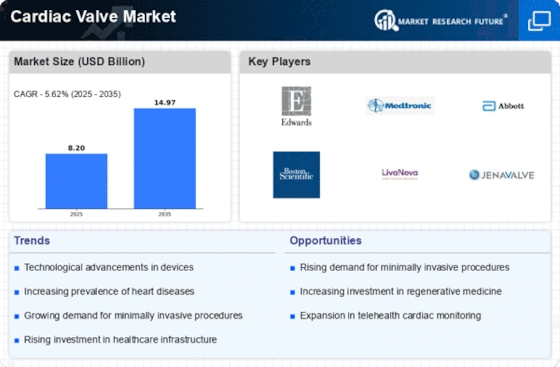
As per Market Research Future analysis, the Cardiac Valve Market Size was estimated at 8.2 USD Billion in 2024. The Cardiac Valve industry is projected to grow from 8.661 USD Billion in 2025 to 14.97 USD Billion by 2035, exhibiting a compound annual growth rate (CAGR) of 5.62% during the forecast period 2025 - 2035

Key Market Trends & Highlights

The Cardiac Valve Market is experiencing robust growth driven by technological advancements and increasing healthcare demands.

  • Technological advancements are enhancing the efficacy and safety of cardiac valve procedures. Minimally invasive procedures are gaining traction, particularly in North America, due to their associated benefits. The aging population is contributing to a rising demand for cardiac wall repair, which remains the largest segment in the market. Rising prevalence of cardiovascular diseases and increasing healthcare expenditure are key drivers propelling market growth.

Market Size & Forecast

2024 Market Size 8.2 (USD Billion)
2035 Market Size 14.97 (USD Billion)
CAGR (2025 - 2035) 5.62%
Largest Regional Market Share in 2024 North America

Major Players

Edwards Lifesciences (US), <a title="Medtronic" href="https://www.medtronic.com/in-en/healthcare-professionals/products/cardiovascular/heart-valves-surgical.html" target="_blank" rel="noopener">Medtronic</a> (US), Abbott Laboratories (US), Boston Scientific (US), LivaNova (GB), JenaValve Technology (DE), CryoLife (US), Sorin Group (IT), AtriCure (US)

Market Trends

The Cardiac Valve Market is currently experiencing a dynamic evolution, driven by advancements in technology and an increasing prevalence of cardiovascular diseases. Innovations in valve design and materials are enhancing the performance and longevity of cardiac valves, which appears to be a key factor in the growing adoption of these devices. Furthermore, the rise in minimally invasive surgical techniques is likely to contribute to the expansion of this market, as patients increasingly prefer procedures that offer reduced recovery times and lower risks of complications. Regulatory bodies are also playing a crucial role in shaping the landscape, as they establish guidelines that ensure safety and efficacy in valve implantation procedures. In addition, the demographic shift towards an aging population is expected to further fuel demand within the Cardiac Valve Market. As individuals age, the incidence of heart-related ailments tends to increase, leading to a higher requirement for valve replacements and repairs. This trend suggests that manufacturers may need to focus on developing products that cater specifically to the needs of older patients. Overall, the Cardiac Valve Market appears poised for growth, with a combination of technological advancements, changing patient preferences, and demographic factors driving its trajectory.

Technological Advancements

Recent innovations in materials and design are enhancing the functionality and durability of cardiac valves. These advancements may lead to improved patient outcomes and increased adoption rates.

Minimally Invasive Procedures

The shift towards less invasive surgical techniques is transforming the Cardiac Valve Market. Patients are increasingly opting for procedures that promise quicker recovery and reduced hospital stays.

Aging Population

The growing elderly demographic is likely to escalate the demand for cardiac interventions. As age-related heart conditions become more prevalent, the need for valve replacements is expected to rise.

Cardiac Valve Market Market Drivers

Growing Awareness of Heart Health

The rising awareness of heart health among the general population is driving the Cardiac Valve Market. Educational campaigns and initiatives aimed at promoting cardiovascular health have led to increased public knowledge about the importance of regular check-ups and early intervention. As individuals become more informed about the risks associated with heart diseases, they are more likely to seek medical advice and treatment. This proactive approach to heart health is likely to result in a higher demand for cardiac valve procedures, as patients are diagnosed earlier and referred for surgical options. The Cardiac Valve Market stands to gain from this heightened awareness, as it encourages timely interventions and the adoption of advanced valve technologies.

Increasing Healthcare Expenditure

The rise in healthcare expenditure across various regions is a significant driver for the Cardiac Valve Market. Governments and private sectors are allocating more resources to healthcare, particularly in cardiovascular care. This trend is evident in the growing investments in hospitals and surgical facilities, which are equipped to perform complex cardiac procedures. As healthcare budgets expand, the availability of advanced cardiac valve technologies increases, making them more accessible to patients. Moreover, higher healthcare spending correlates with improved patient education and awareness regarding heart health, leading to increased demand for cardiac interventions. Consequently, the Cardiac Valve Market is expected to benefit from this upward trajectory in healthcare expenditure.

Technological Innovations in Valve Design

Technological advancements in valve design are significantly influencing the Cardiac Valve Market. Innovations such as bioprosthetic valves and transcatheter aortic valve replacement (TAVR) procedures have revolutionized treatment options for patients with valvular heart diseases. These cutting-edge technologies not only enhance the efficacy of surgical interventions but also improve patient outcomes and recovery times. The introduction of durable materials and minimally invasive techniques has expanded the patient population eligible for valve replacement. As a result, the market is witnessing a surge in demand for these advanced products. The Cardiac Valve Market is likely to continue evolving as manufacturers invest in research and development to create next-generation valves that cater to diverse patient needs.

Rising Prevalence of Cardiovascular Diseases

The increasing incidence of cardiovascular diseases is a primary driver for the Cardiac Valve Market. As heart-related ailments become more prevalent, the demand for cardiac valve replacements and repairs escalates. According to recent statistics, cardiovascular diseases account for a substantial percentage of global mortality rates, prompting healthcare systems to prioritize cardiac care. This trend is likely to fuel the growth of the cardiac valve market, as more patients require surgical interventions. Furthermore, advancements in diagnostic technologies enable earlier detection of heart conditions, leading to timely treatments. Consequently, the Cardiac Valve Market is poised for expansion as healthcare providers seek innovative solutions to address the rising burden of cardiovascular diseases.

Aging Population and Increased Surgical Demand

The aging population is a critical factor influencing the Cardiac Valve Market. As life expectancy rises, the number of elderly individuals requiring cardiac interventions is also increasing. Older adults are more susceptible to valvular heart diseases, necessitating surgical procedures such as valve replacements. This demographic shift is prompting healthcare providers to enhance their cardiac care capabilities, leading to a greater demand for innovative valve solutions. Additionally, the prevalence of comorbidities in the elderly population often complicates treatment, further driving the need for specialized cardiac interventions. The Cardiac Valve Market is likely to experience sustained growth as the aging population continues to seek effective solutions for managing heart health.

Market Segment Insights

By Treatment: Cardiac Wall Repair (Largest) vs. Cardiac Wall Replacement (Fastest-Growing)

In the cardiac valve market, the treatment segment is primarily defined by three categories: cardiac wall repair, cardiac wall replacement, and others. Among these, cardiac wall repair holds the largest market share, largely attributed to its established efficacy and cost-effectiveness. Cardiac wall replacement, while smaller in size, shows promising growth prospects, driven by advancements in technology and increasing patient acceptance. Others encompass a variety of innovative treatments and approaches, contributing to the overall dynamics of this segment.

Cardiac Wall Repair (Dominant) vs. Cardiac Wall Replacement (Emerging)

Cardiac wall repair dominates the treatment segment within the cardiac valve market, benefitting from a well-established tradition in surgical practices and a robust patient base. This technique is often preferred for its minimally invasive nature and shorter recovery times, which greatly appeal to both healthcare providers and patients. On the other hand, cardiac wall replacement is emerging as a significant contender, driven by recent technological advancements that enhance procedural success rates and patient outcomes. The growing prevalence of heart diseases is also propelling the demand for innovative replacement solutions, making it a vital area of growth that attracts increasing investments and research.

By Type: Mechanical Valves (Largest) vs. Tissue/Bioprosthetic Valves (Fastest-Growing)

In the Cardiac Valve Market, Mechanical Valves hold the largest share, primarily due to their durability and longevity, making them a preferred choice in various surgical procedures. However, Tissue/Bioprosthetic Valves are emerging rapidly, appealing to a growing preference for biocompatibility and reduced anticoagulation requirements, symbolizing a significant shift in surgical preferences. The landscape indicates a healthy competition amongst these valves, highlighting the need for continuous innovation.

Mechanical Valves (Dominant) vs. Tissue/Bioprosthetic Valves (Emerging)

Mechanical Valves are engineered for exceptional longevity and strength, which makes them a dominant player in the Cardiac Valve Market. Their robust materials allow for extensive use in patients who require lifelong protection against valve failure. However, Tissue/Bioprosthetic Valves are gaining traction due to increasing patient demand for options that reduce complications associated with prolonged anticoagulation therapy. This shift towards tissue alternatives is spurred by advancements in materials and manufacturing processes that enhance the performance of these valves, making them highly competitive in the market.

By Position: Mitral Valve (Largest) vs. Aortic Valve (Fastest-Growing)

In the Cardiac Valve Market, the Mitral Valve continues to dominate with a significant market share, attributed to its critical role in managing left atrial and ventricular functions. Its prevalence in various cardiac surgeries ensures a steady demand, thus solidifying its position as the largest segment. In contrast, the Aortic Valve is emerging rapidly, fueled by an increase in aortic valve replacement procedures and advancements in minimally invasive techniques, appealing to both patients and surgeons alike.

Mitral Valve: Dominant vs. Aortic Valve: Emerging

The Mitral Valve segment holds a strong market position due to the high incidence of mitral valve disorders and extensive surgical applications. It is favored for its established surgical methods, which provide reliability and effectiveness in treatment. Meanwhile, the Aortic Valve segment is gaining traction as innovative technologies are introduced, particularly transcatheter aortic valve replacement (TAVR) procedures. This shift towards less invasive options is attracting a larger patient base, showcasing the aortic valve's emerging power in the cardiac valve market.

By End User: Hospital & Clinics (Largest) vs. Specialty Centers (Fastest-Growing)

In the Cardiac Valve Market, the 'By End User' segment is predominantly composed of Hospitals &amp; Clinics, which holds the largest market share. This segment benefits from a wide range of procedures conducted within its facilities and a high influx of patients requiring cardiac interventions. Specialty Centers also represent a growing subset of this market, exhibiting rapid expansion due to their focused expertise and tailored services that attract specific patient demographics seeking advanced surgical options.

Hospital &amp; Clinics (Dominant) vs. Specialty Centers (Emerging)

Hospital &amp; Clinics serve as the dominant force in the Cardiac Valve Market, providing essential services such as valve repair and replacement surgeries. These institutions are often equipped with state-of-the-art technology and skilled personnel, making them the first choice for many patients. On the other hand, Specialty Centers are emerging as pivotal players in this segment. They generally offer specialized care and advanced techniques, catering to particular conditions within cardiac health. Such centers are gaining traction due to their personalized patient care and efficiency in treatment protocols, positioning them as key contributors to the evolving landscape of cardiac valve interventions.

Get more detailed insights about Cardiac Valve Market Research Report-Forecast till 2035

Regional Insights

North America : Market Leader in Innovation

North America is the largest market for cardiac valves, accounting for approximately 45% of the global share. The region benefits from advanced healthcare infrastructure, high prevalence of cardiovascular diseases, and significant investments in medical technology. Regulatory support from agencies like the FDA accelerates the approval of innovative products, driving market growth. The increasing aging population further fuels demand for cardiac interventions, making this region a focal point for market expansion. The United States is the leading country in this market, with major players such as Edwards Lifesciences, Medtronic, and Abbott Laboratories dominating the landscape. The competitive environment is characterized by continuous innovation and strategic partnerships among key players. The presence of established companies and a robust distribution network enhances market accessibility, ensuring that advanced cardiac valve solutions reach healthcare providers efficiently.

Europe : Emerging Regulatory Frameworks

Europe is the second-largest market for cardiac valves, holding approximately 30% of the global market share. The region is witnessing growth driven by increasing awareness of cardiovascular diseases and advancements in minimally invasive surgical techniques. Regulatory frameworks, such as the Medical Device Regulation (MDR), are enhancing product safety and efficacy, thereby boosting consumer confidence and market demand. Countries like Germany and France are at the forefront of this growth, supported by favorable healthcare policies. Germany leads the European market, with a strong presence of key players like JenaValve Technology and LivaNova. The competitive landscape is marked by innovation and collaboration among manufacturers, healthcare providers, and research institutions. The emphasis on research and development, coupled with a growing aging population, is expected to further propel market growth. The integration of digital health solutions is also becoming a significant trend in the region.

Asia-Pacific : Rapidly Growing Market Potential

Asia-Pacific is rapidly emerging as a significant player in the cardiac valve market, accounting for approximately 20% of the global share. The region's growth is driven by increasing healthcare expenditure, rising awareness of cardiovascular diseases, and a growing aging population. Countries like China and India are witnessing a surge in demand for advanced cardiac solutions, supported by government initiatives aimed at improving healthcare infrastructure and access to medical technologies. China is the leading country in this region, with a burgeoning market for cardiac valves. The competitive landscape is characterized by both local and international players, including Medtronic and Abbott Laboratories. The presence of key players is fostering innovation and enhancing product offerings. Additionally, the increasing prevalence of lifestyle-related diseases is expected to drive further growth in the cardiac valve market, making Asia-Pacific a focal point for future investments.

Middle East and Africa : Untapped Market Opportunities

The Middle East and Africa region is gradually emerging in the cardiac valve market, holding approximately 5% of the global share. The growth is primarily driven by increasing healthcare investments, rising awareness of cardiovascular diseases, and the expansion of healthcare facilities. Countries like South Africa and the UAE are leading this growth, supported by government initiatives to enhance healthcare access and quality. The region's diverse population and varying healthcare needs present unique opportunities for market expansion. South Africa is the leading country in this region, with a growing presence of both local and international players. The competitive landscape is evolving, with companies focusing on innovative solutions tailored to meet regional healthcare demands. The increasing prevalence of heart diseases is prompting healthcare providers to seek advanced cardiac valve technologies, making this region an attractive market for future investments.

Key Players and Competitive Insights

The Cardiac Valve Market is currently characterized by a dynamic competitive landscape, driven by technological advancements, increasing prevalence of cardiovascular diseases, and a growing aging population. Major players such as Edwards Lifesciences (US), Medtronic (US), and Abbott Laboratories (US) are at the forefront, each adopting distinct strategies to enhance their market presence. Edwards Lifesciences (US) focuses on innovation in transcatheter heart valves, while Medtronic (US) emphasizes a diversified portfolio that includes both surgical and transcatheter solutions. Abbott Laboratories (US) is leveraging its strong research capabilities to develop next-generation valve technologies, indicating a collective shift towards advanced therapeutic options that cater to diverse patient needs.
In terms of business tactics, companies are increasingly localizing manufacturing to reduce costs and enhance supply chain efficiency. The Cardiac Valve Market appears moderately fragmented, with a mix of established players and emerging companies vying for market share. This competitive structure allows for a variety of innovations and approaches, as key players collaborate and compete simultaneously, shaping a robust ecosystem.
In August 2025, Edwards Lifesciences (US) announced the launch of its latest transcatheter aortic valve replacement (TAVR) system, which incorporates advanced imaging technology to improve procedural outcomes. This strategic move not only reinforces Edwards' commitment to innovation but also positions the company to capture a larger share of the growing TAVR market, which is expected to expand significantly in the coming years. The integration of cutting-edge imaging technology could potentially enhance surgical precision, thereby improving patient outcomes and satisfaction.
In September 2025, Medtronic (US) revealed a partnership with a leading digital health company to develop AI-driven analytics tools aimed at optimizing valve replacement procedures. This collaboration underscores Medtronic's focus on digital transformation and its intent to leverage artificial intelligence to enhance clinical decision-making. By integrating AI into its offerings, Medtronic may improve operational efficiencies and patient care, setting a new standard in the cardiac valve sector.
In July 2025, Abbott Laboratories (US) completed the acquisition of a promising startup specializing in biodegradable valve technologies. This acquisition is indicative of Abbott's strategy to diversify its product portfolio and invest in sustainable solutions. The move not only enhances Abbott's technological capabilities but also aligns with the growing demand for environmentally friendly medical devices, potentially giving the company a competitive edge in a market increasingly focused on sustainability.
As of October 2025, the Cardiac Valve Market is witnessing trends such as digitalization, sustainability, and the integration of artificial intelligence, which are reshaping competitive dynamics. Strategic alliances are becoming more prevalent, as companies recognize the value of collaboration in driving innovation and enhancing market reach. Looking ahead, competitive differentiation is likely to evolve from traditional price-based competition to a focus on innovation, technological advancements, and supply chain reliability, suggesting a transformative shift in how companies position themselves in the market.

Key Companies in the Cardiac Valve Market include

Industry Developments

September 2019 Transcatheter aortic valve replacement (TAVR) system Evolut PRO+ has been made available in the United States, according to Medtronic.

September 2019 TriClip, a transcatheter tricuspid valve repair for the treatment of tricuspid regurgitation, was the subject of the TRILUMINATE pivotal trial that was started by Abbott.

Future Outlook

Cardiac Valve Market Future Outlook

The Cardiac Valve Market is projected to grow at a 5.62% CAGR from 2025 to 2035, driven by technological advancements, increasing prevalence of heart diseases, and rising geriatric population.

New opportunities lie in:

  • Development of minimally invasive surgical techniques for valve replacement
  • Expansion of telehealth services for remote patient monitoring
  • Investment in biodegradable valve materials for enhanced patient outcomes

By 2035, the Cardiac Valve Market is expected to achieve substantial growth and innovation.

Market Segmentation

Cardiac Valve Market Type Outlook

  • Mechanical Valves
  • Tissue/Bioprosthetic Valves
  • Transcatheter Heart Valves/Percutaneous Heart Valves
  • Others

Cardiac Valve Market End User Outlook

  • Hospital & Clinics
  • Specialty Centers
  • Cardiac Research Institute
  • Others

Cardiac Valve Market Position Outlook

  • Mitral Valve
  • Aortic Valve
  • Other Position

Cardiac Valve Market Treatment Outlook

  • Cardiac Wall Repair
  • Cardiac Wall Replacement
  • Others

Report Scope

MARKET SIZE 2024 8.2(USD Billion)
MARKET SIZE 2025 8.661(USD Billion)
MARKET SIZE 2035 14.97(USD Billion)
COMPOUND ANNUAL GROWTH RATE (CAGR) 5.62% (2025 - 2035)
REPORT COVERAGE Revenue Forecast, Competitive Landscape, Growth Factors, and Trends
BASE YEAR 2024
Market Forecast Period 2025 - 2035
Historical Data 2019 - 2024
Market Forecast Units USD Billion
Key Companies Profiled Edwards Lifesciences (US), Medtronic (US), Abbott Laboratories (US), Boston Scientific (US), LivaNova (GB), JenaValve Technology (DE), CryoLife (US), Sorin Group (IT), AtriCure (US)
Segments Covered Types, Position, Treatment, End User, Region
Key Market Opportunities Advancements in minimally invasive surgical techniques enhance growth potential in the Cardiac Valve Market.
Key Market Dynamics Technological advancements in minimally invasive procedures drive growth and competition in the cardiac valve market.
Countries Covered North America, Europe, APAC, South America, MEA

FAQs

What is the projected market valuation of the Cardiac Valve Market by 2035?

<p>The Cardiac Valve Market is projected to reach approximately 14.97 USD Billion by 2035.</p>

What was the market valuation of the Cardiac Valve Market in 2024?

<p>In 2024, the overall market valuation of the Cardiac Valve Market was 8.2 USD Billion.</p>

What is the expected CAGR for the Cardiac Valve Market during the forecast period 2025 - 2035?

<p>The expected CAGR for the Cardiac Valve Market during the forecast period 2025 - 2035 is 5.62%.</p>

Which segment of the Cardiac Valve Market had the highest valuation in 2024?

<p>In 2024, the Cardiac Wall Replacement segment had the highest valuation at 3.0 USD Billion.</p>

What are the key players in the Cardiac Valve Market?

<p>Key players in the Cardiac Valve Market include Edwards Lifesciences, Medtronic, Abbott Laboratories, and Boston Scientific.</p>

How does the valuation of Mechanical Valves compare to Tissue/Bioprosthetic Valves in 2024?

<p>In 2024, Mechanical Valves were valued at 2.5 USD Billion, while Tissue/Bioprosthetic Valves were valued at 2.0 USD Billion.</p>

What is the projected valuation for the Mitral Valve segment by 2035?

The Mitral Valve segment is projected to reach approximately 6.2 USD Billion by 2035.

Which end user segment is expected to grow the most by 2035?

The Hospital &amp; Clinics end user segment is expected to grow the most, reaching around 6.5 USD Billion by 2035.

What was the valuation of the Other Position segment in 2024?

The Other Position segment was valued at 1.7 USD Billion in 2024.

What is the projected growth for Transcatheter Heart Valves by 2035?

Transcatheter Heart Valves are projected to grow to approximately 5.0 USD Billion by 2035.

  1. SECTION I: EXECUTIVE SUMMARY AND KEY HIGHLIGHTS
    1. | 1.1 EXECUTIVE SUMMARY
    2. | | 1.1.1 Market Overview
    3. | | 1.1.2 Key Findings
    4. | | 1.1.3 Market Segmentation
    5. | | 1.1.4 Competitive Landscape
    6. | | 1.1.5 Challenges and Opportunities
    7. | | 1.1.6 Future Outlook
  2. SECTION II: SCOPING, METHODOLOGY AND MARKET STRUCTURE
    1. | 2.1 MARKET INTRODUCTION
    2. | | 2.1.1 Definition
    3. | | 2.1.2 Scope of the study
    4. | | | 2.1.2.1 Research Objective
    5. | | | 2.1.2.2 Assumption
    6. | | | 2.1.2.3 Limitations
    7. | 2.2 RESEARCH METHODOLOGY
    8. | | 2.2.1 Overview
    9. | | 2.2.2 Data Mining
    10. | | 2.2.3 Secondary Research
    11. | | 2.2.4 Primary Research
    12. | | | 2.2.4.1 Primary Interviews and Information Gathering Process
    13. | | | 2.2.4.2 Breakdown of Primary Respondents
    14. | | 2.2.5 Forecasting Model
    15. | | 2.2.6 Market Size Estimation
    16. | | | 2.2.6.1 Bottom-Up Approach
    17. | | | 2.2.6.2 Top-Down Approach
    18. | | 2.2.7 Data Triangulation
    19. | | 2.2.8 Validation
  3. SECTION III: QUALITATIVE ANALYSIS
    1. | 3.1 MARKET DYNAMICS
    2. | | 3.1.1 Overview
    3. | | 3.1.2 Drivers
    4. | | 3.1.3 Restraints
    5. | | 3.1.4 Opportunities
    6. | 3.2 MARKET FACTOR ANALYSIS
    7. | | 3.2.1 Value chain Analysis
    8. | | 3.2.2 Porter's Five Forces Analysis
    9. | | | 3.2.2.1 Bargaining Power of Suppliers
    10. | | | 3.2.2.2 Bargaining Power of Buyers
    11. | | | 3.2.2.3 Threat of New Entrants
    12. | | | 3.2.2.4 Threat of Substitutes
    13. | | | 3.2.2.5 Intensity of Rivalry
    14. | | 3.2.3 COVID-19 Impact Analysis
    15. | | | 3.2.3.1 Market Impact Analysis
    16. | | | 3.2.3.2 Regional Impact
    17. | | | 3.2.3.3 Opportunity and Threat Analysis
  4. SECTION IV: QUANTITATIVE ANALYSIS
    1. | 4.1 Healthcare, BY Treatment (USD Billion)
    2. | | 4.1.1 Cardiac Wall Repair
    3. | | 4.1.2 Cardiac Wall Replacement
    4. | | 4.1.3 Others
    5. | 4.2 Healthcare, BY Type (USD Billion)
    6. | | 4.2.1 Mechanical Valves
    7. | | 4.2.2 Tissue/Bioprosthetic Valves
    8. | | 4.2.3 Transcatheter Heart Valves/Percutaneous Heart Valves
    9. | | 4.2.4 Others
    10. | 4.3 Healthcare, BY Position (USD Billion)
    11. | | 4.3.1 Mitral Valve
    12. | | 4.3.2 Aortic Valve
    13. | | 4.3.3 Other Position
    14. | 4.4 Healthcare, BY End User (USD Billion)
    15. | | 4.4.1 Hospital & Clinics
    16. | | 4.4.2 Specialty Centers
    17. | | 4.4.3 Cardiac Research Institute
    18. | | 4.4.4 Others
    19. | 4.5 Healthcare, BY Region (USD Billion)
    20. | | 4.5.1 North America
    21. | | | 4.5.1.1 US
    22. | | | 4.5.1.2 Canada
    23. | | 4.5.2 Europe
    24. | | | 4.5.2.1 Germany
    25. | | | 4.5.2.2 UK
    26. | | | 4.5.2.3 France
    27. | | | 4.5.2.4 Russia
    28. | | | 4.5.2.5 Italy
    29. | | | 4.5.2.6 Spain
    30. | | | 4.5.2.7 Rest of Europe
    31. | | 4.5.3 APAC
    32. | | | 4.5.3.1 China
    33. | | | 4.5.3.2 India
    34. | | | 4.5.3.3 Japan
    35. | | | 4.5.3.4 South Korea
    36. | | | 4.5.3.5 Malaysia
    37. | | | 4.5.3.6 Thailand
    38. | | | 4.5.3.7 Indonesia
    39. | | | 4.5.3.8 Rest of APAC
    40. | | 4.5.4 South America
    41. | | | 4.5.4.1 Brazil
    42. | | | 4.5.4.2 Mexico
    43. | | | 4.5.4.3 Argentina
    44. | | | 4.5.4.4 Rest of South America
    45. | | 4.5.5 MEA
    46. | | | 4.5.5.1 GCC Countries
    47. | | | 4.5.5.2 South Africa
    48. | | | 4.5.5.3 Rest of MEA
  5. SECTION V: COMPETITIVE ANALYSIS
    1. | 5.1 Competitive Landscape
    2. | | 5.1.1 Overview
    3. | | 5.1.2 Competitive Analysis
    4. | | 5.1.3 Market share Analysis
    5. | | 5.1.4 Major Growth Strategy in the Healthcare
    6. | | 5.1.5 Competitive Benchmarking
    7. | | 5.1.6 Leading Players in Terms of Number of Developments in the Healthcare
    8. | | 5.1.7 Key developments and growth strategies
    9. | | | 5.1.7.1 New Product Launch/Service Deployment
    10. | | | 5.1.7.2 Merger & Acquisitions
    11. | | | 5.1.7.3 Joint Ventures
    12. | | 5.1.8 Major Players Financial Matrix
    13. | | | 5.1.8.1 Sales and Operating Income
    14. | | | 5.1.8.2 Major Players R&D Expenditure. 2023
    15. | 5.2 Company Profiles
    16. | | 5.2.1 Edwards Lifesciences (US)
    17. | | | 5.2.1.1 Financial Overview
    18. | | | 5.2.1.2 Products Offered
    19. | | | 5.2.1.3 Key Developments
    20. | | | 5.2.1.4 SWOT Analysis
    21. | | | 5.2.1.5 Key Strategies
    22. | | 5.2.2 Medtronic (US)
    23. | | | 5.2.2.1 Financial Overview
    24. | | | 5.2.2.2 Products Offered
    25. | | | 5.2.2.3 Key Developments
    26. | | | 5.2.2.4 SWOT Analysis
    27. | | | 5.2.2.5 Key Strategies
    28. | | 5.2.3 Abbott Laboratories (US)
    29. | | | 5.2.3.1 Financial Overview
    30. | | | 5.2.3.2 Products Offered
    31. | | | 5.2.3.3 Key Developments
    32. | | | 5.2.3.4 SWOT Analysis
    33. | | | 5.2.3.5 Key Strategies
    34. | | 5.2.4 Boston Scientific (US)
    35. | | | 5.2.4.1 Financial Overview
    36. | | | 5.2.4.2 Products Offered
    37. | | | 5.2.4.3 Key Developments
    38. | | | 5.2.4.4 SWOT Analysis
    39. | | | 5.2.4.5 Key Strategies
    40. | | 5.2.5 LivaNova (GB)
    41. | | | 5.2.5.1 Financial Overview
    42. | | | 5.2.5.2 Products Offered
    43. | | | 5.2.5.3 Key Developments
    44. | | | 5.2.5.4 SWOT Analysis
    45. | | | 5.2.5.5 Key Strategies
    46. | | 5.2.6 JenaValve Technology (DE)
    47. | | | 5.2.6.1 Financial Overview
    48. | | | 5.2.6.2 Products Offered
    49. | | | 5.2.6.3 Key Developments
    50. | | | 5.2.6.4 SWOT Analysis
    51. | | | 5.2.6.5 Key Strategies
    52. | | 5.2.7 CryoLife (US)
    53. | | | 5.2.7.1 Financial Overview
    54. | | | 5.2.7.2 Products Offered
    55. | | | 5.2.7.3 Key Developments
    56. | | | 5.2.7.4 SWOT Analysis
    57. | | | 5.2.7.5 Key Strategies
    58. | | 5.2.8 Sorin Group (IT)
    59. | | | 5.2.8.1 Financial Overview
    60. | | | 5.2.8.2 Products Offered
    61. | | | 5.2.8.3 Key Developments
    62. | | | 5.2.8.4 SWOT Analysis
    63. | | | 5.2.8.5 Key Strategies
    64. | | 5.2.9 AtriCure (US)
    65. | | | 5.2.9.1 Financial Overview
    66. | | | 5.2.9.2 Products Offered
    67. | | | 5.2.9.3 Key Developments
    68. | | | 5.2.9.4 SWOT Analysis
    69. | | | 5.2.9.5 Key Strategies
    70. | 5.3 Appendix
    71. | | 5.3.1 References
    72. | | 5.3.2 Related Reports
  6. LIST OF FIGURES
    1. | 6.1 MARKET SYNOPSIS
    2. | 6.2 NORTH AMERICA MARKET ANALYSIS
    3. | 6.3 US MARKET ANALYSIS BY TREATMENT
    4. | 6.4 US MARKET ANALYSIS BY TYPE
    5. | 6.5 US MARKET ANALYSIS BY POSITION
    6. | 6.6 US MARKET ANALYSIS BY END USER
    7. | 6.7 CANADA MARKET ANALYSIS BY TREATMENT
    8. | 6.8 CANADA MARKET ANALYSIS BY TYPE
    9. | 6.9 CANADA MARKET ANALYSIS BY POSITION
    10. | 6.10 CANADA MARKET ANALYSIS BY END USER
    11. | 6.11 EUROPE MARKET ANALYSIS
    12. | 6.12 GERMANY MARKET ANALYSIS BY TREATMENT
    13. | 6.13 GERMANY MARKET ANALYSIS BY TYPE
    14. | 6.14 GERMANY MARKET ANALYSIS BY POSITION
    15. | 6.15 GERMANY MARKET ANALYSIS BY END USER
    16. | 6.16 UK MARKET ANALYSIS BY TREATMENT
    17. | 6.17 UK MARKET ANALYSIS BY TYPE
    18. | 6.18 UK MARKET ANALYSIS BY POSITION
    19. | 6.19 UK MARKET ANALYSIS BY END USER
    20. | 6.20 FRANCE MARKET ANALYSIS BY TREATMENT
    21. | 6.21 FRANCE MARKET ANALYSIS BY TYPE
    22. | 6.22 FRANCE MARKET ANALYSIS BY POSITION
    23. | 6.23 FRANCE MARKET ANALYSIS BY END USER
    24. | 6.24 RUSSIA MARKET ANALYSIS BY TREATMENT
    25. | 6.25 RUSSIA MARKET ANALYSIS BY TYPE
    26. | 6.26 RUSSIA MARKET ANALYSIS BY POSITION
    27. | 6.27 RUSSIA MARKET ANALYSIS BY END USER
    28. | 6.28 ITALY MARKET ANALYSIS BY TREATMENT
    29. | 6.29 ITALY MARKET ANALYSIS BY TYPE
    30. | 6.30 ITALY MARKET ANALYSIS BY POSITION
    31. | 6.31 ITALY MARKET ANALYSIS BY END USER
    32. | 6.32 SPAIN MARKET ANALYSIS BY TREATMENT
    33. | 6.33 SPAIN MARKET ANALYSIS BY TYPE
    34. | 6.34 SPAIN MARKET ANALYSIS BY POSITION
    35. | 6.35 SPAIN MARKET ANALYSIS BY END USER
    36. | 6.36 REST OF EUROPE MARKET ANALYSIS BY TREATMENT
    37. | 6.37 REST OF EUROPE MARKET ANALYSIS BY TYPE
    38. | 6.38 REST OF EUROPE MARKET ANALYSIS BY POSITION
    39. | 6.39 REST OF EUROPE MARKET ANALYSIS BY END USER
    40. | 6.40 APAC MARKET ANALYSIS
    41. | 6.41 CHINA MARKET ANALYSIS BY TREATMENT
    42. | 6.42 CHINA MARKET ANALYSIS BY TYPE
    43. | 6.43 CHINA MARKET ANALYSIS BY POSITION
    44. | 6.44 CHINA MARKET ANALYSIS BY END USER
    45. | 6.45 INDIA MARKET ANALYSIS BY TREATMENT
    46. | 6.46 INDIA MARKET ANALYSIS BY TYPE
    47. | 6.47 INDIA MARKET ANALYSIS BY POSITION
    48. | 6.48 INDIA MARKET ANALYSIS BY END USER
    49. | 6.49 JAPAN MARKET ANALYSIS BY TREATMENT
    50. | 6.50 JAPAN MARKET ANALYSIS BY TYPE
    51. | 6.51 JAPAN MARKET ANALYSIS BY POSITION
    52. | 6.52 JAPAN MARKET ANALYSIS BY END USER
    53. | 6.53 SOUTH KOREA MARKET ANALYSIS BY TREATMENT
    54. | 6.54 SOUTH KOREA MARKET ANALYSIS BY TYPE
    55. | 6.55 SOUTH KOREA MARKET ANALYSIS BY POSITION
    56. | 6.56 SOUTH KOREA MARKET ANALYSIS BY END USER
    57. | 6.57 MALAYSIA MARKET ANALYSIS BY TREATMENT
    58. | 6.58 MALAYSIA MARKET ANALYSIS BY TYPE
    59. | 6.59 MALAYSIA MARKET ANALYSIS BY POSITION
    60. | 6.60 MALAYSIA MARKET ANALYSIS BY END USER
    61. | 6.61 THAILAND MARKET ANALYSIS BY TREATMENT
    62. | 6.62 THAILAND MARKET ANALYSIS BY TYPE
    63. | 6.63 THAILAND MARKET ANALYSIS BY POSITION
    64. | 6.64 THAILAND MARKET ANALYSIS BY END USER
    65. | 6.65 INDONESIA MARKET ANALYSIS BY TREATMENT
    66. | 6.66 INDONESIA MARKET ANALYSIS BY TYPE
    67. | 6.67 INDONESIA MARKET ANALYSIS BY POSITION
    68. | 6.68 INDONESIA MARKET ANALYSIS BY END USER
    69. | 6.69 REST OF APAC MARKET ANALYSIS BY TREATMENT
    70. | 6.70 REST OF APAC MARKET ANALYSIS BY TYPE
    71. | 6.71 REST OF APAC MARKET ANALYSIS BY POSITION
    72. | 6.72 REST OF APAC MARKET ANALYSIS BY END USER
    73. | 6.73 SOUTH AMERICA MARKET ANALYSIS
    74. | 6.74 BRAZIL MARKET ANALYSIS BY TREATMENT
    75. | 6.75 BRAZIL MARKET ANALYSIS BY TYPE
    76. | 6.76 BRAZIL MARKET ANALYSIS BY POSITION
    77. | 6.77 BRAZIL MARKET ANALYSIS BY END USER
    78. | 6.78 MEXICO MARKET ANALYSIS BY TREATMENT
    79. | 6.79 MEXICO MARKET ANALYSIS BY TYPE
    80. | 6.80 MEXICO MARKET ANALYSIS BY POSITION
    81. | 6.81 MEXICO MARKET ANALYSIS BY END USER
    82. | 6.82 ARGENTINA MARKET ANALYSIS BY TREATMENT
    83. | 6.83 ARGENTINA MARKET ANALYSIS BY TYPE
    84. | 6.84 ARGENTINA MARKET ANALYSIS BY POSITION
    85. | 6.85 ARGENTINA MARKET ANALYSIS BY END USER
    86. | 6.86 REST OF SOUTH AMERICA MARKET ANALYSIS BY TREATMENT
    87. | 6.87 REST OF SOUTH AMERICA MARKET ANALYSIS BY TYPE
    88. | 6.88 REST OF SOUTH AMERICA MARKET ANALYSIS BY POSITION
    89. | 6.89 REST OF SOUTH AMERICA MARKET ANALYSIS BY END USER
    90. | 6.90 MEA MARKET ANALYSIS
    91. | 6.91 GCC COUNTRIES MARKET ANALYSIS BY TREATMENT
    92. | 6.92 GCC COUNTRIES MARKET ANALYSIS BY TYPE
    93. | 6.93 GCC COUNTRIES MARKET ANALYSIS BY POSITION
    94. | 6.94 GCC COUNTRIES MARKET ANALYSIS BY END USER
    95. | 6.95 SOUTH AFRICA MARKET ANALYSIS BY TREATMENT
    96. | 6.96 SOUTH AFRICA MARKET ANALYSIS BY TYPE
    97. | 6.97 SOUTH AFRICA MARKET ANALYSIS BY POSITION
    98. | 6.98 SOUTH AFRICA MARKET ANALYSIS BY END USER
    99. | 6.99 REST OF MEA MARKET ANALYSIS BY TREATMENT
    100. | 6.100 REST OF MEA MARKET ANALYSIS BY TYPE
    101. | 6.101 REST OF MEA MARKET ANALYSIS BY POSITION
    102. | 6.102 REST OF MEA MARKET ANALYSIS BY END USER
    103. | 6.103 KEY BUYING CRITERIA OF HEALTHCARE
    104. | 6.104 RESEARCH PROCESS OF MRFR
    105. | 6.105 DRO ANALYSIS OF HEALTHCARE
    106. | 6.106 DRIVERS IMPACT ANALYSIS: HEALTHCARE
    107. | 6.107 RESTRAINTS IMPACT ANALYSIS: HEALTHCARE
    108. | 6.108 SUPPLY / VALUE CHAIN: HEALTHCARE
    109. | 6.109 HEALTHCARE, BY TREATMENT, 2024 (% SHARE)
    110. | 6.110 HEALTHCARE, BY TREATMENT, 2024 TO 2035 (USD Billion)
    111. | 6.111 HEALTHCARE, BY TYPE, 2024 (% SHARE)
    112. | 6.112 HEALTHCARE, BY TYPE, 2024 TO 2035 (USD Billion)
    113. | 6.113 HEALTHCARE, BY POSITION, 2024 (% SHARE)
    114. | 6.114 HEALTHCARE, BY POSITION, 2024 TO 2035 (USD Billion)
    115. | 6.115 HEALTHCARE, BY END USER, 2024 (% SHARE)
    116. | 6.116 HEALTHCARE, BY END USER, 2024 TO 2035 (USD Billion)
    117. | 6.117 BENCHMARKING OF MAJOR COMPETITORS
  7. LIST OF TABLES
    1. | 7.1 LIST OF ASSUMPTIONS
    2. | | 7.1.1
    3. | 7.2 North America MARKET SIZE ESTIMATES; FORECAST
    4. | | 7.2.1 BY TREATMENT, 2025-2035 (USD Billion)
    5. | | 7.2.2 BY TYPE, 2025-2035 (USD Billion)
    6. | | 7.2.3 BY POSITION, 2025-2035 (USD Billion)
    7. | | 7.2.4 BY END USER, 2025-2035 (USD Billion)
    8. | 7.3 US MARKET SIZE ESTIMATES; FORECAST
    9. | | 7.3.1 BY TREATMENT, 2025-2035 (USD Billion)
    10. | | 7.3.2 BY TYPE, 2025-2035 (USD Billion)
    11. | | 7.3.3 BY POSITION, 2025-2035 (USD Billion)
    12. | | 7.3.4 BY END USER, 2025-2035 (USD Billion)
    13. | 7.4 Canada MARKET SIZE ESTIMATES; FORECAST
    14. | | 7.4.1 BY TREATMENT, 2025-2035 (USD Billion)
    15. | | 7.4.2 BY TYPE, 2025-2035 (USD Billion)
    16. | | 7.4.3 BY POSITION, 2025-2035 (USD Billion)
    17. | | 7.4.4 BY END USER, 2025-2035 (USD Billion)
    18. | 7.5 Europe MARKET SIZE ESTIMATES; FORECAST
    19. | | 7.5.1 BY TREATMENT, 2025-2035 (USD Billion)
    20. | | 7.5.2 BY TYPE, 2025-2035 (USD Billion)
    21. | | 7.5.3 BY POSITION, 2025-2035 (USD Billion)
    22. | | 7.5.4 BY END USER, 2025-2035 (USD Billion)
    23. | 7.6 Germany MARKET SIZE ESTIMATES; FORECAST
    24. | | 7.6.1 BY TREATMENT, 2025-2035 (USD Billion)
    25. | | 7.6.2 BY TYPE, 2025-2035 (USD Billion)
    26. | | 7.6.3 BY POSITION, 2025-2035 (USD Billion)
    27. | | 7.6.4 BY END USER, 2025-2035 (USD Billion)
    28. | 7.7 UK MARKET SIZE ESTIMATES; FORECAST
    29. | | 7.7.1 BY TREATMENT, 2025-2035 (USD Billion)
    30. | | 7.7.2 BY TYPE, 2025-2035 (USD Billion)
    31. | | 7.7.3 BY POSITION, 2025-2035 (USD Billion)
    32. | | 7.7.4 BY END USER, 2025-2035 (USD Billion)
    33. | 7.8 France MARKET SIZE ESTIMATES; FORECAST
    34. | | 7.8.1 BY TREATMENT, 2025-2035 (USD Billion)
    35. | | 7.8.2 BY TYPE, 2025-2035 (USD Billion)
    36. | | 7.8.3 BY POSITION, 2025-2035 (USD Billion)
    37. | | 7.8.4 BY END USER, 2025-2035 (USD Billion)
    38. | 7.9 Russia MARKET SIZE ESTIMATES; FORECAST
    39. | | 7.9.1 BY TREATMENT, 2025-2035 (USD Billion)
    40. | | 7.9.2 BY TYPE, 2025-2035 (USD Billion)
    41. | | 7.9.3 BY POSITION, 2025-2035 (USD Billion)
    42. | | 7.9.4 BY END USER, 2025-2035 (USD Billion)
    43. | 7.10 Italy MARKET SIZE ESTIMATES; FORECAST
    44. | | 7.10.1 BY TREATMENT, 2025-2035 (USD Billion)
    45. | | 7.10.2 BY TYPE, 2025-2035 (USD Billion)
    46. | | 7.10.3 BY POSITION, 2025-2035 (USD Billion)
    47. | | 7.10.4 BY END USER, 2025-2035 (USD Billion)
    48. | 7.11 Spain MARKET SIZE ESTIMATES; FORECAST
    49. | | 7.11.1 BY TREATMENT, 2025-2035 (USD Billion)
    50. | | 7.11.2 BY TYPE, 2025-2035 (USD Billion)
    51. | | 7.11.3 BY POSITION, 2025-2035 (USD Billion)
    52. | | 7.11.4 BY END USER, 2025-2035 (USD Billion)
    53. | 7.12 Rest of Europe MARKET SIZE ESTIMATES; FORECAST
    54. | | 7.12.1 BY TREATMENT, 2025-2035 (USD Billion)
    55. | | 7.12.2 BY TYPE, 2025-2035 (USD Billion)
    56. | | 7.12.3 BY POSITION, 2025-2035 (USD Billion)
    57. | | 7.12.4 BY END USER, 2025-2035 (USD Billion)
    58. | 7.13 APAC MARKET SIZE ESTIMATES; FORECAST
    59. | | 7.13.1 BY TREATMENT, 2025-2035 (USD Billion)
    60. | | 7.13.2 BY TYPE, 2025-2035 (USD Billion)
    61. | | 7.13.3 BY POSITION, 2025-2035 (USD Billion)
    62. | | 7.13.4 BY END USER, 2025-2035 (USD Billion)
    63. | 7.14 China MARKET SIZE ESTIMATES; FORECAST
    64. | | 7.14.1 BY TREATMENT, 2025-2035 (USD Billion)
    65. | | 7.14.2 BY TYPE, 2025-2035 (USD Billion)
    66. | | 7.14.3 BY POSITION, 2025-2035 (USD Billion)
    67. | | 7.14.4 BY END USER, 2025-2035 (USD Billion)
    68. | 7.15 India MARKET SIZE ESTIMATES; FORECAST
    69. | | 7.15.1 BY TREATMENT, 2025-2035 (USD Billion)
    70. | | 7.15.2 BY TYPE, 2025-2035 (USD Billion)
    71. | | 7.15.3 BY POSITION, 2025-2035 (USD Billion)
    72. | | 7.15.4 BY END USER, 2025-2035 (USD Billion)
    73. | 7.16 Japan MARKET SIZE ESTIMATES; FORECAST
    74. | | 7.16.1 BY TREATMENT, 2025-2035 (USD Billion)
    75. | | 7.16.2 BY TYPE, 2025-2035 (USD Billion)
    76. | | 7.16.3 BY POSITION, 2025-2035 (USD Billion)
    77. | | 7.16.4 BY END USER, 2025-2035 (USD Billion)
    78. | 7.17 South Korea MARKET SIZE ESTIMATES; FORECAST
    79. | | 7.17.1 BY TREATMENT, 2025-2035 (USD Billion)
    80. | | 7.17.2 BY TYPE, 2025-2035 (USD Billion)
    81. | | 7.17.3 BY POSITION, 2025-2035 (USD Billion)
    82. | | 7.17.4 BY END USER, 2025-2035 (USD Billion)
    83. | 7.18 Malaysia MARKET SIZE ESTIMATES; FORECAST
    84. | | 7.18.1 BY TREATMENT, 2025-2035 (USD Billion)
    85. | | 7.18.2 BY TYPE, 2025-2035 (USD Billion)
    86. | | 7.18.3 BY POSITION, 2025-2035 (USD Billion)
    87. | | 7.18.4 BY END USER, 2025-2035 (USD Billion)
    88. | 7.19 Thailand MARKET SIZE ESTIMATES; FORECAST
    89. | | 7.19.1 BY TREATMENT, 2025-2035 (USD Billion)
    90. | | 7.19.2 BY TYPE, 2025-2035 (USD Billion)
    91. | | 7.19.3 BY POSITION, 2025-2035 (USD Billion)
    92. | | 7.19.4 BY END USER, 2025-2035 (USD Billion)
    93. | 7.20 Indonesia MARKET SIZE ESTIMATES; FORECAST
    94. | | 7.20.1 BY TREATMENT, 2025-2035 (USD Billion)
    95. | | 7.20.2 BY TYPE, 2025-2035 (USD Billion)
    96. | | 7.20.3 BY POSITION, 2025-2035 (USD Billion)
    97. | | 7.20.4 BY END USER, 2025-2035 (USD Billion)
    98. | 7.21 Rest of APAC MARKET SIZE ESTIMATES; FORECAST
    99. | | 7.21.1 BY TREATMENT, 2025-2035 (USD Billion)
    100. | | 7.21.2 BY TYPE, 2025-2035 (USD Billion)
    101. | | 7.21.3 BY POSITION, 2025-2035 (USD Billion)
    102. | | 7.21.4 BY END USER, 2025-2035 (USD Billion)
    103. | 7.22 South America MARKET SIZE ESTIMATES; FORECAST
    104. | | 7.22.1 BY TREATMENT, 2025-2035 (USD Billion)
    105. | | 7.22.2 BY TYPE, 2025-2035 (USD Billion)
    106. | | 7.22.3 BY POSITION, 2025-2035 (USD Billion)
    107. | | 7.22.4 BY END USER, 2025-2035 (USD Billion)
    108. | 7.23 Brazil MARKET SIZE ESTIMATES; FORECAST
    109. | | 7.23.1 BY TREATMENT, 2025-2035 (USD Billion)
    110. | | 7.23.2 BY TYPE, 2025-2035 (USD Billion)
    111. | | 7.23.3 BY POSITION, 2025-2035 (USD Billion)
    112. | | 7.23.4 BY END USER, 2025-2035 (USD Billion)
    113. | 7.24 Mexico MARKET SIZE ESTIMATES; FORECAST
    114. | | 7.24.1 BY TREATMENT, 2025-2035 (USD Billion)
    115. | | 7.24.2 BY TYPE, 2025-2035 (USD Billion)
    116. | | 7.24.3 BY POSITION, 2025-2035 (USD Billion)
    117. | | 7.24.4 BY END USER, 2025-2035 (USD Billion)
    118. | 7.25 Argentina MARKET SIZE ESTIMATES; FORECAST
    119. | | 7.25.1 BY TREATMENT, 2025-2035 (USD Billion)
    120. | | 7.25.2 BY TYPE, 2025-2035 (USD Billion)
    121. | | 7.25.3 BY POSITION, 2025-2035 (USD Billion)
    122. | | 7.25.4 BY END USER, 2025-2035 (USD Billion)
    123. | 7.26 Rest of South America MARKET SIZE ESTIMATES; FORECAST
    124. | | 7.26.1 BY TREATMENT, 2025-2035 (USD Billion)
    125. | | 7.26.2 BY TYPE, 2025-2035 (USD Billion)
    126. | | 7.26.3 BY POSITION, 2025-2035 (USD Billion)
    127. | | 7.26.4 BY END USER, 2025-2035 (USD Billion)
    128. | 7.27 MEA MARKET SIZE ESTIMATES; FORECAST
    129. | | 7.27.1 BY TREATMENT, 2025-2035 (USD Billion)
    130. | | 7.27.2 BY TYPE, 2025-2035 (USD Billion)
    131. | | 7.27.3 BY POSITION, 2025-2035 (USD Billion)
    132. | | 7.27.4 BY END USER, 2025-2035 (USD Billion)
    133. | 7.28 GCC Countries MARKET SIZE ESTIMATES; FORECAST
    134. | | 7.28.1 BY TREATMENT, 2025-2035 (USD Billion)
    135. | | 7.28.2 BY TYPE, 2025-2035 (USD Billion)
    136. | | 7.28.3 BY POSITION, 2025-2035 (USD Billion)
    137. | | 7.28.4 BY END USER, 2025-2035 (USD Billion)
    138. | 7.29 South Africa MARKET SIZE ESTIMATES; FORECAST
    139. | | 7.29.1 BY TREATMENT, 2025-2035 (USD Billion)
    140. | | 7.29.2 BY TYPE, 2025-2035 (USD Billion)
    141. | | 7.29.3 BY POSITION, 2025-2035 (USD Billion)
    142. | | 7.29.4 BY END USER, 2025-2035 (USD Billion)
    143. | 7.30 Rest of MEA MARKET SIZE ESTIMATES; FORECAST
    144. | | 7.30.1 BY TREATMENT, 2025-2035 (USD Billion)
    145. | | 7.30.2 BY TYPE, 2025-2035 (USD Billion)
    146. | | 7.30.3 BY POSITION, 2025-2035 (USD Billion)
    147. | | 7.30.4 BY END USER, 2025-2035 (USD Billion)
    148. | 7.31 PRODUCT LAUNCH/PRODUCT DEVELOPMENT/APPROVAL
    149. | | 7.31.1
    150. | 7.32 ACQUISITION/PARTNERSHIP
    151. | | 7.32.1

Healthcare Market Segmentation

Healthcare By Treatment (USD Billion, 2025-2035)

  • Cardiac Wall Repair
  • Cardiac Wall Replacement
  • Others

Healthcare By Type (USD Billion, 2025-2035)

  • Mechanical Valves
  • Tissue/Bioprosthetic Valves
  • Transcatheter Heart Valves/Percutaneous Heart Valves
  • Others

Healthcare By Position (USD Billion, 2025-2035)

  • Mitral Valve
  • Aortic Valve
  • Other Position

Healthcare By End User (USD Billion, 2025-2035)

  • Hospital & Clinics
  • Specialty Centers
  • Cardiac Research Institute
  • Others
Infographic

Free Sample Request

Kindly complete the form below to receive a free sample of this Report

Get Free Sample

Customer Strories

Compare Licence

×
Features License Type
Single User Multiuser License Enterprise User
Price $4,950 $5,950 $7,250
Maximum User Access Limit 1 User Upto 10 Users Unrestricted Access Throughout the Organization
Free Customization
Direct Access to Analyst
Deliverable Format
Platform Access
Discount on Next Purchase 10% 15% 15%
Printable Versions