
Top Industry Leaders in the Carborundum Market
 Carborundum, the gritty powerhouse of abrasives, This dynamic landscape is a clash of established titans and nimble newcomers, all vying for a bite out of this lucrative pie. Let's delve into the strategies, factors, and trends shaping the future of this abrasive giant.
Market Share Strategies:
-
Product Diversification: Leading players like Saint-Gobain and Wuxi Jingang Abrasives are expanding their portfolios beyond traditional silicon carbide products, offering diamond abrasives, boron nitride options, and customized solutions for specific applications.
-
Technological Advancements: Pioneering new manufacturing processes and developing innovative grain shapes (think Norton's Cubitron™ abrasives) to enhance cutting efficiency and lifespan is key to differentiation.
-
Sustainability Push: Eco-friendly options like recycled silicon carbide and water-based lubricants are gaining traction, with 3M's Cubitron II™ line leading the charge.
-
Regional Expansion: Targeting high-growth regions like Asia-Pacific, driven by booming manufacturing and infrastructure development, presents significant opportunities. China's Jiangsu Hengda Special Abrasives exemplifies this trend.
Factors Influencing Market Share:
- Fluctuating Raw Material Costs: Volatility in the prices of key raw materials like silicon carbide and quartz sand can impact profit margins and product pricing.
- Evolving Customer Demands: Increased automation and robotic applications necessitate faster-cutting and longer-lasting abrasives, challenging manufacturers to adapt.
- Stringent Environmental Regulations: Restrictions on dust emissions and water usage in some regions influence production processes and material choices.
- Technological Disruptions: Development of alternative abrasive technologies like laser cutting can pose challenges for traditional carborundum applications.
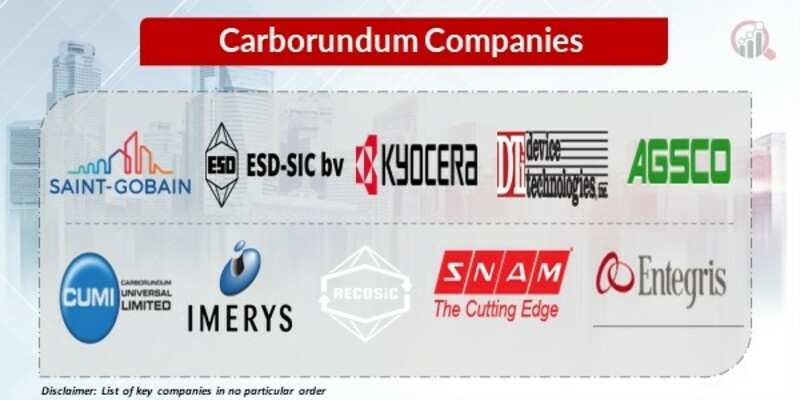
Key Players
- Saint Gobain Ceramics Materials GmbH (France)
- ESD-SIC BV (Netherlands)
- KYOCERA Corporation (Japan)
- Gaddis Mechanical Seals (US)
- AGSCO Corp (US)
- Norstel AB (Sweden)
- Carborundum Universal Ltd (India)
- Imerys Graphite & Carbon (Switzerland)
- ESK-SIC GmbH (Germany)
- Snam Abrasives Pvt. Ltd (India)
- Entegris Inc. (US)
- Xiamen Powerway Advanced Material Company Limited (China).
Recent Developments (Last 6 Months):
- September 2023: Siemens partners with a research institute to develop next-generation carborundum abrasives with significantly improved wear resistance and heat dissipation.
- October 2023: Stanley Black & Decker invests in a new manufacturing facility in Mexico, aiming to increase production capacity and cater to the growing North American market.
- November 2023: A consortium of European carborundum manufacturers joins forces to develop a standard for sustainable production practices, setting a new industry benchmark.
- December 2023: A team of scientists unveils a breakthrough in manufacturing synthetic diamond abrasives, potentially reshaping the future of high-performance grinding and cutting.

 Noah Malgeri
Co-Founder
Noah Malgeri
Co-Founder

 Peter Groot koerkamp
Account and Business Manager
Peter Groot koerkamp
Account and Business Manager

 Younghwan Choi
Senior Retail Manager
Younghwan Choi
Senior Retail Manager

 Mark Irwin
Management Consultant
Mark Irwin
Management Consultant

 Akif Moroglu
Strategy & Business Development Director
Akif Moroglu
Strategy & Business Development Director

 Guilherme Gomes Martins
Product Management Director
Guilherme Gomes Martins
Product Management Director

 Joseph Aguayo
Sales Operations & Pricing Manager
Joseph Aguayo
Sales Operations & Pricing Manager

 La Terria Dodd
Program Support Specialist
La Terria Dodd
Program Support Specialist

 Rob Kooiker
Group Product Manager HVAC & Fire Protection GMA
Rob Kooiker
Group Product Manager HVAC & Fire Protection GMA

