×
Request Free Sample ×

Kindly complete the form below to receive a free sample of this Report

* Please use a valid business email

Leading companies partner with us for data-driven Insights

clients tt-cursor
Hero Background
English
Chinese
French
Japanese
Korean
German
Spanish

Carbon Neutral Fuels Market Trends

ID: MRFR/CnM/6701-CR
140 Pages
Priya Nagrale
September 2023

Carbon-neutral Fuels Market Research Report Information By feedstock (carbon dioxide, hydrogen, plant starches, animal fats, vegetable oil, and others), type (hydrogen cells, biodiesel, bioethanol, biobutanol, methanol, algae, and others), application (automobiles, ships, aircraft, trains, power generation, chemicals, and others), and region and By Region (North America, Europe, Asia-Pacific, Latin America, and the Middle East & Africa) -Global Forecast to 2035

Share:
Download PDF ×

We do not share your information with anyone. However, we may send you emails based on your report interest from time to time. You may contact us at any time to opt-out.

Carbon Neutral Fuels Market Infographic
×
Carbon Neutral Fuels Market Infographic Full View
Purchase Options

Market Trends

Key Emerging Trends in the Carbon-Neutral Fuels Market

The Carbon-Neutral Fuels Market is witnessing a significant shift as global attention intensifies on sustainable and environmentally friendly energy solutions. With increasing concerns about climate change and the detrimental effects of traditional fossil fuels, there has been a notable surge in demand for carbon-neutral fuels. These fuels, also known as renewable or green fuels, are produced through processes that either capture and offset carbon emissions or utilize feedstocks that do not contribute to a net increase in greenhouse gases. One prominent market trend is the growing investment in research and development to enhance the production efficiency and scalability of carbon-neutral fuels.

Various stakeholders, including governments, private companies, and research institutions, are actively investing in technologies such as carbon capture and utilization, biomass conversion, and synthetic fuel production. These efforts aim to make carbon-neutral fuels more economically viable and accessible on a larger scale, ultimately fostering their widespread adoption. The transportation sector is emerging as a key driver for the carbon-neutral fuels market. Governments worldwide are implementing stringent regulations to reduce carbon emissions from vehicles, pushing automotive manufacturers to explore alternative fuel options. Carbon-neutral fuels, such as biofuels and synthetic fuels, offer a promising solution for reducing the carbon footprint of transportation. As a result, there is a growing trend of collaborations and partnerships between fuel producers and automotive companies to integrate carbon-neutral fuels into existing infrastructure and vehicle fleets. Consumer awareness and preferences are also influencing the market trends of carbon-neutral fuels. With an increasing emphasis on sustainability, consumers are becoming more conscious of the environmental impact of their choices, including the fuels they use. This shift in consumer behavior is prompting businesses to adopt sustainable practices, leading to a rise in the demand for carbon-neutral fuels. As a response, fuel retailers are incorporating renewable options into their product portfolios, catering to a growing market of eco-conscious consumers. Furthermore, government policies and incentives are playing a crucial role in shaping the market landscape of carbon-neutral fuels. Many countries are implementing regulatory frameworks and financial incentives to encourage the production and consumption of renewable fuels. These policies aim to create a favorable environment for businesses to invest in carbon-neutral technologies and promote the transition towards a more sustainable energy landscape. Governments are also exploring carbon pricing mechanisms to encourage industries to reduce their carbon emissions, indirectly driving the demand for carbon-neutral fuels.

Despite the positive trends, challenges remain in the carbon-neutral fuels market. The cost of production, limited infrastructure, and the need for significant technological advancements are obstacles that industry players must overcome. However, ongoing advancements in technology, coupled with increasing global awareness and regulatory support, are expected to address these challenges over time. In conclusion, the market trends of the Carbon-Neutral Fuels Market reflect a promising trajectory towards a more sustainable and environmentally friendly energy future. As investments in research and development continue to drive technological innovations, and governments and consumers alike prioritize sustainable choices, carbon-neutral fuels are poised to play a pivotal role in the global transition towards a low-carbon economy.
Author
Priya Nagrale
Senior Research Analyst

With an experience of over five years in market research industry (Chemicals & Materials domain), I gather and analyze market data from diverse sources to produce results, which are then presented back to a client. Also, provide recommendations based on the findings. As a Senior Research Analyst, I perform quality checks (QC) for market estimations, QC for reports, and handle queries and work extensively on client customizations. Also, handle the responsibilities of client proposals, report planning, report finalization, and execution

Leave a Comment

FAQs

How much is the Carbon-neutral fuels Market?

Carbon Neutral Fuels Market size was USD 78,975.4 million in 2022

What is the growth rate of the Carbon-neutral fuels Market?

The market is projected to grow at a CAGR of 7.42% during the forecast period, 2025-2035

Which region held the largest market share in the Carbon-neutral fuels Market?

North America had the largest share in the market

Who are the key players in the Carbon-neutral fuels Market?

Carbon Engineering Ltd, Mitsui Kinzoku, Umcor, Nanoshell LLC, American Element, Pometon Powder, ADM, POET, LLC, and others.

Market Summary

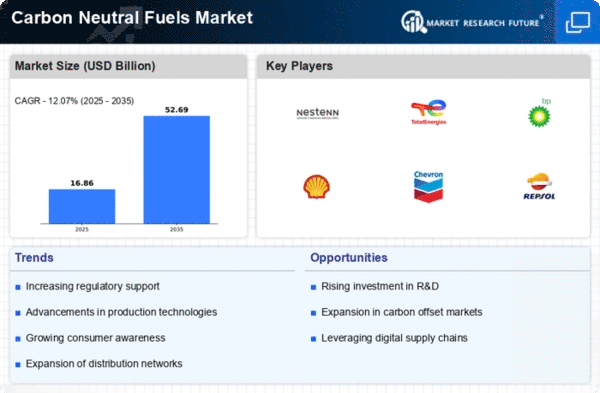
As per MRFR analysis, the Carbon Neutral Fuels Market Size was estimated at 15.04 USD Billion in 2024. The Carbon Neutral Fuels industry is projected to grow from 16.86 USD Billion in 2025 to 52.69 USD Billion by 2035, exhibiting a compound annual growth rate (CAGR) of 12.07 during the forecast period 2025 - 2035.

Key Market Trends & Highlights

The Carbon Neutral Fuels Market is poised for substantial growth driven by technological advancements and increasing consumer demand for sustainability.

  • North America remains the largest market for carbon neutral fuels, driven by robust regulatory support and technological innovations.
  • The Asia-Pacific region is emerging as the fastest-growing market, fueled by rising investments in renewable energy infrastructure.
  • The transportation segment continues to dominate the market, while the industrial segment is experiencing rapid growth due to evolving consumer preferences.
  • Key market drivers include technological innovations in carbon neutral fuels and rising consumer awareness and demand for sustainable energy solutions.

Market Size & Forecast

2024 Market Size 15.04 (USD Billion)
2035 Market Size 52.69 (USD Billion)
CAGR (2025 - 2035) 12.07%
Largest Regional Market Share in 2024 North America

Major Players

<p>Neste (FI), TotalEnergies (FR), BP (GB), Shell (GB), Chevron (US), Repsol (ES), Eni (IT), Cargill (US), LyondellBasell (US)</p>

Market Trends

The Carbon Neutral Fuels Market is currently experiencing a transformative phase, driven by a global shift towards sustainability and environmental responsibility. This market encompasses a variety of fuels that are produced with the aim of achieving net-zero carbon emissions. As governments and industries increasingly prioritize the reduction of greenhouse gas emissions, the demand for carbon neutral fuels is expected to rise. This trend is further supported by advancements in technology and innovation, which enhance the efficiency and viability of these fuels. Furthermore, the growing awareness among consumers regarding climate change and its impacts is likely to influence purchasing decisions, thereby propelling market growth. In addition, the Carbon Neutral Fuels Market is characterized by a diverse range of applications, spanning transportation, energy generation, and industrial processes. The integration of renewable energy sources and the development of alternative fuel options are pivotal in shaping the future landscape of this market. Stakeholders are actively exploring partnerships and collaborations to foster innovation and expand their product offerings. As the world moves towards a more sustainable future, the Carbon Neutral Fuels Market appears poised for significant evolution, with potential opportunities for growth and investment in the coming years.

Technological Advancements

Recent innovations in production processes and fuel technologies are enhancing the efficiency of carbon neutral fuels. These advancements may lead to lower production costs and improved performance, making these fuels more competitive in the energy market.

Regulatory Support

Government policies and regulations aimed at reducing carbon emissions are increasingly favoring the adoption of carbon neutral fuels. This regulatory environment could create a more favorable market landscape, encouraging investment and development in this sector.

Consumer Demand for Sustainability

There is a growing consumer preference for sustainable products, which is influencing the Carbon Neutral Fuels Market. As awareness of environmental issues increases, consumers are likely to seek out fuels that align with their values, driving demand for carbon neutral options.

Carbon Neutral Fuels Market Market Drivers

Market Growth Projections

The Global Carbon-neutral Fuels Market Industry is poised for substantial growth, with projections indicating a market size of 83.1 USD Billion in 2024 and an anticipated increase to 200.2 USD Billion by 2035. This growth trajectory reflects a compound annual growth rate of 8.33% from 2025 to 2035, driven by various factors including regulatory pressures, technological advancements, and evolving consumer preferences. The market's expansion is indicative of a broader transition towards sustainable energy solutions, as stakeholders across sectors recognize the importance of carbon-neutral fuels in addressing climate change and ensuring energy security.

Technological Advancements

Innovations in technology are playing a pivotal role in the Global Carbon-neutral Fuels Market Industry. Advances in production methods, such as carbon capture and utilization, are enhancing the efficiency of carbon-neutral fuel generation. For example, the development of biofuels from waste materials is gaining traction, providing a sustainable alternative to fossil fuels. These technological improvements not only lower production costs but also improve fuel quality, making carbon-neutral options more competitive. As a result, the market is anticipated to grow at a compound annual growth rate of 8.33% from 2025 to 2035, indicating a robust shift towards cleaner energy sources.

Global Energy Security Concerns

Concerns regarding global energy security are driving interest in the Global Carbon-neutral Fuels Market Industry. As geopolitical tensions and supply chain vulnerabilities become more pronounced, nations are seeking to diversify their energy sources. Carbon-neutral fuels, such as biofuels and synthetic fuels, offer a pathway to reduce dependence on fossil fuels and enhance energy independence. Countries are increasingly investing in domestic production of these fuels to bolster their energy security. This strategic shift is expected to contribute to the overall growth of the market, as nations prioritize sustainable and reliable energy solutions.

Rising Environmental Regulations

The Global Carbon-neutral Fuels Market Industry is experiencing a surge in demand due to increasing environmental regulations aimed at reducing greenhouse gas emissions. Governments worldwide are implementing stricter policies to combat climate change, which is driving industries to seek carbon-neutral alternatives. For instance, the European Union has set ambitious targets for carbon neutrality by 2050, prompting significant investments in carbon-neutral fuels. This regulatory pressure is expected to propel the market's growth, with projections indicating a market size of 83.1 USD Billion in 2024, reflecting the urgency for sustainable energy solutions.

Growing Investment in Renewable Energy

Investment in renewable energy sources is a significant driver for the Global Carbon-neutral Fuels Market Industry. Governments and private sectors are increasingly allocating funds to develop and promote carbon-neutral fuels, recognizing their potential to mitigate climate change. For instance, the United States has seen a surge in funding for renewable projects, with billions directed towards biofuels and hydrogen production. This influx of capital is expected to enhance production capabilities and infrastructure, contributing to a projected market size of 200.2 USD Billion by 2035. Such investments are crucial for transitioning to a sustainable energy landscape.

Consumer Demand for Sustainable Products

There is a notable shift in consumer preferences towards sustainable products, significantly impacting the Global Carbon-neutral Fuels Market Industry. As awareness of climate change grows, consumers are increasingly seeking out carbon-neutral fuel options for transportation and energy needs. This trend is evident in the automotive sector, where electric and hydrogen-powered vehicles are gaining popularity. Companies are responding by investing in carbon-neutral fuel technologies to meet this demand. This consumer-driven shift is likely to sustain market growth, as businesses align their strategies with evolving consumer values, thereby reinforcing the transition to a greener economy.

Market Segment Insights

By Application: Transportation (Largest) vs. Industrial (Fastest-Growing)

<p>In the Carbon Neutral Fuels Market, the application segment showcases varied dynamics, with Transportation holding the largest market share. This segment benefits from increasing demand for sustainable mobility solutions, driven by regulatory support and growing consumer awareness. In contrast, the Industrial segment is witnessing rapid expansion, fueled by shifts towards decarbonization and sustainable production methods, making it a critical focal point for future investments. Growth trends reveal that the Transportation sector remains pivotal, yet the Industrial segment is emerging as a powerhouse for carbon-neutral fuel uptake. The industrial demand for cleaner fuels stems from industries striving for efficiency and reduced carbon footprints. Meanwhile, technological innovations and stringent environmental regulations continue to bolster both segments, setting a robust framework for their future growth.</p>

<p>Transportation (Dominant) vs. Industrial (Emerging)</p>

<p>The Transportation sector is characterized by its significant reliance on carbon-neutral fuels to mitigate the environmental impact of vehicular emissions. This dominant segment includes electric vehicles and biofuels that cater to personal and commercial transport needs. Conversely, the Industrial segment is emerging as a vital player, adopting carbon-neutral sources to power manufacturing processes and reduce greenhouse gas emissions. This shift is prompted by industries aiming to meet sustainability goals and regulatory compliance. With investments in advanced technologies, both sectors are fostering innovation and efficiency, thereby solidifying their respective positions in the carbon-neutral fuel landscape.</p>

By Feedstock Type: Biomass (Largest) vs. Hydrogen (Fastest-Growing)

<p>The Carbon Neutral Fuels Market showcases a diverse feedstock landscape, with Biomass currently holding the largest market share. This segment has gained significant traction due to its capacity to produce renewable energy while effectively utilizing organic waste and agricultural residues. Following closely, Waste as a feedstock type reflects a noteworthy share in the market, owing to increasing global waste management initiatives. Natural Gas, though established, has seen varying interest levels as countries shift towards more sustainable solutions, while Hydrogen is rapidly emerging as a game-changer within this sector, appealing to environmentally conscious consumers and industries alike. The growth trends in the feedstock type segment reveal an escalating inclination towards sustainable alternatives. Biomass remains dominant, supported by technological advancements in conversion processes and governmental push for renewable energy sources. Meanwhile, Hydrogen is on an exceptional growth trajectory, driven by investments in fuel cell technologies and increasing infrastructure support. The transition towards carbon neutrality is fostering innovation in feedstock production, with Waste materials being recognized for their potential in generating clean energy. These elements collectively indicate a robust progress towards integrating diverse feedstock types in the Carbon Neutral Fuels Market, aligning with global sustainability goals.</p>

<p>Biomass (Dominant) vs. Waste (Emerging)</p>

<p>Biomass stands out as the dominant feedstock in the Carbon Neutral Fuels Market, characterized by its ability to transform organic materials into renewable energy sources. This segment benefits from a well-established infrastructure and extensive research backing its efficiency in carbon management. As a conventional choice for biofuels, Biomass supports various agricultural and forestry processes, making it a reliable option for energy production. On the other hand, Waste is emerging as a vital component, capitalizing on the rising emphasis on waste-to-energy initiatives. This segment leverages municipal solid waste, agricultural leftovers, and industrial by-products to generate fuel, contributing to waste reduction and energy sustainability. The evolving technologies in converting Waste into viable fuel alternatives signify its growing recognition within the market, although it currently trails behind Biomass in terms of share.</p>

By Fuel Type: Biofuels (Largest) vs. Hydrogen Fuels (Fastest-Growing)

<p>In the Carbon Neutral Fuels Market, the distribution of market share reveals that Biofuels are currently the largest segment, driven by widespread adoption in transportation and industrial applications. Their established infrastructure and existing technologies contribute to their leading position. In contrast, Hydrogen Fuels, while holding a smaller share, are rapidly gaining traction due to advancements in production and storage technologies, showcasing their potential as a clean alternative to conventional fossil fuels.</p>

<p>Biofuels (Dominant) vs. Hydrogen Fuels (Emerging)</p>

<p>Biofuels stand out in the Carbon Neutral Fuels Market due to their established position and extensive utilization across various sectors. As a dominant fuel type, they benefit from existing production methods like biodiesel and bioethanol, which leverage agricultural feedstocks for energy. Conversely, Hydrogen Fuels are regarded as an emerging player, poised for significant growth fueled by increasing investments in green hydrogen solutions and supportive governmental policies. This segment focuses on developing efficient electrolysis technologies and hydrogen fuel cells, aiming to create a sustainable energy ecosystem. The shift toward hydrogen is enhanced by its potential to decarbonize sectors that are hard to electrify, including heavy transportation and industrial processes.</p>

By End Use: Automotive (Largest) vs. Aviation (Fastest-Growing)

<p>In the Carbon Neutral Fuels Market, the end-use segment exhibits a diverse distribution, with Automotive dominating due to its significant adoption of biofuels and electric solutions. The Automotive sector benefits from extensive investments in infrastructure and technology developments aimed at reducing carbon emissions, positioning it as the largest segment. Conversely, the Aviation sector, while currently smaller, is witnessing rapid growth thanks to increasing regulatory pressures and an urgent demand for sustainable fuel alternatives, making it the fastest-growing segment.</p>

<p>Automotive: Traditional Vehicles (Dominant) vs. Electric Vehicles (Emerging)</p>

<p>Within the Automotive segment, traditional vehicles currently hold a dominant position as they represent the established market, benefiting from a mature infrastructure and consumer familiarity. However, electric vehicles are rapidly emerging as a viable alternative, spurred by technological advancements in battery capacity and efficiency. The shift towards electric vehicles is driven by stringent emission regulations and increasing consumer awareness of sustainability. As automakers pivot towards electrification, investments in charging infrastructure and public acceptance will play crucial roles in determining the future balance between these two sub-segments.</p>

By Production Technology: Fermentation (Largest) vs. Gasification (Fastest-Growing)

<p>In the Carbon Neutral Fuels Market, the production technologies are essential in determining how fuels are generated sustainably. Fermentation currently dominates this segment, owing to its established processes and widespread application in producing biofuels from organic materials. Gasification follows closely, emerging strongly due to its adaptability to various feedstocks, enabling the conversion of waste into valuable fuels. Meanwhile, electrolysis and thermochemical methods are also gaining traction but hold smaller market shares as they continue to mature in technology and market acceptance.</p>

<p>Production Technology: Fermentation (Dominant) vs. Gasification (Emerging)</p>

<p>Fermentation stands out as the dominant production technology in the Carbon Neutral Fuels Market, characterized by its reliance on biological processes to transform feedstocks into alcohols and other fuels. This method's established infrastructure and ease of integration into existing operations make it a preferred choice for many biofuel producers. On the other hand, gasification represents an emerging trend, leveraging advanced thermal and catalytic processes to convert various solid feedstocks. Its versatility in utilizing waste materials gives it significant growth potential, attracting investments and innovation aimed at expanding its capabilities in the production of cleaner fuels, vital for transitioning toward carbon neutrality.</p>

Get more detailed insights about Carbon-Neutral Fuels Market Research Report - Global Forecast till 2035

Regional Insights

North America : Leading Market Innovators

North America is poised to maintain its leadership in the Carbon Neutral Fuels market, holding a significant market share of 6.02 in 2024. The region's growth is driven by stringent environmental regulations, increasing investments in renewable energy, and a growing consumer demand for sustainable fuel alternatives. Government incentives and policies aimed at reducing carbon emissions are further catalyzing market expansion, making it a hub for innovation in clean energy solutions. The competitive landscape in North America is characterized by the presence of major players such as Chevron, BP, and Shell, who are actively investing in research and development to enhance their carbon-neutral offerings. The U.S. leads the market, supported by favorable regulations and a robust infrastructure for biofuels and synthetic fuels. This competitive environment fosters collaboration among industry stakeholders, ensuring continuous advancements in technology and sustainability practices.

Europe : Sustainable Energy Transition

Europe is rapidly advancing in the Carbon Neutral Fuels market, with a market size of 4.52. The region's commitment to achieving net-zero emissions by 2050 is a key driver of growth, supported by ambitious policies and regulations promoting renewable energy sources. The European Green Deal and various national initiatives are fostering innovation and investment in carbon-neutral technologies, making Europe a leader in sustainable energy transition. Leading countries such as Germany, France, and the Netherlands are at the forefront of this revolution, with significant investments from key players like TotalEnergies and Repsol. The competitive landscape is marked by a strong emphasis on research and development, with numerous partnerships and collaborations aimed at enhancing the efficiency and scalability of carbon-neutral fuels. This dynamic environment positions Europe as a critical player in The Carbon Neutral Fuels.

Asia-Pacific : Emerging Market Potential

The Asia-Pacific region is emerging as a significant player in the Carbon Neutral Fuels market, with a market size of 3.5. The increasing demand for cleaner energy sources, driven by urbanization and industrialization, is propelling market growth. Governments are implementing policies to reduce carbon footprints, and investments in renewable energy infrastructure are on the rise, creating a favorable environment for carbon-neutral fuel adoption. Countries like China, Japan, and India are leading the charge, with major companies such as Cargill and LyondellBasell actively participating in the market. The competitive landscape is evolving, with a focus on innovation and technology to enhance fuel efficiency and sustainability. As the region continues to prioritize environmental goals, the demand for carbon-neutral fuels is expected to grow significantly, positioning Asia-Pacific as a key market player.

Middle East and Africa : Resource-Rich Opportunities

The Middle East and Africa region is gradually entering the Carbon Neutral Fuels market, with a market size of 1.0. The region's abundant natural resources provide a unique opportunity for the development of sustainable fuel alternatives. Governments are increasingly recognizing the importance of diversifying energy sources and are implementing policies to promote renewable energy initiatives, which are essential for reducing carbon emissions and enhancing energy security. Countries like South Africa and the UAE are taking the lead in this transition, with investments in clean energy projects and partnerships with global players. The competitive landscape is still developing, but there is a growing interest from both local and international companies in exploring carbon-neutral fuel technologies. As the region continues to evolve, it holds significant potential for growth in the carbon-neutral sector.

Key Players and Competitive Insights

The Carbon Neutral Fuels Market is currently characterized by a dynamic competitive landscape, driven by increasing regulatory pressures and a global shift towards sustainability. Major players such as Neste (FI), TotalEnergies (FR), and BP (GB) are actively positioning themselves through innovation and strategic partnerships. Neste (FI) has focused on expanding its renewable diesel production capabilities, while TotalEnergies (FR) emphasizes its commitment to integrating renewable energy sources into its portfolio. BP (GB) is pursuing a dual strategy of divesting from traditional fossil fuels while investing heavily in biofuels and hydrogen technologies. Collectively, these strategies not only enhance their market presence but also contribute to a more sustainable energy ecosystem.

In terms of business tactics, companies are increasingly localizing manufacturing to reduce carbon footprints and optimize supply chains. The market structure appears moderately fragmented, with a mix of established players and emerging startups. This fragmentation allows for diverse approaches to carbon neutrality, as companies leverage their unique strengths to capture market share. The influence of key players is substantial, as their operational decisions often set industry standards and drive innovation.

In November 2025, Neste (FI) announced the opening of a new biorefinery in the Netherlands, aimed at increasing its production capacity of sustainable aviation fuel (SAF). This strategic move is significant as it aligns with the growing demand for SAF in the aviation sector, which is under pressure to reduce emissions. By enhancing its production capabilities, Neste positions itself as a leader in the SAF market, potentially capturing a larger share of this emerging segment.

In October 2025, TotalEnergies (FR) unveiled a partnership with a leading technology firm to develop advanced biofuel technologies. This collaboration is noteworthy as it underscores TotalEnergies' commitment to innovation and its strategy to diversify its energy offerings. By integrating cutting-edge technology into its biofuel production processes, the company aims to improve efficiency and reduce costs, thereby enhancing its competitive edge in the market.

In September 2025, BP (GB) completed the acquisition of a biofuel startup specializing in waste-to-energy technologies. This acquisition is pivotal as it not only expands BP's portfolio but also enhances its capabilities in converting waste into valuable fuels. Such strategic acquisitions are indicative of a broader trend where established companies seek to bolster their innovation pipelines through targeted investments in emerging technologies.

As of December 2025, the competitive trends in the Carbon Neutral Fuels Market are increasingly defined by digitalization, sustainability, and the integration of artificial intelligence (AI) in production processes. Strategic alliances are becoming more prevalent, as companies recognize the value of collaboration in achieving sustainability goals. Looking ahead, competitive differentiation is likely to evolve from traditional price-based competition to a focus on innovation, technological advancements, and supply chain reliability. This shift suggests that companies that prioritize these aspects will be better positioned to thrive in an increasingly competitive landscape.

Key Companies in the Carbon Neutral Fuels Market include

Industry Developments

January  2023: ADM introduces new crop biostimulant to boost nutrient use efficiency and yields: ADM announced the introduction of its new agricultural biostimulant that boosts corn yields by improving nutrient use efficiency..

December 2022, ADM recognized as a “Diversity Leader 2023” by the Financial Times: ADM was named a Diversity Leader in this year’s Financial Times ranking of 850 European companies on diversity and inclusion. ADM placed 15th overall and 2nd in the food and beverages sector for the 2023 study.

February 2023: Raízen connects new renewable energy plant in Vazante and increases its capacity in Minas Gerais: Raízen, an integrated energy company and a global reference in bioenergy, announces that it will increase 72.3% of its renewable capacity in Minas Gerais by April 2023.

Future Outlook

Carbon Neutral Fuels Market Future Outlook

<p>The Carbon Neutral Fuels Market is projected to grow at a 12.07% CAGR from 2024 to 2035, driven by regulatory support, technological advancements, and increasing consumer demand for sustainable energy solutions.</p>

New opportunities lie in:

  • <p>Development of carbon capture and utilization technologies for fuel production.</p>
  • <p>Expansion of biofuel supply chains to enhance market accessibility.</p>
  • <p>Investment in renewable energy infrastructure to support fuel distribution networks.</p>

<p>By 2035, the Carbon Neutral Fuels Market is expected to be robust, reflecting substantial growth and innovation.</p>

Market Segmentation

Carbon Neutral Fuels Market End Use Outlook

  • Automotive
  • Aviation
  • Marine
  • Power Generation

Carbon Neutral Fuels Market Fuel Type Outlook

  • Biofuels
  • Synthetic Fuels
  • Hydrogen Fuels
  • Electric Fuels

Carbon Neutral Fuels Market Application Outlook

  • Transportation
  • Industrial
  • Residential
  • Commercial

Carbon Neutral Fuels Market Feedstock Type Outlook

  • Biomass
  • Waste
  • Natural Gas
  • Hydrogen

Carbon Neutral Fuels Market Production Technology Outlook

  • Fermentation
  • Gasification
  • Electrolysis
  • Thermochemical

Report Scope

MARKET SIZE 202415.04(USD Billion)
MARKET SIZE 202516.86(USD Billion)
MARKET SIZE 203552.69(USD Billion)
COMPOUND ANNUAL GROWTH RATE (CAGR)12.07% (2024 - 2035)
REPORT COVERAGERevenue Forecast, Competitive Landscape, Growth Factors, and Trends
BASE YEAR2024
Market Forecast Period2025 - 2035
Historical Data2019 - 2024
Market Forecast UnitsUSD Billion
Key Companies ProfiledNeste (FI), TotalEnergies (FR), BP (GB), Shell (GB), Chevron (US), Repsol (ES), Eni (IT), Cargill (US), LyondellBasell (US)
Segments CoveredApplication, Feedstock Type, Fuel Type, End Use, Production Technology
Key Market OpportunitiesAdvancements in biofuel technologies enhance sustainability in the Carbon Neutral Fuels Market.
Key Market DynamicsRising regulatory pressures and technological advancements drive innovation and competition in the carbon neutral fuels sector.
Countries CoveredNorth America, Europe, APAC, South America, MEA

FAQs

How much is the Carbon-neutral fuels Market?

Carbon Neutral Fuels Market size was USD 78,975.4 million in 2022

What is the growth rate of the Carbon-neutral fuels Market?

The market is projected to grow at a CAGR of 7.42% during the forecast period, 2025-2035

Which region held the largest market share in the Carbon-neutral fuels Market?

North America had the largest share in the market

Who are the key players in the Carbon-neutral fuels Market?

Carbon Engineering Ltd, Mitsui Kinzoku, Umcor, Nanoshell LLC, American Element, Pometon Powder, ADM, POET, LLC, and others.

  1. SECTION I: EXECUTIVE SUMMARY AND KEY HIGHLIGHTS
    1. | 1.1 EXECUTIVE SUMMARY
  2. SECTION II: SCOPING, METHODOLOGY AND MARKET STRUCTURE
    1. | 2.1 MARKET INTRODUCTION
    2. | 2.2 RESEARCH METHODOLOGY
  3. SECTION III: QUALITATIVE ANALYSIS
    1. | 3.1 MARKET DYNAMICS
    2. | 3.2 MARKET FACTOR ANALYSIS
  4. SECTION IV: QUANTITATIVE ANALYSIS
    1. | 4.1 Chemicals and Materials, BY Application (USD Billion)
    2. | 4.2 Chemicals and Materials, BY Feedstock Type (USD Billion)
    3. | 4.3 Chemicals and Materials, BY Fuel Type (USD Billion)
    4. | 4.4 Chemicals and Materials, BY End Use (USD Billion)
    5. | 4.5 Chemicals and Materials, BY Production Technology (USD Billion)
    6. | 4.6 Chemicals and Materials, BY Region (USD Billion)
  5. SECTION V: COMPETITIVE ANALYSIS
    1. | 5.1 Competitive Landscape
    2. | 5.2 Company Profiles
    3. | 5.3 Appendix

Carbon-Neutral Fuels Market Segmentation

Market Segmentation Overview

  • Detailed segmentation data will be available in the full report
  • Comprehensive analysis by multiple parameters
  • Regional and country-level breakdowns
  • Market size forecasts by segment
Infographic

Free Sample Request

Kindly complete the form below to receive a free sample of this Report

Get Free Sample

Customer Strories

Compare Licence

×
Features License Type
Single User Multiuser License Enterprise User
Price $4,950 $5,950 $7,250
Maximum User Access Limit 1 User Upto 10 Users Unrestricted Access Throughout the Organization
Free Customization
Direct Access to Analyst
Deliverable Format
Platform Access
Discount on Next Purchase 10% 15% 15%
Printable Versions