Request Free Sample ×

Kindly complete the form below to receive a free sample of this Report

* Please use a valid business email

Leading companies partner with us for data-driven Insights

clients tt-cursor
Hero Background
English
Chinese
French
Japanese
Korean
German
Spanish

Carbon Nanotube Market Analysis

ID: MRFR/CnM/2988-CR
111 Pages
Chitranshi Jaiswal
February 2021

Carbon Nanotubes (CNTs) Market Research Report Information by Type (Single-Walled Carbon Nanotubes (SWCNTs) and Multi-Walled Carbon Nanotubes (MWCNTs)), Method (Chemical Vapor Deposition, High-Pressure Carbon Monoxide Disproportionation, Arc Discharge, Laser Ablation and others), End-Use Industry (Aerospace & Defense, Electrical & Electronics, Automotive, Energy, Sports and others) - Forecast till 2035

Share:
Download PDF ×

We do not share your information with anyone. However, we may send you emails based on your report interest from time to time. You may contact us at any time to opt-out.

Carbon Nanotube Market Infographic
Purchase Options

Market Analysis

In-depth Analysis of Carbon Nanotube Market Industry Landscape

Carbon nanotubes (CNTs) are incredibly versatile materials with exceptional electrical, thermal, and mechanical properties. Their unique combination of lightweight strength and tuneable conductivity makes them promising candidates for a wide range of applications in the electronics industry.

CNTs can be engineered to exhibit both highly conductive and semi-conductive properties, enabling their use in a variety of electronic components, including nonvolatile random-access memory (NRAM), sensors, transistors, interconnects, and 3D layering techniques. Their extraordinary thinness, with a diameter 1/50,000th that of a human hair, allows them to be incorporated into even the smallest devices, such as wearables and sensors. This opens up exciting possibilities for miniaturization and enhanced performance in mainstream electronics and other devices.

The growing popularity of wearable electronic devices is further fueling the demand for materials that can withstand harsh conditions. CNTs are exceptionally well-suited for these applications due to their exceptional durability, making them a valuable asset in the development of next-generation wearable electronics.

In the automotive sector, CNTs offer a plethora of opportunities to enhance performance and efficiency. They are being explored for energy storage applications in batteries and supercapacitors, promising to revolutionize electric vehicles with improved power density and longer life cycles. Additionally, CNTs are being investigated for use in printable, thermoformable, capacitive touch sensors for automotive interiors, replacing traditional membrane switches. Their incorporation into polymer composites is also being explored to enhance electrical conductivity, thermal conductivity, and mechanical properties.

Battery manufacturers are particularly interested in using CNTs in conjunction with silicon anodes, as they offer significantly higher capacity compared to traditional carbon anodes. This combination can potentially address the limitations of silicon anodes, namely their volumetric contraction and expansion during charging and discharging cycles, which can significantly reduce battery life. CNTs can help mitigate these issues, leading to dramatic improvements in cycle life and overall battery performance.

Supercapacitors, another energy storage technology, are also benefiting from the advancements in CNT technology. CNTs are being explored as electrode materials in supercapacitors, which are capable of delivering high power density, making them suitable for applications where rapid energy delivery is crucial. This aligns well with the high power demands of electric vehicles, typically met by combustion engines in traditional vehicles.

The demand for carbon nanotubes is expected to exceed several thousand tons per year, driven by their growing applications in energy storage, device modeling, and automotive parts. This surge in demand is propelling the growth of the CNT market, with CNTs becoming increasingly recognized as essential materials for the development of next-generation technologies.


Author
Author Profile
Chitranshi Jaiswal
Team Lead - Research

Chitranshi is a Team Leader in the Chemicals & Materials (CnM) and Energy & Power (EnP) domains, with 6+ years of experience in market research. She leads and mentors teams to deliver cross-domain projects that equip clients with actionable insights and growth strategies. She is skilled in market estimation, forecasting, competitive benchmarking, and both primary & secondary research, enabling her to turn complex data into decision-ready insights. An engineer and MBA professional, she combines technical expertise with strategic acumen to solve dynamic market challenges. Chitranshi has successfully managed projects that support market entry, investment planning, and competitive positioning, while building strong client relationships. Certified in Advanced Excel & Power BI she leverages data-driven approaches to ensure accuracy, clarity, and impactful outcomes.

Leave a Comment

FAQs

What is the current valuation of the Carbon Nanotubes Market?

<p>As of 2024, the Carbon Nanotubes Market was valued at 1.27 USD Billion.</p>

What is the projected market size for Carbon Nanotubes by 2035?

<p>The market is projected to reach approximately 6.199 USD Billion by 2035.</p>

What is the expected CAGR for the Carbon Nanotubes Market during the forecast period?

<p>The expected CAGR for the Carbon Nanotubes Market from 2025 to 2035 is 15.5%.</p>

Which segment of Carbon Nanotubes is anticipated to have the highest valuation by 2035?

<p>The Electronics and Semiconductor Industry segment is expected to grow to approximately 2.7 USD Billion by 2035.</p>

What are the leading methods of producing Carbon Nanotubes?

<p>The primary methods include Chemical Vapour Deposition, Arc Discharge, Laser Ablation, and High-pressure Carbon Monoxide.</p>

Which company is a key player in the Carbon Nanotubes Market?

<p>Nanocyl, based in Belgium, is one of the prominent players in the Carbon Nanotubes Market.</p>

How does the Automotive Industry segment perform in the Carbon Nanotubes Market?

<p>The Automotive Industry segment is projected to grow to around 2.0 USD Billion by 2035.</p>

What is the valuation of Multi-walled Carbon Nanotubes in 2024?

<p>In 2024, the valuation of Multi-walled Carbon Nanotubes was approximately 0.76 USD Billion.</p>

What is the expected growth for Single-walled Carbon Nanotubes by 2035?

<p>Single-walled Carbon Nanotubes are projected to reach a valuation of about 3.2 USD Billion by 2035.</p>

Which company specializes in the production of Carbon Nanotubes using Chemical Vapour Deposition?

<p>Ocsial, located in Russia, is known for its expertise in producing Carbon Nanotubes via Chemical Vapour Deposition.</p>

Market Summary

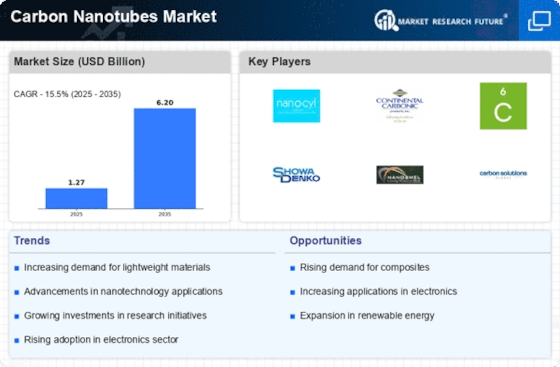
As per Market Research Future analysis, the Carbon Nanotubes Market Size was estimated at 1.27 USD Billion in 2024. The Carbon Nanotubes industry is projected to grow from 1.467 USD Billion in 2025 to 6.199 USD Billion by 2035, exhibiting a compound annual growth rate (CAGR) of 15.5% during the forecast period 2025 - 2035

Key Market Trends & Highlights

The Carbon Nanotubes Market is poised for substantial growth driven by technological advancements and increasing applications across various sectors.

  • North America remains the largest market for carbon nanotubes, driven by robust demand in electronics and aerospace applications. The Asia-Pacific region is emerging as the fastest-growing market, fueled by rapid industrialization and technological innovation. Multi-walled carbon nanotubes dominate the market, while single-walled carbon nanotubes are witnessing the fastest growth due to their unique properties. Key market drivers include the rising demand in electronics and advancements in energy storage technologies, which are propelling market expansion.

Market Size & Forecast

2024 Market Size 1.27 (USD Billion)
2035 Market Size 6.199 (USD Billion)
CAGR (2025 - 2035) 15.5%
Largest Regional Market Share in 2024 Asia Pacific

Major Players

Nanocyl (BE), Continental Carbon (US), Ocsial (RU), Showa Denko (JP), Nanoshel (IN), Carbon Solutions (US), Chengdu Organic Chemicals (CN), Hyperion Catalysis International (US), Klean Industries (CA)

Market Trends

The Carbon Nanotubes Market is currently experiencing a dynamic evolution, driven by advancements in nanotechnology and increasing demand across various sectors. Applications in electronics, materials science, and energy storage are expanding, suggesting a robust growth trajectory. The unique properties of carbon nanotubes, such as exceptional strength and electrical conductivity, are attracting attention from industries seeking innovative solutions. As research continues to unveil new applications, the market appears poised for further development, potentially leading to enhanced performance in existing products and the creation of novel technologies. Moreover, the sustainability aspect of carbon nanotubes is gaining traction, as industries strive to reduce their environmental footprint. This trend indicates a shift towards greener manufacturing processes and the exploration of bio-based alternatives. The interplay between technological advancements and environmental considerations may shape the future landscape of the Carbon Nanotubes Market, fostering a more sustainable approach to production and application. Stakeholders are likely to focus on collaboration and investment in research to harness the full potential of carbon nanotubes, ensuring their relevance in an increasingly competitive market.

Rising Demand in Electronics

The Carbon Nanotubes Market is witnessing heightened interest from the electronics sector. Their unique electrical properties make them ideal for applications in transistors, sensors, and conductive films. This trend suggests that as electronic devices become more sophisticated, the need for advanced materials like carbon nanotubes will likely increase.

Advancements in Energy Storage

Innovations in energy storage technologies are propelling the Carbon Nanotubes Market forward. Carbon nanotubes are being explored for use in batteries and supercapacitors, potentially enhancing energy density and charge/discharge rates. This trend indicates a growing recognition of the role carbon nanotubes could play in the future of energy solutions.

Focus on Sustainable Manufacturing

Sustainability is becoming a central theme in the Carbon Nanotubes Market. Manufacturers are increasingly seeking eco-friendly production methods and materials. This shift suggests a potential transformation in how carbon nanotubes are produced, with an emphasis on reducing environmental impact and promoting circular economy principles.

Carbon Nanotube Market Market Drivers

Growth in Automotive Sector

The Carbon Nanotubes Market is poised for growth as the automotive sector increasingly incorporates advanced materials to enhance vehicle performance. Carbon nanotubes are utilized in various applications, including lightweight composites and conductive materials for electric vehicles. The automotive industry is undergoing a transformation towards electric mobility, with projections indicating that electric vehicle sales could reach 30 percent of total vehicle sales by 2030. This shift is likely to create substantial opportunities for carbon nanotubes, as they can improve battery efficiency and reduce overall vehicle weight. Consequently, the demand for carbon nanotubes in automotive applications is expected to rise, reflecting a broader trend towards innovation and sustainability in transportation.

Rising Demand in Electronics

The Carbon Nanotubes Market is significantly influenced by the rising demand for advanced electronic components. Carbon nanotubes are being explored for their potential in various electronic applications, including transistors, sensors, and displays. Their unique electrical properties allow for the development of smaller, faster, and more efficient electronic devices. The Carbon Nanotubes is projected to grow at a compound annual growth rate of over 5 percent, which may further stimulate the demand for carbon nanotubes. As manufacturers seek to enhance the performance and miniaturization of electronic devices, the integration of carbon nanotubes is likely to become more prevalent, thereby driving growth in the carbon nanotubes market.

Focus on Sustainable Manufacturing

The Carbon Nanotubes Market is increasingly aligned with the focus on sustainable manufacturing practices. As industries strive to reduce their environmental impact, the demand for materials that contribute to sustainability is rising. Carbon nanotubes, known for their strength and lightweight properties, can lead to reduced material usage and lower energy consumption in manufacturing processes. The global push towards sustainability is reflected in various sectors, including construction, automotive, and electronics, where carbon nanotubes are being integrated to enhance product performance while minimizing environmental footprints. This trend is likely to drive the adoption of carbon nanotubes, positioning them as a key material in the transition towards more sustainable manufacturing practices.

Increasing Applications in Aerospace

The Carbon Nanotubes Market is experiencing a surge in demand due to the increasing applications of carbon nanotubes in the aerospace sector. These materials are recognized for their lightweight and high-strength properties, which are essential for enhancing the performance of aircraft. The integration of carbon nanotubes in composite materials can lead to weight reductions of up to 30 percent, thereby improving fuel efficiency. As aerospace manufacturers seek to innovate and reduce operational costs, the adoption of carbon nanotubes is likely to expand. Furthermore, The Carbon Nanotubes is projected to grow significantly, which may further drive the demand for advanced materials like carbon nanotubes, positioning them as a critical component in future aerospace designs.

Advancements in Energy Storage Technologies

The Carbon Nanotubes Market is benefiting from advancements in energy storage technologies, particularly in batteries and supercapacitors. Carbon nanotubes are being utilized to enhance the performance of these energy storage devices, offering improved conductivity and energy density. The Carbon Nanotubes is expected to witness substantial growth, with projections indicating a market size exceeding 500 billion dollars by 2030. This growth is likely to be fueled by the increasing demand for renewable energy sources and the need for efficient energy storage solutions. As energy storage technologies evolve, the role of carbon nanotubes in enhancing performance and efficiency is expected to expand, thereby driving demand within the carbon nanotubes market.

Market Segment Insights

By Type: Multi-walled Carbon Nanotubes (Largest) vs. Single-walled Carbon Nanotubes (Fastest-Growing)

<p>In the Carbon Nanotubes Market, Multi-walled Carbon Nanotubes (MWCNTs) hold a significant share due to their extensive applications in various industries, including electronics, energy storage, and materials science. Their ability to enhance strength, conductivity, and thermal resistivity makes them a preferred choice for manufacturers seeking to integrate advanced materials into their products. On the other hand, Single-walled Carbon Nanotubes (SWCNTs) are gaining market traction because of their unique electrical properties and potential applications in nanotechnology and advanced composites. As industries increasingly focus on innovative solutions, the demand for SWCNTs is expected to rise.</p>

<p>Carbon Nanotubes: MWCNTs (Dominant) vs. SWCNTs (Emerging)</p>

<p>Multi-walled Carbon Nanotubes (MWCNTs) are characterized by their structure comprising multiple layers of carbon atoms, which provides them with superior mechanical strength and enhanced electrical conductivity. This makes MWCNTs particularly dominant in sectors like aerospace, automotive, and electronics, where performance is crucial. They are also more cost-effective to produce compared to Single-walled Carbon Nanotubes (SWCNTs). In contrast, SWCNTs, featuring a single layer of carbon atoms, have unique electrical and optical properties, making them an emerging choice in high-tech applications such as flexible electronics and sensors. The versatility and growing interest in nanotechnology are driving the demand for SWCNTs, setting the stage for a competitive landscape between these two types.</p>

By Method: Chemical Vapour Deposition (Largest) vs. Laser Ablation (Fastest-Growing)

<p>The carbon nanotubes market reveals distinct dynamics in its method segment, with Chemical Vapour Deposition (CVD) emerging as the largest contributor. CVD is widely utilized due to its efficiency and the high quality of carbon nanotubes produced, appealing to various applications from electronics to materials science. In contrast, Laser Ablation and Arc Discharge methods are also present, albeit with smaller market shares. These methods cater to niche applications, leading to their unique positioning within the market.</p>

<p>CVD (Dominant) vs. Laser Ablation (Emerging)</p>

<p>Chemical Vapour Deposition (CVD) is recognized for dominating the carbon nanotubes market, thanks to its scalability and ability to produce uniform, high-quality nanotubes which can be applied in diverse sectors such as integrated circuits and composites. Meanwhile, Laser Ablation stands out as an emerging method, often favored for its capability to yield specific carbon nanotube structures with unique electronic properties. While CVD is the preferred choice for bulk production, Laser Ablation is seeing an uptick in interest due to advancements aimed at enhancing its production efficiencies and expanding its practical applications in cutting-edge technology.</p>

By End-Use: Energy Sector (Largest) vs. Electronics and Semiconductor Industry (Fastest-Growing)

<p>The Carbon Nanotubes Market is significantly influenced by diverse end-use applications. The Energy Sector accounts for the largest share, buoyed by the increasing demand for advanced materials in energy storage solutions, such as batteries and supercapacitors. Meanwhile, the Electronics and Semiconductor Industry rapidly follows, employing carbon nanotubes in the development of nano-scaled electronic components, resulting in improved performance and miniaturization, thus driving its share in the market. Growth trends continue to highlight the Energy Sector's robust position, underpinned by global shifts towards renewable energy sources and storage technology. Simultaneously, the Electronics and Semiconductor Industry accelerates as technological advancements and increasing R&D investments foster higher adoption rates. The emergence of innovative applications in both sectors showcases significant potential for future growth, highlighting the Carbon Nanotubes Market's adaptability to evolving industry needs.</p>

<p>Energy Sector (Dominant) vs. Electronics and Semiconductor Industry (Emerging)</p>

<p>The Energy Sector remains dominant due to its extensive applications in energy storage, wherein carbon nanotubes significantly enhance battery efficiency and lifespan. This sector benefits from heightened investments in renewable technologies, which leverage the unparalleled conductivity and lightweight properties of carbon nanotubes. Conversely, the Electronics and Semiconductor Industry is emerging as a crucial player, utilizing carbon nanotubes for their superior electrical properties in small-scale devices and components. This sector is characterized by rapid innovation cycles, where carbon nanotubes contribute to advancements in faster and more efficient electronic devices. As technology progresses, the competition between these sectors intensifies, with the Energy Sector establishing a solid base while the Electronics and Semiconductor Industry capitalizes on new tech trends.</p>

Get more detailed insights about Carbon Nanotubes (CNTs) Market Research Report - Global Forecast till 2035

Regional Insights

North America : Innovation and Demand Surge

North America is the largest market for carbon nanotubes, holding approximately 40% of the global share. The region's growth is driven by advancements in nanotechnology, increasing demand in electronics, and supportive government regulations promoting research and development. The U.S. leads in market share, followed closely by Canada, which contributes around 15%. Regulatory frameworks are increasingly favoring sustainable materials, enhancing market potential. The competitive landscape in North America is robust, featuring key players like Continental Carbon and Hyperion Catalysis International. The presence of advanced research institutions and a strong manufacturing base further bolster the market. The U.S. is at the forefront of innovation, with significant investments in carbon nanotube applications across various sectors, including automotive and aerospace. This dynamic environment fosters collaboration between industry and academia, driving further growth.

Europe : Emerging Market with Regulations

Europe is witnessing significant growth in the carbon nanotubes market, accounting for approximately 25% of the global share. The region's expansion is fueled by increasing investments in nanotechnology and stringent regulations aimed at promoting sustainable materials. Germany and France are the largest markets, together holding about 15% of the total market. The European Union's Green Deal is a key regulatory catalyst, encouraging innovation in nanomaterials. Leading countries in Europe include Germany, France, and the UK, with a competitive landscape featuring companies like Nanocyl and Ocsial. The presence of strong research institutions and a focus on sustainability drive the market forward. European manufacturers are increasingly collaborating with research organizations to develop advanced applications for carbon nanotubes, particularly in the automotive and electronics sectors. This collaborative approach enhances the region's competitive edge.

Asia-Pacific : Rapid Growth and Adoption

Asia-Pacific is emerging as a powerhouse in the carbon nanotubes market, holding around 30% of the global share. The region's growth is driven by rapid industrialization, increasing demand from electronics and energy sectors, and government initiatives supporting nanotechnology research. China is the largest market, contributing approximately 20%, followed by Japan and India, which are also witnessing significant growth in this sector. The competitive landscape in Asia-Pacific is characterized by a mix of established players and new entrants. Companies like Showa Denko and Chengdu Organic Chemicals are leading the charge, supported by a strong manufacturing base and favorable government policies. The region's focus on innovation and technology transfer is enhancing the development of advanced applications for carbon nanotubes, particularly in renewable energy and electronics, positioning Asia-Pacific as a key player in the global market.

Middle East and Africa : Emerging Opportunities in Nanotechnology

The Middle East and Africa region is gradually emerging in the carbon nanotubes market, currently holding about 5% of the global share. The growth is primarily driven by increasing investments in nanotechnology and a rising demand for advanced materials in various industries. Countries like South Africa and the UAE are leading the market, with a focus on developing sustainable solutions and enhancing local manufacturing capabilities. The competitive landscape in this region is still developing, with a few key players beginning to establish a presence. Local initiatives aimed at fostering research and development in nanotechnology are gaining momentum, supported by government policies that encourage innovation. As the region continues to invest in infrastructure and education, the potential for growth in the carbon nanotubes market is significant, paving the way for future advancements and collaborations.

Key Players and Competitive Insights

The Carbon Nanotubes Market is currently characterized by a dynamic competitive landscape, driven by increasing demand across various sectors such as electronics, energy storage, and materials science. Key players are actively engaging in strategies that emphasize innovation, regional expansion, and strategic partnerships to enhance their market positioning. Notably, companies like Nanocyl (Belgium) and Ocsial (Russia) are focusing on product development and technological advancements, while Continental Carbon (US) is pursuing aggressive growth through mergers and acquisitions. These strategies collectively contribute to a moderately fragmented market structure, where the interplay of established firms and emerging players shapes competitive dynamics.

In terms of business tactics, companies are increasingly localizing manufacturing to reduce costs and enhance supply chain efficiency. This approach not only mitigates risks associated with The Carbon Nanotubes demands. The competitive structure of the Carbon Nanotubes Market appears to be moderately fragmented, with several key players exerting influence over market trends and pricing strategies. The collective actions of these companies indicate a shift towards more sustainable practices and innovative solutions, which are becoming essential for maintaining competitive advantage.

In August 2025, Ocsial (Russia) announced the launch of a new production facility aimed at increasing its capacity for high-quality carbon nanotubes. This strategic move is expected to bolster Ocsial's position in the market by meeting the growing demand for advanced materials in various applications, particularly in the electronics and automotive sectors. The establishment of this facility not only enhances production capabilities but also signifies Ocsial's commitment to innovation and sustainability in its operations.

In September 2025, Continental Carbon (US) revealed a partnership with a leading automotive manufacturer to develop lightweight materials utilizing carbon nanotubes. This collaboration is strategically significant as it aligns with the automotive industry's shift towards lighter, more efficient materials to improve fuel efficiency and reduce emissions. By leveraging its expertise in carbon nanotube production, Continental Carbon is poised to capitalize on this trend, potentially leading to increased market share and enhanced brand reputation.

In October 2025, Nanocyl (Belgium) unveiled a new line of carbon nanotube-based composites designed for the aerospace industry. This product launch reflects a strategic focus on high-performance applications, which are increasingly sought after in aerospace engineering. By targeting this niche market, Nanocyl aims to differentiate itself from competitors and establish a strong foothold in a sector that values innovation and advanced materials.

As of October 2025, the Carbon Nanotubes Market is witnessing trends that emphasize digitalization, sustainability, and the integration of artificial intelligence in production processes. Strategic alliances are becoming increasingly prevalent, as companies recognize the value of collaboration in driving innovation and enhancing operational efficiency. Looking ahead, competitive differentiation is likely to evolve from traditional price-based competition to a focus on technological advancements, sustainable practices, and reliable supply chains. This shift underscores the importance of innovation as a key driver of success in the Carbon Nanotubes Market.

Key Companies in the Carbon Nanotube Market include

Industry Developments

In April 2023, NEC Corporation created the first ever sensitivity uncooled infrared image sensor using pure semiconductor carbon nanotubes (CNTs) for infrared sensing. To achieve this, NEC employed its unique extraction technique.

In May 2023, LG Chem Ltd. announced that it had broken ground on a fourth carbon nanotube (CNT) plant in South Korea that will ultimately increase production of this vital industrial material by more than three times over the coming years. The CNT 4 factory, to be located at LG Chem’s Daesan site in Seosan, will raise the total CNT production capacity of the chemical firm to 6,100 tons when it comes online in 2025. It currently produces about 2,900 tons per year.

In January 2023, MG Motor India announced an investment of USD 100 million to expand its capacity. Mahindra & Mahindra revealed plans in December 2022 to invest INR 10,000 crore (USD 1.2 billion) in an EV manufacturing plant in Pune. This investment underscores the increasing importance of the EV sector.

May 2023: LG CHEM announced a new factory being built at its Daesan location in South Korea. The plant is scheduled for completion by 2025. This was achieved through expansion, thereby doubling LG Chem’s annual CNT production capability to reach as high as 6,100 tons and strengthen its product portfolio.

January 2023: Showa Denko KK and Showa Denko Materials Co., Ltd merged on January 1, 2023, into two new companies - a holding company named “ResonacHoldings Corporation” and a manufacturing firm branded “ResonacCorporation”.

Future Outlook

Carbon Nanotube Market Future Outlook

The Carbon Nanotubes Market is poised for growth at a 15.5% CAGR from 2024 to 2035, driven by advancements in electronics, energy storage, and composite materials.

New opportunities lie in:

  • Development of high-capacity energy storage solutions using carbon nanotubes.
  • Integration of carbon nanotubes in lightweight automotive components.
  • Expansion into biomedical applications for drug delivery systems.

By 2035, the Carbon Nanotubes Market is expected to achieve substantial growth and innovation.

Market Segmentation

Carbon Nanotube Market Type Outlook

  • Multi-walled Carbon Nanotubes
  • Single-walled Carbon Nanotubes

Carbon Nanotube Market Method Outlook

  • Laser Ablation
  • Arc Discharge
  • Chemical Vapour Deposition
  • High-pressure Carbon Monoxide

Carbon Nanotube Market End-Use Outlook

  • Energy Sector
  • Automotive Industry
  • Electronics and Semiconductor Industry

Report Scope

MARKET SIZE 20241.27(USD Billion)
MARKET SIZE 20251.467(USD Billion)
MARKET SIZE 20356.199(USD Billion)
COMPOUND ANNUAL GROWTH RATE (CAGR)15.5% (2024 - 2035)
REPORT COVERAGERevenue Forecast, Competitive Landscape, Growth Factors, and Trends
BASE YEAR2024
Market Forecast Period2025 - 2035
Historical Data2019 - 2024
Market Forecast UnitsUSD Billion
Key Companies ProfiledMarket analysis in progress
Segments CoveredMarket segmentation analysis in progress
Key Market OpportunitiesGrowing demand for lightweight materials in aerospace and automotive sectors drives Carbon Nanotubes Market expansion.
Key Market DynamicsRising demand for lightweight materials drives innovation and competition in the Carbon Nanotubes Market.
Countries CoveredNorth America, Europe, APAC, South America, MEA

FAQs

What is the current valuation of the Carbon Nanotubes Market?

<p>As of 2024, the Carbon Nanotubes Market was valued at 1.27 USD Billion.</p>

What is the projected market size for Carbon Nanotubes by 2035?

<p>The market is projected to reach approximately 6.199 USD Billion by 2035.</p>

What is the expected CAGR for the Carbon Nanotubes Market during the forecast period?

<p>The expected CAGR for the Carbon Nanotubes Market from 2025 to 2035 is 15.5%.</p>

Which segment of Carbon Nanotubes is anticipated to have the highest valuation by 2035?

<p>The Electronics and Semiconductor Industry segment is expected to grow to approximately 2.7 USD Billion by 2035.</p>

What are the leading methods of producing Carbon Nanotubes?

<p>The primary methods include Chemical Vapour Deposition, Arc Discharge, Laser Ablation, and High-pressure Carbon Monoxide.</p>

Which company is a key player in the Carbon Nanotubes Market?

<p>Nanocyl, based in Belgium, is one of the prominent players in the Carbon Nanotubes Market.</p>

How does the Automotive Industry segment perform in the Carbon Nanotubes Market?

<p>The Automotive Industry segment is projected to grow to around 2.0 USD Billion by 2035.</p>

What is the valuation of Multi-walled Carbon Nanotubes in 2024?

<p>In 2024, the valuation of Multi-walled Carbon Nanotubes was approximately 0.76 USD Billion.</p>

What is the expected growth for Single-walled Carbon Nanotubes by 2035?

<p>Single-walled Carbon Nanotubes are projected to reach a valuation of about 3.2 USD Billion by 2035.</p>

Which company specializes in the production of Carbon Nanotubes using Chemical Vapour Deposition?

<p>Ocsial, located in Russia, is known for its expertise in producing Carbon Nanotubes via Chemical Vapour Deposition.</p>

  1. SECTION I: EXECUTIVE SUMMARY AND KEY HIGHLIGHTS
    1. | 1.1 EXECUTIVE SUMMARY
    2. | | 1.1.1 Market Overview
    3. | | 1.1.2 Key Findings
    4. | | 1.1.3 Market Segmentation
    5. | | 1.1.4 Competitive Landscape
    6. | | 1.1.5 Challenges and Opportunities
    7. | | 1.1.6 Future Outlook
  2. SECTION II: SCOPING, METHODOLOGY AND MARKET STRUCTURE
    1. | 2.1 MARKET INTRODUCTION
    2. | | 2.1.1 Definition
    3. | | 2.1.2 Scope of the study
    4. | | | 2.1.2.1 Research Objective
    5. | | | 2.1.2.2 Assumption
    6. | | | 2.1.2.3 Limitations
    7. | 2.2 RESEARCH METHODOLOGY
    8. | | 2.2.1 Overview
    9. | | 2.2.2 Data Mining
    10. | | 2.2.3 Secondary Research
    11. | | 2.2.4 Primary Research
    12. | | | 2.2.4.1 Primary Interviews and Information Gathering Process
    13. | | | 2.2.4.2 Breakdown of Primary Respondents
    14. | | 2.2.5 Forecasting Model
    15. | | 2.2.6 Market Size Estimation
    16. | | | 2.2.6.1 Bottom-Up Approach
    17. | | | 2.2.6.2 Top-Down Approach
    18. | | 2.2.7 Data Triangulation
    19. | | 2.2.8 Validation
  3. SECTION III: QUALITATIVE ANALYSIS
    1. | 3.1 MARKET DYNAMICS
    2. | | 3.1.1 Overview
    3. | | 3.1.2 Drivers
    4. | | 3.1.3 Restraints
    5. | | 3.1.4 Opportunities
    6. | 3.2 MARKET FACTOR ANALYSIS
    7. | | 3.2.1 Value chain Analysis
    8. | | 3.2.2 Porter's Five Forces Analysis
    9. | | | 3.2.2.1 Bargaining Power of Suppliers
    10. | | | 3.2.2.2 Bargaining Power of Buyers
    11. | | | 3.2.2.3 Threat of New Entrants
    12. | | | 3.2.2.4 Threat of Substitutes
    13. | | | 3.2.2.5 Intensity of Rivalry
    14. | | 3.2.3 COVID-19 Impact Analysis
    15. | | | 3.2.3.1 Market Impact Analysis
    16. | | | 3.2.3.2 Regional Impact
    17. | | | 3.2.3.3 Opportunity and Threat Analysis
  4. SECTION IV: QUANTITATIVE ANALYSIS
    1. | 4.1 Chemicals and Materials, BY Type (USD Billion)
    2. | | 4.1.1 Multi-walled Carbon Nanotubes
    3. | | 4.1.2 Single-walled Carbon Nanotubes
    4. | 4.2 Chemicals and Materials, BY Method (USD Billion)
    5. | | 4.2.1 Laser Ablation
    6. | | 4.2.2 Arc Discharge
    7. | | 4.2.3 Chemical Vapour Deposition
    8. | | 4.2.4 High-pressure Carbon Monoxide
    9. | 4.3 Chemicals and Materials, BY End-Use (USD Billion)
    10. | | 4.3.1 Energy Sector
    11. | | 4.3.2 Automotive Industry
    12. | | 4.3.3 Electronics and Semiconductor Industry
    13. | 4.4 Chemicals and Materials, BY Region (USD Billion)
    14. | | 4.4.1 North America
    15. | | | 4.4.1.1 US
    16. | | | 4.4.1.2 Canada
    17. | | 4.4.2 Europe
    18. | | | 4.4.2.1 Germany
    19. | | | 4.4.2.2 UK
    20. | | | 4.4.2.3 France
    21. | | | 4.4.2.4 Russia
    22. | | | 4.4.2.5 Italy
    23. | | | 4.4.2.6 Spain
    24. | | | 4.4.2.7 Rest of Europe
    25. | | 4.4.3 APAC
    26. | | | 4.4.3.1 China
    27. | | | 4.4.3.2 India
    28. | | | 4.4.3.3 Japan
    29. | | | 4.4.3.4 South Korea
    30. | | | 4.4.3.5 Malaysia
    31. | | | 4.4.3.6 Thailand
    32. | | | 4.4.3.7 Indonesia
    33. | | | 4.4.3.8 Rest of APAC
    34. | | 4.4.4 South America
    35. | | | 4.4.4.1 Brazil
    36. | | | 4.4.4.2 Mexico
    37. | | | 4.4.4.3 Argentina
    38. | | | 4.4.4.4 Rest of South America
    39. | | 4.4.5 MEA
    40. | | | 4.4.5.1 GCC Countries
    41. | | | 4.4.5.2 South Africa
    42. | | | 4.4.5.3 Rest of MEA
  5. SECTION V: COMPETITIVE ANALYSIS
    1. | 5.1 Competitive Landscape
    2. | | 5.1.1 Overview
    3. | | 5.1.2 Competitive Analysis
    4. | | 5.1.3 Market share Analysis
    5. | | 5.1.4 Major Growth Strategy in the Chemicals and Materials
    6. | | 5.1.5 Competitive Benchmarking
    7. | | 5.1.6 Leading Players in Terms of Number of Developments in the Chemicals and Materials
    8. | | 5.1.7 Key developments and growth strategies
    9. | | | 5.1.7.1 New Product Launch/Service Deployment
    10. | | | 5.1.7.2 Merger & Acquisitions
    11. | | | 5.1.7.3 Joint Ventures
    12. | | 5.1.8 Major Players Financial Matrix
    13. | | | 5.1.8.1 Sales and Operating Income
    14. | | | 5.1.8.2 Major Players R&D Expenditure. 2023
    15. | 5.2 Company Profiles
    16. | | 5.2.1 Nanocyl (BE)
    17. | | | 5.2.1.1 Financial Overview
    18. | | | 5.2.1.2 Products Offered
    19. | | | 5.2.1.3 Key Developments
    20. | | | 5.2.1.4 SWOT Analysis
    21. | | | 5.2.1.5 Key Strategies
    22. | | 5.2.2 Continental Carbon (US)
    23. | | | 5.2.2.1 Financial Overview
    24. | | | 5.2.2.2 Products Offered
    25. | | | 5.2.2.3 Key Developments
    26. | | | 5.2.2.4 SWOT Analysis
    27. | | | 5.2.2.5 Key Strategies
    28. | | 5.2.3 Ocsial (RU)
    29. | | | 5.2.3.1 Financial Overview
    30. | | | 5.2.3.2 Products Offered
    31. | | | 5.2.3.3 Key Developments
    32. | | | 5.2.3.4 SWOT Analysis
    33. | | | 5.2.3.5 Key Strategies
    34. | | 5.2.4 Showa Denko (JP)
    35. | | | 5.2.4.1 Financial Overview
    36. | | | 5.2.4.2 Products Offered
    37. | | | 5.2.4.3 Key Developments
    38. | | | 5.2.4.4 SWOT Analysis
    39. | | | 5.2.4.5 Key Strategies
    40. | | 5.2.5 Nanoshel (IN)
    41. | | | 5.2.5.1 Financial Overview
    42. | | | 5.2.5.2 Products Offered
    43. | | | 5.2.5.3 Key Developments
    44. | | | 5.2.5.4 SWOT Analysis
    45. | | | 5.2.5.5 Key Strategies
    46. | | 5.2.6 Carbon Solutions (US)
    47. | | | 5.2.6.1 Financial Overview
    48. | | | 5.2.6.2 Products Offered
    49. | | | 5.2.6.3 Key Developments
    50. | | | 5.2.6.4 SWOT Analysis
    51. | | | 5.2.6.5 Key Strategies
    52. | | 5.2.7 Chengdu Organic Chemicals (CN)
    53. | | | 5.2.7.1 Financial Overview
    54. | | | 5.2.7.2 Products Offered
    55. | | | 5.2.7.3 Key Developments
    56. | | | 5.2.7.4 SWOT Analysis
    57. | | | 5.2.7.5 Key Strategies
    58. | | 5.2.8 Hyperion Catalysis International (US)
    59. | | | 5.2.8.1 Financial Overview
    60. | | | 5.2.8.2 Products Offered
    61. | | | 5.2.8.3 Key Developments
    62. | | | 5.2.8.4 SWOT Analysis
    63. | | | 5.2.8.5 Key Strategies
    64. | | 5.2.9 Klean Industries (CA)
    65. | | | 5.2.9.1 Financial Overview
    66. | | | 5.2.9.2 Products Offered
    67. | | | 5.2.9.3 Key Developments
    68. | | | 5.2.9.4 SWOT Analysis
    69. | | | 5.2.9.5 Key Strategies
    70. | 5.3 Appendix
    71. | | 5.3.1 References
    72. | | 5.3.2 Related Reports
  6. LIST OF FIGURES
    1. | 6.1 MARKET SYNOPSIS
    2. | 6.2 NORTH AMERICA MARKET ANALYSIS
    3. | 6.3 US MARKET ANALYSIS BY TYPE
    4. | 6.4 US MARKET ANALYSIS BY METHOD
    5. | 6.5 US MARKET ANALYSIS BY END-USE
    6. | 6.6 CANADA MARKET ANALYSIS BY TYPE
    7. | 6.7 CANADA MARKET ANALYSIS BY METHOD
    8. | 6.8 CANADA MARKET ANALYSIS BY END-USE
    9. | 6.9 EUROPE MARKET ANALYSIS
    10. | 6.10 GERMANY MARKET ANALYSIS BY TYPE
    11. | 6.11 GERMANY MARKET ANALYSIS BY METHOD
    12. | 6.12 GERMANY MARKET ANALYSIS BY END-USE
    13. | 6.13 UK MARKET ANALYSIS BY TYPE
    14. | 6.14 UK MARKET ANALYSIS BY METHOD
    15. | 6.15 UK MARKET ANALYSIS BY END-USE
    16. | 6.16 FRANCE MARKET ANALYSIS BY TYPE
    17. | 6.17 FRANCE MARKET ANALYSIS BY METHOD
    18. | 6.18 FRANCE MARKET ANALYSIS BY END-USE
    19. | 6.19 RUSSIA MARKET ANALYSIS BY TYPE
    20. | 6.20 RUSSIA MARKET ANALYSIS BY METHOD
    21. | 6.21 RUSSIA MARKET ANALYSIS BY END-USE
    22. | 6.22 ITALY MARKET ANALYSIS BY TYPE
    23. | 6.23 ITALY MARKET ANALYSIS BY METHOD
    24. | 6.24 ITALY MARKET ANALYSIS BY END-USE
    25. | 6.25 SPAIN MARKET ANALYSIS BY TYPE
    26. | 6.26 SPAIN MARKET ANALYSIS BY METHOD
    27. | 6.27 SPAIN MARKET ANALYSIS BY END-USE
    28. | 6.28 REST OF EUROPE MARKET ANALYSIS BY TYPE
    29. | 6.29 REST OF EUROPE MARKET ANALYSIS BY METHOD
    30. | 6.30 REST OF EUROPE MARKET ANALYSIS BY END-USE
    31. | 6.31 APAC MARKET ANALYSIS
    32. | 6.32 CHINA MARKET ANALYSIS BY TYPE
    33. | 6.33 CHINA MARKET ANALYSIS BY METHOD
    34. | 6.34 CHINA MARKET ANALYSIS BY END-USE
    35. | 6.35 INDIA MARKET ANALYSIS BY TYPE
    36. | 6.36 INDIA MARKET ANALYSIS BY METHOD
    37. | 6.37 INDIA MARKET ANALYSIS BY END-USE
    38. | 6.38 JAPAN MARKET ANALYSIS BY TYPE
    39. | 6.39 JAPAN MARKET ANALYSIS BY METHOD
    40. | 6.40 JAPAN MARKET ANALYSIS BY END-USE
    41. | 6.41 SOUTH KOREA MARKET ANALYSIS BY TYPE
    42. | 6.42 SOUTH KOREA MARKET ANALYSIS BY METHOD
    43. | 6.43 SOUTH KOREA MARKET ANALYSIS BY END-USE
    44. | 6.44 MALAYSIA MARKET ANALYSIS BY TYPE
    45. | 6.45 MALAYSIA MARKET ANALYSIS BY METHOD
    46. | 6.46 MALAYSIA MARKET ANALYSIS BY END-USE
    47. | 6.47 THAILAND MARKET ANALYSIS BY TYPE
    48. | 6.48 THAILAND MARKET ANALYSIS BY METHOD
    49. | 6.49 THAILAND MARKET ANALYSIS BY END-USE
    50. | 6.50 INDONESIA MARKET ANALYSIS BY TYPE
    51. | 6.51 INDONESIA MARKET ANALYSIS BY METHOD
    52. | 6.52 INDONESIA MARKET ANALYSIS BY END-USE
    53. | 6.53 REST OF APAC MARKET ANALYSIS BY TYPE
    54. | 6.54 REST OF APAC MARKET ANALYSIS BY METHOD
    55. | 6.55 REST OF APAC MARKET ANALYSIS BY END-USE
    56. | 6.56 SOUTH AMERICA MARKET ANALYSIS
    57. | 6.57 BRAZIL MARKET ANALYSIS BY TYPE
    58. | 6.58 BRAZIL MARKET ANALYSIS BY METHOD
    59. | 6.59 BRAZIL MARKET ANALYSIS BY END-USE
    60. | 6.60 MEXICO MARKET ANALYSIS BY TYPE
    61. | 6.61 MEXICO MARKET ANALYSIS BY METHOD
    62. | 6.62 MEXICO MARKET ANALYSIS BY END-USE
    63. | 6.63 ARGENTINA MARKET ANALYSIS BY TYPE
    64. | 6.64 ARGENTINA MARKET ANALYSIS BY METHOD
    65. | 6.65 ARGENTINA MARKET ANALYSIS BY END-USE
    66. | 6.66 REST OF SOUTH AMERICA MARKET ANALYSIS BY TYPE
    67. | 6.67 REST OF SOUTH AMERICA MARKET ANALYSIS BY METHOD
    68. | 6.68 REST OF SOUTH AMERICA MARKET ANALYSIS BY END-USE
    69. | 6.69 MEA MARKET ANALYSIS
    70. | 6.70 GCC COUNTRIES MARKET ANALYSIS BY TYPE
    71. | 6.71 GCC COUNTRIES MARKET ANALYSIS BY METHOD
    72. | 6.72 GCC COUNTRIES MARKET ANALYSIS BY END-USE
    73. | 6.73 SOUTH AFRICA MARKET ANALYSIS BY TYPE
    74. | 6.74 SOUTH AFRICA MARKET ANALYSIS BY METHOD
    75. | 6.75 SOUTH AFRICA MARKET ANALYSIS BY END-USE
    76. | 6.76 REST OF MEA MARKET ANALYSIS BY TYPE
    77. | 6.77 REST OF MEA MARKET ANALYSIS BY METHOD
    78. | 6.78 REST OF MEA MARKET ANALYSIS BY END-USE
    79. | 6.79 KEY BUYING CRITERIA OF CHEMICALS AND MATERIALS
    80. | 6.80 RESEARCH PROCESS OF MRFR
    81. | 6.81 DRO ANALYSIS OF CHEMICALS AND MATERIALS
    82. | 6.82 DRIVERS IMPACT ANALYSIS: CHEMICALS AND MATERIALS
    83. | 6.83 RESTRAINTS IMPACT ANALYSIS: CHEMICALS AND MATERIALS
    84. | 6.84 SUPPLY / VALUE CHAIN: CHEMICALS AND MATERIALS
    85. | 6.85 CHEMICALS AND MATERIALS, BY TYPE, 2024 (% SHARE)
    86. | 6.86 CHEMICALS AND MATERIALS, BY TYPE, 2024 TO 2035 (USD Billion)
    87. | 6.87 CHEMICALS AND MATERIALS, BY METHOD, 2024 (% SHARE)
    88. | 6.88 CHEMICALS AND MATERIALS, BY METHOD, 2024 TO 2035 (USD Billion)
    89. | 6.89 CHEMICALS AND MATERIALS, BY END-USE, 2024 (% SHARE)
    90. | 6.90 CHEMICALS AND MATERIALS, BY END-USE, 2024 TO 2035 (USD Billion)
    91. | 6.91 BENCHMARKING OF MAJOR COMPETITORS
  7. LIST OF TABLES
    1. | 7.1 LIST OF ASSUMPTIONS
    2. | | 7.1.1
    3. | 7.2 North America MARKET SIZE ESTIMATES; FORECAST
    4. | | 7.2.1 BY TYPE, 2025-2035 (USD Billion)
    5. | | 7.2.2 BY METHOD, 2025-2035 (USD Billion)
    6. | | 7.2.3 BY END-USE, 2025-2035 (USD Billion)
    7. | 7.3 US MARKET SIZE ESTIMATES; FORECAST
    8. | | 7.3.1 BY TYPE, 2025-2035 (USD Billion)
    9. | | 7.3.2 BY METHOD, 2025-2035 (USD Billion)
    10. | | 7.3.3 BY END-USE, 2025-2035 (USD Billion)
    11. | 7.4 Canada MARKET SIZE ESTIMATES; FORECAST
    12. | | 7.4.1 BY TYPE, 2025-2035 (USD Billion)
    13. | | 7.4.2 BY METHOD, 2025-2035 (USD Billion)
    14. | | 7.4.3 BY END-USE, 2025-2035 (USD Billion)
    15. | 7.5 Europe MARKET SIZE ESTIMATES; FORECAST
    16. | | 7.5.1 BY TYPE, 2025-2035 (USD Billion)
    17. | | 7.5.2 BY METHOD, 2025-2035 (USD Billion)
    18. | | 7.5.3 BY END-USE, 2025-2035 (USD Billion)
    19. | 7.6 Germany MARKET SIZE ESTIMATES; FORECAST
    20. | | 7.6.1 BY TYPE, 2025-2035 (USD Billion)
    21. | | 7.6.2 BY METHOD, 2025-2035 (USD Billion)
    22. | | 7.6.3 BY END-USE, 2025-2035 (USD Billion)
    23. | 7.7 UK MARKET SIZE ESTIMATES; FORECAST
    24. | | 7.7.1 BY TYPE, 2025-2035 (USD Billion)
    25. | | 7.7.2 BY METHOD, 2025-2035 (USD Billion)
    26. | | 7.7.3 BY END-USE, 2025-2035 (USD Billion)
    27. | 7.8 France MARKET SIZE ESTIMATES; FORECAST
    28. | | 7.8.1 BY TYPE, 2025-2035 (USD Billion)
    29. | | 7.8.2 BY METHOD, 2025-2035 (USD Billion)
    30. | | 7.8.3 BY END-USE, 2025-2035 (USD Billion)
    31. | 7.9 Russia MARKET SIZE ESTIMATES; FORECAST
    32. | | 7.9.1 BY TYPE, 2025-2035 (USD Billion)
    33. | | 7.9.2 BY METHOD, 2025-2035 (USD Billion)
    34. | | 7.9.3 BY END-USE, 2025-2035 (USD Billion)
    35. | 7.10 Italy MARKET SIZE ESTIMATES; FORECAST
    36. | | 7.10.1 BY TYPE, 2025-2035 (USD Billion)
    37. | | 7.10.2 BY METHOD, 2025-2035 (USD Billion)
    38. | | 7.10.3 BY END-USE, 2025-2035 (USD Billion)
    39. | 7.11 Spain MARKET SIZE ESTIMATES; FORECAST
    40. | | 7.11.1 BY TYPE, 2025-2035 (USD Billion)
    41. | | 7.11.2 BY METHOD, 2025-2035 (USD Billion)
    42. | | 7.11.3 BY END-USE, 2025-2035 (USD Billion)
    43. | 7.12 Rest of Europe MARKET SIZE ESTIMATES; FORECAST
    44. | | 7.12.1 BY TYPE, 2025-2035 (USD Billion)
    45. | | 7.12.2 BY METHOD, 2025-2035 (USD Billion)
    46. | | 7.12.3 BY END-USE, 2025-2035 (USD Billion)
    47. | 7.13 APAC MARKET SIZE ESTIMATES; FORECAST
    48. | | 7.13.1 BY TYPE, 2025-2035 (USD Billion)
    49. | | 7.13.2 BY METHOD, 2025-2035 (USD Billion)
    50. | | 7.13.3 BY END-USE, 2025-2035 (USD Billion)
    51. | 7.14 China MARKET SIZE ESTIMATES; FORECAST
    52. | | 7.14.1 BY TYPE, 2025-2035 (USD Billion)
    53. | | 7.14.2 BY METHOD, 2025-2035 (USD Billion)
    54. | | 7.14.3 BY END-USE, 2025-2035 (USD Billion)
    55. | 7.15 India MARKET SIZE ESTIMATES; FORECAST
    56. | | 7.15.1 BY TYPE, 2025-2035 (USD Billion)
    57. | | 7.15.2 BY METHOD, 2025-2035 (USD Billion)
    58. | | 7.15.3 BY END-USE, 2025-2035 (USD Billion)
    59. | 7.16 Japan MARKET SIZE ESTIMATES; FORECAST
    60. | | 7.16.1 BY TYPE, 2025-2035 (USD Billion)
    61. | | 7.16.2 BY METHOD, 2025-2035 (USD Billion)
    62. | | 7.16.3 BY END-USE, 2025-2035 (USD Billion)
    63. | 7.17 South Korea MARKET SIZE ESTIMATES; FORECAST
    64. | | 7.17.1 BY TYPE, 2025-2035 (USD Billion)
    65. | | 7.17.2 BY METHOD, 2025-2035 (USD Billion)
    66. | | 7.17.3 BY END-USE, 2025-2035 (USD Billion)
    67. | 7.18 Malaysia MARKET SIZE ESTIMATES; FORECAST
    68. | | 7.18.1 BY TYPE, 2025-2035 (USD Billion)
    69. | | 7.18.2 BY METHOD, 2025-2035 (USD Billion)
    70. | | 7.18.3 BY END-USE, 2025-2035 (USD Billion)
    71. | 7.19 Thailand MARKET SIZE ESTIMATES; FORECAST
    72. | | 7.19.1 BY TYPE, 2025-2035 (USD Billion)
    73. | | 7.19.2 BY METHOD, 2025-2035 (USD Billion)
    74. | | 7.19.3 BY END-USE, 2025-2035 (USD Billion)
    75. | 7.20 Indonesia MARKET SIZE ESTIMATES; FORECAST
    76. | | 7.20.1 BY TYPE, 2025-2035 (USD Billion)
    77. | | 7.20.2 BY METHOD, 2025-2035 (USD Billion)
    78. | | 7.20.3 BY END-USE, 2025-2035 (USD Billion)
    79. | 7.21 Rest of APAC MARKET SIZE ESTIMATES; FORECAST
    80. | | 7.21.1 BY TYPE, 2025-2035 (USD Billion)
    81. | | 7.21.2 BY METHOD, 2025-2035 (USD Billion)
    82. | | 7.21.3 BY END-USE, 2025-2035 (USD Billion)
    83. | 7.22 South America MARKET SIZE ESTIMATES; FORECAST
    84. | | 7.22.1 BY TYPE, 2025-2035 (USD Billion)
    85. | | 7.22.2 BY METHOD, 2025-2035 (USD Billion)
    86. | | 7.22.3 BY END-USE, 2025-2035 (USD Billion)
    87. | 7.23 Brazil MARKET SIZE ESTIMATES; FORECAST
    88. | | 7.23.1 BY TYPE, 2025-2035 (USD Billion)
    89. | | 7.23.2 BY METHOD, 2025-2035 (USD Billion)
    90. | | 7.23.3 BY END-USE, 2025-2035 (USD Billion)
    91. | 7.24 Mexico MARKET SIZE ESTIMATES; FORECAST
    92. | | 7.24.1 BY TYPE, 2025-2035 (USD Billion)
    93. | | 7.24.2 BY METHOD, 2025-2035 (USD Billion)
    94. | | 7.24.3 BY END-USE, 2025-2035 (USD Billion)
    95. | 7.25 Argentina MARKET SIZE ESTIMATES; FORECAST
    96. | | 7.25.1 BY TYPE, 2025-2035 (USD Billion)
    97. | | 7.25.2 BY METHOD, 2025-2035 (USD Billion)
    98. | | 7.25.3 BY END-USE, 2025-2035 (USD Billion)
    99. | 7.26 Rest of South America MARKET SIZE ESTIMATES; FORECAST
    100. | | 7.26.1 BY TYPE, 2025-2035 (USD Billion)
    101. | | 7.26.2 BY METHOD, 2025-2035 (USD Billion)
    102. | | 7.26.3 BY END-USE, 2025-2035 (USD Billion)
    103. | 7.27 MEA MARKET SIZE ESTIMATES; FORECAST
    104. | | 7.27.1 BY TYPE, 2025-2035 (USD Billion)
    105. | | 7.27.2 BY METHOD, 2025-2035 (USD Billion)
    106. | | 7.27.3 BY END-USE, 2025-2035 (USD Billion)
    107. | 7.28 GCC Countries MARKET SIZE ESTIMATES; FORECAST
    108. | | 7.28.1 BY TYPE, 2025-2035 (USD Billion)
    109. | | 7.28.2 BY METHOD, 2025-2035 (USD Billion)
    110. | | 7.28.3 BY END-USE, 2025-2035 (USD Billion)
    111. | 7.29 South Africa MARKET SIZE ESTIMATES; FORECAST
    112. | | 7.29.1 BY TYPE, 2025-2035 (USD Billion)
    113. | | 7.29.2 BY METHOD, 2025-2035 (USD Billion)
    114. | | 7.29.3 BY END-USE, 2025-2035 (USD Billion)
    115. | 7.30 Rest of MEA MARKET SIZE ESTIMATES; FORECAST
    116. | | 7.30.1 BY TYPE, 2025-2035 (USD Billion)
    117. | | 7.30.2 BY METHOD, 2025-2035 (USD Billion)
    118. | | 7.30.3 BY END-USE, 2025-2035 (USD Billion)
    119. | 7.31 PRODUCT LAUNCH/PRODUCT DEVELOPMENT/APPROVAL
    120. | | 7.31.1
    121. | 7.32 ACQUISITION/PARTNERSHIP
    122. | | 7.32.1

Chemicals and Materials Market Segmentation

Chemicals and Materials By Type (USD Billion, 2025-2035)

  • Multi-walled Carbon Nanotubes
  • Single-walled Carbon Nanotubes

Chemicals and Materials By Method (USD Billion, 2025-2035)

  • Laser Ablation
  • Arc Discharge
  • Chemical Vapour Deposition
  • High-pressure Carbon Monoxide

Chemicals and Materials By End-Use (USD Billion, 2025-2035)

  • Energy Sector
  • Automotive Industry
  • Electronics and Semiconductor Industry
Infographic

Free Sample Request

Kindly complete the form below to receive a free sample of this Report

Get Free Sample

Customer Strories

Compare Licence

×
Features License Type
Single User Multiuser License Enterprise User
Price $4,950 $5,950 $7,250
Maximum User Access Limit 1 User Upto 10 Users Unrestricted Access Throughout the Organization
Free Customization
Direct Access to Analyst
Deliverable Format
Platform Access
Discount on Next Purchase 10% 15% 15%
Printable Versions