
×
Request Free Sample ×

Kindly complete the form below to receive a free sample of this Report

* Please use a valid business email

Leading companies partner with us for data-driven Insights

clients tt-cursor
Hero Background
English
Chinese
French
Japanese
Korean
German
Spanish

Car Carburetors Market Trends

ID: MRFR/AT/14552-HCR
128 Pages
Swapnil Palwe
February 2026

Car Carburetors Market Research Report Information By Type (Diaphragm Carburetor, and Float-Feed Carburetor), By Application Type (Automotive, Motorcycle & Power sports, General Machinery, and Others) And By Region (North America, Europe, Asia-Pacific, And Rest Of The World) –Market Forecast Till 2035

Share:
Download PDF ×

We do not share your information with anyone. However, we may send you emails based on your report interest from time to time. You may contact us at any time to opt-out.

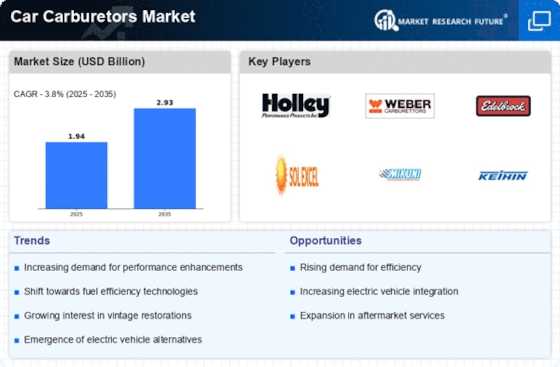
Car Carburetors Market Infographic
Purchase Options

Market Trends

Key Emerging Trends in the Car Carburetors Market

Car carburetors market is associating powerful trends due to modern advances in automotive technology, emission regulations amidst a new orientation toward high mileage and earth-friendly vehicles. The gradual shift away from traditional carburetors in favor of electronic fuel injection systems is one major development. First, contemporary automobiles gradually integrate EFI technology because it provides better fuel economy, high-quality and precise combustion control of fuel mixture as well superior emission management. However, this trend involves the desire to cleaner and at most efficient combustion processes within the industry as a result of global attempts in reducing carbon emissions Most changes affecting trends in the car carburetors market are mainly driven by interest or concern on environmental sustainability. In the automotive industry, many companies focus on meeting strict emission regulations by embracing more environmentally responsible fuel systems. There is popularity of electronic fuel injection, direct-injection, and hybrid technologies because these methods give an opportunity to improve combustion optimization as well as emissions reduction. This trend shows the direction towards cleaner and green technologies that are gaining ground in this industry. Another emerging trend, which affects the car carburetors market is increasing electrification of vehicles. In the face of increased popularity among electric vehicles, old-fashioned internal combustion engine with carburetors or fuel injection systems is gradually fading away due to electrification driven drivetrains. This shift is transforming the automotive competitive landscape, where EVs are emerging as a central point of concern to manufacturers and carving out a new direction for the evolution of the market. The advent of new design in carburetors significantly features as a response to the need for fuel efficient and low polluting classic internal combustion engines. In a bid to make fuel atomization, combustion efficiency and overall engine performance better manufacturers are working on advanced carburetor technologies like variable venturi carburetors being evaluated along with electronic ones. This development serves as an indication that the sector is working towards realizing better fuel efficiency through improving on combustion process. One distinctive pattern in the car carburetors market is retrofitting and aftermarket modifications. The aftermarket carburetor upgrades are very popular among car enthusiasts and collectors of classic automobiles who sometimes change or modify vintage vehicles for various reasons, such as performance improvement, quality fuel-air mixture matching. This feature denotes the steady prevalence of carbureted engines among car aficionados and dynamic artisty in supporting niche temptations for personalization as well as renovation. Various regulations and policies related to the emissions level from vehicles as well as fuel efficiency standards have significant effects on trends in the market for car carburetors. With increased emission standards by global regulatory bodies, automotive manufacturers have no choice but to resort towards cleaner and advanced technologies.


Author
Swapnil Palwe
Team Lead - Research

With a technical background as Bachelor's in Mechanical Engineering, with MBA in Operations Management , Swapnil has 6+ years of experience in market research, consulting and analytics with the tasks of data mining, analysis, and project execution. He is the POC for our clients, for their consulting projects running under the Automotive/A&D domain. Swapnil has worked on major projects in verticals such as Aerospace & Defense, Automotive and many other domain projects. He has worked on projects for fortune 500 companies' syndicate and consulting projects along with several government projects.

Leave a Comment

FAQs

What is the current valuation of the Car Carburetors Market as of 2024?

<p>The Car Carburetors Market was valued at 1.941 USD Billion in 2024.</p>

What is the projected market valuation for the Car Carburetors Market in 2035?

<p>The market is projected to reach 2.926 USD Billion by 2035.</p>

What is the expected CAGR for the Car Carburetors Market during the forecast period 2025 - 2035?

<p>The expected CAGR for the Car Carburetors Market during 2025 - 2035 is 3.8%.</p>

Which companies are considered key players in the Car Carburetors Market?

<p>Key players include Holley Performance Products, Weber Carburetors, Edelbrock LLC, Solex, Mikuni Corporation, Keihin Corporation, Zenith Carburetors, and Bing Power Systems.</p>

What are the main types of carburetors in the market and their valuations?

<p>The main types are Diaphragm Carburetors and Float-Feed Carburetors, each valued at 1.463 USD Billion in 2035.</p>

How does the Automotive application segment perform in the Car Carburetors Market?

<p>The Automotive segment was valued at 0.9705 USD Billion in 2024 and is projected to reach 1.4405 USD Billion by 2035.</p>

What is the projected valuation for the Motorcycle & Power Sports application segment by 2035?

<p>The Motorcycle & Power Sports segment is expected to grow from 0.4853 USD Billion in 2024 to 0.7275 USD Billion by 2035.</p>

What is the valuation trend for the General Machinery application segment?

<p>The General Machinery segment was valued at 0.2922 USD Billion in 2024 and is anticipated to reach 0.4384 USD Billion by 2035.</p>

What is the expected growth for the Others application segment in the Car Carburetors Market?

<p>The Others segment is projected to grow from 0.193 USD Billion in 2024 to 0.2196 USD Billion by 2035.</p>

How do the valuations of Diaphragm and Float-Feed Carburetors compare in 2035?

<p>Both Diaphragm and Float-Feed Carburetors are projected to have equal valuations of 1.463 USD Billion in 2035.</p>

Market Summary

As per Market Research Future analysis, the Car Carburetors Market Size was estimated at 1.941 USD Billion in 2024. The Car Carburetors industry is projected to grow from USD 2.015 Billion in 2025 to USD 2.926 Billion by 2035, exhibiting a compound annual growth rate (CAGR) of 3.8% during the forecast period 2025 - 2035

Key Market Trends & Highlights

The Car Carburetors Market is experiencing a dynamic shift driven by technological advancements and evolving consumer preferences.

  • Technological advancements in carburetor design are reshaping the market landscape, particularly in North America. The vintage car restoration trend is gaining momentum, significantly impacting demand in the automotive segment. The float-feed carburetor segment is witnessing rapid growth, driven by increasing interest in performance enhancements. Market drivers such as rising demand for vintage car restoration and a focus on fuel efficiency are propelling growth in both North America and Asia-Pacific.

Market Size & Forecast

2024 Market Size 1.941 (USD Billion)
2035 Market Size 2.926 (USD Billion)
CAGR (2025 - 2035) 3.8%
Largest Regional Market Share in 2024 North America

Major Players

Holley Performance Products (US), <a href="https://www.webercarburettor.com/technical-information/carburettor-manuals-diagrams/weber-carburettor-manuals-and-diagrams/">Weber Carburetors</a> (IT), Edelbrock LLC (US), Solex (FR), Mikuni Corporation (JP), Keihin Corporation (JP), Zenith Carburetors (GB), <a href="https://www.bingpower.de/en/">Bing Power Systems</a> (DE)

Market Trends

The Car Carburetors Market is currently experiencing a transformative phase, driven by evolving automotive technologies and shifting consumer preferences. As manufacturers increasingly focus on enhancing fuel efficiency and reducing emissions, the demand for advanced carburetor systems is likely to rise. This trend is further influenced by the growing popularity of vintage and classic cars, which often rely on carburetors for optimal performance. Additionally, the market appears to be adapting to the increasing integration of electronic components, which may enhance the precision and efficiency of carburetor systems. Moreover, the Car Carburetors Market is witnessing a notable shift towards sustainability. With environmental regulations becoming more stringent, manufacturers are exploring innovative designs that align with eco-friendly practices. This includes the development of carburetors that utilize alternative fuels and materials, potentially reducing the carbon footprint associated with traditional automotive components. As the industry evolves, it seems that the Car Carburetors Market will continue to adapt, reflecting broader trends in automotive engineering and consumer expectations.

Technological Advancements

The Car Carburetors Market is increasingly influenced by technological innovations. Manufacturers are integrating electronic fuel injection systems with traditional carburetors, enhancing performance and efficiency. This convergence may lead to more precise fuel delivery, improving overall vehicle performance.

Sustainability Initiatives

There is a growing emphasis on sustainability within the Car Carburetors Market. Companies are exploring eco-friendly materials and designs that minimize environmental impact. This trend aligns with global efforts to reduce emissions and promote greener automotive solutions.

Vintage Car Restoration

The resurgence of interest in vintage and classic cars is impacting the Car Carburetors Market. Enthusiasts are seeking authentic carburetor systems to restore these vehicles, driving demand for specialized products and services tailored to this niche market.

Car Carburetors Market Market Drivers

Increased Focus on Fuel Efficiency

The Car Carburetors Market is witnessing an increased focus on fuel efficiency, driven by rising fuel prices and environmental concerns. Consumers are becoming more conscious of their fuel consumption, prompting manufacturers to develop carburetors that optimize fuel-air mixtures for better mileage. This shift is reflected in the growing sales of vehicles equipped with high-efficiency carburetors, which are projected to account for a significant share of the market. Additionally, regulatory bodies are imposing stricter fuel economy standards, further pushing manufacturers to innovate. The demand for fuel-efficient vehicles is expected to grow, potentially leading to a 5% increase in the Car Carburetors Market over the next few years. This trend indicates a clear opportunity for manufacturers to enhance their product offerings and cater to the evolving preferences of consumers.

Expansion of Automotive Aftermarket

The Car Carburetors Market is benefiting from the expansion of the automotive aftermarket. As vehicle ownership increases, the need for replacement parts, including carburetors, is also on the rise. The aftermarket is projected to grow at a rate of approximately 6% annually, driven by factors such as increased vehicle age and the demand for performance upgrades. This growth presents a lucrative opportunity for manufacturers and suppliers in the carburetor segment. Additionally, the rise of e-commerce platforms has made it easier for consumers to access replacement carburetors, further fueling market growth. As the aftermarket continues to expand, the Car Carburetors Market is likely to see increased competition and innovation, as companies strive to meet the diverse needs of consumers.

Rising Demand for Vintage Car Restoration

The Car Carburetors Market is significantly influenced by the rising demand for vintage car restoration. Enthusiasts and collectors are increasingly seeking authentic parts to maintain the originality of classic vehicles. This trend has led to a resurgence in the production of carburetors specifically designed for vintage models, which may account for a substantial portion of the market. The restoration market is estimated to be worth billions, with a growing number of workshops specializing in vintage car restoration. This demand not only supports the production of traditional carburetors but also encourages manufacturers to innovate and adapt their offerings to meet the needs of this niche market. As the interest in vintage cars continues to grow, the Car Carburetors Market is likely to benefit from this trend.

Regulatory Compliance and Emission Standards

The Car Carburetors Market is significantly impacted by regulatory compliance and emission standards. Governments worldwide are implementing stringent regulations to reduce vehicular emissions, which is compelling manufacturers to innovate and adapt their carburetor designs. Compliance with these regulations is not only essential for market access but also influences consumer purchasing decisions. The market is expected to see a shift towards carburetors that meet or exceed these standards, potentially leading to a 4% growth in the industry. Manufacturers are investing in cleaner technologies and alternative fuel systems to align with these regulations, which could reshape the competitive landscape of the Car Carburetors Market. As emission standards become more rigorous, the demand for compliant carburetors is likely to increase, driving further innovation and development.

Technological Advancements in Carburetor Design

The Car Carburetors Market is experiencing a notable shift due to technological advancements in carburetor design. Innovations such as electronic fuel injection systems and improved materials are enhancing performance and efficiency. These advancements are likely to lead to a reduction in emissions, aligning with stricter environmental regulations. The market for carburetors is projected to grow at a compound annual growth rate of approximately 4.5% over the next five years, driven by these technological improvements. Manufacturers are increasingly investing in research and development to create more efficient and reliable carburetors, which could potentially capture a larger share of the automotive market. As vehicles become more sophisticated, the demand for advanced carburetor systems is expected to rise, further propelling the Car Carburetors Market.

Market Segment Insights

By Type: Diaphragm Carburetor (Largest) vs. Float-Feed Carburetor (Fastest-Growing)

In the Car Carburetors Market, the distribution of market share between diaphragm carburetors and float-feed carburetors reveals diaphragm carburetors as the dominant type, capturing a significant portion of the market. Their established presence, largely due to longstanding applications in various vehicle types, has solidified their market position. On the other hand, float-feed carburetors are witnessing rapid acceptance, primarily driven by their advantages in modern vehicles which enhance performance and fuel efficiency.

Carburetor Type: Diaphragm (Dominant) vs. Float-Feed (Emerging)

Diaphragm carburetors serve as the backbone of traditional carburetor technology, favored for their reliability and simplicity in design. They excel in a broad range of automotive applications, providing consistent performance and ease of maintenance. Conversely, float-feed carburetors are gaining traction as emerging contenders, especially in the context of high-performance engines and more stringent emission standards. This adaptation is driven by their superior responsiveness and fuel metering accuracy, making them an attractive choice for vehicle manufacturers aiming for improved efficiency and lower emissions.

By Application Type: Automotive (Largest) vs. Motorcycle & Power Sports (Fastest-Growing)

The Car Carburetors Market exhibits a diverse distribution of application types with automotive applications dominating the segment. This includes cars, trucks, and other vehicles that rely heavily on carburetors for optimal fuel-air mixture control. Following automotive, the motorcycle and power sports segment has emerged as a considerable segment, attracting attention due to rising recreational activities and increased motorcycle sales. Other segments, including general machinery and others, hold a smaller market share but are important for niche applications.

Automotive (Dominant) vs. Motorcycle &amp; Power Sports (Emerging)

In the Car Carburetors Market, the automotive application stands out as the dominant force, driven by the extensive use of carburetors in internal combustion engines of various vehicles. This segment is critical for performance, with manufacturers continuously innovating to enhance efficiency and reduce emissions. Conversely, the motorcycle and power sports segment, while emerging, is characterized by a growing consumer base engaging in leisure activities and sporting events. This segment's growth is bolstered by advancements in technology and the rise of environmentally friendly models, making it an appealing market for investors and manufacturers looking to capitalize on evolving consumer preferences.

Get more detailed insights about Car Carburetors Market Research Report — Global Forecast till 2035

Regional Insights

North America : Dominant Market Leader

North America is the largest market for car carburetors, holding approximately 45% of the global market share. The region's growth is driven by a robust automotive industry, increasing demand for performance parts, and stringent emissions regulations that encourage innovation. The U.S. leads this market, followed closely by Canada, which contributes around 15% to the overall share. Regulatory catalysts, such as the Clean Air Act, further stimulate market growth by promoting cleaner technologies. The competitive landscape in North America is characterized by the presence of key players like Holley Performance Products and Edelbrock LLC, which dominate the performance carburetor segment. The market is also witnessing a trend towards electric vehicle integration, prompting traditional manufacturers to innovate. As a result, companies are investing in R&D to develop advanced carburetor technologies that meet evolving consumer demands and regulatory standards.

Europe : Emerging Regulatory Frameworks

Europe is witnessing a significant transformation in the car carburetor market, holding approximately 30% of the global share. The region's growth is fueled by increasing environmental regulations and a shift towards sustainable automotive technologies. Countries like Germany and France are at the forefront, contributing around 20% and 5% respectively to the market. The European Union's stringent emissions standards are driving manufacturers to innovate and adapt their products to meet these regulations, thus enhancing market dynamics. Leading countries in Europe, particularly Germany, are home to major players like Weber Carburetors and Solex. The competitive landscape is marked by a focus on high-performance and eco-friendly carburetor solutions. Additionally, the presence of established automotive manufacturers encourages collaboration with carburetor suppliers, fostering innovation. As the market evolves, companies are increasingly investing in research to develop advanced carburetor technologies that align with regulatory requirements and consumer preferences.

Asia-Pacific : Rapid Growth and Innovation

Asia-Pacific is emerging as a powerhouse in the car carburetor market, accounting for approximately 20% of the global share. The region's growth is driven by rising automotive production, increasing disposable incomes, and a growing middle class. Countries like China and Japan are leading this market, with China alone contributing around 15% to the overall share. The demand for both traditional and performance carburetors is on the rise, supported by favorable government policies promoting automotive manufacturing. The competitive landscape in Asia-Pacific is characterized by the presence of key players such as Mikuni Corporation and Keihin Corporation. These companies are focusing on innovation and technology to meet the diverse needs of consumers. Additionally, the region is witnessing a surge in electric vehicle adoption, prompting traditional carburetor manufacturers to explore new technologies. As a result, the market is becoming increasingly competitive, with companies investing in R&D to stay ahead of the curve.

Middle East and Africa : Untapped Market Potential

The Middle East and Africa region is gradually emerging in the car carburetor market, holding about 5% of the global share. The growth is primarily driven by increasing automotive sales and a rising demand for aftermarket parts. Countries like South Africa and the UAE are leading this market, with South Africa contributing around 3% to the overall share. The region's automotive sector is expanding, supported by government initiatives aimed at boosting local manufacturing and reducing import dependency. The competitive landscape in the Middle East and Africa is still developing, with a mix of local and international players. Companies are focusing on establishing distribution networks to cater to the growing demand for carburetors. Additionally, the presence of key players like Zenith Carburetors and Bing Power Systems is fostering competition. As the market matures, there is a significant opportunity for innovation and growth, particularly in the aftermarket segment, which is gaining traction among consumers.

Key Players and Competitive Insights

Leading market players are putting a lot of money on R&D to expand their product lines, which will help the market for car carburetors remain growing. Additionally, market players are engaging in a range of calculated initiatives to increase their worldwide presence, with important market developments involving the introduction of new products, contracts, M&A transactions, increased investment, and cooperation with other enterprises. To grow and endure in an increasingly cutthroat and dynamic market, Car Carburetors industry must provide reasonably priced goods.
One of the main business strategies employed by manufacturers is to manufacture locally in order to reduce operating expenses in the global Car Carburetors industry to help customers and expand the market segment. In recent years, the Car Carburetors industry has provided some of the biggest benefits to medicine. Major players in the Car Carburetors Market, including DENI Carburetor Company, Zhanjiang Deni, Zama Group, Fujian FuDing Jingke, Holley Performance Products, Edelbrock Corporation., and others, are engaging in research and development activities in an effort to boost market demand.
Bowling Green, Kentucky is home to Holley Performance Products, an automotive performance business. By 1896, George and Earl Holley had created it in Bradford, Pennsylvania. A significant manufacturer of carburetors for numerous Detroit-built cars, the company had its headquarters in Michigan.
In March Holley declared that it has signed a formal merger agreement with Empower Ltd (Tkr: EMPW), a special purpose acquisition company. As a result, Holley will be listed as a publicly traded corporation on the NYSE with the new ticker symbol "HLLY."
Edelbrock, LLC produces specialty parts for cars and motorcycles. The company's Southern California R&D Tech Center is situated in Cerritos, CA, and its Memphis area headquarters are in Olive Branch, Mississippi. San Jacinto, California is home to the Edelbrock Sand Cast and Permanent Mold Manufacturing foundries. The Edelbrock Race Center in Mooresville and the Edelbrock Carburetor Division in Sanford are the two locations of Edelbrock in North Carolina.
In January It was stated that the corporation would be moving its headquarters to the Memphis, TN area.

Key Companies in the Car Carburetors Market include

Industry Developments

October 2021: Landon Capital Partners, LLC and Nova Capital Management Ltd. purchase Walbro. The Walbro owners are business partners and important market investors who have developed their companies well. Delivering new items and enhancing qualities were the main goals of the acquisition.

December 2022: The American Kart Racing Association and Tillotson Racing have announced their cooperation. Through the agreement, the Tillotson 212RS engine will be able to compete in the 2023 AKRA competition.

February 2023: Tom Tomlinson left his role as Chief Executive Officer. Michelle Gloeckler, a board director, was named the company's interim president and CEO while it searches for a permanent replacement.

Future Outlook

Car Carburetors Market Future Outlook

The Car Carburetors Market is projected to grow at a 3.8% CAGR from 2025 to 2035, driven by technological advancements, increasing vehicle production, and rising demand for fuel efficiency.

New opportunities lie in:

  • <p>Development of advanced electronic carburetors for improved performance. Expansion into emerging markets with tailored product offerings. Partnerships with automotive manufacturers for integrated solutions.</p>

By 2035, the Car Carburetors Market is expected to achieve robust growth and enhanced market positioning.

Market Segmentation

Car Carburetors Market Type Outlook

  • Diaphragm Carburetor
  • Float-Feed Carburetor

Car Carburetors Market Application Type Outlook

  • Automotive
  • Motorcycle & Power sports
  • General Machinery
  • Others

Report Scope

MARKET SIZE 2024 1.941(USD Billion)
MARKET SIZE 2025 2.015(USD Billion)
MARKET SIZE 2035 2.926(USD Billion)
COMPOUND ANNUAL GROWTH RATE (CAGR) 3.8% (2025 - 2035)
REPORT COVERAGE Revenue Forecast, Competitive Landscape, Growth Factors, and Trends
BASE YEAR 2024
Market Forecast Period 2025 - 2035
Historical Data 2019 - 2024
Market Forecast Units USD Billion
Key Companies Profiled Holley Performance Products (US), Weber Carburetors (IT), Edelbrock LLC (US), Solex (FR), Mikuni Corporation (JP), Keihin Corporation (JP), Zenith Carburetors (GB), Bing Power Systems (DE)
Segments Covered Type, Application Type, Region
Key Market Opportunities Integration of advanced fuel efficiency technologies in the Car Carburetors Market presents substantial growth opportunities.
Key Market Dynamics Technological advancements and regulatory changes drive innovation and competition in the car carburetors market.
Countries Covered North America, Europe, APAC, South America, MEA

FAQs

What is the current valuation of the Car Carburetors Market as of 2024?

<p>The Car Carburetors Market was valued at 1.941 USD Billion in 2024.</p>

What is the projected market valuation for the Car Carburetors Market in 2035?

<p>The market is projected to reach 2.926 USD Billion by 2035.</p>

What is the expected CAGR for the Car Carburetors Market during the forecast period 2025 - 2035?

<p>The expected CAGR for the Car Carburetors Market during 2025 - 2035 is 3.8%.</p>

Which companies are considered key players in the Car Carburetors Market?

<p>Key players include Holley Performance Products, Weber Carburetors, Edelbrock LLC, Solex, Mikuni Corporation, Keihin Corporation, Zenith Carburetors, and Bing Power Systems.</p>

What are the main types of carburetors in the market and their valuations?

<p>The main types are Diaphragm Carburetors and Float-Feed Carburetors, each valued at 1.463 USD Billion in 2035.</p>

How does the Automotive application segment perform in the Car Carburetors Market?

<p>The Automotive segment was valued at 0.9705 USD Billion in 2024 and is projected to reach 1.4405 USD Billion by 2035.</p>

What is the projected valuation for the Motorcycle & Power Sports application segment by 2035?

<p>The Motorcycle & Power Sports segment is expected to grow from 0.4853 USD Billion in 2024 to 0.7275 USD Billion by 2035.</p>

What is the valuation trend for the General Machinery application segment?

<p>The General Machinery segment was valued at 0.2922 USD Billion in 2024 and is anticipated to reach 0.4384 USD Billion by 2035.</p>

What is the expected growth for the Others application segment in the Car Carburetors Market?

<p>The Others segment is projected to grow from 0.193 USD Billion in 2024 to 0.2196 USD Billion by 2035.</p>

How do the valuations of Diaphragm and Float-Feed Carburetors compare in 2035?

<p>Both Diaphragm and Float-Feed Carburetors are projected to have equal valuations of 1.463 USD Billion in 2035.</p>

  1. SECTION I: EXECUTIVE SUMMARY AND KEY HIGHLIGHTS
    1. | 1.1 EXECUTIVE SUMMARY
    2. | | 1.1.1 Market Overview
    3. | | 1.1.2 Key Findings
    4. | | 1.1.3 Market Segmentation
    5. | | 1.1.4 Competitive Landscape
    6. | | 1.1.5 Challenges and Opportunities
    7. | | 1.1.6 Future Outlook
  2. SECTION II: SCOPING, METHODOLOGY AND MARKET STRUCTURE
    1. | 2.1 MARKET INTRODUCTION
    2. | | 2.1.1 Definition
    3. | | 2.1.2 Scope of the study
    4. | | | 2.1.2.1 Research Objective
    5. | | | 2.1.2.2 Assumption
    6. | | | 2.1.2.3 Limitations
    7. | 2.2 RESEARCH METHODOLOGY
    8. | | 2.2.1 Overview
    9. | | 2.2.2 Data Mining
    10. | | 2.2.3 Secondary Research
    11. | | 2.2.4 Primary Research
    12. | | | 2.2.4.1 Primary Interviews and Information Gathering Process
    13. | | | 2.2.4.2 Breakdown of Primary Respondents
    14. | | 2.2.5 Forecasting Model
    15. | | 2.2.6 Market Size Estimation
    16. | | | 2.2.6.1 Bottom-Up Approach
    17. | | | 2.2.6.2 Top-Down Approach
    18. | | 2.2.7 Data Triangulation
    19. | | 2.2.8 Validation
  3. SECTION III: QUALITATIVE ANALYSIS
    1. | 3.1 MARKET DYNAMICS
    2. | | 3.1.1 Overview
    3. | | 3.1.2 Drivers
    4. | | 3.1.3 Restraints
    5. | | 3.1.4 Opportunities
    6. | 3.2 MARKET FACTOR ANALYSIS
    7. | | 3.2.1 Value chain Analysis
    8. | | 3.2.2 Porter's Five Forces Analysis
    9. | | | 3.2.2.1 Bargaining Power of Suppliers
    10. | | | 3.2.2.2 Bargaining Power of Buyers
    11. | | | 3.2.2.3 Threat of New Entrants
    12. | | | 3.2.2.4 Threat of Substitutes
    13. | | | 3.2.2.5 Intensity of Rivalry
    14. | | 3.2.3 COVID-19 Impact Analysis
    15. | | | 3.2.3.1 Market Impact Analysis
    16. | | | 3.2.3.2 Regional Impact
    17. | | | 3.2.3.3 Opportunity and Threat Analysis
  4. SECTION IV: QUANTITATIVE ANALYSIS
    1. | 4.1 Automobile, BY Type (USD Billion)
    2. | | 4.1.1 Diaphragm Carburetor
    3. | | 4.1.2 Float-Feed Carburetor
    4. | 4.2 Automobile, BY Application Type (USD Billion)
    5. | | 4.2.1 Automotive
    6. | | 4.2.2 Motorcycle & Power sports
    7. | | 4.2.3 General Machinery
    8. | | 4.2.4 Others
    9. | 4.3 Automobile, BY Region (USD Billion)
    10. | | 4.3.1 North America
    11. | | | 4.3.1.1 US
    12. | | | 4.3.1.2 Canada
    13. | | 4.3.2 Europe
    14. | | | 4.3.2.1 Germany
    15. | | | 4.3.2.2 UK
    16. | | | 4.3.2.3 France
    17. | | | 4.3.2.4 Russia
    18. | | | 4.3.2.5 Italy
    19. | | | 4.3.2.6 Spain
    20. | | | 4.3.2.7 Rest of Europe
    21. | | 4.3.3 APAC
    22. | | | 4.3.3.1 China
    23. | | | 4.3.3.2 India
    24. | | | 4.3.3.3 Japan
    25. | | | 4.3.3.4 South Korea
    26. | | | 4.3.3.5 Malaysia
    27. | | | 4.3.3.6 Thailand
    28. | | | 4.3.3.7 Indonesia
    29. | | | 4.3.3.8 Rest of APAC
    30. | | 4.3.4 South America
    31. | | | 4.3.4.1 Brazil
    32. | | | 4.3.4.2 Mexico
    33. | | | 4.3.4.3 Argentina
    34. | | | 4.3.4.4 Rest of South America
    35. | | 4.3.5 MEA
    36. | | | 4.3.5.1 GCC Countries
    37. | | | 4.3.5.2 South Africa
    38. | | | 4.3.5.3 Rest of MEA
  5. SECTION V: COMPETITIVE ANALYSIS
    1. | 5.1 Competitive Landscape
    2. | | 5.1.1 Overview
    3. | | 5.1.2 Competitive Analysis
    4. | | 5.1.3 Market share Analysis
    5. | | 5.1.4 Major Growth Strategy in the Automobile
    6. | | 5.1.5 Competitive Benchmarking
    7. | | 5.1.6 Leading Players in Terms of Number of Developments in the Automobile
    8. | | 5.1.7 Key developments and growth strategies
    9. | | | 5.1.7.1 New Product Launch/Service Deployment
    10. | | | 5.1.7.2 Merger & Acquisitions
    11. | | | 5.1.7.3 Joint Ventures
    12. | | 5.1.8 Major Players Financial Matrix
    13. | | | 5.1.8.1 Sales and Operating Income
    14. | | | 5.1.8.2 Major Players R&D Expenditure. 2023
    15. | 5.2 Company Profiles
    16. | | 5.2.1 Holley Performance Products (US)
    17. | | | 5.2.1.1 Financial Overview
    18. | | | 5.2.1.2 Products Offered
    19. | | | 5.2.1.3 Key Developments
    20. | | | 5.2.1.4 SWOT Analysis
    21. | | | 5.2.1.5 Key Strategies
    22. | | 5.2.2 Weber Carburetors (IT)
    23. | | | 5.2.2.1 Financial Overview
    24. | | | 5.2.2.2 Products Offered
    25. | | | 5.2.2.3 Key Developments
    26. | | | 5.2.2.4 SWOT Analysis
    27. | | | 5.2.2.5 Key Strategies
    28. | | 5.2.3 Edelbrock LLC (US)
    29. | | | 5.2.3.1 Financial Overview
    30. | | | 5.2.3.2 Products Offered
    31. | | | 5.2.3.3 Key Developments
    32. | | | 5.2.3.4 SWOT Analysis
    33. | | | 5.2.3.5 Key Strategies
    34. | | 5.2.4 Solex (FR)
    35. | | | 5.2.4.1 Financial Overview
    36. | | | 5.2.4.2 Products Offered
    37. | | | 5.2.4.3 Key Developments
    38. | | | 5.2.4.4 SWOT Analysis
    39. | | | 5.2.4.5 Key Strategies
    40. | | 5.2.5 Mikuni Corporation (JP)
    41. | | | 5.2.5.1 Financial Overview
    42. | | | 5.2.5.2 Products Offered
    43. | | | 5.2.5.3 Key Developments
    44. | | | 5.2.5.4 SWOT Analysis
    45. | | | 5.2.5.5 Key Strategies
    46. | | 5.2.6 Keihin Corporation (JP)
    47. | | | 5.2.6.1 Financial Overview
    48. | | | 5.2.6.2 Products Offered
    49. | | | 5.2.6.3 Key Developments
    50. | | | 5.2.6.4 SWOT Analysis
    51. | | | 5.2.6.5 Key Strategies
    52. | | 5.2.7 Zenith Carburetors (GB)
    53. | | | 5.2.7.1 Financial Overview
    54. | | | 5.2.7.2 Products Offered
    55. | | | 5.2.7.3 Key Developments
    56. | | | 5.2.7.4 SWOT Analysis
    57. | | | 5.2.7.5 Key Strategies
    58. | | 5.2.8 Bing Power Systems (DE)
    59. | | | 5.2.8.1 Financial Overview
    60. | | | 5.2.8.2 Products Offered
    61. | | | 5.2.8.3 Key Developments
    62. | | | 5.2.8.4 SWOT Analysis
    63. | | | 5.2.8.5 Key Strategies
    64. | 5.3 Appendix
    65. | | 5.3.1 References
    66. | | 5.3.2 Related Reports
  6. LIST OF FIGURES
    1. | 6.1 MARKET SYNOPSIS
    2. | 6.2 NORTH AMERICA MARKET ANALYSIS
    3. | 6.3 US MARKET ANALYSIS BY TYPE
    4. | 6.4 US MARKET ANALYSIS BY APPLICATION TYPE
    5. | 6.5 CANADA MARKET ANALYSIS BY TYPE
    6. | 6.6 CANADA MARKET ANALYSIS BY APPLICATION TYPE
    7. | 6.7 EUROPE MARKET ANALYSIS
    8. | 6.8 GERMANY MARKET ANALYSIS BY TYPE
    9. | 6.9 GERMANY MARKET ANALYSIS BY APPLICATION TYPE
    10. | 6.10 UK MARKET ANALYSIS BY TYPE
    11. | 6.11 UK MARKET ANALYSIS BY APPLICATION TYPE
    12. | 6.12 FRANCE MARKET ANALYSIS BY TYPE
    13. | 6.13 FRANCE MARKET ANALYSIS BY APPLICATION TYPE
    14. | 6.14 RUSSIA MARKET ANALYSIS BY TYPE
    15. | 6.15 RUSSIA MARKET ANALYSIS BY APPLICATION TYPE
    16. | 6.16 ITALY MARKET ANALYSIS BY TYPE
    17. | 6.17 ITALY MARKET ANALYSIS BY APPLICATION TYPE
    18. | 6.18 SPAIN MARKET ANALYSIS BY TYPE
    19. | 6.19 SPAIN MARKET ANALYSIS BY APPLICATION TYPE
    20. | 6.20 REST OF EUROPE MARKET ANALYSIS BY TYPE
    21. | 6.21 REST OF EUROPE MARKET ANALYSIS BY APPLICATION TYPE
    22. | 6.22 APAC MARKET ANALYSIS
    23. | 6.23 CHINA MARKET ANALYSIS BY TYPE
    24. | 6.24 CHINA MARKET ANALYSIS BY APPLICATION TYPE
    25. | 6.25 INDIA MARKET ANALYSIS BY TYPE
    26. | 6.26 INDIA MARKET ANALYSIS BY APPLICATION TYPE
    27. | 6.27 JAPAN MARKET ANALYSIS BY TYPE
    28. | 6.28 JAPAN MARKET ANALYSIS BY APPLICATION TYPE
    29. | 6.29 SOUTH KOREA MARKET ANALYSIS BY TYPE
    30. | 6.30 SOUTH KOREA MARKET ANALYSIS BY APPLICATION TYPE
    31. | 6.31 MALAYSIA MARKET ANALYSIS BY TYPE
    32. | 6.32 MALAYSIA MARKET ANALYSIS BY APPLICATION TYPE
    33. | 6.33 THAILAND MARKET ANALYSIS BY TYPE
    34. | 6.34 THAILAND MARKET ANALYSIS BY APPLICATION TYPE
    35. | 6.35 INDONESIA MARKET ANALYSIS BY TYPE
    36. | 6.36 INDONESIA MARKET ANALYSIS BY APPLICATION TYPE
    37. | 6.37 REST OF APAC MARKET ANALYSIS BY TYPE
    38. | 6.38 REST OF APAC MARKET ANALYSIS BY APPLICATION TYPE
    39. | 6.39 SOUTH AMERICA MARKET ANALYSIS
    40. | 6.40 BRAZIL MARKET ANALYSIS BY TYPE
    41. | 6.41 BRAZIL MARKET ANALYSIS BY APPLICATION TYPE
    42. | 6.42 MEXICO MARKET ANALYSIS BY TYPE
    43. | 6.43 MEXICO MARKET ANALYSIS BY APPLICATION TYPE
    44. | 6.44 ARGENTINA MARKET ANALYSIS BY TYPE
    45. | 6.45 ARGENTINA MARKET ANALYSIS BY APPLICATION TYPE
    46. | 6.46 REST OF SOUTH AMERICA MARKET ANALYSIS BY TYPE
    47. | 6.47 REST OF SOUTH AMERICA MARKET ANALYSIS BY APPLICATION TYPE
    48. | 6.48 MEA MARKET ANALYSIS
    49. | 6.49 GCC COUNTRIES MARKET ANALYSIS BY TYPE
    50. | 6.50 GCC COUNTRIES MARKET ANALYSIS BY APPLICATION TYPE
    51. | 6.51 SOUTH AFRICA MARKET ANALYSIS BY TYPE
    52. | 6.52 SOUTH AFRICA MARKET ANALYSIS BY APPLICATION TYPE
    53. | 6.53 REST OF MEA MARKET ANALYSIS BY TYPE
    54. | 6.54 REST OF MEA MARKET ANALYSIS BY APPLICATION TYPE
    55. | 6.55 KEY BUYING CRITERIA OF AUTOMOBILE
    56. | 6.56 RESEARCH PROCESS OF MRFR
    57. | 6.57 DRO ANALYSIS OF AUTOMOBILE
    58. | 6.58 DRIVERS IMPACT ANALYSIS: AUTOMOBILE
    59. | 6.59 RESTRAINTS IMPACT ANALYSIS: AUTOMOBILE
    60. | 6.60 SUPPLY / VALUE CHAIN: AUTOMOBILE
    61. | 6.61 AUTOMOBILE, BY TYPE, 2024 (% SHARE)
    62. | 6.62 AUTOMOBILE, BY TYPE, 2024 TO 2035 (USD Billion)
    63. | 6.63 AUTOMOBILE, BY APPLICATION TYPE, 2024 (% SHARE)
    64. | 6.64 AUTOMOBILE, BY APPLICATION TYPE, 2024 TO 2035 (USD Billion)
    65. | 6.65 BENCHMARKING OF MAJOR COMPETITORS
  7. LIST OF TABLES
    1. | 7.1 LIST OF ASSUMPTIONS
    2. | | 7.1.1
    3. | 7.2 North America MARKET SIZE ESTIMATES; FORECAST
    4. | | 7.2.1 BY TYPE, 2025-2035 (USD Billion)
    5. | | 7.2.2 BY APPLICATION TYPE, 2025-2035 (USD Billion)
    6. | 7.3 US MARKET SIZE ESTIMATES; FORECAST
    7. | | 7.3.1 BY TYPE, 2025-2035 (USD Billion)
    8. | | 7.3.2 BY APPLICATION TYPE, 2025-2035 (USD Billion)
    9. | 7.4 Canada MARKET SIZE ESTIMATES; FORECAST
    10. | | 7.4.1 BY TYPE, 2025-2035 (USD Billion)
    11. | | 7.4.2 BY APPLICATION TYPE, 2025-2035 (USD Billion)
    12. | 7.5 Europe MARKET SIZE ESTIMATES; FORECAST
    13. | | 7.5.1 BY TYPE, 2025-2035 (USD Billion)
    14. | | 7.5.2 BY APPLICATION TYPE, 2025-2035 (USD Billion)
    15. | 7.6 Germany MARKET SIZE ESTIMATES; FORECAST
    16. | | 7.6.1 BY TYPE, 2025-2035 (USD Billion)
    17. | | 7.6.2 BY APPLICATION TYPE, 2025-2035 (USD Billion)
    18. | 7.7 UK MARKET SIZE ESTIMATES; FORECAST
    19. | | 7.7.1 BY TYPE, 2025-2035 (USD Billion)
    20. | | 7.7.2 BY APPLICATION TYPE, 2025-2035 (USD Billion)
    21. | 7.8 France MARKET SIZE ESTIMATES; FORECAST
    22. | | 7.8.1 BY TYPE, 2025-2035 (USD Billion)
    23. | | 7.8.2 BY APPLICATION TYPE, 2025-2035 (USD Billion)
    24. | 7.9 Russia MARKET SIZE ESTIMATES; FORECAST
    25. | | 7.9.1 BY TYPE, 2025-2035 (USD Billion)
    26. | | 7.9.2 BY APPLICATION TYPE, 2025-2035 (USD Billion)
    27. | 7.10 Italy MARKET SIZE ESTIMATES; FORECAST
    28. | | 7.10.1 BY TYPE, 2025-2035 (USD Billion)
    29. | | 7.10.2 BY APPLICATION TYPE, 2025-2035 (USD Billion)
    30. | 7.11 Spain MARKET SIZE ESTIMATES; FORECAST
    31. | | 7.11.1 BY TYPE, 2025-2035 (USD Billion)
    32. | | 7.11.2 BY APPLICATION TYPE, 2025-2035 (USD Billion)
    33. | 7.12 Rest of Europe MARKET SIZE ESTIMATES; FORECAST
    34. | | 7.12.1 BY TYPE, 2025-2035 (USD Billion)
    35. | | 7.12.2 BY APPLICATION TYPE, 2025-2035 (USD Billion)
    36. | 7.13 APAC MARKET SIZE ESTIMATES; FORECAST
    37. | | 7.13.1 BY TYPE, 2025-2035 (USD Billion)
    38. | | 7.13.2 BY APPLICATION TYPE, 2025-2035 (USD Billion)
    39. | 7.14 China MARKET SIZE ESTIMATES; FORECAST
    40. | | 7.14.1 BY TYPE, 2025-2035 (USD Billion)
    41. | | 7.14.2 BY APPLICATION TYPE, 2025-2035 (USD Billion)
    42. | 7.15 India MARKET SIZE ESTIMATES; FORECAST
    43. | | 7.15.1 BY TYPE, 2025-2035 (USD Billion)
    44. | | 7.15.2 BY APPLICATION TYPE, 2025-2035 (USD Billion)
    45. | 7.16 Japan MARKET SIZE ESTIMATES; FORECAST
    46. | | 7.16.1 BY TYPE, 2025-2035 (USD Billion)
    47. | | 7.16.2 BY APPLICATION TYPE, 2025-2035 (USD Billion)
    48. | 7.17 South Korea MARKET SIZE ESTIMATES; FORECAST
    49. | | 7.17.1 BY TYPE, 2025-2035 (USD Billion)
    50. | | 7.17.2 BY APPLICATION TYPE, 2025-2035 (USD Billion)
    51. | 7.18 Malaysia MARKET SIZE ESTIMATES; FORECAST
    52. | | 7.18.1 BY TYPE, 2025-2035 (USD Billion)
    53. | | 7.18.2 BY APPLICATION TYPE, 2025-2035 (USD Billion)
    54. | 7.19 Thailand MARKET SIZE ESTIMATES; FORECAST
    55. | | 7.19.1 BY TYPE, 2025-2035 (USD Billion)
    56. | | 7.19.2 BY APPLICATION TYPE, 2025-2035 (USD Billion)
    57. | 7.20 Indonesia MARKET SIZE ESTIMATES; FORECAST
    58. | | 7.20.1 BY TYPE, 2025-2035 (USD Billion)
    59. | | 7.20.2 BY APPLICATION TYPE, 2025-2035 (USD Billion)
    60. | 7.21 Rest of APAC MARKET SIZE ESTIMATES; FORECAST
    61. | | 7.21.1 BY TYPE, 2025-2035 (USD Billion)
    62. | | 7.21.2 BY APPLICATION TYPE, 2025-2035 (USD Billion)
    63. | 7.22 South America MARKET SIZE ESTIMATES; FORECAST
    64. | | 7.22.1 BY TYPE, 2025-2035 (USD Billion)
    65. | | 7.22.2 BY APPLICATION TYPE, 2025-2035 (USD Billion)
    66. | 7.23 Brazil MARKET SIZE ESTIMATES; FORECAST
    67. | | 7.23.1 BY TYPE, 2025-2035 (USD Billion)
    68. | | 7.23.2 BY APPLICATION TYPE, 2025-2035 (USD Billion)
    69. | 7.24 Mexico MARKET SIZE ESTIMATES; FORECAST
    70. | | 7.24.1 BY TYPE, 2025-2035 (USD Billion)
    71. | | 7.24.2 BY APPLICATION TYPE, 2025-2035 (USD Billion)
    72. | 7.25 Argentina MARKET SIZE ESTIMATES; FORECAST
    73. | | 7.25.1 BY TYPE, 2025-2035 (USD Billion)
    74. | | 7.25.2 BY APPLICATION TYPE, 2025-2035 (USD Billion)
    75. | 7.26 Rest of South America MARKET SIZE ESTIMATES; FORECAST
    76. | | 7.26.1 BY TYPE, 2025-2035 (USD Billion)
    77. | | 7.26.2 BY APPLICATION TYPE, 2025-2035 (USD Billion)
    78. | 7.27 MEA MARKET SIZE ESTIMATES; FORECAST
    79. | | 7.27.1 BY TYPE, 2025-2035 (USD Billion)
    80. | | 7.27.2 BY APPLICATION TYPE, 2025-2035 (USD Billion)
    81. | 7.28 GCC Countries MARKET SIZE ESTIMATES; FORECAST
    82. | | 7.28.1 BY TYPE, 2025-2035 (USD Billion)
    83. | | 7.28.2 BY APPLICATION TYPE, 2025-2035 (USD Billion)
    84. | 7.29 South Africa MARKET SIZE ESTIMATES; FORECAST
    85. | | 7.29.1 BY TYPE, 2025-2035 (USD Billion)
    86. | | 7.29.2 BY APPLICATION TYPE, 2025-2035 (USD Billion)
    87. | 7.30 Rest of MEA MARKET SIZE ESTIMATES; FORECAST
    88. | | 7.30.1 BY TYPE, 2025-2035 (USD Billion)
    89. | | 7.30.2 BY APPLICATION TYPE, 2025-2035 (USD Billion)
    90. | 7.31 PRODUCT LAUNCH/PRODUCT DEVELOPMENT/APPROVAL
    91. | | 7.31.1
    92. | 7.32 ACQUISITION/PARTNERSHIP
    93. | | 7.32.1

Automobile Market Segmentation

Automobile By Type (USD Billion, 2025-2035)

  • Diaphragm Carburetor
  • Float-Feed Carburetor

Automobile By Application Type (USD Billion, 2025-2035)

  • Automotive
  • Motorcycle & Power sports
  • General Machinery
  • Others
Infographic

Free Sample Request

Kindly complete the form below to receive a free sample of this Report

Get Free Sample

Customer Strories

Compare Licence

×
Features License Type
Single User Multiuser License Enterprise User
Price $4,950 $5,950 $7,250
Maximum User Access Limit 1 User Upto 10 Users Unrestricted Access Throughout the Organization
Free Customization
Direct Access to Analyst
Deliverable Format
Platform Access
Discount on Next Purchase 10% 15% 15%
Printable Versions